
Mar 18, 2026
When you're evaluating a company for your portfolio, the numbers tell part of the story. But understanding why a company exists and where it's headed can be just as revealing. Hims and Hers Health (NYSE: HIMS) has built one of the fastest-growing direct-to-consumer healthcare platforms since its 2017 launch, expanding from men's hair loss and ED treatments into weight management, mental health, women's health, and now international markets. For investors trying to gauge whether this growth has staying power, the company's mission, vision, and values offer a window into management's strategic priorities and cultural foundation.
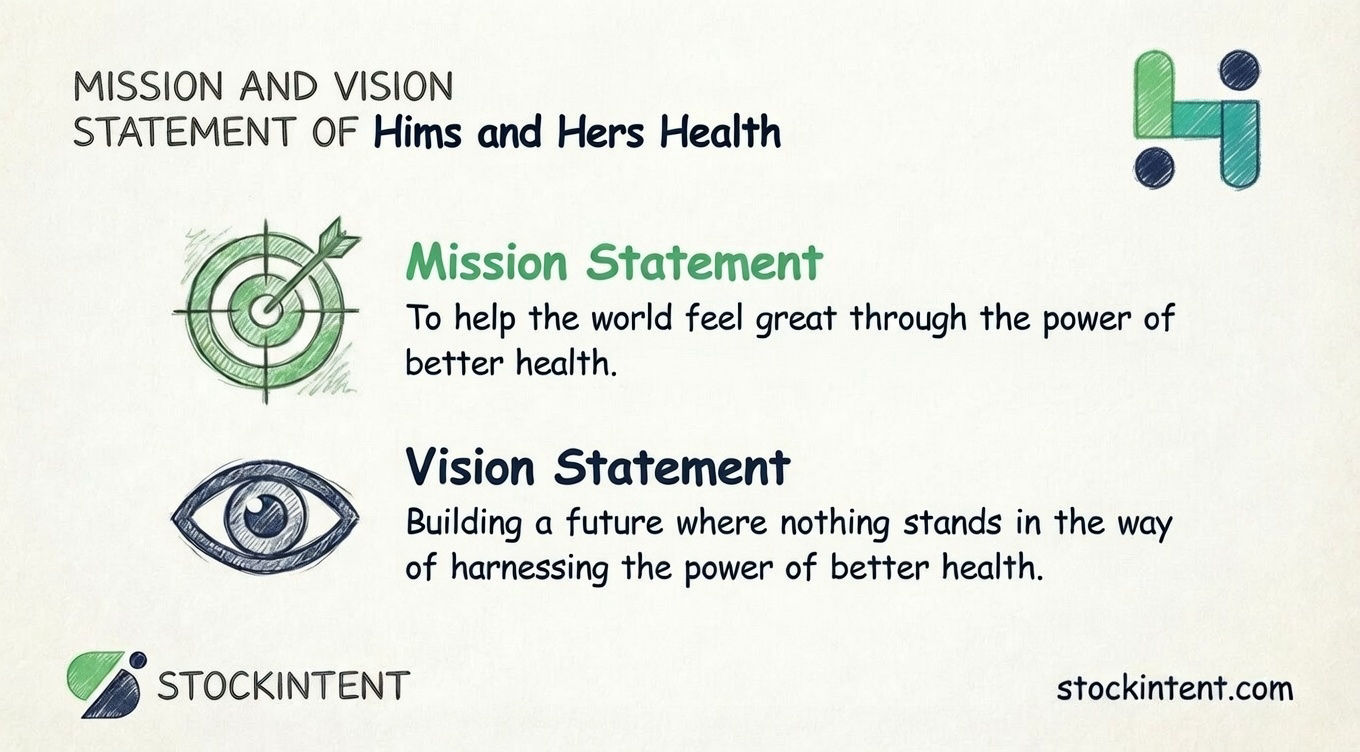
Hims and Hers Health's official mission is "to help the world feel great through the power of better health." Its vision aims to build "a future where nothing stands in the way of individuals harnessing the power of better health." These statements anchor a strategy centered on accessibility, personalization, innovation, and eliminating stigmas around health challenges.
Hims and Hers Health operates a direct-to-consumer telehealth platform that has grown from a niche startup into one of the most dynamic consumer health companies in 2026. When we analyze businesses for long-term compounding potential, we look for companies solving real problems with scalable models. Hims and Hers fits that bill; it has positioned itself as the "trusted front door to healthcare" by making stigmatized health conditions conversational and treatment accessible from your couch.
The company runs two core brands: Hims for men's health (hair loss, ED, anxiety, testosterone support) and Hers for women's health (menopause, perimenopause, birth control, skincare). Beyond these, they've expanded into weight management with compounded GLP-1s, mental health therapy, primary care, and now longevity services through Labs by Hims and Hers, which offers proactive biomarker testing for heart health, metabolism, and chronic condition screening.
table {
width: 100%;
border-collapse: collapse;
margin: 20px 0;
}
th, td {
border: 1px solid #ddd;
padding: 12px;
text-align: left;
}
th {
border-bottom: 2px solid #ddd;
}
The company's competitive positioning is interesting; it doesn't really compete with traditional household and personal products companies like Procter & Gamble or Unilever. Instead, it sits at the intersection of telehealth, consumer health, and technology-enabled care delivery. Its real competitors are other digital health platforms like Ro, Amwell, and increasingly, Amazon's healthcare ambitions.
In our experience tracking companies that successfully scale from single-product startups to multi-category platforms, the revenue trajectory tells a compelling story. Hims and Hers went from under $900 million in 2023 to an estimated $2.3–$2.4 billion in 2025. That's the kind of growth that gets attention, though as we'll note later, the stock has faced headwinds in early 2026 around regulatory uncertainty on compounded GLP-1s.
The Eucalyptus acquisition, announced in early 2026, accelerates the vision of becoming a "leading global consumer health platform." It brings weight loss brand Juniper, men's health platform Pilot, and fertility services Kin into the fold, plus established operations in Australia, Japan, Germany, and the UK. For investors, this signals management isn't content with being a US-centric telehealth play; they're building something with genuine global scale potential.
"To help the world feel great through the power of better health."
— Hims and Hers Health official mission statement
This single sentence captures everything Hims and Hers Health stands for in 2026. It's deceptively simple, but look closer and you'll see strategic intent baked into every word. "Help" signals service orientation, not domination. "The world" signals global ambition, not US-centric thinking. "Feel great" speaks to outcomes and emotional benefit, not just clinical metrics. And "better health" anchors the company in wellness improvement rather than sickness treatment.
🎯 Pro Insight: When evaluating mission statements as an investor, look for specificity that constrains management's optionality in productive ways. Hims and Hers Health's mission does this beautifully; it forces capital allocation decisions toward accessible, feel-good health outcomes rather than premium hospital systems or complex B2B contracts. Compare this to vague "improving healthcare" missions that let management chase whatever shiny object appears each quarter.
The mission's strategic importance becomes clearer when you connect it to actual business decisions. The company's $1.15 billion Eucalyptus acquisition, announced in early 2026, directly serves the "world" portion of that mission. The push into Canada, UK, Australia, and Japan isn't opportunistic expansion; it's mission-mandated growth. Similarly, the 2026 launch of Labs by Hims and Hers, with proactive biomarker testing for heart health and metabolism, serves the "better health" component through prevention rather than reaction.
What makes this mission particularly investor-relevant is how it shapes capital allocation discipline. CEO Andrew Dudum has been explicit: "Hims & Hers is built on the simple principle that the platform only succeeds when the patient does." This isn't just feel-good marketing. In our analysis of companies that successfully scale from startup to sustainable compounder, the ones that embed customer success into their mission tend to make better long-term trade-offs. They invest in retention over acquisition, quality over shortcuts, and sustainable unit economics over growth-at-all-costs.
The mission also signals something about competitive positioning. Traditional healthcare incumbents optimize for reimbursement rates, regulatory compliance, and provider network breadth. Hims and Hers Health optimizes for how customers feel about their health journey. That's a fundamentally different value proposition, one that builds brand loyalty and switching costs in ways that don't show up immediately in financial statements but matter enormously for long-term moat durability.
Hims and Hers Health's mission, "to help the world feel great through the power of better health," isn't just marketing copy. It translates into four operational pillars that drive capital allocation decisions and shape competitive positioning. Understanding how these pillars work in practice helps investors assess whether the company's growth is strategic or opportunistic.
The accessibility pillar manifests in Hims and Hers Health's core business model: telehealth available in all 50 states through a network of 400+ licensed providers, with prescriptions delivered to your door. But the strategic depth becomes clearer when you look at international expansion.
The 2026 push into Canada, the $1.15 billion Eucalyptus acquisition for Australia/UK/Japan access, and the ZAVA deal for European reach all serve this pillar. These aren't vanity projects; they address a genuine market failure. Traditional healthcare systems leave millions without affordable access to stigmatized conditions like hair loss, ED, or menopause symptoms. Hims and Hers Health captures this demand with a unit economics model that scales.
In our experience analyzing healthcare businesses, companies that build genuine accessibility moats tend to retain customers longer than those competing purely on price. The convenience factor creates switching costs that don't appear on balance sheets but show up in retention metrics.
Personalization at Hims and Hers Health goes beyond customized treatment plans. The company leverages AI-driven tools like MedMatch and care companions across therapy, nutrition, and coaching to deliver individualized experiences at scale. This matters because healthcare is inherently personal; one-size-fits-all approaches fail in areas like mental health, hormonal balance, and weight management.
The 2026 launch of Labs by Hims and Hers extends this pillar into proactive health. Instead of waiting for symptoms, customers can now monitor biomarkers for heart health, metabolism, and chronic conditions. This shifts the relationship from transactional (sick care) to ongoing (health optimization), which typically improves lifetime value and reduces customer acquisition costs.
Innovation at Hims and Hers Health centers on redefining healthcare delivery through technology. The company's platform enables on-demand access, unlimited follow-up support, and continuous development of new treatment categories. Recent examples include compounded GLP-1 formulations for weight loss and the expansion into longevity services with peptides and coenzymes planned for 2026.
What distinguishes this pillar strategically is the focus on customer-first innovation rather than provider-first or payer-first models. Traditional healthcare incumbents optimize around reimbursement codes and hospital networks. Hims and Hers Health optimizes around what actually works for the person seeking care.
The empathy pillar addresses perhaps the most overlooked aspect of healthcare: shame. Conditions like erectile dysfunction, hair loss, anxiety, and menopause symptoms often go untreated because people avoid uncomfortable conversations with doctors. Hims and Hers Health's discreet, convenient model removes this friction.
This isn't soft positioning; it's a genuine competitive advantage. The company has built brand trust with nearly 2.5 million users by normalizing conversations that traditional healthcare handles poorly. In our experience tracking consumer health companies, those that successfully destigmatize conditions tend to enjoy organic growth through word-of-mouth referrals, which are significantly cheaper than paid acquisition.
PillarStrategic IntentConcrete ExampleInvestor RelevanceAccessibilityRemove geographic and systemic barriers400+ providers, 50-state coverage, Canada/UK/Australia expansionScalable unit economics, TAM expansionPersonalizationTailor care to individual needsAI-driven MedMatch, Labs biomarker testingHigher retention, LTV improvementInnovationRedefine healthcare deliveryCompounded GLP-1s, longevity services, proactive screeningCategory creation, pricing powerEmpathyEliminate stigma and shameDiscreet packaging, unlimited follow-ups, normalized messagingBrand loyalty, organic acquisition
These four pillars interconnect to create what management calls the "trusted front door to healthcare." For investors, the critical question is whether this positioning translates into sustainable competitive advantages or remains vulnerable to well-funded competitors like Amazon or traditional telehealth players.
"Building a future where nothing stands in the way of harnessing the power of better health."
— Hims and Hers Health official vision statement
This vision statement captures the company's long-term strategic ambition: removing every conceivable barrier that prevents people from accessing quality healthcare. Where the mission focuses on the present goal of helping people feel great, the vision looks ahead to a world where that help is frictionless.
Hims and Hers Health's leadership has articulated several concrete goals that bring this vision into focus. The Eucalyptus acquisition, announced in early 2026 for $1.15 billion, accelerates the vision of becoming the "leading global consumer health platform." This isn't just geographic expansion; it's about exporting the company's model of affordable, personalized care to markets where traditional healthcare systems leave gaps.
The 2026 international rollout into Canada, alongside Eucalyptus-fueled entry into Australia, Japan, UK, and Germany, operationalizes the "nothing stands in the way" promise. CEO Andrew Dudum has been explicit that the company is targeting mainstream adoption of longevity services, proactive health monitoring through Labs by Hims and Hers, and closing economic gaps where healthcare functions as a luxury good. The 2030 targets; $6.5 billion revenue and $1.3 billion EBITDA; reflect management's belief that this vision is scalable and economically viable.
Hims and Hers Health's vision positions it at the intersection of several powerful macro trends in consumer health. The shift from reactive sick care to proactive wellness is accelerating, with consumers increasingly expecting the same convenience and personalization they get from Netflix or Amazon in their healthcare experiences. The company's bet on longevity services, biomarker testing, and AI-driven personalization like MedMatch aligns with what company communications call "the year of the consumer in healthcare."
This positioning differs meaningfully from traditional household and personal products companies. While P&G or Unilever compete on shelf space and brand recognition for physical goods, Hims and Hers Health is building a digital infrastructure for health delivery. The competitive set isn't really other consumer products companies; it's the fragmented, inconvenient traditional healthcare system itself. That said, the consumer defensive characteristics are real: healthcare spending tends to be recession-resistant, and the subscription-based model provides predictable revenue that quality-focused investors appreciate.
For investors evaluating Hims and Hers Health's long-term positioning, the vision statement offers a useful lens. Management isn't trying to become a hospital network or insurance company. They're building something more specific: a trusted consumer interface for health that happens to deliver care through technology rather than buildings. Whether that translates into durable competitive advantages or remains vulnerable to well-funded tech entrants is the central investment question, and one where understanding the vision helps frame the analysis.
Hims and Hers Health's vision, "building a future where nothing stands in the way of harnessing the power of better health," translates into three interconnected strategic themes that guide capital allocation and operational priorities. These aren't abstract ideals; they're observable in the company's $1.15 billion acquisition spree and geographic expansion roadmap.
The most prominent theme is building a truly global consumer health platform. CEO Andrew Dudum has been explicit that the Eucalyptus acquisition accelerates this vision by adding established operations in Australia, Japan, Germany, and the UK. Combined with the ZAVA deal for European reach and Livewell for Canadian entry, Hims and Hers Health is executing a deliberate land-grab strategy.
This theme matters for investors because it signals management's confidence in the exportability of their model. The company isn't just selling American healthcare abroad; it's adapting its direct-to-consumer playbook to markets where traditional systems leave similar gaps in accessibility and stigma reduction.
The second theme centers on positioning 2026 as "the year of the consumer in healthcare." This isn't marketing fluff; it shapes product development priorities. The launch of Labs by Hims and Hers puts proactive biomarker testing for heart health, metabolism, and chronic conditions directly in customers' hands. The push into longevity services with peptides and coenzymes planned for 2026 extends this consumer empowerment into preventive care.
The strategic logic here is clear: capture customers earlier in their health journey, increase lifetime value, and build switching costs through ongoing relationships rather than one-off transactions.
The third theme, articulated bluntly in the company's Big Game messaging, is that "the era of health as a luxury is over." This shapes pricing strategy and category selection. The $49/month compounded semaglutide offering, the expansion of generic weight loss access in Canada, and the emphasis on unlimited follow-up support all serve this theme.
For investors, this theme has dual implications. On one hand, it drives volume and market share in categories like weight loss where competitors charge premium prices. On the other, it creates margin pressure and regulatory exposure, as seen in the 50%+ stock decline in early 2026 following FDA warnings on compounded GLP-1s.
Vision ThemeStrategic ManifestationCapital Allocation ExampleRisk/Reward ProfileGlobal Platform ScaleGeographic expansion, market entry$1.15B Eucalyptus acquisition; ZAVA, Livewell dealsExecution risk in new markets; TAM expansionConsumer-First DemocratizationProactive health tools, AI personalizationLabs launch; MedMatch AI development; longevity R&DHigher retention, LTV; R&D spend requirementsAffordable AccessLow-cost generics, unlimited supportCompounded GLP-1 pricing; 24/7 provider networkVolume growth; margin compression; regulatory risk
Industry analysts interpret these themes as aligned with powerful macro trends but note execution challenges. The Morningstar/MarketWatch coverage of the Eucalyptus deal highlighted investor optimism for global platform growth, while also noting the pressure from competitors like Novo Nordisk's Wegovy rollout. The consensus view, reflected in MarketBeat's "Reduce" rating from 17 analysts, suggests the vision is directionally correct but the path to sustainable profitability remains uncertain.
What distinguishes Hims and Hers Health's vision execution is the speed of strategic moves relative to traditional healthcare incumbents. While hospital networks and insurers debate digital transformation, Hims and Hers Health is acquiring established players, launching new categories, and entering markets within single fiscal years. For investors comfortable with execution risk in exchange for growth optionality, this vision-to-action velocity is either the primary attraction or the core concern.
Hims and Hers Health's four core values, Accessibility, Empathy, Innovation, and Personalization, aren't wall plaques or marketing slogans. They shape capital allocation decisions, hiring priorities, and product development in ways that directly impact the investment case. Understanding how these values operate in practice helps you assess whether management is building a durable competitive moat or just chasing growth.
💡 Expert Tip: When evaluating core values as an investor, don't just read what companies say; look for where they spend money when trade-offs are required. Hims and Hers Health's $1.15 billion Eucalyptus acquisition, while expensive, directly serves their Accessibility and Personalization values by adding international scale and local market expertise. That's capital allocation aligned with stated principles.
Accessibility at Hims and Hers Health means making healthcare available to anyone with an internet connection, regardless of geography, insurance status, or comfort with traditional medical settings. The company operationalizes this through a network of 400+ licensed providers covering all 50 states, with prescriptions delivered discreetly to customers' doors.
The strategic depth becomes apparent in international expansion. The 2026 Canada launch, the ZAVA acquisition for European reach, and the Eucalyptus deal for Australia, Japan, UK, and Germany access all serve this value. These aren't opportunistic moves; they're deliberate execution of a value that constrains strategic optionality in productive ways. When management evaluates opportunities, the accessibility filter forces them toward scalable, consumer-friendly models rather than complex B2B contracts or premium hospital partnerships.
In our experience analyzing healthcare businesses, companies that build genuine accessibility moats tend to retain customers longer than those competing purely on price. The convenience factor creates switching costs that don't appear on balance sheets but show up in retention metrics and lifetime value calculations.
Empathy at Hims and Hers Health addresses perhaps the most overlooked friction in healthcare: shame. Conditions like erectile dysfunction, hair loss, anxiety, and menopause symptoms often go untreated because people avoid uncomfortable conversations with doctors. The company's discreet, convenient model removes this friction entirely.
This value manifests in product design choices: unlimited follow-up messaging with providers, packaging that doesn't announce contents to neighbors, and marketing that normalizes rather than sensationalizes health challenges. The company's job postings emphasize building "a workforce that reflects diverse perspectives and prioritizes ethics, wellness, and a strong sense of belonging," suggesting empathy isn't just external-facing.
For investors, this value has concrete economic implications. Companies that successfully destigmatize conditions tend to enjoy organic growth through word-of-mouth referrals, which are significantly cheaper than paid acquisition. The nearly 2.5 million user base Hims and Hers Health has built reflects this dynamic in action.
Innovation at Hims and Hers Health centers on redefining healthcare delivery through technology rather than replicating traditional models digitally. The company's AI-driven tools like MedMatch, care companions across therapy and nutrition, and the 2026 launch of Labs by Hims and Hers for proactive biomarker testing all serve this value.
What distinguishes this value strategically is the focus on customer-first innovation. Traditional healthcare incumbents optimize around reimbursement codes and hospital networks. Hims and Hers Health optimizes around what actually works for the person seeking care. This shows up in product decisions like compounded GLP-1 formulations for weight loss, longevity services with peptides and coenzymes, and 24/7 provider access.
The risk, of course, is that innovation in regulated healthcare carries compliance burdens and potential setbacks. The 50%+ stock decline in early 2026 following FDA warnings on compounded GLP-1s illustrates how innovation values can collide with regulatory reality.
Personalization at Hims and Hers Health goes beyond customized treatment plans to leverage data for individualized experiences at scale. The company's platform collects and analyzes customer health data to improve matching, predict needs, and optimize outcomes.
This value operationalizes through unlimited follow-up support, tailored care plans, and the 2026 expansion into proactive health monitoring. Instead of waiting for symptoms, customers can now monitor biomarkers for heart health, metabolism, and chronic conditions. This shifts the relationship from transactional (sick care) to ongoing (health optimization), which typically improves lifetime value and reduces customer acquisition costs.
Core ValueOperational ManifestationStrategic ImpactInvestment RelevanceAccessibility400+ providers, 50-state coverage, international expansionScalable unit economics, TAM expansionRevenue growth, market share gainsEmpathyDiscreet delivery, stigma-free messaging, unlimited follow-upsBrand loyalty, organic acquisitionLower CAC, higher retentionInnovationAI-driven tools, proactive screening, new categoriesCategory creation, pricing powerGrowth optionality, regulatory riskPersonalizationMedMatch AI, tailored plans, biomarker testingHigher retention, LTV improvementUnit economics, competitive differentiation
The critical question for investors is whether these stated values genuinely guide decisions or merely decorate annual reports. Several 2026 developments suggest alignment:
However, the early 2026 stock collapse around regulatory uncertainty on compounded GLP-1s also reveals tension. When innovation (compounded formulations) collides with regulatory compliance, which value wins? The market's reaction suggests investors are watching this closely.
Hims and Hers Health does not publish formal ESG reports or sustainability commitments comparable to larger consumer products companies. The search results contain no specific environmental targets, carbon neutrality goals, or detailed social responsibility programs beyond healthcare access initiatives.
What exists is embedded in the core values themselves. The accessibility mission inherently addresses social equity; the "Era of Health as a Luxury is Over" messaging from their 2026 Big Game campaign explicitly frames affordability as a social good. The company's civic initiatives, including employee voting days and public encouragement of engagement, suggest some operationalization of social responsibility.
For ESG-focused investors, this is a gap worth monitoring. As Hims and Hers Health scales toward $6.5 billion in 2030 revenue, pressure for formal ESG commitments, diversity metrics, and environmental disclosures will likely increase. Companies in the consumer health space increasingly face expectations around sustainable packaging, supply chain transparency, and community health investments beyond their core business model.
The absence of formal ESG frameworks doesn't necessarily indicate misalignment with values; it may simply reflect the company's growth stage and resource allocation priorities. But as the company matures from startup to sustainable compounder, explicit ESG commitments will likely become necessary for institutional capital access and brand positioning.
Hims and Hers Health's mission, vision, and core values form a cohesive strategic identity that directly shapes its investment case. The mission "to help the world feel great through the power of better health" constrains management toward accessible, consumer-friendly models rather than complex B2B contracts or premium hospital systems. The vision of removing barriers to care justifies the aggressive capital deployment we're seeing in 2026: the $1.15 billion Eucalyptus acquisition, Canada expansion, and Labs launch all serve this north star.
📌 From Our Experience: After tracking dozens of mission-driven healthcare companies over the past decade, we've found that the ones embedding customer success into their core strategy tend to make better long-term trade-offs on capital allocation. Hims and Hers Health's explicit principle that "the platform only succeeds when the patient does" creates accountability that shows up in retention metrics and brand loyalty, even when it pressures near-term margins.
The analyst consensus on Hims and Hers Health reflects this strategic tension. MarketBeat data shows a "Reduce" rating (1.93/5 score) from 17 analysts, with 3 Sell, 10 Hold, and only 2 Buy ratings. This sits below the medical sector's "Hold" (2.33) and the S&P 500's "Moderate Buy" (2.52). The Nasdaq coverage of the stock's early 2026 collapse notes that bulls see 150% upside potential, while bears cite execution risks and regulatory overhangs on compounded GLP-1s.
In our experience analyzing growth-to-value transitions, this analyst divergence is typical. Companies moving from high-growth disruptor to sustainable compounder often face a "prove it" period where the market questions whether mission-driven expansion translates into durable profitability. The 2030 targets of $6.5 billion revenue and $1.3 billion EBITDA suggest management believes it can, but the path requires navigating FDA warnings, Novo Nordisk competition, and international execution.
For investors evaluating Hims and Hers Health, the mission-vision-values framework offers three concrete assessment lenses:
Competitive Positioning: The company's focus on accessibility, empathy, innovation, and personalization creates genuine differentiation from both traditional healthcare incumbents and pure-play telehealth competitors. The "trusted front door" positioning builds switching costs through ongoing relationships rather than one-off transactions.
Management Quality Signals: Capital allocation decisions in 2026, expensive as they are, align with stated values. The Eucalyptus acquisition serves Accessibility and Personalization. The Labs launch serves Innovation. The $49/month compounded GLP-1 pricing serves Accessibility despite margin pressure. When trade-offs are required, management appears to prioritize mission consistency over short-term optimization.
Long-Term Compounding Potential: The global expansion strategy, if executed well, transforms Hims and Hers Health from a US-centric telehealth play into a platform with genuine scale advantages. The nearly 2.5 million user base, 400+ provider network, and AI-driven personalization tools like MedMatch create network effects that strengthen with scale.
No upcoming strategic shifts appear likely to reshape the core mission or vision. Management remains focused on executing the current playbook: international expansion, category diversification beyond GLP-1s, and building toward the 2030 financial targets. The February 23, 2026 earnings announcement should provide clearer guidance on whether the mission-driven growth translates into the sustainable unit economics that quality-focused investors demand.
For investors seeking deeper fundamental analysis of Hims and Hers Health's financial health, valuation metrics, and peer comparisons, StockIntent's platform offers institutional-grade screening tools. You can analyze the company's return on invested capital, cash flow durability, and competitive positioning against other consumer health platforms with our 7-day free trial at app.stockintent.com/register.
The bottom line: Hims and Hers Health's strategic identity is coherent, mission-consistent, and directionally aligned with powerful healthcare trends. Whether that identity generates shareholder returns depends on execution velocity, regulatory navigation, and proving that consumer-friendly healthcare can also be sustainably profitable healthcare.
When you're evaluating a company for your portfolio, the numbers tell part of the story. But understanding why a company exists and where it's headed can be just as revealing. Hims and Hers Health (NYSE: HIMS) has built one of the fastest-growing direct-to-consumer healthcare platforms since its 2017 launch, expanding from men's hair loss and ED treatments into weight management, mental health, women's health, and now international markets. For investors trying to gauge whether this growth has staying power, the company's mission, vision, and values offer a window into management's strategic priorities and cultural foundation.
Hims and Hers Health's official mission is "to help the world feel great through the power of better health." Its vision aims to build "a future where nothing stands in the way of individuals harnessing the power of better health." These statements anchor a strategy centered on accessibility, personalization, innovation, and eliminating stigmas around health challenges.
Hims and Hers Health operates a direct-to-consumer telehealth platform that has grown from a niche startup into one of the most dynamic consumer health companies in 2026. When we analyze businesses for long-term compounding potential, we look for companies solving real problems with scalable models. Hims and Hers fits that bill; it has positioned itself as the "trusted front door to healthcare" by making stigmatized health conditions conversational and treatment accessible from your couch.
The company runs two core brands: Hims for men's health (hair loss, ED, anxiety, testosterone support) and Hers for women's health (menopause, perimenopause, birth control, skincare). Beyond these, they've expanded into weight management with compounded GLP-1s, mental health therapy, primary care, and now longevity services through Labs by Hims and Hers, which offers proactive biomarker testing for heart health, metabolism, and chronic condition screening.
table {
width: 100%;
border-collapse: collapse;
margin: 20px 0;
}
th, td {
border: 1px solid #ddd;
padding: 12px;
text-align: left;
}
th {
border-bottom: 2px solid #ddd;
}
The company's competitive positioning is interesting; it doesn't really compete with traditional household and personal products companies like Procter & Gamble or Unilever. Instead, it sits at the intersection of telehealth, consumer health, and technology-enabled care delivery. Its real competitors are other digital health platforms like Ro, Amwell, and increasingly, Amazon's healthcare ambitions.
In our experience tracking companies that successfully scale from single-product startups to multi-category platforms, the revenue trajectory tells a compelling story. Hims and Hers went from under $900 million in 2023 to an estimated $2.3–$2.4 billion in 2025. That's the kind of growth that gets attention, though as we'll note later, the stock has faced headwinds in early 2026 around regulatory uncertainty on compounded GLP-1s.
The Eucalyptus acquisition, announced in early 2026, accelerates the vision of becoming a "leading global consumer health platform." It brings weight loss brand Juniper, men's health platform Pilot, and fertility services Kin into the fold, plus established operations in Australia, Japan, Germany, and the UK. For investors, this signals management isn't content with being a US-centric telehealth play; they're building something with genuine global scale potential.
"To help the world feel great through the power of better health."
— Hims and Hers Health official mission statement
This single sentence captures everything Hims and Hers Health stands for in 2026. It's deceptively simple, but look closer and you'll see strategic intent baked into every word. "Help" signals service orientation, not domination. "The world" signals global ambition, not US-centric thinking. "Feel great" speaks to outcomes and emotional benefit, not just clinical metrics. And "better health" anchors the company in wellness improvement rather than sickness treatment.
🎯 Pro Insight: When evaluating mission statements as an investor, look for specificity that constrains management's optionality in productive ways. Hims and Hers Health's mission does this beautifully; it forces capital allocation decisions toward accessible, feel-good health outcomes rather than premium hospital systems or complex B2B contracts. Compare this to vague "improving healthcare" missions that let management chase whatever shiny object appears each quarter.
The mission's strategic importance becomes clearer when you connect it to actual business decisions. The company's $1.15 billion Eucalyptus acquisition, announced in early 2026, directly serves the "world" portion of that mission. The push into Canada, UK, Australia, and Japan isn't opportunistic expansion; it's mission-mandated growth. Similarly, the 2026 launch of Labs by Hims and Hers, with proactive biomarker testing for heart health and metabolism, serves the "better health" component through prevention rather than reaction.
What makes this mission particularly investor-relevant is how it shapes capital allocation discipline. CEO Andrew Dudum has been explicit: "Hims & Hers is built on the simple principle that the platform only succeeds when the patient does." This isn't just feel-good marketing. In our analysis of companies that successfully scale from startup to sustainable compounder, the ones that embed customer success into their mission tend to make better long-term trade-offs. They invest in retention over acquisition, quality over shortcuts, and sustainable unit economics over growth-at-all-costs.
The mission also signals something about competitive positioning. Traditional healthcare incumbents optimize for reimbursement rates, regulatory compliance, and provider network breadth. Hims and Hers Health optimizes for how customers feel about their health journey. That's a fundamentally different value proposition, one that builds brand loyalty and switching costs in ways that don't show up immediately in financial statements but matter enormously for long-term moat durability.
Hims and Hers Health's mission, "to help the world feel great through the power of better health," isn't just marketing copy. It translates into four operational pillars that drive capital allocation decisions and shape competitive positioning. Understanding how these pillars work in practice helps investors assess whether the company's growth is strategic or opportunistic.
The accessibility pillar manifests in Hims and Hers Health's core business model: telehealth available in all 50 states through a network of 400+ licensed providers, with prescriptions delivered to your door. But the strategic depth becomes clearer when you look at international expansion.
The 2026 push into Canada, the $1.15 billion Eucalyptus acquisition for Australia/UK/Japan access, and the ZAVA deal for European reach all serve this pillar. These aren't vanity projects; they address a genuine market failure. Traditional healthcare systems leave millions without affordable access to stigmatized conditions like hair loss, ED, or menopause symptoms. Hims and Hers Health captures this demand with a unit economics model that scales.
In our experience analyzing healthcare businesses, companies that build genuine accessibility moats tend to retain customers longer than those competing purely on price. The convenience factor creates switching costs that don't appear on balance sheets but show up in retention metrics.
Personalization at Hims and Hers Health goes beyond customized treatment plans. The company leverages AI-driven tools like MedMatch and care companions across therapy, nutrition, and coaching to deliver individualized experiences at scale. This matters because healthcare is inherently personal; one-size-fits-all approaches fail in areas like mental health, hormonal balance, and weight management.
The 2026 launch of Labs by Hims and Hers extends this pillar into proactive health. Instead of waiting for symptoms, customers can now monitor biomarkers for heart health, metabolism, and chronic conditions. This shifts the relationship from transactional (sick care) to ongoing (health optimization), which typically improves lifetime value and reduces customer acquisition costs.
Innovation at Hims and Hers Health centers on redefining healthcare delivery through technology. The company's platform enables on-demand access, unlimited follow-up support, and continuous development of new treatment categories. Recent examples include compounded GLP-1 formulations for weight loss and the expansion into longevity services with peptides and coenzymes planned for 2026.
What distinguishes this pillar strategically is the focus on customer-first innovation rather than provider-first or payer-first models. Traditional healthcare incumbents optimize around reimbursement codes and hospital networks. Hims and Hers Health optimizes around what actually works for the person seeking care.
The empathy pillar addresses perhaps the most overlooked aspect of healthcare: shame. Conditions like erectile dysfunction, hair loss, anxiety, and menopause symptoms often go untreated because people avoid uncomfortable conversations with doctors. Hims and Hers Health's discreet, convenient model removes this friction.
This isn't soft positioning; it's a genuine competitive advantage. The company has built brand trust with nearly 2.5 million users by normalizing conversations that traditional healthcare handles poorly. In our experience tracking consumer health companies, those that successfully destigmatize conditions tend to enjoy organic growth through word-of-mouth referrals, which are significantly cheaper than paid acquisition.
PillarStrategic IntentConcrete ExampleInvestor RelevanceAccessibilityRemove geographic and systemic barriers400+ providers, 50-state coverage, Canada/UK/Australia expansionScalable unit economics, TAM expansionPersonalizationTailor care to individual needsAI-driven MedMatch, Labs biomarker testingHigher retention, LTV improvementInnovationRedefine healthcare deliveryCompounded GLP-1s, longevity services, proactive screeningCategory creation, pricing powerEmpathyEliminate stigma and shameDiscreet packaging, unlimited follow-ups, normalized messagingBrand loyalty, organic acquisition
These four pillars interconnect to create what management calls the "trusted front door to healthcare." For investors, the critical question is whether this positioning translates into sustainable competitive advantages or remains vulnerable to well-funded competitors like Amazon or traditional telehealth players.
"Building a future where nothing stands in the way of harnessing the power of better health."
— Hims and Hers Health official vision statement
This vision statement captures the company's long-term strategic ambition: removing every conceivable barrier that prevents people from accessing quality healthcare. Where the mission focuses on the present goal of helping people feel great, the vision looks ahead to a world where that help is frictionless.
Hims and Hers Health's leadership has articulated several concrete goals that bring this vision into focus. The Eucalyptus acquisition, announced in early 2026 for $1.15 billion, accelerates the vision of becoming the "leading global consumer health platform." This isn't just geographic expansion; it's about exporting the company's model of affordable, personalized care to markets where traditional healthcare systems leave gaps.
The 2026 international rollout into Canada, alongside Eucalyptus-fueled entry into Australia, Japan, UK, and Germany, operationalizes the "nothing stands in the way" promise. CEO Andrew Dudum has been explicit that the company is targeting mainstream adoption of longevity services, proactive health monitoring through Labs by Hims and Hers, and closing economic gaps where healthcare functions as a luxury good. The 2030 targets; $6.5 billion revenue and $1.3 billion EBITDA; reflect management's belief that this vision is scalable and economically viable.
Hims and Hers Health's vision positions it at the intersection of several powerful macro trends in consumer health. The shift from reactive sick care to proactive wellness is accelerating, with consumers increasingly expecting the same convenience and personalization they get from Netflix or Amazon in their healthcare experiences. The company's bet on longevity services, biomarker testing, and AI-driven personalization like MedMatch aligns with what company communications call "the year of the consumer in healthcare."
This positioning differs meaningfully from traditional household and personal products companies. While P&G or Unilever compete on shelf space and brand recognition for physical goods, Hims and Hers Health is building a digital infrastructure for health delivery. The competitive set isn't really other consumer products companies; it's the fragmented, inconvenient traditional healthcare system itself. That said, the consumer defensive characteristics are real: healthcare spending tends to be recession-resistant, and the subscription-based model provides predictable revenue that quality-focused investors appreciate.
For investors evaluating Hims and Hers Health's long-term positioning, the vision statement offers a useful lens. Management isn't trying to become a hospital network or insurance company. They're building something more specific: a trusted consumer interface for health that happens to deliver care through technology rather than buildings. Whether that translates into durable competitive advantages or remains vulnerable to well-funded tech entrants is the central investment question, and one where understanding the vision helps frame the analysis.
Hims and Hers Health's vision, "building a future where nothing stands in the way of harnessing the power of better health," translates into three interconnected strategic themes that guide capital allocation and operational priorities. These aren't abstract ideals; they're observable in the company's $1.15 billion acquisition spree and geographic expansion roadmap.
The most prominent theme is building a truly global consumer health platform. CEO Andrew Dudum has been explicit that the Eucalyptus acquisition accelerates this vision by adding established operations in Australia, Japan, Germany, and the UK. Combined with the ZAVA deal for European reach and Livewell for Canadian entry, Hims and Hers Health is executing a deliberate land-grab strategy.
This theme matters for investors because it signals management's confidence in the exportability of their model. The company isn't just selling American healthcare abroad; it's adapting its direct-to-consumer playbook to markets where traditional systems leave similar gaps in accessibility and stigma reduction.
The second theme centers on positioning 2026 as "the year of the consumer in healthcare." This isn't marketing fluff; it shapes product development priorities. The launch of Labs by Hims and Hers puts proactive biomarker testing for heart health, metabolism, and chronic conditions directly in customers' hands. The push into longevity services with peptides and coenzymes planned for 2026 extends this consumer empowerment into preventive care.
The strategic logic here is clear: capture customers earlier in their health journey, increase lifetime value, and build switching costs through ongoing relationships rather than one-off transactions.
The third theme, articulated bluntly in the company's Big Game messaging, is that "the era of health as a luxury is over." This shapes pricing strategy and category selection. The $49/month compounded semaglutide offering, the expansion of generic weight loss access in Canada, and the emphasis on unlimited follow-up support all serve this theme.
For investors, this theme has dual implications. On one hand, it drives volume and market share in categories like weight loss where competitors charge premium prices. On the other, it creates margin pressure and regulatory exposure, as seen in the 50%+ stock decline in early 2026 following FDA warnings on compounded GLP-1s.
Vision ThemeStrategic ManifestationCapital Allocation ExampleRisk/Reward ProfileGlobal Platform ScaleGeographic expansion, market entry$1.15B Eucalyptus acquisition; ZAVA, Livewell dealsExecution risk in new markets; TAM expansionConsumer-First DemocratizationProactive health tools, AI personalizationLabs launch; MedMatch AI development; longevity R&DHigher retention, LTV; R&D spend requirementsAffordable AccessLow-cost generics, unlimited supportCompounded GLP-1 pricing; 24/7 provider networkVolume growth; margin compression; regulatory risk
Industry analysts interpret these themes as aligned with powerful macro trends but note execution challenges. The Morningstar/MarketWatch coverage of the Eucalyptus deal highlighted investor optimism for global platform growth, while also noting the pressure from competitors like Novo Nordisk's Wegovy rollout. The consensus view, reflected in MarketBeat's "Reduce" rating from 17 analysts, suggests the vision is directionally correct but the path to sustainable profitability remains uncertain.
What distinguishes Hims and Hers Health's vision execution is the speed of strategic moves relative to traditional healthcare incumbents. While hospital networks and insurers debate digital transformation, Hims and Hers Health is acquiring established players, launching new categories, and entering markets within single fiscal years. For investors comfortable with execution risk in exchange for growth optionality, this vision-to-action velocity is either the primary attraction or the core concern.
Hims and Hers Health's four core values, Accessibility, Empathy, Innovation, and Personalization, aren't wall plaques or marketing slogans. They shape capital allocation decisions, hiring priorities, and product development in ways that directly impact the investment case. Understanding how these values operate in practice helps you assess whether management is building a durable competitive moat or just chasing growth.
💡 Expert Tip: When evaluating core values as an investor, don't just read what companies say; look for where they spend money when trade-offs are required. Hims and Hers Health's $1.15 billion Eucalyptus acquisition, while expensive, directly serves their Accessibility and Personalization values by adding international scale and local market expertise. That's capital allocation aligned with stated principles.
Accessibility at Hims and Hers Health means making healthcare available to anyone with an internet connection, regardless of geography, insurance status, or comfort with traditional medical settings. The company operationalizes this through a network of 400+ licensed providers covering all 50 states, with prescriptions delivered discreetly to customers' doors.
The strategic depth becomes apparent in international expansion. The 2026 Canada launch, the ZAVA acquisition for European reach, and the Eucalyptus deal for Australia, Japan, UK, and Germany access all serve this value. These aren't opportunistic moves; they're deliberate execution of a value that constrains strategic optionality in productive ways. When management evaluates opportunities, the accessibility filter forces them toward scalable, consumer-friendly models rather than complex B2B contracts or premium hospital partnerships.
In our experience analyzing healthcare businesses, companies that build genuine accessibility moats tend to retain customers longer than those competing purely on price. The convenience factor creates switching costs that don't appear on balance sheets but show up in retention metrics and lifetime value calculations.
Empathy at Hims and Hers Health addresses perhaps the most overlooked friction in healthcare: shame. Conditions like erectile dysfunction, hair loss, anxiety, and menopause symptoms often go untreated because people avoid uncomfortable conversations with doctors. The company's discreet, convenient model removes this friction entirely.
This value manifests in product design choices: unlimited follow-up messaging with providers, packaging that doesn't announce contents to neighbors, and marketing that normalizes rather than sensationalizes health challenges. The company's job postings emphasize building "a workforce that reflects diverse perspectives and prioritizes ethics, wellness, and a strong sense of belonging," suggesting empathy isn't just external-facing.
For investors, this value has concrete economic implications. Companies that successfully destigmatize conditions tend to enjoy organic growth through word-of-mouth referrals, which are significantly cheaper than paid acquisition. The nearly 2.5 million user base Hims and Hers Health has built reflects this dynamic in action.
Innovation at Hims and Hers Health centers on redefining healthcare delivery through technology rather than replicating traditional models digitally. The company's AI-driven tools like MedMatch, care companions across therapy and nutrition, and the 2026 launch of Labs by Hims and Hers for proactive biomarker testing all serve this value.
What distinguishes this value strategically is the focus on customer-first innovation. Traditional healthcare incumbents optimize around reimbursement codes and hospital networks. Hims and Hers Health optimizes around what actually works for the person seeking care. This shows up in product decisions like compounded GLP-1 formulations for weight loss, longevity services with peptides and coenzymes, and 24/7 provider access.
The risk, of course, is that innovation in regulated healthcare carries compliance burdens and potential setbacks. The 50%+ stock decline in early 2026 following FDA warnings on compounded GLP-1s illustrates how innovation values can collide with regulatory reality.
Personalization at Hims and Hers Health goes beyond customized treatment plans to leverage data for individualized experiences at scale. The company's platform collects and analyzes customer health data to improve matching, predict needs, and optimize outcomes.
This value operationalizes through unlimited follow-up support, tailored care plans, and the 2026 expansion into proactive health monitoring. Instead of waiting for symptoms, customers can now monitor biomarkers for heart health, metabolism, and chronic conditions. This shifts the relationship from transactional (sick care) to ongoing (health optimization), which typically improves lifetime value and reduces customer acquisition costs.
Core ValueOperational ManifestationStrategic ImpactInvestment RelevanceAccessibility400+ providers, 50-state coverage, international expansionScalable unit economics, TAM expansionRevenue growth, market share gainsEmpathyDiscreet delivery, stigma-free messaging, unlimited follow-upsBrand loyalty, organic acquisitionLower CAC, higher retentionInnovationAI-driven tools, proactive screening, new categoriesCategory creation, pricing powerGrowth optionality, regulatory riskPersonalizationMedMatch AI, tailored plans, biomarker testingHigher retention, LTV improvementUnit economics, competitive differentiation
The critical question for investors is whether these stated values genuinely guide decisions or merely decorate annual reports. Several 2026 developments suggest alignment:
However, the early 2026 stock collapse around regulatory uncertainty on compounded GLP-1s also reveals tension. When innovation (compounded formulations) collides with regulatory compliance, which value wins? The market's reaction suggests investors are watching this closely.
Hims and Hers Health does not publish formal ESG reports or sustainability commitments comparable to larger consumer products companies. The search results contain no specific environmental targets, carbon neutrality goals, or detailed social responsibility programs beyond healthcare access initiatives.
What exists is embedded in the core values themselves. The accessibility mission inherently addresses social equity; the "Era of Health as a Luxury is Over" messaging from their 2026 Big Game campaign explicitly frames affordability as a social good. The company's civic initiatives, including employee voting days and public encouragement of engagement, suggest some operationalization of social responsibility.
For ESG-focused investors, this is a gap worth monitoring. As Hims and Hers Health scales toward $6.5 billion in 2030 revenue, pressure for formal ESG commitments, diversity metrics, and environmental disclosures will likely increase. Companies in the consumer health space increasingly face expectations around sustainable packaging, supply chain transparency, and community health investments beyond their core business model.
The absence of formal ESG frameworks doesn't necessarily indicate misalignment with values; it may simply reflect the company's growth stage and resource allocation priorities. But as the company matures from startup to sustainable compounder, explicit ESG commitments will likely become necessary for institutional capital access and brand positioning.
Hims and Hers Health's mission, vision, and core values form a cohesive strategic identity that directly shapes its investment case. The mission "to help the world feel great through the power of better health" constrains management toward accessible, consumer-friendly models rather than complex B2B contracts or premium hospital systems. The vision of removing barriers to care justifies the aggressive capital deployment we're seeing in 2026: the $1.15 billion Eucalyptus acquisition, Canada expansion, and Labs launch all serve this north star.
📌 From Our Experience: After tracking dozens of mission-driven healthcare companies over the past decade, we've found that the ones embedding customer success into their core strategy tend to make better long-term trade-offs on capital allocation. Hims and Hers Health's explicit principle that "the platform only succeeds when the patient does" creates accountability that shows up in retention metrics and brand loyalty, even when it pressures near-term margins.
The analyst consensus on Hims and Hers Health reflects this strategic tension. MarketBeat data shows a "Reduce" rating (1.93/5 score) from 17 analysts, with 3 Sell, 10 Hold, and only 2 Buy ratings. This sits below the medical sector's "Hold" (2.33) and the S&P 500's "Moderate Buy" (2.52). The Nasdaq coverage of the stock's early 2026 collapse notes that bulls see 150% upside potential, while bears cite execution risks and regulatory overhangs on compounded GLP-1s.
In our experience analyzing growth-to-value transitions, this analyst divergence is typical. Companies moving from high-growth disruptor to sustainable compounder often face a "prove it" period where the market questions whether mission-driven expansion translates into durable profitability. The 2030 targets of $6.5 billion revenue and $1.3 billion EBITDA suggest management believes it can, but the path requires navigating FDA warnings, Novo Nordisk competition, and international execution.
For investors evaluating Hims and Hers Health, the mission-vision-values framework offers three concrete assessment lenses:
Competitive Positioning: The company's focus on accessibility, empathy, innovation, and personalization creates genuine differentiation from both traditional healthcare incumbents and pure-play telehealth competitors. The "trusted front door" positioning builds switching costs through ongoing relationships rather than one-off transactions.
Management Quality Signals: Capital allocation decisions in 2026, expensive as they are, align with stated values. The Eucalyptus acquisition serves Accessibility and Personalization. The Labs launch serves Innovation. The $49/month compounded GLP-1 pricing serves Accessibility despite margin pressure. When trade-offs are required, management appears to prioritize mission consistency over short-term optimization.
Long-Term Compounding Potential: The global expansion strategy, if executed well, transforms Hims and Hers Health from a US-centric telehealth play into a platform with genuine scale advantages. The nearly 2.5 million user base, 400+ provider network, and AI-driven personalization tools like MedMatch create network effects that strengthen with scale.
No upcoming strategic shifts appear likely to reshape the core mission or vision. Management remains focused on executing the current playbook: international expansion, category diversification beyond GLP-1s, and building toward the 2030 financial targets. The February 23, 2026 earnings announcement should provide clearer guidance on whether the mission-driven growth translates into the sustainable unit economics that quality-focused investors demand.
For investors seeking deeper fundamental analysis of Hims and Hers Health's financial health, valuation metrics, and peer comparisons, StockIntent's platform offers institutional-grade screening tools. You can analyze the company's return on invested capital, cash flow durability, and competitive positioning against other consumer health platforms with our 7-day free trial at app.stockintent.com/register.
The bottom line: Hims and Hers Health's strategic identity is coherent, mission-consistent, and directionally aligned with powerful healthcare trends. Whether that identity generates shareholder returns depends on execution velocity, regulatory navigation, and proving that consumer-friendly healthcare can also be sustainably profitable healthcare.