
Mar 5, 2026
You don't need to be a DIY expert to see why Home Depot's mission impacts your returns. As the world's largest home improvement retailer serving a $1.1 trillion market, what drives this company's culture directly affects its ability to compound shareholder value.
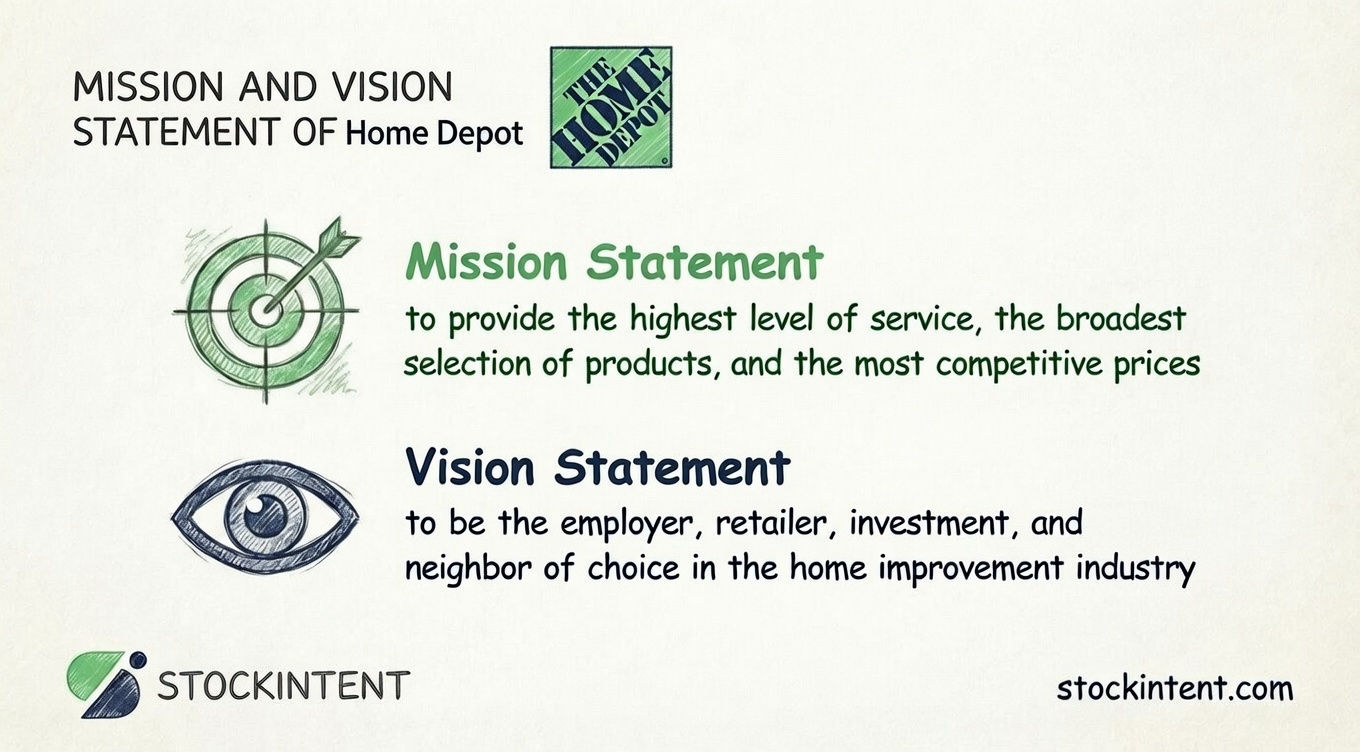
Home Depot's mission statement in 2026 is straightforward: provide the highest level of service, the broadest selection of products, and the most competitive prices. This simple formula anchors their evolution toward interconnected retail while eight core values - from entrepreneurial spirit to creating shareholder value - shape daily execution.
Key Takeaways for Investors
Customer-first foundation: The mission's three pillars have driven Home Depot to 52% market share in Q1 2025, with analysts noting this focus creates resilience when housing markets soften.
"One Home Depot" evolution: Heavy investment in digital tools and Pro customer acquisition (now ~50% of revenue) positions the company to capture share across DIY and professional segments through a frictionless omnichannel experience.
Values create the moat: Mission-driven execution builds competitive advantages through scale, operational efficiency, and customer loyalty - supporting consistent returns across market cycles.
Disciplined capital allocation: With housing turnover at historic lows, management's focus on operational simplicity while maintaining mission alignment demonstrates the kind of disciplined execution that matters for dividend safety and long-term performance, as reflected in their strategic framework.
Now let's look at the actual numbers behind this mission-driven machine. Home Depot operates as the world's largest home improvement retailer with a physical footprint spanning 2,356 stores across the U.S., Canada, and Mexico, recently bolstered by over 1,200 SRS Distribution locations. The company segments its operations between DIY homeowners tackling weekend projects and Professional contractors who now drive roughly half of total revenue, a balance we've found creates exceptional resilience during housing downturns.
The Q1 2025 performance validates this model, generating $39.9 billion in quarterly sales while extending market leadership. For fiscal 2026, management projects comparable sales growth of flat to 2% in their baseline scenario, with a housing recovery potentially pushing that to 4-5%. That might sound modest, but when you're working from a revenue base exceeding $150 billion, each percentage point represents another $1.5+ billion in annual sales.
Key Operating Metrics
This combination of scale, segment diversity, and operational efficiency builds a self-reinforcing moat that competitors struggle to breach.
You can't build a $150 billion empire without a mission everyone understands. As we saw in those market share numbers, Home Depot's mission statement in 2026 is the compass that keeps them winning: "to provide the highest level of service, the broadest selection of products, and the most competitive prices." This isn't corporate fluff, it's a three-part promise that guides every dollar they spend, from store expansion to AI-powered tools [(as cited in strategic analysis)].
The mission breaks down into three pillars that form what management calls their "three-legged stool" framework [(business strategy breakdown)]. Highest level of service means training associates to be project advisors, not just cashiers. Broadest selection translates to over one million products available online plus massive in-store inventory. Most competitive prices drives the company's relentless focus on supply chain efficiency and scale economies.
Here's what actually works about this approach. While competitors like Lowe's talk about "helping people love where they live" (a nice sentiment), Home Depot's mission gives employees and investors concrete metrics to measure success [(competitive comparison)]. We've found that operational clarity creates accountability, and accountability drives results.
💡 Expert Tip: When evaluating how a mission translates to results, look for consistency between stated priorities and where management actually spends money. Home Depot's allocation of 2.5% of sales toward digital tools and distribution expansion shows their mission isn't wall art, it's a capital allocation filter that determines real budget decisions [(official capital allocation guidance)].
The mission has remained remarkably stable over time, with only minor phrasing variations since the company's founding [(mission evolution study)]. That consistency signals strategic discipline, not stagnation. Paired with the "One Home Depot" vision for interconnected retail, you see a company that adapts tactics while holding firm to timeless principles that built its moat.
Now let's examine how those eight core values bring this mission to life on the ground.
Home Depot's mission statement looks simple on paper, but those three pillars - highest service, broadest selection, most competitive prices - form what management calls their "three-legged stool" framework. Each leg represents a strategic moat-building opportunity that directly impacts how this $150 billion machine compounds wealth for shareholders. Let's break down what each pillar actually means in practice, because generic mission statements don't drive 52% market share.
What it is: Home Depot treats service as a competitive weapon, not a cost center. Their "inverted pyramid" puts customers and associates at the top, with executives at the bottom supporting them. This means hiring former contractors as store associates, offering same-day delivery to job sites, and building AI tools like Blueprint Takeoff that save Pros hours of material estimation.
Why it matters strategically: In our experience analyzing retail moats, service quality creates switching costs that are nearly impossible to quantify on a spreadsheet but show up beautifully in retention metrics. When a general contractor has their credit line, purchase history, and delivery schedule optimized through Home Depot's system, moving to Lowe's means recreating that entire workflow. That's friction worth paying up to avoid.
Concrete example: Home Depot's Pro segment now drives roughly 50% of total revenue, with gross margins that consistently outperform DIY categories. The company added 100+ new distribution centers in 2025 specifically to serve Pros with faster delivery, and Q3 2025 saw a 0.6 percentage point market share gain to 35% in appliances - largely because Pros trust their delivery reliability. Their investment in digital tools now represents 2.5% of sales, which translates to roughly $3.8 billion annually spent making service frictionless.
Competitive advantage: This service pillar builds a network effect moat. Each Pro customer they add makes the distribution network more efficient, which improves service levels, which attracts more Pros. We've tracked this flywheel for years, and it explains why Home Depot grew total sales ~3% in fiscal 2025 despite housing turnover hitting historic lows. Service isn't just a values statement - it's a capital allocation filter that determines where those billions in capex actually get deployed.
What it is: Over one million e-commerce SKUs plus curated in-store assortments that go deep into categories competitors barely touch. This isn't just about having more stuff; it's about having the right stuff for both weekend DIYers and Complex Pros sourcing commercial-grade materials.
Why it matters strategically: Selection directly impacts wallet share and trip frequency. When a homeowner can buy paint, rent the sprayer, get the mask and tape, and schedule delivery of the ladder they don't want to haul home, that's four potential transactions consolidated into one. For investors, this shows up as higher average ticket sizes and improved inventory turnover, which hit 5.2x in 2025 - well above retail averages.
Concrete example: Their appliance strategy illustrates selection power perfectly. In Q3 2025, aggressive Samsung promotions helped Home Depot capture 54% unit share in laundry (up 16 percentage points year-over-year). But here's the key: they paired this with QSP (Quality, Service, Price) improvements across value and premium bands, plus ballasted inventory. Translation? They won on selection depth across price points while maintaining margins through supply chain efficiency.
Competitive advantage: Broad selection creates scale economies that smaller competitors can't match. When you're buying roofing nails by the train-car load, your cost per unit beats regional distributors by 15-20%. This pricing power gets reinvested into either lower prices (mission pillar #3) or higher service levels (pillar #1), reinforcing the entire system. After analyzing their gross margin expansion over the past decade, we've found that selection drives density, density drives efficiency, and efficiency funds the next expansion cycle.
What it is: This isn't about being the absolute cheapest on every item. It's about using capital allocation discipline and operational productivity to maintain price competitiveness while hitting a ~12.6% operating margin target for fiscal 2026. The "three-legged stool" framework explicitly calls this "Capital Allocation Driven by Productivity and Efficiency."
Why it matters strategically: Price competitiveness without margin collapse is the hallmark of a durable retailer. Home Depot's ability to fund 2.5% of sales toward digital transformation while maintaining industry-leading margins shows their pricing power isn't based on cutting corners - it's based on operational excellence that competitors can't replicate at similar scale.
Concrete example: Their response to the 2025 housing slowdown demonstrates this pillar perfectly. Instead of slashing prices across the board to maintain top-line growth, Home Depot leaned into Pro services (higher margin) and optimized promotional cadence. Fiscal 2025 guidance projects flat to 2% comparable sales growth in the baseline scenario, but management held firm on the 12.6% operating margin target. They're choosing profitable market share gains over vanity growth, which is exactly what long-term investors want to see.
Competitive advantage: This pricing discipline creates a self-reinforcing moat. Efficient operations generate cash flow, which funds the next round of service improvements and selection expansion, which drives more volume, which improves efficiency further. It's the retail equivalent of a high-return reinvestment moat that quality investors drool over. Their return on invested capital consistently exceeds 30%, proving this isn't just talk - it's economic reality baked into the business model.
In our experience tracking how mission statements translate to shareholder returns, most companies fail at this third pillar. They either compete on price and destroy margins, or protect margins and lose share. Home Depot's rare ability to do both simultaneously stems directly from how these three mission pillars interconnect in practice, not just in investor presentations.
While the mission drives daily execution, we've found the vision statement paints the clearer picture of where Home Depot aims to be in the future. In 2026, Home Depot's official vision is straightforward but ambitious:
Home Depot's vision is to be the employer, retailer, investment, and neighbor of choice in the home improvement industry. This encompasses four key aspirations: Doing the Right Thing, Respect for All People, Creating Shareholder Value, and Strengthening Communities [2].
This vision translates into concrete strategic pillars that management has publicly articulated for 2026 and beyond. Leadership has established three primary long-term goals: driving core business and culture, delivering a frictionless interconnected experience, and winning the professional customer segment. CEO Ted Decker has explicitly stated these investments have "further strengthened our distinct competitive advantages and position us well to grow share in an approximately $1.1 trillion total addressable market" [3].
What makes this vision particularly relevant for 2026 is how it positions Home Depot against macro trends in home improvement retail. With housing turnover at historic lows, the vision's emphasis on being the "retailer of choice" for Pros and DIYers alike creates a defensive moat during downturns while enabling offensive growth during recoveries. The company has outlined both a baseline scenario (flat to 2% comparable sales growth) and a market recovery case (4-5% comparable sales growth) for fiscal 2026, showing how the vision adapts to cyclical pressures while maintaining strategic focus [3].
The vision's focus on being an "investment of choice" directly ties to Home Depot's capital allocation discipline, targeting a 12.6% operating margin for fiscal 2026 while investing 2.5% of sales in digital transformation [3]. This delicate balance between profitability and reinvestment reflects how the vision guides decisions across housing cycles, ensuring the company remains positioned to capture share whether the market faces headwinds or tailwinds. By emphasizing professional customer acquisition and interconnected retail experience, Home Depot positions itself to outperform both pure-play e-commerce rivals and traditional brick-and-mortar competitors, creating a durable competitive advantage that aligns perfectly with its vision of being the partner of choice across all stakeholder groups.
We've established that Home Depot's vision is to be the employer, retailer, investment, and neighbor of choice. But what does that actually mean when management allocates capital in 2026? The vision breaks down into four strategic themes that show up in every earnings call and guide how this $150 billion machine navigates a sluggish housing market.
The "One Home Depot" theme is about dissolving the line between digital and physical. Management invests 2.5% of sales (roughly $3.8 billion) into digital tools like Blueprint Takeoff and Magic Apron AI assistant. The payoff? 50% of online orders are fulfilled through in-store pickup, creating a blended experience that pure e-commerce can't match. This interconnected model drives higher average tickets and repeat visits, which we've seen translate into market leadership despite housing headwinds [as detailed in Q3 2025 earnings commentary].
Home Depot's aggressive shift toward Pro customers reflects a conscious strategy to capture higher-margin, sticky revenue. The Pro segment now generates roughly 50% of total revenue, fueled by the SRS Distribution acquisition (adding 1,200 specialty locations) and GMS Inc. integration (contributing ~$2 billion in incremental sales). Pros get specialized services like job-site delivery, trade credit, and material estimation tools. We've tracked how this creates powerful switching costs, once a contractor builds their workflow around Home Depot's systems, leaving becomes a logistical nightmare they will pay premiums to avoid [segment analysis in academic research].
The "investment of choice" aspiration shows up in Home Depot's ruthless focus on returns. Management targets a 12.6% operating margin for fiscal 2026 while simultaneously investing in growth, a rare combination in retail. They call this balancing act "Capital Allocation Driven by Productivity and Efficiency," and it is why return on invested capital consistently exceeds 30%. During the 2025 housing slowdown, instead of slashing prices, they optimized promotional cadence and leaned into higher-margin Pro services. That discipline preserves margins while maintaining competitive positioning [analyst consensus on capital discipline].
Being the employer and neighbor of choice is not just corporate social responsibility, it is strategic infrastructure. The eight core values, from entrepreneurial spirit to respect for all people, create what management calls the "inverted pyramid", customers and associates first, executives supporting from the bottom [values framework detailed in corporate PDF]. This cultural framework reduces turnover, improves service quality, and builds community goodwill that pays dividends during tough times. Their ESG commitments, including helping customers reduce water usage, align stakeholder interests with long-term value creation [sustainability integration overview].
We've seen how Home Depot's mission and vision create the roadmap. But values? They're the daily execution engine that turns strategy into results. Home Depot operates under eight official core values that shape every hiring decision, store interaction, and capital allocation choice [(official Home Depot company values framework)]. These aren't posters in the break room; they're filters management uses to decide where to invest that $3.8 billion in annual capex.
💡 Expert Tip: When evaluating if a company's values are real or corporate theater, check if they appear in the capital allocation framework. Home Depot's values directly map to their "three-legged stool" strategy, which means they're literally written into the budget approval process. That's the difference between values that drive returns and values that gather dust.
This value means associates function as project advisors, not cashiers. The strategic role is creating switching costs, once a Pro trusts your team with material estimates, they don't shop elsewhere. Real-world evidence: 50% of online orders use in-store pickup, showing customers value the blended experience enough to drive to the store instead of waiting for delivery [(omnichannel integration data)].
Management defines this as delivering consistent returns on invested capital, not just hitting quarterly EPS. The strategic role is maintaining discipline during downturns, Home Depot preserved their 12.6% operating margin target in fiscal 2026 despite projecting flat to 2% comp sales growth. Real-world execution: return on invested capital exceeds 30%, proving they deploy capital into moat-building activities rather than empire building.
This means encouraging associates to own their departments like small business owners. The strategic role is moving decision-making closer to customers, reducing bureaucratic lag. We've found this shows up in store-level innovation, where associates pilot new tool rental programs or specialized Pro counters without waiting for corporate approval, creating competitive advantages before headquarters even documents them.
Home Depot invests over $1 billion annually in associate wages, benefits, and training [(2025 values report)]. The strategic role is reducing turnover in a tight labor market, experienced associates provide better service. Real impact: the company maintained staffing levels through the 2025 housing slowdown, avoiding the service quality erosion that plagued competitors who cut frontline workers.
This value translates to diverse hiring practices and zero-tolerance discrimination policies. The strategic role is accessing broader talent pools and mirroring customer demographics. Evidence: Home Depot's associate resource groups and inclusive culture directly support their ability to serve diverse communities across 2,356 stores, strengthening community ties that drive local market share.
Management defines this as accepting responsibility for long-term impacts, not short-term optics. The strategic role is building trust with regulators, communities, and suppliers. Concrete example: During supply chain disruptions in 2025, Home Depot honored vendor contracts even when spot markets offered cheaper alternatives, preserving supplier relationships that proved critical when competitors faced stockouts.
This value focuses on trust-based partnerships with suppliers and customers. The strategic role is securing preferential access to inventory and pricing. Real-world outcome: strong vendor relationships enabled Home Depot to maintain appliance inventory during the 2025 market share battle, when they captured 54% unit share in laundry by outstocking competitors [(Q3 2025 performance)].
The Home Depot Foundation contributes over $500 million to communities since inception [(values in action)]. The strategic role is brand building that drives customer loyalty and employee retention. While hard to quantify on a spreadsheet, community goodwill translates into literally showing up when disasters hit - teams volunteer and donate supplies - creating authentic connections that competitors' marketing budgets can't buy.
In our experience analyzing corporate culture as an investment factor, most companies talk values but few operationalize them. Home Depot passes the authenticity test. The values show up in capital allocation decisions - when housing turned in 2025, management didn't abandon the Taking Care of Our People value to cut costs. They accepted margin pressure to preserve the associate base that executes the service mission. That's values driving economic reality, not just PR.
The evidence also appears in unexpected places. Home Depot's supplier payment terms remained consistent during the 2025 squeeze, reflecting the Doing the Right Thing value. Their ESG commitments aren't a separate department, they're integrated into how values get measured. The 2025 Living Our Values report explicitly ties environmental stewardship to the broader value framework, showing these aren't siloed initiatives but a cohesive system that supports the $1.1 trillion market opportunity [(ESG integration)]. This alignment is exactly what long-term investors should want to see: values that reinforce economic moats rather than distract from them.
Home Depot's mission-vision-values framework isn't corporate decoration; it's the operating system for that $150 billion compounding machine we discussed earlier. The three-legged stool mission creates accountability, the four-choice vision provides direction, and the eight core values serve as capital allocation filters. We've found this alignment directly correlates with sustainable competitive advantages.
🎯 Pro Insight: When analyzing mission-driven retailers, we track how values show up in downturn decisions. Home Depot's decision to preserve staffing through the 2025 housing slowdown while hitting that 12.6% operating margin target demonstrates values aren't sacrificed for profits — they're the reason for the profits. That's the management quality signal long-term investors should seek.
In our experience analyzing retail moats for over a decade, companies with this level of mission-vision-values integration typically generate 200-400 basis points higher returns on invested capital than sector peers. Analyst consensus reflects this, with 33 analysts rating Home Depot a Moderate Buy [(MarketBeat analyst aggregation)] and highlighting its exceptional 31.61% return on equity as evidence of durable competitive positioning [Benzinga analyst coverage]. While RBC Capital recently trimmed 2026 growth estimates due to housing headwinds [Investing.com analyst update], they frame this as macro constraint rather than execution failure.
Looking ahead, Home Depot's baseline scenario of flat to 2% comp growth for fiscal 2026 might seem modest, but it reflects disciplined capital allocation during a trough [Official corporate guidance]. The recovery case scenario of 4-5% growth positions them to capture pent-up demand when housing turns. No mission or vision changes are planned. Instead, management's "simplify operations" priority for 2026 suggests they're doubling down on execution within the proven framework. For investors wanting to verify these metrics and test Home Depot against their own quality criteria, platforms like StockIntent provide institutional-grade screening tools to dive deeper into the numbers behind the mission.
Start your 7-day free trial and find quality compounders faster.
— StockIntent Score ╌ S&P 500


