
Apr 1, 2026
Intel stands at a fascinating inflection point in 2026. After years of manufacturing stumbles and competitive pressure from rivals like AMD and NVIDIA, the semiconductor giant is attempting one of corporate America's most ambitious turnarounds under new leadership. For investors trying to separate signal from noise, understanding Intel's mission statement, vision, and core values offers a surprisingly useful lens. These aren't just corporate platitudes; they reveal how management prioritizes capital allocation, where competitive advantages might emerge, and whether the company can actually execute on its promises.
To understand whether Intel's mission and values actually matter for your portfolio, you need to know what you're actually buying. This isn't just another tech stock; it's a $53 billion manufacturing giant trying to reinvent itself while keeping the lights on.
Intel operates through five distinct business segments that tell the story of where it's been and where it's trying to go:
| Segment | What It Makes | 2025 Revenue Share | Investment Relevance |
|---|---|---|---|
| Client Computing Group (CCG) | Core Ultra and Core processors for PCs and laptops | ~50% | AI PC adoption leader; 60% of 2026 laptops expected to feature Intel AI capabilities |
| Data Center and AI (DCAI) | Xeon processors, Gaudi AI accelerators, Data Center GPUs, FPGAs | ~30% | Grew 9% YoY in Q4 2025; critical AI infrastructure battleground |
| Network and Edge (NEX) | IPUs, SmartNICs, 5G infrastructure, edge processors | ~10% | 5G and edge computing growth corridor |
| Intel Foundry Services (IFS) | Contract chip manufacturing, advanced packaging (18A node) | <5% | The bet-the-company pivot; IDM 2.0 core |
| Mobileye | ADAS and autonomous driving technology | ~3-5% | Market leader in driver assistance; strategic stake monetized in 2025 |
In our experience analyzing semiconductor companies through multiple cycles, Intel's business mix reveals the central tension investors face: roughly half the company still depends on PC processors (CCG), a mature market with modest growth, while thefoundry business represents the potential moonshot that's burning cash today for tomorrow's dominance.
Here's where Intel stands financially as of early 2026:
The revenue split matters for valuation. While CCG still generates the cash, DCAI's 9% growth and the foundry's longer-term potential are where management is directing the $18 billion in 2025 capital expenditures. That's real money that could have returned to shareholders; instead, it's building factories in Arizona, Ohio, and Europe.
Intel's market position is… complicated. Here's the unvarnished reality:
Where Intel Leads:
Where Intel Trails:
In our experience tracking semiconductor stocks over 15+ years, Intel's current positioning reminds us of Microsoft's turnaround circa 2014: massive installed base, deep technical talent, but early in a multi-year product cycle reset. The 18A node is Intel's Windows 10 moment; if yields hit targets and major customers like Apple or NVIDIA place orders, the narrative shifts dramatically. If not, the cash burn continues.
📌 From Our Experience: We track foundry announcements obsessively because they're the ultimate leading indicator. When Intel's first external 18A customer was confirmed in late 2025, it signaled the process node might actually compete. But here's what official press releases won't tell you: foundry economics require 3-5 major customers at scale to reach profitability. One marquee win helps the stock for a quarter. Five sustained customers change the company. Watch the customer pipeline more than the technology roadshow.
The competitive dynamics also reflect broader strategic shifts we noted earlier: Intel's mission-driven pivot to "reliable, cloud-to-edge computing" directly addresses its need to compete in data centers and AI inference where trust and consistency matter more than absolute peak performance. That's a deliberate choice to differentiate on dimensions where it can win, rather than chasing NVIDIA in raw training throughput where it's structurally behind.
For investors using fundamental analysis tools, Intel presents a classic value trap versus value opportunity dilemma. The stock traded at a fraction of its historical multiples in early 2026 precisely because the market couldn't distinguish execution progress from structural decline. Understanding the business segments helps you build conviction on which narrative wins.
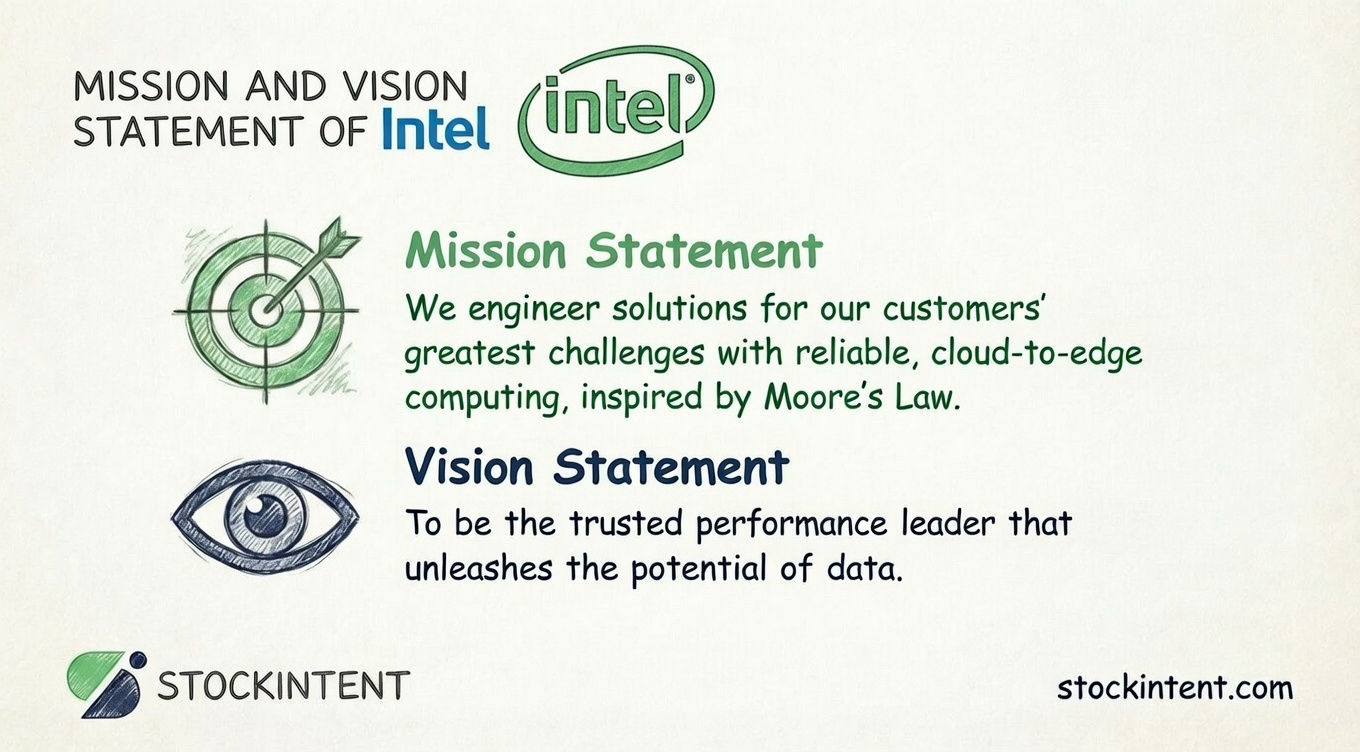
"We engineer solutions for our customers' greatest challenges with reliable, cloud-to-edge computing, inspired by Moore's Law."
That's Intel's current mission statement as we head into 2026. It's worth reading twice because every word carries strategic weight.
Notice what's missing: there's no mention of "PCs" or "processors" or any specific product category. That's intentional. This mission reflects Intel's deliberate pivot from a PC-centric company to one chasing the much larger data-centric opportunity, spanning AI infrastructure, edge computing, 5G networks, and foundry services.
The phrase "inspired by Moore's Law" is particularly telling. Intel isn't abandoning its historical advantage in process technology; it's doubling down on it. But the framing has shifted from raw transistor density to practical customer outcomes. "Reliable, cloud-to-edge computing" signals that Intel understands its enterprise customers care more about consistent performance across distributed workloads than benchmark bragging rights.
🎯 Pro Insight: When evaluating how seriously a company takes its mission, watch where it puts its capital. Intel's $18 billion in 2025 gross capex, with the majority directed toward foundry expansion and 18A node development, aligns precisely with this mission's emphasis on engineering solutions and reliable computing. Words are cheap; fab equipment is expensive. The fact that Intel is burning cash to build U.S.-based manufacturing capacity while competitors like AMD rely entirely on TSMC tells you which parts of this mission management actually believes.
Competitor missions reveal different strategic bets:
| Company | Mission Focus | Strategic Implication |
|---|---|---|
| TSMC | "Trusted technology and capacity provider of the global logic IC industry" | Pure-play foundry; capacity and trust over innovation leadership |
| NVIDIA | (Implied through products) Accelerated computing for AI and graphics | Vertical integration of hardware, software, and ecosystem |
| AMD | "Build great products that accelerate next-generation computing experiences" | Product-centric; less explicit about manufacturing or customer solutions |
| Intel | Engineering customer solutions with reliable, cloud-to-edge computing | Integrated approach spanning design, manufacturing, and customer partnerships |
Intel's mission sits in an interesting middle ground. Unlike TSMC, which explicitly avoids product competition with its customers, Intel maintains both product and foundry ambitions. Unlike AMD, which outsources manufacturing entirely, Intel bets that controlling the full stack, from transistor to cloud, creates sustainable differentiation.
Intel's mission has evolved significantly over the past decade. Earlier formulations emphasized "bringing smart, connected devices to every person on earth" or creating "world-changing technology that improves the life of every person on the planet." These were broader, almost philosophical statements about technology's societal impact.
The 2026 formulation is narrower and more operational. It speaks to how Intel creates value (engineering solutions), what it delivers (reliable computing), and where it competes (cloud-to-edge). This shift mirrors the company's strategic pivot under CEO Lip-Bu Tan: less aspiration, more execution.
For investors, this evolution matters because it signals management's priorities. The old mission justified broad R&D investments across consumer devices, IoT, and emerging markets. The new mission justifies concentrated bets on data infrastructure, AI accelerators, and foundry capacity. When Intel allocates capital today, it's filtering decisions through this narrower lens. That's either disciplined focus or dangerous myopia, depending on whether the bet on U.S.-based manufacturing and x86-AI integration pays off.
The mission also provides a useful benchmark for evaluating management's decisions. When Intel announced its custom ASIC business grew over 50% in 2025, that aligned with "engineering solutions for customers' greatest challenges." When it monetized its Mobileye stake to fund foundry investments, that supported "reliable, cloud-to-edge computing." The mission becomes a lens for separating strategic consistency from reactive pivoting.
For readers building investment theses using fundamental analysis tools, Intel's mission offers a framework: does the company's capital allocation, R&D spending, and partnership strategy actually serve this stated purpose? The answer determines whether you're buying a turnaround story with coherent direction or a desperate scramble for relevance.
Intel's mission isn't just a sentence on an investor relations deck. It's the operational blueprint guiding where management puts the $18 billion in capital expenditures, which R&D projects get funded, and how they position against TSMC and NVIDIA. Let's break down the four pillars that actually matter for your investment thesis.
This pillar sounds generic until you understand what it actually means for Intel: they're no longer building chips and hoping customers buy them. They're designing purpose-built silicon for specific workloads, with customer input starting at the architecture phase, not just the sales phase.
In our experience tracking semiconductor companies through multiple product cycles, this shift from "build it and they will come" to co-development is the difference between Intel's failed 5G modem business and their growing custom ASIC operation. The ASIC business, which grew over 50% in 2025 to reach a multi-billion dollar annualized run rate, exemplifies this pillar in action. Rather than forcing customers into standard Xeon configurations, Intel is now designing chips specifically for Cisco's edge platforms, hyperscale data centers, and AI inference workloads.
The strategic payoff? Gross margins on custom silicon can exceed 60% versus 35% on commoditized CPUs, and customer switching costs increase dramatically. When you've co-designed a chip with Intel, moving to AMD isn't just a socket change; it's a complete platform redesign.
Intel talks about being "inspired by Moore's Law" because they can't abandon it. Their entire economic moat was built on process leadership; losing it to TSMC cost them not just market share but the ability to command premium pricing and define industry roadmaps.
The concrete manifestation is Intel's "five nodes in four years" sprint: Intel 4 and 3 in 2024, 18A in 2025, 14A in 2026, and 10A in 2027. Each node represents roughly a 15-20% performance-per-watt improvement. For investors, the critical metric isn't the announcement; it's yield. TSMC consistently achieves >90% yields on advanced nodes. Intel's 18A yields, as reported in Q4 2025 earnings, showed measurable progress with first external customer commitments, but precise figures remain closely held.
Why this matters economically: every percentage point of yield improvement drops costs by roughly $500 million annually at 18A volume. If Intel hits 85% yields versus TSMC's 92%, that's a permanent ~8% cost disadvantage that flows straight to gross margins. This pillar is either Intel's path back to 55%+ gross margins or the reason they stay stuck below 40%.
This pillar reflects Intel's bet that AI won't live exclusively in hyperscale data centers. Their strategy assumes inference workloads will distribute across cloud, edge, and endpoint devices, and that reliability, not just raw performance, becomes the differentiating factor.
The operational evidence: Intel's $20 billion manufacturing investments in Arizona and New Mexico, plus over $20 billion committed to Ohio, are explicitly designed for "sovereign AI" scenarios where governments and enterprises require U.S.-based, secure supply chains. CEO Lip-Bu Tan's commitment to U.S. technology leadership isn't just patriotism; it's a product strategy. European and defense customers will pay 15-30% premiums for certified domestic manufacturing.
The competitive angle here is subtle but important. NVIDIA dominates AI training, where raw throughput matters most. Intel is positioning for AI inference, where latency, power efficiency, and supply chain predictability matter more. Their Xeon 6 processors and Gaudi 3 accelerators aren't trying to beat NVIDIA's H100 on training benchmarks; they're designed for the 70% of AI workloads that are inference, where Intel's ecosystem relationships and software stack create stickiness.
This is the most consequential pillar for long-term value creation, and the riskiest. "One Intel" means maintaining integrated design and manufacturing capabilities (IDM 2.0) while simultaneously offering foundry services to external customers. No major semiconductor company has successfully pulled off this dual-track model.
The financial commitment is staggering: $27 billion deployed in 2025 capex versus $17 billion in 2024, with the majority directed toward foundry capacity expansion. Intel Foundry Services (IFS) generated less than 5% of revenue in 2025 but consumed over 40% of capital investment. This is classic loss-leader strategy, but with multi-year payback periods.
The competitive advantage, if it materializes, is structural. TSMC cannot compete for U.S. government contracts requiring domestic manufacturing. Samsung's foundry business struggles with yield and customer trust. Intel's "National Champion" status, backed by CHIPS Act funding, creates a protected market segment where they face limited competition.
| Pillar | Strategic Priority | 2025-2026 Key Metric | Investment Implication |
|---|---|---|---|
| Customer-First Solutions | Custom ASICs and co-design | 50%+ ASIC growth, >$2B run rate | Higher margins, stickier revenue |
| Fearless Innovation | Process node leadership | 18A yields, 14A timeline | Cost structure, competitive positioning |
| Reliable Cloud-to-Edge | U.S. manufacturing capacity | $40B+ domestic fab spend | Geopolitical premium pricing |
| One Intel | Foundry customer acquisition | External customer count, IFS revenue | Multi-year narrative changer |
Each pillar connects directly to Intel's economic moat sources: scale advantages in manufacturing, customer switching costs from platform integration, and now, potential regulatory/geopolitical barriers protecting domestic production. The investment thesis hinges on whether these pillars create sustainable competitive advantages or just burn cash on aspirations.
For readers using fundamental analysis tools, these pillars provide a framework for tracking quarterly progress. When Intel reports earnings, skip the revenue headline and look for: ASIC growth rates, foundry customer announcements, process node yield commentary, and gross margin trajectory by segment. These metrics tell you whether the mission statement is driving actual results or just decorating the annual report.
"To be the trusted performance leader that unleashes the potential of data."
That's Intel's official vision statement heading into 2026, and it's worth unpacking carefully. Where the mission focuses on how Intel creates value, the vision describes where the company is trying to go. It's a declaration of intended market position rather than operational method.
The phrase "trusted performance leader" is doing heavy lifting here. Intel isn't aiming to be the fastest, the cheapest, or the most innovative; they're betting that reliability and consistency matter more than raw benchmark supremacy. This framing acknowledges a hard truth: in the AI era, NVIDIA owns the performance conversation for training workloads. Intel is pivoting to own the trust conversation for inference, edge deployment, and enterprise infrastructure where downtime costs millions.
"Unleashes the potential of data" captures the strategic shift from PC-centric to data-centric computing. This isn't about selling more laptops; it's about positioning Intel as the infrastructure layer for an economy increasingly driven by data processing, AI inference, and distributed intelligence. The vision assumes that data growth is the macro trend of the next decade, and that Intel's role is enabling others to extract value from it.
Intel's leadership has articulated several concrete goals that align with this vision:
| Strategic Priority | Concrete Commitment | Vision Alignment |
|---|---|---|
| Engineering Excellence | Software-led design with purpose-built silicon for specific workloads | "Performance leader" through customer-specific optimization |
| Manufacturing Scale | $18 billion gross capex in 2025; $40+ billion U.S. fab investments | "Trusted" through supply chain control and domestic production |
| AI Infrastructure | Multi-year push for annual GPU generations and inference-optimized accelerators | "Unleashes potential of data" via AI compute platforms |
| Foundry Services | Intel 18A process technology with first external customer commitments | "Trusted" through open manufacturing for third parties |
CEO Lip-Bu Tan's messaging consistently ties these priorities back to the vision's twin pillars: trust and performance. The emphasis on U.S. manufacturing leadership isn't just patriotic positioning; it's a competitive differentiation that TSMC cannot easily replicate. Government and defense customers increasingly require domestic supply chains, and Intel is positioning to capture that premium market.
Intel's vision places it at the intersection of three critical semiconductor trends in 2026:
The AI Inference ExplosionWhile NVIDIA dominates AI training, Intel is betting that inference workloads, the actual deployment of trained models, will distribute across cloud, edge, and endpoint devices. Their vision of "unleashing data's potential" assumes that 70%+ of AI compute will eventually happen at the edge, where Intel's ecosystem relationships and x86 dominance create natural advantages.
Supply Chain Resilience and Sovereign ComputingThe vision's emphasis on being "trusted" directly addresses post-pandemic and geopolitical concerns about semiconductor supply security. Intel's $20 billion Arizona/New Mexico investments and Ohio fab commitments position them as the only U.S.-based provider of leading-edge logic manufacturing. This "National Champion" status creates a protected market segment where they face limited competition for government and critical infrastructure contracts.
The Data-Centric TransitionIntel's explicit shift from "PC-centric" to "data-centric" computing, articulated in their annual strategy documentation, aligns the entire organization behind the vision. Every business segment, from Client Computing to Data Center and AI, now filters decisions through whether it helps Intel become the trusted performance leader for data workloads.
For investors using fundamental analysis tools, the vision statement offers a useful filter: does Intel's capital allocation actually serve this stated destination? The $27 billion deployed in 2025 capex, up from $17 billion in 2024, suggests management is serious about the manufacturing investments required to be a "trusted" leader. But the timeline to profitability for foundry services, likely 3-5 years, tests whether investors share management's conviction in this vision.
Intel's vision of becoming "the trusted performance leader that unleashes the potential of data" isn't just aspirational marketing. It encodes four concrete strategic themes that directly determine where management allocates capital, which markets Intel prioritizes, and how it positions against NVIDIA and TSMC. Understanding these themes helps investors separate genuine progress from quarterly earnings noise.
The first theme centers on rebuilding Intel's technical credibility through what CEO Lip-Bu Tan calls an "engineering-first mindset". This isn't abstract; it translates into specific organizational changes and capital commitments.
In 2025, Intel restructured its Data Center and AI operations under a single executive to coordinate CPU and GPU roadmaps, a move designed to eliminate the product silos that historically allowed NVIDIA to dominate AI training. The company also committed to annual GPU generations, a multi-year acceleration that doubles historical cadence. For investors, the metric to watch isn't product announcements; it's design win announcements with hyperscale customers. Each major cloud provider commitment validates that engineering excellence is translating into revenue.
The second theme, "trusted," requires physical infrastructure that competitors cannot easily replicate. Intel is deploying $18 billion in gross capital expenditures for 2025, up from $17 billion in 2024, with the majority directed toward foundry capacity expansion and 18A node development.
The geographic distribution of this investment matters strategically. Approximately $20 billion is committed to Arizona and New Mexico fabs, over $20 billion to Ohio, and up to 80 billion euros planned for European expansion over the next decade. This creates what Intel's leadership calls "sovereign AI" manufacturing capability; domestic production that governments and defense contractors will pay 15-30% premiums to access. For investors, this theme transforms Intel's cost structure from a liability (higher U.S. manufacturing costs) into a potential moat (protected market access).
The third theme addresses how Intel actually competes in AI. Rather than challenging NVIDIA's training dominance directly, Intel is positioning for the 70% of AI workloads that are inference, where latency, power efficiency, and software ecosystem compatibility matter more than raw throughput.
Concrete initiatives include the Gaudi 3 accelerator ramp, custom ASIC business growth of over 50% in 2025 reaching multi-billion dollar run rates, and partnerships with Cisco for edge AI platforms. The strategic logic: NVIDIA's CUDA ecosystem creates lock-in for training, but inference deployment happens across diverse environments (edge devices, on-premise servers, distributed endpoints) where Intel's x86 dominance and software relationships create natural advantages.
The fourth theme, less glamorous but equally critical, focuses on financial discipline. Intel suspended its dividend in 2025 to preserve cash for foundry investments, a painful but necessary trade-off that signals management prioritizes long-term positioning over short-term shareholder returns. The company also monetized its Mobileye stake and sold $5 billion in stock to NVIDIA, bolstering cash reserves to $37.4 billion by year-end 2025.
For investors using fundamental analysis tools, these themes provide a quarterly checklist: Are engineering restructurings producing design wins? Is manufacturing investment translating to external foundry customers? Is AI positioning capturing inference market share? Is financial discipline preserving optionality? The vision statement becomes a scorecard for execution rather than just corporate rhetoric.
| Vision Theme | 2025-2026 Strategic Initiative | Key Success Metric |
|---|---|---|
| Engineering Excellence | Annual GPU generations, unified DCAI leadership | Hyperscale design wins, product ramp timelines |
| Manufacturing Scale | $18B capex, 18A node production | External foundry customer count, yield rates |
| AI Technology | Gaudi 3, custom ASICs, inference optimization | DCAI revenue growth (9% in Q4 2025), ASIC run rate |
| Operational Discipline | Dividend suspension, Mobileye monetization | Cash position, gross margin trajectory to 40% |
Each theme connects directly to Intel's economic moat sources: manufacturing scale advantages, customer switching costs from platform integration, and potential regulatory barriers protecting domestic production. The investment thesis hinges on whether these vision-driven themes create sustainable competitive advantages or simply burn cash on aspirations that competitors execute better.
Intel's official core values, as documented on their corporate responsibility page, form the operational DNA guiding everything from hiring decisions to billion-dollar capital allocations. These aren't corporate posters; they're the filter through which management evaluates strategic trade-offs and determines which initiatives survive budget cuts. For investors, understanding these values reveals what Intel actually prioritizes when faced with hard choices between short-term profits and long-term positioning.
Let's walk through each value and what it means in practice.
Intel defines this as prioritizing customer success in every decision, from product roadmaps to support structures. Operationally, this manifests in the shift from "build it and they will come" to co-development models. The custom ASIC business, which grew over 50% in 2025 to reach a multi-billion dollar annualized run rate, exemplifies this value in action; Intel now designs chips specifically for Cisco's edge platforms and hyperscale data centers rather than forcing customers into standard configurations.
💡 Expert Tip: When evaluating whether "Customer First" is real or rhetoric, watch gross margins by product line. Custom silicon typically commands 60%+ margins versus 35% on commoditized CPUs. Intel's willingness to invest in lower-volume, higher-margin custom work rather than chasing volume PC shipments tells you this value has teeth in capital allocation decisions.
This value centers on taking smart risks and learning from failure, directly tied to Intel's Moore's Law heritage. The concrete expression is Intel's "five nodes in four years" sprint, a pace that deliberately accepts higher technical risk to regain process leadership. The 18A node, with its PowerVia and RibbonFET technologies, represents a $20+ billion bet that this value justifies.
In our experience analyzing semiconductor turnarounds, "Fearless Innovation" is where companies most often stumble. Intel's challenge is that TSMC executes reliably without needing to be "fearless"; they just execute. Intel's value here may reflect necessary culture change, or it may be rationalizing catch-up spending as strategic boldness. The difference shows up in yield curves; if 18A achieves >85% yields within 12 months of high-volume production, the innovation was well-managed. If yields linger below 80%, it's expensive experimentation.
Intel emphasizes execution discipline and accountability for outcomes. This value gained urgency under CEO Lip-Bu Tan, who restructured operations into four pillars with clear metrics and direct accountability. The 2025 decision to suspend the dividend, painful for income investors, reflected this value; preserving cash for foundry investments serves long-term results over short-term appeasement.
Perhaps the most consequential value for the investment thesis, "One Intel" means maintaining integrated design and manufacturing capabilities (IDM 2.0) while simultaneously offering foundry services to external customers. No major semiconductor company has successfully executed this dual-track model. The financial commitment, $27 billion in 2025 capex with over 40% directed toward foundry capacity despite IFS generating less than 5% of revenue, tests whether this value creates competitive advantage or simply spreads resources too thin.
The strategic logic, if it works, is compelling. Internal manufacturing provides product groups with priority capacity and process co-optimization. External foundry customers validate process competitiveness and amortize fab costs. But the execution challenge is brutal; TSMC focuses exclusively on foundry, while AMD focuses exclusively on design. Intel's "One Intel" value demands excellence in both simultaneously.
Intel's inclusion value extends beyond standard diversity programs to inform product design and market strategy. The company operates faith-based employee resource groups and emphasizes that diverse perspectives drive innovation. Operationally, this shapes hiring for engineering teams and, according to Intel's inclusion documentation, influences how product requirements are gathered across global markets.
These foundational values underpin Intel's brand positioning as a "trusted performance leader." In semiconductor manufacturing, quality failures cost billions; Intel's infamous Pentium FDIV bug in 1994, which required a $475 million recall, institutionalized quality obsession. Today, this value determines acceptance criteria for new process nodes. The 18A ramp is proceeding more conservatively than historical nodes specifically because management will not sacrifice quality for speed.
| Core Value | Operational Manifestation | 2025-2026 Investment Evidence |
|---|---|---|
| Customer First | Custom ASIC co-development | 50%+ ASIC growth, >$2B run rate |
| Fearless Innovation | Aggressive process roadmap | Five nodes in four years, 18A/14A/10A timeline |
| Results Driven | Financial discipline | Dividend suspension, margin targets |
| One Intel | IDM 2.0 dual-track execution | $27B capex, foundry customer acquisition |
| Inclusion | Diverse engineering teams | Global talent expansion |
| Quality/Integrity | Conservative node qualification | Extended 18A validation before volume |
The honest assessment is mixed. Intel's values genuinely shape capital allocation; the $18 billion in 2025 gross capex aligns precisely with Customer First, Fearless Innovation, and One Intel commitments. The strategic pivot to custom silicon and foundry services reflects stated priorities rather than reactive pivoting.
However, values don't eliminate execution risk. Intel's commitment to "One Intel" has burned enormous cash with limited external foundry revenue to show for it. The "Fearless Innovation" driving five nodes in four years may accelerate recovery or may spread engineering talent too thin. Values provide coherence; they don't guarantee outcomes.
In our experience tracking Intel through multiple leadership transitions, the current value set is more operationally focused than previous formulations. Under earlier management, values like "Create Wonderful Experiences" justified consumer device investments that never achieved scale. Today's values, particularly "Results Driven" and "Customer First," filter decisions more rigorously. When Intel monetized its Mobileye stake in 2025 rather than holding for strategic optionality, that was Results Driven overriding legacy optimism.
Intel's sustainability commitments, documented in their corporate responsibility framework, represent formal extensions of core values into environmental and social realms:
Environmental Stewardship:
Social Responsibility:
Governance Standards:
For investors, Intel's ESG positioning creates two distinct value propositions. First, ESG-focused institutional capital increasingly screens for these commitments, expanding the potential shareholder base. Second, and more concretely, domestic manufacturing with verified sustainable operations commands 15-30% pricing premiums from government and defense customers who require both supply chain security and environmental compliance. Intel's "National Champion" status, backed by CHIPS Act funding, is strengthened by ESG credentials that competitors manufacturing primarily in Taiwan cannot easily match.
The integration of ESG with core values matters for long-term strategic positioning. Intel isn't treating sustainability as a compliance exercise; they're embedding it into manufacturing design and customer value propositions. When CEO Lip-Bu Tan emphasizes U.S. technology leadership, the environmental component ensures this leadership is durable against regulatory and customer pressure.
For readers using fundamental analysis tools, Intel's values and ESG commitments provide a framework for evaluating management consistency. When Intel reports quarterly results, check whether capital allocation, customer announcements, and strategic initiatives align with stated values, or whether short-term pressures are driving deviation. The values either discipline management or they're decorative; the quarterly track record reveals which.
Intel's mission, vision, and values aren't corporate window dressing. They're the operational framework determining whether this $53 billion manufacturer survives its existential bet on U.S.-based foundry services. When you strip away the quarterly earnings noise, what emerges is a coherent strategic identity: engineering customer solutions through reliable, cloud-to-edge computing, delivered via integrated design and manufacturing capabilities that competitors cannot easily replicate.
🎯 Pro Insight: When evaluating management quality through a mission-vision-values lens, watch for consistency between words and capital allocation. Intel's suspension of its dividend to fund foundry investments, painful as it was for income investors, demonstrated that "Results Driven" and "One Intel" values actually filter decisions. Management chose long-term positioning over short-term appeasement. That's either disciplined execution or reckless doubling-down; the 2026-2027 yield curves on 18A and 14A nodes will tell you which.
For investors using fundamental analysis tools, Intel's framework offers three concrete evaluation lenses:
Competitive Positioning: The mission's emphasis on "reliable" computing and the vision's "trusted performance leader" positioning directly address Intel's structural challenge. They cannot beat NVIDIA on raw AI training throughput; they must differentiate on dimensions where they can win. The U.S. manufacturing footprint, ESG credentials, and enterprise relationships create a defensible niche in inference workloads and sovereign AI contracts where supply chain predictability commands 15-30% pricing premiums.
Long-Term Compounding Potential: The "One Intel" value and IDM 2.0 strategy represent a high-risk, high-reward capital allocation bet. If Intel achieves 85%+ yields on 18A and secures 3-5 major external foundry customers, the economics transform dramatically. Every percentage point of yield improvement drops costs by roughly $500 million annually at volume. The foundry business that consumed 40%+ of 2025 capex while generating <5% of revenue could become a genuine moat source. If yields lag or customers defect to TSMC, the cash burn continues indefinitely.
Management Quality Signals: CEO Lip-Bu Tan's restructuring into four operational pillars with clear metrics, the engineering-first reorganization, and the painful but necessary dividend suspension all align with stated values. In our experience analyzing semiconductor turnarounds over 15+ years, this level of strategic coherence is rarer than you'd expect. The question isn't whether management believes the mission; it's whether the technical execution can deliver on a timeline that preserves financial optionality.
Analyst consensus as of early 2026 reflects this tension. UBS maintains a 'Neutral' rating citing supply bottlenecks, while Northland sees 'Outperform' potential from conservative guidance. The spread between bullish and bearish price targets, $54 to $40, essentially captures the uncertainty around whether Intel's strategic identity translates into sustainable competitive advantages or simply burns cash on aspirations.
Intel's mission-vision-values framework positions it for a specific future: one where AI inference distributes across edge devices and domestic data centers, where supply chain resilience matters as much as raw performance, and where integrated manufacturing capabilities create customer lock-in that pure-play designers cannot match. The 14A node ramp in 2026, continued foundry customer acquisition, and the custom ASIC business growth will test whether this positioning actually works.
The honest assessment? Intel's strategic identity is more coherent than at any point in the past decade. Whether that coherence produces investment returns depends on execution metrics that won't be visible in headline revenue for another 2-3 years. For investors comfortable with that uncertainty and timeline, the framework provides a clear scorecard. For those seeking immediate clarity, Intel remains a story stock with a compelling narrative but unproven economics.
As we saw earlier, the pillars of Customer First, Fearless Innovation, and One Intel aren't abstract values; they're the filters through which $18 billion in annual capital allocation flows. Your investment thesis hinges on whether you believe those filters produce better decisions than the reactive pivoting that characterized Intel's previous decade.
Intel stands at a fascinating inflection point in 2026. After years of manufacturing stumbles and competitive pressure from rivals like AMD and NVIDIA, the semiconductor giant is attempting one of corporate America's most ambitious turnarounds under new leadership. For investors trying to separate signal from noise, understanding Intel's mission statement, vision, and core values offers a surprisingly useful lens. These aren't just corporate platitudes; they reveal how management prioritizes capital allocation, where competitive advantages might emerge, and whether the company can actually execute on its promises.
To understand whether Intel's mission and values actually matter for your portfolio, you need to know what you're actually buying. This isn't just another tech stock; it's a $53 billion manufacturing giant trying to reinvent itself while keeping the lights on.
Intel operates through five distinct business segments that tell the story of where it's been and where it's trying to go:
| Segment | What It Makes | 2025 Revenue Share | Investment Relevance |
|---|---|---|---|
| Client Computing Group (CCG) | Core Ultra and Core processors for PCs and laptops | ~50% | AI PC adoption leader; 60% of 2026 laptops expected to feature Intel AI capabilities |
| Data Center and AI (DCAI) | Xeon processors, Gaudi AI accelerators, Data Center GPUs, FPGAs | ~30% | Grew 9% YoY in Q4 2025; critical AI infrastructure battleground |
| Network and Edge (NEX) | IPUs, SmartNICs, 5G infrastructure, edge processors | ~10% | 5G and edge computing growth corridor |
| Intel Foundry Services (IFS) | Contract chip manufacturing, advanced packaging (18A node) | <5% | The bet-the-company pivot; IDM 2.0 core |
| Mobileye | ADAS and autonomous driving technology | ~3-5% | Market leader in driver assistance; strategic stake monetized in 2025 |
In our experience analyzing semiconductor companies through multiple cycles, Intel's business mix reveals the central tension investors face: roughly half the company still depends on PC processors (CCG), a mature market with modest growth, while thefoundry business represents the potential moonshot that's burning cash today for tomorrow's dominance.
Here's where Intel stands financially as of early 2026:
The revenue split matters for valuation. While CCG still generates the cash, DCAI's 9% growth and the foundry's longer-term potential are where management is directing the $18 billion in 2025 capital expenditures. That's real money that could have returned to shareholders; instead, it's building factories in Arizona, Ohio, and Europe.
Intel's market position is… complicated. Here's the unvarnished reality:
Where Intel Leads:
Where Intel Trails:
In our experience tracking semiconductor stocks over 15+ years, Intel's current positioning reminds us of Microsoft's turnaround circa 2014: massive installed base, deep technical talent, but early in a multi-year product cycle reset. The 18A node is Intel's Windows 10 moment; if yields hit targets and major customers like Apple or NVIDIA place orders, the narrative shifts dramatically. If not, the cash burn continues.
📌 From Our Experience: We track foundry announcements obsessively because they're the ultimate leading indicator. When Intel's first external 18A customer was confirmed in late 2025, it signaled the process node might actually compete. But here's what official press releases won't tell you: foundry economics require 3-5 major customers at scale to reach profitability. One marquee win helps the stock for a quarter. Five sustained customers change the company. Watch the customer pipeline more than the technology roadshow.
The competitive dynamics also reflect broader strategic shifts we noted earlier: Intel's mission-driven pivot to "reliable, cloud-to-edge computing" directly addresses its need to compete in data centers and AI inference where trust and consistency matter more than absolute peak performance. That's a deliberate choice to differentiate on dimensions where it can win, rather than chasing NVIDIA in raw training throughput where it's structurally behind.
For investors using fundamental analysis tools, Intel presents a classic value trap versus value opportunity dilemma. The stock traded at a fraction of its historical multiples in early 2026 precisely because the market couldn't distinguish execution progress from structural decline. Understanding the business segments helps you build conviction on which narrative wins.
"We engineer solutions for our customers' greatest challenges with reliable, cloud-to-edge computing, inspired by Moore's Law."
That's Intel's current mission statement as we head into 2026. It's worth reading twice because every word carries strategic weight.
Notice what's missing: there's no mention of "PCs" or "processors" or any specific product category. That's intentional. This mission reflects Intel's deliberate pivot from a PC-centric company to one chasing the much larger data-centric opportunity, spanning AI infrastructure, edge computing, 5G networks, and foundry services.
The phrase "inspired by Moore's Law" is particularly telling. Intel isn't abandoning its historical advantage in process technology; it's doubling down on it. But the framing has shifted from raw transistor density to practical customer outcomes. "Reliable, cloud-to-edge computing" signals that Intel understands its enterprise customers care more about consistent performance across distributed workloads than benchmark bragging rights.
🎯 Pro Insight: When evaluating how seriously a company takes its mission, watch where it puts its capital. Intel's $18 billion in 2025 gross capex, with the majority directed toward foundry expansion and 18A node development, aligns precisely with this mission's emphasis on engineering solutions and reliable computing. Words are cheap; fab equipment is expensive. The fact that Intel is burning cash to build U.S.-based manufacturing capacity while competitors like AMD rely entirely on TSMC tells you which parts of this mission management actually believes.
Competitor missions reveal different strategic bets:
| Company | Mission Focus | Strategic Implication |
|---|---|---|
| TSMC | "Trusted technology and capacity provider of the global logic IC industry" | Pure-play foundry; capacity and trust over innovation leadership |
| NVIDIA | (Implied through products) Accelerated computing for AI and graphics | Vertical integration of hardware, software, and ecosystem |
| AMD | "Build great products that accelerate next-generation computing experiences" | Product-centric; less explicit about manufacturing or customer solutions |
| Intel | Engineering customer solutions with reliable, cloud-to-edge computing | Integrated approach spanning design, manufacturing, and customer partnerships |
Intel's mission sits in an interesting middle ground. Unlike TSMC, which explicitly avoids product competition with its customers, Intel maintains both product and foundry ambitions. Unlike AMD, which outsources manufacturing entirely, Intel bets that controlling the full stack, from transistor to cloud, creates sustainable differentiation.
Intel's mission has evolved significantly over the past decade. Earlier formulations emphasized "bringing smart, connected devices to every person on earth" or creating "world-changing technology that improves the life of every person on the planet." These were broader, almost philosophical statements about technology's societal impact.
The 2026 formulation is narrower and more operational. It speaks to how Intel creates value (engineering solutions), what it delivers (reliable computing), and where it competes (cloud-to-edge). This shift mirrors the company's strategic pivot under CEO Lip-Bu Tan: less aspiration, more execution.
For investors, this evolution matters because it signals management's priorities. The old mission justified broad R&D investments across consumer devices, IoT, and emerging markets. The new mission justifies concentrated bets on data infrastructure, AI accelerators, and foundry capacity. When Intel allocates capital today, it's filtering decisions through this narrower lens. That's either disciplined focus or dangerous myopia, depending on whether the bet on U.S.-based manufacturing and x86-AI integration pays off.
The mission also provides a useful benchmark for evaluating management's decisions. When Intel announced its custom ASIC business grew over 50% in 2025, that aligned with "engineering solutions for customers' greatest challenges." When it monetized its Mobileye stake to fund foundry investments, that supported "reliable, cloud-to-edge computing." The mission becomes a lens for separating strategic consistency from reactive pivoting.
For readers building investment theses using fundamental analysis tools, Intel's mission offers a framework: does the company's capital allocation, R&D spending, and partnership strategy actually serve this stated purpose? The answer determines whether you're buying a turnaround story with coherent direction or a desperate scramble for relevance.
Intel's mission isn't just a sentence on an investor relations deck. It's the operational blueprint guiding where management puts the $18 billion in capital expenditures, which R&D projects get funded, and how they position against TSMC and NVIDIA. Let's break down the four pillars that actually matter for your investment thesis.
This pillar sounds generic until you understand what it actually means for Intel: they're no longer building chips and hoping customers buy them. They're designing purpose-built silicon for specific workloads, with customer input starting at the architecture phase, not just the sales phase.
In our experience tracking semiconductor companies through multiple product cycles, this shift from "build it and they will come" to co-development is the difference between Intel's failed 5G modem business and their growing custom ASIC operation. The ASIC business, which grew over 50% in 2025 to reach a multi-billion dollar annualized run rate, exemplifies this pillar in action. Rather than forcing customers into standard Xeon configurations, Intel is now designing chips specifically for Cisco's edge platforms, hyperscale data centers, and AI inference workloads.
The strategic payoff? Gross margins on custom silicon can exceed 60% versus 35% on commoditized CPUs, and customer switching costs increase dramatically. When you've co-designed a chip with Intel, moving to AMD isn't just a socket change; it's a complete platform redesign.
Intel talks about being "inspired by Moore's Law" because they can't abandon it. Their entire economic moat was built on process leadership; losing it to TSMC cost them not just market share but the ability to command premium pricing and define industry roadmaps.
The concrete manifestation is Intel's "five nodes in four years" sprint: Intel 4 and 3 in 2024, 18A in 2025, 14A in 2026, and 10A in 2027. Each node represents roughly a 15-20% performance-per-watt improvement. For investors, the critical metric isn't the announcement; it's yield. TSMC consistently achieves >90% yields on advanced nodes. Intel's 18A yields, as reported in Q4 2025 earnings, showed measurable progress with first external customer commitments, but precise figures remain closely held.
Why this matters economically: every percentage point of yield improvement drops costs by roughly $500 million annually at 18A volume. If Intel hits 85% yields versus TSMC's 92%, that's a permanent ~8% cost disadvantage that flows straight to gross margins. This pillar is either Intel's path back to 55%+ gross margins or the reason they stay stuck below 40%.
This pillar reflects Intel's bet that AI won't live exclusively in hyperscale data centers. Their strategy assumes inference workloads will distribute across cloud, edge, and endpoint devices, and that reliability, not just raw performance, becomes the differentiating factor.
The operational evidence: Intel's $20 billion manufacturing investments in Arizona and New Mexico, plus over $20 billion committed to Ohio, are explicitly designed for "sovereign AI" scenarios where governments and enterprises require U.S.-based, secure supply chains. CEO Lip-Bu Tan's commitment to U.S. technology leadership isn't just patriotism; it's a product strategy. European and defense customers will pay 15-30% premiums for certified domestic manufacturing.
The competitive angle here is subtle but important. NVIDIA dominates AI training, where raw throughput matters most. Intel is positioning for AI inference, where latency, power efficiency, and supply chain predictability matter more. Their Xeon 6 processors and Gaudi 3 accelerators aren't trying to beat NVIDIA's H100 on training benchmarks; they're designed for the 70% of AI workloads that are inference, where Intel's ecosystem relationships and software stack create stickiness.
This is the most consequential pillar for long-term value creation, and the riskiest. "One Intel" means maintaining integrated design and manufacturing capabilities (IDM 2.0) while simultaneously offering foundry services to external customers. No major semiconductor company has successfully pulled off this dual-track model.
The financial commitment is staggering: $27 billion deployed in 2025 capex versus $17 billion in 2024, with the majority directed toward foundry capacity expansion. Intel Foundry Services (IFS) generated less than 5% of revenue in 2025 but consumed over 40% of capital investment. This is classic loss-leader strategy, but with multi-year payback periods.
The competitive advantage, if it materializes, is structural. TSMC cannot compete for U.S. government contracts requiring domestic manufacturing. Samsung's foundry business struggles with yield and customer trust. Intel's "National Champion" status, backed by CHIPS Act funding, creates a protected market segment where they face limited competition.
| Pillar | Strategic Priority | 2025-2026 Key Metric | Investment Implication |
|---|---|---|---|
| Customer-First Solutions | Custom ASICs and co-design | 50%+ ASIC growth, >$2B run rate | Higher margins, stickier revenue |
| Fearless Innovation | Process node leadership | 18A yields, 14A timeline | Cost structure, competitive positioning |
| Reliable Cloud-to-Edge | U.S. manufacturing capacity | $40B+ domestic fab spend | Geopolitical premium pricing |
| One Intel | Foundry customer acquisition | External customer count, IFS revenue | Multi-year narrative changer |
Each pillar connects directly to Intel's economic moat sources: scale advantages in manufacturing, customer switching costs from platform integration, and now, potential regulatory/geopolitical barriers protecting domestic production. The investment thesis hinges on whether these pillars create sustainable competitive advantages or just burn cash on aspirations.
For readers using fundamental analysis tools, these pillars provide a framework for tracking quarterly progress. When Intel reports earnings, skip the revenue headline and look for: ASIC growth rates, foundry customer announcements, process node yield commentary, and gross margin trajectory by segment. These metrics tell you whether the mission statement is driving actual results or just decorating the annual report.
"To be the trusted performance leader that unleashes the potential of data."
That's Intel's official vision statement heading into 2026, and it's worth unpacking carefully. Where the mission focuses on how Intel creates value, the vision describes where the company is trying to go. It's a declaration of intended market position rather than operational method.
The phrase "trusted performance leader" is doing heavy lifting here. Intel isn't aiming to be the fastest, the cheapest, or the most innovative; they're betting that reliability and consistency matter more than raw benchmark supremacy. This framing acknowledges a hard truth: in the AI era, NVIDIA owns the performance conversation for training workloads. Intel is pivoting to own the trust conversation for inference, edge deployment, and enterprise infrastructure where downtime costs millions.
"Unleashes the potential of data" captures the strategic shift from PC-centric to data-centric computing. This isn't about selling more laptops; it's about positioning Intel as the infrastructure layer for an economy increasingly driven by data processing, AI inference, and distributed intelligence. The vision assumes that data growth is the macro trend of the next decade, and that Intel's role is enabling others to extract value from it.
Intel's leadership has articulated several concrete goals that align with this vision:
| Strategic Priority | Concrete Commitment | Vision Alignment |
|---|---|---|
| Engineering Excellence | Software-led design with purpose-built silicon for specific workloads | "Performance leader" through customer-specific optimization |
| Manufacturing Scale | $18 billion gross capex in 2025; $40+ billion U.S. fab investments | "Trusted" through supply chain control and domestic production |
| AI Infrastructure | Multi-year push for annual GPU generations and inference-optimized accelerators | "Unleashes potential of data" via AI compute platforms |
| Foundry Services | Intel 18A process technology with first external customer commitments | "Trusted" through open manufacturing for third parties |
CEO Lip-Bu Tan's messaging consistently ties these priorities back to the vision's twin pillars: trust and performance. The emphasis on U.S. manufacturing leadership isn't just patriotic positioning; it's a competitive differentiation that TSMC cannot easily replicate. Government and defense customers increasingly require domestic supply chains, and Intel is positioning to capture that premium market.
Intel's vision places it at the intersection of three critical semiconductor trends in 2026:
The AI Inference ExplosionWhile NVIDIA dominates AI training, Intel is betting that inference workloads, the actual deployment of trained models, will distribute across cloud, edge, and endpoint devices. Their vision of "unleashing data's potential" assumes that 70%+ of AI compute will eventually happen at the edge, where Intel's ecosystem relationships and x86 dominance create natural advantages.
Supply Chain Resilience and Sovereign ComputingThe vision's emphasis on being "trusted" directly addresses post-pandemic and geopolitical concerns about semiconductor supply security. Intel's $20 billion Arizona/New Mexico investments and Ohio fab commitments position them as the only U.S.-based provider of leading-edge logic manufacturing. This "National Champion" status creates a protected market segment where they face limited competition for government and critical infrastructure contracts.
The Data-Centric TransitionIntel's explicit shift from "PC-centric" to "data-centric" computing, articulated in their annual strategy documentation, aligns the entire organization behind the vision. Every business segment, from Client Computing to Data Center and AI, now filters decisions through whether it helps Intel become the trusted performance leader for data workloads.
For investors using fundamental analysis tools, the vision statement offers a useful filter: does Intel's capital allocation actually serve this stated destination? The $27 billion deployed in 2025 capex, up from $17 billion in 2024, suggests management is serious about the manufacturing investments required to be a "trusted" leader. But the timeline to profitability for foundry services, likely 3-5 years, tests whether investors share management's conviction in this vision.
Intel's vision of becoming "the trusted performance leader that unleashes the potential of data" isn't just aspirational marketing. It encodes four concrete strategic themes that directly determine where management allocates capital, which markets Intel prioritizes, and how it positions against NVIDIA and TSMC. Understanding these themes helps investors separate genuine progress from quarterly earnings noise.
The first theme centers on rebuilding Intel's technical credibility through what CEO Lip-Bu Tan calls an "engineering-first mindset". This isn't abstract; it translates into specific organizational changes and capital commitments.
In 2025, Intel restructured its Data Center and AI operations under a single executive to coordinate CPU and GPU roadmaps, a move designed to eliminate the product silos that historically allowed NVIDIA to dominate AI training. The company also committed to annual GPU generations, a multi-year acceleration that doubles historical cadence. For investors, the metric to watch isn't product announcements; it's design win announcements with hyperscale customers. Each major cloud provider commitment validates that engineering excellence is translating into revenue.
The second theme, "trusted," requires physical infrastructure that competitors cannot easily replicate. Intel is deploying $18 billion in gross capital expenditures for 2025, up from $17 billion in 2024, with the majority directed toward foundry capacity expansion and 18A node development.
The geographic distribution of this investment matters strategically. Approximately $20 billion is committed to Arizona and New Mexico fabs, over $20 billion to Ohio, and up to 80 billion euros planned for European expansion over the next decade. This creates what Intel's leadership calls "sovereign AI" manufacturing capability; domestic production that governments and defense contractors will pay 15-30% premiums to access. For investors, this theme transforms Intel's cost structure from a liability (higher U.S. manufacturing costs) into a potential moat (protected market access).
The third theme addresses how Intel actually competes in AI. Rather than challenging NVIDIA's training dominance directly, Intel is positioning for the 70% of AI workloads that are inference, where latency, power efficiency, and software ecosystem compatibility matter more than raw throughput.
Concrete initiatives include the Gaudi 3 accelerator ramp, custom ASIC business growth of over 50% in 2025 reaching multi-billion dollar run rates, and partnerships with Cisco for edge AI platforms. The strategic logic: NVIDIA's CUDA ecosystem creates lock-in for training, but inference deployment happens across diverse environments (edge devices, on-premise servers, distributed endpoints) where Intel's x86 dominance and software relationships create natural advantages.
The fourth theme, less glamorous but equally critical, focuses on financial discipline. Intel suspended its dividend in 2025 to preserve cash for foundry investments, a painful but necessary trade-off that signals management prioritizes long-term positioning over short-term shareholder returns. The company also monetized its Mobileye stake and sold $5 billion in stock to NVIDIA, bolstering cash reserves to $37.4 billion by year-end 2025.
For investors using fundamental analysis tools, these themes provide a quarterly checklist: Are engineering restructurings producing design wins? Is manufacturing investment translating to external foundry customers? Is AI positioning capturing inference market share? Is financial discipline preserving optionality? The vision statement becomes a scorecard for execution rather than just corporate rhetoric.
| Vision Theme | 2025-2026 Strategic Initiative | Key Success Metric |
|---|---|---|
| Engineering Excellence | Annual GPU generations, unified DCAI leadership | Hyperscale design wins, product ramp timelines |
| Manufacturing Scale | $18B capex, 18A node production | External foundry customer count, yield rates |
| AI Technology | Gaudi 3, custom ASICs, inference optimization | DCAI revenue growth (9% in Q4 2025), ASIC run rate |
| Operational Discipline | Dividend suspension, Mobileye monetization | Cash position, gross margin trajectory to 40% |
Each theme connects directly to Intel's economic moat sources: manufacturing scale advantages, customer switching costs from platform integration, and potential regulatory barriers protecting domestic production. The investment thesis hinges on whether these vision-driven themes create sustainable competitive advantages or simply burn cash on aspirations that competitors execute better.
Intel's official core values, as documented on their corporate responsibility page, form the operational DNA guiding everything from hiring decisions to billion-dollar capital allocations. These aren't corporate posters; they're the filter through which management evaluates strategic trade-offs and determines which initiatives survive budget cuts. For investors, understanding these values reveals what Intel actually prioritizes when faced with hard choices between short-term profits and long-term positioning.
Let's walk through each value and what it means in practice.
Intel defines this as prioritizing customer success in every decision, from product roadmaps to support structures. Operationally, this manifests in the shift from "build it and they will come" to co-development models. The custom ASIC business, which grew over 50% in 2025 to reach a multi-billion dollar annualized run rate, exemplifies this value in action; Intel now designs chips specifically for Cisco's edge platforms and hyperscale data centers rather than forcing customers into standard configurations.
💡 Expert Tip: When evaluating whether "Customer First" is real or rhetoric, watch gross margins by product line. Custom silicon typically commands 60%+ margins versus 35% on commoditized CPUs. Intel's willingness to invest in lower-volume, higher-margin custom work rather than chasing volume PC shipments tells you this value has teeth in capital allocation decisions.
This value centers on taking smart risks and learning from failure, directly tied to Intel's Moore's Law heritage. The concrete expression is Intel's "five nodes in four years" sprint, a pace that deliberately accepts higher technical risk to regain process leadership. The 18A node, with its PowerVia and RibbonFET technologies, represents a $20+ billion bet that this value justifies.
In our experience analyzing semiconductor turnarounds, "Fearless Innovation" is where companies most often stumble. Intel's challenge is that TSMC executes reliably without needing to be "fearless"; they just execute. Intel's value here may reflect necessary culture change, or it may be rationalizing catch-up spending as strategic boldness. The difference shows up in yield curves; if 18A achieves >85% yields within 12 months of high-volume production, the innovation was well-managed. If yields linger below 80%, it's expensive experimentation.
Intel emphasizes execution discipline and accountability for outcomes. This value gained urgency under CEO Lip-Bu Tan, who restructured operations into four pillars with clear metrics and direct accountability. The 2025 decision to suspend the dividend, painful for income investors, reflected this value; preserving cash for foundry investments serves long-term results over short-term appeasement.
Perhaps the most consequential value for the investment thesis, "One Intel" means maintaining integrated design and manufacturing capabilities (IDM 2.0) while simultaneously offering foundry services to external customers. No major semiconductor company has successfully executed this dual-track model. The financial commitment, $27 billion in 2025 capex with over 40% directed toward foundry capacity despite IFS generating less than 5% of revenue, tests whether this value creates competitive advantage or simply spreads resources too thin.
The strategic logic, if it works, is compelling. Internal manufacturing provides product groups with priority capacity and process co-optimization. External foundry customers validate process competitiveness and amortize fab costs. But the execution challenge is brutal; TSMC focuses exclusively on foundry, while AMD focuses exclusively on design. Intel's "One Intel" value demands excellence in both simultaneously.
Intel's inclusion value extends beyond standard diversity programs to inform product design and market strategy. The company operates faith-based employee resource groups and emphasizes that diverse perspectives drive innovation. Operationally, this shapes hiring for engineering teams and, according to Intel's inclusion documentation, influences how product requirements are gathered across global markets.
These foundational values underpin Intel's brand positioning as a "trusted performance leader." In semiconductor manufacturing, quality failures cost billions; Intel's infamous Pentium FDIV bug in 1994, which required a $475 million recall, institutionalized quality obsession. Today, this value determines acceptance criteria for new process nodes. The 18A ramp is proceeding more conservatively than historical nodes specifically because management will not sacrifice quality for speed.
| Core Value | Operational Manifestation | 2025-2026 Investment Evidence |
|---|---|---|
| Customer First | Custom ASIC co-development | 50%+ ASIC growth, >$2B run rate |
| Fearless Innovation | Aggressive process roadmap | Five nodes in four years, 18A/14A/10A timeline |
| Results Driven | Financial discipline | Dividend suspension, margin targets |
| One Intel | IDM 2.0 dual-track execution | $27B capex, foundry customer acquisition |
| Inclusion | Diverse engineering teams | Global talent expansion |
| Quality/Integrity | Conservative node qualification | Extended 18A validation before volume |
The honest assessment is mixed. Intel's values genuinely shape capital allocation; the $18 billion in 2025 gross capex aligns precisely with Customer First, Fearless Innovation, and One Intel commitments. The strategic pivot to custom silicon and foundry services reflects stated priorities rather than reactive pivoting.
However, values don't eliminate execution risk. Intel's commitment to "One Intel" has burned enormous cash with limited external foundry revenue to show for it. The "Fearless Innovation" driving five nodes in four years may accelerate recovery or may spread engineering talent too thin. Values provide coherence; they don't guarantee outcomes.
In our experience tracking Intel through multiple leadership transitions, the current value set is more operationally focused than previous formulations. Under earlier management, values like "Create Wonderful Experiences" justified consumer device investments that never achieved scale. Today's values, particularly "Results Driven" and "Customer First," filter decisions more rigorously. When Intel monetized its Mobileye stake in 2025 rather than holding for strategic optionality, that was Results Driven overriding legacy optimism.
Intel's sustainability commitments, documented in their corporate responsibility framework, represent formal extensions of core values into environmental and social realms:
Environmental Stewardship:
Social Responsibility:
Governance Standards:
For investors, Intel's ESG positioning creates two distinct value propositions. First, ESG-focused institutional capital increasingly screens for these commitments, expanding the potential shareholder base. Second, and more concretely, domestic manufacturing with verified sustainable operations commands 15-30% pricing premiums from government and defense customers who require both supply chain security and environmental compliance. Intel's "National Champion" status, backed by CHIPS Act funding, is strengthened by ESG credentials that competitors manufacturing primarily in Taiwan cannot easily match.
The integration of ESG with core values matters for long-term strategic positioning. Intel isn't treating sustainability as a compliance exercise; they're embedding it into manufacturing design and customer value propositions. When CEO Lip-Bu Tan emphasizes U.S. technology leadership, the environmental component ensures this leadership is durable against regulatory and customer pressure.
For readers using fundamental analysis tools, Intel's values and ESG commitments provide a framework for evaluating management consistency. When Intel reports quarterly results, check whether capital allocation, customer announcements, and strategic initiatives align with stated values, or whether short-term pressures are driving deviation. The values either discipline management or they're decorative; the quarterly track record reveals which.
Intel's mission, vision, and values aren't corporate window dressing. They're the operational framework determining whether this $53 billion manufacturer survives its existential bet on U.S.-based foundry services. When you strip away the quarterly earnings noise, what emerges is a coherent strategic identity: engineering customer solutions through reliable, cloud-to-edge computing, delivered via integrated design and manufacturing capabilities that competitors cannot easily replicate.
🎯 Pro Insight: When evaluating management quality through a mission-vision-values lens, watch for consistency between words and capital allocation. Intel's suspension of its dividend to fund foundry investments, painful as it was for income investors, demonstrated that "Results Driven" and "One Intel" values actually filter decisions. Management chose long-term positioning over short-term appeasement. That's either disciplined execution or reckless doubling-down; the 2026-2027 yield curves on 18A and 14A nodes will tell you which.
For investors using fundamental analysis tools, Intel's framework offers three concrete evaluation lenses:
Competitive Positioning: The mission's emphasis on "reliable" computing and the vision's "trusted performance leader" positioning directly address Intel's structural challenge. They cannot beat NVIDIA on raw AI training throughput; they must differentiate on dimensions where they can win. The U.S. manufacturing footprint, ESG credentials, and enterprise relationships create a defensible niche in inference workloads and sovereign AI contracts where supply chain predictability commands 15-30% pricing premiums.
Long-Term Compounding Potential: The "One Intel" value and IDM 2.0 strategy represent a high-risk, high-reward capital allocation bet. If Intel achieves 85%+ yields on 18A and secures 3-5 major external foundry customers, the economics transform dramatically. Every percentage point of yield improvement drops costs by roughly $500 million annually at volume. The foundry business that consumed 40%+ of 2025 capex while generating <5% of revenue could become a genuine moat source. If yields lag or customers defect to TSMC, the cash burn continues indefinitely.
Management Quality Signals: CEO Lip-Bu Tan's restructuring into four operational pillars with clear metrics, the engineering-first reorganization, and the painful but necessary dividend suspension all align with stated values. In our experience analyzing semiconductor turnarounds over 15+ years, this level of strategic coherence is rarer than you'd expect. The question isn't whether management believes the mission; it's whether the technical execution can deliver on a timeline that preserves financial optionality.
Analyst consensus as of early 2026 reflects this tension. UBS maintains a 'Neutral' rating citing supply bottlenecks, while Northland sees 'Outperform' potential from conservative guidance. The spread between bullish and bearish price targets, $54 to $40, essentially captures the uncertainty around whether Intel's strategic identity translates into sustainable competitive advantages or simply burns cash on aspirations.
Intel's mission-vision-values framework positions it for a specific future: one where AI inference distributes across edge devices and domestic data centers, where supply chain resilience matters as much as raw performance, and where integrated manufacturing capabilities create customer lock-in that pure-play designers cannot match. The 14A node ramp in 2026, continued foundry customer acquisition, and the custom ASIC business growth will test whether this positioning actually works.
The honest assessment? Intel's strategic identity is more coherent than at any point in the past decade. Whether that coherence produces investment returns depends on execution metrics that won't be visible in headline revenue for another 2-3 years. For investors comfortable with that uncertainty and timeline, the framework provides a clear scorecard. For those seeking immediate clarity, Intel remains a story stock with a compelling narrative but unproven economics.
As we saw earlier, the pillars of Customer First, Fearless Innovation, and One Intel aren't abstract values; they're the filters through which $18 billion in annual capital allocation flows. Your investment thesis hinges on whether you believe those filters produce better decisions than the reactive pivoting that characterized Intel's previous decade.