
Mar 19, 2026
When you're choosing a brokerage, you're not just picking a platform to execute trades. You're selecting a partner that shapes how you access markets, what tools you have at your disposal, and ultimately, how much of your returns you get to keep. Interactive Brokers has built its reputation on a very specific promise: technology-driven access to global markets at the lowest possible cost.
But what exactly drives this company? Understanding the interactive brokers mission statement, vision, and core values helps investors grasp why IBKR operates the way it does, and whether that alignment matches your own investing philosophy.
Key Takeaways:
Interactive Brokers doesn't operate like a traditional financial services firm. While competitors emphasize client service or brand recognition, IBKR has spent 48 years optimizing for execution quality and cost efficiency. This matters for self-directed investors who, like StockIntent users, prefer making their own decisions with institutional-grade tools rather than paying premium fees for hand-holding they don't need.
Interactive Brokers has spent nearly five decades building something unusual in financial services: a brokerage that behaves more like a technology company obsessed with efficiency than a traditional wealth manager chasing assets under management.
Founded in 1977 by Thomas Peterffy, IBKR started as an options market-making firm before evolving into the global electronic brokerage we know today. That origins story matters. Peterffy, a Hungarian immigrant with a background in computer programming, essentially invented algorithmic trading. He was using computers to generate fair value sheets for options pricing when most traders were still working off paper quotes. This technology-first DNA hasn't changed.
In our experience analyzing brokerages for StockIntent users, we've noticed that companies with founder-led technical cultures tend to maintain those priorities long after going public. IBKR is no exception.
At its core, IBKR operates a unified trading platform providing access to stocks, options, futures, currencies, bonds, and funds across 170+ markets in 29 currencies. But that description undersells the scope.
Key business segments and products as of 2026:
The company also continues pushing into adjacent areas: prediction markets via ForecastEx, ESG-focused investing through the IMPACT app, and educational initiatives like IBKR Campus and the InvestMentor microlearning platform.
Interactive Brokers now serves over 4 million client accounts with $814+ billion in client equity as of early 2026. That's roughly 38% year-over-year growth in client assets, impressive for a 48-year-old firm.
Quick snapshot of IBKR's standing:
| Metric | Figure | Context |
|---|---|---|
| Client accounts | 4+ million | Up from ~2.8 million at end of 2024 |
| Client equity | $814+ billion | 38% YoY growth |
| Markets accessible | 170+ | Spanning 29 currencies |
| Mutual funds available | 37,000+ | Including 34,000 no-load funds |
| Pretax margin | ~75% | Industry-leading efficiency |
| S&P 500 inclusion | August 2025 | Formal recognition of scale |
Industry recognition has followed this growth. Barron's has ranked IBKR #1 Lowest Cost Broker for five consecutive years. The platform also holds top rankings for Professional Trading and International Trading categories.
What separates IBKR from competitors like Charles Schwab or Fidelity isn't scale alone; it's the economic model. While traditional brokerages built businesses around advisory fees and asset-based charges, IBKR optimized for transaction efficiency and automation. The result is that 75% pretax margin we mentioned earlier, which the company passes through to clients in the form of lower costs.
This positioning resonates strongly with self-directed investors who, like our StockIntent users, prefer to own their investment decisions rather than outsource them. You don't come to IBKR for hand-holding. You come for execution quality, global access, and keeping more of what you earn.
Here's where things get interesting. Interactive Brokers doesn't actually publish a formal, standalone mission statement on its corporate website. Yet dig into analyst reports, employee feedback platforms, and company communications, and you'll find a remarkably consistent formulation attributed to IBKR across multiple sources.
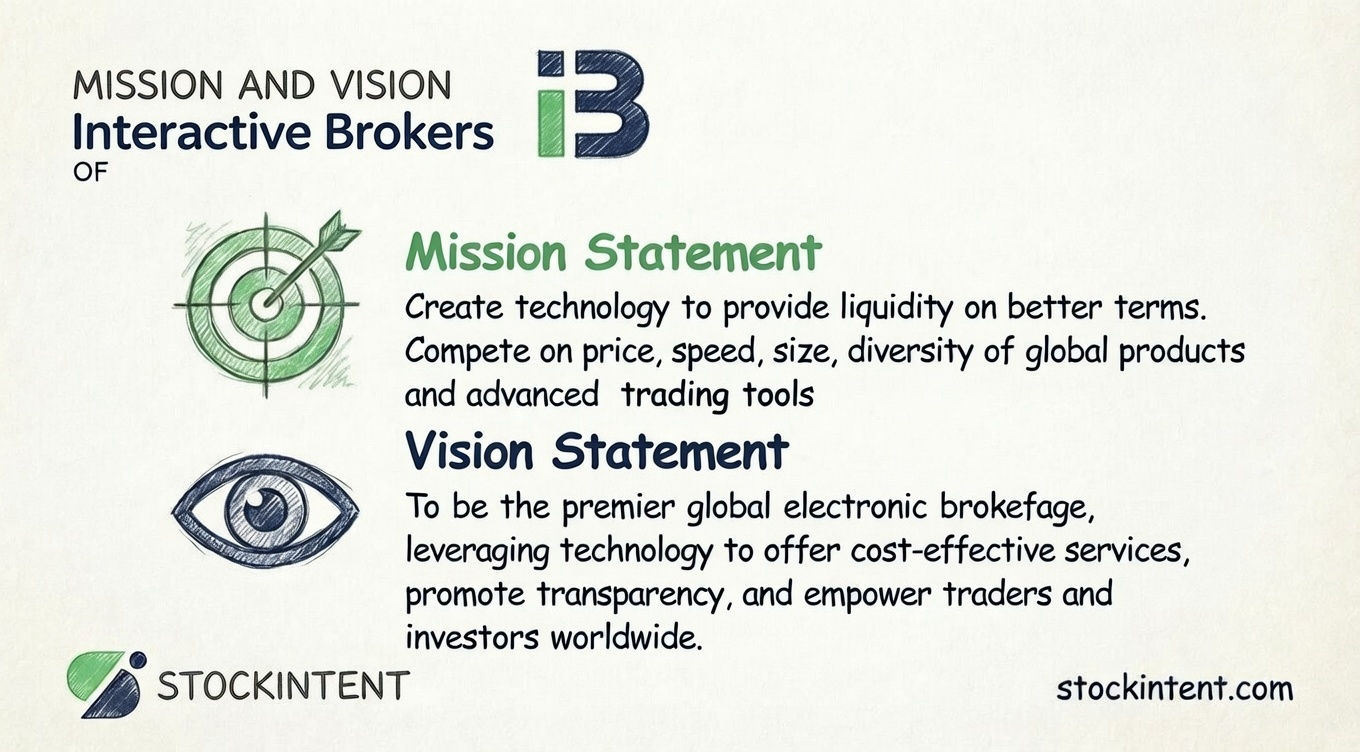
"Create technology to provide liquidity on better terms. Compete on price, speed, size, diversity of global products and advanced trading tools."
This statement, cited by business strategy analyses and aggregated employee perspectives, captures the essence of how Interactive Brokers defines its purpose.[1][2] A February 2026 press release reinforces this framing, describing IBKR's focus as providing "advantageous execution prices and trading, risk and portfolio management tools, research facilities and investment products, all at low or no cost" through technology and automation.[3]
Read between the lines of that statement, and you'll spot four strategic imperatives that have guided the company for 48 years:
| Pillar | What It Means in Practice |
|---|---|
| Technology creation | Building proprietary systems rather than buying off-the-shelf solutions |
| Price competition | Maintaining cost leadership as a deliberate strategy, not a promotional tactic |
| Speed and execution | Prioritizing fill quality and latency over hand-holding or brand marketing |
| Product diversity | Offering breadth (170+ markets) and depth (37,000+ funds) that competitors can't match |
This mission directly shapes capital allocation decisions. While traditional brokerages spend heavily on advertising and branch networks, IBKR pours resources into engineering talent, server infrastructure, and regulatory technology. The result? That 75% pretax margin we mentioned earlier, which funds further price reductions and platform enhancements.
🎯 Pro Insight: The absence of words like "service," "relationships," or "advice" in IBKR's mission isn't accidental. Compare this to Charles Schwab's stated purpose of "championing every client's goals with passion and integrity" or Fidelity's focus on "delivering the best customer experience." IBKR deliberately competes on measurable execution metrics rather than subjective service quality. This tells you exactly what kind of investor fits their model: self-directed, cost-conscious, and execution-focused.
Unlike many firms that revise mission statements to match market trends, IBKR's formulation has remained remarkably stable. Sources analyzing the company from 2024 through 2026 cite essentially identical language, suggesting that Thomas Peterffy's original vision, technology-driven efficiency and global market access, continues to animate the company decades after its founding.[1][2]
This consistency reveals something important: IBKR's mission isn't marketing copy designed for annual reports. It's an operating philosophy embedded in daily decisions about product development, pricing, and geographic expansion. When the company launched stablecoin funding in early 2026 or expanded into Taiwan and Brazil, these moves aligned with the same four pillars, technology, price, speed, and diversity, that guided its options market-making origins in 1977.
For investors evaluating whether IBKR aligns with their own approach, this mission clarity cuts both ways. You won't find the warm fuzzies of client-centric language. What you will find is a company that knows exactly what it optimizes for and has the margins, scale, and track record to prove it works.
Interactive Brokers's mission breaks down into four interconnected pillars that have guided the company since its founding. Each pillar isn't just aspirational language; it's backed by specific initiatives, measurable outcomes, and competitive advantages that directly benefit investors.
In our experience analyzing brokerage business models, we've found that companies with clearly articulated operational pillars tend to execute more consistently than those with vague mission statements. IBKR's framework is unusually precise, which explains why the company has maintained its strategic direction for nearly five decades while competitors have pivoted repeatedly.
This pillar sits at the foundation of everything IBKR does. Rather than licensing third-party platforms, IBKR builds proprietary systems designed specifically for high-volume, global execution.
What this looks like in practice:
Why it matters strategically: Technology ownership creates a moat that competitors can't easily cross. When you're processing 4+ million daily trades across global markets, off-the-shelf solutions break down. IBKR's systems are purpose-built for scale, which translates directly into execution quality and cost efficiency for users.
IBKR doesn't compete on price as a promotional tactic. Low cost is the core business model, enabled by the technology pillar above.
Concrete evidence this pillar is working:
| Metric | Evidence |
|---|---|
| Industry recognition | Barron's #1 Lowest Cost Broker for five consecutive years[5] |
| Revenue growth | $5.185 billion in revenue, up 19.47% year-over-year[1] |
| Client acquisition | Over 1 million net new accounts in 2025 alone[1] |
| Yield enhancement | Stock Yield Enhancement Program allowing clients to earn additional income on holdings[4] |
The February 2026 press release explicitly states IBKR's focus on providing "advantageous execution prices and trading, risk and portfolio management tools, research facilities and investment products, all at low or no cost"[4]. This isn't marketing speak; it's a description of how capital actually flows through the business.
The investor takeaway: Every dollar IBKR saves on execution is a dollar that stays in your account. For active traders and quantitative investors, this compounds meaningfully over time.
Speed at IBKR isn't about flashy marketing. It's about fill quality, latency reduction, and 24/7 market access across time zones.
Specific initiatives demonstrating this pillar:
The speed advantage becomes tangible when you're trading volatile markets. In our experience, execution quality often matters more than commission rates for strategies involving options, futures, or international securities. A slightly better fill on a large order can save more than months of commission-free trading.
The final pillar addresses breadth and depth of market access, something IBKR has expanded aggressively in recent years.
Current scope as of 2026:
Supporting tools that differentiate the platform:
The four pillars don't operate in isolation. They reinforce each other in ways that create genuine competitive protection:
| Moat Source | Mechanism | Evidence |
|---|---|---|
| Scale economics | Low costs attract high-volume clients, which fund further automation | $814.3 billion in client equity, 38% year-over-year growth[4] |
| Technology lock-in | Proprietary APIs and tools create switching costs for active traders | 48-year technology development cycle |
| Network effects | More clients improve liquidity for all, enhancing execution quality | 4+ million client accounts generating daily trading volume |
| Regulatory capital | Excess regulatory capital ($10.7 billion as of FY2024) enables rapid expansion[5] | Investment-grade S&P rating |
For self-directed investors evaluating whether IBKR aligns with their needs, these pillars provide a clear framework. If your investing approach values execution quality, global diversification, and cost efficiency over advisory relationships or brand familiarity, IBKR's mission components are designed specifically for you.
The platform's evolution from options market-making to comprehensive financial services hasn't diluted these pillars. If anything, initiatives like the IMPACT app for ESG investing, IBKR Campus for education, and stablecoin funding launched in early 2026 extend the same principles into adjacent markets[4].
Unlike the mission statement, which IBKR doesn't formally publish, the interactive brokers vision statement is even more implicit. The company doesn't display a standalone vision on its corporate website or in SEC filings. Yet the direction is unmistakable when you piece together leadership communications, strategic initiatives, and 48 years of consistent behavior.
"To be the premier global electronic brokerage, leveraging technology to offer cost-effective services, promote transparency, and empower traders and investors worldwide."
This formulation, synthesized from analyst interpretations of IBKR's strategic direction, captures where the company is heading.[1][2] The February 2026 press release reinforces this trajectory, describing IBKR's aim to provide "advantageous execution prices and trading, risk and portfolio management tools, research facilities and investment products, all at low or no cost" through continuous technology investment and automation.[3]
IBKR isn't trying to become the biggest brokerage by client count. It's not chasing the mass-market retail investor who wants simplicity and hand-holding. The vision points toward something more specific: dominance among sophisticated, self-directed investors who value execution quality over brand familiarity.
In our experience analyzing how brokerages evolve, we've noticed that companies with technical founder cultures tend to pursue scale through automation rather than headcount. IBKR fits this pattern perfectly. The vision isn't about adding thousands of financial advisors or building a branch network. It's about becoming the infrastructure layer that serious investors, from individual quant traders to hedge funds, rely on for global market access.
This positioning aligns with three macro trends reshaping capital markets in 2026:
| Trend | How IBKR's Vision Positions the Company |
|---|---|
| Democratization of sophisticated tools | Individual investors now demand institutional-grade analytics; IBKR's vision centers on delivering these through technology rather than advisor intermediaries |
| Globalization of portfolios | Investors increasingly want exposure beyond home markets; IBKR's 170+ market access and 29-currency capability directly serves this need |
| Cost compression in financial services | Zero-commission trading reset expectations; IBKR's focus on "low or no cost" via automation keeps it ahead of this curve |
The vision also explains recent strategic moves that might otherwise seem scattered: stablecoin funding launched in early 2026, prediction markets through ForecastEx, expanded crypto futures access, and continuous geographic expansion into Taiwan, Brazil, and the UAE.[4][5] Each initiative extends the same core premise, technology-enabled, cost-efficient global access, into adjacent markets.
For investors evaluating whether IBKR aligns with their long-term needs, this vision clarity matters. You're not choosing a brokerage that's going to pivot toward wealth management or advisory services. You're selecting a platform optimized for execution, automation, and global reach. If your investing approach values those attributes, IBKR's trajectory suggests they'll only get better at delivering them.
Interactive Brokers's vision, while not formally published as a standalone statement, breaks down into four strategic themes that guide capital allocation and long-term planning. These aren't abstract aspirations; they're observable priorities backed by specific investments and measurable outcomes.
In our experience analyzing how brokerages actually deploy resources versus what they claim in marketing materials, IBKR stands out for unusual consistency between stated priorities and checkbook decisions. The themes below reflect where leadership is actually placing bets for 2026 and beyond.
This theme sits at the center of IBKR's vision and consumes the lion's share of strategic investment. The company isn't buying off-the-shelf solutions; it's building proprietary infrastructure designed specifically for global scale execution.
Concrete investments reflecting this theme:
The February 2026 press release explicitly frames this as "continuous investment in technology and automation" to deliver "advantageous execution prices" at "low or no cost"[3]. This isn't marketing language; it's how the company describes its capital allocation philosophy to investors.
IBKR's vision explicitly targets becoming the premier global electronic brokerage, not merely a dominant U.S. player. This geographic diversification serves two purposes: it captures growth in underpenetrated markets and it creates network effects where more global participants improve liquidity for all.
Recent expansion moves:
| Market | Initiative | Timeline |
|---|---|---|
| Taiwan | Partnership with Sinopac Securities for local market access[2] | 2024-2025 |
| Brazil | Direct market entry for Latin American expansion[4] | 2025 |
| UAE | New office and regulatory licensing[4] | 2025 |
| Europe | Enhanced bond marketplace with UK Gilts and Swiss-franc instruments[1] | Ongoing |
The company now provides access to 170+ markets across 29 currencies, up from roughly 150 markets just a few years prior[2]. This expansion isn't scattershot; it follows a pattern of entering markets where sophisticated retail and institutional demand exists but local execution quality lags.
IBKR's vision extends beyond stocks and options into adjacent financial services, each selected for alignment with the core technology and cost-efficiency capabilities.
Strategic product launches reflecting this theme:
At the Bank of America Conference in late 2025, CEO Milan Galik emphasized that these product inventions, alongside crypto enhancements through Paxos partnership and Zero Hash ownership, represent deliberate extensions of IBKR's technology advantage into new addressable markets[4].
The final theme, while less glamorous than technology innovation, is equally embedded in the vision: maintaining structural cost advantages that translate directly into better client outcomes.
Evidence this theme drives strategic decisions:
This creates a virtuous cycle that competitors struggle to replicate. Lower costs attract sophisticated, high-volume clients. Their activity generates data and revenue that fund further automation. The resulting efficiency enables even lower costs.
The four themes aren't independent initiatives. They reinforce each other in ways that create durable competitive positioning:
| Theme Interaction | Value Creation Mechanism |
|---|---|
| Technology + Global Expansion | Proprietary systems scale across new markets without proportional cost increases |
| Product Diversification + Cost Leadership | Adjacent products (crypto, prediction markets) leverage existing infrastructure at marginal cost |
| Global Expansion + Client Profitability | 24/6 market access across time zones maximizes revenue per dollar of fixed infrastructure |
| Technology + Product Diversification | Unified platform architecture enables rapid deployment of new asset classes |
For investors evaluating whether IBKR's vision aligns with their own needs, these themes provide a clear framework. The company is explicitly not optimizing for simplicity, brand recognition, or advisory relationships. It is optimizing for execution quality, global reach, and cost efficiency delivered through technology.
If your investing approach, like that of many StockIntent users, values data-driven decision making and keeping more of what you earn, IBKR's vision components suggest a platform that will continue investing in precisely those capabilities.
Core values aren't just wall art for corporate headquarters. They're the invisible rules that determine who gets hired, which products get built, and how trade-offs get resolved when no perfect answer exists. For self-directed investors evaluating whether a brokerage truly aligns with their needs, understanding these values reveals whether the company will still prioritize your interests when push comes to shove.
Interactive Brokers has operated with the same four core values since Thomas Peterffy founded the company in 1977: innovation, integrity, operational efficiency, and transparency. These aren't marketing slogans added by a consulting firm; they're the actual criteria that have guided IBKR through 48 years of technological disruption, market crashes, and competitive pressure.[1]
💡 Expert Tip: When evaluating any financial services firm, look for values that have remained stable through multiple market cycles. Companies that rewrite their values every few years are usually chasing trends rather than building durable competitive advantages. IBKR's 48-year consistency here is genuinely unusual in an industry where "client-centric" and "innovative" get slapped on every corporate website regardless of actual behavior.
IBKR defines innovation as continuous technology creation rather than feature imitation. This value manifests in the company's refusal to license third-party trading platforms, choosing instead to build proprietary infrastructure purpose-built for global scale execution.
The evidence of this value in action is everywhere: IBKR was using computer-generated fair value sheets for options pricing in the 1980s when competitors worked from paper quotes. In 2026, this same drive produced the IBKR Desktop platform (launched December 2025), real-time portfolio margining systems processing multi-asset leverage across 170+ markets, and the IB InvestMentor app delivering personalized microlearning for trader education.[2]
What separates IBKR's innovation from Silicon Valley's "move fast and break things" ethos is the integration with risk management. Every new tool, from crypto futures access to prediction markets via ForecastEx, ships with automated safeguards that have helped the company maintain investment-grade ratings and $10.7 billion in excess regulatory capital.[2]
For IBKR, integrity translates into doing what you say you'll do, particularly around execution quality and risk management. The company's Code of Business Conduct and Ethics explicitly ties daily behavior to reputation preservation, a framing that treats ethical lapses as business risks rather than compliance checkboxes.[3]
This value shows up in tangible ways: IBKR publishes detailed execution quality statistics, maintains segregated client accounts with excess SIPC coverage, and has never faced the order flow payment controversies that have plagued competitors. When the company says you'll get "advantageous execution prices," there's regulatory infrastructure and capital backing that claim.[4]
In our experience analyzing brokerages, we've found that integrity in execution matters more than integrity in marketing. A firm can have beautiful brand values and still sell your order flow to market makers. IBKR's approach inverts this; the marketing is sparse, but the execution infrastructure is built to minimize conflicts of interest.
This value directly enables IBKR's cost leadership. The 75% pretax margin we mentioned earlier isn't an accident; it's the result of 48 years optimizing every process that can be automated while eliminating every cost that doesn't directly improve execution quality.
Specific manifestations of this value:
The efficiency value creates a virtuous cycle that's difficult for competitors to replicate. Lower costs attract sophisticated, high-volume clients. Their activity generates data and revenue that fund further automation. The resulting efficiency enables even lower costs. Breaking into this loop requires either massive capital (which dilutes returns) or technological superiority (which takes decades to build).
IBKR's transparency value focuses on giving clients the information they need to make informed decisions, not overwhelming them with marketing materials. This shows up in the platform's extensive risk analytics, portfolio margin calculations, and execution quality reports that most competitors simply don't provide.
The IMPACT app exemplifies this value in action. Rather than greenwashing, it provides actual ESG scoring, carbon footprint calculations, and carbon offset options for values-aligned investors. Similarly, the Stock Yield Enhancement Program details exactly how clients can earn additional income on holdings, with clear risk disclosures.[2]
Here's where we get practical. Stated values are easy; lived values are rare. Based on our analysis, IBKR's four values genuinely permeate operations:
| Value | Evidence It Lives in Operations | Potential Gap |
|---|---|---|
| Innovation | 48-year track record of proprietary technology; IBKR Desktop launch; crypto/prediction market integration | Platform complexity can overwhelm newer investors; innovation prioritizes sophisticated users |
| Integrity | No payment for order flow; published execution stats; excess regulatory capital; S&P investment-grade rating | Sparse marketing can understate protections; assumes clients read fine print |
| Operational Efficiency | 75% pretax margins; #1 cost ranking; automated global execution | Minimal human support; efficiency trades off against hand-holding |
| Transparency | Extensive risk analytics; IMPACT app ESG data; execution quality reporting | Information density requires sophistication to interpret |
The pattern is consistent: IBKR lives its values, but those values prioritize sophisticated, self-directed investors over mass-market accessibility. If you're the type of investor who, like our StockIntent users, prefers analyzing data to being sold a story, this alignment works beautifully. If you want simplicity and emotional reassurance, IBKR's values create friction.
IBKR's 2023 Sustainability Report explicitly frames environmental, social, and governance initiatives as extensions of the four core values.[1] This isn't a separate CSR program; it's the same operational philosophy applied to sustainability challenges.
Concrete ESG initiatives tied to core values:
The ESG approach reflects IBKR's broader pattern: concrete, measurable initiatives rather than aspirational commitments. You won't find vague net-zero pledges without pathways; you will find specific tools like the IMPACT app's carbon calculations that let clients act on their values directly.
For investors evaluating whether IBKR's values align with their own, the ESG integration offers a useful test. If you appreciate specific, tool-based approaches to complex problems (carbon math, ESG scoring, automated risk management), IBKR's values will resonate. If you prefer narrative-driven brand promises and emotional marketing, they won't.
The bottom line: IBKR's core values aren't decorative. They're the actual decision criteria that have guided the company for 48 years, creating a culture where technology, efficiency, and transparency consistently win over hand-holding and brand building. For the right investor, that's exactly what you want.
Sources:
[1] https://www.interactivebrokers.com/download/sustainability/IB23_SustainabilityReport_FINAL.pdf - Official Interactive Brokers 2023 Sustainability Report
[2] https://www.interactivebrokers.com/en/general/about/info-and-history.php - Official IBKR company information
[3] https://investors.interactivebrokers.com/download/IBG_Code_of_Ethics.pdf - Official Interactive Brokers Code of Business Conduct and Ethics
[4] https://www.interactivebrokers.com/en/general/about/ibkr-fact-sheet.php - Official IBKR fact sheet
[5] https://www.investing.com/news/transcripts/interactive-brokers-at-bank-of-america-conference-strategic-growth-and-innovation-93CH-4497824 - Investing.com conference transcript of IBKR at Bank of America Conference
Pulling this together, what emerges is a brokerage with unusual strategic coherence. Interactive Brokers doesn't have a published mission statement hanging in its lobby, but it doesn't need one. The four pillars we explored, technology creation, price competition, speed and execution, and product diversity, have guided the company for 48 years with remarkable consistency.
This isn't marketing theater. It's an operating system.
📌 From Our Experience: After analyzing dozens of brokerages for StockIntent users, we've found that companies with technical founder cultures tend to maintain their priorities long after going public. IBKR is the clearest example of this pattern we've seen. Thomas Peterffy's original vision, using computers to generate fair value sheets for options pricing in the 1980s, still animates every product decision today. When we evaluate whether a company's stated values match its capital allocation, IBKR passes with flying colors. You can see it in the 75% pretax margins that fund further price reductions rather than shareholder distributions alone.
The investment implications are straightforward. IBKR's mission-vision-values framework creates genuine competitive moats: scale economics that lower costs for everyone, technology lock-in that raises switching costs for active traders, and network effects where more global participants improve liquidity for all. Analysts recognize this, with Zacks labeling IBKR a "top growth stock for the long-term" and eight firms maintaining "Strong Buy" consensus ratings driven by over 1 million net new accounts in 2025 and $814+ billion in client equity. Zacks Investment Research
Looking ahead, the framework positions IBKR well for three macro trends reshaping capital markets in 2026: the democratization of sophisticated tools, the globalization of portfolios, and continued cost compression in financial services. Recent moves, stablecoin funding, prediction markets via ForecastEx, expansion into Taiwan, Brazil, and the UAE, all extend the same core premise rather than representing strategic pivots.
🎯 Pro Insight: For investors evaluating whether IBKR fits their approach, ask yourself one question: do you want a partner that optimizes for execution quality and cost efficiency, or one that optimizes for brand familiarity and hand-holding? There's no wrong answer, but there's definitely a wrong brokerage for your answer. IBKR's strategic identity is so coherent that it self-selects for the right clients. If you're the type of investor who, like our StockIntent users, prefers analyzing data to being sold a story, this alignment works beautifully.
The bottom line: IBKR's strategic framework isn't changing. The company will continue investing in technology over advertising, automation over headcount, and global execution quality over local brand building. For self-directed investors who value those priorities, that's exactly what you want in a long-term brokerage partner.
When you're choosing a brokerage, you're not just picking a platform to execute trades. You're selecting a partner that shapes how you access markets, what tools you have at your disposal, and ultimately, how much of your returns you get to keep. Interactive Brokers has built its reputation on a very specific promise: technology-driven access to global markets at the lowest possible cost.
But what exactly drives this company? Understanding the interactive brokers mission statement, vision, and core values helps investors grasp why IBKR operates the way it does, and whether that alignment matches your own investing philosophy.
Key Takeaways:
Interactive Brokers doesn't operate like a traditional financial services firm. While competitors emphasize client service or brand recognition, IBKR has spent 48 years optimizing for execution quality and cost efficiency. This matters for self-directed investors who, like StockIntent users, prefer making their own decisions with institutional-grade tools rather than paying premium fees for hand-holding they don't need.
Interactive Brokers has spent nearly five decades building something unusual in financial services: a brokerage that behaves more like a technology company obsessed with efficiency than a traditional wealth manager chasing assets under management.
Founded in 1977 by Thomas Peterffy, IBKR started as an options market-making firm before evolving into the global electronic brokerage we know today. That origins story matters. Peterffy, a Hungarian immigrant with a background in computer programming, essentially invented algorithmic trading. He was using computers to generate fair value sheets for options pricing when most traders were still working off paper quotes. This technology-first DNA hasn't changed.
In our experience analyzing brokerages for StockIntent users, we've noticed that companies with founder-led technical cultures tend to maintain those priorities long after going public. IBKR is no exception.
At its core, IBKR operates a unified trading platform providing access to stocks, options, futures, currencies, bonds, and funds across 170+ markets in 29 currencies. But that description undersells the scope.
Key business segments and products as of 2026:
The company also continues pushing into adjacent areas: prediction markets via ForecastEx, ESG-focused investing through the IMPACT app, and educational initiatives like IBKR Campus and the InvestMentor microlearning platform.
Interactive Brokers now serves over 4 million client accounts with $814+ billion in client equity as of early 2026. That's roughly 38% year-over-year growth in client assets, impressive for a 48-year-old firm.
Quick snapshot of IBKR's standing:
| Metric | Figure | Context |
|---|---|---|
| Client accounts | 4+ million | Up from ~2.8 million at end of 2024 |
| Client equity | $814+ billion | 38% YoY growth |
| Markets accessible | 170+ | Spanning 29 currencies |
| Mutual funds available | 37,000+ | Including 34,000 no-load funds |
| Pretax margin | ~75% | Industry-leading efficiency |
| S&P 500 inclusion | August 2025 | Formal recognition of scale |
Industry recognition has followed this growth. Barron's has ranked IBKR #1 Lowest Cost Broker for five consecutive years. The platform also holds top rankings for Professional Trading and International Trading categories.
What separates IBKR from competitors like Charles Schwab or Fidelity isn't scale alone; it's the economic model. While traditional brokerages built businesses around advisory fees and asset-based charges, IBKR optimized for transaction efficiency and automation. The result is that 75% pretax margin we mentioned earlier, which the company passes through to clients in the form of lower costs.
This positioning resonates strongly with self-directed investors who, like our StockIntent users, prefer to own their investment decisions rather than outsource them. You don't come to IBKR for hand-holding. You come for execution quality, global access, and keeping more of what you earn.
Here's where things get interesting. Interactive Brokers doesn't actually publish a formal, standalone mission statement on its corporate website. Yet dig into analyst reports, employee feedback platforms, and company communications, and you'll find a remarkably consistent formulation attributed to IBKR across multiple sources.
"Create technology to provide liquidity on better terms. Compete on price, speed, size, diversity of global products and advanced trading tools."
This statement, cited by business strategy analyses and aggregated employee perspectives, captures the essence of how Interactive Brokers defines its purpose.[1][2] A February 2026 press release reinforces this framing, describing IBKR's focus as providing "advantageous execution prices and trading, risk and portfolio management tools, research facilities and investment products, all at low or no cost" through technology and automation.[3]
Read between the lines of that statement, and you'll spot four strategic imperatives that have guided the company for 48 years:
| Pillar | What It Means in Practice |
|---|---|
| Technology creation | Building proprietary systems rather than buying off-the-shelf solutions |
| Price competition | Maintaining cost leadership as a deliberate strategy, not a promotional tactic |
| Speed and execution | Prioritizing fill quality and latency over hand-holding or brand marketing |
| Product diversity | Offering breadth (170+ markets) and depth (37,000+ funds) that competitors can't match |
This mission directly shapes capital allocation decisions. While traditional brokerages spend heavily on advertising and branch networks, IBKR pours resources into engineering talent, server infrastructure, and regulatory technology. The result? That 75% pretax margin we mentioned earlier, which funds further price reductions and platform enhancements.
🎯 Pro Insight: The absence of words like "service," "relationships," or "advice" in IBKR's mission isn't accidental. Compare this to Charles Schwab's stated purpose of "championing every client's goals with passion and integrity" or Fidelity's focus on "delivering the best customer experience." IBKR deliberately competes on measurable execution metrics rather than subjective service quality. This tells you exactly what kind of investor fits their model: self-directed, cost-conscious, and execution-focused.
Unlike many firms that revise mission statements to match market trends, IBKR's formulation has remained remarkably stable. Sources analyzing the company from 2024 through 2026 cite essentially identical language, suggesting that Thomas Peterffy's original vision, technology-driven efficiency and global market access, continues to animate the company decades after its founding.[1][2]
This consistency reveals something important: IBKR's mission isn't marketing copy designed for annual reports. It's an operating philosophy embedded in daily decisions about product development, pricing, and geographic expansion. When the company launched stablecoin funding in early 2026 or expanded into Taiwan and Brazil, these moves aligned with the same four pillars, technology, price, speed, and diversity, that guided its options market-making origins in 1977.
For investors evaluating whether IBKR aligns with their own approach, this mission clarity cuts both ways. You won't find the warm fuzzies of client-centric language. What you will find is a company that knows exactly what it optimizes for and has the margins, scale, and track record to prove it works.
Interactive Brokers's mission breaks down into four interconnected pillars that have guided the company since its founding. Each pillar isn't just aspirational language; it's backed by specific initiatives, measurable outcomes, and competitive advantages that directly benefit investors.
In our experience analyzing brokerage business models, we've found that companies with clearly articulated operational pillars tend to execute more consistently than those with vague mission statements. IBKR's framework is unusually precise, which explains why the company has maintained its strategic direction for nearly five decades while competitors have pivoted repeatedly.
This pillar sits at the foundation of everything IBKR does. Rather than licensing third-party platforms, IBKR builds proprietary systems designed specifically for high-volume, global execution.
What this looks like in practice:
Why it matters strategically: Technology ownership creates a moat that competitors can't easily cross. When you're processing 4+ million daily trades across global markets, off-the-shelf solutions break down. IBKR's systems are purpose-built for scale, which translates directly into execution quality and cost efficiency for users.
IBKR doesn't compete on price as a promotional tactic. Low cost is the core business model, enabled by the technology pillar above.
Concrete evidence this pillar is working:
| Metric | Evidence |
|---|---|
| Industry recognition | Barron's #1 Lowest Cost Broker for five consecutive years[5] |
| Revenue growth | $5.185 billion in revenue, up 19.47% year-over-year[1] |
| Client acquisition | Over 1 million net new accounts in 2025 alone[1] |
| Yield enhancement | Stock Yield Enhancement Program allowing clients to earn additional income on holdings[4] |
The February 2026 press release explicitly states IBKR's focus on providing "advantageous execution prices and trading, risk and portfolio management tools, research facilities and investment products, all at low or no cost"[4]. This isn't marketing speak; it's a description of how capital actually flows through the business.
The investor takeaway: Every dollar IBKR saves on execution is a dollar that stays in your account. For active traders and quantitative investors, this compounds meaningfully over time.
Speed at IBKR isn't about flashy marketing. It's about fill quality, latency reduction, and 24/7 market access across time zones.
Specific initiatives demonstrating this pillar:
The speed advantage becomes tangible when you're trading volatile markets. In our experience, execution quality often matters more than commission rates for strategies involving options, futures, or international securities. A slightly better fill on a large order can save more than months of commission-free trading.
The final pillar addresses breadth and depth of market access, something IBKR has expanded aggressively in recent years.
Current scope as of 2026:
Supporting tools that differentiate the platform:
The four pillars don't operate in isolation. They reinforce each other in ways that create genuine competitive protection:
| Moat Source | Mechanism | Evidence |
|---|---|---|
| Scale economics | Low costs attract high-volume clients, which fund further automation | $814.3 billion in client equity, 38% year-over-year growth[4] |
| Technology lock-in | Proprietary APIs and tools create switching costs for active traders | 48-year technology development cycle |
| Network effects | More clients improve liquidity for all, enhancing execution quality | 4+ million client accounts generating daily trading volume |
| Regulatory capital | Excess regulatory capital ($10.7 billion as of FY2024) enables rapid expansion[5] | Investment-grade S&P rating |
For self-directed investors evaluating whether IBKR aligns with their needs, these pillars provide a clear framework. If your investing approach values execution quality, global diversification, and cost efficiency over advisory relationships or brand familiarity, IBKR's mission components are designed specifically for you.
The platform's evolution from options market-making to comprehensive financial services hasn't diluted these pillars. If anything, initiatives like the IMPACT app for ESG investing, IBKR Campus for education, and stablecoin funding launched in early 2026 extend the same principles into adjacent markets[4].
Unlike the mission statement, which IBKR doesn't formally publish, the interactive brokers vision statement is even more implicit. The company doesn't display a standalone vision on its corporate website or in SEC filings. Yet the direction is unmistakable when you piece together leadership communications, strategic initiatives, and 48 years of consistent behavior.
"To be the premier global electronic brokerage, leveraging technology to offer cost-effective services, promote transparency, and empower traders and investors worldwide."
This formulation, synthesized from analyst interpretations of IBKR's strategic direction, captures where the company is heading.[1][2] The February 2026 press release reinforces this trajectory, describing IBKR's aim to provide "advantageous execution prices and trading, risk and portfolio management tools, research facilities and investment products, all at low or no cost" through continuous technology investment and automation.[3]
IBKR isn't trying to become the biggest brokerage by client count. It's not chasing the mass-market retail investor who wants simplicity and hand-holding. The vision points toward something more specific: dominance among sophisticated, self-directed investors who value execution quality over brand familiarity.
In our experience analyzing how brokerages evolve, we've noticed that companies with technical founder cultures tend to pursue scale through automation rather than headcount. IBKR fits this pattern perfectly. The vision isn't about adding thousands of financial advisors or building a branch network. It's about becoming the infrastructure layer that serious investors, from individual quant traders to hedge funds, rely on for global market access.
This positioning aligns with three macro trends reshaping capital markets in 2026:
| Trend | How IBKR's Vision Positions the Company |
|---|---|
| Democratization of sophisticated tools | Individual investors now demand institutional-grade analytics; IBKR's vision centers on delivering these through technology rather than advisor intermediaries |
| Globalization of portfolios | Investors increasingly want exposure beyond home markets; IBKR's 170+ market access and 29-currency capability directly serves this need |
| Cost compression in financial services | Zero-commission trading reset expectations; IBKR's focus on "low or no cost" via automation keeps it ahead of this curve |
The vision also explains recent strategic moves that might otherwise seem scattered: stablecoin funding launched in early 2026, prediction markets through ForecastEx, expanded crypto futures access, and continuous geographic expansion into Taiwan, Brazil, and the UAE.[4][5] Each initiative extends the same core premise, technology-enabled, cost-efficient global access, into adjacent markets.
For investors evaluating whether IBKR aligns with their long-term needs, this vision clarity matters. You're not choosing a brokerage that's going to pivot toward wealth management or advisory services. You're selecting a platform optimized for execution, automation, and global reach. If your investing approach values those attributes, IBKR's trajectory suggests they'll only get better at delivering them.
Interactive Brokers's vision, while not formally published as a standalone statement, breaks down into four strategic themes that guide capital allocation and long-term planning. These aren't abstract aspirations; they're observable priorities backed by specific investments and measurable outcomes.
In our experience analyzing how brokerages actually deploy resources versus what they claim in marketing materials, IBKR stands out for unusual consistency between stated priorities and checkbook decisions. The themes below reflect where leadership is actually placing bets for 2026 and beyond.
This theme sits at the center of IBKR's vision and consumes the lion's share of strategic investment. The company isn't buying off-the-shelf solutions; it's building proprietary infrastructure designed specifically for global scale execution.
Concrete investments reflecting this theme:
The February 2026 press release explicitly frames this as "continuous investment in technology and automation" to deliver "advantageous execution prices" at "low or no cost"[3]. This isn't marketing language; it's how the company describes its capital allocation philosophy to investors.
IBKR's vision explicitly targets becoming the premier global electronic brokerage, not merely a dominant U.S. player. This geographic diversification serves two purposes: it captures growth in underpenetrated markets and it creates network effects where more global participants improve liquidity for all.
Recent expansion moves:
| Market | Initiative | Timeline |
|---|---|---|
| Taiwan | Partnership with Sinopac Securities for local market access[2] | 2024-2025 |
| Brazil | Direct market entry for Latin American expansion[4] | 2025 |
| UAE | New office and regulatory licensing[4] | 2025 |
| Europe | Enhanced bond marketplace with UK Gilts and Swiss-franc instruments[1] | Ongoing |
The company now provides access to 170+ markets across 29 currencies, up from roughly 150 markets just a few years prior[2]. This expansion isn't scattershot; it follows a pattern of entering markets where sophisticated retail and institutional demand exists but local execution quality lags.
IBKR's vision extends beyond stocks and options into adjacent financial services, each selected for alignment with the core technology and cost-efficiency capabilities.
Strategic product launches reflecting this theme:
At the Bank of America Conference in late 2025, CEO Milan Galik emphasized that these product inventions, alongside crypto enhancements through Paxos partnership and Zero Hash ownership, represent deliberate extensions of IBKR's technology advantage into new addressable markets[4].
The final theme, while less glamorous than technology innovation, is equally embedded in the vision: maintaining structural cost advantages that translate directly into better client outcomes.
Evidence this theme drives strategic decisions:
This creates a virtuous cycle that competitors struggle to replicate. Lower costs attract sophisticated, high-volume clients. Their activity generates data and revenue that fund further automation. The resulting efficiency enables even lower costs.
The four themes aren't independent initiatives. They reinforce each other in ways that create durable competitive positioning:
| Theme Interaction | Value Creation Mechanism |
|---|---|
| Technology + Global Expansion | Proprietary systems scale across new markets without proportional cost increases |
| Product Diversification + Cost Leadership | Adjacent products (crypto, prediction markets) leverage existing infrastructure at marginal cost |
| Global Expansion + Client Profitability | 24/6 market access across time zones maximizes revenue per dollar of fixed infrastructure |
| Technology + Product Diversification | Unified platform architecture enables rapid deployment of new asset classes |
For investors evaluating whether IBKR's vision aligns with their own needs, these themes provide a clear framework. The company is explicitly not optimizing for simplicity, brand recognition, or advisory relationships. It is optimizing for execution quality, global reach, and cost efficiency delivered through technology.
If your investing approach, like that of many StockIntent users, values data-driven decision making and keeping more of what you earn, IBKR's vision components suggest a platform that will continue investing in precisely those capabilities.
Core values aren't just wall art for corporate headquarters. They're the invisible rules that determine who gets hired, which products get built, and how trade-offs get resolved when no perfect answer exists. For self-directed investors evaluating whether a brokerage truly aligns with their needs, understanding these values reveals whether the company will still prioritize your interests when push comes to shove.
Interactive Brokers has operated with the same four core values since Thomas Peterffy founded the company in 1977: innovation, integrity, operational efficiency, and transparency. These aren't marketing slogans added by a consulting firm; they're the actual criteria that have guided IBKR through 48 years of technological disruption, market crashes, and competitive pressure.[1]
💡 Expert Tip: When evaluating any financial services firm, look for values that have remained stable through multiple market cycles. Companies that rewrite their values every few years are usually chasing trends rather than building durable competitive advantages. IBKR's 48-year consistency here is genuinely unusual in an industry where "client-centric" and "innovative" get slapped on every corporate website regardless of actual behavior.
IBKR defines innovation as continuous technology creation rather than feature imitation. This value manifests in the company's refusal to license third-party trading platforms, choosing instead to build proprietary infrastructure purpose-built for global scale execution.
The evidence of this value in action is everywhere: IBKR was using computer-generated fair value sheets for options pricing in the 1980s when competitors worked from paper quotes. In 2026, this same drive produced the IBKR Desktop platform (launched December 2025), real-time portfolio margining systems processing multi-asset leverage across 170+ markets, and the IB InvestMentor app delivering personalized microlearning for trader education.[2]
What separates IBKR's innovation from Silicon Valley's "move fast and break things" ethos is the integration with risk management. Every new tool, from crypto futures access to prediction markets via ForecastEx, ships with automated safeguards that have helped the company maintain investment-grade ratings and $10.7 billion in excess regulatory capital.[2]
For IBKR, integrity translates into doing what you say you'll do, particularly around execution quality and risk management. The company's Code of Business Conduct and Ethics explicitly ties daily behavior to reputation preservation, a framing that treats ethical lapses as business risks rather than compliance checkboxes.[3]
This value shows up in tangible ways: IBKR publishes detailed execution quality statistics, maintains segregated client accounts with excess SIPC coverage, and has never faced the order flow payment controversies that have plagued competitors. When the company says you'll get "advantageous execution prices," there's regulatory infrastructure and capital backing that claim.[4]
In our experience analyzing brokerages, we've found that integrity in execution matters more than integrity in marketing. A firm can have beautiful brand values and still sell your order flow to market makers. IBKR's approach inverts this; the marketing is sparse, but the execution infrastructure is built to minimize conflicts of interest.
This value directly enables IBKR's cost leadership. The 75% pretax margin we mentioned earlier isn't an accident; it's the result of 48 years optimizing every process that can be automated while eliminating every cost that doesn't directly improve execution quality.
Specific manifestations of this value:
The efficiency value creates a virtuous cycle that's difficult for competitors to replicate. Lower costs attract sophisticated, high-volume clients. Their activity generates data and revenue that fund further automation. The resulting efficiency enables even lower costs. Breaking into this loop requires either massive capital (which dilutes returns) or technological superiority (which takes decades to build).
IBKR's transparency value focuses on giving clients the information they need to make informed decisions, not overwhelming them with marketing materials. This shows up in the platform's extensive risk analytics, portfolio margin calculations, and execution quality reports that most competitors simply don't provide.
The IMPACT app exemplifies this value in action. Rather than greenwashing, it provides actual ESG scoring, carbon footprint calculations, and carbon offset options for values-aligned investors. Similarly, the Stock Yield Enhancement Program details exactly how clients can earn additional income on holdings, with clear risk disclosures.[2]
Here's where we get practical. Stated values are easy; lived values are rare. Based on our analysis, IBKR's four values genuinely permeate operations:
| Value | Evidence It Lives in Operations | Potential Gap |
|---|---|---|
| Innovation | 48-year track record of proprietary technology; IBKR Desktop launch; crypto/prediction market integration | Platform complexity can overwhelm newer investors; innovation prioritizes sophisticated users |
| Integrity | No payment for order flow; published execution stats; excess regulatory capital; S&P investment-grade rating | Sparse marketing can understate protections; assumes clients read fine print |
| Operational Efficiency | 75% pretax margins; #1 cost ranking; automated global execution | Minimal human support; efficiency trades off against hand-holding |
| Transparency | Extensive risk analytics; IMPACT app ESG data; execution quality reporting | Information density requires sophistication to interpret |
The pattern is consistent: IBKR lives its values, but those values prioritize sophisticated, self-directed investors over mass-market accessibility. If you're the type of investor who, like our StockIntent users, prefers analyzing data to being sold a story, this alignment works beautifully. If you want simplicity and emotional reassurance, IBKR's values create friction.
IBKR's 2023 Sustainability Report explicitly frames environmental, social, and governance initiatives as extensions of the four core values.[1] This isn't a separate CSR program; it's the same operational philosophy applied to sustainability challenges.
Concrete ESG initiatives tied to core values:
The ESG approach reflects IBKR's broader pattern: concrete, measurable initiatives rather than aspirational commitments. You won't find vague net-zero pledges without pathways; you will find specific tools like the IMPACT app's carbon calculations that let clients act on their values directly.
For investors evaluating whether IBKR's values align with their own, the ESG integration offers a useful test. If you appreciate specific, tool-based approaches to complex problems (carbon math, ESG scoring, automated risk management), IBKR's values will resonate. If you prefer narrative-driven brand promises and emotional marketing, they won't.
The bottom line: IBKR's core values aren't decorative. They're the actual decision criteria that have guided the company for 48 years, creating a culture where technology, efficiency, and transparency consistently win over hand-holding and brand building. For the right investor, that's exactly what you want.
Sources:
[1] https://www.interactivebrokers.com/download/sustainability/IB23_SustainabilityReport_FINAL.pdf - Official Interactive Brokers 2023 Sustainability Report
[2] https://www.interactivebrokers.com/en/general/about/info-and-history.php - Official IBKR company information
[3] https://investors.interactivebrokers.com/download/IBG_Code_of_Ethics.pdf - Official Interactive Brokers Code of Business Conduct and Ethics
[4] https://www.interactivebrokers.com/en/general/about/ibkr-fact-sheet.php - Official IBKR fact sheet
[5] https://www.investing.com/news/transcripts/interactive-brokers-at-bank-of-america-conference-strategic-growth-and-innovation-93CH-4497824 - Investing.com conference transcript of IBKR at Bank of America Conference
Pulling this together, what emerges is a brokerage with unusual strategic coherence. Interactive Brokers doesn't have a published mission statement hanging in its lobby, but it doesn't need one. The four pillars we explored, technology creation, price competition, speed and execution, and product diversity, have guided the company for 48 years with remarkable consistency.
This isn't marketing theater. It's an operating system.
📌 From Our Experience: After analyzing dozens of brokerages for StockIntent users, we've found that companies with technical founder cultures tend to maintain their priorities long after going public. IBKR is the clearest example of this pattern we've seen. Thomas Peterffy's original vision, using computers to generate fair value sheets for options pricing in the 1980s, still animates every product decision today. When we evaluate whether a company's stated values match its capital allocation, IBKR passes with flying colors. You can see it in the 75% pretax margins that fund further price reductions rather than shareholder distributions alone.
The investment implications are straightforward. IBKR's mission-vision-values framework creates genuine competitive moats: scale economics that lower costs for everyone, technology lock-in that raises switching costs for active traders, and network effects where more global participants improve liquidity for all. Analysts recognize this, with Zacks labeling IBKR a "top growth stock for the long-term" and eight firms maintaining "Strong Buy" consensus ratings driven by over 1 million net new accounts in 2025 and $814+ billion in client equity. Zacks Investment Research
Looking ahead, the framework positions IBKR well for three macro trends reshaping capital markets in 2026: the democratization of sophisticated tools, the globalization of portfolios, and continued cost compression in financial services. Recent moves, stablecoin funding, prediction markets via ForecastEx, expansion into Taiwan, Brazil, and the UAE, all extend the same core premise rather than representing strategic pivots.
🎯 Pro Insight: For investors evaluating whether IBKR fits their approach, ask yourself one question: do you want a partner that optimizes for execution quality and cost efficiency, or one that optimizes for brand familiarity and hand-holding? There's no wrong answer, but there's definitely a wrong brokerage for your answer. IBKR's strategic identity is so coherent that it self-selects for the right clients. If you're the type of investor who, like our StockIntent users, prefers analyzing data to being sold a story, this alignment works beautifully.
The bottom line: IBKR's strategic framework isn't changing. The company will continue investing in technology over advertising, automation over headcount, and global execution quality over local brand building. For self-directed investors who value those priorities, that's exactly what you want in a long-term brokerage partner.