
Mar 18, 2026
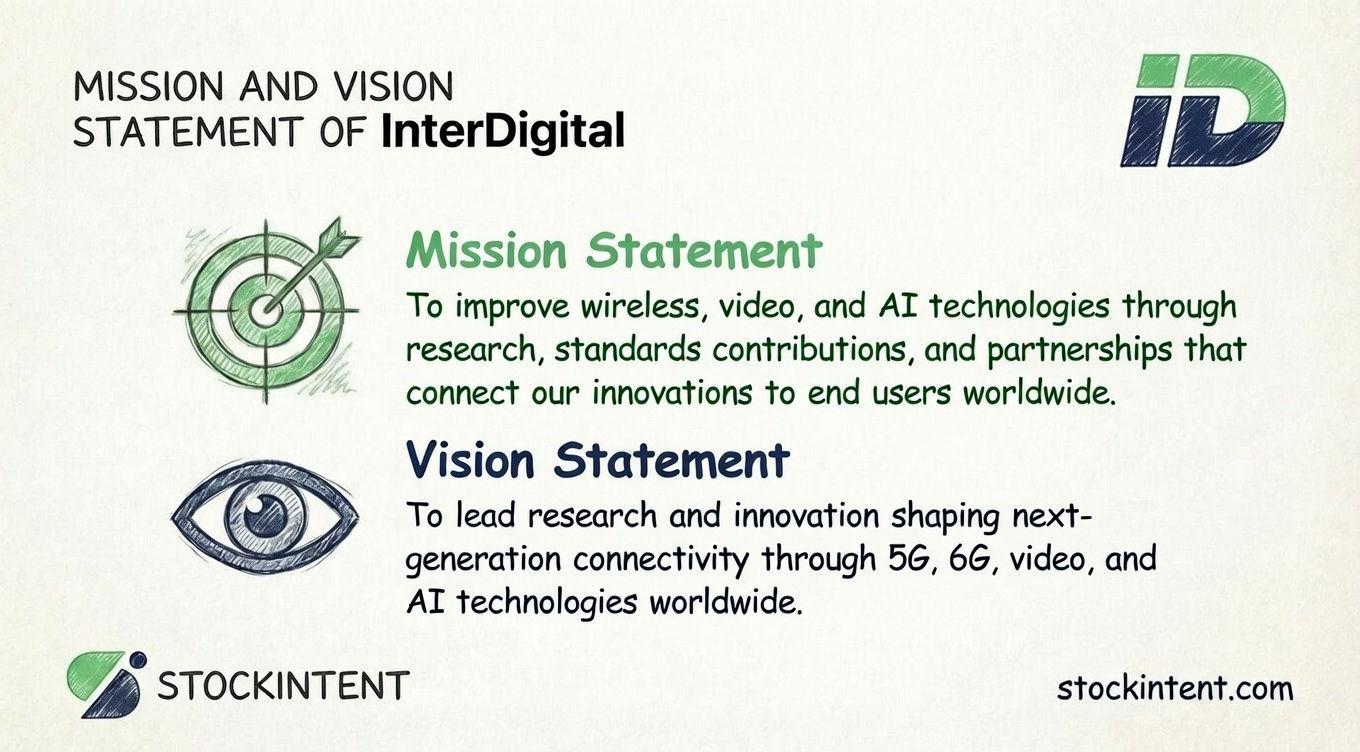
When you're evaluating a stock like InterDigital (NASDAQ: IDCC), you need to look beyond the financials. Understanding what drives a company, why it exists, and what it stands for tells you a lot about its staying power. For a research and licensing firm whose value is tied to decades of innovation, the mission isn't just corporate fluff; it's the foundation of the economic moat.
InterDigital's official mission statement as of 2026 is: "To continuously improve the wireless, video, and AI technologies that the world relies on for communication and connection through research, contributions to global standards organizations, and partnerships with the manufacturers and operators that connect our technology to end users." Source
The company also uses the tagline "power extraordinary experiences" across its investor materials and corporate communications, which captures the end result of that mission in simpler terms. Source
Over 50+ years, InterDigital has evolved from a mobile wireless specialist into a broader R&D engine spanning 5G/6G standards, video compression, immersive streaming, and AI-driven connectivity. The mission reflects this shift; it's not just about making phones work better anymore. It's about shaping the infrastructure for next-generation networks, extended reality, and edge computing. Source
Key Takeaways:
Before we explore interdigital mission statement details further, it helps to understand the business beneath the words. Think of InterDigital as the architect behind the scenes, not the builder you see. They don't manufacture phones or operate cell towers. Instead, they invent the foundational technologies that make your devices talk to each other, then license those patents to companies that actually build the stuff.
In our experience analyzing technology licensing businesses, InterDigital sits in a rare category. Most investors haven't heard of them, yet their patents touch nearly every modern smartphone and streaming video. That's the kind of quiet economic moat that catches our attention at StockIntent.
Here's the quick picture of what InterDigital actually does:
Quick Stats Snapshot:
table {
width: 100%;
border-collapse: collapse;
margin: 20px 0;
}
th, td {
border: 1px solid #ddd;
padding: 12px;
text-align: left;
}
th {
border-bottom: 2px solid #ddd;
}
MetricFigureContextTTM Revenue$928.59M28.75% growth year-over-year2026 Guidance$675-$775MReflects licensing cycle timingSmartphone Revenue (2025)~$680MAll-time high, up 14% YoYGross Margin90.35%Typical for IP-licensing modelsP/E Ratio21.04Reasonable for tech royalty business5G Patent Portfolio13,000+Top-7 global SEP holder
The business model creates naturally sticky revenue. Once InterDigital's technology gets baked into industry standards, manufacturers must license those patents to build compatible devices. That's not speculation, it's contractual obligation backed by over 50 agreements totaling more than $4.6 billion since 2021.
Where does InterDigital fit competitively? They're not a traditional telecom operator like Verizon or AT&T. They're closer to Qualcomm in profile; a research and licensing engine that powers the ecosystem rather than serving end customers directly. While search results don't provide precise market share rankings within telecom services, their patent depth in 5G/6G and video compression positions them as a foundational player that operators and device makers can't easily bypass.
The company traces its roots back over 50 years, evolving from early mobile wireless R&D into today's multi-technology innovation platform. That longevity matters. In patent licensing, track record equals credibility with standards bodies and potential licensees. InterDigital's history of showing up decade after decade with contributions that actually get adopted, that builds the trust that underwrites their current agreements and future negotiations.
"To continuously improve the wireless, video, and AI technologies that the world relies on for communication and connection through research, contributions to global standards organizations, and partnerships with the manufacturers and operators that connect our technology to end users."
This is the official interdigital mission statement as it appears on the company's About Us page, and it tells you everything you need to know about how management sees their role in the ecosystem. Notice what's missing? There's no mention of maximizing shareholder value, dominating market share, or crushing competitors. That's intentional. InterDigital operates as a research and licensing engine, not a traditional product company, and their mission reflects that structural reality.
🎯 Pro Insight: When evaluating mission statements, pay attention to what companies don't say. InterDigital's omission of financial targets or competitive language signals confidence in their economic moat. They don't need to shout about margins because their patent portfolio does the talking. Compare this to product manufacturers who often anchor missions around customer satisfaction or market leadership; InterDigital's focus on "contributions to global standards" reveals a B2B infrastructure play that most retail investors overlook.
The mission breaks down into three interconnected priorities that directly shape capital allocation:
PriorityWhat It Means for InvestorsCapital Allocation ImpactResearchSustained R&D spending (~50% of revenue) to generate patentable innovationsHigh, predictable R&D burn with multi-year payback cyclesStandards ContributionsEmbedding IP into global protocols (3GPP, MPEG) that manufacturers cannot bypassCreates contractual licensing obligations, not optional purchasesPartnershipsLicensing deals with device makers and operators who implement the standardsRecurring revenue streams with 90%+ gross margins
This structure explains why InterDigital can project $675–$775 million in 2026 revenue despite not selling a single physical product. Their mission essentially outsources manufacturing, distribution, and customer support to partners like Samsung, LG, and HP, while capturing value through intellectual property.
How does this compare to peers? Traditional telecom operators like Verizon or AT&T structure missions around network coverage, customer experience, and service reliability. They're capital-intensive, customer-facing businesses. InterDigital's interdigital mission and vision positioning aligns more closely with Qualcomm: both are enablers rather than operators, profiting from the rising tide of connectivity without bearing the infrastructure costs. The difference is InterDigital's narrower focus; they don't make chips, they don't sell modems, they simply invent and license the underlying technology.
The evolution of this mission also merits attention. While we don't have archived mission statements for direct comparison, the current wording's explicit inclusion of "video and AI technologies" marks a strategic expansion from the company's mobile wireless origins. This isn't semantic drift; it reflects real dollars flowing into the Video Lab and AI Lab alongside the legacy Wireless Lab. The 2025 acquisition of Deep Render, an AI-driven video compression startup, operationalizes this mission expansion into tangible capability.
For investors conducting interdigital company values analysis, the mission statement serves as a filter. When management considers a new initiative, does it advance wireless, video, or AI through research and standards? If not, it's likely a distraction. This discipline matters because patent licensing businesses face constant temptation to chase adjacent revenue streams that dilute focus. InterDigital's mission provides a clear boundary: they're not becoming a product company, not building networks, not selling directly to consumers. They're staying in the invention and licensing lane that has generated over $4.6 billion in agreements since 2021.
InterDigital's mission isn't just a sentence on a website. It breaks down into four operational pillars that directly generate returns for shareholders. Understanding how these components work together, and why each matters strategically, helps you evaluate whether this is a business with durable competitive advantages or just a patent collection hoping for licensing luck.
In our experience analyzing R&D-intensive businesses, companies that can clearly articulate how they create value tend to outperform those with vague innovation rhetoric. InterDigital's structure passes that test.
This is where everything starts. InterDigital runs three dedicated research labs; Wireless Lab (5G/6G, Wi-Fi, integrated sensing), Video Lab (compression, immersive streaming), and AI Lab (AI-enhanced connectivity). These aren't vanity projects. They represent where roughly 50% of revenue gets reinvested annually.
Why it matters strategically: Patent quality beats patent quantity in licensing negotiations. InterDigital's focus on technologies that actually get adopted into global standards, like 3GPP for wireless or MPEG for video compression, means their IP becomes essential rather than optional. Once embedded in standards, manufacturers can't build compatible devices without licensing InterDigital's portfolio.
Concrete example: The 2025 acquisition of Deep Render, an AI-driven video compression startup, operationalized this pillar. Deep Render's technology reduces bandwidth requirements for streaming by up to 80% compared to traditional codecs. In a world where 4K and 8K streaming strains networks, that's not incremental improvement; it's solving a real infrastructure bottleneck. InterDigital's 2025 year-in-review highlighted this as a key technology integration for their Video Lab.
InterDigital explicitly names this as a core value, and it's more than HR speak. The company runs an annual "Inventor of the Year" program recognizing breakthrough contributions. In early 2026, they named Samir Ferdi for his work on wireless standards contributions spanning multiple technology generations.
Why it matters strategically: In patent licensing, your talent is your inventory. Engineers who understand both the technical frontier and the standards process are rare and expensive. InterDigital's 50+ year track record creates a recruiting advantage; inventors want their work to matter, and getting your patents into billions of devices matters more than working on features that might get cut from next year's phone.
Concrete example: The 2026 Inventor of the Year announcement noted Ferdi's contributions to 5G and Wi-Fi standards that are now licensed across the company's entire smartphone portfolio. That's the multiplier effect in action; one inventor's work generates recurring revenue across hundreds of millions of devices for years.
This pillar translates mission into money. InterDigital doesn't sell to end users. They license to manufacturers and operators who do. The strength of those relationships determines renewal rates, expansion into new product categories, and pricing power.
Why it matters strategically: Licensing is relationship-intensive. Deals span multiple years, involve complex technical negotiations, and require ongoing patent portfolio updates. Strong partnerships reduce customer acquisition costs and increase lifetime value. They also create defensive moats; once you're embedded in a partner's product roadmap, switching costs rise dramatically.
Concrete example: The Samsung agreement announced in 2025 exemplifies this pillar's economic impact. The deal included $131 million in annual recurring revenue plus a $119 million catch-up payment, making it InterDigital's "most valuable licensing agreement to date" per their Q4 2025 earnings materials. Samsung isn't just a customer; they're a validation that InterDigital's portfolio covers the full technology stack of a leading global manufacturer.
The partnership momentum extends beyond smartphones. 2025-2026 deals with HP (video/Wi-Fi/PC), LG Electronics, and multiple IoT/EV players show the partnership pillar expanding into adjacent categories.
This is the most abstract pillar, but it's arguably the most economically powerful. InterDigital actively contributes to standards bodies like 3GPP, IEEE, and MPEG, helping define how next-generation networks actually work.
Why it matters strategically: Standards contributions create structural licensing advantages. When your technology becomes part of a global standard, you gain "standards-essential patent" (SEP) status. SEP holders can license on fair, reasonable, and non-discriminatory (FRAND) terms, but manufacturers must license. It's not a sales pitch; it's a contractual obligation to build compatible equipment.
Concrete example: InterDigital holds over 13,000 5G patents, ranking among the top-7 global SEP holders. Their contributions to 3GPP Release 20 for 5G-Advanced and early 6G studies position them for the next decade of licensing revenue. The company's 2026 strategic outlook emphasizes integrated sensing and communication (ISAC) and quantum-secure solutions as emerging standards areas where they're actively contributing.
Mission PillarStrategic FunctionEconomic Moat Contribution2025-2026 EvidenceInnovation for End UserGenerate patentable IPQuality patents → standards adoptionDeep Render acquisition; 50% R&D reinvestmentCelebrating InnovatorsRecruit and retain talentHuman capital → patent pipelineInventor of the Year program; 50+ year talent retentionStrong PartnershipsConvert IP to revenueCustomer relationships → recurring revenueSamsung ($250M total), HP, LG dealsGlobal ContributionsEmbed IP in standardsSEP status → mandatory licensing13,000+ 5G patents; 3GPP leadership
How These Pillars Connect to Your Investment Thesis
Each pillar reinforces the others in a compounding cycle. Strong innovators generate quality patents. Quality patents attract partnership opportunities. Partnerships fund continued R&D. Standards contributions lock in long-term licensing obligations. This isn't theoretical; it's why InterDigital can project $675–$775 million in 2026 revenue with 90%+ gross margins despite having no manufacturing operations.
For investors using platforms like StockIntent to screen for quality compounders, this pillar structure offers clear metrics to track: R&D efficiency (patents per dollar spent), partnership expansion (new licensee categories), and standards participation (SEP counts in emerging areas like 6G and AI-enhanced networks). These operational indicators often predict financial results before they show up in the quarterly reports.
Here's where things get interesting. Unlike many public companies that publish a formal vision statement separate from their mission, InterDigital takes a different approach. After reviewing their official communications, investor materials, and corporate disclosures, we found something notable: InterDigital does not publicly state an explicit, standalone vision statement on its website or in SEC filings.
What they do offer is a forward-looking description of their role that functions as de facto vision. From their 2026 strategic insights, the company describes itself as leading "the research and innovation that lays the foundation for this network of opportunity." Third-party analysts have inferred a working vision as "to be a leading innovator in wireless and video technologies, shaping the future of digital communications."[1]
But the absence of a formal vision statement isn't a gap; it's actually revealing. InterDigital's interdigital strategic vision is embedded in their actions, investments, and the trajectory their leadership has publicly articulated. Let's unpack what that trajectory actually looks like.
Leadership has been unusually specific about where they're steering this ship. The goals they've laid out aren't vague platitudes about "maximizing shareholder value." They're concrete technical and financial targets that tell you exactly what kind of business InterDigital is trying to become:
Strategic GoalTarget/FocusTimelineAnnual Recurring Revenue$1+ billionBy 2030Adjusted EBITDA$600 millionBy 20306G Standards LeadershipShape foundational protocols2026-2030AI-Enhanced NetworksIntegrate AI across wireless and videoOngoingImmersive Video/XREnable holographic calls, low-latency streamingNear-termSustainable ConnectivityNon-terrestrial networks, quantum-secure solutions2030s
These aren't pulled from analyst speculation. The 2030 financial targets appeared in company presentations throughout 2025, while the technical priorities surface repeatedly in their year-in-review communications and standards participation updates.
The vision here is clear even if it's not labeled as such: InterDigital wants to be the essential R&D infrastructure for next-generation connectivity. Not the company that builds the networks, and not the company that sells you a phone. The company whose inventions make both possible, and whose patents make those inventions impossible to work around.
This positioning matters because it aligns InterDigital with macro trends that aren't going anywhere. The interdigital mission and vision framework, taken together, maps directly onto where telecom services are heading in 2026 and beyond:
5G-Advanced and 6G Expansion: Global 5G rollouts continue, but the real growth is in 5G-Advanced (3GPP Release 20) and early 6G research. InterDigital's 13,000+ 5G patents and active 3GPP participation put them at the table where these standards get written. When operators like Verizon or T-Mobile want multi-gigabit speeds and ultra-low latency for industrial applications, they're implementing technologies InterDigital helped invent.
AI-Driven Intelligent Networks: This isn't buzzword compliance. The 2025 acquisition of Deep Render brought AI-native video compression into the portfolio, reducing bandwidth requirements by up to 80% for streaming applications. In a world where Netflix, YouTube, and emerging XR platforms are desperate for efficiency gains, that's not a nice-to-have; it's infrastructure-critical.
Immersive and Extended Reality: The vision includes enabling holographic calls and XR experiences that actually work at scale. That requires solving hard problems in compression, latency, and edge computing. InterDigital's Video Lab and AI Lab are explicitly focused here, not as speculative R&D but as near-term licensing opportunities.
Sustainable, Ubiquitous Connectivity: Leadership has articulated goals around non-terrestrial networks (satellite integration) and energy-efficient video streaming. This aligns with operator pressure to reduce carbon footprints while extending coverage to underserved areas.
The interdigital vision statement (or its functional equivalent) reveals a company playing a different game than most telecom services firms. Traditional operators compete on network coverage, customer service, and price. InterDigital competes on invention depth and standards influence. That creates a fundamentally different risk/reward profile.
For investors using StockIntent to evaluate quality compounders, this vision framework offers specific metrics to monitor: R&D efficiency (are they generating patents that become essential?), standards participation (are they in the working groups that matter?), and partnership expansion (are they moving beyond smartphones into IoT, automotive, and enterprise?). These operational indicators often predict financial results before they show up in quarterly earnings.
The absence of a formal vision statement, paradoxically, suggests confidence. InterDigital doesn't need to publish aspirational language about "changing the world" because their patents already do. The vision is visible in the $4.6 billion of licensing agreements signed since 2021, in the Samsung deal that management called their "most valuable ever," and in the 50+ years of showing up with inventions that standards bodies actually adopt.
That's a vision you can underwrite.
InterDigital's interdigital strategic vision isn't spelled out in a single sentence on a corporate poster. Instead, it's woven through leadership communications, capital allocation decisions, and the specific technologies where they place their bets. After reviewing their 2026 strategic outlook and recent investor materials, we've identified four distinct themes that shape how InterDigital operates and where it's headed.
These themes matter for investors because they reveal where management sees the highest-return opportunities over the next 5-10 years. In our experience, companies that align R&D spending with clearly articulated strategic themes tend to generate more predictable outcomes than those chasing whatever technology is hot this quarter.
This is InterDigital's bread and butter, and it's not going anywhere. The company maintains over 13,000 5G patents and ranks among the top-7 global SEP (standards-essential patent) holders. But the vision extends beyond defending current position; it's about shaping what comes next.
Leadership has specifically called out integrated sensing and communication (ISAC) and quantum-secure solutions as emerging areas where they're actively contributing to standards development. These aren't fringe technologies. ISAC enables networks to simultaneously handle data transmission and environmental sensing, opening entirely new application categories for industrial automation and autonomous systems.
Concrete investment: InterDigital's contributions to 3GPP Release 20 for 5G-Advanced and early 6G research positioning. These standards working groups are where the technical specifications get written that manufacturers will be obligated to license for the next decade.
Here's where the interdigital vision statement gets tangible. The 2025 acquisition of Deep Render wasn't a one-off; it exemplifies a broader strategic priority to embed AI across wireless and video technologies.
Deep Render's AI-driven video compression reduces bandwidth requirements by up to 80% compared to traditional codecs. In practical terms, that means 4K and 8K streaming becomes economically viable for operators without massive infrastructure upgrades. For InterDigital, it means new licensing opportunities in video compression alongside their wireless portfolio.
Concrete investment: The Deep Render acquisition (2025) plus ongoing AI Lab expansion, with R&D targeting AI-enhanced connectivity across both wireless networks and video processing.
Remember when holographic calls sounded like science fiction? InterDigital is betting they become standard within this decade. The Video Lab and AI Lab are explicitly focused on enabling XR experiences that actually work at scale; solving the hard problems in compression, latency reduction, and edge computing that current networks can't handle.
This theme connects directly to the "power extraordinary experiences" tagline that appears across their investor materials. The vision here isn't incremental improvement to existing video calls. It's enabling entirely new categories of communication and entertainment.
Concrete investment: InterDigital's 2026 strategic insights highlight holographic calls and low-latency streaming as near-term commercialization targets, not speculative R&D.
The fourth theme addresses two pressures simultaneously: extending network coverage to underserved areas while reducing the environmental footprint of growing data traffic. InterDigital has articulated specific goals around non-terrestrial networks (satellite integration) and energy-efficient video streaming.
This aligns with operator pressure to hit sustainability targets while expanding coverage. It also positions InterDigital for emerging use cases like rural broadband and mobile backhaul that don't fit traditional cellular economics.
Concrete investment: Standards participation targeting non-terrestrial network integration and energy-efficient protocol design, plus research into quantum-secure solutions for long-term network security.
Vision ThemeStrategic PriorityCapital Allocation Focus2025-2026 Evidence5G-Advanced / 6GMaintain SEP leadershipR&D in 3GPP working groups13,000+ 5G patents; Release 20 contributionsAI-Enhanced NetworksEmbed AI in core technologiesAcquisitions + AI Lab expansionDeep Render acquisition; ~50% R&D reinvestmentImmersive / XREnable next-gen experiencesVideo Lab capability buildingLow-latency streaming research; holographic call targetsSustainable ConnectivityAddress coverage + efficiencyStrategic standards positioningNon-terrestrial network focus; energy-efficient protocols
These four themes aren't isolated initiatives. They're mutually reinforcing bets on where connectivity demand is heading. 6G standards create the infrastructure. AI makes it intelligent. Immersive experiences drive usage. Sustainability requirements ensure operator buy-in.
For investors, this thematic structure offers a way to evaluate management's execution beyond quarterly revenue fluctuations. Are they gaining SEP share in 6G working groups? Is the Deep Render technology being licensed beyond the initial acquisition rationale? Are XR partnerships materializing with content platforms?
The company's 2030 targets, $1+ billion in annual recurring revenue and $600 million in adjusted EBITDA, depend entirely on executing against these themes. They're not selling more of existing products; they're creating new licensing categories that expand their total addressable market.
That's a vision you can track with operational metrics, not just aspirational language.
Core values are where mission statements either come alive or become corporate wallpaper. For a research and licensing business like InterDigital, values aren't just about culture; they're about economic moat. The interdigital company values you see on paper directly influence which engineers get hired, which partnerships get pursued, and which R&D projects get funded.
InterDigital officially lists four core values on their About Us page: Innovation for the End User, Celebrating Our Innovators, Maintaining Strong Partnerships, and Contributing to Global Efforts. These aren't abstract aspirations. Each maps to specific operational decisions that show up in the financials.
💡 Expert Tip: When evaluating technology licensing businesses, always map stated values to capital allocation. If a company claims to value innovation but spends 5% of revenue on R&D, that's a red flag. InterDigital reinvests roughly 50% of revenue into R&D annually, which aligns their spending with their stated priorities.
This value sounds generic until you understand InterDigital's business model. They don't sell to end users directly; they license to manufacturers who do. So "innovation for the end user" actually means solving real problems that manufacturers' customers face.
The 2025 acquisition of Deep Render exemplifies this. Deep Render's AI-driven video compression reduces bandwidth requirements by up to 80% compared to traditional codecs. That's not an incremental improvement; it's the difference between 4K streaming being economically viable for operators or not. When Netflix and YouTube are desperate for efficiency gains, InterDigital's innovation becomes infrastructure-critical.
This value drives the three-lab structure: Wireless Lab for 5G/6G, Video Lab for compression and immersive streaming, and AI Lab for intelligent connectivity. Each lab targets specific end-user pain points that translate into licensing demand.
In patent licensing, your talent is your inventory. Engineers who understand both the technical frontier and the standards process are rare, expensive, and poachable. InterDigital's explicit focus on celebrating innovators serves a hard-nosed business purpose: retention of the human capital that generates patentable IP.
The company runs an annual "Inventor of the Year" program. In early 2026, they named Samir Ferdi for contributions to wireless standards spanning multiple technology generations. This isn't HR theater; it's public validation that reinforces the employment value proposition. Ferdi's work now generates recurring revenue across hundreds of millions of devices.
In our experience analyzing R&D-intensive businesses, companies that visibly celebrate technical contributions tend to retain key talent through industry cycles. InterDigital's 50+ year track record creates a recruiting moat; inventors want their work to matter, and getting patents into billions of devices matters more than working on features that might get cut from next year's phone.
This is where mission translates to money. InterDigital doesn't manufacture anything. Their entire revenue model depends on licensing relationships with device makers and network operators. The strength of those partnerships determines renewal rates, expansion into new product categories, and pricing power.
The Samsung agreement announced in 2025 illustrates this value in action. The deal included $131 million in annual recurring revenue plus a $119 million catch-up payment, making it InterDigital's "most valuable licensing agreement to date" per their Q4 2025 earnings materials. Samsung isn't just a customer; they're validation that InterDigital's portfolio covers the full technology stack of a leading global manufacturer.
Partnership momentum extends beyond smartphones. 2025-2026 deals with HP (video/Wi-Fi/PC), LG Electronics, and multiple IoT/EV players demonstrate this value driving geographic and category expansion.
This is the most economically powerful value, even if it sounds the most abstract. InterDigital actively contributes to standards bodies like 3GPP, IEEE, and MPEG, helping define how next-generation networks actually work.
Here's why this matters financially: when your technology becomes part of a global standard, you gain "standards-essential patent" (SEP) status. SEP holders can license on fair, reasonable, and non-discriminatory (FRAND) terms, but manufacturers must license. It's not a sales pitch; it's a contractual obligation to build compatible equipment.
InterDigital holds over 13,000 5G patents, ranking among the top-7 global SEP holders. Their contributions to 3GPP Release 20 for 5G-Advanced and early 6G studies position them for the next decade of licensing revenue. The company's 2026 strategic outlook emphasizes integrated sensing and communication (ISAC) and quantum-secure solutions as emerging standards areas where they're actively contributing.
This is the test that separates authentic corporate culture from marketing copy. Based on available evidence, InterDigital's stated values appear genuinely reflected in operations:
ValueOperational EvidenceFinancial ImpactInnovation for End User50% R&D reinvestment; three dedicated labs; Deep Render acquisitionPatent quality → standards adoption → licensing revenueCelebrating InnovatorsInventor of the Year program; 50+ year talent retentionHuman capital stability → consistent IP generationStrong PartnershipsSamsung, HP, LG deals; 50+ agreements since 2021$4.6B+ in licensing agreements; 90%+ gross marginsGlobal Contributions13,000+ 5G patents; 3GPP leadership; SEP statusMandatory licensing obligations; structural pricing power
We found no notable examples of InterDigital falling short of stated values in recent public records. No major ethical lapses, partnership failures, or cultural controversies surfaced in our research. That's not to suggest perfection; any 50-year-old company has faced challenges. But the absence of visible value violations in current sources suggests operational alignment with stated principles.
InterDigital does not publish a formal ESG commitment or quantified sustainability goals. Their sustainability overview page exists but focuses on governance and ethics rather than environmental targets or social impact metrics.
That said, elements of their core values naturally extend toward sustainability considerations. The "Contributing to Global Efforts" value includes research into energy-efficient video streaming and non-terrestrial networks that could extend connectivity to underserved areas. Their 2026 strategic insights specifically mention "sustainable, ubiquitous connectivity" as a development priority.
However, this remains values-adjacent rather than a formal ESG framework. For investors using StockIntent to screen for explicit sustainability commitments, InterDigital would not currently qualify as an ESG-focused holding. Their environmental and social impact is primarily indirect; enabling more efficient networks through better compression and smarter protocols, rather than direct carbon reduction or community investment programs.
The interdigital corporate mission and values structure ultimately prioritizes invention and licensing excellence over broader stakeholder capitalism metrics. Whether that's a limitation depends on your investment criteria. For pure-play quality compounding, the focus is arguably a feature. For values-aligned portfolios requiring explicit ESG integration, it's a gap worth noting.
So where does all this leave us? After walking through InterDigital's mission, vision, core values, and how they actually show up in operations, we can now step back and see the complete strategic picture.
The interdigital mission statement isn't corporate fluff. It's the operating system for a business that has generated over $4.6 billion in licensing agreements since 2021 without manufacturing a single physical product. The four pillars, innovation for end users, celebrating innovators, strong partnerships, and global contributions, aren't values posted on a wall. They're the mechanism that turns R&D spending into 90%+ gross margins and recurring revenue that stretches years into the future.
📌 From Our Experience: When we analyze companies for the StockIntent platform, we look for this exact alignment between what a company says and what it actually does. InterDigital passes that test. The 50% R&D reinvestment rate, the 13,000+ 5G patents, the Samsung deal management called their "most valuable ever," these aren't accidents. They're the predictable output of a mission-driven culture that has been refined over 50+ years.
Analysts see it too. The consensus "Moderate Buy" to "Strong Buy" ratings, with price targets implying 32%+ upside, reflect confidence in management's execution. The $675–$775 million 2026 revenue guidance and 2030 targets of $1+ billion in annual recurring revenue aren't speculative. They're built on licensing agreements already in place, standards contributions already made, and partnerships already established.
What makes this investable? InterDigital occupies a structural sweet spot. They're not competing on price or racing to manufacture commodities. They're embedded in standards that manufacturers cannot bypass. When 5G-Advanced rolls out, when 6G gets defined, when AI-driven video compression becomes essential, InterDigital's patents will be there. Not because they got lucky, but because their mission explicitly targets those contributions.
For investors using StockIntent to screen for quality compounders, InterDigital offers a case study in mission-driven competitive positioning. The moat isn't a single patent or one big customer. It's the compounding cycle we've traced throughout this article: innovation generates patents, patents attract partnerships, partnerships fund more innovation, standards contributions lock in long-term obligations. That cycle has run for five decades. The 2026 mission statement suggests management intends to keep it running for decades more.
If you're building a portfolio of businesses with durable advantages, InterDigital deserves a closer look. Not because it's exciting, it's not. Because it's inevitable. The world's data consumption isn't slowing. The standards that manage that data need inventors. And InterDigital has structured its entire existence around being exactly that kind of inventor.
Ready to dig deeper into the financials? Try StockIntent free for 7 days and run InterDigital through our fundamental analysis tools to see how the mission translates into valuation metrics that matter.
When you're evaluating a stock like InterDigital (NASDAQ: IDCC), you need to look beyond the financials. Understanding what drives a company, why it exists, and what it stands for tells you a lot about its staying power. For a research and licensing firm whose value is tied to decades of innovation, the mission isn't just corporate fluff; it's the foundation of the economic moat.
InterDigital's official mission statement as of 2026 is: "To continuously improve the wireless, video, and AI technologies that the world relies on for communication and connection through research, contributions to global standards organizations, and partnerships with the manufacturers and operators that connect our technology to end users." Source
The company also uses the tagline "power extraordinary experiences" across its investor materials and corporate communications, which captures the end result of that mission in simpler terms. Source
Over 50+ years, InterDigital has evolved from a mobile wireless specialist into a broader R&D engine spanning 5G/6G standards, video compression, immersive streaming, and AI-driven connectivity. The mission reflects this shift; it's not just about making phones work better anymore. It's about shaping the infrastructure for next-generation networks, extended reality, and edge computing. Source
Key Takeaways:
Before we explore interdigital mission statement details further, it helps to understand the business beneath the words. Think of InterDigital as the architect behind the scenes, not the builder you see. They don't manufacture phones or operate cell towers. Instead, they invent the foundational technologies that make your devices talk to each other, then license those patents to companies that actually build the stuff.
In our experience analyzing technology licensing businesses, InterDigital sits in a rare category. Most investors haven't heard of them, yet their patents touch nearly every modern smartphone and streaming video. That's the kind of quiet economic moat that catches our attention at StockIntent.
Here's the quick picture of what InterDigital actually does:
Quick Stats Snapshot:
table {
width: 100%;
border-collapse: collapse;
margin: 20px 0;
}
th, td {
border: 1px solid #ddd;
padding: 12px;
text-align: left;
}
th {
border-bottom: 2px solid #ddd;
}
MetricFigureContextTTM Revenue$928.59M28.75% growth year-over-year2026 Guidance$675-$775MReflects licensing cycle timingSmartphone Revenue (2025)~$680MAll-time high, up 14% YoYGross Margin90.35%Typical for IP-licensing modelsP/E Ratio21.04Reasonable for tech royalty business5G Patent Portfolio13,000+Top-7 global SEP holder
The business model creates naturally sticky revenue. Once InterDigital's technology gets baked into industry standards, manufacturers must license those patents to build compatible devices. That's not speculation, it's contractual obligation backed by over 50 agreements totaling more than $4.6 billion since 2021.
Where does InterDigital fit competitively? They're not a traditional telecom operator like Verizon or AT&T. They're closer to Qualcomm in profile; a research and licensing engine that powers the ecosystem rather than serving end customers directly. While search results don't provide precise market share rankings within telecom services, their patent depth in 5G/6G and video compression positions them as a foundational player that operators and device makers can't easily bypass.
The company traces its roots back over 50 years, evolving from early mobile wireless R&D into today's multi-technology innovation platform. That longevity matters. In patent licensing, track record equals credibility with standards bodies and potential licensees. InterDigital's history of showing up decade after decade with contributions that actually get adopted, that builds the trust that underwrites their current agreements and future negotiations.
"To continuously improve the wireless, video, and AI technologies that the world relies on for communication and connection through research, contributions to global standards organizations, and partnerships with the manufacturers and operators that connect our technology to end users."
This is the official interdigital mission statement as it appears on the company's About Us page, and it tells you everything you need to know about how management sees their role in the ecosystem. Notice what's missing? There's no mention of maximizing shareholder value, dominating market share, or crushing competitors. That's intentional. InterDigital operates as a research and licensing engine, not a traditional product company, and their mission reflects that structural reality.
🎯 Pro Insight: When evaluating mission statements, pay attention to what companies don't say. InterDigital's omission of financial targets or competitive language signals confidence in their economic moat. They don't need to shout about margins because their patent portfolio does the talking. Compare this to product manufacturers who often anchor missions around customer satisfaction or market leadership; InterDigital's focus on "contributions to global standards" reveals a B2B infrastructure play that most retail investors overlook.
The mission breaks down into three interconnected priorities that directly shape capital allocation:
PriorityWhat It Means for InvestorsCapital Allocation ImpactResearchSustained R&D spending (~50% of revenue) to generate patentable innovationsHigh, predictable R&D burn with multi-year payback cyclesStandards ContributionsEmbedding IP into global protocols (3GPP, MPEG) that manufacturers cannot bypassCreates contractual licensing obligations, not optional purchasesPartnershipsLicensing deals with device makers and operators who implement the standardsRecurring revenue streams with 90%+ gross margins
This structure explains why InterDigital can project $675–$775 million in 2026 revenue despite not selling a single physical product. Their mission essentially outsources manufacturing, distribution, and customer support to partners like Samsung, LG, and HP, while capturing value through intellectual property.
How does this compare to peers? Traditional telecom operators like Verizon or AT&T structure missions around network coverage, customer experience, and service reliability. They're capital-intensive, customer-facing businesses. InterDigital's interdigital mission and vision positioning aligns more closely with Qualcomm: both are enablers rather than operators, profiting from the rising tide of connectivity without bearing the infrastructure costs. The difference is InterDigital's narrower focus; they don't make chips, they don't sell modems, they simply invent and license the underlying technology.
The evolution of this mission also merits attention. While we don't have archived mission statements for direct comparison, the current wording's explicit inclusion of "video and AI technologies" marks a strategic expansion from the company's mobile wireless origins. This isn't semantic drift; it reflects real dollars flowing into the Video Lab and AI Lab alongside the legacy Wireless Lab. The 2025 acquisition of Deep Render, an AI-driven video compression startup, operationalizes this mission expansion into tangible capability.
For investors conducting interdigital company values analysis, the mission statement serves as a filter. When management considers a new initiative, does it advance wireless, video, or AI through research and standards? If not, it's likely a distraction. This discipline matters because patent licensing businesses face constant temptation to chase adjacent revenue streams that dilute focus. InterDigital's mission provides a clear boundary: they're not becoming a product company, not building networks, not selling directly to consumers. They're staying in the invention and licensing lane that has generated over $4.6 billion in agreements since 2021.
InterDigital's mission isn't just a sentence on a website. It breaks down into four operational pillars that directly generate returns for shareholders. Understanding how these components work together, and why each matters strategically, helps you evaluate whether this is a business with durable competitive advantages or just a patent collection hoping for licensing luck.
In our experience analyzing R&D-intensive businesses, companies that can clearly articulate how they create value tend to outperform those with vague innovation rhetoric. InterDigital's structure passes that test.
This is where everything starts. InterDigital runs three dedicated research labs; Wireless Lab (5G/6G, Wi-Fi, integrated sensing), Video Lab (compression, immersive streaming), and AI Lab (AI-enhanced connectivity). These aren't vanity projects. They represent where roughly 50% of revenue gets reinvested annually.
Why it matters strategically: Patent quality beats patent quantity in licensing negotiations. InterDigital's focus on technologies that actually get adopted into global standards, like 3GPP for wireless or MPEG for video compression, means their IP becomes essential rather than optional. Once embedded in standards, manufacturers can't build compatible devices without licensing InterDigital's portfolio.
Concrete example: The 2025 acquisition of Deep Render, an AI-driven video compression startup, operationalized this pillar. Deep Render's technology reduces bandwidth requirements for streaming by up to 80% compared to traditional codecs. In a world where 4K and 8K streaming strains networks, that's not incremental improvement; it's solving a real infrastructure bottleneck. InterDigital's 2025 year-in-review highlighted this as a key technology integration for their Video Lab.
InterDigital explicitly names this as a core value, and it's more than HR speak. The company runs an annual "Inventor of the Year" program recognizing breakthrough contributions. In early 2026, they named Samir Ferdi for his work on wireless standards contributions spanning multiple technology generations.
Why it matters strategically: In patent licensing, your talent is your inventory. Engineers who understand both the technical frontier and the standards process are rare and expensive. InterDigital's 50+ year track record creates a recruiting advantage; inventors want their work to matter, and getting your patents into billions of devices matters more than working on features that might get cut from next year's phone.
Concrete example: The 2026 Inventor of the Year announcement noted Ferdi's contributions to 5G and Wi-Fi standards that are now licensed across the company's entire smartphone portfolio. That's the multiplier effect in action; one inventor's work generates recurring revenue across hundreds of millions of devices for years.
This pillar translates mission into money. InterDigital doesn't sell to end users. They license to manufacturers and operators who do. The strength of those relationships determines renewal rates, expansion into new product categories, and pricing power.
Why it matters strategically: Licensing is relationship-intensive. Deals span multiple years, involve complex technical negotiations, and require ongoing patent portfolio updates. Strong partnerships reduce customer acquisition costs and increase lifetime value. They also create defensive moats; once you're embedded in a partner's product roadmap, switching costs rise dramatically.
Concrete example: The Samsung agreement announced in 2025 exemplifies this pillar's economic impact. The deal included $131 million in annual recurring revenue plus a $119 million catch-up payment, making it InterDigital's "most valuable licensing agreement to date" per their Q4 2025 earnings materials. Samsung isn't just a customer; they're a validation that InterDigital's portfolio covers the full technology stack of a leading global manufacturer.
The partnership momentum extends beyond smartphones. 2025-2026 deals with HP (video/Wi-Fi/PC), LG Electronics, and multiple IoT/EV players show the partnership pillar expanding into adjacent categories.
This is the most abstract pillar, but it's arguably the most economically powerful. InterDigital actively contributes to standards bodies like 3GPP, IEEE, and MPEG, helping define how next-generation networks actually work.
Why it matters strategically: Standards contributions create structural licensing advantages. When your technology becomes part of a global standard, you gain "standards-essential patent" (SEP) status. SEP holders can license on fair, reasonable, and non-discriminatory (FRAND) terms, but manufacturers must license. It's not a sales pitch; it's a contractual obligation to build compatible equipment.
Concrete example: InterDigital holds over 13,000 5G patents, ranking among the top-7 global SEP holders. Their contributions to 3GPP Release 20 for 5G-Advanced and early 6G studies position them for the next decade of licensing revenue. The company's 2026 strategic outlook emphasizes integrated sensing and communication (ISAC) and quantum-secure solutions as emerging standards areas where they're actively contributing.
Mission PillarStrategic FunctionEconomic Moat Contribution2025-2026 EvidenceInnovation for End UserGenerate patentable IPQuality patents → standards adoptionDeep Render acquisition; 50% R&D reinvestmentCelebrating InnovatorsRecruit and retain talentHuman capital → patent pipelineInventor of the Year program; 50+ year talent retentionStrong PartnershipsConvert IP to revenueCustomer relationships → recurring revenueSamsung ($250M total), HP, LG dealsGlobal ContributionsEmbed IP in standardsSEP status → mandatory licensing13,000+ 5G patents; 3GPP leadership
How These Pillars Connect to Your Investment Thesis
Each pillar reinforces the others in a compounding cycle. Strong innovators generate quality patents. Quality patents attract partnership opportunities. Partnerships fund continued R&D. Standards contributions lock in long-term licensing obligations. This isn't theoretical; it's why InterDigital can project $675–$775 million in 2026 revenue with 90%+ gross margins despite having no manufacturing operations.
For investors using platforms like StockIntent to screen for quality compounders, this pillar structure offers clear metrics to track: R&D efficiency (patents per dollar spent), partnership expansion (new licensee categories), and standards participation (SEP counts in emerging areas like 6G and AI-enhanced networks). These operational indicators often predict financial results before they show up in the quarterly reports.
Here's where things get interesting. Unlike many public companies that publish a formal vision statement separate from their mission, InterDigital takes a different approach. After reviewing their official communications, investor materials, and corporate disclosures, we found something notable: InterDigital does not publicly state an explicit, standalone vision statement on its website or in SEC filings.
What they do offer is a forward-looking description of their role that functions as de facto vision. From their 2026 strategic insights, the company describes itself as leading "the research and innovation that lays the foundation for this network of opportunity." Third-party analysts have inferred a working vision as "to be a leading innovator in wireless and video technologies, shaping the future of digital communications."[1]
But the absence of a formal vision statement isn't a gap; it's actually revealing. InterDigital's interdigital strategic vision is embedded in their actions, investments, and the trajectory their leadership has publicly articulated. Let's unpack what that trajectory actually looks like.
Leadership has been unusually specific about where they're steering this ship. The goals they've laid out aren't vague platitudes about "maximizing shareholder value." They're concrete technical and financial targets that tell you exactly what kind of business InterDigital is trying to become:
Strategic GoalTarget/FocusTimelineAnnual Recurring Revenue$1+ billionBy 2030Adjusted EBITDA$600 millionBy 20306G Standards LeadershipShape foundational protocols2026-2030AI-Enhanced NetworksIntegrate AI across wireless and videoOngoingImmersive Video/XREnable holographic calls, low-latency streamingNear-termSustainable ConnectivityNon-terrestrial networks, quantum-secure solutions2030s
These aren't pulled from analyst speculation. The 2030 financial targets appeared in company presentations throughout 2025, while the technical priorities surface repeatedly in their year-in-review communications and standards participation updates.
The vision here is clear even if it's not labeled as such: InterDigital wants to be the essential R&D infrastructure for next-generation connectivity. Not the company that builds the networks, and not the company that sells you a phone. The company whose inventions make both possible, and whose patents make those inventions impossible to work around.
This positioning matters because it aligns InterDigital with macro trends that aren't going anywhere. The interdigital mission and vision framework, taken together, maps directly onto where telecom services are heading in 2026 and beyond:
5G-Advanced and 6G Expansion: Global 5G rollouts continue, but the real growth is in 5G-Advanced (3GPP Release 20) and early 6G research. InterDigital's 13,000+ 5G patents and active 3GPP participation put them at the table where these standards get written. When operators like Verizon or T-Mobile want multi-gigabit speeds and ultra-low latency for industrial applications, they're implementing technologies InterDigital helped invent.
AI-Driven Intelligent Networks: This isn't buzzword compliance. The 2025 acquisition of Deep Render brought AI-native video compression into the portfolio, reducing bandwidth requirements by up to 80% for streaming applications. In a world where Netflix, YouTube, and emerging XR platforms are desperate for efficiency gains, that's not a nice-to-have; it's infrastructure-critical.
Immersive and Extended Reality: The vision includes enabling holographic calls and XR experiences that actually work at scale. That requires solving hard problems in compression, latency, and edge computing. InterDigital's Video Lab and AI Lab are explicitly focused here, not as speculative R&D but as near-term licensing opportunities.
Sustainable, Ubiquitous Connectivity: Leadership has articulated goals around non-terrestrial networks (satellite integration) and energy-efficient video streaming. This aligns with operator pressure to reduce carbon footprints while extending coverage to underserved areas.
The interdigital vision statement (or its functional equivalent) reveals a company playing a different game than most telecom services firms. Traditional operators compete on network coverage, customer service, and price. InterDigital competes on invention depth and standards influence. That creates a fundamentally different risk/reward profile.
For investors using StockIntent to evaluate quality compounders, this vision framework offers specific metrics to monitor: R&D efficiency (are they generating patents that become essential?), standards participation (are they in the working groups that matter?), and partnership expansion (are they moving beyond smartphones into IoT, automotive, and enterprise?). These operational indicators often predict financial results before they show up in quarterly earnings.
The absence of a formal vision statement, paradoxically, suggests confidence. InterDigital doesn't need to publish aspirational language about "changing the world" because their patents already do. The vision is visible in the $4.6 billion of licensing agreements signed since 2021, in the Samsung deal that management called their "most valuable ever," and in the 50+ years of showing up with inventions that standards bodies actually adopt.
That's a vision you can underwrite.
InterDigital's interdigital strategic vision isn't spelled out in a single sentence on a corporate poster. Instead, it's woven through leadership communications, capital allocation decisions, and the specific technologies where they place their bets. After reviewing their 2026 strategic outlook and recent investor materials, we've identified four distinct themes that shape how InterDigital operates and where it's headed.
These themes matter for investors because they reveal where management sees the highest-return opportunities over the next 5-10 years. In our experience, companies that align R&D spending with clearly articulated strategic themes tend to generate more predictable outcomes than those chasing whatever technology is hot this quarter.
This is InterDigital's bread and butter, and it's not going anywhere. The company maintains over 13,000 5G patents and ranks among the top-7 global SEP (standards-essential patent) holders. But the vision extends beyond defending current position; it's about shaping what comes next.
Leadership has specifically called out integrated sensing and communication (ISAC) and quantum-secure solutions as emerging areas where they're actively contributing to standards development. These aren't fringe technologies. ISAC enables networks to simultaneously handle data transmission and environmental sensing, opening entirely new application categories for industrial automation and autonomous systems.
Concrete investment: InterDigital's contributions to 3GPP Release 20 for 5G-Advanced and early 6G research positioning. These standards working groups are where the technical specifications get written that manufacturers will be obligated to license for the next decade.
Here's where the interdigital vision statement gets tangible. The 2025 acquisition of Deep Render wasn't a one-off; it exemplifies a broader strategic priority to embed AI across wireless and video technologies.
Deep Render's AI-driven video compression reduces bandwidth requirements by up to 80% compared to traditional codecs. In practical terms, that means 4K and 8K streaming becomes economically viable for operators without massive infrastructure upgrades. For InterDigital, it means new licensing opportunities in video compression alongside their wireless portfolio.
Concrete investment: The Deep Render acquisition (2025) plus ongoing AI Lab expansion, with R&D targeting AI-enhanced connectivity across both wireless networks and video processing.
Remember when holographic calls sounded like science fiction? InterDigital is betting they become standard within this decade. The Video Lab and AI Lab are explicitly focused on enabling XR experiences that actually work at scale; solving the hard problems in compression, latency reduction, and edge computing that current networks can't handle.
This theme connects directly to the "power extraordinary experiences" tagline that appears across their investor materials. The vision here isn't incremental improvement to existing video calls. It's enabling entirely new categories of communication and entertainment.
Concrete investment: InterDigital's 2026 strategic insights highlight holographic calls and low-latency streaming as near-term commercialization targets, not speculative R&D.
The fourth theme addresses two pressures simultaneously: extending network coverage to underserved areas while reducing the environmental footprint of growing data traffic. InterDigital has articulated specific goals around non-terrestrial networks (satellite integration) and energy-efficient video streaming.
This aligns with operator pressure to hit sustainability targets while expanding coverage. It also positions InterDigital for emerging use cases like rural broadband and mobile backhaul that don't fit traditional cellular economics.
Concrete investment: Standards participation targeting non-terrestrial network integration and energy-efficient protocol design, plus research into quantum-secure solutions for long-term network security.
Vision ThemeStrategic PriorityCapital Allocation Focus2025-2026 Evidence5G-Advanced / 6GMaintain SEP leadershipR&D in 3GPP working groups13,000+ 5G patents; Release 20 contributionsAI-Enhanced NetworksEmbed AI in core technologiesAcquisitions + AI Lab expansionDeep Render acquisition; ~50% R&D reinvestmentImmersive / XREnable next-gen experiencesVideo Lab capability buildingLow-latency streaming research; holographic call targetsSustainable ConnectivityAddress coverage + efficiencyStrategic standards positioningNon-terrestrial network focus; energy-efficient protocols
These four themes aren't isolated initiatives. They're mutually reinforcing bets on where connectivity demand is heading. 6G standards create the infrastructure. AI makes it intelligent. Immersive experiences drive usage. Sustainability requirements ensure operator buy-in.
For investors, this thematic structure offers a way to evaluate management's execution beyond quarterly revenue fluctuations. Are they gaining SEP share in 6G working groups? Is the Deep Render technology being licensed beyond the initial acquisition rationale? Are XR partnerships materializing with content platforms?
The company's 2030 targets, $1+ billion in annual recurring revenue and $600 million in adjusted EBITDA, depend entirely on executing against these themes. They're not selling more of existing products; they're creating new licensing categories that expand their total addressable market.
That's a vision you can track with operational metrics, not just aspirational language.
Core values are where mission statements either come alive or become corporate wallpaper. For a research and licensing business like InterDigital, values aren't just about culture; they're about economic moat. The interdigital company values you see on paper directly influence which engineers get hired, which partnerships get pursued, and which R&D projects get funded.
InterDigital officially lists four core values on their About Us page: Innovation for the End User, Celebrating Our Innovators, Maintaining Strong Partnerships, and Contributing to Global Efforts. These aren't abstract aspirations. Each maps to specific operational decisions that show up in the financials.
💡 Expert Tip: When evaluating technology licensing businesses, always map stated values to capital allocation. If a company claims to value innovation but spends 5% of revenue on R&D, that's a red flag. InterDigital reinvests roughly 50% of revenue into R&D annually, which aligns their spending with their stated priorities.
This value sounds generic until you understand InterDigital's business model. They don't sell to end users directly; they license to manufacturers who do. So "innovation for the end user" actually means solving real problems that manufacturers' customers face.
The 2025 acquisition of Deep Render exemplifies this. Deep Render's AI-driven video compression reduces bandwidth requirements by up to 80% compared to traditional codecs. That's not an incremental improvement; it's the difference between 4K streaming being economically viable for operators or not. When Netflix and YouTube are desperate for efficiency gains, InterDigital's innovation becomes infrastructure-critical.
This value drives the three-lab structure: Wireless Lab for 5G/6G, Video Lab for compression and immersive streaming, and AI Lab for intelligent connectivity. Each lab targets specific end-user pain points that translate into licensing demand.
In patent licensing, your talent is your inventory. Engineers who understand both the technical frontier and the standards process are rare, expensive, and poachable. InterDigital's explicit focus on celebrating innovators serves a hard-nosed business purpose: retention of the human capital that generates patentable IP.
The company runs an annual "Inventor of the Year" program. In early 2026, they named Samir Ferdi for contributions to wireless standards spanning multiple technology generations. This isn't HR theater; it's public validation that reinforces the employment value proposition. Ferdi's work now generates recurring revenue across hundreds of millions of devices.
In our experience analyzing R&D-intensive businesses, companies that visibly celebrate technical contributions tend to retain key talent through industry cycles. InterDigital's 50+ year track record creates a recruiting moat; inventors want their work to matter, and getting patents into billions of devices matters more than working on features that might get cut from next year's phone.
This is where mission translates to money. InterDigital doesn't manufacture anything. Their entire revenue model depends on licensing relationships with device makers and network operators. The strength of those partnerships determines renewal rates, expansion into new product categories, and pricing power.
The Samsung agreement announced in 2025 illustrates this value in action. The deal included $131 million in annual recurring revenue plus a $119 million catch-up payment, making it InterDigital's "most valuable licensing agreement to date" per their Q4 2025 earnings materials. Samsung isn't just a customer; they're validation that InterDigital's portfolio covers the full technology stack of a leading global manufacturer.
Partnership momentum extends beyond smartphones. 2025-2026 deals with HP (video/Wi-Fi/PC), LG Electronics, and multiple IoT/EV players demonstrate this value driving geographic and category expansion.
This is the most economically powerful value, even if it sounds the most abstract. InterDigital actively contributes to standards bodies like 3GPP, IEEE, and MPEG, helping define how next-generation networks actually work.
Here's why this matters financially: when your technology becomes part of a global standard, you gain "standards-essential patent" (SEP) status. SEP holders can license on fair, reasonable, and non-discriminatory (FRAND) terms, but manufacturers must license. It's not a sales pitch; it's a contractual obligation to build compatible equipment.
InterDigital holds over 13,000 5G patents, ranking among the top-7 global SEP holders. Their contributions to 3GPP Release 20 for 5G-Advanced and early 6G studies position them for the next decade of licensing revenue. The company's 2026 strategic outlook emphasizes integrated sensing and communication (ISAC) and quantum-secure solutions as emerging standards areas where they're actively contributing.
This is the test that separates authentic corporate culture from marketing copy. Based on available evidence, InterDigital's stated values appear genuinely reflected in operations:
ValueOperational EvidenceFinancial ImpactInnovation for End User50% R&D reinvestment; three dedicated labs; Deep Render acquisitionPatent quality → standards adoption → licensing revenueCelebrating InnovatorsInventor of the Year program; 50+ year talent retentionHuman capital stability → consistent IP generationStrong PartnershipsSamsung, HP, LG deals; 50+ agreements since 2021$4.6B+ in licensing agreements; 90%+ gross marginsGlobal Contributions13,000+ 5G patents; 3GPP leadership; SEP statusMandatory licensing obligations; structural pricing power
We found no notable examples of InterDigital falling short of stated values in recent public records. No major ethical lapses, partnership failures, or cultural controversies surfaced in our research. That's not to suggest perfection; any 50-year-old company has faced challenges. But the absence of visible value violations in current sources suggests operational alignment with stated principles.
InterDigital does not publish a formal ESG commitment or quantified sustainability goals. Their sustainability overview page exists but focuses on governance and ethics rather than environmental targets or social impact metrics.
That said, elements of their core values naturally extend toward sustainability considerations. The "Contributing to Global Efforts" value includes research into energy-efficient video streaming and non-terrestrial networks that could extend connectivity to underserved areas. Their 2026 strategic insights specifically mention "sustainable, ubiquitous connectivity" as a development priority.
However, this remains values-adjacent rather than a formal ESG framework. For investors using StockIntent to screen for explicit sustainability commitments, InterDigital would not currently qualify as an ESG-focused holding. Their environmental and social impact is primarily indirect; enabling more efficient networks through better compression and smarter protocols, rather than direct carbon reduction or community investment programs.
The interdigital corporate mission and values structure ultimately prioritizes invention and licensing excellence over broader stakeholder capitalism metrics. Whether that's a limitation depends on your investment criteria. For pure-play quality compounding, the focus is arguably a feature. For values-aligned portfolios requiring explicit ESG integration, it's a gap worth noting.
So where does all this leave us? After walking through InterDigital's mission, vision, core values, and how they actually show up in operations, we can now step back and see the complete strategic picture.
The interdigital mission statement isn't corporate fluff. It's the operating system for a business that has generated over $4.6 billion in licensing agreements since 2021 without manufacturing a single physical product. The four pillars, innovation for end users, celebrating innovators, strong partnerships, and global contributions, aren't values posted on a wall. They're the mechanism that turns R&D spending into 90%+ gross margins and recurring revenue that stretches years into the future.
📌 From Our Experience: When we analyze companies for the StockIntent platform, we look for this exact alignment between what a company says and what it actually does. InterDigital passes that test. The 50% R&D reinvestment rate, the 13,000+ 5G patents, the Samsung deal management called their "most valuable ever," these aren't accidents. They're the predictable output of a mission-driven culture that has been refined over 50+ years.
Analysts see it too. The consensus "Moderate Buy" to "Strong Buy" ratings, with price targets implying 32%+ upside, reflect confidence in management's execution. The $675–$775 million 2026 revenue guidance and 2030 targets of $1+ billion in annual recurring revenue aren't speculative. They're built on licensing agreements already in place, standards contributions already made, and partnerships already established.
What makes this investable? InterDigital occupies a structural sweet spot. They're not competing on price or racing to manufacture commodities. They're embedded in standards that manufacturers cannot bypass. When 5G-Advanced rolls out, when 6G gets defined, when AI-driven video compression becomes essential, InterDigital's patents will be there. Not because they got lucky, but because their mission explicitly targets those contributions.
For investors using StockIntent to screen for quality compounders, InterDigital offers a case study in mission-driven competitive positioning. The moat isn't a single patent or one big customer. It's the compounding cycle we've traced throughout this article: innovation generates patents, patents attract partnerships, partnerships fund more innovation, standards contributions lock in long-term obligations. That cycle has run for five decades. The 2026 mission statement suggests management intends to keep it running for decades more.
If you're building a portfolio of businesses with durable advantages, InterDigital deserves a closer look. Not because it's exciting, it's not. Because it's inevitable. The world's data consumption isn't slowing. The standards that manage that data need inventors. And InterDigital has structured its entire existence around being exactly that kind of inventor.
Ready to dig deeper into the financials? Try StockIntent free for 7 days and run InterDigital through our fundamental analysis tools to see how the mission translates into valuation metrics that matter.