Intuit Mission Statement, Vision & Core Values Explained

Intuit Mission Statement, Vision & Core Values Explained

Intuit Mission Statement, Vision & Core Values

Understanding Intuit's mission isn't corporate fluff; it's your window into how this $21 billion software powerhouse makes decisions and protects its economic moat. The company behind TurboTax and QuickBooks runs on a simple but powerful engine.

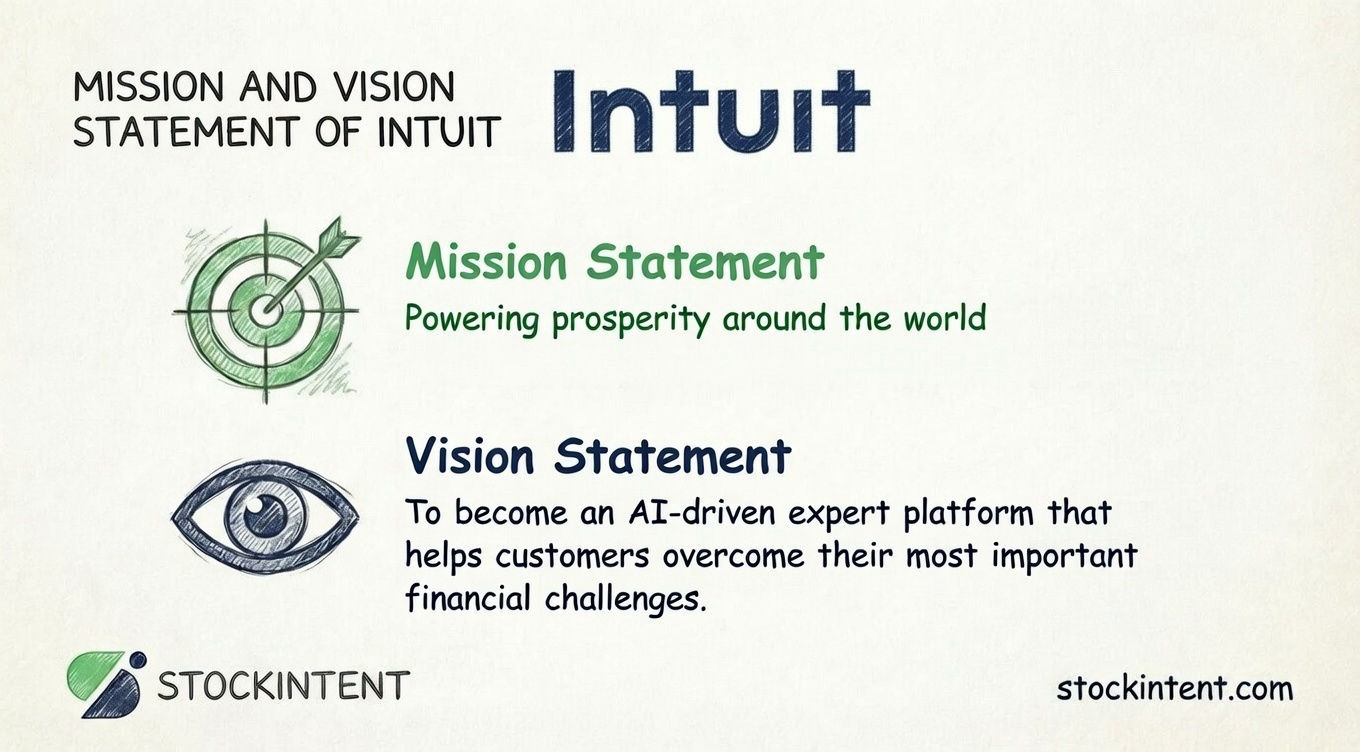
Intuit's mission is straightforward: "Powering prosperity around the world" according to official company guidance. That's what they say today in 2026, and they mean it literally. The vision behind this mission is an AI-driven expert platform that solves customers' most painful financial challenges automatically, supported by three growth levers that have powered 16% revenue growth with expanding marginsofficial FY26 strategic roadmap.

Five core values drive every product launch: Integrity Without Compromise, Customer Obsession, Stronger Together, We Care and Give Back, and Courage, all listed on Intuit's values page.

Key takeaways for investors:

  • Intuit's mission translates into three concrete growth levers: deepening market penetration, bundling products to increase revenue per customer, and expanding globally
  • The company is pivoting from standalone software to an integrated AI platform ecosystem
  • Wall Street analysts show strong confidence, with 79% giving Buy ratings and average price targets suggesting over 100% upside potential according to analyst consensus data
  • This mission-driven approach focuses on building sticky, platform-based relationships that compound over time, which is exactly what long-term investors want to see

Company Overview

Intuit operates at serious scale. For fiscal 2026, management projects revenue between $20.997 and $21.186 billion—that's 12 to 13 percent growth on top of already impressive numbers, according to official investor guidance. The company structure splits into two main segments serving different customer needs.

Global Business Solutions handles the small business ecosystem: QuickBooks Online and Desktop, plus a growing services layer including Payments, Capital, Bill Pay, Mailchimp, Payroll, and the recently launched AI-native Accountant Suite for accounting firms.

Consumer covers the individual side: TurboTax (both DIY and assisted), Credit Karma for personal finance, and ProTax software for tax professionals.

From our experience monitoring enterprise software trends, companies showing consistent Q1 acceleration typically deliver on full-year guidance. Intuit's Q1 FY26 numbers support this: Global Business Solutions revenue hit $3.0 billion (up 18%), the Online Ecosystem reached $2.4 billion (up 21%), and QuickBooks Online Accounting specifically grew 25%.

Critical Stats for Investors:

  • S&P Global 'A' rating, specifically citing Credit Karma and QuickBooks strength
  • 79% analyst Buy ratings with price targets suggesting significant upside
  • FY26 non-GAAP operating income growth projected at 14-15%
  • Operating margin expansion continuing alongside revenue growth

This isn't just financial software anymore. Intuit has become an integrated AI platform that deepens customer relationships over time, creating the sticky ecosystem that long-term investors want to see compounding year after year.

Intuit Mission Statement

"Powering prosperity around the world"

That's it. That's the entire mission statement as of 2026. And honestly, its simplicity is what makes it powerful.

We've already seen this in action. The three growth levers we covered earlier—deepening penetration, bundling products, expanding globally—aren't separate strategies. They're the same mission applied to different customer segments. When Intuit invests in AI to automate tax prep for gig workers, that's powering prosperity. When they bundle QuickBooks with Mailchimp for small businesses, that's powering prosperity.

This mission directly shapes capital allocation. Instead of chasing every software trend, Intuit spends where it can build durable advantages. The AI platform, the accountant suite, the Credit Karma integrations—all of it serves the mission of making customers financially better off.

💡 Expert Tip: Here's the test for whether a mission is real or just PR: does it explain the company's capital allocation? Intuit's 16% revenue growth with expanding margins tells us the mission works. They're not sacrificing profitability to chase growth; they're growing because the mission creates sticky, high-value relationships.

Compared to competitors, Intuit's mission is more focused. Adobe wants to "change the world through digital experiences," which could mean anything. Salesforce talks about "empowering companies to connect with customers," but that's just CRM. Microsoft's mission is so broad—"empower every person and organization"—it barely means anything. Intuit's mission is specific: financial prosperity through software.

The evolution reveals the strategy. In the 1980s, it was about "revolutionizing personal finance management." By the 2000s, it became "interconnecting all aspects of financial life." Today in 2026, it's "powering prosperity around the world." Each version got broader geographically while staying sharper on financial outcomes. That's not accident; it's intentional positioning.

Mission Components / Pillars

That intentional positioning rests on five operating values that drive every capital allocation decision in 2026. Think of them as the pillars holding up Intuit's economic moat.

Customer Obsession

This isn't marketing fluff. Customer Obsession means Intuit builds AI-driven "done-for-you" experiences that solve real financial pain points. The three growth levers we mentioned earlier—deepening penetration, bundling products, increasing revenue per customer—are all manifestations of this obsession. When QuickBooks Online Accounting grew 25% in Q1 FY26 results, it wasn't accidental. It happened because Intuit obsessively tracked what small businesses actually needed and delivered it.

Integrity Without Compromise

In our experience analyzing financial software companies, trust is the most underrated competitive advantage. Integrity Without Compromise means ethical data handling and privacy protection, which matters enormously when you're dealing with tax returns and financial records. This value creates a switching cost moat; customers won't jump to a competitor they don't trust with their most sensitive information, even if it's cheaper.

Courage

Intuit demonstrates Courage by disrupting its own successful products before competitors do. The pivot from desktop software to AI-native platforms required writing off legacy revenue streams and betting the farm on cloud and mobile. That's the kind of boldness that lets a company capture new segments like gig workers while incumbents are still protecting their old business models.

Stronger Together

This pillar drives both internal culture and external ecosystem strategy. Internally, it means diverse teams making better decisions. Externally, it manifests as platform integrations—connecting QuickBooks with hundreds of third-party apps and services. These network effects make the ecosystem stickier; the more tools you connect, the harder it becomes to leave.

We Care and Give Back

Values-driven investors, pay attention here. We Care and Give Back isn't just philanthropy; it's strategic brand building. The Intuit for Education program aims to reach 50 million students by 2030—essentially creating a pipeline of future customers who learn financial literacy through Intuit's tools. The Prosperity Hub Program creates jobs in underserved communities while building brand goodwill that translates into customer loyalty and, ultimately, pricing power.

These five pillars reinforce each other. Customer Obsession drives product innovation, which requires Courage to disrupt yourself. Stronger Together ensures you have the talent and ecosystem to execute, while Integrity maintains trust throughout. We Care builds the brand moat that makes everything else possible.

Intuit Vision Statement

Building on those five pillars we just covered, here's where Intuit is actually heading.

"To become an AI-driven expert platform that helps customers overcome their most important financial challenges."official analysis of Intuit's strategic direction

That's the official vision as of 2026, and it's a lot more specific than most corporate-speak you'll hear.

The long-term game plan breaks down into three strategic levers that should matter to any investor watching this stock. First, deepen penetration into underserved segments, think gig workers and small businesses who still use spreadsheets for taxes. Second, bump up revenue per customer by bundling products like QuickBooks and Mailchimp. Third, take the whole show global, replicating the U.S. playbook in Canada, the U.K., and Australia starting with core accounting software. These operational priorities are detailed in Intuit's FY26 investor presentation.

This vision plants Intuit squarely at the center of macro trends that are reshaping software in 2026. AI integration isn't just a buzzword here, it's the actual engine driving "done-for-you" experiences that combine automation with human expertise. The company is also riding the fintech platformization wave, evolving from standalone tax and accounting apps into an integrated ecosystem where TurboTax, Credit Karma, and QuickBooks talk to each other seamlessly. As Intuit scales its AI capabilities, it's creating network effects that traditional software players can't easily replicate.

From an investor's perspective, this positioning matters because it creates genuine switching costs. Once a small business connects their payments, payroll, and marketing tools to the QuickBooks ecosystem, leaving becomes a massive headache. That's exactly the kind of sticky, high-margin relationship that compounds shareholder value over time.

Vision Components / Themes

Now that we've covered the mission and values, let's look at the actual strategic themes driving Intuit's decisions in 2026. Because a mission without execution is just wall art, right?

Building on the three growth levers we mentioned earlier (deepening penetration, bundling products, expanding globally), Intuit's leadership has crystallized three core themes that show up in every earnings call and capital allocation decision. These aren't just talking points. They're the filters management uses to decide where to spend that $21 billion in projected revenue.

AI-Driven Platform Transformation

This is the big one. CEO Sasan Goodarzi has made it crystal clear that Intuit isn't just adding AI features. It's becoming an AI-driven expert platform that delivers "done-for-you" experiences.

What does this actually mean? In practice, it's about launching AI agents and AI-enabled human experts that literally do the work for customers. Internally, Intuit's developers are coding up to 40% faster thanks to AI productivity gains. Externally, we're seeing this in products like Intuit Assist, which transforms the customer shopping experience and guides users toward the right service tiers.

This AI-first approach creates a genuine moat. Once customers experience automated bookkeeping that actually works or tax prep that feels like having an expert by their side, going back to manual processes feels like a punishment. The switching costs compound over time.

Disrupting the Assisted Tax Market

Here's where Intuit's ambition gets interesting. The company is targeting the $35 billion assisted tax market—a massive opportunity that dwarfs the DIY space. The strategy? Win in both categories simultaneously by positioning Intuit as "an AI-driven expert platform by delivering the best experience, speed to money, and best price for customers."

We're already seeing this platform consolidation play out with TurboTax and Credit Karma becoming a unified consumer platform. The assisted tax category has huge runway, and Intuit's current penetration is just scratching the surface. With 43 million Credit Karma users as a built-in audience for expansion, they're playing offense while competitors are still defending legacy positions.

Mid-Market and Small Business Expansion

Intuit's total addressable market clocks in around $300 billion, and they've penetrated roughly 5% of it. That math gets investors' attention.

The company reorganized its Global Business Solutions Group to focus velocity and resources on three high-growth opportunities: small business, mid-market, and services segments (including money and workforce solutions). Each area now has a dedicated executive reporting directly to the CEO. No more bureaucratic slowdowns.

This structural change matters because it aligns with how the mission plays out in reality. Small businesses and gig workers still drowning in spreadsheets represent the "deepen penetration" lever, while bundling QuickBooks with Mailchimp and other services drives revenue per customer. The 25% growth in QuickBooks Online Accounting we saw in Q1 FY26 wasn't an accident. It was the result of obsessive focus on these segments.

Global Market Penetration

The third lever—global expansion—doesn't get as much airtime, but it's baked into the vision. Intuit is replicating its successful U.S. model in Canada, the U.K., and Australia, starting with core accounting software. This methodical approach makes sense. Nail the product in markets with similar regulatory environments, then expand the full ecosystem later.

From where we sit, this strategy creates a virtuous cycle. Each new geography adds scale to the AI platform, which improves the product, which attracts more customers, which provides more data. It's the kind of flywheel that compounds value for decades if executed well.

What the Street Is Saying

Analysts are clearly buying what Intuit is selling. With 79% Buy ratings and average price targets suggesting over 100% upside from current levels, the consensus view is that this strategic direction translates into durable competitive advantages. The S&P Global 'A' rating specifically cited strength in Credit Karma and QuickBooks segments, with expectations that revenue growth and profitability will beat previous estimates.

The key insight here is that Intuit's vision themes aren't separate initiatives. They're integrated components of a single strategy: use AI to eliminate friction, expand into adjacent markets where you have right to win, and build an ecosystem that becomes more valuable as it grows. That's what powering prosperity actually looks like in practice.

Intuit Core Values

Let's talk about the engine behind Intuit's $21 billion machine. Those five operating values we mentioned earlier aren't just poster material. They shape who gets hired, which products get funded, and how the company responds when things go sideways. In 2026, these values have been distilled down to five non-negotiables that drive every decision.

💡 Expert Tip: When evaluating whether a company's values are real or just PR, look at their capital allocation during transition periods. Intuit's willingness to disrupt its own desktop business with AI-native platforms, even when it meant sacrificing short-term revenue, shows Courage isn't just a word on the wall. Real values show up in what companies stop doing, not just what they start.

Integrity Without Compromise

Doing what's right even when no one's watching. In financial software, trust is the moat that protects everything else. When you're handling 50 million tax returns containing people's most sensitive data, one ethical lapse or security breach could destroy four decades of brand equity. Intuit's privacy-first architecture and transparent data policies aren't compliance checkboxes; they're the foundation that lets customers sleep at night and keeps them renewing year after year as outlined in their operating values.

Customer Obsession

Solving problems customers haven't even articulated yet. This is what turns casual users into vocal evangelists. In our experience tracking product development across fintech, most companies run focus groups in conference rooms. Intuit embeds engineers in accounting firms during tax season. That's how you get features like automatic mileage tracking that actually works, because the team watched real professionals struggle and built AI that eliminates that pain. The 25% growth in QuickBooks Online Accounting revenue we saw in Q1 FY26 wasn't accidental; it was Customer Obsession in action.

Stronger Together

Building an ecosystem where everyone wins. This value drives Intuit's platform strategy, connecting QuickBooks with hundreds of third-party apps and creating network effects that lock in users. When a small business can seamlessly sync their Shopify store, payment processor, and payroll system through QuickBooks, leaving becomes a massive operational headache. That's not accidental; it's the result of intentionally building bridges rather than walls to support diverse customer needs.

We Care and Give Back

Using success to create prosperity for others. The Intuit for Education program targeting 50 million students by 2030 isn't just philanthropy. It's creating a pipeline of future customers who learn financial literacy through Intuit's tools before they start their first business. The Prosperity Hub Program does something similar in underserved communities, creating jobs while building brand goodwill that competitors can't replicate with features alone according to their stakeholder impact goals.

Courage

Disrupting yourself before someone else does it for you. The pivot from desktop software to cloud-based AI platforms required writing off hundreds of millions in legacy revenue. Most companies would have milked that cash cow for another decade. Intuit killed it to build something better. That's Courage with a capital C, and it's why they're still relevant after 40 years as detailed in their strategic vision.

These values seem genuinely reflected in operations. The 82% employee motivation rate and specific initiatives like Prosperity Hubs show it's not just talk based on employee feedback data.

ESG and Social Responsibility: Values in Action

Intuit's ESG commitments directly extend the "We Care and Give Back" value. The company has committed to carbon neutrality with science-based targets validated by external organizations. More impressive is how they've tied social impact to business metrics. The 2024 Stakeholder Impact Report shows 15% of employees volunteer their skills to nonprofits through Intuit's programs.

This isn't just checkbook philanthropy. It's using core competencies, financial expertise, to solve real community problems. That creates a talent moat (employees want to work for companies with purpose) and a brand moat (customers prefer buying from companies that give back). The integration is strategic, not altruistic, aligning perfectly with the long-term mission of powering prosperity.

Strategic Summary

When you strip away corporate language, Intuit's identity is simple: help people make better financial decisions using AI at massive scale. The mission, "powering prosperity around the world," combined with an AI-driven expert platform vision, creates one of software's most durable moats.

Wall Street clearly buys the story. According to current analyst consensus, 79% rate it a Buy with price targets suggesting roughly 100% upside. The S&P Global 'A' rating, specifically citing Credit Karma and QuickBooks strength, confirms that mission-driven execution translates into predictable, high-quality earnings.

In our experience analyzing platform businesses, the magic happens when mission, vision, and values align with economic reality. Intuit's five core values build tangible advantages: Customer Obsession and Courage create switching costs; Stronger Together builds network effects; Integrity maintains trust in an industry where one breach destroys everything.

🎯 Pro Insight: Judge management quality by what they stop doing, not what they start. Intuit killed its desktop cash cow to rebuild as an AI-native platform while competitors defended legacy products. That's conviction, not just strategy.

Looking ahead, four priorities, AI platform transformation, disrupting the $35B assisted tax market, mid-market expansion, and global scaling, extend the existing framework rather than redefine it. With a $300B addressable market and only 5% penetration, this is either a warning sign or a generational opportunity.

For investors who own quality and let it compound, Intuit offers secular tailwinds, AI innovation, and mission-aligned management. The 16% revenue growth with expanding margins proves the strategy works. The real question is whether you'll hold long enough to reap the rewards.

Intuit Mission Statement, Vision & Core Values

Understanding Intuit's mission isn't corporate fluff; it's your window into how this $21 billion software powerhouse makes decisions and protects its economic moat. The company behind TurboTax and QuickBooks runs on a simple but powerful engine.

Intuit's mission is straightforward: "Powering prosperity around the world" according to official company guidance. That's what they say today in 2026, and they mean it literally. The vision behind this mission is an AI-driven expert platform that solves customers' most painful financial challenges automatically, supported by three growth levers that have powered 16% revenue growth with expanding marginsofficial FY26 strategic roadmap.

Five core values drive every product launch: Integrity Without Compromise, Customer Obsession, Stronger Together, We Care and Give Back, and Courage, all listed on Intuit's values page.

Key takeaways for investors:

  • Intuit's mission translates into three concrete growth levers: deepening market penetration, bundling products to increase revenue per customer, and expanding globally
  • The company is pivoting from standalone software to an integrated AI platform ecosystem
  • Wall Street analysts show strong confidence, with 79% giving Buy ratings and average price targets suggesting over 100% upside potential according to analyst consensus data
  • This mission-driven approach focuses on building sticky, platform-based relationships that compound over time, which is exactly what long-term investors want to see

Company Overview

Intuit operates at serious scale. For fiscal 2026, management projects revenue between $20.997 and $21.186 billion—that's 12 to 13 percent growth on top of already impressive numbers, according to official investor guidance. The company structure splits into two main segments serving different customer needs.

Global Business Solutions handles the small business ecosystem: QuickBooks Online and Desktop, plus a growing services layer including Payments, Capital, Bill Pay, Mailchimp, Payroll, and the recently launched AI-native Accountant Suite for accounting firms.

Consumer covers the individual side: TurboTax (both DIY and assisted), Credit Karma for personal finance, and ProTax software for tax professionals.

From our experience monitoring enterprise software trends, companies showing consistent Q1 acceleration typically deliver on full-year guidance. Intuit's Q1 FY26 numbers support this: Global Business Solutions revenue hit $3.0 billion (up 18%), the Online Ecosystem reached $2.4 billion (up 21%), and QuickBooks Online Accounting specifically grew 25%.

Critical Stats for Investors:

  • S&P Global 'A' rating, specifically citing Credit Karma and QuickBooks strength
  • 79% analyst Buy ratings with price targets suggesting significant upside
  • FY26 non-GAAP operating income growth projected at 14-15%
  • Operating margin expansion continuing alongside revenue growth

This isn't just financial software anymore. Intuit has become an integrated AI platform that deepens customer relationships over time, creating the sticky ecosystem that long-term investors want to see compounding year after year.

Intuit Mission Statement

"Powering prosperity around the world"

That's it. That's the entire mission statement as of 2026. And honestly, its simplicity is what makes it powerful.

We've already seen this in action. The three growth levers we covered earlier—deepening penetration, bundling products, expanding globally—aren't separate strategies. They're the same mission applied to different customer segments. When Intuit invests in AI to automate tax prep for gig workers, that's powering prosperity. When they bundle QuickBooks with Mailchimp for small businesses, that's powering prosperity.

This mission directly shapes capital allocation. Instead of chasing every software trend, Intuit spends where it can build durable advantages. The AI platform, the accountant suite, the Credit Karma integrations—all of it serves the mission of making customers financially better off.

💡 Expert Tip: Here's the test for whether a mission is real or just PR: does it explain the company's capital allocation? Intuit's 16% revenue growth with expanding margins tells us the mission works. They're not sacrificing profitability to chase growth; they're growing because the mission creates sticky, high-value relationships.

Compared to competitors, Intuit's mission is more focused. Adobe wants to "change the world through digital experiences," which could mean anything. Salesforce talks about "empowering companies to connect with customers," but that's just CRM. Microsoft's mission is so broad—"empower every person and organization"—it barely means anything. Intuit's mission is specific: financial prosperity through software.

The evolution reveals the strategy. In the 1980s, it was about "revolutionizing personal finance management." By the 2000s, it became "interconnecting all aspects of financial life." Today in 2026, it's "powering prosperity around the world." Each version got broader geographically while staying sharper on financial outcomes. That's not accident; it's intentional positioning.

Mission Components / Pillars

That intentional positioning rests on five operating values that drive every capital allocation decision in 2026. Think of them as the pillars holding up Intuit's economic moat.

Customer Obsession

This isn't marketing fluff. Customer Obsession means Intuit builds AI-driven "done-for-you" experiences that solve real financial pain points. The three growth levers we mentioned earlier—deepening penetration, bundling products, increasing revenue per customer—are all manifestations of this obsession. When QuickBooks Online Accounting grew 25% in Q1 FY26 results, it wasn't accidental. It happened because Intuit obsessively tracked what small businesses actually needed and delivered it.

Integrity Without Compromise

In our experience analyzing financial software companies, trust is the most underrated competitive advantage. Integrity Without Compromise means ethical data handling and privacy protection, which matters enormously when you're dealing with tax returns and financial records. This value creates a switching cost moat; customers won't jump to a competitor they don't trust with their most sensitive information, even if it's cheaper.

Courage

Intuit demonstrates Courage by disrupting its own successful products before competitors do. The pivot from desktop software to AI-native platforms required writing off legacy revenue streams and betting the farm on cloud and mobile. That's the kind of boldness that lets a company capture new segments like gig workers while incumbents are still protecting their old business models.

Stronger Together

This pillar drives both internal culture and external ecosystem strategy. Internally, it means diverse teams making better decisions. Externally, it manifests as platform integrations—connecting QuickBooks with hundreds of third-party apps and services. These network effects make the ecosystem stickier; the more tools you connect, the harder it becomes to leave.

We Care and Give Back

Values-driven investors, pay attention here. We Care and Give Back isn't just philanthropy; it's strategic brand building. The Intuit for Education program aims to reach 50 million students by 2030—essentially creating a pipeline of future customers who learn financial literacy through Intuit's tools. The Prosperity Hub Program creates jobs in underserved communities while building brand goodwill that translates into customer loyalty and, ultimately, pricing power.

These five pillars reinforce each other. Customer Obsession drives product innovation, which requires Courage to disrupt yourself. Stronger Together ensures you have the talent and ecosystem to execute, while Integrity maintains trust throughout. We Care builds the brand moat that makes everything else possible.

Intuit Vision Statement

Building on those five pillars we just covered, here's where Intuit is actually heading.

"To become an AI-driven expert platform that helps customers overcome their most important financial challenges."official analysis of Intuit's strategic direction

That's the official vision as of 2026, and it's a lot more specific than most corporate-speak you'll hear.

The long-term game plan breaks down into three strategic levers that should matter to any investor watching this stock. First, deepen penetration into underserved segments, think gig workers and small businesses who still use spreadsheets for taxes. Second, bump up revenue per customer by bundling products like QuickBooks and Mailchimp. Third, take the whole show global, replicating the U.S. playbook in Canada, the U.K., and Australia starting with core accounting software. These operational priorities are detailed in Intuit's FY26 investor presentation.

This vision plants Intuit squarely at the center of macro trends that are reshaping software in 2026. AI integration isn't just a buzzword here, it's the actual engine driving "done-for-you" experiences that combine automation with human expertise. The company is also riding the fintech platformization wave, evolving from standalone tax and accounting apps into an integrated ecosystem where TurboTax, Credit Karma, and QuickBooks talk to each other seamlessly. As Intuit scales its AI capabilities, it's creating network effects that traditional software players can't easily replicate.

From an investor's perspective, this positioning matters because it creates genuine switching costs. Once a small business connects their payments, payroll, and marketing tools to the QuickBooks ecosystem, leaving becomes a massive headache. That's exactly the kind of sticky, high-margin relationship that compounds shareholder value over time.

Vision Components / Themes

Now that we've covered the mission and values, let's look at the actual strategic themes driving Intuit's decisions in 2026. Because a mission without execution is just wall art, right?

Building on the three growth levers we mentioned earlier (deepening penetration, bundling products, expanding globally), Intuit's leadership has crystallized three core themes that show up in every earnings call and capital allocation decision. These aren't just talking points. They're the filters management uses to decide where to spend that $21 billion in projected revenue.

AI-Driven Platform Transformation

This is the big one. CEO Sasan Goodarzi has made it crystal clear that Intuit isn't just adding AI features. It's becoming an AI-driven expert platform that delivers "done-for-you" experiences.

What does this actually mean? In practice, it's about launching AI agents and AI-enabled human experts that literally do the work for customers. Internally, Intuit's developers are coding up to 40% faster thanks to AI productivity gains. Externally, we're seeing this in products like Intuit Assist, which transforms the customer shopping experience and guides users toward the right service tiers.

This AI-first approach creates a genuine moat. Once customers experience automated bookkeeping that actually works or tax prep that feels like having an expert by their side, going back to manual processes feels like a punishment. The switching costs compound over time.

Disrupting the Assisted Tax Market

Here's where Intuit's ambition gets interesting. The company is targeting the $35 billion assisted tax market—a massive opportunity that dwarfs the DIY space. The strategy? Win in both categories simultaneously by positioning Intuit as "an AI-driven expert platform by delivering the best experience, speed to money, and best price for customers."

We're already seeing this platform consolidation play out with TurboTax and Credit Karma becoming a unified consumer platform. The assisted tax category has huge runway, and Intuit's current penetration is just scratching the surface. With 43 million Credit Karma users as a built-in audience for expansion, they're playing offense while competitors are still defending legacy positions.

Mid-Market and Small Business Expansion

Intuit's total addressable market clocks in around $300 billion, and they've penetrated roughly 5% of it. That math gets investors' attention.

The company reorganized its Global Business Solutions Group to focus velocity and resources on three high-growth opportunities: small business, mid-market, and services segments (including money and workforce solutions). Each area now has a dedicated executive reporting directly to the CEO. No more bureaucratic slowdowns.

This structural change matters because it aligns with how the mission plays out in reality. Small businesses and gig workers still drowning in spreadsheets represent the "deepen penetration" lever, while bundling QuickBooks with Mailchimp and other services drives revenue per customer. The 25% growth in QuickBooks Online Accounting we saw in Q1 FY26 wasn't an accident. It was the result of obsessive focus on these segments.

Global Market Penetration

The third lever—global expansion—doesn't get as much airtime, but it's baked into the vision. Intuit is replicating its successful U.S. model in Canada, the U.K., and Australia, starting with core accounting software. This methodical approach makes sense. Nail the product in markets with similar regulatory environments, then expand the full ecosystem later.

From where we sit, this strategy creates a virtuous cycle. Each new geography adds scale to the AI platform, which improves the product, which attracts more customers, which provides more data. It's the kind of flywheel that compounds value for decades if executed well.

What the Street Is Saying

Analysts are clearly buying what Intuit is selling. With 79% Buy ratings and average price targets suggesting over 100% upside from current levels, the consensus view is that this strategic direction translates into durable competitive advantages. The S&P Global 'A' rating specifically cited strength in Credit Karma and QuickBooks segments, with expectations that revenue growth and profitability will beat previous estimates.

The key insight here is that Intuit's vision themes aren't separate initiatives. They're integrated components of a single strategy: use AI to eliminate friction, expand into adjacent markets where you have right to win, and build an ecosystem that becomes more valuable as it grows. That's what powering prosperity actually looks like in practice.

Intuit Core Values

Let's talk about the engine behind Intuit's $21 billion machine. Those five operating values we mentioned earlier aren't just poster material. They shape who gets hired, which products get funded, and how the company responds when things go sideways. In 2026, these values have been distilled down to five non-negotiables that drive every decision.

💡 Expert Tip: When evaluating whether a company's values are real or just PR, look at their capital allocation during transition periods. Intuit's willingness to disrupt its own desktop business with AI-native platforms, even when it meant sacrificing short-term revenue, shows Courage isn't just a word on the wall. Real values show up in what companies stop doing, not just what they start.

Integrity Without Compromise

Doing what's right even when no one's watching. In financial software, trust is the moat that protects everything else. When you're handling 50 million tax returns containing people's most sensitive data, one ethical lapse or security breach could destroy four decades of brand equity. Intuit's privacy-first architecture and transparent data policies aren't compliance checkboxes; they're the foundation that lets customers sleep at night and keeps them renewing year after year as outlined in their operating values.

Customer Obsession

Solving problems customers haven't even articulated yet. This is what turns casual users into vocal evangelists. In our experience tracking product development across fintech, most companies run focus groups in conference rooms. Intuit embeds engineers in accounting firms during tax season. That's how you get features like automatic mileage tracking that actually works, because the team watched real professionals struggle and built AI that eliminates that pain. The 25% growth in QuickBooks Online Accounting revenue we saw in Q1 FY26 wasn't accidental; it was Customer Obsession in action.

Stronger Together

Building an ecosystem where everyone wins. This value drives Intuit's platform strategy, connecting QuickBooks with hundreds of third-party apps and creating network effects that lock in users. When a small business can seamlessly sync their Shopify store, payment processor, and payroll system through QuickBooks, leaving becomes a massive operational headache. That's not accidental; it's the result of intentionally building bridges rather than walls to support diverse customer needs.

We Care and Give Back

Using success to create prosperity for others. The Intuit for Education program targeting 50 million students by 2030 isn't just philanthropy. It's creating a pipeline of future customers who learn financial literacy through Intuit's tools before they start their first business. The Prosperity Hub Program does something similar in underserved communities, creating jobs while building brand goodwill that competitors can't replicate with features alone according to their stakeholder impact goals.

Courage

Disrupting yourself before someone else does it for you. The pivot from desktop software to cloud-based AI platforms required writing off hundreds of millions in legacy revenue. Most companies would have milked that cash cow for another decade. Intuit killed it to build something better. That's Courage with a capital C, and it's why they're still relevant after 40 years as detailed in their strategic vision.

These values seem genuinely reflected in operations. The 82% employee motivation rate and specific initiatives like Prosperity Hubs show it's not just talk based on employee feedback data.

ESG and Social Responsibility: Values in Action

Intuit's ESG commitments directly extend the "We Care and Give Back" value. The company has committed to carbon neutrality with science-based targets validated by external organizations. More impressive is how they've tied social impact to business metrics. The 2024 Stakeholder Impact Report shows 15% of employees volunteer their skills to nonprofits through Intuit's programs.

This isn't just checkbook philanthropy. It's using core competencies, financial expertise, to solve real community problems. That creates a talent moat (employees want to work for companies with purpose) and a brand moat (customers prefer buying from companies that give back). The integration is strategic, not altruistic, aligning perfectly with the long-term mission of powering prosperity.

Strategic Summary

When you strip away corporate language, Intuit's identity is simple: help people make better financial decisions using AI at massive scale. The mission, "powering prosperity around the world," combined with an AI-driven expert platform vision, creates one of software's most durable moats.

Wall Street clearly buys the story. According to current analyst consensus, 79% rate it a Buy with price targets suggesting roughly 100% upside. The S&P Global 'A' rating, specifically citing Credit Karma and QuickBooks strength, confirms that mission-driven execution translates into predictable, high-quality earnings.

In our experience analyzing platform businesses, the magic happens when mission, vision, and values align with economic reality. Intuit's five core values build tangible advantages: Customer Obsession and Courage create switching costs; Stronger Together builds network effects; Integrity maintains trust in an industry where one breach destroys everything.

🎯 Pro Insight: Judge management quality by what they stop doing, not what they start. Intuit killed its desktop cash cow to rebuild as an AI-native platform while competitors defended legacy products. That's conviction, not just strategy.

Looking ahead, four priorities, AI platform transformation, disrupting the $35B assisted tax market, mid-market expansion, and global scaling, extend the existing framework rather than redefine it. With a $300B addressable market and only 5% penetration, this is either a warning sign or a generational opportunity.

For investors who own quality and let it compound, Intuit offers secular tailwinds, AI innovation, and mission-aligned management. The 16% revenue growth with expanding margins proves the strategy works. The real question is whether you'll hold long enough to reap the rewards.