
Sep 18, 2026
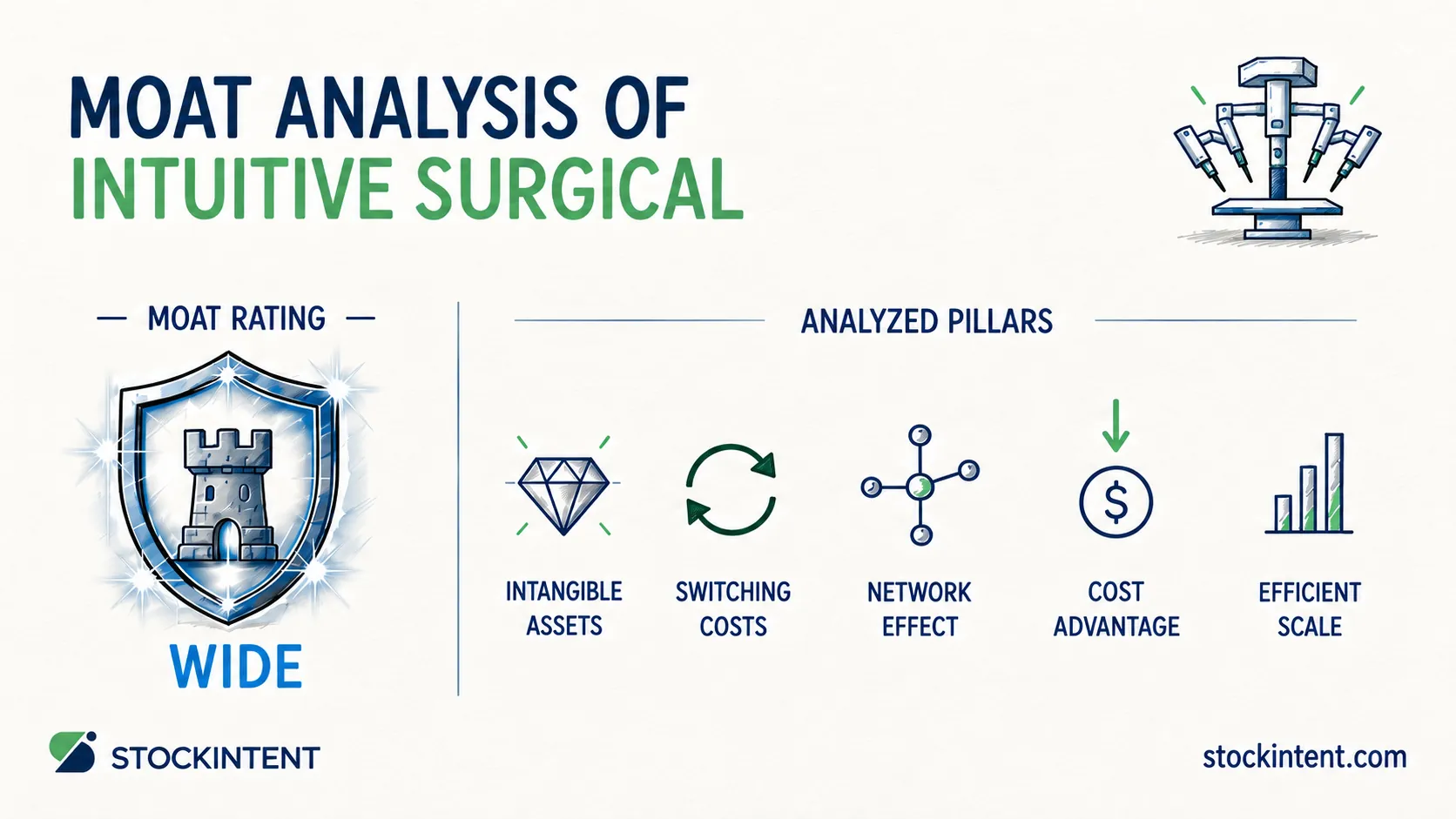
Intuitive Surgical carries a Wide moat driven primarily by switching costs and intangible assets, with a trend we judge as Widening in core markets but Stable overall, and a Medium uncertainty rating due to China competition and policy risks.
In Q2 2026, the company reported $2.89 billion in revenue, a 70.0% non-GAAP gross margin, and $2.80 non-GAAP EPS, while guiding for 13.5% to 15.5% worldwide da Vinci procedure growth and maintaining an installed base of 11,710 systems, up 12% year over year.
Here's the quick take:
For quality investors, the question isn't whether Intuitive Surgical looks cheap on today's multiples. It's whether these competitive advantages are durable enough to support uninterrupted compounding over the next decade. Understanding which moat pillars are genuine, and which are overstated by bullish narratives, is what separates a quality business from a quality trap.
Intuitive Surgical's moat rests on five pillars, but they are not equally strong. Switching costs and intangible assets carry the weight in our assessment. Efficient scale adds meaningful backup. Network effects exist but are weaker than commonly claimed. Cost advantage is essentially absent.
Here's how each pillar holds up in detail.
This is the bedrock of Intuitive's moat. Hospitals and surgeons sink years into training, workflow redesign, and capital equipment dedicated to da Vinci. Switching to a rival system isn't just expensive; it's clinically disruptive. A hospital that has trained dozens of surgeons on da Vinci doesn't casually test a competitor's platform. The Q2 2026 earnings call made clear that management views this installed-base lock-in as the core defensive strength. With 11,710 systems deployed globally as of June 2026, the practical cost of migration keeps rising.
Pro Insight: Switching costs are often underestimated by investors who focus on Intuitive's "network effects." While the platform has ecosystem advantages, the real moat lies in the years of surgeon training and hospital workflow integration that make switching to a competing robotic system economically disruptive and clinically risky.
Brand recognition in robotic-assisted surgery and a deep patent portfolio create genuine barriers. Intuitive's clinical reputation isn't easily replicated; it took decades of procedures, publications, and regulatory clearances to build. The company's investor presentations consistently emphasize platform adoption and clinical reputation as moat pillars.
Intuitive's scale is formidable. The company performed 3.153 million da Vinci procedures in 2025, and the installed base keeps compounding. Rivals like Medtronic, Johnson & Johnson, and Stryker can invest in competing platforms because the surgical robotics market is large and growing. That said, Intuitive's head start in procedures, training infrastructure, and service networks means competitors must spend heavily just to reach economic parity. The Ion platform's installed base reached 1,096 systems by Q2 2026, up 21% year over year, showing scale advantages extending beyond da Vinci.
Here's where bullish narratives often overreach. More surgeons and procedures on the platform do improve training availability, clinical familiarity, and data accumulation. But these are indirect, ecosystem-style effects, not the direct viral loops where each new user immediately increases value for every other user. The Q1 2026 10-Q filing describes network effects as moderate and indirect. The ecosystem has value, but calling it a classic network effect overstates the dynamic in our opinion - especially compared to other pillars discussed already.
Intuitive does not compete on price. It sells premium systems at premium prices and captures premium margins. Competitors may eventually achieve manufacturing scale that undercuts Intuitive on price; the moat is that customers would still face prohibitive switching costs to capture those savings.
Here is a quick recap of our pillar assessment:
| Moat Pillar | Strength | Why It Matters |
|---|---|---|
| Switching Costs | Strong | Years of training and workflow integration make migration costly and risky |
| Intangible Assets | Strong | Brand trust and patents are hard to replicate quickly |
| Efficient Scale | Moderate to Strong | Large installed base and procedure volume, but market size enables rival entry |
| Network Effects | Moderate | Indirect ecosystem benefits; weaker than often claimed |
| Cost Advantage | Weak / Disputed | Competes on premium outcomes, not price leadership |
A moat is only as real as the financial performance it produces. For Intuitive Surgical, the competitive advantages translate into tangible business results that are visible in the numbers.
Recurring revenue is the clearest proof of moat strength. In Q1 2026, recurring revenue reached approximately $2.4 billion, representing 86% of total revenue and growing 23% year over year. This razor-and-blades dynamic shows that customers are locked into ongoing instrument, accessory, and service purchases long after the initial system sale. The installed base of 11,710 da Vinci systems as of June 30, 2026, up 12% year over year, keeps compounding that recurring revenue stream.
Pricing power shows up in per-procedure economics. Instrument and accessory revenue per procedure rose to approximately $1,880 in Q1 2026, up from roughly $1,780 in the prior year. That $100 increase reflects mix shifts toward newer platforms like da Vinci 5 and SP, not just volume growth. When a company can raise effective prices per unit of activity while growing volumes, moat dynamics are doing real work.
Margin resilience confirms durability. Non-GAAP gross margin was 67.8% in Q1 2026, with full-year 2026 guidance of 67.5% to 68.5%. That guidance already absorbs an estimated 1.0% to 1.2% tariff impact on revenue. High margins that survive external cost shocks are exactly what you'd expect from a business with genuine pricing power.
Still, the moat has boundaries. U.S. bariatrics procedures have declined due to GLP-1 medication adoption, showing that external therapeutic advances can directly impact procedure volumes. And intensifying competition and pricing pressure in China, with reimbursement clarity not expected until 2027, demonstrate that regional markets can crack even when the core moat remains intact.
For investors evaluating whether Intuitive's advantages are durable, these financial metrics provide the evidence that matters. StockIntent's company reports let you dig into the financial statements, rankings, and historical performance of comparable medical device companies to verify whether similar moat dynamics show up in their numbers too.
We judge Intuitive Surgical's moat as widening in core markets, stable overall, with regional cracks. The U.S. franchise is compounding its lead through platform upgrades and surging procedure volumes. Overseas, especially China, competition and policy uncertainty are creating friction that keeps the global trend from outright widening.
Core market strength is the dominant signal. In Q2 2026, worldwide procedures grew approximately 16%, with da Vinci up roughly 15% and Ion accelerating at approximately 36%. The da Vinci 5 launch is gaining real traction: 232 of 431 Q1 2026 placements were da Vinci 5 systems, bringing the installed base to nearly 1,500 systems used by nearly 13,000 surgeons since launch. When a new platform ramps this quickly without cannibalizing the legacy base, it suggests customers are deepening their commitment to the ecosystem rather than shopping alternatives.
Regional cracks are concentrated in two areas. China faces intensifying competition and pricing pressure, with reimbursement clarity not expected until 2027. That timeline matters. Hospitals delay capital commitments when payment rules are unsettled, and domestic competitors use that window to gain footholds. Separately, U.S. bariatrics procedures have declined due to GLP-1 medication adoption, a reminder that external therapeutic advances can directly shrink addressable procedure volumes. The moat is strong, but it doesn't insulate every indication from substitution.
Tariffs add another layer of near-term friction. The company's 2026 gross margin guidance embeds an estimated 1.0% to 1.2% tariff impact on revenue, yet margins remain guided at 67.5% to 68.5%. That sounds like strong resilience to us. Still, if tariff pressures escalate we could see that resilience fade eventually.
From Our Experience: Medium uncertainty reflects the tension we see in high-quality medical device companies between visible installed-base economics and unpredictable regulatory shifts. The recurring revenue model provides predictability, but China reimbursement timing and U.S. policy changes can shift the trajectory faster than operational execution alone can compensate for - even with a moat that strong!.
What to watch over the next three to five years:
The key question is less whether Intuitive remains dominant, and more whether it can convert that dominance into durable procedure growth and margin expansion as competition slowly broadens. The moat is widening where it matters most. The cracks are there, but they're regional and manageable in our opinion.
We rate Intuitive Surgical's moat uncertainty as Medium. The business generates unusually predictable cash flows for a med-tech company, yet several external forces could shift the trajectory faster than operational execution alone can offset.
What creates confidence: Recurring revenue hit approximately $2.4 billion in Q1 2026, representing 86% of total revenue. Management also provides explicit annual guidance, including 13.5% to 15.5% worldwide da Vinci procedure growth and 67.5% to 68.5% gross margin, which gives investors concrete benchmarks. That visibility is rare in medical devices.
What creates doubt: China reimbursement clarity isn't expected until 2027, and domestic competitors are already pressuring pricing and share. U.S. bariatrics procedures have declined due to GLP-1 medication adoption, showing that external therapeutic advances can directly shrink addressable volumes. Management has also flagged risks from U.S. health funding changes, Europe macro pressures, and capital constraints in Japan. Tariffs are already embedded in margin guidance at 1.0% to 1.2% of revenue, but escalation remains a risk.
From Our Experience: Medium uncertainty reflects the tension we see in high-quality medical device companies between visible installed-base economics and unpredictable regulatory shifts. The recurring revenue model provides predictability, but China reimbursement timing and U.S. policy changes can shift the trajectory fast.
A collapse in competitive position looks unlikely given 11,710 installed systems and deep surgeon training. The real question is whether Intuitive preserves dominant share while defending pricing and expanding in newer procedures and regions.
Intuitive Surgical earns a Wide moat rating, anchored by switching costs and intangible assets, with a trend we judge as Widening in core markets but Stable overall, and a Medium uncertainty rating. The evidence is concrete: an installed base of 11,710 da Vinci systems as of June 2026, 86% recurring revenue that compounds with every procedure, and gross margins near 70% that absorb tariff headwinds without cracking. These are not theoretical advantages. They show up in the financials quarter after quarter.
The two issues that matter most from here are China execution and procedure growth sustainability. Reimbursement clarity in China isn't expected until 2027, and domestic competitors are using that window aggressively. Meanwhile, GLP-1 medications have already reduced U.S. bariatrics volumes, a reminder that even wide moats have boundaries where external innovation can shrink addressable markets.
For investors who think in terms of business quality rather than valuation multiples alone, the framework is clear. Intuitive's competitive position is durable, its core markets are strengthening, and its cash flows are unusually predictable for med-tech. The uncertainty is real but bounded. If you want to apply this same moat lens systematically across the market, StockIntent's screener can help you find other quality compounders with similarly defensible economics.
This content is for informational and educational purposes only and is not investment advice.
Intuitive Surgical carries a Wide moat driven primarily by switching costs and intangible assets, with a trend we judge as Widening in core markets but Stable overall, and a Medium uncertainty rating due to China competition and policy risks.
In Q2 2026, the company reported $2.89 billion in revenue, a 70.0% non-GAAP gross margin, and $2.80 non-GAAP EPS, while guiding for 13.5% to 15.5% worldwide da Vinci procedure growth and maintaining an installed base of 11,710 systems, up 12% year over year.
Here's the quick take:
For quality investors, the question isn't whether Intuitive Surgical looks cheap on today's multiples. It's whether these competitive advantages are durable enough to support uninterrupted compounding over the next decade. Understanding which moat pillars are genuine, and which are overstated by bullish narratives, is what separates a quality business from a quality trap.
Intuitive Surgical's moat rests on five pillars, but they are not equally strong. Switching costs and intangible assets carry the weight in our assessment. Efficient scale adds meaningful backup. Network effects exist but are weaker than commonly claimed. Cost advantage is essentially absent.
Here's how each pillar holds up in detail.
This is the bedrock of Intuitive's moat. Hospitals and surgeons sink years into training, workflow redesign, and capital equipment dedicated to da Vinci. Switching to a rival system isn't just expensive; it's clinically disruptive. A hospital that has trained dozens of surgeons on da Vinci doesn't casually test a competitor's platform. The Q2 2026 earnings call made clear that management views this installed-base lock-in as the core defensive strength. With 11,710 systems deployed globally as of June 2026, the practical cost of migration keeps rising.
Pro Insight: Switching costs are often underestimated by investors who focus on Intuitive's "network effects." While the platform has ecosystem advantages, the real moat lies in the years of surgeon training and hospital workflow integration that make switching to a competing robotic system economically disruptive and clinically risky.
Brand recognition in robotic-assisted surgery and a deep patent portfolio create genuine barriers. Intuitive's clinical reputation isn't easily replicated; it took decades of procedures, publications, and regulatory clearances to build. The company's investor presentations consistently emphasize platform adoption and clinical reputation as moat pillars.
Intuitive's scale is formidable. The company performed 3.153 million da Vinci procedures in 2025, and the installed base keeps compounding. Rivals like Medtronic, Johnson & Johnson, and Stryker can invest in competing platforms because the surgical robotics market is large and growing. That said, Intuitive's head start in procedures, training infrastructure, and service networks means competitors must spend heavily just to reach economic parity. The Ion platform's installed base reached 1,096 systems by Q2 2026, up 21% year over year, showing scale advantages extending beyond da Vinci.
Here's where bullish narratives often overreach. More surgeons and procedures on the platform do improve training availability, clinical familiarity, and data accumulation. But these are indirect, ecosystem-style effects, not the direct viral loops where each new user immediately increases value for every other user. The Q1 2026 10-Q filing describes network effects as moderate and indirect. The ecosystem has value, but calling it a classic network effect overstates the dynamic in our opinion - especially compared to other pillars discussed already.
Intuitive does not compete on price. It sells premium systems at premium prices and captures premium margins. Competitors may eventually achieve manufacturing scale that undercuts Intuitive on price; the moat is that customers would still face prohibitive switching costs to capture those savings.
Here is a quick recap of our pillar assessment:
| Moat Pillar | Strength | Why It Matters |
|---|---|---|
| Switching Costs | Strong | Years of training and workflow integration make migration costly and risky |
| Intangible Assets | Strong | Brand trust and patents are hard to replicate quickly |
| Efficient Scale | Moderate to Strong | Large installed base and procedure volume, but market size enables rival entry |
| Network Effects | Moderate | Indirect ecosystem benefits; weaker than often claimed |
| Cost Advantage | Weak / Disputed | Competes on premium outcomes, not price leadership |
A moat is only as real as the financial performance it produces. For Intuitive Surgical, the competitive advantages translate into tangible business results that are visible in the numbers.
Recurring revenue is the clearest proof of moat strength. In Q1 2026, recurring revenue reached approximately $2.4 billion, representing 86% of total revenue and growing 23% year over year. This razor-and-blades dynamic shows that customers are locked into ongoing instrument, accessory, and service purchases long after the initial system sale. The installed base of 11,710 da Vinci systems as of June 30, 2026, up 12% year over year, keeps compounding that recurring revenue stream.
Pricing power shows up in per-procedure economics. Instrument and accessory revenue per procedure rose to approximately $1,880 in Q1 2026, up from roughly $1,780 in the prior year. That $100 increase reflects mix shifts toward newer platforms like da Vinci 5 and SP, not just volume growth. When a company can raise effective prices per unit of activity while growing volumes, moat dynamics are doing real work.
Margin resilience confirms durability. Non-GAAP gross margin was 67.8% in Q1 2026, with full-year 2026 guidance of 67.5% to 68.5%. That guidance already absorbs an estimated 1.0% to 1.2% tariff impact on revenue. High margins that survive external cost shocks are exactly what you'd expect from a business with genuine pricing power.
Still, the moat has boundaries. U.S. bariatrics procedures have declined due to GLP-1 medication adoption, showing that external therapeutic advances can directly impact procedure volumes. And intensifying competition and pricing pressure in China, with reimbursement clarity not expected until 2027, demonstrate that regional markets can crack even when the core moat remains intact.
For investors evaluating whether Intuitive's advantages are durable, these financial metrics provide the evidence that matters. StockIntent's company reports let you dig into the financial statements, rankings, and historical performance of comparable medical device companies to verify whether similar moat dynamics show up in their numbers too.
We judge Intuitive Surgical's moat as widening in core markets, stable overall, with regional cracks. The U.S. franchise is compounding its lead through platform upgrades and surging procedure volumes. Overseas, especially China, competition and policy uncertainty are creating friction that keeps the global trend from outright widening.
Core market strength is the dominant signal. In Q2 2026, worldwide procedures grew approximately 16%, with da Vinci up roughly 15% and Ion accelerating at approximately 36%. The da Vinci 5 launch is gaining real traction: 232 of 431 Q1 2026 placements were da Vinci 5 systems, bringing the installed base to nearly 1,500 systems used by nearly 13,000 surgeons since launch. When a new platform ramps this quickly without cannibalizing the legacy base, it suggests customers are deepening their commitment to the ecosystem rather than shopping alternatives.
Regional cracks are concentrated in two areas. China faces intensifying competition and pricing pressure, with reimbursement clarity not expected until 2027. That timeline matters. Hospitals delay capital commitments when payment rules are unsettled, and domestic competitors use that window to gain footholds. Separately, U.S. bariatrics procedures have declined due to GLP-1 medication adoption, a reminder that external therapeutic advances can directly shrink addressable procedure volumes. The moat is strong, but it doesn't insulate every indication from substitution.
Tariffs add another layer of near-term friction. The company's 2026 gross margin guidance embeds an estimated 1.0% to 1.2% tariff impact on revenue, yet margins remain guided at 67.5% to 68.5%. That sounds like strong resilience to us. Still, if tariff pressures escalate we could see that resilience fade eventually.
From Our Experience: Medium uncertainty reflects the tension we see in high-quality medical device companies between visible installed-base economics and unpredictable regulatory shifts. The recurring revenue model provides predictability, but China reimbursement timing and U.S. policy changes can shift the trajectory faster than operational execution alone can compensate for - even with a moat that strong!.
What to watch over the next three to five years:
The key question is less whether Intuitive remains dominant, and more whether it can convert that dominance into durable procedure growth and margin expansion as competition slowly broadens. The moat is widening where it matters most. The cracks are there, but they're regional and manageable in our opinion.
We rate Intuitive Surgical's moat uncertainty as Medium. The business generates unusually predictable cash flows for a med-tech company, yet several external forces could shift the trajectory faster than operational execution alone can offset.
What creates confidence: Recurring revenue hit approximately $2.4 billion in Q1 2026, representing 86% of total revenue. Management also provides explicit annual guidance, including 13.5% to 15.5% worldwide da Vinci procedure growth and 67.5% to 68.5% gross margin, which gives investors concrete benchmarks. That visibility is rare in medical devices.
What creates doubt: China reimbursement clarity isn't expected until 2027, and domestic competitors are already pressuring pricing and share. U.S. bariatrics procedures have declined due to GLP-1 medication adoption, showing that external therapeutic advances can directly shrink addressable volumes. Management has also flagged risks from U.S. health funding changes, Europe macro pressures, and capital constraints in Japan. Tariffs are already embedded in margin guidance at 1.0% to 1.2% of revenue, but escalation remains a risk.
From Our Experience: Medium uncertainty reflects the tension we see in high-quality medical device companies between visible installed-base economics and unpredictable regulatory shifts. The recurring revenue model provides predictability, but China reimbursement timing and U.S. policy changes can shift the trajectory fast.
A collapse in competitive position looks unlikely given 11,710 installed systems and deep surgeon training. The real question is whether Intuitive preserves dominant share while defending pricing and expanding in newer procedures and regions.
Intuitive Surgical earns a Wide moat rating, anchored by switching costs and intangible assets, with a trend we judge as Widening in core markets but Stable overall, and a Medium uncertainty rating. The evidence is concrete: an installed base of 11,710 da Vinci systems as of June 2026, 86% recurring revenue that compounds with every procedure, and gross margins near 70% that absorb tariff headwinds without cracking. These are not theoretical advantages. They show up in the financials quarter after quarter.
The two issues that matter most from here are China execution and procedure growth sustainability. Reimbursement clarity in China isn't expected until 2027, and domestic competitors are using that window aggressively. Meanwhile, GLP-1 medications have already reduced U.S. bariatrics volumes, a reminder that even wide moats have boundaries where external innovation can shrink addressable markets.
For investors who think in terms of business quality rather than valuation multiples alone, the framework is clear. Intuitive's competitive position is durable, its core markets are strengthening, and its cash flows are unusually predictable for med-tech. The uncertainty is real but bounded. If you want to apply this same moat lens systematically across the market, StockIntent's screener can help you find other quality compounders with similarly defensible economics.
This content is for informational and educational purposes only and is not investment advice.