
Aug 11, 2026
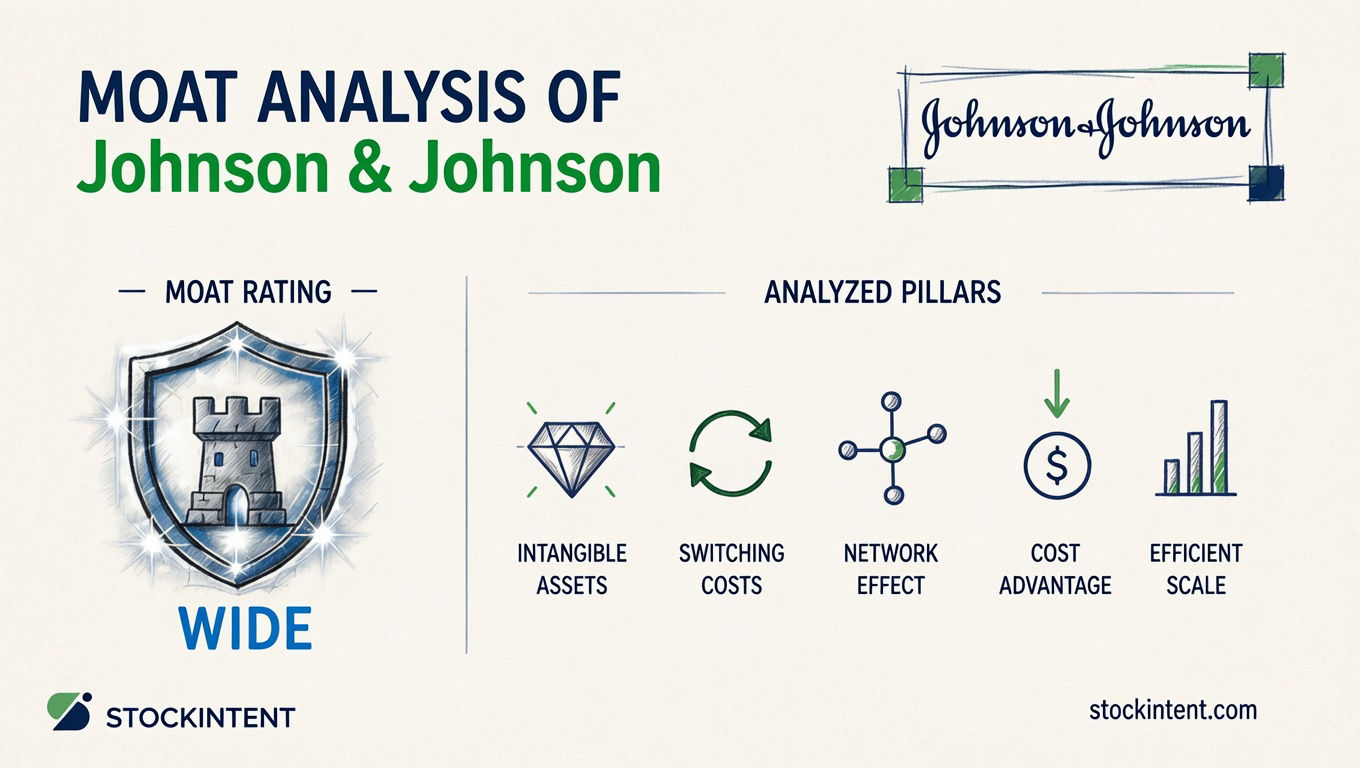
Johnson & Johnson holds a Wide Moat with a Stable trend and Low Uncertainty rating. Its competitive position rests on strong intangible assets, particularly intellectual property and regulatory barriers, plus meaningful switching costs in MedTech. The moat is observable in current performance: operational sales grew 6.4% in Q1 2026 and 5.6% in Q2 2026, with management raising full-year guidance after both quarters.
For long-term investors, durability matters more than current cheapness. A wide moat compounds returns over decades; a narrow one can erode faster than any discount protects you.
StockIntent Perspective: Investors seeking to identify companies with similar durable competitive advantages can screen for wide-moat characteristics using StockIntent's screener, filtering for strong returns on capital, consistent margins, and market leadership across multiple business segments.
Johnson & Johnson's moat rests on three meaningful pillars: intangible assets, switching costs in MedTech, and selective efficient scale. Two other pillars, cost advantage and network effects, are either weak or not material to the business. Here's how each one holds up under scrutiny.
This is the backbone of J&J's moat. The company relies on brand strength, extensive intellectual property, significant regulatory barriers, and a global distribution network that competitors would need years and billions to replicate. Ainvest's 2026 analysis describes these intangibles as the core of J&J's durable advantage, while Morningstar's wide-moat assessment also cites a developing research pipeline as part of the case. In pharma and MedTech alike, regulatory clearance and patent protection create real barriers. A competitor cannot simply decide to build an oncology franchise or a surgical robotics platform overnight.
Hospitals and clinicians train extensively on J&J's surgical equipment. They develop muscle memory, integrate workflows, and build institutional knowledge around specific device ecosystems. As one 2026 investment analysis puts it, switching becomes "super risky and expensive" due to workflow friction and retraining burden. This lock-in is most visible in electrophysiology and orthopedics, where J&J's growth has been robust. Still, this pillar is concentrated in MedTech. Pharmaceutical switching costs are lower; a formulary change can redirect prescriptions with fewer friction points than replacing a surgical system.
J&J holds number one or two positions in roughly 65% of its segments, which creates scale benefits in R&D, manufacturing, and distribution. But healthcare is not a classic efficient-scale industry like local utilities or regional rails. Markets often support multiple viable competitors, so scale helps without being the dominant moat driver. It reinforces the other pillars more than it stands alone.
Profitability is excellent. Gross margins sit above 70% and net margins near 28%. Ainvest's 2026 assessment attributes this strength to pricing power, brand, and market leadership rather than structural cost superiority. J&J is not the lowest-cost producer in its markets, and that is fine. Its moat comes from what it can charge and defend, not from what it can squeeze out of unit economics.
J&J does not benefit from network effects in any meaningful sense. Each additional user of a drug or device does not directly increase its value to other users. There is no platform dynamic where participation begets more participation.
Summary:Only three pillars meaningfully contribute to J&J's moat: intangible assets, MedTech switching costs, and partial efficient scale. The other two are either secondary or absent entirely. That is enough for a wide moat in our analysis, but we will go deeper looking at evidence and trend of that moat next.
Johnson & Johnson's moat is most visible where market leadership and regulatory barriers translate into durable growth and pricing power. In 2025, the Oncology segment grew 22%, driven by Darzalex and Carvykti, while Electrophysiology expanded 16%. Morningstar's 2026 analysis ties this performance directly to J&J's competitive positioning in these high-barrier therapeutic areas. These are not lucky breaks; they reflect years of R&D investment, clinical data accumulation, and regulatory approvals that competitors struggle to replicate.
Profitability tells the same story. Third-party analysis estimates gross margins above 70% and net margins near 28%, well above what commodity healthcare businesses achieve. J&J also holds number one or two positions in roughly 65% of its segments, which Ainvest's 2026 assessment links to entrenched customer relationships and scale advantages. This breadth matters: unlike single-franchise pharma peers, J&J generates mid-single-digit growth across both Innovative Medicine and MedTech simultaneously.
Pro Insight: In our experience analyzing healthcare compounders, J&J's moat is most visible not in explosive growth rates but in the consistency of mid-single-digit expansion across both pharma and MedTech despite patent headwinds. This resilience is often the sign of true business quality that single-franchise peers rarely match.
Still, the moat has thin spots. Stelara faces steep biosimilar pressure, which Syneticx's 2026 analysis flags as a major test of whether pipeline innovation can offset mature franchise decline. OPSUMIT also confronts generic competition in 2026, an event J&J's own 2025 Annual Report expects will significantly reduce future sales. These patent cliffs reveal a hard truth: even wide moats require continuous reinvestment to maintain their perimeter.
The moat trend is Stable. Johnson & Johnson is not widening its competitive position dramatically in 2026, nor is it eroding. Instead, widening forces and weakening pressures are roughly in balance, with the net result being a durable but contested franchise.
Widening forces include pipeline execution and long-term targeting. Management has set a 5-7% operational sales CAGR through 2030, and J&J's Enterprise Business Review frames this as achievable through new product launches and MedTech integration. The company also committed over $1 billion to a cell-therapy manufacturing facility in 2026, signaling confidence in scaling next-generation platforms. If CAPLYTA, Rybrevant, and robotics investments convert to durable revenue streams, the moat could strengthen meaningfully.
Stable forces are more immediate. J&J holds number one or two positions in 65% of its segments, and its two-engine model across Innovative Medicine and MedTech provides revenue stability that single-franchise peers lack. Q1 2026 operational sales grew 6.4% and Q2 2026 grew 5.6%, with guidance raised after both quarters. That resilience amid headwinds is itself evidence of moat durability.
Weakening forces are real and concentrated. Stelara faces steep biosimilar pressure, testing whether pipeline innovation can offset mature franchise decline. OPSUMIT confronts generic competition in 2026, which J&J expects will significantly reduce future sales. Perhaps more structurally, drug-pricing reforms including IRA-related constraints are compressing margins and reducing pricing power, with an analysis from Reuters estimating hundreds of millions in annual impact. Talc litigation remains a persistent uncertainty that can constrain capital allocation and absorb management attention regardless of underlying business quality.
What to watch. We track four indicators to judge whether the moat trend is improving or weakening over the next three to five years:
Investors can organize these indicators into a monitoring workflow using StockIntent's watchlist to track earnings, guidance changes, and segment performance over time.
We rate Johnson & Johnson's uncertainty as Low. The range of future business outcomes is narrower than for most large-cap healthcare peers, though patent cliffs and litigation prevent it from being bond-like predictable.
Revenue predictability is the strongest argument for this rating. J&J raised its 2026 guidance after both Q1 and Q2 results, with adjusted EPS coming in at $2.70 in Q1 and $2.90 in Q2. Reuters reports annual revenue is expected to exceed $100 billion, and the diversified mix across Innovative Medicine and MedTech means no single product drives the entire story. Morningstar's Low Uncertainty rating aligns with this view.
From our experience, the Low Uncertainty rating is warranted despite headline litigation risks because J&J's diversification across 65% market-leading segments creates earnings stability that single-franchise biotech peers cannot replicate.
The litigation overhang is the clearest risk that widens outcomes. Finterra Research describes talc litigation as a persistent uncertainty that can constrain capital allocation and investor confidence. J&J itself does not provide forward-looking GAAP measures because of uncertainties tied to legal outcomes, unusual gains or losses, and acquisition-related expenses. That disclosure is telling: management sees material volatility it cannot precisely forecast.
Regulatory and pricing pressure adds another layer. Reuters notes J&J is absorbing a hundreds-of-millions-of-dollars financial impact from a drug-pricing agreement. This is not a one-time event; it reflects a structural shift in U.S. pharmaceutical pricing power that could compress margins for years.
The bottom line: J&J's competitive position is more knowable than most, but not perfectly so. The moat is durable, the earnings are relatively steady, and the range of outcomes is manageable. What keeps uncertainty from falling to negligible levels is the combination of legal binary risk and a regulatory environment that is actively renegotiating the terms of pharmaceutical profitability.
Johnson & Johnson earns a Wide Moat with a Stable trend and Low Uncertainty. This assessment rests on durable intangible assets, meaningful MedTech switching costs, and a diversified business model that produces steadier outcomes than single-franchise peers.
Two tensions matter most from here. First, can pipeline innovation offset Stelara biosimilar pressure and OPSUMIT generic erosion over the next three to five years? The moat's width depends on continuous reinvestment, not past achievements alone. Second, will drug-pricing reform and talc litigation costs structurally impair capital allocation? These are business-quality questions, not just stock-price questions.
We do not believe the current price is cheap or expensive based on this moat analysis alone. What we do believe is that durable competitive advantages compound over decades, and J&J's remain intact with manageable risks. For investors evaluating whether the current price adequately reflects these considerations, StockIntent's valuation models allow scenario testing across growth, margin, and exit-multiple assumptions.
This content is for informational purposes only and is not investment advice.
Johnson & Johnson holds a Wide Moat with a Stable trend and Low Uncertainty rating. Its competitive position rests on strong intangible assets, particularly intellectual property and regulatory barriers, plus meaningful switching costs in MedTech. The moat is observable in current performance: operational sales grew 6.4% in Q1 2026 and 5.6% in Q2 2026, with management raising full-year guidance after both quarters.
For long-term investors, durability matters more than current cheapness. A wide moat compounds returns over decades; a narrow one can erode faster than any discount protects you.
StockIntent Perspective: Investors seeking to identify companies with similar durable competitive advantages can screen for wide-moat characteristics using StockIntent's screener, filtering for strong returns on capital, consistent margins, and market leadership across multiple business segments.
Johnson & Johnson's moat rests on three meaningful pillars: intangible assets, switching costs in MedTech, and selective efficient scale. Two other pillars, cost advantage and network effects, are either weak or not material to the business. Here's how each one holds up under scrutiny.
This is the backbone of J&J's moat. The company relies on brand strength, extensive intellectual property, significant regulatory barriers, and a global distribution network that competitors would need years and billions to replicate. Ainvest's 2026 analysis describes these intangibles as the core of J&J's durable advantage, while Morningstar's wide-moat assessment also cites a developing research pipeline as part of the case. In pharma and MedTech alike, regulatory clearance and patent protection create real barriers. A competitor cannot simply decide to build an oncology franchise or a surgical robotics platform overnight.
Hospitals and clinicians train extensively on J&J's surgical equipment. They develop muscle memory, integrate workflows, and build institutional knowledge around specific device ecosystems. As one 2026 investment analysis puts it, switching becomes "super risky and expensive" due to workflow friction and retraining burden. This lock-in is most visible in electrophysiology and orthopedics, where J&J's growth has been robust. Still, this pillar is concentrated in MedTech. Pharmaceutical switching costs are lower; a formulary change can redirect prescriptions with fewer friction points than replacing a surgical system.
J&J holds number one or two positions in roughly 65% of its segments, which creates scale benefits in R&D, manufacturing, and distribution. But healthcare is not a classic efficient-scale industry like local utilities or regional rails. Markets often support multiple viable competitors, so scale helps without being the dominant moat driver. It reinforces the other pillars more than it stands alone.
Profitability is excellent. Gross margins sit above 70% and net margins near 28%. Ainvest's 2026 assessment attributes this strength to pricing power, brand, and market leadership rather than structural cost superiority. J&J is not the lowest-cost producer in its markets, and that is fine. Its moat comes from what it can charge and defend, not from what it can squeeze out of unit economics.
J&J does not benefit from network effects in any meaningful sense. Each additional user of a drug or device does not directly increase its value to other users. There is no platform dynamic where participation begets more participation.
Summary:Only three pillars meaningfully contribute to J&J's moat: intangible assets, MedTech switching costs, and partial efficient scale. The other two are either secondary or absent entirely. That is enough for a wide moat in our analysis, but we will go deeper looking at evidence and trend of that moat next.
Johnson & Johnson's moat is most visible where market leadership and regulatory barriers translate into durable growth and pricing power. In 2025, the Oncology segment grew 22%, driven by Darzalex and Carvykti, while Electrophysiology expanded 16%. Morningstar's 2026 analysis ties this performance directly to J&J's competitive positioning in these high-barrier therapeutic areas. These are not lucky breaks; they reflect years of R&D investment, clinical data accumulation, and regulatory approvals that competitors struggle to replicate.
Profitability tells the same story. Third-party analysis estimates gross margins above 70% and net margins near 28%, well above what commodity healthcare businesses achieve. J&J also holds number one or two positions in roughly 65% of its segments, which Ainvest's 2026 assessment links to entrenched customer relationships and scale advantages. This breadth matters: unlike single-franchise pharma peers, J&J generates mid-single-digit growth across both Innovative Medicine and MedTech simultaneously.
Pro Insight: In our experience analyzing healthcare compounders, J&J's moat is most visible not in explosive growth rates but in the consistency of mid-single-digit expansion across both pharma and MedTech despite patent headwinds. This resilience is often the sign of true business quality that single-franchise peers rarely match.
Still, the moat has thin spots. Stelara faces steep biosimilar pressure, which Syneticx's 2026 analysis flags as a major test of whether pipeline innovation can offset mature franchise decline. OPSUMIT also confronts generic competition in 2026, an event J&J's own 2025 Annual Report expects will significantly reduce future sales. These patent cliffs reveal a hard truth: even wide moats require continuous reinvestment to maintain their perimeter.
The moat trend is Stable. Johnson & Johnson is not widening its competitive position dramatically in 2026, nor is it eroding. Instead, widening forces and weakening pressures are roughly in balance, with the net result being a durable but contested franchise.
Widening forces include pipeline execution and long-term targeting. Management has set a 5-7% operational sales CAGR through 2030, and J&J's Enterprise Business Review frames this as achievable through new product launches and MedTech integration. The company also committed over $1 billion to a cell-therapy manufacturing facility in 2026, signaling confidence in scaling next-generation platforms. If CAPLYTA, Rybrevant, and robotics investments convert to durable revenue streams, the moat could strengthen meaningfully.
Stable forces are more immediate. J&J holds number one or two positions in 65% of its segments, and its two-engine model across Innovative Medicine and MedTech provides revenue stability that single-franchise peers lack. Q1 2026 operational sales grew 6.4% and Q2 2026 grew 5.6%, with guidance raised after both quarters. That resilience amid headwinds is itself evidence of moat durability.
Weakening forces are real and concentrated. Stelara faces steep biosimilar pressure, testing whether pipeline innovation can offset mature franchise decline. OPSUMIT confronts generic competition in 2026, which J&J expects will significantly reduce future sales. Perhaps more structurally, drug-pricing reforms including IRA-related constraints are compressing margins and reducing pricing power, with an analysis from Reuters estimating hundreds of millions in annual impact. Talc litigation remains a persistent uncertainty that can constrain capital allocation and absorb management attention regardless of underlying business quality.
What to watch. We track four indicators to judge whether the moat trend is improving or weakening over the next three to five years:
Investors can organize these indicators into a monitoring workflow using StockIntent's watchlist to track earnings, guidance changes, and segment performance over time.
We rate Johnson & Johnson's uncertainty as Low. The range of future business outcomes is narrower than for most large-cap healthcare peers, though patent cliffs and litigation prevent it from being bond-like predictable.
Revenue predictability is the strongest argument for this rating. J&J raised its 2026 guidance after both Q1 and Q2 results, with adjusted EPS coming in at $2.70 in Q1 and $2.90 in Q2. Reuters reports annual revenue is expected to exceed $100 billion, and the diversified mix across Innovative Medicine and MedTech means no single product drives the entire story. Morningstar's Low Uncertainty rating aligns with this view.
From our experience, the Low Uncertainty rating is warranted despite headline litigation risks because J&J's diversification across 65% market-leading segments creates earnings stability that single-franchise biotech peers cannot replicate.
The litigation overhang is the clearest risk that widens outcomes. Finterra Research describes talc litigation as a persistent uncertainty that can constrain capital allocation and investor confidence. J&J itself does not provide forward-looking GAAP measures because of uncertainties tied to legal outcomes, unusual gains or losses, and acquisition-related expenses. That disclosure is telling: management sees material volatility it cannot precisely forecast.
Regulatory and pricing pressure adds another layer. Reuters notes J&J is absorbing a hundreds-of-millions-of-dollars financial impact from a drug-pricing agreement. This is not a one-time event; it reflects a structural shift in U.S. pharmaceutical pricing power that could compress margins for years.
The bottom line: J&J's competitive position is more knowable than most, but not perfectly so. The moat is durable, the earnings are relatively steady, and the range of outcomes is manageable. What keeps uncertainty from falling to negligible levels is the combination of legal binary risk and a regulatory environment that is actively renegotiating the terms of pharmaceutical profitability.
Johnson & Johnson earns a Wide Moat with a Stable trend and Low Uncertainty. This assessment rests on durable intangible assets, meaningful MedTech switching costs, and a diversified business model that produces steadier outcomes than single-franchise peers.
Two tensions matter most from here. First, can pipeline innovation offset Stelara biosimilar pressure and OPSUMIT generic erosion over the next three to five years? The moat's width depends on continuous reinvestment, not past achievements alone. Second, will drug-pricing reform and talc litigation costs structurally impair capital allocation? These are business-quality questions, not just stock-price questions.
We do not believe the current price is cheap or expensive based on this moat analysis alone. What we do believe is that durable competitive advantages compound over decades, and J&J's remain intact with manageable risks. For investors evaluating whether the current price adequately reflects these considerations, StockIntent's valuation models allow scenario testing across growth, margin, and exit-multiple assumptions.
This content is for informational purposes only and is not investment advice.