
Aug 3, 2026
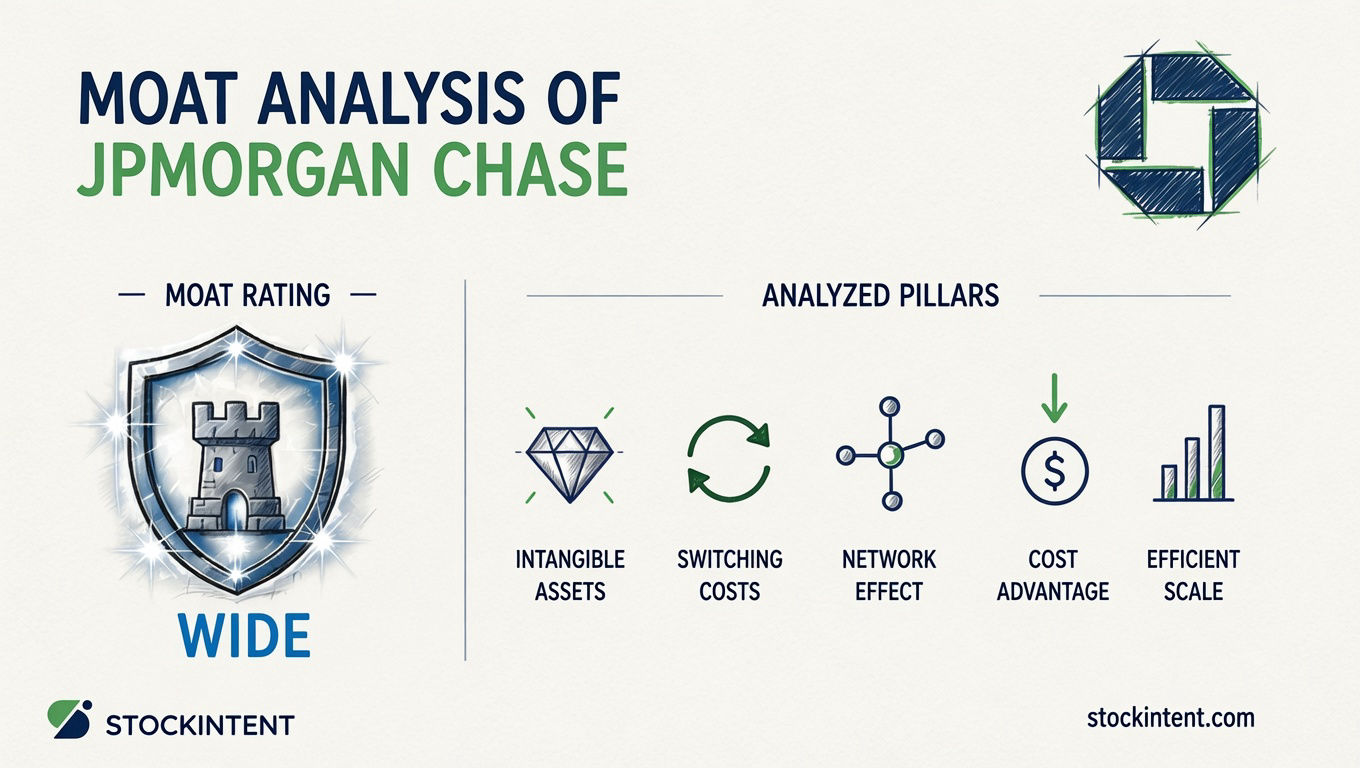
JPMorgan Chase carries a Wide Moat with a Stable to Slightly Widening trend and Medium uncertainty. In our assessment, the bank's structural advantages remain among the strongest in U.S. financial services, though regulatory and cyclical factors keep the range of future outcomes moderately wide.
Here's what matters most if you're evaluating JPMorgan as a long-term business owner:
This analysis focuses on business quality and durability, not whether the stock is a buy today. We're asking whether JPMorgan operates an exceptional business worth owning for years, evaluated through the lens of competitive advantage and sustainable returns on capital.
JPMorgan's moat rests on three strong pillars, one moderate pillar, and one that barely is worth mentioning. Here's how each one actually benchmarks.
Switching Costs: Strong
Corporate and institutional clients don't just bank with JPMorgan. They're embedded across accounts, lending, markets, and payments, with treasury management and payment pipelines woven into daily operations. Flash Research describes these relationships as creating high switching costs because replacing JPMorgan means untangling systems that handle cash flow, payroll, and liquidity management. That integration is deliberate. It took years to build, and it makes client relationships sticky in ways that show up in retention data rather than brand surveys.
Cost Advantage: Strong
The $2.4 trillion deposit base isn't just large. MCH Advisory Research characterizes it as the "lowest-cost, stickiest US deposit franchise," which directly widens net interest margins through cycles. When funding costs less than competitors', JPMorgan can price loans competitively without sacrificing profitability, or maintain margins while peers compress. This is the core economic engine. The scale-and-deposit-funding moat, as MCH frames it, explains why JPMorgan's returns consistently exceed industry norms even when credit conditions tighten.
Efficient Scale: Strong
Compliance, technology infrastructure, and regulatory capital requirements create fixed costs that smaller rivals cannot absorb efficiently. Flash Research notes this as a structural barrier, not a temporary headwind. JPMorgan spreads these costs across consumer banking, investment banking, wealth management, payments, and securities services in ways that would require massive capital and time to replicate. The result is operating leverage that compounds with size.
Network Effects: Moderate
Payments networks improve as more participants join, and JPMorgan's scale here is real. However, competitors operate viable alternatives. The payments ecosystem adds stickiness, but it doesn't create the winner-take-most dynamics you'd see in a platform like Visa or a social network. We view this pillar as supportive, not dominant.
Intangible Assets: Weak
Brand recognition matters for consumer banking, but Flash Research is explicit that "intangible assets (patents, proprietary IP, brand) are described as weak or not material to the moat." JPMorgan's durable advantage comes from operational embedding and funding economics, not from intellectual property or brand premium that competitors cannot match. Regulatory licenses create entry barriers, but those are distinct from intangible assets in the classic moat framework.
Pro Insight: Contrary to consumer-facing banks where brand intangible assets often dominate the moat narrative, JPMorgan's durable advantage is primarily operational. It stems from the deep embedding of corporate treasury services (switching costs) and the funding economics of its $2.4 trillion deposit base (cost advantage), not from brand recognition or proprietary IP. This scale-and-funding moat requires monitoring deposit betas and client retention metrics rather than brand perception surveys.
For investors who want to verify whether these competitive advantages translate into durable financial performance, StockIntent's company reports provide the detailed financial statements, deposit trends, and client concentration metrics that help separate narrative from numbers.
JPMorgan's competitive advantages translate into numbers that are hard to ignore. The bank reported a 20% return on tangible common equity in its 2026 company update, alongside 12% EPS growth and 11% tangible book value per share growth from 2025. These are not one-off figures. They suggest a franchise generating durable excess returns.
The mechanism is straightforward. With roughly $2.4 trillion in deposits, JPMorgan funds itself more cheaply than almost any U.S. competitor. That funding advantage widens net interest margins and supports returns that consistently exceed industry norms. The market recognizes this: JPMorgan trades at approximately 15x earnings and 2.5x tangible book value, versus roughly 11.5x earnings for peers. This indicates that investors are willing to pay a premium for franchise quality they believe will persist.
But the picture isn't unanimous. One analysis disputes moat strength, arguing that ROIC has fallen below WACC and that profitability declined from 2021 to 2025. That critique matters. It implies that accounting returns may not fully support the premium valuation narrative, and that scale alone doesn't guarantee value creation. We don't dismiss this counterpoint. It keeps our assessment grounded.
In our view, the evidence tilts toward a real but qualified moat. The deposit franchise and corporate embedding generate observable returns and market premiums. Whether those advantages compound into sustained value creation, or merely reflect cyclical scale, depends on whether JPMorgan can keep its funding costs low and its client relationships sticky as competition and regulation evolve.
We rate JPMorgan's moat trend as Stable to Slightly Widening. The franchise is not dramatically expanding its competitive position, but the evidence points to incremental strengthening through market-share gains, technology investment, and capital-driven share-taking from weaker peers. The offsetting forces, expense pressure and credit normalization, are real but currently manageable.
Three developments support the slight-widening case. First, management attributes ongoing share gains to "a decade of continued investment and effort", framing the moat as actively compounded rather than passively maintained. That distinction matters. It suggests JPMorgan's advantages are deepening through execution, not merely persisting through legacy. Second, the bank's 2026 adjusted expense guidance of approximately $105 billion reflects continued investment in technology and operations that smaller competitors struggle to match. Third, with a Common Equity Tier 1 ratio near 15%, JPMorgan holds excess capital that lets it invest and take share when constrained peers pull back.
Two factors keep the trend from widening more decisively. Expense growth is a headwind. The $105 billion guidance represents real cost inflation, and if revenue growth doesn't keep pace, operating leverage could stall. Credit normalization is the second factor. JPMorgan guided consumer loss rates to 3.3% - 3.6%, which is manageable but directionally higher than the ultra-low losses of recent years. The bank expects to land at the lower end of that range so far, but credit is a cyclical variable that can shift quickly.
For investors monitoring this trend, we suggest tracking four indicators:
These indicators won't predict the moat's trajectory perfectly. But together they offer a practical framework for judging whether JPMorgan's competitive position is strengthening, holding steady, or beginning to erode.
We assign JPMorgan a Medium uncertainty rating. The franchise is structurally durable, but the range of plausible outcomes over the next three to five years is wider than a narrow-moat consumer staple and narrower than a speculative growth company. Four factors drive this assessment.
In our experience analyzing financial institutions, banking moats face a distinct uncertainty profile compared to technology or consumer franchises. Tech moats risk obsolescence disruption. Consumer moats risk brand erosion. Universal banks like JPMorgan face regulatory and cyclical volatility that can compress returns without eliminating the franchise. The medium uncertainty rating reflects this specific risk geometry: structural durability with cyclical and policy-induced variability. JPMorgan will likely remain the dominant U.S. bank in most plausible scenarios, but the returns it earns on that dominance could vary significantly.
JPMorgan Chase earns a Wide Moat, a Stable to Slightly Widening trend, and a Medium uncertainty rating. The bank's scale-and-funding advantages remain structurally durable, though regulatory and cyclical forces will test whether returns stay elevated.
Two issues matter most from here. First, can JPMorgan sustain ROTCE in the high teens as regulatory capital rules evolve and competition intensifies? Second, will the $2.4 trillion deposit franchise remain sticky through potential rate cuts and deposit beta pressure? The answers will determine whether the current premium valuation reflects durable quality or cyclical scale.
Investors who want to test these assumptions can use StockIntent's valuation models to run scenarios on ROTCE sustainability, margin trajectories, and growth rates. It allows to understand how sensitive estimated intrinsic value is to changes in the moat drivers we've discussed.
This content is for informational purposes only and is not investment advice. Historical performance, including moat trends and returns on capital, does not guarantee future results.
JPMorgan Chase carries a Wide Moat with a Stable to Slightly Widening trend and Medium uncertainty. In our assessment, the bank's structural advantages remain among the strongest in U.S. financial services, though regulatory and cyclical factors keep the range of future outcomes moderately wide.
Here's what matters most if you're evaluating JPMorgan as a long-term business owner:
This analysis focuses on business quality and durability, not whether the stock is a buy today. We're asking whether JPMorgan operates an exceptional business worth owning for years, evaluated through the lens of competitive advantage and sustainable returns on capital.
JPMorgan's moat rests on three strong pillars, one moderate pillar, and one that barely is worth mentioning. Here's how each one actually benchmarks.
Switching Costs: Strong
Corporate and institutional clients don't just bank with JPMorgan. They're embedded across accounts, lending, markets, and payments, with treasury management and payment pipelines woven into daily operations. Flash Research describes these relationships as creating high switching costs because replacing JPMorgan means untangling systems that handle cash flow, payroll, and liquidity management. That integration is deliberate. It took years to build, and it makes client relationships sticky in ways that show up in retention data rather than brand surveys.
Cost Advantage: Strong
The $2.4 trillion deposit base isn't just large. MCH Advisory Research characterizes it as the "lowest-cost, stickiest US deposit franchise," which directly widens net interest margins through cycles. When funding costs less than competitors', JPMorgan can price loans competitively without sacrificing profitability, or maintain margins while peers compress. This is the core economic engine. The scale-and-deposit-funding moat, as MCH frames it, explains why JPMorgan's returns consistently exceed industry norms even when credit conditions tighten.
Efficient Scale: Strong
Compliance, technology infrastructure, and regulatory capital requirements create fixed costs that smaller rivals cannot absorb efficiently. Flash Research notes this as a structural barrier, not a temporary headwind. JPMorgan spreads these costs across consumer banking, investment banking, wealth management, payments, and securities services in ways that would require massive capital and time to replicate. The result is operating leverage that compounds with size.
Network Effects: Moderate
Payments networks improve as more participants join, and JPMorgan's scale here is real. However, competitors operate viable alternatives. The payments ecosystem adds stickiness, but it doesn't create the winner-take-most dynamics you'd see in a platform like Visa or a social network. We view this pillar as supportive, not dominant.
Intangible Assets: Weak
Brand recognition matters for consumer banking, but Flash Research is explicit that "intangible assets (patents, proprietary IP, brand) are described as weak or not material to the moat." JPMorgan's durable advantage comes from operational embedding and funding economics, not from intellectual property or brand premium that competitors cannot match. Regulatory licenses create entry barriers, but those are distinct from intangible assets in the classic moat framework.
Pro Insight: Contrary to consumer-facing banks where brand intangible assets often dominate the moat narrative, JPMorgan's durable advantage is primarily operational. It stems from the deep embedding of corporate treasury services (switching costs) and the funding economics of its $2.4 trillion deposit base (cost advantage), not from brand recognition or proprietary IP. This scale-and-funding moat requires monitoring deposit betas and client retention metrics rather than brand perception surveys.
For investors who want to verify whether these competitive advantages translate into durable financial performance, StockIntent's company reports provide the detailed financial statements, deposit trends, and client concentration metrics that help separate narrative from numbers.
JPMorgan's competitive advantages translate into numbers that are hard to ignore. The bank reported a 20% return on tangible common equity in its 2026 company update, alongside 12% EPS growth and 11% tangible book value per share growth from 2025. These are not one-off figures. They suggest a franchise generating durable excess returns.
The mechanism is straightforward. With roughly $2.4 trillion in deposits, JPMorgan funds itself more cheaply than almost any U.S. competitor. That funding advantage widens net interest margins and supports returns that consistently exceed industry norms. The market recognizes this: JPMorgan trades at approximately 15x earnings and 2.5x tangible book value, versus roughly 11.5x earnings for peers. This indicates that investors are willing to pay a premium for franchise quality they believe will persist.
But the picture isn't unanimous. One analysis disputes moat strength, arguing that ROIC has fallen below WACC and that profitability declined from 2021 to 2025. That critique matters. It implies that accounting returns may not fully support the premium valuation narrative, and that scale alone doesn't guarantee value creation. We don't dismiss this counterpoint. It keeps our assessment grounded.
In our view, the evidence tilts toward a real but qualified moat. The deposit franchise and corporate embedding generate observable returns and market premiums. Whether those advantages compound into sustained value creation, or merely reflect cyclical scale, depends on whether JPMorgan can keep its funding costs low and its client relationships sticky as competition and regulation evolve.
We rate JPMorgan's moat trend as Stable to Slightly Widening. The franchise is not dramatically expanding its competitive position, but the evidence points to incremental strengthening through market-share gains, technology investment, and capital-driven share-taking from weaker peers. The offsetting forces, expense pressure and credit normalization, are real but currently manageable.
Three developments support the slight-widening case. First, management attributes ongoing share gains to "a decade of continued investment and effort", framing the moat as actively compounded rather than passively maintained. That distinction matters. It suggests JPMorgan's advantages are deepening through execution, not merely persisting through legacy. Second, the bank's 2026 adjusted expense guidance of approximately $105 billion reflects continued investment in technology and operations that smaller competitors struggle to match. Third, with a Common Equity Tier 1 ratio near 15%, JPMorgan holds excess capital that lets it invest and take share when constrained peers pull back.
Two factors keep the trend from widening more decisively. Expense growth is a headwind. The $105 billion guidance represents real cost inflation, and if revenue growth doesn't keep pace, operating leverage could stall. Credit normalization is the second factor. JPMorgan guided consumer loss rates to 3.3% - 3.6%, which is manageable but directionally higher than the ultra-low losses of recent years. The bank expects to land at the lower end of that range so far, but credit is a cyclical variable that can shift quickly.
For investors monitoring this trend, we suggest tracking four indicators:
These indicators won't predict the moat's trajectory perfectly. But together they offer a practical framework for judging whether JPMorgan's competitive position is strengthening, holding steady, or beginning to erode.
We assign JPMorgan a Medium uncertainty rating. The franchise is structurally durable, but the range of plausible outcomes over the next three to five years is wider than a narrow-moat consumer staple and narrower than a speculative growth company. Four factors drive this assessment.
In our experience analyzing financial institutions, banking moats face a distinct uncertainty profile compared to technology or consumer franchises. Tech moats risk obsolescence disruption. Consumer moats risk brand erosion. Universal banks like JPMorgan face regulatory and cyclical volatility that can compress returns without eliminating the franchise. The medium uncertainty rating reflects this specific risk geometry: structural durability with cyclical and policy-induced variability. JPMorgan will likely remain the dominant U.S. bank in most plausible scenarios, but the returns it earns on that dominance could vary significantly.
JPMorgan Chase earns a Wide Moat, a Stable to Slightly Widening trend, and a Medium uncertainty rating. The bank's scale-and-funding advantages remain structurally durable, though regulatory and cyclical forces will test whether returns stay elevated.
Two issues matter most from here. First, can JPMorgan sustain ROTCE in the high teens as regulatory capital rules evolve and competition intensifies? Second, will the $2.4 trillion deposit franchise remain sticky through potential rate cuts and deposit beta pressure? The answers will determine whether the current premium valuation reflects durable quality or cyclical scale.
Investors who want to test these assumptions can use StockIntent's valuation models to run scenarios on ROTCE sustainability, margin trajectories, and growth rates. It allows to understand how sensitive estimated intrinsic value is to changes in the moat drivers we've discussed.
This content is for informational purposes only and is not investment advice. Historical performance, including moat trends and returns on capital, does not guarantee future results.