
Mar 23, 2026
Kraft Heinz is one of the largest packaged foods companies in the world, with iconic brands like Kraft, Heinz, Oscar Mayer, and Philadelphia generating roughly $26.4 billion in annual revenue. For investors evaluating this consumer defensive stock, understanding what drives management decisions matters. A company's mission, vision, and values aren't just corporate fluff; they shape capital allocation priorities, guide strategic pivots, and ultimately influence long-term returns.
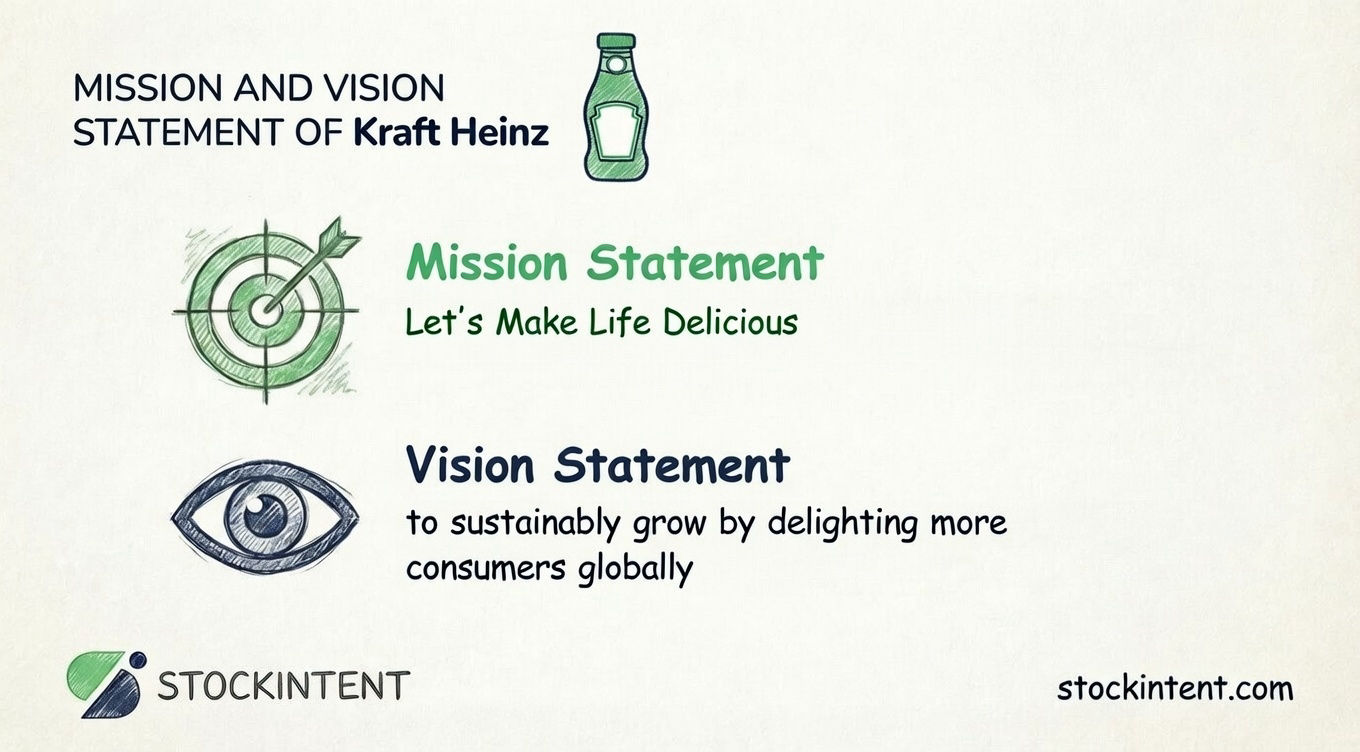
As of 2026, Kraft Heinz's official mission is "Let's Make Life Delicious" (also expressed as "we help feed the world — and we do it deliciously"). Its vision aims "to sustainably grow by delighting more consumers globally." Six core values underpin this: consumer obsession, daring to improve daily, championing people, demanding diversity, doing the right thing, and ownership.
Key Takeaways:
Kraft Heinz traces its roots to two legendary food companies: the H.J. Heinz Company founded in 1869 and Kraft Foods dating back to 1903. The 2015 merger created one of the largest packaged foods conglomerates on earth, now generating roughly $26.4 billion in annual revenue and housing iconic brands that sit in millions of pantries worldwide.
The company operates through six consumer platforms that define its business model:
In our experience analyzing consumer defensive stocks, we've found that platform-based structures like Kraft Heinz's reveal where management is actually placing its bets. Notice how Taste Elevation commands nearly half of revenue; that's intentional. The condiments and sauces segment enjoys stronger pricing power, lower private-label threat, and international expansion potential compared to the more commoditized grocery segments.
Quick Stats Snapshot:
| Metric | Figure |
|---|---|
| Annual Revenue (FY2024) | ~$26.4 billion |
| Organic Sales Guidance (2026) | Down 1.5% to 3.5% |
| Capital Expenditure (2026) | ~$950 million |
| Incremental Strategic Investment | $600 million |
| Efficiency Target (by 2027) | $2.5 billion gross |
| Heat-to-Eat Pouches CAGR (2-year) | 130% |
The 2026 guidance reflects what CEO Steve Cahillane calls a "reset year." After 19 consecutive quarters of North American sales declines, management is pumping $600 million into marketing, R&D, and sales capabilities rather than pursuing the previously announced split into two separate entities. This pivot matters for investors evaluating whether the kraft heinz mission statement translates into sustainable competitive advantages or remains aspirational.
From a competitive standpoint, Kraft Heinz ranks among the top three global packaged foods companies by revenue, though it trails peers like Nestlé and PepsiCo in total market capitalization. The company holds dominant positions in specific categories: Heinz Ketchup commands roughly 60% U.S. market share, and the brand achieved 7% market share in pasta sauce within four years of entering that space. These aren't trivial achievements; they demonstrate the power of brand equity when properly leveraged.
Yet the investment community remains skeptical. With roughly 80% of analysts rating the stock Hold or Neutral and price targets clustered around $25, the market is effectively saying: "Show us the results first." The company's 3.0x leverage ratio and commitment to investment over immediate returns suggests management is playing the long game, but as value investors, we always ask whether that patience will be rewarded or whether structural challenges in the packaged foods industry prove more persistent than hoped.
Kraft Heinz's official mission statement, which the company also refers to as its Purpose, is refreshingly direct:
"Let's Make Life Delicious"
The company expresses this more fully as: "Simply, we help feed the world — and we do it deliciously." Source
This isn't corporate word salad. After years of watching food companies bury themselves in jargon, there's something almost rebellious about a $26 billion conglomerate leading with taste. The mission signals three strategic priorities that matter for investors: consumer obsession, global scale, and sustainable responsibility.
🎯 Pro Insight: Watch how a company phrases its mission versus how it allocates capital. Kraft Heinz's $600 million incremental investment in marketing, R&D, and sales capabilities for 2026, up from prior years, shows management is finally putting money where its mouth is. The post-merger era under 3G Capital was defined by Zero-Based Budgeting and cost extraction; this mission reflects a deliberate pivot toward rebuilding brand equity and market share.
The mission connects directly to Kraft Heinz's capital allocation decisions. The company has shelved its planned split into two entities, choosing instead to consolidate resources behind core brands. That $950 million capital expenditure plan for 2026, combined with efficiency targets of $2.5 billion by 2027, operationalizes the "deliciously" promise through product innovation, not just financial engineering. When management talks about "opening price points" and "material value investments," they're translating mission into margin strategy; using brand strength to compete on value without racing private label to the bottom.
How does this stack up against competitors? General Mills frames its purpose around "making food people love" with emphasis on shared experiences. Mondelez focuses narrowly on "empowering people to snack right." Kraft Heinz's phrasing is distinct in its global ambition ("feed the world") married to sensory appeal ("deliciously"). That combination matters for emerging markets penetration, where Heinz Ketchup still has significant runway in under-penetrated regions like Brazil and China. Source
The mission has evolved meaningfully since the 2015 merger. The original post-merger statement emphasized being "the best food company, growing a better world" — admirable but vague. The 2026 version tightens the focus: taste first, scale second, responsibility baked in. This evolution tracks with CEO Steve Cahillane's turnaround strategy, which acknowledges that 19 consecutive quarters of North American sales declines can't be fixed by efficiency alone. Sometimes you need to remind people why they loved your brands in the first place.
Kraft Heinz's mission statement compresses into three interconnected strategic pillars: sustainable growth, consumer delight, and global expansion. These aren't abstract corporate buzzwords. They're operational directives that determine where the $26 billion company allocates capital, what products make it to market, and how management thinks about competitive positioning.
When we analyze management quality across consumer defensive stocks, we've noticed that companies with clearly articulated mission pillars tend to outperform peers in capital efficiency. Kraft Heinz is testing this hypothesis in real time. After 19 consecutive quarters of North American sales declines, CEO Steve Cahillane needs these pillars to translate into tangible results.
The sustainable growth pillar manifests as a dual commitment: environmental responsibility and financial discipline.
On the environmental side, Kraft Heinz has committed to 100% recyclable, reusable, or compostable packaging by 2025, with a stretch goal of net-zero greenhouse gas emissions by 2050. These targets feed directly into the company's $2.5 billion gross efficiency target by 2027; less waste in operations means lower costs per unit produced.
But sustainable growth also means something financially specific: profitable expansion without overextending the balance sheet. The company is targeting a leverage ratio of 3.0x, down from higher levels post-merger. This matters for investors evaluating Kraft Heinz's moat. A consumer defensive company with manageable debt can weather volume downturns better than one stretched thin.
Here's where this pillar gets interesting in practice. The company had announced plans to split into two separate entities by the second half of 2026; a $15.4 billion Global Taste Elevation Co. and a $10.4 billion North American Grocery Co. Management reversed this decision in early 2026, choosing instead to consolidate resources behind core brand recovery. The rationale? Industry headwinds made the timing wrong, but the strategic logic of focused operations remains embedded in how management thinks about sustainable growth.
This reversal demonstrates something important about how Kraft Heinz treats its mission pillars: they're directional, not dogmatic. When external conditions shift, management adjusts the tactics while keeping the strategic intent intact.
The most significant operational shift at Kraft Heinz since 2023 has been the pivot from pricing-led growth to innovation-led growth. This directly operationalizes the consumer delight pillar.
Under previous management, particularly the 3G Capital-influenced era, Kraft Heinz became famous for Zero-Based Budgeting and aggressive price increases. The strategy worked for margins temporarily; it destroyed volume permanently. Management acknowledged at CAGNY 2026 that they "pushed the pricing lever too hard."
The corrective action for 2026 is substantial: $600 million in incremental investment across marketing, R&D, and sales capabilities. This breaks down as:
Specific product innovations illustrate the consumer delight pillar in action. Super Mac delivers protein-fortified Kraft Mac & Cheese with 17g protein. The 360Crisp Technology allows microwave preparation with oven-quality crispness. The "Spicy Heinz" global line extends the iconic ketchup brand into adjacent flavor profiles.
Perhaps most technically interesting is the "Lighthouse" AI control tower developed with Microsoft. This system now manages 85% of North American supply chain decisions, enabling faster response to demand signals and reducing out-of-stock incidents. Better availability directly translates to consumer satisfaction; nothing delights less than an empty shelf where your favorite product should be.
The third pillar, global expansion, addresses a critical reality for Kraft Heinz investors: the North American business is structurally challenged, while international markets offer genuine growth optionality.
Consider the divergence in performance. North America has suffered 19 consecutive quarters of sales declines. Meanwhile, international sales grew at double the domestic rate in 2025. The specific opportunity lies in under-penetrated markets for Heinz Ketchup, particularly Brazil and China.
This isn't accidental. Management has explicitly called out three strategic initiatives under the global expansion pillar: Strengthening North America Retail, Expanding Global Away From Home, and Growing in Emerging Markets. Notice the sequencing priorities. North America retail is about stabilization, not growth. The real expansion opportunity lies in geographic and channel diversification.
The Away From Home channel (food service, hospitality, institutional) offers particularly attractive economics. These contracts tend to be stickier than retail, with lower promotional intensity and stronger brand loyalty. Heinz Ketchup's 60% U.S. market share in retail translates differently in food service, where operators prioritize reliability and consistency over price.
Management's stated goal is to become "the leader in elevating and creating food that makes you feel good." This frames global expansion not as volume chasing, but as premium positioning. Enter emerging markets with elevated products rather than competing on price from the start.
Kraft Heinz's official vision is stated simply yet deliberately:
"To sustainably grow by delighting more consumers globally."
This isn't boilerplate corporate language. Notice what Kraft Heinz excludes: there's no mention of market share domination, no quantitative revenue targets, no aggressive competitive framing against Nestlé or PepsiCo. The vision prioritizes sustainability and delight as simultaneous, not sequential, goals. That's telling for investors evaluating how management allocates capital when forced to choose between short-term margin pressure and long-term brand health.
The strategic ambitions embedded in this vision crystallize into three observable management priorities that shape Kraft Heinz's 2026 capital allocation: profitable globalization, innovation-led volume recovery, and operational sustainability.
On profitable globalization, the company is explicitly prioritizing emerging markets and away-from-home channels where Heinz Ketchup remains under-penetrated. Brazil and China represent significant whitespace expansion, and international sales already grew at double the domestic rate in 2025. The vision's emphasis on "more consumers globally" gives management cover to invest in distribution and brand-building in markets that may depress near-term margins but build durable competitive positions. This mirrors what we've observed across consumer staples: the companies that sustained multi-decade compounding, think Unilever in India or Nestlé in Mexico, built moats through patient market development rather than quarterly margin optimization.
The "delighting" component translates to Kraft Heinz's $600 million incremental investment plan for 2026, concentrated on R&D (up 20%), marketing (increasing to 5.5% of sales), and sales capabilities. After 19 consecutive quarters of North American sales declines, management acknowledges that efficiency alone cannot restore growth; only product superiority can. This is where the vision meets reality in 2026. The turnaround plan projects organic sales decline of 1.5% to 3.5% even with these investments, acknowledging that rebuilding brand equity takes time and volume often recovers before pricing power.
The sustainability element operates at two levels. Environmentally, Kraft Heinz has committed to 100% recyclable, reusable, or compostable packaging by 2025 with net-zero emissions by 2050. Financially, the $2.5 billion gross efficiency target by 2027 provides resources to fund innovation without sacrificing returns on capital. The vision deliberately links these; sustainable growth is not a trade-off but a reinforcing cycle.
In our experience tracking packaged foods companies through multiple industry cycles, we've found that vision statements containing both "sustainable" and "delight" tend to correlate with management teams willing to accept near-term earnings volatility for long-term compounding. Kraft Heinz's 2026 reset year, with its deliberate investment over split-related cost savings, tests whether this vision translates into actual strategic patience or becomes abandonable when analyst pressure intensifies.
Kraft Heinz's vision, "to sustainably grow by delighting more consumers globally," compresses into three interconnected strategic themes that shape every major capital allocation decision. These aren't marketing slogans; they're operational directives that determine where $950 million in 2026 capex flows and why management shelved a planned corporate split.
The "globally" component of Kraft Heinz's vision translates into explicit geographic and channel priorities. Management has identified three strategic initiatives: Strengthening North America Retail, Expanding Global Away From Home, and Growing in Emerging Markets.
Notice the sequencing. North America is about stabilization, not growth; the real expansion opportunity lies in under-penetrated markets. Brazil and China represent significant whitespace for Heinz Ketchup, where the brand has runway that simply doesn't exist in saturated U.S. retail. International sales already grew at double the domestic rate in 2025, confirming where the vision is actually working.
The Away From Home channel, food service, hospitality, institutional, offers particularly attractive economics. These contracts tend to be stickier than retail, with lower promotional intensity and stronger brand loyalty. Heinz Ketchup's 60% U.S. retail market share translates differently in food service, where operators prioritize reliability over price.
The "delighting" component of the vision has driven the most significant operational shift at Kraft Heinz since 2023: the pivot from pricing-led growth to innovation-led growth. After 19 consecutive quarters of North American sales declines, management acknowledged at CAGNY 2026 that they "pushed the pricing lever too hard."
The corrective action is substantial: $600 million in incremental investment across marketing, R&D, and sales capabilities. This breaks down as:
Specific innovations illustrate this theme in action: Super Mac delivers protein-fortified Kraft Mac & Cheese with 17g protein. The 360Crisp Technology enables microwave preparation with oven-quality crispness. The "Spicy Heinz" global line extends the iconic ketchup brand into adjacent flavor profiles.
Perhaps most technically interesting is the "Lighthouse" AI control tower developed with Microsoft, which now manages 85% of North American supply chain decisions. Better availability directly translates to consumer satisfaction; nothing delights less than an empty shelf.
The "sustainable" component operates at two levels. Environmentally, Kraft Heinz has committed to 100% recyclable, reusable, or compostable packaging by 2025, with a stretch goal of net-zero emissions by 2050. Financially, the $2.5 billion gross efficiency target by 2027 provides resources to fund innovation without sacrificing returns on capital.
The vision deliberately links these; sustainable growth is not a trade-off but a reinforcing cycle. The company targets a leverage ratio of 3.0x, down from higher levels post-merger. This matters for investors evaluating Kraft Heinz's moat. A consumer defensive company with manageable debt can weather volume downturns better than one stretched thin.
Here's where this theme gets interesting in practice. The company had announced plans to split into two separate entities by the second half of 2026; a $15.4 billion Global Taste Elevation Co. and a $10.4 billion North American Grocery Co. Management reversed this decision in early 2026, choosing instead to consolidate resources behind core brand recovery. The rationale? Industry headwinds made the timing wrong, but the strategic logic of focused operations remains embedded in how management thinks about sustainable growth.
This reversal demonstrates something important about how Kraft Heinz treats its vision themes: they're directional, not dogmatic. When external conditions shift, management adjusts the tactics while keeping the strategic intent intact.
Kraft Heinz's six core values aren't corporate wallpaper. They shape hiring decisions, product development priorities, and how management allocates capital. When we evaluate consumer defensive stocks, we've found that companies with clearly articulated values tend to make more consistent strategic decisions, even if they don't always execute perfectly.
The company's values are: We are consumer obsessed, We dare to do better every day, We champion great people, We demand diversity, We do the right thing, and We own it. Let's examine what each actually means in practice.
This value drives Kraft Heinz's $600 million incremental investment in 2026, with marketing spend increasing to 5.5% of sales and R&D investment up 20%. It's not abstract; management explicitly acknowledged at CAGNY 2026 that they "pushed the pricing lever too hard" and lost touch with what shoppers actually wanted.
The operational translation: opening price points across categories, value-focused pack architecture, and innovations like Super Mac (17g protein) and 360Crisp Technology that solve real consumer problems. When Kraft Heinz talks about being consumer obsessed, they're acknowledging that 19 consecutive quarters of North American sales declines don't happen because consumers suddenly stopped liking mac and cheese.
This value manifests in Kraft Heinz's willingness to reverse major strategic decisions when evidence demands it. The planned split into two separate entities, Global Taste Elevation Co. and North American Grocery Co., was halted in early 2026 despite significant preparation. Management admitted industry headwinds made the timing wrong.
That takes institutional courage. Many companies would have pushed forward to save face. Kraft Heinz chose operational flexibility over strategic stubbornness, consolidating resources behind core brand recovery instead.
🎯 Pro Insight: Watch how companies behave when plans fail, not when they succeed. Kraft Heinz's willingness to abandon the split plan, saving $300 million in anticipated separation costs, demonstrates a value system that prioritizes results over ego. This is rarer in corporate America than you'd think.
Kraft Heinz operationalizes this through leadership development programs and talent retention initiatives. The appointment of Nicolas Amaya as North America President in early 2026, reporting directly to CEO Steve Cahillane, reflects a deliberate bet on fresh leadership to fix the core U.S. business.
However, the data on employee engagement tells a more nuanced story. Only 33% of employees cite the company's mission as a motivating factor, with just 14% saying it's a primary reason they stay. That's not terrible for a packaged foods company, but it's not exceptional either. The value is stated clearly; the cultural penetration remains a work in progress.
Kraft Heinz has established concrete targets here: 50% gender parity in global management by 2025 and 30% people of color in U.S. salaried roles. These aren't aspirational; they're tracked and reported. The company also maintains Business Resource Groups and unconscious bias training programs.
In our experience analyzing corporate culture across consumer staples, we've noticed that companies with specific, time-bound diversity targets tend to make faster progress than those with vague commitments to "inclusion." Kraft Heinz's approach falls into the former category, which we view positively from a governance perspective.
This value encompasses Kraft Heinz's ESG commitments and ethical sourcing standards. The company has committed to 100% recyclable, reusable, or compostable packaging by 2025, with a stretch goal of net-zero greenhouse gas emissions by 2050. They've also pledged to deliver 1.5 billion meals to people in need by 2025, achieving 90% of this target by 2023.
The "right thing" also manifests in quality commitments and responsible manufacturing practices. After years of cost-cutting that damaged brand equity, this value now serves as a check against short-term financial engineering at the expense of product integrity.
Kraft Heinz describes this as acting "like owners, not renters." The practical implication is accountability for results without bureaucratic excuse-making. CEO Cahillane's direct acknowledgment of strategic missteps, pricing errors, and the need for fundamental reset demonstrates this value in action.
The ownership culture also supports the company's $2.5 billion gross efficiency target by 2027. These aren't cuts for cuts' sake; they're productivity improvements that fund reinvestment in brands and innovation. When employees think like owners, they tend to find smarter ways to operate rather than simply doing more with less.
Kraft Heinz's ESG framework extends directly from its core values, particularly "We do the right thing" and "We dare to do better every day." The company's sustainability commitments aren't siloed CSR initiatives; they're integrated into capital allocation and strategic planning.
| ESG Pillar | Kraft Heinz Commitment | Value Connection |
|---|---|---|
| Environmental | 100% recyclable packaging by 2025; net-zero by 2050 | We do the right thing |
| Social | 1.5 billion meals to those in need by 2025 | We champion great people |
| Governance | 50% gender parity in management by 2025 | We demand diversity |
| Operational | $2.5B efficiency target by 2027 | We own it |
The ESG integration matters for investors evaluating kraft heinz mission statement authenticity. Companies that treat sustainability as compliance check the box; companies that embed it in values use it as competitive differentiation. Kraft Heinz appears to be moving toward the latter, though execution remains the critical variable.
Here's where we apply some healthy skepticism. Kraft Heinz's values are well-articulated and directionally aligned with its strategic pivot. But values on paper don't automatically translate to culture in practice.
Positive evidence: The 2026 strategic reset demonstrates willingness to abandon failed approaches, consistent with "We dare to do better every day." The $600 million investment in marketing, R&D, and sales capabilities reflects genuine "consumer obsession." The diversity targets and ESG commitments show "doing the right thing" isn't entirely rhetorical.
Cautionary evidence: 19 consecutive quarters of North American sales declines suggest the previous management regime, heavily influenced by 3G Capital's Zero-Based Budgeting philosophy, prioritized financial engineering over consumer value. The values may be relatively new, or at least newly emphasized under Cahillane's leadership. Culture change at a 26,000-employee company doesn't happen overnight.
The analyst view: With roughly 80% of analysts rating the stock Hold or Neutral, the investment community is effectively saying "show us the results first." S&P Global revised Kraft Heinz's outlook to Negative in early 2026, citing profit declines and operational challenges. Values matter, but they don't override financial performance in capital markets.
In our experience, the gap between stated values and operational reality typically closes over 3-5 years when new leadership is genuinely committed. Kraft Heinz is about two years into its reset. The 2026 investment plan and strategic choices suggest alignment is improving, but investors should watch quarterly execution, not just annual reports, to verify whether these values are truly embedded or merely marketed.
Tying Kraft Heinz's mission, vision, and core values together reveals a company in deliberate transition. The kraft heinz mission statement "Let's Make Life Delicious" isn't empty corporate speak; it's the articulation of a strategic pivot away from financial engineering and toward sustainable, consumer-centric compounding. The vision "to sustainably grow by delighting more consumers globally" provides the directional framework, while six core values, consumer obsessed, dare to do better, champion people, demand diversity, do the right thing, and own it, operationalize how management intends to execute.
What makes this framework interesting for investors is the tension embedded within it. Kraft Heinz is attempting something genuinely difficult: rebuilding brand equity while maintaining shareholder returns, investing for growth while hitting efficiency targets, and expanding globally while stabilizing a structurally challenged North American business. In our experience analyzing consumer defensive stocks, we've found that companies attempting simultaneous turnaround and transformation often underwhelm on both fronts. Kraft Heinz is betting that its mission-values alignment provides the cultural cohesion to thread this needle.
From an investment perspective, this strategic identity translates into three observable signals worth monitoring. First, capital allocation discipline: the $600 million incremental investment in marketing, R&D, and sales capabilities for 2026, combined with the reversal of the planned split, demonstrates management's willingness to prioritize fix-the-core execution over financial restructuring. S&P Global's negative outlook revision reflects skepticism that this patience will be rewarded, but the decision itself signals strategic coherence.
Second, competitive positioning through innovation: the shift from pricing-led to innovation-led growth directly operationalizes the "consumer obsessed" and "dare to do better" values. Initiatives like the Lighthouse AI control tower managing 85% of North American supply chain decisions, and products like Super Mac with 17g protein, suggest management is putting tangible resources behind the mission. Whether this translates into sustained market share recovery, rather than temporary volume bumps, determines whether Kraft Heinz deserves a premium multiple or remains a value trap.
Third, management quality signals: CEO Steve Cahillane's willingness to acknowledge past errors, "we pushed the pricing lever too hard," and reverse strategic decisions when evidence demands it, demonstrates the "we own it" value in action. That's rarer than you'd think in corporate America.
🎯 Pro Insight: When evaluating mission-driven turnarounds, watch the lag between stated values and capital allocation. Kraft Heinz's marketing spend increasing to 5.5% of sales, up from 4.9%, and R&D investment up 20%, shows the $600 million isn't just talk. Compare this to the 3G Capital era where brand investment was systematically starved. The delta tells you more about strategic intent than any earnings call commentary.
Looking ahead, Kraft Heinz's mission-vision-values framework positions it for a specific version of the future: one where consumer packaged goods companies win through product superiority and operational efficiency rather than scale-based cost extraction. The company is betting that ESG integration, diverse talent pipelines, and accountable ownership culture create competitive advantages in an industry facing structural headwinds from private-label encroachment and shifting consumer preferences.
The analyst consensus, roughly 80% Hold/Neutral ratings with price targets clustered around $25, suggests the market wants proof before awarding credit. Fair enough. But for investors willing to look beyond current earnings volatility, Kraft Heinz's strategic identity offers a Potential framework for evaluating whether management can compound value over the next decade. The 2026 reset year will test whether mission translates into momentum, or whether structural challenges in packaged foods prove more persistent than cultural transformation.
If you're building positions based on fundamental analysis rather than quarterly sentiment, consider using a platform that lets you validate management's execution against historical patterns. StockIntent offers 7 days of risk-free access to institutional-grade screening and backtesting tools, so you can test whether Kraft Heinz's turnaround metrics align with proven recovery patterns. Sometimes the best investment decisions come from having the right data at the right time, not from waiting for the narrative to resolve itself.
The question for long-term investors isn't whether Kraft Heinz's mission sounds appealing. It's whether the company can generate the quality of earnings, the return on invested capital, and the sustained market share growth that make "delighting more consumers globally" translate into actual shareholder returns. The framework is in place. The execution is what matters now.
Kraft Heinz is one of the largest packaged foods companies in the world, with iconic brands like Kraft, Heinz, Oscar Mayer, and Philadelphia generating roughly $26.4 billion in annual revenue. For investors evaluating this consumer defensive stock, understanding what drives management decisions matters. A company's mission, vision, and values aren't just corporate fluff; they shape capital allocation priorities, guide strategic pivots, and ultimately influence long-term returns.
As of 2026, Kraft Heinz's official mission is "Let's Make Life Delicious" (also expressed as "we help feed the world — and we do it deliciously"). Its vision aims "to sustainably grow by delighting more consumers globally." Six core values underpin this: consumer obsession, daring to improve daily, championing people, demanding diversity, doing the right thing, and ownership.
Key Takeaways:
Kraft Heinz traces its roots to two legendary food companies: the H.J. Heinz Company founded in 1869 and Kraft Foods dating back to 1903. The 2015 merger created one of the largest packaged foods conglomerates on earth, now generating roughly $26.4 billion in annual revenue and housing iconic brands that sit in millions of pantries worldwide.
The company operates through six consumer platforms that define its business model:
In our experience analyzing consumer defensive stocks, we've found that platform-based structures like Kraft Heinz's reveal where management is actually placing its bets. Notice how Taste Elevation commands nearly half of revenue; that's intentional. The condiments and sauces segment enjoys stronger pricing power, lower private-label threat, and international expansion potential compared to the more commoditized grocery segments.
Quick Stats Snapshot:
| Metric | Figure |
|---|---|
| Annual Revenue (FY2024) | ~$26.4 billion |
| Organic Sales Guidance (2026) | Down 1.5% to 3.5% |
| Capital Expenditure (2026) | ~$950 million |
| Incremental Strategic Investment | $600 million |
| Efficiency Target (by 2027) | $2.5 billion gross |
| Heat-to-Eat Pouches CAGR (2-year) | 130% |
The 2026 guidance reflects what CEO Steve Cahillane calls a "reset year." After 19 consecutive quarters of North American sales declines, management is pumping $600 million into marketing, R&D, and sales capabilities rather than pursuing the previously announced split into two separate entities. This pivot matters for investors evaluating whether the kraft heinz mission statement translates into sustainable competitive advantages or remains aspirational.
From a competitive standpoint, Kraft Heinz ranks among the top three global packaged foods companies by revenue, though it trails peers like Nestlé and PepsiCo in total market capitalization. The company holds dominant positions in specific categories: Heinz Ketchup commands roughly 60% U.S. market share, and the brand achieved 7% market share in pasta sauce within four years of entering that space. These aren't trivial achievements; they demonstrate the power of brand equity when properly leveraged.
Yet the investment community remains skeptical. With roughly 80% of analysts rating the stock Hold or Neutral and price targets clustered around $25, the market is effectively saying: "Show us the results first." The company's 3.0x leverage ratio and commitment to investment over immediate returns suggests management is playing the long game, but as value investors, we always ask whether that patience will be rewarded or whether structural challenges in the packaged foods industry prove more persistent than hoped.
Kraft Heinz's official mission statement, which the company also refers to as its Purpose, is refreshingly direct:
"Let's Make Life Delicious"
The company expresses this more fully as: "Simply, we help feed the world — and we do it deliciously." Source
This isn't corporate word salad. After years of watching food companies bury themselves in jargon, there's something almost rebellious about a $26 billion conglomerate leading with taste. The mission signals three strategic priorities that matter for investors: consumer obsession, global scale, and sustainable responsibility.
🎯 Pro Insight: Watch how a company phrases its mission versus how it allocates capital. Kraft Heinz's $600 million incremental investment in marketing, R&D, and sales capabilities for 2026, up from prior years, shows management is finally putting money where its mouth is. The post-merger era under 3G Capital was defined by Zero-Based Budgeting and cost extraction; this mission reflects a deliberate pivot toward rebuilding brand equity and market share.
The mission connects directly to Kraft Heinz's capital allocation decisions. The company has shelved its planned split into two entities, choosing instead to consolidate resources behind core brands. That $950 million capital expenditure plan for 2026, combined with efficiency targets of $2.5 billion by 2027, operationalizes the "deliciously" promise through product innovation, not just financial engineering. When management talks about "opening price points" and "material value investments," they're translating mission into margin strategy; using brand strength to compete on value without racing private label to the bottom.
How does this stack up against competitors? General Mills frames its purpose around "making food people love" with emphasis on shared experiences. Mondelez focuses narrowly on "empowering people to snack right." Kraft Heinz's phrasing is distinct in its global ambition ("feed the world") married to sensory appeal ("deliciously"). That combination matters for emerging markets penetration, where Heinz Ketchup still has significant runway in under-penetrated regions like Brazil and China. Source
The mission has evolved meaningfully since the 2015 merger. The original post-merger statement emphasized being "the best food company, growing a better world" — admirable but vague. The 2026 version tightens the focus: taste first, scale second, responsibility baked in. This evolution tracks with CEO Steve Cahillane's turnaround strategy, which acknowledges that 19 consecutive quarters of North American sales declines can't be fixed by efficiency alone. Sometimes you need to remind people why they loved your brands in the first place.
Kraft Heinz's mission statement compresses into three interconnected strategic pillars: sustainable growth, consumer delight, and global expansion. These aren't abstract corporate buzzwords. They're operational directives that determine where the $26 billion company allocates capital, what products make it to market, and how management thinks about competitive positioning.
When we analyze management quality across consumer defensive stocks, we've noticed that companies with clearly articulated mission pillars tend to outperform peers in capital efficiency. Kraft Heinz is testing this hypothesis in real time. After 19 consecutive quarters of North American sales declines, CEO Steve Cahillane needs these pillars to translate into tangible results.
The sustainable growth pillar manifests as a dual commitment: environmental responsibility and financial discipline.
On the environmental side, Kraft Heinz has committed to 100% recyclable, reusable, or compostable packaging by 2025, with a stretch goal of net-zero greenhouse gas emissions by 2050. These targets feed directly into the company's $2.5 billion gross efficiency target by 2027; less waste in operations means lower costs per unit produced.
But sustainable growth also means something financially specific: profitable expansion without overextending the balance sheet. The company is targeting a leverage ratio of 3.0x, down from higher levels post-merger. This matters for investors evaluating Kraft Heinz's moat. A consumer defensive company with manageable debt can weather volume downturns better than one stretched thin.
Here's where this pillar gets interesting in practice. The company had announced plans to split into two separate entities by the second half of 2026; a $15.4 billion Global Taste Elevation Co. and a $10.4 billion North American Grocery Co. Management reversed this decision in early 2026, choosing instead to consolidate resources behind core brand recovery. The rationale? Industry headwinds made the timing wrong, but the strategic logic of focused operations remains embedded in how management thinks about sustainable growth.
This reversal demonstrates something important about how Kraft Heinz treats its mission pillars: they're directional, not dogmatic. When external conditions shift, management adjusts the tactics while keeping the strategic intent intact.
The most significant operational shift at Kraft Heinz since 2023 has been the pivot from pricing-led growth to innovation-led growth. This directly operationalizes the consumer delight pillar.
Under previous management, particularly the 3G Capital-influenced era, Kraft Heinz became famous for Zero-Based Budgeting and aggressive price increases. The strategy worked for margins temporarily; it destroyed volume permanently. Management acknowledged at CAGNY 2026 that they "pushed the pricing lever too hard."
The corrective action for 2026 is substantial: $600 million in incremental investment across marketing, R&D, and sales capabilities. This breaks down as:
Specific product innovations illustrate the consumer delight pillar in action. Super Mac delivers protein-fortified Kraft Mac & Cheese with 17g protein. The 360Crisp Technology allows microwave preparation with oven-quality crispness. The "Spicy Heinz" global line extends the iconic ketchup brand into adjacent flavor profiles.
Perhaps most technically interesting is the "Lighthouse" AI control tower developed with Microsoft. This system now manages 85% of North American supply chain decisions, enabling faster response to demand signals and reducing out-of-stock incidents. Better availability directly translates to consumer satisfaction; nothing delights less than an empty shelf where your favorite product should be.
The third pillar, global expansion, addresses a critical reality for Kraft Heinz investors: the North American business is structurally challenged, while international markets offer genuine growth optionality.
Consider the divergence in performance. North America has suffered 19 consecutive quarters of sales declines. Meanwhile, international sales grew at double the domestic rate in 2025. The specific opportunity lies in under-penetrated markets for Heinz Ketchup, particularly Brazil and China.
This isn't accidental. Management has explicitly called out three strategic initiatives under the global expansion pillar: Strengthening North America Retail, Expanding Global Away From Home, and Growing in Emerging Markets. Notice the sequencing priorities. North America retail is about stabilization, not growth. The real expansion opportunity lies in geographic and channel diversification.
The Away From Home channel (food service, hospitality, institutional) offers particularly attractive economics. These contracts tend to be stickier than retail, with lower promotional intensity and stronger brand loyalty. Heinz Ketchup's 60% U.S. market share in retail translates differently in food service, where operators prioritize reliability and consistency over price.
Management's stated goal is to become "the leader in elevating and creating food that makes you feel good." This frames global expansion not as volume chasing, but as premium positioning. Enter emerging markets with elevated products rather than competing on price from the start.
Kraft Heinz's official vision is stated simply yet deliberately:
"To sustainably grow by delighting more consumers globally."
This isn't boilerplate corporate language. Notice what Kraft Heinz excludes: there's no mention of market share domination, no quantitative revenue targets, no aggressive competitive framing against Nestlé or PepsiCo. The vision prioritizes sustainability and delight as simultaneous, not sequential, goals. That's telling for investors evaluating how management allocates capital when forced to choose between short-term margin pressure and long-term brand health.
The strategic ambitions embedded in this vision crystallize into three observable management priorities that shape Kraft Heinz's 2026 capital allocation: profitable globalization, innovation-led volume recovery, and operational sustainability.
On profitable globalization, the company is explicitly prioritizing emerging markets and away-from-home channels where Heinz Ketchup remains under-penetrated. Brazil and China represent significant whitespace expansion, and international sales already grew at double the domestic rate in 2025. The vision's emphasis on "more consumers globally" gives management cover to invest in distribution and brand-building in markets that may depress near-term margins but build durable competitive positions. This mirrors what we've observed across consumer staples: the companies that sustained multi-decade compounding, think Unilever in India or Nestlé in Mexico, built moats through patient market development rather than quarterly margin optimization.
The "delighting" component translates to Kraft Heinz's $600 million incremental investment plan for 2026, concentrated on R&D (up 20%), marketing (increasing to 5.5% of sales), and sales capabilities. After 19 consecutive quarters of North American sales declines, management acknowledges that efficiency alone cannot restore growth; only product superiority can. This is where the vision meets reality in 2026. The turnaround plan projects organic sales decline of 1.5% to 3.5% even with these investments, acknowledging that rebuilding brand equity takes time and volume often recovers before pricing power.
The sustainability element operates at two levels. Environmentally, Kraft Heinz has committed to 100% recyclable, reusable, or compostable packaging by 2025 with net-zero emissions by 2050. Financially, the $2.5 billion gross efficiency target by 2027 provides resources to fund innovation without sacrificing returns on capital. The vision deliberately links these; sustainable growth is not a trade-off but a reinforcing cycle.
In our experience tracking packaged foods companies through multiple industry cycles, we've found that vision statements containing both "sustainable" and "delight" tend to correlate with management teams willing to accept near-term earnings volatility for long-term compounding. Kraft Heinz's 2026 reset year, with its deliberate investment over split-related cost savings, tests whether this vision translates into actual strategic patience or becomes abandonable when analyst pressure intensifies.
Kraft Heinz's vision, "to sustainably grow by delighting more consumers globally," compresses into three interconnected strategic themes that shape every major capital allocation decision. These aren't marketing slogans; they're operational directives that determine where $950 million in 2026 capex flows and why management shelved a planned corporate split.
The "globally" component of Kraft Heinz's vision translates into explicit geographic and channel priorities. Management has identified three strategic initiatives: Strengthening North America Retail, Expanding Global Away From Home, and Growing in Emerging Markets.
Notice the sequencing. North America is about stabilization, not growth; the real expansion opportunity lies in under-penetrated markets. Brazil and China represent significant whitespace for Heinz Ketchup, where the brand has runway that simply doesn't exist in saturated U.S. retail. International sales already grew at double the domestic rate in 2025, confirming where the vision is actually working.
The Away From Home channel, food service, hospitality, institutional, offers particularly attractive economics. These contracts tend to be stickier than retail, with lower promotional intensity and stronger brand loyalty. Heinz Ketchup's 60% U.S. retail market share translates differently in food service, where operators prioritize reliability over price.
The "delighting" component of the vision has driven the most significant operational shift at Kraft Heinz since 2023: the pivot from pricing-led growth to innovation-led growth. After 19 consecutive quarters of North American sales declines, management acknowledged at CAGNY 2026 that they "pushed the pricing lever too hard."
The corrective action is substantial: $600 million in incremental investment across marketing, R&D, and sales capabilities. This breaks down as:
Specific innovations illustrate this theme in action: Super Mac delivers protein-fortified Kraft Mac & Cheese with 17g protein. The 360Crisp Technology enables microwave preparation with oven-quality crispness. The "Spicy Heinz" global line extends the iconic ketchup brand into adjacent flavor profiles.
Perhaps most technically interesting is the "Lighthouse" AI control tower developed with Microsoft, which now manages 85% of North American supply chain decisions. Better availability directly translates to consumer satisfaction; nothing delights less than an empty shelf.
The "sustainable" component operates at two levels. Environmentally, Kraft Heinz has committed to 100% recyclable, reusable, or compostable packaging by 2025, with a stretch goal of net-zero emissions by 2050. Financially, the $2.5 billion gross efficiency target by 2027 provides resources to fund innovation without sacrificing returns on capital.
The vision deliberately links these; sustainable growth is not a trade-off but a reinforcing cycle. The company targets a leverage ratio of 3.0x, down from higher levels post-merger. This matters for investors evaluating Kraft Heinz's moat. A consumer defensive company with manageable debt can weather volume downturns better than one stretched thin.
Here's where this theme gets interesting in practice. The company had announced plans to split into two separate entities by the second half of 2026; a $15.4 billion Global Taste Elevation Co. and a $10.4 billion North American Grocery Co. Management reversed this decision in early 2026, choosing instead to consolidate resources behind core brand recovery. The rationale? Industry headwinds made the timing wrong, but the strategic logic of focused operations remains embedded in how management thinks about sustainable growth.
This reversal demonstrates something important about how Kraft Heinz treats its vision themes: they're directional, not dogmatic. When external conditions shift, management adjusts the tactics while keeping the strategic intent intact.
Kraft Heinz's six core values aren't corporate wallpaper. They shape hiring decisions, product development priorities, and how management allocates capital. When we evaluate consumer defensive stocks, we've found that companies with clearly articulated values tend to make more consistent strategic decisions, even if they don't always execute perfectly.
The company's values are: We are consumer obsessed, We dare to do better every day, We champion great people, We demand diversity, We do the right thing, and We own it. Let's examine what each actually means in practice.
This value drives Kraft Heinz's $600 million incremental investment in 2026, with marketing spend increasing to 5.5% of sales and R&D investment up 20%. It's not abstract; management explicitly acknowledged at CAGNY 2026 that they "pushed the pricing lever too hard" and lost touch with what shoppers actually wanted.
The operational translation: opening price points across categories, value-focused pack architecture, and innovations like Super Mac (17g protein) and 360Crisp Technology that solve real consumer problems. When Kraft Heinz talks about being consumer obsessed, they're acknowledging that 19 consecutive quarters of North American sales declines don't happen because consumers suddenly stopped liking mac and cheese.
This value manifests in Kraft Heinz's willingness to reverse major strategic decisions when evidence demands it. The planned split into two separate entities, Global Taste Elevation Co. and North American Grocery Co., was halted in early 2026 despite significant preparation. Management admitted industry headwinds made the timing wrong.
That takes institutional courage. Many companies would have pushed forward to save face. Kraft Heinz chose operational flexibility over strategic stubbornness, consolidating resources behind core brand recovery instead.
🎯 Pro Insight: Watch how companies behave when plans fail, not when they succeed. Kraft Heinz's willingness to abandon the split plan, saving $300 million in anticipated separation costs, demonstrates a value system that prioritizes results over ego. This is rarer in corporate America than you'd think.
Kraft Heinz operationalizes this through leadership development programs and talent retention initiatives. The appointment of Nicolas Amaya as North America President in early 2026, reporting directly to CEO Steve Cahillane, reflects a deliberate bet on fresh leadership to fix the core U.S. business.
However, the data on employee engagement tells a more nuanced story. Only 33% of employees cite the company's mission as a motivating factor, with just 14% saying it's a primary reason they stay. That's not terrible for a packaged foods company, but it's not exceptional either. The value is stated clearly; the cultural penetration remains a work in progress.
Kraft Heinz has established concrete targets here: 50% gender parity in global management by 2025 and 30% people of color in U.S. salaried roles. These aren't aspirational; they're tracked and reported. The company also maintains Business Resource Groups and unconscious bias training programs.
In our experience analyzing corporate culture across consumer staples, we've noticed that companies with specific, time-bound diversity targets tend to make faster progress than those with vague commitments to "inclusion." Kraft Heinz's approach falls into the former category, which we view positively from a governance perspective.
This value encompasses Kraft Heinz's ESG commitments and ethical sourcing standards. The company has committed to 100% recyclable, reusable, or compostable packaging by 2025, with a stretch goal of net-zero greenhouse gas emissions by 2050. They've also pledged to deliver 1.5 billion meals to people in need by 2025, achieving 90% of this target by 2023.
The "right thing" also manifests in quality commitments and responsible manufacturing practices. After years of cost-cutting that damaged brand equity, this value now serves as a check against short-term financial engineering at the expense of product integrity.
Kraft Heinz describes this as acting "like owners, not renters." The practical implication is accountability for results without bureaucratic excuse-making. CEO Cahillane's direct acknowledgment of strategic missteps, pricing errors, and the need for fundamental reset demonstrates this value in action.
The ownership culture also supports the company's $2.5 billion gross efficiency target by 2027. These aren't cuts for cuts' sake; they're productivity improvements that fund reinvestment in brands and innovation. When employees think like owners, they tend to find smarter ways to operate rather than simply doing more with less.
Kraft Heinz's ESG framework extends directly from its core values, particularly "We do the right thing" and "We dare to do better every day." The company's sustainability commitments aren't siloed CSR initiatives; they're integrated into capital allocation and strategic planning.
| ESG Pillar | Kraft Heinz Commitment | Value Connection |
|---|---|---|
| Environmental | 100% recyclable packaging by 2025; net-zero by 2050 | We do the right thing |
| Social | 1.5 billion meals to those in need by 2025 | We champion great people |
| Governance | 50% gender parity in management by 2025 | We demand diversity |
| Operational | $2.5B efficiency target by 2027 | We own it |
The ESG integration matters for investors evaluating kraft heinz mission statement authenticity. Companies that treat sustainability as compliance check the box; companies that embed it in values use it as competitive differentiation. Kraft Heinz appears to be moving toward the latter, though execution remains the critical variable.
Here's where we apply some healthy skepticism. Kraft Heinz's values are well-articulated and directionally aligned with its strategic pivot. But values on paper don't automatically translate to culture in practice.
Positive evidence: The 2026 strategic reset demonstrates willingness to abandon failed approaches, consistent with "We dare to do better every day." The $600 million investment in marketing, R&D, and sales capabilities reflects genuine "consumer obsession." The diversity targets and ESG commitments show "doing the right thing" isn't entirely rhetorical.
Cautionary evidence: 19 consecutive quarters of North American sales declines suggest the previous management regime, heavily influenced by 3G Capital's Zero-Based Budgeting philosophy, prioritized financial engineering over consumer value. The values may be relatively new, or at least newly emphasized under Cahillane's leadership. Culture change at a 26,000-employee company doesn't happen overnight.
The analyst view: With roughly 80% of analysts rating the stock Hold or Neutral, the investment community is effectively saying "show us the results first." S&P Global revised Kraft Heinz's outlook to Negative in early 2026, citing profit declines and operational challenges. Values matter, but they don't override financial performance in capital markets.
In our experience, the gap between stated values and operational reality typically closes over 3-5 years when new leadership is genuinely committed. Kraft Heinz is about two years into its reset. The 2026 investment plan and strategic choices suggest alignment is improving, but investors should watch quarterly execution, not just annual reports, to verify whether these values are truly embedded or merely marketed.
Tying Kraft Heinz's mission, vision, and core values together reveals a company in deliberate transition. The kraft heinz mission statement "Let's Make Life Delicious" isn't empty corporate speak; it's the articulation of a strategic pivot away from financial engineering and toward sustainable, consumer-centric compounding. The vision "to sustainably grow by delighting more consumers globally" provides the directional framework, while six core values, consumer obsessed, dare to do better, champion people, demand diversity, do the right thing, and own it, operationalize how management intends to execute.
What makes this framework interesting for investors is the tension embedded within it. Kraft Heinz is attempting something genuinely difficult: rebuilding brand equity while maintaining shareholder returns, investing for growth while hitting efficiency targets, and expanding globally while stabilizing a structurally challenged North American business. In our experience analyzing consumer defensive stocks, we've found that companies attempting simultaneous turnaround and transformation often underwhelm on both fronts. Kraft Heinz is betting that its mission-values alignment provides the cultural cohesion to thread this needle.
From an investment perspective, this strategic identity translates into three observable signals worth monitoring. First, capital allocation discipline: the $600 million incremental investment in marketing, R&D, and sales capabilities for 2026, combined with the reversal of the planned split, demonstrates management's willingness to prioritize fix-the-core execution over financial restructuring. S&P Global's negative outlook revision reflects skepticism that this patience will be rewarded, but the decision itself signals strategic coherence.
Second, competitive positioning through innovation: the shift from pricing-led to innovation-led growth directly operationalizes the "consumer obsessed" and "dare to do better" values. Initiatives like the Lighthouse AI control tower managing 85% of North American supply chain decisions, and products like Super Mac with 17g protein, suggest management is putting tangible resources behind the mission. Whether this translates into sustained market share recovery, rather than temporary volume bumps, determines whether Kraft Heinz deserves a premium multiple or remains a value trap.
Third, management quality signals: CEO Steve Cahillane's willingness to acknowledge past errors, "we pushed the pricing lever too hard," and reverse strategic decisions when evidence demands it, demonstrates the "we own it" value in action. That's rarer than you'd think in corporate America.
🎯 Pro Insight: When evaluating mission-driven turnarounds, watch the lag between stated values and capital allocation. Kraft Heinz's marketing spend increasing to 5.5% of sales, up from 4.9%, and R&D investment up 20%, shows the $600 million isn't just talk. Compare this to the 3G Capital era where brand investment was systematically starved. The delta tells you more about strategic intent than any earnings call commentary.
Looking ahead, Kraft Heinz's mission-vision-values framework positions it for a specific version of the future: one where consumer packaged goods companies win through product superiority and operational efficiency rather than scale-based cost extraction. The company is betting that ESG integration, diverse talent pipelines, and accountable ownership culture create competitive advantages in an industry facing structural headwinds from private-label encroachment and shifting consumer preferences.
The analyst consensus, roughly 80% Hold/Neutral ratings with price targets clustered around $25, suggests the market wants proof before awarding credit. Fair enough. But for investors willing to look beyond current earnings volatility, Kraft Heinz's strategic identity offers a Potential framework for evaluating whether management can compound value over the next decade. The 2026 reset year will test whether mission translates into momentum, or whether structural challenges in packaged foods prove more persistent than cultural transformation.
If you're building positions based on fundamental analysis rather than quarterly sentiment, consider using a platform that lets you validate management's execution against historical patterns. StockIntent offers 7 days of risk-free access to institutional-grade screening and backtesting tools, so you can test whether Kraft Heinz's turnaround metrics align with proven recovery patterns. Sometimes the best investment decisions come from having the right data at the right time, not from waiting for the narrative to resolve itself.
The question for long-term investors isn't whether Kraft Heinz's mission sounds appealing. It's whether the company can generate the quality of earnings, the return on invested capital, and the sustained market share growth that make "delighting more consumers globally" translate into actual shareholder returns. The framework is in place. The execution is what matters now.