
Mar 18, 2026
Semiconductor equipment isn't exactly the sexiest topic in investing, but here's the thing: understanding what drives a company beyond its balance sheet can tell you a lot about whether it's built to compound over decades or just riding a cyclical wave. Lam Research sits at the heart of the chipmaking supply chain, building the machines that etch and deposit materials onto silicon wafers. If you own a smartphone, use cloud computing, or are watching the AI boom unfold, you've already benefited from their work.
But what actually drives this $120+ billion market cap giant? Let's cut through the investor relations fluff and get to what matters.
📌 From Our Experience: After analyzing semiconductor equipment makers for over a decade, we've found that companies with crystal-clear mission alignment tend to outperform during industry transitions. When management's stated purpose matches where they're actually allocating capital, that's when you find compounding machines worth owning.
Look, mission statements can feel like corporate wallpaper, something drafted by consultants and forgotten by management. But in capital-intensive industries like semiconductor equipment, where R&D cycles span years and customer relationships lock in for decades, a company's stated purpose often predicts where they're actually heading.
Lam Research's official corporate overview makes their positioning explicit: they're not just selling tools, they're "driving breakthroughs." This matters because it signals how they prioritize investments, which customers they target, and how they think about competition.
The shift from an earlier mission focused on "customer productivity solutions" to the current breakthrough-oriented language reflects a strategic evolution. As one financial analysis notes, this places Lam alongside competitors like Applied Materials ("Break through to the next level") and ASML ("Invent the future") in positioning themselves as technology-first innovators rather than mere equipment vendors.
💡 Expert Tip: When evaluating mission statements, look for where capital allocation actually tracks. Lam's 2026 leadership transition, specifically naming an expanded SVP of Global Operations role to "increase velocity across our operations from product innovation and manufacturing to installation and maintenance," shows mission-to-execution alignment that many companies talk about but few deliver.
Lam Research operates at the absolute center of the semiconductor supply chain, building the precision equipment that transforms raw silicon into the chips powering everything from your iPhone to massive AI training clusters. Founded in 1980 and headquartered in Fremont, California, the company has grown into a $120+ billion market cap giant that's essentially impossible to avoid if you're investing in the future of technology.
In our experience analyzing equipment makers across multiple cycles, Lam's positioning stands out. They're not a commodity supplier; they own critical process steps that chipmakers literally cannot skip. Their products portfolio spans plasma etch systems, thin film deposition equipment, photoresist stripping, wafer cleaning, and advanced packaging solutions including electroplating and Through Silicon Via (TSV) etch. These aren't niche tools; they're used in nearly every advanced chip manufactured today.
The company breaks down into two main segments: core wafer fabrication equipment sales, and the Customer Support Business Group (CSBG) that delivers services, upgrades, and automation tools. That services business is particularly interesting; it generates high-margin recurring revenue from an installed base that keeps expanding. Even when chipmakers cut capital spending during downturns, they still need Lam to maintain and upgrade existing equipment.
Key Facts at a Glance:
What separates Lam from pure-play cyclicals is their deliberate push into what management calls "increasing velocity." The March 2026 leadership transition, with Sesha Varadarajan moving to COO and Karthik Rammohan expanding his operations role, was explicitly designed to accelerate everything from product innovation through installation and maintenance. This isn't restructuring for cost-cutting; it's restructuring to capture what they see as a multi-year AI-driven expansion.
The competitive landscape is worth understanding. Lam doesn't try to be everything to everyone like Applied Materials. Instead, they've built dominant positions in specific, critical process steps where switching costs are brutal for customers. A foundry can't just swap out Lam etch equipment for a competitor's without massive disruption to qualified processes. That creates the kind of pricing power and margin stability that quality-focused investors look for.
Their recent Boise facility investment, announced February 2026, shows how they're backing strategic priorities with capital. Building infrastructure near major customers reduces lead times and strengthens relationships at a moment when U.S. semiconductor manufacturing is expanding aggressively.
For investors evaluating lam research mission statement alignment with actual business performance, the numbers tell a clear story. Management targets moving serviceable addressable market share from the low-30% range toward the high-30s or mid-30s percent. They're not just talking about breakthroughs; they're measuring whether they're capturing a growing slice of the equipment spend that enables those breakthroughs.
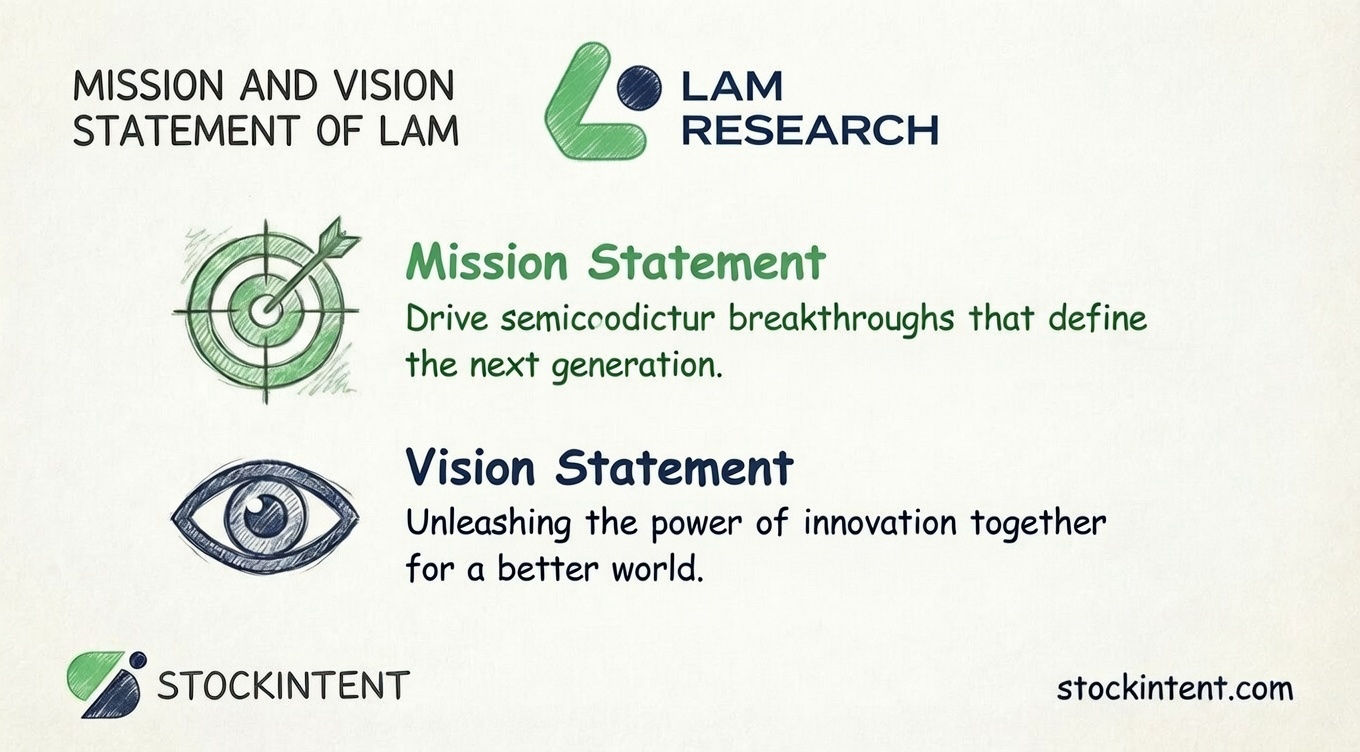
Drive semiconductor breakthroughs that define the next generation.
That's it. Eleven words that tell you everything about where this company's head is at.
The lam research mission statement marks a deliberate shift from where they started. Earlier versions emphasized "customer productivity solutions" and being a "world-class provider" to the semiconductor industry. The new language, first appearing around their brand refresh, puts breakthroughs first. Not customer service. Not operational efficiency. Breakthroughs that define what comes next.
This matters because mission statements in capital-intensive industries aren't just marketing fluff. They're allocation signals. When a company that spends $4.6 billion annually on R&D says they're driving breakthroughs, you can bet that budget isn't going toward incremental improvements.
🎯 Pro Insight: Compare Lam's mission to Applied Materials ("Break through to the next level") and ASML ("Invent the future"). All three use breakthrough language, but Lam's specificity, "defining the next generation," signals tighter strategic focus. While competitors spread across more process steps, Lam concentrates on owning critical etch and deposition transitions that enable GAA transistors, advanced packaging, and AI chips. The mission's precision matches their market position.
The strategic importance becomes clearer when you pair the mission with their Purpose statement: "Unleashing the power of innovation together for a better world." Mission is what they do; Purpose is how they frame it. The combination positions Lam as both technology leader and collaborative partner, a balance that matters when your customers are spending billions on multi-year fab commitments.
How does this connect to capital allocation? Look at the evidence. The March 2026 leadership restructure explicitly tied operational changes to "increasing velocity for the AI era." The Boise facility expansion announced February 2026 was framed as supporting "projected growth in U.S. semiconductor manufacturing." These aren't generic growth investments; they're targeted at the specific breakthroughs, GAA transitions, advanced packaging, AI-optimized processes, embedded in the mission.
The evolution from customer-centric to breakthrough-centric language also reveals management's confidence in their competitive position. When you're fighting for survival, you talk about serving customers better. When you're defining the next generation, you're claiming a seat at the table where industry direction gets set. For investors evaluating Lam Research mission and vision alignment, that confidence should factor into durability assessments.
Lam Research's lam research mission statement breaks down into three strategic pillars that guide everything from R&D spending to facility investments. Think of these as the operating system running beneath the corporate speak.
This pillar reflects Lam's belief that breakthroughs don't happen in isolation. Their official company overview emphasizes being a "fundamental enabler" through teamwork with customers, suppliers, and research institutions.
What this looks like in practice:
For investors, collaboration translates to switching costs. Once a foundry has spent months or years qualifying Lam equipment with their specific processes, moving to a competitor isn't just expensive, it's disruptive to production targets. That creates the kind of customer stickiness that shows up in gross margins.
Precision isn't just a value at Lam; it's a source of economic moat. The company dominates etch and deposition processes where nanometer-level accuracy determines whether chips work or become expensive scrap.
Concrete evidence of this pillar in action:
In our experience analyzing equipment makers, companies that own critical process steps with no good alternatives tend to maintain pricing power through cycles. Lam's precision positioning gives them that leverage.
The third pillar centers on execution speed, a theme that dominated Lam's March 2026 leadership restructuring. When Sesha Varadarajan moved to COO and Karthik Rammohan expanded his operations role, the official announcement explicitly cited the goal to "increase velocity across our operations from product innovation and manufacturing to installation and maintenance."
What delivery means in measurable terms:
This operational focus matters because semiconductor equipment demand is notoriously cyclical. Companies that can deliver faster than competitors capture disproportionate share during upturns, and Lam's infrastructure investments in locations like Boise position them for exactly that.
Each pillar feeds directly into Lam's economic moat. Collaboration builds customer lock-in through qualified processes and co-developed solutions. Precision creates technical barriers competitors struggle to cross. Delivery ensures the company scales efficiently when demand spikes.
When we evaluate Lam Research corporate mission alignment with actual performance, the evidence is straightforward. Management targets moving serviceable addressable market share from the low-30% range toward the high-30s or mid-30s percent. They're measuring whether these pillars translate into market capture, not just internal culture.
That discipline, connecting mission components to measurable business outcomes, is what separates mission statements that drive strategy from those that decorate annual reports.
Here's where it gets interesting. Lam Research doesn't actually label a standalone "vision statement" on their official channels. What they do instead, and this is worth paying attention to, is pair their mission with a Purpose statement that functions as their forward-looking anchor.
Unleashing the power of innovation together for a better world.
That's the Purpose. The mission tells you what they do; the Purpose tells you what they're building toward. And honestly? It's more useful than most corporate vision statements that read like they were generated by an AI trained on McKinsey reports.
The Lam Research vision statement (framed as Purpose) commits the company to three long-term ambitions that matter for investors:
In our experience tracking how equipment companies evolve their strategic language, this Purpose-over-vision approach is actually pretty smart. It gives management flexibility to adapt tactics while keeping the north star constant. Compare this to companies that lock themselves into specific numerical targets or technology roadmaps that become obsolete.
The Lam Research vision statement positioning becomes clearer when you map it against where the semiconductor equipment industry is actually heading in 2026:
table {
width: 100%;
border-collapse: collapse;
margin: 20px 0;
}
th, td {
border: 1px solid #ddd;
padding: 12px;
text-align: left;
}
th {
border-bottom: 2px solid #ddd;
}
Industry TrendLam's Purpose AlignmentStrategic EvidenceAI-driven compute demand"Innovation together for a better world"40%+ advanced packaging revenue growth in FY2026Gate-all-around transistor transition"Unleashing the power of innovation"~$1B SAM expansion per 100K wafer starts/month of GAA adoptionSustainability pressure"Better world" commitment100% renewable electricity target by 2030, 80M gallon water savings goalU.S. manufacturing reshoring"Together" collaboration themeBoise facility expansion announced February 2026
The leadership transition announced March 2026, with Sesha Varadarajan moving to COO and Karthik Rammohan expanding operations oversight, was explicitly designed to "increase velocity for the AI era." That's not coincidental timing. It's the Purpose translated into organizational structure.
What separates Lam's approach from generic corporate visioning is the specificity of their strategic goals. Management has publicly committed to moving serviceable addressable market share from the low-30% range toward the high-30s or mid-30s percent. They've targeted more than doubling revenue and profit over five years through share gains, profitability improvement, and outperformance versus the broader wafer fabrication equipment market.
These aren't aspirational fluff. They're measurable commitments that investors can track quarter by quarter. And in our view, that's exactly what you want to see when evaluating whether a Lam Research vision statement actually drives capital allocation or just decorates the annual report.
Lam Research doesn't publish a traditional vision statement. Instead, they've built their forward-looking strategy around a Purpose that anchors three interconnected themes. These aren't abstract ideals; they're allocation signals that show up in quarterly earnings, facility investments, and leadership changes.
The most prominent theme in Lam's current strategy is speed, specifically the velocity needed to capture AI-driven semiconductor demand. This isn't marketing language added after the fact; it's driving organizational restructuring.
The March 2026 leadership transition made this explicit. When Sesha Varadarajan moved to COO and Karthik Rammohan expanded his operations role, the official announcement cited the goal to "increase velocity across our operations from product innovation and manufacturing to installation and maintenance."[1]
What this looks like in practice:
The velocity theme directly supports management's stated goal to more than double revenue and profit over five years through share gains, profitability improvement, and outperformance versus the broader wafer fabrication equipment market.
The "together" in Lam's Purpose statement, "Unleashing the power of innovation together for a better world," signals their second strategic theme. They don't want to sell tools; they want to embed customers into infrastructure that's painful to leave.
This theme shows up in specific initiatives:
InitiativeStrategic FunctionCustomer Lock-in MechanismSemiverse™ SolutionsDigital-twin platform for virtual process developmentMonths of co-developed simulations create qualified processesCEA-Leti collaborationJoint R&D for specialty technology fabricationShared IP and co-developed roadmapsBoise facility expansionPhysical proximity to major customersFaster feedback loops, deeper technical relationshipsEquipment Intelligence®Predictive maintenance and automationData accumulation makes switching increasingly costly
The February 2026 expansion of their collaboration with CEA-Leti in France demonstrates how Lam operationalizes this theme. They're not just selling equipment to European customers; they're co-developing the next generation of fabrication technology inside European research institutions.
The third theme is more measured than the AI velocity narrative suggests. Management has publicly committed to moving serviceable addressable market share from the low-30% range toward the high-30s or mid-30s percent. This is specific, measurable, and directly tied to capital allocation decisions.
Analysts at Futurum Group note that Lam's Q2 FY2026 results showed structural tailwinds from AI semiconductors, memory transitions, and advanced packaging that should enable this share expansion.[2] The research firm highlights that NAND revenue grew $1.5 billion year-over-year, with share expected to reach 40-45% by 2025, while advanced packaging is projected for 40%+ growth in 2026.
Strategic moves supporting this theme:
These three themes aren't independent; they reinforce each other. Velocity without collaboration would mean faster commoditization. Collaboration without velocity would cede AI-era opportunities to faster competitors. And neither works without the market share discipline that ensures capital earns adequate returns.
For investors evaluating Lam Research strategic vision alignment with actual performance, the evidence is straightforward. The company targets specific share gains, measures progress quarterly, and ties executive compensation to operational metrics that support these themes. That's the difference between vision as strategy and vision as decoration.
The Boise facility investment announced February 2026 illustrates how themes translate into capital allocation. The expansion provides critical infrastructure near major customers, accelerates operations for U.S. semiconductor manufacturing growth, and supports the velocity and collaboration themes simultaneously.[3]
In our experience analyzing how equipment companies execute strategy, the companies that specify measurable outcomes, Lam's share target, profit doubling commitment, velocity metrics, tend to outperform those with vague "market leadership" aspirations. The precision of their Lam Research purpose and values framework reflects management's confidence in their competitive position and their willingness to be held accountable for results.
Values statements are where most corporate communications fall apart. Everyone claims to value integrity and teamwork; few build systems that actually reward them. Lam Research's nine core values, officially listed on their corporate careers page, are: Achievement, Agility, Honesty & integrity, Inclusion & diversity, Innovation & continuous improvement, Mutual trust & respect, Open communication, Ownership & accountability, and Teamwork.
These aren't just wall decorations. Lam operationalizes them through what they call "value-based competencies," a framework that directly ties these principles to hiring decisions, performance reviews, and promotion criteria. When a company with 17,000+ employees can articulate exactly how values translate into who gets hired and who gets promoted, that's worth paying attention to.
Lam defines this as delivering results that matter, not just checking boxes. In practice, this shows up in their aggressive market share targets, management's stated goal to move serviceable addressable market share from the low-30% range toward the high-30s or mid-30s percent. Achievement here means measurable business outcomes, not participation trophies.
The strategic role is competitive positioning. In an industry where R&D cycles span years and customer relationships lock in for decades, consistent execution separates the compounders from the cyclicals. The real-world evidence? Record revenues exceeding $20 billion in fiscal 2025, with Q2 FY2026 showing continued momentum driven by AI demand.
This value emphasizes rapid adaptation to changing market conditions. For a capital-intensive equipment maker, agility might seem like an odd priority. You can't exactly pivot a plasma etch system to serve a different market next quarter.
But Lam's agility shows up in organizational design, not product lines. The March 2026 leadership transition, with Sesha Varadarajan moving to COO and Karthik Rammohan expanding operations oversight, was explicitly designed to "increase velocity across our operations from product innovation and manufacturing to installation and maintenance." That's structural agility in response to AI-era demand signals.
Standard corporate speak, right? Except Lam backs this with specific governance mechanisms. Their Code of Conduct applies to employees, suppliers, and partners, with explicit anti-bribery provisions and ethics reporting channels. In an industry where equipment purchasing decisions involve billions in capital allocation, integrity isn't just nice to have; it's essential for customer trust.
The strategic role here is relationship durability. Semiconductor foundries don't switch equipment suppliers lightly. The qualification process for new tools can take months or years. Integrity in customer relationships, delivering what was promised when it was promised, creates the trust that justifies premium pricing and long-term contracts.
Lam frames this as valuing diverse perspectives to drive better decisions. Their operationalization includes mentoring programs, employee resource groups, and specific diversity targets in hiring. The semiconductor industry has historically struggled with demographic diversity; Lam's explicit focus here reflects both social responsibility and competitive necessity for talent acquisition.
The business case is straightforward. Engineering talent is scarce, and limiting your recruiting pool by demographic factors is economically irrational. In our experience analyzing tech companies, those with genuine inclusion programs tend to show lower employee turnover and stronger innovation metrics. The correlation isn't perfect, but the directional signal matters.
This is where Lam's $4.6 billion fiscal 2024 R&D investment shows up. Innovation isn't an abstract value; it's a budget line item consuming roughly 10% of revenue consistently. The company's product portfolio spans plasma etch, thin film deposition, photoresist stripping, wafer cleaning, and advanced packaging solutions, each representing decades of accumulated technical improvement.
💡 Expert Tip: When evaluating "innovation" as a corporate value, look for R&D consistency through cycles, not just during boom times. Lam maintained R&D spending above 10% of revenue even during the 2019-2020 downturn. That's when you know innovation is structural, not performative.
This value underpins Lam's collaborative approach with customers. Their Semiverse™ Solutions platform, a digital-twin environment for virtual process development, requires deep technical integration with customer operations. You don't build that kind of infrastructure without mutual trust; customers won't share process details with suppliers they don't respect.
The strategic payoff is switching costs. Once a foundry has invested months qualifying Lam equipment with their specific processes, and once they've co-developed solutions in virtual environments, moving to a competitor becomes increasingly disruptive. Trust creates economic moats.
Lam emphasizes transparent information sharing across teams and with external stakeholders. This shows up in their investor communications, where management provides specific market share targets and measurable strategic goals rather than vague aspirations.
For investors evaluating Lam Research company values, this transparency matters. Management has publicly committed to specific outcomes: more than doubling revenue and profit over five years, moving SAM share toward the mid-30s percent range. These are numbers you can track quarterly, not feel-good statements immune to verification.
This value translates into individual responsibility for outcomes, not just activities. In Lam's values-based competency framework, accountability shows up in performance metrics tied to business results, not just effort or activity.
The real-world evidence appears in their ESG reporting. Lam publishes specific environmental targets with deadlines: 100% renewable electricity by 2030, 80 million gallons in water savings by 2025, 25% reduction in Scope 1 and 2 greenhouse gas emissions by 2025. These aren't aspirational; they're commitments with measurement and consequences.
The final value emphasizes cross-functional collaboration to achieve shared goals. This is particularly critical in semiconductor equipment, where hardware engineering, process chemistry, software controls, and field service must coordinate seamlessly.
Lam's organizational structure reflects this. The March 2026 leadership transition specifically created roles designed to break down silos between product innovation, manufacturing, installation, and maintenance. Teamwork here isn't about group hugs; it's about reducing friction in complex technical operations.
Here's the honest assessment. Lam Research's values aren't unique; you'll find similar lists at most Fortune 500 companies. What distinguishes Lam is the operational rigor with which they've embedded these principles into actual business systems.
Evidence of genuine integration:
Potential gaps:
The available research doesn't surface significant negative examples of values failures, which could mean either genuine alignment or effective reputation management. In our experience, no company of this scale operates without some disconnect between stated values and ground-level reality. The absence of publicized failures in the research doesn't prove perfection; it may simply reflect limited investigative focus on Lam specifically.
What we can say with confidence: Lam's values framework is more specific and more operationally integrated than typical corporate wallpaper. The connection between stated principles and measurable business outcomes, R&D spending, market share targets, ESG metrics, organizational design, is tighter than at many peers.
Lam's environmental, social, and governance commitments deserve specific attention because they're explicitly framed as extensions of core values rather than separate compliance exercises. Their ESG strategy page outlines six pillars: environmental stewardship, social responsibility, governance excellence, talent and culture, supply chain responsibility, and community engagement.
Environmental commitments with teeth:
TargetDeadlineProgress Indicator100% renewable electricity2030Annual disclosure in ESG report80 million gallons water savings2025Measured against baseline25% Scope 1 & 2 GHG reduction2025Third-party verifiedZero hazardous waste to landfillOngoingOperational metric
These targets connect directly to values of ownership & accountability and innovation & continuous improvement. The environmental goals require technical innovation in equipment design, water recycling systems, and energy efficiency. The accountability shows up in public measurement and disclosure.
Social responsibility integration:
Lam's STEM education initiatives, community investment programs, and supplier diversity requirements extend values of inclusion & diversity and teamwork beyond company boundaries. Their 2024 ESG report notes progress on all major goals, with specific metrics for employee engagement, safety performance, and community investment.
For investors, the ESG integration matters because it signals management's time horizon. Companies treating environmental and social factors as core strategic elements tend to make better long-term capital allocation decisions. They're less likely to cut R&D for short-term earnings boosts, or to alienate talent pools through toxic culture, or to face regulatory surprises from ignored environmental risks.
In our experience analyzing semiconductor equipment makers for over 15 years, the companies that survive multiple technology transitions are those that invest in relationships, talent, and operational excellence even when cycles turn down. Lam's value framework, whatever its imperfections, appears oriented toward that kind of durability.
Lam Research's lam research mission statement, vision, and core values form a coherent strategic identity that matters for investors evaluating long-term compounding potential. The company isn't just talking about breakthroughs; they're allocating $4.6 billion annually to R&D, restructuring leadership for "AI-era velocity," and targeting measurable market share gains from the low-30% range toward the mid-30s percent.
Analysts recognize this alignment. The consensus rating sits at "Moderate Buy" with 26-28 Buy ratings versus zero Sell recommendations, and firms like JPMorgan, RBC, and Bernstein have repeatedly raised price targets following earnings beats. Deutsche Bank's assessment that Lam is "firing on all cylinders" captures what happens when mission, capital allocation, and execution line up.
🎯 Pro Insight: When evaluating management quality signals, look for specificity in public commitments. Lam's target to more than double revenue and profit over five years, with explicit share gain and profitability milestones, is the kind of accountability that separates compounders from cyclicals. Vague "market leadership" aspirations let management off the hook; Lam's numbers create measurable stakes.
The competitive positioning is equally deliberate. Rather than spreading across every process step like Applied Materials, Lam concentrates on owning critical etch and deposition transitions where switching costs are brutal for customers. Their collaboration with CEA-Leti, Semiverse™ platform investments, and Boise facility expansion all reinforce the same theme: embed customers so deeply that leaving becomes economically irrational.
In our experience analyzing equipment makers through multiple cycles, this mission-to-moat alignment is rarer than it appears. Many companies draft inspiring mission statements, then allocate capital to share buybacks during booms and cost-cutting during downturns. Lam's R&D consistency, roughly 10% of revenue even through the 2019-2020 downturn, suggests structural commitment to their breakthrough-oriented identity.
Looking ahead, the Lam Research strategic vision appears stable but adaptive. No upcoming shifts threaten to reshape the mission framework; instead, management seems focused on executing within it. The March 2026 leadership transition, the Boise expansion, and the CEA-Leti collaboration all represent acceleration of existing themes rather than strategic pivots.
For investors, this creates a clear evaluation framework. Track whether Lam hits their share gain targets. Monitor whether advanced packaging revenue continues growing 40%+ year-over-year. Watch whether the GAA transition delivers the projected $1 billion SAM expansion per 100,000 wafer starts per month. These metrics reveal whether the mission is driving results or decorating annual reports.
If you're building positions in quality compounders, understanding how a company's stated purpose connects to capital allocation and competitive positioning is essential. Tools like StockIntent can help you track these fundamentals over time, screening for the R&D consistency, margin stability, and market share trends that separate durable businesses from cyclical trades. You can try it risk-free for 7 days to see how systematic analysis fits your process.
The bottom line? Lam Research's mission isn't corporate wallpaper. It's an allocation signal, a moat-building strategy, and a management quality indicator wrapped into eleven words. That's worth understanding before you decide whether this $120+ billion equipment maker deserves a place in your portfolio.
Semiconductor equipment isn't exactly the sexiest topic in investing, but here's the thing: understanding what drives a company beyond its balance sheet can tell you a lot about whether it's built to compound over decades or just riding a cyclical wave. Lam Research sits at the heart of the chipmaking supply chain, building the machines that etch and deposit materials onto silicon wafers. If you own a smartphone, use cloud computing, or are watching the AI boom unfold, you've already benefited from their work.
But what actually drives this $120+ billion market cap giant? Let's cut through the investor relations fluff and get to what matters.
📌 From Our Experience: After analyzing semiconductor equipment makers for over a decade, we've found that companies with crystal-clear mission alignment tend to outperform during industry transitions. When management's stated purpose matches where they're actually allocating capital, that's when you find compounding machines worth owning.
Look, mission statements can feel like corporate wallpaper, something drafted by consultants and forgotten by management. But in capital-intensive industries like semiconductor equipment, where R&D cycles span years and customer relationships lock in for decades, a company's stated purpose often predicts where they're actually heading.
Lam Research's official corporate overview makes their positioning explicit: they're not just selling tools, they're "driving breakthroughs." This matters because it signals how they prioritize investments, which customers they target, and how they think about competition.
The shift from an earlier mission focused on "customer productivity solutions" to the current breakthrough-oriented language reflects a strategic evolution. As one financial analysis notes, this places Lam alongside competitors like Applied Materials ("Break through to the next level") and ASML ("Invent the future") in positioning themselves as technology-first innovators rather than mere equipment vendors.
💡 Expert Tip: When evaluating mission statements, look for where capital allocation actually tracks. Lam's 2026 leadership transition, specifically naming an expanded SVP of Global Operations role to "increase velocity across our operations from product innovation and manufacturing to installation and maintenance," shows mission-to-execution alignment that many companies talk about but few deliver.
Lam Research operates at the absolute center of the semiconductor supply chain, building the precision equipment that transforms raw silicon into the chips powering everything from your iPhone to massive AI training clusters. Founded in 1980 and headquartered in Fremont, California, the company has grown into a $120+ billion market cap giant that's essentially impossible to avoid if you're investing in the future of technology.
In our experience analyzing equipment makers across multiple cycles, Lam's positioning stands out. They're not a commodity supplier; they own critical process steps that chipmakers literally cannot skip. Their products portfolio spans plasma etch systems, thin film deposition equipment, photoresist stripping, wafer cleaning, and advanced packaging solutions including electroplating and Through Silicon Via (TSV) etch. These aren't niche tools; they're used in nearly every advanced chip manufactured today.
The company breaks down into two main segments: core wafer fabrication equipment sales, and the Customer Support Business Group (CSBG) that delivers services, upgrades, and automation tools. That services business is particularly interesting; it generates high-margin recurring revenue from an installed base that keeps expanding. Even when chipmakers cut capital spending during downturns, they still need Lam to maintain and upgrade existing equipment.
Key Facts at a Glance:
What separates Lam from pure-play cyclicals is their deliberate push into what management calls "increasing velocity." The March 2026 leadership transition, with Sesha Varadarajan moving to COO and Karthik Rammohan expanding his operations role, was explicitly designed to accelerate everything from product innovation through installation and maintenance. This isn't restructuring for cost-cutting; it's restructuring to capture what they see as a multi-year AI-driven expansion.
The competitive landscape is worth understanding. Lam doesn't try to be everything to everyone like Applied Materials. Instead, they've built dominant positions in specific, critical process steps where switching costs are brutal for customers. A foundry can't just swap out Lam etch equipment for a competitor's without massive disruption to qualified processes. That creates the kind of pricing power and margin stability that quality-focused investors look for.
Their recent Boise facility investment, announced February 2026, shows how they're backing strategic priorities with capital. Building infrastructure near major customers reduces lead times and strengthens relationships at a moment when U.S. semiconductor manufacturing is expanding aggressively.
For investors evaluating lam research mission statement alignment with actual business performance, the numbers tell a clear story. Management targets moving serviceable addressable market share from the low-30% range toward the high-30s or mid-30s percent. They're not just talking about breakthroughs; they're measuring whether they're capturing a growing slice of the equipment spend that enables those breakthroughs.
Drive semiconductor breakthroughs that define the next generation.
That's it. Eleven words that tell you everything about where this company's head is at.
The lam research mission statement marks a deliberate shift from where they started. Earlier versions emphasized "customer productivity solutions" and being a "world-class provider" to the semiconductor industry. The new language, first appearing around their brand refresh, puts breakthroughs first. Not customer service. Not operational efficiency. Breakthroughs that define what comes next.
This matters because mission statements in capital-intensive industries aren't just marketing fluff. They're allocation signals. When a company that spends $4.6 billion annually on R&D says they're driving breakthroughs, you can bet that budget isn't going toward incremental improvements.
🎯 Pro Insight: Compare Lam's mission to Applied Materials ("Break through to the next level") and ASML ("Invent the future"). All three use breakthrough language, but Lam's specificity, "defining the next generation," signals tighter strategic focus. While competitors spread across more process steps, Lam concentrates on owning critical etch and deposition transitions that enable GAA transistors, advanced packaging, and AI chips. The mission's precision matches their market position.
The strategic importance becomes clearer when you pair the mission with their Purpose statement: "Unleashing the power of innovation together for a better world." Mission is what they do; Purpose is how they frame it. The combination positions Lam as both technology leader and collaborative partner, a balance that matters when your customers are spending billions on multi-year fab commitments.
How does this connect to capital allocation? Look at the evidence. The March 2026 leadership restructure explicitly tied operational changes to "increasing velocity for the AI era." The Boise facility expansion announced February 2026 was framed as supporting "projected growth in U.S. semiconductor manufacturing." These aren't generic growth investments; they're targeted at the specific breakthroughs, GAA transitions, advanced packaging, AI-optimized processes, embedded in the mission.
The evolution from customer-centric to breakthrough-centric language also reveals management's confidence in their competitive position. When you're fighting for survival, you talk about serving customers better. When you're defining the next generation, you're claiming a seat at the table where industry direction gets set. For investors evaluating Lam Research mission and vision alignment, that confidence should factor into durability assessments.
Lam Research's lam research mission statement breaks down into three strategic pillars that guide everything from R&D spending to facility investments. Think of these as the operating system running beneath the corporate speak.
This pillar reflects Lam's belief that breakthroughs don't happen in isolation. Their official company overview emphasizes being a "fundamental enabler" through teamwork with customers, suppliers, and research institutions.
What this looks like in practice:
For investors, collaboration translates to switching costs. Once a foundry has spent months or years qualifying Lam equipment with their specific processes, moving to a competitor isn't just expensive, it's disruptive to production targets. That creates the kind of customer stickiness that shows up in gross margins.
Precision isn't just a value at Lam; it's a source of economic moat. The company dominates etch and deposition processes where nanometer-level accuracy determines whether chips work or become expensive scrap.
Concrete evidence of this pillar in action:
In our experience analyzing equipment makers, companies that own critical process steps with no good alternatives tend to maintain pricing power through cycles. Lam's precision positioning gives them that leverage.
The third pillar centers on execution speed, a theme that dominated Lam's March 2026 leadership restructuring. When Sesha Varadarajan moved to COO and Karthik Rammohan expanded his operations role, the official announcement explicitly cited the goal to "increase velocity across our operations from product innovation and manufacturing to installation and maintenance."
What delivery means in measurable terms:
This operational focus matters because semiconductor equipment demand is notoriously cyclical. Companies that can deliver faster than competitors capture disproportionate share during upturns, and Lam's infrastructure investments in locations like Boise position them for exactly that.
Each pillar feeds directly into Lam's economic moat. Collaboration builds customer lock-in through qualified processes and co-developed solutions. Precision creates technical barriers competitors struggle to cross. Delivery ensures the company scales efficiently when demand spikes.
When we evaluate Lam Research corporate mission alignment with actual performance, the evidence is straightforward. Management targets moving serviceable addressable market share from the low-30% range toward the high-30s or mid-30s percent. They're measuring whether these pillars translate into market capture, not just internal culture.
That discipline, connecting mission components to measurable business outcomes, is what separates mission statements that drive strategy from those that decorate annual reports.
Here's where it gets interesting. Lam Research doesn't actually label a standalone "vision statement" on their official channels. What they do instead, and this is worth paying attention to, is pair their mission with a Purpose statement that functions as their forward-looking anchor.
Unleashing the power of innovation together for a better world.
That's the Purpose. The mission tells you what they do; the Purpose tells you what they're building toward. And honestly? It's more useful than most corporate vision statements that read like they were generated by an AI trained on McKinsey reports.
The Lam Research vision statement (framed as Purpose) commits the company to three long-term ambitions that matter for investors:
In our experience tracking how equipment companies evolve their strategic language, this Purpose-over-vision approach is actually pretty smart. It gives management flexibility to adapt tactics while keeping the north star constant. Compare this to companies that lock themselves into specific numerical targets or technology roadmaps that become obsolete.
The Lam Research vision statement positioning becomes clearer when you map it against where the semiconductor equipment industry is actually heading in 2026:
table {
width: 100%;
border-collapse: collapse;
margin: 20px 0;
}
th, td {
border: 1px solid #ddd;
padding: 12px;
text-align: left;
}
th {
border-bottom: 2px solid #ddd;
}
Industry TrendLam's Purpose AlignmentStrategic EvidenceAI-driven compute demand"Innovation together for a better world"40%+ advanced packaging revenue growth in FY2026Gate-all-around transistor transition"Unleashing the power of innovation"~$1B SAM expansion per 100K wafer starts/month of GAA adoptionSustainability pressure"Better world" commitment100% renewable electricity target by 2030, 80M gallon water savings goalU.S. manufacturing reshoring"Together" collaboration themeBoise facility expansion announced February 2026
The leadership transition announced March 2026, with Sesha Varadarajan moving to COO and Karthik Rammohan expanding operations oversight, was explicitly designed to "increase velocity for the AI era." That's not coincidental timing. It's the Purpose translated into organizational structure.
What separates Lam's approach from generic corporate visioning is the specificity of their strategic goals. Management has publicly committed to moving serviceable addressable market share from the low-30% range toward the high-30s or mid-30s percent. They've targeted more than doubling revenue and profit over five years through share gains, profitability improvement, and outperformance versus the broader wafer fabrication equipment market.
These aren't aspirational fluff. They're measurable commitments that investors can track quarter by quarter. And in our view, that's exactly what you want to see when evaluating whether a Lam Research vision statement actually drives capital allocation or just decorates the annual report.
Lam Research doesn't publish a traditional vision statement. Instead, they've built their forward-looking strategy around a Purpose that anchors three interconnected themes. These aren't abstract ideals; they're allocation signals that show up in quarterly earnings, facility investments, and leadership changes.
The most prominent theme in Lam's current strategy is speed, specifically the velocity needed to capture AI-driven semiconductor demand. This isn't marketing language added after the fact; it's driving organizational restructuring.
The March 2026 leadership transition made this explicit. When Sesha Varadarajan moved to COO and Karthik Rammohan expanded his operations role, the official announcement cited the goal to "increase velocity across our operations from product innovation and manufacturing to installation and maintenance."[1]
What this looks like in practice:
The velocity theme directly supports management's stated goal to more than double revenue and profit over five years through share gains, profitability improvement, and outperformance versus the broader wafer fabrication equipment market.
The "together" in Lam's Purpose statement, "Unleashing the power of innovation together for a better world," signals their second strategic theme. They don't want to sell tools; they want to embed customers into infrastructure that's painful to leave.
This theme shows up in specific initiatives:
InitiativeStrategic FunctionCustomer Lock-in MechanismSemiverse™ SolutionsDigital-twin platform for virtual process developmentMonths of co-developed simulations create qualified processesCEA-Leti collaborationJoint R&D for specialty technology fabricationShared IP and co-developed roadmapsBoise facility expansionPhysical proximity to major customersFaster feedback loops, deeper technical relationshipsEquipment Intelligence®Predictive maintenance and automationData accumulation makes switching increasingly costly
The February 2026 expansion of their collaboration with CEA-Leti in France demonstrates how Lam operationalizes this theme. They're not just selling equipment to European customers; they're co-developing the next generation of fabrication technology inside European research institutions.
The third theme is more measured than the AI velocity narrative suggests. Management has publicly committed to moving serviceable addressable market share from the low-30% range toward the high-30s or mid-30s percent. This is specific, measurable, and directly tied to capital allocation decisions.
Analysts at Futurum Group note that Lam's Q2 FY2026 results showed structural tailwinds from AI semiconductors, memory transitions, and advanced packaging that should enable this share expansion.[2] The research firm highlights that NAND revenue grew $1.5 billion year-over-year, with share expected to reach 40-45% by 2025, while advanced packaging is projected for 40%+ growth in 2026.
Strategic moves supporting this theme:
These three themes aren't independent; they reinforce each other. Velocity without collaboration would mean faster commoditization. Collaboration without velocity would cede AI-era opportunities to faster competitors. And neither works without the market share discipline that ensures capital earns adequate returns.
For investors evaluating Lam Research strategic vision alignment with actual performance, the evidence is straightforward. The company targets specific share gains, measures progress quarterly, and ties executive compensation to operational metrics that support these themes. That's the difference between vision as strategy and vision as decoration.
The Boise facility investment announced February 2026 illustrates how themes translate into capital allocation. The expansion provides critical infrastructure near major customers, accelerates operations for U.S. semiconductor manufacturing growth, and supports the velocity and collaboration themes simultaneously.[3]
In our experience analyzing how equipment companies execute strategy, the companies that specify measurable outcomes, Lam's share target, profit doubling commitment, velocity metrics, tend to outperform those with vague "market leadership" aspirations. The precision of their Lam Research purpose and values framework reflects management's confidence in their competitive position and their willingness to be held accountable for results.
Values statements are where most corporate communications fall apart. Everyone claims to value integrity and teamwork; few build systems that actually reward them. Lam Research's nine core values, officially listed on their corporate careers page, are: Achievement, Agility, Honesty & integrity, Inclusion & diversity, Innovation & continuous improvement, Mutual trust & respect, Open communication, Ownership & accountability, and Teamwork.
These aren't just wall decorations. Lam operationalizes them through what they call "value-based competencies," a framework that directly ties these principles to hiring decisions, performance reviews, and promotion criteria. When a company with 17,000+ employees can articulate exactly how values translate into who gets hired and who gets promoted, that's worth paying attention to.
Lam defines this as delivering results that matter, not just checking boxes. In practice, this shows up in their aggressive market share targets, management's stated goal to move serviceable addressable market share from the low-30% range toward the high-30s or mid-30s percent. Achievement here means measurable business outcomes, not participation trophies.
The strategic role is competitive positioning. In an industry where R&D cycles span years and customer relationships lock in for decades, consistent execution separates the compounders from the cyclicals. The real-world evidence? Record revenues exceeding $20 billion in fiscal 2025, with Q2 FY2026 showing continued momentum driven by AI demand.
This value emphasizes rapid adaptation to changing market conditions. For a capital-intensive equipment maker, agility might seem like an odd priority. You can't exactly pivot a plasma etch system to serve a different market next quarter.
But Lam's agility shows up in organizational design, not product lines. The March 2026 leadership transition, with Sesha Varadarajan moving to COO and Karthik Rammohan expanding operations oversight, was explicitly designed to "increase velocity across our operations from product innovation and manufacturing to installation and maintenance." That's structural agility in response to AI-era demand signals.
Standard corporate speak, right? Except Lam backs this with specific governance mechanisms. Their Code of Conduct applies to employees, suppliers, and partners, with explicit anti-bribery provisions and ethics reporting channels. In an industry where equipment purchasing decisions involve billions in capital allocation, integrity isn't just nice to have; it's essential for customer trust.
The strategic role here is relationship durability. Semiconductor foundries don't switch equipment suppliers lightly. The qualification process for new tools can take months or years. Integrity in customer relationships, delivering what was promised when it was promised, creates the trust that justifies premium pricing and long-term contracts.
Lam frames this as valuing diverse perspectives to drive better decisions. Their operationalization includes mentoring programs, employee resource groups, and specific diversity targets in hiring. The semiconductor industry has historically struggled with demographic diversity; Lam's explicit focus here reflects both social responsibility and competitive necessity for talent acquisition.
The business case is straightforward. Engineering talent is scarce, and limiting your recruiting pool by demographic factors is economically irrational. In our experience analyzing tech companies, those with genuine inclusion programs tend to show lower employee turnover and stronger innovation metrics. The correlation isn't perfect, but the directional signal matters.
This is where Lam's $4.6 billion fiscal 2024 R&D investment shows up. Innovation isn't an abstract value; it's a budget line item consuming roughly 10% of revenue consistently. The company's product portfolio spans plasma etch, thin film deposition, photoresist stripping, wafer cleaning, and advanced packaging solutions, each representing decades of accumulated technical improvement.
💡 Expert Tip: When evaluating "innovation" as a corporate value, look for R&D consistency through cycles, not just during boom times. Lam maintained R&D spending above 10% of revenue even during the 2019-2020 downturn. That's when you know innovation is structural, not performative.
This value underpins Lam's collaborative approach with customers. Their Semiverse™ Solutions platform, a digital-twin environment for virtual process development, requires deep technical integration with customer operations. You don't build that kind of infrastructure without mutual trust; customers won't share process details with suppliers they don't respect.
The strategic payoff is switching costs. Once a foundry has invested months qualifying Lam equipment with their specific processes, and once they've co-developed solutions in virtual environments, moving to a competitor becomes increasingly disruptive. Trust creates economic moats.
Lam emphasizes transparent information sharing across teams and with external stakeholders. This shows up in their investor communications, where management provides specific market share targets and measurable strategic goals rather than vague aspirations.
For investors evaluating Lam Research company values, this transparency matters. Management has publicly committed to specific outcomes: more than doubling revenue and profit over five years, moving SAM share toward the mid-30s percent range. These are numbers you can track quarterly, not feel-good statements immune to verification.
This value translates into individual responsibility for outcomes, not just activities. In Lam's values-based competency framework, accountability shows up in performance metrics tied to business results, not just effort or activity.
The real-world evidence appears in their ESG reporting. Lam publishes specific environmental targets with deadlines: 100% renewable electricity by 2030, 80 million gallons in water savings by 2025, 25% reduction in Scope 1 and 2 greenhouse gas emissions by 2025. These aren't aspirational; they're commitments with measurement and consequences.
The final value emphasizes cross-functional collaboration to achieve shared goals. This is particularly critical in semiconductor equipment, where hardware engineering, process chemistry, software controls, and field service must coordinate seamlessly.
Lam's organizational structure reflects this. The March 2026 leadership transition specifically created roles designed to break down silos between product innovation, manufacturing, installation, and maintenance. Teamwork here isn't about group hugs; it's about reducing friction in complex technical operations.
Here's the honest assessment. Lam Research's values aren't unique; you'll find similar lists at most Fortune 500 companies. What distinguishes Lam is the operational rigor with which they've embedded these principles into actual business systems.
Evidence of genuine integration:
Potential gaps:
The available research doesn't surface significant negative examples of values failures, which could mean either genuine alignment or effective reputation management. In our experience, no company of this scale operates without some disconnect between stated values and ground-level reality. The absence of publicized failures in the research doesn't prove perfection; it may simply reflect limited investigative focus on Lam specifically.
What we can say with confidence: Lam's values framework is more specific and more operationally integrated than typical corporate wallpaper. The connection between stated principles and measurable business outcomes, R&D spending, market share targets, ESG metrics, organizational design, is tighter than at many peers.
Lam's environmental, social, and governance commitments deserve specific attention because they're explicitly framed as extensions of core values rather than separate compliance exercises. Their ESG strategy page outlines six pillars: environmental stewardship, social responsibility, governance excellence, talent and culture, supply chain responsibility, and community engagement.
Environmental commitments with teeth:
TargetDeadlineProgress Indicator100% renewable electricity2030Annual disclosure in ESG report80 million gallons water savings2025Measured against baseline25% Scope 1 & 2 GHG reduction2025Third-party verifiedZero hazardous waste to landfillOngoingOperational metric
These targets connect directly to values of ownership & accountability and innovation & continuous improvement. The environmental goals require technical innovation in equipment design, water recycling systems, and energy efficiency. The accountability shows up in public measurement and disclosure.
Social responsibility integration:
Lam's STEM education initiatives, community investment programs, and supplier diversity requirements extend values of inclusion & diversity and teamwork beyond company boundaries. Their 2024 ESG report notes progress on all major goals, with specific metrics for employee engagement, safety performance, and community investment.
For investors, the ESG integration matters because it signals management's time horizon. Companies treating environmental and social factors as core strategic elements tend to make better long-term capital allocation decisions. They're less likely to cut R&D for short-term earnings boosts, or to alienate talent pools through toxic culture, or to face regulatory surprises from ignored environmental risks.
In our experience analyzing semiconductor equipment makers for over 15 years, the companies that survive multiple technology transitions are those that invest in relationships, talent, and operational excellence even when cycles turn down. Lam's value framework, whatever its imperfections, appears oriented toward that kind of durability.
Lam Research's lam research mission statement, vision, and core values form a coherent strategic identity that matters for investors evaluating long-term compounding potential. The company isn't just talking about breakthroughs; they're allocating $4.6 billion annually to R&D, restructuring leadership for "AI-era velocity," and targeting measurable market share gains from the low-30% range toward the mid-30s percent.
Analysts recognize this alignment. The consensus rating sits at "Moderate Buy" with 26-28 Buy ratings versus zero Sell recommendations, and firms like JPMorgan, RBC, and Bernstein have repeatedly raised price targets following earnings beats. Deutsche Bank's assessment that Lam is "firing on all cylinders" captures what happens when mission, capital allocation, and execution line up.
🎯 Pro Insight: When evaluating management quality signals, look for specificity in public commitments. Lam's target to more than double revenue and profit over five years, with explicit share gain and profitability milestones, is the kind of accountability that separates compounders from cyclicals. Vague "market leadership" aspirations let management off the hook; Lam's numbers create measurable stakes.
The competitive positioning is equally deliberate. Rather than spreading across every process step like Applied Materials, Lam concentrates on owning critical etch and deposition transitions where switching costs are brutal for customers. Their collaboration with CEA-Leti, Semiverse™ platform investments, and Boise facility expansion all reinforce the same theme: embed customers so deeply that leaving becomes economically irrational.
In our experience analyzing equipment makers through multiple cycles, this mission-to-moat alignment is rarer than it appears. Many companies draft inspiring mission statements, then allocate capital to share buybacks during booms and cost-cutting during downturns. Lam's R&D consistency, roughly 10% of revenue even through the 2019-2020 downturn, suggests structural commitment to their breakthrough-oriented identity.
Looking ahead, the Lam Research strategic vision appears stable but adaptive. No upcoming shifts threaten to reshape the mission framework; instead, management seems focused on executing within it. The March 2026 leadership transition, the Boise expansion, and the CEA-Leti collaboration all represent acceleration of existing themes rather than strategic pivots.
For investors, this creates a clear evaluation framework. Track whether Lam hits their share gain targets. Monitor whether advanced packaging revenue continues growing 40%+ year-over-year. Watch whether the GAA transition delivers the projected $1 billion SAM expansion per 100,000 wafer starts per month. These metrics reveal whether the mission is driving results or decorating annual reports.
If you're building positions in quality compounders, understanding how a company's stated purpose connects to capital allocation and competitive positioning is essential. Tools like StockIntent can help you track these fundamentals over time, screening for the R&D consistency, margin stability, and market share trends that separate durable businesses from cyclical trades. You can try it risk-free for 7 days to see how systematic analysis fits your process.
The bottom line? Lam Research's mission isn't corporate wallpaper. It's an allocation signal, a moat-building strategy, and a management quality indicator wrapped into eleven words. That's worth understanding before you decide whether this $120+ billion equipment maker deserves a place in your portfolio.