
Aug 17, 2026
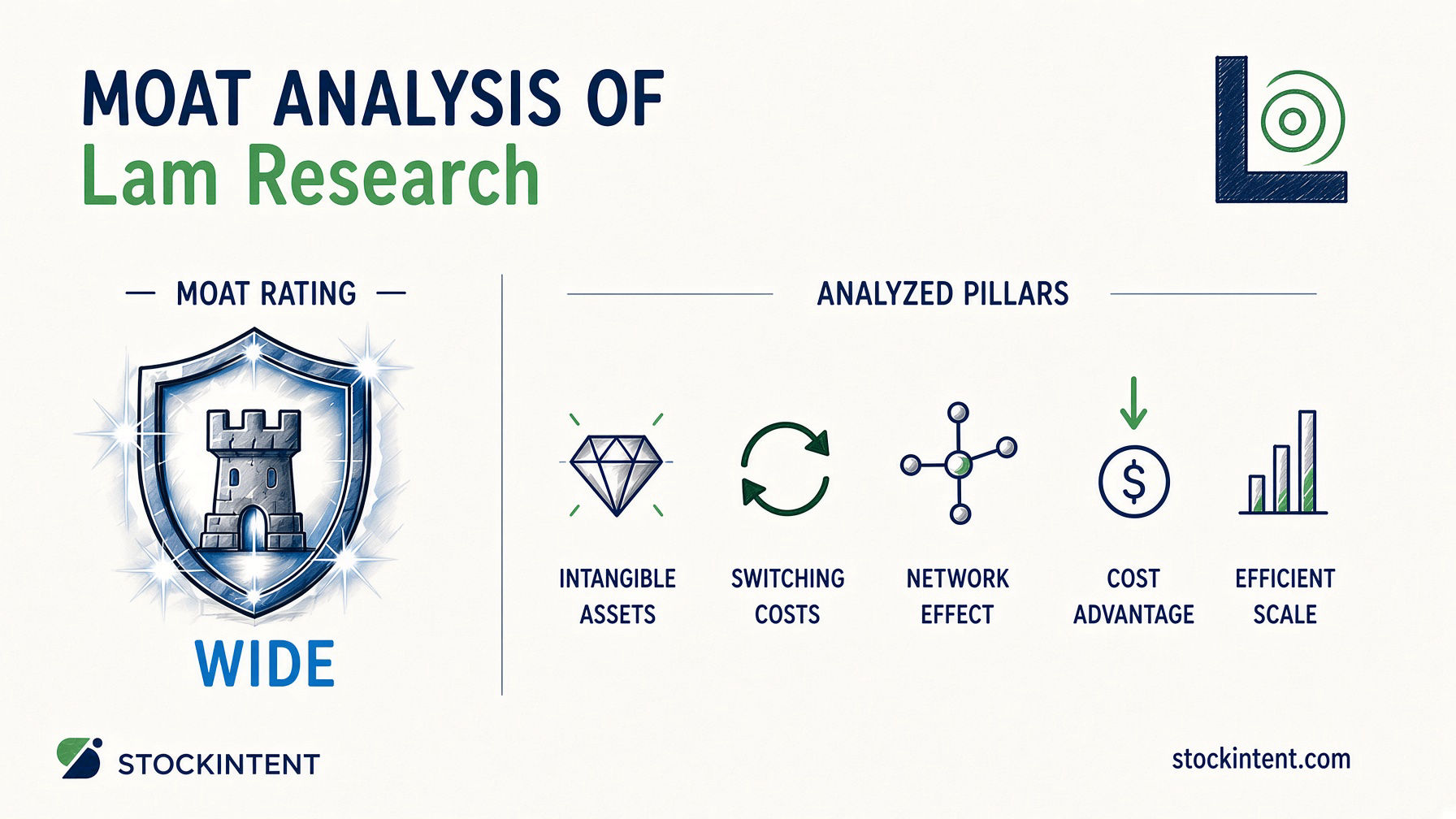
Lam Research carries a wide economic moat with a stable-to-widening trend and medium uncertainty. That verdict rests on technology leadership in semiconductor etch and deposition, a massive installed base that locks in customers, and financial performance that most industrial businesses would envy.
Morningstar calls the company a "wide-moat heavyweight," and the numbers from its June 2026 quarter back that up: $6.72 billion in revenue, 51.7% GAAP gross margin, and 37.4% operating margin.
Here's what matters most for investors evaluating business quality:
For long-term investors, moat durability matters because it determines whether today's strong returns on capital are a cyclical peak or a sustainable baseline. The question isn't whether Lam Research is a good business right now; it's whether the economics that produce these margins will still be intact five to ten years from now.
Lam Research's moat rests on two genuinely strong pillars, two moderate ones, and one that investors should stop looking for. Here's how each of the five standard moat pillars applies.
Strong: Morningstar attributes Lam's wide moat partly to "intangible assets related to equipment design." The company's proprietary capabilities in atomic layer etching, selective deposition, and cryogenic etching represent years of accumulated process knowledge that competitors cannot replicate overnight. This isn't just patents on paper; it's the practical know-how embedded in tools that define how leading-edge chips get manufactured.
Strong: Once a fab qualifies Lam's tools and recipes, changing vendors is genuinely costly. Re-qualification risks production delays, yield loss, and downtime that chipmakers simply cannot afford at the leading edge. The 102,000+ installed chamber base isn't just a scale metric; it's evidence of deep integration into customer workflows. GuruFocus emphasizes that this integration creates material stickiness that protects market share even when competitors offer competitive tools.
Moderate: Morningstar explicitly cites cost advantages as part of the wide moat, but the mechanism differs from classic manufacturing scale. Lam's leadership position supports R&D spending levels that only Applied Materials can match. Annual R&D runs $1.7 billion to $2.5 billion depending on definition. This is capital allocation as competitive defense: the spending sustains technical leadership that produces the margins that fund the spending. The loop works, but it depends on continued execution rather than a fixed structural edge.
Moderate: Lam's approximately 45% market share in etch equipment sits in a concentrated market where three players dominate. This creates scale advantages in customer relationships, service infrastructure, and process learning. Still, this isn't the classic efficient-scale moat of a local monopoly with protected geography. It's more accurate to call it scale-backed leadership in a global oligopoly.
Weak / Not Material: Here's where investors commonly misapply the framework. Lam benefits from an installed base and learning effects: more chambers running means more process data, which improves future tools. But that is not a network effect in the strict sense. Morningstar is explicit: more users of Lam's equipment do not directly increase value for other users the way they do on a platform or marketplace. The installed base creates stickiness and knowledge advantages, not self-reinforcing network dynamics.
Pro Insight: In semiconductor equipment, investors often misapply the network effects pillar because of the large installed base. The key distinction is that Lam's value increases with customer process knowledge (learning effects), not with the number of other users (network effects). Intangible assets and switching costs are the durable pillars here in our opinion.
Lam Research's competitive advantages are not theoretical. They show up in the financials, and they show up in ways that matter for long-term business quality.
The most visible moat benefit is the Customer Support Business Group (CSBG), which delivered its first $2 billion quarter in 2026. This is recurring revenue from an installed base that keeps expanding. Services are growing at a mid-teens rate, which means the moat is literally compounding every year. When customers stay because switching is painful, that stickiness becomes a predictable revenue stream.
Margins tell the same story. In the June 2026 quarter, Lam posted a 51.7% GAAP gross margin and 37.4% operating margin. Non-GAAP figures were even stronger: 52.0% and 38.4% respectively. These aren't one-off peaks. They're the kind of numbers that suggest real pricing power in a business where customers have few alternatives for complex etch and deposition work.
But the moat picture isn't perfect. Pure pricing power is inferred from margins, not demonstrated through explicit price increases. And customer prepayments have fallen to nearly four-year lows because the fastest-growing customers aren't the ones who typically prepay. That's a mixed signal about bargaining leverage.
Cycle dependence also remains. The current strength is partly driven by AI-related demand, which raises a fair question: how much of this performance is structural moat, and how much is favorable cyclical timing?
Still, the combination of $2 billion in quarterly services revenue, 50%-plus gross margins, and an expanding installed base distinguishes Lam from commodity equipment vendors. These metrics are what you'd expect from a company with durable competitive advantages, even if the full durability test comes in a weaker demand environment.
For investors comparing these figures against peers, StockIntent's company reports let you evaluate whether current margins represent sustainable advantage or cyclical peak conditions, and how Lam's profile stacks up against Applied Materials and other equipment names on the metrics that matter most for moat assessment.
Lam Research's moat is stable to widening in 2026. The semiconductor industry is spending more on precisely the process steps where Lam holds technical leadership, and the company's served market is expanding with AI-driven complexity rather than shrinking.
Several forces are pushing the moat wider. Advanced packaging revenue is projected to grow more than 50% in 2026, opening a significant new demand vector beyond Lam's core memory franchise. The company's Serviceable Available Market (SAM) is expected to reach the mid-30s percent of total wafer fabrication equipment spending in 2026, with management targeting a high-30s percent medium-term goal. Dielectric deposition SAM alone should increase more than 20% in DRAM as 1C DRAM ramps, directly expanding Lam's addressable demand.
The installed base compounds this effect. With over 102,000 chambers in the field and the Customer Support Business Group hitting its first $2 billion quarter, services are growing at a mid-teens rate. That recurring revenue stream deepens customer entrenchment and provides financial ballast when equipment orders turn lumpy.
But widening doesn't mean uncontested. Competition is intensifying in advanced packaging specifically, with Applied Materials and KLA pursuing the same opportunity set. This matters because advanced packaging is Lam's fastest-growing segment. If rivals close the technology gap or win key customer qualifications, Lam's expansion into this critical growth vector could stall.
The core etch and deposition franchises look more defensible. Morningstar's wide moat assessment remains intact, and the industry structure favors incumbents: leading-edge process steps are growing more complex, not less, which raises barriers to entry and increases the value of specialized know-how.
| Indicator | What to Watch For |
|---|---|
| CSBG Growth Rate | Sustained mid-teens growth or better, signaling deeper customer entrenchment |
| SAM Percentage | Progress toward the high-30s percent medium-term target from current mid-30s levels |
| Advanced Packaging Revenue Growth | Continued 50%+ growth or evidence of sustained momentum beyond 2026 |
| Gross Margin Durability | Margins holding near 50%+ through cycle normalization, confirming pricing power |
These four indicators cut through the noise. If CSBG growth stays strong, SAM expands, packaging momentum continues, and margins prove resilient in a softer demand environment, the moat is genuinely widening. If two or more of these indicators falter, the trend is closer to stable than widening, and the competitive threat is materializing faster than Lam can outrun it.
The range of outcomes is moderately wide. AI capex cycles are inherently unpredictable, and customer spending patterns have already shifted toward more project-driven, second-half-weighted purchasing. The moat's structural integrity looks solid; the question is whether its economic rewards expand or merely hold steady.
We rate Lam Research's moat uncertainty as Medium.
That rating reflects three drivers that widen the range of plausible outcomes beyond what the current strong numbers suggest. First, semiconductor equipment spending remains cyclical even when the cycle is favorable. Lam's June 2026 quarter revenue of $6.72 billion and 51.7% gross margin are impressive, but historical revenue fell in 2024 after a weaker industry year, then rebounded sharply. The business is not structurally flat. Management itself acknowledges that customer spending timing is uncertain, particularly around NAND and DRAM conversion cycles.
Second, geographic concentration creates genuine geopolitical risk. In the June 2026 quarter, Taiwan contributed 27% of revenue and China contributed 26%. Korea added another 20%. That means roughly three-quarters of revenue depends on a handful of semiconductor ecosystems in Asia, with China specifically subject to export controls, licensing restrictions, and policy shifts that could abruptly alter Lam's addressable market.
Third, competitive dynamics in growth areas remain unresolved. Advanced packaging revenue is projected to grow more than 50% in 2026, but Applied Materials and KLA are intensifying their push into the same space. The moat's core etch and deposition franchises look durable; whether Lam can extend that dominance into newer, strategically critical segments is less certain.
From Our Experience: In semiconductor equipment, geographic concentration is often underestimated as an uncertainty factor. A 26% exposure to a single market subject to export controls creates binary outcome risks that standard deviation metrics miss. When assessing moat durability, we weight geopolitical concentration heavily because regulatory shifts can abruptly alter a company's addressable market regardless of technical leadership.
The range of outcomes over three to five years is moderately wide. The upside case is credible: AI-driven spending, expanding SAM toward the high-30s percent of WFE, and services compounding at mid-teens rates. The downside case is also real: a sharp capex downturn, China access restrictions, or competitive share loss in advanced packaging could compress margins and revenue simultaneously.
For investors tracking these dynamics, the key question isn't whether Lam Research has competitive advantages today. It's whether the conditions that let those advantages produce 37% operating margins and $2 billion quarterly services revenue will persist through the next industry cycle and the next geopolitical shift.
Lam Research earns a wide economic moat with a stable-to-widening trend and medium uncertainty. The verdict rests on two genuinely durable pillars: proprietary etch and deposition technology that competitors cannot replicate overnight, and switching costs embedded across an installed base exceeding 102,000 chambers. The financial evidence is equally clear: 51.7% gross margins, 37.4% operating margins, and a Customer Support Business Group that recently delivered its first $2 billion quarter.
Two issues matter most from here. First, execution in advanced packaging amid intensifying competition from Applied Materials and KLA. Second, China revenue exposure and export control developments that could abruptly alter the addressable market. These are not distant risks; they are active variables that will shape whether the moat's economic rewards expand or hold steady.
The practical next step is straightforward. Monitor the four watchlist indicators we outlined: CSBG growth rate, SAM percentage trends, advanced packaging revenue momentum, and gross margin durability through cycle normalization. StockIntent watchlists let you organize ongoing tracking of these metrics and compare Lam's trajectory against peers on the signals that actually predict moat durability.
This content is for informational and educational purposes only and is not investment advice.
Lam Research carries a wide economic moat with a stable-to-widening trend and medium uncertainty. That verdict rests on technology leadership in semiconductor etch and deposition, a massive installed base that locks in customers, and financial performance that most industrial businesses would envy.
Morningstar calls the company a "wide-moat heavyweight," and the numbers from its June 2026 quarter back that up: $6.72 billion in revenue, 51.7% GAAP gross margin, and 37.4% operating margin.
Here's what matters most for investors evaluating business quality:
For long-term investors, moat durability matters because it determines whether today's strong returns on capital are a cyclical peak or a sustainable baseline. The question isn't whether Lam Research is a good business right now; it's whether the economics that produce these margins will still be intact five to ten years from now.
Lam Research's moat rests on two genuinely strong pillars, two moderate ones, and one that investors should stop looking for. Here's how each of the five standard moat pillars applies.
Strong: Morningstar attributes Lam's wide moat partly to "intangible assets related to equipment design." The company's proprietary capabilities in atomic layer etching, selective deposition, and cryogenic etching represent years of accumulated process knowledge that competitors cannot replicate overnight. This isn't just patents on paper; it's the practical know-how embedded in tools that define how leading-edge chips get manufactured.
Strong: Once a fab qualifies Lam's tools and recipes, changing vendors is genuinely costly. Re-qualification risks production delays, yield loss, and downtime that chipmakers simply cannot afford at the leading edge. The 102,000+ installed chamber base isn't just a scale metric; it's evidence of deep integration into customer workflows. GuruFocus emphasizes that this integration creates material stickiness that protects market share even when competitors offer competitive tools.
Moderate: Morningstar explicitly cites cost advantages as part of the wide moat, but the mechanism differs from classic manufacturing scale. Lam's leadership position supports R&D spending levels that only Applied Materials can match. Annual R&D runs $1.7 billion to $2.5 billion depending on definition. This is capital allocation as competitive defense: the spending sustains technical leadership that produces the margins that fund the spending. The loop works, but it depends on continued execution rather than a fixed structural edge.
Moderate: Lam's approximately 45% market share in etch equipment sits in a concentrated market where three players dominate. This creates scale advantages in customer relationships, service infrastructure, and process learning. Still, this isn't the classic efficient-scale moat of a local monopoly with protected geography. It's more accurate to call it scale-backed leadership in a global oligopoly.
Weak / Not Material: Here's where investors commonly misapply the framework. Lam benefits from an installed base and learning effects: more chambers running means more process data, which improves future tools. But that is not a network effect in the strict sense. Morningstar is explicit: more users of Lam's equipment do not directly increase value for other users the way they do on a platform or marketplace. The installed base creates stickiness and knowledge advantages, not self-reinforcing network dynamics.
Pro Insight: In semiconductor equipment, investors often misapply the network effects pillar because of the large installed base. The key distinction is that Lam's value increases with customer process knowledge (learning effects), not with the number of other users (network effects). Intangible assets and switching costs are the durable pillars here in our opinion.
Lam Research's competitive advantages are not theoretical. They show up in the financials, and they show up in ways that matter for long-term business quality.
The most visible moat benefit is the Customer Support Business Group (CSBG), which delivered its first $2 billion quarter in 2026. This is recurring revenue from an installed base that keeps expanding. Services are growing at a mid-teens rate, which means the moat is literally compounding every year. When customers stay because switching is painful, that stickiness becomes a predictable revenue stream.
Margins tell the same story. In the June 2026 quarter, Lam posted a 51.7% GAAP gross margin and 37.4% operating margin. Non-GAAP figures were even stronger: 52.0% and 38.4% respectively. These aren't one-off peaks. They're the kind of numbers that suggest real pricing power in a business where customers have few alternatives for complex etch and deposition work.
But the moat picture isn't perfect. Pure pricing power is inferred from margins, not demonstrated through explicit price increases. And customer prepayments have fallen to nearly four-year lows because the fastest-growing customers aren't the ones who typically prepay. That's a mixed signal about bargaining leverage.
Cycle dependence also remains. The current strength is partly driven by AI-related demand, which raises a fair question: how much of this performance is structural moat, and how much is favorable cyclical timing?
Still, the combination of $2 billion in quarterly services revenue, 50%-plus gross margins, and an expanding installed base distinguishes Lam from commodity equipment vendors. These metrics are what you'd expect from a company with durable competitive advantages, even if the full durability test comes in a weaker demand environment.
For investors comparing these figures against peers, StockIntent's company reports let you evaluate whether current margins represent sustainable advantage or cyclical peak conditions, and how Lam's profile stacks up against Applied Materials and other equipment names on the metrics that matter most for moat assessment.
Lam Research's moat is stable to widening in 2026. The semiconductor industry is spending more on precisely the process steps where Lam holds technical leadership, and the company's served market is expanding with AI-driven complexity rather than shrinking.
Several forces are pushing the moat wider. Advanced packaging revenue is projected to grow more than 50% in 2026, opening a significant new demand vector beyond Lam's core memory franchise. The company's Serviceable Available Market (SAM) is expected to reach the mid-30s percent of total wafer fabrication equipment spending in 2026, with management targeting a high-30s percent medium-term goal. Dielectric deposition SAM alone should increase more than 20% in DRAM as 1C DRAM ramps, directly expanding Lam's addressable demand.
The installed base compounds this effect. With over 102,000 chambers in the field and the Customer Support Business Group hitting its first $2 billion quarter, services are growing at a mid-teens rate. That recurring revenue stream deepens customer entrenchment and provides financial ballast when equipment orders turn lumpy.
But widening doesn't mean uncontested. Competition is intensifying in advanced packaging specifically, with Applied Materials and KLA pursuing the same opportunity set. This matters because advanced packaging is Lam's fastest-growing segment. If rivals close the technology gap or win key customer qualifications, Lam's expansion into this critical growth vector could stall.
The core etch and deposition franchises look more defensible. Morningstar's wide moat assessment remains intact, and the industry structure favors incumbents: leading-edge process steps are growing more complex, not less, which raises barriers to entry and increases the value of specialized know-how.
| Indicator | What to Watch For |
|---|---|
| CSBG Growth Rate | Sustained mid-teens growth or better, signaling deeper customer entrenchment |
| SAM Percentage | Progress toward the high-30s percent medium-term target from current mid-30s levels |
| Advanced Packaging Revenue Growth | Continued 50%+ growth or evidence of sustained momentum beyond 2026 |
| Gross Margin Durability | Margins holding near 50%+ through cycle normalization, confirming pricing power |
These four indicators cut through the noise. If CSBG growth stays strong, SAM expands, packaging momentum continues, and margins prove resilient in a softer demand environment, the moat is genuinely widening. If two or more of these indicators falter, the trend is closer to stable than widening, and the competitive threat is materializing faster than Lam can outrun it.
The range of outcomes is moderately wide. AI capex cycles are inherently unpredictable, and customer spending patterns have already shifted toward more project-driven, second-half-weighted purchasing. The moat's structural integrity looks solid; the question is whether its economic rewards expand or merely hold steady.
We rate Lam Research's moat uncertainty as Medium.
That rating reflects three drivers that widen the range of plausible outcomes beyond what the current strong numbers suggest. First, semiconductor equipment spending remains cyclical even when the cycle is favorable. Lam's June 2026 quarter revenue of $6.72 billion and 51.7% gross margin are impressive, but historical revenue fell in 2024 after a weaker industry year, then rebounded sharply. The business is not structurally flat. Management itself acknowledges that customer spending timing is uncertain, particularly around NAND and DRAM conversion cycles.
Second, geographic concentration creates genuine geopolitical risk. In the June 2026 quarter, Taiwan contributed 27% of revenue and China contributed 26%. Korea added another 20%. That means roughly three-quarters of revenue depends on a handful of semiconductor ecosystems in Asia, with China specifically subject to export controls, licensing restrictions, and policy shifts that could abruptly alter Lam's addressable market.
Third, competitive dynamics in growth areas remain unresolved. Advanced packaging revenue is projected to grow more than 50% in 2026, but Applied Materials and KLA are intensifying their push into the same space. The moat's core etch and deposition franchises look durable; whether Lam can extend that dominance into newer, strategically critical segments is less certain.
From Our Experience: In semiconductor equipment, geographic concentration is often underestimated as an uncertainty factor. A 26% exposure to a single market subject to export controls creates binary outcome risks that standard deviation metrics miss. When assessing moat durability, we weight geopolitical concentration heavily because regulatory shifts can abruptly alter a company's addressable market regardless of technical leadership.
The range of outcomes over three to five years is moderately wide. The upside case is credible: AI-driven spending, expanding SAM toward the high-30s percent of WFE, and services compounding at mid-teens rates. The downside case is also real: a sharp capex downturn, China access restrictions, or competitive share loss in advanced packaging could compress margins and revenue simultaneously.
For investors tracking these dynamics, the key question isn't whether Lam Research has competitive advantages today. It's whether the conditions that let those advantages produce 37% operating margins and $2 billion quarterly services revenue will persist through the next industry cycle and the next geopolitical shift.
Lam Research earns a wide economic moat with a stable-to-widening trend and medium uncertainty. The verdict rests on two genuinely durable pillars: proprietary etch and deposition technology that competitors cannot replicate overnight, and switching costs embedded across an installed base exceeding 102,000 chambers. The financial evidence is equally clear: 51.7% gross margins, 37.4% operating margins, and a Customer Support Business Group that recently delivered its first $2 billion quarter.
Two issues matter most from here. First, execution in advanced packaging amid intensifying competition from Applied Materials and KLA. Second, China revenue exposure and export control developments that could abruptly alter the addressable market. These are not distant risks; they are active variables that will shape whether the moat's economic rewards expand or hold steady.
The practical next step is straightforward. Monitor the four watchlist indicators we outlined: CSBG growth rate, SAM percentage trends, advanced packaging revenue momentum, and gross margin durability through cycle normalization. StockIntent watchlists let you organize ongoing tracking of these metrics and compare Lam's trajectory against peers on the signals that actually predict moat durability.
This content is for informational and educational purposes only and is not investment advice.