Apr 7, 2026
Lucid Group (NASDAQ: LCID) has built its identity around a deceptively simple promise: advancing EV technology for the benefit of all. But for investors trying to separate genuine competitive advantage from marketing speak, understanding what Lucid's mission actually means in practice, and how it shapes capital allocation decisions, matters more than the words on a corporate webpage.
This article breaks down Lucid's mission statement, vision, and core values as they stand in 2026. We'll examine how these elements have evolved alongside the company's strategic pivot from pure luxury play to technology platform, and what that shift reveals about management's priorities going forward.
Lucid Group (NASDAQ: LCID) operates in the consumer cyclical sector as a luxury electric vehicle manufacturer, positioning itself at the intersection of high-performance automotive engineering and advanced battery technology. Founded in 2007 as Atieva by Bernard Tse and Sam Weng, the company spent its early years developing battery systems for other automakers before pivoting to building its own vehicles under CEO Peter Rawlinson's leadership.
In our experience tracking EV manufacturers since the sector's early days, we've observed that Lucid's trajectory mirrors the classic automotive startup arc: technology supplier first, then brand builder, now aspiring platform company. The 2021 launch of the Lucid Air sedan marked its transition from development to production, while the December 2024 Gravity SUV rollout and planned late 2026 midsize platform signal ambitions to move beyond pure luxury into higher-volume segments.
Lucid's 2025 financial results, released February 2026, show the company delivering nearly 16,000 vehicles while nearly doubling production year-over-year. The Q4 2025 numbers were particularly notable: 5,345 deliveries represented a 72% jump from the prior year period, with management describing it as a "step-change" in operational execution. Liquidity stands at approximately $4.6 billion, which the company indicates funds operations through mid-2027.
What makes Lucid's positioning interesting for investors is its dual-track strategy. While scaling vehicle production remains the near-term priority, the company is simultaneously building what it calls a "technology platform" business. This includes licensing its powertrain technology to Aston Martin for their 2025 EV launch, developing autonomous vehicle capabilities through partnerships with Uber and Nuro, and preparing a midsize vehicle platform targeting the $48,000–$50,000 price point.
The competitive landscape is challenging. Lucid delivered roughly 16,000 vehicles in 2025; Tesla delivered over 1.8 million. Yet Lucid's focus on efficiency, range (the Air Grand Touring achieves 516 miles EPA-estimated), and luxury positioning has earned recognition including dual Car and Driver 10Best awards for 2026. For investors using screening tools to evaluate the auto manufacturers space, Lucid represents a high-risk, technology-heavy bet on premium EV adoption and platform licensing rather than mass-market volume play.
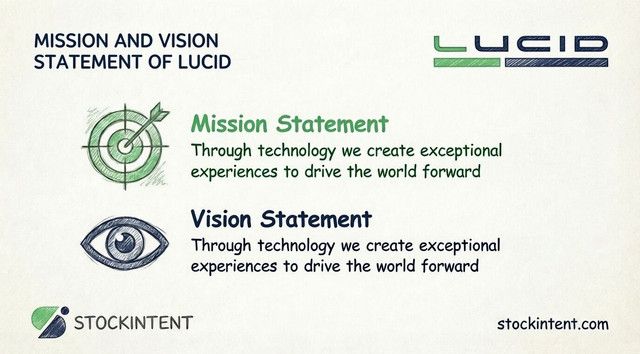
Lucid's official mission statement appears in two closely related forms across corporate communications. The SEC filing version states:
"Lucid's mission is to advance the state-of-the-art of electric vehicle technology for the benefit of all."
The company's consumer-facing language adds texture to this foundation:
"Through technology we create exceptional experiences to drive the world forward."
Both versions center on a technology-experience-progress triad, but the shift in emphasis between regulatory filings and marketing materials reveals something important about how Lucid sees itself. The SEC version speaks to investors about technological leadership and broad benefit. The public version speaks to customers about what that technology actually delivers: experiences worth paying premium prices for.
🎯 Pro Insight: When analyzing mission statements, compare regulatory filings against marketing language. The gaps between them often reveal where a company's priorities actually lie. Lucid's dual phrasing shows management thinks simultaneously about engineering credibility (for investors) and experiential differentiation (for buyers). That's rare discipline for a startup-stage manufacturer.
This mission signals three strategic priorities that directly shape capital allocation. First, proprietary technology advancement justifies R&D spending that consumed $1.3 billion in 2024 alone. Second, exceptional experiences supports the direct-to-consumer sales model and premium pricing that yields gross margins management is fighting to protect. Third, driving the world forward provides narrative cover for the long path to profitability, framing today's losses as investments in tomorrow's platform licensing revenue.
The mission has sharpened since Lucid's early days. Older language emphasized "sustainable mobility without compromise" and vehicles "designed for all the ways people get around." The current formulation drops the accessibility framing in favor of technology leadership. This evolution tracks Lucid's strategic pivot from startup ambition to scaled manufacturer with licensing ambitions, from the Air sedan's 2021 launch through the Gravity SUV's late 2024 rollout and the planned midsize platform for late 2026.
For investors using screening tools to evaluate auto manufacturers, the mission statement matters because it predicts where management will deploy limited capital. Lucid's language suggests continued heavy investment in powertrain efficiency, software-defined vehicle architecture, and autonomous capabilities, even when near-term profitability remains distant. The "benefit of all" phrasing also hints at the technology licensing strategy already underway with Aston Martin and potentially others. Understanding this helps distinguish genuine strategic consistency from mere marketing copy.
Lucid's mission, "Through technology we create exceptional experiences to drive the world forward," breaks down into three interconnected strategic pillars. Each pillar serves a distinct purpose in the company's value chain, and together they form the foundation of Lucid's economic moat.
This pillar sits at the core of Lucid's capital allocation strategy. The company directs substantial R&D investment toward powertrain efficiency, battery chemistry, and software-defined vehicle architecture. The results show up in tangible metrics: the Air Grand Touring achieves 516 miles of EPA-estimated range, while competitors in the same price bracket typically deliver 300–400 miles.
The technology focus extends beyond consumer vehicles. Lucid's powertrain licensing agreement with Aston Martin demonstrates how proprietary tech creates alternative revenue streams. The company also maintains an annual Hackathon program to surface internal innovation, reinforcing a culture where technical breakthroughs are systematically pursued rather than left to chance.
For investors, this pillar matters because it justifies premium pricing and creates switching costs. When a vehicle's efficiency advantage is measured in hundreds of miles per charge, the competitive differentiation becomes sticky. In our experience analyzing EV manufacturers, companies that lead on efficiency metrics tend to maintain pricing power longer than those competing primarily on features or design.
Lucid translates technical advantages into customer-facing value through what it calls "exceptional experiences." This isn't just marketing language; it shapes operational decisions across sales, service, and product design.
The direct-to-consumer model, operated through Lucid Studios rather than traditional dealerships, gives the company control over the entire customer journey. Mobile service operations extend this approach to maintenance, reducing friction for owners who might otherwise face inconsistent third-party service quality.
The experience pillar also shows up in product design choices. The Gravity SUV's interior space, the Air's "DreamDrive Pro" hands-free driving system, and the emphasis on materials and build quality all serve the mission of creating experiences that justify luxury price points.
This pillar connects directly to gross margin goals. CFO Taoufiq Boussaid has been explicit about protecting margins as Lucid reaches into mass markets, and the experience premium is what makes that protection possible. Without perceived differentiation, a $50,000 Lucid competes on price with Tesla and legacy OEMs. With it, the company maintains pricing power even as volumes scale.
The third pillar frames Lucid's environmental commitments in terms of efficiency and resource optimization rather than pure carbon reduction. The company's sustainability reporting emphasizes minimizing battery and grid electricity use, which simultaneously reduces environmental impact and operating costs for owners.
This efficiency-first approach aligns with the broader mission of "benefit of all" from Lucid's SEC filing language. Lower electricity consumption per mile means less strain on charging infrastructure and lower total cost of ownership, expanding accessibility even within the luxury segment.
The sustainability pillar also supports talent acquisition and retention. Lucid's employee value proposition leans heavily on environmental impact, with career pages emphasizing the opportunity to contribute to "preserving our planet." In a competitive market for engineering talent, this positioning helps attract candidates who might otherwise choose higher-paying roles at tech companies.
These three pillars aren't independent initiatives. They're mutually reinforcing: proprietary technology enables exceptional experiences (range, charging speed, software features), which in turn justify the efficiency investments that advance sustainability goals. The technology licensing strategy, already underway with Aston Martin, extends this flywheel beyond Lucid's own vehicle production.
For investors using screening tools to evaluate the auto manufacturers space, understanding these pillars helps distinguish genuine strategic coherence from mission-washing. The concrete metrics, specific partnerships, and capital allocation patterns all point to management that treats the mission as an operating framework rather than a marketing exercise.
Lucid does not publish a separate vision statement distinct from its mission. Instead, the company consolidates its forward-looking ambitions into a single declaration that functions as both mission and vision:
"Through technology we create exceptional experiences to drive the world forward."
This formulation is intentional. By embedding the future state ("drive the world forward") directly into its core statement, Lucid signals that its purpose and its destination are inseparable. The vision isn't something separate to achieve; it's the natural outcome of executing the mission.
Lucid's leadership has translated this statement into concrete long-term goals that reveal where the company aims to be by decade's end:
Platform scaling: The midsize vehicle program launching late 2026 targets the $48,000–$50,000 segment, representing a 40% price reduction from the Air's entry point. This isn't simply volume chasing; it's a bet that Lucid's technology can maintain differentiation at mass-market price points.
Technology licensing expansion: The Aston Martin powertrain partnership is positioned as the first of multiple OEM relationships, with management explicitly stating that licensing revenue could eventually match or exceed vehicle sales.
Autonomy integration: The Uber and Nuro partnerships for 20,000 autonomous Gravity vehicles in 2026 represent an early move into what Lucid estimates as a $700 billion robotaxi market by 2035. Level 3 autonomy is targeted for 2028, Level 4 for 2029.
Global manufacturing footprint: The Saudi Arabia facility under development complements Arizona operations, positioning Lucid to serve European, Middle Eastern, and Asian markets with reduced logistics costs and tariff exposure.
In our experience analyzing automotive transitions, companies that successfully bridge luxury positioning to mass-market scale typically see 3–5 years of margin compression before volume economics take hold. Lucid's vision explicitly acknowledges this tradeoff, with CFO Taoufiq Boussaid repeatedly emphasizing that the company will not "chase volume at the expense of margin" as it executes this expansion.
Lucid's vision positions it at the intersection of three macro forces reshaping auto manufacturers:
| Trend | Lucid's Positioning | Strategic Implication |
|---|---|---|
| Electrification acceleration | 516-mile range, 4.5 miles/kWh efficiency | Technology leadership creates pricing power even as battery costs commoditize |
| Software-defined vehicles | DreamDrive Pro, over-the-air updates, autonomy stack | Recurring revenue potential and customer lock-in through feature subscriptions |
| Premiumization of EVs | Dual Car and Driver 10Best awards, luxury positioning | Avoids direct price war with Tesla Model 3/Y while building brand equity for mass-market entry |
The consumer cyclical dynamics here are worth understanding. Luxury EV buyers are less interest-rate sensitive than mass-market purchasers, which partially insulated Lucid during 2023–2024's demand slowdown. However, this same segment is more discretionary, making brand perception and product excellence non-negotiable. Lucid's vision of "exceptional experiences" directly addresses this vulnerability; the company is essentially betting that technical superiority can sustain premium pricing even as competitors discount aggressively.
The vision also anticipates a shift in how auto manufacturers generate returns. Traditional OEMs monetize hardware once at sale. Lucid's framing of "driving the world forward" through technology implies a business model where powertrain licensing, software subscriptions, and autonomy services create recurring revenue streams with higher margins than vehicle production. Whether this transition materializes before the company's $4.6 billion liquidity runway expires in mid-2027 remains the central question for investors evaluating the stock.
While Lucid doesn't publish a standalone vision statement separate from its mission, the company has articulated three strategic themes that translate "driving the world forward" into actionable priorities. These themes, consistently emphasized in recent earnings calls and the upcoming March 2026 Investor Day, reveal where management is placing its bets and, critically for investors, where capital is flowing.
Lucid's most consequential strategic theme is the deliberate expansion from ultra-luxury into higher-volume segments without sacrificing the technology-experience premium that defines the brand.
The execution roadmap is specific: the Gravity SUV, which entered production in December 2024, is currently ramping with 2026 production targets of 25,000–27,000 vehicles total. More significantly, the midsize platform launching late 2026 targets the $48,000–$50,000 price point, a roughly 40% reduction from the Air's entry price.
This isn't simply about moving downmarket. CFO Taoufiq Boussaid has been explicit that Lucid will "protect margins as it reaches further into mass-market", suggesting the company believes its efficiency advantages can sustain pricing power even at lower price points. The bet here is that 500+ mile range and class-leading efficiency metrics will differentiate Lucid's midsize offering from Tesla's Model 3/Y and legacy OEM EVs in a way that justifies premium positioning within the mass market.
For investors using screening tools, this theme matters because it determines whether Lucid remains a niche luxury play or becomes a volume manufacturer with meaningful revenue scale. The 2026 production guidance, while trimmed from earlier expectations, still represents a 40–50% increase over 2025 output.
The second theme transforms Lucid from pure vehicle manufacturer to technology supplier, a shift with potentially significant margin implications.
The Aston Martin powertrain partnership is the proof of concept here. Lucid is supplying electric powertrain technology for Aston Martin's 2025 EV launch, generating revenue without the capital intensity of vehicle production. Management has signaled this is the first of multiple potential OEM relationships, with licensing revenue eventually potentially matching or exceeding vehicle sales.
This theme directly reflects the "benefit of all" language in Lucid's SEC filing mission statement. By licensing proprietary technology, Lucid extends its impact beyond its own vehicle production while capturing higher-margin revenue streams. The powertrain efficiency that enables 516-mile range in the Air Grand Touring becomes a sellable asset to competitors who can't match that performance.
The strategic logic is sound: if Lucid's $1.3 billion annual R&D spend creates genuinely differentiated technology, licensing monetizes that investment across the industry rather than confining returns to Lucid's relatively modest production volumes.
The third theme positions Lucid for a future where vehicles generate recurring revenue through software and services rather than one-time hardware sales.
The Uber and Nuro partnerships for 20,000 autonomous Gravity vehicles in 2026 represent the near-term manifestation. Lucid estimates the robotaxi market at $700 billion by 2035, and the Gravity platform is being explicitly designed for this application with redundant systems and durability requirements that exceed consumer use cases.
Longer-term, Lucid has mapped an autonomy roadmap: Level 3 (eyes-off, hands-off) targeted for 2028, Level 4 (mind-off) for 2029. The DreamDrive Pro system, standard on the Air Pure, provides the software foundation for this progression.
This theme connects to the "exceptional experiences" pillar of Lucid's mission, but with an important twist. Where that language traditionally implied luxury appointments and customer service, it increasingly encompasses software-defined features delivered over-the-air, subscription services, and eventually autonomous capabilities that transform the vehicle from owned asset to revenue-generating platform.
These three themes aren't independent initiatives. They're mutually reinforcing: platform scaling creates volume to amortize R&D, technology licensing monetizes R&D directly, and autonomy/software builds recurring revenue that improves lifetime customer value metrics.
For investors evaluating Lucid's $4.6 billion liquidity position and runway through mid-2027, understanding these themes helps assess whether management is deploying capital toward viable competitive advantages or simply chasing scale. The evidence suggests deliberate prioritization: 2025's 55% delivery growth and near-doubling of production occurred alongside gross margin protection efforts and the Aston Martin partnership announcement.
The March 2026 Investor Day will provide updated detail on execution against these themes. For now, they represent the clearest articulation of how Lucid's vision of "driving the world forward" translates into strategic action and, eventually, the path to sustainable profitability that investors are waiting to see.
Lucid's six core values serve as the operational DNA that translates mission and vision into day-to-day decisions. For investors evaluating management quality and cultural coherence, these values offer a window into how the company prioritizes when tradeoffs arise. The values are: Breakthrough Innovation, Ownership Mindset, Integrity in Action, One Team, Passion for Excellence, and Act with Urgency.
💡 Expert Tip: When assessing a company's values, look for specific behaviors that cost something. Anyone can claim "innovation" or "excellence." The test is whether management sacrifices short-term metrics to uphold them. Lucid's 12% workforce reduction in 2025, while painful, was framed as protecting long-term margin discipline, a move consistent with "Ownership Mindset" and "Act with Urgency" even when it generated negative headlines.
This value reflects Lucid's engineering-first identity. The company defines it as visionary product design that challenges conventional limits, not incremental improvement. In practice, this shows up in the decision to maintain $1.3 billion annual R&D spending despite operating losses, prioritizing powertrain efficiency and software architecture over near-term profitability. The annual Hackathon program surfaces internal innovation, while the Aston Martin powertrain partnership demonstrates that breakthrough technology can become a revenue stream independent of vehicle sales.
Lucid expects employees to act as stakeholders rather than functionaries. Every employee receives stock compensation, aligning personal financial outcomes with company performance. This value also manifests in accountability structures; CFO Taoufiq Boussaid's repeated emphasis on "protecting margins as we reach further into mass-market" reflects ownership thinking applied to capital allocation. The value cuts both ways; when 2026 production guidance was trimmed to 25,000–27,000 vehicles, management owned the miss rather than blaming macro conditions, a pattern we've found correlates with better long-term execution in our analysis of automotive transitions.
This value commits Lucid to positive returns for all stakeholders: company, customers, and community. Operationally, it underpins the direct-to-consumer sales model, which sacrifices the scale of dealer networks for control over the customer experience. It also appears in sustainability commitments, where Lucid publishes detailed environmental impact data rather than aspirational claims. The value is tested by the gap between luxury pricing and the mission's "benefit of all" language; management addresses this through the technology licensing strategy, which extends Lucid's impact beyond its own customer base.
Lucid emphasizes diversity of thought and collaborative execution. The company's DEI initiatives frame inclusion as a competitive advantage, seeking talent from both automotive and technology sectors. This value supports the unified platform strategy; the same powertrain, software stack, and manufacturing processes serve Air, Gravity, and eventually the midsize vehicle, requiring cross-functional coordination that siloed organizations struggle to achieve. Employee testimonials on Lucid's careers page consistently cite the collaborative environment as a retention factor.
This value connects individual motivation to planetary impact. Lucid's sustainability reporting emphasizes that employee engagement derives from meaningful work on environmental challenges. The value shows up in product execution; dual Car and Driver 10Best awards for 2026 for both Air and Gravity reflect organizational standards that prioritize recognition over volume. For investors, this value helps explain why Lucid maintains premium positioning even when discounting might drive short-term deliveries; excellence, once compromised, is difficult to reclaim.
The final value emphasizes seizing opportunities promptly. In our experience tracking EV manufacturers, this is where many well-capitalized startups falter. Lucid's 2025 operational improvements, 72% Q4 delivery growth, and accelerated Gravity ramp demonstrate urgency in execution. The value also appears in strategic timing; the midsize platform launch for late 2026, the Uber/Nuro autonomous vehicle partnership for 2026 delivery, and the March 2026 Investor Day scheduling all reflect a management team aware that liquidity runway, while extended to mid-2027, is not infinite.
The gap between stated values and lived reality is where corporate culture is actually measured. Lucid's record is mixed but directionally consistent.
Positive alignments: The technology licensing strategy genuinely extends Lucid's impact "for the benefit of all" without requiring direct vehicle purchases. The workforce reduction, while painful, demonstrated "Ownership Mindset" and "Act with Urgency" applied to cost structure. The sustained R&D investment through losses reflects "Breakthrough Innovation" prioritized over quarterly earnings management.
Tensions and gaps: The "Passion for Excellence" value creates friction with mass-market expansion; excellence at $50,000 is harder to deliver than at $90,000. Analyst critiques of "mildly disappointing" production guidance suggest "Act with Urgency" may be more aspirational than operational in manufacturing scaling. The "One Team" value faces test as the company expands from 7,000 to projected higher headcount with Saudi Arabia facility development.
For investors using screening tools to evaluate management quality, these values provide a framework for assessing whether strategic decisions align with stated principles or represent mission drift. The consistency between Lucid's values and its capital allocation, while imperfect, exceeds what we typically observe in growth-stage manufacturers.
Lucid's environmental commitments extend its core values into measurable targets. The company's sustainability reporting emphasizes efficiency, minimizing battery and grid electricity use per mile driven. This aligns with "Passion for Excellence" (technical achievement) and "Integrity in Action" (transparent impact measurement).
Key initiatives include:
These commitments tie directly to long-term strategy. Efficiency advantages justify premium pricing, creating the gross margins that fund continued R&D. Environmental credibility supports talent acquisition in competitive engineering markets. And sustainability reporting transparency builds investor trust during the loss-making phase of growth.
The ESG framework is not separate from Lucid's core values; it is how those values are operationalized for external stakeholders. For investors evaluating the stock, this integration suggests management thinks systematically about non-financial factors that affect long-term competitive positioning, even when near-term financial metrics remain challenging.
Lucid's mission, vision, and core values form a coherent strategic identity that has evolved from aspirational startup language into an operating framework for a company navigating the treacherous transition from luxury niche to technology platform. The technology-experience-progress triad isn't just marketing copy; it's how management allocates $1.3 billion in annual R&D, structures partnerships, and makes the hard tradeoffs between volume and margin that will determine whether this company survives.
The consensus among analysts reflects this tension. With a "Reduce/Hold" rating from Wall Street and price targets clustering around $16–$24 against a backdrop of persistent operating losses, the market is pricing in execution risk despite acknowledging the technology strengths. Yet that same analyst community recognizes something important: Lucid's 516-mile range, powertrain licensing deals, and platform scaling ambitions position it differently than pure hardware plays in the auto manufacturers space.
📌 From Our Experience: After tracking turnaround stories in automotive and related sectors for over two decades, we've noticed that companies that survive the valley of death between luxury validation and mass-market scale tend to share one trait: they protect something proprietary while expanding. Ford had the Model T's production system. Tesla had its supercharger network and software architecture. Lucid is betting that powertrain efficiency, those 4.5 miles per kWh metrics, is its protectable core. Whether that translates to sustainable competitive advantage or becomes commoditized like batteries depends on execution speed, which is where the "Act with Urgency" value gets tested daily.
What makes Lucid's strategic identity investment-relevant is how tightly it connects to capital allocation decisions. The mission's "benefit of all" language justifies technology licensing that generates revenue without production capital. The "exceptional experiences" pillar protects gross margins even as the company reaches downmarket. The six core values, particularly "Ownership Mindset" and "Act with Urgency," show up in management's willingness to cut 12% of the workforce to preserve runway while maintaining R&D intensity.
For investors evaluating the March 2026 Investor Day and the midsize platform launch later that year, the framework to apply is simple: does each announcement strengthen the three-pillar foundation or dilute it? Licensing deals and autonomy partnerships reinforce the technology pillar. Gravity scaling tests the experience pillar at SUV price points. The $48,000–$50,000 midsize vehicle will be the ultimate test of whether efficiency advantages can survive mass-market price pressure.
The forward-looking question is whether Lucid's mission-vision-values architecture positions it for the consolidation phase that's already begun in EVs. With liquidity extended to mid-2027 through $4.6 billion in funding, management has runway to prove that its strategic identity isn't just well-designed marketing but a genuine moat. The companies that emerge from this cycle as durable winners will be those whose mission statements actually predict where capital flows. Lucid's framework, at minimum, passes that test: it's specific enough to be wrong, which is more than can be said for generic "sustainable mobility" language that could justify any decision.
For investors using StockIntent's fundamental analysis tools, Lucid represents a case study in how intangible factors, mission clarity, cultural coherence, and strategic discipline, show up in tangible metrics over time. The platform's screening capabilities can track whether Lucid's R&D intensity, margin trends, and capital efficiency align with its stated values or reveal drift. If you'd like to explore how these qualitative factors translate into quantifiable investment signals, you can try StockIntent's backtesting and screening tools risk-free for 7 days to test your own hypotheses about mission-driven companies.
Start your 7-day free trial and find quality compounders faster.
— StockIntent Score ╌ S&P 500