
Jun 7, 2026
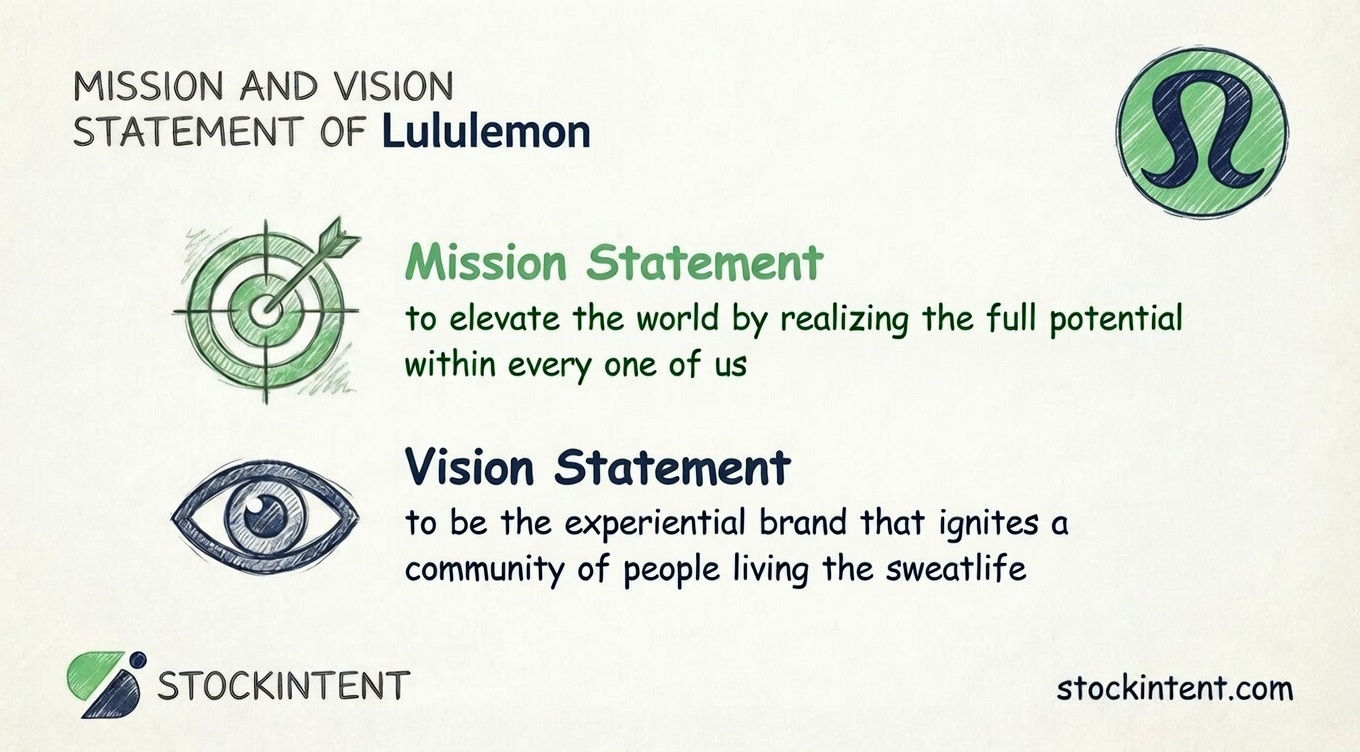
If you're evaluating Lululemon (LULU) as a potential investment, its mission, vision, and core values can help explain how management wants the brand to compete. They matter only when the company's decisions and results support them.
So what is Lululemon's mission statement? Lululemon does not appear to consistently use a traditional "mission statement" label. The closest current official language is its purpose: "to elevate the world by realizing the full potential within every one of us." Other formulations circulate online without clear current attribution. The direction is still clear: Lululemon uses apparel as the entry point into a broader identity built around wellbeing, community, and personal growth.
The vision pushes further: to be the experiential brand that ignites a global community living what Lululemon calls "the sweatlife." That word choice is deliberate. While Nike talks about athletic performance and Adidas chases market share through scale, Lululemon wants to own a feeling, a daily practice, a social identity.
Key takeaways:
Lululemon Athletica Inc. (NASDAQ: LULU) sells premium athletic apparel and accessories through stores and digital channels. Founded in 1998 by Chip Wilson in Vancouver, it began with technical yoga apparel and later expanded into men's products, footwear, and international markets.
Community attachment may support a retail brand, but product relevance and execution still determine whether customers keep paying premium prices.
The business breaks down into three core segments:
The company operates through a vertically integrated direct-to-consumer model that blends physical stores with digital channels. This omnichannel approach supports premium pricing and gives Lululemon direct control over customer relationships, merchandising, and brand presentation.
According to TIKR's early-2026 outlook, Lululemon had $11.0 billion in trailing-twelve-month revenue, a 22% operating margin, and expected revenue growth of 4.8%.
| Metric | Figure | Context |
|---|---|---|
| LTM Revenue | $11.0 billion | Passed the $10 billion milestone |
| Operating Margin | 22% | Strong profitability for an apparel retailer |
| Expected Revenue Growth | 4.8% | Reflects slower near-term growth |
| International Expansion | 6 new markets in 2026 | Greece, Austria, Poland, Hungary, Romania, India |
The growth story has split geographically. An aggregated Q2 2025 earnings-call transcript reported 34% China Mainland growth and $900 million in digital revenue, equal to 38% of quarterly revenue. The Americas was softer. This divergence matters for investors assessing whether global expansion can offset slower growth in Lululemon's more mature markets.
Lululemon occupies a distinctive position in athletic apparel retail. Unlike Nike and Adidas, which compete on performance innovation and scale across footwear and apparel, or Under Armour, which has struggled to build lifestyle credibility, Lululemon has cultivated what analysts call an "experiential brand." The company doesn't just sell products; it sells membership in a community defined by wellness, mindfulness, and what it terms "the sweatlife."
This positioning creates both strengths and vulnerabilities. The brand commands pricing power that few retailers match. However, competitors like Vuori, Athleta, and newer entrants are aggressively targeting the same premium athleisure space. Meanwhile, Nike and Adidas have noticed the margin opportunity and are expanding their lifestyle offerings.
The strategic response, called "Power of Three x2," aims to double men's revenue, double digital revenue, and quadruple international revenue by 2026. Its execution will help show whether Lululemon's brand advantage can scale.
"To elevate the world by realizing the full potential within every one of us."
This is best described as Lululemon's purpose statement rather than a consistently labeled official mission statement. Several alternatives circulate online, but Lululemon does not appear to present them as its current purpose.
| Wording | Where it appears | Likely status | How to use it |
|---|---|---|---|
| "To elevate the world by realizing the full potential within every one of us" | Lululemon careers snippet and purpose-focused sources | Closest current official purpose language | Best answer when describing Lululemon's present purpose |
| "To create components for people to live longer, healthier, more fun lives" | Mission-statement websites and company summaries | Common older formulation without clear current attribution | Often cited online, but not presented by Lululemon as its current purpose |
| "To elevate the world from mediocrity to greatness" | Older company summaries | Historical formulation without clear current attribution | Useful for understanding how Lululemon's language has changed |
The wording has broadened as Lululemon expanded beyond its original yoga-apparel niche. Human-potential language can cover men's apparel, footwear, international markets, and community programs without tying the company to one product category.
Pro Insight: Treat mission language as an investment hypothesis, not evidence by itself. The stronger test is whether product spending, market expansion, community programs, and management trade-offs remain consistent with the stated purpose.
It's not about selling clothes. The mission deliberately avoids product-centric language. No mention of leggings, performance fabrics, or even athletic apparel. Instead, the focus sits squarely on human transformation, community, and personal growth. This signals management's intent to build something bigger than a retail operation.
The human-potential framing may support pricing power. By positioning the brand around personal betterment rather than only product function, Lululemon gives customers another reason to accept premium prices. Investors should still test that interpretation against full-price demand and margins.
Community and wellness sit at the center. The mission's emphasis on "every one of us" and "full potential" directly supports the "sweatlife" community strategy, the ambassador network, and the experiential retail approach that differentiates Lululemon from competitors chasing pure scale.
Lululemon's stated purpose provides a useful lens for several strategic bets, though it does not prove that each investment will succeed:
| Strategic Priority | Mission Connection | Capital Allocation Evidence |
|---|---|---|
| International expansion (6 new markets in 2026) | "Elevate the world" | Store openings in Greece, Austria, Poland, Hungary, Romania, and India |
| Men's apparel doubling by 2026 | "Full potential within every one of us" | Product development, marketing investment, store format changes |
| Digital revenue doubling | Realizing potential through accessibility | Power of Three x2 target to double digital revenue |
| Impact Agenda sustainability goals | "Elevate the world" | Reported 2030 sustainable-materials goal |
| lululemon Gives mental health initiative | "Realizing full potential" | Movement and mindfulness programs |
One way to read these choices is that management uses the purpose as a shared direction for growth and impact programs. For investors, the harder question is whether those choices produce attractive returns and strengthen the brand.
Nike talks about bringing inspiration and innovation to every athlete. Performance-focused, broader demographic, less emphasis on community and lifestyle transformation.
Adidas emphasizes being the best sports company in the world. Scale-oriented, product-centric, lacking the experiential and wellness positioning.
Under Armour has historically focused on making athletes better through passion, design, and relentless pursuit of innovation. Similar performance angle to Nike, but without the lifestyle and community depth that Lululemon has cultivated.
The differentiation matters. While competitors battle on product features and celebrity endorsements, Lululemon has carved out defensible positioning around wellness community and personal transformation. Whether that positioning justifies the current valuation multiple is the question investors need to answer for themselves.
The Be Human, Be Well, and Be Planet pillars come from Lululemon's Impact Agenda. They show how the company applies its purpose to community, wellbeing, and environmental initiatives.
This pillar centers on diversity, inclusion, and human connection.
Lululemon has built what analysts call an "experiential brand" through fitness classes, local ambassador partnerships, and store formats designed as community hubs rather than purely transactional retail spaces.
From Our Experience: Community programs deserve moat credit only when they improve measurable customer behavior. For Lululemon, investors should watch repeat purchases, full-price demand, and store productivity rather than assume ambassador relationships automatically lower acquisition costs.
When Lululemon enters new markets like Greece, Austria, or India in 2026, it can use local fitness communities to introduce the brand before relying on broad awareness. The investor question is whether that approach produces attractive store economics across different cultures.
This pillar supports physical, mental, and social wellbeing.
Lululemon's official lululemon Gives announcement says the company committed $75 million to its Centre for Social Impact by 2025. It also says related programs had reached 700,000 students and 1.4 million people through community movement programs, while lululemon Gives targets 20 million people by 2030.
| Initiative | Target/Metric | Strategic Purpose |
|---|---|---|
| lululemon Gives | 20 million people by 2030 | Brand awareness in wellness community |
| Centre for Social Impact | $75 million by 2025 | Authentic purpose positioning |
| Student mental health programs | 700,000 reached | Access to mental-health support |
| Community movement programs | 1.4 million reached | Access to movement programs |
By positioning around wellbeing rather than only apparel, Lululemon creates touchpoints with customers beyond the purchase cycle. Free classes, mental health resources, and community events may keep the brand top-of-mind, but the resulting effect on retention and pricing power should be tested against operating results.
The environmental pillar covers materials, emissions, and circularity across Lululemon's supply chain. Commercial mission analyses report a goal of 100% sustainable materials by 2030 and efforts addressing Scope 3 emissions and thermal energy. Because these are not primary sources, investors should confirm progress through Lululemon's reporting.
Sustainability commitments are increasingly standard in apparel. Lululemon's execution and measurable progress matter more than the commitments alone.
The company's Like New resale program and circular-economy initiatives may introduce new buyers to the brand at lower price points while extending product life. Whether those programs strengthen pricing power remains an investment hypothesis rather than a settled conclusion.
Each pillar contributes to competitive advantages that translate into financial outcomes:
Community attachment: Classes, ambassador relationships, and wellness content may increase loyalty, though apparel customers can still switch brands easily.
Brand premium through purpose: The Impact Agenda and sustainability commitments may support the brand with customers who value those issues. Investors should look for evidence in full-price demand and margins.
International expansion playbook: The community-first model is being tested across cultures as Lululemon pursues its Power of Three x2 international goal.
Talent and culture retention: A values-driven culture may support employee retention and service quality, but Lululemon does not appear to publish enough data to quantify that effect.
As Lululemon enters new markets while navigating softer demand in the Americas, results will show whether these pillars strengthen the brand or mainly describe its ambitions.
"To be the experiential brand that ignites a community of people living the sweatlife."
That's the vision statement most often associated with Lululemon, though the company does not appear to consistently publish one current official version. Other formulations describe global leadership in athletic apparel and a community promoting health, mindfulness, and sustainable living.
The inconsistency matters less than the direction. Both formulations point toward the intersection of premium athletic wear, wellbeing, and community belonging.
In this context, "sweatlife" describes a lifestyle built around physical activity, personal growth, and connection. It is best understood as Lululemon's community and experience frame, not another name for its purpose statement.
Lululemon wants customers to interact with the brand beyond buying products. Stores, local ambassadors, and community events support that experience.
The economics of this approach depend on whether community activity improves customer retention and full-price demand. Those outcomes matter more than the number of events or ambassadors alone.
Lululemon's vision connects directly to three measurable goals management has publicly committed to through 2026:
| Strategic Target | 2026 Goal | Vision Connection |
|---|---|---|
| Men's revenue | Double 2021 levels | Expand "community" beyond female yoga demographic |
| Digital revenue | Double 2021 levels | Scale experiential brand without physical store limits |
| International revenue | Quadruple 2021 levels | Globalize the "sweatlife" community |
| Total revenue | $12.5 billion | Prove experiential model scales |
These targets test whether Lululemon can expand beyond its original North American women's yoga audience into men's products, digital channels, and international markets. Nasdaq's review of Power of Three x2 notes that the plan targets $12.5 billion in revenue by 2026, while commercial strategy analyses estimate international revenue grew at a 20% compound annual rate from 2021 to 2024.
The vision aligns with three apparel trends:
Athleisure permanence: Customers increasingly want clothes that work across exercise, leisure, and everyday settings.
Wellness programs: Lululemon's vision extends the brand beyond apparel. The lululemon Gives initiative, launched in 2025, targets reaching 20 million people by 2030 through movement and mindfulness programs.
Experiential retail: Stores can offer product education and community contact that basic e-commerce cannot.
The risk is that these trends become standard across athletic apparel. Competitors such as Vuori, Athleta, and Nike can adopt similar community and lifestyle positioning.
Lululemon's vision provides context for its capital allocation. The 2026 targets are specific enough for investors to judge whether the strategy is working.
The softer elements of the vision, community, mindfulness, and sustainability, may serve a harder business purpose by supporting customer relationships and premium positioning. Investors should treat that as a hypothesis and look for evidence in margins, repeat demand, and employee retention.
Shareholder returns still depend on execution amid softer Americas demand, leadership changes, and competition.
Three themes show how Lululemon is pursuing the vision.
Lululemon is targeting six new market entries in 2026: Greece, Austria, Poland, Hungary, Romania, and India. The India expansion is particularly notable, partnering with Tata CLiQ to use local retail expertise.
The investor test is whether local community activity helps those stores reach attractive economics.
Physical locations host fitness classes, serve as community hubs, and work with local ambassadors rather than relying only on paid celebrities. Investors should assess whether this approach produces stronger retention and store productivity than conventional advertising.
The fast-track design capabilities implemented in 2025 exemplify this theme. Rather than seasonal cycles, Lululemon accelerated product development to introduce new colors, prints, and fabric innovations more rapidly. This directly addresses a recognized weakness: management acknowledged that increasing product "newness" directly impacts sales performance, particularly in U.S. women's categories.
The "sweatlife" framing extends beyond apparel through programs such as lululemon Gives and the Centre for Social Impact.
The $75 million commitment to the Centre for Social Impact funds mindfulness partnerships, maker support, and global well-being research. These programs fit the vision, although their effect on customer acquisition and retention is not directly established.
| Strategic Theme | 2026 Capital Allocation | Vision Connection | Measurable Outcome |
|---|---|---|---|
| Global Community Expansion | 6 new market entries, store openings in Greece, Austria, Poland, Hungary, Romania, India | "Ignite a community" | International revenue quadruple target by 2026 |
| Experiential Brand Differentiation | Fast-track design capabilities, store optimization, ambassador network expansion | "Experiential brand" | Product newness driving sales recovery |
| Wellness Ecosystem Integration | lululemon Gives, Centre for Social Impact, free fitness classes | "Living the sweatlife" | 20 million people reached by 2030 |
Each vision theme translates into specific competitive advantages that matter for investors:
Pricing power through differentiation: The experiential positioning may support premium pricing when product quality and brand relevance remain strong.
Customer relationships: Community-driven marketing may strengthen retention, but Lululemon does not appear to publish its effect on acquisition costs or lifetime value.
International replication: New markets will test whether the community-first model transfers across cultures.
Talent retention: The values-driven culture may help attract and retain employees, which can affect service quality and training costs.
Execution must keep pace with ambition. Softer Americas demand, leadership changes, and competition are testing whether the model remains differentiated.
For investors wanting to stress-test whether these strategic themes justify the current valuation, StockIntent's comparison tools can compare Lululemon's margins, growth, and capital efficiency with Nike, Adidas, and emerging competitors.
Lululemon's core values are commonly listed as courage, connection, inclusion, personal responsibility, and fun. Older company summaries sometimes include additional themes, so investors should focus on how the current values appear in company behavior. Understanding whether the values are embedded in the business or merely marketing language matters for assessing management quality and cultural durability.
The useful test is whether these values affect decisions when the company faces pressure.
Courage at Lululemon means taking risks and addressing problems directly.
The MIRROR acquisition shows why courage must be paired with capital discipline: commercial strategy analyses put the 2020 purchase price at $500 million, yet the strategic fit did not ensure a good outcome. Expansion into men's apparel, footwear, and new countries creates the same need to balance ambition with returns.
Faster product-development processes also show management responding to a recognized weakness in product newness.
Connection centers on relationships with customers, employees, and local communities.
The ambassador program identifies local fitness instructors and builds relationships within their communities. According to the National Retail Federation, Lululemon also uses culture and values when competing for talent.
For investors, connection may support customer and employee retention. That conclusion should remain conditional until the company's results demonstrate it.
Inclusion at Lululemon operates through its formal IDEA program (Inclusion, Diversity, Equity, and Action), which focuses on removing barriers to wellbeing. The company's official IDEA page outlines commitments to equitable environments and diverse representation.
Expansion into new product categories and countries requires Lululemon to adapt product design, marketing, and store experiences for different customers.
Inclusion also applies to access. Lululemon's community programs aim to reach people beyond its existing customer base.
Expert Tip: When evaluating whether a company's inclusion commitments are genuine, look for measurable goals, spending, and outcomes. Broad statements deserve less weight when progress is difficult to verify.
Personal responsibility emphasizes accountability for outcomes, including product quality and supply-chain choices.
The company has set sustainability goals and operates the Like New resale program as part of its circular-economy efforts. Academic and commercial analyses report an 86% recycling figure, but it is not clearly defined enough to carry the investment case. Investors should assess progress, cost, and product-lifecycle impact rather than assume these initiatives strengthen premium positioning.
For management, the clearest test is whether leaders acknowledge mistakes and change course before losses compound.
Fun supports a customer experience built around movement as a social and enjoyable activity.
Stores and events can reinforce that association, though product quality remains more important to repeat demand.
Positive brand associations may support customer retention. The financial effect is plausible, but it should be confirmed through customer behavior rather than assumed from the value itself.
Lululemon's Impact Agenda connects the values to environmental, social, and governance commitments.
| ESG Pillar | Core Value Connection | Specific Commitment | Progress Indicator |
|---|---|---|---|
| Environmental | Personal responsibility, inclusion | Materials and circularity goals | Progress should be measured against company reporting |
| Social | Connection, inclusion, fun | lululemon Gives: 20 million people by 2030 | 2.1 million reached since 2025 launch |
| Governance | Courage, personal responsibility | Transparent Impact Agenda reporting | Annual progress disclosures |
The environmental commitments address supply-chain impact, while social programs fund movement, mindfulness, and community initiatives.
Pro Insight: ESG programs are increasingly common in apparel retail. Give them moat credit only when progress is measurable and the programs improve customer behavior, risk, or business economics.
The critical test for any corporate values is behavior under stress. Lululemon has faced softer Americas demand, leadership changes, and execution concerns. MarketBeat's analyst-rating aggregation shows a cautious consensus, while TIKR reported that the stock fell roughly 60% during 2025.
The evidence is mixed. International expansion, faster product development, and continued social programs suggest the values influence decisions, but they have not prevented strategic mistakes. Investors should judge whether management responds to those mistakes with discipline.
Lululemon's purpose, vision, and core values form a coherent strategic identity that has helped guide its move from a yoga-focused retailer to a global athletic-apparel brand. The purpose language aligns with community-building and international expansion, but investors still need to test whether those choices produce attractive returns.
From Our Experience: Mission language deserves investment weight only when it explains repeated decisions and those decisions produce better operating results. For Lululemon, product relevance, international store economics, and full-price demand are stronger tests than the wording itself.
For investors, the framework matters in three areas: whether the brand retains pricing power, whether the strategy scales profitably, and whether management responds well when investments underperform.
Pro Insight: Compare what management says with where it invests. Alignment is useful, but returns on those investments determine whether the strategy creates shareholder value.
The risk is that competitors close the gap. Nike and Adidas have noticed the margin opportunity. Vuori and Athleta are aggressively targeting the same premium space. Sustainability claims are becoming table stakes, not differentiators. Whether Lululemon's decade-plus head start in experiential brand-building creates durable advantages, or whether its premium multiple reflects temporary brand heat, will largely determine shareholder returns from here.
For investors wanting to stress-test whether Lululemon's strategic identity justifies its valuation, StockIntent's fundamental analysis tools let you compare gross margins, revenue growth trajectories, and capital efficiency against Nike, Adidas, and emerging competitors. You can model different scenarios for international expansion success and see how the numbers change. Start your free 7-day trial at /app/register.
If you're evaluating Lululemon (LULU) as a potential investment, its mission, vision, and core values can help explain how management wants the brand to compete. They matter only when the company's decisions and results support them.
So what is Lululemon's mission statement? Lululemon does not appear to consistently use a traditional "mission statement" label. The closest current official language is its purpose: "to elevate the world by realizing the full potential within every one of us." Other formulations circulate online without clear current attribution. The direction is still clear: Lululemon uses apparel as the entry point into a broader identity built around wellbeing, community, and personal growth.
The vision pushes further: to be the experiential brand that ignites a global community living what Lululemon calls "the sweatlife." That word choice is deliberate. While Nike talks about athletic performance and Adidas chases market share through scale, Lululemon wants to own a feeling, a daily practice, a social identity.
Key takeaways:
Lululemon Athletica Inc. (NASDAQ: LULU) sells premium athletic apparel and accessories through stores and digital channels. Founded in 1998 by Chip Wilson in Vancouver, it began with technical yoga apparel and later expanded into men's products, footwear, and international markets.
Community attachment may support a retail brand, but product relevance and execution still determine whether customers keep paying premium prices.
The business breaks down into three core segments:
The company operates through a vertically integrated direct-to-consumer model that blends physical stores with digital channels. This omnichannel approach supports premium pricing and gives Lululemon direct control over customer relationships, merchandising, and brand presentation.
According to TIKR's early-2026 outlook, Lululemon had $11.0 billion in trailing-twelve-month revenue, a 22% operating margin, and expected revenue growth of 4.8%.
| Metric | Figure | Context |
|---|---|---|
| LTM Revenue | $11.0 billion | Passed the $10 billion milestone |
| Operating Margin | 22% | Strong profitability for an apparel retailer |
| Expected Revenue Growth | 4.8% | Reflects slower near-term growth |
| International Expansion | 6 new markets in 2026 | Greece, Austria, Poland, Hungary, Romania, India |
The growth story has split geographically. An aggregated Q2 2025 earnings-call transcript reported 34% China Mainland growth and $900 million in digital revenue, equal to 38% of quarterly revenue. The Americas was softer. This divergence matters for investors assessing whether global expansion can offset slower growth in Lululemon's more mature markets.
Lululemon occupies a distinctive position in athletic apparel retail. Unlike Nike and Adidas, which compete on performance innovation and scale across footwear and apparel, or Under Armour, which has struggled to build lifestyle credibility, Lululemon has cultivated what analysts call an "experiential brand." The company doesn't just sell products; it sells membership in a community defined by wellness, mindfulness, and what it terms "the sweatlife."
This positioning creates both strengths and vulnerabilities. The brand commands pricing power that few retailers match. However, competitors like Vuori, Athleta, and newer entrants are aggressively targeting the same premium athleisure space. Meanwhile, Nike and Adidas have noticed the margin opportunity and are expanding their lifestyle offerings.
The strategic response, called "Power of Three x2," aims to double men's revenue, double digital revenue, and quadruple international revenue by 2026. Its execution will help show whether Lululemon's brand advantage can scale.
"To elevate the world by realizing the full potential within every one of us."
This is best described as Lululemon's purpose statement rather than a consistently labeled official mission statement. Several alternatives circulate online, but Lululemon does not appear to present them as its current purpose.
| Wording | Where it appears | Likely status | How to use it |
|---|---|---|---|
| "To elevate the world by realizing the full potential within every one of us" | Lululemon careers snippet and purpose-focused sources | Closest current official purpose language | Best answer when describing Lululemon's present purpose |
| "To create components for people to live longer, healthier, more fun lives" | Mission-statement websites and company summaries | Common older formulation without clear current attribution | Often cited online, but not presented by Lululemon as its current purpose |
| "To elevate the world from mediocrity to greatness" | Older company summaries | Historical formulation without clear current attribution | Useful for understanding how Lululemon's language has changed |
The wording has broadened as Lululemon expanded beyond its original yoga-apparel niche. Human-potential language can cover men's apparel, footwear, international markets, and community programs without tying the company to one product category.
Pro Insight: Treat mission language as an investment hypothesis, not evidence by itself. The stronger test is whether product spending, market expansion, community programs, and management trade-offs remain consistent with the stated purpose.
It's not about selling clothes. The mission deliberately avoids product-centric language. No mention of leggings, performance fabrics, or even athletic apparel. Instead, the focus sits squarely on human transformation, community, and personal growth. This signals management's intent to build something bigger than a retail operation.
The human-potential framing may support pricing power. By positioning the brand around personal betterment rather than only product function, Lululemon gives customers another reason to accept premium prices. Investors should still test that interpretation against full-price demand and margins.
Community and wellness sit at the center. The mission's emphasis on "every one of us" and "full potential" directly supports the "sweatlife" community strategy, the ambassador network, and the experiential retail approach that differentiates Lululemon from competitors chasing pure scale.
Lululemon's stated purpose provides a useful lens for several strategic bets, though it does not prove that each investment will succeed:
| Strategic Priority | Mission Connection | Capital Allocation Evidence |
|---|---|---|
| International expansion (6 new markets in 2026) | "Elevate the world" | Store openings in Greece, Austria, Poland, Hungary, Romania, and India |
| Men's apparel doubling by 2026 | "Full potential within every one of us" | Product development, marketing investment, store format changes |
| Digital revenue doubling | Realizing potential through accessibility | Power of Three x2 target to double digital revenue |
| Impact Agenda sustainability goals | "Elevate the world" | Reported 2030 sustainable-materials goal |
| lululemon Gives mental health initiative | "Realizing full potential" | Movement and mindfulness programs |
One way to read these choices is that management uses the purpose as a shared direction for growth and impact programs. For investors, the harder question is whether those choices produce attractive returns and strengthen the brand.
Nike talks about bringing inspiration and innovation to every athlete. Performance-focused, broader demographic, less emphasis on community and lifestyle transformation.
Adidas emphasizes being the best sports company in the world. Scale-oriented, product-centric, lacking the experiential and wellness positioning.
Under Armour has historically focused on making athletes better through passion, design, and relentless pursuit of innovation. Similar performance angle to Nike, but without the lifestyle and community depth that Lululemon has cultivated.
The differentiation matters. While competitors battle on product features and celebrity endorsements, Lululemon has carved out defensible positioning around wellness community and personal transformation. Whether that positioning justifies the current valuation multiple is the question investors need to answer for themselves.
The Be Human, Be Well, and Be Planet pillars come from Lululemon's Impact Agenda. They show how the company applies its purpose to community, wellbeing, and environmental initiatives.
This pillar centers on diversity, inclusion, and human connection.
Lululemon has built what analysts call an "experiential brand" through fitness classes, local ambassador partnerships, and store formats designed as community hubs rather than purely transactional retail spaces.
From Our Experience: Community programs deserve moat credit only when they improve measurable customer behavior. For Lululemon, investors should watch repeat purchases, full-price demand, and store productivity rather than assume ambassador relationships automatically lower acquisition costs.
When Lululemon enters new markets like Greece, Austria, or India in 2026, it can use local fitness communities to introduce the brand before relying on broad awareness. The investor question is whether that approach produces attractive store economics across different cultures.
This pillar supports physical, mental, and social wellbeing.
Lululemon's official lululemon Gives announcement says the company committed $75 million to its Centre for Social Impact by 2025. It also says related programs had reached 700,000 students and 1.4 million people through community movement programs, while lululemon Gives targets 20 million people by 2030.
| Initiative | Target/Metric | Strategic Purpose |
|---|---|---|
| lululemon Gives | 20 million people by 2030 | Brand awareness in wellness community |
| Centre for Social Impact | $75 million by 2025 | Authentic purpose positioning |
| Student mental health programs | 700,000 reached | Access to mental-health support |
| Community movement programs | 1.4 million reached | Access to movement programs |
By positioning around wellbeing rather than only apparel, Lululemon creates touchpoints with customers beyond the purchase cycle. Free classes, mental health resources, and community events may keep the brand top-of-mind, but the resulting effect on retention and pricing power should be tested against operating results.
The environmental pillar covers materials, emissions, and circularity across Lululemon's supply chain. Commercial mission analyses report a goal of 100% sustainable materials by 2030 and efforts addressing Scope 3 emissions and thermal energy. Because these are not primary sources, investors should confirm progress through Lululemon's reporting.
Sustainability commitments are increasingly standard in apparel. Lululemon's execution and measurable progress matter more than the commitments alone.
The company's Like New resale program and circular-economy initiatives may introduce new buyers to the brand at lower price points while extending product life. Whether those programs strengthen pricing power remains an investment hypothesis rather than a settled conclusion.
Each pillar contributes to competitive advantages that translate into financial outcomes:
Community attachment: Classes, ambassador relationships, and wellness content may increase loyalty, though apparel customers can still switch brands easily.
Brand premium through purpose: The Impact Agenda and sustainability commitments may support the brand with customers who value those issues. Investors should look for evidence in full-price demand and margins.
International expansion playbook: The community-first model is being tested across cultures as Lululemon pursues its Power of Three x2 international goal.
Talent and culture retention: A values-driven culture may support employee retention and service quality, but Lululemon does not appear to publish enough data to quantify that effect.
As Lululemon enters new markets while navigating softer demand in the Americas, results will show whether these pillars strengthen the brand or mainly describe its ambitions.
"To be the experiential brand that ignites a community of people living the sweatlife."
That's the vision statement most often associated with Lululemon, though the company does not appear to consistently publish one current official version. Other formulations describe global leadership in athletic apparel and a community promoting health, mindfulness, and sustainable living.
The inconsistency matters less than the direction. Both formulations point toward the intersection of premium athletic wear, wellbeing, and community belonging.
In this context, "sweatlife" describes a lifestyle built around physical activity, personal growth, and connection. It is best understood as Lululemon's community and experience frame, not another name for its purpose statement.
Lululemon wants customers to interact with the brand beyond buying products. Stores, local ambassadors, and community events support that experience.
The economics of this approach depend on whether community activity improves customer retention and full-price demand. Those outcomes matter more than the number of events or ambassadors alone.
Lululemon's vision connects directly to three measurable goals management has publicly committed to through 2026:
| Strategic Target | 2026 Goal | Vision Connection |
|---|---|---|
| Men's revenue | Double 2021 levels | Expand "community" beyond female yoga demographic |
| Digital revenue | Double 2021 levels | Scale experiential brand without physical store limits |
| International revenue | Quadruple 2021 levels | Globalize the "sweatlife" community |
| Total revenue | $12.5 billion | Prove experiential model scales |
These targets test whether Lululemon can expand beyond its original North American women's yoga audience into men's products, digital channels, and international markets. Nasdaq's review of Power of Three x2 notes that the plan targets $12.5 billion in revenue by 2026, while commercial strategy analyses estimate international revenue grew at a 20% compound annual rate from 2021 to 2024.
The vision aligns with three apparel trends:
Athleisure permanence: Customers increasingly want clothes that work across exercise, leisure, and everyday settings.
Wellness programs: Lululemon's vision extends the brand beyond apparel. The lululemon Gives initiative, launched in 2025, targets reaching 20 million people by 2030 through movement and mindfulness programs.
Experiential retail: Stores can offer product education and community contact that basic e-commerce cannot.
The risk is that these trends become standard across athletic apparel. Competitors such as Vuori, Athleta, and Nike can adopt similar community and lifestyle positioning.
Lululemon's vision provides context for its capital allocation. The 2026 targets are specific enough for investors to judge whether the strategy is working.
The softer elements of the vision, community, mindfulness, and sustainability, may serve a harder business purpose by supporting customer relationships and premium positioning. Investors should treat that as a hypothesis and look for evidence in margins, repeat demand, and employee retention.
Shareholder returns still depend on execution amid softer Americas demand, leadership changes, and competition.
Three themes show how Lululemon is pursuing the vision.
Lululemon is targeting six new market entries in 2026: Greece, Austria, Poland, Hungary, Romania, and India. The India expansion is particularly notable, partnering with Tata CLiQ to use local retail expertise.
The investor test is whether local community activity helps those stores reach attractive economics.
Physical locations host fitness classes, serve as community hubs, and work with local ambassadors rather than relying only on paid celebrities. Investors should assess whether this approach produces stronger retention and store productivity than conventional advertising.
The fast-track design capabilities implemented in 2025 exemplify this theme. Rather than seasonal cycles, Lululemon accelerated product development to introduce new colors, prints, and fabric innovations more rapidly. This directly addresses a recognized weakness: management acknowledged that increasing product "newness" directly impacts sales performance, particularly in U.S. women's categories.
The "sweatlife" framing extends beyond apparel through programs such as lululemon Gives and the Centre for Social Impact.
The $75 million commitment to the Centre for Social Impact funds mindfulness partnerships, maker support, and global well-being research. These programs fit the vision, although their effect on customer acquisition and retention is not directly established.
| Strategic Theme | 2026 Capital Allocation | Vision Connection | Measurable Outcome |
|---|---|---|---|
| Global Community Expansion | 6 new market entries, store openings in Greece, Austria, Poland, Hungary, Romania, India | "Ignite a community" | International revenue quadruple target by 2026 |
| Experiential Brand Differentiation | Fast-track design capabilities, store optimization, ambassador network expansion | "Experiential brand" | Product newness driving sales recovery |
| Wellness Ecosystem Integration | lululemon Gives, Centre for Social Impact, free fitness classes | "Living the sweatlife" | 20 million people reached by 2030 |
Each vision theme translates into specific competitive advantages that matter for investors:
Pricing power through differentiation: The experiential positioning may support premium pricing when product quality and brand relevance remain strong.
Customer relationships: Community-driven marketing may strengthen retention, but Lululemon does not appear to publish its effect on acquisition costs or lifetime value.
International replication: New markets will test whether the community-first model transfers across cultures.
Talent retention: The values-driven culture may help attract and retain employees, which can affect service quality and training costs.
Execution must keep pace with ambition. Softer Americas demand, leadership changes, and competition are testing whether the model remains differentiated.
For investors wanting to stress-test whether these strategic themes justify the current valuation, StockIntent's comparison tools can compare Lululemon's margins, growth, and capital efficiency with Nike, Adidas, and emerging competitors.
Lululemon's core values are commonly listed as courage, connection, inclusion, personal responsibility, and fun. Older company summaries sometimes include additional themes, so investors should focus on how the current values appear in company behavior. Understanding whether the values are embedded in the business or merely marketing language matters for assessing management quality and cultural durability.
The useful test is whether these values affect decisions when the company faces pressure.
Courage at Lululemon means taking risks and addressing problems directly.
The MIRROR acquisition shows why courage must be paired with capital discipline: commercial strategy analyses put the 2020 purchase price at $500 million, yet the strategic fit did not ensure a good outcome. Expansion into men's apparel, footwear, and new countries creates the same need to balance ambition with returns.
Faster product-development processes also show management responding to a recognized weakness in product newness.
Connection centers on relationships with customers, employees, and local communities.
The ambassador program identifies local fitness instructors and builds relationships within their communities. According to the National Retail Federation, Lululemon also uses culture and values when competing for talent.
For investors, connection may support customer and employee retention. That conclusion should remain conditional until the company's results demonstrate it.
Inclusion at Lululemon operates through its formal IDEA program (Inclusion, Diversity, Equity, and Action), which focuses on removing barriers to wellbeing. The company's official IDEA page outlines commitments to equitable environments and diverse representation.
Expansion into new product categories and countries requires Lululemon to adapt product design, marketing, and store experiences for different customers.
Inclusion also applies to access. Lululemon's community programs aim to reach people beyond its existing customer base.
Expert Tip: When evaluating whether a company's inclusion commitments are genuine, look for measurable goals, spending, and outcomes. Broad statements deserve less weight when progress is difficult to verify.
Personal responsibility emphasizes accountability for outcomes, including product quality and supply-chain choices.
The company has set sustainability goals and operates the Like New resale program as part of its circular-economy efforts. Academic and commercial analyses report an 86% recycling figure, but it is not clearly defined enough to carry the investment case. Investors should assess progress, cost, and product-lifecycle impact rather than assume these initiatives strengthen premium positioning.
For management, the clearest test is whether leaders acknowledge mistakes and change course before losses compound.
Fun supports a customer experience built around movement as a social and enjoyable activity.
Stores and events can reinforce that association, though product quality remains more important to repeat demand.
Positive brand associations may support customer retention. The financial effect is plausible, but it should be confirmed through customer behavior rather than assumed from the value itself.
Lululemon's Impact Agenda connects the values to environmental, social, and governance commitments.
| ESG Pillar | Core Value Connection | Specific Commitment | Progress Indicator |
|---|---|---|---|
| Environmental | Personal responsibility, inclusion | Materials and circularity goals | Progress should be measured against company reporting |
| Social | Connection, inclusion, fun | lululemon Gives: 20 million people by 2030 | 2.1 million reached since 2025 launch |
| Governance | Courage, personal responsibility | Transparent Impact Agenda reporting | Annual progress disclosures |
The environmental commitments address supply-chain impact, while social programs fund movement, mindfulness, and community initiatives.
Pro Insight: ESG programs are increasingly common in apparel retail. Give them moat credit only when progress is measurable and the programs improve customer behavior, risk, or business economics.
The critical test for any corporate values is behavior under stress. Lululemon has faced softer Americas demand, leadership changes, and execution concerns. MarketBeat's analyst-rating aggregation shows a cautious consensus, while TIKR reported that the stock fell roughly 60% during 2025.
The evidence is mixed. International expansion, faster product development, and continued social programs suggest the values influence decisions, but they have not prevented strategic mistakes. Investors should judge whether management responds to those mistakes with discipline.
Lululemon's purpose, vision, and core values form a coherent strategic identity that has helped guide its move from a yoga-focused retailer to a global athletic-apparel brand. The purpose language aligns with community-building and international expansion, but investors still need to test whether those choices produce attractive returns.
From Our Experience: Mission language deserves investment weight only when it explains repeated decisions and those decisions produce better operating results. For Lululemon, product relevance, international store economics, and full-price demand are stronger tests than the wording itself.
For investors, the framework matters in three areas: whether the brand retains pricing power, whether the strategy scales profitably, and whether management responds well when investments underperform.
Pro Insight: Compare what management says with where it invests. Alignment is useful, but returns on those investments determine whether the strategy creates shareholder value.
The risk is that competitors close the gap. Nike and Adidas have noticed the margin opportunity. Vuori and Athleta are aggressively targeting the same premium space. Sustainability claims are becoming table stakes, not differentiators. Whether Lululemon's decade-plus head start in experiential brand-building creates durable advantages, or whether its premium multiple reflects temporary brand heat, will largely determine shareholder returns from here.
For investors wanting to stress-test whether Lululemon's strategic identity justifies its valuation, StockIntent's fundamental analysis tools let you compare gross margins, revenue growth trajectories, and capital efficiency against Nike, Adidas, and emerging competitors. You can model different scenarios for international expansion success and see how the numbers change. Start your free 7-day trial at /app/register.