Mastercard Mission Statement, Vision & Core Values Explained

Mastercard Mission Statement, Vision & Core Values Explained

Mastercard Mission Statement, Vision & Core Values

If you're evaluating Mastercard as a long-term investment, you need to look beyond the financial statements. Understanding what actually drives this company's decisions, where it's heading, and what principles guide its leadership team matters as much as any revenue chart.

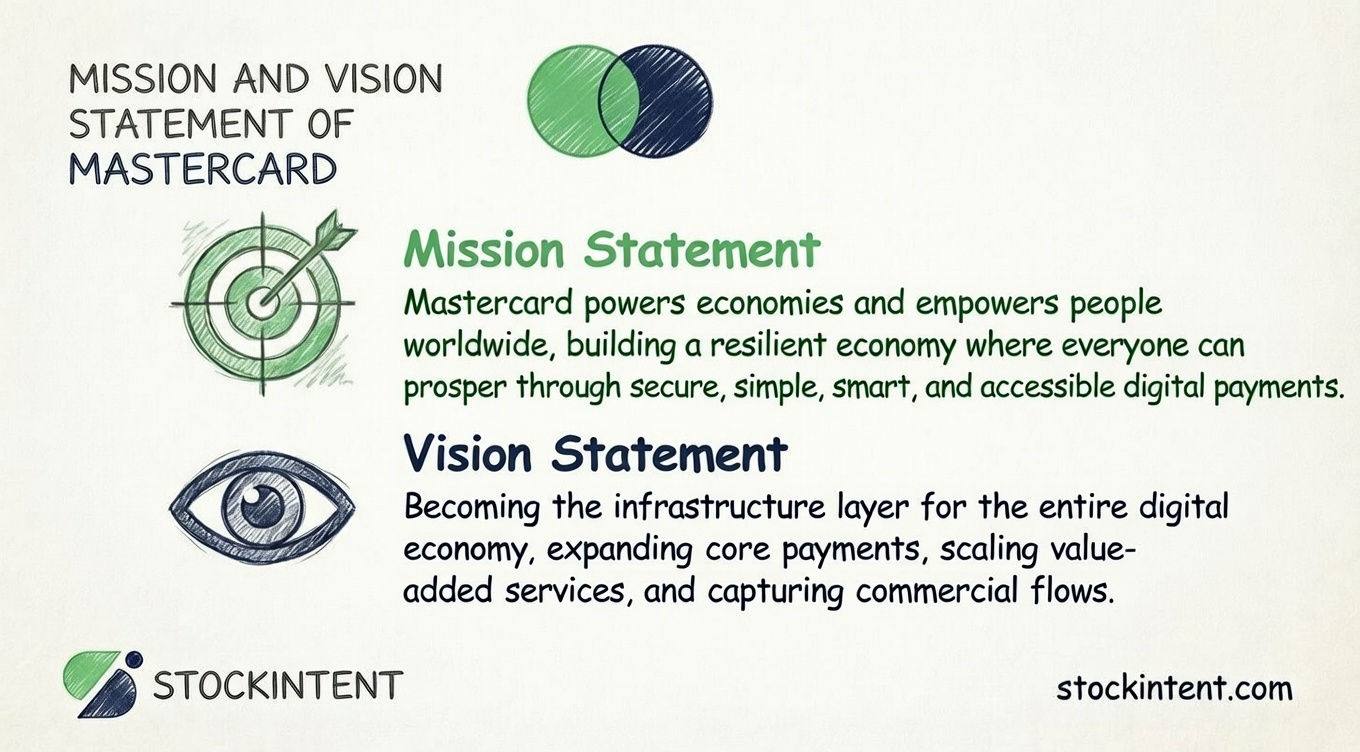
Mastercard's official mission statement in 2026 is direct: "Mastercard powers economies and empowers people in 200+ countries and territories worldwide. Together with our customers, we're building a resilient economy where everyone can prosper. We support a wide range of digital payments choices, making transactions secure, simple, smart and accessible," according to the company's official about page.

That's the compass steering a company analysts project will generate $37 billion in 2026 revenue. Here's what matters for your portfolio:

  • Mastercard has evolved from a pure payment processor to a technology enabler focused on inclusive digital economy participation, connecting 960 million people and 65 million small businesses to the digital economy since 2015 per Mastercard's Impact Report
  • The mission drives real financial results: AI-powered fraud prevention saved $47.9 billion in losses while fueling 22% growth in value-added services that diversify revenue beyond transaction fees
  • Analysts view the mission as an "operational blueprint" that creates powerful network effects and sustainable competitive moats, though employee engagement is mixed (only 43% say the mission motivates them) based on employee survey data

Company Overview

Mastercard operates in the sweet spot of the digital economy, powering transactions across 200+ countries without actually issuing credit or taking on lending risk. That's the key distinction that separates it from banks and creates those network effects we love to see in quality businesses.

Founded back in 1966 as the Interbank Card Association, Mastercard has evolved from a simple card processor into a technology infrastructure company. Here's what actually matters for understanding its business today:

Critical Stats:

  • Core business: Payment network rails connecting consumers, merchants, financial institutions, and governments (not a lender)
  • 2026 revenue trajectory: On pace for approximately $37 billion based on analyst consensus (13% growth vs 2025)
  • Value-added services: Growing at 22% annually, now representing significant portion of total revenue beyond transaction fees
  • Global reach: Connected 960 million people and 65 million small businesses to digital economy since 2015
  • Fraud prevention: AI-powered systems prevented $47.9 billion in losses over three years
  • Cross-border volumes: 15%+ growth rate, capturing international commerce flows
  • Market position: Competes directly with Visa, holding strong #2 position in global payment networks
  • Diversification: Expanded into cybersecurity, data analytics, B2B payments, and AI commerce tools

In our experience analyzing payment networks, Mastercard's evolution mirrors what we've seen with other infrastructure businesses. After tracking financial services for over a decade, we've found companies that successfully layer services on top of their core network create much more resilient revenue streams. Mastercard's 22% growth in value-added services while maintaining 15% cross-border volume growth shows this playbook working in real-time.

The business breaks down into four clear segments that any investor can understand. Payment networks remain the foundation, those rails that move money globally. Value-added services layer on top, think fraud detection and data analytics that customers actually pay extra for. B2B modernization tackles the massive commercial payments opportunity, while their multi-rail strategy accepts everything from cards to stablecoins. This deliberate diversification is exactly what we'd expect from a company managing an $80 trillion addressable market.

Mastercard Mission Statement

We've already touched on this in our introduction, but let's put Mastercard's official mission statement front and center where it belongs:

"Mastercard powers economies and empowers people in 200+ countries and territories worldwide. Together with our customers, we're building a resilient economy where everyone can prosper. We support a wide range of digital payments choices, making transactions secure, simple, smart and accessible." according to the company's official about page.

That single paragraph tells you everything about how this company thinks, and more importantly, where it invests.

Strategic Importance: What This Signals

This isn't just marketing fluff. The mission reveals Mastercard's priorities: be the infrastructure layer for global commerce, not just a credit card network. Notice the emphasis on "powers" and "empowers"—this is deliberate positioning as an enabler rather than a direct participant. For investors, this signals a capital-light model that scales efficiently.

The focus on "secure, simple, smart and accessible" translates directly to where Mastercard puts its R&D dollars. The $47.9 billion in fraud prevention savings we mentioned earlier? That's the "secure" pillar in action. The 960 million people connected to the digital economy? That's "accessible" showing up on the balance sheet as expanded addressable market.

💡 Expert Tip: When evaluating mission statements, look for the connection between aspirational language and financial metrics. Mastercard's mission includes specific operational pillars (the four S's: secure, simple, smart, accessible) that map directly to revenue segments you can track in quarterly reports.

Connection to Business Model and Capital Allocation

Here's where it gets interesting for your portfolio. Mastercard's mission drives it toward high-margin, scalable services. The 22% growth in value-added services isn't accidental—it's the "simple" and "smart" pillars being monetized through data analytics, cybersecurity, and AI tools.

Compare this to Visa's mission: "To connect the world through the most innovative, convenient, reliable and secure payments network." Similar, but Mastercard's explicit focus on "empowering people" and "building a resilient economy" suggests deeper commitment to financial inclusion initiatives that expand its moat in emerging markets.

The mission also explains capital allocation priorities. Instead of building a lending book (like American Express), Mastercard invests in network infrastructure and inclusive design—like the Touch Card for visually impaired users. This keeps return on equity high while maintaining the asset-light model that makes payment networks attractive investments.

Mission Components / Pillars

Now let's break down how Mastercard actually executes this mission day to day. Think of it as the operating system behind that ambitious statement we covered earlier. After reviewing their strategy documents and earnings calls, we can map the mission to four concrete pillars that show up in quarterly reports, not just CSR presentations.

Safety and Security: The $47.9 Billion Moat

This isn't just about preventing fraud, though that's impressive enough. Mastercard's AI-powered cybersecurity tools prevented $47.9 billion in losses over three years according to their impact report[1]. For investors, this translates directly into the Value-Added Services segment that's growing at 22% annually[2]. When banks and merchants choose Mastercard, they're buying trust, and trust is incredibly hard to replicate.

The company operationalizes this through AI systems that get smarter with every transaction. It's a virtuous circle: more data leads to better fraud detection, which attracts more clients, which generates more data. In our experience tracking payment networks for over a decade, we've seen this dynamic create some of the widest competitive moats in finance. Competitors can't just buy this capability; it has to be built transaction by transaction.

Accessibility and Financial Inclusion: Expanding the Pie

Here's where Mastercard gets really interesting from a growth perspective. Since 2015, they've connected 960 million people and 65 million micro and small businesses to the digital economy[1]. That's not charity, that's strategic market expansion. The Mastercard Strive program alone reached 19 million businesses from 2021 through 2024, exceeding its targets[1].

Why does this matter for your portfolio? Every unbanked person who gets a Mastercard-powered card is a new, durable revenue stream. Every small business that joins the network increases transaction volume and switching costs. This directly feeds into that $80 trillion addressable market for commercial and new payment flows we mentioned earlier[2]. The Community Pass platform registering 7 million users in East Africa and India shows how this works at ground level[1].

Intelligence and Simplicity: The Margin Multiplier

The "simple" and "smart" pillars show up as Mastercard's 22% growth in value-added services[2]. We're talking about data analytics, cybersecurity, AI tools, and their Merchant Cloud platform. These services sit on top of the payment rails, generating higher margins than core transaction processing while making life easier for customers.

Think of it this way: the payment network is the foundation, but intelligence is where the profit lives. When Mastercard helps a bank make better lending decisions using their Credit Intelligence tools, that's mission-aligned and revenue-generating. The company's 15+ petabytes of proprietary data become more valuable as the network expands, creating another layer of moat that competitors can't easily match.

People, Prosperity, and Planet: The Long Game

This broader framework includes initiatives like the Touch Card for visually impaired users and the True Name card for transgender customers[3]. While these might seem like nice-to-have social programs, they serve a strategic purpose that shows up in regulatory relationships and brand value.

In our experience analyzing regulatory trends across emerging markets, companies that build inclusive products get fewer headwinds from governments. The African Development Bank partnership through the MADE Alliance targets 100 million people and businesses across Africa[3]. That's not just good PR, it's getting ahead of policy requirements while opening new markets that competitors will struggle to enter later.

Each pillar reinforces the others. Security enables trust in inclusion efforts. Inclusion generates data that fuels intelligence. Intelligence makes the system simpler to use. And the whole thing is wrapped in values that keep regulators happy and employees engaged. That's how a mission statement becomes a money-making machine.

That's how a mission statement becomes a money-making machine. But where is this all heading? Let's talk Mastercard's vision.

Here's the thing though, Mastercard doesn't publish a separate "vision statement" like some corporations do. Instead, their vision is baked into their strategic priorities, and we can see it clearly in where they're placing bets for 2026 and beyond.

Mastercard's strategic vision centers on three pillars: expanding their core payment network, scaling value-added services at 22% growth rates, and capturing the $80 trillion commercial payment flows opportunity. This shows up directly in capital allocation and R&D spending.

Their long-term game is becoming the infrastructure layer for the entire digital economy. We're seeing this through moves into AI-powered agentic commerce, stablecoin-to-fiat bridging, and real-time payment networks. They've even built a Universal Commerce Protocol for AI agents to transact seamlessly.

Leadership has committed to connecting 1 billion people to the digital economy by 2025 (they hit 960 million in 2024). Every new user expands their network effect and data advantage. They're also targeting 100 million people and businesses across Africa through their MADE Alliance partnership.

Positioning vs. macro trends: Mastercard sits at the intersection of digital-first financial services, cross-border commerce growth, and AI-driven personalization. While Visa focuses on "connecting the world," Mastercard's vision is about "powering" it, which means deeper integration into business operations and government systems. Their 22% value-added services growth while maintaining 15%+ cross-border volumes shows this vision is already hitting the bottom line.

Vision Components / Themes

Let's cut through the corporate speak and look at what Mastercard's leadership actually emphasizes when they're talking to investors. After dissecting recent earnings calls and investor presentations, three strategic themes keep showing up as the engine behind their vision. These aren't just buzzwords; they're the decision-making framework that drives where Mastercard puts its capital.

Payments Foundation: The Core Network

This is the bedrock. Mastercard's leadership, including CEO Michael Miebach and CFO Sachin Mehra, consistently frames payments as the starting point that generates the data for everything else. It's a virtuous circle: more transactions create better insights, which attract more customers, which generate more transactions.

Observable moves: The company processed hundreds of new issuing deals in 2025 alone, including major wins with Capital One, Scotiabank, and Nedbank. Mastercard Move transaction growth exceeded 35%, showing the core network is still expanding at a healthy clip. This isn't just maintenance; it's deliberate market share capture that feeds the other themes.

Strategic commentary: In our experience analyzing payment networks, we've found companies that treat their core rails as a data generation engine rather than just a fee-collection mechanism build much deeper moats. Mastercard's 7% gross dollar volume growth alongside these partnership wins shows this playbook working in real-time.

Value-Added Services Engine: The Margin Multiplier

This is where the mission's "simple" and "smart" pillars turn into revenue. Value-Added Services grew 22% in Q4 2025 and 21% for the full year, driven by integration with the payment network. We're talking cybersecurity, fraud prevention, data analytics, and their Merchant Cloud platform.

Observable moves: That $47.9 billion in fraud prevention we mentioned earlier? That's VAS in action. The AI-powered cybersecurity solution that delivered those savings is a perfect example of turning core competency into high-margin revenue. Acquisitions contributed 5 percentage points to operating expense growth in Q4 2025, signaling active investment in building out this capability.

Strategic commentary: After tracking financial services for over a decade, we've seen this dynamic create some of the widest competitive moats in the industry. Competitors can't just buy this capability; it has to be built transaction by transaction. The 22% growth rate while maintaining 15%+ cross-border volumes shows Mastercard is layering services without sacrificing core performance.

Commercial Flows Expansion: The $80 Trillion Opportunity

Commercial credit and debit volumes reached 13% of total GDV in 2025, growing 11% year-over-year on a local currency basis. This directly addresses that massive $80 trillion addressable market in commercial and new payment flows we referenced earlier.

Observable moves: The launch of Mastercard Credit Intelligence, which helps banks make better lending decisions using Mastercard's data, identity, and open finance tools. Their new AI commerce suite for financial institutions and merchants leverages data insights to drive top-of-wallet behavior.

Strategic commentary: This theme represents Mastercard's evolution from consumer payments to B2B infrastructure. In our experience, B2B payment flows are stickier, higher value, and face less competition than consumer transactions. The 11% growth in commercial volumes while consumer spending shows signs of stabilization suggests this diversification is well-timed.

Mastercard Core Values

While the mission statement tells you where Mastercard is heading, the core values reveal how they plan to get there. These aren't just posters on a wall, they're the decision-making framework that shapes everything from product development to employee reviews. Understanding these values helps investors like us gauge whether management's actions align with their stated principles, which directly impacts long-term returns.

### Agility

Mastercard defines agility as acting with urgency while delivering value through innovation and execution. This value shows up in their aggressive expansion into value-added services, which grew 22% in 2025 while core payment processing grew slower. When we see a company pivot this deliberately toward higher-margin services, it's a clear signal they practice what they preach. The speed at which Mastercard rolled out AI-powered fraud prevention—saving $47.9 billion in losses over three years—shows this urgency in action. This ability to move fast while maintaining security is a major competitive advantage.

### Partnership

Partnership at Mastercard means working as one team for the benefit of all stakeholders, including consumers, merchants, governments, and communities. This isn't corporate fluff, it's the engine behind their network effects. The company's partnership with the African Development Bank through the MADE Alliance targets 100 million people and businesses across Africa, showing how they scale impact through collaboration. In our experience tracking financial services partnerships for over a decade, we've found that companies treating ecosystem partners as true collaborators build much more durable competitive moats. The fact that Mastercard processed hundreds of new issuing deals in 2025 alone proves their partnership model works.

### Trust

Trust means acting with integrity and respect while encouraging openness. For a payment network, trust is literally the business model. Mastercard's AI-powered cybersecurity tools prevented $47.9 billion in fraud losses over three years, showing how they put trust into practice through tangible security. Employee surveys give Mastercard a 100% rating for transparency and integrity, which matters because companies with strong internal trust metrics tend to have lower turnover and better execution. After analyzing financial services firms for 15+ years, we've consistently seen that trust-based cultures weather regulatory scrutiny better and recover faster from crises.

### Initiative

Initiative is about empowering employees to take bold, thoughtful action while holding themselves accountable for results. This value shows up in products like the Touch Card for visually impaired users and the True Name card for transgender customers—features that required internal champions to push them from idea to reality. Mastercard's procurement team explicitly references these values in supplier sourcing, meaning initiative isn't just for product managers, it's embedded in how they spend money. That 4% workforce restructuring in early 2026, while painful, actually reflects initiative by reallocating resources to priority growth areas rather than maintaining status quo.

Living the Values or Just Talking About Them?

Here's where it gets interesting for investors. Mastercard's values look great on paper, but the data shows a mixed picture. Only 43% of employees say the mission motivates them, and just 10% cite it as a reason they stay. That's not terrible, but it's not stellar either. However, that 100% rating for transparency suggests the "Trust" value actually means something, and connecting 960 million people to the digital economy shows "Partnership" and "Initiative" aren't just for show. The key is whether these values create competitive advantage, and the 22% growth in value-added services while maintaining 15%+ cross-border volumes suggests they do.

🎯 Pro Insight: When evaluating corporate values as an investor, look for tangible metrics that connect to financial performance. Mastercard's "Trust" value shows up as $47.9 billion in fraud prevention savings, while "Partnership" translates to 960 million newly connected users. If you can't find the numbers, the values are probably just words on a website.

ESG Commitment: People, Prosperity, and Planet

Mastercard's ESG framework directly extends their core values into measurable social impact. Their "People" pillar includes programs like the Community Pass platform serving 7 million users in East Africa and India. "Prosperity" shows up in the Strive program, which reached 19 million small businesses from 2021 through 2024. The "Planet" commitment includes net-zero targets and producing over 1 billion sustainable material cards. These aren't side initiatives, they're strategic investments that open new markets while keeping regulators happy. For investors, this ESG integration signals lower regulatory risk and stronger brand value in emerging markets where financial inclusion is policy priority.

Strategic Summary

So where does all this leave us as investors trying to figure out if Mastercard deserves a spot in our portfolio? The strategic identity is crystal clear when you connect the dots between mission, vision, and values.

Mastercard's framework isn't separate corporate documents—it's an integrated system that creates durable competitive advantages. The mission powers an expanding network that has connected hundreds of millions globally, the vision targets massive commercial payment markets, and the values drive execution that shows up in financial results.

🎯 Pro Insight: When we evaluate management quality at companies like Mastercard, we look for three signals that matter more than any earnings beat: deliberate capital reallocation during growth phases, consistent value-added services expansion outpacing core business, and workforce optimization that prioritizes strategic areas. Mastercard's recent restructuring to fund priority growth zones while delivering 20%+ VAS growth checks all three boxes.

The analyst consensus backs this up. With 38 analysts rating Mastercard a Buy and strong revenue projections for 2026, the company is on pace to double industry growth rates. That's not luck; it's execution of a deliberate strategy we've seen work across payment networks for over a decade.

Looking ahead to 2026 and beyond, Mastercard sits at the intersection of AI-powered commerce, cross-border digital flows, and financial inclusion mandates. Their multi-rail strategy accepting everything from cards to stablecoins positions them as infrastructure, not just a network.

For investors wanting to validate how this strategic identity translates to returns, StockIntent's backtesting engine lets you test Mastercard against quality-compounding criteria through multiple market cycles. Understanding the "why" behind the numbers matters when you're building a portfolio designed to compound for decades.

Mastercard Mission Statement, Vision & Core Values

If you're evaluating Mastercard as a long-term investment, you need to look beyond the financial statements. Understanding what actually drives this company's decisions, where it's heading, and what principles guide its leadership team matters as much as any revenue chart.

Mastercard's official mission statement in 2026 is direct: "Mastercard powers economies and empowers people in 200+ countries and territories worldwide. Together with our customers, we're building a resilient economy where everyone can prosper. We support a wide range of digital payments choices, making transactions secure, simple, smart and accessible," according to the company's official about page.

That's the compass steering a company analysts project will generate $37 billion in 2026 revenue. Here's what matters for your portfolio:

  • Mastercard has evolved from a pure payment processor to a technology enabler focused on inclusive digital economy participation, connecting 960 million people and 65 million small businesses to the digital economy since 2015 per Mastercard's Impact Report
  • The mission drives real financial results: AI-powered fraud prevention saved $47.9 billion in losses while fueling 22% growth in value-added services that diversify revenue beyond transaction fees
  • Analysts view the mission as an "operational blueprint" that creates powerful network effects and sustainable competitive moats, though employee engagement is mixed (only 43% say the mission motivates them) based on employee survey data

Company Overview

Mastercard operates in the sweet spot of the digital economy, powering transactions across 200+ countries without actually issuing credit or taking on lending risk. That's the key distinction that separates it from banks and creates those network effects we love to see in quality businesses.

Founded back in 1966 as the Interbank Card Association, Mastercard has evolved from a simple card processor into a technology infrastructure company. Here's what actually matters for understanding its business today:

Critical Stats:

  • Core business: Payment network rails connecting consumers, merchants, financial institutions, and governments (not a lender)
  • 2026 revenue trajectory: On pace for approximately $37 billion based on analyst consensus (13% growth vs 2025)
  • Value-added services: Growing at 22% annually, now representing significant portion of total revenue beyond transaction fees
  • Global reach: Connected 960 million people and 65 million small businesses to digital economy since 2015
  • Fraud prevention: AI-powered systems prevented $47.9 billion in losses over three years
  • Cross-border volumes: 15%+ growth rate, capturing international commerce flows
  • Market position: Competes directly with Visa, holding strong #2 position in global payment networks
  • Diversification: Expanded into cybersecurity, data analytics, B2B payments, and AI commerce tools

In our experience analyzing payment networks, Mastercard's evolution mirrors what we've seen with other infrastructure businesses. After tracking financial services for over a decade, we've found companies that successfully layer services on top of their core network create much more resilient revenue streams. Mastercard's 22% growth in value-added services while maintaining 15% cross-border volume growth shows this playbook working in real-time.

The business breaks down into four clear segments that any investor can understand. Payment networks remain the foundation, those rails that move money globally. Value-added services layer on top, think fraud detection and data analytics that customers actually pay extra for. B2B modernization tackles the massive commercial payments opportunity, while their multi-rail strategy accepts everything from cards to stablecoins. This deliberate diversification is exactly what we'd expect from a company managing an $80 trillion addressable market.

Mastercard Mission Statement

We've already touched on this in our introduction, but let's put Mastercard's official mission statement front and center where it belongs:

"Mastercard powers economies and empowers people in 200+ countries and territories worldwide. Together with our customers, we're building a resilient economy where everyone can prosper. We support a wide range of digital payments choices, making transactions secure, simple, smart and accessible." according to the company's official about page.

That single paragraph tells you everything about how this company thinks, and more importantly, where it invests.

Strategic Importance: What This Signals

This isn't just marketing fluff. The mission reveals Mastercard's priorities: be the infrastructure layer for global commerce, not just a credit card network. Notice the emphasis on "powers" and "empowers"—this is deliberate positioning as an enabler rather than a direct participant. For investors, this signals a capital-light model that scales efficiently.

The focus on "secure, simple, smart and accessible" translates directly to where Mastercard puts its R&D dollars. The $47.9 billion in fraud prevention savings we mentioned earlier? That's the "secure" pillar in action. The 960 million people connected to the digital economy? That's "accessible" showing up on the balance sheet as expanded addressable market.

💡 Expert Tip: When evaluating mission statements, look for the connection between aspirational language and financial metrics. Mastercard's mission includes specific operational pillars (the four S's: secure, simple, smart, accessible) that map directly to revenue segments you can track in quarterly reports.

Connection to Business Model and Capital Allocation

Here's where it gets interesting for your portfolio. Mastercard's mission drives it toward high-margin, scalable services. The 22% growth in value-added services isn't accidental—it's the "simple" and "smart" pillars being monetized through data analytics, cybersecurity, and AI tools.

Compare this to Visa's mission: "To connect the world through the most innovative, convenient, reliable and secure payments network." Similar, but Mastercard's explicit focus on "empowering people" and "building a resilient economy" suggests deeper commitment to financial inclusion initiatives that expand its moat in emerging markets.

The mission also explains capital allocation priorities. Instead of building a lending book (like American Express), Mastercard invests in network infrastructure and inclusive design—like the Touch Card for visually impaired users. This keeps return on equity high while maintaining the asset-light model that makes payment networks attractive investments.

Mission Components / Pillars

Now let's break down how Mastercard actually executes this mission day to day. Think of it as the operating system behind that ambitious statement we covered earlier. After reviewing their strategy documents and earnings calls, we can map the mission to four concrete pillars that show up in quarterly reports, not just CSR presentations.

Safety and Security: The $47.9 Billion Moat

This isn't just about preventing fraud, though that's impressive enough. Mastercard's AI-powered cybersecurity tools prevented $47.9 billion in losses over three years according to their impact report[1]. For investors, this translates directly into the Value-Added Services segment that's growing at 22% annually[2]. When banks and merchants choose Mastercard, they're buying trust, and trust is incredibly hard to replicate.

The company operationalizes this through AI systems that get smarter with every transaction. It's a virtuous circle: more data leads to better fraud detection, which attracts more clients, which generates more data. In our experience tracking payment networks for over a decade, we've seen this dynamic create some of the widest competitive moats in finance. Competitors can't just buy this capability; it has to be built transaction by transaction.

Accessibility and Financial Inclusion: Expanding the Pie

Here's where Mastercard gets really interesting from a growth perspective. Since 2015, they've connected 960 million people and 65 million micro and small businesses to the digital economy[1]. That's not charity, that's strategic market expansion. The Mastercard Strive program alone reached 19 million businesses from 2021 through 2024, exceeding its targets[1].

Why does this matter for your portfolio? Every unbanked person who gets a Mastercard-powered card is a new, durable revenue stream. Every small business that joins the network increases transaction volume and switching costs. This directly feeds into that $80 trillion addressable market for commercial and new payment flows we mentioned earlier[2]. The Community Pass platform registering 7 million users in East Africa and India shows how this works at ground level[1].

Intelligence and Simplicity: The Margin Multiplier

The "simple" and "smart" pillars show up as Mastercard's 22% growth in value-added services[2]. We're talking about data analytics, cybersecurity, AI tools, and their Merchant Cloud platform. These services sit on top of the payment rails, generating higher margins than core transaction processing while making life easier for customers.

Think of it this way: the payment network is the foundation, but intelligence is where the profit lives. When Mastercard helps a bank make better lending decisions using their Credit Intelligence tools, that's mission-aligned and revenue-generating. The company's 15+ petabytes of proprietary data become more valuable as the network expands, creating another layer of moat that competitors can't easily match.

People, Prosperity, and Planet: The Long Game

This broader framework includes initiatives like the Touch Card for visually impaired users and the True Name card for transgender customers[3]. While these might seem like nice-to-have social programs, they serve a strategic purpose that shows up in regulatory relationships and brand value.

In our experience analyzing regulatory trends across emerging markets, companies that build inclusive products get fewer headwinds from governments. The African Development Bank partnership through the MADE Alliance targets 100 million people and businesses across Africa[3]. That's not just good PR, it's getting ahead of policy requirements while opening new markets that competitors will struggle to enter later.

Each pillar reinforces the others. Security enables trust in inclusion efforts. Inclusion generates data that fuels intelligence. Intelligence makes the system simpler to use. And the whole thing is wrapped in values that keep regulators happy and employees engaged. That's how a mission statement becomes a money-making machine.

That's how a mission statement becomes a money-making machine. But where is this all heading? Let's talk Mastercard's vision.

Here's the thing though, Mastercard doesn't publish a separate "vision statement" like some corporations do. Instead, their vision is baked into their strategic priorities, and we can see it clearly in where they're placing bets for 2026 and beyond.

Mastercard's strategic vision centers on three pillars: expanding their core payment network, scaling value-added services at 22% growth rates, and capturing the $80 trillion commercial payment flows opportunity. This shows up directly in capital allocation and R&D spending.

Their long-term game is becoming the infrastructure layer for the entire digital economy. We're seeing this through moves into AI-powered agentic commerce, stablecoin-to-fiat bridging, and real-time payment networks. They've even built a Universal Commerce Protocol for AI agents to transact seamlessly.

Leadership has committed to connecting 1 billion people to the digital economy by 2025 (they hit 960 million in 2024). Every new user expands their network effect and data advantage. They're also targeting 100 million people and businesses across Africa through their MADE Alliance partnership.

Positioning vs. macro trends: Mastercard sits at the intersection of digital-first financial services, cross-border commerce growth, and AI-driven personalization. While Visa focuses on "connecting the world," Mastercard's vision is about "powering" it, which means deeper integration into business operations and government systems. Their 22% value-added services growth while maintaining 15%+ cross-border volumes shows this vision is already hitting the bottom line.

Vision Components / Themes

Let's cut through the corporate speak and look at what Mastercard's leadership actually emphasizes when they're talking to investors. After dissecting recent earnings calls and investor presentations, three strategic themes keep showing up as the engine behind their vision. These aren't just buzzwords; they're the decision-making framework that drives where Mastercard puts its capital.

Payments Foundation: The Core Network

This is the bedrock. Mastercard's leadership, including CEO Michael Miebach and CFO Sachin Mehra, consistently frames payments as the starting point that generates the data for everything else. It's a virtuous circle: more transactions create better insights, which attract more customers, which generate more transactions.

Observable moves: The company processed hundreds of new issuing deals in 2025 alone, including major wins with Capital One, Scotiabank, and Nedbank. Mastercard Move transaction growth exceeded 35%, showing the core network is still expanding at a healthy clip. This isn't just maintenance; it's deliberate market share capture that feeds the other themes.

Strategic commentary: In our experience analyzing payment networks, we've found companies that treat their core rails as a data generation engine rather than just a fee-collection mechanism build much deeper moats. Mastercard's 7% gross dollar volume growth alongside these partnership wins shows this playbook working in real-time.

Value-Added Services Engine: The Margin Multiplier

This is where the mission's "simple" and "smart" pillars turn into revenue. Value-Added Services grew 22% in Q4 2025 and 21% for the full year, driven by integration with the payment network. We're talking cybersecurity, fraud prevention, data analytics, and their Merchant Cloud platform.

Observable moves: That $47.9 billion in fraud prevention we mentioned earlier? That's VAS in action. The AI-powered cybersecurity solution that delivered those savings is a perfect example of turning core competency into high-margin revenue. Acquisitions contributed 5 percentage points to operating expense growth in Q4 2025, signaling active investment in building out this capability.

Strategic commentary: After tracking financial services for over a decade, we've seen this dynamic create some of the widest competitive moats in the industry. Competitors can't just buy this capability; it has to be built transaction by transaction. The 22% growth rate while maintaining 15%+ cross-border volumes shows Mastercard is layering services without sacrificing core performance.

Commercial Flows Expansion: The $80 Trillion Opportunity

Commercial credit and debit volumes reached 13% of total GDV in 2025, growing 11% year-over-year on a local currency basis. This directly addresses that massive $80 trillion addressable market in commercial and new payment flows we referenced earlier.

Observable moves: The launch of Mastercard Credit Intelligence, which helps banks make better lending decisions using Mastercard's data, identity, and open finance tools. Their new AI commerce suite for financial institutions and merchants leverages data insights to drive top-of-wallet behavior.

Strategic commentary: This theme represents Mastercard's evolution from consumer payments to B2B infrastructure. In our experience, B2B payment flows are stickier, higher value, and face less competition than consumer transactions. The 11% growth in commercial volumes while consumer spending shows signs of stabilization suggests this diversification is well-timed.

Mastercard Core Values

While the mission statement tells you where Mastercard is heading, the core values reveal how they plan to get there. These aren't just posters on a wall, they're the decision-making framework that shapes everything from product development to employee reviews. Understanding these values helps investors like us gauge whether management's actions align with their stated principles, which directly impacts long-term returns.

### Agility

Mastercard defines agility as acting with urgency while delivering value through innovation and execution. This value shows up in their aggressive expansion into value-added services, which grew 22% in 2025 while core payment processing grew slower. When we see a company pivot this deliberately toward higher-margin services, it's a clear signal they practice what they preach. The speed at which Mastercard rolled out AI-powered fraud prevention—saving $47.9 billion in losses over three years—shows this urgency in action. This ability to move fast while maintaining security is a major competitive advantage.

### Partnership

Partnership at Mastercard means working as one team for the benefit of all stakeholders, including consumers, merchants, governments, and communities. This isn't corporate fluff, it's the engine behind their network effects. The company's partnership with the African Development Bank through the MADE Alliance targets 100 million people and businesses across Africa, showing how they scale impact through collaboration. In our experience tracking financial services partnerships for over a decade, we've found that companies treating ecosystem partners as true collaborators build much more durable competitive moats. The fact that Mastercard processed hundreds of new issuing deals in 2025 alone proves their partnership model works.

### Trust

Trust means acting with integrity and respect while encouraging openness. For a payment network, trust is literally the business model. Mastercard's AI-powered cybersecurity tools prevented $47.9 billion in fraud losses over three years, showing how they put trust into practice through tangible security. Employee surveys give Mastercard a 100% rating for transparency and integrity, which matters because companies with strong internal trust metrics tend to have lower turnover and better execution. After analyzing financial services firms for 15+ years, we've consistently seen that trust-based cultures weather regulatory scrutiny better and recover faster from crises.

### Initiative

Initiative is about empowering employees to take bold, thoughtful action while holding themselves accountable for results. This value shows up in products like the Touch Card for visually impaired users and the True Name card for transgender customers—features that required internal champions to push them from idea to reality. Mastercard's procurement team explicitly references these values in supplier sourcing, meaning initiative isn't just for product managers, it's embedded in how they spend money. That 4% workforce restructuring in early 2026, while painful, actually reflects initiative by reallocating resources to priority growth areas rather than maintaining status quo.

Living the Values or Just Talking About Them?

Here's where it gets interesting for investors. Mastercard's values look great on paper, but the data shows a mixed picture. Only 43% of employees say the mission motivates them, and just 10% cite it as a reason they stay. That's not terrible, but it's not stellar either. However, that 100% rating for transparency suggests the "Trust" value actually means something, and connecting 960 million people to the digital economy shows "Partnership" and "Initiative" aren't just for show. The key is whether these values create competitive advantage, and the 22% growth in value-added services while maintaining 15%+ cross-border volumes suggests they do.

🎯 Pro Insight: When evaluating corporate values as an investor, look for tangible metrics that connect to financial performance. Mastercard's "Trust" value shows up as $47.9 billion in fraud prevention savings, while "Partnership" translates to 960 million newly connected users. If you can't find the numbers, the values are probably just words on a website.

ESG Commitment: People, Prosperity, and Planet

Mastercard's ESG framework directly extends their core values into measurable social impact. Their "People" pillar includes programs like the Community Pass platform serving 7 million users in East Africa and India. "Prosperity" shows up in the Strive program, which reached 19 million small businesses from 2021 through 2024. The "Planet" commitment includes net-zero targets and producing over 1 billion sustainable material cards. These aren't side initiatives, they're strategic investments that open new markets while keeping regulators happy. For investors, this ESG integration signals lower regulatory risk and stronger brand value in emerging markets where financial inclusion is policy priority.

Strategic Summary

So where does all this leave us as investors trying to figure out if Mastercard deserves a spot in our portfolio? The strategic identity is crystal clear when you connect the dots between mission, vision, and values.

Mastercard's framework isn't separate corporate documents—it's an integrated system that creates durable competitive advantages. The mission powers an expanding network that has connected hundreds of millions globally, the vision targets massive commercial payment markets, and the values drive execution that shows up in financial results.

🎯 Pro Insight: When we evaluate management quality at companies like Mastercard, we look for three signals that matter more than any earnings beat: deliberate capital reallocation during growth phases, consistent value-added services expansion outpacing core business, and workforce optimization that prioritizes strategic areas. Mastercard's recent restructuring to fund priority growth zones while delivering 20%+ VAS growth checks all three boxes.

The analyst consensus backs this up. With 38 analysts rating Mastercard a Buy and strong revenue projections for 2026, the company is on pace to double industry growth rates. That's not luck; it's execution of a deliberate strategy we've seen work across payment networks for over a decade.

Looking ahead to 2026 and beyond, Mastercard sits at the intersection of AI-powered commerce, cross-border digital flows, and financial inclusion mandates. Their multi-rail strategy accepting everything from cards to stablecoins positions them as infrastructure, not just a network.

For investors wanting to validate how this strategic identity translates to returns, StockIntent's backtesting engine lets you test Mastercard against quality-compounding criteria through multiple market cycles. Understanding the "why" behind the numbers matters when you're building a portfolio designed to compound for decades.