
Aug 9, 2026
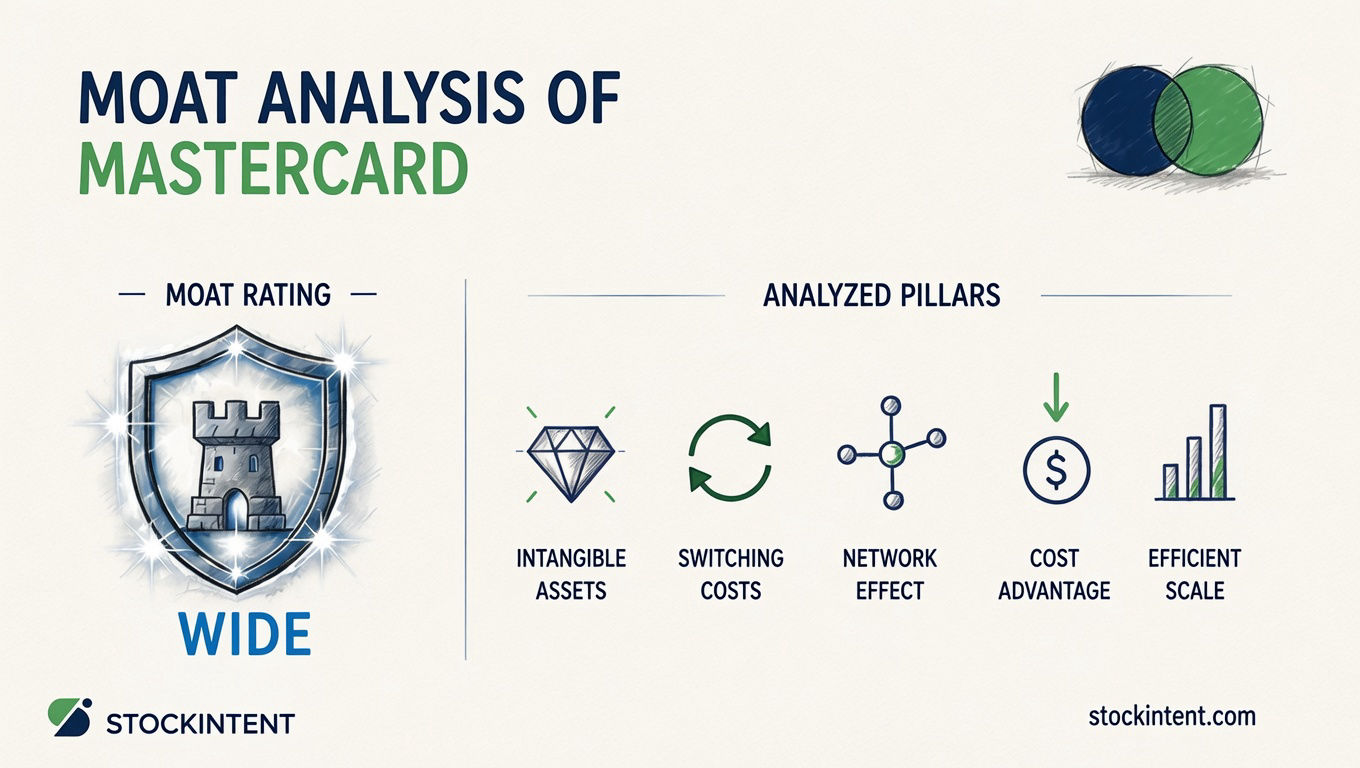
Mastercard carries a wide economic moat with a stable trend and medium uncertainty rating. In Q1 2026, the company delivered reported net revenue growth of 16% and 12% on a currency-neutral basis, while Value-Added Services and Solutions reached approximately 40% of net revenue. That mix shift toward higher-margin services, layered on top of a global acceptance footprint spanning 200+ countries and territories, is hinting at a potential durable competitive advantage.
Here are the key takeaways from our moat assessment:
For long-term investors evaluating business quality, the question isn't whether Mastercard is growing. It's whether that growth is protected by structural advantages that let the company earn excess returns for years to come. The five-pillar analysis that follows breaks down exactly where that protection comes from and where it could crack.
Mastercard's moat rests on five pillars, with network effects standing as the strongest and efficient scale being the most contested. Understanding each pillar's actual strength, not just its theoretical appeal, is what separates durable quality from temporary market position.
Reviewing the financial evidence behind each pillar is where StockIntent company reports become useful. You can pull historical margins, returns on invested capital, and segment growth rates to test whether the theoretical moat shows up in actual performance data.
Mastercard operates a two-sided network where merchants and cardholders reinforce each other. More acceptance locations increase card utility for consumers; more cardholders increase transaction volume for merchants. This interdependence is described as "near-irreplaceable" at global scale, with a global acceptance footprint spanning 200+ countries and territories. The Visa-Mastercard duopoly makes simultaneous replication of both sides very difficult for any new entrant.
Brand trust, security infrastructure, and proprietary data layers form Mastercard's intangible strength. Tokenization now covers nearly 40% of transactions, reducing fraud exposure while deepening merchant integration. The moat is increasingly shifting from pure card rails toward embedded services like fraud screening and identity verification that are harder to regulate away. These intangibles matter most in the fast-growing value-added services segment.
Banks and merchants face real friction when changing card networks: contract renegotiation, card reissuance, systems integration, and customer communication. But switching costs are not absolute. Regulatory pressure, multi-network incentives, and competitive offers can overcome this friction. Switching costs support the moat without a doubt though.
Mastercard's asset-light, non-lending model avoids credit risk and balance-sheet intensity. This produces exceptional margins: Q1 2026 pre-tax profit margin of approximately 57.3% and free cash flow margin of 42.3%. Still, this is better understood as an operating model advantage than a classic cost moat. The sources emphasize network value and pricing power more than a unique structural cost base.
The Visa-Mastercard duopoly creates barriers that look like efficient scale. A third network would struggle to justify duplicative global infrastructure. Some analysts argue this edge is reinforced by historical rules and regulatory tolerance rather than pure natural scale. The moat is real, but its explanation is stronger as "network effects plus institutional reinforcement" than as efficient scale alone.
Reviewing the financial evidence behind each pillar is where StockIntent company reports become useful. You can pull historical margins, returns on invested capital, and segment growth rates to test whether the theoretical moat shows up in actual performance data.
The clearest proof of Mastercard's moat is the gap between how fast revenue grows and how fast expenses grow. In Q1 2026, operating expenses rose just 9% on a currency-neutral basis, while net revenue grew 12% currency-neutral and 16% reported. That spread is operating leverage in action: the network handles more volume without proportional cost increases.
Value-Added Services show the moat widening into stickier, higher-margin revenue. VAS grew approximately 26% in the most recent quarter and now represents roughly 38% of total revenue. These services, think fraud prevention and data analytics, embed deeper into customer workflows than transaction processing alone.
Capital efficiency is equally striking. Mastercard generated a free cash flow margin of 42.3% in 2026, up dramatically from the high-20% range a decade earlier. The company returned $4.4 billion through share repurchases and $777 million in dividends in Q1 2026 alone. That's what a wide moat looks like when translated into owner earnings.
Against peers, Mastercard's asset-light, non-lending model insulates it from credit risk that burdens integrated lenders like American Express. The trade-off is shared vulnerability: geopolitical tensions in the Middle East affected cross-border volumes, one of Mastercard's highest-yield segments. Still, the structural quality advantage is hard to dispute. Mastercard earns more like a software business than a financial institution, and that difference compounds over time.
Mastercard's moat trend is stable to widening. The network's core economics remain intact, but the direction over the next three to five years depends on whether service expansion and international growth outpace regulatory pressure and payment rail substitution.
Value-added services are the clearest widening signal. Sustained growth above 25% shows Mastercard monetizing fraud prevention, identity verification, and data analytics beyond basic transaction routing. These products embed deeper into merchant operations and carry higher margins than swipe fees.
Tokenization is another positive indicator. Nearly 40% of transactions are now tokenized, which reduces fraud, improves authorization rates, and makes the network harder to displace. The more payment flows run through Mastercard's security infrastructure, the stickier the relationship becomes.
International expansion adds a third widening vector. Partnerships and product launches in Bangladesh, the Philippines, and China tap markets where digital adoption is still accelerating. Cross-border flows and debit-prepaid mix expansion in these regions extend the network's reach before local competitors can establish equivalent scale.
Regulatory pressure tops the risk list. The Credit Card Competition Act threatens to force routing changes that would directly compress interchange fees. European cross-border fee caps and merchant antitrust litigation add parallel pressure. These are not distant threats; they are active legislative and legal processes.
Alternative payment rails present a longer-term substitution risk. Real-time payment systems and account-to-account transfers bypass card networks entirely for an expanding set of use cases. The risk is potential gradual erosion as merchants and consumers grow comfortable with cheaper, faster alternatives.
Geopolitical disruption has already shown tangible impact. Tensions in the Middle East affected cross-border travel and transaction volumes in Q1 2026, hitting one of Mastercard's highest-yield segments. This vulnerability is structural, not temporary, for any global network.
Tracking these indicators over time is where a structured watchlist helps. StockIntent watchlists let you organize these metrics and monitor them through predefined or custom views, so you can spot whether the moat trend is improving or weakening before it shows up in the headline numbers.
We rate Mastercard's uncertainty as medium.
The company's revenue is highly predictable relative to most financial firms. Payment flows recur automatically, and Value-Added Services now represent roughly 40% of net revenue, which diversifies the mix beyond pure card-spend volume. Analyst estimates for 2026 cluster around $36.7 billion with relatively narrow dispersion, suggesting the market sees a fairly stable path ahead.
However, that predictability has limits. Regulatory scrutiny on interchange fees and the Credit Card Competition Act threaten the pricing power that underpins network economics. Geopolitical tensions in the Middle East already affected cross-border volumes in Q1 2026, demonstrating how external shocks can hit Mastercard's highest-yield segment. Longer term, real-time payment rails and account-to-account transfers could gradually displace card networks for an expanding set of transactions.
Expert Tip: When assessing uncertainty in network businesses, distinguish between volatility in stock price and volatility in business outcomes. Mastercard's medium uncertainty stems not from earnings unpredictability, its revenue is highly visible, but from the wide potential range of regulatory and competitive outcomes that could alter its economics by 2030.
The plausible range of outcomes over the next three to five years is narrow to moderately narrow. The base case remains durable leadership with continued high-quality growth. The downside case is slower growth and margin compression, not a collapse in competitive position. What would change our view? Passage of the Credit Card Competition Act or sustained VASS deceleration below 20% would push uncertainty toward high.
Mastercard earns a wide economic moat, a stable to widening trend, and a medium uncertainty rating. The network's core economics remain formidable: a 42.3% free cash flow margin and Value-Added Services growing at 26% demonstrate that competitive advantages translate into durable excess returns.
The central tension for investors watching from here is straightforward. On one side, service expansion and tokenization are embedding Mastercard deeper into customer operations. On the other, regulatory pressure and alternative payment rails threaten the fee structure and volume growth that power returns. Passage of the Credit Card Competition Act or sustained VASS deceleration below 20% would weaken the thesis. Continued international expansion and AI-driven identity adoption would strengthen it.
For long-term investors evaluating business quality, the question is not whether Mastercard will grow next quarter. It is whether the structural advantages behind that growth can survive a decade of regulatory and technological pressure. Our read: the moat is real, the trend is favorable, but the range of outcomes is wider than the stock's calm revenue trajectory suggests. Monitor the watchlist indicators we outlined above, and test your own assumptions with the full financial evidence before making any capital commitment.
This content is for informational or educational purposes and is not investment advice.
Mastercard carries a wide economic moat with a stable trend and medium uncertainty rating. In Q1 2026, the company delivered reported net revenue growth of 16% and 12% on a currency-neutral basis, while Value-Added Services and Solutions reached approximately 40% of net revenue. That mix shift toward higher-margin services, layered on top of a global acceptance footprint spanning 200+ countries and territories, is hinting at a potential durable competitive advantage.
Here are the key takeaways from our moat assessment:
For long-term investors evaluating business quality, the question isn't whether Mastercard is growing. It's whether that growth is protected by structural advantages that let the company earn excess returns for years to come. The five-pillar analysis that follows breaks down exactly where that protection comes from and where it could crack.
Mastercard's moat rests on five pillars, with network effects standing as the strongest and efficient scale being the most contested. Understanding each pillar's actual strength, not just its theoretical appeal, is what separates durable quality from temporary market position.
Reviewing the financial evidence behind each pillar is where StockIntent company reports become useful. You can pull historical margins, returns on invested capital, and segment growth rates to test whether the theoretical moat shows up in actual performance data.
Mastercard operates a two-sided network where merchants and cardholders reinforce each other. More acceptance locations increase card utility for consumers; more cardholders increase transaction volume for merchants. This interdependence is described as "near-irreplaceable" at global scale, with a global acceptance footprint spanning 200+ countries and territories. The Visa-Mastercard duopoly makes simultaneous replication of both sides very difficult for any new entrant.
Brand trust, security infrastructure, and proprietary data layers form Mastercard's intangible strength. Tokenization now covers nearly 40% of transactions, reducing fraud exposure while deepening merchant integration. The moat is increasingly shifting from pure card rails toward embedded services like fraud screening and identity verification that are harder to regulate away. These intangibles matter most in the fast-growing value-added services segment.
Banks and merchants face real friction when changing card networks: contract renegotiation, card reissuance, systems integration, and customer communication. But switching costs are not absolute. Regulatory pressure, multi-network incentives, and competitive offers can overcome this friction. Switching costs support the moat without a doubt though.
Mastercard's asset-light, non-lending model avoids credit risk and balance-sheet intensity. This produces exceptional margins: Q1 2026 pre-tax profit margin of approximately 57.3% and free cash flow margin of 42.3%. Still, this is better understood as an operating model advantage than a classic cost moat. The sources emphasize network value and pricing power more than a unique structural cost base.
The Visa-Mastercard duopoly creates barriers that look like efficient scale. A third network would struggle to justify duplicative global infrastructure. Some analysts argue this edge is reinforced by historical rules and regulatory tolerance rather than pure natural scale. The moat is real, but its explanation is stronger as "network effects plus institutional reinforcement" than as efficient scale alone.
Reviewing the financial evidence behind each pillar is where StockIntent company reports become useful. You can pull historical margins, returns on invested capital, and segment growth rates to test whether the theoretical moat shows up in actual performance data.
The clearest proof of Mastercard's moat is the gap between how fast revenue grows and how fast expenses grow. In Q1 2026, operating expenses rose just 9% on a currency-neutral basis, while net revenue grew 12% currency-neutral and 16% reported. That spread is operating leverage in action: the network handles more volume without proportional cost increases.
Value-Added Services show the moat widening into stickier, higher-margin revenue. VAS grew approximately 26% in the most recent quarter and now represents roughly 38% of total revenue. These services, think fraud prevention and data analytics, embed deeper into customer workflows than transaction processing alone.
Capital efficiency is equally striking. Mastercard generated a free cash flow margin of 42.3% in 2026, up dramatically from the high-20% range a decade earlier. The company returned $4.4 billion through share repurchases and $777 million in dividends in Q1 2026 alone. That's what a wide moat looks like when translated into owner earnings.
Against peers, Mastercard's asset-light, non-lending model insulates it from credit risk that burdens integrated lenders like American Express. The trade-off is shared vulnerability: geopolitical tensions in the Middle East affected cross-border volumes, one of Mastercard's highest-yield segments. Still, the structural quality advantage is hard to dispute. Mastercard earns more like a software business than a financial institution, and that difference compounds over time.
Mastercard's moat trend is stable to widening. The network's core economics remain intact, but the direction over the next three to five years depends on whether service expansion and international growth outpace regulatory pressure and payment rail substitution.
Value-added services are the clearest widening signal. Sustained growth above 25% shows Mastercard monetizing fraud prevention, identity verification, and data analytics beyond basic transaction routing. These products embed deeper into merchant operations and carry higher margins than swipe fees.
Tokenization is another positive indicator. Nearly 40% of transactions are now tokenized, which reduces fraud, improves authorization rates, and makes the network harder to displace. The more payment flows run through Mastercard's security infrastructure, the stickier the relationship becomes.
International expansion adds a third widening vector. Partnerships and product launches in Bangladesh, the Philippines, and China tap markets where digital adoption is still accelerating. Cross-border flows and debit-prepaid mix expansion in these regions extend the network's reach before local competitors can establish equivalent scale.
Regulatory pressure tops the risk list. The Credit Card Competition Act threatens to force routing changes that would directly compress interchange fees. European cross-border fee caps and merchant antitrust litigation add parallel pressure. These are not distant threats; they are active legislative and legal processes.
Alternative payment rails present a longer-term substitution risk. Real-time payment systems and account-to-account transfers bypass card networks entirely for an expanding set of use cases. The risk is potential gradual erosion as merchants and consumers grow comfortable with cheaper, faster alternatives.
Geopolitical disruption has already shown tangible impact. Tensions in the Middle East affected cross-border travel and transaction volumes in Q1 2026, hitting one of Mastercard's highest-yield segments. This vulnerability is structural, not temporary, for any global network.
Tracking these indicators over time is where a structured watchlist helps. StockIntent watchlists let you organize these metrics and monitor them through predefined or custom views, so you can spot whether the moat trend is improving or weakening before it shows up in the headline numbers.
We rate Mastercard's uncertainty as medium.
The company's revenue is highly predictable relative to most financial firms. Payment flows recur automatically, and Value-Added Services now represent roughly 40% of net revenue, which diversifies the mix beyond pure card-spend volume. Analyst estimates for 2026 cluster around $36.7 billion with relatively narrow dispersion, suggesting the market sees a fairly stable path ahead.
However, that predictability has limits. Regulatory scrutiny on interchange fees and the Credit Card Competition Act threaten the pricing power that underpins network economics. Geopolitical tensions in the Middle East already affected cross-border volumes in Q1 2026, demonstrating how external shocks can hit Mastercard's highest-yield segment. Longer term, real-time payment rails and account-to-account transfers could gradually displace card networks for an expanding set of transactions.
Expert Tip: When assessing uncertainty in network businesses, distinguish between volatility in stock price and volatility in business outcomes. Mastercard's medium uncertainty stems not from earnings unpredictability, its revenue is highly visible, but from the wide potential range of regulatory and competitive outcomes that could alter its economics by 2030.
The plausible range of outcomes over the next three to five years is narrow to moderately narrow. The base case remains durable leadership with continued high-quality growth. The downside case is slower growth and margin compression, not a collapse in competitive position. What would change our view? Passage of the Credit Card Competition Act or sustained VASS deceleration below 20% would push uncertainty toward high.
Mastercard earns a wide economic moat, a stable to widening trend, and a medium uncertainty rating. The network's core economics remain formidable: a 42.3% free cash flow margin and Value-Added Services growing at 26% demonstrate that competitive advantages translate into durable excess returns.
The central tension for investors watching from here is straightforward. On one side, service expansion and tokenization are embedding Mastercard deeper into customer operations. On the other, regulatory pressure and alternative payment rails threaten the fee structure and volume growth that power returns. Passage of the Credit Card Competition Act or sustained VASS deceleration below 20% would weaken the thesis. Continued international expansion and AI-driven identity adoption would strengthen it.
For long-term investors evaluating business quality, the question is not whether Mastercard will grow next quarter. It is whether the structural advantages behind that growth can survive a decade of regulatory and technological pressure. Our read: the moat is real, the trend is favorable, but the range of outcomes is wider than the stock's calm revenue trajectory suggests. Monitor the watchlist indicators we outlined above, and test your own assumptions with the full financial evidence before making any capital commitment.
This content is for informational or educational purposes and is not investment advice.