Apr 3, 2026
Match Group sits at the intersection of technology and human connection, operating the world's largest portfolio of dating apps including Tinder, Hinge, Match.com, and PlentyOfFish. For investors evaluating this $3.5 billion revenue company, understanding what drives its strategic decisions matters more than you might think. A company's mission isn't just marketing fluff, it's the compass that guides capital allocation, product innovation, and competitive positioning over decades.
So what exactly is Match Group building toward? And more importantly, does their stated purpose translate into durable competitive advantages that protect your investment? Let's cut through the corporate speak and examine what the company actually stands for in 2026.
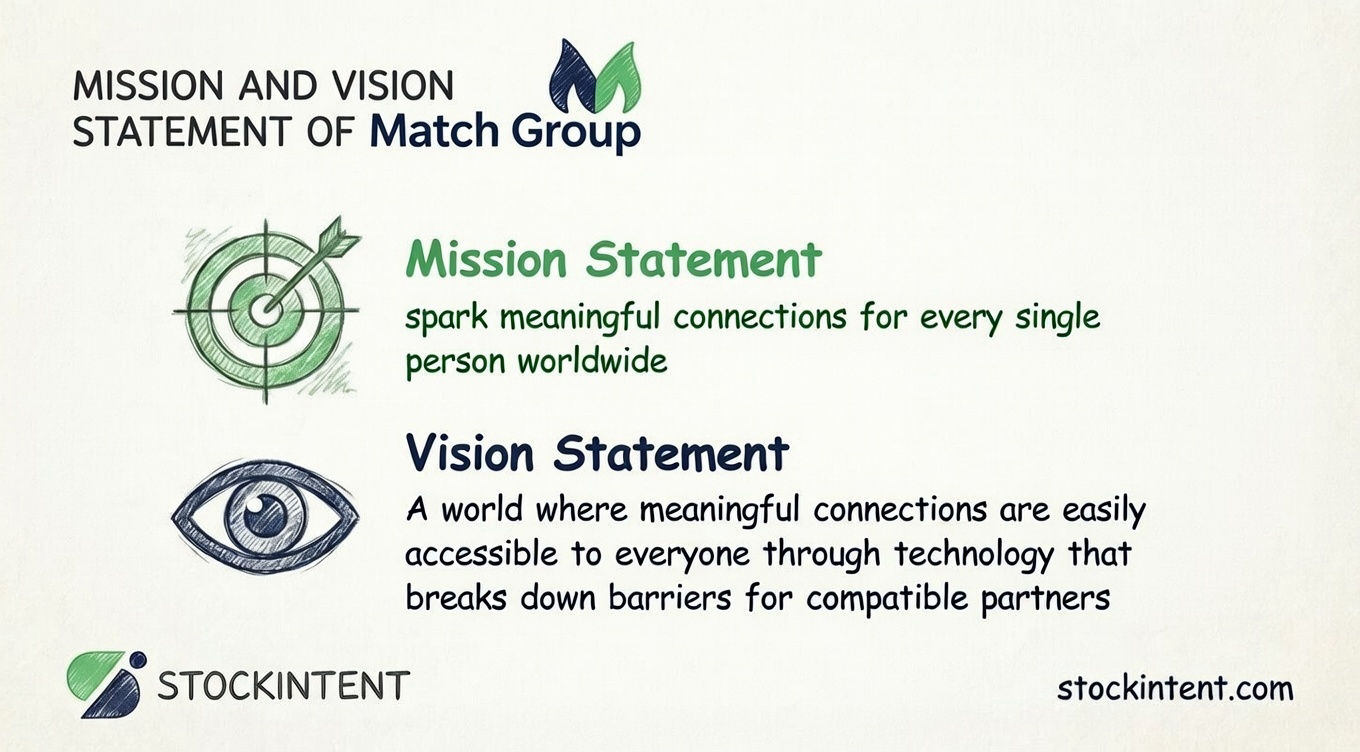
Match Group's official mission statement is direct and unchanging: to "spark meaningful connections for every single person worldwide." This isn't a recent pivot or response to market pressure. The company has held this purpose steady while completely transforming how it pursues that goal.
Entering 2026, Match Group refined its philosophy with a critical clarification: technology should facilitate genuine human connection rather than substitute for it. This positioning matters because it directly addresses growing user fatigue with superficial digital interactions and rising demand for authenticity.
The company's strategic pillars now include:
| Pillar | What It Means in Practice |
|---|---|
| AI-Driven Innovation | Features like Tinder's "Sparks" (six-way conversations), FaceCheck facial verification, and Hinge's Convo Starters that boost match quality by 15% |
| Intentional Dating | Product design prioritizing quality matches over volume, aligning with Gen Z preferences for authentic experiences |
| Global Scale | Hinge became the #2 downloaded dating app in Mexico and Brazil within months of 2025 launch |
| Safety by Design | $125M annual investment in trust and safety infrastructure, including partnerships with RAINN |
The market is paying close attention to whether this mission-driven approach actually works financially. As Simply Wall St noted, board changes in early 2026 "could support the existing narrative that Match Group is leaning into AI-powered features, safety, and global expansion." Investors want to see if new directors bring expertise that accelerates execution on these priorities.
The caution is warranted. Match Group's 2026 revenue guidance is essentially flat at $3.41–$3.535 billion, and the stock carries a consensus "Hold" rating from 20+ analysts. The mission is clear. The execution remains a work in progress.
Match Group operates as the dominant force in online dating, commanding a portfolio that reaches hundreds of millions of users across more than 40 languages worldwide. Founded in 1995 with the launch of Match.com, the company has evolved from a single subscription site into a multi-platform empire spanning casual discovery, relationship-focused matching, and global social connection.
In our experience analyzing digital marketplace businesses, companies that own the entire customer journey from discovery to monetization tend to build the most durable moats. Match Group's structure exemplifies this; they don't just run Tinder, they operate 45+ distinct brands including Hinge, OkCupid, PlentyOfFish, Pairs, and Azar, each calibrated to different demographics, relationship goals, and geographic markets.
| Metric | Figure | Context |
|---|---|---|
| LTM Revenue | $3.5 billion | Flat guidance for 2026 signals turnaround phase |
| 2026 Revenue Guidance | $3.41–$3.535 billion | Management prioritizing product quality over short-term growth |
| Adjusted EBITDA (2026E) | $1.280–$1.325 billion | 37.5% margin target reflects cost discipline |
| Paying Users | 14.2 million | Down from peaks; recovery is key 2026 priority |
| Portfolio Brands | 45+ | From Tinder's casual discovery to Hinge's intentional dating |
Match Group sits within the Communication Services sector, specifically internet content and information. It's not a traditional media company, nor is it purely a social platform. The business model blends subscription revenue (recurring, high-margin) with in-app purchases and advertising; a hybrid that has attracted both growth and value investors at different times.
The competitive landscape has tightened. While Tinder remains the #1 downloaded and highest-grossing lifestyle app globally, rivals like Bumble and emerging social discovery features from Meta pose real threats. What separates Match Group is scale and specialization: no competitor offers the breadth of brand positioning, from Tinder's "most fun way to spark something new" to Hinge's "Designed to be Deleted" philosophy.
The investment case hinges on execution of three priorities management has telegraphed clearly:
The market remains skeptical, with a consensus "Hold" rating from 20+ analysts and price targets clustering around $35–$40, implying modest upside from current levels. For investors, the question isn't whether online dating is a durable category; it's whether Match Group's mission-driven operational improvements can reignite growth against a backdrop of user fatigue and rising acquisition costs.
"To spark meaningful connections for every single person worldwide."
This single sentence has anchored Match Group's strategic decisions for years, surviving leadership changes, platform pivots, and the complete transformation of how people meet online. While competitors have shifted messaging to chase trends, Match Group has held this purpose steady. The consistency matters; it signals management's conviction that the fundamental human need for connection doesn't change, even as the technology enabling it evolves dramatically.
🎯 Pro Insight: Mission statement stability is a subtle but important quality signal for long-term investors. Companies that rewrite their purpose every few years often lack strategic clarity or are reacting to pressure rather than leading. Match Group's unchanging mission, paired with evolving execution strategy, suggests disciplined management that knows the difference between what they do (the mission) and how they do it (the strategy).
The wording itself carries important signals for investors analyzing Match Group's mission and vision:
This mission directly shapes capital allocation. The company's $125 million annual investment in trust and safety infrastructure isn't charity; it's operational execution of "meaningful connections." Users won't form relationships on platforms they don't trust. Similarly, the 2026 clarification that "technology should help people make real connections, not replace human relationships" addresses growing user fatigue with superficial digital interactions, a competitive threat that could undermine the entire business model if ignored.
For value investors, the mission statement is worth analyzing because it reveals where management will direct resources when trade-offs arise. Match Group's mission supports three identifiable competitive advantages:
| Moat Source | Mission Connection | Evidence in Capital Allocation |
|---|---|---|
| Network Effects | "Every single person" requires scale | 82 million monthly active users across 45+ brands, winner-take-most market dynamics |
| Brand Trust | "Meaningful connections" requires safety | $125M annual trust and safety spend, RAINN partnership, no third-party data sales |
| Innovation Discipline | "Spark" requires continuous improvement | $60M Project Aurora budget for Tinder, AI ROI discipline with "higher bar" for new projects |
The mission also explains what Match Group won't do. You won't see them pivoting to general social media, entertainment streaming, or other adjacencies that might juice short-term engagement but dilute the core purpose. This focus is a double-edged sword; it limits optionality but deepens competitive positioning in a specific, defensible niche.
Comparing Match Group's corporate mission to competitors reveals this clarity. Bumble's mission emphasizes women's empowerment in dating, a differentiated but narrower positioning. Meta's dating features, by contrast, lack any coherent mission beyond "add another feature to keep users in our ecosystem." Match Group's singular focus on connection quality, backed by three decades of operational experience in the category, creates a moat that generalist competitors struggle to cross.
Match Group's mission to "spark meaningful connections for every single person worldwide" isn't just a tagline; it's operationalized through four distinct strategic pillars that guide capital allocation and product development. Understanding these pillars helps investors assess whether management is building durable competitive advantages or simply chasing trends.
In our experience analyzing platform businesses, the companies that translate mission into measurable operational priorities tend to outperform those with vague aspirations. Match Group's 2026 strategy provides that specificity.
This pillar prioritizes authentic relationship formation over short-term engagement metrics or aggressive monetization. It's the difference between optimizing for "time spent" versus "connections made."
Why it matters strategically: Dating apps face a fundamental tension. More matches and swipes drive near-term usage, but if users don't form actual relationships, they churn permanently. Match Group's focus on outcomes, exemplified by Hinge's "Designed to be Deleted®" positioning, aligns the company's success with user success. This creates longer customer lifecycles and stronger word-of-mouth; the most powerful, cheapest acquisition channel in dating.
Concrete example: Hinge's AI-powered Convo Starters, launched in 2025, boosted match quality by 15% according to internal metrics. Rather than gamifying endless swiping, the feature helps users initiate meaningful conversations. Tinder's 2026 repositioning under "Project Aurora" similarly prioritizes better algorithms and features like Double Date and Chemistry over volume metrics.
Investor implication: This pillar supports premium pricing power. Users will pay more for platforms that demonstrably work, creating defensible revenue per payer growth even in competitive markets.
Match Group treats AI not as a buzzword but as infrastructure for improving connection quality at scale. The company has moved from experimental pilots to disciplined, ROI-focused deployment.
Why it matters strategically: AI creates network effect reinforcement. Better matching algorithms improve outcomes, which attracts more users, which generates more training data, which further improves algorithms. This flywheel is difficult for smaller competitors to replicate.
Concrete example: Tinder's "Sparks" feature enables six-way group conversations, while FaceCheck facial verification reduced bad actor interactions by over 50% in deployed markets with minimal revenue impact. CFO Steve Bailey has established a "higher bar" for AI spending in 2026, requiring business cases demonstrating revenue impact, user engagement gains, or cost savings. This discipline contrasts with the unlimited pilot spending of 2024–2025.
Investor implication: The shift from "AI experimentation" to "AI ROI discipline" suggests maturing capital allocation. For a company with flat 2026 revenue guidance, operational efficiency in technology spend protects margins while still funding innovation.
Match Group operates 45+ distinct brands across 40+ languages, each calibrated to different demographics, relationship goals, and geographic markets. This isn't accidental sprawl; it's strategic optionality.
Why it matters strategically: Dating preferences vary enormously by culture, age, and relationship intent. A single app cannot optimally serve all segments. The multi-brand approach creates multiple "shots on goal" and enables user lifecycle management; someone might start on Tinder for casual dating, migrate to Hinge for relationships, without leaving the Match Group ecosystem.
Concrete example: Hinge's international expansion illustrates this pillar's execution. Launched in Mexico and Brazil in 2025, Hinge became the #2 downloaded dating app in both markets within months. International MAUs reached 3.3 million by year-end 2025, up nearly 50% year-over-year. This success validates that Hinge's "intentional dating" positioning travels beyond its US origins.
Investor implication: Portfolio diversification reduces single-brand risk. Tinder's well-documented challenges (MAU declines, payer compression) are partially offset by Hinge's growth and emerging market expansion. For investors, this creates more predictable consolidated cash flows.
This pillar addresses the existential risk facing all dating platforms: user safety breaches that destroy brand trust and invite regulatory intervention. Match Group has made this a genuine operational priority, not merely a PR concern.
Why it matters strategically: Trust is the core currency in dating. Users won't form vulnerable connections on platforms they perceive as unsafe. Competitors that underinvest in safety may enjoy lower costs short-term but face catastrophic reputation risk and regulatory action long-term.
Concrete example: Match Group invests $125 million annually in trust and safety infrastructure. Specific initiatives include the Safety Advisory Council formed in 2018 with experts like Tarana Burke (#MeToo founder), partnership with RAINN (Rape, Abuse & Incest National Network), and being the first tech company to support the 2020 EARN IT Act against online exploitation. The company also maintains a strict policy of not selling user data to third parties.
Investor implication: This spending is defensible moat-building, not discretionary CSR. The alternative, underinvestment, risks regulatory action that could impose far costlier operational changes or liability. For long-term investors, proactive safety investment indicates management that understands the business's risk profile.
Unlike many companies that publish elaborate vision statements filled with buzzwords, Match Group takes a more understated approach. The company does not maintain a separate, formal vision statement distinct from its mission. Instead, the vision is implicitly woven throughout its strategic communications and operational priorities.
Based on official company communications and management commentary, Match Group's vision can be summarized as follows:
A world where meaningful connections are easily accessible to everyone through technology that breaks down barriers for compatible partners.
This vision, while not packaged as a standalone quote on investor materials, consistently emerges from how leadership describes the company's long-term trajectory. It reflects an ambition that extends beyond simply dominating the dating app category to fundamentally reshaping how people form relationships in an increasingly digital world.
Match Group's leadership, including CEO Spencer Raine who joined in February 2025, has articulated a clear three-part strategic framework that brings this vision to life:
Confront challenges with urgency. Rather than masking Tinder's user declines or Hinge's growing pains, management has been direct about problems while moving quickly to address them. This rebuilds credibility with investors who've seen too many tech companies paper over operational weaknesses until they become crises.
Accelerate innovation with purpose. The 2026 roadmap emphasizes AI and machine learning investments, but with a critical caveat: technology must enhance genuine human connection, not substitute for it. This positioning addresses the growing user fatigue with superficial digital interactions that we've seen across social platforms.
Prioritize trust and safety as foundation. With $125 million in annual safety investments and partnerships with organizations like RAINN, Match Group treats user protection as competitive infrastructure rather than compliance overhead.
Match Group's implicit vision positions it advantageously against macro trends reshaping internet content and information services:
| Trend | Match Group Positioning | Strategic Implication |
|---|---|---|
| AI-driven personalization | AI hub-and-spoke model for tailored matching | Better outcomes create network effects and pricing power |
| Demand for authenticity | "Intentional dating" product design | Differentiates from entertainment-focused competitors |
| Privacy concerns | No third-party data sales policy | Builds trust moat as regulation tightens |
| Global digital adoption | 40+ languages, Hinge expansion in Latin America | Captures emerging market growth before local competitors scale |
| Post-pandemic connection needs | Features like Double Date, Sparks group conversations | Addresses loneliness epidemic with structured social experiences |
The vision also explains what Match Group won't pursue. You won't see them launching general social media features, entertainment streaming, or other adjacencies that might juice short-term engagement but dilute the core purpose. This focus limits strategic optionality but deepens competitive positioning in a specific, defensible niche.
For investors evaluating Match Group's strategic vision, the key question is whether this focused ambition can reignite growth in a maturing market. The 2026 guidance, essentially flat revenue at $3.41–$3.535 billion, suggests management is prioritizing sustainable execution over growth-at-all-costs. Whether that discipline translates into long-term value creation remains the central debate among the 20+ analysts covering the stock.
Match Group's vision, while not published as a standalone formal statement, emerges clearly from how leadership describes the company's long-term trajectory. Based on official communications and management commentary, we can identify four core strategic themes that operationalize their ambition to make meaningful connections accessible worldwide.
Match Group has moved decisively from experimental AI pilots to disciplined, results-oriented deployment. This theme reflects management's conviction that artificial intelligence should enhance connection quality, not simply automate engagement.
CFO Steve Bailey established a "higher bar" for AI spending in 2026, requiring business cases that demonstrate revenue impact, user engagement gains, or cost savings. This marks a maturation from the unlimited pilot spending of 2024–2025. Hinge's AI-powered Convo Starters already boosted match quality by 15%, validating the approach.
Strategic moves backing this theme:
This theme addresses the growing user fatigue with superficial digital interactions, particularly among Gen Z. Match Group's 2026 positioning emphasizes that "technology should help people make real connections, not replace human relationships."
The shift shows up in product design choices. Hinge's "Designed to be Deleted®" philosophy explicitly prioritizes relationship formation over endless engagement. Tinder's repositioning under "Project Aurora" similarly emphasizes quality matching through features like Double Date and Chemistry rather than volume metrics.
Strategic moves backing this theme:
Match Group operates 45+ brands across 40+ languages, treating geographic and demographic diversity as strategic optionality rather than operational complexity. This theme explains why the company maintains distinct apps rather than consolidating into a single platform.
The multi-brand approach creates multiple "shots on goal" and enables user lifecycle management. Someone might start on Tinder for casual dating, then migrate to Hinge for serious relationships, without ever leaving the Match Group ecosystem.
Strategic moves backing this theme:
With $125 million in annual investments, Match Group treats user protection as competitive infrastructure rather than compliance overhead. This theme recognizes that trust is the core currency in dating; users won't form vulnerable connections on platforms they perceive as unsafe.
The company was the first tech firm to support the 2020 EARN IT Act against online exploitation. Its Safety Advisory Council, formed in 2018 with experts like Tarana Burke (#MeToo founder), and partnership with RAINN demonstrate institutional commitment beyond lip service.
Strategic moves backing this theme:
For investors analyzing Match Group's strategic vision, these four themes reveal management's theory of value creation:
| Theme | Competitive Advantage | Financial Impact |
|---|---|---|
| AI Discipline | Network effect reinforcement through better matching | Improved retention, pricing power |
| Intentional Dating | Differentiation from entertainment-focused rivals | Premium subscription tiers, lower churn |
| Global Portfolio | Reduced single-brand risk, lifecycle monetization | More predictable consolidated cash flows |
| Trust Investment | Regulatory risk mitigation, brand moat | Protected long-term addressable market |
The board refresh in early 2026 "could support the existing narrative that Match Group is leaning into AI-powered features, safety, and global expansion," according to Simply Wall St analysis. New directors bring relevant expertise, but investors remain cautious with a consensus "Hold" rating and flat 2026 revenue guidance of $3.41–$3.535 billion.
The vision themes are clear. Whether they translate into renewed growth is the execution challenge that will define Match Group's investment case over the next 24 months.
Here's where corporate communications get interesting. Match Group doesn't actually publish a formal list of core values on its website. No laminated posters, no inspirational wall decals. Instead, the company's values emerge from how it describes its culture, where it allocates capital, and what leadership emphasizes when speaking to investors and employees.
In our experience analyzing companies for investment potential, this absence of explicit values isn't necessarily a red flag. Sometimes the most authentic values are demonstrated rather than declared. What matters is whether operational reality aligns with the implicit values the company claims to hold.
Based on corporate communications, SEC filings, and management commentary, we can identify five core values that consistently surface across Match Group's operations:
This value prioritizes authentic relationship formation over short-term engagement metrics or aggressive monetization. It's the difference between optimizing for "time spent" versus "connections made."
Match Group operationalizes this through product design choices that align company success with user success. Hinge's "Designed to be Deleted®" positioning exemplifies this philosophy; the brand explicitly celebrates when users find relationships and leave the app. This creates longer customer lifecycles and stronger word-of-mouth, the most powerful acquisition channel in dating.
The value shows up in capital allocation too. Hinge's AI-powered Convo Starters, launched in 2025, boosted match quality by 15% according to internal metrics. Rather than gamifying endless swiping, the feature helps users initiate meaningful conversations. Tinder's 2026 repositioning under "Project Aurora" similarly prioritizes better algorithms over volume metrics.
💡 Expert Tip: When evaluating platform businesses, look for this alignment between user success and company success. Businesses that extract value from users (endless engagement, pay-to-play mechanics) tend to have shorter lifespans than those that create genuine value and capture a portion of it through satisfied, retained customers.
Match Group emphasizes welcoming users and employees from all backgrounds, operationalized through sponsorship of pipeline programs for underrepresented people in STEM and explicit commitments to diversity "both on and off our apps."
This value supports the mission's "every single person worldwide" language. A platform claiming to serve everyone must actually build for everyone. The 45+ brand portfolio reflects this, with distinct apps calibrated to different demographics, relationship goals, and cultural contexts.
With $125 million in annual trust and safety investments, Match Group treats user protection as competitive infrastructure rather than compliance overhead. Specific commitments include:
This value recognizes that trust is the core currency in dating. Users won't form vulnerable connections on platforms they perceive as unsafe. The investment is defensive moat-building; underinvestment risks regulatory action that could impose far costlier operational changes.
Match Group treats technology as infrastructure for improving connection quality, not as a buzzword or engagement hack. The 2026 AI strategy exemplifies this discipline; CFO Steve Bailey established a "higher bar" for AI spending, requiring business cases demonstrating revenue impact, user engagement gains, or cost savings.
This marks maturation from the unlimited pilot spending of 2024–2025. Features like Tinder's FaceCheck facial verification (reducing bad actor interactions by 50%+) and "Sparks" six-way conversations show innovation directed at genuine user needs rather than novelty for its own sake.
This value addresses growing user fatigue with superficial digital interactions, particularly among Gen Z. Match Group's 2026 positioning emphasizes that "technology should help people make real connections, not replace human relationships."
Product manifestations include mandatory face photos, liveness checks, and features like Hinge's Direct to Date that streamline real-world meetings. The company recognizes that authenticity is becoming a competitive differentiator as users abandon platforms that feel artificial or manipulative.
This is where investment analysis gets practical. Stated values are easy; operational reality is harder.
Evidence of alignment:
Areas of tension:
In our experience, no company perfectly lives its values. What matters for investors is whether management recognizes gaps and allocates resources to close them. Match Group's 2026 strategic refresh, with its emphasis on intentional dating and AI discipline, suggests leadership is aware of these tensions and actively addressing them.
Match Group doesn't publish a comprehensive ESG framework with quantified sustainability goals. For investors focused on environmental metrics or carbon reduction targets, this will be disappointing.
However, the company does demonstrate social responsibility through:
| Initiative | Description | Connection to Values |
|---|---|---|
| Trust & Safety Investment | $125M annual spend on teams, features, and initiatives to prevent harm | Integrity, Authenticity |
| RAINN Partnership | Collaboration with leading anti-sexual violence organization | User Outcomes First |
| EARN IT Act Support | First tech company backing 2020 legislation against online exploitation | Integrity |
| Diversity Programs | STEM pipeline sponsorships for underrepresented groups | Diversity and Inclusion |
| No Data Sales Policy | Strict prohibition on third-party data monetization | Integrity, Trust |
For investors using StockIntent's screening tools, Match Group presents an interesting case study in how social responsibility manifests differently across industries. A manufacturing company's ESG profile centers on environmental impact and worker safety. For a digital platform handling vulnerable human interactions, the equivalent priorities are user safety, data privacy, and authentic connection quality.
The absence of formal environmental targets reflects the company's asset-light business model. Match Group doesn't operate data centers, manufacturing facilities, or logistics networks. Its environmental footprint is minimal by design, not through specific sustainability initiatives.
What matters for long-term investors is whether the company's social investments create durable competitive advantages. In Match Group's case, the trust and safety spending appears to be genuine moat-building. Users increasingly choose platforms they perceive as safe, and regulatory pressure on digital platforms is only intensifying. Proactive investment here protects the long-term addressable market.
Match Group's mission to "spark meaningful connections for every single person worldwide" isn't corporate wallpaper. It's the throughline connecting every strategic decision management makes, from the $125 million annual trust and safety budget to the disciplined "higher bar" for AI spending that CFO Steve Bailey established for 2026.
What makes this strategic identity compelling for investors is the consistency between stated purpose and capital allocation. The company isn't chasing every shiny trend; it's building durable competitive advantages in a specific, defensible niche. Network effects from 82 million monthly active users. Brand trust from three decades of operational experience. Innovation discipline that prioritizes match quality over engagement hacking.
📌 From Our Experience: We've tracked dozens of platform businesses through turnaround phases, and the ones that succeed share a pattern Match Group is now exhibiting: management gets direct about problems while moving quickly to fix them. The flat 2026 revenue guidance ($3.41–$3.535 billion) isn't failure; it's the realism required before sustainable growth returns. Companies that paper over weakness with optimistic forecasts tend to disappoint repeatedly. Those that reset expectations and execute methodically, like Match Group is attempting with Project Aurora's $60 million Tinder investment, often emerge stronger.
Analysts remain cautious, with a consensus "Hold" rating from 20+ analysts and price targets clustering around $35–$40. The market is waiting to see if mission-driven strategy translates into financial results. That's fair. Turnarounds are hard, and user fatigue in dating apps is real.
But here's what the skepticism misses: Match Group's strategic identity creates optionality that pure-play competitors lack. When Tinder struggles, Hinge grows 50% year-over-year in international markets. When one demographic ages out, 45+ brands capture the next cohort. This portfolio resilience, backed by a mission that has survived three decades of technology change, is the foundation for long-term compounding.
For investors doing deeper fundamental analysis, StockIntent's screening tools can help evaluate how Match Group's mission-driven capital allocation compares to competitors on metrics like ROIC, reinvestment rates, and margin sustainability. You can try StockIntent totally risk-free for 7 days to see how this strategic identity shows up in the numbers that matter for long-term returns.
The question isn't whether online dating disappears. Humans will always seek connection. The question is whether Match Group's focused execution of a clear mission can capture an outsized share of that permanent human need. The pieces are in place. The execution remains the work in progress.
Start your 7-day free trial and find quality compounders faster.
— StockIntent Score ╌ S&P 500