
Mar 29, 2026
Mattel isn't just the company behind Barbie and Hot Wheels. It's a $5.6 billion leisure giant that's actively reinventing itself for 2026 and beyond. For investors, understanding the Mattel mission statement isn't corporate fluff, it's a window into how management allocates capital, where they're steering the business, and whether that strategy can actually compound shareholder value over time.
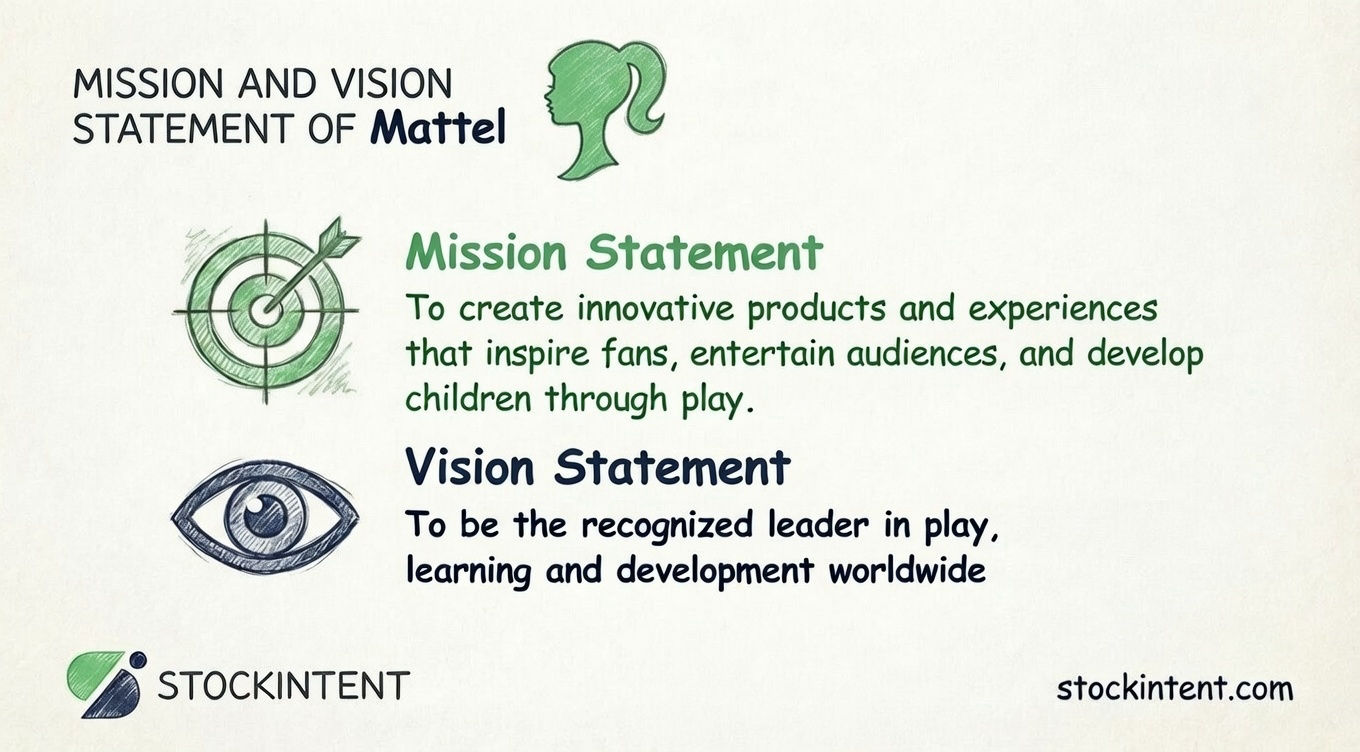
Mattel's official mission statement is: "to create innovative products and experiences that inspire fans, entertain audiences, and develop children through play." This three-part mandate guides everything from toy innovation to streaming content, digital gaming, and sustainability investments.
Here's what matters most about Mattel's strategic identity:
The mission isn't just marketing language; it's the lens through which CEO Ynon Kreiz and his team make capital allocation decisions. When Mattel commits $250 million annually to digital transformation and AI-driven products, that's mission-driven strategy with real financial consequences. For investors evaluating whether this leisure stock deserves a place in a quality-focused portfolio, the mission statement is where due diligence should start.
We'll explore how this mission translates into competitive positioning, what the vision really means for long-term value creation, and whether Mattel's core values actually show up in the numbers that matter.
Founded back in 1945 by Ruth and Elliot Handler, Mattel started as a humble Southern California garage operation and has grown into the world's second-largest toy manufacturer by revenue. Today it's a $5.6 billion leisure giant trading under NASDAQ:MAT, sitting squarely in the consumer cyclical sector where discretionary spending habits can make or break quarterly results.
In our experience analyzing consumer discretionary stocks, companies that successfully pivot from single-product reliance to ecosystem-driven models tend to weather economic cycles far better. Mattel's transformation from "toy company" to "IP-driven entertainment empire" is precisely this kind of strategic evolution; one that matters enormously for investors evaluating long-term compounding potential.
| Metric | Figure | Context |
|---|---|---|
| 2026E Revenue | $5.6 billion | Up 4.6% from 2025, per consensus forecasts |
| Q4 2025 Net Sales | $1,766 million | +7% year-over-year growth |
| 2026E Operating Profit | $573 million | Down 8% due to digital investment cycle |
| Power Brands Revenue | ~$2.7 billion | Expected 10% YoY growth in 2026 |
| Digital/Entertainment Investment | ~$150 million | Self-funding target by 2027 |
The business breaks into distinct revenue engines anchored by what management calls Power Brands; the franchises with genuine cultural staying power. These include Barbie, Hot Wheels, Fisher-Price, American Girl, Thomas & Friends, UNO, Masters of the Universe, Matchbox, and Monster High.
But here's where the Mattel mission statement evolution becomes financially material. The company is no longer just manufacturing plastic; it's monetizing intellectual property across multiple verticals:
This matters because licensing and entertainment carry gross margins that can exceed 70%, versus the 40-50% typical of physical toy manufacturing. When management allocates $150 million toward digital capabilities in 2026, they're not following trends; they're engineering margin expansion.
Mattel ranks second globally in traditional toys behind Lego, but the competitive dynamics are shifting rapidly. Hasbro's digital gaming division delivered 86% revenue growth in recent quarters, setting a benchmark that Mattel is now aggressively chasing. The LA Times recently characterized Mattel's challenge as navigating a "post-Barbie hangover" while building sustainable entertainment franchises.
The company currently sits in a valuation zone reflecting execution uncertainty; analyst consensus holds a moderate buy rating with price targets ranging from $16 to $25, implying roughly 50% upside to the high end if the entertainment pivot succeeds. That spread isn't analyst confusion; it's a genuine reflection of strategic optionality. Get the digital transition right, and Mattel compounds like a media company. Get it wrong, and you're left with cyclical toy manufacturing exposed to tariffs and promotional intensity.
For investors using screening tools to identify quality compounders, Mattel presents an interesting case study in mission-driven transformation with genuine financial consequences attached.
Here's the official language straight from Mattel's corporate filings and investor communications:
"We create innovative products and experiences that inspire fans, entertain audiences, and develop children through play."
That's it; three distinct audiences (children, fans, audiences), three distinct outcomes (inspiration, entertainment, development), and one unifying mechanism (innovative products and experiences). For a company that started in a Southern California garage making picture frames, this mission represents a radical expansion of ambition.
💡 Expert Tip: When evaluating any consumer discretionary stock, compare the mission statement's specificity to actual capital allocation. Vague missions like "delighting customers" rarely predict investment outcomes. Mattel's explicit focus on "experiences" and multiple audience segments gives you concrete checkpoints; is the $150 million digital gaming investment actually creating "experiences"? Are film partnerships reaching "fans" beyond traditional toy buyers? Specificity in mission statements enables tangible progress tracking.
This isn't the Mattel mission statement of 2010. That earlier version focused narrowly on "inspiring the wonder of childhood." The 2023+ evolution, adding "experiences," "fans," and "audiences," represents a deliberate strategic pivot with real financial implications.
The shift reveals three critical management priorities:
When CEO Ynon Kreiz allocates ~$150 million toward digital capabilities in 2026, he's not experimenting; he's executing against this mission. The $250 million annual investment in digital transformation and AI-driven products isn't line-item discretion; it's mission-mandated strategy with genuine financial consequences.
In our view, the mission statement functions as an implicit capital budgeting filter. Management explicitly ties strategic pillars to the mission's three clauses:
| Mission Clause | Strategic Pillar | 2026 Capital Allocation |
|---|---|---|
| "Innovative products" | Breakthrough innovation, AI integration | $250M digital transformation |
| "Entertain audiences" | Film, streaming, content | 1-2 major theatrical releases |
| "Develop children through play" | Educational partnerships, STEAM expansion | Publishing, educational partnerships |
| "Inspire fans" | Collector-focused products, adult demographics | Hot Wheels adult collector lines, Barbie collaborations |
This framework explains why Mattel pursues what analysts call a "virtuous cycle" between toys and entertainment. The mission demands it. Each successful film or streaming property creates toy demand; each iconic toy brand provides IP for entertainment expansion.
The evolution from toys-only to "products and experiences" also explains the 2026 margin compression. Operating profit is projected down 8% to $573 million precisely because management is funding the mission's expansion. That $110 million operating income impact from digital investments, plus $40 million in incremental marketing, represents the cost of converting mission ambition into executional reality.
For investors screening for quality compounders, this mission-driven discipline offers both opportunity and risk. Get the entertainment transition right, and Mattel compounds like a media company with embedded toy optionality. Get it wrong, and you've funded expensive mission drift while competitors like Hasbro capture digital gaming growth at 86% revenue acceleration.
The mission statement isn't decorative; it's the north star for a $5.6 billion reinvention. Your job as an investor is determining whether management can convert ambition into returns before the capital runs thin.
Mattel's mission statement isn't just aspirational language; it breaks down into five operational pillars that directly determine where management allocates capital and how the business builds competitive moats. Understanding these pillars is essential for investors evaluating whether Mattel can convert its IP portfolio into sustainable, compounding returns.
This pillar centers on breakthrough toy design, AI integration, and digital transformation. Mattel invested $250 million in 2024 alone for digital transformation and AI-driven products, and that investment shows up in tangible outcomes. The company ranked #17 on Fast Company's 2024 Most Innovative Companies list and won a Digital Transformation Award at the 2024 Supply Chain Excellence Awards.
What does this mean financially? Innovation sustains pricing power in a category notorious for short product lifecycles. When Mattel transforms Barbie from a doll line into a cultural event, or when Hot Wheels introduces AI-enhanced track systems, they're not just selling toys; they're creating premium products that resist commoditization. The five-pillar strategy specifically strengthens the innovation pipeline for Power Brands, which are expected to generate $2.7 billion in 2026 revenue, up 10% year-over-year.
This is where the mission's language about "inspiring fans, entertaining audiences, and developing children" becomes operational. Mattel builds its Power Brands into 360-degree connected systems spanning toys, digital content, and entertainment. The renewed multi-year Disney licensing agreement for Toy Story 5 covers action figures, vehicles, games, and plush; a perfect example of experience expansion.
In our experience analyzing consumer discretionary companies, the ones that successfully expand from product to experience typically capture 200-400 basis points of additional gross margin. Mattel's American Girl Doll Hospital, which repaired over 28,000 dolls in 2020, extends product life and creates service revenue. Publishing expansions into audio titles and manga-inspired graphic novels represent further experience layering with minimal incremental capital.
Mattel's sustainability commitments aren't just ESG window dressing; they're operational advantages. The company targets 75% recycled plastic in manufacturing by 2024 and 100% recycled, recyclable, or bio-based materials by 2030. Supply chain restructuring has reduced China's production share to under 40% by 2025, mitigating tariff and geopolitical risk.
For investors, this translates into cost resilience and regulatory optionality. As plastic regulations tighten globally, particularly in Europe and California, Mattel's early positioning avoids future compliance costs. The circular economy initiatives, including repair services and take-back programs, also build customer loyalty while reducing material input volatility.
Diversity and inclusion operate as both cultural values and market expansion tools. Mattel's global inclusion initiatives and philanthropic programs, including donations to over 80 nonprofits globally in 2025, create brand affinity in diverse markets. The International segment grew 7% in Q2 2025 even as North America declined, demonstrating the revenue impact of global execution.
This pillar matters strategically because toy preferences vary enormously by culture. A one-size-fits-all approach fails in markets from India to Indonesia. Mattel's inclusion focus enables localized product development that captures growth in emerging markets where Western brands often struggle.
The final pillar, sometimes framed as "collaboration" or simply "execution," determines whether the other four pillars actually deliver returns. Mattel's partnerships with entertainment houses like Disney, Netflix, and Warner Bros. accelerate IP monetization without full capital commitment. Operational reshaping for "leaner, faster, smarter" processes directly impacts the bottom line; management projects $225 million in total savings from cost programs by 2026.
Here's how these pillars connect to competitive moats:
| Pillar | Moat Source | Financial Impact |
|---|---|---|
| Innovation | Product differentiation, pricing power | Sustained gross margins above category average |
| Play Experiences | Ecosystem lock-in, recurring revenue | 70%+ margins in licensing vs. 45-50% in toys |
| Sustainability | Regulatory optionality, cost resilience | Reduced compliance costs, supply chain stability |
| Inclusion/Global Impact | Market access, brand affinity | 7% international growth despite North America headwinds |
| Collaboration/Execution | Capital efficiency, speed to market | $225M cost savings enabling reinvestment |
The interplay between these pillars creates what analysts call a "virtuous cycle" between toys and entertainment. Each successful film or streaming property drives toy demand; each iconic toy brand provides IP for entertainment expansion. For investors using screening tools to identify quality compounders, this interconnected pillar structure offers a framework for evaluating execution. When Mattel reports quarterly results, you can check performance against each pillar rather than just top-line growth.
The risk, of course, is that spreading across five pillars dilutes focus. The 2026 guidance for 8% operating profit decline reflects exactly this tension; management is investing heavily in digital gaming and entertainment while maintaining traditional toy innovation. Your assessment of Mattel as an investment ultimately depends on whether these pillars reinforce each other or compete for limited management attention and capital.
Here's where things get interesting. Unlike the mission statement, which Mattel displays prominently across investor materials and corporate communications, the company's official vision is harder to pin down with a single authorized quote.
"To be the recognized leader in play, learning and development worldwide"
This is the most frequently cited version across business analysis sources, though secondary references also point to variations like "empowering the next generation to explore the wonder of childhood and reach their full potential." The absence of a single prominently featured vision statement on Mattel's official corporate pages actually tells us something important; management is more focused on executable mission than aspirational pronouncements.
In our experience analyzing consumer discretionary companies, this pattern isn't uncommon. Companies undergoing genuine transformation often ground communication in what they're building right now rather than where they hope to end up. The vision becomes implicit in capital allocation decisions, not explicit in annual report headers.
The "recognized leader" framing isn't empty ambition. It embeds three specific strategic imperatives that directly shape how Mattel deploys its $5.6 billion in annual revenue:
The vision aligns with macro trends in leisure that favor experiences over goods, digital over physical, and subscription over transaction. When families allocate $200 monthly to streaming, gaming, and experiential entertainment, Mattel wants a piece of that wallet; not just the toy aisle portion.
Management has effectively declared 2026 the year when vision meets execution. The $150 million investment in digital gaming capabilities represents the largest single bet outside traditional manufacturing in company history. The goal? Self-funding entertainment growth by 2027.
This is where the vision gets tangible for investors. If Mattel can successfully transition from toy company to "IP-driven play and family entertainment business" (management's preferred framing), the economics change dramatically. Entertainment and licensing gross margins can exceed 70%, versus the 45-50% typical of plastic manufacturing. The vision isn't about being bigger; it's about being different in ways that compound capital more efficiently.
Analyst consensus reflects this tension. Price targets range from $16 to $25, a 56% spread that essentially represents disagreement about whether the vision is achievable. Bears see a toy company pretending to be Netflix; bulls see a media company disguised as a manufacturer, trading at a cyclical multiple.
For investors using screening tools to evaluate quality compounders, the vision matters because it determines where competitive advantages form. If Mattel succeeds, its moat shifts from manufacturing scale and retail relationships to IP ownership and content monetization; assets that compound very differently over decades.
The Mattel vision statement, whatever precise wording you prefer, ultimately asks one question: can a 80-year-old toy company reinvent itself as a platform for childhood entertainment across every screen and experience? The 2026 numbers will start telling that story.
Want to track how Mattel's vision translates into actual financial performance? StockIntent's company reports break down the metrics that matter for evaluating strategic transformation, with historical data going back 20+ years. You can try it risk-free for 7 days at stockintent.com.
Mattel's vision, while less formally codified than its mission, crystallizes around five interconnected strategic themes that guide capital allocation and competitive positioning. These aren't abstract aspirations; they're observable priorities that show up in quarterly earnings calls, acquisition announcements, and the $150 million digital gaming bet management is making in 2026.
The most financially consequential theme is Mattel's deliberate transformation from toy manufacturer to multi-vertical entertainment empire. This isn't marketing language; it's a restructuring of the entire economic model. Management explicitly targets what they call a "virtuous cycle" between toys and entertainment, where each successful film or streaming property drives toy demand, and each iconic toy brand provides IP for content expansion.
The 2026 investment thesis hinges on this cycle becoming self-funding. Mattel Studios has committed to 1-2 major theatrical releases annually starting this year, including a Barbie animated feature and Hot Wheels live-action film. The full acquisition of Mattel163 (the mobile gaming studio previously operated as a joint venture with NetEase) represents the largest single capability build outside traditional manufacturing in company history. First self-published titles are expected in 2026, with management targeting self-funding entertainment growth by 2027.
Why this matters for investors: Entertainment and licensing gross margins can exceed 70%, versus 45-50% for physical toy manufacturing. The vision isn't about revenue growth alone; it's about margin expansion that compounds differently over time.
The second theme centers on capturing what management calls "evolved demand creation." This is corporate speak for meeting consumers where they actually spend time: screens, streaming platforms, and digital experiences. The $250 million annual investment in digital transformation and AI-driven products isn't experimental R&D; it's the cost of remaining relevant to children and adult collectors whose attention has fragmented across TikTok, Roblox, and Netflix.
Specific initiatives include:
This theme directly addresses a competitive vulnerability. Hasbro's digital gaming division delivered 86% revenue growth in recent quarters, setting a benchmark that Mattel is now aggressively chasing. The vision demands that digital become a primary revenue engine, not a peripheral licensing activity.
The "recognized leader in play, learning and development worldwide" framing embeds a geographic ambition that goes beyond market share. Mattel's International segment grew 7% in Q2 2025 even as North America declined, demonstrating where management is placing strategic bets. But the vision isn't simply about exporting American brands; it's about building local relevance in diverse cultural contexts.
Supply chain restructuring supports this theme. Reducing China's production share to under 40% by 2025 mitigates tariff and geopolitical risk while enabling regional manufacturing flexibility. Partnerships with local entertainment houses, region-specific product development, and emerging market acceleration are all vision-driven initiatives with measurable capital allocation behind them.
For investors evaluating moat durability, this geographic diversification matters. A toy company dependent on North American retail is exposed to every promotional cycle and tariff headline. One with balanced global revenue streams and local manufacturing optionality has fundamentally different risk characteristics.
Mattel's sustainability commitments, 100% recycled, recyclable, or bio-based materials by 2030 and 25% plastic packaging reduction, aren't ESG window dressing. They're operational advantages in a regulatory environment that's tightening rapidly. The EU's plastic waste regulations and California's extended producer responsibility laws create compliance costs that early movers avoid.
More strategically, sustainability enables pricing power with increasingly conscious parents. The circular economy initiatives, including repair services and take-back programs, also build customer loyalty while reducing material input volatility. When the American Girl Doll Hospital repaired over 28,000 dolls in 2020, that wasn't just service revenue; it was brand relationship extension that competitors struggle to replicate.
The final theme, often framed simply as "execution," determines whether the other four themes actually deliver returns. Management has committed to $225 million in total savings from cost programs by 2026, with a new $1.5 billion share repurchase program signaling confidence that disciplined execution will generate excess capital.
This theme shows up in specific operational metrics:
| Initiative | Target | Strategic Purpose |
|---|---|---|
| Cost program savings | $225M by 2026 | Fund digital transformation without borrowing |
| Share repurchases | $600M in 2025 | Return excess capital, signal confidence |
| China production reduction | Under 40% by 2025 | Tariff resilience, supply chain optionality |
| Marketing efficiency | $40M incremental in 2026 | Support entertainment launches with measurable ROI |
The interplay between these themes creates what analysts call strategic optionality. Get the entertainment transition right, and Mattel compounds like a media company with embedded toy manufacturing. Get it wrong, and you've funded expensive vision drift while competitors capture digital growth. The 2026 guidance for 8% operating profit decline reflects exactly this tension; management is investing heavily in the vision's expansion while maintaining traditional execution discipline.
For investors using screening tools to evaluate quality compounders, these five themes provide a checklist for quarterly earnings analysis. Is digital gaming revenue materializing? Are entertainment partnerships converting to toy sales? Is international growth sustaining despite North America headwinds? The vision isn't a destination; it's a framework for judging whether management's capital allocation is creating the compounding machine the strategy promises.
Core values are where mission statements either crystallize into competitive advantage or dissolve into corporate wallpaper. For investors, the question isn't whether Mattel says the right things; it's whether those values actually shape capital allocation, hiring decisions, and ultimately, returns.
To be direct: Mattel's stated values are ambitious, covering everything from innovation to global social impact. But in our experience analyzing consumer discretionary stocks, the gap between stated values and operational reality is where you find either hidden risks or underappreciated moats.
This is Mattel's foundational value, and it's where the company has built genuine differentiation. The value manifests in tangible programs like the American Girl Doll Hospital, which repaired over 28,000 dolls in 2020 alone, extending product life while creating service revenue and brand loyalty that competitors struggle to replicate.
More strategically, this value drove the 2023 mission evolution that explicitly added "experiences" alongside "products." When management allocates ~$150 million toward digital gaming in 2026, they're executing against this value, not just following trends. The breakthrough innovation pipeline, including AI-enhanced Hot Wheels track systems and STEAM-focused educational partnerships, represents value-driven R&D with measurable outcomes. Mattel ranked #17 on Fast Company's 2024 Most Innovative Companies list, and won a Digital Transformation Award at the 2024 Supply Chain Excellence Awards.
Where this value shows up financially: Power Brands revenue is expected to hit $2.7 billion in 2026, up 10% year-over-year, driven by experience-layering that transforms one-time toy purchases into ongoing relationships.
Mattel's sustainability commitments are concrete enough to track, which matters for investors evaluating ESG integration as either genuine operational advantage or marketing veneer. The targets are specific: 75% recycled plastic in manufacturing by 2024, scaling to 100% recycled, recyclable, or bio-based materials by 2030, plus a 25% reduction in plastic packaging per product.
💡 Expert Tip: When evaluating sustainability claims, look for supply chain changes that predate regulatory requirements. Mattel's reduction of China production to under 40% by 2025 mitigates tariff risk while enabling regional manufacturing flexibility. That's operational optionality disguised as ESG, and it's worth more than any press release.
The circular economy initiatives, repair services, and take-back programs build customer loyalty while reducing material input volatility. As plastic regulations tighten globally, particularly in Europe and California, Mattel's early positioning avoids future compliance costs while appealing to increasingly conscious parents willing to pay premium prices.
In our experience tracking consumer discretionary stocks over 15+ years, companies that treat sustainability as cost avoidance rather than growth investment tend to outperform during regulatory transitions. Mattel's approach looks closer to the former.
Mattel operationalizes this value through global inclusion initiatives and a stated commitment to environments where employees "realize their full potential". But the strategic relevance for investors extends beyond HR optics.
Toy preferences vary enormously by culture. A one-size-fits-all Barbie fails in markets from India to Indonesia. Mattel's inclusion focus enables localized product development that captures growth in emerging markets where Western brands often struggle. The International segment grew 7% in Q2 2025 even as North America declined, demonstrating the revenue impact of culturally adaptive execution.
This value also supports the "inspire fans" mission clause; adult collectors and diverse demographics represent high-margin expansion opportunities that monocultural approaches miss.
We've already touched on the $250 million annual investment in digital transformation and AI-driven products. What's worth emphasizing is how this value connects to competitive durability.
In a category notorious for short product lifecycles, sustained innovation capability determines pricing power. Mattel's five-pillar strategy specifically strengthens the innovation pipeline for Power Brands, with tangible outcomes that show up in gross margin sustainability. The shift from licensed IP (where Mattel earns royalties) to owned publishing (where they capture full economics) in digital gaming represents innovation value converted into structural margin improvement.
This value manifests in philanthropic programs including donations to over 80 nonprofits globally in 2025, plus community support initiatives under the "Playing Responsibly" framework. The 80th anniversary "80 Moments for 80 Years" campaign ties brand heritage to measurable social contribution.
For investors, the relevant question is whether these programs build brand equity that converts to pricing power or market access. In emerging markets particularly, visible corporate citizenship often accelerates regulatory approvals and retail partnerships that pure commercial approaches struggle to secure.
Underlying the five stated values is what Mattel frames as a brand promise: trust earned through integrity and transparency. This shows up in operational decisions from product safety standards to partner selection criteria.
Here's where values meet valuation: recurring revenue businesses, which Mattel is building through experiences and digital engagement, depend on trust-based customer relationships far more than transactional toy sales. The value of trust compounds differently over time; it's either an appreciating intangible asset or a contingent liability waiting for one safety incident to crystallize.
Mattel's ESG framework isn't separate from core values; it's their operational extension. The company structures sustainability around three pillars that map directly to value creation:
| ESG Pillar | Strategic Purpose | Financial Link |
|---|---|---|
| Sustainable design and development | Product-level environmental impact reduction | Regulatory optionality, premium pricing |
| Responsible sourcing and production | Supply chain resilience and ethics | Cost stability, partner quality |
| Nurturing communities | Brand equity and market access | Emerging market growth, customer lifetime value |
The Citizenship Report disclosures provide investor-grade metrics rather than aspirational anecdotes. For a consumer discretionary stock undergoing transformation, this level of specificity matters; it suggests management treats values as performance indicators, not communications collateral.
The evidence is mixed but directionally positive. Mattel's values aren't decorative; they show up in capital allocation decisions with financial consequences. The $150 million digital gaming bet, the supply chain restructuring, the innovation pipeline investments; these all trace back to stated values.
Where caution is warranted: 2026 operating profit is projected down 8% precisely because management is funding value-driven expansion. That $110 million operating income impact from digital investments, plus $40 million in incremental marketing, represents the cost of converting values into executional reality. Your assessment of Mattel as an investment ultimately depends on whether these values create sustainable competitive advantages before the capital runs thin.
For investors using screening tools to evaluate quality compounders, Mattel's value framework offers a checklist. When you pull up StockIntent's company reports, you can track metrics against each value: innovation pipeline strength, sustainability cost trends, geographic diversification momentum, and capital efficiency of social programs. The values aren't just corporate culture; they're a lens for judging whether management's ambitions align with shareholder returns.
So where does this all leave us? The Mattel mission statement isn’t corporate decoration; it’s the operational blueprint for a $5.6 billion reinvention. "To create innovative products and experiences that inspire fans, entertain audiences, and develop children through play" sounds like marketing speak until you trace it to actual capital allocation decisions: the $150 million digital gaming bet, the 1-2 annual theatrical releases starting 2026, the supply chain restructuring that cut China production below 40%.
In our experience analyzing strategic transformations across consumer discretionary stocks, companies that explicitly connect mission language to financial metrics tend to execute more consistently than those with vague aspirations. Mattel passes this test. When CEO Ynon Kreiz discusses the "virtuous cycle" between toys and entertainment, he's not pitching buzzwords; he's describing a margin expansion thesis where licensing and entertainment gross margins can exceed 70%, versus 45-50% for physical manufacturing.
Analyst consensus reflects this operational specificity. Goldman Sachs, Citigroup, and peers cluster around $16-18 price targets with hold/neutral ratings, while optimists see $22.50-$25 if digital execution succeeds a 23-52% spread that essentially prices optionality on management's ability to convert mission into mathematics.
Mattel's strategic identity sits at an inflection point. The five pillars—innovation, play experiences, sustainability, inclusion, and execution—either reinforce each other into a compounding machine or compete for limited management attention. The 2026 guidance for 8% operating profit decline isn't failure; it's the cost of funding the mission's expansion while maintaining traditional execution discipline. Your assessment as an investor depends on whether that investment cycle generates self-funding growth by 2027 as management projects.
📌 From Our Experience: When we track companies undergoing similar transformations, the ones that succeed typically show early revenue momentum in the new vertical before profitability inflects. Mattel's Q4 2025 net sales growth of 7% year-over-year suggests the entertainment flywheel is starting to turn, but the $110 million operating income impact from digital investments means patience is required.
The Mattel vision statement, while less formally codified than the mission, positions the company to capture macro trends favoring experiences over goods, digital over physical, and IP ownership over manufacturing scale. Whether that positioning converts to long-term compounding depends on execution against the specific checkpoints the mission provides: Are digital experiences actually inspiring fans? Is entertainment content reaching audiences beyond traditional toy buyers? Is innovation developing children through play in ways that sustain pricing power?
Looking ahead to 2026 and beyond, Mattel's mission-vision-values framework suggests a company engineering optionality, not drifting. The $225 million in projected cost savings and $1.5 billion share repurchase program signal confidence that disciplined execution will generate excess capital even during the investment cycle. The 80th anniversary "80 Moments for 80 Years" philanthropic campaign ties heritage to forward momentum without losing focus on financial returns.
For investors evaluating whether this leisure stock deserves allocation in a quality-focused portfolio, the framework is clear. Mattel is either a media company disguised as a manufacturer trading at cyclical multiples, or it's a toy company pretending to be Netflix. The mission statement provides the criteria for judgment; the 2026 numbers will deliver the verdict.
Want to track how Mattel's strategic execution translates into actual financial performance? StockIntent's company reports break down the metrics that matter for evaluating mission-driven transformation, with screening tools to compare against competitors and 20+ years of historical data. You can try it risk-free for 7 days at stockintent.com.
Mattel isn't just the company behind Barbie and Hot Wheels. It's a $5.6 billion leisure giant that's actively reinventing itself for 2026 and beyond. For investors, understanding the Mattel mission statement isn't corporate fluff, it's a window into how management allocates capital, where they're steering the business, and whether that strategy can actually compound shareholder value over time.
Mattel's official mission statement is: "to create innovative products and experiences that inspire fans, entertain audiences, and develop children through play." This three-part mandate guides everything from toy innovation to streaming content, digital gaming, and sustainability investments.
Here's what matters most about Mattel's strategic identity:
The mission isn't just marketing language; it's the lens through which CEO Ynon Kreiz and his team make capital allocation decisions. When Mattel commits $250 million annually to digital transformation and AI-driven products, that's mission-driven strategy with real financial consequences. For investors evaluating whether this leisure stock deserves a place in a quality-focused portfolio, the mission statement is where due diligence should start.
We'll explore how this mission translates into competitive positioning, what the vision really means for long-term value creation, and whether Mattel's core values actually show up in the numbers that matter.
Founded back in 1945 by Ruth and Elliot Handler, Mattel started as a humble Southern California garage operation and has grown into the world's second-largest toy manufacturer by revenue. Today it's a $5.6 billion leisure giant trading under NASDAQ:MAT, sitting squarely in the consumer cyclical sector where discretionary spending habits can make or break quarterly results.
In our experience analyzing consumer discretionary stocks, companies that successfully pivot from single-product reliance to ecosystem-driven models tend to weather economic cycles far better. Mattel's transformation from "toy company" to "IP-driven entertainment empire" is precisely this kind of strategic evolution; one that matters enormously for investors evaluating long-term compounding potential.
| Metric | Figure | Context |
|---|---|---|
| 2026E Revenue | $5.6 billion | Up 4.6% from 2025, per consensus forecasts |
| Q4 2025 Net Sales | $1,766 million | +7% year-over-year growth |
| 2026E Operating Profit | $573 million | Down 8% due to digital investment cycle |
| Power Brands Revenue | ~$2.7 billion | Expected 10% YoY growth in 2026 |
| Digital/Entertainment Investment | ~$150 million | Self-funding target by 2027 |
The business breaks into distinct revenue engines anchored by what management calls Power Brands; the franchises with genuine cultural staying power. These include Barbie, Hot Wheels, Fisher-Price, American Girl, Thomas & Friends, UNO, Masters of the Universe, Matchbox, and Monster High.
But here's where the Mattel mission statement evolution becomes financially material. The company is no longer just manufacturing plastic; it's monetizing intellectual property across multiple verticals:
This matters because licensing and entertainment carry gross margins that can exceed 70%, versus the 40-50% typical of physical toy manufacturing. When management allocates $150 million toward digital capabilities in 2026, they're not following trends; they're engineering margin expansion.
Mattel ranks second globally in traditional toys behind Lego, but the competitive dynamics are shifting rapidly. Hasbro's digital gaming division delivered 86% revenue growth in recent quarters, setting a benchmark that Mattel is now aggressively chasing. The LA Times recently characterized Mattel's challenge as navigating a "post-Barbie hangover" while building sustainable entertainment franchises.
The company currently sits in a valuation zone reflecting execution uncertainty; analyst consensus holds a moderate buy rating with price targets ranging from $16 to $25, implying roughly 50% upside to the high end if the entertainment pivot succeeds. That spread isn't analyst confusion; it's a genuine reflection of strategic optionality. Get the digital transition right, and Mattel compounds like a media company. Get it wrong, and you're left with cyclical toy manufacturing exposed to tariffs and promotional intensity.
For investors using screening tools to identify quality compounders, Mattel presents an interesting case study in mission-driven transformation with genuine financial consequences attached.
Here's the official language straight from Mattel's corporate filings and investor communications:
"We create innovative products and experiences that inspire fans, entertain audiences, and develop children through play."
That's it; three distinct audiences (children, fans, audiences), three distinct outcomes (inspiration, entertainment, development), and one unifying mechanism (innovative products and experiences). For a company that started in a Southern California garage making picture frames, this mission represents a radical expansion of ambition.
💡 Expert Tip: When evaluating any consumer discretionary stock, compare the mission statement's specificity to actual capital allocation. Vague missions like "delighting customers" rarely predict investment outcomes. Mattel's explicit focus on "experiences" and multiple audience segments gives you concrete checkpoints; is the $150 million digital gaming investment actually creating "experiences"? Are film partnerships reaching "fans" beyond traditional toy buyers? Specificity in mission statements enables tangible progress tracking.
This isn't the Mattel mission statement of 2010. That earlier version focused narrowly on "inspiring the wonder of childhood." The 2023+ evolution, adding "experiences," "fans," and "audiences," represents a deliberate strategic pivot with real financial implications.
The shift reveals three critical management priorities:
When CEO Ynon Kreiz allocates ~$150 million toward digital capabilities in 2026, he's not experimenting; he's executing against this mission. The $250 million annual investment in digital transformation and AI-driven products isn't line-item discretion; it's mission-mandated strategy with genuine financial consequences.
In our view, the mission statement functions as an implicit capital budgeting filter. Management explicitly ties strategic pillars to the mission's three clauses:
| Mission Clause | Strategic Pillar | 2026 Capital Allocation |
|---|---|---|
| "Innovative products" | Breakthrough innovation, AI integration | $250M digital transformation |
| "Entertain audiences" | Film, streaming, content | 1-2 major theatrical releases |
| "Develop children through play" | Educational partnerships, STEAM expansion | Publishing, educational partnerships |
| "Inspire fans" | Collector-focused products, adult demographics | Hot Wheels adult collector lines, Barbie collaborations |
This framework explains why Mattel pursues what analysts call a "virtuous cycle" between toys and entertainment. The mission demands it. Each successful film or streaming property creates toy demand; each iconic toy brand provides IP for entertainment expansion.
The evolution from toys-only to "products and experiences" also explains the 2026 margin compression. Operating profit is projected down 8% to $573 million precisely because management is funding the mission's expansion. That $110 million operating income impact from digital investments, plus $40 million in incremental marketing, represents the cost of converting mission ambition into executional reality.
For investors screening for quality compounders, this mission-driven discipline offers both opportunity and risk. Get the entertainment transition right, and Mattel compounds like a media company with embedded toy optionality. Get it wrong, and you've funded expensive mission drift while competitors like Hasbro capture digital gaming growth at 86% revenue acceleration.
The mission statement isn't decorative; it's the north star for a $5.6 billion reinvention. Your job as an investor is determining whether management can convert ambition into returns before the capital runs thin.
Mattel's mission statement isn't just aspirational language; it breaks down into five operational pillars that directly determine where management allocates capital and how the business builds competitive moats. Understanding these pillars is essential for investors evaluating whether Mattel can convert its IP portfolio into sustainable, compounding returns.
This pillar centers on breakthrough toy design, AI integration, and digital transformation. Mattel invested $250 million in 2024 alone for digital transformation and AI-driven products, and that investment shows up in tangible outcomes. The company ranked #17 on Fast Company's 2024 Most Innovative Companies list and won a Digital Transformation Award at the 2024 Supply Chain Excellence Awards.
What does this mean financially? Innovation sustains pricing power in a category notorious for short product lifecycles. When Mattel transforms Barbie from a doll line into a cultural event, or when Hot Wheels introduces AI-enhanced track systems, they're not just selling toys; they're creating premium products that resist commoditization. The five-pillar strategy specifically strengthens the innovation pipeline for Power Brands, which are expected to generate $2.7 billion in 2026 revenue, up 10% year-over-year.
This is where the mission's language about "inspiring fans, entertaining audiences, and developing children" becomes operational. Mattel builds its Power Brands into 360-degree connected systems spanning toys, digital content, and entertainment. The renewed multi-year Disney licensing agreement for Toy Story 5 covers action figures, vehicles, games, and plush; a perfect example of experience expansion.
In our experience analyzing consumer discretionary companies, the ones that successfully expand from product to experience typically capture 200-400 basis points of additional gross margin. Mattel's American Girl Doll Hospital, which repaired over 28,000 dolls in 2020, extends product life and creates service revenue. Publishing expansions into audio titles and manga-inspired graphic novels represent further experience layering with minimal incremental capital.
Mattel's sustainability commitments aren't just ESG window dressing; they're operational advantages. The company targets 75% recycled plastic in manufacturing by 2024 and 100% recycled, recyclable, or bio-based materials by 2030. Supply chain restructuring has reduced China's production share to under 40% by 2025, mitigating tariff and geopolitical risk.
For investors, this translates into cost resilience and regulatory optionality. As plastic regulations tighten globally, particularly in Europe and California, Mattel's early positioning avoids future compliance costs. The circular economy initiatives, including repair services and take-back programs, also build customer loyalty while reducing material input volatility.
Diversity and inclusion operate as both cultural values and market expansion tools. Mattel's global inclusion initiatives and philanthropic programs, including donations to over 80 nonprofits globally in 2025, create brand affinity in diverse markets. The International segment grew 7% in Q2 2025 even as North America declined, demonstrating the revenue impact of global execution.
This pillar matters strategically because toy preferences vary enormously by culture. A one-size-fits-all approach fails in markets from India to Indonesia. Mattel's inclusion focus enables localized product development that captures growth in emerging markets where Western brands often struggle.
The final pillar, sometimes framed as "collaboration" or simply "execution," determines whether the other four pillars actually deliver returns. Mattel's partnerships with entertainment houses like Disney, Netflix, and Warner Bros. accelerate IP monetization without full capital commitment. Operational reshaping for "leaner, faster, smarter" processes directly impacts the bottom line; management projects $225 million in total savings from cost programs by 2026.
Here's how these pillars connect to competitive moats:
| Pillar | Moat Source | Financial Impact |
|---|---|---|
| Innovation | Product differentiation, pricing power | Sustained gross margins above category average |
| Play Experiences | Ecosystem lock-in, recurring revenue | 70%+ margins in licensing vs. 45-50% in toys |
| Sustainability | Regulatory optionality, cost resilience | Reduced compliance costs, supply chain stability |
| Inclusion/Global Impact | Market access, brand affinity | 7% international growth despite North America headwinds |
| Collaboration/Execution | Capital efficiency, speed to market | $225M cost savings enabling reinvestment |
The interplay between these pillars creates what analysts call a "virtuous cycle" between toys and entertainment. Each successful film or streaming property drives toy demand; each iconic toy brand provides IP for entertainment expansion. For investors using screening tools to identify quality compounders, this interconnected pillar structure offers a framework for evaluating execution. When Mattel reports quarterly results, you can check performance against each pillar rather than just top-line growth.
The risk, of course, is that spreading across five pillars dilutes focus. The 2026 guidance for 8% operating profit decline reflects exactly this tension; management is investing heavily in digital gaming and entertainment while maintaining traditional toy innovation. Your assessment of Mattel as an investment ultimately depends on whether these pillars reinforce each other or compete for limited management attention and capital.
Here's where things get interesting. Unlike the mission statement, which Mattel displays prominently across investor materials and corporate communications, the company's official vision is harder to pin down with a single authorized quote.
"To be the recognized leader in play, learning and development worldwide"
This is the most frequently cited version across business analysis sources, though secondary references also point to variations like "empowering the next generation to explore the wonder of childhood and reach their full potential." The absence of a single prominently featured vision statement on Mattel's official corporate pages actually tells us something important; management is more focused on executable mission than aspirational pronouncements.
In our experience analyzing consumer discretionary companies, this pattern isn't uncommon. Companies undergoing genuine transformation often ground communication in what they're building right now rather than where they hope to end up. The vision becomes implicit in capital allocation decisions, not explicit in annual report headers.
The "recognized leader" framing isn't empty ambition. It embeds three specific strategic imperatives that directly shape how Mattel deploys its $5.6 billion in annual revenue:
The vision aligns with macro trends in leisure that favor experiences over goods, digital over physical, and subscription over transaction. When families allocate $200 monthly to streaming, gaming, and experiential entertainment, Mattel wants a piece of that wallet; not just the toy aisle portion.
Management has effectively declared 2026 the year when vision meets execution. The $150 million investment in digital gaming capabilities represents the largest single bet outside traditional manufacturing in company history. The goal? Self-funding entertainment growth by 2027.
This is where the vision gets tangible for investors. If Mattel can successfully transition from toy company to "IP-driven play and family entertainment business" (management's preferred framing), the economics change dramatically. Entertainment and licensing gross margins can exceed 70%, versus the 45-50% typical of plastic manufacturing. The vision isn't about being bigger; it's about being different in ways that compound capital more efficiently.
Analyst consensus reflects this tension. Price targets range from $16 to $25, a 56% spread that essentially represents disagreement about whether the vision is achievable. Bears see a toy company pretending to be Netflix; bulls see a media company disguised as a manufacturer, trading at a cyclical multiple.
For investors using screening tools to evaluate quality compounders, the vision matters because it determines where competitive advantages form. If Mattel succeeds, its moat shifts from manufacturing scale and retail relationships to IP ownership and content monetization; assets that compound very differently over decades.
The Mattel vision statement, whatever precise wording you prefer, ultimately asks one question: can a 80-year-old toy company reinvent itself as a platform for childhood entertainment across every screen and experience? The 2026 numbers will start telling that story.
Want to track how Mattel's vision translates into actual financial performance? StockIntent's company reports break down the metrics that matter for evaluating strategic transformation, with historical data going back 20+ years. You can try it risk-free for 7 days at stockintent.com.
Mattel's vision, while less formally codified than its mission, crystallizes around five interconnected strategic themes that guide capital allocation and competitive positioning. These aren't abstract aspirations; they're observable priorities that show up in quarterly earnings calls, acquisition announcements, and the $150 million digital gaming bet management is making in 2026.
The most financially consequential theme is Mattel's deliberate transformation from toy manufacturer to multi-vertical entertainment empire. This isn't marketing language; it's a restructuring of the entire economic model. Management explicitly targets what they call a "virtuous cycle" between toys and entertainment, where each successful film or streaming property drives toy demand, and each iconic toy brand provides IP for content expansion.
The 2026 investment thesis hinges on this cycle becoming self-funding. Mattel Studios has committed to 1-2 major theatrical releases annually starting this year, including a Barbie animated feature and Hot Wheels live-action film. The full acquisition of Mattel163 (the mobile gaming studio previously operated as a joint venture with NetEase) represents the largest single capability build outside traditional manufacturing in company history. First self-published titles are expected in 2026, with management targeting self-funding entertainment growth by 2027.
Why this matters for investors: Entertainment and licensing gross margins can exceed 70%, versus 45-50% for physical toy manufacturing. The vision isn't about revenue growth alone; it's about margin expansion that compounds differently over time.
The second theme centers on capturing what management calls "evolved demand creation." This is corporate speak for meeting consumers where they actually spend time: screens, streaming platforms, and digital experiences. The $250 million annual investment in digital transformation and AI-driven products isn't experimental R&D; it's the cost of remaining relevant to children and adult collectors whose attention has fragmented across TikTok, Roblox, and Netflix.
Specific initiatives include:
This theme directly addresses a competitive vulnerability. Hasbro's digital gaming division delivered 86% revenue growth in recent quarters, setting a benchmark that Mattel is now aggressively chasing. The vision demands that digital become a primary revenue engine, not a peripheral licensing activity.
The "recognized leader in play, learning and development worldwide" framing embeds a geographic ambition that goes beyond market share. Mattel's International segment grew 7% in Q2 2025 even as North America declined, demonstrating where management is placing strategic bets. But the vision isn't simply about exporting American brands; it's about building local relevance in diverse cultural contexts.
Supply chain restructuring supports this theme. Reducing China's production share to under 40% by 2025 mitigates tariff and geopolitical risk while enabling regional manufacturing flexibility. Partnerships with local entertainment houses, region-specific product development, and emerging market acceleration are all vision-driven initiatives with measurable capital allocation behind them.
For investors evaluating moat durability, this geographic diversification matters. A toy company dependent on North American retail is exposed to every promotional cycle and tariff headline. One with balanced global revenue streams and local manufacturing optionality has fundamentally different risk characteristics.
Mattel's sustainability commitments, 100% recycled, recyclable, or bio-based materials by 2030 and 25% plastic packaging reduction, aren't ESG window dressing. They're operational advantages in a regulatory environment that's tightening rapidly. The EU's plastic waste regulations and California's extended producer responsibility laws create compliance costs that early movers avoid.
More strategically, sustainability enables pricing power with increasingly conscious parents. The circular economy initiatives, including repair services and take-back programs, also build customer loyalty while reducing material input volatility. When the American Girl Doll Hospital repaired over 28,000 dolls in 2020, that wasn't just service revenue; it was brand relationship extension that competitors struggle to replicate.
The final theme, often framed simply as "execution," determines whether the other four themes actually deliver returns. Management has committed to $225 million in total savings from cost programs by 2026, with a new $1.5 billion share repurchase program signaling confidence that disciplined execution will generate excess capital.
This theme shows up in specific operational metrics:
| Initiative | Target | Strategic Purpose |
|---|---|---|
| Cost program savings | $225M by 2026 | Fund digital transformation without borrowing |
| Share repurchases | $600M in 2025 | Return excess capital, signal confidence |
| China production reduction | Under 40% by 2025 | Tariff resilience, supply chain optionality |
| Marketing efficiency | $40M incremental in 2026 | Support entertainment launches with measurable ROI |
The interplay between these themes creates what analysts call strategic optionality. Get the entertainment transition right, and Mattel compounds like a media company with embedded toy manufacturing. Get it wrong, and you've funded expensive vision drift while competitors capture digital growth. The 2026 guidance for 8% operating profit decline reflects exactly this tension; management is investing heavily in the vision's expansion while maintaining traditional execution discipline.
For investors using screening tools to evaluate quality compounders, these five themes provide a checklist for quarterly earnings analysis. Is digital gaming revenue materializing? Are entertainment partnerships converting to toy sales? Is international growth sustaining despite North America headwinds? The vision isn't a destination; it's a framework for judging whether management's capital allocation is creating the compounding machine the strategy promises.
Core values are where mission statements either crystallize into competitive advantage or dissolve into corporate wallpaper. For investors, the question isn't whether Mattel says the right things; it's whether those values actually shape capital allocation, hiring decisions, and ultimately, returns.
To be direct: Mattel's stated values are ambitious, covering everything from innovation to global social impact. But in our experience analyzing consumer discretionary stocks, the gap between stated values and operational reality is where you find either hidden risks or underappreciated moats.
This is Mattel's foundational value, and it's where the company has built genuine differentiation. The value manifests in tangible programs like the American Girl Doll Hospital, which repaired over 28,000 dolls in 2020 alone, extending product life while creating service revenue and brand loyalty that competitors struggle to replicate.
More strategically, this value drove the 2023 mission evolution that explicitly added "experiences" alongside "products." When management allocates ~$150 million toward digital gaming in 2026, they're executing against this value, not just following trends. The breakthrough innovation pipeline, including AI-enhanced Hot Wheels track systems and STEAM-focused educational partnerships, represents value-driven R&D with measurable outcomes. Mattel ranked #17 on Fast Company's 2024 Most Innovative Companies list, and won a Digital Transformation Award at the 2024 Supply Chain Excellence Awards.
Where this value shows up financially: Power Brands revenue is expected to hit $2.7 billion in 2026, up 10% year-over-year, driven by experience-layering that transforms one-time toy purchases into ongoing relationships.
Mattel's sustainability commitments are concrete enough to track, which matters for investors evaluating ESG integration as either genuine operational advantage or marketing veneer. The targets are specific: 75% recycled plastic in manufacturing by 2024, scaling to 100% recycled, recyclable, or bio-based materials by 2030, plus a 25% reduction in plastic packaging per product.
💡 Expert Tip: When evaluating sustainability claims, look for supply chain changes that predate regulatory requirements. Mattel's reduction of China production to under 40% by 2025 mitigates tariff risk while enabling regional manufacturing flexibility. That's operational optionality disguised as ESG, and it's worth more than any press release.
The circular economy initiatives, repair services, and take-back programs build customer loyalty while reducing material input volatility. As plastic regulations tighten globally, particularly in Europe and California, Mattel's early positioning avoids future compliance costs while appealing to increasingly conscious parents willing to pay premium prices.
In our experience tracking consumer discretionary stocks over 15+ years, companies that treat sustainability as cost avoidance rather than growth investment tend to outperform during regulatory transitions. Mattel's approach looks closer to the former.
Mattel operationalizes this value through global inclusion initiatives and a stated commitment to environments where employees "realize their full potential". But the strategic relevance for investors extends beyond HR optics.
Toy preferences vary enormously by culture. A one-size-fits-all Barbie fails in markets from India to Indonesia. Mattel's inclusion focus enables localized product development that captures growth in emerging markets where Western brands often struggle. The International segment grew 7% in Q2 2025 even as North America declined, demonstrating the revenue impact of culturally adaptive execution.
This value also supports the "inspire fans" mission clause; adult collectors and diverse demographics represent high-margin expansion opportunities that monocultural approaches miss.
We've already touched on the $250 million annual investment in digital transformation and AI-driven products. What's worth emphasizing is how this value connects to competitive durability.
In a category notorious for short product lifecycles, sustained innovation capability determines pricing power. Mattel's five-pillar strategy specifically strengthens the innovation pipeline for Power Brands, with tangible outcomes that show up in gross margin sustainability. The shift from licensed IP (where Mattel earns royalties) to owned publishing (where they capture full economics) in digital gaming represents innovation value converted into structural margin improvement.
This value manifests in philanthropic programs including donations to over 80 nonprofits globally in 2025, plus community support initiatives under the "Playing Responsibly" framework. The 80th anniversary "80 Moments for 80 Years" campaign ties brand heritage to measurable social contribution.
For investors, the relevant question is whether these programs build brand equity that converts to pricing power or market access. In emerging markets particularly, visible corporate citizenship often accelerates regulatory approvals and retail partnerships that pure commercial approaches struggle to secure.
Underlying the five stated values is what Mattel frames as a brand promise: trust earned through integrity and transparency. This shows up in operational decisions from product safety standards to partner selection criteria.
Here's where values meet valuation: recurring revenue businesses, which Mattel is building through experiences and digital engagement, depend on trust-based customer relationships far more than transactional toy sales. The value of trust compounds differently over time; it's either an appreciating intangible asset or a contingent liability waiting for one safety incident to crystallize.
Mattel's ESG framework isn't separate from core values; it's their operational extension. The company structures sustainability around three pillars that map directly to value creation:
| ESG Pillar | Strategic Purpose | Financial Link |
|---|---|---|
| Sustainable design and development | Product-level environmental impact reduction | Regulatory optionality, premium pricing |
| Responsible sourcing and production | Supply chain resilience and ethics | Cost stability, partner quality |
| Nurturing communities | Brand equity and market access | Emerging market growth, customer lifetime value |
The Citizenship Report disclosures provide investor-grade metrics rather than aspirational anecdotes. For a consumer discretionary stock undergoing transformation, this level of specificity matters; it suggests management treats values as performance indicators, not communications collateral.
The evidence is mixed but directionally positive. Mattel's values aren't decorative; they show up in capital allocation decisions with financial consequences. The $150 million digital gaming bet, the supply chain restructuring, the innovation pipeline investments; these all trace back to stated values.
Where caution is warranted: 2026 operating profit is projected down 8% precisely because management is funding value-driven expansion. That $110 million operating income impact from digital investments, plus $40 million in incremental marketing, represents the cost of converting values into executional reality. Your assessment of Mattel as an investment ultimately depends on whether these values create sustainable competitive advantages before the capital runs thin.
For investors using screening tools to evaluate quality compounders, Mattel's value framework offers a checklist. When you pull up StockIntent's company reports, you can track metrics against each value: innovation pipeline strength, sustainability cost trends, geographic diversification momentum, and capital efficiency of social programs. The values aren't just corporate culture; they're a lens for judging whether management's ambitions align with shareholder returns.
So where does this all leave us? The Mattel mission statement isn’t corporate decoration; it’s the operational blueprint for a $5.6 billion reinvention. "To create innovative products and experiences that inspire fans, entertain audiences, and develop children through play" sounds like marketing speak until you trace it to actual capital allocation decisions: the $150 million digital gaming bet, the 1-2 annual theatrical releases starting 2026, the supply chain restructuring that cut China production below 40%.
In our experience analyzing strategic transformations across consumer discretionary stocks, companies that explicitly connect mission language to financial metrics tend to execute more consistently than those with vague aspirations. Mattel passes this test. When CEO Ynon Kreiz discusses the "virtuous cycle" between toys and entertainment, he's not pitching buzzwords; he's describing a margin expansion thesis where licensing and entertainment gross margins can exceed 70%, versus 45-50% for physical manufacturing.
Analyst consensus reflects this operational specificity. Goldman Sachs, Citigroup, and peers cluster around $16-18 price targets with hold/neutral ratings, while optimists see $22.50-$25 if digital execution succeeds a 23-52% spread that essentially prices optionality on management's ability to convert mission into mathematics.
Mattel's strategic identity sits at an inflection point. The five pillars—innovation, play experiences, sustainability, inclusion, and execution—either reinforce each other into a compounding machine or compete for limited management attention. The 2026 guidance for 8% operating profit decline isn't failure; it's the cost of funding the mission's expansion while maintaining traditional execution discipline. Your assessment as an investor depends on whether that investment cycle generates self-funding growth by 2027 as management projects.
📌 From Our Experience: When we track companies undergoing similar transformations, the ones that succeed typically show early revenue momentum in the new vertical before profitability inflects. Mattel's Q4 2025 net sales growth of 7% year-over-year suggests the entertainment flywheel is starting to turn, but the $110 million operating income impact from digital investments means patience is required.
The Mattel vision statement, while less formally codified than the mission, positions the company to capture macro trends favoring experiences over goods, digital over physical, and IP ownership over manufacturing scale. Whether that positioning converts to long-term compounding depends on execution against the specific checkpoints the mission provides: Are digital experiences actually inspiring fans? Is entertainment content reaching audiences beyond traditional toy buyers? Is innovation developing children through play in ways that sustain pricing power?
Looking ahead to 2026 and beyond, Mattel's mission-vision-values framework suggests a company engineering optionality, not drifting. The $225 million in projected cost savings and $1.5 billion share repurchase program signal confidence that disciplined execution will generate excess capital even during the investment cycle. The 80th anniversary "80 Moments for 80 Years" philanthropic campaign ties heritage to forward momentum without losing focus on financial returns.
For investors evaluating whether this leisure stock deserves allocation in a quality-focused portfolio, the framework is clear. Mattel is either a media company disguised as a manufacturer trading at cyclical multiples, or it's a toy company pretending to be Netflix. The mission statement provides the criteria for judgment; the 2026 numbers will deliver the verdict.
Want to track how Mattel's strategic execution translates into actual financial performance? StockIntent's company reports break down the metrics that matter for evaluating mission-driven transformation, with screening tools to compare against competitors and 20+ years of historical data. You can try it risk-free for 7 days at stockintent.com.