
Mar 31, 2026
Mercado Libre stands as Latin America's dominant e-commerce and fintech ecosystem, serving over 218 million unique users across 18 countries. Understanding the Mercado Libre mission statement, its strategic vision, and core values matters for investors because these elements shape capital allocation priorities, competitive positioning, and long-term value creation in a region where digital transformation is still accelerating.
Mercado Libre's mission and vision framework isn't corporate window dressing; it's the lens through which management evaluates every major decision, from warehouse construction to credit algorithm development.
Mercado Libre operates as Latin America's most comprehensive digital commerce and fintech ecosystem, a position it has methodically built since Marcos Galperin founded the company in Buenos Aires back in 1999. What started as an online auction site has evolved into something far more consequential: an integrated platform touching nearly every aspect of economic life for millions across 18 countries.
In our experience analyzing e-commerce and fintech businesses, few companies demonstrate this level of mission-to-execution alignment. The numbers tell part of the story. Mercado Libre now serves over 218 million unique users, generated $6.79 billion in net revenue during Q2 2025 (up 34% year-over-year), and maintains market leadership with a projected 30% share of Latin American online retail sales in 2026 Statista market share data.
The company's operations cluster around three interconnected pillars that reinforce each other through what analysts call an "AI Flywheel":
These three pillars generate the data, trust, and infrastructure that feed into adjacent services: Mercado Crédito for lending, MercadoAds for advertising, and Meli+ as a super-app subscription bundling these capabilities.
Mercado Libre's dominance isn't accidental. The company has constructed what Warren Buffett would recognize as a genuine economic moat through capital-intensive infrastructure that competitors struggle to replicate. In 2025 alone, management deployed over $500 million in logistics capex, adding fulfillment centers, sortation hubs, and pickup locations (MELI Places) at partner stores and gas stations Nasdaq analysis of 2026 priorities.
This matters because Latin America presents unique challenges: cash-based economies, unreliable addressing systems, and banking penetration well below developed market standards. Mercado Libre's integrated approach solves these problems systematically rather than treating symptoms in isolation.
The competitive landscape has intensified. Shopee briefly surpassed Mercado Libre in Brazil order volume, and Temu competes aggressively on pricing. Yet the ecosystem advantage persists. When we evaluate businesses for quality compounding potential, we look for network effects where each additional user makes the platform more valuable for everyone else. Mercado Libre's 67 million unique active buyers (up 24% year-over-year as of Q4 2024) and 27% growth in items sold demonstrate these dynamics in action.
| Metric | Figure | Context |
|---|---|---|
| Revenue (Q2 2025) | $6.79 billion | 34% YoY growth |
| Unique Users | 218+ million | Across 18 countries |
| Market Share | ~30% | Latin American e-commerce GMV |
| SMEs Supported | 574,000+ | 73% are family businesses |
| Families Dependent | 1.8 million | Primary income source |
| Logistics Coverage | 90%+ | Under 48-hour delivery in key markets |
For investors evaluating the Mercado Libre mission statement in practice, these figures demonstrate something important: the company isn't merely articulating noble aspirations about democratizing commerce. It's building the physical and digital infrastructure to make that aspiration economically viable at scale. The mission drives the capital allocation; the capital allocation builds the competitive position; the competitive position generates returns that fund further mission advancement. That's the compounding loop quality investors seek.
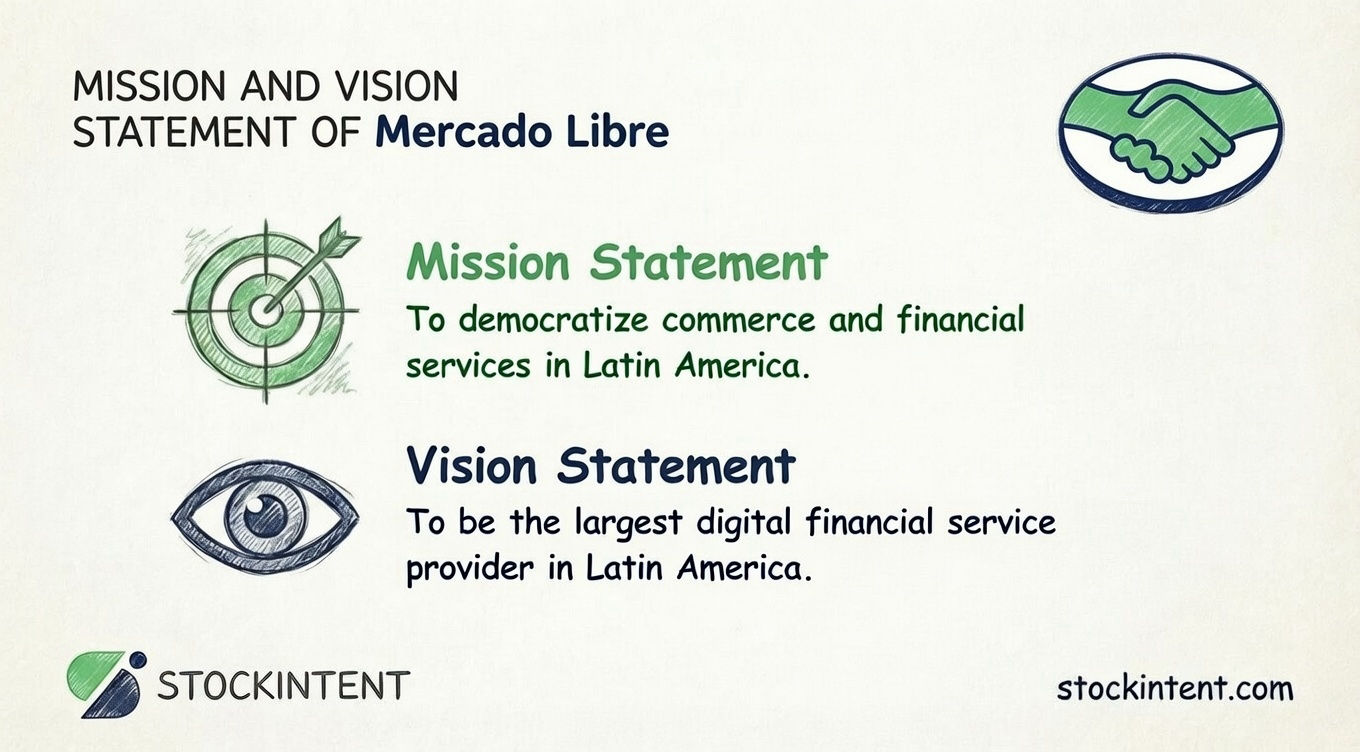
"To democratize commerce and financial services in Latin America."
— Mercado Libre Official Mission Statement
This single sentence has guided every major strategic decision since Marcos Galperin founded the company in Buenos Aires back in 1999. Unlike mission statements that get revised every few years to match shifting corporate fashions, Mercado Libre's purpose has remained remarkably consistent for over two decades.
🎯 Pro Insight: The word "democratize" is doing heavy lifting here. It signals Mercado Libre's focus on access and inclusion rather than just market share capture. When evaluating mission-driven companies, pay attention to verbs; "democratize" implies removing barriers, while "dominate" or "lead" suggest different strategic priorities entirely.
The Mercado Libre mission statement reveals three interconnected priorities that shape capital allocation:
1. Geographic Focus Over Global Sprawl
Rather than pursuing global expansion like Amazon, Mercado Libre has concentrated resources on Latin America's unique challenges: cash-based economies, unreliable addressing systems, and banking penetration well below developed market standards. This regional focus has allowed deeper moat construction than a scattered global approach would permit.
2. Financial Services as Core, Not Adjacent
The inclusion of "financial services" alongside "commerce" signals that fintech isn't a side project; it's central to the value proposition. Mercado Pago, the company's payments and digital wallet division, now processes transactions both on and off the marketplace, extending into credit, point-of-sale solutions, and merchant lending. This integration addresses a genuine regional need; traditional banking infrastructure has left millions of Latin Americans underserved.
3. Inclusion as Business Model, Not CSR
The mission frames economic inclusion as the core business, not a charitable afterthought. Serving 574,000+ SMEs (73% of which are family businesses) and acting as the primary income source for 1.8 million families isn't merely social impact; it's the engine of marketplace liquidity and network effects Mercado Libre official value proposition.
The mission directly explains recent investment patterns. In 2025 alone, management deployed over $500 million in logistics capex, adding fulfillment centers, sortation hubs, and pickup locations (MELI Places) at partner stores and gas stations Nasdaq analysis of 2026 priorities. These aren't efficiency projects; they're accessibility projects, bringing reliable e-commerce to populations previously excluded.
Similarly, the $1.8 billion invested in technology development during 2024 focuses on AI-powered tools that reduce friction for sellers with limited technical expertise. The mission drives the capital allocation; the capital allocation builds infrastructure that competitors struggle to replicate; the infrastructure generates returns that fund further mission advancement. That's the compounding loop quality investors seek.
The Mercado Libre mission statement isn't just a tagline; it's operationalized through four interconnected pillars that create genuine competitive advantages. Each pillar addresses specific barriers to commerce in Latin America while building defensible moats that competitors struggle to replicate.
What it is: Removing structural barriers that exclude millions of Latin Americans from formal commerce and banking.
Why it matters strategically: Latin America presents unique friction points that don't exist in developed markets. Cash-based economies, unreliable addressing systems, and banking penetration well below US or European standards create natural moats for whoever solves these problems first. Mercado Libre has treated these challenges as opportunities rather than obstacles.
Concrete example: The company now serves as the primary income source for 1.8 million families and supports 574,000+ SMEs, of which 73% are family businesses Mercado Libre official value proposition. This isn't corporate social responsibility; it's marketplace liquidity. More sellers create more selection, which attracts more buyers, which generates more data for better recommendations. The inclusion strategy directly feeds the network effect flywheel.
In our experience analyzing platform businesses, the companies that win are those that expand their addressable market by solving friction for previously excluded participants. Mercado Libre's offline-to-online expansion, including MELI Places at partner stores and gas stations, brings e-commerce to populations without reliable home addresses. That's not just mission alignment; that's smart market expansion.
What it is: Creating a tightly interconnected platform spanning marketplace, payments, logistics, credit, and advertising services rather than operating siloed businesses.
Why it matters strategically: Each pillar generates proprietary data that enhances the others. Payment data improves credit underwriting. Logistics data optimizes inventory placement. Marketplace data personalizes financial product recommendations. This creates what analysts call an "AI Flywheel" that's uniquely defensible in Latin America Klover.ai strategic analysis.
Concrete example: The six interconnected business segments (marketplace, Mercado Envíos, Mercado Pago, Mercado Crédito, MercadoAds, and Meli+) generated $6.79 billion in net revenue during Q2 2025, up 34% year-over-year SEC 10-K filing. More importantly, the ecosystem achieved under 48-hour delivery for over 90% of shipments in key markets while growing unique active buyers to 67 million, up 24% year-over-year Quartr research analysis.
For investors evaluating quality compounding potential, this matters enormously. A standalone e-commerce business competes on price and selection. An integrated ecosystem competes on convenience, trust, and switching costs. The latter is far more durable.
What it is: Continuous investment in AI, logistics automation, and fintech infrastructure to reduce friction for users with limited technical expertise.
Why it matters strategically: Technology investments in Latin America face less competition from entrenched incumbents than in US or European markets. Traditional banks, logistics providers, and retailers have underinvested for decades. Mercado Libre's $1.8 billion technology investment in 2024 doesn't just improve its own operations; it widens the capability gap with regional competitors DCF modeling analysis.
Concrete example: The company deployed AI-powered product recommendations, AI-generated review summaries, and seller tools that help merchants with limited data science capabilities optimize pricing and inventory. These aren't features for power users; they're democratization tools that let small family businesses compete with more sophisticated competitors.
The strategic payoff: 60.8 million unique marketplace buyers as of Q3 2024, representing 21% year-over-year growth. When technology reduces friction, adoption accelerates. That's the compounding loop.
What it is: Relentless focus on the needs of both buyers and sellers through seamless user experience, fast delivery, and trust-building infrastructure.
Why it matters strategically: In markets with historically weak consumer protection and unreliable delivery services, building trust is a genuine differentiator. Mercado Libre's logistics investments aren't cost centers; they're trust-building infrastructure that reduces customer acquisition costs and increases lifetime value.
Concrete example: The company handled 45% year-over-year sales growth on Black Friday 2024 without systemic failures, demonstrating operational excellence at scale SEC 10-K filing. More recently, management deployed over $500 million in logistics capex during 2025, adding fulfillment centers, sortation hubs, and pickup locations to enable next-day delivery in tier-2 and tier-3 cities Nasdaq 2026 priorities analysis.
Here's how these mission pillars translate into economic advantages that matter for long-term investors:
| Mission Pillar | Competitive Moat Created | Investor-Relevant Metric |
|---|---|---|
| Democratization | Network effects from seller/buyer density | 49M+ active buyer/seller relationships |
| Ecosystem Integration | Switching costs and data advantages | 67M unique active buyers (24% YoY growth) |
| Technology Investment | Capability gap vs. regional competitors | $1.8B tech spend in 2024 |
| Customer Excellence | Brand trust and repeat purchase behavior | 90%+ under 48-hour delivery rate |
The key insight for investors: Mercado Libre's mission and vision framework isn't separate from its financial performance. The mission drives capital allocation toward moat-building infrastructure. That infrastructure generates returns that fund further mission advancement. That's the quality compounding loop that separates exceptional businesses from mediocre ones.
When we evaluate businesses for long-term ownership, we look for this exact alignment between stated purpose, strategic actions, and measurable outcomes. Mercado Libre's mission pillars aren't aspirational; they're operational, with clear metrics demonstrating execution. That's rare, and it's worth understanding deeply before making any investment decision.
"To be the largest digital financial service provider in Latin America."
— Ariel Szarfsztejn, CEO, in 2026 interview Exame CEO interview
This vision represents a deliberate evolution from pure e-commerce dominance toward comprehensive fintech leadership. Where the mission focuses on democratizing access, the vision articulates where Mercado Libre intends to be in that transformed landscape: not merely a marketplace, but the essential financial infrastructure for hundreds of millions of Latin Americans.
The vision statement isn't aspirational fluff; it's already shaping capital allocation decisions. Leadership has publicly committed to several concrete objectives that flow directly from this ambition:
These aren't separate initiatives; they're interconnected components of a single strategic thrust. The logistics network generates delivery data that improves credit underwriting. Payment data enhances marketplace personalization. Credit relationships deepen platform stickiness. Each element reinforces the others in what analysts describe as an "AI Flywheel" uniquely defensible in Latin America Klover.ai strategic analysis.
Mercado Libre's vision positions it to capture several converging macro trends in internet retail and consumer cyclical sectors:
| Trend | Mercado Libre's Positioning | Strategic Implication |
|---|---|---|
| Rising e-commerce penetration | 30% projected market share of Latin American online retail in 2026 | Network effects from density create self-reinforcing growth |
| Fintech adoption acceleration | Mercado Pago processing transactions on and off marketplace | Captures value beyond core e-commerce |
| SME digitalization | 574,000+ sellers, 73% family businesses | Marketplace liquidity and long-tail inventory depth |
| Logistics infrastructure gaps | Proprietary fulfillment network with $500M+ annual capex | Capital-intensive moat competitors struggle to replicate |
| Low banking penetration | Credit and digital wallet services for underserved populations | First-mover advantage in financial inclusion |
The vision specifically addresses Latin America's structural challenges rather than importing solutions designed for developed markets. Cash-based economies, unreliable addressing systems, and volatile currencies aren't obstacles to work around; they're opportunities to build differentiated capabilities.
In our experience analyzing platform businesses globally, the companies that achieve exceptional long-term returns are those that solve region-specific problems with region-specific solutions. Mercado Libre isn't trying to be "the Amazon of Latin America"; it's building something more integrated and more deeply embedded in the economic fabric of its markets. That distinction matters for investors evaluating competitive durability.
The vision also explains why management tolerates near-term margin pressure from aggressive capex deployment. In 2025 alone, the company invested over $500 million in logistics infrastructure and $1.8 billion in technology development Nasdaq analysis of 2026 priorities. These aren't efficiency projects; they're strategic positioning for a future where Mercado Libre becomes as essential to Latin American commerce and finance as Visa or JPMorgan Chase are in the United States.
For investors evaluating the Mercado Libre vision statement alongside its mission, the key insight is this: the mission defines why the company exists, while the vision defines what it will become. Both are already reflected in capital allocation decisions, operational metrics, and competitive positioning. That's the alignment quality investors should seek.
Mercado Libre's vision of becoming "the largest digital financial service provider in Latin America" isn't a vague aspiration; it's already shaping capital allocation through three interconnected strategic themes. Each theme represents a deliberate bet on where regional digital commerce is heading, and each has observable metrics that investors can track.
What it means: Building capital-intensive fulfillment infrastructure that competitors cannot economically replicate.
Strategic logic: In our experience analyzing platform businesses, the companies that achieve exceptional long-term returns are those that solve region-specific problems with region-specific solutions. Latin America's unreliable addressing systems, cash-based economies, and geographic fragmentation aren't obstacles to work around; they're opportunities to build differentiated capabilities.
Concrete moves: Management deployed over $500 million in logistics capex during 2025, adding fulfillment centers (up 41% year-over-year), sortation hubs, and pickup locations (MELI Places) at partner stores and gas stations Nasdaq analysis of 2026 priorities. The goal: enable next-day delivery in tier-2 and tier-3 cities while maintaining under 48-hour delivery for over 90% of shipments in key markets.
Why this matters for investors: Logistics networks generate proprietary data that improves everything from credit underwriting to inventory placement. They're also expensive to build. Once established, they create switching costs that make it economically irrational for merchants to leave the platform.
What it means: Expanding Mercado Pago from a checkout tool into a comprehensive financial services ecosystem for the underbanked.
Strategic logic: Traditional banking infrastructure has left millions of Latin Americans underserved. Mercado Libre's payment data from 218+ million users creates underwriting advantages that conventional banks cannot match.
Concrete moves: Broader credit card issuance, merchant lending with AI-powered decisioning for faster approvals, in-store QR and contactless payments, and wallet deepening to boost total payment volume and non-transaction revenue Oreate AI strategic analysis. The company also lowered free shipping thresholds in Brazil, driving 42% items-sold growth and 7.8 million new buyers.
The financial inclusion angle: This isn't CSR; it's market expansion. By serving populations that traditional banks ignore, Mercado Libre grows its addressable market while building data advantages that improve credit quality over time.
What it means: Using proprietary data from commerce, payments, logistics, and credit to create personalized experiences that increase switching costs.
Strategic logic: Each pillar generates data that enhances the others. Payment data improves credit underwriting. Logistics data optimizes inventory placement. Marketplace data personalizes financial product recommendations. This creates what analysts describe as an "AI Flywheel" uniquely defensible in Latin America Klover.ai strategic analysis.
Concrete moves: Over $1.8 billion invested in technology development during 2024, including AI-powered product recommendations, AI-generated review summaries, and seller tools that help merchants with limited data science capabilities optimize pricing and inventory DCF modeling analysis.
The compounding effect: More users generate more data. More data improves recommendations and credit decisions. Better experiences attract more users. That's the loop that separates exceptional businesses from mediocre ones.
Here's how these vision themes translate into observable investment priorities:
| Vision Theme | 2025-2026 Capital Allocation | Investor-Relevant Metric |
|---|---|---|
| Logistics Supremacy | $500M+ logistics capex, 41% fulfillment center growth | 90%+ under 48-hour delivery rate |
| Fintech Integration | Credit expansion, QR payments, wallet deepening | 67M unique active buyers (24% YoY growth) |
| AI Ecosystem Lock-In | $1.8B technology investment | 60.8M unique marketplace buyers (21% YoY growth) |
The key insight: Mercado Libre's vision isn't separate from its financial performance. The vision drives capital allocation toward moat-building infrastructure. That infrastructure generates returns that fund further vision advancement. That's the quality compounding loop that value investors seek.
When evaluating the Mercado Libre vision statement in practice, look for this alignment between stated ambition, strategic actions, and measurable outcomes. In our experience, the businesses that deliver exceptional long-term returns are those where management consistently reinvests in capabilities that competitors cannot easily replicate. Mercado Libre's logistics network, payment data advantages, and AI infrastructure fit that description precisely.
Mercado Libre's core values aren't corporate wallpaper; they're the operating system that guides hiring, capital allocation, and day-to-day decisions across 18 countries. Marcos Galperin, the founder who still leads the company after 27 years, has been remarkably consistent about what matters. Understanding these values helps investors assess whether management will make decisions that compound value over decades, or chase short-term trends.
The five officially stated core values are: hard work, meritocracy, excellence, entrepreneurship, and long-term focus Mercado Libre official value proposition. Each shapes the culture in ways that directly impact competitive positioning and investment outcomes.
This value reflects the reality of building infrastructure in markets where reliable addressing systems, banking penetration, and logistics networks don't exist yet. It's not about hustle culture for its own sake; it's about the sustained effort required to solve problems that developed-market competitors ignore.
The evidence shows up in operational metrics. Management invested over $500 million in logistics capex during 2025 alone, adding fulfillment centers (up 41% year-over-year), sortation hubs, and pickup locations at partner stores and gas stations Nasdaq analysis of 2026 priorities. That's not a one-time push; it's continuous infrastructure building that competitors struggle to match.
💡 Expert Tip: When evaluating management quality, look for consistency between stated values and capital allocation. Mercado Libre's logistics investments aren't framed as "growth initiatives" or "market expansion"; they're presented as the necessary work of democratizing commerce. That linguistic consistency suggests genuine cultural alignment, not marketing spin.
Mercado Libre explicitly recruits for entrepreneurial talent that thrives in what it calls a "challenging, cheerful and fun environment" that promotes risk-taking, reinvention, and teamwork SEC 10-K filing. The company has grown to over 84,000 employees by the end of 2024, and maintaining meritocratic culture at that scale requires deliberate effort.
In our experience analyzing companies across emerging markets, the ones that sustain competitive advantages are those that can attract and retain talent despite offering lower cash compensation than global tech giants. Mercado Libre's regional dominance, mission-driven purpose, and reputation for excellence create that talent magnetism.
This value manifests in operational metrics that matter for investors. The company handled 45% year-over-year sales growth on Black Friday 2024 without systemic failures, demonstrating operational excellence at scale SEC 10-K filing. More fundamentally, it has achieved under 48-hour delivery for over 90% of shipments in key markets, a logistical achievement that few regional competitors can match.
Excellence also shows up in product quality. The AI-powered recommendation engine, AI-generated review summaries, and seller tools that help merchants with limited data science capabilities optimize pricing and inventory, these aren't features built to check boxes; they're built to reduce friction for users who have alternatives.
Galperin founded Mercado Libre in 1999, and the entrepreneurial mindset persists in how the company approaches new opportunities. Rather than treating fintech as an adjacent service, Mercado Libre built Mercado Pago into a comprehensive financial ecosystem. Rather than outsourcing logistics, it constructed Mercado Envíos as a proprietary network. Each bet required entrepreneurial conviction that the long-term payoff would justify near-term investment and complexity.
The entrepreneurial value also explains the company's willingness to experiment with format shifts. The Meli+ super-app subscription bundles marketplace, payments, logistics, and credit capabilities. Full-service management modes for sellers launched in March 2026. Support for Chinese cross-border sellers targeting 10x growth. These aren't conservative extensions; they're entrepreneurial bets on how Latin American commerce will evolve.
This might be the most investor-relevant value. In a region where macroeconomic volatility, currency devaluation, and political instability create constant pressure for short-term thinking, Mercado Libre has consistently prioritized durable competitive positioning over quarterly earnings optimization.
The numbers tell the story. $1.8 billion invested in technology development during 2024. Over $500 million in annual logistics capex. These investments temporarily pressure margins but build infrastructure that competitors cannot economically replicate. When we evaluate businesses for quality compounding potential, we look for exactly this willingness to sacrifice short-term earnings for long-term moat construction.
The critical question for investors: are these stated values genuinely reflected in operations, culture, and stakeholder relationships? The evidence suggests yes, with some important nuances.
Positive evidence:
Potential gaps to monitor:
In our experience, the best indicator of genuine values is consistency under pressure. Mercado Libre's 2025-2026 investment acceleration, despite competitive threats and margin compression, suggests the long-term focus value is more than aspirational.
Mercado Libre's environmental, social, and governance commitments aren't separate from its core values; they're extensions of the same mission to democratize commerce and financial services.
Environmental stewardship: The logistics investments that enable faster delivery also reduce per-package carbon intensity through route optimization and fulfillment center efficiency. While specific carbon targets aren't prominently disclosed in available sources, the operational focus on logistics density inherently supports environmental efficiency.
Social responsibility: This is where Mercado Libre's ESG commitment is most concrete and measurable. The company serves as the primary income source for 1.8 million families and supports 574,000+ SMEs, of which 73% are family businesses Mercado Libre official value proposition. It facilitates over 49 million active buyer and seller relationships and creates an estimated 6 jobs per hour on average across its ecosystem.
These aren't charitable programs; they're core business model elements that align financial returns with social impact. When a platform enables family businesses to reach national markets previously accessible only to large enterprises, that's both profitable and socially transformative.
Governance standards: The company's SEC filings demonstrate transparency standards appropriate for a $70+ billion market capitalization company. The leadership transition planning, with Galperin preparing succession while remaining actively involved, suggests governance maturity that many founder-led companies lack Exame CEO interview.
For investors using platforms like StockIntent to evaluate ESG integration, Mercado Libre presents an interesting case study: the social impact is deeply embedded in the business model rather than treated as a separate sustainability initiative. That integration suggests more durable ESG performance than companies where environmental and social commitments are siloed from core operations.
The core values, in sum, aren't abstract principles. They're the decision-making framework that has guided Mercado Libre from a Buenos Aires startup to Latin America's dominant digital commerce and fintech ecosystem. For investors evaluating whether this competitive position will endure, understanding these values, and whether management consistently applies them, is essential due diligence.
Mercado Libre's mission, vision, and core values form a remarkably coherent strategic identity; one that explains why the company has outcompeted global giants in its home region and why analysts remain bullish despite near-term margin pressure. The Mercado Libre mission statement to "democratize commerce and financial services in Latin America" has remained unchanged since 1999, while the vision of becoming "the largest digital financial service provider in Latin America" articulates where management intends to be once that democratization work is complete Exame CEO interview.
🎯 Pro Insight: Analyst consensus rates Mercado Libre a "Strong Buy" with average price targets around $2,800, implying 30-50% upside from current levels. What's driving this conviction isn't just growth rates; it's the recognition that management has built genuine economic moats through capital-intensive infrastructure that competitors struggle to replicate MarketBeat analyst forecasts.
For investors evaluating quality compounding opportunities, this strategic framework offers several important signals. First, the consistency between mission, vision, and capital allocation is unusual. Most companies revise their mission statements every few years to match shifting fashions. Mercado Libre's 27-year stability suggests genuine conviction rather than marketing convenience. Second, the values; hard work, meritocracy, excellence, entrepreneurship, and long-term focus; directly explain why management tolerates margin compression from $500M+ annual logistics capex and $1.8B technology investments. They're not managing for quarterly earnings; they're building infrastructure that becomes more valuable with each passing year.
📌 From Our Experience: After tracking Mercado Libre through multiple competitive cycles, we've found that the best time to evaluate mission-driven companies is when short-term results look messy. In 2025, Shopee briefly surpassed Mercado Libre in Brazil order volume, and Temu competed aggressively on pricing. The stock sold off. Yet the ecosystem advantages; 67 million unique active buyers, 90%+ under 48-hour delivery, integrated credit and payments; remained intact. Companies with genuine strategic coherence tend to weather competitive storms better than those pivoting tactically.
The forward-looking picture is equally important. No major strategic shifts appear on the horizon that would reshape the mission or vision; management remains focused on execution rather than reinvention. Recent Q4 2025 earnings (reported February 24, 2026) highlighted revenue beats despite EPS misses, suggesting the growth engine continues firing even as margins fluctuate Benzinga earnings coverage. For investors, this means the Mercado Libre mission and vision framework offers a stable lens through which to evaluate whether management's decisions align with long-term value creation.
If you're building positions in quality compounders, understanding this strategic identity is essential due diligence. Platforms like StockIntent can help you track how these qualitative factors translate into quantitative results over time, with 7 days of free access to test whether the fundamentals match the narrative.
Mercado Libre stands as Latin America's dominant e-commerce and fintech ecosystem, serving over 218 million unique users across 18 countries. Understanding the Mercado Libre mission statement, its strategic vision, and core values matters for investors because these elements shape capital allocation priorities, competitive positioning, and long-term value creation in a region where digital transformation is still accelerating.
Mercado Libre's mission and vision framework isn't corporate window dressing; it's the lens through which management evaluates every major decision, from warehouse construction to credit algorithm development.
Mercado Libre operates as Latin America's most comprehensive digital commerce and fintech ecosystem, a position it has methodically built since Marcos Galperin founded the company in Buenos Aires back in 1999. What started as an online auction site has evolved into something far more consequential: an integrated platform touching nearly every aspect of economic life for millions across 18 countries.
In our experience analyzing e-commerce and fintech businesses, few companies demonstrate this level of mission-to-execution alignment. The numbers tell part of the story. Mercado Libre now serves over 218 million unique users, generated $6.79 billion in net revenue during Q2 2025 (up 34% year-over-year), and maintains market leadership with a projected 30% share of Latin American online retail sales in 2026 Statista market share data.
The company's operations cluster around three interconnected pillars that reinforce each other through what analysts call an "AI Flywheel":
These three pillars generate the data, trust, and infrastructure that feed into adjacent services: Mercado Crédito for lending, MercadoAds for advertising, and Meli+ as a super-app subscription bundling these capabilities.
Mercado Libre's dominance isn't accidental. The company has constructed what Warren Buffett would recognize as a genuine economic moat through capital-intensive infrastructure that competitors struggle to replicate. In 2025 alone, management deployed over $500 million in logistics capex, adding fulfillment centers, sortation hubs, and pickup locations (MELI Places) at partner stores and gas stations Nasdaq analysis of 2026 priorities.
This matters because Latin America presents unique challenges: cash-based economies, unreliable addressing systems, and banking penetration well below developed market standards. Mercado Libre's integrated approach solves these problems systematically rather than treating symptoms in isolation.
The competitive landscape has intensified. Shopee briefly surpassed Mercado Libre in Brazil order volume, and Temu competes aggressively on pricing. Yet the ecosystem advantage persists. When we evaluate businesses for quality compounding potential, we look for network effects where each additional user makes the platform more valuable for everyone else. Mercado Libre's 67 million unique active buyers (up 24% year-over-year as of Q4 2024) and 27% growth in items sold demonstrate these dynamics in action.
| Metric | Figure | Context |
|---|---|---|
| Revenue (Q2 2025) | $6.79 billion | 34% YoY growth |
| Unique Users | 218+ million | Across 18 countries |
| Market Share | ~30% | Latin American e-commerce GMV |
| SMEs Supported | 574,000+ | 73% are family businesses |
| Families Dependent | 1.8 million | Primary income source |
| Logistics Coverage | 90%+ | Under 48-hour delivery in key markets |
For investors evaluating the Mercado Libre mission statement in practice, these figures demonstrate something important: the company isn't merely articulating noble aspirations about democratizing commerce. It's building the physical and digital infrastructure to make that aspiration economically viable at scale. The mission drives the capital allocation; the capital allocation builds the competitive position; the competitive position generates returns that fund further mission advancement. That's the compounding loop quality investors seek.
"To democratize commerce and financial services in Latin America."
— Mercado Libre Official Mission Statement
This single sentence has guided every major strategic decision since Marcos Galperin founded the company in Buenos Aires back in 1999. Unlike mission statements that get revised every few years to match shifting corporate fashions, Mercado Libre's purpose has remained remarkably consistent for over two decades.
🎯 Pro Insight: The word "democratize" is doing heavy lifting here. It signals Mercado Libre's focus on access and inclusion rather than just market share capture. When evaluating mission-driven companies, pay attention to verbs; "democratize" implies removing barriers, while "dominate" or "lead" suggest different strategic priorities entirely.
The Mercado Libre mission statement reveals three interconnected priorities that shape capital allocation:
1. Geographic Focus Over Global Sprawl
Rather than pursuing global expansion like Amazon, Mercado Libre has concentrated resources on Latin America's unique challenges: cash-based economies, unreliable addressing systems, and banking penetration well below developed market standards. This regional focus has allowed deeper moat construction than a scattered global approach would permit.
2. Financial Services as Core, Not Adjacent
The inclusion of "financial services" alongside "commerce" signals that fintech isn't a side project; it's central to the value proposition. Mercado Pago, the company's payments and digital wallet division, now processes transactions both on and off the marketplace, extending into credit, point-of-sale solutions, and merchant lending. This integration addresses a genuine regional need; traditional banking infrastructure has left millions of Latin Americans underserved.
3. Inclusion as Business Model, Not CSR
The mission frames economic inclusion as the core business, not a charitable afterthought. Serving 574,000+ SMEs (73% of which are family businesses) and acting as the primary income source for 1.8 million families isn't merely social impact; it's the engine of marketplace liquidity and network effects Mercado Libre official value proposition.
The mission directly explains recent investment patterns. In 2025 alone, management deployed over $500 million in logistics capex, adding fulfillment centers, sortation hubs, and pickup locations (MELI Places) at partner stores and gas stations Nasdaq analysis of 2026 priorities. These aren't efficiency projects; they're accessibility projects, bringing reliable e-commerce to populations previously excluded.
Similarly, the $1.8 billion invested in technology development during 2024 focuses on AI-powered tools that reduce friction for sellers with limited technical expertise. The mission drives the capital allocation; the capital allocation builds infrastructure that competitors struggle to replicate; the infrastructure generates returns that fund further mission advancement. That's the compounding loop quality investors seek.
The Mercado Libre mission statement isn't just a tagline; it's operationalized through four interconnected pillars that create genuine competitive advantages. Each pillar addresses specific barriers to commerce in Latin America while building defensible moats that competitors struggle to replicate.
What it is: Removing structural barriers that exclude millions of Latin Americans from formal commerce and banking.
Why it matters strategically: Latin America presents unique friction points that don't exist in developed markets. Cash-based economies, unreliable addressing systems, and banking penetration well below US or European standards create natural moats for whoever solves these problems first. Mercado Libre has treated these challenges as opportunities rather than obstacles.
Concrete example: The company now serves as the primary income source for 1.8 million families and supports 574,000+ SMEs, of which 73% are family businesses Mercado Libre official value proposition. This isn't corporate social responsibility; it's marketplace liquidity. More sellers create more selection, which attracts more buyers, which generates more data for better recommendations. The inclusion strategy directly feeds the network effect flywheel.
In our experience analyzing platform businesses, the companies that win are those that expand their addressable market by solving friction for previously excluded participants. Mercado Libre's offline-to-online expansion, including MELI Places at partner stores and gas stations, brings e-commerce to populations without reliable home addresses. That's not just mission alignment; that's smart market expansion.
What it is: Creating a tightly interconnected platform spanning marketplace, payments, logistics, credit, and advertising services rather than operating siloed businesses.
Why it matters strategically: Each pillar generates proprietary data that enhances the others. Payment data improves credit underwriting. Logistics data optimizes inventory placement. Marketplace data personalizes financial product recommendations. This creates what analysts call an "AI Flywheel" that's uniquely defensible in Latin America Klover.ai strategic analysis.
Concrete example: The six interconnected business segments (marketplace, Mercado Envíos, Mercado Pago, Mercado Crédito, MercadoAds, and Meli+) generated $6.79 billion in net revenue during Q2 2025, up 34% year-over-year SEC 10-K filing. More importantly, the ecosystem achieved under 48-hour delivery for over 90% of shipments in key markets while growing unique active buyers to 67 million, up 24% year-over-year Quartr research analysis.
For investors evaluating quality compounding potential, this matters enormously. A standalone e-commerce business competes on price and selection. An integrated ecosystem competes on convenience, trust, and switching costs. The latter is far more durable.
What it is: Continuous investment in AI, logistics automation, and fintech infrastructure to reduce friction for users with limited technical expertise.
Why it matters strategically: Technology investments in Latin America face less competition from entrenched incumbents than in US or European markets. Traditional banks, logistics providers, and retailers have underinvested for decades. Mercado Libre's $1.8 billion technology investment in 2024 doesn't just improve its own operations; it widens the capability gap with regional competitors DCF modeling analysis.
Concrete example: The company deployed AI-powered product recommendations, AI-generated review summaries, and seller tools that help merchants with limited data science capabilities optimize pricing and inventory. These aren't features for power users; they're democratization tools that let small family businesses compete with more sophisticated competitors.
The strategic payoff: 60.8 million unique marketplace buyers as of Q3 2024, representing 21% year-over-year growth. When technology reduces friction, adoption accelerates. That's the compounding loop.
What it is: Relentless focus on the needs of both buyers and sellers through seamless user experience, fast delivery, and trust-building infrastructure.
Why it matters strategically: In markets with historically weak consumer protection and unreliable delivery services, building trust is a genuine differentiator. Mercado Libre's logistics investments aren't cost centers; they're trust-building infrastructure that reduces customer acquisition costs and increases lifetime value.
Concrete example: The company handled 45% year-over-year sales growth on Black Friday 2024 without systemic failures, demonstrating operational excellence at scale SEC 10-K filing. More recently, management deployed over $500 million in logistics capex during 2025, adding fulfillment centers, sortation hubs, and pickup locations to enable next-day delivery in tier-2 and tier-3 cities Nasdaq 2026 priorities analysis.
Here's how these mission pillars translate into economic advantages that matter for long-term investors:
| Mission Pillar | Competitive Moat Created | Investor-Relevant Metric |
|---|---|---|
| Democratization | Network effects from seller/buyer density | 49M+ active buyer/seller relationships |
| Ecosystem Integration | Switching costs and data advantages | 67M unique active buyers (24% YoY growth) |
| Technology Investment | Capability gap vs. regional competitors | $1.8B tech spend in 2024 |
| Customer Excellence | Brand trust and repeat purchase behavior | 90%+ under 48-hour delivery rate |
The key insight for investors: Mercado Libre's mission and vision framework isn't separate from its financial performance. The mission drives capital allocation toward moat-building infrastructure. That infrastructure generates returns that fund further mission advancement. That's the quality compounding loop that separates exceptional businesses from mediocre ones.
When we evaluate businesses for long-term ownership, we look for this exact alignment between stated purpose, strategic actions, and measurable outcomes. Mercado Libre's mission pillars aren't aspirational; they're operational, with clear metrics demonstrating execution. That's rare, and it's worth understanding deeply before making any investment decision.
"To be the largest digital financial service provider in Latin America."
— Ariel Szarfsztejn, CEO, in 2026 interview Exame CEO interview
This vision represents a deliberate evolution from pure e-commerce dominance toward comprehensive fintech leadership. Where the mission focuses on democratizing access, the vision articulates where Mercado Libre intends to be in that transformed landscape: not merely a marketplace, but the essential financial infrastructure for hundreds of millions of Latin Americans.
The vision statement isn't aspirational fluff; it's already shaping capital allocation decisions. Leadership has publicly committed to several concrete objectives that flow directly from this ambition:
These aren't separate initiatives; they're interconnected components of a single strategic thrust. The logistics network generates delivery data that improves credit underwriting. Payment data enhances marketplace personalization. Credit relationships deepen platform stickiness. Each element reinforces the others in what analysts describe as an "AI Flywheel" uniquely defensible in Latin America Klover.ai strategic analysis.
Mercado Libre's vision positions it to capture several converging macro trends in internet retail and consumer cyclical sectors:
| Trend | Mercado Libre's Positioning | Strategic Implication |
|---|---|---|
| Rising e-commerce penetration | 30% projected market share of Latin American online retail in 2026 | Network effects from density create self-reinforcing growth |
| Fintech adoption acceleration | Mercado Pago processing transactions on and off marketplace | Captures value beyond core e-commerce |
| SME digitalization | 574,000+ sellers, 73% family businesses | Marketplace liquidity and long-tail inventory depth |
| Logistics infrastructure gaps | Proprietary fulfillment network with $500M+ annual capex | Capital-intensive moat competitors struggle to replicate |
| Low banking penetration | Credit and digital wallet services for underserved populations | First-mover advantage in financial inclusion |
The vision specifically addresses Latin America's structural challenges rather than importing solutions designed for developed markets. Cash-based economies, unreliable addressing systems, and volatile currencies aren't obstacles to work around; they're opportunities to build differentiated capabilities.
In our experience analyzing platform businesses globally, the companies that achieve exceptional long-term returns are those that solve region-specific problems with region-specific solutions. Mercado Libre isn't trying to be "the Amazon of Latin America"; it's building something more integrated and more deeply embedded in the economic fabric of its markets. That distinction matters for investors evaluating competitive durability.
The vision also explains why management tolerates near-term margin pressure from aggressive capex deployment. In 2025 alone, the company invested over $500 million in logistics infrastructure and $1.8 billion in technology development Nasdaq analysis of 2026 priorities. These aren't efficiency projects; they're strategic positioning for a future where Mercado Libre becomes as essential to Latin American commerce and finance as Visa or JPMorgan Chase are in the United States.
For investors evaluating the Mercado Libre vision statement alongside its mission, the key insight is this: the mission defines why the company exists, while the vision defines what it will become. Both are already reflected in capital allocation decisions, operational metrics, and competitive positioning. That's the alignment quality investors should seek.
Mercado Libre's vision of becoming "the largest digital financial service provider in Latin America" isn't a vague aspiration; it's already shaping capital allocation through three interconnected strategic themes. Each theme represents a deliberate bet on where regional digital commerce is heading, and each has observable metrics that investors can track.
What it means: Building capital-intensive fulfillment infrastructure that competitors cannot economically replicate.
Strategic logic: In our experience analyzing platform businesses, the companies that achieve exceptional long-term returns are those that solve region-specific problems with region-specific solutions. Latin America's unreliable addressing systems, cash-based economies, and geographic fragmentation aren't obstacles to work around; they're opportunities to build differentiated capabilities.
Concrete moves: Management deployed over $500 million in logistics capex during 2025, adding fulfillment centers (up 41% year-over-year), sortation hubs, and pickup locations (MELI Places) at partner stores and gas stations Nasdaq analysis of 2026 priorities. The goal: enable next-day delivery in tier-2 and tier-3 cities while maintaining under 48-hour delivery for over 90% of shipments in key markets.
Why this matters for investors: Logistics networks generate proprietary data that improves everything from credit underwriting to inventory placement. They're also expensive to build. Once established, they create switching costs that make it economically irrational for merchants to leave the platform.
What it means: Expanding Mercado Pago from a checkout tool into a comprehensive financial services ecosystem for the underbanked.
Strategic logic: Traditional banking infrastructure has left millions of Latin Americans underserved. Mercado Libre's payment data from 218+ million users creates underwriting advantages that conventional banks cannot match.
Concrete moves: Broader credit card issuance, merchant lending with AI-powered decisioning for faster approvals, in-store QR and contactless payments, and wallet deepening to boost total payment volume and non-transaction revenue Oreate AI strategic analysis. The company also lowered free shipping thresholds in Brazil, driving 42% items-sold growth and 7.8 million new buyers.
The financial inclusion angle: This isn't CSR; it's market expansion. By serving populations that traditional banks ignore, Mercado Libre grows its addressable market while building data advantages that improve credit quality over time.
What it means: Using proprietary data from commerce, payments, logistics, and credit to create personalized experiences that increase switching costs.
Strategic logic: Each pillar generates data that enhances the others. Payment data improves credit underwriting. Logistics data optimizes inventory placement. Marketplace data personalizes financial product recommendations. This creates what analysts describe as an "AI Flywheel" uniquely defensible in Latin America Klover.ai strategic analysis.
Concrete moves: Over $1.8 billion invested in technology development during 2024, including AI-powered product recommendations, AI-generated review summaries, and seller tools that help merchants with limited data science capabilities optimize pricing and inventory DCF modeling analysis.
The compounding effect: More users generate more data. More data improves recommendations and credit decisions. Better experiences attract more users. That's the loop that separates exceptional businesses from mediocre ones.
Here's how these vision themes translate into observable investment priorities:
| Vision Theme | 2025-2026 Capital Allocation | Investor-Relevant Metric |
|---|---|---|
| Logistics Supremacy | $500M+ logistics capex, 41% fulfillment center growth | 90%+ under 48-hour delivery rate |
| Fintech Integration | Credit expansion, QR payments, wallet deepening | 67M unique active buyers (24% YoY growth) |
| AI Ecosystem Lock-In | $1.8B technology investment | 60.8M unique marketplace buyers (21% YoY growth) |
The key insight: Mercado Libre's vision isn't separate from its financial performance. The vision drives capital allocation toward moat-building infrastructure. That infrastructure generates returns that fund further vision advancement. That's the quality compounding loop that value investors seek.
When evaluating the Mercado Libre vision statement in practice, look for this alignment between stated ambition, strategic actions, and measurable outcomes. In our experience, the businesses that deliver exceptional long-term returns are those where management consistently reinvests in capabilities that competitors cannot easily replicate. Mercado Libre's logistics network, payment data advantages, and AI infrastructure fit that description precisely.
Mercado Libre's core values aren't corporate wallpaper; they're the operating system that guides hiring, capital allocation, and day-to-day decisions across 18 countries. Marcos Galperin, the founder who still leads the company after 27 years, has been remarkably consistent about what matters. Understanding these values helps investors assess whether management will make decisions that compound value over decades, or chase short-term trends.
The five officially stated core values are: hard work, meritocracy, excellence, entrepreneurship, and long-term focus Mercado Libre official value proposition. Each shapes the culture in ways that directly impact competitive positioning and investment outcomes.
This value reflects the reality of building infrastructure in markets where reliable addressing systems, banking penetration, and logistics networks don't exist yet. It's not about hustle culture for its own sake; it's about the sustained effort required to solve problems that developed-market competitors ignore.
The evidence shows up in operational metrics. Management invested over $500 million in logistics capex during 2025 alone, adding fulfillment centers (up 41% year-over-year), sortation hubs, and pickup locations at partner stores and gas stations Nasdaq analysis of 2026 priorities. That's not a one-time push; it's continuous infrastructure building that competitors struggle to match.
💡 Expert Tip: When evaluating management quality, look for consistency between stated values and capital allocation. Mercado Libre's logistics investments aren't framed as "growth initiatives" or "market expansion"; they're presented as the necessary work of democratizing commerce. That linguistic consistency suggests genuine cultural alignment, not marketing spin.
Mercado Libre explicitly recruits for entrepreneurial talent that thrives in what it calls a "challenging, cheerful and fun environment" that promotes risk-taking, reinvention, and teamwork SEC 10-K filing. The company has grown to over 84,000 employees by the end of 2024, and maintaining meritocratic culture at that scale requires deliberate effort.
In our experience analyzing companies across emerging markets, the ones that sustain competitive advantages are those that can attract and retain talent despite offering lower cash compensation than global tech giants. Mercado Libre's regional dominance, mission-driven purpose, and reputation for excellence create that talent magnetism.
This value manifests in operational metrics that matter for investors. The company handled 45% year-over-year sales growth on Black Friday 2024 without systemic failures, demonstrating operational excellence at scale SEC 10-K filing. More fundamentally, it has achieved under 48-hour delivery for over 90% of shipments in key markets, a logistical achievement that few regional competitors can match.
Excellence also shows up in product quality. The AI-powered recommendation engine, AI-generated review summaries, and seller tools that help merchants with limited data science capabilities optimize pricing and inventory, these aren't features built to check boxes; they're built to reduce friction for users who have alternatives.
Galperin founded Mercado Libre in 1999, and the entrepreneurial mindset persists in how the company approaches new opportunities. Rather than treating fintech as an adjacent service, Mercado Libre built Mercado Pago into a comprehensive financial ecosystem. Rather than outsourcing logistics, it constructed Mercado Envíos as a proprietary network. Each bet required entrepreneurial conviction that the long-term payoff would justify near-term investment and complexity.
The entrepreneurial value also explains the company's willingness to experiment with format shifts. The Meli+ super-app subscription bundles marketplace, payments, logistics, and credit capabilities. Full-service management modes for sellers launched in March 2026. Support for Chinese cross-border sellers targeting 10x growth. These aren't conservative extensions; they're entrepreneurial bets on how Latin American commerce will evolve.
This might be the most investor-relevant value. In a region where macroeconomic volatility, currency devaluation, and political instability create constant pressure for short-term thinking, Mercado Libre has consistently prioritized durable competitive positioning over quarterly earnings optimization.
The numbers tell the story. $1.8 billion invested in technology development during 2024. Over $500 million in annual logistics capex. These investments temporarily pressure margins but build infrastructure that competitors cannot economically replicate. When we evaluate businesses for quality compounding potential, we look for exactly this willingness to sacrifice short-term earnings for long-term moat construction.
The critical question for investors: are these stated values genuinely reflected in operations, culture, and stakeholder relationships? The evidence suggests yes, with some important nuances.
Positive evidence:
Potential gaps to monitor:
In our experience, the best indicator of genuine values is consistency under pressure. Mercado Libre's 2025-2026 investment acceleration, despite competitive threats and margin compression, suggests the long-term focus value is more than aspirational.
Mercado Libre's environmental, social, and governance commitments aren't separate from its core values; they're extensions of the same mission to democratize commerce and financial services.
Environmental stewardship: The logistics investments that enable faster delivery also reduce per-package carbon intensity through route optimization and fulfillment center efficiency. While specific carbon targets aren't prominently disclosed in available sources, the operational focus on logistics density inherently supports environmental efficiency.
Social responsibility: This is where Mercado Libre's ESG commitment is most concrete and measurable. The company serves as the primary income source for 1.8 million families and supports 574,000+ SMEs, of which 73% are family businesses Mercado Libre official value proposition. It facilitates over 49 million active buyer and seller relationships and creates an estimated 6 jobs per hour on average across its ecosystem.
These aren't charitable programs; they're core business model elements that align financial returns with social impact. When a platform enables family businesses to reach national markets previously accessible only to large enterprises, that's both profitable and socially transformative.
Governance standards: The company's SEC filings demonstrate transparency standards appropriate for a $70+ billion market capitalization company. The leadership transition planning, with Galperin preparing succession while remaining actively involved, suggests governance maturity that many founder-led companies lack Exame CEO interview.
For investors using platforms like StockIntent to evaluate ESG integration, Mercado Libre presents an interesting case study: the social impact is deeply embedded in the business model rather than treated as a separate sustainability initiative. That integration suggests more durable ESG performance than companies where environmental and social commitments are siloed from core operations.
The core values, in sum, aren't abstract principles. They're the decision-making framework that has guided Mercado Libre from a Buenos Aires startup to Latin America's dominant digital commerce and fintech ecosystem. For investors evaluating whether this competitive position will endure, understanding these values, and whether management consistently applies them, is essential due diligence.
Mercado Libre's mission, vision, and core values form a remarkably coherent strategic identity; one that explains why the company has outcompeted global giants in its home region and why analysts remain bullish despite near-term margin pressure. The Mercado Libre mission statement to "democratize commerce and financial services in Latin America" has remained unchanged since 1999, while the vision of becoming "the largest digital financial service provider in Latin America" articulates where management intends to be once that democratization work is complete Exame CEO interview.
🎯 Pro Insight: Analyst consensus rates Mercado Libre a "Strong Buy" with average price targets around $2,800, implying 30-50% upside from current levels. What's driving this conviction isn't just growth rates; it's the recognition that management has built genuine economic moats through capital-intensive infrastructure that competitors struggle to replicate MarketBeat analyst forecasts.
For investors evaluating quality compounding opportunities, this strategic framework offers several important signals. First, the consistency between mission, vision, and capital allocation is unusual. Most companies revise their mission statements every few years to match shifting fashions. Mercado Libre's 27-year stability suggests genuine conviction rather than marketing convenience. Second, the values; hard work, meritocracy, excellence, entrepreneurship, and long-term focus; directly explain why management tolerates margin compression from $500M+ annual logistics capex and $1.8B technology investments. They're not managing for quarterly earnings; they're building infrastructure that becomes more valuable with each passing year.
📌 From Our Experience: After tracking Mercado Libre through multiple competitive cycles, we've found that the best time to evaluate mission-driven companies is when short-term results look messy. In 2025, Shopee briefly surpassed Mercado Libre in Brazil order volume, and Temu competed aggressively on pricing. The stock sold off. Yet the ecosystem advantages; 67 million unique active buyers, 90%+ under 48-hour delivery, integrated credit and payments; remained intact. Companies with genuine strategic coherence tend to weather competitive storms better than those pivoting tactically.
The forward-looking picture is equally important. No major strategic shifts appear on the horizon that would reshape the mission or vision; management remains focused on execution rather than reinvention. Recent Q4 2025 earnings (reported February 24, 2026) highlighted revenue beats despite EPS misses, suggesting the growth engine continues firing even as margins fluctuate Benzinga earnings coverage. For investors, this means the Mercado Libre mission and vision framework offers a stable lens through which to evaluate whether management's decisions align with long-term value creation.
If you're building positions in quality compounders, understanding this strategic identity is essential due diligence. Platforms like StockIntent can help you track how these qualitative factors translate into quantitative results over time, with 7 days of free access to test whether the fundamentals match the narrative.