
Mar 18, 2026
When you're sizing up a pharmaceutical giant for your portfolio, mission statements might seem like corporate fluff. But here's the thing: they reveal what management actually prioritizes when tough decisions hit the desk. For Merck (NYSE: MRK), a company navigating the looming patent cliff of its $25 billion blockbuster Keytruda, understanding its strategic DNA isn't optional; it's essential for any investor trying to gauge whether this drug manufacturer can compound value over the next decade.
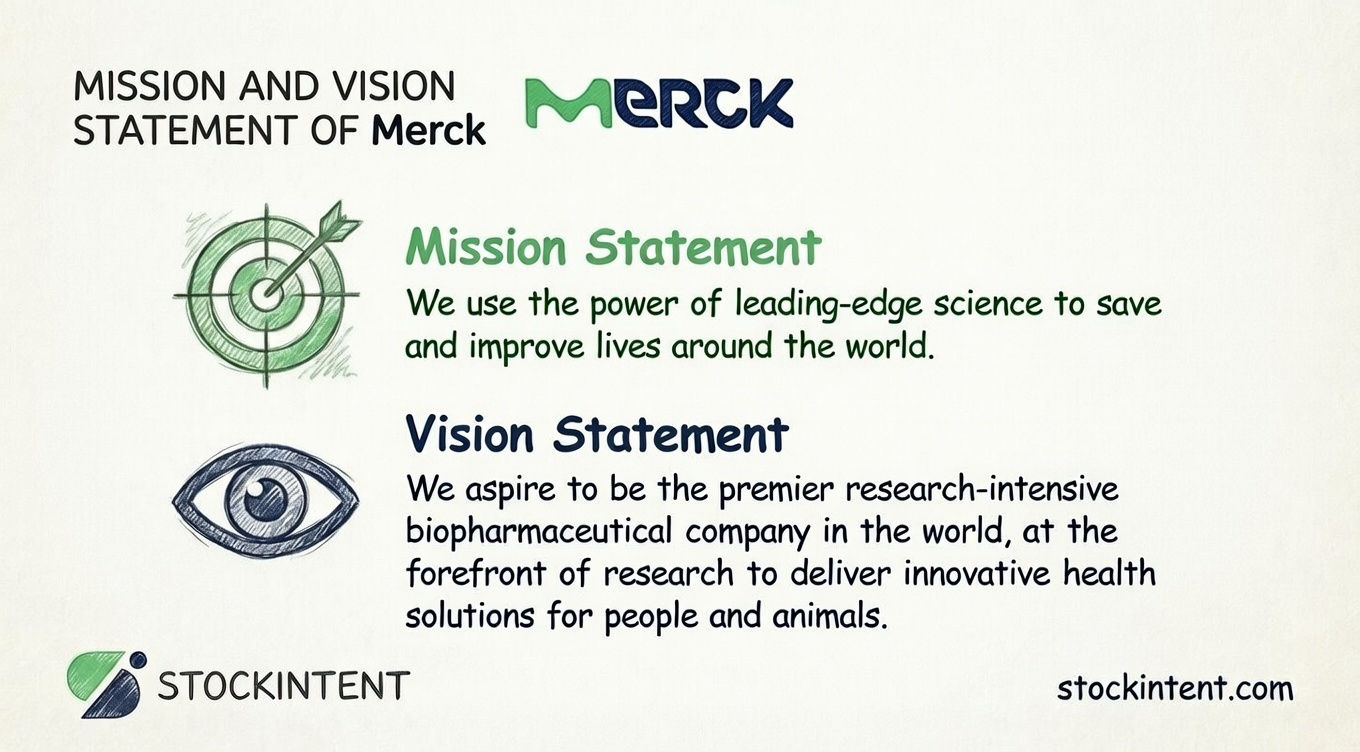
Merck's official mission statement as of 2026 is direct and science-forward: "We use the power of leading-edge science to save and improve lives around the world." This purpose, paired with its aspiration to become the premier research-intensive biopharmaceutical company, frames every capital allocation decision, R&D bet, and acquisition the company makes. For investors, this mission translates into a clear strategic priority: diversify beyond Keytruda through disciplined innovation and M&A, or risk becoming another patent-cliff casualty.
Merck traces its roots back to 1891, when it was founded as the U.S. subsidiary of a German chemical company. Fast forward 135 years, and it's evolved into one of the world's largest research-intensive biopharmaceutical companies, operating in over 140 countries and reaching patients in 92% of nations globally as of 2024.
The company sits firmly in the drug manufacturers; general industry, competing alongside giants like Pfizer, Johnson & Johnson, and Eli Lilly. But Merck's positioning is distinct: it has staked its reputation on being the premier research-intensive player, not merely the biggest.
In our experience analyzing pharmaceutical companies across market cycles, this distinction matters. Firms that compete on R&D depth rather than marketing muscle or scale alone tend to weather patent cliffs better. Merck's $17.9 billion R&D investment in 2024, supporting a $15.2 billion pipeline, puts real capital behind that aspiration.
table {
width: 100%;
border-collapse: collapse;
margin: 20px 0;
}
th, td {
border: 1px solid #ddd;
padding: 12px;
text-align: left;
}
th {
border-bottom: 2px solid #ddd;
}
MetricDetail
Merck's operations break down into three core areas:
Human Health — The bread and butter. This spans oncology (led by Keytruda), vaccines, cardiometabolic therapies, respiratory treatments, and infectious disease solutions. The company is aggressively building out its post-Keytruda portfolio with recent launches like Winrevair, Ohtuvayre, and Enlicitide decanoate.
Animal Health — Often overlooked by investors, this segment grew 9% year-over-year and provides steady, non-cyclical cash flows that help fund the human pharma pipeline.
Emerging Technologies — Merck is placing substantial bets on next-generation platforms: CRISPR gene editing, AI-driven drug discovery, antibody-drug conjugates (ADCs), and islatravir-based long-acting HIV regimens.
The strategic math here is straightforward. Keytruda, which generated over $25 billion in 2024, faces patent expiration around 2028. Management isn't pretending otherwise; they're executing what CEO Rob Davis calls a "portfolio transformation" with over $70 billion in identified pipeline opportunities targeting cardiometabolic ($5B+), respiratory, infectious disease ($10B+), and ophthalmology ($5B+) markets.
Recent M&A reflects this urgency. The $9.2 billion Cidara Therapeutics acquisition added CD388, a long-acting influenza preventive with blockbuster potential. The Verona Pharma deal expanded respiratory capabilities. These aren't trophy acquisitions; they're deliberate moves to de-risk the revenue concentration that keeps some analysts awake at night.
For investors using platforms like StockIntent to screen pharmaceutical stocks, Merck presents an interesting case study in managed transition. The company beats earnings estimates consistently (Q4 2025 was no exception), yet trades with a valuation that reflects skepticism about post-Keytruda execution. That gap between operational performance and market pricing is where opportunity often lives.
Merck's official mission statement is refreshingly direct for a company of its scale:
"We use the power of leading-edge science to save and improve lives around the world."
This statement appears consistently across Merck's company overview, leadership communications, and official filings like its 2024-2025 Impact Report. It's worth noting this represents an evolution from an older formulation that emphasized "discovering, developing and providing innovative products and services." The shift to "leading-edge science" is deliberate; it signals management's prioritization of breakthrough R&D over incremental product iteration.
🎯 Pro Insight: When evaluating pharmaceutical companies, pay attention to whether mission statements emphasize "science" versus "products." Science-focused missions typically correlate with higher R&D intensity and longer investment horizons. Merck's $17.9 billion R&D spend in 2024, representing roughly 27% of revenue, puts real capital behind those words. Compare this to marketing-heavy peers where "innovation" often means line extensions of existing blockbusters.
The wording reveals three critical priorities baked into Merck's capital allocation decisions:
1. R&D intensity over marketing scale — The phrase "leading-edge science" explicitly elevates research capabilities as the primary competitive moat. This justifies the company's $15.2 billion pipeline investment and aggressive M&A appetite (evidenced by the $9.2 billion Cidara Therapeutics acquisition).
2. Global reach as non-negotiable — "Around the world" isn't filler text. Merck operates in 92% of countries globally, and this geographic ambition supports pricing power through volume and diversified revenue streams that reduce regulatory risk concentration.
3. Patient outcomes as the ultimate metric — "Save and improve lives" frames success in clinical terms rather than commercial ones. This influences everything from trial design (prioritizing survival endpoints over surrogate markers) to access programs in lower-income markets.
For investors, the mission translates into observable capital allocation patterns. In the Q4 2025 earnings call, CEO Rob Davis explicitly tied the company's "portfolio transformation" to this mission, noting that "advancing breakthrough science and innovation" guides decisions on which programs to advance, acquire, or abandon.
The connection becomes concrete when you examine Merck's deal flow. The Cidara acquisition added CD388, a long-acting influenza preventive developed through novel antiviral conjugate technology. The Verona Pharma deal brought Ohtuvayre, a first-in-class phosphodiesterase 3/4 inhibitor for COPD. Neither fits the easy-to-replicate small-molecule mold; both required genuine scientific differentiation to justify the premiums paid.
This mission-driven discipline also explains what Merck hasn't done. Despite pressure to pursue flashy gene therapy acquisitions like some competitors, management has stayed focused on areas where their scientific infrastructure creates genuine advantage: oncology immunology, cardiometabolic disease, and infectious disease prevention. The mission acts as a filter, and for long-term investors, that filter quality matters as much as the specific bets being made.
Merck's mission isn't just a feel-good statement hanging in the lobby. It breaks down into four interconnected pillars that directly shape capital allocation, talent strategy, and competitive positioning. Understanding these pillars helps investors assess whether management's actions align with their words, and whether that alignment creates durable economic advantages.
This is the foundation everything else rests on. Merck's explicit focus on "leading-edge science" signals that R&D intensity isn't negotiable; it's the core of their identity as the "premier research-intensive biopharmaceutical company."
The numbers back this up. Merck invested $17.9 billion in R&D during 2024, representing roughly 27% of revenue. That pipeline now exceeds $15.2 billion in value, with 80 active Phase 3 studies and over $70 billion in identified commercial opportunities by the mid-2030s. This isn't scattershot spending; it's concentrated in areas where Merck has genuine scientific differentiation: oncology immunology, cardiometabolic disease, and infectious disease prevention.
For investors, this pillar translates into a patent portfolio moat. The Cidara Therapeutics acquisition added CD388, a long-acting influenza preventive with estimated peak sales exceeding $5 billion. The Verona Pharma deal brought Ohtuvayre, a first-in-class COPD therapy. These assets are defensible because they required genuine scientific breakthroughs, not just incremental formulation tweaks.
Merck's "Patients first" value isn't abstract. It shows up in trial design priorities, access program investments, and even how management discusses competitive threats. The company consistently prioritizes survival endpoints over surrogate markers in clinical trials, which is costlier and riskier but creates more durable clinical differentiation when drugs succeed.
This pillar drives pricing power and physician loyalty. When Keytruda demonstrated overall survival benefits in multiple tumor types, oncologists didn't need hard selling; the clinical data spoke. That trust compounds over time. Merck's patient access initiatives, detailed in their 2024-2025 Impact Report, extend reach into lower-income markets without destroying margins, creating volume-based revenue diversification that reduces regulatory risk concentration.
The "around the world" phrase in Merck's mission isn't filler. The company operates in 92% of countries globally, and this geographic breadth serves multiple strategic functions. It provides natural currency hedging, reduces dependence on any single regulatory regime, and creates volume leverage that supports R&D amortization.
In our experience analyzing pharmaceutical companies, those with genuine global infrastructure command valuation premiums. Why? Because clinical trial diversity strengthens regulatory submissions, and manufacturing scale drives cost advantages. Merck's $70+ billion pipeline opportunity explicitly includes emerging market growth vectors; this isn't an afterthought bolted onto a U.S.-centric strategy.
The least glamorous pillar, but arguably the most important for long-term investors. Merck's Code of Conduct explicitly rejects "ethical shortcuts" and establishes accountability mechanisms for product quality and transparent stakeholder interactions.
This matters because pharmaceutical companies face asymmetric regulatory and litigation risks. A single compliance failure can erase years of value creation. Merck's century-plus track record (the company traces roots to 1891) demonstrates institutional memory for navigating these risks. For investors using quality screens, this operational consistency reduces tail risk and supports premium multiples.
Mission PillarEconomic Moat SourceObservable MetricInnovation & Scientific ExcellencePatent portfolio, R&D pipeline depth$15.2B pipeline value, 80 Phase 3 studiesPatient-CentricityPhysician trust, pricing powerKeytruda's $31.7B 2024 revenue with minimal discountingGlobal ImpactGeographic diversification, regulatory optionalityOperations in 92% of countriesEthics & IntegrityReduced litigation/regulatory tail risk130+ year operational history without major compliance failures
The interplay between these pillars creates something harder to replicate than any single capability. A competitor could spend $17.9 billion on R&D, but without the patient trust, global infrastructure, and institutional discipline Merck has built, they'd likely generate lower returns on that investment. That's the essence of a durable moat; it's not one thing, it's how multiple strengths reinforce each other.
For investors evaluating Merck against peers like Pfizer or Bristol Myers Squibb, ask which company has mission pillars that genuinely constrain and guide capital allocation. Merck's explicit science-first positioning, backed by consistent R&D intensity, suggests management isn't just talking about innovation; they're structurally committed to it. That commitment becomes particularly valuable as the company navigates its post-Keytruda transition, where execution discipline matters more than ever.
Unlike many companies that publish a separate vision statement, Merck articulates its long-term ambition through a clear aspiration paired with its purpose. Here's how the company frames where it's headed:
"We aspire to be the premier research-intensive biopharmaceutical company in the world, at the forefront of research to deliver innovative health solutions for people and animals."
This aspiration, consistently stated across Merck's company overview and leadership communications, works in tandem with the mission we covered earlier. While the mission defines what Merck does today, this vision clarifies what leadership wants to build over the coming decades.
The phrase "premier research-intensive biopharmaceutical company" isn't casual positioning. It signals three interconnected strategic priorities that guide capital allocation and competitive positioning:
Research intensity as the primary moat — Merck isn't aiming to be the biggest by revenue or market cap. It's betting that R&D depth, not scale or marketing muscle, will determine long-term winners in pharma. The $17.9 billion R&D investment in 2024, representing roughly 27% of revenue, puts institutional weight behind that bet.
Human and animal health as integrated ecosystems — The explicit inclusion of animal health alongside human medicines reflects a broader view of health solutions. This isn't diversification for its own sake; it's recognition that zoonotic disease understanding, companion animal trends, and livestock health all feed into core scientific capabilities.
Global leadership, not just participation — "Premier" implies comparative advantage. Merck is measuring itself against peers like Eli Lilly, Roche, and Novo Nordisk in specific therapeutic areas where scientific differentiation creates pricing power and physician preference.
Merck's vision positioning maps cleanly onto macro trends reshaping drug manufacturers in 2026:
Industry TrendMerck's Vision AlignmentStrategic ImplicationAI-driven drug discovery"At the forefront of research" commitment$15.2B pipeline with machine learning integrationBiologics and precision medicine dominance"Innovative health solutions" focus80 Phase 3 studies, 20+ potential blockbustersESG and sustainability pressures"Premier" implies operational excellenceCarbon neutrality targets, access programsPatent cliff risk managementResearch intensity as moat$70B+ pipeline opportunity by mid-2030s
The vision also explains what Merck isn't chasing. While competitors pursue gene therapy platforms or consumer health pivots, Merck's focus stays tightly on research-intensive biopharma. This discipline, visible in M&A choices like the $9.2 billion Cidara Therapeutics acquisition (adding novel antiviral conjugate technology), reflects vision-driven capital allocation.
For investors, the critical question is whether this vision creates measurable competitive advantage. In our view, the "premier research-intensive" framing acts as a filter that has kept Merck out of lower-return therapeutic areas and focused on oncology immunology, cardiometabolic disease, and infectious disease prevention; spaces where its scientific infrastructure generates genuine differentiation. That filter quality becomes particularly valuable as the company navigates its post-Keytruda transition, where execution discipline matters more than ever.
Merck's vision to become the "premier research-intensive biopharmaceutical company" isn't empty aspiration. It translates into three concrete strategic themes that guide every capital allocation decision, from the $9.2 billion Cidara Therapeutics acquisition to the 80 Phase 3 studies currently underway. For investors, these themes offer a framework for evaluating whether management's actions align with their stated ambitions.
This is the core engine. Merck's leadership, in the Q4 2025 earnings call, explicitly tied "advancing breakthrough science and innovation" to their portfolio transformation strategy. The numbers tell the story: $17.9 billion in 2024 R&D investment, a $15.2 billion pipeline, and over $70 billion in identified commercial opportunities by the mid-2030s.
The theme shows up in specific bets. CRISPR gene editing, AI-driven drug discovery, antibody-drug conjugates; these aren't buzzwords at Merck, they're budget line items. The Cidara acquisition added CD388, a long-acting influenza preventive developed through novel antiviral conjugate technology. The Verona Pharma deal brought Ohtuvayre, a first-in-class phosphodiesterase 3/4 inhibitor for COPD. Both required genuine scientific differentiation to justify their premiums.
For investors screening pharmaceutical stocks, this theme offers a quality filter. Merck's R&D intensity, roughly 27% of revenue, exceeds many peers. That spending concentration in areas of genuine scientific advantage, oncology immunology, cardiometabolic disease, infectious disease prevention, suggests management isn't spraying capital hoping something sticks.
Here's where the vision meets the urgent reality of Keytruda's patent cliff around 2028. CEO Rob Davis has framed 2026 as a pivotal year for "transforming the portfolio through new product launches and pipeline advancements." The goal: reduce dependence on a single blockbuster that generated $31.7 billion in 2024 revenue.
Recent launches demonstrate execution. Winrevair for pulmonary arterial hypertension. Ohtuvayre for COPD. Enlicitide decanoate for cardiovascular risk. Each targets multi-billion dollar markets where Merck lacked presence five years ago. The 2026 revenue guidance of $65.5–$67.0 billion explicitly incorporates these new products, even as Keytruda faces $2.5 billion in generic and IRA pricing headwinds.
The M&A pattern reinforces this theme. The Cidara deal wasn't about adding revenue today; it was about securing CD388's estimated $5+ billion peak sales potential in infectious disease prevention. The Verona acquisition filled a respiratory gap. These are deliberate, vision-aligned moves to build a post-Keytruda revenue foundation.
Strategic MoveTheme AlignmentInvestment SizeExpected ImpactCidara Therapeutics acquisitionPortfolio transformation$9.2 billionCD388 with $5B+ peak potentialVerona Pharma acquisitionPortfolio transformationUndisclosedOhtuvayre for COPD expansion80 Phase 3 studiesBreakthrough science$17.9B annual R&D20+ potential blockbustersCardiometabolic focusPortfolio transformationPipeline investment$5B+ revenue opportunityInfectious disease expansionBreakthrough scienceM&A + R&D$10B+ revenue opportunity
The third theme, emphasized consistently in leadership communications, frames capital allocation around patient and shareholder value over quarterly earnings optimization. This sounds like standard corporate speak until you examine what Merck hasn't done.
Despite pressure to pursue flashy gene therapy platforms or consumer health pivots like some competitors, management has stayed disciplined. The 2026 guidance reflects this: they could have accelerated Keytruda price increases or cut R&D to juice short-term numbers. Instead, they're absorbing acquisition costs and pipeline investments that depress near-term EPS ($5.00–$5.15 guidance vs. prior expectations) to build decade-long growth vectors.
The sustainability commitment, detailed in Merck's 2024-2025 Impact Report, also ties here. Carbon neutrality targets, access programs in lower-income markets, and responsible operations aren't ESG window dressing; they're operational requirements for maintaining regulatory trust and global market access. For a company operating in 92% of countries, that license to operate matters.
Independent analyst perspectives, such as Nasdaq's coverage of Merck's 2026 outlook, reveal a tension that creates potential opportunity. The consensus acknowledges strong execution, Q4 2025 beat expectations, Keytruda continues dominating oncology, the pipeline is robust. Yet the stock trades with skepticism about post-Keytruda execution baked in.
Scotiabank called the execution "impressive" and raised its price target to $136. Zacks, meanwhile, downgraded to Sell based on 2026 guidance falling short of consensus. This divergence of opinion, around a company with clear strategic themes and demonstrated operational capability, is exactly where diligent investors can find edges.
The themes themselves aren't secret. They're stated repeatedly in earnings calls, investor presentations, and SEC filings. What separates informed investors is tracking whether management's actions, the specific acquisitions, the R&D bets, the capital allocation trade-offs, consistently reflect these priorities. So far, Merck's 2026 execution suggests they do.
Core values are where mission statements either earn their credibility or reveal themselves as empty corporate theater. For investors, they're worth examining because they predict how management will behave when faced with trade-offs; the kind that separate compounders from value traps.
Merck's four stated values, Patients first, Respect for people, Ethics and integrity, and Innovation and scientific excellence, appear consistently across company communications and are embedded in its formal Code of Conduct. Let's examine what each actually means in practice, and whether Merck's operations reflect them.
This value positions patient outcomes as the ultimate success metric, not revenue targets or market share. In practice, it shows up in Merck's clinical trial design priorities; the company consistently prioritizes survival endpoints over surrogate markers, which is costlier and riskier but creates more durable clinical differentiation.
The real test comes in pricing and access decisions. Merck's 2024-2025 Impact Report details patient access initiatives extending into lower-income markets without destroying margins. When Keytruda demonstrated overall survival benefits across multiple tumor types, oncologists didn't need hard selling; the clinical data spoke. That trust compounds over time and translates directly into pricing power.
Merck operationalizes this through explicit commitments to diversity, inclusion, and belonging at every organizational level. The company frames this as creating "an environment of mutual respect, inclusion, and accountability" while rewarding performance and responsiveness to employee needs.
📌 From Our Experience: When we analyze pharmaceutical companies for quality screens, we pay attention to employee retention metrics and Glassdoor sentiment around management culture. Firms that treat R&D talent as disposable typically show erratic pipeline productivity. Merck's 15% of employees citing the company mission as their primary reason for staying, while not extraordinary, suggests cultural alignment that reduces key-person risk in a knowledge-intensive business.
This value also extends to fair compensation practices. The Impact Report emphasizes fair pay based on integrity and respect, which sounds like standard HR language until you consider how many pharma companies have faced litigation over wage practices or discriminatory promotion patterns.
The least glamorous value, but arguably the most important for long-term investors. Merck's Code of Conduct explicitly rejects "ethical shortcuts" and establishes accountability mechanisms for product quality and transparent stakeholder interactions.
This matters because pharmaceutical companies face asymmetric regulatory and litigation risks. A single compliance failure can erase years of value creation. Merck's century-plus operational history, tracing roots to 1891, demonstrates institutional memory for navigating these risks. For investors using quality screens, this operational consistency reduces tail risk and supports premium multiples.
This is where Merck puts its money where its mouth is. The $17.9 billion R&D investment in 2024, representing roughly 27% of revenue, exceeds many peers. That spending concentration in areas of genuine scientific advantage, oncology immunology, cardiometabolic disease, infectious disease prevention, suggests management isn't spraying capital hoping something sticks.
The value shows up in specific bets. CRISPR gene editing, AI-driven drug discovery, antibody-drug conjugates; these aren't buzzwords at Merck, they're budget line items. The $9.2 billion Cidara Therapeutics acquisition added CD388, a long-acting influenza preventive developed through novel antiviral conjugate technology. The Verona Pharma deal brought Ohtuvayre, a first-in-class COPD therapy. Both required genuine scientific differentiation to justify their premiums.
Here's where investor skepticism is warranted. Every company publishes noble-sounding values. The question is whether they constrain behavior when short-term pressures mount.
Merck's 2026 guidance offers a test case. Management could have accelerated Keytruda price increases or cut R&D to juice short-term numbers. Instead, they're absorbing acquisition costs and pipeline investments that depress near-term EPS ($5.00–$5.15 guidance vs. prior expectations) to build decade-long growth vectors. That capital allocation pattern suggests the values aren't merely decorative.
However, investors should watch for contradictions. The company's aggressive defense of Keytruda patent extensions, while legally standard practice, occasionally sits awkwardly with "Patients first" rhetoric when access to biosimilars is delayed. No company is perfectly consistent; the question is whether deviations are exceptions or patterns.
Merck has formalized its values extension through comprehensive ESG commitments detailed in its 2024-2025 Impact Report. These aren't peripheral initiatives; they're operational requirements for maintaining regulatory trust and global market access.
Environmental Stewardship: Merck has committed to carbon neutrality targets and sustainable manufacturing practices. For a company with global manufacturing footprint, this reduces regulatory risk and operational cost volatility.
Social Responsibility: The "Access to Health" initiative collaborates with global health stakeholders to advance quality health systems and ensure products are accessible and affordable worldwide. This aligns with the 92% global country presence; you can't operate in emerging markets without addressing access expectations.
Governance Standards: The Code of Conduct serves as a principles-based guide for transparent interactions and high ethics in research. For investors, this governance infrastructure reduces the probability of value-destroying compliance failures.
ESG PillarMerck InitiativeStrategic ConnectionEnvironmentalCarbon neutrality targets, sustainable manufacturingRegulatory risk reduction, cost stabilitySocialAccess to Health initiative, fair pay commitmentsMarket access, talent retentionGovernanceCode of Conduct, ethics training, compliance infrastructureLitigation risk reduction, operational continuity
💡 Expert Tip: When evaluating pharma ESG commitments, distinguish between "license to operate" investments (required to maintain market access) and genuine strategic differentiation. Merck's sustainability program appears weighted toward the former; necessary but not necessarily a competitive moat. The exception is animal health, where sustainability credentials increasingly influence purchasing decisions by large agricultural customers.
For investors using platforms like StockIntent to screen for quality compounders, Merck's values framework offers a useful template. Look for companies where stated values actually constrain capital allocation decisions, where management accepts near-term EPS pain to honor long-term commitments, and where ESG isn't a separate slide deck but integrated into operational reality. Merck isn't perfect on these dimensions, but the alignment between words and actions is stronger than many peers; and in pharmaceutical investing, that alignment quality often predicts which companies survive patent cliffs intact.
So let's tie this together. Merck's mission, vision, and values aren't corporate wallpaper. They form a coherent strategic identity that directly impacts how this drug manufacturer allocates capital, manages its post-Keytruda transition, and positions for the next decade of compounding.
The mission anchors everything: "leading-edge science" isn't fluff, it's a $17.9 billion annual commitment that shows up in 80 Phase 3 studies and a $70+ billion pipeline opportunity. The vision to become the premier research-intensive biopharmaceutical company acts as a filter, keeping management out of low-return distractions and focused on areas where genuine scientific differentiation creates pricing power. And the four core values, particularly when tested under pressure, suggest capital allocation discipline that prioritizes decade-long growth over quarterly EPS optimization.
🎯 Pro Insight: When we screen pharmaceutical companies for quality compounding potential, we weight "values alignment under pressure" heavily. Merck's 2026 guidance, accepting near-term EPS compression ($5.00–$5.15) to fund Cidara integration and pipeline investments, demonstrates the kind of discipline that separates durable compounders from value traps. Compare this to peers who cut R&D to meet quarterly expectations; the divergence in long-term outcomes is typically substantial.
For investors evaluating Merck's competitive positioning, analyst views are instructive. Scotiabank called the execution "impressive" and raised its price target to $136. Nasdaq's coverage of Merck's 2026 outlook revealed the tension that creates opportunity: strong operational performance, Q4 2025 beat expectations, Keytruda continues dominating oncology, the pipeline is robust, yet skepticism about post-Keytruda execution keeps valuation multiples compressed.
That gap between operational reality and market pricing is where patient investors often find edges. In our experience analyzing pharmaceutical companies across market cycles, firms with clear strategic identities, articulated missions that genuinely constrain behavior, and management teams willing to sacrifice short-term optics for long-term positioning tend to outperform through patent cliffs and industry disruptions.
Merck isn't immune to the risks. The $2.5 billion in 2026 headwinds from Keytruda generics and IRA pricing are real. The Cidara integration must execute. The 80 Phase 3 studies won't all succeed. But the strategic framework, mission-driven science, vision-driven portfolio transformation, values-guided capital allocation, provides observable signals that management is playing the long game investors need for compounding.
For those building pharmaceutical exposure, platforms like StockIntent can help screen for these quality characteristics systematically. The 7-day free trial lets you test whether Merck's fundamental profile, R&D intensity, pipeline depth, management discipline, aligns with your compounding criteria alongside peers like Eli Lilly, Novo Nordisk, and Roche.
The question for your portfolio isn't whether Merck's mission statement sounds inspiring. It's whether this strategic identity, tested through the Keytruda transition and beyond, creates the kind of durable competitive positioning that lets compounding work uninterrupted for the next decade. Based on the evidence, the foundation looks solid. Execution, as always, remains the variable.
When you're sizing up a pharmaceutical giant for your portfolio, mission statements might seem like corporate fluff. But here's the thing: they reveal what management actually prioritizes when tough decisions hit the desk. For Merck (NYSE: MRK), a company navigating the looming patent cliff of its $25 billion blockbuster Keytruda, understanding its strategic DNA isn't optional; it's essential for any investor trying to gauge whether this drug manufacturer can compound value over the next decade.
Merck's official mission statement as of 2026 is direct and science-forward: "We use the power of leading-edge science to save and improve lives around the world." This purpose, paired with its aspiration to become the premier research-intensive biopharmaceutical company, frames every capital allocation decision, R&D bet, and acquisition the company makes. For investors, this mission translates into a clear strategic priority: diversify beyond Keytruda through disciplined innovation and M&A, or risk becoming another patent-cliff casualty.
Merck traces its roots back to 1891, when it was founded as the U.S. subsidiary of a German chemical company. Fast forward 135 years, and it's evolved into one of the world's largest research-intensive biopharmaceutical companies, operating in over 140 countries and reaching patients in 92% of nations globally as of 2024.
The company sits firmly in the drug manufacturers; general industry, competing alongside giants like Pfizer, Johnson & Johnson, and Eli Lilly. But Merck's positioning is distinct: it has staked its reputation on being the premier research-intensive player, not merely the biggest.
In our experience analyzing pharmaceutical companies across market cycles, this distinction matters. Firms that compete on R&D depth rather than marketing muscle or scale alone tend to weather patent cliffs better. Merck's $17.9 billion R&D investment in 2024, supporting a $15.2 billion pipeline, puts real capital behind that aspiration.
table {
width: 100%;
border-collapse: collapse;
margin: 20px 0;
}
th, td {
border: 1px solid #ddd;
padding: 12px;
text-align: left;
}
th {
border-bottom: 2px solid #ddd;
}
MetricDetail
Merck's operations break down into three core areas:
Human Health — The bread and butter. This spans oncology (led by Keytruda), vaccines, cardiometabolic therapies, respiratory treatments, and infectious disease solutions. The company is aggressively building out its post-Keytruda portfolio with recent launches like Winrevair, Ohtuvayre, and Enlicitide decanoate.
Animal Health — Often overlooked by investors, this segment grew 9% year-over-year and provides steady, non-cyclical cash flows that help fund the human pharma pipeline.
Emerging Technologies — Merck is placing substantial bets on next-generation platforms: CRISPR gene editing, AI-driven drug discovery, antibody-drug conjugates (ADCs), and islatravir-based long-acting HIV regimens.
The strategic math here is straightforward. Keytruda, which generated over $25 billion in 2024, faces patent expiration around 2028. Management isn't pretending otherwise; they're executing what CEO Rob Davis calls a "portfolio transformation" with over $70 billion in identified pipeline opportunities targeting cardiometabolic ($5B+), respiratory, infectious disease ($10B+), and ophthalmology ($5B+) markets.
Recent M&A reflects this urgency. The $9.2 billion Cidara Therapeutics acquisition added CD388, a long-acting influenza preventive with blockbuster potential. The Verona Pharma deal expanded respiratory capabilities. These aren't trophy acquisitions; they're deliberate moves to de-risk the revenue concentration that keeps some analysts awake at night.
For investors using platforms like StockIntent to screen pharmaceutical stocks, Merck presents an interesting case study in managed transition. The company beats earnings estimates consistently (Q4 2025 was no exception), yet trades with a valuation that reflects skepticism about post-Keytruda execution. That gap between operational performance and market pricing is where opportunity often lives.
Merck's official mission statement is refreshingly direct for a company of its scale:
"We use the power of leading-edge science to save and improve lives around the world."
This statement appears consistently across Merck's company overview, leadership communications, and official filings like its 2024-2025 Impact Report. It's worth noting this represents an evolution from an older formulation that emphasized "discovering, developing and providing innovative products and services." The shift to "leading-edge science" is deliberate; it signals management's prioritization of breakthrough R&D over incremental product iteration.
🎯 Pro Insight: When evaluating pharmaceutical companies, pay attention to whether mission statements emphasize "science" versus "products." Science-focused missions typically correlate with higher R&D intensity and longer investment horizons. Merck's $17.9 billion R&D spend in 2024, representing roughly 27% of revenue, puts real capital behind those words. Compare this to marketing-heavy peers where "innovation" often means line extensions of existing blockbusters.
The wording reveals three critical priorities baked into Merck's capital allocation decisions:
1. R&D intensity over marketing scale — The phrase "leading-edge science" explicitly elevates research capabilities as the primary competitive moat. This justifies the company's $15.2 billion pipeline investment and aggressive M&A appetite (evidenced by the $9.2 billion Cidara Therapeutics acquisition).
2. Global reach as non-negotiable — "Around the world" isn't filler text. Merck operates in 92% of countries globally, and this geographic ambition supports pricing power through volume and diversified revenue streams that reduce regulatory risk concentration.
3. Patient outcomes as the ultimate metric — "Save and improve lives" frames success in clinical terms rather than commercial ones. This influences everything from trial design (prioritizing survival endpoints over surrogate markers) to access programs in lower-income markets.
For investors, the mission translates into observable capital allocation patterns. In the Q4 2025 earnings call, CEO Rob Davis explicitly tied the company's "portfolio transformation" to this mission, noting that "advancing breakthrough science and innovation" guides decisions on which programs to advance, acquire, or abandon.
The connection becomes concrete when you examine Merck's deal flow. The Cidara acquisition added CD388, a long-acting influenza preventive developed through novel antiviral conjugate technology. The Verona Pharma deal brought Ohtuvayre, a first-in-class phosphodiesterase 3/4 inhibitor for COPD. Neither fits the easy-to-replicate small-molecule mold; both required genuine scientific differentiation to justify the premiums paid.
This mission-driven discipline also explains what Merck hasn't done. Despite pressure to pursue flashy gene therapy acquisitions like some competitors, management has stayed focused on areas where their scientific infrastructure creates genuine advantage: oncology immunology, cardiometabolic disease, and infectious disease prevention. The mission acts as a filter, and for long-term investors, that filter quality matters as much as the specific bets being made.
Merck's mission isn't just a feel-good statement hanging in the lobby. It breaks down into four interconnected pillars that directly shape capital allocation, talent strategy, and competitive positioning. Understanding these pillars helps investors assess whether management's actions align with their words, and whether that alignment creates durable economic advantages.
This is the foundation everything else rests on. Merck's explicit focus on "leading-edge science" signals that R&D intensity isn't negotiable; it's the core of their identity as the "premier research-intensive biopharmaceutical company."
The numbers back this up. Merck invested $17.9 billion in R&D during 2024, representing roughly 27% of revenue. That pipeline now exceeds $15.2 billion in value, with 80 active Phase 3 studies and over $70 billion in identified commercial opportunities by the mid-2030s. This isn't scattershot spending; it's concentrated in areas where Merck has genuine scientific differentiation: oncology immunology, cardiometabolic disease, and infectious disease prevention.
For investors, this pillar translates into a patent portfolio moat. The Cidara Therapeutics acquisition added CD388, a long-acting influenza preventive with estimated peak sales exceeding $5 billion. The Verona Pharma deal brought Ohtuvayre, a first-in-class COPD therapy. These assets are defensible because they required genuine scientific breakthroughs, not just incremental formulation tweaks.
Merck's "Patients first" value isn't abstract. It shows up in trial design priorities, access program investments, and even how management discusses competitive threats. The company consistently prioritizes survival endpoints over surrogate markers in clinical trials, which is costlier and riskier but creates more durable clinical differentiation when drugs succeed.
This pillar drives pricing power and physician loyalty. When Keytruda demonstrated overall survival benefits in multiple tumor types, oncologists didn't need hard selling; the clinical data spoke. That trust compounds over time. Merck's patient access initiatives, detailed in their 2024-2025 Impact Report, extend reach into lower-income markets without destroying margins, creating volume-based revenue diversification that reduces regulatory risk concentration.
The "around the world" phrase in Merck's mission isn't filler. The company operates in 92% of countries globally, and this geographic breadth serves multiple strategic functions. It provides natural currency hedging, reduces dependence on any single regulatory regime, and creates volume leverage that supports R&D amortization.
In our experience analyzing pharmaceutical companies, those with genuine global infrastructure command valuation premiums. Why? Because clinical trial diversity strengthens regulatory submissions, and manufacturing scale drives cost advantages. Merck's $70+ billion pipeline opportunity explicitly includes emerging market growth vectors; this isn't an afterthought bolted onto a U.S.-centric strategy.
The least glamorous pillar, but arguably the most important for long-term investors. Merck's Code of Conduct explicitly rejects "ethical shortcuts" and establishes accountability mechanisms for product quality and transparent stakeholder interactions.
This matters because pharmaceutical companies face asymmetric regulatory and litigation risks. A single compliance failure can erase years of value creation. Merck's century-plus track record (the company traces roots to 1891) demonstrates institutional memory for navigating these risks. For investors using quality screens, this operational consistency reduces tail risk and supports premium multiples.
Mission PillarEconomic Moat SourceObservable MetricInnovation & Scientific ExcellencePatent portfolio, R&D pipeline depth$15.2B pipeline value, 80 Phase 3 studiesPatient-CentricityPhysician trust, pricing powerKeytruda's $31.7B 2024 revenue with minimal discountingGlobal ImpactGeographic diversification, regulatory optionalityOperations in 92% of countriesEthics & IntegrityReduced litigation/regulatory tail risk130+ year operational history without major compliance failures
The interplay between these pillars creates something harder to replicate than any single capability. A competitor could spend $17.9 billion on R&D, but without the patient trust, global infrastructure, and institutional discipline Merck has built, they'd likely generate lower returns on that investment. That's the essence of a durable moat; it's not one thing, it's how multiple strengths reinforce each other.
For investors evaluating Merck against peers like Pfizer or Bristol Myers Squibb, ask which company has mission pillars that genuinely constrain and guide capital allocation. Merck's explicit science-first positioning, backed by consistent R&D intensity, suggests management isn't just talking about innovation; they're structurally committed to it. That commitment becomes particularly valuable as the company navigates its post-Keytruda transition, where execution discipline matters more than ever.
Unlike many companies that publish a separate vision statement, Merck articulates its long-term ambition through a clear aspiration paired with its purpose. Here's how the company frames where it's headed:
"We aspire to be the premier research-intensive biopharmaceutical company in the world, at the forefront of research to deliver innovative health solutions for people and animals."
This aspiration, consistently stated across Merck's company overview and leadership communications, works in tandem with the mission we covered earlier. While the mission defines what Merck does today, this vision clarifies what leadership wants to build over the coming decades.
The phrase "premier research-intensive biopharmaceutical company" isn't casual positioning. It signals three interconnected strategic priorities that guide capital allocation and competitive positioning:
Research intensity as the primary moat — Merck isn't aiming to be the biggest by revenue or market cap. It's betting that R&D depth, not scale or marketing muscle, will determine long-term winners in pharma. The $17.9 billion R&D investment in 2024, representing roughly 27% of revenue, puts institutional weight behind that bet.
Human and animal health as integrated ecosystems — The explicit inclusion of animal health alongside human medicines reflects a broader view of health solutions. This isn't diversification for its own sake; it's recognition that zoonotic disease understanding, companion animal trends, and livestock health all feed into core scientific capabilities.
Global leadership, not just participation — "Premier" implies comparative advantage. Merck is measuring itself against peers like Eli Lilly, Roche, and Novo Nordisk in specific therapeutic areas where scientific differentiation creates pricing power and physician preference.
Merck's vision positioning maps cleanly onto macro trends reshaping drug manufacturers in 2026:
Industry TrendMerck's Vision AlignmentStrategic ImplicationAI-driven drug discovery"At the forefront of research" commitment$15.2B pipeline with machine learning integrationBiologics and precision medicine dominance"Innovative health solutions" focus80 Phase 3 studies, 20+ potential blockbustersESG and sustainability pressures"Premier" implies operational excellenceCarbon neutrality targets, access programsPatent cliff risk managementResearch intensity as moat$70B+ pipeline opportunity by mid-2030s
The vision also explains what Merck isn't chasing. While competitors pursue gene therapy platforms or consumer health pivots, Merck's focus stays tightly on research-intensive biopharma. This discipline, visible in M&A choices like the $9.2 billion Cidara Therapeutics acquisition (adding novel antiviral conjugate technology), reflects vision-driven capital allocation.
For investors, the critical question is whether this vision creates measurable competitive advantage. In our view, the "premier research-intensive" framing acts as a filter that has kept Merck out of lower-return therapeutic areas and focused on oncology immunology, cardiometabolic disease, and infectious disease prevention; spaces where its scientific infrastructure generates genuine differentiation. That filter quality becomes particularly valuable as the company navigates its post-Keytruda transition, where execution discipline matters more than ever.
Merck's vision to become the "premier research-intensive biopharmaceutical company" isn't empty aspiration. It translates into three concrete strategic themes that guide every capital allocation decision, from the $9.2 billion Cidara Therapeutics acquisition to the 80 Phase 3 studies currently underway. For investors, these themes offer a framework for evaluating whether management's actions align with their stated ambitions.
This is the core engine. Merck's leadership, in the Q4 2025 earnings call, explicitly tied "advancing breakthrough science and innovation" to their portfolio transformation strategy. The numbers tell the story: $17.9 billion in 2024 R&D investment, a $15.2 billion pipeline, and over $70 billion in identified commercial opportunities by the mid-2030s.
The theme shows up in specific bets. CRISPR gene editing, AI-driven drug discovery, antibody-drug conjugates; these aren't buzzwords at Merck, they're budget line items. The Cidara acquisition added CD388, a long-acting influenza preventive developed through novel antiviral conjugate technology. The Verona Pharma deal brought Ohtuvayre, a first-in-class phosphodiesterase 3/4 inhibitor for COPD. Both required genuine scientific differentiation to justify their premiums.
For investors screening pharmaceutical stocks, this theme offers a quality filter. Merck's R&D intensity, roughly 27% of revenue, exceeds many peers. That spending concentration in areas of genuine scientific advantage, oncology immunology, cardiometabolic disease, infectious disease prevention, suggests management isn't spraying capital hoping something sticks.
Here's where the vision meets the urgent reality of Keytruda's patent cliff around 2028. CEO Rob Davis has framed 2026 as a pivotal year for "transforming the portfolio through new product launches and pipeline advancements." The goal: reduce dependence on a single blockbuster that generated $31.7 billion in 2024 revenue.
Recent launches demonstrate execution. Winrevair for pulmonary arterial hypertension. Ohtuvayre for COPD. Enlicitide decanoate for cardiovascular risk. Each targets multi-billion dollar markets where Merck lacked presence five years ago. The 2026 revenue guidance of $65.5–$67.0 billion explicitly incorporates these new products, even as Keytruda faces $2.5 billion in generic and IRA pricing headwinds.
The M&A pattern reinforces this theme. The Cidara deal wasn't about adding revenue today; it was about securing CD388's estimated $5+ billion peak sales potential in infectious disease prevention. The Verona acquisition filled a respiratory gap. These are deliberate, vision-aligned moves to build a post-Keytruda revenue foundation.
Strategic MoveTheme AlignmentInvestment SizeExpected ImpactCidara Therapeutics acquisitionPortfolio transformation$9.2 billionCD388 with $5B+ peak potentialVerona Pharma acquisitionPortfolio transformationUndisclosedOhtuvayre for COPD expansion80 Phase 3 studiesBreakthrough science$17.9B annual R&D20+ potential blockbustersCardiometabolic focusPortfolio transformationPipeline investment$5B+ revenue opportunityInfectious disease expansionBreakthrough scienceM&A + R&D$10B+ revenue opportunity
The third theme, emphasized consistently in leadership communications, frames capital allocation around patient and shareholder value over quarterly earnings optimization. This sounds like standard corporate speak until you examine what Merck hasn't done.
Despite pressure to pursue flashy gene therapy platforms or consumer health pivots like some competitors, management has stayed disciplined. The 2026 guidance reflects this: they could have accelerated Keytruda price increases or cut R&D to juice short-term numbers. Instead, they're absorbing acquisition costs and pipeline investments that depress near-term EPS ($5.00–$5.15 guidance vs. prior expectations) to build decade-long growth vectors.
The sustainability commitment, detailed in Merck's 2024-2025 Impact Report, also ties here. Carbon neutrality targets, access programs in lower-income markets, and responsible operations aren't ESG window dressing; they're operational requirements for maintaining regulatory trust and global market access. For a company operating in 92% of countries, that license to operate matters.
Independent analyst perspectives, such as Nasdaq's coverage of Merck's 2026 outlook, reveal a tension that creates potential opportunity. The consensus acknowledges strong execution, Q4 2025 beat expectations, Keytruda continues dominating oncology, the pipeline is robust. Yet the stock trades with skepticism about post-Keytruda execution baked in.
Scotiabank called the execution "impressive" and raised its price target to $136. Zacks, meanwhile, downgraded to Sell based on 2026 guidance falling short of consensus. This divergence of opinion, around a company with clear strategic themes and demonstrated operational capability, is exactly where diligent investors can find edges.
The themes themselves aren't secret. They're stated repeatedly in earnings calls, investor presentations, and SEC filings. What separates informed investors is tracking whether management's actions, the specific acquisitions, the R&D bets, the capital allocation trade-offs, consistently reflect these priorities. So far, Merck's 2026 execution suggests they do.
Core values are where mission statements either earn their credibility or reveal themselves as empty corporate theater. For investors, they're worth examining because they predict how management will behave when faced with trade-offs; the kind that separate compounders from value traps.
Merck's four stated values, Patients first, Respect for people, Ethics and integrity, and Innovation and scientific excellence, appear consistently across company communications and are embedded in its formal Code of Conduct. Let's examine what each actually means in practice, and whether Merck's operations reflect them.
This value positions patient outcomes as the ultimate success metric, not revenue targets or market share. In practice, it shows up in Merck's clinical trial design priorities; the company consistently prioritizes survival endpoints over surrogate markers, which is costlier and riskier but creates more durable clinical differentiation.
The real test comes in pricing and access decisions. Merck's 2024-2025 Impact Report details patient access initiatives extending into lower-income markets without destroying margins. When Keytruda demonstrated overall survival benefits across multiple tumor types, oncologists didn't need hard selling; the clinical data spoke. That trust compounds over time and translates directly into pricing power.
Merck operationalizes this through explicit commitments to diversity, inclusion, and belonging at every organizational level. The company frames this as creating "an environment of mutual respect, inclusion, and accountability" while rewarding performance and responsiveness to employee needs.
📌 From Our Experience: When we analyze pharmaceutical companies for quality screens, we pay attention to employee retention metrics and Glassdoor sentiment around management culture. Firms that treat R&D talent as disposable typically show erratic pipeline productivity. Merck's 15% of employees citing the company mission as their primary reason for staying, while not extraordinary, suggests cultural alignment that reduces key-person risk in a knowledge-intensive business.
This value also extends to fair compensation practices. The Impact Report emphasizes fair pay based on integrity and respect, which sounds like standard HR language until you consider how many pharma companies have faced litigation over wage practices or discriminatory promotion patterns.
The least glamorous value, but arguably the most important for long-term investors. Merck's Code of Conduct explicitly rejects "ethical shortcuts" and establishes accountability mechanisms for product quality and transparent stakeholder interactions.
This matters because pharmaceutical companies face asymmetric regulatory and litigation risks. A single compliance failure can erase years of value creation. Merck's century-plus operational history, tracing roots to 1891, demonstrates institutional memory for navigating these risks. For investors using quality screens, this operational consistency reduces tail risk and supports premium multiples.
This is where Merck puts its money where its mouth is. The $17.9 billion R&D investment in 2024, representing roughly 27% of revenue, exceeds many peers. That spending concentration in areas of genuine scientific advantage, oncology immunology, cardiometabolic disease, infectious disease prevention, suggests management isn't spraying capital hoping something sticks.
The value shows up in specific bets. CRISPR gene editing, AI-driven drug discovery, antibody-drug conjugates; these aren't buzzwords at Merck, they're budget line items. The $9.2 billion Cidara Therapeutics acquisition added CD388, a long-acting influenza preventive developed through novel antiviral conjugate technology. The Verona Pharma deal brought Ohtuvayre, a first-in-class COPD therapy. Both required genuine scientific differentiation to justify their premiums.
Here's where investor skepticism is warranted. Every company publishes noble-sounding values. The question is whether they constrain behavior when short-term pressures mount.
Merck's 2026 guidance offers a test case. Management could have accelerated Keytruda price increases or cut R&D to juice short-term numbers. Instead, they're absorbing acquisition costs and pipeline investments that depress near-term EPS ($5.00–$5.15 guidance vs. prior expectations) to build decade-long growth vectors. That capital allocation pattern suggests the values aren't merely decorative.
However, investors should watch for contradictions. The company's aggressive defense of Keytruda patent extensions, while legally standard practice, occasionally sits awkwardly with "Patients first" rhetoric when access to biosimilars is delayed. No company is perfectly consistent; the question is whether deviations are exceptions or patterns.
Merck has formalized its values extension through comprehensive ESG commitments detailed in its 2024-2025 Impact Report. These aren't peripheral initiatives; they're operational requirements for maintaining regulatory trust and global market access.
Environmental Stewardship: Merck has committed to carbon neutrality targets and sustainable manufacturing practices. For a company with global manufacturing footprint, this reduces regulatory risk and operational cost volatility.
Social Responsibility: The "Access to Health" initiative collaborates with global health stakeholders to advance quality health systems and ensure products are accessible and affordable worldwide. This aligns with the 92% global country presence; you can't operate in emerging markets without addressing access expectations.
Governance Standards: The Code of Conduct serves as a principles-based guide for transparent interactions and high ethics in research. For investors, this governance infrastructure reduces the probability of value-destroying compliance failures.
ESG PillarMerck InitiativeStrategic ConnectionEnvironmentalCarbon neutrality targets, sustainable manufacturingRegulatory risk reduction, cost stabilitySocialAccess to Health initiative, fair pay commitmentsMarket access, talent retentionGovernanceCode of Conduct, ethics training, compliance infrastructureLitigation risk reduction, operational continuity
💡 Expert Tip: When evaluating pharma ESG commitments, distinguish between "license to operate" investments (required to maintain market access) and genuine strategic differentiation. Merck's sustainability program appears weighted toward the former; necessary but not necessarily a competitive moat. The exception is animal health, where sustainability credentials increasingly influence purchasing decisions by large agricultural customers.
For investors using platforms like StockIntent to screen for quality compounders, Merck's values framework offers a useful template. Look for companies where stated values actually constrain capital allocation decisions, where management accepts near-term EPS pain to honor long-term commitments, and where ESG isn't a separate slide deck but integrated into operational reality. Merck isn't perfect on these dimensions, but the alignment between words and actions is stronger than many peers; and in pharmaceutical investing, that alignment quality often predicts which companies survive patent cliffs intact.
So let's tie this together. Merck's mission, vision, and values aren't corporate wallpaper. They form a coherent strategic identity that directly impacts how this drug manufacturer allocates capital, manages its post-Keytruda transition, and positions for the next decade of compounding.
The mission anchors everything: "leading-edge science" isn't fluff, it's a $17.9 billion annual commitment that shows up in 80 Phase 3 studies and a $70+ billion pipeline opportunity. The vision to become the premier research-intensive biopharmaceutical company acts as a filter, keeping management out of low-return distractions and focused on areas where genuine scientific differentiation creates pricing power. And the four core values, particularly when tested under pressure, suggest capital allocation discipline that prioritizes decade-long growth over quarterly EPS optimization.
🎯 Pro Insight: When we screen pharmaceutical companies for quality compounding potential, we weight "values alignment under pressure" heavily. Merck's 2026 guidance, accepting near-term EPS compression ($5.00–$5.15) to fund Cidara integration and pipeline investments, demonstrates the kind of discipline that separates durable compounders from value traps. Compare this to peers who cut R&D to meet quarterly expectations; the divergence in long-term outcomes is typically substantial.
For investors evaluating Merck's competitive positioning, analyst views are instructive. Scotiabank called the execution "impressive" and raised its price target to $136. Nasdaq's coverage of Merck's 2026 outlook revealed the tension that creates opportunity: strong operational performance, Q4 2025 beat expectations, Keytruda continues dominating oncology, the pipeline is robust, yet skepticism about post-Keytruda execution keeps valuation multiples compressed.
That gap between operational reality and market pricing is where patient investors often find edges. In our experience analyzing pharmaceutical companies across market cycles, firms with clear strategic identities, articulated missions that genuinely constrain behavior, and management teams willing to sacrifice short-term optics for long-term positioning tend to outperform through patent cliffs and industry disruptions.
Merck isn't immune to the risks. The $2.5 billion in 2026 headwinds from Keytruda generics and IRA pricing are real. The Cidara integration must execute. The 80 Phase 3 studies won't all succeed. But the strategic framework, mission-driven science, vision-driven portfolio transformation, values-guided capital allocation, provides observable signals that management is playing the long game investors need for compounding.
For those building pharmaceutical exposure, platforms like StockIntent can help screen for these quality characteristics systematically. The 7-day free trial lets you test whether Merck's fundamental profile, R&D intensity, pipeline depth, management discipline, aligns with your compounding criteria alongside peers like Eli Lilly, Novo Nordisk, and Roche.
The question for your portfolio isn't whether Merck's mission statement sounds inspiring. It's whether this strategic identity, tested through the Keytruda transition and beyond, creates the kind of durable competitive positioning that lets compounding work uninterrupted for the next decade. Based on the evidence, the foundation looks solid. Execution, as always, remains the variable.