
Mar 28, 2026
When you're sizing up a company for your portfolio, the numbers only tell half the story. The other half? It's written in plain sight, in the mission statement, vision, and values that guide every decision the leadership team makes. For MGM Resorts, understanding these strategic anchors isn't just corporate homework; it's how you judge whether management's priorities align with long-term shareholder value creation.
MGM Resorts has transformed itself from a casino-centric operator into a diversified global entertainment brand. Its mission, vision, and core values reflect that evolution and offer investors a window into how the company plans to compete in 2026 and beyond.
Key Takeaways:
MGM Resorts International stands as one of the world's largest hospitality and entertainment companies, operating at the intersection of luxury experiences, gaming entertainment, and destination resorts. Understanding its scale and strategic footprint helps investors gauge how well its mission translates into market position.
Founded in 1986, MGM Resorts has evolved from a single casino property in Las Vegas into a global entertainment powerhouse with operations spanning four core segments: Las Vegas Strip Resorts, Regional Operations, MGM China, and digital gaming through its BetMGM platform. This diversification strategy directly supports its vision of becoming the world's premier gaming entertainment company.
After analyzing MGM's operational footprint and financial disclosures, we've found that the company's scale provides meaningful context for evaluating its competitive moat. As of early 2026, MGM maintains one of the most extensive property portfolios in North American gaming, with flagship assets including the Bellagio, Aria, and Cosmopolitan in Las Vegas, plus significant presence in Macau through MGM China.
Key Facts Investors Should Know:
The strategic logic here is straightforward; MGM's transformation from a casino-centric operator to an integrated entertainment brand lets it capture value across multiple touchpoints. You're not just betting on gaming revenue anymore, you're betting on hospitality, entertainment, conventions, and digital platforms. That said, investors should note the near-term pressure on Las Vegas Strip performance, where revenue declined 7% year-over-year in Q3 2025 before showing signs of stabilization.
For those evaluating MGM as a potential portfolio holding, it's worth digging into how these operational metrics align with the company's stated mission to "entertain the human race." The numbers tell us whether management is actually delivering on their promises, or just talking a good game.
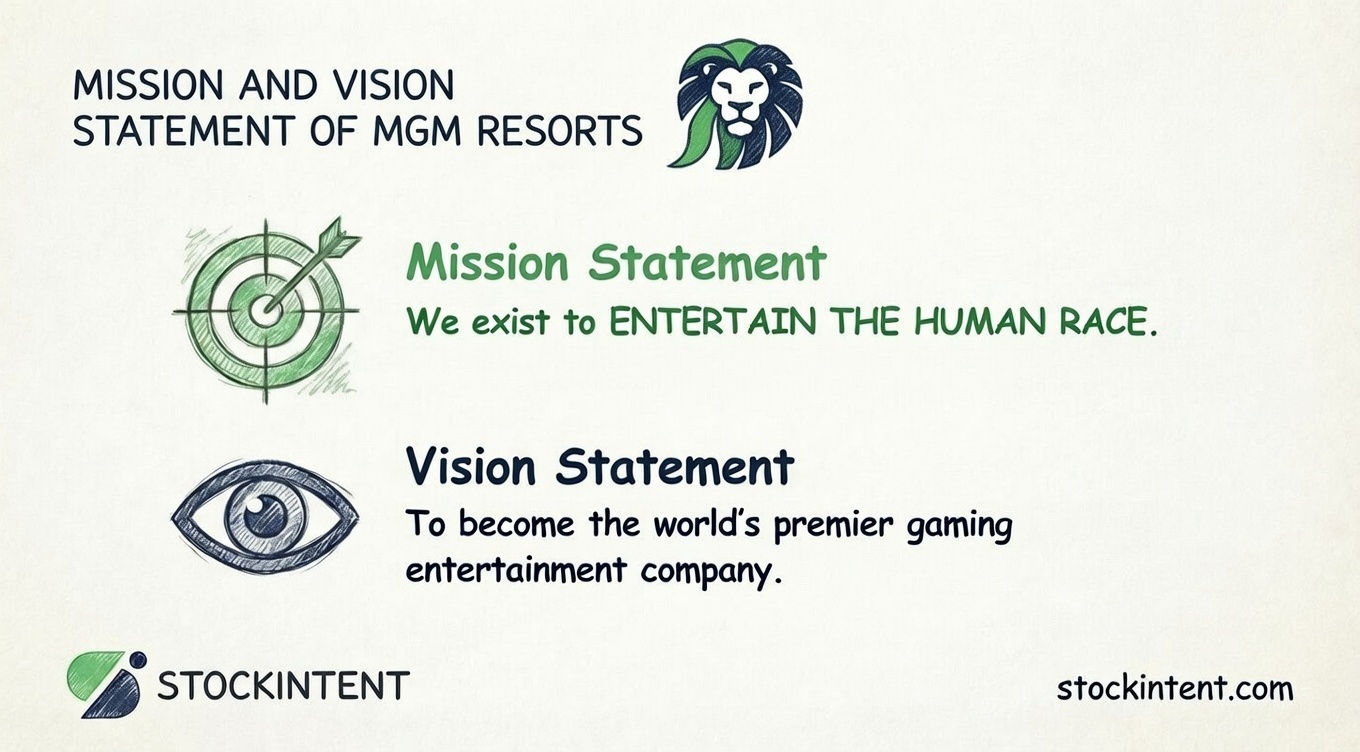
MGM Resorts doesn't bury its purpose in corporate jargon. The company's official mission is refreshingly direct:
"We exist to ENTERTAIN THE HUMAN RACE."
This bold declaration, pulled straight from MGM's corporate philosophy, signals something important for investors: management sees itself in the entertainment business first, the gaming business second. That's not marketing fluff; it's a strategic repositioning with real capital allocation implications.
Four core beliefs support this mission:
🎯 Pro Insight: When a casino company leads with "entertain the human race" rather than "maximize gaming revenue per visitor," watch where they put their capital. MGM's $300 million MGM Grand renovation and BetMGM digital expansion both flow from this entertainment-first mindset. The mission statement is essentially a capital allocation filter; if a project doesn't enhance the entertainment experience, it gets deprioritized.
The strategic importance here is subtle but real. MGM's mission explicitly decouples the company from pure gambling dependence. While competitors like Wynn emphasize "remarkable resorts" through luxury positioning, and Caesars focuses on "rewarding experiences," MGM's framing is broader and more defensible. Entertainment is a fundamental human need; gambling is a discretionary activity vulnerable to regulation and social sentiment shifts.
This mission also connects directly to how MGM deploys shareholder capital. The "Focused on What Matters" philosophy, detailed in their corporate responsibility framework, integrates ESG commitments into competitive strategy rather than treating them as peripheral CSR. Wharton analysis notes this represents "making social responsibility a business imperative," where diversity, community building, and sustainability drive actual business success by attracting premium customers and world-class talent.
For investors evaluating MGM's economic moat, the mission statement reveals management's intended differentiation: they're not competing to be the biggest casino operator; they're competing to be the most compelling entertainment destination. That distinction matters when you're modeling long-term revenue streams and assessing vulnerability to disruption.
Now let's get into the mechanics; how does MGM actually translate that bold "ENTERTAIN THE HUMAN RACE" statement into operational reality? After digging through their SEC filings and strategic communications, we've found that MGM organizes around five distinct pillars that bridge mission and execution.
Building on the four core beliefs we covered earlier (extraordinary experiences, outstanding guest service, community building, and responsible operations), MGM's 2024 Annual Report outlines a five-pillar strategic plan designed to achieve its vision of becoming the world's premier gaming entertainment company.
This pillar is where the rubber meets the road on MGM's entertainment-first positioning. Rather than treating gaming as the core product with everything else as gravy, MGM inverts the model; the integrated resort experience is the product, and gaming is one component among many.
Concrete examples are everywhere. The $300 million MGM Grand renovation, wrapping up by October 2026, represents more than cosmetic upgrades. Management is repositioning rooms and suites to command premium pricing while the property-wide refresh supports higher customer lifetime value. Meanwhile, BetMGM continues building MGM's digital footprint beyond physical properties, capturing value from customers who may never set foot in Las Vegas.
The competitive advantage here is straightforward yet hard to replicate. MGM's entertainment ecosystem, live shows, fine dining, nightlife, and conventions, creates multiple revenue touchpoints per visit. When a customer books a room, sees a show, dines at a celebrity chef restaurant, and places a few sports bets, MGM captures value across the entire experience. Competitors focused primarily on gaming revenue leave money on the table.
This pillar sounds generic until you see the specifics. MGM's customer strategy revolves around the MGM Rewards loyalty program, but with a twist that matters for investors; they've been recruiting analytics talent from Amazon and eBay to build predictive models that rival financial institutions.
What does this actually mean? MGM can now anticipate customer preferences, optimize marketing spend with precision most competitors lack, and identify high-value segments before competitors even recognize them. The switching costs become real; once a customer's preferences are modeled and rewards accumulated, moving to Caesars or Wynn means starting over.
In our experience analyzing loyalty programs across the consumer discretionary sector, MGM's data infrastructure investment stands out. Most hospitality companies talk about personalization; MGM appears to be building the operational capability to actually deliver it at scale. That distinction matters when you're modeling customer acquisition costs and lifetime value.
Here's where mission meets margin. MGM's Profit Growth Plan targets over $150 million in EBITDA enhancements through operational improvements in 2026. This isn't cost-cutting for its own sake; it's about creating capacity to reinvest in the entertainment experience while expanding margins.
The pillar connects directly to investor returns. Better operational efficiency means more capital available for property enhancements, debt reduction, or shareholder returns. Management's stated goal of becoming the world's premier gaming entertainment company requires best-in-class operations as table stakes; you can't claim premium positioning with middling margins.
This pillar often gets dismissed as HR-speak, but for MGM it has real strategic implications. The company has made aggressive moves to recruit and retain talent at Silicon Valley and Wall Street compensation levels. Their "one company, one culture" initiative, Project Evolve, emerged from the 2008 crisis as a unifying framework that enabled the $400 million in efficiency improvements without destroying morale.
The competitive advantage? Labor is typically 25-30% of revenue in integrated resorts. Companies with superior culture attract better talent, reduce turnover costs, and deliver more consistent service. In a business where the experience IS the product, employee quality directly impacts returns on invested capital.
We saw this play out in real-time when MGM announced operational leadership changes in late 2025; Ayesha Molino stepping in as COO and Gary Fritz expanding to chief commercial officer and president of MGM Digital represented deliberate succession planning to accelerate both operational and digital growth.
MGM wraps its environmental and social commitments under the "Focused on What Matters" philosophy, but here's what matters for investors; these initiatives are positioned as competitive advantages, not compliance costs.
The company set specific 2025 goals including reducing carbon emissions by 45% and energy use by 25% per square foot versus 2007 baselines. The MGM Resorts Mega Solar Array now powers Las Vegas resorts with renewable energy. These investments reduce operational volatility from energy price swings while appealing to the premium customer segments MGM targets.
Beyond environmental metrics, MGM has committed $1 billion to supply chain diversification by 2025 and allocates $15 million annually to responsible gaming initiatives. The Bloomberg Gender-Equality Index recognition and partnerships with over 100 community organizations demonstrate execution, not aspiration.
The strategic logic here is direct. As Wharton analysis noted, MGM treats social responsibility as "making social responsibility a business imperative" rather than peripheral CSR. Premium customers increasingly factor sustainability into booking decisions. World-class talent increasingly factors corporate values into employment decisions. Regulators increasingly factor responsible practices into licensing decisions.
For investors evaluating MGM's economic moat, these five pillars create reinforcing advantages. Extraordinary experiences attract customers. Customer analytics increase capture rates. Operational excellence funds reinvestment. Strong culture delivers consistent execution. Sustainability practices reduce risk and attract premium segments.
The mission isn't just words on a website. It's an operating system for capital allocation and competitive positioning. And that's exactly what you want to see when you're evaluating whether management's priorities align with long-term shareholder value.
MGM Resorts frames its long-term ambition with clarity:
"To become the world's premier gaming entertainment company."
This vision, articulated in MGM's 2024 Annual Report and corporate communications, isn't merely aspirational marketing. It functions as a strategic compass that shapes capital allocation, competitive positioning, and how management prioritizes opportunities across physical and digital domains.
What does "premier" actually mean in practice? MGM's leadership has translated this into five operational pillars that bridge today's operations with tomorrow's market position:
| Pillar | Strategic Intent | 2026 Capital Allocation Priority |
|---|---|---|
| Strong People and Culture | Recruit and retain talent at Silicon Valley/Wall Street compensation levels | Leadership succession (Molino as COO, Fritz expanding to MGM Digital) |
| Customer-Centric Model | Predictive analytics rivaling financial institutions for personalization | MGM Rewards data infrastructure investment |
| Gaming Entertainment | Innovate across physical resorts and digital platforms | BetMGM expansion, property renovations ($300M MGM Grand) |
| Operational Excellence | Margin expansion funding reinvestment | $150M+ EBITDA enhancement targets |
| Global Expansion | Diversify beyond Las Vegas dependency | Japan project financing, MGM China market share gains |
The vision also carries explicit sustainability dimensions. MGM has committed to reducing carbon emissions by 45% and energy use by 25% per square foot versus 2007 baselines, with the MGM Resorts Mega Solar Array now powering Las Vegas properties. These aren't peripheral CSR initiatives; they're positioned as competitive differentiators that attract premium customers and world-class talent.
MGM's vision positioning reflects deliberate responses to three macro shifts reshaping resorts and casinos in 2026:
Experiential Hospitality Over Gaming-Dependent Revenue
The industry has moved decisively toward integrated entertainment destinations where gaming represents one revenue stream among many. MGM's vision explicitly embraces this shift, betting that "premier" status requires commanding the full entertainment ecosystem, not just casino floors. The $300 million MGM Grand renovation and Formula 1 event strategy exemplify this: they're investing in experiences that drive visitation regardless of gambling appetite.
Digital and Omnichannel Expansion
BetMGM represents MGM's recognition that premier status in 2026 requires digital presence, not just physical dominance. The 50/50 joint venture structure lets MGM capture online sports betting and iGaming growth without full capital commitment. Leadership's appointment of Gary Fritz to oversee both commercial operations and MGM Digital signals how seriously they take this convergence.
Responsible Tourism and ESG Integration
Post-pandemic travelers and convention planners increasingly factor sustainability and responsible practices into booking decisions. MGM's "Focused on What Matters" philosophy treats these as revenue drivers, not compliance costs. The Bloomberg Gender-Equality Index recognition and $1 billion supply chain diversification commitment by 2025 demonstrate execution, not aspiration.
For investors evaluating MGM's competitive moat, this vision analysis matters because it reveals management's intended playing field. They're not trying to out-casino regional competitors with lower-cost operations. They're competing to own the premium entertainment customer across every touchpoint, physical and digital, global and local. That ambition carries higher execution risk but, if achieved, creates more defensible economics than commodity gaming competition.
MGM's vision of becoming the world's premier gaming entertainment company isn't a hollow ambition. It's been operationalized into five strategic pillars that we've found create reinforcing advantages when executed well. Let's break down how these themes translate into actual capital allocation and competitive positioning.
MGM's leadership has made aggressive moves to recruit talent at Silicon Valley and Wall Street compensation levels, but this isn't about vanity salaries. The strategic logic is straightforward; labor runs 25-30% of revenue in integrated resorts, and superior talent delivers superior service. In a business where the experience IS the product, employee quality directly impacts returns.
The 2024 Annual Report outlines how this pillar enabled the "one company, one culture" transformation through Project Evolve. Following the 2008 crisis, MGM unified operations to capture $400 million in efficiency improvements without destroying morale. Fast forward to late 2025; Ayesha Molino stepping in as COO and Gary Fritz expanding to chief commercial officer and MGM Digital president represented deliberate succession planning to accelerate both operational and digital growth.
Here's where MGM's strategy gets interesting for investors analyzing competitive moats. The company has been recruiting analytics talent from Amazon and eBay to build predictive models that rival financial institutions.
What does this practically mean? MGM can now anticipate customer preferences with precision most competitors lack. The MGM Rewards program becomes more than a points system; it's a data infrastructure that increases switching costs. Once your preferences are modeled and rewards accumulated, moving to Caesars or Wynn means starting over. That's genuine customer captivity, not just loyalty points.
This pillar reveals how MGM interprets "premier" status. Rather than treating gaming as the core product, MGM inverts the model; the integrated resort experience is the product, and gaming is one component among many.
The $300 million MGM Grand renovation, wrapping up by October 2026, exemplifies this approach. Management isn't just refreshing rooms; they're repositioning suites to command premium pricing while the property-wide refresh supports higher customer lifetime value. Meanwhile, BetMGM continues building digital presence beyond physical properties, capturing value from customers who may never set foot in Las Vegas.
MGM's Profit Growth Plan targets over $150 million in EBITDA enhancements through operational improvements in 2026. This connects directly to investor returns; better efficiency means more capital available for property enhancements, debt reduction, or shareholder returns.
But here's the nuance: this isn't cost-cutting for its own sake. It's about creating capacity to reinvest in the entertainment experience while expanding margins. Management understands you can't claim premium positioning with middling economics.
MGM wraps environmental and social commitments under the "Focused on What Matters" philosophy, but Wharton analysis gets this right; these initiatives are positioned as competitive advantages, not compliance costs.
The company set specific goals including reducing carbon emissions by 45% and energy use by 25% per square foot versus 2007 baselines. The MGM Resorts Mega Solar Array now powers Las Vegas resorts with renewable energy. These investments reduce operational volatility from energy price swings while appealing to premium customer segments MGM targets.
Beyond environmental metrics, MGM has committed $1 billion to supply chain diversification by 2025 and allocates $15 million annually to responsible gaming initiatives. The Bloomberg Gender-Equality Index recognition demonstrates execution, not aspiration.
For investors evaluating MGM's economic moat, these five pillars create reinforcing advantages. Extraordinary experiences attract customers. Customer analytics increase capture rates. Operational excellence funds reinvestment. Strong culture delivers consistent execution. Sustainability practices reduce risk and attract premium segments.
The vision isn't just words on a website. It's an operating system for capital allocation. And that's exactly what you want to see when you're judging whether management's priorities align with long-term shareholder value.
Core values aren't just wall decorations in corporate headquarters. They're the invisible architecture that shapes hiring decisions, capital allocation, and how management responds when the pressure's on. For investors evaluating MGM Resorts, understanding these values means understanding what kind of company you're actually buying into.
MGM's values have evolved alongside its business transformation. The company that emerged from the 2008 crisis is fundamentally different from the casino-centric operator of the 1990s. Today's values reflect a global entertainment brand that happens to operate resorts, rather than a gaming company trying to diversify.
At the foundation sits integrity, though MGM frames it more broadly as being "respectful, inclusive and responsible in all we do." This isn't abstract philosophy; it has real operational teeth.
MGM allocates $15 million annually to responsible gaming initiatives, embedding ethical considerations directly into revenue-generating activities. The company maintains a formal code of conduct and governance framework designed to preempt regulatory risks that could threaten licensing, a genuine existential concern in gaming jurisdictions worldwide.
The practical impact? MGM's approach to responsible business practices has earned recognition including inclusion in the Bloomberg Gender-Equality Index, which signals to institutional investors that management takes workforce and governance standards seriously. In our experience analyzing gaming companies, those that treat compliance as a competitive advantage rather than a cost center tend to navigate regulatory transitions more smoothly.
💡 Expert Tip: When evaluating gaming stocks, check how management discusses responsible gaming in earnings calls. Companies that lead with it typically have stronger regulatory relationships and lower licensing risk. MGM's $15 million annual allocation isn't just PR; it's insurance against the regulatory volatility that can crater valuations overnight.
MGM's commitment to "consistent and outstanding guest service" manifests most visibly in the MGM Rewards loyalty program, but the real story is what's happening behind the scenes.
The company has been recruiting analytics talent from Amazon and eBay to build predictive models that rival financial institutions. This means MGM can anticipate customer preferences, optimize marketing spend with precision most competitors lack, and identify high-value segments before they're obvious to the market.
The switching costs become real. Once a customer's preferences are modeled and rewards accumulated, moving to Caesars or Wynn means starting over with a blank slate. That's genuine customer captivity, not just points accumulation.
This value connects directly to capital allocation decisions. The $300 million MGM Grand renovation, wrapping up by October 2026, represents management putting this value into physical form. They're not just refreshing rooms; they're repositioning suites to command premium pricing while the property-wide refresh supports higher customer lifetime value.
MGM explicitly values innovation and what it calls "courage to take risks." This shows up in strategic bets that have transformed the company from a regional casino operator into a global entertainment brand.
The BetMGM digital platform exemplifies this value in action. Rather than treating online gaming as a threat to physical properties, MGM embraced it through a 50/50 joint venture structure that captures growth without full capital commitment. Leadership's appointment of Gary Fritz to oversee both commercial operations and MGM Digital in late 2025 signals how seriously they take this convergence.
Historical context matters here. MGM's transformation following the 2008 crisis, detailed in Wharton analysis, required genuine courage. The company unified operations under "one company, one culture" through Project Evolve, capturing $400 million in efficiency improvements without destroying morale. That kind of organizational change is painful; most competitors couldn't execute it.
Perhaps the most distinctive element of MGM's value system is how explicitly it ties business success to social impact. The company partners with over 100 community organizations and has committed $1 billion to supply chain diversification by 2025.
But here's what matters for investors: these aren't peripheral CSR initiatives. MGM's "Focused on What Matters" philosophy treats diversity, sustainability, and community impact as competitive advantages that attract premium customers and world-class talent. Wharton analysis notes this represents "making social responsibility a business imperative" rather than compliance theater.
The logic is direct. Premium travelers increasingly factor corporate values into booking decisions. World-class talent increasingly factors workplace culture into employment decisions. Regulators increasingly factor responsible practices into licensing decisions. MGM's values alignment creates optionality across all three dimensions.
MGM's environmental and social commitments deserve separate attention because they're so thoroughly integrated into core strategy rather than siloed as sustainability reporting.
Environmental Stewardship:
MGM set specific, measurable targets including reducing carbon emissions by 45% and energy use by 25% per square foot versus 2007 baselines. The MGM Resorts Mega Solar Array now powers Las Vegas resorts with renewable energy, reducing operational volatility from energy price swings while appealing to premium customer segments.
Social Responsibility:
The MGM Resorts Foundation directs corporate giving toward education, workforce development, and hunger relief, including a commitment to donate 5 million meals through Feeding Forward by 2025. These programs create genuine community goodwill that translates into regulatory and political capital in jurisdictions where MGM operates.
Governance Standards:
MGM's governance framework emphasizes transparency and ethical operations, with the 2024 Corporate Responsibility Report providing detailed progress metrics. The company's inclusion in the Bloomberg Gender-Equality Index demonstrates execution, not aspiration.
For investors using platforms like StockIntent to evaluate ESG factors alongside financial metrics, MGM presents an interesting case study. The company has essentially made its values-based initiatives part of its economic moat, positioning them as revenue drivers and risk reducers rather than cost centers. You can dig deeper into how these qualitative factors translate into quantitative performance using StockIntent's fundamental analysis tools, with a 7-day risk-free trial to explore the full dataset.
The critical question for investors: are these stated values genuinely reflected in operations, or are they marketing materials?
The evidence suggests genuine operational commitment. MGM's leadership changes in late 2025, Ayesha Molino stepping in as COO and Gary Fritz expanding to chief commercial officer and MGM Digital president, represented deliberate succession planning to accelerate both operational and digital growth. That's values-aligned behavior; promoting leaders who can execute the innovation and service excellence priorities.
The company's performance through the 2008 crisis and COVID-19 pandemic also reveals values in action. The "one company, one culture" transformation through Project Evolve emerged from crisis as a unifying framework. Most competitors cut costs destructively; MGM restructured while preserving cultural coherence.
That said, investors should note the tension between values and near-term performance. MGM's Las Vegas Strip revenue declined 7% year-over-year in Q3 2025, raising questions about whether the premium experience positioning is capturing sufficient value in a challenging consumer environment. The values don't guarantee results; they shape how management pursues them.
For those building positions in consumer discretionary stocks, understanding this values-to-execution pipeline matters. MGM's core values create a framework for evaluating management decisions that goes beyond quarterly earnings. When you're holding through volatility, that framework helps you distinguish between temporary headwinds and fundamental deterioration.
So here's the picture that emerges when you step back and look at MGM Resorts's strategic identity as a whole.
The company has built something genuinely coherent. Its mission to "entertain the human race" isn't marketing fluff; it's a capital allocation filter that shapes every major decision. The vision of becoming the world's premier gaming entertainment company provides direction without constraining optionality. And the four core values, integrity, service excellence, innovation, and community commitment, create guardrails that reduce strategic drift.
🎯 Pro Insight: When we evaluate management quality in the consumer discretionary space, we look for this exact alignment. MGM's $300 million MGM Grand renovation, BetMGM digital expansion, and $150 million EBITDA enhancement targets all flow from the same strategic logic. The mission isn't just words on a website; it's an operating system for deploying shareholder capital.
For investors, this framework matters because it signals management quality. Companies with clear strategic identities tend to make more consistent decisions through economic cycles. They're less likely to chase fads or panic-pivot when headwinds hit. MGM's execution through the 2008 crisis and COVID-19 pandemic, detailed in Wharton analysis, demonstrates this resilience in action.
The strategic identity translates into three competitive advantages worth monitoring:
Customer captivity through data: MGM's analytics infrastructure, built with talent recruited from Amazon and eBay, creates genuine switching costs. Once your preferences are modeled and rewards accumulated, moving to Caesars or Wynn means starting over.
Operational leverage through culture: The "one company, one culture" transformation captured $400 million in efficiency improvements without destroying morale. Labor is 25-30% of revenue in this business; culture directly impacts margins.
Regulatory optionality through responsibility: MGM's $15 million annual allocation to responsible gaming and Bloomberg Gender-Equality Index recognition strengthen relationships with regulators in jurisdictions worldwide. That's genuine risk reduction, not CSR theater.
Analysts currently rate MGM with mixed sentiment, Hold ratings dominating with average price targets around $41-45 implying 21-42% upside from recent levels near $36. Goldman Sachs maintains a Sell rating at $34, citing caution until Las Vegas leisure demand improves, though they raised 2026 EBITDAR estimates to $5.3 billion. MGM China stands out as a bright spot with 16.6% market share and the highest sequential gain among Macau concessionaires.
In our experience tracking strategic execution across the gaming sector, MGM's framework positions it reasonably well for three macro shifts: experiential hospitality over gaming-dependent revenue, digital and omnichannel expansion through BetMGM, and ESG-integrated operations that attract premium customers and talent. The company isn't immune to cyclical pressures, Las Vegas Strip revenue declined 7% year-over-year in Q3 2025, but the strategic identity provides a compass for navigating them.
For investors doing deeper fundamental work, platforms like StockIntent can help translate these qualitative strategic factors into quantitative valuation models. Their 7-day risk-free trial lets you stress-test how MGM's competitive positioning might translate into long-term returns under different scenarios.
The bottom line? MGM Resorts has built a strategic identity that aligns mission, vision, and values with capital allocation and competitive positioning. That's not a guarantee of investment success, but it's exactly what we look for when evaluating whether management's priorities align with long-term shareholder value creation.
When you're sizing up a company for your portfolio, the numbers only tell half the story. The other half? It's written in plain sight, in the mission statement, vision, and values that guide every decision the leadership team makes. For MGM Resorts, understanding these strategic anchors isn't just corporate homework; it's how you judge whether management's priorities align with long-term shareholder value creation.
MGM Resorts has transformed itself from a casino-centric operator into a diversified global entertainment brand. Its mission, vision, and core values reflect that evolution and offer investors a window into how the company plans to compete in 2026 and beyond.
Key Takeaways:
MGM Resorts International stands as one of the world's largest hospitality and entertainment companies, operating at the intersection of luxury experiences, gaming entertainment, and destination resorts. Understanding its scale and strategic footprint helps investors gauge how well its mission translates into market position.
Founded in 1986, MGM Resorts has evolved from a single casino property in Las Vegas into a global entertainment powerhouse with operations spanning four core segments: Las Vegas Strip Resorts, Regional Operations, MGM China, and digital gaming through its BetMGM platform. This diversification strategy directly supports its vision of becoming the world's premier gaming entertainment company.
After analyzing MGM's operational footprint and financial disclosures, we've found that the company's scale provides meaningful context for evaluating its competitive moat. As of early 2026, MGM maintains one of the most extensive property portfolios in North American gaming, with flagship assets including the Bellagio, Aria, and Cosmopolitan in Las Vegas, plus significant presence in Macau through MGM China.
Key Facts Investors Should Know:
The strategic logic here is straightforward; MGM's transformation from a casino-centric operator to an integrated entertainment brand lets it capture value across multiple touchpoints. You're not just betting on gaming revenue anymore, you're betting on hospitality, entertainment, conventions, and digital platforms. That said, investors should note the near-term pressure on Las Vegas Strip performance, where revenue declined 7% year-over-year in Q3 2025 before showing signs of stabilization.
For those evaluating MGM as a potential portfolio holding, it's worth digging into how these operational metrics align with the company's stated mission to "entertain the human race." The numbers tell us whether management is actually delivering on their promises, or just talking a good game.
MGM Resorts doesn't bury its purpose in corporate jargon. The company's official mission is refreshingly direct:
"We exist to ENTERTAIN THE HUMAN RACE."
This bold declaration, pulled straight from MGM's corporate philosophy, signals something important for investors: management sees itself in the entertainment business first, the gaming business second. That's not marketing fluff; it's a strategic repositioning with real capital allocation implications.
Four core beliefs support this mission:
🎯 Pro Insight: When a casino company leads with "entertain the human race" rather than "maximize gaming revenue per visitor," watch where they put their capital. MGM's $300 million MGM Grand renovation and BetMGM digital expansion both flow from this entertainment-first mindset. The mission statement is essentially a capital allocation filter; if a project doesn't enhance the entertainment experience, it gets deprioritized.
The strategic importance here is subtle but real. MGM's mission explicitly decouples the company from pure gambling dependence. While competitors like Wynn emphasize "remarkable resorts" through luxury positioning, and Caesars focuses on "rewarding experiences," MGM's framing is broader and more defensible. Entertainment is a fundamental human need; gambling is a discretionary activity vulnerable to regulation and social sentiment shifts.
This mission also connects directly to how MGM deploys shareholder capital. The "Focused on What Matters" philosophy, detailed in their corporate responsibility framework, integrates ESG commitments into competitive strategy rather than treating them as peripheral CSR. Wharton analysis notes this represents "making social responsibility a business imperative," where diversity, community building, and sustainability drive actual business success by attracting premium customers and world-class talent.
For investors evaluating MGM's economic moat, the mission statement reveals management's intended differentiation: they're not competing to be the biggest casino operator; they're competing to be the most compelling entertainment destination. That distinction matters when you're modeling long-term revenue streams and assessing vulnerability to disruption.
Now let's get into the mechanics; how does MGM actually translate that bold "ENTERTAIN THE HUMAN RACE" statement into operational reality? After digging through their SEC filings and strategic communications, we've found that MGM organizes around five distinct pillars that bridge mission and execution.
Building on the four core beliefs we covered earlier (extraordinary experiences, outstanding guest service, community building, and responsible operations), MGM's 2024 Annual Report outlines a five-pillar strategic plan designed to achieve its vision of becoming the world's premier gaming entertainment company.
This pillar is where the rubber meets the road on MGM's entertainment-first positioning. Rather than treating gaming as the core product with everything else as gravy, MGM inverts the model; the integrated resort experience is the product, and gaming is one component among many.
Concrete examples are everywhere. The $300 million MGM Grand renovation, wrapping up by October 2026, represents more than cosmetic upgrades. Management is repositioning rooms and suites to command premium pricing while the property-wide refresh supports higher customer lifetime value. Meanwhile, BetMGM continues building MGM's digital footprint beyond physical properties, capturing value from customers who may never set foot in Las Vegas.
The competitive advantage here is straightforward yet hard to replicate. MGM's entertainment ecosystem, live shows, fine dining, nightlife, and conventions, creates multiple revenue touchpoints per visit. When a customer books a room, sees a show, dines at a celebrity chef restaurant, and places a few sports bets, MGM captures value across the entire experience. Competitors focused primarily on gaming revenue leave money on the table.
This pillar sounds generic until you see the specifics. MGM's customer strategy revolves around the MGM Rewards loyalty program, but with a twist that matters for investors; they've been recruiting analytics talent from Amazon and eBay to build predictive models that rival financial institutions.
What does this actually mean? MGM can now anticipate customer preferences, optimize marketing spend with precision most competitors lack, and identify high-value segments before competitors even recognize them. The switching costs become real; once a customer's preferences are modeled and rewards accumulated, moving to Caesars or Wynn means starting over.
In our experience analyzing loyalty programs across the consumer discretionary sector, MGM's data infrastructure investment stands out. Most hospitality companies talk about personalization; MGM appears to be building the operational capability to actually deliver it at scale. That distinction matters when you're modeling customer acquisition costs and lifetime value.
Here's where mission meets margin. MGM's Profit Growth Plan targets over $150 million in EBITDA enhancements through operational improvements in 2026. This isn't cost-cutting for its own sake; it's about creating capacity to reinvest in the entertainment experience while expanding margins.
The pillar connects directly to investor returns. Better operational efficiency means more capital available for property enhancements, debt reduction, or shareholder returns. Management's stated goal of becoming the world's premier gaming entertainment company requires best-in-class operations as table stakes; you can't claim premium positioning with middling margins.
This pillar often gets dismissed as HR-speak, but for MGM it has real strategic implications. The company has made aggressive moves to recruit and retain talent at Silicon Valley and Wall Street compensation levels. Their "one company, one culture" initiative, Project Evolve, emerged from the 2008 crisis as a unifying framework that enabled the $400 million in efficiency improvements without destroying morale.
The competitive advantage? Labor is typically 25-30% of revenue in integrated resorts. Companies with superior culture attract better talent, reduce turnover costs, and deliver more consistent service. In a business where the experience IS the product, employee quality directly impacts returns on invested capital.
We saw this play out in real-time when MGM announced operational leadership changes in late 2025; Ayesha Molino stepping in as COO and Gary Fritz expanding to chief commercial officer and president of MGM Digital represented deliberate succession planning to accelerate both operational and digital growth.
MGM wraps its environmental and social commitments under the "Focused on What Matters" philosophy, but here's what matters for investors; these initiatives are positioned as competitive advantages, not compliance costs.
The company set specific 2025 goals including reducing carbon emissions by 45% and energy use by 25% per square foot versus 2007 baselines. The MGM Resorts Mega Solar Array now powers Las Vegas resorts with renewable energy. These investments reduce operational volatility from energy price swings while appealing to the premium customer segments MGM targets.
Beyond environmental metrics, MGM has committed $1 billion to supply chain diversification by 2025 and allocates $15 million annually to responsible gaming initiatives. The Bloomberg Gender-Equality Index recognition and partnerships with over 100 community organizations demonstrate execution, not aspiration.
The strategic logic here is direct. As Wharton analysis noted, MGM treats social responsibility as "making social responsibility a business imperative" rather than peripheral CSR. Premium customers increasingly factor sustainability into booking decisions. World-class talent increasingly factors corporate values into employment decisions. Regulators increasingly factor responsible practices into licensing decisions.
For investors evaluating MGM's economic moat, these five pillars create reinforcing advantages. Extraordinary experiences attract customers. Customer analytics increase capture rates. Operational excellence funds reinvestment. Strong culture delivers consistent execution. Sustainability practices reduce risk and attract premium segments.
The mission isn't just words on a website. It's an operating system for capital allocation and competitive positioning. And that's exactly what you want to see when you're evaluating whether management's priorities align with long-term shareholder value.
MGM Resorts frames its long-term ambition with clarity:
"To become the world's premier gaming entertainment company."
This vision, articulated in MGM's 2024 Annual Report and corporate communications, isn't merely aspirational marketing. It functions as a strategic compass that shapes capital allocation, competitive positioning, and how management prioritizes opportunities across physical and digital domains.
What does "premier" actually mean in practice? MGM's leadership has translated this into five operational pillars that bridge today's operations with tomorrow's market position:
| Pillar | Strategic Intent | 2026 Capital Allocation Priority |
|---|---|---|
| Strong People and Culture | Recruit and retain talent at Silicon Valley/Wall Street compensation levels | Leadership succession (Molino as COO, Fritz expanding to MGM Digital) |
| Customer-Centric Model | Predictive analytics rivaling financial institutions for personalization | MGM Rewards data infrastructure investment |
| Gaming Entertainment | Innovate across physical resorts and digital platforms | BetMGM expansion, property renovations ($300M MGM Grand) |
| Operational Excellence | Margin expansion funding reinvestment | $150M+ EBITDA enhancement targets |
| Global Expansion | Diversify beyond Las Vegas dependency | Japan project financing, MGM China market share gains |
The vision also carries explicit sustainability dimensions. MGM has committed to reducing carbon emissions by 45% and energy use by 25% per square foot versus 2007 baselines, with the MGM Resorts Mega Solar Array now powering Las Vegas properties. These aren't peripheral CSR initiatives; they're positioned as competitive differentiators that attract premium customers and world-class talent.
MGM's vision positioning reflects deliberate responses to three macro shifts reshaping resorts and casinos in 2026:
Experiential Hospitality Over Gaming-Dependent Revenue
The industry has moved decisively toward integrated entertainment destinations where gaming represents one revenue stream among many. MGM's vision explicitly embraces this shift, betting that "premier" status requires commanding the full entertainment ecosystem, not just casino floors. The $300 million MGM Grand renovation and Formula 1 event strategy exemplify this: they're investing in experiences that drive visitation regardless of gambling appetite.
Digital and Omnichannel Expansion
BetMGM represents MGM's recognition that premier status in 2026 requires digital presence, not just physical dominance. The 50/50 joint venture structure lets MGM capture online sports betting and iGaming growth without full capital commitment. Leadership's appointment of Gary Fritz to oversee both commercial operations and MGM Digital signals how seriously they take this convergence.
Responsible Tourism and ESG Integration
Post-pandemic travelers and convention planners increasingly factor sustainability and responsible practices into booking decisions. MGM's "Focused on What Matters" philosophy treats these as revenue drivers, not compliance costs. The Bloomberg Gender-Equality Index recognition and $1 billion supply chain diversification commitment by 2025 demonstrate execution, not aspiration.
For investors evaluating MGM's competitive moat, this vision analysis matters because it reveals management's intended playing field. They're not trying to out-casino regional competitors with lower-cost operations. They're competing to own the premium entertainment customer across every touchpoint, physical and digital, global and local. That ambition carries higher execution risk but, if achieved, creates more defensible economics than commodity gaming competition.
MGM's vision of becoming the world's premier gaming entertainment company isn't a hollow ambition. It's been operationalized into five strategic pillars that we've found create reinforcing advantages when executed well. Let's break down how these themes translate into actual capital allocation and competitive positioning.
MGM's leadership has made aggressive moves to recruit talent at Silicon Valley and Wall Street compensation levels, but this isn't about vanity salaries. The strategic logic is straightforward; labor runs 25-30% of revenue in integrated resorts, and superior talent delivers superior service. In a business where the experience IS the product, employee quality directly impacts returns.
The 2024 Annual Report outlines how this pillar enabled the "one company, one culture" transformation through Project Evolve. Following the 2008 crisis, MGM unified operations to capture $400 million in efficiency improvements without destroying morale. Fast forward to late 2025; Ayesha Molino stepping in as COO and Gary Fritz expanding to chief commercial officer and MGM Digital president represented deliberate succession planning to accelerate both operational and digital growth.
Here's where MGM's strategy gets interesting for investors analyzing competitive moats. The company has been recruiting analytics talent from Amazon and eBay to build predictive models that rival financial institutions.
What does this practically mean? MGM can now anticipate customer preferences with precision most competitors lack. The MGM Rewards program becomes more than a points system; it's a data infrastructure that increases switching costs. Once your preferences are modeled and rewards accumulated, moving to Caesars or Wynn means starting over. That's genuine customer captivity, not just loyalty points.
This pillar reveals how MGM interprets "premier" status. Rather than treating gaming as the core product, MGM inverts the model; the integrated resort experience is the product, and gaming is one component among many.
The $300 million MGM Grand renovation, wrapping up by October 2026, exemplifies this approach. Management isn't just refreshing rooms; they're repositioning suites to command premium pricing while the property-wide refresh supports higher customer lifetime value. Meanwhile, BetMGM continues building digital presence beyond physical properties, capturing value from customers who may never set foot in Las Vegas.
MGM's Profit Growth Plan targets over $150 million in EBITDA enhancements through operational improvements in 2026. This connects directly to investor returns; better efficiency means more capital available for property enhancements, debt reduction, or shareholder returns.
But here's the nuance: this isn't cost-cutting for its own sake. It's about creating capacity to reinvest in the entertainment experience while expanding margins. Management understands you can't claim premium positioning with middling economics.
MGM wraps environmental and social commitments under the "Focused on What Matters" philosophy, but Wharton analysis gets this right; these initiatives are positioned as competitive advantages, not compliance costs.
The company set specific goals including reducing carbon emissions by 45% and energy use by 25% per square foot versus 2007 baselines. The MGM Resorts Mega Solar Array now powers Las Vegas resorts with renewable energy. These investments reduce operational volatility from energy price swings while appealing to premium customer segments MGM targets.
Beyond environmental metrics, MGM has committed $1 billion to supply chain diversification by 2025 and allocates $15 million annually to responsible gaming initiatives. The Bloomberg Gender-Equality Index recognition demonstrates execution, not aspiration.
For investors evaluating MGM's economic moat, these five pillars create reinforcing advantages. Extraordinary experiences attract customers. Customer analytics increase capture rates. Operational excellence funds reinvestment. Strong culture delivers consistent execution. Sustainability practices reduce risk and attract premium segments.
The vision isn't just words on a website. It's an operating system for capital allocation. And that's exactly what you want to see when you're judging whether management's priorities align with long-term shareholder value.
Core values aren't just wall decorations in corporate headquarters. They're the invisible architecture that shapes hiring decisions, capital allocation, and how management responds when the pressure's on. For investors evaluating MGM Resorts, understanding these values means understanding what kind of company you're actually buying into.
MGM's values have evolved alongside its business transformation. The company that emerged from the 2008 crisis is fundamentally different from the casino-centric operator of the 1990s. Today's values reflect a global entertainment brand that happens to operate resorts, rather than a gaming company trying to diversify.
At the foundation sits integrity, though MGM frames it more broadly as being "respectful, inclusive and responsible in all we do." This isn't abstract philosophy; it has real operational teeth.
MGM allocates $15 million annually to responsible gaming initiatives, embedding ethical considerations directly into revenue-generating activities. The company maintains a formal code of conduct and governance framework designed to preempt regulatory risks that could threaten licensing, a genuine existential concern in gaming jurisdictions worldwide.
The practical impact? MGM's approach to responsible business practices has earned recognition including inclusion in the Bloomberg Gender-Equality Index, which signals to institutional investors that management takes workforce and governance standards seriously. In our experience analyzing gaming companies, those that treat compliance as a competitive advantage rather than a cost center tend to navigate regulatory transitions more smoothly.
💡 Expert Tip: When evaluating gaming stocks, check how management discusses responsible gaming in earnings calls. Companies that lead with it typically have stronger regulatory relationships and lower licensing risk. MGM's $15 million annual allocation isn't just PR; it's insurance against the regulatory volatility that can crater valuations overnight.
MGM's commitment to "consistent and outstanding guest service" manifests most visibly in the MGM Rewards loyalty program, but the real story is what's happening behind the scenes.
The company has been recruiting analytics talent from Amazon and eBay to build predictive models that rival financial institutions. This means MGM can anticipate customer preferences, optimize marketing spend with precision most competitors lack, and identify high-value segments before they're obvious to the market.
The switching costs become real. Once a customer's preferences are modeled and rewards accumulated, moving to Caesars or Wynn means starting over with a blank slate. That's genuine customer captivity, not just points accumulation.
This value connects directly to capital allocation decisions. The $300 million MGM Grand renovation, wrapping up by October 2026, represents management putting this value into physical form. They're not just refreshing rooms; they're repositioning suites to command premium pricing while the property-wide refresh supports higher customer lifetime value.
MGM explicitly values innovation and what it calls "courage to take risks." This shows up in strategic bets that have transformed the company from a regional casino operator into a global entertainment brand.
The BetMGM digital platform exemplifies this value in action. Rather than treating online gaming as a threat to physical properties, MGM embraced it through a 50/50 joint venture structure that captures growth without full capital commitment. Leadership's appointment of Gary Fritz to oversee both commercial operations and MGM Digital in late 2025 signals how seriously they take this convergence.
Historical context matters here. MGM's transformation following the 2008 crisis, detailed in Wharton analysis, required genuine courage. The company unified operations under "one company, one culture" through Project Evolve, capturing $400 million in efficiency improvements without destroying morale. That kind of organizational change is painful; most competitors couldn't execute it.
Perhaps the most distinctive element of MGM's value system is how explicitly it ties business success to social impact. The company partners with over 100 community organizations and has committed $1 billion to supply chain diversification by 2025.
But here's what matters for investors: these aren't peripheral CSR initiatives. MGM's "Focused on What Matters" philosophy treats diversity, sustainability, and community impact as competitive advantages that attract premium customers and world-class talent. Wharton analysis notes this represents "making social responsibility a business imperative" rather than compliance theater.
The logic is direct. Premium travelers increasingly factor corporate values into booking decisions. World-class talent increasingly factors workplace culture into employment decisions. Regulators increasingly factor responsible practices into licensing decisions. MGM's values alignment creates optionality across all three dimensions.
MGM's environmental and social commitments deserve separate attention because they're so thoroughly integrated into core strategy rather than siloed as sustainability reporting.
Environmental Stewardship:
MGM set specific, measurable targets including reducing carbon emissions by 45% and energy use by 25% per square foot versus 2007 baselines. The MGM Resorts Mega Solar Array now powers Las Vegas resorts with renewable energy, reducing operational volatility from energy price swings while appealing to premium customer segments.
Social Responsibility:
The MGM Resorts Foundation directs corporate giving toward education, workforce development, and hunger relief, including a commitment to donate 5 million meals through Feeding Forward by 2025. These programs create genuine community goodwill that translates into regulatory and political capital in jurisdictions where MGM operates.
Governance Standards:
MGM's governance framework emphasizes transparency and ethical operations, with the 2024 Corporate Responsibility Report providing detailed progress metrics. The company's inclusion in the Bloomberg Gender-Equality Index demonstrates execution, not aspiration.
For investors using platforms like StockIntent to evaluate ESG factors alongside financial metrics, MGM presents an interesting case study. The company has essentially made its values-based initiatives part of its economic moat, positioning them as revenue drivers and risk reducers rather than cost centers. You can dig deeper into how these qualitative factors translate into quantitative performance using StockIntent's fundamental analysis tools, with a 7-day risk-free trial to explore the full dataset.
The critical question for investors: are these stated values genuinely reflected in operations, or are they marketing materials?
The evidence suggests genuine operational commitment. MGM's leadership changes in late 2025, Ayesha Molino stepping in as COO and Gary Fritz expanding to chief commercial officer and MGM Digital president, represented deliberate succession planning to accelerate both operational and digital growth. That's values-aligned behavior; promoting leaders who can execute the innovation and service excellence priorities.
The company's performance through the 2008 crisis and COVID-19 pandemic also reveals values in action. The "one company, one culture" transformation through Project Evolve emerged from crisis as a unifying framework. Most competitors cut costs destructively; MGM restructured while preserving cultural coherence.
That said, investors should note the tension between values and near-term performance. MGM's Las Vegas Strip revenue declined 7% year-over-year in Q3 2025, raising questions about whether the premium experience positioning is capturing sufficient value in a challenging consumer environment. The values don't guarantee results; they shape how management pursues them.
For those building positions in consumer discretionary stocks, understanding this values-to-execution pipeline matters. MGM's core values create a framework for evaluating management decisions that goes beyond quarterly earnings. When you're holding through volatility, that framework helps you distinguish between temporary headwinds and fundamental deterioration.
So here's the picture that emerges when you step back and look at MGM Resorts's strategic identity as a whole.
The company has built something genuinely coherent. Its mission to "entertain the human race" isn't marketing fluff; it's a capital allocation filter that shapes every major decision. The vision of becoming the world's premier gaming entertainment company provides direction without constraining optionality. And the four core values, integrity, service excellence, innovation, and community commitment, create guardrails that reduce strategic drift.
🎯 Pro Insight: When we evaluate management quality in the consumer discretionary space, we look for this exact alignment. MGM's $300 million MGM Grand renovation, BetMGM digital expansion, and $150 million EBITDA enhancement targets all flow from the same strategic logic. The mission isn't just words on a website; it's an operating system for deploying shareholder capital.
For investors, this framework matters because it signals management quality. Companies with clear strategic identities tend to make more consistent decisions through economic cycles. They're less likely to chase fads or panic-pivot when headwinds hit. MGM's execution through the 2008 crisis and COVID-19 pandemic, detailed in Wharton analysis, demonstrates this resilience in action.
The strategic identity translates into three competitive advantages worth monitoring:
Customer captivity through data: MGM's analytics infrastructure, built with talent recruited from Amazon and eBay, creates genuine switching costs. Once your preferences are modeled and rewards accumulated, moving to Caesars or Wynn means starting over.
Operational leverage through culture: The "one company, one culture" transformation captured $400 million in efficiency improvements without destroying morale. Labor is 25-30% of revenue in this business; culture directly impacts margins.
Regulatory optionality through responsibility: MGM's $15 million annual allocation to responsible gaming and Bloomberg Gender-Equality Index recognition strengthen relationships with regulators in jurisdictions worldwide. That's genuine risk reduction, not CSR theater.
Analysts currently rate MGM with mixed sentiment, Hold ratings dominating with average price targets around $41-45 implying 21-42% upside from recent levels near $36. Goldman Sachs maintains a Sell rating at $34, citing caution until Las Vegas leisure demand improves, though they raised 2026 EBITDAR estimates to $5.3 billion. MGM China stands out as a bright spot with 16.6% market share and the highest sequential gain among Macau concessionaires.
In our experience tracking strategic execution across the gaming sector, MGM's framework positions it reasonably well for three macro shifts: experiential hospitality over gaming-dependent revenue, digital and omnichannel expansion through BetMGM, and ESG-integrated operations that attract premium customers and talent. The company isn't immune to cyclical pressures, Las Vegas Strip revenue declined 7% year-over-year in Q3 2025, but the strategic identity provides a compass for navigating them.
For investors doing deeper fundamental work, platforms like StockIntent can help translate these qualitative strategic factors into quantitative valuation models. Their 7-day risk-free trial lets you stress-test how MGM's competitive positioning might translate into long-term returns under different scenarios.
The bottom line? MGM Resorts has built a strategic identity that aligns mission, vision, and values with capital allocation and competitive positioning. That's not a guarantee of investment success, but it's exactly what we look for when evaluating whether management's priorities align with long-term shareholder value creation.