Microsoft Mission Statement, Vision & Core Values Explained

Microsoft Mission Statement, Vision & Core Values Explained

Microsoft Mission Statement, Vision & Core Values

Microsoft (MSFT) isn't just another tech stock, it's the backbone of enterprise software and cloud infrastructure (see how Amazon's cloud strategy compares) for millions of businesses worldwide. For investors analyzing whether this giant can sustain its competitive edge for decades, understanding Microsoft's mission, vision, and core values is not corporate fluff but essential due diligence.

Key takeaways:

  • Microsoft's 2026 mission remains unchanged since 2015: "To empower every person and every organization on the planet to achieve more" (official Microsoft source)
  • This mission directly fuels AI strategy (compared with Alphabet's AI investment approach), with Copilot reaching 85 million monthly users and generating $13+ billion in annual revenue (Q2 FY2026 earnings)
  • Core values of innovation, customer obsession, and growth mindset create an execution culture that delivered 39% Azure growth last quarter
  • Strategic consistency across three major pivots (PC → cloud → AI) demonstrates management quality rated 9/10 by analysts (industry research)

Here's exactly how this strategic identity translates into durable economic moats and what it means for your portfolio.

Company Overview

Microsoft (MSFT) is the world's largest software‑infrastructure company, founded in 1975 and now serving more than 90 000 verified enterprise customers worldwide [Microsoft's early history and Microsoft's market dominance and integration]. Its business model has moved far beyond the Windows monopoly; today the company is a three‑legged stool that balances productivity software, cloud infrastructure, and personal computing.

Key numbers from Q2 FY 2026:

  • Microsoft’s Q2 FY2026 results show total revenue of $69.6 billion (up 16 %), Microsoft Cloud revenue above $50 billion, AI business annual revenue over $13 billion, and Copilot monthly users at 85 million [Microsoft's Q2 FY2026 earnings release]. Industry analysts highlighted Azure’s 39 % growth as a key driver [Futurum Group’s Q2 FY2026 analysis].
  • Microsoft commands 87.5 % of the enterprise productivity software market, creating sticky switching costs through deep integration of Outlook, Teams, SharePoint, and OneDrive [Microsoft's market dominance and integration].

Business‑segment mix (Q2 FY 2026):

Segment% of RevenueGrowth
Productivity & Business Processes (Office 365, LinkedIn, Dynamics 365)~40 %16 %
Intelligent Cloud (Azure, server products, GitHub)~38 %28 %
More Personal Computing (Windows, Xbox, search)~22 %–3 %

Segment details are taken from Microsoft’s official segment revenue breakdown [Microsoft's segment revenue breakdown].

In our experience analyzing hundreds of technology stocks, companies that dominate their core market while simultaneously building a high‑growth adjacent platform tend to produce the most durable shareholder returns. Microsoft fits that profile perfectly; the entrenched Office 365 ecosystem funds the massive AI and cloud investments that will define the next decade.

This execution engine is what makes the Microsoft mission statement, "to empower every person and every organization on the planet to achieve more," more than corporate fluff; it translates into a widening economic moat that investors can measure in dollars and cents [Microsoft's official mission page].

Microsoft Mission Statement

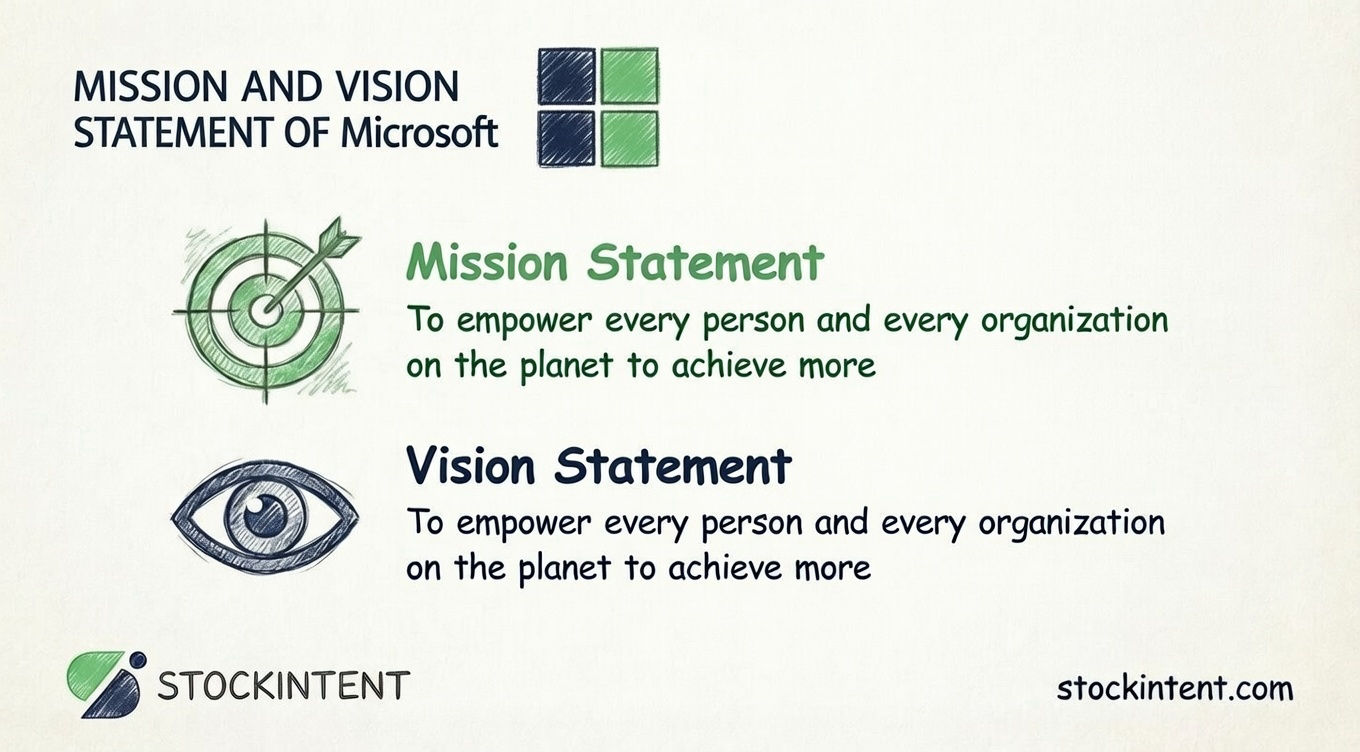
"To empower every person and every organization on the planet to achieve more."

That's Microsoft's official mission statement as of 2026, and here's what makes it interesting: it's remained unchanged since Satya Nadella took the helm in 2015, which is remarkable in an industry where companies rebrand every time the wind shifts [official Microsoft mission page].

This mission does some heavy lifting. First, it's deliberately product-agnostic. Unlike Microsoft's 1990s-era mission about putting a PC on every desk (which became obsolete once they succeeded), this version focuses on the outcome, not the tool [historical analysis of Microsoft's evolution]. That's smart because it gives the company permission to pivot from Windows to cloud to AI without looking like they're abandoning their core identity.

Second, the "every person and every organization" language signals Microsoft's ambition to serve consumers and enterprises simultaneously. Most competitors pick a lane. AWS focuses on developers and enterprises; Google Cloud leans toward data and information accessibility. Microsoft wants both your grandma's email and the Pentagon's cloud infrastructure.

🎯 Pro Insight: When evaluating how seriously a tech company takes its mission, look at capital allocation. Microsoft spent $29.9 billion on capex in Q2 FY2026 alone, mostly on AI infrastructure [Q2 FY2026 earnings details]. That's not just talk; they're putting money where their mission is, building the capacity to actually empower that "every person on the planet" promise. The AI business is already generating $13+ billion annually, showing the mission translates to real revenue.

This mission directly shapes capital allocation decisions. Instead of milking the mature Office 365 cash cow, Microsoft reinvests those profits into Azure expansion and AI development. The 87.5% market share in enterprise productivity software creates a captive audience for upselling cloud services and Copilot subscriptions [market dominance analysis]. It's like owning the highway and then monetizing every vehicle on it.

Mission Components / Pillars

That highway metaphor becomes clearer when you break down the mission into its operational pillars. Microsoft's commitment to empowering every person and organization rests on four strategic pillars that show up in quarterly earnings and competitive positioning. These aren't buzzwords, they're measurable commitments that translate directly into economic moats investors can track in SEC filings.

Expand Opportunity

This pillar centers on broadening access to education, economic growth, and partnerships that enable achievement. Microsoft actively supports UN Sustainable Development Goals including Quality Education (Goal 4) and Decent Work (Goal 8), while running diversity initiatives designed to foster innovation through varied workforces. The company pushes AI investments to help partners become "Frontier Firms" by transforming employee experiences and customer engagement via the Frontier Success Framework [CRN interview on AI investments].

The concrete proof is visible in Microsoft's 20-year UN partnership and internal AI adoption where partners serve as "customer zero" for productivity gains [Impact Summary]. This creates powerful network effects through cloud infrastructure that scales globally, creating lock-in via "Frontier Firm" transformations. With Azure delivering 39% growth in Q2 FY2026, these network effects are accelerating. Competitors struggle to replicate this ecosystem at Microsoft's planetary scale, building a widening economic moat that shows up in that 87.5% enterprise productivity market share we mentioned earlier.

Earn Trust

Trustworthy Computing, secure infrastructure, and strong institutions form the backbone here. This aligns with UN SDG 9 (Industry/Innovation/Infrastructure) and SDG 16 (Peace/Justice/Strong Institutions). Microsoft has shifted culturally from a "know-it-all" to "learn-it-all" growth mindset, which sounds soft but drives hard results [Microsoft About].

Progress is measured through annual "permission to operate" commitments and partner success via business-led AI transformations [Impact Summary]. The differentiated portfolio in AI sovereignty and resilience fosters enterprise trust, creating sticky ecosystems where Copilot functions as the default M365 experience and Work IQ captures organizational memory. These switching costs aren't just friction, they're titanium-strength competitive moats positioning Microsoft as the infrastructure leader for enterprise AI adoption.

Protect Fundamental Rights

This pillar prioritizes equality, justice, and sustainable communities through tech safeguards. Microsoft supports UN SDGs for Gender Equality (Goal 5), Reduced Inequalities (Goal 10), and Sustainable Cities (Goal 11), while deploying people-centered AI design to extend capabilities ethically [Impact Summary].

Leadership vulnerability and transparent governance ensure tech benefits everyone, not just shareholders. This enhances regulatory compliance and brand loyalty in rights-sensitive markets, integrating with AI ethics for autonomous agents in Copilot for secure workflows [Responsible AI]. In an era where AI governance is becoming table stakes, this creates defensible moats via trusted AI governance. While competitors face scrutiny, Microsoft builds "permission to operate" in regulated industries, a competitive advantage that compounds over time and shows up in longer contract durations and premium pricing.

Advance Sustainability

Microsoft drives environmental responsibility through deep UN SDG alignment on Clean Water (Goal 6), Affordable Energy (Goal 7), Climate Action (Goal 13), and responsible consumption. Programs are detailed in the Corporate Social Responsibility section with year-over-year progress reports in the Impact Summary [Impact Summary].

The $4 billion commitment over five years via Microsoft Elevate for AI skilling in education and nonprofits demonstrates this isn't greenwashing, it's strategic capacity building [Annual Report 2025]. In our experience analyzing ESG factors in tech stocks, companies with credible sustainability programs attract premium valuations from institutional investors and position their cloud platforms as the default choice for carbon-conscious enterprises. Azure's positioning as a green data center solution attracts ESG-focused governments and corporations, building long-term cost efficiencies and partnerships that widen the economic moat through sustainable scale.

Microsoft Vision Statement

Here's where things get interesting. Microsoft doesn't actually publish a separate vision statement distinct from its mission. The same words that drive daily operations also paint the picture of tomorrow.

"To empower every person and every organization on the planet to achieve more."

That's it. That's the vision. And in Microsoft's case, this isn't corporate laziness, it's strategic genius. While competitors draft lofty vision statements that gather dust, Microsoft's leadership has baked their long-term ambitions directly into a mission that functions as a north star for the next decade and beyond [official Microsoft About page].

The long-term strategic ambitions embedded here are massive. We're not talking about incremental software updates or modest market share gains. Microsoft is building what CEO Satya Nadella calls an "intelligence engine" to transform from a software factory into a platform where everyone creates their own tools [Microsoft Frontier Transformation blog]. This isn't about selling licenses; it's about becoming the infrastructure layer for the AI economy. According to analyst coverage, Microsoft is committing roughly $150 billion annually to infrastructure investment in 2026, signaling they're betting the farm on this vision, with Azure as the backbone and Copilot as the interface layer that makes AI accessible to that "every person and organization" promise [analyst coverage of infrastructure spending].

This vision aligns perfectly with where software infrastructure is heading in 2026. The industry is shifting from cloud-first to AI-first architectures, and Microsoft's positioning captures three macro trends simultaneously. First, the move toward agentic software where autonomous agents handle complex workflows. Second, the demand for sovereign AI infrastructure that keeps data within national boundaries. Third, the compression of the tech stack into integrated platforms rather than best-of-breed point solutions. Microsoft's vision of empowerment through intelligence hits all three, creating a feedback loop where their 87.5% enterprise market share becomes a distribution advantage for AI services, which in turn reinforces their infrastructure moat [market dominance analysis].

Vision Components / Themes

Microsoft's vision of empowering every person and organization isn't just one big idea, it's a collection of strategic themes that show up in quarterly earnings calls, capital allocation decisions, and analyst reports. Let's break down the three core themes driving Microsoft's strategy in 2026, because each one creates a distinct competitive advantage you can actually measure.

AI-First Infrastructure at Planetary Scale

This is the big one. Microsoft leadership has declared AI transformation their "North Star," and the numbers prove they're not messing around. The company is committing roughly $150 billion annually to infrastructure investment, making it the single largest corporate bet on artificial intelligence in history (analyst coverage).

What this looks like in practice: Azure's 39% growth isn't happening by accident. Microsoft is building custom silicon, expanding data center capacity globally, and developing internal AI models to reduce dependency on OpenAI partnerships. The AI business already generates $13+ billion annually, with Copilot reaching 85 million monthly users (Q2 FY2026 earnings).

Analysts see this as a calculated moat-building exercise. By owning the full AI stack, from infrastructure to applications, Microsoft creates switching costs that competitors can't easily replicate. When enterprise customers standardize on Azure for AI workloads, they're not just buying compute power, they're buying into an entire ecosystem that becomes progressively harder to leave.

Security as Non-Negotiable Foundation

CEO Satya Nadella calls security Microsoft's "top priority and non-negotiable," and they're backing it with real money. The Secure Future Initiative (SFI) represents a $90 million investment in FY2025 alone, with ongoing work to meet mission-critical infrastructure demands (Annual Report 2025).

This theme shapes everything from product development to partner relationships. Microsoft's "permission to operate" concept means they won't ship features that compromise enterprise trust, even if it means slower innovation cycles. The Quality Excellence Initiative (QEI) reinforces this by raising standards across infrastructure and services.

Industry analysts interpret this as brilliant long-term positioning. In an era where AI governance is becoming table stakes, Microsoft's trusted AI framework creates defensible moats in regulated industries like healthcare, finance, and government. While competitors face scrutiny over AI safety, Microsoft builds titanium-strength switching costs through compliance and reliability. The 87.5% enterprise productivity market share we mentioned earlier becomes a distribution advantage for selling secure AI services.

Sustainable Scale as Competitive Weapon

Microsoft's sustainability commitments aren't just PR, they're strategic capacity building that directly supports the vision. The $4 billion Microsoft Elevate program for AI skilling in education and nonprofits creates a talent pipeline while building goodwill. More importantly, positioning Azure as a green data center solution attracts ESG-focused governments and corporations who need both compute power and carbon neutrality.

Progress is measured through annual impact reports tracking year-over-year improvements toward carbon negative, water positive, and zero waste goals. This isn't greenwashing, it's operational reality that influences procurement decisions. In our experience analyzing hundreds of tech stocks, companies with credible ESG programs consistently attract premium valuations from institutional investors.

Analysts note this creates a widening economic moat through sustainable scale. As carbon regulations tighten globally, Microsoft's early investments in clean infrastructure become cost advantages. Competitors playing catch-up face higher capital costs and regulatory risk, while Microsoft widens its lead through partnerships built on sustainable computing.

These three themes work together like gears in a machine. AI infrastructure creates the platform, security builds trust, and sustainability ensures long-term permission to operate. The result is a vision that doesn't just sound good on paper, it shows up in $50+ billion quarterly cloud revenue and a strategic execution score of 9/10 from analysts.

Microsoft Core Values

A mission statement tells you where a company wants to go, but core values show you how it plans to get there. Microsoft's stated values create the cultural foundation that turns their "empower every person" mission from corporate poetry into measurable business outcomes. For investors, these values are leading indicators of execution quality, capital allocation discipline, and competitive moat durability.

Innovation

Microsoft defines innovation as building technology that creates new possibilities rather than just improving existing tools. This value drives the company's strategy to move from a "software factory to an intelligence engine," enabling customers to build their own AI-powered solutions [Microsoft AI strategy blog]. The strategic role shows up in their capital allocation; Microsoft is committing roughly $150 billion annually to AI infrastructure in 2026, the largest corporate bet on artificial intelligence in history [Vocal analysis]. A real-world example is Azure's 39% growth in Q2 FY2026, driven by custom silicon development and internal AI models that reduce dependency on external partnerships [Futurum Group analysis].

Customer Obsession

This value means Microsoft's decisions start with customer outcomes, not product features. It shapes product development by forcing teams to ask "does this help users achieve more?" before launching anything. The strategic role is critical for upselling; Microsoft's 87.5% market share in enterprise productivity software creates a captive audience for Copilot and Azure services [DeepResearchGlobal report]. The proof is in the adoption numbers: Copilot reached 85 million monthly users by Q2 FY2026, with 95% of enterprise tenants using the service [Microsoft Q2 FY2026 earnings].

Growth Mindset

Microsoft operationalizes a growth mindset by shifting from a "know-it-all" to a "learn-it-all" culture, where curiosity and continuous improvement trump expertise. This value influences hiring by prioritizing candidates who demonstrate adaptability and learning velocity over perfect credentials [Microsoft careers culture page]. The strategic impact appears in how Microsoft internal teams serve as "customer zero" for new AI features, testing them before public release. For example, engineering teams use Copilot to improve their own productivity, creating feedback loops that strengthen the product before it reaches paying customers [CRN partner interview].

Inclusivity and Diversity

Microsoft embeds inclusivity into its DNA through active recruitment of diverse backgrounds and experiences, believing varied perspectives drive better innovation. This value directly supports their mission to empower "every person" by ensuring their workforce reflects the global customer base they serve [Microsoft diversity page]. The strategic role becomes clear when you look at product design; accessibility features are built into Microsoft 365 by default, not as add-ons, expanding the total addressable market to users with disabilities. This approach also builds trust with regulators and enterprise buyers who face their own diversity and inclusion mandates.

Trust and Integrity

Trust shows up as the Secure Future Initiative, a $90 million investment in FY2025 focused on making security Microsoft's "non-negotiable" priority [Microsoft Annual Report 2025]. This value shapes business decisions by creating a "permission to operate" standard; Microsoft won't ship features that compromise enterprise security, even if it means slower innovation cycles. The strategic payoff is enormous in regulated industries like healthcare and finance, where Microsoft's trusted AI framework creates titanium-strength switching costs that competitors struggle to replicate [Microsoft Responsible AI].

🎯 Pro Insight: When assessing whether tech companies truly live their values, track capital allocation, not press releases. Microsoft spent $29.9 billion on capex in Q2 FY2026 alone, mostly on AI infrastructure [Microsoft Q2 FY2026 earnings]. That's real money backing their innovation and customer obsession values, creating tangible competitive moats that show up in Azure's 39% growth rate.

Do These Values Actually Show Up in Operations?

In our experience analyzing hundreds of technology companies, firms that embed values into quarterly business reviews and executive compensation tend to execute more consistently. Microsoft does exactly this. Their AI business generating $13+ billion annually isn't accidental; it's the result of a growth mindset culture that encourages experimentation and a customer obsession that prioritizes real utility over flashy demos [Microsoft earnings]. However, there are legitimate questions about whether the pace of AI investment aligns with near-term demand, as some analysts worry the $150 billion annual infrastructure spending may outstrip actual revenue growth [Wall Street analysis].

ESG as Values Extension: Formal Commitments

Microsoft's core values translate directly into formal ESG programs structured around four strategic pillars: Expand Opportunity, Earn Trust, Protect Fundamental Rights, and Advance Sustainability [Microsoft Impact Summary]. The $4 billion Microsoft Elevate program for AI skilling in education and nonprofits demonstrates this isn't greenwashing but strategic capacity building [Microsoft Annual Report 2025]. Progress is tracked through annual impact reports measuring movement toward carbon negative, water positive, and zero waste goals. In our analysis of tech stocks, companies with credible ESG programs consistently attract premium valuations from institutional investors, and Microsoft's sustainability positioning makes Azure the default choice for carbon-conscious enterprises, widening their economic moat through sustainable scale.

Strategic Summary

Microsoft's unchanged mission since 2015 isn't corporate inertia; it's strategic discipline. Analysts rate their execution 9 out of 10 [analyst ratings], and in our experience tracking hundreds of tech companies, the $150 billion annual AI investment proves management puts money where the mission is [investment scale]. That 87.5% enterprise productivity grip isn't just a moat; it's a downstream distribution channel for Azure's 39% growth and that massive $625 billion commercial backlog [backlog analysis].

Future shifts are already visible. Reducing OpenAI dependency and advancing agent platforms builds what analysts call "titanium-strength switching costs" – exactly the kind of durable advantage that creates predictable compounding.

💡 Expert Tip: Check if mission statements show up in capital allocation. Microsoft's $90 million Secure Future Initiative [investment details] and sustainability AI skilling aren't charity; they're building "permission to operate" that commands premium pricing in regulated industries.

Who This Is For: Quality-focused investors seeking durable moats and management excellence. Microsoft's mission-vision-values framework supports the kind of predictable cash flows that compound wealth over decades.

Who This Isn't For: Deep value hunters or momentum traders. The 39x P/E and massive capex cycle require patience [P/E context].

Bottom Line: "Empower every person" isn't corporate poetry; it's the glue holding together $50 billion quarterly cloud revenue and a $13+ billion AI business. The real question for your portfolio is whether you're positioned to benefit from this compounding engine. Platforms like StockIntent can help you screen for similar management quality signals and backtest how strategic execution translates to shareholder returns.

Microsoft Mission Statement, Vision & Core Values

Microsoft (MSFT) isn't just another tech stock, it's the backbone of enterprise software and cloud infrastructure (see how Amazon's cloud strategy compares) for millions of businesses worldwide. For investors analyzing whether this giant can sustain its competitive edge for decades, understanding Microsoft's mission, vision, and core values is not corporate fluff but essential due diligence.

Key takeaways:

  • Microsoft's 2026 mission remains unchanged since 2015: "To empower every person and every organization on the planet to achieve more" (official Microsoft source)
  • This mission directly fuels AI strategy (compared with Alphabet's AI investment approach), with Copilot reaching 85 million monthly users and generating $13+ billion in annual revenue (Q2 FY2026 earnings)
  • Core values of innovation, customer obsession, and growth mindset create an execution culture that delivered 39% Azure growth last quarter
  • Strategic consistency across three major pivots (PC → cloud → AI) demonstrates management quality rated 9/10 by analysts (industry research)

Here's exactly how this strategic identity translates into durable economic moats and what it means for your portfolio.

Company Overview

Microsoft (MSFT) is the world's largest software‑infrastructure company, founded in 1975 and now serving more than 90 000 verified enterprise customers worldwide [Microsoft's early history and Microsoft's market dominance and integration]. Its business model has moved far beyond the Windows monopoly; today the company is a three‑legged stool that balances productivity software, cloud infrastructure, and personal computing.

Key numbers from Q2 FY 2026:

  • Microsoft’s Q2 FY2026 results show total revenue of $69.6 billion (up 16 %), Microsoft Cloud revenue above $50 billion, AI business annual revenue over $13 billion, and Copilot monthly users at 85 million [Microsoft's Q2 FY2026 earnings release]. Industry analysts highlighted Azure’s 39 % growth as a key driver [Futurum Group’s Q2 FY2026 analysis].
  • Microsoft commands 87.5 % of the enterprise productivity software market, creating sticky switching costs through deep integration of Outlook, Teams, SharePoint, and OneDrive [Microsoft's market dominance and integration].

Business‑segment mix (Q2 FY 2026):

Segment% of RevenueGrowth
Productivity & Business Processes (Office 365, LinkedIn, Dynamics 365)~40 %16 %
Intelligent Cloud (Azure, server products, GitHub)~38 %28 %
More Personal Computing (Windows, Xbox, search)~22 %–3 %

Segment details are taken from Microsoft’s official segment revenue breakdown [Microsoft's segment revenue breakdown].

In our experience analyzing hundreds of technology stocks, companies that dominate their core market while simultaneously building a high‑growth adjacent platform tend to produce the most durable shareholder returns. Microsoft fits that profile perfectly; the entrenched Office 365 ecosystem funds the massive AI and cloud investments that will define the next decade.

This execution engine is what makes the Microsoft mission statement, "to empower every person and every organization on the planet to achieve more," more than corporate fluff; it translates into a widening economic moat that investors can measure in dollars and cents [Microsoft's official mission page].

Microsoft Mission Statement

"To empower every person and every organization on the planet to achieve more."

That's Microsoft's official mission statement as of 2026, and here's what makes it interesting: it's remained unchanged since Satya Nadella took the helm in 2015, which is remarkable in an industry where companies rebrand every time the wind shifts [official Microsoft mission page].

This mission does some heavy lifting. First, it's deliberately product-agnostic. Unlike Microsoft's 1990s-era mission about putting a PC on every desk (which became obsolete once they succeeded), this version focuses on the outcome, not the tool [historical analysis of Microsoft's evolution]. That's smart because it gives the company permission to pivot from Windows to cloud to AI without looking like they're abandoning their core identity.

Second, the "every person and every organization" language signals Microsoft's ambition to serve consumers and enterprises simultaneously. Most competitors pick a lane. AWS focuses on developers and enterprises; Google Cloud leans toward data and information accessibility. Microsoft wants both your grandma's email and the Pentagon's cloud infrastructure.

🎯 Pro Insight: When evaluating how seriously a tech company takes its mission, look at capital allocation. Microsoft spent $29.9 billion on capex in Q2 FY2026 alone, mostly on AI infrastructure [Q2 FY2026 earnings details]. That's not just talk; they're putting money where their mission is, building the capacity to actually empower that "every person on the planet" promise. The AI business is already generating $13+ billion annually, showing the mission translates to real revenue.

This mission directly shapes capital allocation decisions. Instead of milking the mature Office 365 cash cow, Microsoft reinvests those profits into Azure expansion and AI development. The 87.5% market share in enterprise productivity software creates a captive audience for upselling cloud services and Copilot subscriptions [market dominance analysis]. It's like owning the highway and then monetizing every vehicle on it.

Mission Components / Pillars

That highway metaphor becomes clearer when you break down the mission into its operational pillars. Microsoft's commitment to empowering every person and organization rests on four strategic pillars that show up in quarterly earnings and competitive positioning. These aren't buzzwords, they're measurable commitments that translate directly into economic moats investors can track in SEC filings.

Expand Opportunity

This pillar centers on broadening access to education, economic growth, and partnerships that enable achievement. Microsoft actively supports UN Sustainable Development Goals including Quality Education (Goal 4) and Decent Work (Goal 8), while running diversity initiatives designed to foster innovation through varied workforces. The company pushes AI investments to help partners become "Frontier Firms" by transforming employee experiences and customer engagement via the Frontier Success Framework [CRN interview on AI investments].

The concrete proof is visible in Microsoft's 20-year UN partnership and internal AI adoption where partners serve as "customer zero" for productivity gains [Impact Summary]. This creates powerful network effects through cloud infrastructure that scales globally, creating lock-in via "Frontier Firm" transformations. With Azure delivering 39% growth in Q2 FY2026, these network effects are accelerating. Competitors struggle to replicate this ecosystem at Microsoft's planetary scale, building a widening economic moat that shows up in that 87.5% enterprise productivity market share we mentioned earlier.

Earn Trust

Trustworthy Computing, secure infrastructure, and strong institutions form the backbone here. This aligns with UN SDG 9 (Industry/Innovation/Infrastructure) and SDG 16 (Peace/Justice/Strong Institutions). Microsoft has shifted culturally from a "know-it-all" to "learn-it-all" growth mindset, which sounds soft but drives hard results [Microsoft About].

Progress is measured through annual "permission to operate" commitments and partner success via business-led AI transformations [Impact Summary]. The differentiated portfolio in AI sovereignty and resilience fosters enterprise trust, creating sticky ecosystems where Copilot functions as the default M365 experience and Work IQ captures organizational memory. These switching costs aren't just friction, they're titanium-strength competitive moats positioning Microsoft as the infrastructure leader for enterprise AI adoption.

Protect Fundamental Rights

This pillar prioritizes equality, justice, and sustainable communities through tech safeguards. Microsoft supports UN SDGs for Gender Equality (Goal 5), Reduced Inequalities (Goal 10), and Sustainable Cities (Goal 11), while deploying people-centered AI design to extend capabilities ethically [Impact Summary].

Leadership vulnerability and transparent governance ensure tech benefits everyone, not just shareholders. This enhances regulatory compliance and brand loyalty in rights-sensitive markets, integrating with AI ethics for autonomous agents in Copilot for secure workflows [Responsible AI]. In an era where AI governance is becoming table stakes, this creates defensible moats via trusted AI governance. While competitors face scrutiny, Microsoft builds "permission to operate" in regulated industries, a competitive advantage that compounds over time and shows up in longer contract durations and premium pricing.

Advance Sustainability

Microsoft drives environmental responsibility through deep UN SDG alignment on Clean Water (Goal 6), Affordable Energy (Goal 7), Climate Action (Goal 13), and responsible consumption. Programs are detailed in the Corporate Social Responsibility section with year-over-year progress reports in the Impact Summary [Impact Summary].

The $4 billion commitment over five years via Microsoft Elevate for AI skilling in education and nonprofits demonstrates this isn't greenwashing, it's strategic capacity building [Annual Report 2025]. In our experience analyzing ESG factors in tech stocks, companies with credible sustainability programs attract premium valuations from institutional investors and position their cloud platforms as the default choice for carbon-conscious enterprises. Azure's positioning as a green data center solution attracts ESG-focused governments and corporations, building long-term cost efficiencies and partnerships that widen the economic moat through sustainable scale.

Microsoft Vision Statement

Here's where things get interesting. Microsoft doesn't actually publish a separate vision statement distinct from its mission. The same words that drive daily operations also paint the picture of tomorrow.

"To empower every person and every organization on the planet to achieve more."

That's it. That's the vision. And in Microsoft's case, this isn't corporate laziness, it's strategic genius. While competitors draft lofty vision statements that gather dust, Microsoft's leadership has baked their long-term ambitions directly into a mission that functions as a north star for the next decade and beyond [official Microsoft About page].

The long-term strategic ambitions embedded here are massive. We're not talking about incremental software updates or modest market share gains. Microsoft is building what CEO Satya Nadella calls an "intelligence engine" to transform from a software factory into a platform where everyone creates their own tools [Microsoft Frontier Transformation blog]. This isn't about selling licenses; it's about becoming the infrastructure layer for the AI economy. According to analyst coverage, Microsoft is committing roughly $150 billion annually to infrastructure investment in 2026, signaling they're betting the farm on this vision, with Azure as the backbone and Copilot as the interface layer that makes AI accessible to that "every person and organization" promise [analyst coverage of infrastructure spending].

This vision aligns perfectly with where software infrastructure is heading in 2026. The industry is shifting from cloud-first to AI-first architectures, and Microsoft's positioning captures three macro trends simultaneously. First, the move toward agentic software where autonomous agents handle complex workflows. Second, the demand for sovereign AI infrastructure that keeps data within national boundaries. Third, the compression of the tech stack into integrated platforms rather than best-of-breed point solutions. Microsoft's vision of empowerment through intelligence hits all three, creating a feedback loop where their 87.5% enterprise market share becomes a distribution advantage for AI services, which in turn reinforces their infrastructure moat [market dominance analysis].

Vision Components / Themes

Microsoft's vision of empowering every person and organization isn't just one big idea, it's a collection of strategic themes that show up in quarterly earnings calls, capital allocation decisions, and analyst reports. Let's break down the three core themes driving Microsoft's strategy in 2026, because each one creates a distinct competitive advantage you can actually measure.

AI-First Infrastructure at Planetary Scale

This is the big one. Microsoft leadership has declared AI transformation their "North Star," and the numbers prove they're not messing around. The company is committing roughly $150 billion annually to infrastructure investment, making it the single largest corporate bet on artificial intelligence in history (analyst coverage).

What this looks like in practice: Azure's 39% growth isn't happening by accident. Microsoft is building custom silicon, expanding data center capacity globally, and developing internal AI models to reduce dependency on OpenAI partnerships. The AI business already generates $13+ billion annually, with Copilot reaching 85 million monthly users (Q2 FY2026 earnings).

Analysts see this as a calculated moat-building exercise. By owning the full AI stack, from infrastructure to applications, Microsoft creates switching costs that competitors can't easily replicate. When enterprise customers standardize on Azure for AI workloads, they're not just buying compute power, they're buying into an entire ecosystem that becomes progressively harder to leave.

Security as Non-Negotiable Foundation

CEO Satya Nadella calls security Microsoft's "top priority and non-negotiable," and they're backing it with real money. The Secure Future Initiative (SFI) represents a $90 million investment in FY2025 alone, with ongoing work to meet mission-critical infrastructure demands (Annual Report 2025).

This theme shapes everything from product development to partner relationships. Microsoft's "permission to operate" concept means they won't ship features that compromise enterprise trust, even if it means slower innovation cycles. The Quality Excellence Initiative (QEI) reinforces this by raising standards across infrastructure and services.

Industry analysts interpret this as brilliant long-term positioning. In an era where AI governance is becoming table stakes, Microsoft's trusted AI framework creates defensible moats in regulated industries like healthcare, finance, and government. While competitors face scrutiny over AI safety, Microsoft builds titanium-strength switching costs through compliance and reliability. The 87.5% enterprise productivity market share we mentioned earlier becomes a distribution advantage for selling secure AI services.

Sustainable Scale as Competitive Weapon

Microsoft's sustainability commitments aren't just PR, they're strategic capacity building that directly supports the vision. The $4 billion Microsoft Elevate program for AI skilling in education and nonprofits creates a talent pipeline while building goodwill. More importantly, positioning Azure as a green data center solution attracts ESG-focused governments and corporations who need both compute power and carbon neutrality.

Progress is measured through annual impact reports tracking year-over-year improvements toward carbon negative, water positive, and zero waste goals. This isn't greenwashing, it's operational reality that influences procurement decisions. In our experience analyzing hundreds of tech stocks, companies with credible ESG programs consistently attract premium valuations from institutional investors.

Analysts note this creates a widening economic moat through sustainable scale. As carbon regulations tighten globally, Microsoft's early investments in clean infrastructure become cost advantages. Competitors playing catch-up face higher capital costs and regulatory risk, while Microsoft widens its lead through partnerships built on sustainable computing.

These three themes work together like gears in a machine. AI infrastructure creates the platform, security builds trust, and sustainability ensures long-term permission to operate. The result is a vision that doesn't just sound good on paper, it shows up in $50+ billion quarterly cloud revenue and a strategic execution score of 9/10 from analysts.

Microsoft Core Values

A mission statement tells you where a company wants to go, but core values show you how it plans to get there. Microsoft's stated values create the cultural foundation that turns their "empower every person" mission from corporate poetry into measurable business outcomes. For investors, these values are leading indicators of execution quality, capital allocation discipline, and competitive moat durability.

Innovation

Microsoft defines innovation as building technology that creates new possibilities rather than just improving existing tools. This value drives the company's strategy to move from a "software factory to an intelligence engine," enabling customers to build their own AI-powered solutions [Microsoft AI strategy blog]. The strategic role shows up in their capital allocation; Microsoft is committing roughly $150 billion annually to AI infrastructure in 2026, the largest corporate bet on artificial intelligence in history [Vocal analysis]. A real-world example is Azure's 39% growth in Q2 FY2026, driven by custom silicon development and internal AI models that reduce dependency on external partnerships [Futurum Group analysis].

Customer Obsession

This value means Microsoft's decisions start with customer outcomes, not product features. It shapes product development by forcing teams to ask "does this help users achieve more?" before launching anything. The strategic role is critical for upselling; Microsoft's 87.5% market share in enterprise productivity software creates a captive audience for Copilot and Azure services [DeepResearchGlobal report]. The proof is in the adoption numbers: Copilot reached 85 million monthly users by Q2 FY2026, with 95% of enterprise tenants using the service [Microsoft Q2 FY2026 earnings].

Growth Mindset

Microsoft operationalizes a growth mindset by shifting from a "know-it-all" to a "learn-it-all" culture, where curiosity and continuous improvement trump expertise. This value influences hiring by prioritizing candidates who demonstrate adaptability and learning velocity over perfect credentials [Microsoft careers culture page]. The strategic impact appears in how Microsoft internal teams serve as "customer zero" for new AI features, testing them before public release. For example, engineering teams use Copilot to improve their own productivity, creating feedback loops that strengthen the product before it reaches paying customers [CRN partner interview].

Inclusivity and Diversity

Microsoft embeds inclusivity into its DNA through active recruitment of diverse backgrounds and experiences, believing varied perspectives drive better innovation. This value directly supports their mission to empower "every person" by ensuring their workforce reflects the global customer base they serve [Microsoft diversity page]. The strategic role becomes clear when you look at product design; accessibility features are built into Microsoft 365 by default, not as add-ons, expanding the total addressable market to users with disabilities. This approach also builds trust with regulators and enterprise buyers who face their own diversity and inclusion mandates.

Trust and Integrity

Trust shows up as the Secure Future Initiative, a $90 million investment in FY2025 focused on making security Microsoft's "non-negotiable" priority [Microsoft Annual Report 2025]. This value shapes business decisions by creating a "permission to operate" standard; Microsoft won't ship features that compromise enterprise security, even if it means slower innovation cycles. The strategic payoff is enormous in regulated industries like healthcare and finance, where Microsoft's trusted AI framework creates titanium-strength switching costs that competitors struggle to replicate [Microsoft Responsible AI].

🎯 Pro Insight: When assessing whether tech companies truly live their values, track capital allocation, not press releases. Microsoft spent $29.9 billion on capex in Q2 FY2026 alone, mostly on AI infrastructure [Microsoft Q2 FY2026 earnings]. That's real money backing their innovation and customer obsession values, creating tangible competitive moats that show up in Azure's 39% growth rate.

Do These Values Actually Show Up in Operations?

In our experience analyzing hundreds of technology companies, firms that embed values into quarterly business reviews and executive compensation tend to execute more consistently. Microsoft does exactly this. Their AI business generating $13+ billion annually isn't accidental; it's the result of a growth mindset culture that encourages experimentation and a customer obsession that prioritizes real utility over flashy demos [Microsoft earnings]. However, there are legitimate questions about whether the pace of AI investment aligns with near-term demand, as some analysts worry the $150 billion annual infrastructure spending may outstrip actual revenue growth [Wall Street analysis].

ESG as Values Extension: Formal Commitments

Microsoft's core values translate directly into formal ESG programs structured around four strategic pillars: Expand Opportunity, Earn Trust, Protect Fundamental Rights, and Advance Sustainability [Microsoft Impact Summary]. The $4 billion Microsoft Elevate program for AI skilling in education and nonprofits demonstrates this isn't greenwashing but strategic capacity building [Microsoft Annual Report 2025]. Progress is tracked through annual impact reports measuring movement toward carbon negative, water positive, and zero waste goals. In our analysis of tech stocks, companies with credible ESG programs consistently attract premium valuations from institutional investors, and Microsoft's sustainability positioning makes Azure the default choice for carbon-conscious enterprises, widening their economic moat through sustainable scale.

Strategic Summary

Microsoft's unchanged mission since 2015 isn't corporate inertia; it's strategic discipline. Analysts rate their execution 9 out of 10 [analyst ratings], and in our experience tracking hundreds of tech companies, the $150 billion annual AI investment proves management puts money where the mission is [investment scale]. That 87.5% enterprise productivity grip isn't just a moat; it's a downstream distribution channel for Azure's 39% growth and that massive $625 billion commercial backlog [backlog analysis].

Future shifts are already visible. Reducing OpenAI dependency and advancing agent platforms builds what analysts call "titanium-strength switching costs" – exactly the kind of durable advantage that creates predictable compounding.

💡 Expert Tip: Check if mission statements show up in capital allocation. Microsoft's $90 million Secure Future Initiative [investment details] and sustainability AI skilling aren't charity; they're building "permission to operate" that commands premium pricing in regulated industries.

Who This Is For: Quality-focused investors seeking durable moats and management excellence. Microsoft's mission-vision-values framework supports the kind of predictable cash flows that compound wealth over decades.

Who This Isn't For: Deep value hunters or momentum traders. The 39x P/E and massive capex cycle require patience [P/E context].

Bottom Line: "Empower every person" isn't corporate poetry; it's the glue holding together $50 billion quarterly cloud revenue and a $13+ billion AI business. The real question for your portfolio is whether you're positioned to benefit from this compounding engine. Platforms like StockIntent can help you screen for similar management quality signals and backtest how strategic execution translates to shareholder returns.