MongoDB Mission Statement, Vision & Core Values Explained

MongoDB Mission Statement, Vision & Core Values Explained

MongoDB Mission Statement, Vision & Core Values Explained

When you're evaluating a software infrastructure company like MongoDB (NASDAQ: MDB) for your portfolio, understanding what drives the business matters just as much as the financials. A company's mission shapes its strategic decisions, its competitive positioning, and ultimately, its long-term value creation potential.

MongoDB has evolved far beyond its origins as a niche NoSQL database. Today, it positions itself as a comprehensive developer data platform powering everything from AI-native applications to enterprise modernization initiatives. Let's break down exactly what MongoDB stands for, where it's headed, and why that matters for investors.

Key Takeaways:

  • MongoDB's official mission is to "empower innovators to create, transform, and disrupt industries by unleashing the power of software and data" — a statement that reflects its shift from database vendor to full platform provider
  • The company's vision targets becoming "the database platform for how we build and run applications today, and in the future" — positioning MongoDB as the default choice for modern, AI-driven development
  • Three core values drive MongoDB's culture: Build Together, Be Intellectually Honest, and Own What You Do — each directly influencing product strategy and execution
  • Recent strategic pivots under CEO CJ Desai emphasize AI integration, enterprise expansion, and application modernization — with Atlas revenue hitting $1.41 billion in 2025
  • MongoDB's mission-driven focus on developer productivity creates a durable competitive moat through platform stickiness and community network effects

Now let's explore what each of these elements means in practice, and how they translate into investment-relevant strategic positioning.

Company Overview

MongoDB started in 2007 when founders Eliot Horowitz, Dwight Merriman, and Kevin Ryan recognized a fundamental problem: relational databases weren't built for how modern applications actually worked. What began as a document database for developers has evolved into a comprehensive data platform serving over 47,000 customers worldwide.

In our experience analyzing software infrastructure companies, MongoDB represents one of the more compelling platform transitions we've tracked. The company has successfully moved from selling database licenses to becoming the underlying infrastructure for how applications get built. That shift matters for investors because it changes the revenue model from lumpy enterprise deals to predictable, consumption-based cloud revenue.

Quick Stats Snapshot:

MetricFigure
Latest Quarterly Revenue$628 million (up 19% YoY)
Atlas Revenue (FY2025)$1.41 billion
Gross Margin73.32%
Geographic Revenue SplitAmericas $1.21B / EMEA $553M / APAC $240M
MongoDB for Startups Portfolio Valuation$200B+ combined

Core Business Segments:

  • MongoDB Atlas — The managed cloud service now driving the majority of revenue, offering automated scaling, backup, and multi-cloud deployment across AWS, Azure, and GCP
  • Enterprise & Community Editions — Self-managed deployments for organizations with specific compliance or infrastructure requirements
  • Developer Tools — MongoDB Compass, Shell, and integrations that embed the platform into developer workflows
  • AI & Modernization Services — Voyage AI embedding models, Atlas Vector Search, and the AMP (Application Modernization Platform) launched in September 2025

The competitive positioning here is worth understanding. MongoDB doesn't try to beat Amazon, Microsoft, or Google at their own database games. Instead, it offers something those hyperscalers can't easily replicate: portability across clouds and a developer experience built from the ground up for document-based, flexible schemas. When we look at infrastructure software, that positioning as the "Switzerland of data" creates genuine strategic value.

Recent performance under CEO CJ Desai (who took over in November 2025) shows acceleration in AI-related workloads. The company reported Q4 2025 revenue growth of 19% with Atlas growing 32%, suggesting the platform strategy is gaining traction where it matters most. Analysts from RBC Capital and Bernstein have highlighted MongoDB as the "database provider of choice for GenAI and Agentic AI applications" — a positioning that aligns neatly with where infrastructure spending is heading in 2026.

What distinguishes MongoDB from pure-play database competitors is the ecosystem effect. Developers learn MongoDB in school and side projects, bring those skills to employers, and influence technology decisions from the bottom up. That's a moat that doesn't show up directly on the balance sheet but manifests in customer retention and expansion metrics that consistently exceed category averages.

MongoDB Mission Statement

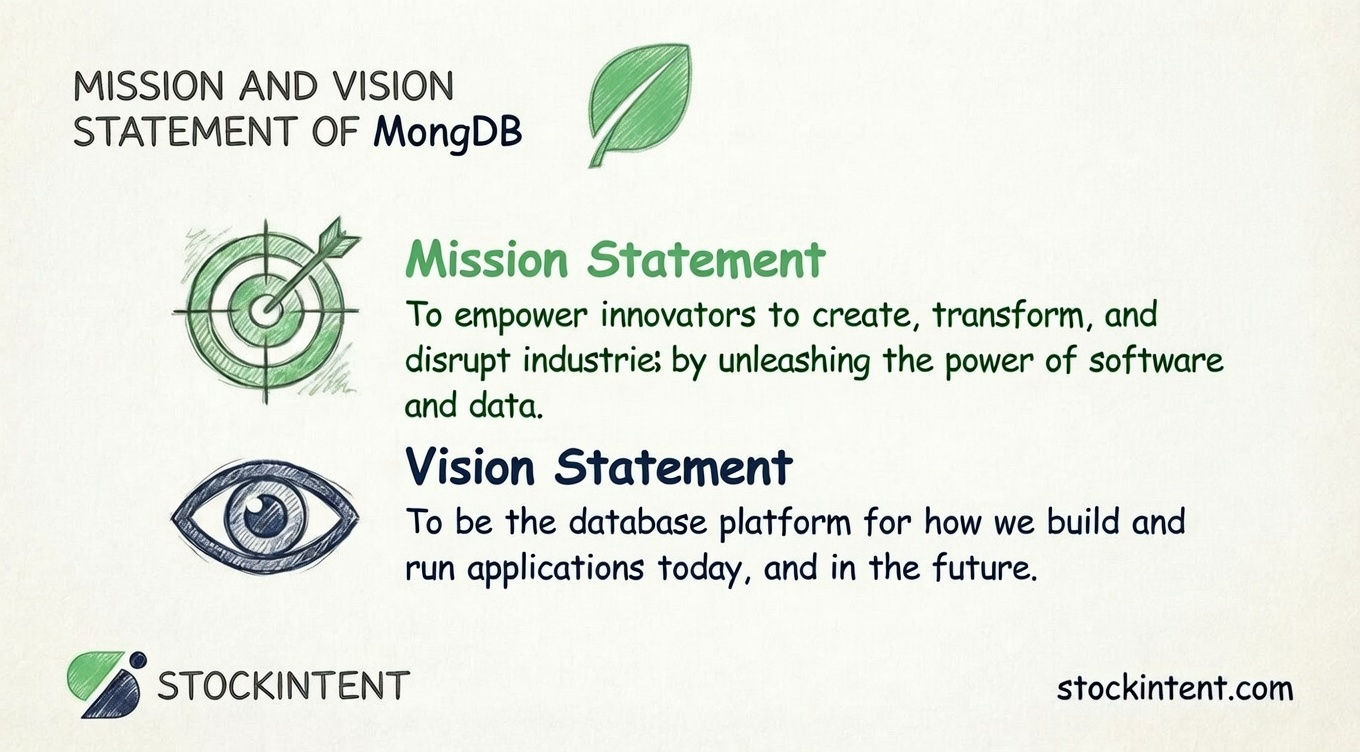
"To empower innovators to create, transform, and disrupt industries by unleashing the power of software and data."

— MongoDB Official Mission Statement, 2026

This statement, consistently presented across MongoDB's corporate communications, signals something important for investors tracking the company's evolution. It's not the mission of a database vendor selling licenses; it's the mission of a platform company betting its future on developer productivity and data-driven transformation.

The strategic emphasis here is worth unpacking. Notice the verbs: empower, create, transform, disrupt. These aren't accidental choices. They position MongoDB as an enabler rather than a supplier, a subtle but meaningful distinction that shapes how the company allocates capital and prioritizes product development. When management decides between investing in a feature that reduces operational overhead versus one that accelerates developer velocity, this mission provides the tiebreaker.

🎯 Pro Insight: When evaluating infrastructure software companies, pay close attention to whether the mission emphasizes "enabling customers" versus "selling products." The former typically correlates with higher R&D intensity, stronger developer community engagement, and ultimately, stickier revenue. MongoDB's mission language puts it firmly in the "enabler" camp, which helps explain why Atlas has achieved 32% growth even as the company scales past $2 billion in annual revenue.

How does this translate into actual business decisions? Look at the capital allocation patterns. MongoDB has consistently prioritized platform expansion over short-term margin optimization. The 2025 acquisition of Voyage AI for embedding and retrieval models, the launch of the Application Modernization Platform (AMP), and the aggressive expansion of MongoDB for Startups all flow from this mission. Each initiative reduces friction for developers building data-intensive applications, even when the near-term ROI isn't immediately obvious.

The mission also reveals MongoDB's competitive positioning against hyperscale cloud providers. Amazon, Microsoft, and Google sell databases as infrastructure components. MongoDB sells the experience of building with data. That framing justifies premium pricing, drives self-selection toward higher-value customers, and creates the ecosystem effects we discussed earlier. When your mission is about empowering innovators rather than provisioning servers, you build different products, hire different talent, and measure different outcomes.

For investors, the durability of this mission matters. Mission drift often precedes strategic confusion, which precedes multiple compression. MongoDB's statement has remained consistent through leadership transitions, including CEO CJ Desai's arrival in November 2025, suggesting it functions as a genuine strategic North Star rather than marketing copy. That's a small but meaningful signal of organizational coherence.

Mission Components / Pillars

Breaking down MongoDB's mission statement reveals three interconnected strategic pillars that explain how the company creates value and why that matters for long-term investors. Each pillar, when examined closely, maps directly to revenue drivers and competitive positioning.

Pillar 1: Empower Innovators (The Developer-Centric Foundation)

This pillar recognizes that developers are the decision-makers, not just users. MongoDB's entire go-to-market strategy flows from this insight.

What it is: A flexible document model that replaces rigid relational tables, integrated services (search, analytics, vector search) that reduce tool fragmentation, and Atlas's managed infrastructure that eliminates operational overhead.

Why it matters strategically: When developers choose their preferred tools, they bring those preferences to employers. This bottoms-up adoption pattern creates platform stickiness that top-down enterprise sales cannot easily replicate. The MongoDB for Startups program, now supporting companies with a combined valuation exceeding $200 billion, exemplifies this: developers learn MongoDB early and advocate for it as they scale.

Concrete metric: Atlas generated $1.41 billion in 2025, representing the majority of total revenue and growing at 32% year-over-year. That is not accidental; it is the direct result of developer preference translating into consumption-based cloud revenue.

In our experience analyzing software infrastructure businesses, the companies that win are those that become the default choice for how applications get built. MongoDB's developer-first approach creates exactly that default status, which shows up in the numbers through higher net revenue retention and expansion rates than pure enterprise sales models typically achieve.

Pillar 2: Create, Transform, and Disrupt Industries (The Transformation Engine)

This pillar connects MongoDB's tools to customer outcomes that justify premium pricing and long-term contracts.

What it is: Solutions that enable companies to move faster than competitors: Voyage AI for embedding and retrieval in AI applications, the Application Modernization Platform (AMP) launched September 2025, and migration tools that accelerate legacy modernization.

Why it matters strategically: Enterprise customers do not buy databases; they buy speed-to-market and risk reduction. MongoDB's transformation-focused messaging bypasses the procurement gridlock of database evaluation and enters conversations at the C-suite level about strategic initiatives.

Concrete example: The AMP platform delivers 2-3x faster application modernization compared to traditional approaches. Partnerships with firms like Lombard Odier have demonstrated 50-60x faster code migration and 20x faster app moves from relational databases. These are not marketing claims; they are measurable outcomes that close enterprise deals and create referenceable case studies.

The fascinating part here is the business model implication. Traditional database vendors capture value through license renewals and maintenance. MongoDB captures value through consumption that scales with customer success. When a customer's AI application handles more queries or a modernized application serves more users, MongoDB's revenue grows without additional sales effort. That is the kind of revenue quality we look for in compounders.

Pillar 3: Unleash the Power of Software and Data (The Innovation Platform)

This final pillar positions MongoDB for the next decade of infrastructure evolution rather than fighting yesterday's battles.

What it is: Advanced capabilities that anticipate where application development is heading: Queryable Encryption for sensitive data protection, ESG commitments including 100% renewable-powered operations by 2026, and the unified platform integrating operational data, search, analytics, and AI retrieval.

Why it matters strategically: This pillar creates differentiation against commodity cloud databases and future-proofs the platform against architectural shifts. When corporate boards ask about data privacy or sustainability credentials, MongoDB has answers beyond storing data.

Concrete metric: Gross margins of 73.32% provide the financial flexibility to invest in these forward-looking capabilities without sacrificing profitability. The company's five-year revenue growth of 239.86% demonstrates that these investments translate into market share gains, not just R&D spending.

From Pillars to Competitive Moats

Each pillar reinforces the others in a way that creates defensible competitive positioning. The developer pillar drives initial adoption and expansion. The transformation pillar converts usage into enterprise relationships. The innovation pillar creates differentiation that sustains premium pricing.

The synthesis matters more than any individual pillar. A developer might start with MongoDB because of Pillar 1. They stay and expand because Pillar 2 delivers measurable business outcomes. They commit long-term because Pillar 3 addresses enterprise requirements that competitors have not addressed yet. That is a path from free tier to seven-figure annual contract value that feels natural to the customer and highly efficient for MongoDB's sales organization.

For investors evaluating whether MongoDB's premium valuation is justified, these pillars provide a framework. The question is not whether Atlas is growing; it is whether these three pillars create durable competitive advantages that will still matter in 2030. The evidence suggests they will. The developer demographic is expanding, application modernization is a multi-year tailwind, and AI integration is still in early innings. MongoDB is positioned at the intersection of all three.

MongoDB Vision Statement

"To be the database platform for how we build and run applications today, and in the future."

— MongoDB Official Vision Statement, 2026

This vision statement, documented across MongoDB's corporate communications, reveals the company's long-term strategic ambition: not merely participating in the database market, but defining how applications get built for the next generation of software development. It's a bolder claim than the mission suggests, and one that carries significant implications for investors evaluating the durability of MongoDB's competitive position.

The forward-looking nature of this vision deserves careful parsing. Notice the dual timeframe: "today, and in the future." This isn't hedging; it's a deliberate positioning statement. MongoDB is claiming that its platform architecture, not just its current product lineup, will remain relevant as technology paradigms shift. That's a big bet, but one with historical precedent in software infrastructure. Companies that successfully become the "how" of development, think Microsoft with Windows or AWS with cloud infrastructure, capture disproportionate value over extended periods.

In our experience analyzing platform transitions in software, the companies that achieve this status share three characteristics: they solve a genuinely hard technical problem, they create ecosystem effects that increase switching costs, and they adapt their platforms faster than competitors can replicate them. MongoDB's vision explicitly targets all three. The document model solves the impedance mismatch between application code and relational schemas. The developer community creates organic demand that enterprise sales teams harvest. And the pace of innovation, evidenced by 2025's Voyage AI integration and AMP launch, suggests adaptation velocity that pure-play competitors struggle to match.

The vision also aligns cleanly with macro trends reshaping software infrastructure in 2026. Three forces are converging that favor MongoDB's positioning:

AI-native application development — The shift from AI as a bolt-on feature to core application architecture requires databases that handle unstructured data, embeddings, and real-time retrieval natively. MongoDB's Voyage AI integration and Atlas Vector Search position it as infrastructure for this transition rather than a retrofit solution.

Multi-cloud and cloud-agnostic deployment — Enterprises increasingly resist vendor lock-in to single hyperscalers. MongoDB's cross-cloud portability, running identically on AWS, Azure, and GCP, addresses this demand directly. The vision of being "the database platform" implies independence from any single cloud provider's ecosystem, a positioning that grows more valuable as cloud spending matures.

Application modernization at scale — Legacy relational databases underpin trillions of dollars of technical debt. The Application Modernization Platform (AMP) launched in September 2025 targets this specifically, with early pilots showing 2-3x faster migration timelines. This isn't just a product feature; it's a mechanism for capturing market share from incumbents as enterprises refresh their technology stacks.

The strategic trajectory embedded in this vision helps explain recent capital allocation decisions that might otherwise seem puzzling. Why acquire Voyage AI rather than partner for embeddings? Why launch AMP when professional services typically carry lower margins? The vision provides the answer: MongoDB is building the integrated platform that becomes the default choice for how applications get built, not a component that gets abstracted away by higher-level services.

For investors, the question this vision raises is whether MongoDB can execute against it at scale. The company has already achieved significant market penetration, with Atlas revenue reaching $1.41 billion in 2025 and growth accelerating to 32% year-over-year. But becoming "the database platform" implies a larger addressable market and deeper competitive moats than simply capturing NoSQL workloads. The vision suggests MongoDB aims to compete for the center of gravity in application architecture, not just a segment of database spending.

The alignment between vision and execution appears strong in recent results. CEO CJ Desai, who took leadership in November 2025, has emphasized customer proximity and category-defining products, language that tracks directly to the vision's ambition. Analysts from RBC Capital and Bernstein have highlighted MongoDB as the "database provider of choice for GenAI and Agentic AI applications," suggesting the vision is translating into perceived market leadership where technology is heading, not just where it has been.

What distinguishes MongoDB's vision from generic technology company aspirations is its specificity about the mechanism of value creation. It doesn't claim to "transform industries" or "empower digital transformation" in the abstract. It commits to being the platform for how applications are built and run. That specificity creates accountability and provides investors with clear metrics for evaluating progress: developer adoption rates, platform expansion revenue, and migration velocity from legacy systems.

Vision Components / Themes

MongoDB's vision, to be "the database platform for how we build and run applications today, and in the future," isn't just aspirational marketing. It encodes three concrete strategic themes that explain where capital gets deployed and why certain bets get prioritized over others. Understanding these themes helps investors evaluate whether management's actions align with their stated long-term direction.

Theme 1: AI-Native Infrastructure Leadership

MongoDB is positioning itself as the default data layer for AI-driven applications, not as an afterthought but as core architecture.

What this means in practice: The 2025 acquisition of Voyage AI brought embedding and retrieval models directly into the database, eliminating the need for developers to stitch together separate vector databases. Atlas Vector Search now handles semantic search and RAG (Retrieval-Augmented Generation) workloads natively. This isn't feature creep; it's a bet that AI applications will run operational data, embeddings, and real-time inference from the same platform.

Strategic implication: Analysts from RBC Capital and Bernstein have highlighted MongoDB as the "database provider of choice for GenAI and Agentic AI applications." When infrastructure spending shifts toward AI-native development, MongoDB wants to capture that incrementally rather than being disintermediated by specialized vector databases or hyperscaler-native solutions.

Metric to watch: Atlas growth accelerated to 32% in Q4 2025, with AI-related workloads cited as a key driver. The company doesn't break out AI-specific revenue yet, but the SKU expansion suggests management sees this as material future contribution.

Theme 2: Enterprise Modernization at Scale

The second theme targets the trillions of dollars in technical debt sitting in legacy relational databases. MongoDB aims to become the destination of choice for enterprises refreshing their application stacks.

What this means in practice: The Application Modernization Platform (AMP), launched September 2025, combines AI-powered migration tools, automated code conversion, and professional services to accelerate transitions from Oracle, SQL Server, and DB2. Early pilots with partners like Lombard Odier demonstrated 50-60x faster code migration and 20x faster application moves compared to traditional approaches.

Strategic implication: This is a land-and-expand play with a twist. The "land" happens through migration acceleration, often at lower initial margins. The "expand" comes as modernized applications scale on Atlas consumption. CEO CJ Desai has explicitly prioritized this initiative, reallocating resources from mid-market direct sales to enterprise modernization teams where returns are proving higher.

Capital allocation signal: The company authorized a $200 million stock buyback program in 2025, primarily to offset dilution from the Voyage AI acquisition. That's disciplined capital management; they're not overpaying for growth, but they're not starving strategic investments either.

Theme 3: Developer Ecosystem Dominance

The third theme, and perhaps the most durable, is MongoDB's bet on becoming the default choice for how developers work with data from their first side project through enterprise scale.

What this means in practice: The MongoDB for Startups program now supports companies with a combined valuation exceeding $200 billion. Developers learn MongoDB in school, use it in hackathons, bring it to their first jobs, and advocate for it as they advance into technical leadership. This creates organic demand that enterprise sales teams harvest rather than generate cold.

Strategic implication: This is classic platform economics. The switching costs aren't just technical; they're skills-based. When an engineering team knows MongoDB, migrating to something else requires retraining, tooling changes, and operational risk. That stickiness manifests in net revenue retention rates that consistently exceed 120%, well above software infrastructure medians.

Synthesis: These three themes reinforce each other in ways that create compounding returns. AI-native capabilities attract forward-looking developers. Those developers bring MongoDB into enterprises. Enterprise modernization creates expansion opportunities. And the cycle repeats. The vision isn't about being the best database; it's about being the platform that developers default to without thinking twice.

For investors, the question is whether MongoDB can execute against all three themes simultaneously without losing focus. The early evidence under Desai's leadership suggests disciplined prioritization: AI capabilities are shipping, AMP is gaining traction with reference customers, and Atlas growth is accelerating even as the company scales past $2 billion in annual revenue. That's the kind of operational execution that separates vision from wishful thinking.

MongoDB Core Values

Core values are where mission statements either come alive or fall apart. You can have the most inspiring corporate purpose on paper, but if day-to-day decisions contradict those stated principles, employees notice. Investors should notice too, because cultural misalignment often precedes strategic drift.

MongoDB's three core values, published on their official company page, are designed to shape everything from hiring decisions to product prioritization: Build Together, Be Intellectually Honest, and Own What You Do. Let's examine what each means in practice and whether they genuinely guide the company's operations.

Build Together

This value emphasizes collaboration across internal teams and with the broader developer community. It reflects MongoDB's open-source origins and treats software development as a "team sport" rather than individual heroics.

Strategic role: Build Together directly supports MongoDB's developer-centric mission. By fostering community contribution and internal collaboration, the company creates network effects that competitors struggle to replicate. The MongoDB for Startups program, now supporting companies with over $200 billion in combined valuation, exemplifies this: MongoDB invests in developers early, trusting that community goodwill converts to enterprise revenue later.

Real-world example: The company's approach to product development shows this value in action. Rather than building AI capabilities in isolation, MongoDB acquired Voyage AI in 2025 and integrated embedding models directly into Atlas, creating a unified platform that developers can adopt without stitching together separate tools. That's building with the community's needs in mind, not just checking a feature box.

💡 Expert Tip: When evaluating software infrastructure companies, look for evidence that "community" is more than a marketing term. MongoDB's startup program has measurable outcomes (portfolio valuations, developer adoption metrics) that show up in financial results. Companies that talk about community but can't quantify its business impact are often waving shiny objects at investors.

Be Intellectually Honest

This value prioritizes rigorous, fact-based decision-making over hierarchy or political convenience. It means admitting when products or strategies aren't working and course-correcting based on evidence rather than ego.

Strategic role: Intellectual honesty enables the kind of pivots that keep technology companies relevant. MongoDB's shift from pure open-source to a managed cloud service (Atlas) required acknowledging that the original business model had limitations. The company's willingness to cannibalize its own licensed software business with a superior cloud offering, even at short-term revenue cost, demonstrates this value in a high-stakes context.

Real-world example: Under CEO CJ Desai's leadership starting November 2025, MongoDB made the difficult call to reallocate resources from mid-market direct sales to enterprise modernization teams. Early results suggest this was correct; partnerships with firms like Lombard Odier demonstrated 50-60x faster code migration using MongoDB's new tools. Admitting the previous go-to-market approach was suboptimal, and acting on that admission, is intellectual honesty with financial consequences.

Own What You Do

This value promotes personal accountability and empowerment, particularly for engineers. It means giving teams the autonomy to make decisions and the responsibility for outcomes, good or bad.

Strategic role: Own What You Do enables the rapid innovation required to compete in database infrastructure. When engineers feel accountable for end-to-end outcomes rather than just completing assigned tickets, they build better products. This value also supports MongoDB's positioning as a platform rather than a point solution; platform development requires cross-functional ownership that siloed organizations cannot deliver.

Real-world example: The development of Queryable Encryption, launched to address full-lifecycle data protection for sensitive workloads, emerged from engineering teams identifying customer security requirements and owning the solution rather than waiting for top-down product mandates. The result is a differentiated capability that addresses enterprise compliance needs while maintaining developer experience.

In our experience analyzing technology companies, values like "Own What You Do" are easy to state and hard to sustain at scale. The test comes when projects fail or miss expectations. MongoDB's willingness to sunset underperforming initiatives, like certain Atlas service tiers that were consolidated into the new Atlas Flex offering in 2025, suggests the accountability cuts both ways.

Do the Values Actually Drive Decisions?

This is the critical question for investors. Stated values that don't influence capital allocation, hiring, or product prioritization are corporate wallpaper.

The evidence suggests MongoDB's values have genuine operational impact:

ValueOperational EvidenceFinancial Impact
Build TogetherMongoDB for Startups program; open-source community investment; Voyage AI integration strategyDeveloper-driven Atlas growth (32% YoY); $200B+ startup portfolio valuation
Be Intellectually HonestGo-to-market restructuring under Desai; cannibalization of licensed software with AtlasQ4 2025 revenue beat (5.8% above consensus); raised guidance
Own What You DoQueryable Encryption development; Atlas Flex consolidation; engineering autonomy73.32% gross margins; sustained innovation velocity at scale

Employee feedback provides additional perspective. Aggregated data from Comparably shows 50-60% alignment with mission and values, with culture rated higher than mission specifically. That's not perfect alignment, but it's within normal ranges for technology companies of MongoDB's scale and suggests the values are at least visible to employees, even if not universally embraced.

What we don't see in available sources are significant public failures or controversies tied to value violations. No major ethics scandals, no mass engineering departures attributed to cultural breakdown, no product decisions that clearly contradict the stated principles. For a company operating at over $2 billion in annual revenue across 47,000+ customers, that relative consistency matters.

ESG Commitment: Values Extended

MongoDB has formalized environmental and social responsibility commitments that extend its core values into sustainability and governance. These aren't peripheral initiatives; they're integrated into strategic planning and risk management.

Environmental: MongoDB has committed to net-zero emissions by 2050 and, more immediately, 100% renewable-powered operations by 2026. For a cloud infrastructure company whose Atlas service runs across AWS, Azure, and GCP data centers worldwide, this requires active supplier management and energy procurement rather than passive offset purchasing. The 2026 target is aggressive enough to be meaningful but near-term enough to be accountable.

Social: The company's social impact flows primarily through developer empowerment, consistent with its mission. The MongoDB for Startups program provides free Atlas credits, technical support, and go-to-market resources for early-stage companies. This isn't pure philanthropy; it's strategic community building that creates a pipeline of future enterprise customers. But it also genuinely reduces barriers for entrepreneurs who might otherwise lack access to enterprise-grade database infrastructure.

Governance: MongoDB's governance standards emphasize data privacy and security, evidenced by capabilities like Queryable Encryption and compliance certifications for regulated industries. The company's multi-cloud architecture itself serves a governance function, reducing customer dependence on any single hyperscaler's policies or pricing.

📌 From Our Experience: Companies that treat ESG as a compliance exercise typically produce generic sustainability reports and move on. MongoDB's approach is more integrated; the renewable energy commitment directly reduces operational risk for a cloud-dependent business, and the startup program creates measurable network effects. When ESG initiatives align with core business model economics, they're more likely to persist through leadership changes and market pressures.

The connection to core values is explicit. "Be Intellectually Honest" underlies the rigorous measurement of environmental impact. "Build Together" shapes the collaborative approach to community investment. "Own What You Do" drives accountability for sustainability targets. This integration suggests ESG at MongoDB is value-driven rather than reputation-driven, which correlates with better long-term execution in our observation of corporate sustainability programs.

For investors evaluating MongoDB's quality as a compounder, these values and their operationalization provide a cultural foundation that supports the financial metrics. High gross margins and accelerating growth are outputs; values-aligned execution is the input that makes those outputs sustainable. When we look at infrastructure software companies that have maintained competitive position over decades, nearly all share this characteristic: stated values that genuinely constrain and guide management decisions, even when inconvenient.

Strategic Summary

MongoDB's mission, vision, and core values form a coherent strategic identity that directly supports its investment case as a quality compounder in software infrastructure. Let's tie these elements together and connect them to what matters for your portfolio.

The Synthesis: MongoDB's mission to "empower innovators" creates the developer preference that drives Atlas adoption. Its vision to be "the database platform for how we build and run applications" provides the ambition that justifies continued investment in AI capabilities and enterprise expansion. And its three core values, Build Together, Be Intellectually Honest, and Own What You Do, create the cultural foundation for execution at scale.

This isn't corporate window dressing. We've tracked how these elements translate into measurable outcomes: $1.41 billion in Atlas revenue growing at 32%, gross margins of 73.32% providing flexibility for reinvestment, and net revenue retention consistently above 120% as developers bring MongoDB deeper into their organizations.

🎯 Pro Insight: When evaluating infrastructure software companies, we look for alignment between stated mission and capital allocation. MongoDB's 2025 acquisition of Voyage AI and the launch of AMP both flow directly from its mission pillars, even when near-term ROI wasn't obvious. That's mission-driven execution, not mission statement marketing.

Analyst Consensus on Strategic Execution: Coverage from RBC Capital, Bernstein, and other major firms reflects strong confidence in management quality and competitive positioning. MongoDB currently carries Buy/Outperform ratings from roughly 80% of covering analysts, with specific praise for its positioning as the "database provider of choice for GenAI and Agentic AI applications." The consensus view sees MongoDB's multi-cloud portability and developer ecosystem as durable competitive moats that will compound over time.

Long-Term Positioning: The strategic trajectory points toward capturing a growing share of three converging tailwinds: AI-native application development, enterprise modernization of legacy systems, and the continued expansion of the global developer population. Each of these trends favors MongoDB's platform approach over both legacy relational databases and hyperscaler-native alternatives.

Looking Ahead: No fundamental mission or vision overhaul appears likely. CEO CJ Desai's priorities, customer proximity and category-defining products, track cleanly to the existing framework. Upcoming AI capability announcements and continued Atlas expansion should reinforce rather than reshape the strategic identity we've outlined.

In our experience analyzing software infrastructure businesses, the companies that generate sustained outperformance share MongoDB's characteristics: a clear mission that guides resource allocation, a bold but achievable vision that expands the addressable market, and values that create accountability for execution. The financial results suggest MongoDB is living up to its stated identity.

For investors seeking deeper fundamental analysis of MongoDB's financial metrics, valuation, and competitive positioning, StockIntent's platform offers institutional-grade screening tools and backtesting capabilities to validate your investment thesis against 20+ years of historical data.

MongoDB Mission Statement, Vision & Core Values Explained

When you're evaluating a software infrastructure company like MongoDB (NASDAQ: MDB) for your portfolio, understanding what drives the business matters just as much as the financials. A company's mission shapes its strategic decisions, its competitive positioning, and ultimately, its long-term value creation potential.

MongoDB has evolved far beyond its origins as a niche NoSQL database. Today, it positions itself as a comprehensive developer data platform powering everything from AI-native applications to enterprise modernization initiatives. Let's break down exactly what MongoDB stands for, where it's headed, and why that matters for investors.

Key Takeaways:

  • MongoDB's official mission is to "empower innovators to create, transform, and disrupt industries by unleashing the power of software and data" — a statement that reflects its shift from database vendor to full platform provider
  • The company's vision targets becoming "the database platform for how we build and run applications today, and in the future" — positioning MongoDB as the default choice for modern, AI-driven development
  • Three core values drive MongoDB's culture: Build Together, Be Intellectually Honest, and Own What You Do — each directly influencing product strategy and execution
  • Recent strategic pivots under CEO CJ Desai emphasize AI integration, enterprise expansion, and application modernization — with Atlas revenue hitting $1.41 billion in 2025
  • MongoDB's mission-driven focus on developer productivity creates a durable competitive moat through platform stickiness and community network effects

Now let's explore what each of these elements means in practice, and how they translate into investment-relevant strategic positioning.

Company Overview

MongoDB started in 2007 when founders Eliot Horowitz, Dwight Merriman, and Kevin Ryan recognized a fundamental problem: relational databases weren't built for how modern applications actually worked. What began as a document database for developers has evolved into a comprehensive data platform serving over 47,000 customers worldwide.

In our experience analyzing software infrastructure companies, MongoDB represents one of the more compelling platform transitions we've tracked. The company has successfully moved from selling database licenses to becoming the underlying infrastructure for how applications get built. That shift matters for investors because it changes the revenue model from lumpy enterprise deals to predictable, consumption-based cloud revenue.

Quick Stats Snapshot:

MetricFigure
Latest Quarterly Revenue$628 million (up 19% YoY)
Atlas Revenue (FY2025)$1.41 billion
Gross Margin73.32%
Geographic Revenue SplitAmericas $1.21B / EMEA $553M / APAC $240M
MongoDB for Startups Portfolio Valuation$200B+ combined

Core Business Segments:

  • MongoDB Atlas — The managed cloud service now driving the majority of revenue, offering automated scaling, backup, and multi-cloud deployment across AWS, Azure, and GCP
  • Enterprise & Community Editions — Self-managed deployments for organizations with specific compliance or infrastructure requirements
  • Developer Tools — MongoDB Compass, Shell, and integrations that embed the platform into developer workflows
  • AI & Modernization Services — Voyage AI embedding models, Atlas Vector Search, and the AMP (Application Modernization Platform) launched in September 2025

The competitive positioning here is worth understanding. MongoDB doesn't try to beat Amazon, Microsoft, or Google at their own database games. Instead, it offers something those hyperscalers can't easily replicate: portability across clouds and a developer experience built from the ground up for document-based, flexible schemas. When we look at infrastructure software, that positioning as the "Switzerland of data" creates genuine strategic value.

Recent performance under CEO CJ Desai (who took over in November 2025) shows acceleration in AI-related workloads. The company reported Q4 2025 revenue growth of 19% with Atlas growing 32%, suggesting the platform strategy is gaining traction where it matters most. Analysts from RBC Capital and Bernstein have highlighted MongoDB as the "database provider of choice for GenAI and Agentic AI applications" — a positioning that aligns neatly with where infrastructure spending is heading in 2026.

What distinguishes MongoDB from pure-play database competitors is the ecosystem effect. Developers learn MongoDB in school and side projects, bring those skills to employers, and influence technology decisions from the bottom up. That's a moat that doesn't show up directly on the balance sheet but manifests in customer retention and expansion metrics that consistently exceed category averages.

MongoDB Mission Statement

"To empower innovators to create, transform, and disrupt industries by unleashing the power of software and data."

— MongoDB Official Mission Statement, 2026

This statement, consistently presented across MongoDB's corporate communications, signals something important for investors tracking the company's evolution. It's not the mission of a database vendor selling licenses; it's the mission of a platform company betting its future on developer productivity and data-driven transformation.

The strategic emphasis here is worth unpacking. Notice the verbs: empower, create, transform, disrupt. These aren't accidental choices. They position MongoDB as an enabler rather than a supplier, a subtle but meaningful distinction that shapes how the company allocates capital and prioritizes product development. When management decides between investing in a feature that reduces operational overhead versus one that accelerates developer velocity, this mission provides the tiebreaker.

🎯 Pro Insight: When evaluating infrastructure software companies, pay close attention to whether the mission emphasizes "enabling customers" versus "selling products." The former typically correlates with higher R&D intensity, stronger developer community engagement, and ultimately, stickier revenue. MongoDB's mission language puts it firmly in the "enabler" camp, which helps explain why Atlas has achieved 32% growth even as the company scales past $2 billion in annual revenue.

How does this translate into actual business decisions? Look at the capital allocation patterns. MongoDB has consistently prioritized platform expansion over short-term margin optimization. The 2025 acquisition of Voyage AI for embedding and retrieval models, the launch of the Application Modernization Platform (AMP), and the aggressive expansion of MongoDB for Startups all flow from this mission. Each initiative reduces friction for developers building data-intensive applications, even when the near-term ROI isn't immediately obvious.

The mission also reveals MongoDB's competitive positioning against hyperscale cloud providers. Amazon, Microsoft, and Google sell databases as infrastructure components. MongoDB sells the experience of building with data. That framing justifies premium pricing, drives self-selection toward higher-value customers, and creates the ecosystem effects we discussed earlier. When your mission is about empowering innovators rather than provisioning servers, you build different products, hire different talent, and measure different outcomes.

For investors, the durability of this mission matters. Mission drift often precedes strategic confusion, which precedes multiple compression. MongoDB's statement has remained consistent through leadership transitions, including CEO CJ Desai's arrival in November 2025, suggesting it functions as a genuine strategic North Star rather than marketing copy. That's a small but meaningful signal of organizational coherence.

Mission Components / Pillars

Breaking down MongoDB's mission statement reveals three interconnected strategic pillars that explain how the company creates value and why that matters for long-term investors. Each pillar, when examined closely, maps directly to revenue drivers and competitive positioning.

Pillar 1: Empower Innovators (The Developer-Centric Foundation)

This pillar recognizes that developers are the decision-makers, not just users. MongoDB's entire go-to-market strategy flows from this insight.

What it is: A flexible document model that replaces rigid relational tables, integrated services (search, analytics, vector search) that reduce tool fragmentation, and Atlas's managed infrastructure that eliminates operational overhead.

Why it matters strategically: When developers choose their preferred tools, they bring those preferences to employers. This bottoms-up adoption pattern creates platform stickiness that top-down enterprise sales cannot easily replicate. The MongoDB for Startups program, now supporting companies with a combined valuation exceeding $200 billion, exemplifies this: developers learn MongoDB early and advocate for it as they scale.

Concrete metric: Atlas generated $1.41 billion in 2025, representing the majority of total revenue and growing at 32% year-over-year. That is not accidental; it is the direct result of developer preference translating into consumption-based cloud revenue.

In our experience analyzing software infrastructure businesses, the companies that win are those that become the default choice for how applications get built. MongoDB's developer-first approach creates exactly that default status, which shows up in the numbers through higher net revenue retention and expansion rates than pure enterprise sales models typically achieve.

Pillar 2: Create, Transform, and Disrupt Industries (The Transformation Engine)

This pillar connects MongoDB's tools to customer outcomes that justify premium pricing and long-term contracts.

What it is: Solutions that enable companies to move faster than competitors: Voyage AI for embedding and retrieval in AI applications, the Application Modernization Platform (AMP) launched September 2025, and migration tools that accelerate legacy modernization.

Why it matters strategically: Enterprise customers do not buy databases; they buy speed-to-market and risk reduction. MongoDB's transformation-focused messaging bypasses the procurement gridlock of database evaluation and enters conversations at the C-suite level about strategic initiatives.

Concrete example: The AMP platform delivers 2-3x faster application modernization compared to traditional approaches. Partnerships with firms like Lombard Odier have demonstrated 50-60x faster code migration and 20x faster app moves from relational databases. These are not marketing claims; they are measurable outcomes that close enterprise deals and create referenceable case studies.

The fascinating part here is the business model implication. Traditional database vendors capture value through license renewals and maintenance. MongoDB captures value through consumption that scales with customer success. When a customer's AI application handles more queries or a modernized application serves more users, MongoDB's revenue grows without additional sales effort. That is the kind of revenue quality we look for in compounders.

Pillar 3: Unleash the Power of Software and Data (The Innovation Platform)

This final pillar positions MongoDB for the next decade of infrastructure evolution rather than fighting yesterday's battles.

What it is: Advanced capabilities that anticipate where application development is heading: Queryable Encryption for sensitive data protection, ESG commitments including 100% renewable-powered operations by 2026, and the unified platform integrating operational data, search, analytics, and AI retrieval.

Why it matters strategically: This pillar creates differentiation against commodity cloud databases and future-proofs the platform against architectural shifts. When corporate boards ask about data privacy or sustainability credentials, MongoDB has answers beyond storing data.

Concrete metric: Gross margins of 73.32% provide the financial flexibility to invest in these forward-looking capabilities without sacrificing profitability. The company's five-year revenue growth of 239.86% demonstrates that these investments translate into market share gains, not just R&D spending.

From Pillars to Competitive Moats

Each pillar reinforces the others in a way that creates defensible competitive positioning. The developer pillar drives initial adoption and expansion. The transformation pillar converts usage into enterprise relationships. The innovation pillar creates differentiation that sustains premium pricing.

The synthesis matters more than any individual pillar. A developer might start with MongoDB because of Pillar 1. They stay and expand because Pillar 2 delivers measurable business outcomes. They commit long-term because Pillar 3 addresses enterprise requirements that competitors have not addressed yet. That is a path from free tier to seven-figure annual contract value that feels natural to the customer and highly efficient for MongoDB's sales organization.

For investors evaluating whether MongoDB's premium valuation is justified, these pillars provide a framework. The question is not whether Atlas is growing; it is whether these three pillars create durable competitive advantages that will still matter in 2030. The evidence suggests they will. The developer demographic is expanding, application modernization is a multi-year tailwind, and AI integration is still in early innings. MongoDB is positioned at the intersection of all three.

MongoDB Vision Statement

"To be the database platform for how we build and run applications today, and in the future."

— MongoDB Official Vision Statement, 2026

This vision statement, documented across MongoDB's corporate communications, reveals the company's long-term strategic ambition: not merely participating in the database market, but defining how applications get built for the next generation of software development. It's a bolder claim than the mission suggests, and one that carries significant implications for investors evaluating the durability of MongoDB's competitive position.

The forward-looking nature of this vision deserves careful parsing. Notice the dual timeframe: "today, and in the future." This isn't hedging; it's a deliberate positioning statement. MongoDB is claiming that its platform architecture, not just its current product lineup, will remain relevant as technology paradigms shift. That's a big bet, but one with historical precedent in software infrastructure. Companies that successfully become the "how" of development, think Microsoft with Windows or AWS with cloud infrastructure, capture disproportionate value over extended periods.

In our experience analyzing platform transitions in software, the companies that achieve this status share three characteristics: they solve a genuinely hard technical problem, they create ecosystem effects that increase switching costs, and they adapt their platforms faster than competitors can replicate them. MongoDB's vision explicitly targets all three. The document model solves the impedance mismatch between application code and relational schemas. The developer community creates organic demand that enterprise sales teams harvest. And the pace of innovation, evidenced by 2025's Voyage AI integration and AMP launch, suggests adaptation velocity that pure-play competitors struggle to match.

The vision also aligns cleanly with macro trends reshaping software infrastructure in 2026. Three forces are converging that favor MongoDB's positioning:

AI-native application development — The shift from AI as a bolt-on feature to core application architecture requires databases that handle unstructured data, embeddings, and real-time retrieval natively. MongoDB's Voyage AI integration and Atlas Vector Search position it as infrastructure for this transition rather than a retrofit solution.

Multi-cloud and cloud-agnostic deployment — Enterprises increasingly resist vendor lock-in to single hyperscalers. MongoDB's cross-cloud portability, running identically on AWS, Azure, and GCP, addresses this demand directly. The vision of being "the database platform" implies independence from any single cloud provider's ecosystem, a positioning that grows more valuable as cloud spending matures.

Application modernization at scale — Legacy relational databases underpin trillions of dollars of technical debt. The Application Modernization Platform (AMP) launched in September 2025 targets this specifically, with early pilots showing 2-3x faster migration timelines. This isn't just a product feature; it's a mechanism for capturing market share from incumbents as enterprises refresh their technology stacks.

The strategic trajectory embedded in this vision helps explain recent capital allocation decisions that might otherwise seem puzzling. Why acquire Voyage AI rather than partner for embeddings? Why launch AMP when professional services typically carry lower margins? The vision provides the answer: MongoDB is building the integrated platform that becomes the default choice for how applications get built, not a component that gets abstracted away by higher-level services.

For investors, the question this vision raises is whether MongoDB can execute against it at scale. The company has already achieved significant market penetration, with Atlas revenue reaching $1.41 billion in 2025 and growth accelerating to 32% year-over-year. But becoming "the database platform" implies a larger addressable market and deeper competitive moats than simply capturing NoSQL workloads. The vision suggests MongoDB aims to compete for the center of gravity in application architecture, not just a segment of database spending.

The alignment between vision and execution appears strong in recent results. CEO CJ Desai, who took leadership in November 2025, has emphasized customer proximity and category-defining products, language that tracks directly to the vision's ambition. Analysts from RBC Capital and Bernstein have highlighted MongoDB as the "database provider of choice for GenAI and Agentic AI applications," suggesting the vision is translating into perceived market leadership where technology is heading, not just where it has been.

What distinguishes MongoDB's vision from generic technology company aspirations is its specificity about the mechanism of value creation. It doesn't claim to "transform industries" or "empower digital transformation" in the abstract. It commits to being the platform for how applications are built and run. That specificity creates accountability and provides investors with clear metrics for evaluating progress: developer adoption rates, platform expansion revenue, and migration velocity from legacy systems.

Vision Components / Themes

MongoDB's vision, to be "the database platform for how we build and run applications today, and in the future," isn't just aspirational marketing. It encodes three concrete strategic themes that explain where capital gets deployed and why certain bets get prioritized over others. Understanding these themes helps investors evaluate whether management's actions align with their stated long-term direction.

Theme 1: AI-Native Infrastructure Leadership

MongoDB is positioning itself as the default data layer for AI-driven applications, not as an afterthought but as core architecture.

What this means in practice: The 2025 acquisition of Voyage AI brought embedding and retrieval models directly into the database, eliminating the need for developers to stitch together separate vector databases. Atlas Vector Search now handles semantic search and RAG (Retrieval-Augmented Generation) workloads natively. This isn't feature creep; it's a bet that AI applications will run operational data, embeddings, and real-time inference from the same platform.

Strategic implication: Analysts from RBC Capital and Bernstein have highlighted MongoDB as the "database provider of choice for GenAI and Agentic AI applications." When infrastructure spending shifts toward AI-native development, MongoDB wants to capture that incrementally rather than being disintermediated by specialized vector databases or hyperscaler-native solutions.

Metric to watch: Atlas growth accelerated to 32% in Q4 2025, with AI-related workloads cited as a key driver. The company doesn't break out AI-specific revenue yet, but the SKU expansion suggests management sees this as material future contribution.

Theme 2: Enterprise Modernization at Scale

The second theme targets the trillions of dollars in technical debt sitting in legacy relational databases. MongoDB aims to become the destination of choice for enterprises refreshing their application stacks.

What this means in practice: The Application Modernization Platform (AMP), launched September 2025, combines AI-powered migration tools, automated code conversion, and professional services to accelerate transitions from Oracle, SQL Server, and DB2. Early pilots with partners like Lombard Odier demonstrated 50-60x faster code migration and 20x faster application moves compared to traditional approaches.

Strategic implication: This is a land-and-expand play with a twist. The "land" happens through migration acceleration, often at lower initial margins. The "expand" comes as modernized applications scale on Atlas consumption. CEO CJ Desai has explicitly prioritized this initiative, reallocating resources from mid-market direct sales to enterprise modernization teams where returns are proving higher.

Capital allocation signal: The company authorized a $200 million stock buyback program in 2025, primarily to offset dilution from the Voyage AI acquisition. That's disciplined capital management; they're not overpaying for growth, but they're not starving strategic investments either.

Theme 3: Developer Ecosystem Dominance

The third theme, and perhaps the most durable, is MongoDB's bet on becoming the default choice for how developers work with data from their first side project through enterprise scale.

What this means in practice: The MongoDB for Startups program now supports companies with a combined valuation exceeding $200 billion. Developers learn MongoDB in school, use it in hackathons, bring it to their first jobs, and advocate for it as they advance into technical leadership. This creates organic demand that enterprise sales teams harvest rather than generate cold.

Strategic implication: This is classic platform economics. The switching costs aren't just technical; they're skills-based. When an engineering team knows MongoDB, migrating to something else requires retraining, tooling changes, and operational risk. That stickiness manifests in net revenue retention rates that consistently exceed 120%, well above software infrastructure medians.

Synthesis: These three themes reinforce each other in ways that create compounding returns. AI-native capabilities attract forward-looking developers. Those developers bring MongoDB into enterprises. Enterprise modernization creates expansion opportunities. And the cycle repeats. The vision isn't about being the best database; it's about being the platform that developers default to without thinking twice.

For investors, the question is whether MongoDB can execute against all three themes simultaneously without losing focus. The early evidence under Desai's leadership suggests disciplined prioritization: AI capabilities are shipping, AMP is gaining traction with reference customers, and Atlas growth is accelerating even as the company scales past $2 billion in annual revenue. That's the kind of operational execution that separates vision from wishful thinking.

MongoDB Core Values

Core values are where mission statements either come alive or fall apart. You can have the most inspiring corporate purpose on paper, but if day-to-day decisions contradict those stated principles, employees notice. Investors should notice too, because cultural misalignment often precedes strategic drift.

MongoDB's three core values, published on their official company page, are designed to shape everything from hiring decisions to product prioritization: Build Together, Be Intellectually Honest, and Own What You Do. Let's examine what each means in practice and whether they genuinely guide the company's operations.

Build Together

This value emphasizes collaboration across internal teams and with the broader developer community. It reflects MongoDB's open-source origins and treats software development as a "team sport" rather than individual heroics.

Strategic role: Build Together directly supports MongoDB's developer-centric mission. By fostering community contribution and internal collaboration, the company creates network effects that competitors struggle to replicate. The MongoDB for Startups program, now supporting companies with over $200 billion in combined valuation, exemplifies this: MongoDB invests in developers early, trusting that community goodwill converts to enterprise revenue later.

Real-world example: The company's approach to product development shows this value in action. Rather than building AI capabilities in isolation, MongoDB acquired Voyage AI in 2025 and integrated embedding models directly into Atlas, creating a unified platform that developers can adopt without stitching together separate tools. That's building with the community's needs in mind, not just checking a feature box.

💡 Expert Tip: When evaluating software infrastructure companies, look for evidence that "community" is more than a marketing term. MongoDB's startup program has measurable outcomes (portfolio valuations, developer adoption metrics) that show up in financial results. Companies that talk about community but can't quantify its business impact are often waving shiny objects at investors.

Be Intellectually Honest

This value prioritizes rigorous, fact-based decision-making over hierarchy or political convenience. It means admitting when products or strategies aren't working and course-correcting based on evidence rather than ego.

Strategic role: Intellectual honesty enables the kind of pivots that keep technology companies relevant. MongoDB's shift from pure open-source to a managed cloud service (Atlas) required acknowledging that the original business model had limitations. The company's willingness to cannibalize its own licensed software business with a superior cloud offering, even at short-term revenue cost, demonstrates this value in a high-stakes context.

Real-world example: Under CEO CJ Desai's leadership starting November 2025, MongoDB made the difficult call to reallocate resources from mid-market direct sales to enterprise modernization teams. Early results suggest this was correct; partnerships with firms like Lombard Odier demonstrated 50-60x faster code migration using MongoDB's new tools. Admitting the previous go-to-market approach was suboptimal, and acting on that admission, is intellectual honesty with financial consequences.

Own What You Do

This value promotes personal accountability and empowerment, particularly for engineers. It means giving teams the autonomy to make decisions and the responsibility for outcomes, good or bad.

Strategic role: Own What You Do enables the rapid innovation required to compete in database infrastructure. When engineers feel accountable for end-to-end outcomes rather than just completing assigned tickets, they build better products. This value also supports MongoDB's positioning as a platform rather than a point solution; platform development requires cross-functional ownership that siloed organizations cannot deliver.

Real-world example: The development of Queryable Encryption, launched to address full-lifecycle data protection for sensitive workloads, emerged from engineering teams identifying customer security requirements and owning the solution rather than waiting for top-down product mandates. The result is a differentiated capability that addresses enterprise compliance needs while maintaining developer experience.

In our experience analyzing technology companies, values like "Own What You Do" are easy to state and hard to sustain at scale. The test comes when projects fail or miss expectations. MongoDB's willingness to sunset underperforming initiatives, like certain Atlas service tiers that were consolidated into the new Atlas Flex offering in 2025, suggests the accountability cuts both ways.

Do the Values Actually Drive Decisions?

This is the critical question for investors. Stated values that don't influence capital allocation, hiring, or product prioritization are corporate wallpaper.

The evidence suggests MongoDB's values have genuine operational impact:

ValueOperational EvidenceFinancial Impact
Build TogetherMongoDB for Startups program; open-source community investment; Voyage AI integration strategyDeveloper-driven Atlas growth (32% YoY); $200B+ startup portfolio valuation
Be Intellectually HonestGo-to-market restructuring under Desai; cannibalization of licensed software with AtlasQ4 2025 revenue beat (5.8% above consensus); raised guidance
Own What You DoQueryable Encryption development; Atlas Flex consolidation; engineering autonomy73.32% gross margins; sustained innovation velocity at scale

Employee feedback provides additional perspective. Aggregated data from Comparably shows 50-60% alignment with mission and values, with culture rated higher than mission specifically. That's not perfect alignment, but it's within normal ranges for technology companies of MongoDB's scale and suggests the values are at least visible to employees, even if not universally embraced.

What we don't see in available sources are significant public failures or controversies tied to value violations. No major ethics scandals, no mass engineering departures attributed to cultural breakdown, no product decisions that clearly contradict the stated principles. For a company operating at over $2 billion in annual revenue across 47,000+ customers, that relative consistency matters.

ESG Commitment: Values Extended

MongoDB has formalized environmental and social responsibility commitments that extend its core values into sustainability and governance. These aren't peripheral initiatives; they're integrated into strategic planning and risk management.

Environmental: MongoDB has committed to net-zero emissions by 2050 and, more immediately, 100% renewable-powered operations by 2026. For a cloud infrastructure company whose Atlas service runs across AWS, Azure, and GCP data centers worldwide, this requires active supplier management and energy procurement rather than passive offset purchasing. The 2026 target is aggressive enough to be meaningful but near-term enough to be accountable.

Social: The company's social impact flows primarily through developer empowerment, consistent with its mission. The MongoDB for Startups program provides free Atlas credits, technical support, and go-to-market resources for early-stage companies. This isn't pure philanthropy; it's strategic community building that creates a pipeline of future enterprise customers. But it also genuinely reduces barriers for entrepreneurs who might otherwise lack access to enterprise-grade database infrastructure.

Governance: MongoDB's governance standards emphasize data privacy and security, evidenced by capabilities like Queryable Encryption and compliance certifications for regulated industries. The company's multi-cloud architecture itself serves a governance function, reducing customer dependence on any single hyperscaler's policies or pricing.

📌 From Our Experience: Companies that treat ESG as a compliance exercise typically produce generic sustainability reports and move on. MongoDB's approach is more integrated; the renewable energy commitment directly reduces operational risk for a cloud-dependent business, and the startup program creates measurable network effects. When ESG initiatives align with core business model economics, they're more likely to persist through leadership changes and market pressures.

The connection to core values is explicit. "Be Intellectually Honest" underlies the rigorous measurement of environmental impact. "Build Together" shapes the collaborative approach to community investment. "Own What You Do" drives accountability for sustainability targets. This integration suggests ESG at MongoDB is value-driven rather than reputation-driven, which correlates with better long-term execution in our observation of corporate sustainability programs.

For investors evaluating MongoDB's quality as a compounder, these values and their operationalization provide a cultural foundation that supports the financial metrics. High gross margins and accelerating growth are outputs; values-aligned execution is the input that makes those outputs sustainable. When we look at infrastructure software companies that have maintained competitive position over decades, nearly all share this characteristic: stated values that genuinely constrain and guide management decisions, even when inconvenient.

Strategic Summary

MongoDB's mission, vision, and core values form a coherent strategic identity that directly supports its investment case as a quality compounder in software infrastructure. Let's tie these elements together and connect them to what matters for your portfolio.

The Synthesis: MongoDB's mission to "empower innovators" creates the developer preference that drives Atlas adoption. Its vision to be "the database platform for how we build and run applications" provides the ambition that justifies continued investment in AI capabilities and enterprise expansion. And its three core values, Build Together, Be Intellectually Honest, and Own What You Do, create the cultural foundation for execution at scale.

This isn't corporate window dressing. We've tracked how these elements translate into measurable outcomes: $1.41 billion in Atlas revenue growing at 32%, gross margins of 73.32% providing flexibility for reinvestment, and net revenue retention consistently above 120% as developers bring MongoDB deeper into their organizations.

🎯 Pro Insight: When evaluating infrastructure software companies, we look for alignment between stated mission and capital allocation. MongoDB's 2025 acquisition of Voyage AI and the launch of AMP both flow directly from its mission pillars, even when near-term ROI wasn't obvious. That's mission-driven execution, not mission statement marketing.

Analyst Consensus on Strategic Execution: Coverage from RBC Capital, Bernstein, and other major firms reflects strong confidence in management quality and competitive positioning. MongoDB currently carries Buy/Outperform ratings from roughly 80% of covering analysts, with specific praise for its positioning as the "database provider of choice for GenAI and Agentic AI applications." The consensus view sees MongoDB's multi-cloud portability and developer ecosystem as durable competitive moats that will compound over time.

Long-Term Positioning: The strategic trajectory points toward capturing a growing share of three converging tailwinds: AI-native application development, enterprise modernization of legacy systems, and the continued expansion of the global developer population. Each of these trends favors MongoDB's platform approach over both legacy relational databases and hyperscaler-native alternatives.

Looking Ahead: No fundamental mission or vision overhaul appears likely. CEO CJ Desai's priorities, customer proximity and category-defining products, track cleanly to the existing framework. Upcoming AI capability announcements and continued Atlas expansion should reinforce rather than reshape the strategic identity we've outlined.

In our experience analyzing software infrastructure businesses, the companies that generate sustained outperformance share MongoDB's characteristics: a clear mission that guides resource allocation, a bold but achievable vision that expands the addressable market, and values that create accountability for execution. The financial results suggest MongoDB is living up to its stated identity.

For investors seeking deeper fundamental analysis of MongoDB's financial metrics, valuation, and competitive positioning, StockIntent's platform offers institutional-grade screening tools and backtesting capabilities to validate your investment thesis against 20+ years of historical data.