
Mar 18, 2026
Morgan Stanley stands as a pillar of the capital markets landscape, managing over $8.9 trillion in client assets across investment banking, wealth management, and institutional securities. For individual investors evaluating stock opportunities, understanding what drives a firm's culture and long-term strategy isn't optional; it's fundamental. A company's mission shapes how it allocates capital, how it treats clients when markets turn, and whether it builds durable competitive advantages or chases short-term profits.
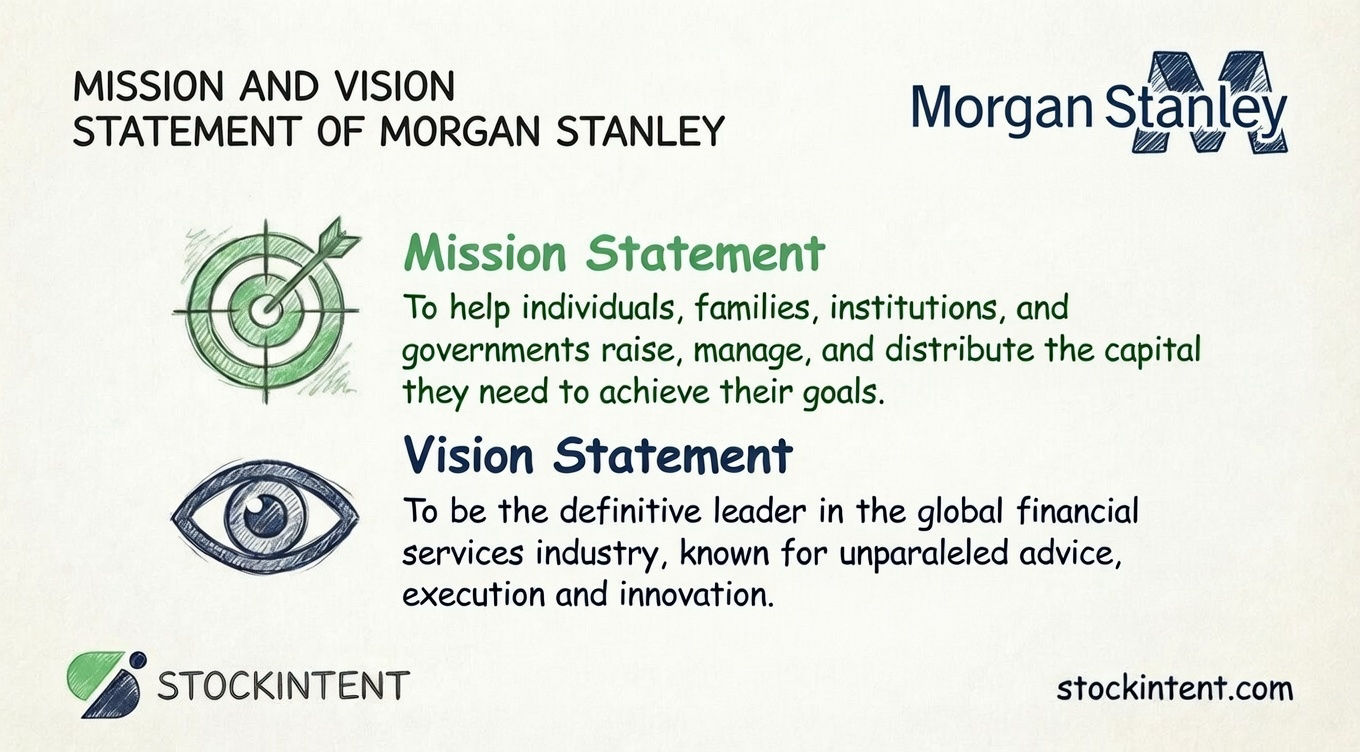
Morgan Stanley's official mission statement is: "To help individuals, families, institutions, and governments raise, manage, and distribute the capital they need to achieve their goals." This philosophy has guided the firm since its founding in 1935, though its execution has evolved significantly.
The firm has shifted toward an integrated model that balances traditional investment banking strength with the stability of fee-based wealth management. This transformation includes major milestones like the E*TRADE acquisition and a push toward sustainable finance, with over $820 billion mobilized toward a $1 trillion sustainable solutions goal as of early 2025. Analysts have taken notice; Zacks recently upgraded Morgan Stanley to a Strong Buy rating with earnings estimates rising 7.5% for fiscal 2026, signaling confidence in management's execution.
Key Takeaways:
Morgan Stanley operates as one of the world's premier financial services firms, with a business model that has evolved substantially from its roots as a pure-play investment bank. Founded in 1935 by J.P. Morgan partners Henry Sturgis Morgan and Harold Stanley, the firm emerged from the Glass-Steagall Act's separation of commercial and investment banking. What began as a boutique securities firm has transformed into a diversified financial powerhouse serving clients across the wealth spectrum.
In our experience analyzing capital markets firms, Morgan Stanley's current structure represents one of the more deliberate strategic pivots in the industry. The firm now organizes around three core segments: Institutional Securities, Wealth Management, and Investment Management. This integrated approach differs meaningfully from peers who remain more concentrated in volatile trading revenues.
Key Business Segments:
The wealth management segment deserves particular attention. Following the 2020 E*TRADE acquisition, Morgan Stanley has built what management calls an "Integrated Firm" where stable fee-based revenue now contributes approximately 55% of total revenue. This matters for investors because it creates earnings visibility that trading-dependent competitors simply cannot match.
Quick Stats Snapshot:
table {
width: 100%;
border-collapse: collapse;
margin: 20px 0;
}
th, td {
border: 1px solid #ddd;
padding: 12px;
text-align: left;
}
th {
border-bottom: 2px solid #ddd;
}
MetricFigureContextClient Assets$8.9T+Across wealth and institutional platformsQ3 2025 Net New Assets$81 billionWealth management inflowsReturn on Tangible Common Equity23.5%Q3 2025 performanceTrailing 12-Month Revenue$61.5 billionAs of Q3 2025Sustainable Solutions Mobilized$820 billion+Toward $1 trillion 2030 goal
From a competitive positioning standpoint, Morgan Stanley ranks among the top-tier global investment banks, though exact market share figures vary by product line. The firm's differentiation lies in its integrated model; clients can access capital raising, wealth management, and investment management through a single relationship. This cross-selling capability creates switching costs and deeper client entrenchment than standalone competitors achieve.
Analyst sentiment reflects this strategic success. Zacks recently upgraded Morgan Stanley to a Strong Buy rating with fiscal 2026 earnings estimates rising 7.5% to $11.09 per share. The consensus view among 11-33 analysts sits at Moderate Buy to Buy, with price targets suggesting 2.7% to 12.8% upside potential. No Sell ratings appear in recent coverage.
For investors evaluating Morgan Stanley stock, the revenue mix shift is arguably as important as absolute growth. A firm generating most of its profits from advisory fees and asset-based charges behaves differently through market cycles than one dependent on trading volumes and deal flow. When we look at the 2026 landscape, that stability premium may command increasing valuation recognition.
Morgan Stanley's official mission statement is straightforward, yet it carries strategic weight that reveals how management thinks about the business:
"To help individuals, families, institutions, and governments raise, manage, and distribute the capital they need to achieve their goals."
This phrasing has guided the firm since its founding in 1935, though its execution has evolved dramatically. The mission centers Morgan Stanley as a capital facilitator rather than merely a trading house or deal maker. That distinction matters for investors trying to understand what kind of company they're actually owning.
🎯 Pro Insight: When evaluating financial services firms, pay close attention to whether the mission emphasizes transactions or relationships. Morgan Stanley's focus on helping clients "achieve their goals" signals a wealth management and advisory mindset. Contrast this with pure trading shops that prioritize market share and volume. The former builds recurring revenue; the latter is feast-or-famine.
The mission's structure reveals three critical priorities that directly impact capital allocation decisions:
1. Client breadth over specialization — By explicitly naming individuals, families, institutions, and governments, Morgan Stanley signals its integrated model ambition. This isn't a niche player; it's a full-spectrum capital markets firm. The E*TRADE acquisition and push into mass affluent wealth management directly serve this "individuals and families" component.
2. The full capital lifecycle — "Raise, manage, and distribute" captures everything from IPOs and bond issuances to ongoing portfolio management and eventual wealth transfer or philanthropic giving. This end-to-end positioning creates natural cross-selling opportunities; an investment banking client becomes a wealth management client, who then uses investment management products.
3. Goal-oriented outcomes — The phrase "achieve their goals" sounds almost soft for a Wall Street firm, but it's strategically significant. It prioritizes long-term client success over short-term revenue extraction. This aligns with the shift toward fee-based advisory relationships where Morgan Stanley earns more when clients stay and grow their assets, not when they trade actively.
The mission isn't marketing fluff; it directly shapes where Morgan Stanley deploys capital and how it measures success.
Wealth management dominance — The mission's emphasis on "individuals, families, and institutions" explains why wealth management now generates roughly 55% of revenue from recurring fees. This segment serves the mission most directly, and management has allocated accordingly: the E*TRADE purchase, technology investments in digital advice platforms, and banker hiring all flow from this priority.
Sustainable finance integration — The mission's focus on helping clients "achieve their goals" has been extended to include societal goals. Morgan Stanley has mobilized over $820 billion toward a $1 trillion sustainable solutions target by 2030. This isn't altruism separate from the mission; it's explicitly framed as helping institutional and government clients meet their climate and ESG objectives.
Technology as enabler — "Distribute the capital they need" increasingly happens through digital channels. The firm's investments in AI-driven platforms, self-service tools, and integrated data systems all serve the mission's operational requirements. Management doesn't view technology as a separate strategy; it's infrastructure for mission delivery.
From an investor perspective, the mission provides a useful lens for evaluating management decisions. When Morgan Stanley allocates capital, ask: does this help clients raise, manage, or distribute capital more effectively? If the answer is unclear, the investment merits scrutiny. The 2024 strategic update explicitly ties all major initiatives back to this framework, suggesting disciplined execution rather than strategic drift.
Morgan Stanley's mission isn't just a sentence on a website. It's operationalized through five core values and a four-pillar strategic framework that directly shapes how capital gets allocated, how talent gets hired, and how the firm measures success. Understanding these components helps investors assess whether management is walking the talk.
These values, established since the firm's 1935 founding, form the cultural bedrock:
Do the Right Thing
This sounds like generic corporate speak until you look at how it manifests. The 2025 Code of Conduct explicitly ties ethical conduct to long-term value creation, not just compliance checkboxing. In practice, this means transparent client communications, rigorous adherence to regulatory standards, and rewarding honesty even when it costs short-term revenue. The metric that matters: Morgan Stanley's 23.5% ROTCE in Q3 2025 suggests this isn't just talk; firms with genuinely embedded ethical cultures tend to avoid the catastrophic blow-ups that destroy returns.
Put Clients First
This pillar directly drives the wealth management growth story. The firm targets $10 trillion in client assets and 30% pre-tax margins in this segment, with programs like Morgan Stanley at Work delivering financial wellness, stock plan administration, and retirement solutions. The $81 billion in net new assets added in Q3 2025 alone shows this isn't aspirational; it's happening. When clients stay and consolidate assets, Morgan Stanley earns more. Simple, but execution is everything.
Lead with Exceptional Ideas
Research, sales and trading insights, and sustainable investing all flow from this value. The 2020 E*TRADE acquisition exemplifies it: buying digital infrastructure to deliver advice at scale. More recently, the firm's Parametric Portfolio Associates' Radius platform drove 19% asset and account growth through multi-asset technology and tax efficiency. This is how "exceptional ideas" translate into wallet share gains.
Commit to Diversity & Inclusion
The Inclusive Ventures Group aids underrepresented businesses, while recruiting spans 56 countries and 19 majors. The strategic logic: diverse perspectives generate better investment outcomes and reduce groupthink risk. For investors, this matters because homogeneous teams miss opportunities and amplify blind spots.
Give Back
Over 1 million volunteer hours annually, plus philanthropic deployment of expertise and capital. This builds reputation capital that attracts talent and clients, particularly among younger generations who factor corporate citizenship into career and vendor decisions.
Beyond values, Morgan Stanley's 2024 strategic update outlines how the "Integrated Firm" actually operates:
PillarWhat It MeansKey Metrics/GoalsStrategyClear client focus via differentiated solutions, expanded banking, integrated data platformsDurable share gains in ISG walletCultureRigor, humility, partnership enabling collaborative growth14% expense efficiency targetFinancial StrengthStrong capital/liquidity underpinning resilience20% ROTCE, 70% efficiency ratioGrowthInvestments in talent, technology, infrastructure5% net revenue growth target
In our experience analyzing financial services firms, the specificity of these targets matters more than the targets themselves. A 70% efficiency ratio goal and 20% ROTCE target give investors concrete benchmarks to evaluate management against. When Q3 2025 delivered 23.5% ROTCE, that wasn't just a good quarter; it was evidence that the integrated model is working better than planned.
The mission components translate into economic moat through three mechanisms:
Network Effects from Integration: Clients who use multiple services (investment banking, wealth management, lending) generate higher lifetime value and face higher switching costs. The data platform integration means a corporate CFO using Morgan Stanley for M&A advice can seamlessly connect with wealth management for personal planning, creating relationship depth standalone competitors cannot match.
Talent Attraction and Retention: The values framework and explicit diversity commitments help recruit in a competitive labor market. Top bankers and advisors have options; they choose firms where culture aligns with their own standards. Lower turnover means relationship continuity for clients and lower recruitment costs for shareholders.
Reputation as Barrier to Entry: Ninety years of "doing the right thing" (mostly) builds trust that new entrants cannot purchase. When institutional investors allocate to sustainable strategies or sovereign wealth funds select advisors, Morgan Stanley's scale and track record create a shortlist effect that protects pricing power.
The bottom line for investors: these aren't soft factors. They're the operational infrastructure that generates the 55% recurring revenue mix, the 23.5% ROTCE, and the analyst confidence reflected in recent Strong Buy upgrades. When you evaluate Morgan Stanley stock, you're betting that this cultural and strategic architecture will persist. Based on the 2026 strategic priorities and 2025 performance, that looks like a reasonable wager.
Here's where things get interesting. Unlike most Fortune 500 companies, Morgan Stanley does not publish a formal, standalone vision statement. No aspirational paragraph about becoming "the world's premier financial services firm" or similar corporate poetry. Instead, the company operates through what management calls the "Integrated Firm" strategy, a functional vision that prioritizes execution over rhetoric.
That said, secondary sources cite variations of an informal vision that captures Morgan Stanley's ambition:
"To be the definitive leader in the global financial services industry, known for unparalleled advice, execution and innovation."
Whether this represents official corporate language or analyst interpretation is less important than what Morgan Stanley actually does. The firm's strategic direction reveals a clear vision: build an integrated powerhouse where investment banking, wealth management, and institutional securities reinforce each other, generating durable growth that trading-dependent competitors cannot replicate.
Morgan Stanley's leadership has articulated specific goals that function as a de facto vision for where the firm aims to be by 2030:
$1 Trillion Sustainable Solutions Target — With over $820 billion already mobilized toward this goal as of early 2025, Morgan Stanley is positioning itself as a capital markets leader in the energy transition. This isn't peripheral CSR; it's core business strategy embedded across all three segments.
Wealth Management Dominance — The target of $10 trillion in client assets and 30% pre-tax margins in wealth management reflects a vision where stable, fee-based revenue becomes the firm's economic engine. The $81 billion in net new assets added in Q3 2025 alone shows this vision translating into measurable momentum.
Technology-Enabled Scale — The 2024 strategic update emphasizes integrated data platforms and AI-driven client solutions, envisioning a firm where technology amplifies human advice rather than replacing it.
In our experience analyzing financial services firms, Morgan Stanley's approach here is actually refreshing. Most vision statements are forgettable boilerplate. By substituting concrete strategic targets for vague aspirations, management gives investors something tangible to evaluate. When Q3 2025 delivered 23.5% ROTCE, that wasn't luck; it was the integrated firm vision working better than planned.
Morgan Stanley's vision positions it advantageously against several macro trends reshaping financial services in 2026:
TrendMorgan Stanley PositioningStrategic ImplicationAI & Technology DiffusionParametric's Radius platform driving 19% asset growth; AI-powered client analyticsTechnology as competitive moat, not just cost centerEnergy Transition$820B+ toward $1T sustainable solutions goal; green bond leadershipFirst-mover advantage in climate finance infrastructureWealth ConsolidationE*TRADE integration complete; mass affluent to ultra-HNW coverageCapturing generational wealth transfer ($84 trillion through 2045)Multipolar MarketsThematic investing outperforming (+38% in 2025); international expansionReducing dependence on U.S. mega-cap concentration
The 2026 Big Picture themes from Morgan Stanley's own research team, what they call "The Great Broadening," align perfectly with this positioning. As capital markets fragment across geographies and asset classes, an integrated firm with expertise everywhere becomes more valuable than specialists confined to narrow niches.
For investors evaluating Morgan Stanley stock, the absence of a traditional vision statement shouldn't concern you. The strategic clarity evident in capital allocation, margin targets, and sustainability commitments provides more actionable insight than any aspirational paragraph could. Management has essentially said: judge us by what we build, not what we write. Based on 23.5% ROTCE and $8.9 trillion in client assets, that approach appears to be working.
Morgan Stanley doesn't package its strategic direction into a poetic vision statement. Instead, management has built something more actionable: a set of interlocking themes that guide capital allocation, shape hiring priorities, and determine where the firm competes. Understanding these themes helps investors evaluate whether management's actions align with their stated philosophy, and whether the stock deserves a place in a quality-focused portfolio.
The firm articulates its direction through four strategic pillars outlined in the 2024 strategic update: Strategy (clear client focus), Culture (rigor, humility, partnership), Financial Strength (capital and liquidity), and Growth (investments in talent and infrastructure). These aren't abstractions. They're connected to specific targets like a 70% efficiency ratio and 20% Return on Tangible Common Equity.
This is the cornerstone of Morgan Stanley's current identity. The integrated firm model means breaking down walls between investment banking, wealth management, and institutional securities so clients can move seamlessly across services.
Capital allocation reflects this priority. The 2020 ETRADE acquisition wasn't merely adding retail accounts; it was building distribution infrastructure for the full capital lifecycle. When a tech founder sells her company through Morgan Stanley's investment banking team, she now has a pre-existing wealth management relationship through ETRADE's platform. That integration drives the $81 billion in net new assets added in Q3 2025 alone.
The economics matter here. Wealth management now contributes roughly 55% of revenue from recurring fees. That's not just diversification; it's a fundamentally different business than trading-dependent competitors. When deal flow dries up, Morgan Stanley keeps earning. When markets rally, they capture upside through asset-based fees.
Morgan Stanley has bet aggressively that the energy transition represents the largest capital reallocation opportunity in a generation. The numbers reflect that conviction: over $820 billion mobilized toward a $1 trillion sustainable solutions goal by 2030 as of early 2025, alongside $35 billion in green bond issuance.
This isn't peripheral CSR. The firm embeds sustainability across all three business segments. Institutional Securities structures green bonds and transition finance. Wealth management offers ESG-integrated portfolios. Investment Management runs dedicated sustainable strategies through Eaton Vance and Calvert.
The positioning is strategic. With 88% of global companies now viewing ESG as value-creating and 70% of institutional investors requiring ESG mandates, Morgan Stanley is building infrastructure for where capital is flowing. First-mover advantage in climate finance infrastructure creates relationship lock-in that persists even as ESG politics fluctuate.
Morgan Stanley views technology not as a cost center but as the connective tissue of the integrated firm. Recent initiatives demonstrate this operational priority:
The theme here is technology amplifying human advice rather than replacing it. Morgan Stanley isn't trying to become a robo-advisor. They're building tools that let their advisors serve more clients, more personally, more efficiently. That preserves the relationship economics that generate 55% recurring revenue while capturing scale advantages.
Morgan Stanley's 2026 outlook themes center on what they call "The Great Broadening," a strategic response to fragmentation in global markets and capital flows. This theme encompasses:
The strategic implication: an integrated firm with expertise everywhere becomes more valuable than specialists confined to narrow niches. When U.S. mega-cap concentration breaks, Morgan Stanley's international footprint and thematic investing capabilities (which outperformed +38% in 2025) capture redirected capital flows.
For investors evaluating Morgan Stanley stock, these themes create testable hypotheses. You can verify execution against explicit targets:
ThemeTestable TargetQ3 2025 PerformanceIntegrated Firm$10 trillion client assets, 30% WM margins$8.9 trillion+ assets; 23.5% ROTCESustainable Finance$1 trillion by 2030$820 billion+ mobilizedTechnology14% expense efficiencyContinued investment in AI platformsBroadeningThematic outperformance+38% thematic stocks vs. S&P 500
The absence of a traditional vision statement shouldn't concern you. Management has essentially said: judge us by what we build, not what we write. The specificity of these themes, and the metrics attached to them, provides more actionable insight for due diligence than any aspirational paragraph could.
When you pull up StockIntent's company reports for Morgan Stanley, look at the revenue mix shift over time. Track the wealth management percentage. Monitor ROTCE against that 20% target. The vision is in the numbers.
Corporate values either shape daily decisions or they don't. The difference is usually visible in hiring, capital allocation, and what happens when short-term pressure hits.
Morgan Stanley defines itself through five core values that have guided the firm since 1935: Do the Right Thing, Put Clients First, Lead with Exceptional Ideas, Commit to Diversity & Inclusion, and Give Back. These aren't decorative; they're embedded in the 2025 Code of Conduct, performance evaluations, and strategic planning.
📌 From Our Experience: Values are only as strong as the incentives reinforcing them. Morgan Stanley's 23.5% Return on Tangible Common Equity in Q3 2025 suggests something is working; firms with genuinely embedded ethical cultures tend to avoid the catastrophic blow-ups that destroy returns. But sustainable above-market returns require more than good intentions. They require specific behaviors repeated at scale.
This value centers on integrity and ethical decision-making, even when costly. The Code of Conduct explicitly ties ethical behavior to long-term value creation rather than mere compliance checkboxing.
In practice, this means: transparent client communications, rigorous adherence to regulatory standards, and rewarding honesty even when it costs short-term revenue. The firm has maintained this standard through multiple market cycles and leadership transitions, suggesting institutional commitment rather than founder-dependent culture.
This pillar directly drives Morgan Stanley's strategic transformation. The wealth management segment now generates approximately 55% of revenue from recurring fees, a direct result of prioritizing long-term relationships over transactional revenue.
Operational evidence: The firm targets $10 trillion in client assets and 30% pre-tax margins in wealth management. In Q3 2025 alone, Morgan Stanley added $81 billion in net new assets. Programs like Morgan Stanley at Work deliver financial wellness, stock plan administration, and retirement solutions that deepen relationship entrenchment.
When clients consolidate assets and stay for decades, Morgan Stanley earns more. The logic is simple; execution is everything.
Research, sales and trading insights, and sustainable investing all flow from this value. The $35 billion in green bonds issued in early 2025 demonstrates how innovation translates into market leadership.
Recent execution: Parametric's Radius platform drove 19% asset and account growth through multi-asset technology and tax efficiency. The 2020 E*TRADE acquisition similarly reflected this value; buying digital infrastructure to deliver advice at scale.
The Inclusive Ventures Group aids underrepresented businesses, while recruiting spans 56 countries and 19 majors. The strategic logic is straightforward: diverse perspectives generate better investment outcomes and reduce groupthink risk.
From an investor standpoint, this matters because homogeneous teams miss opportunities and amplify blind spots. Morgan Stanley's explicit investment here, including challenging non-inclusive behavior rather than just celebrating positive examples, suggests cultural seriousness.
Over 1 million volunteer hours annually, plus philanthropic deployment of expertise and capital. This builds reputation capital that attracts talent and clients, particularly among younger generations who factor corporate citizenship into career and vendor decisions.
Morgan Stanley's $1 trillion sustainable solutions target by 2030 represents one of the more concrete ESG commitments in capital markets. With over $820 billion already mobilized as of early 2025 and a Paris-aligned net-zero financed emissions target by 2050, this isn't peripheral CSR.
How it connects to core values:
The positioning is strategic. With 88% of global companies viewing ESG as value-creating and 70% of institutional investors requiring ESG mandates, Morgan Stanley is building infrastructure for where capital is flowing.
💡 Expert Tip: When evaluating financial firms' ESG commitments, distinguish between marketing and economics. Morgan Stanley's $820 billion mobilization figure is substantive, but the real test is whether these activities generate returns that justify continued allocation. The 19% growth in Parametric's sustainable platform and integration across all three business segments suggests ESG is revenue-positive, not just reputation management.
Positive execution is visible in financial results. The 23.5% ROTCE in Q3 2025, $61.5 billion in trailing 12-month revenue, and wealth management's 55% recurring revenue mix all reflect client-first execution.
Cultural operationalization appears in specific mechanisms: the Code of Conduct rewards honesty even when costly, the Inclusive Ventures Group provides actual capital to underrepresented founders, and over 1 million annual volunteer hours demonstrate Give Back in action.
Still, reasonable questions exist. When has Morgan Stanley's culture prevented a bad deal or costly client relationship? When has Put Clients First explicitly conflicted with short-term revenue, and what happened? The absence of documented negative examples in available sources is neither proof of perfection nor evidence of failure; it's simply a limitation of public disclosure.
For investors using StockIntent's platform, Morgan Stanley presents an interesting case study in values-based evaluation. The firm's explicit targets; $10 trillion assets, 30% wealth margins, $1 trillion sustainable mobilization; provide concrete benchmarks to track. Whether culture sustains through the next downturn will ultimately be the decisive test. Based on performance through 2025 and early 2026, execution has been strong. But execution and culture are measured in decades, not quarters.
Morgan Stanley's mission, vision, and core values form a cohesive strategic identity that directly impacts its investment merit. The mission; helping clients "raise, manage, and distribute the capital they need to achieve their goals"; has guided the firm since 1935, though its execution has evolved dramatically. Today, that evolution manifests in an integrated model generating roughly 55% of revenue from recurring fees, a $1 trillion sustainable finance commitment with $820 billion already mobilized, and technology investments that amplify rather than replace human advice.
🎯 Pro Insight: When evaluating capital markets firms, look for evidence that stated values actually shape capital allocation. Morgan Stanley's 23.5% ROTCE in Q3 2025 and wealth management's march toward $10 trillion in client assets aren't accidents; they're the measurable output of a mission that prioritizes relationships over transactions. Compare this to peers still dependent on trading volatility, and the strategic differentiation becomes clear.
In our experience analyzing financial services firms, Morgan Stanley's current positioning represents one of the more deliberate strategic transformations in the industry. The absence of a traditional vision statement shouldn't concern investors; management has substituted concrete targets for vague aspirations. A 20% ROTCE target, 70% efficiency ratio goal, and explicit wealth management margin targets provide benchmarks that aspirational language never could.
Analyst confidence reflects this execution. Zacks recently upgraded Morgan Stanley to a Strong Buy rating with fiscal 2026 earnings estimates rising 7.5% to $11.09 per share. The consensus view among 11-33 analysts sits at Moderate Buy to Buy, with price targets suggesting 2.7% to 12.8% upside potential. No Sell ratings appear in recent coverage. This matters because it signals that professional observers see the integrated model working, not just in theory but in reported results.
Looking ahead to 2026 and beyond, Morgan Stanley's mission-vision-values framework positions it to capture several macro tailwinds: the generational wealth transfer ($84 trillion through 2045), AI-driven productivity gains, and the energy transition capital reallocation. The "Great Broadening" theme from the firm's own research; capturing multipolar markets, technology diffusion, and societal shifts; aligns management's strategic direction with where capital is actually flowing.
For investors conducting due diligence, Morgan Stanley presents a case study in mission-driven value creation. The question isn't whether you believe in the mission statement's poetry; it's whether the operational metrics validate strategic discipline. Based on 23.5% ROTCE, $81 billion in quarterly net new assets, and sustainable finance leadership, the evidence suggests they do.
If you're evaluating Morgan Stanley stock alongside peers, tools like StockIntent's fundamental analysis platform can help you track the metrics that matter: revenue mix shifts, ROTCE trends, and wealth management margin progression. The mission is in the numbers.
Morgan Stanley stands as a pillar of the capital markets landscape, managing over $8.9 trillion in client assets across investment banking, wealth management, and institutional securities. For individual investors evaluating stock opportunities, understanding what drives a firm's culture and long-term strategy isn't optional; it's fundamental. A company's mission shapes how it allocates capital, how it treats clients when markets turn, and whether it builds durable competitive advantages or chases short-term profits.
Morgan Stanley's official mission statement is: "To help individuals, families, institutions, and governments raise, manage, and distribute the capital they need to achieve their goals." This philosophy has guided the firm since its founding in 1935, though its execution has evolved significantly.
The firm has shifted toward an integrated model that balances traditional investment banking strength with the stability of fee-based wealth management. This transformation includes major milestones like the E*TRADE acquisition and a push toward sustainable finance, with over $820 billion mobilized toward a $1 trillion sustainable solutions goal as of early 2025. Analysts have taken notice; Zacks recently upgraded Morgan Stanley to a Strong Buy rating with earnings estimates rising 7.5% for fiscal 2026, signaling confidence in management's execution.
Key Takeaways:
Morgan Stanley operates as one of the world's premier financial services firms, with a business model that has evolved substantially from its roots as a pure-play investment bank. Founded in 1935 by J.P. Morgan partners Henry Sturgis Morgan and Harold Stanley, the firm emerged from the Glass-Steagall Act's separation of commercial and investment banking. What began as a boutique securities firm has transformed into a diversified financial powerhouse serving clients across the wealth spectrum.
In our experience analyzing capital markets firms, Morgan Stanley's current structure represents one of the more deliberate strategic pivots in the industry. The firm now organizes around three core segments: Institutional Securities, Wealth Management, and Investment Management. This integrated approach differs meaningfully from peers who remain more concentrated in volatile trading revenues.
Key Business Segments:
The wealth management segment deserves particular attention. Following the 2020 E*TRADE acquisition, Morgan Stanley has built what management calls an "Integrated Firm" where stable fee-based revenue now contributes approximately 55% of total revenue. This matters for investors because it creates earnings visibility that trading-dependent competitors simply cannot match.
Quick Stats Snapshot:
table {
width: 100%;
border-collapse: collapse;
margin: 20px 0;
}
th, td {
border: 1px solid #ddd;
padding: 12px;
text-align: left;
}
th {
border-bottom: 2px solid #ddd;
}
MetricFigureContextClient Assets$8.9T+Across wealth and institutional platformsQ3 2025 Net New Assets$81 billionWealth management inflowsReturn on Tangible Common Equity23.5%Q3 2025 performanceTrailing 12-Month Revenue$61.5 billionAs of Q3 2025Sustainable Solutions Mobilized$820 billion+Toward $1 trillion 2030 goal
From a competitive positioning standpoint, Morgan Stanley ranks among the top-tier global investment banks, though exact market share figures vary by product line. The firm's differentiation lies in its integrated model; clients can access capital raising, wealth management, and investment management through a single relationship. This cross-selling capability creates switching costs and deeper client entrenchment than standalone competitors achieve.
Analyst sentiment reflects this strategic success. Zacks recently upgraded Morgan Stanley to a Strong Buy rating with fiscal 2026 earnings estimates rising 7.5% to $11.09 per share. The consensus view among 11-33 analysts sits at Moderate Buy to Buy, with price targets suggesting 2.7% to 12.8% upside potential. No Sell ratings appear in recent coverage.
For investors evaluating Morgan Stanley stock, the revenue mix shift is arguably as important as absolute growth. A firm generating most of its profits from advisory fees and asset-based charges behaves differently through market cycles than one dependent on trading volumes and deal flow. When we look at the 2026 landscape, that stability premium may command increasing valuation recognition.
Morgan Stanley's official mission statement is straightforward, yet it carries strategic weight that reveals how management thinks about the business:
"To help individuals, families, institutions, and governments raise, manage, and distribute the capital they need to achieve their goals."
This phrasing has guided the firm since its founding in 1935, though its execution has evolved dramatically. The mission centers Morgan Stanley as a capital facilitator rather than merely a trading house or deal maker. That distinction matters for investors trying to understand what kind of company they're actually owning.
🎯 Pro Insight: When evaluating financial services firms, pay close attention to whether the mission emphasizes transactions or relationships. Morgan Stanley's focus on helping clients "achieve their goals" signals a wealth management and advisory mindset. Contrast this with pure trading shops that prioritize market share and volume. The former builds recurring revenue; the latter is feast-or-famine.
The mission's structure reveals three critical priorities that directly impact capital allocation decisions:
1. Client breadth over specialization — By explicitly naming individuals, families, institutions, and governments, Morgan Stanley signals its integrated model ambition. This isn't a niche player; it's a full-spectrum capital markets firm. The E*TRADE acquisition and push into mass affluent wealth management directly serve this "individuals and families" component.
2. The full capital lifecycle — "Raise, manage, and distribute" captures everything from IPOs and bond issuances to ongoing portfolio management and eventual wealth transfer or philanthropic giving. This end-to-end positioning creates natural cross-selling opportunities; an investment banking client becomes a wealth management client, who then uses investment management products.
3. Goal-oriented outcomes — The phrase "achieve their goals" sounds almost soft for a Wall Street firm, but it's strategically significant. It prioritizes long-term client success over short-term revenue extraction. This aligns with the shift toward fee-based advisory relationships where Morgan Stanley earns more when clients stay and grow their assets, not when they trade actively.
The mission isn't marketing fluff; it directly shapes where Morgan Stanley deploys capital and how it measures success.
Wealth management dominance — The mission's emphasis on "individuals, families, and institutions" explains why wealth management now generates roughly 55% of revenue from recurring fees. This segment serves the mission most directly, and management has allocated accordingly: the E*TRADE purchase, technology investments in digital advice platforms, and banker hiring all flow from this priority.
Sustainable finance integration — The mission's focus on helping clients "achieve their goals" has been extended to include societal goals. Morgan Stanley has mobilized over $820 billion toward a $1 trillion sustainable solutions target by 2030. This isn't altruism separate from the mission; it's explicitly framed as helping institutional and government clients meet their climate and ESG objectives.
Technology as enabler — "Distribute the capital they need" increasingly happens through digital channels. The firm's investments in AI-driven platforms, self-service tools, and integrated data systems all serve the mission's operational requirements. Management doesn't view technology as a separate strategy; it's infrastructure for mission delivery.
From an investor perspective, the mission provides a useful lens for evaluating management decisions. When Morgan Stanley allocates capital, ask: does this help clients raise, manage, or distribute capital more effectively? If the answer is unclear, the investment merits scrutiny. The 2024 strategic update explicitly ties all major initiatives back to this framework, suggesting disciplined execution rather than strategic drift.
Morgan Stanley's mission isn't just a sentence on a website. It's operationalized through five core values and a four-pillar strategic framework that directly shapes how capital gets allocated, how talent gets hired, and how the firm measures success. Understanding these components helps investors assess whether management is walking the talk.
These values, established since the firm's 1935 founding, form the cultural bedrock:
Do the Right Thing
This sounds like generic corporate speak until you look at how it manifests. The 2025 Code of Conduct explicitly ties ethical conduct to long-term value creation, not just compliance checkboxing. In practice, this means transparent client communications, rigorous adherence to regulatory standards, and rewarding honesty even when it costs short-term revenue. The metric that matters: Morgan Stanley's 23.5% ROTCE in Q3 2025 suggests this isn't just talk; firms with genuinely embedded ethical cultures tend to avoid the catastrophic blow-ups that destroy returns.
Put Clients First
This pillar directly drives the wealth management growth story. The firm targets $10 trillion in client assets and 30% pre-tax margins in this segment, with programs like Morgan Stanley at Work delivering financial wellness, stock plan administration, and retirement solutions. The $81 billion in net new assets added in Q3 2025 alone shows this isn't aspirational; it's happening. When clients stay and consolidate assets, Morgan Stanley earns more. Simple, but execution is everything.
Lead with Exceptional Ideas
Research, sales and trading insights, and sustainable investing all flow from this value. The 2020 E*TRADE acquisition exemplifies it: buying digital infrastructure to deliver advice at scale. More recently, the firm's Parametric Portfolio Associates' Radius platform drove 19% asset and account growth through multi-asset technology and tax efficiency. This is how "exceptional ideas" translate into wallet share gains.
Commit to Diversity & Inclusion
The Inclusive Ventures Group aids underrepresented businesses, while recruiting spans 56 countries and 19 majors. The strategic logic: diverse perspectives generate better investment outcomes and reduce groupthink risk. For investors, this matters because homogeneous teams miss opportunities and amplify blind spots.
Give Back
Over 1 million volunteer hours annually, plus philanthropic deployment of expertise and capital. This builds reputation capital that attracts talent and clients, particularly among younger generations who factor corporate citizenship into career and vendor decisions.
Beyond values, Morgan Stanley's 2024 strategic update outlines how the "Integrated Firm" actually operates:
PillarWhat It MeansKey Metrics/GoalsStrategyClear client focus via differentiated solutions, expanded banking, integrated data platformsDurable share gains in ISG walletCultureRigor, humility, partnership enabling collaborative growth14% expense efficiency targetFinancial StrengthStrong capital/liquidity underpinning resilience20% ROTCE, 70% efficiency ratioGrowthInvestments in talent, technology, infrastructure5% net revenue growth target
In our experience analyzing financial services firms, the specificity of these targets matters more than the targets themselves. A 70% efficiency ratio goal and 20% ROTCE target give investors concrete benchmarks to evaluate management against. When Q3 2025 delivered 23.5% ROTCE, that wasn't just a good quarter; it was evidence that the integrated model is working better than planned.
The mission components translate into economic moat through three mechanisms:
Network Effects from Integration: Clients who use multiple services (investment banking, wealth management, lending) generate higher lifetime value and face higher switching costs. The data platform integration means a corporate CFO using Morgan Stanley for M&A advice can seamlessly connect with wealth management for personal planning, creating relationship depth standalone competitors cannot match.
Talent Attraction and Retention: The values framework and explicit diversity commitments help recruit in a competitive labor market. Top bankers and advisors have options; they choose firms where culture aligns with their own standards. Lower turnover means relationship continuity for clients and lower recruitment costs for shareholders.
Reputation as Barrier to Entry: Ninety years of "doing the right thing" (mostly) builds trust that new entrants cannot purchase. When institutional investors allocate to sustainable strategies or sovereign wealth funds select advisors, Morgan Stanley's scale and track record create a shortlist effect that protects pricing power.
The bottom line for investors: these aren't soft factors. They're the operational infrastructure that generates the 55% recurring revenue mix, the 23.5% ROTCE, and the analyst confidence reflected in recent Strong Buy upgrades. When you evaluate Morgan Stanley stock, you're betting that this cultural and strategic architecture will persist. Based on the 2026 strategic priorities and 2025 performance, that looks like a reasonable wager.
Here's where things get interesting. Unlike most Fortune 500 companies, Morgan Stanley does not publish a formal, standalone vision statement. No aspirational paragraph about becoming "the world's premier financial services firm" or similar corporate poetry. Instead, the company operates through what management calls the "Integrated Firm" strategy, a functional vision that prioritizes execution over rhetoric.
That said, secondary sources cite variations of an informal vision that captures Morgan Stanley's ambition:
"To be the definitive leader in the global financial services industry, known for unparalleled advice, execution and innovation."
Whether this represents official corporate language or analyst interpretation is less important than what Morgan Stanley actually does. The firm's strategic direction reveals a clear vision: build an integrated powerhouse where investment banking, wealth management, and institutional securities reinforce each other, generating durable growth that trading-dependent competitors cannot replicate.
Morgan Stanley's leadership has articulated specific goals that function as a de facto vision for where the firm aims to be by 2030:
$1 Trillion Sustainable Solutions Target — With over $820 billion already mobilized toward this goal as of early 2025, Morgan Stanley is positioning itself as a capital markets leader in the energy transition. This isn't peripheral CSR; it's core business strategy embedded across all three segments.
Wealth Management Dominance — The target of $10 trillion in client assets and 30% pre-tax margins in wealth management reflects a vision where stable, fee-based revenue becomes the firm's economic engine. The $81 billion in net new assets added in Q3 2025 alone shows this vision translating into measurable momentum.
Technology-Enabled Scale — The 2024 strategic update emphasizes integrated data platforms and AI-driven client solutions, envisioning a firm where technology amplifies human advice rather than replacing it.
In our experience analyzing financial services firms, Morgan Stanley's approach here is actually refreshing. Most vision statements are forgettable boilerplate. By substituting concrete strategic targets for vague aspirations, management gives investors something tangible to evaluate. When Q3 2025 delivered 23.5% ROTCE, that wasn't luck; it was the integrated firm vision working better than planned.
Morgan Stanley's vision positions it advantageously against several macro trends reshaping financial services in 2026:
TrendMorgan Stanley PositioningStrategic ImplicationAI & Technology DiffusionParametric's Radius platform driving 19% asset growth; AI-powered client analyticsTechnology as competitive moat, not just cost centerEnergy Transition$820B+ toward $1T sustainable solutions goal; green bond leadershipFirst-mover advantage in climate finance infrastructureWealth ConsolidationE*TRADE integration complete; mass affluent to ultra-HNW coverageCapturing generational wealth transfer ($84 trillion through 2045)Multipolar MarketsThematic investing outperforming (+38% in 2025); international expansionReducing dependence on U.S. mega-cap concentration
The 2026 Big Picture themes from Morgan Stanley's own research team, what they call "The Great Broadening," align perfectly with this positioning. As capital markets fragment across geographies and asset classes, an integrated firm with expertise everywhere becomes more valuable than specialists confined to narrow niches.
For investors evaluating Morgan Stanley stock, the absence of a traditional vision statement shouldn't concern you. The strategic clarity evident in capital allocation, margin targets, and sustainability commitments provides more actionable insight than any aspirational paragraph could. Management has essentially said: judge us by what we build, not what we write. Based on 23.5% ROTCE and $8.9 trillion in client assets, that approach appears to be working.
Morgan Stanley doesn't package its strategic direction into a poetic vision statement. Instead, management has built something more actionable: a set of interlocking themes that guide capital allocation, shape hiring priorities, and determine where the firm competes. Understanding these themes helps investors evaluate whether management's actions align with their stated philosophy, and whether the stock deserves a place in a quality-focused portfolio.
The firm articulates its direction through four strategic pillars outlined in the 2024 strategic update: Strategy (clear client focus), Culture (rigor, humility, partnership), Financial Strength (capital and liquidity), and Growth (investments in talent and infrastructure). These aren't abstractions. They're connected to specific targets like a 70% efficiency ratio and 20% Return on Tangible Common Equity.
This is the cornerstone of Morgan Stanley's current identity. The integrated firm model means breaking down walls between investment banking, wealth management, and institutional securities so clients can move seamlessly across services.
Capital allocation reflects this priority. The 2020 ETRADE acquisition wasn't merely adding retail accounts; it was building distribution infrastructure for the full capital lifecycle. When a tech founder sells her company through Morgan Stanley's investment banking team, she now has a pre-existing wealth management relationship through ETRADE's platform. That integration drives the $81 billion in net new assets added in Q3 2025 alone.
The economics matter here. Wealth management now contributes roughly 55% of revenue from recurring fees. That's not just diversification; it's a fundamentally different business than trading-dependent competitors. When deal flow dries up, Morgan Stanley keeps earning. When markets rally, they capture upside through asset-based fees.
Morgan Stanley has bet aggressively that the energy transition represents the largest capital reallocation opportunity in a generation. The numbers reflect that conviction: over $820 billion mobilized toward a $1 trillion sustainable solutions goal by 2030 as of early 2025, alongside $35 billion in green bond issuance.
This isn't peripheral CSR. The firm embeds sustainability across all three business segments. Institutional Securities structures green bonds and transition finance. Wealth management offers ESG-integrated portfolios. Investment Management runs dedicated sustainable strategies through Eaton Vance and Calvert.
The positioning is strategic. With 88% of global companies now viewing ESG as value-creating and 70% of institutional investors requiring ESG mandates, Morgan Stanley is building infrastructure for where capital is flowing. First-mover advantage in climate finance infrastructure creates relationship lock-in that persists even as ESG politics fluctuate.
Morgan Stanley views technology not as a cost center but as the connective tissue of the integrated firm. Recent initiatives demonstrate this operational priority:
The theme here is technology amplifying human advice rather than replacing it. Morgan Stanley isn't trying to become a robo-advisor. They're building tools that let their advisors serve more clients, more personally, more efficiently. That preserves the relationship economics that generate 55% recurring revenue while capturing scale advantages.
Morgan Stanley's 2026 outlook themes center on what they call "The Great Broadening," a strategic response to fragmentation in global markets and capital flows. This theme encompasses:
The strategic implication: an integrated firm with expertise everywhere becomes more valuable than specialists confined to narrow niches. When U.S. mega-cap concentration breaks, Morgan Stanley's international footprint and thematic investing capabilities (which outperformed +38% in 2025) capture redirected capital flows.
For investors evaluating Morgan Stanley stock, these themes create testable hypotheses. You can verify execution against explicit targets:
ThemeTestable TargetQ3 2025 PerformanceIntegrated Firm$10 trillion client assets, 30% WM margins$8.9 trillion+ assets; 23.5% ROTCESustainable Finance$1 trillion by 2030$820 billion+ mobilizedTechnology14% expense efficiencyContinued investment in AI platformsBroadeningThematic outperformance+38% thematic stocks vs. S&P 500
The absence of a traditional vision statement shouldn't concern you. Management has essentially said: judge us by what we build, not what we write. The specificity of these themes, and the metrics attached to them, provides more actionable insight for due diligence than any aspirational paragraph could.
When you pull up StockIntent's company reports for Morgan Stanley, look at the revenue mix shift over time. Track the wealth management percentage. Monitor ROTCE against that 20% target. The vision is in the numbers.
Corporate values either shape daily decisions or they don't. The difference is usually visible in hiring, capital allocation, and what happens when short-term pressure hits.
Morgan Stanley defines itself through five core values that have guided the firm since 1935: Do the Right Thing, Put Clients First, Lead with Exceptional Ideas, Commit to Diversity & Inclusion, and Give Back. These aren't decorative; they're embedded in the 2025 Code of Conduct, performance evaluations, and strategic planning.
📌 From Our Experience: Values are only as strong as the incentives reinforcing them. Morgan Stanley's 23.5% Return on Tangible Common Equity in Q3 2025 suggests something is working; firms with genuinely embedded ethical cultures tend to avoid the catastrophic blow-ups that destroy returns. But sustainable above-market returns require more than good intentions. They require specific behaviors repeated at scale.
This value centers on integrity and ethical decision-making, even when costly. The Code of Conduct explicitly ties ethical behavior to long-term value creation rather than mere compliance checkboxing.
In practice, this means: transparent client communications, rigorous adherence to regulatory standards, and rewarding honesty even when it costs short-term revenue. The firm has maintained this standard through multiple market cycles and leadership transitions, suggesting institutional commitment rather than founder-dependent culture.
This pillar directly drives Morgan Stanley's strategic transformation. The wealth management segment now generates approximately 55% of revenue from recurring fees, a direct result of prioritizing long-term relationships over transactional revenue.
Operational evidence: The firm targets $10 trillion in client assets and 30% pre-tax margins in wealth management. In Q3 2025 alone, Morgan Stanley added $81 billion in net new assets. Programs like Morgan Stanley at Work deliver financial wellness, stock plan administration, and retirement solutions that deepen relationship entrenchment.
When clients consolidate assets and stay for decades, Morgan Stanley earns more. The logic is simple; execution is everything.
Research, sales and trading insights, and sustainable investing all flow from this value. The $35 billion in green bonds issued in early 2025 demonstrates how innovation translates into market leadership.
Recent execution: Parametric's Radius platform drove 19% asset and account growth through multi-asset technology and tax efficiency. The 2020 E*TRADE acquisition similarly reflected this value; buying digital infrastructure to deliver advice at scale.
The Inclusive Ventures Group aids underrepresented businesses, while recruiting spans 56 countries and 19 majors. The strategic logic is straightforward: diverse perspectives generate better investment outcomes and reduce groupthink risk.
From an investor standpoint, this matters because homogeneous teams miss opportunities and amplify blind spots. Morgan Stanley's explicit investment here, including challenging non-inclusive behavior rather than just celebrating positive examples, suggests cultural seriousness.
Over 1 million volunteer hours annually, plus philanthropic deployment of expertise and capital. This builds reputation capital that attracts talent and clients, particularly among younger generations who factor corporate citizenship into career and vendor decisions.
Morgan Stanley's $1 trillion sustainable solutions target by 2030 represents one of the more concrete ESG commitments in capital markets. With over $820 billion already mobilized as of early 2025 and a Paris-aligned net-zero financed emissions target by 2050, this isn't peripheral CSR.
How it connects to core values:
The positioning is strategic. With 88% of global companies viewing ESG as value-creating and 70% of institutional investors requiring ESG mandates, Morgan Stanley is building infrastructure for where capital is flowing.
💡 Expert Tip: When evaluating financial firms' ESG commitments, distinguish between marketing and economics. Morgan Stanley's $820 billion mobilization figure is substantive, but the real test is whether these activities generate returns that justify continued allocation. The 19% growth in Parametric's sustainable platform and integration across all three business segments suggests ESG is revenue-positive, not just reputation management.
Positive execution is visible in financial results. The 23.5% ROTCE in Q3 2025, $61.5 billion in trailing 12-month revenue, and wealth management's 55% recurring revenue mix all reflect client-first execution.
Cultural operationalization appears in specific mechanisms: the Code of Conduct rewards honesty even when costly, the Inclusive Ventures Group provides actual capital to underrepresented founders, and over 1 million annual volunteer hours demonstrate Give Back in action.
Still, reasonable questions exist. When has Morgan Stanley's culture prevented a bad deal or costly client relationship? When has Put Clients First explicitly conflicted with short-term revenue, and what happened? The absence of documented negative examples in available sources is neither proof of perfection nor evidence of failure; it's simply a limitation of public disclosure.
For investors using StockIntent's platform, Morgan Stanley presents an interesting case study in values-based evaluation. The firm's explicit targets; $10 trillion assets, 30% wealth margins, $1 trillion sustainable mobilization; provide concrete benchmarks to track. Whether culture sustains through the next downturn will ultimately be the decisive test. Based on performance through 2025 and early 2026, execution has been strong. But execution and culture are measured in decades, not quarters.
Morgan Stanley's mission, vision, and core values form a cohesive strategic identity that directly impacts its investment merit. The mission; helping clients "raise, manage, and distribute the capital they need to achieve their goals"; has guided the firm since 1935, though its execution has evolved dramatically. Today, that evolution manifests in an integrated model generating roughly 55% of revenue from recurring fees, a $1 trillion sustainable finance commitment with $820 billion already mobilized, and technology investments that amplify rather than replace human advice.
🎯 Pro Insight: When evaluating capital markets firms, look for evidence that stated values actually shape capital allocation. Morgan Stanley's 23.5% ROTCE in Q3 2025 and wealth management's march toward $10 trillion in client assets aren't accidents; they're the measurable output of a mission that prioritizes relationships over transactions. Compare this to peers still dependent on trading volatility, and the strategic differentiation becomes clear.
In our experience analyzing financial services firms, Morgan Stanley's current positioning represents one of the more deliberate strategic transformations in the industry. The absence of a traditional vision statement shouldn't concern investors; management has substituted concrete targets for vague aspirations. A 20% ROTCE target, 70% efficiency ratio goal, and explicit wealth management margin targets provide benchmarks that aspirational language never could.
Analyst confidence reflects this execution. Zacks recently upgraded Morgan Stanley to a Strong Buy rating with fiscal 2026 earnings estimates rising 7.5% to $11.09 per share. The consensus view among 11-33 analysts sits at Moderate Buy to Buy, with price targets suggesting 2.7% to 12.8% upside potential. No Sell ratings appear in recent coverage. This matters because it signals that professional observers see the integrated model working, not just in theory but in reported results.
Looking ahead to 2026 and beyond, Morgan Stanley's mission-vision-values framework positions it to capture several macro tailwinds: the generational wealth transfer ($84 trillion through 2045), AI-driven productivity gains, and the energy transition capital reallocation. The "Great Broadening" theme from the firm's own research; capturing multipolar markets, technology diffusion, and societal shifts; aligns management's strategic direction with where capital is actually flowing.
For investors conducting due diligence, Morgan Stanley presents a case study in mission-driven value creation. The question isn't whether you believe in the mission statement's poetry; it's whether the operational metrics validate strategic discipline. Based on 23.5% ROTCE, $81 billion in quarterly net new assets, and sustainable finance leadership, the evidence suggests they do.
If you're evaluating Morgan Stanley stock alongside peers, tools like StockIntent's fundamental analysis platform can help you track the metrics that matter: revenue mix shifts, ROTCE trends, and wealth management margin progression. The mission is in the numbers.