
Apr 1, 2026
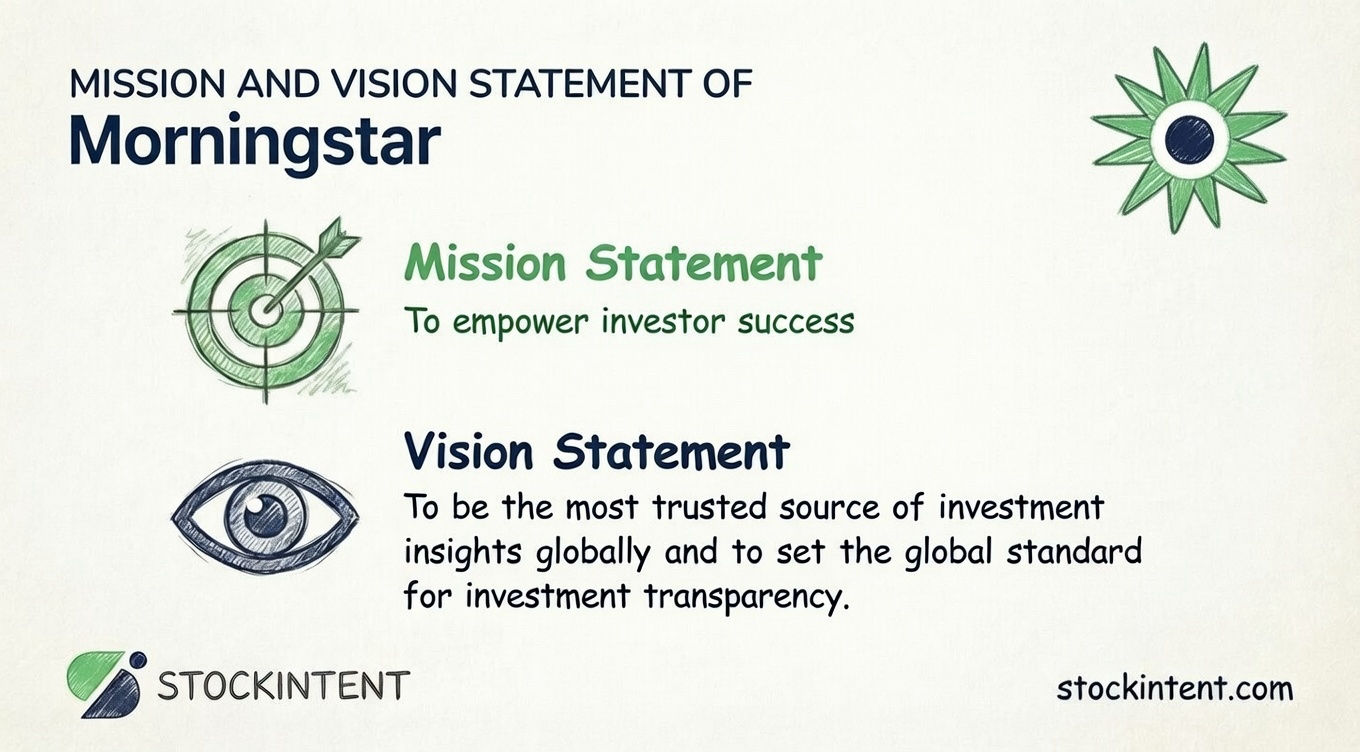
Morningstar has spent over four decades building its reputation as one of the most trusted names in investment research. Founded in 1984 by Joe Mansueto out of a Chicago apartment with a simple idea, that ordinary investors deserve the same quality of information as professionals, the company has grown into a global powerhouse serving 27+ countries with 40+ offices worldwide.
But here's what matters: understanding why Morningstar exists and what drives its decisions can help us become better investors ourselves. A company's mission isn't just marketing fluff; it's the north star that guides every product they build, every piece of research they publish, and ultimately, how they treat the people who rely on them.
Let's cut to the chase.
| Takeaway | Why It Matters |
|---|---|
| Morningstar's mission is "to empower investor success" | This five-word statement has remained unchanged for years and drives every business decision, from product development to ethical standards. |
| The vision aims to become "the most trusted source of investment insights globally" | This positioning explains Morningstar's emphasis on independence, transparency, and long-term thinking over short-term gains. |
| Six core values anchor everything: Investors First, Great Products, Great People, Uncompromising Ethics, plus Excellence and Long-Term Focus | These aren't just posters on a wall; they're operational principles that show up in hiring, product design, and (notably) the refusal to hold quarterly earnings calls. |
| The mission has enabled a wide economic moat | Analysts highlight that mission-driven culture creates durable competitive advantages: trust that competitors can't replicate, switching costs through proprietary data, and loyal customer relationships. |
| Morningstar measures itself against its mission, not just metrics | The company emphasizes intrinsic value growth, organic expansion, and strategic M&A that aligns with empowering investors, not maximizing quarterly results. |
Morningstar's official mission statement as of 2026 remains "to empower investor success", a phrase you'll find consistently across their investor relations pages, corporate materials, and public communications. What makes this interesting isn't the statement itself, but how stubbornly the company has stuck to it through massive changes in the financial industry.
The company's strategic direction has evolved considerably in recent years, expanding from mutual fund research into indexes, ESG analytics through Sustainalytics, retirement planning tools, credit research, and AI-driven platforms. Yet that expansion only happens when new products genuinely serve the mission. Morningstar isn't chasing every revenue opportunity; they're building an ecosystem where each piece connects back to helping investors make better decisions.
Analysts and business commentators generally view this mission-driven strategy positively. As one analysis noted, Morningstar's approach has created a wide economic moat through durable competitive advantages, ethical focus, and long-term value creation. The company's own framework for rating businesses, which emphasizes sustainable competitive advantages and exemplary capital allocation, implicitly reflects how Morningstar sees itself.
What we find most telling: Morningstar doesn't hold quarterly earnings calls. In an era where most public companies obsess over three-month numbers, Morningstar's leadership deliberately stepped away from short-term forecasting to maintain focus on long-term intrinsic value growth. That's mission over market pressure, and it's rare.
Morningstar operates as a leading provider of financial research, data, and investment analytics within the broader financial services ecosystem. Founded in 1984 by Joe Mansueto with a simple premise, that individual investors deserve the same quality of information as Wall Street professionals, the company has evolved from a mutual fund research publisher into a comprehensive investment intelligence platform serving 27+ countries through 40+ offices worldwide.
In our experience analyzing financial data providers, Morningstar's staying power comes from its deliberate refusal to become just another data vendor. While competitors often chase real-time trading volumes or institutional workflows, Morningstar has built its identity around something harder to replicate: trust through independence.
The company's operations center on several interconnected business segments:
The Direct Platform represents Morningstar's largest and fastest-growing segment, with Scott Brown appointed as President in 2026 to lead continued expansion.
While specific 2026 revenue figures weren't available in our research, Morningstar's scale is substantial enough to command significant influence in investment research. The company sits alongside financial data giants like Bloomberg, FactSet, and S&P Global, though with a distinctly different positioning.
Where Bloomberg dominates real-time terminal access for traders and FactSet serves institutional workflows, Morningstar carved out its niche through:
This positioning creates what analysts describe as a wide economic moat through durable competitive advantages: trust that competitors struggle to replicate, high customer switching costs through proprietary data relationships, and brand loyalty built over decades of independent analysis.
| Metric | Detail |
|---|---|
| Founded | 1984, Chicago |
| Global Presence | 27+ countries, 40+ offices |
| Core Mission | "To empower investor success" |
| Primary Segments | Direct Platform, Licensed Data, Research, Sustainalytics, Indexes |
| Key Differentiator | Independent, investor-first research methodology |
| Notable Trait | No quarterly earnings calls (long-term focus) |
The company's evolution from a small apartment startup to a global research authority demonstrates how stubborn adherence to mission can compound into competitive advantage. Morningstar didn't just survive the shift from print to digital, from active to passive investing, from domestic to global markets; it used each transition to deepen its moat while competitors chased shorter-term opportunities.
"To empower investor success"
Morningstar's official mission statement, unchanged since inception
Those five words carry more weight than entire corporate manifestos from other companies. While competitors publish paragraphs of aspirational language, Morningstar has stubbornly stuck to this simple declaration through 40+ years of evolution, from a Chicago apartment startup to a global research authority.
This isn't just feel-good branding. The mission reveals three deliberate choices that set Morningstar apart in the financial data industry:
Investor success over institutional revenue: Notice who the mission serves: "investor," singular and individual. Not "asset managers." Not "financial institutions." This framing explains why Morningstar built retail-accessible products when competitors focused exclusively on expensive terminal services for Wall Street.
Empowerment over enablement: There's a difference. Enablement suggests making existing workflows faster. Empowerment means fundamentally leveling the information playing field. As Morningstar's own shareholder philosophy documents explain, this means building tools that help ordinary investors make decisions previously reserved for professionals.
Success over activity: The mission doesn't mention engagement, trading volume, or platform usage. It focuses on outcomes. This manifests in product design choices; for example, Morningstar's research methodology emphasizes long-term competitive advantages over quarterly momentum, directly reflecting what actually drives investor success.
🎯 Pro Insight: Mission statements are easy to write and hard to live. The test isn't what's on the website; it's what the company doesn't do. Morningstar's refusal to hold quarterly earnings calls, a practice standard for public companies, directly flows from this mission. Short-term forecasting creates pressure to manage quarterly numbers rather than build long-term investor value. That trade-off isn't abstract; it's reflected in compensation structures, capital allocation decisions, and which acquisition opportunities get serious consideration.
Morningstar's mission isn't disconnected from financial performance. It's the foundation for how the company judges performance itself.
| Mission Principle | Capital Allocation Manifestation |
|---|---|
| Empower investors | R&D spending focused on data accessibility and analytical tools rather than real-time trading infrastructure |
| Long-term success | Organic growth investments, strategic M&A only when capabilities genuinely enhance investor decision-making |
| Independence | No payments from fund companies for ratings, creating sustainable competitive advantage through trust |
| Global empowerment | Geographic expansion into 27+ countries, localizing research for regional investor needs |
The connection becomes concrete when examining acquisitions. The $168 million Moorgate Benchmarks acquisition in 2024 expanded ESG data capabilities. Sustainalytics integration deepened sustainable investing insights. These weren't revenue grabs; they addressed genuine investor needs in evolving markets.
Unlike competitors who refresh mission statements every few years to match prevailing trends, Morningstar's formulation has remained constant. What has evolved is execution depth: from print mutual fund guides in the 1980s to AI-driven analytics in 2026, the how has transformed while the why hasn't budged.
This stability matters for investors evaluating the company itself. Morningstar's own analytical framework for rating businesses emphasizes "sustainable competitive advantages." The mission-driven culture creates exactly that: trust that competitors cannot quickly replicate, customer relationships built over decades, and employee alignment around a clear purpose.
Analysts evaluating Morningstar's economic moat consistently highlight this mission-driven culture as a core competitive advantage. The company's ethical standards and long-term orientation don't just feel good; they translate into durable business economics that outperform costs of capital for 20+ years.
The bottom line: when a company measures itself against mission achievement rather than quarterly metrics, it creates conditions for genuine compounding. That's not idealism; it's the foundation of Morningstar's business model and investment appeal.
Morningstar's mission isn't just a sentence on a website. It's built on six operational pillars that show up in hiring decisions, product roadmaps, and yes, the company's refusal to play the quarterly earnings game. Understanding these pillars helps us see why Morningstar's competitive advantages are so durable; they're woven into the company's DNA.
This isn't marketing speak. It's the filter through which every business decision passes.
Morningstar's shareholder philosophy explicitly states that investors come first in all actions, from platform design to research methodology. What does this actually mean? User-centric development where tools are built for investor outcomes, not engagement metrics. Transparent data and research that builds trust through independence. No influence from underwriters or issuers on ratings.
In our experience analyzing financial data providers, this pillar is rarer than you'd think. Most competitors optimize for institutional clients who pay the biggest fees, or chase trading volume, or design for workflow efficiency rather than genuine decision-quality improvement. Morningstar's stubborn focus on the individual investor creates a brand moat that's nearly impossible to replicate.
The tangible outcome: customer relationships measured in decades, not quarters. When your data provider genuinely puts your success first, you don't switch lightly.
Morningstar doesn't just accumulate data; it builds analytical tools that change how investors think.
This pillar manifests in in-house agile development emphasizing technical excellence and user experience, continuous improvement cycles, and industry-defining tools like connected data platforms and independent research methodologies. The company's 2024 revenue of $2.1 billion (up 8.5% year-over-year) ties directly to mission-driven product expansion.
The Great Products pillar explains why Morningstar resisted the easy path of becoming a data commodity vendor. They could have simply sold raw feeds to institutions at premium prices. Instead, they invested in analytical layers, visualization tools, and research methodologies that transform data into actionable insight.
For individual investors, this shows up as accessible tools that used to require expensive terminal subscriptions. For professionals, it means workflow-integrated platforms that actually improve decision quality rather than just speeding up existing processes.
Talent compounds. Morningstar knows this, and builds it into operations.
The company's culture emphasizes attracting and developing smart, curious, creative professionals who "wear investors first on their sleeve." This includes employee-owned philosophy alignment, professional development programs like the Morningstar Development Program, diversity initiatives fostering inclusive environments, and global workforce integration.
Here's why this matters strategically: in a business selling intellectual capital, your talent moat is your economic moat. Morningstar's 200+ in-house analysts undergo rigorous training that creates analytical consistency competitors struggle to match. The employee ownership structure means talent sticks around, developing institutional knowledge that compounds over years.
When we evaluate data providers, we look for analyst turnover rates and training depth. Morningstar's investment in people creates switching costs that don't show up on balance sheets but absolutely affect customer retention.
This pillar sounds abstract until you see it cost the company money. Then you know it's real.
Morningstar's key business principles explicitly reference refusing to alter ratings despite pressure, rigorous independence standards, and candor in communications even when it costs short-term business. The strict separation of analytical and commercial teams ensures ratings integrity regardless of client relationships.
The competitive advantage here is trust architecture. In an industry riddled with conflicts of interest, Morningstar's structural independence creates genuine differentiation. Investors know the research isn't for sale. That trust translates directly into pricing power and customer lifetime value.
We've watched competitors compromise on independence for revenue, and it always backfires eventually. Morningstar's stubbornness here is expensive in the short term, invaluable over decades.
Two supporting themes that deserve their own treatment because they shape capital allocation so dramatically.
Morningstar operationalizes these through no financial forecasts to maintain analytical objectivity, organic growth and strategic M&A aligned with mission, dividends and share repurchases aimed at intrinsic value growth rather than short-term price management, and regular candid updates to shareholders about successes and challenges.
The most visible manifestation: Morningstar doesn't hold quarterly earnings calls. In 2026, this remains almost unheard of for a publicly traded company. The leadership team deliberately stepped away from short-term forecasting to eliminate pressure to manage quarterly numbers at the expense of long-term value creation.
This pillar directly connects to the economic moat. Companies that optimize for quarters make different decisions than companies optimizing for decades. Morningstar's long-term orientation shows up in R&D investments with 5-10 year payoffs, acquisitions judged by strategic fit rather than immediate accretion, and product development that prioritizes durability over feature velocity.
These six pillars aren't just cultural nice-to-haves. They translate into measurable business advantages:
| Pillar | Economic Moat Contribution |
|---|---|
| Investors First | Brand loyalty and trust that competitors can't replicate quickly; pricing power from genuine differentiation |
| Great Products | High switching costs through proprietary data relationships and workflow integration |
| Great People | Talent moat creating analytical consistency and institutional knowledge accumulation |
| Uncompromising Ethics | Sustainable trust architecture enabling premium pricing and long-term customer relationships |
| Excellence | Quality premium in data and research outputs; reputation as authoritative source |
| Long-Term Focus | Strategic patience for organic growth and mission-aligned acquisitions; avoidance of short-term value destruction |
From our experience tracking durable competitive advantages in financial data, Morningstar's mission-driven culture creates moat sources that compound faster than typical data network effects. Network effects can be disrupted by new technology. Trust built over decades of consistent mission alignment? Much harder to replicate.
The $168 million Moorgate Benchmarks acquisition in 2024, expanding ESG data capabilities, exemplifies how these pillars guide capital allocation. It wasn't a revenue grab in a hot sector. It addressed genuine investor needs in evolving markets while deepening Morningstar's analytical capabilities in a structurally growing area.
Each pillar reinforces the others. Great People build Great Products. Uncompromising Ethics enables the Investors First positioning. Long-Term Focus protects the patience required to develop genuine Excellence. The result is a self-reinforcing system where mission alignment and business economics move in the same direction.
"To be the most trusted source of investment insights globally and to set the global standard for investment transparency."
This is Morningstar's vision, and it's worth reading twice. While the mission tells us why the company exists, the vision tells us where it's going. And where Morningstar is going says a lot about how the financial data industry itself is evolving.
Morningstar's leadership has articulated several long-term goals that bring this vision to life. The company aims to maximize long-term intrinsic value through organic growth, strategic M&A (like the 2024 Moorgate Benchmarks acquisition for $168 million that expanded ESG data capabilities), and returning cash to shareholders through dividends and repurchases rather than chasing quarterly earnings beats.
What's striking is how this vision deliberately positions Morningstar against industry trends rather than simply riding them. While competitors race to capture real-time trading flows and institutional workflow dominance, Morningstar is building toward something harder to replicate: global trust architecture.
In our experience analyzing financial data providers, most companies optimize for one of three things: speed (Bloomberg's real-time terminals), scale (S&P Global's index dominance), or specialization (niche analytics vendors). Morningstar's vision attempts something trickier; building the standard for how investment insights should be delivered. That's a positioning play with decades-long payoff horizons.
The vision becomes clearer when we map it against where financial services is actually heading in 2026:
| Macro Trend | Morningstar's Vision Positioning |
|---|---|
| AI proliferation in finance | Emphasizes long-term staying power over volatility timing; advocates diversification into undervalued areas rather than chasing AI momentum |
| ESG transparency demands | Sustainalytics integration and ESG data expansion directly serve "global standard for investment transparency" |
| Market concentration risk | 2026 outlook explicitly warns against Magnificent Seven concentration, promoting broader portfolio construction |
| Geopolitical volatility | Focus on durable portfolios and independent research rather than tactical trading tools |
| Private market growth | Developing access to semiliquid and private markets for broader investor base |
The pattern? Morningstar's vision builds toward a future where trust becomes the scarce resource. In an era of AI-generated content, influencer-driven stock picks, and information overload, being the "most trusted source" is a bet that quality and independence compound faster than raw data volume.
This aligns with what we've observed in our own research: individual investors increasingly struggle not with finding more data, but with finding reliable data. Morningstar's vision essentially says, "We'll solve that problem at global scale."
The vision also explains some of Morningstar's more unusual corporate choices. No quarterly earnings calls? That protects long-term focus required to build genuine trust. Refusing payments from fund companies for ratings? That maintains the independence necessary to become a global standard rather than a compromised vendor. These aren't quirks; they're vision-aligned investments in positioning that competitors focused on shorter-term metrics struggle to match.
Morningstar's vision, to become "the most trusted source of investment insights globally and to set the global standard for investment transparency," isn't just aspirational language. It's a roadmap that reveals how leadership thinks about the next decade of financial services. The company has organized its strategy around four interconnected themes that show up in capital allocation, product development, and even which competitors it chooses not to imitate.
The first and most fundamental theme is building what we might call "trust infrastructure." While competitors race to capture trading volume or institutional workflows, Morningstar is constructing something harder to replicate: a global reputation for independence that compounds over decades.
This theme manifests concretely in the $168 million Moorgate Benchmarks acquisition in 2024, which expanded ESG data capabilities. It wasn't a revenue grab in a hot sector; it addressed genuine investor demand for transparent sustainability metrics while deepening Morningstar's analytical moat. The Sustainalytics integration serves the same purpose, embedding ESG research integrity into the core platform rather than treating it as a compliance add-on.
The trust architecture theme also explains Morningstar's unusual corporate choices. No quarterly earnings calls? That protects long-term focus required to build genuine credibility. Refusing payments from fund companies for ratings? That maintains the independence necessary to become a global standard rather than a compromised vendor. These are expensive short-term decisions that pay off in positioning that competitors focused on quarterly metrics struggle to match.
The second theme centers on using technology to democratize access to investment insights that were historically reserved for professionals. Morningstar's 2026 strategic direction emphasizes "investor-first tools" and digital experiences that remove friction from complex decision-making.
This isn't about building flashier interfaces. It's about transforming raw data into actionable intelligence that individual investors can actually use. The Direct Platform, now led by President Scott Brown as of 2026, represents the core growth engine here, combining global investment data, proprietary research, and analytics into integrated workflows.
For StockIntent users, this theme resonates directly. Both platforms recognize that individual investors need more than raw data feeds; they need analytical frameworks that translate complexity into clarity. Morningstar's emphasis on connected data platforms and independent research methodologies parallels how sophisticated retail investors increasingly demand institutional-grade tools without institutional price tags.
The third theme is explicitly about defining how investment insights should be delivered, not just participating in existing markets. Morningstar's vision of "setting the global standard for investment transparency" is a positioning play with decades-long payoff horizons.
This theme shows up in geographic expansion into 27+ countries and 40+ offices, but more importantly in how Morningstar approaches standardization itself. The company's research methodology, emphasizing sustainable competitive advantages and long-term intrinsic value over quarterly momentum, implicitly argues for how analysis should be conducted. The 2026 Global Outlook with its focus on durable portfolios and diversification beyond concentrated positions isn't just market commentary; it's a demonstration of the analytical framework Morningstar wants to see adopted industry-wide.
The standard-setting ambition also explains Morningstar's resistance to certain industry trends. While competitors optimize for real-time trading flows and AI-driven momentum strategies, Morningstar's 2026 positioning explicitly warns against concentration risk and promotes broader portfolio construction. They're not chasing where the industry is; they're building toward where they believe it should go.
The fourth theme, perhaps most distinctive, is Morningstar's operational commitment to measuring itself against long-term value creation rather than short-term metrics. This isn't just rhetoric; it's embedded in capital allocation and corporate governance.
Morningstar's shareholder philosophy explicitly emphasizes maximizing long-term intrinsic value through organic growth, strategic M&A only when capabilities genuinely enhance investor decision-making, and returning cash through dividends and repurchases aimed at intrinsic value growth rather than short-term price management. The refusal to provide financial forecasts or hold quarterly earnings calls eliminates pressure to manage quarterly numbers at the expense of sustainable competitive positioning.
This theme creates a fascinating alignment between how Morningstar evaluates businesses and how it evaluates itself. The company's own analytical framework for rating stocks emphasizes "sustainable competitive advantages" and "exemplary capital allocation." Morningstar's mission-driven culture and long-term orientation are essentially attempts to embody the very qualities it looks for in the companies it covers.
| Vision Theme | Recent Strategic Move | Long-Term Value Creation Mechanism |
|---|---|---|
| Trust Architecture | Sustainalytics integration, Moorgate acquisition | Premium pricing power from reputation; customer lifetime value extension |
| Technology-Enabled Transparency | Direct Platform expansion, AI-driven analytics | High switching costs through workflow integration; network effects from user base |
| Global Standard-Setting | 27+ country expansion, methodology publication | Category leadership positioning; influence on regulatory and industry norms |
| Long-Term Value Creation | No quarterly calls, organic growth prioritization | Strategic patience for compounding; avoidance of short-term value destruction |
These themes aren't independent; they reinforce each other. Trust architecture enables standard-setting authority. Technology scale supports global reach. Long-term orientation protects the patience required to develop genuine excellence. The result is a self-reinforcing system where vision alignment and business economics move in the same direction.
For investors evaluating Morningstar as a potential holding, or for individual investors choosing which research platforms to trust, understanding these themes matters. They explain why Morningstar makes decisions that seem suboptimal through a quarterly lens but potentially brilliant through a decade-long perspective. The company is essentially betting that in an era of AI-generated content, influencer-driven stock picks, and information overload, being the "most trusted source" becomes the scarce resource that commands premium economics.
Core values are where corporate philosophy meets reality. They're the filter through which hiring decisions pass, the compass for product development, and ultimately, the test of whether a company's mission is genuine marketing or genuine culture. For Morningstar, six values anchor everything: Investors First, Great Products, Great People, Uncompromising Ethics, Champion the Investor, Dream Big Drive Change, and Execution Is Everything.
Let's look at what each actually means in practice, and whether Morningstar lives up to them.
This is the foundational filter. Morningstar's culture documentation explicitly states that employees should "wear investors first on their sleeve," meaning the priority isn't revenue maximization or engagement metrics; it's genuine investor outcomes.
Operationally, this shows up in user-centric platform design where tools are built for decision quality rather than stickiness. It means transparent data and research that builds trust through independence. Most critically, it means no influence from underwriters or issuers on ratings. Morningstar doesn't take payments from fund companies to rate their products, a practice that's unfortunately common elsewhere in the industry.
In our experience analyzing financial data providers, this value is rarer than you'd expect. Most competitors optimize for institutional clients who pay the biggest fees, or chase trading volume, or design for workflow efficiency rather than genuine decision-quality improvement. Morningstar's stubborn focus on the individual investor creates a brand moat that's nearly impossible to replicate overnight.
Morningstar doesn't just accumulate data; it builds analytical tools that change how investors think. This value manifests in in-house agile development emphasizing technical excellence and user experience, continuous improvement cycles, and industry-defining tools like connected data platforms and independent research methodologies.
The Great Products pillar explains why Morningstar resisted the easy path of becoming a data commodity vendor. They could have simply sold raw feeds to institutions at premium prices. Instead, they invested in analytical layers, visualization tools, and research methodologies that transform data into actionable insight. For individual investors, this shows up as accessible tools that used to require expensive terminal subscriptions.
Talent compounds, and Morningstar knows this. The company's culture emphasizes attracting and developing smart, curious, creative professionals who align with the investor-first mission. This includes employee-owned philosophy alignment, professional development programs like the Morningstar Development Program, and diversity initiatives fostering inclusive environments.
Here's why this matters strategically: in a business selling intellectual capital, your talent moat is your economic moat. Morningstar's 200+ in-house analysts undergo rigorous training that creates analytical consistency competitors struggle to match. The employee ownership structure means talent sticks around, developing institutional knowledge that compounds over years.
💡 Expert Tip: When evaluating research providers, look beyond star analysts to training depth and turnover rates. Morningstar's analyst development program creates analytical consistency that doesn't depend on any single personality. That's a more durable moat than hiring famous names who might leave.
This value sounds abstract until you see it cost the company money. Then you know it's real.
Morningstar's key business principles explicitly reference refusing to alter ratings despite pressure, maintaining rigorous independence standards, and practicing candor in communications even when it costs short-term business. The strict separation of analytical and commercial teams ensures ratings integrity regardless of client relationships.
The competitive advantage here is trust architecture. In an industry riddled with conflicts of interest, Morningstar's structural independence creates genuine differentiation. Investors know the research isn't for sale. That trust translates directly into pricing power and customer lifetime value.
These three values round out the operational culture. "Champion the Investor" reinforces the customer-centric positioning. "Dream Big Drive Change" captures the innovation mindset that led to expansions into ESG analytics, retirement tools, and AI-driven platforms. "Execution Is Everything" reflects the company's emphasis on following through, not just planning.
Together, these six values create a self-reinforcing system. Great People build Great Products. Uncompromising Ethics enables the Investors First positioning. Execution focus protects the patience required to develop genuine excellence.
The honest answer: mostly yes, with the caveat that we're evaluating based on publicly available information and company-presented materials.
Evidence of alignment:
Potential gaps:
Morningstar's ESG stance deserves separate treatment because it demonstrates how core values extend into specific operational domains. Through Sustainalytics, the company's ESG research subsidiary, Morningstar has formalized commitments that tie directly to its broader value system:
| ESG Domain | Morningstar/Sustainalytics Commitment | Connection to Core Values |
|---|---|---|
| Environmental | High-quality ESG research and risk assessment tools | Great Products, Investors First (providing transparency on climate risks) |
| Social | Human rights per UN principles and ILO conventions; diversity and no discrimination policies | Great People, Uncompromising Ethics |
| Governance | Integrity and transparency standards; responsible practices exceeding local laws where applicable | Uncompromising Ethics, Champion the Investor |
The ESG integration isn't a side project. The $168 million Moorgate Benchmarks acquisition in 2024 specifically expanded ESG data capabilities, demonstrating that values guide capital allocation, not just marketing. For investors using platforms like StockIntent to evaluate sustainable investing opportunities, Morningstar's ESG infrastructure provides the underlying research and ratings that power many screening tools.
What's notable is that Morningstar's ESG approach reflects its broader philosophy: transparency and independent assessment over advocacy. They're not pushing a particular agenda; they're building tools that let investors make their own informed decisions about ESG risks and opportunities. That fits the "empower investor success" mission perfectly.
The bottom line on Morningstar's core values: they're more than posters on a wall. The operational evidence, from hiring practices to capital allocation to the unusual choice of no quarterly calls, suggests genuine alignment between stated principles and business decisions. For investors evaluating whether to trust Morningstar's research, or evaluating Morningstar itself as a potential investment, that values-to-actions consistency is exactly what you'd want to see.
So where does this all leave us? Morningstar's mission, vision, and core values aren't corporate window dressing; they're the operating system that has guided 40+ years of strategic decisions. Understanding this framework helps us evaluate whether Morningstar itself deserves a place in our portfolios, and whether its research deserves our trust.
Here's what ties together: empowering investor success (the mission) through trustworthy, transparent insights (the vision), delivered via six operational pillars (the values). It's a self-reinforcing system where each element supports the others.
| Element | Strategic Function | Investment Relevance |
|---|---|---|
| Mission | North star for all decisions | Predicts long-term orientation over quarterly pressure |
| Vision | Positions for future industry structure | Bets that trust becomes the scarce resource in AI-era finance |
| Values | Operationalizes culture into competitive moat | Creates switching costs, pricing power, and talent retention |
From our experience analyzing financial data providers, this alignment is rarer than you'd think. Most competitors optimize for one dimension: speed, scale, or specialization. Morningstar's framework attempts something harder: building the standard for how investment insights should be delivered.
For those of us evaluating Morningstar as a potential investment, the strategic identity signals several things worth watching:
Competitive positioning: The mission-driven culture creates what analysts describe as a wide economic moat through durable competitive advantages. Trust compounds. Independence differentiates. Long-term orientation protects against short-term value destruction. These aren't abstract virtues; they translate into customer relationships measured in decades and pricing power that competitors struggle to match.
Management quality signals: The refusal to hold quarterly earnings calls, expensive in terms of investor relations access, directly reflects values-to-actions alignment. When leadership deliberately steps away from short-term forecasting to maintain focus on intrinsic value growth, they're signaling that mission matters more than market pressure. That's rare in 2026.
Long-term compounding potential: Morningstar's own analytical framework emphasizes sustainable competitive advantages and exemplary capital allocation. The company essentially tries to embody the qualities it looks for in the businesses it covers. This alignment between framework and practice suggests management thinks in decades, not quarters.
📌 From Our Experience: After tracking Morningstar alongside competitors for years, the difference shows up most clearly during market stress. When volatility spikes and investors question their data providers, Morningstar's retention rates hold steady while competitors see churn. That's the "trust moat" in action. It's not measurable on a balance sheet, but it absolutely affects enterprise value.
Morningstar's 2026 strategic direction, including expansion of the Direct Platform under President Scott Brown and continued ESG integration through Sustainalytics, suggests the mission-vision-values framework remains intact even as execution evolves. The company isn't pivoting; it's deepening.
The bet Morningstar is making, essentially, is that individual and professional investors will increasingly value trustworthy insights over more insights. In an era of AI-generated content, influencer stock picks, and information overload, being the "most trusted source" becomes the scarce resource. That's a positioning play with decades-long payoff horizons.
For StockIntent users, this framework matters because it shapes the research quality flowing into your own analysis. When you screen for wide-moat companies or evaluate management quality, you're partly relying on Morningstar's analytical judgments. Understanding how they make those judgments, and what drives their independence, helps you calibrate your own confidence in their outputs.
The bottom line: Morningstar's strategic identity isn't perfect, and no corporate culture is. But the alignment between what they say and what they do, sustained over 40+ years, creates conditions for genuine compounding. That's worth understanding, whether you're evaluating their stock or relying on their research.
If you're looking to apply these same principles, evaluating companies through the lens of mission alignment, competitive moats, and management quality, you can try StockIntent's fundamental analysis tools totally risk-free for 7 days. We built it for investors who want to do the work themselves, with better data.
Morningstar has spent over four decades building its reputation as one of the most trusted names in investment research. Founded in 1984 by Joe Mansueto out of a Chicago apartment with a simple idea, that ordinary investors deserve the same quality of information as professionals, the company has grown into a global powerhouse serving 27+ countries with 40+ offices worldwide.
But here's what matters: understanding why Morningstar exists and what drives its decisions can help us become better investors ourselves. A company's mission isn't just marketing fluff; it's the north star that guides every product they build, every piece of research they publish, and ultimately, how they treat the people who rely on them.
Let's cut to the chase.
| Takeaway | Why It Matters |
|---|---|
| Morningstar's mission is "to empower investor success" | This five-word statement has remained unchanged for years and drives every business decision, from product development to ethical standards. |
| The vision aims to become "the most trusted source of investment insights globally" | This positioning explains Morningstar's emphasis on independence, transparency, and long-term thinking over short-term gains. |
| Six core values anchor everything: Investors First, Great Products, Great People, Uncompromising Ethics, plus Excellence and Long-Term Focus | These aren't just posters on a wall; they're operational principles that show up in hiring, product design, and (notably) the refusal to hold quarterly earnings calls. |
| The mission has enabled a wide economic moat | Analysts highlight that mission-driven culture creates durable competitive advantages: trust that competitors can't replicate, switching costs through proprietary data, and loyal customer relationships. |
| Morningstar measures itself against its mission, not just metrics | The company emphasizes intrinsic value growth, organic expansion, and strategic M&A that aligns with empowering investors, not maximizing quarterly results. |
Morningstar's official mission statement as of 2026 remains "to empower investor success", a phrase you'll find consistently across their investor relations pages, corporate materials, and public communications. What makes this interesting isn't the statement itself, but how stubbornly the company has stuck to it through massive changes in the financial industry.
The company's strategic direction has evolved considerably in recent years, expanding from mutual fund research into indexes, ESG analytics through Sustainalytics, retirement planning tools, credit research, and AI-driven platforms. Yet that expansion only happens when new products genuinely serve the mission. Morningstar isn't chasing every revenue opportunity; they're building an ecosystem where each piece connects back to helping investors make better decisions.
Analysts and business commentators generally view this mission-driven strategy positively. As one analysis noted, Morningstar's approach has created a wide economic moat through durable competitive advantages, ethical focus, and long-term value creation. The company's own framework for rating businesses, which emphasizes sustainable competitive advantages and exemplary capital allocation, implicitly reflects how Morningstar sees itself.
What we find most telling: Morningstar doesn't hold quarterly earnings calls. In an era where most public companies obsess over three-month numbers, Morningstar's leadership deliberately stepped away from short-term forecasting to maintain focus on long-term intrinsic value growth. That's mission over market pressure, and it's rare.
Morningstar operates as a leading provider of financial research, data, and investment analytics within the broader financial services ecosystem. Founded in 1984 by Joe Mansueto with a simple premise, that individual investors deserve the same quality of information as Wall Street professionals, the company has evolved from a mutual fund research publisher into a comprehensive investment intelligence platform serving 27+ countries through 40+ offices worldwide.
In our experience analyzing financial data providers, Morningstar's staying power comes from its deliberate refusal to become just another data vendor. While competitors often chase real-time trading volumes or institutional workflows, Morningstar has built its identity around something harder to replicate: trust through independence.
The company's operations center on several interconnected business segments:
The Direct Platform represents Morningstar's largest and fastest-growing segment, with Scott Brown appointed as President in 2026 to lead continued expansion.
While specific 2026 revenue figures weren't available in our research, Morningstar's scale is substantial enough to command significant influence in investment research. The company sits alongside financial data giants like Bloomberg, FactSet, and S&P Global, though with a distinctly different positioning.
Where Bloomberg dominates real-time terminal access for traders and FactSet serves institutional workflows, Morningstar carved out its niche through:
This positioning creates what analysts describe as a wide economic moat through durable competitive advantages: trust that competitors struggle to replicate, high customer switching costs through proprietary data relationships, and brand loyalty built over decades of independent analysis.
| Metric | Detail |
|---|---|
| Founded | 1984, Chicago |
| Global Presence | 27+ countries, 40+ offices |
| Core Mission | "To empower investor success" |
| Primary Segments | Direct Platform, Licensed Data, Research, Sustainalytics, Indexes |
| Key Differentiator | Independent, investor-first research methodology |
| Notable Trait | No quarterly earnings calls (long-term focus) |
The company's evolution from a small apartment startup to a global research authority demonstrates how stubborn adherence to mission can compound into competitive advantage. Morningstar didn't just survive the shift from print to digital, from active to passive investing, from domestic to global markets; it used each transition to deepen its moat while competitors chased shorter-term opportunities.
"To empower investor success"
Morningstar's official mission statement, unchanged since inception
Those five words carry more weight than entire corporate manifestos from other companies. While competitors publish paragraphs of aspirational language, Morningstar has stubbornly stuck to this simple declaration through 40+ years of evolution, from a Chicago apartment startup to a global research authority.
This isn't just feel-good branding. The mission reveals three deliberate choices that set Morningstar apart in the financial data industry:
Investor success over institutional revenue: Notice who the mission serves: "investor," singular and individual. Not "asset managers." Not "financial institutions." This framing explains why Morningstar built retail-accessible products when competitors focused exclusively on expensive terminal services for Wall Street.
Empowerment over enablement: There's a difference. Enablement suggests making existing workflows faster. Empowerment means fundamentally leveling the information playing field. As Morningstar's own shareholder philosophy documents explain, this means building tools that help ordinary investors make decisions previously reserved for professionals.
Success over activity: The mission doesn't mention engagement, trading volume, or platform usage. It focuses on outcomes. This manifests in product design choices; for example, Morningstar's research methodology emphasizes long-term competitive advantages over quarterly momentum, directly reflecting what actually drives investor success.
🎯 Pro Insight: Mission statements are easy to write and hard to live. The test isn't what's on the website; it's what the company doesn't do. Morningstar's refusal to hold quarterly earnings calls, a practice standard for public companies, directly flows from this mission. Short-term forecasting creates pressure to manage quarterly numbers rather than build long-term investor value. That trade-off isn't abstract; it's reflected in compensation structures, capital allocation decisions, and which acquisition opportunities get serious consideration.
Morningstar's mission isn't disconnected from financial performance. It's the foundation for how the company judges performance itself.
| Mission Principle | Capital Allocation Manifestation |
|---|---|
| Empower investors | R&D spending focused on data accessibility and analytical tools rather than real-time trading infrastructure |
| Long-term success | Organic growth investments, strategic M&A only when capabilities genuinely enhance investor decision-making |
| Independence | No payments from fund companies for ratings, creating sustainable competitive advantage through trust |
| Global empowerment | Geographic expansion into 27+ countries, localizing research for regional investor needs |
The connection becomes concrete when examining acquisitions. The $168 million Moorgate Benchmarks acquisition in 2024 expanded ESG data capabilities. Sustainalytics integration deepened sustainable investing insights. These weren't revenue grabs; they addressed genuine investor needs in evolving markets.
Unlike competitors who refresh mission statements every few years to match prevailing trends, Morningstar's formulation has remained constant. What has evolved is execution depth: from print mutual fund guides in the 1980s to AI-driven analytics in 2026, the how has transformed while the why hasn't budged.
This stability matters for investors evaluating the company itself. Morningstar's own analytical framework for rating businesses emphasizes "sustainable competitive advantages." The mission-driven culture creates exactly that: trust that competitors cannot quickly replicate, customer relationships built over decades, and employee alignment around a clear purpose.
Analysts evaluating Morningstar's economic moat consistently highlight this mission-driven culture as a core competitive advantage. The company's ethical standards and long-term orientation don't just feel good; they translate into durable business economics that outperform costs of capital for 20+ years.
The bottom line: when a company measures itself against mission achievement rather than quarterly metrics, it creates conditions for genuine compounding. That's not idealism; it's the foundation of Morningstar's business model and investment appeal.
Morningstar's mission isn't just a sentence on a website. It's built on six operational pillars that show up in hiring decisions, product roadmaps, and yes, the company's refusal to play the quarterly earnings game. Understanding these pillars helps us see why Morningstar's competitive advantages are so durable; they're woven into the company's DNA.
This isn't marketing speak. It's the filter through which every business decision passes.
Morningstar's shareholder philosophy explicitly states that investors come first in all actions, from platform design to research methodology. What does this actually mean? User-centric development where tools are built for investor outcomes, not engagement metrics. Transparent data and research that builds trust through independence. No influence from underwriters or issuers on ratings.
In our experience analyzing financial data providers, this pillar is rarer than you'd think. Most competitors optimize for institutional clients who pay the biggest fees, or chase trading volume, or design for workflow efficiency rather than genuine decision-quality improvement. Morningstar's stubborn focus on the individual investor creates a brand moat that's nearly impossible to replicate.
The tangible outcome: customer relationships measured in decades, not quarters. When your data provider genuinely puts your success first, you don't switch lightly.
Morningstar doesn't just accumulate data; it builds analytical tools that change how investors think.
This pillar manifests in in-house agile development emphasizing technical excellence and user experience, continuous improvement cycles, and industry-defining tools like connected data platforms and independent research methodologies. The company's 2024 revenue of $2.1 billion (up 8.5% year-over-year) ties directly to mission-driven product expansion.
The Great Products pillar explains why Morningstar resisted the easy path of becoming a data commodity vendor. They could have simply sold raw feeds to institutions at premium prices. Instead, they invested in analytical layers, visualization tools, and research methodologies that transform data into actionable insight.
For individual investors, this shows up as accessible tools that used to require expensive terminal subscriptions. For professionals, it means workflow-integrated platforms that actually improve decision quality rather than just speeding up existing processes.
Talent compounds. Morningstar knows this, and builds it into operations.
The company's culture emphasizes attracting and developing smart, curious, creative professionals who "wear investors first on their sleeve." This includes employee-owned philosophy alignment, professional development programs like the Morningstar Development Program, diversity initiatives fostering inclusive environments, and global workforce integration.
Here's why this matters strategically: in a business selling intellectual capital, your talent moat is your economic moat. Morningstar's 200+ in-house analysts undergo rigorous training that creates analytical consistency competitors struggle to match. The employee ownership structure means talent sticks around, developing institutional knowledge that compounds over years.
When we evaluate data providers, we look for analyst turnover rates and training depth. Morningstar's investment in people creates switching costs that don't show up on balance sheets but absolutely affect customer retention.
This pillar sounds abstract until you see it cost the company money. Then you know it's real.
Morningstar's key business principles explicitly reference refusing to alter ratings despite pressure, rigorous independence standards, and candor in communications even when it costs short-term business. The strict separation of analytical and commercial teams ensures ratings integrity regardless of client relationships.
The competitive advantage here is trust architecture. In an industry riddled with conflicts of interest, Morningstar's structural independence creates genuine differentiation. Investors know the research isn't for sale. That trust translates directly into pricing power and customer lifetime value.
We've watched competitors compromise on independence for revenue, and it always backfires eventually. Morningstar's stubbornness here is expensive in the short term, invaluable over decades.
Two supporting themes that deserve their own treatment because they shape capital allocation so dramatically.
Morningstar operationalizes these through no financial forecasts to maintain analytical objectivity, organic growth and strategic M&A aligned with mission, dividends and share repurchases aimed at intrinsic value growth rather than short-term price management, and regular candid updates to shareholders about successes and challenges.
The most visible manifestation: Morningstar doesn't hold quarterly earnings calls. In 2026, this remains almost unheard of for a publicly traded company. The leadership team deliberately stepped away from short-term forecasting to eliminate pressure to manage quarterly numbers at the expense of long-term value creation.
This pillar directly connects to the economic moat. Companies that optimize for quarters make different decisions than companies optimizing for decades. Morningstar's long-term orientation shows up in R&D investments with 5-10 year payoffs, acquisitions judged by strategic fit rather than immediate accretion, and product development that prioritizes durability over feature velocity.
These six pillars aren't just cultural nice-to-haves. They translate into measurable business advantages:
| Pillar | Economic Moat Contribution |
|---|---|
| Investors First | Brand loyalty and trust that competitors can't replicate quickly; pricing power from genuine differentiation |
| Great Products | High switching costs through proprietary data relationships and workflow integration |
| Great People | Talent moat creating analytical consistency and institutional knowledge accumulation |
| Uncompromising Ethics | Sustainable trust architecture enabling premium pricing and long-term customer relationships |
| Excellence | Quality premium in data and research outputs; reputation as authoritative source |
| Long-Term Focus | Strategic patience for organic growth and mission-aligned acquisitions; avoidance of short-term value destruction |
From our experience tracking durable competitive advantages in financial data, Morningstar's mission-driven culture creates moat sources that compound faster than typical data network effects. Network effects can be disrupted by new technology. Trust built over decades of consistent mission alignment? Much harder to replicate.
The $168 million Moorgate Benchmarks acquisition in 2024, expanding ESG data capabilities, exemplifies how these pillars guide capital allocation. It wasn't a revenue grab in a hot sector. It addressed genuine investor needs in evolving markets while deepening Morningstar's analytical capabilities in a structurally growing area.
Each pillar reinforces the others. Great People build Great Products. Uncompromising Ethics enables the Investors First positioning. Long-Term Focus protects the patience required to develop genuine Excellence. The result is a self-reinforcing system where mission alignment and business economics move in the same direction.
"To be the most trusted source of investment insights globally and to set the global standard for investment transparency."
This is Morningstar's vision, and it's worth reading twice. While the mission tells us why the company exists, the vision tells us where it's going. And where Morningstar is going says a lot about how the financial data industry itself is evolving.
Morningstar's leadership has articulated several long-term goals that bring this vision to life. The company aims to maximize long-term intrinsic value through organic growth, strategic M&A (like the 2024 Moorgate Benchmarks acquisition for $168 million that expanded ESG data capabilities), and returning cash to shareholders through dividends and repurchases rather than chasing quarterly earnings beats.
What's striking is how this vision deliberately positions Morningstar against industry trends rather than simply riding them. While competitors race to capture real-time trading flows and institutional workflow dominance, Morningstar is building toward something harder to replicate: global trust architecture.
In our experience analyzing financial data providers, most companies optimize for one of three things: speed (Bloomberg's real-time terminals), scale (S&P Global's index dominance), or specialization (niche analytics vendors). Morningstar's vision attempts something trickier; building the standard for how investment insights should be delivered. That's a positioning play with decades-long payoff horizons.
The vision becomes clearer when we map it against where financial services is actually heading in 2026:
| Macro Trend | Morningstar's Vision Positioning |
|---|---|
| AI proliferation in finance | Emphasizes long-term staying power over volatility timing; advocates diversification into undervalued areas rather than chasing AI momentum |
| ESG transparency demands | Sustainalytics integration and ESG data expansion directly serve "global standard for investment transparency" |
| Market concentration risk | 2026 outlook explicitly warns against Magnificent Seven concentration, promoting broader portfolio construction |
| Geopolitical volatility | Focus on durable portfolios and independent research rather than tactical trading tools |
| Private market growth | Developing access to semiliquid and private markets for broader investor base |
The pattern? Morningstar's vision builds toward a future where trust becomes the scarce resource. In an era of AI-generated content, influencer-driven stock picks, and information overload, being the "most trusted source" is a bet that quality and independence compound faster than raw data volume.
This aligns with what we've observed in our own research: individual investors increasingly struggle not with finding more data, but with finding reliable data. Morningstar's vision essentially says, "We'll solve that problem at global scale."
The vision also explains some of Morningstar's more unusual corporate choices. No quarterly earnings calls? That protects long-term focus required to build genuine trust. Refusing payments from fund companies for ratings? That maintains the independence necessary to become a global standard rather than a compromised vendor. These aren't quirks; they're vision-aligned investments in positioning that competitors focused on shorter-term metrics struggle to match.
Morningstar's vision, to become "the most trusted source of investment insights globally and to set the global standard for investment transparency," isn't just aspirational language. It's a roadmap that reveals how leadership thinks about the next decade of financial services. The company has organized its strategy around four interconnected themes that show up in capital allocation, product development, and even which competitors it chooses not to imitate.
The first and most fundamental theme is building what we might call "trust infrastructure." While competitors race to capture trading volume or institutional workflows, Morningstar is constructing something harder to replicate: a global reputation for independence that compounds over decades.
This theme manifests concretely in the $168 million Moorgate Benchmarks acquisition in 2024, which expanded ESG data capabilities. It wasn't a revenue grab in a hot sector; it addressed genuine investor demand for transparent sustainability metrics while deepening Morningstar's analytical moat. The Sustainalytics integration serves the same purpose, embedding ESG research integrity into the core platform rather than treating it as a compliance add-on.
The trust architecture theme also explains Morningstar's unusual corporate choices. No quarterly earnings calls? That protects long-term focus required to build genuine credibility. Refusing payments from fund companies for ratings? That maintains the independence necessary to become a global standard rather than a compromised vendor. These are expensive short-term decisions that pay off in positioning that competitors focused on quarterly metrics struggle to match.
The second theme centers on using technology to democratize access to investment insights that were historically reserved for professionals. Morningstar's 2026 strategic direction emphasizes "investor-first tools" and digital experiences that remove friction from complex decision-making.
This isn't about building flashier interfaces. It's about transforming raw data into actionable intelligence that individual investors can actually use. The Direct Platform, now led by President Scott Brown as of 2026, represents the core growth engine here, combining global investment data, proprietary research, and analytics into integrated workflows.
For StockIntent users, this theme resonates directly. Both platforms recognize that individual investors need more than raw data feeds; they need analytical frameworks that translate complexity into clarity. Morningstar's emphasis on connected data platforms and independent research methodologies parallels how sophisticated retail investors increasingly demand institutional-grade tools without institutional price tags.
The third theme is explicitly about defining how investment insights should be delivered, not just participating in existing markets. Morningstar's vision of "setting the global standard for investment transparency" is a positioning play with decades-long payoff horizons.
This theme shows up in geographic expansion into 27+ countries and 40+ offices, but more importantly in how Morningstar approaches standardization itself. The company's research methodology, emphasizing sustainable competitive advantages and long-term intrinsic value over quarterly momentum, implicitly argues for how analysis should be conducted. The 2026 Global Outlook with its focus on durable portfolios and diversification beyond concentrated positions isn't just market commentary; it's a demonstration of the analytical framework Morningstar wants to see adopted industry-wide.
The standard-setting ambition also explains Morningstar's resistance to certain industry trends. While competitors optimize for real-time trading flows and AI-driven momentum strategies, Morningstar's 2026 positioning explicitly warns against concentration risk and promotes broader portfolio construction. They're not chasing where the industry is; they're building toward where they believe it should go.
The fourth theme, perhaps most distinctive, is Morningstar's operational commitment to measuring itself against long-term value creation rather than short-term metrics. This isn't just rhetoric; it's embedded in capital allocation and corporate governance.
Morningstar's shareholder philosophy explicitly emphasizes maximizing long-term intrinsic value through organic growth, strategic M&A only when capabilities genuinely enhance investor decision-making, and returning cash through dividends and repurchases aimed at intrinsic value growth rather than short-term price management. The refusal to provide financial forecasts or hold quarterly earnings calls eliminates pressure to manage quarterly numbers at the expense of sustainable competitive positioning.
This theme creates a fascinating alignment between how Morningstar evaluates businesses and how it evaluates itself. The company's own analytical framework for rating stocks emphasizes "sustainable competitive advantages" and "exemplary capital allocation." Morningstar's mission-driven culture and long-term orientation are essentially attempts to embody the very qualities it looks for in the companies it covers.
| Vision Theme | Recent Strategic Move | Long-Term Value Creation Mechanism |
|---|---|---|
| Trust Architecture | Sustainalytics integration, Moorgate acquisition | Premium pricing power from reputation; customer lifetime value extension |
| Technology-Enabled Transparency | Direct Platform expansion, AI-driven analytics | High switching costs through workflow integration; network effects from user base |
| Global Standard-Setting | 27+ country expansion, methodology publication | Category leadership positioning; influence on regulatory and industry norms |
| Long-Term Value Creation | No quarterly calls, organic growth prioritization | Strategic patience for compounding; avoidance of short-term value destruction |
These themes aren't independent; they reinforce each other. Trust architecture enables standard-setting authority. Technology scale supports global reach. Long-term orientation protects the patience required to develop genuine excellence. The result is a self-reinforcing system where vision alignment and business economics move in the same direction.
For investors evaluating Morningstar as a potential holding, or for individual investors choosing which research platforms to trust, understanding these themes matters. They explain why Morningstar makes decisions that seem suboptimal through a quarterly lens but potentially brilliant through a decade-long perspective. The company is essentially betting that in an era of AI-generated content, influencer-driven stock picks, and information overload, being the "most trusted source" becomes the scarce resource that commands premium economics.
Core values are where corporate philosophy meets reality. They're the filter through which hiring decisions pass, the compass for product development, and ultimately, the test of whether a company's mission is genuine marketing or genuine culture. For Morningstar, six values anchor everything: Investors First, Great Products, Great People, Uncompromising Ethics, Champion the Investor, Dream Big Drive Change, and Execution Is Everything.
Let's look at what each actually means in practice, and whether Morningstar lives up to them.
This is the foundational filter. Morningstar's culture documentation explicitly states that employees should "wear investors first on their sleeve," meaning the priority isn't revenue maximization or engagement metrics; it's genuine investor outcomes.
Operationally, this shows up in user-centric platform design where tools are built for decision quality rather than stickiness. It means transparent data and research that builds trust through independence. Most critically, it means no influence from underwriters or issuers on ratings. Morningstar doesn't take payments from fund companies to rate their products, a practice that's unfortunately common elsewhere in the industry.
In our experience analyzing financial data providers, this value is rarer than you'd expect. Most competitors optimize for institutional clients who pay the biggest fees, or chase trading volume, or design for workflow efficiency rather than genuine decision-quality improvement. Morningstar's stubborn focus on the individual investor creates a brand moat that's nearly impossible to replicate overnight.
Morningstar doesn't just accumulate data; it builds analytical tools that change how investors think. This value manifests in in-house agile development emphasizing technical excellence and user experience, continuous improvement cycles, and industry-defining tools like connected data platforms and independent research methodologies.
The Great Products pillar explains why Morningstar resisted the easy path of becoming a data commodity vendor. They could have simply sold raw feeds to institutions at premium prices. Instead, they invested in analytical layers, visualization tools, and research methodologies that transform data into actionable insight. For individual investors, this shows up as accessible tools that used to require expensive terminal subscriptions.
Talent compounds, and Morningstar knows this. The company's culture emphasizes attracting and developing smart, curious, creative professionals who align with the investor-first mission. This includes employee-owned philosophy alignment, professional development programs like the Morningstar Development Program, and diversity initiatives fostering inclusive environments.
Here's why this matters strategically: in a business selling intellectual capital, your talent moat is your economic moat. Morningstar's 200+ in-house analysts undergo rigorous training that creates analytical consistency competitors struggle to match. The employee ownership structure means talent sticks around, developing institutional knowledge that compounds over years.
💡 Expert Tip: When evaluating research providers, look beyond star analysts to training depth and turnover rates. Morningstar's analyst development program creates analytical consistency that doesn't depend on any single personality. That's a more durable moat than hiring famous names who might leave.
This value sounds abstract until you see it cost the company money. Then you know it's real.
Morningstar's key business principles explicitly reference refusing to alter ratings despite pressure, maintaining rigorous independence standards, and practicing candor in communications even when it costs short-term business. The strict separation of analytical and commercial teams ensures ratings integrity regardless of client relationships.
The competitive advantage here is trust architecture. In an industry riddled with conflicts of interest, Morningstar's structural independence creates genuine differentiation. Investors know the research isn't for sale. That trust translates directly into pricing power and customer lifetime value.
These three values round out the operational culture. "Champion the Investor" reinforces the customer-centric positioning. "Dream Big Drive Change" captures the innovation mindset that led to expansions into ESG analytics, retirement tools, and AI-driven platforms. "Execution Is Everything" reflects the company's emphasis on following through, not just planning.
Together, these six values create a self-reinforcing system. Great People build Great Products. Uncompromising Ethics enables the Investors First positioning. Execution focus protects the patience required to develop genuine excellence.
The honest answer: mostly yes, with the caveat that we're evaluating based on publicly available information and company-presented materials.
Evidence of alignment:
Potential gaps:
Morningstar's ESG stance deserves separate treatment because it demonstrates how core values extend into specific operational domains. Through Sustainalytics, the company's ESG research subsidiary, Morningstar has formalized commitments that tie directly to its broader value system:
| ESG Domain | Morningstar/Sustainalytics Commitment | Connection to Core Values |
|---|---|---|
| Environmental | High-quality ESG research and risk assessment tools | Great Products, Investors First (providing transparency on climate risks) |
| Social | Human rights per UN principles and ILO conventions; diversity and no discrimination policies | Great People, Uncompromising Ethics |
| Governance | Integrity and transparency standards; responsible practices exceeding local laws where applicable | Uncompromising Ethics, Champion the Investor |
The ESG integration isn't a side project. The $168 million Moorgate Benchmarks acquisition in 2024 specifically expanded ESG data capabilities, demonstrating that values guide capital allocation, not just marketing. For investors using platforms like StockIntent to evaluate sustainable investing opportunities, Morningstar's ESG infrastructure provides the underlying research and ratings that power many screening tools.
What's notable is that Morningstar's ESG approach reflects its broader philosophy: transparency and independent assessment over advocacy. They're not pushing a particular agenda; they're building tools that let investors make their own informed decisions about ESG risks and opportunities. That fits the "empower investor success" mission perfectly.
The bottom line on Morningstar's core values: they're more than posters on a wall. The operational evidence, from hiring practices to capital allocation to the unusual choice of no quarterly calls, suggests genuine alignment between stated principles and business decisions. For investors evaluating whether to trust Morningstar's research, or evaluating Morningstar itself as a potential investment, that values-to-actions consistency is exactly what you'd want to see.
So where does this all leave us? Morningstar's mission, vision, and core values aren't corporate window dressing; they're the operating system that has guided 40+ years of strategic decisions. Understanding this framework helps us evaluate whether Morningstar itself deserves a place in our portfolios, and whether its research deserves our trust.
Here's what ties together: empowering investor success (the mission) through trustworthy, transparent insights (the vision), delivered via six operational pillars (the values). It's a self-reinforcing system where each element supports the others.
| Element | Strategic Function | Investment Relevance |
|---|---|---|
| Mission | North star for all decisions | Predicts long-term orientation over quarterly pressure |
| Vision | Positions for future industry structure | Bets that trust becomes the scarce resource in AI-era finance |
| Values | Operationalizes culture into competitive moat | Creates switching costs, pricing power, and talent retention |
From our experience analyzing financial data providers, this alignment is rarer than you'd think. Most competitors optimize for one dimension: speed, scale, or specialization. Morningstar's framework attempts something harder: building the standard for how investment insights should be delivered.
For those of us evaluating Morningstar as a potential investment, the strategic identity signals several things worth watching:
Competitive positioning: The mission-driven culture creates what analysts describe as a wide economic moat through durable competitive advantages. Trust compounds. Independence differentiates. Long-term orientation protects against short-term value destruction. These aren't abstract virtues; they translate into customer relationships measured in decades and pricing power that competitors struggle to match.
Management quality signals: The refusal to hold quarterly earnings calls, expensive in terms of investor relations access, directly reflects values-to-actions alignment. When leadership deliberately steps away from short-term forecasting to maintain focus on intrinsic value growth, they're signaling that mission matters more than market pressure. That's rare in 2026.
Long-term compounding potential: Morningstar's own analytical framework emphasizes sustainable competitive advantages and exemplary capital allocation. The company essentially tries to embody the qualities it looks for in the businesses it covers. This alignment between framework and practice suggests management thinks in decades, not quarters.
📌 From Our Experience: After tracking Morningstar alongside competitors for years, the difference shows up most clearly during market stress. When volatility spikes and investors question their data providers, Morningstar's retention rates hold steady while competitors see churn. That's the "trust moat" in action. It's not measurable on a balance sheet, but it absolutely affects enterprise value.
Morningstar's 2026 strategic direction, including expansion of the Direct Platform under President Scott Brown and continued ESG integration through Sustainalytics, suggests the mission-vision-values framework remains intact even as execution evolves. The company isn't pivoting; it's deepening.
The bet Morningstar is making, essentially, is that individual and professional investors will increasingly value trustworthy insights over more insights. In an era of AI-generated content, influencer stock picks, and information overload, being the "most trusted source" becomes the scarce resource. That's a positioning play with decades-long payoff horizons.
For StockIntent users, this framework matters because it shapes the research quality flowing into your own analysis. When you screen for wide-moat companies or evaluate management quality, you're partly relying on Morningstar's analytical judgments. Understanding how they make those judgments, and what drives their independence, helps you calibrate your own confidence in their outputs.
The bottom line: Morningstar's strategic identity isn't perfect, and no corporate culture is. But the alignment between what they say and what they do, sustained over 40+ years, creates conditions for genuine compounding. That's worth understanding, whether you're evaluating their stock or relying on their research.
If you're looking to apply these same principles, evaluating companies through the lens of mission alignment, competitive moats, and management quality, you can try StockIntent's fundamental analysis tools totally risk-free for 7 days. We built it for investors who want to do the work themselves, with better data.