
Aug 14, 2026
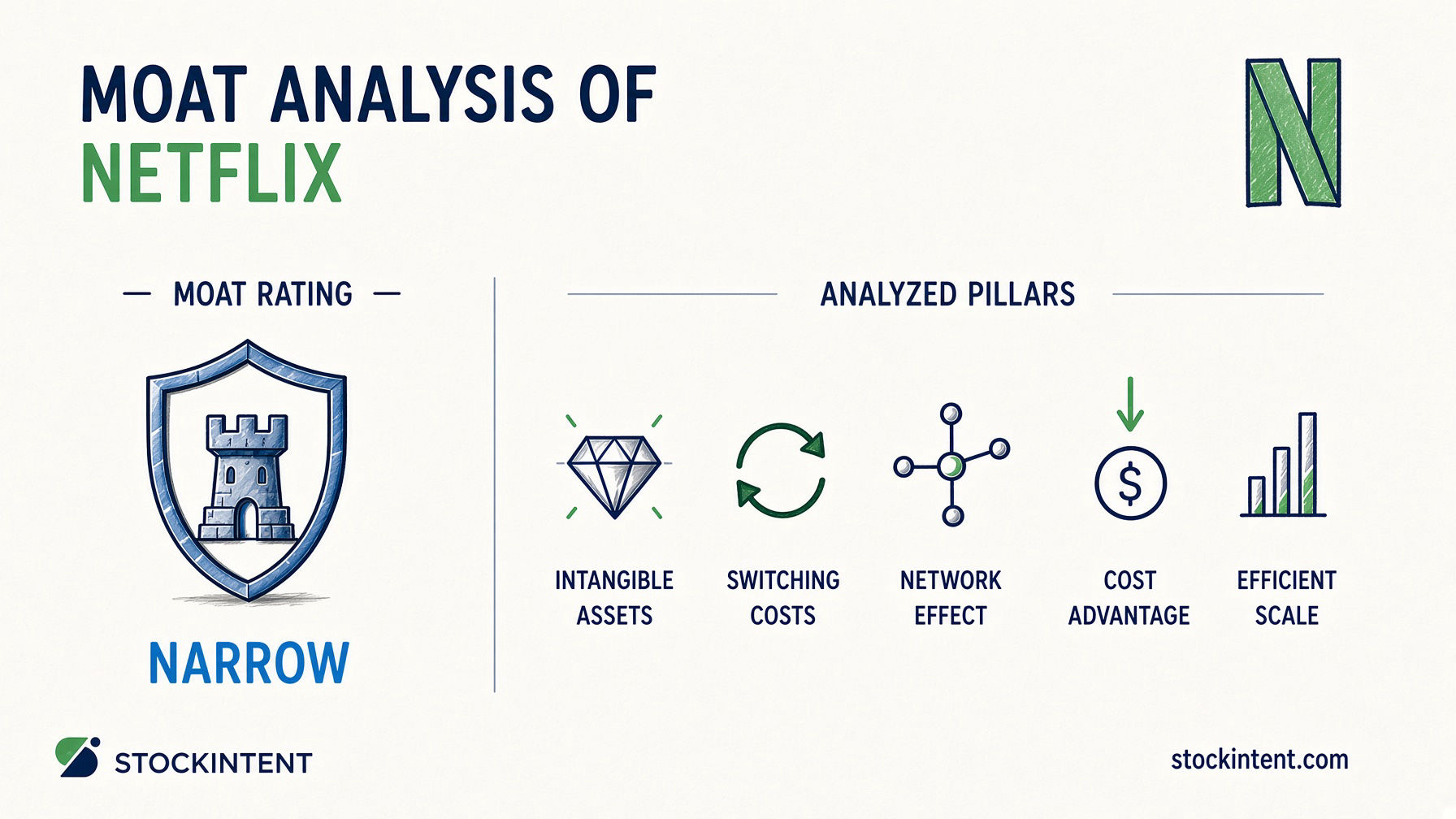
Netflix carries a narrow economic moat with a stable to moderately widening trend and medium uncertainty as of 2026. Its competitive advantages are real and producing strong financial results, but they remain contested rather than invincible.
Moat quality matters because it shapes whether Netflix can sustain its 32%+ operating margins and approximately $12.5 billion in guided free cash flow over the next decade. This analysis focuses on business durability, not whether the stock is a buy today.
Netflix's moat rests on two genuinely strong pillars, one disputed advantage, and two weak ones. Understanding which is which keeps us from overestimating how defensible this business really is.
Cost advantage is the strongest pillar. Netflix plans to spend roughly $20 billion on content in 2026, up about 10% from the prior year per Bloomberg reporting. Spread across more than 325 million subscribers, that content budget achieves meaningfully lower cost per subscriber than Disney+ or Warner Bros. Discovery. This scale efficiency creates a reinforcing cycle: Netflix can outspend rivals on shows and films while maintaining superior unit economics. That is hard to match unless a competitor somehow closes both the subscriber gap and the spending gap simultaneously.
Intangible assets run a close second. The Netflix brand is "synonymous with streaming video entertainment" and carries the highest awareness among U.S. video-on-demand services. Beyond brand, the proprietary content library and recommendation algorithms represent real intellectual property that would take years and billions to replicate. Morningstar's 2026 "narrow moat" rating explicitly credits these intangible assets as durable, though not quite dominant enough to qualify as a wide moat.
Network effects are present, but limited and disputed. Netflix lacks the direct user-to-user network effects of a marketplace or social network, but scale still creates a meaningful flywheel. Popular shows become cultural trends that people discuss and share, while a larger subscriber base spreads production costs across more users and funds more content that can create the next hit. We therefore see a modest network effect reinforced by scale, rather than a winner-take-all moat.
Pro Insight: Netflix's viewing-data advantage is better understood as a data flywheel than a traditional network effect. More viewing improves recommendations and informs content decisions, but competitors with sufficient scale can build similar datasets. The data strengthens Netflix's flywheel without creating the structural lock-in seen in marketplaces or social networks.
Switching costs are limited in our opinion. FFF Instill's April 2026 analysis puts this plainly: no contracts, no penalties, easy cancellation. The only stickiness comes from soft factors like your viewing history and the algorithm's familiarity with your tastes. That is not nothing, but it is not structural lock-in either. A competitor with a hit show can poach subscribers with minimal friction.
Efficient scale does not really apply. Streaming is not a railroad or a utility. Multiple competitors operate at viable scale: Disney+, Amazon Prime Video, YouTube, and others. The market is not structurally limited to one or a few winners. Netflix's size helps its economics enormously, but that is cost advantage, not efficient scale in the textbook sense.
Taken together, these pillars produce a narrow but real moat. The economics are genuinely defensible because of scale and brand. The vulnerability is that customers can leave easily for other trending shows, and competitors with deep pockets can keep trying.
Netflix's cost advantage and brand strength translate directly into financial results you can see. In Q1 2026, the company reported $12.25 billion in revenue, up 16% year over year, with an operating margin of 32.3%. For the full year, management is guiding to roughly $12.5 billion in free cash flow. Those are the profile of a business with real pricing power and scale efficiency.
You can evaluate these metrics comprehensively using StockIntent's company reports to review financial statements, margin history, and performance rankings in one consolidated workflow.
But the moat is not equally visible everywhere. Here's where it gets more complicated.
YouTube captured 13.2% of U.S. daily TV viewing time in 2026 versus Netflix's 8.2%. That is a material counterpoint. Netflix dominates subscription streaming, yet it does not dominate total video attention. A wider moat would show up in unchallenged engagement leadership across all formats, not just the subscription niche.
The bigger limitation is disclosure. Netflix stopped publishing quarterly subscriber numbers in 2025 and will reduce viewing-hours reporting to once annually starting January 2027. External verification of customer momentum is getting harder, not easier. Strong margins and cash flow are visible today. Whether they are sustainable tomorrow depends partly on trends we will no longer be able to track quarter by quarter.
So the moat shows up clearly in profitability. It is less clear in competitive dominance of total attention, and it is becoming harder to verify in subscriber and engagement trends. That gap between what we can see and what we need to know is what makes the trend assessment matter.
Netflix's moat trend is stable to moderately widening as of 2026. The core streaming business remains very strong, but rising content spend and competition for viewer attention mean the widening is not guaranteed.
What's pushing the moat wider. Netflix is scaling its advertising tier aggressively, with one analysis putting 2026 ad revenue on track to roughly double to about $3 billion. That deepens monetization per user and broadens the revenue mix beyond pure subscription pricing. At the same time, Bloomberg reported in January 2026 that Netflix plans a 10% increase in content spending to support engagement and the ad-supported tier. More programming investment, if it translates into sustained viewership, reinforces the scale advantage that keeps competitors at a distance.Netflix also walked away from its proposed Warner Bros. acquisition after declining to match Paramount Skydance's higher offer, avoiding the associated acquisition and integration risk while resuming its share repurchase program.
What's creating friction. YouTube captured 13.2% of U.S. TV viewing time in March 2026 versus Netflix's 8.2%, a reminder that Netflix does not own total video attention. Morningstar still rates Netflix's moat as narrow and expects growth to slow materially this year. The moat is not clearly widening across every dimension.
What to watch over the next 3-5 years. We track four indicators to judge whether the trend is improving or weakening:
These are multi-year signals, not quarterly trading triggers. Patient observation matters more than reacting to any single headline.
We rate Netflix's moat uncertainty as medium.
The business is strong, but three factors widen the range of plausible outcomes enough that we cannot treat this as a low-uncertainty, sleep-well-at-night assessment.
Disclosure opacity is the biggest concern. Netflix stopped reporting quarterly subscriber numbers in 2025 and will cut viewing-hours reporting to once annually starting January 2027. Investors now rely more heavily on revenue, margins, and engagement proxies rather than direct user counts. That makes external verification of customer momentum harder, not easier.
Margin stability is less certain than the headline figures suggest. Netflix posted a 32.3% operating margin in Q1 2026, and guidance implies roughly $12.5 billion in free cash flow for the full year. But S&P Global flagged a roughly 400 basis point range of debate among analysts for FY 2026–FY 2027 margin estimates. Content spending is front-loaded and rising to support the ad tier, which introduces timing volatility even if the long-run model holds up.
Ad-tier execution remains unproven at scale. Netflix is targeting approximately $3 billion in advertising revenue for 2026, roughly doubling year over year. That is ambitious and would meaningfully diversify the revenue mix. But ad monetization is newer terrain for Netflix, and rivals like Google and Amazon operate far larger advertising ecosystems. If the ad business scales less efficiently than planned, the path to sustained margin expansion gets steeper.
These factors do not suggest Netflix is fragile. The company generates substantial cash while still growing revenue in the low teens, which is a narrower range of outcomes than early-stage tech ventures face. But the combination of reduced transparency, margin debate, and ad-tier execution risk creates enough uncertainty that a medium rating feels appropriate.
Netflix carries a narrow economic moat with a stable to moderately widening trend and medium uncertainty as of 2026. The strongest evidence sits in its scale-driven cost advantages and brand strength, which together produced a 32.3% operating margin in Q1 2026 and roughly $12.5 billion in guided free cash flow for the full year. Those are genuinely defensible economics.
The main uncertainty that could shift this view is the combination of disclosure opacity and ad-tier execution risk. Netflix has stopped reporting quarterly subscribers and will cut viewing-hours reporting to once annually starting January 2027, making it harder to verify customer momentum from the outside. Meanwhile, the advertising business must scale efficiently against far larger rivals like Google and Amazon.
For investors tracking moat durability over time, the practical next step is to organize these indicators into a monitoring system. You can set up a watchlist to follow ad revenue growth, content spend efficiency, attention share metrics, and margin trends as new data becomes available. Moat assessment is a long-term exercise, and having the right tools to track it helps you stay focused on business quality rather than headlines.
Netflix carries a narrow economic moat with a stable to moderately widening trend and medium uncertainty as of 2026. Its competitive advantages are real and producing strong financial results, but they remain contested rather than invincible.
Moat quality matters because it shapes whether Netflix can sustain its 32%+ operating margins and approximately $12.5 billion in guided free cash flow over the next decade. This analysis focuses on business durability, not whether the stock is a buy today.
Netflix's moat rests on two genuinely strong pillars, one disputed advantage, and two weak ones. Understanding which is which keeps us from overestimating how defensible this business really is.
Cost advantage is the strongest pillar. Netflix plans to spend roughly $20 billion on content in 2026, up about 10% from the prior year per Bloomberg reporting. Spread across more than 325 million subscribers, that content budget achieves meaningfully lower cost per subscriber than Disney+ or Warner Bros. Discovery. This scale efficiency creates a reinforcing cycle: Netflix can outspend rivals on shows and films while maintaining superior unit economics. That is hard to match unless a competitor somehow closes both the subscriber gap and the spending gap simultaneously.
Intangible assets run a close second. The Netflix brand is "synonymous with streaming video entertainment" and carries the highest awareness among U.S. video-on-demand services. Beyond brand, the proprietary content library and recommendation algorithms represent real intellectual property that would take years and billions to replicate. Morningstar's 2026 "narrow moat" rating explicitly credits these intangible assets as durable, though not quite dominant enough to qualify as a wide moat.
Network effects are present, but limited and disputed. Netflix lacks the direct user-to-user network effects of a marketplace or social network, but scale still creates a meaningful flywheel. Popular shows become cultural trends that people discuss and share, while a larger subscriber base spreads production costs across more users and funds more content that can create the next hit. We therefore see a modest network effect reinforced by scale, rather than a winner-take-all moat.
Pro Insight: Netflix's viewing-data advantage is better understood as a data flywheel than a traditional network effect. More viewing improves recommendations and informs content decisions, but competitors with sufficient scale can build similar datasets. The data strengthens Netflix's flywheel without creating the structural lock-in seen in marketplaces or social networks.
Switching costs are limited in our opinion. FFF Instill's April 2026 analysis puts this plainly: no contracts, no penalties, easy cancellation. The only stickiness comes from soft factors like your viewing history and the algorithm's familiarity with your tastes. That is not nothing, but it is not structural lock-in either. A competitor with a hit show can poach subscribers with minimal friction.
Efficient scale does not really apply. Streaming is not a railroad or a utility. Multiple competitors operate at viable scale: Disney+, Amazon Prime Video, YouTube, and others. The market is not structurally limited to one or a few winners. Netflix's size helps its economics enormously, but that is cost advantage, not efficient scale in the textbook sense.
Taken together, these pillars produce a narrow but real moat. The economics are genuinely defensible because of scale and brand. The vulnerability is that customers can leave easily for other trending shows, and competitors with deep pockets can keep trying.
Netflix's cost advantage and brand strength translate directly into financial results you can see. In Q1 2026, the company reported $12.25 billion in revenue, up 16% year over year, with an operating margin of 32.3%. For the full year, management is guiding to roughly $12.5 billion in free cash flow. Those are the profile of a business with real pricing power and scale efficiency.
You can evaluate these metrics comprehensively using StockIntent's company reports to review financial statements, margin history, and performance rankings in one consolidated workflow.
But the moat is not equally visible everywhere. Here's where it gets more complicated.
YouTube captured 13.2% of U.S. daily TV viewing time in 2026 versus Netflix's 8.2%. That is a material counterpoint. Netflix dominates subscription streaming, yet it does not dominate total video attention. A wider moat would show up in unchallenged engagement leadership across all formats, not just the subscription niche.
The bigger limitation is disclosure. Netflix stopped publishing quarterly subscriber numbers in 2025 and will reduce viewing-hours reporting to once annually starting January 2027. External verification of customer momentum is getting harder, not easier. Strong margins and cash flow are visible today. Whether they are sustainable tomorrow depends partly on trends we will no longer be able to track quarter by quarter.
So the moat shows up clearly in profitability. It is less clear in competitive dominance of total attention, and it is becoming harder to verify in subscriber and engagement trends. That gap between what we can see and what we need to know is what makes the trend assessment matter.
Netflix's moat trend is stable to moderately widening as of 2026. The core streaming business remains very strong, but rising content spend and competition for viewer attention mean the widening is not guaranteed.
What's pushing the moat wider. Netflix is scaling its advertising tier aggressively, with one analysis putting 2026 ad revenue on track to roughly double to about $3 billion. That deepens monetization per user and broadens the revenue mix beyond pure subscription pricing. At the same time, Bloomberg reported in January 2026 that Netflix plans a 10% increase in content spending to support engagement and the ad-supported tier. More programming investment, if it translates into sustained viewership, reinforces the scale advantage that keeps competitors at a distance.Netflix also walked away from its proposed Warner Bros. acquisition after declining to match Paramount Skydance's higher offer, avoiding the associated acquisition and integration risk while resuming its share repurchase program.
What's creating friction. YouTube captured 13.2% of U.S. TV viewing time in March 2026 versus Netflix's 8.2%, a reminder that Netflix does not own total video attention. Morningstar still rates Netflix's moat as narrow and expects growth to slow materially this year. The moat is not clearly widening across every dimension.
What to watch over the next 3-5 years. We track four indicators to judge whether the trend is improving or weakening:
These are multi-year signals, not quarterly trading triggers. Patient observation matters more than reacting to any single headline.
We rate Netflix's moat uncertainty as medium.
The business is strong, but three factors widen the range of plausible outcomes enough that we cannot treat this as a low-uncertainty, sleep-well-at-night assessment.
Disclosure opacity is the biggest concern. Netflix stopped reporting quarterly subscriber numbers in 2025 and will cut viewing-hours reporting to once annually starting January 2027. Investors now rely more heavily on revenue, margins, and engagement proxies rather than direct user counts. That makes external verification of customer momentum harder, not easier.
Margin stability is less certain than the headline figures suggest. Netflix posted a 32.3% operating margin in Q1 2026, and guidance implies roughly $12.5 billion in free cash flow for the full year. But S&P Global flagged a roughly 400 basis point range of debate among analysts for FY 2026–FY 2027 margin estimates. Content spending is front-loaded and rising to support the ad tier, which introduces timing volatility even if the long-run model holds up.
Ad-tier execution remains unproven at scale. Netflix is targeting approximately $3 billion in advertising revenue for 2026, roughly doubling year over year. That is ambitious and would meaningfully diversify the revenue mix. But ad monetization is newer terrain for Netflix, and rivals like Google and Amazon operate far larger advertising ecosystems. If the ad business scales less efficiently than planned, the path to sustained margin expansion gets steeper.
These factors do not suggest Netflix is fragile. The company generates substantial cash while still growing revenue in the low teens, which is a narrower range of outcomes than early-stage tech ventures face. But the combination of reduced transparency, margin debate, and ad-tier execution risk creates enough uncertainty that a medium rating feels appropriate.
Netflix carries a narrow economic moat with a stable to moderately widening trend and medium uncertainty as of 2026. The strongest evidence sits in its scale-driven cost advantages and brand strength, which together produced a 32.3% operating margin in Q1 2026 and roughly $12.5 billion in guided free cash flow for the full year. Those are genuinely defensible economics.
The main uncertainty that could shift this view is the combination of disclosure opacity and ad-tier execution risk. Netflix has stopped reporting quarterly subscribers and will cut viewing-hours reporting to once annually starting January 2027, making it harder to verify customer momentum from the outside. Meanwhile, the advertising business must scale efficiently against far larger rivals like Google and Amazon.
For investors tracking moat durability over time, the practical next step is to organize these indicators into a monitoring system. You can set up a watchlist to follow ad revenue growth, content spend efficiency, attention share metrics, and margin trends as new data becomes available. Moat assessment is a long-term exercise, and having the right tools to track it helps you stay focused on business quality rather than headlines.