
Sep 18, 2026
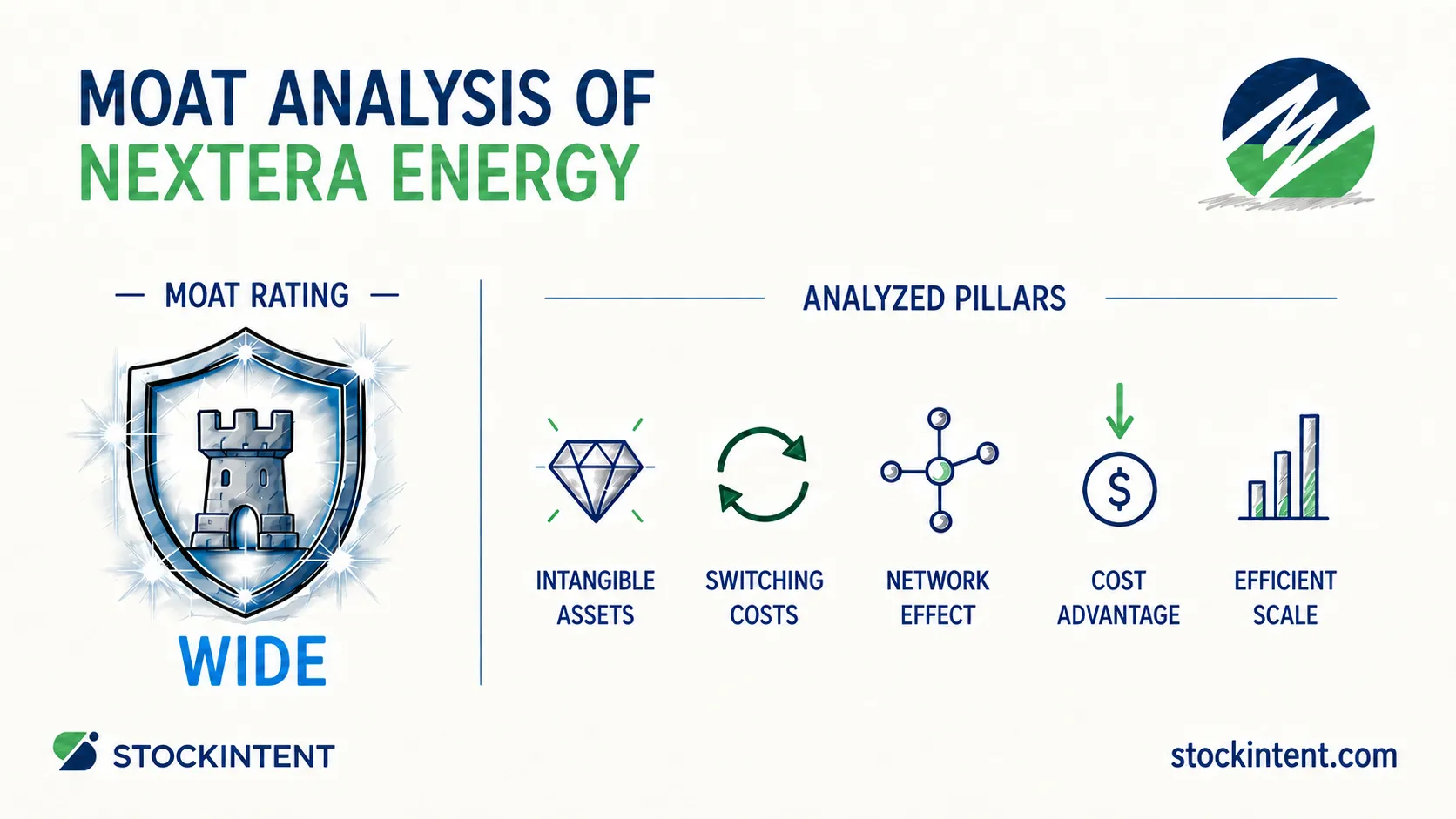
NextEra Energy earns a Wide moat rating, with a stable to modestly widening trend and Medium uncertainty. The company's February 2026 PSG research describes durable competitive barriers built on scale, and 2026 disclosures point to continued strength.
Here's the short version:
For long-term investors, this matters more than any valuation multiple. A wide moat is what lets a business compound excess returns for years, and NextEra's regulated franchise plus renewable scale look built to last. The catch is that regulators, not customers, ultimately control the pricing power, so we'll weight that risk carefully.
The next section breaks down each of the five moat pillars with specific 2026 evidence.
Two pillars carry NextEra's wide moat: cost advantage and efficient scale. The other three contribute, but unevenly. Here's how each one stacks up in our analysis.
NextEra runs what the PSG research from February 2026 calls enormous scale in wind and solar, and it's frequently described as the world's largest producer of both. That scale translates into procurement power on equipment and operating leverage across its development pipeline, which lets it bid competitively where smaller developers can't.
FPL holds a legal monopoly over its Florida service territory, and duplicating the transmission and distribution network would be economically pointless. This is a classic regulated natural monopoly. NEER's sheer size in renewables adds a second layer that competitors would need years and billions of dollars to replicate.
FPL customers can't switch providers; the utility is the only game in town. On the NEER side, long-term power purchase agreements lock counterparties in for years once signed.
There's little evidence of a moat built on patents or brands. What NextEra does have is permitting know-how and project-execution expertise, which help it win contracts and complete builds. Useful, but more skill-based than asset-based.
Grid infrastructure is networked, sure, but that's a regulated natural monopoly, not a self-reinforcing effect where each new user makes the product better for everyone. We wouldn't credit NextEra with this pillar.
Pro Insight: Utility moats differ fundamentally from technology moats. Tech moats often rely on rapid network effects or proprietary assets. NextEra's is built on boring efficient scale and cost advantage that compound slowly but predictably through regulatory cycles. Many investors miss this when they apply tech moat frameworks to regulated utilities.
When these pillars work together, capital allocation gets easier to judge: a regulated franchise and low-cost renewables give management a long reinvestment runway where each dollar deployed into rate base and backlog should earn attractive returns. The question is whether the cost advantage actually shows up in margins and returns on capital versus peers like Duke or Southern Company.
That's exactly what StockIntent's company reports are built for, letting you review the financial statements, regulatory filings, and competitive rankings in one place.
The clearest proof of NextEra's moat is earnings growth. In Q1 2026, adjusted EPS rose 10.1% year-over-year to $1.09 from $0.99, per the company's Q1 2026 news release. The Q2 2026 release reported $1.15, up 9.5% from $1.05.
The regulated base explains the stability. Per S&P Global Ratings' April 2026 credit review, more than 70% of consolidated EBITDA comes from lower-risk regulated utility operations, with only about 10% from higher-risk unregulated activities. That's the efficient-scale pillar doing its job: anchoring earnings while the renewables business adds growth.
Here's the honest counterpoint. Both quarters beat on EPS but missed on revenue, as the Q2 2026 earnings call transcript shows. Our interpretation: the moat shows up in cost discipline and capital efficiency, not classic pricing power with customers.
Versus peers like Duke Energy and Southern Company, a May 2026 Tippie College of Business analysis finds stronger growth, better operating margins, and more visible long-term earnings expansion.
That momentum raises the next question: is the moat widening or just holding steady?
Our call: the moat is stable and modestly widening. Two things drive that. FPL keeps growing its regulated franchise, and NextEra keeps winning clean-energy work at a pace competitors haven't matched.
The backlog is the clearest widening signal. NextEra added 4 GW of renewables and storage in Q1 2026, according to its 8-K filing, then added another 3.6 GW in Q2. That pushed the total pipeline from roughly 33 GW to about 35.1 GW by mid-2026. In a capital-intensive industry where origination, interconnection access, and financing matter more than ambition, a backlog that size is a genuine barrier.
Demand conditions are also shifting in NextEra's favor. Reuters reported in July 2026 that data-center power demand lifted both the utility and renewables results. Large customers are signing long-duration contracts for clean power, which rewards developers with big pipelines and cheap financing.
On top of that, management reaffirmed 2026 adjusted EPS guidance of $3.92 to $4.02 in its Q1 2026 investor presentation and targets 8%-plus annual adjusted EPS growth through the mid-2030s, per its January 2026 outlook.
Here's our four-indicator watchlist for judging the trend over the next 3-5 years:
Setting up a StockIntent watchlist with custom views for backlog conversion and EPS growth trends makes tracking these signals painless.
Medium. NextEra's moat rests on solid evidence, but the range of future business outcomes is wider than you'd find in a low-leverage, unregulated compounder.
Start with the balance sheet. S&P Global Ratings' April 2026 credit review expects adjusted debt-to-EBITDA around 4.5x with interest coverage near 4x. That's serviceable for a regulated utility, though it's clearly not the fortress profile of a consumer staples business. When capital costs rise, they flow straight through a leveraged developer's returns.
Regulation is the bigger variable. NextEra's own filings explicitly warn that recovering costs and earning reasonable returns depends on regulators, and adverse rulings could impair returns even if operations stay sound. Customers can't fire FPL, but commissioners can shape what the franchise earns.
Put together, we'd describe the plausible 3-5 year outcome range for competitive position as narrow to moderate. A collapse in standing looks unlikely given the regulated base and renewable scale, but interest rates, capital costs, and project execution can still move returns materially.
That's the calibration we want you to hold: durable evidence where it exists, honest uncertainty where it doesn't.
Final verdict: Wide moat, stable to modestly widening trend, Medium uncertainty.
The evidence supporting that rating is concrete. FPL's regulated Florida monopoly anchors more than 70% of EBITDA in lower-risk utility operations, and the renewable cost advantage keeps producing near-10% adjusted EPS growth. A 35.1 GW backlog plus data-center demand gives the trend genuine room to widen.
Two issues matter most from here: execution on converting that backlog into operating assets on time and on budget, and the regulatory environment that ultimately decides what the franchise earns. Those same factors explain why we rate uncertainty Medium rather than Low.
Keep watching the four indicators we listed above. They'll tell you, quarter by quarter, whether NextEra's moat is widening or simply holding the line.
NextEra Energy earns a Wide moat rating, with a stable to modestly widening trend and Medium uncertainty. The company's February 2026 PSG research describes durable competitive barriers built on scale, and 2026 disclosures point to continued strength.
Here's the short version:
For long-term investors, this matters more than any valuation multiple. A wide moat is what lets a business compound excess returns for years, and NextEra's regulated franchise plus renewable scale look built to last. The catch is that regulators, not customers, ultimately control the pricing power, so we'll weight that risk carefully.
The next section breaks down each of the five moat pillars with specific 2026 evidence.
Two pillars carry NextEra's wide moat: cost advantage and efficient scale. The other three contribute, but unevenly. Here's how each one stacks up in our analysis.
NextEra runs what the PSG research from February 2026 calls enormous scale in wind and solar, and it's frequently described as the world's largest producer of both. That scale translates into procurement power on equipment and operating leverage across its development pipeline, which lets it bid competitively where smaller developers can't.
FPL holds a legal monopoly over its Florida service territory, and duplicating the transmission and distribution network would be economically pointless. This is a classic regulated natural monopoly. NEER's sheer size in renewables adds a second layer that competitors would need years and billions of dollars to replicate.
FPL customers can't switch providers; the utility is the only game in town. On the NEER side, long-term power purchase agreements lock counterparties in for years once signed.
There's little evidence of a moat built on patents or brands. What NextEra does have is permitting know-how and project-execution expertise, which help it win contracts and complete builds. Useful, but more skill-based than asset-based.
Grid infrastructure is networked, sure, but that's a regulated natural monopoly, not a self-reinforcing effect where each new user makes the product better for everyone. We wouldn't credit NextEra with this pillar.
Pro Insight: Utility moats differ fundamentally from technology moats. Tech moats often rely on rapid network effects or proprietary assets. NextEra's is built on boring efficient scale and cost advantage that compound slowly but predictably through regulatory cycles. Many investors miss this when they apply tech moat frameworks to regulated utilities.
When these pillars work together, capital allocation gets easier to judge: a regulated franchise and low-cost renewables give management a long reinvestment runway where each dollar deployed into rate base and backlog should earn attractive returns. The question is whether the cost advantage actually shows up in margins and returns on capital versus peers like Duke or Southern Company.
That's exactly what StockIntent's company reports are built for, letting you review the financial statements, regulatory filings, and competitive rankings in one place.
The clearest proof of NextEra's moat is earnings growth. In Q1 2026, adjusted EPS rose 10.1% year-over-year to $1.09 from $0.99, per the company's Q1 2026 news release. The Q2 2026 release reported $1.15, up 9.5% from $1.05.
The regulated base explains the stability. Per S&P Global Ratings' April 2026 credit review, more than 70% of consolidated EBITDA comes from lower-risk regulated utility operations, with only about 10% from higher-risk unregulated activities. That's the efficient-scale pillar doing its job: anchoring earnings while the renewables business adds growth.
Here's the honest counterpoint. Both quarters beat on EPS but missed on revenue, as the Q2 2026 earnings call transcript shows. Our interpretation: the moat shows up in cost discipline and capital efficiency, not classic pricing power with customers.
Versus peers like Duke Energy and Southern Company, a May 2026 Tippie College of Business analysis finds stronger growth, better operating margins, and more visible long-term earnings expansion.
That momentum raises the next question: is the moat widening or just holding steady?
Our call: the moat is stable and modestly widening. Two things drive that. FPL keeps growing its regulated franchise, and NextEra keeps winning clean-energy work at a pace competitors haven't matched.
The backlog is the clearest widening signal. NextEra added 4 GW of renewables and storage in Q1 2026, according to its 8-K filing, then added another 3.6 GW in Q2. That pushed the total pipeline from roughly 33 GW to about 35.1 GW by mid-2026. In a capital-intensive industry where origination, interconnection access, and financing matter more than ambition, a backlog that size is a genuine barrier.
Demand conditions are also shifting in NextEra's favor. Reuters reported in July 2026 that data-center power demand lifted both the utility and renewables results. Large customers are signing long-duration contracts for clean power, which rewards developers with big pipelines and cheap financing.
On top of that, management reaffirmed 2026 adjusted EPS guidance of $3.92 to $4.02 in its Q1 2026 investor presentation and targets 8%-plus annual adjusted EPS growth through the mid-2030s, per its January 2026 outlook.
Here's our four-indicator watchlist for judging the trend over the next 3-5 years:
Setting up a StockIntent watchlist with custom views for backlog conversion and EPS growth trends makes tracking these signals painless.
Medium. NextEra's moat rests on solid evidence, but the range of future business outcomes is wider than you'd find in a low-leverage, unregulated compounder.
Start with the balance sheet. S&P Global Ratings' April 2026 credit review expects adjusted debt-to-EBITDA around 4.5x with interest coverage near 4x. That's serviceable for a regulated utility, though it's clearly not the fortress profile of a consumer staples business. When capital costs rise, they flow straight through a leveraged developer's returns.
Regulation is the bigger variable. NextEra's own filings explicitly warn that recovering costs and earning reasonable returns depends on regulators, and adverse rulings could impair returns even if operations stay sound. Customers can't fire FPL, but commissioners can shape what the franchise earns.
Put together, we'd describe the plausible 3-5 year outcome range for competitive position as narrow to moderate. A collapse in standing looks unlikely given the regulated base and renewable scale, but interest rates, capital costs, and project execution can still move returns materially.
That's the calibration we want you to hold: durable evidence where it exists, honest uncertainty where it doesn't.
Final verdict: Wide moat, stable to modestly widening trend, Medium uncertainty.
The evidence supporting that rating is concrete. FPL's regulated Florida monopoly anchors more than 70% of EBITDA in lower-risk utility operations, and the renewable cost advantage keeps producing near-10% adjusted EPS growth. A 35.1 GW backlog plus data-center demand gives the trend genuine room to widen.
Two issues matter most from here: execution on converting that backlog into operating assets on time and on budget, and the regulatory environment that ultimately decides what the franchise earns. Those same factors explain why we rate uncertainty Medium rather than Low.
Keep watching the four indicators we listed above. They'll tell you, quarter by quarter, whether NextEra's moat is widening or simply holding the line.