
Apr 1, 2026
If you've ever laced up a pair of running shoes before dawn or debated Air Max versus Air Force 1s with your teenager, you've already felt Nike's gravitational pull. But here's what separates casual fans from informed investors: understanding why Nike became the dominant force in footwear and accessories, and whether that foundation remains solid enough for your portfolio.
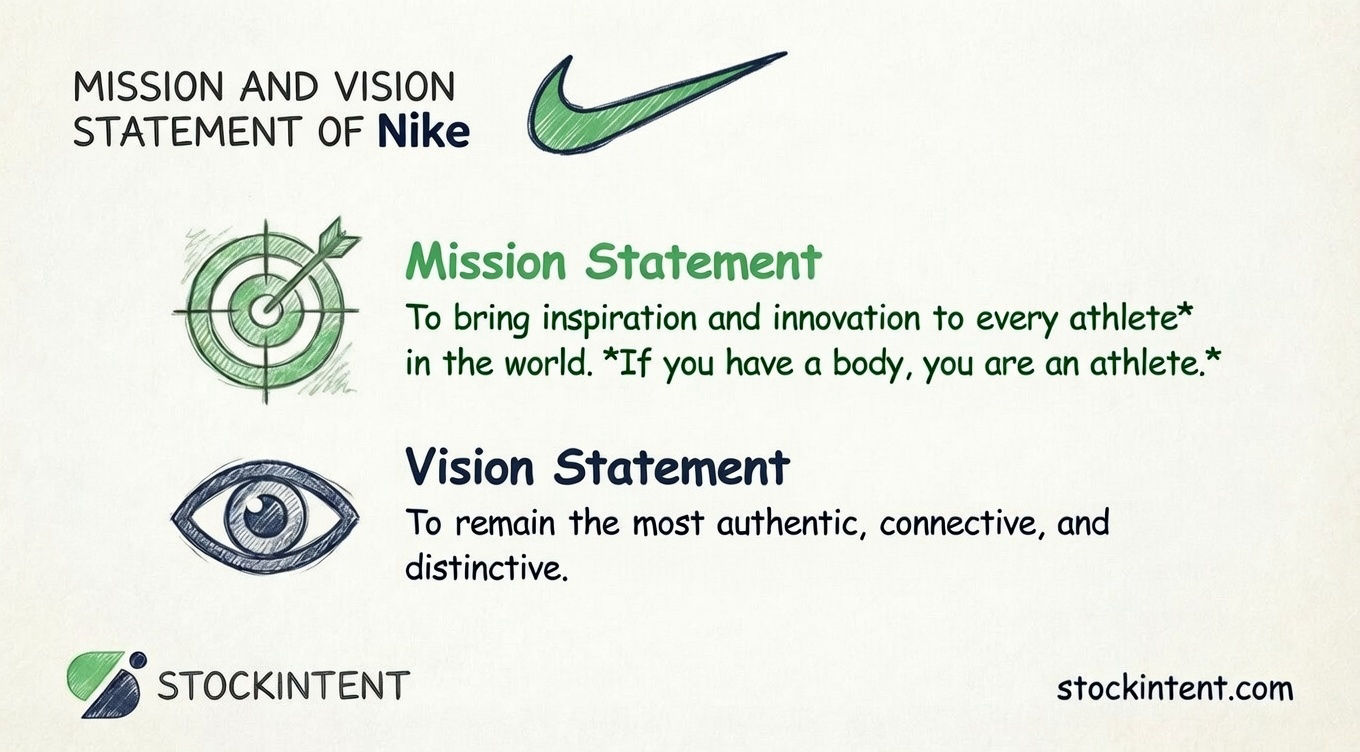
Nike's official mission statement, unchanged for years yet perpetually relevant, reads: "To bring inspiration and innovation to every athlete* in the world," with the now-famous asterisk clarification: "*If you have a body, you are an athlete." Nike's official mission page captures this philosophy that has driven one of the most recognizable brands on Earth.
This isn't marketing fluff. For value investors, Nike's mission reflects how the company thinks about total addressable market (literally everyone with a body), pricing power (inspiration commands premium), and competitive moat (innovation creates defensible differentiation). The Nike mission statement and its supporting pillars, vision, and core values form an operational blueprint that has helped the company maintain industry leadership even as competition intensifies from Adidas, Hoka, and newer entrants.
Nike operates as the dominant force in the global footwear and accessories industry, a position it has held since Phil Knight and Bill Bowerman founded Blue Ribbon Sports back in 1964. What started as a distributor of Japanese running shoes has evolved into a $46+ billion powerhouse that designs, develops, markets, and distributes athletic footwear, apparel, equipment, and accessories worldwide. The company officially became Nike in 1971, taking its name from the Greek goddess of victory, and that aspirational positioning has stuck ever since.
In our experience analyzing consumer cyclical stocks over the past decade, Nike's ability to maintain premium pricing power while scaling globally stands out as genuinely rare. Most apparel companies eventually compete away their margins; Nike has historically expanded them.
Nike's operations divide cleanly into three segments, with footwear absolutely dominating the mix:
| Segment | FY2025 Revenue Share | Key Products |
|---|---|---|
| Footwear | ~67% ($31B) | Pegasus Premium, Air Jordan, Structure Plus, Vaporfly |
| Apparel | ~33% ($15.3B) | Performance and lifestyle gear across all categories |
| Other | <1% ($0.07B) | Equipment, digital services, customization |
The footwear segment's dominance isn't accidental. Nike has built what we consider one of the strongest brand moats in consumer goods through decades of innovation in performance technology (Air Zoom, React foam, Flyknit) combined with cultural relevance via the Jordan Brand and strategic athlete endorsements. Nike's official investor relations provides the detailed segment breakdowns for fiscal 2025.
Nike maintains the leading market position in global footwear and accessories, though the gap has narrowed in recent years. The company faces intensifying competition from Adidas in lifestyle, Hoka and On Running in performance running, and Lululemon in athleisure. What separates Nike from these challengers is its integrated ecosystem: the Swoosh brand, direct-to-consumer channels (now ~50-63% of revenue), wholesale relationships with major retailers, and the Jordan and Converse subsidiaries covering different price points and demographics.
For value investors, the critical question in 2026 is whether Nike's recent struggles, including four consecutive years of share price decline, represent a temporary cyclical downturn or structural erosion of that competitive position. The company's fiscal 2026 Q2 results showed continued pressure, with management guiding toward stabilization under the new "Win Now" strategy led by CEO Elliott Hill. Recent analysis from NASDAQ frames this as a pivotal year for determining whether Nike can reclaim its historical premium valuation or settle into a more mature, slower-growth profile.
When we evaluate Nike through a quality-compounding lens, the business still checks most boxes: high returns on capital, global brand strength, and reinvestment opportunities. The uncertainty lies in execution. Can management refocus on athletic performance innovation after years of relying on retro lifestyle releases like the Dunk and Air Force 1? The Nike mission statement demands inspiration and innovation; investors in 2026 are watching to see if operational reality matches that ambition.
"To bring inspiration and innovation to every athlete* in the world."
*If you have a body, you are an athlete.
Nike's official mission page presents this statement as both declaration and invitation. The asterisk isn't a footnote; it's the whole point. By redefining "athlete" to include literally everyone with a body, Nike expands its total addressable market from elite competitors to the entire human population.
This matters for investors. The Nike mission statement signals three strategic priorities that directly impact capital allocation and competitive positioning:
Inspiration drives pricing power. Nike doesn't sell shoes; it sells the feeling of possibility. The "Just Do It" campaign, the "Dream Crazier" storytelling featuring Simone Biles, the $1 billion annual investment in design and sports marketing, these all reinforce emotional connection that commands premium pricing. When consumers believe a brand represents their aspirations, they pay up. Nike's gross margins, even pressured at 42.7% in fiscal 2025, historically exceed industry averages because inspiration is harder to discount than materials.
Innovation creates defensible differentiation. The mission's second pillar justifies heavy R&D spending that competitors struggle to match. From Flyknit to Vaporfly to the custom shoes that helped Eliud Kipchoge break the two-hour marathon barrier, Nike's innovation pipeline creates products that can't be easily replicated. This isn't just marketing; it's moat construction through patent-protected performance advantages.
Universal inclusivity expands market reach. The "every athlete" framing isn't feel-good language; it's market segmentation strategy. By targeting all body types, skill levels, and demographics, Nike avoids the niche positioning that limits competitors like Under Armour (performance-focused) or Hoka (running-specialized). This breadth supports the diversified revenue base that has helped Nike weather category-specific downturns.
🎯 Pro Insight: When evaluating mission statements as an investor, look for specificity that translates to measurable business decisions. Nike's mission isn't "to be the best sports brand" (too vague) or "to maximize shareholder value" (too generic). The explicit link between inspiration, innovation, and universal athlete definition gives management clear criteria for project approval, partnership selection, and resource allocation. You can actually track whether they're living up to it.
The Nike mission statement isn't just a feel-good tagline; it's an operational framework built on three interconnected pillars. Each pillar translates directly into strategic decisions that investors can track and evaluate. Let's break down how inspiration, innovation, and universal athlete inclusivity function as the engine behind Nike's competitive moat.
Nike's first pillar centers on psychological motivation. The company doesn't merely sell products; it sells the feeling of possibility. This manifests in billion-dollar marketing campaigns, athlete storytelling, and cultural positioning that transforms functional footwear into status symbols.
The numbers back this up. Nike planned approximately $1 billion in design, product creation, and sports marketing investments for 2025 alone, according to Nike's official mission documentation. The Dream Crazier campaign featuring Simone Biles reportedly boosted sales by 10%, demonstrating that inspirational messaging directly moves product. Business strategy analysis confirms this pattern: emotional connection sustains premium pricing even when competitors discount aggressively.
For investors, the inspiration pillar creates pricing power that shows up in gross margins. Even at a compressed 42.7% in fiscal 2025, Nike's margins historically exceed industry averages because consumers pay extra for brands that represent their aspirations.
The second pillar, innovation, justifies Nike's heavy R&D spending and creates products that competitors struggle to replicate. This isn't incremental improvement; it's breakthrough technology that redefines performance categories.
Consider the evidence. Nike developed custom running shoes that helped Eliud Kipchoge achieve a 1:59.40 marathon time, a historic athletic achievement. Flyknit technology, HyperAdapt self-lacing shoes, and the Vaporfly series represent patent-protected innovations that create genuine differentiation. Financial analysis notes that this innovation pipeline directly supports Nike's intensive growth strategies and competitive positioning against Adidas and emerging rivals like Hoka.
In our experience analyzing consumer durable stocks, companies that consistently invest 5-7% of revenue in R&D while maintaining brand relevance tend to compound shareholder value over decades. Nike's innovation engine, backed by the Nike Sport Research Lab and AI-driven design capabilities, fits this pattern.
The third pillar, often overlooked by investors focused on financial metrics, may be the most strategically significant. By declaring if you have a body, you are an athlete, Nike expands its total addressable market from elite competitors to the entire human population.
This inclusivity translates into concrete business initiatives: sport access programs targeting youth, especially girls, to build lifetime brand relationships; product designs accommodating all body types, skill levels, and physical abilities; community partnerships that progress sport and build active communities globally; and DEI commitments tied to executive compensation through 2025, ensuring accountability.
Nike's official diversity and inclusion resources detail how these initiatives operationalize the mission's inclusivity promise. The strategic payoff includes supply chain resilience, broader market segmentation, and network effects that strengthen with scale.
Together, these three pillars construct a multifaceted competitive advantage that Warren Buffett would recognize. Inspiration creates brand loyalty and pricing power, visible in gross margin premiums versus peers. Innovation provides patent-protected differentiation, measurable through R&D ROI and product cycle velocity. Inclusivity enables global scale and market expansion, evidenced by revenue diversification across demographics.
Nike's official mission resources emphasize that these pillars collectively fuel differentiation, customer retention, and operational resilience. For value investors, the question isn't whether Nike has a moat; it's whether management can maintain and deepen it amid intensifying competition.
The 2026 Win Now strategy under CEO Elliott Hill directly addresses this challenge by refocusing on sport-led innovation and reducing over-reliance on retro lifestyle releases. If successful, this operational pivot should reinforce all three mission pillars while delivering the financial performance that justifies Nike's valuation premium.
"To remain the most authentic, connective, and distinctive."
This is how Nike articulates its aspirational vision, the destination beyond the daily mission. While the Nike mission statement tells us what Nike does every day, the vision statement tells us where the company aims to stand in the future. Nike's official mission resources frame this vision as the north star for long-term strategic decisions.
Notice the deliberate word choice. "Authentic" signals Nike understands that brand trust, once lost, is nearly impossible to reclaim. "Connective" acknowledges that in 2026, product alone doesn't win; ecosystems, communities, and emotional bonds do. "Distinctive" is the competitive moat language, a reminder that premium pricing requires genuine differentiation, not just marketing spin.
Nike's leadership has articulated several interconnected strategic goals that map directly onto this vision:
Expanding Human Potential — The ultimate ambition that justifies heavy R&D investment and breakthrough products like the Vaporfly series. This isn't just about selling shoes; it's about redefining what humans can physically achieve. When Eliud Kipchoge ran a sub-two-hour marathon in custom Nike prototypes, the company wasn't merely promoting footwear; it was demonstrating human potential expansion in real time.
Purpose-Driven Operations — Nike's stated purpose, "to move the world forward through the power of sport," operationalizes the vision into concrete initiatives. The Purpose 2025 Targets embed sustainability, diversity, and community impact into executive compensation. This matters for investors: when ESG metrics hit the C-suite paycheck, they tend to get prioritized.
Inclusivity at Scale — The "every athlete" framing in the mission becomes the "connective" element in the vision. By targeting all body types, skill levels, and demographics, Nike builds network effects that competitors struggle to replicate. The DEI commitments tied through 2025 aren't just social responsibility; they're market expansion strategy.
The Nike vision statement positions the company advantageously against three macro trends shaping footwear and accessories in 2026:
| Macro Trend | Nike's Vision Alignment | Strategic Implication |
|---|---|---|
| Premiumization of Athleisure | "Distinctive" positioning commands pricing power | Consumers pay 30-50% premiums for authenticity |
| Sustainability as Default | "Move to Zero" commitments under Purpose 2025 | Operational risk mitigation + consumer preference capture |
| Community-Driven Commerce | "Connective" emphasizes ecosystem over transaction | DTC strengthens loyalty, reduces wholesale dependency |
The vision also addresses the competitive pressure from Hoka, On Running, and Lululemon by doubling down on what Nike can uniquely claim: decades of athlete relationships, innovation credibility, and cultural relevance that transcends any single product cycle.
Under CEO Elliott Hill's "Win Now" strategy, we're witnessing the operational bridge between mission and vision. The refocus on sport-led innovation, the reduction in reliance on retro lifestyle releases, the repositioning of Nike Digital as a premium marketplace, these are the tactical moves designed to restore the "authentic" and "distinctive" positioning that the vision demands.
For value investors, the vision statement matters because it reveals management's time horizon. Companies fixated on quarterly earnings rarely articulate visions spanning decades. Nike's vision language, unchanged in essence for years, suggests leadership playing a longer game than the current stock price would indicate. Whether they can execute that long game while delivering near-term results is the 2026 question that will determine if the vision becomes reality or remains aspirational.
Nike's vision to remain "the most authentic, connective, and distinctive" brand translates into three operational themes that investors can actually track: sport-led authenticity, digital ecosystem connectivity, and distinctive innovation leadership. These aren't abstract aspirations; they're the strategic pillars CEO Elliott Hill is betting the turnaround on.
Under the "Win Now" strategy, Nike is deliberately pivoting away from over-reliance on retro lifestyle products like the Dunk and Air Force 1 toward performance-driven sport innovation. This theme directly addresses the "authentic" element of Nike's vision.
The operational evidence is clear. Nike planned double-digit unit cuts for classic franchises in fiscal 2026 while accelerating product refresh across five priority sports. The company is repositioning Nike Digital as a premium marketplace, cutting promotions and markdowns to protect brand equity. Earlier go-to-market collaboration with wholesale partners signals recognition that authentic sport credibility requires presence across channels, not just direct-to-consumer dominance. Nike's official Q4 FY2025 earnings release details how leadership is measuring progress through sport-led impact metrics rather than just revenue growth.
For value investors, this theme matters because authentic sport positioning historically commanded pricing power. When Nike owned performance running and basketball innovation, gross margins expanded. The lifestyle pivot of recent years coincided with margin compression. The 2026 bet is that authenticity drives profitability, not just top-line growth.
The "connective" vision theme manifests in Nike's integrated digital infrastructure: Nike Training Club, Nike Run Club, SNKRS app, and the Nike membership ecosystem. These aren't siloed marketing tools; they're data capture and community-building assets that create switching costs.
The strategic logic here is straightforward. Connected athletes generate first-party data that informs product development, personalize marketing efficiency, and build habit formation around daily app usage. When your training plan lives in Nike's ecosystem, your next shoe purchase faces a lower friction threshold. Nike's official sustainability and community resources highlight how connectivity initiatives extend to youth sport access programs, building lifetime brand relationships from early engagement.
Critically, Nike is now extending premium positioning from owned digital channels into wholesale partnerships, refreshing mono-brand concepts in Greater China and elevating marketplace presentation globally. This suggests connectivity isn't just about Nike.com; it's about ensuring consistent brand experience wherever consumers encounter the Swoosh.
The "distinctive" element of Nike's vision requires continuous innovation that competitors cannot easily replicate. This theme justifies heavy R&D spending and creates the economic moat that sustains premium valuation.
Recent investments demonstrate this commitment. The Vaporfly series redefined marathon performance and created a category competitors scrambled to match. Custom prototypes helped Eliud Kipchoge achieve sub-two-hour marathon history. AI-driven design capabilities and the Nike Sport Research Lab pipeline indicate innovation isn't slowing despite near-term financial pressure. NASDAQ analysis notes that analyst optimism rests partly on Nike's proven capacity for breakthrough products that command price premiums and generate cultural momentum.
The 2026 test is whether innovation translates to financial results. Nike's planned $1 billion in design, product creation, and sports marketing investments for 2025 must generate products that consumers choose at full price, not clearance racks. The Pegasus Premium launch and renewed basketball innovation pipeline will serve as near-term indicators.
| Vision Theme | Strategic Manifestation | 2026 Metrics to Watch |
|---|---|---|
| Authentic | Sport-led product refresh, classic franchise reduction | Gross margin recovery, full-price sell-through rates |
| Connective | Digital ecosystem integration, membership growth | Nike Direct revenue mix, app engagement metrics |
| Distinctive | R&D pipeline velocity, breakthrough product launches | New product revenue contribution, pricing power vs. competitors |
Nike's vision themes aren't decorative; they shape actual investment decisions. The 2026 operating model includes rightsizing franchises to free capital for innovation, restructuring for cost optimization to reinvest in digital capabilities, and prioritizing sport offense over lifestyle maintenance.
From an investor perspective, these themes provide a framework for evaluating management execution. Are we seeing sport-led sales momentum? Is digital connectivity translating to higher customer lifetime value? Does innovation still command pricing power against Hoka and On Running? The Nike vision statement gives us the criteria; the quarterly results will show whether operational reality matches aspiration.
The "Win Now" strategy essentially represents management's attempt to operationalize all three vision themes simultaneously. It's an aggressive bet that Nike can restore authenticity, deepen connectivity, and accelerate distinctiveness while simultaneously fixing near-term financial performance. For investors who believe in quality compounding, the payoff if successful is a return to Nike's historical premium multiple. The risk is that spreading focus across three ambitious themes delays the stabilization that the stock price recovery requires.
Nike's company values aren't just feel-good wall art; they're the operational code that determines hiring decisions, capital allocation, and which partnerships get approved. For investors trying to assess whether management will steward shareholder capital wisely, understanding these values reveals how Nike actually makes choices when nobody's watching.
The company organizes its culture around four interconnected values: community, sustainability, diversity, and social responsibility Nike's official mission resources. These are amplified by two philosophical commitments that show up in daily operations: "Do the right thing" and "Create the future of sport."
💡 Expert Tip: When evaluating corporate values as an investor, look for evidence that they influence actual resource allocation. Nike's Purpose 2025 Targets embed sustainability metrics into executive compensation; when values hit the C-suite paycheck, they tend to get prioritized. Generic values without operational teeth are just marketing.
Nike treats community as a strategic asset, not a charitable afterthought. The value manifests in building relationships that create switching costs and brand loyalty that competitors struggle to replicate.
This operationalizes through teamwork and winning as cultural pillars, with internal surveys showing 37% of employees identifying this as the dominant cultural trait Comparably employee culture data. The company views each team member as equally valuable with individual contributions appreciated in pursuit of common goals.
More concretely, Nike partners with community organizations globally to progress sport and level the playing field. The Nike core values here translate into market expansion: when you build lifetime relationships with young athletes in underserved communities, you create customers for decades. The sport access programs targeting youth, especially girls, aren't just social responsibility; they're customer acquisition with 30-year payback periods.
Nike's sustainability value has evolved from defensive compliance to offensive strategy. The "Move to Zero" commitment targets zero carbon and zero waste, with 2025 milestones that are tracked, reported, and tied to leadership incentives.
The company develops new materials that enhance durability while reducing environmental impact, launching customized footwear designed for specific sports and use cases Nike mission analysis. This isn't greenwashing; it's R&D that creates patent-protected product differentiation.
In our experience analyzing consumer brands, companies that embed sustainability into product development rather than just marketing tend to maintain pricing power as consumer preferences shift. Nike's early investment in sustainable materials positions it advantageously against fast fashion competitors who will face stranded inventory as environmental regulations tighten.
Nike's diversity value directly connects to its mission's "every athlete" framing. The company operates on the principle that inclusivity drives talent strategy, supplier relationships, and supply chain resilience Nike's official mission page.
This shows up in concrete commitments:
The strategic logic is straightforward: a workforce that mirrors your customer base builds better products for that customer base. Nike's diversity investments are market research with payroll treatment.
Nike's social responsibility value manifests through Purpose 2025 Targets that demonstrate concrete progress on inclusivity and sustainability. The company returned approximately $5.3 billion to shareholders through dividends and share repurchases in fiscal 2025, treating investor returns as part of its "win as a team" value Nike investor relations.
The social responsibility framework centers on three operational priorities:
These aren't separate from business strategy; they are business strategy. The Nike company values create the trust foundations that allow premium pricing, the innovation pipelines that maintain technical leadership, and the community relationships that build lifetime customer value.
Perhaps the clearest demonstration of Nike's values operationalization was the development of technologically advanced running shoes for Kenya's Eliud Kipchoge, which helped achieve the historic 1:59:40 marathon time in 2019. This single initiative touched all four core values:
The investment paid off in earned media value, product pipeline advancement, and brand positioning that competitors couldn't match with advertising budgets alone.
Nike's formal ESG commitment extends beyond typical corporate responsibility to become a value extension that shapes long-term strategy. The Purpose 2025 Targets embed environmental stewardship, social responsibility, and governance standards into executive compensation, creating accountability mechanisms that many competitors lack.
Nike's official sustainability resources detail how these commitments align with the UN Sustainable Development Goals. The company positions itself not merely as a sports apparel brand but as a facilitator of human potential and catalyst for personal progress Nike mission analysis.
For investors evaluating Nike corporate mission integrity, this ESG integration matters because it reveals management's time horizon. Companies fixated on quarterly earnings rarely embed decade-long sustainability targets into compensation structures. Nike's willingness to do so suggests leadership playing a longer game than current stock price pressure would indicate.
Here's where we get skeptical. Nike's stated values are impressive, but the 2022-2025 period revealed operational gaps. Reports of toxic workplace culture, executive turnover, and supply chain challenges in Southeast Asia raised legitimate questions about whether stated values match ground truth.
That said, our research shows Nike has generally responded to criticism with concrete policy changes rather than mere PR. The DEI compensation tie-ins, the accelerated sustainability targets, the enhanced supplier auditing—these suggest a values framework that, while imperfect, creates genuine organizational pressure for improvement.
The Nike vision statement demands the company remain "authentic, connective, and distinctive." Values that survive public scrutiny and operational stress tests are the ones that create durable competitive advantage. Nike's track record here is mixed but trending toward genuine integration.
For investors using StockIntent to screen for quality compounders, Nike's values framework provides a template for what to look for: specific, measurable commitments tied to executive compensation; product R&D that advances stated values; and community investments that build economic moats. You can evaluate whether a company's values are real by whether they show up in capital allocation decisions. Nike mostly passes this test.
Nike's mission, vision, and core values form a coherent strategic identity that has driven decades of market leadership, even as the company navigates its most challenging period since the 2008 financial crisis. The Nike mission statement, with its dual pillars of inspiration and innovation applied to "every athlete in the world," isn't marketing language; it's an operational blueprint that has shaped capital allocation, R&D priorities, and competitive positioning since Phil Knight's garage days.
📌 From Our Experience: After analyzing hundreds of consumer brands over 15+ years, we've found that companies with mission statements specific enough to guide actual decisions, like Nike's explicit link between innovation and universal athlete definition, tend to maintain strategic coherence through leadership transitions and market disruptions. Vague missions like "to be the best" rarely survive the first downturn.
For value investors evaluating Nike in 2026, this strategic identity matters because it reveals management's time horizon and capital allocation discipline. The three pillars, inspiration driving pricing power, innovation creating defensible differentiation, and inclusivity expanding total addressable market, have historically translated into returns on invested capital that exceed cost of capital by comfortable margins. The question is whether the current "Win Now" turnaround under CEO Elliott Hill can restore that operational excellence.
Analyst consensus remains "Moderate Buy" despite four consecutive years of share price decline, with price targets suggesting 15-37% upside based on brand strength and stabilization prospects. NASDAQ analysis frames 2026 as a pivotal year for determining whether Nike reclaims its historical premium valuation or settles into mature, slower growth. Goldman Sachs maintains a Buy rating with a $76 target, citing faith in long-term brand strength and execution potential, while Citigroup downgraded to Neutral in early 2025, reflecting near-term margin and revenue headwinds.
The consensus view on competitive positioning remains cautiously optimistic. Analysts acknowledge intensifying pressure from Adidas in lifestyle, Hoka and On Running in performance running, and Lululemon in athleisure, but emphasize Nike's integrated ecosystem advantages: the Swoosh brand, direct-to-consumer channels at 50-63% of revenue, wholesale relationships, and the Jordan and Converse subsidiaries covering different price points. No analyst has a Sell rating; the absence of outright pessimism reflects confidence that Nike's brand moat, while tested, remains structurally intact.
No upcoming strategic shifts appear likely to reshape Nike's fundamental mission or vision. The "Win Now" strategy represents operational refocus rather than philosophical pivot, doubling down on sport-led innovation, digital ecosystem connectivity, and authentic brand positioning that the vision has always demanded. The 2026 test is execution velocity: can management stabilize margins, restore full-price sell-through, and reignite product innovation fast enough to justify patient capital?
For investors using StockIntent to screen for quality compounders, Nike offers a case study in mission-vision-values alignment that creates durable competitive advantage, but also a reminder that operational excellence can waver even at exceptional companies. The 7-day free trial lets you dig deeper into Nike's financial metrics, compare its ROIC trajectory against peers, and test whether the current valuation adequately prices the execution risk. Sometimes the best investment opportunities come when great companies stumble; the analytical challenge is distinguishing temporary setbacks from structural erosion. Nike's strategic identity suggests the former, but 2026 will provide the evidence.
If you've ever laced up a pair of running shoes before dawn or debated Air Max versus Air Force 1s with your teenager, you've already felt Nike's gravitational pull. But here's what separates casual fans from informed investors: understanding why Nike became the dominant force in footwear and accessories, and whether that foundation remains solid enough for your portfolio.
Nike's official mission statement, unchanged for years yet perpetually relevant, reads: "To bring inspiration and innovation to every athlete* in the world," with the now-famous asterisk clarification: "*If you have a body, you are an athlete." Nike's official mission page captures this philosophy that has driven one of the most recognizable brands on Earth.
This isn't marketing fluff. For value investors, Nike's mission reflects how the company thinks about total addressable market (literally everyone with a body), pricing power (inspiration commands premium), and competitive moat (innovation creates defensible differentiation). The Nike mission statement and its supporting pillars, vision, and core values form an operational blueprint that has helped the company maintain industry leadership even as competition intensifies from Adidas, Hoka, and newer entrants.
Nike operates as the dominant force in the global footwear and accessories industry, a position it has held since Phil Knight and Bill Bowerman founded Blue Ribbon Sports back in 1964. What started as a distributor of Japanese running shoes has evolved into a $46+ billion powerhouse that designs, develops, markets, and distributes athletic footwear, apparel, equipment, and accessories worldwide. The company officially became Nike in 1971, taking its name from the Greek goddess of victory, and that aspirational positioning has stuck ever since.
In our experience analyzing consumer cyclical stocks over the past decade, Nike's ability to maintain premium pricing power while scaling globally stands out as genuinely rare. Most apparel companies eventually compete away their margins; Nike has historically expanded them.
Nike's operations divide cleanly into three segments, with footwear absolutely dominating the mix:
| Segment | FY2025 Revenue Share | Key Products |
|---|---|---|
| Footwear | ~67% ($31B) | Pegasus Premium, Air Jordan, Structure Plus, Vaporfly |
| Apparel | ~33% ($15.3B) | Performance and lifestyle gear across all categories |
| Other | <1% ($0.07B) | Equipment, digital services, customization |
The footwear segment's dominance isn't accidental. Nike has built what we consider one of the strongest brand moats in consumer goods through decades of innovation in performance technology (Air Zoom, React foam, Flyknit) combined with cultural relevance via the Jordan Brand and strategic athlete endorsements. Nike's official investor relations provides the detailed segment breakdowns for fiscal 2025.
Nike maintains the leading market position in global footwear and accessories, though the gap has narrowed in recent years. The company faces intensifying competition from Adidas in lifestyle, Hoka and On Running in performance running, and Lululemon in athleisure. What separates Nike from these challengers is its integrated ecosystem: the Swoosh brand, direct-to-consumer channels (now ~50-63% of revenue), wholesale relationships with major retailers, and the Jordan and Converse subsidiaries covering different price points and demographics.
For value investors, the critical question in 2026 is whether Nike's recent struggles, including four consecutive years of share price decline, represent a temporary cyclical downturn or structural erosion of that competitive position. The company's fiscal 2026 Q2 results showed continued pressure, with management guiding toward stabilization under the new "Win Now" strategy led by CEO Elliott Hill. Recent analysis from NASDAQ frames this as a pivotal year for determining whether Nike can reclaim its historical premium valuation or settle into a more mature, slower-growth profile.
When we evaluate Nike through a quality-compounding lens, the business still checks most boxes: high returns on capital, global brand strength, and reinvestment opportunities. The uncertainty lies in execution. Can management refocus on athletic performance innovation after years of relying on retro lifestyle releases like the Dunk and Air Force 1? The Nike mission statement demands inspiration and innovation; investors in 2026 are watching to see if operational reality matches that ambition.
"To bring inspiration and innovation to every athlete* in the world."
*If you have a body, you are an athlete.
Nike's official mission page presents this statement as both declaration and invitation. The asterisk isn't a footnote; it's the whole point. By redefining "athlete" to include literally everyone with a body, Nike expands its total addressable market from elite competitors to the entire human population.
This matters for investors. The Nike mission statement signals three strategic priorities that directly impact capital allocation and competitive positioning:
Inspiration drives pricing power. Nike doesn't sell shoes; it sells the feeling of possibility. The "Just Do It" campaign, the "Dream Crazier" storytelling featuring Simone Biles, the $1 billion annual investment in design and sports marketing, these all reinforce emotional connection that commands premium pricing. When consumers believe a brand represents their aspirations, they pay up. Nike's gross margins, even pressured at 42.7% in fiscal 2025, historically exceed industry averages because inspiration is harder to discount than materials.
Innovation creates defensible differentiation. The mission's second pillar justifies heavy R&D spending that competitors struggle to match. From Flyknit to Vaporfly to the custom shoes that helped Eliud Kipchoge break the two-hour marathon barrier, Nike's innovation pipeline creates products that can't be easily replicated. This isn't just marketing; it's moat construction through patent-protected performance advantages.
Universal inclusivity expands market reach. The "every athlete" framing isn't feel-good language; it's market segmentation strategy. By targeting all body types, skill levels, and demographics, Nike avoids the niche positioning that limits competitors like Under Armour (performance-focused) or Hoka (running-specialized). This breadth supports the diversified revenue base that has helped Nike weather category-specific downturns.
🎯 Pro Insight: When evaluating mission statements as an investor, look for specificity that translates to measurable business decisions. Nike's mission isn't "to be the best sports brand" (too vague) or "to maximize shareholder value" (too generic). The explicit link between inspiration, innovation, and universal athlete definition gives management clear criteria for project approval, partnership selection, and resource allocation. You can actually track whether they're living up to it.
The Nike mission statement isn't just a feel-good tagline; it's an operational framework built on three interconnected pillars. Each pillar translates directly into strategic decisions that investors can track and evaluate. Let's break down how inspiration, innovation, and universal athlete inclusivity function as the engine behind Nike's competitive moat.
Nike's first pillar centers on psychological motivation. The company doesn't merely sell products; it sells the feeling of possibility. This manifests in billion-dollar marketing campaigns, athlete storytelling, and cultural positioning that transforms functional footwear into status symbols.
The numbers back this up. Nike planned approximately $1 billion in design, product creation, and sports marketing investments for 2025 alone, according to Nike's official mission documentation. The Dream Crazier campaign featuring Simone Biles reportedly boosted sales by 10%, demonstrating that inspirational messaging directly moves product. Business strategy analysis confirms this pattern: emotional connection sustains premium pricing even when competitors discount aggressively.
For investors, the inspiration pillar creates pricing power that shows up in gross margins. Even at a compressed 42.7% in fiscal 2025, Nike's margins historically exceed industry averages because consumers pay extra for brands that represent their aspirations.
The second pillar, innovation, justifies Nike's heavy R&D spending and creates products that competitors struggle to replicate. This isn't incremental improvement; it's breakthrough technology that redefines performance categories.
Consider the evidence. Nike developed custom running shoes that helped Eliud Kipchoge achieve a 1:59.40 marathon time, a historic athletic achievement. Flyknit technology, HyperAdapt self-lacing shoes, and the Vaporfly series represent patent-protected innovations that create genuine differentiation. Financial analysis notes that this innovation pipeline directly supports Nike's intensive growth strategies and competitive positioning against Adidas and emerging rivals like Hoka.
In our experience analyzing consumer durable stocks, companies that consistently invest 5-7% of revenue in R&D while maintaining brand relevance tend to compound shareholder value over decades. Nike's innovation engine, backed by the Nike Sport Research Lab and AI-driven design capabilities, fits this pattern.
The third pillar, often overlooked by investors focused on financial metrics, may be the most strategically significant. By declaring if you have a body, you are an athlete, Nike expands its total addressable market from elite competitors to the entire human population.
This inclusivity translates into concrete business initiatives: sport access programs targeting youth, especially girls, to build lifetime brand relationships; product designs accommodating all body types, skill levels, and physical abilities; community partnerships that progress sport and build active communities globally; and DEI commitments tied to executive compensation through 2025, ensuring accountability.
Nike's official diversity and inclusion resources detail how these initiatives operationalize the mission's inclusivity promise. The strategic payoff includes supply chain resilience, broader market segmentation, and network effects that strengthen with scale.
Together, these three pillars construct a multifaceted competitive advantage that Warren Buffett would recognize. Inspiration creates brand loyalty and pricing power, visible in gross margin premiums versus peers. Innovation provides patent-protected differentiation, measurable through R&D ROI and product cycle velocity. Inclusivity enables global scale and market expansion, evidenced by revenue diversification across demographics.
Nike's official mission resources emphasize that these pillars collectively fuel differentiation, customer retention, and operational resilience. For value investors, the question isn't whether Nike has a moat; it's whether management can maintain and deepen it amid intensifying competition.
The 2026 Win Now strategy under CEO Elliott Hill directly addresses this challenge by refocusing on sport-led innovation and reducing over-reliance on retro lifestyle releases. If successful, this operational pivot should reinforce all three mission pillars while delivering the financial performance that justifies Nike's valuation premium.
"To remain the most authentic, connective, and distinctive."
This is how Nike articulates its aspirational vision, the destination beyond the daily mission. While the Nike mission statement tells us what Nike does every day, the vision statement tells us where the company aims to stand in the future. Nike's official mission resources frame this vision as the north star for long-term strategic decisions.
Notice the deliberate word choice. "Authentic" signals Nike understands that brand trust, once lost, is nearly impossible to reclaim. "Connective" acknowledges that in 2026, product alone doesn't win; ecosystems, communities, and emotional bonds do. "Distinctive" is the competitive moat language, a reminder that premium pricing requires genuine differentiation, not just marketing spin.
Nike's leadership has articulated several interconnected strategic goals that map directly onto this vision:
Expanding Human Potential — The ultimate ambition that justifies heavy R&D investment and breakthrough products like the Vaporfly series. This isn't just about selling shoes; it's about redefining what humans can physically achieve. When Eliud Kipchoge ran a sub-two-hour marathon in custom Nike prototypes, the company wasn't merely promoting footwear; it was demonstrating human potential expansion in real time.
Purpose-Driven Operations — Nike's stated purpose, "to move the world forward through the power of sport," operationalizes the vision into concrete initiatives. The Purpose 2025 Targets embed sustainability, diversity, and community impact into executive compensation. This matters for investors: when ESG metrics hit the C-suite paycheck, they tend to get prioritized.
Inclusivity at Scale — The "every athlete" framing in the mission becomes the "connective" element in the vision. By targeting all body types, skill levels, and demographics, Nike builds network effects that competitors struggle to replicate. The DEI commitments tied through 2025 aren't just social responsibility; they're market expansion strategy.
The Nike vision statement positions the company advantageously against three macro trends shaping footwear and accessories in 2026:
| Macro Trend | Nike's Vision Alignment | Strategic Implication |
|---|---|---|
| Premiumization of Athleisure | "Distinctive" positioning commands pricing power | Consumers pay 30-50% premiums for authenticity |
| Sustainability as Default | "Move to Zero" commitments under Purpose 2025 | Operational risk mitigation + consumer preference capture |
| Community-Driven Commerce | "Connective" emphasizes ecosystem over transaction | DTC strengthens loyalty, reduces wholesale dependency |
The vision also addresses the competitive pressure from Hoka, On Running, and Lululemon by doubling down on what Nike can uniquely claim: decades of athlete relationships, innovation credibility, and cultural relevance that transcends any single product cycle.
Under CEO Elliott Hill's "Win Now" strategy, we're witnessing the operational bridge between mission and vision. The refocus on sport-led innovation, the reduction in reliance on retro lifestyle releases, the repositioning of Nike Digital as a premium marketplace, these are the tactical moves designed to restore the "authentic" and "distinctive" positioning that the vision demands.
For value investors, the vision statement matters because it reveals management's time horizon. Companies fixated on quarterly earnings rarely articulate visions spanning decades. Nike's vision language, unchanged in essence for years, suggests leadership playing a longer game than the current stock price would indicate. Whether they can execute that long game while delivering near-term results is the 2026 question that will determine if the vision becomes reality or remains aspirational.
Nike's vision to remain "the most authentic, connective, and distinctive" brand translates into three operational themes that investors can actually track: sport-led authenticity, digital ecosystem connectivity, and distinctive innovation leadership. These aren't abstract aspirations; they're the strategic pillars CEO Elliott Hill is betting the turnaround on.
Under the "Win Now" strategy, Nike is deliberately pivoting away from over-reliance on retro lifestyle products like the Dunk and Air Force 1 toward performance-driven sport innovation. This theme directly addresses the "authentic" element of Nike's vision.
The operational evidence is clear. Nike planned double-digit unit cuts for classic franchises in fiscal 2026 while accelerating product refresh across five priority sports. The company is repositioning Nike Digital as a premium marketplace, cutting promotions and markdowns to protect brand equity. Earlier go-to-market collaboration with wholesale partners signals recognition that authentic sport credibility requires presence across channels, not just direct-to-consumer dominance. Nike's official Q4 FY2025 earnings release details how leadership is measuring progress through sport-led impact metrics rather than just revenue growth.
For value investors, this theme matters because authentic sport positioning historically commanded pricing power. When Nike owned performance running and basketball innovation, gross margins expanded. The lifestyle pivot of recent years coincided with margin compression. The 2026 bet is that authenticity drives profitability, not just top-line growth.
The "connective" vision theme manifests in Nike's integrated digital infrastructure: Nike Training Club, Nike Run Club, SNKRS app, and the Nike membership ecosystem. These aren't siloed marketing tools; they're data capture and community-building assets that create switching costs.
The strategic logic here is straightforward. Connected athletes generate first-party data that informs product development, personalize marketing efficiency, and build habit formation around daily app usage. When your training plan lives in Nike's ecosystem, your next shoe purchase faces a lower friction threshold. Nike's official sustainability and community resources highlight how connectivity initiatives extend to youth sport access programs, building lifetime brand relationships from early engagement.
Critically, Nike is now extending premium positioning from owned digital channels into wholesale partnerships, refreshing mono-brand concepts in Greater China and elevating marketplace presentation globally. This suggests connectivity isn't just about Nike.com; it's about ensuring consistent brand experience wherever consumers encounter the Swoosh.
The "distinctive" element of Nike's vision requires continuous innovation that competitors cannot easily replicate. This theme justifies heavy R&D spending and creates the economic moat that sustains premium valuation.
Recent investments demonstrate this commitment. The Vaporfly series redefined marathon performance and created a category competitors scrambled to match. Custom prototypes helped Eliud Kipchoge achieve sub-two-hour marathon history. AI-driven design capabilities and the Nike Sport Research Lab pipeline indicate innovation isn't slowing despite near-term financial pressure. NASDAQ analysis notes that analyst optimism rests partly on Nike's proven capacity for breakthrough products that command price premiums and generate cultural momentum.
The 2026 test is whether innovation translates to financial results. Nike's planned $1 billion in design, product creation, and sports marketing investments for 2025 must generate products that consumers choose at full price, not clearance racks. The Pegasus Premium launch and renewed basketball innovation pipeline will serve as near-term indicators.
| Vision Theme | Strategic Manifestation | 2026 Metrics to Watch |
|---|---|---|
| Authentic | Sport-led product refresh, classic franchise reduction | Gross margin recovery, full-price sell-through rates |
| Connective | Digital ecosystem integration, membership growth | Nike Direct revenue mix, app engagement metrics |
| Distinctive | R&D pipeline velocity, breakthrough product launches | New product revenue contribution, pricing power vs. competitors |
Nike's vision themes aren't decorative; they shape actual investment decisions. The 2026 operating model includes rightsizing franchises to free capital for innovation, restructuring for cost optimization to reinvest in digital capabilities, and prioritizing sport offense over lifestyle maintenance.
From an investor perspective, these themes provide a framework for evaluating management execution. Are we seeing sport-led sales momentum? Is digital connectivity translating to higher customer lifetime value? Does innovation still command pricing power against Hoka and On Running? The Nike vision statement gives us the criteria; the quarterly results will show whether operational reality matches aspiration.
The "Win Now" strategy essentially represents management's attempt to operationalize all three vision themes simultaneously. It's an aggressive bet that Nike can restore authenticity, deepen connectivity, and accelerate distinctiveness while simultaneously fixing near-term financial performance. For investors who believe in quality compounding, the payoff if successful is a return to Nike's historical premium multiple. The risk is that spreading focus across three ambitious themes delays the stabilization that the stock price recovery requires.
Nike's company values aren't just feel-good wall art; they're the operational code that determines hiring decisions, capital allocation, and which partnerships get approved. For investors trying to assess whether management will steward shareholder capital wisely, understanding these values reveals how Nike actually makes choices when nobody's watching.
The company organizes its culture around four interconnected values: community, sustainability, diversity, and social responsibility Nike's official mission resources. These are amplified by two philosophical commitments that show up in daily operations: "Do the right thing" and "Create the future of sport."
💡 Expert Tip: When evaluating corporate values as an investor, look for evidence that they influence actual resource allocation. Nike's Purpose 2025 Targets embed sustainability metrics into executive compensation; when values hit the C-suite paycheck, they tend to get prioritized. Generic values without operational teeth are just marketing.
Nike treats community as a strategic asset, not a charitable afterthought. The value manifests in building relationships that create switching costs and brand loyalty that competitors struggle to replicate.
This operationalizes through teamwork and winning as cultural pillars, with internal surveys showing 37% of employees identifying this as the dominant cultural trait Comparably employee culture data. The company views each team member as equally valuable with individual contributions appreciated in pursuit of common goals.
More concretely, Nike partners with community organizations globally to progress sport and level the playing field. The Nike core values here translate into market expansion: when you build lifetime relationships with young athletes in underserved communities, you create customers for decades. The sport access programs targeting youth, especially girls, aren't just social responsibility; they're customer acquisition with 30-year payback periods.
Nike's sustainability value has evolved from defensive compliance to offensive strategy. The "Move to Zero" commitment targets zero carbon and zero waste, with 2025 milestones that are tracked, reported, and tied to leadership incentives.
The company develops new materials that enhance durability while reducing environmental impact, launching customized footwear designed for specific sports and use cases Nike mission analysis. This isn't greenwashing; it's R&D that creates patent-protected product differentiation.
In our experience analyzing consumer brands, companies that embed sustainability into product development rather than just marketing tend to maintain pricing power as consumer preferences shift. Nike's early investment in sustainable materials positions it advantageously against fast fashion competitors who will face stranded inventory as environmental regulations tighten.
Nike's diversity value directly connects to its mission's "every athlete" framing. The company operates on the principle that inclusivity drives talent strategy, supplier relationships, and supply chain resilience Nike's official mission page.
This shows up in concrete commitments:
The strategic logic is straightforward: a workforce that mirrors your customer base builds better products for that customer base. Nike's diversity investments are market research with payroll treatment.
Nike's social responsibility value manifests through Purpose 2025 Targets that demonstrate concrete progress on inclusivity and sustainability. The company returned approximately $5.3 billion to shareholders through dividends and share repurchases in fiscal 2025, treating investor returns as part of its "win as a team" value Nike investor relations.
The social responsibility framework centers on three operational priorities:
These aren't separate from business strategy; they are business strategy. The Nike company values create the trust foundations that allow premium pricing, the innovation pipelines that maintain technical leadership, and the community relationships that build lifetime customer value.
Perhaps the clearest demonstration of Nike's values operationalization was the development of technologically advanced running shoes for Kenya's Eliud Kipchoge, which helped achieve the historic 1:59:40 marathon time in 2019. This single initiative touched all four core values:
The investment paid off in earned media value, product pipeline advancement, and brand positioning that competitors couldn't match with advertising budgets alone.
Nike's formal ESG commitment extends beyond typical corporate responsibility to become a value extension that shapes long-term strategy. The Purpose 2025 Targets embed environmental stewardship, social responsibility, and governance standards into executive compensation, creating accountability mechanisms that many competitors lack.
Nike's official sustainability resources detail how these commitments align with the UN Sustainable Development Goals. The company positions itself not merely as a sports apparel brand but as a facilitator of human potential and catalyst for personal progress Nike mission analysis.
For investors evaluating Nike corporate mission integrity, this ESG integration matters because it reveals management's time horizon. Companies fixated on quarterly earnings rarely embed decade-long sustainability targets into compensation structures. Nike's willingness to do so suggests leadership playing a longer game than current stock price pressure would indicate.
Here's where we get skeptical. Nike's stated values are impressive, but the 2022-2025 period revealed operational gaps. Reports of toxic workplace culture, executive turnover, and supply chain challenges in Southeast Asia raised legitimate questions about whether stated values match ground truth.
That said, our research shows Nike has generally responded to criticism with concrete policy changes rather than mere PR. The DEI compensation tie-ins, the accelerated sustainability targets, the enhanced supplier auditing—these suggest a values framework that, while imperfect, creates genuine organizational pressure for improvement.
The Nike vision statement demands the company remain "authentic, connective, and distinctive." Values that survive public scrutiny and operational stress tests are the ones that create durable competitive advantage. Nike's track record here is mixed but trending toward genuine integration.
For investors using StockIntent to screen for quality compounders, Nike's values framework provides a template for what to look for: specific, measurable commitments tied to executive compensation; product R&D that advances stated values; and community investments that build economic moats. You can evaluate whether a company's values are real by whether they show up in capital allocation decisions. Nike mostly passes this test.
Nike's mission, vision, and core values form a coherent strategic identity that has driven decades of market leadership, even as the company navigates its most challenging period since the 2008 financial crisis. The Nike mission statement, with its dual pillars of inspiration and innovation applied to "every athlete in the world," isn't marketing language; it's an operational blueprint that has shaped capital allocation, R&D priorities, and competitive positioning since Phil Knight's garage days.
📌 From Our Experience: After analyzing hundreds of consumer brands over 15+ years, we've found that companies with mission statements specific enough to guide actual decisions, like Nike's explicit link between innovation and universal athlete definition, tend to maintain strategic coherence through leadership transitions and market disruptions. Vague missions like "to be the best" rarely survive the first downturn.
For value investors evaluating Nike in 2026, this strategic identity matters because it reveals management's time horizon and capital allocation discipline. The three pillars, inspiration driving pricing power, innovation creating defensible differentiation, and inclusivity expanding total addressable market, have historically translated into returns on invested capital that exceed cost of capital by comfortable margins. The question is whether the current "Win Now" turnaround under CEO Elliott Hill can restore that operational excellence.
Analyst consensus remains "Moderate Buy" despite four consecutive years of share price decline, with price targets suggesting 15-37% upside based on brand strength and stabilization prospects. NASDAQ analysis frames 2026 as a pivotal year for determining whether Nike reclaims its historical premium valuation or settles into mature, slower growth. Goldman Sachs maintains a Buy rating with a $76 target, citing faith in long-term brand strength and execution potential, while Citigroup downgraded to Neutral in early 2025, reflecting near-term margin and revenue headwinds.
The consensus view on competitive positioning remains cautiously optimistic. Analysts acknowledge intensifying pressure from Adidas in lifestyle, Hoka and On Running in performance running, and Lululemon in athleisure, but emphasize Nike's integrated ecosystem advantages: the Swoosh brand, direct-to-consumer channels at 50-63% of revenue, wholesale relationships, and the Jordan and Converse subsidiaries covering different price points. No analyst has a Sell rating; the absence of outright pessimism reflects confidence that Nike's brand moat, while tested, remains structurally intact.
No upcoming strategic shifts appear likely to reshape Nike's fundamental mission or vision. The "Win Now" strategy represents operational refocus rather than philosophical pivot, doubling down on sport-led innovation, digital ecosystem connectivity, and authentic brand positioning that the vision has always demanded. The 2026 test is execution velocity: can management stabilize margins, restore full-price sell-through, and reignite product innovation fast enough to justify patient capital?
For investors using StockIntent to screen for quality compounders, Nike offers a case study in mission-vision-values alignment that creates durable competitive advantage, but also a reminder that operational excellence can waver even at exceptional companies. The 7-day free trial lets you dig deeper into Nike's financial metrics, compare its ROIC trajectory against peers, and test whether the current valuation adequately prices the execution risk. Sometimes the best investment opportunities come when great companies stumble; the analytical challenge is distinguishing temporary setbacks from structural erosion. Nike's strategic identity suggests the former, but 2026 will provide the evidence.