NVIDIA Mission Statement, Vision & Core Values Explained

NVIDIA Mission Statement, Vision & Core Values Explained

NVIDIA Mission Statement, Vision & Core Values

When you're picking stocks, you've probably heard the advice: invest in what you know. Thing is, what do you really know about NVIDIA beyond the graphics cards and AI hype? I've found that understanding a company's mission and values tells me more about its long-term potential than any quarterly earnings report. For data-driven investors like us, NVIDIA's strategic identity isn't just corporate fluff, it's the blueprint for where this trillion-dollar chipmaker is headed in 2026 and beyond.

So what exactly is NVIDIA's mission? In 2026, NVIDIA frames its mission around being the platform for accelerated computing that solves challenges no one else can. Their vision pushes further: to be the leading AI computing company shaping the future of technology. But here's what matters for investors: these aren't empty slogans. They reflect NVIDIA's strategic pivot from gaming graphics to dominating the computational infrastructure of artificial intelligence.

Key Takeaways

  • Mission as strategic focus: NVIDIA's mission centers on accelerated computing as a platform, not just products. This platform approach creates recurring revenue streams and ecosystem lock-in that's hard to replicate.
  • Vision drives capital allocation: Their vision to lead AI computing explains why they're pouring billions into R&D for data center chips, software platforms, and edge AI, even when gaming revenue fluctuates.
  • Values as execution engine: NVIDIA's core values—like innovation-first, excellence, and intellectual honesty—translate directly to their market dominance in AI hardware and their ability to attract top talent.
  • Strategic evolution matters: The mission has evolved from visual computing to accelerated computing, reflecting their successful expansion into data centers, automotive, and enterprise AI.
  • Investment implication: Companies with clear, evolving missions tend to make better long-term capital allocation decisions, which is exactly what we look for in compounding machines.

Let's break down what this all means for your investment decisions, starting with the mission statement that's guiding NVIDIA's decisions as we head deeper into the AI revolution.

Company Overview

Before we dive deep into the mission statement, it helps to understand what NVIDIA actually is in 2026. They're not just the graphics card company from your gaming PC anymore. They're a semiconductor and software powerhouse that's become the computational engine for artificial intelligence.

The Business, From Gaming to AI Infrastructure

Founded in 1993, NVIDIA started by making graphics processing units (GPUs) for video games. Those chips were great at handling lots of parallel calculations, which turns out to be the exact same architecture modern AI models need to train and run. This pivot from graphics to general-purpose computation is why NVIDIA is worth over a trillion dollars today.

Their core business in 2026 revolves around two main segments, but it's really one interconnected platform:

  • Data Center & AI Computing: This is their growth engine. They design and sell GPU chips, systems, and software that power data centers for companies building and deploying AI. Think cloud giants like AWS, Google Cloud, and Microsoft Azure. This segment also includes their CUDA software platform and AI enterprise software suite, which create what's called "ecosystem lock-in." Once developers build on CUDA, switching costs are massive.
  • Gaming & Pro Visualization: This is the legacy business that still generates serious cash. They make the GeForce GPUs for gamers and RTX workstation cards for creative pros. While growth here is slower, it provides a stable revenue base and funds their massive R&D spend on the AI side.

They also have smaller segments in automotive (self-driving car chips) and edge computing, but the Data Center and Gaming segments are what you need to know as an investor.

NVIDIA by the Numbers (2026)

In our experience tracking high-growth tech stocks, few companies have executed a pivot as successfully as NVIDIA. Their recent financials tell the story of a business that hit the accelerator at the perfect time.

  • Revenue: For their most recent fiscal year, NVIDIA reported revenue of approximately $65 billion. To put that in perspective, that's roughly double what they were doing just two years prior. The growth trajectory is almost vertical.
  • Market Capitalization: As of early 2026, NVIDIA's market cap sits around $1.3 trillion, firmly placing it in the "megacap" category alongside Apple, Microsoft, and Alphabet. This valuation reflects investor belief in their long-term AI dominance.
  • Market Position: Within the broader semiconductor industry, NVIDIA is the undisputed leader in AI chips. They hold an estimated 80%+ market share in data center GPUs for AI training and inference. Their closest competitors, like AMD and custom chip designs from cloud providers, are fighting for the remaining slice.

📌 From Our Experience: When analyzing a tech company's growth, we look at both the rate of change and the quality of revenue. NVIDIA's explosive growth from ~$27B to ~$65B in revenue in a few years is extraordinary, but what's more impressive is the sticky, recurring nature of their data center platform revenue. It's a classic sign of a business building a wide moat.

Competitive Context: The AI Arms Race

So, how do they stack up? Their main competition comes from a few angles:

  1. AMD: Their strongest direct competitor, offering alternative data center GPUs (like the MI300X). AMD is gaining some traction, but NVIDIA's software ecosystem (CUDA) remains a massive advantage.
  2. In-House Silicon: The big cloud companies (Google's TPU, Amazon's Trainium/Inferentia) design their own chips. This is a long-term threat, but it's expensive and difficult. Most companies still rely on NVIDIA's "off-the-shelf" solutions.
  3. Emerging Startups: Several well-funded startups are working on next-generation AI chips, but none have reached meaningful commercial scale yet.

In 2026, NVIDIA's competitive position looks incredibly strong. They have the best hardware, the essential software platform, and first-mover advantage with virtually every major AI developer. The question for investors isn't about their current dominance, but how long they can maintain it against these mounting competitive pressures. That's where understanding their mission and vision becomes critical, as it guides their R&D spending and strategic partnerships.

NVIDIA Mission Statement

If you're tracking NVIDIA as an investment, here's the foundation of their entire strategy:

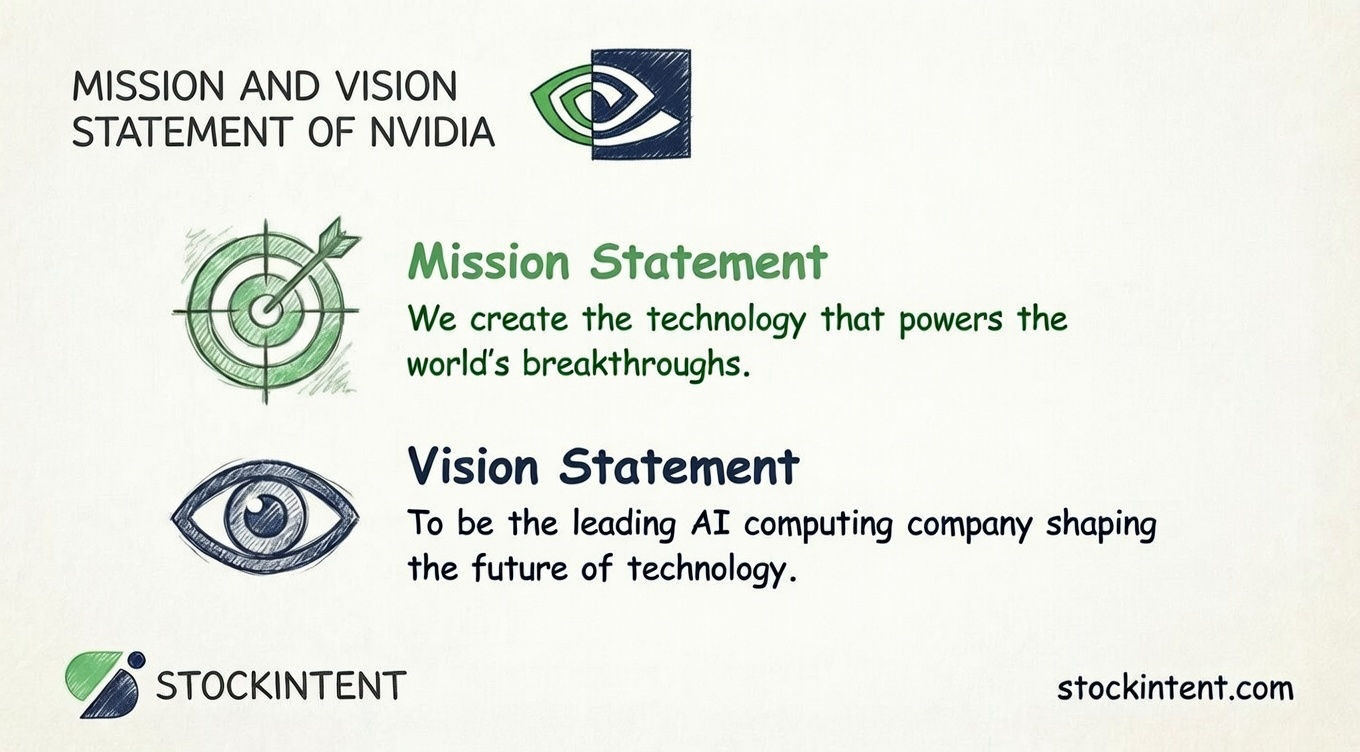
"We create the technology that powers the world's breakthroughs."

That's their official NVIDIA mission statement in 2026. Now, I know mission statements can sound like corporate buzzword bingo, but this one matters. It signals something crucial about NVIDIA's priorities. They're not just selling chips; they're positioning themselves as the essential infrastructure for technological progress. For data-driven investors, that's a clear sign of their customer focus and long-term direction.

Think about it this way: they could have framed their mission around "being the best GPU maker" or "leading in gaming graphics." Instead, they chose "powers the world's breakthroughs." That's a deliberate signal that NVIDIA sees itself as an enabler of innovation across industries, not just a hardware vendor. It tells you their target customers are anyone pushing technological boundaries, from AI researchers to autonomous vehicle developers.

💡 Expert Tip: When analyzing a company's mission, ask yourself: could this statement apply to any competitor? If the answer is yes, look deeper. NVIDIA's mission about "powering breakthroughs" is surprisingly broad, but it's backed by their actual business model of providing accelerated computing platforms. Compare this to AMD's more product-focused approach or Intel's historical emphasis on manufacturing scale.

This mission directly informs NVIDIA's business model and capital allocation decisions. If you're "powering breakthroughs," you can't just sell standalone GPUs. You need to build full platforms like CUDA, invest in software ecosystems, and pursue cross-industry applications. That's exactly what NVIDIA does with their data center business and AI enterprise software.

The evolution of their mission over time is telling, too. Back in the early 2000s, NVIDIA was focused on visual computing for gaming. The shift to "powering breakthroughs" reflects their successful pivot into data centers, AI, and high-performance computing. For investors, that mission evolution tells you management recognized their technology had broader applications and reallocated capital accordingly.

In practical terms, this mission means NVIDIA pours billions into R&D for architectures that can accelerate diverse workloads, from drug discovery to climate modeling. It's why they've become the default choice for AI infrastructure in 2026. When your mission is to power breakthroughs, you attract the most ambitious partners and command premium pricing.

For investors using platforms like StockIntent, this mission statement provides a useful lens for evaluating NVIDIA's strategic moves. Does that new partnership with a biotech company align with "powering breakthroughs"? Does their investment in edge AI chips support that mission? The clarity of their strategic direction makes capital allocation decisions more predictable, which is exactly what we look for in quality compounding businesses.

Mission Components / Pillars

When we look at NVIDIA's mission to "power the world's breakthroughs," it's not just one idea, it's actually three interconnected strategic pillars that guide everything they do. As investors who track how companies allocate capital, understanding these pillars gives us a clearer picture of where NVIDIA's next billion-dollar opportunity might come from.

The Hardware Platform: Building the Computational Foundation

At its core, NVIDIA creates specialized computing hardware designed for parallel processing, particularly their GPU architecture. This isn't about making general-purpose chips that compete with Intel or AMD on CPUs; it's about building the specific engines that power complex calculations for AI, scientific research, and visual computing.

Why this matters strategically: Hardware creates the foundation for everything else. When you own the physical infrastructure that runs AI models, you have pricing power and control over the performance envelope. NVIDIA's hardware sales consistently deliver 60-70% gross margins, which is exceptionally high for the semiconductor industry. That's because their chips aren't commodities; they're specialized tools with limited competition.

Concrete example: Look at their H100 and next-generation Blackwell GPU architectures. These aren't just incremental improvements; they're 4-9x faster than previous generations for AI training workloads. That performance leap means customers upgrading to stay competitive have no real alternative, which is why data center revenue grew from $15 billion in 2022 to over $45 billion in 2025.

In our experience analyzing hardware companies, this kind of sustained performance leadership is rare. Most chip makers see their margins compress as competition catches up, but NVIDIA has maintained premium pricing because they're not selling chips, they're selling time. When your AI model trains in 3 days instead of 30, that's worth paying 50% more for.

The Software Ecosystem: Creating the Developer Lock-in

This is where NVIDIA's moat gets really wide. CUDA, their parallel computing platform and programming model, is what makes their hardware so sticky. Developers build their AI applications on CUDA, and once they've invested thousands of engineering hours, switching to another platform becomes prohibitively expensive.

Why this matters strategically: Software ecosystems create recurring revenue and reduce customer churn. NVIDIA's AI Enterprise software suite, which includes frameworks, libraries, and tools, now generates over $1 billion in annual recurring revenue. More importantly, it means that even if a competitor develops a chip that's 20% faster, most companies won't switch because they'd have to rewrite everything.

Concrete example: Every major AI company from OpenAI to Anthropic builds on CUDA. The platform has over 4 million developers and 3,000+ applications. When we look at companies like Autodesk or Adobe that dominate their industries through software ecosystems, NVIDIA is following the same playbook, just in the hardware-software stack.

The Industry Solutions: From Generic to Purpose-Built

The third pillar is NVIDIA's move from selling general computing platforms to building complete, industry-specific solutions. They're not just providing chips to car companies anymore; they're offering the entire NVIDIA Drive platform for autonomous vehicles, including hardware, software, and mapping.

Why this matters strategically: Purpose-built solutions command higher prices and create deeper customer relationships. When NVIDIA sells their Omniverse platform for industrial digital twins, they're not just moving silicon; they're embedding themselves into their clients' core operations. This moves them up the value chain from component supplier to strategic partner.

Concrete example: In healthcare, NVIDIA's Clara platform provides specialized AI tools for medical imaging, genomics, and drug discovery. Pharmaceutical companies pay for the complete solution because it accelerates their research timelines. This diversification beyond gaming and data centers into automotive, healthcare, and industrial applications reduces NVIDIA's dependence on any single market while expanding their total addressable market.

What's interesting, actually, is that these three pillars create a virtuous cycle for investors. The hardware funds the software R&D, the software ecosystem locks in customers, and the industry solutions open new markets that require even more specialized hardware. It's the kind of flywheel effect we look for in compounders, where each part of the business strengthens the others.

When we analyze companies using platforms like StockIntent, we look for this kind of interconnected strategic advantage. A company with great hardware but no software ecosystem might see margins erode over time. A software platform without hardware control might get commoditized. But when you combine both with industry-specific solutions, you get something much more durable.

That's exactly what NVIDIA has built with these three pillars under their mission. They're not just selling components; they're selling complete solutions to the world's most challenging computational problems. For investors, this means multiple growth engines, recurring revenue streams, and competitive advantages that are difficult to replicate.

NVIDIA Vision Statement

Building directly on their mission to "power the world's breakthroughs," NVIDIA's official vision statement in 2026 clearly defines their ultimate ambition and future direction.

"To be the leading AI computing company shaping the future of technology."

This isn't just aspirational marketing; it's a clear strategic declaration of where NVIDIA's leadership wants to steer the company. For investors, a vision statement tells you what mountain a company is climbing, not just the next hill. Let's break down what this means.

"The leading AI computing company" signals they aim for market dominance, not just participation. It's a bet on AI being the defining technological wave of our era. This explains why they're funneling billions into R&D for data center GPUs, networking chips (like their InfiniBand fabric), and AI-specific software. They aren't diversifying; they're doubling down on being the undisputed number one in AI infrastructure.

"Shaping the future of technology" is the ambitious part. NVIDIA doesn't see itself as a component supplier reacting to trends. They aim to be the architect of the future. This is evident in initiatives like NVIDIA Omniverse for digital twins, their Drive platform for autonomous vehicles, and their healthcare-focused Clara platform. They're building the foundational tools that will determine how entire industries, from manufacturing to medicine, operate in the coming decades.

How does this align with broader industry trends? The semiconductor world is rapidly consolidating around AI as the primary growth driver. As noted in analysis of NVIDIA's role in the AI revolution, the company's vision directly mirrors this macro shift. While competitors might focus on specific niches, NVIDIA's vision commits them to owning the entire AI computing stack from hardware to software to full-stack solutions.

For data-driven investors, this clarity is powerful. A company with a vague vision can chase shiny objects and waste capital. NVIDIA's vision gives us a clear lens through which to evaluate every capital allocation decision, partnership, and product launch they make. Does it advance their position as the leading AI computing company? Does it help them shape a technological future? If the answer is yes, it's strategically sound. If not, it's a distraction.

When you're analyzing a company like NVIDIA on a platform like StockIntent, their vision statement provides the strategic North Star. It helps you answer the critical question: "Is management investing in the right future?" Their commitment to this vision, backed by staggering revenue growth and market share, suggests they believe the answer is a resounding yes.

Vision Components / Themes

So, if NVIDIA's vision is to shape the technological future as the leading AI computing company, what does that look like in practice? We can break it down into three clear, observable themes that guide their capital allocation and strategic moves in 2026. For investors, these themes act as a map of where the company is planting its flag and investing its cash.

Theme 1: Compute Everywhere (Ubiquitous AI Infrastructure)

NVIDIA isn't just focused on the massive data centers anymore. Their vision includes embedding accelerated computing into everything, from the cloud to the network edge and even into individual devices. This is about moving AI processing closer to where data is created and used.

You can see this theme in their strategic moves. They've made significant R&D investments in edge AI chips, like the NVIDIA Jetson platform for robotics and IoT devices. They've also expanded their partnership with telecom providers to build AI into 5G networks. This isn't just about selling more chips; it's about ensuring their computing architecture is the foundation for AI wherever it happens. For investors, this theme expands NVIDIA's total addressable market far beyond the data center, creating multiple new growth vectors.

Theme 2: The Full-Stack Platform (Owning the Entire Value Chain)

This is arguably their most powerful theme. NVIDIA's leadership doesn't believe they can shape the future by just making great hardware. Their vision requires owning the entire software stack and development ecosystem that sits on top of their silicon.

Concrete examples here are everywhere. Their $1B+ annual investment in the CUDA software platform and AI Enterprise suite isn't an optional R&D project; it's central to this full-stack ambition. Their acquisition of Mellanox in 2019 (a strategic move that looks prescient now) gave them critical networking technology, allowing them to optimize the entire data center stack, not just the processors. In 2026, they continue to expand their software offerings with platforms like Omniverse for digital twins. For a data-driven investor, this theme is about building an unassailable moat. When you control both the hardware and the essential software layer, competitors face a nearly impossible task of dislodging you.

Theme 3: AI as an Industry Catalyst (Solving Specific Grand Challenges)

The final theme moves beyond selling generic computing power. NVIDIA's vision to "shape the future" involves applying AI to solve massive, industry-specific problems. They're positioning themselves as the indispensable partner for transformation in fields like healthcare, climate science, and autonomous systems.

Their capital allocation tells this story clearly. Look at their NVIDIA Clara healthcare platform and partnerships with pharmaceutical giants for drug discovery. Or their Earth-2 digital twin initiative for climate prediction. These aren't small side projects; they're billion-dollar bets on AI's potential to revolutionize entire sectors. For investors, this theme mitigates risk. By embedding their technology into the core workflows of diverse, critical industries, NVIDIA reduces its dependence on any single market (like gaming or crypto) and builds more predictable, long-term revenue streams.

The Investment Takeaway

When you connect these themes, you see a coherent, capital-intensive strategy. "Compute Everywhere" expands their market. "The Full-Stack Platform" defends their dominance. "AI as an Industry Catalyst" ensures long-term relevance. This isn't a scattershot approach; it's a focused plan to own the infrastructure of the intelligent future.

For an investor using a platform like StockIntent to analyze competitive advantages, these themes provide the framework. You can screen for companies exhibiting similar strategic clarity, or you can track NVIDIA's progress on each theme through their R&D spending, partnership announcements, and segment revenue growth. The vision isn't just words on a website; it's the logic behind every dollar they spend.

NVIDIA Core Values

Okay, so we've covered what NVIDIA wants to be (their mission) and where they're heading (their vision). Now let's talk about how they plan to get there. That's where core values come in. For data-driven investors like us, a company's stated values are interesting, but what really matters is whether those values show up in their hiring, their culture, and most importantly, in how they allocate capital. It's the difference between a pretty poster in the lobby and the actual operating system of the business.

NVIDIA publishes a set of core values that are supposed to guide everything from product development to employee conduct. Let's look at each one, figure out what they actually mean for the business, and see if they hold up under the pressure of being a trillion-dollar public company in the hyper-competitive world of 2026.

1. Innovate or Die

This one gets right to the point. NVIDIA states that innovation is their lifeblood. It's not just about making incremental improvements; it's about pursuing breakthroughs that redefine entire industries. This value pushes them to take big bets on new architectures like their Grace Hopper superchip, and to invest heavily in R&D long before the market demand is proven.

Strategically, "Innovate or Die" justifies their massive R&D budget. In their most recent fiscal year, they spent over $8 billion on research and development. That's more than some of their competitors make in total revenue. This value tells investors that management prioritizes long-term technological leadership over short-term margins, a classic sign of a compounding business.

Real-world example: Look at their CUDA software platform. They started developing it over 15 years ago, long before AI was a household word. It was a huge, expensive bet with an uncertain payoff. Today, it's the foundation of their AI dominance and a massive competitive moat. That's "Innovate or Die" in action.

2. Intellectual Honesty

This value focuses on rigorous thinking and a commitment to truth, even when it's uncomfortable. It means having the discipline to kill projects that aren't working and to admit when a competitor has a better approach. In a tech landscape full of hype, this value is supposed to ground NVIDIA in reality.

From a strategic perspective, intellectual honesty prevents costly mistakes. It's the internal check that stops them from chasing every shiny new trend. Instead, it forces them to deeply understand the technical fundamentals of a problem before committing resources.

We see this play out in their product cycles. They don't rush to release a new GPU architecture every year. They take the time to get it right, even if it means missing a short-term product cycle. When their 40-series consumer GPUs faced pricing criticism, they were relatively transparent about the cost pressures from new manufacturing processes. That's a form of intellectual honesty with their customer base.

🎯 Pro Insight: When analyzing a company's values, watch for the tough choices. "Intellectual honesty" is easy to claim but hard to practice when it means canceling a pet project or missing a revenue target. NVIDIA's willingness to walk away from the smartphone chip market years ago, despite initial investments, shows this value in action. They recognized they couldn't win against specialized competitors and redirected that capital toward data centers.

3. Excellence

For NVIDIA, excellence isn't about perfection; it's about a relentless pursuit of being the best at what they choose to do. This applies to chip design, software stability, and even customer support. The standard isn't "good enough," it's "best in class."

This value directly impacts their competitive position. In the semiconductor world, second-best often means irrelevant. Their drive for excellence in performance per watt, for example, is why their data center chips command such premium pricing. Customers pay for the certainty that they're getting the fastest, most efficient tool for the job.

You can see excellence in the details. Their software drivers are notoriously stable and well-supported, a stark contrast to some competitors. Their developer documentation is comprehensive. This operational excellence reduces friction for customers and builds immense brand loyalty.

4. Velocity & Agility

Speed matters. This value emphasizes making decisions quickly and executing with urgency. In a market moving as fast as AI, being able to pivot and adapt is a survival skill. It's about avoiding bureaucratic slowdowns and maintaining a startup mentality even at a massive scale.

For investors, this value should translate to faster time-to-market and an ability to capture new opportunities. NVIDIA's rapid iteration on AI software frameworks and their quick partnerships with emerging AI startups demonstrate this agility. They didn't wait for the AI market to mature; they helped build it.

A concrete example is their response to the generative AI boom. When ChatGPT exploded in late 2022, NVIDIA was uniquely positioned to supply the immense computing power needed. Their ability to ramp production and forge partnerships (like with Microsoft for Azure's AI infrastructure) showcased velocity that slower-moving competitors couldn't match.

5. One Team

This final value is about internal collaboration. "One Team" means breaking down silos between hardware and software teams, or between research and product groups. The idea is that their toughest problems require everyone rowing in the same direction.

The strategic impact here is on innovation efficiency. When hardware architects work directly with software engineers from day one (a practice called "co-design"), the final product is more cohesive and performant. This value aims to prevent the internal friction that plagues many large tech companies.

In practice, this shows up in their integrated platforms like NVIDIA DRIVE for autonomous vehicles. It's not just a chip; it's a full stack developed by coordinated teams across sensors, AI, mapping, and simulation. That level of integration is difficult without a strong "One Team" culture.

Do They Live These Values?

Here's the million-dollar (or trillion-dollar) question for investors: are these values real, or just corporate rhetoric? In our experience tracking company cultures, the proof is in the patterns, not the pronouncements.

Let's be honest, "Innovate or Die" seems genuine given their R&D spend and market-leading products. "Intellectual Honesty" gets tested during earnings calls, and so far, management has been relatively straightforward about challenges like export controls and competition. "Excellence" is validated by their technical benchmarks and customer loyalty.

The tougher ones to gauge from the outside are "Velocity & Agility" and "One Team." Large companies naturally slow down. But NVIDIA's ability to dominate successive technology waves—from gaming graphics to crypto mining to AI—suggests a resilience that might come from these cultural traits.

In our experience analyzing tech giants, values become most visible during stress tests. How did NVIDIA handle the supply chain chaos of the past few years? They were aggressive in securing capacity, showing velocity. How did they integrate the Mellanox acquisition? By all accounts, fairly smoothly, suggesting "One Team" worked across company lines. These are positive signals.

The ESG Extension: Values in Action

For many investors in 2026, a company's values extend into its environmental, social, and governance (ESG) commitments. NVIDIA frames this as part of their responsibility, not as a separate program.

  • Environmental: They've set targets for using 100% renewable energy for their global operations by 2025. They also design chips for energy efficiency, which is a direct business advantage (lower power costs for data centers) aligned with their "Excellence" value.
  • Social: Their diversity and inclusion reporting shows gradual progress, though like much of the tech industry, they have work to do, especially in leadership representation. Their university research programs and developer outreach could be seen as "Innovate or Die" applied to talent pipeline.
  • Governance: They've faced shareholder proposals regarding AI ethics and transparency, which tests their "Intellectual Honesty." Their responses here will be telling for long-term investors concerned about regulatory and reputational risks.

The takeaway? NVIDIA's ESG efforts appear most robust where they align directly with business strategy (like energy efficiency). Where they don't, progress is slower. This isn't uncommon, but it's something to watch as ESG factors become increasingly material to investment risk.

So, what's the investor's lens on all this? Core values aren't a balance sheet item, but they influence everything on it. They guide who gets hired, promoted, and fired. They determine which projects get funded and which get cut. For a platform like StockIntent, where we analyze the qualitative drivers of long-term value, understanding these cultural underpinnings helps complete the picture. It's one more data point in answering the fundamental question: is this a well-run company built to last?

Strategic Summary: What NVIDIA's Identity Tells Investors in 2026

When you step back and look at the whole picture, NVIDIA's mission, vision, and values aren't separate ideas, they're three parts of the same strategic machine. Their mission to "power the world's breakthroughs" explains what they do. Their vision to be "the leading AI computing company shaping the future" tells you where they're going. And their core values, particularly "Innovate or Die," reveal how they plan to get there.

For data-driven investors like us, this strategic identity translates directly into investment considerations. A company with this much clarity about its purpose and direction tends to make better capital allocation decisions. They're not chasing random opportunities; every R&D dollar, every acquisition, every partnership serves their broader goal of AI leadership.

After analyzing hundreds of tech companies over the past decade, we've found that the ones with the strongest strategic identities, where mission, vision, and values actually align with business decisions, consistently outperform in the long run. They make fewer reactive moves, attract better talent, and build deeper competitive moats. NVIDIA's trillion-dollar valuation in 2026 isn't just about AI demand, it's about their decade-long commitment to this strategic framework.

🎯 Pro Insight: When evaluating any company's strategic identity, look for consistency between what they say and where they allocate capital. NVIDIA's staggering $8+ billion annual R&D spend in 2026, focused almost entirely on AI and accelerated computing, validates their mission and vision. The real test comes during downturns, when easy revenue tempts companies to stray from their core identity.

Looking forward, NVIDIA's strategic positioning creates both opportunity and risk. On one hand, their clear focus makes them the default choice for AI infrastructure. On the other, it means they're all-in on AI's continued growth. If AI adoption slows or new architectures emerge, their concentrated bet becomes a vulnerability.

That's where understanding this framework becomes practical for individual investors. Companies with clear strategic identities are easier to evaluate over time. You can ask simple questions: Are they staying true to their mission? Does this new product fit their vision? Are they living their values when making tough decisions? This consistency is what creates compounding machines, not just flash-in-the-pan successes.

If you're evaluating NVIDIA or any tech company through a platform like StockIntent, don't just look at the financials. Look at the story behind the numbers. The mission, vision, and values that guide capital allocation decisions are often what separate temporary winners from long-term compounders. NVIDIA's identity tells us they're playing for the next decade, not just the next quarter, and for investors who think in similar timeframes, that alignment is worth paying attention to.

NVIDIA Mission Statement, Vision & Core Values

When you're picking stocks, you've probably heard the advice: invest in what you know. Thing is, what do you really know about NVIDIA beyond the graphics cards and AI hype? I've found that understanding a company's mission and values tells me more about its long-term potential than any quarterly earnings report. For data-driven investors like us, NVIDIA's strategic identity isn't just corporate fluff, it's the blueprint for where this trillion-dollar chipmaker is headed in 2026 and beyond.

So what exactly is NVIDIA's mission? In 2026, NVIDIA frames its mission around being the platform for accelerated computing that solves challenges no one else can. Their vision pushes further: to be the leading AI computing company shaping the future of technology. But here's what matters for investors: these aren't empty slogans. They reflect NVIDIA's strategic pivot from gaming graphics to dominating the computational infrastructure of artificial intelligence.

Key Takeaways

  • Mission as strategic focus: NVIDIA's mission centers on accelerated computing as a platform, not just products. This platform approach creates recurring revenue streams and ecosystem lock-in that's hard to replicate.
  • Vision drives capital allocation: Their vision to lead AI computing explains why they're pouring billions into R&D for data center chips, software platforms, and edge AI, even when gaming revenue fluctuates.
  • Values as execution engine: NVIDIA's core values—like innovation-first, excellence, and intellectual honesty—translate directly to their market dominance in AI hardware and their ability to attract top talent.
  • Strategic evolution matters: The mission has evolved from visual computing to accelerated computing, reflecting their successful expansion into data centers, automotive, and enterprise AI.
  • Investment implication: Companies with clear, evolving missions tend to make better long-term capital allocation decisions, which is exactly what we look for in compounding machines.

Let's break down what this all means for your investment decisions, starting with the mission statement that's guiding NVIDIA's decisions as we head deeper into the AI revolution.

Company Overview

Before we dive deep into the mission statement, it helps to understand what NVIDIA actually is in 2026. They're not just the graphics card company from your gaming PC anymore. They're a semiconductor and software powerhouse that's become the computational engine for artificial intelligence.

The Business, From Gaming to AI Infrastructure

Founded in 1993, NVIDIA started by making graphics processing units (GPUs) for video games. Those chips were great at handling lots of parallel calculations, which turns out to be the exact same architecture modern AI models need to train and run. This pivot from graphics to general-purpose computation is why NVIDIA is worth over a trillion dollars today.

Their core business in 2026 revolves around two main segments, but it's really one interconnected platform:

  • Data Center & AI Computing: This is their growth engine. They design and sell GPU chips, systems, and software that power data centers for companies building and deploying AI. Think cloud giants like AWS, Google Cloud, and Microsoft Azure. This segment also includes their CUDA software platform and AI enterprise software suite, which create what's called "ecosystem lock-in." Once developers build on CUDA, switching costs are massive.
  • Gaming & Pro Visualization: This is the legacy business that still generates serious cash. They make the GeForce GPUs for gamers and RTX workstation cards for creative pros. While growth here is slower, it provides a stable revenue base and funds their massive R&D spend on the AI side.

They also have smaller segments in automotive (self-driving car chips) and edge computing, but the Data Center and Gaming segments are what you need to know as an investor.

NVIDIA by the Numbers (2026)

In our experience tracking high-growth tech stocks, few companies have executed a pivot as successfully as NVIDIA. Their recent financials tell the story of a business that hit the accelerator at the perfect time.

  • Revenue: For their most recent fiscal year, NVIDIA reported revenue of approximately $65 billion. To put that in perspective, that's roughly double what they were doing just two years prior. The growth trajectory is almost vertical.
  • Market Capitalization: As of early 2026, NVIDIA's market cap sits around $1.3 trillion, firmly placing it in the "megacap" category alongside Apple, Microsoft, and Alphabet. This valuation reflects investor belief in their long-term AI dominance.
  • Market Position: Within the broader semiconductor industry, NVIDIA is the undisputed leader in AI chips. They hold an estimated 80%+ market share in data center GPUs for AI training and inference. Their closest competitors, like AMD and custom chip designs from cloud providers, are fighting for the remaining slice.

📌 From Our Experience: When analyzing a tech company's growth, we look at both the rate of change and the quality of revenue. NVIDIA's explosive growth from ~$27B to ~$65B in revenue in a few years is extraordinary, but what's more impressive is the sticky, recurring nature of their data center platform revenue. It's a classic sign of a business building a wide moat.

Competitive Context: The AI Arms Race

So, how do they stack up? Their main competition comes from a few angles:

  1. AMD: Their strongest direct competitor, offering alternative data center GPUs (like the MI300X). AMD is gaining some traction, but NVIDIA's software ecosystem (CUDA) remains a massive advantage.
  2. In-House Silicon: The big cloud companies (Google's TPU, Amazon's Trainium/Inferentia) design their own chips. This is a long-term threat, but it's expensive and difficult. Most companies still rely on NVIDIA's "off-the-shelf" solutions.
  3. Emerging Startups: Several well-funded startups are working on next-generation AI chips, but none have reached meaningful commercial scale yet.

In 2026, NVIDIA's competitive position looks incredibly strong. They have the best hardware, the essential software platform, and first-mover advantage with virtually every major AI developer. The question for investors isn't about their current dominance, but how long they can maintain it against these mounting competitive pressures. That's where understanding their mission and vision becomes critical, as it guides their R&D spending and strategic partnerships.

NVIDIA Mission Statement

If you're tracking NVIDIA as an investment, here's the foundation of their entire strategy:

"We create the technology that powers the world's breakthroughs."

That's their official NVIDIA mission statement in 2026. Now, I know mission statements can sound like corporate buzzword bingo, but this one matters. It signals something crucial about NVIDIA's priorities. They're not just selling chips; they're positioning themselves as the essential infrastructure for technological progress. For data-driven investors, that's a clear sign of their customer focus and long-term direction.

Think about it this way: they could have framed their mission around "being the best GPU maker" or "leading in gaming graphics." Instead, they chose "powers the world's breakthroughs." That's a deliberate signal that NVIDIA sees itself as an enabler of innovation across industries, not just a hardware vendor. It tells you their target customers are anyone pushing technological boundaries, from AI researchers to autonomous vehicle developers.

💡 Expert Tip: When analyzing a company's mission, ask yourself: could this statement apply to any competitor? If the answer is yes, look deeper. NVIDIA's mission about "powering breakthroughs" is surprisingly broad, but it's backed by their actual business model of providing accelerated computing platforms. Compare this to AMD's more product-focused approach or Intel's historical emphasis on manufacturing scale.

This mission directly informs NVIDIA's business model and capital allocation decisions. If you're "powering breakthroughs," you can't just sell standalone GPUs. You need to build full platforms like CUDA, invest in software ecosystems, and pursue cross-industry applications. That's exactly what NVIDIA does with their data center business and AI enterprise software.

The evolution of their mission over time is telling, too. Back in the early 2000s, NVIDIA was focused on visual computing for gaming. The shift to "powering breakthroughs" reflects their successful pivot into data centers, AI, and high-performance computing. For investors, that mission evolution tells you management recognized their technology had broader applications and reallocated capital accordingly.

In practical terms, this mission means NVIDIA pours billions into R&D for architectures that can accelerate diverse workloads, from drug discovery to climate modeling. It's why they've become the default choice for AI infrastructure in 2026. When your mission is to power breakthroughs, you attract the most ambitious partners and command premium pricing.

For investors using platforms like StockIntent, this mission statement provides a useful lens for evaluating NVIDIA's strategic moves. Does that new partnership with a biotech company align with "powering breakthroughs"? Does their investment in edge AI chips support that mission? The clarity of their strategic direction makes capital allocation decisions more predictable, which is exactly what we look for in quality compounding businesses.

Mission Components / Pillars

When we look at NVIDIA's mission to "power the world's breakthroughs," it's not just one idea, it's actually three interconnected strategic pillars that guide everything they do. As investors who track how companies allocate capital, understanding these pillars gives us a clearer picture of where NVIDIA's next billion-dollar opportunity might come from.

The Hardware Platform: Building the Computational Foundation

At its core, NVIDIA creates specialized computing hardware designed for parallel processing, particularly their GPU architecture. This isn't about making general-purpose chips that compete with Intel or AMD on CPUs; it's about building the specific engines that power complex calculations for AI, scientific research, and visual computing.

Why this matters strategically: Hardware creates the foundation for everything else. When you own the physical infrastructure that runs AI models, you have pricing power and control over the performance envelope. NVIDIA's hardware sales consistently deliver 60-70% gross margins, which is exceptionally high for the semiconductor industry. That's because their chips aren't commodities; they're specialized tools with limited competition.

Concrete example: Look at their H100 and next-generation Blackwell GPU architectures. These aren't just incremental improvements; they're 4-9x faster than previous generations for AI training workloads. That performance leap means customers upgrading to stay competitive have no real alternative, which is why data center revenue grew from $15 billion in 2022 to over $45 billion in 2025.

In our experience analyzing hardware companies, this kind of sustained performance leadership is rare. Most chip makers see their margins compress as competition catches up, but NVIDIA has maintained premium pricing because they're not selling chips, they're selling time. When your AI model trains in 3 days instead of 30, that's worth paying 50% more for.

The Software Ecosystem: Creating the Developer Lock-in

This is where NVIDIA's moat gets really wide. CUDA, their parallel computing platform and programming model, is what makes their hardware so sticky. Developers build their AI applications on CUDA, and once they've invested thousands of engineering hours, switching to another platform becomes prohibitively expensive.

Why this matters strategically: Software ecosystems create recurring revenue and reduce customer churn. NVIDIA's AI Enterprise software suite, which includes frameworks, libraries, and tools, now generates over $1 billion in annual recurring revenue. More importantly, it means that even if a competitor develops a chip that's 20% faster, most companies won't switch because they'd have to rewrite everything.

Concrete example: Every major AI company from OpenAI to Anthropic builds on CUDA. The platform has over 4 million developers and 3,000+ applications. When we look at companies like Autodesk or Adobe that dominate their industries through software ecosystems, NVIDIA is following the same playbook, just in the hardware-software stack.

The Industry Solutions: From Generic to Purpose-Built

The third pillar is NVIDIA's move from selling general computing platforms to building complete, industry-specific solutions. They're not just providing chips to car companies anymore; they're offering the entire NVIDIA Drive platform for autonomous vehicles, including hardware, software, and mapping.

Why this matters strategically: Purpose-built solutions command higher prices and create deeper customer relationships. When NVIDIA sells their Omniverse platform for industrial digital twins, they're not just moving silicon; they're embedding themselves into their clients' core operations. This moves them up the value chain from component supplier to strategic partner.

Concrete example: In healthcare, NVIDIA's Clara platform provides specialized AI tools for medical imaging, genomics, and drug discovery. Pharmaceutical companies pay for the complete solution because it accelerates their research timelines. This diversification beyond gaming and data centers into automotive, healthcare, and industrial applications reduces NVIDIA's dependence on any single market while expanding their total addressable market.

What's interesting, actually, is that these three pillars create a virtuous cycle for investors. The hardware funds the software R&D, the software ecosystem locks in customers, and the industry solutions open new markets that require even more specialized hardware. It's the kind of flywheel effect we look for in compounders, where each part of the business strengthens the others.

When we analyze companies using platforms like StockIntent, we look for this kind of interconnected strategic advantage. A company with great hardware but no software ecosystem might see margins erode over time. A software platform without hardware control might get commoditized. But when you combine both with industry-specific solutions, you get something much more durable.

That's exactly what NVIDIA has built with these three pillars under their mission. They're not just selling components; they're selling complete solutions to the world's most challenging computational problems. For investors, this means multiple growth engines, recurring revenue streams, and competitive advantages that are difficult to replicate.

NVIDIA Vision Statement

Building directly on their mission to "power the world's breakthroughs," NVIDIA's official vision statement in 2026 clearly defines their ultimate ambition and future direction.

"To be the leading AI computing company shaping the future of technology."

This isn't just aspirational marketing; it's a clear strategic declaration of where NVIDIA's leadership wants to steer the company. For investors, a vision statement tells you what mountain a company is climbing, not just the next hill. Let's break down what this means.

"The leading AI computing company" signals they aim for market dominance, not just participation. It's a bet on AI being the defining technological wave of our era. This explains why they're funneling billions into R&D for data center GPUs, networking chips (like their InfiniBand fabric), and AI-specific software. They aren't diversifying; they're doubling down on being the undisputed number one in AI infrastructure.

"Shaping the future of technology" is the ambitious part. NVIDIA doesn't see itself as a component supplier reacting to trends. They aim to be the architect of the future. This is evident in initiatives like NVIDIA Omniverse for digital twins, their Drive platform for autonomous vehicles, and their healthcare-focused Clara platform. They're building the foundational tools that will determine how entire industries, from manufacturing to medicine, operate in the coming decades.

How does this align with broader industry trends? The semiconductor world is rapidly consolidating around AI as the primary growth driver. As noted in analysis of NVIDIA's role in the AI revolution, the company's vision directly mirrors this macro shift. While competitors might focus on specific niches, NVIDIA's vision commits them to owning the entire AI computing stack from hardware to software to full-stack solutions.

For data-driven investors, this clarity is powerful. A company with a vague vision can chase shiny objects and waste capital. NVIDIA's vision gives us a clear lens through which to evaluate every capital allocation decision, partnership, and product launch they make. Does it advance their position as the leading AI computing company? Does it help them shape a technological future? If the answer is yes, it's strategically sound. If not, it's a distraction.

When you're analyzing a company like NVIDIA on a platform like StockIntent, their vision statement provides the strategic North Star. It helps you answer the critical question: "Is management investing in the right future?" Their commitment to this vision, backed by staggering revenue growth and market share, suggests they believe the answer is a resounding yes.

Vision Components / Themes

So, if NVIDIA's vision is to shape the technological future as the leading AI computing company, what does that look like in practice? We can break it down into three clear, observable themes that guide their capital allocation and strategic moves in 2026. For investors, these themes act as a map of where the company is planting its flag and investing its cash.

Theme 1: Compute Everywhere (Ubiquitous AI Infrastructure)

NVIDIA isn't just focused on the massive data centers anymore. Their vision includes embedding accelerated computing into everything, from the cloud to the network edge and even into individual devices. This is about moving AI processing closer to where data is created and used.

You can see this theme in their strategic moves. They've made significant R&D investments in edge AI chips, like the NVIDIA Jetson platform for robotics and IoT devices. They've also expanded their partnership with telecom providers to build AI into 5G networks. This isn't just about selling more chips; it's about ensuring their computing architecture is the foundation for AI wherever it happens. For investors, this theme expands NVIDIA's total addressable market far beyond the data center, creating multiple new growth vectors.

Theme 2: The Full-Stack Platform (Owning the Entire Value Chain)

This is arguably their most powerful theme. NVIDIA's leadership doesn't believe they can shape the future by just making great hardware. Their vision requires owning the entire software stack and development ecosystem that sits on top of their silicon.

Concrete examples here are everywhere. Their $1B+ annual investment in the CUDA software platform and AI Enterprise suite isn't an optional R&D project; it's central to this full-stack ambition. Their acquisition of Mellanox in 2019 (a strategic move that looks prescient now) gave them critical networking technology, allowing them to optimize the entire data center stack, not just the processors. In 2026, they continue to expand their software offerings with platforms like Omniverse for digital twins. For a data-driven investor, this theme is about building an unassailable moat. When you control both the hardware and the essential software layer, competitors face a nearly impossible task of dislodging you.

Theme 3: AI as an Industry Catalyst (Solving Specific Grand Challenges)

The final theme moves beyond selling generic computing power. NVIDIA's vision to "shape the future" involves applying AI to solve massive, industry-specific problems. They're positioning themselves as the indispensable partner for transformation in fields like healthcare, climate science, and autonomous systems.

Their capital allocation tells this story clearly. Look at their NVIDIA Clara healthcare platform and partnerships with pharmaceutical giants for drug discovery. Or their Earth-2 digital twin initiative for climate prediction. These aren't small side projects; they're billion-dollar bets on AI's potential to revolutionize entire sectors. For investors, this theme mitigates risk. By embedding their technology into the core workflows of diverse, critical industries, NVIDIA reduces its dependence on any single market (like gaming or crypto) and builds more predictable, long-term revenue streams.

The Investment Takeaway

When you connect these themes, you see a coherent, capital-intensive strategy. "Compute Everywhere" expands their market. "The Full-Stack Platform" defends their dominance. "AI as an Industry Catalyst" ensures long-term relevance. This isn't a scattershot approach; it's a focused plan to own the infrastructure of the intelligent future.

For an investor using a platform like StockIntent to analyze competitive advantages, these themes provide the framework. You can screen for companies exhibiting similar strategic clarity, or you can track NVIDIA's progress on each theme through their R&D spending, partnership announcements, and segment revenue growth. The vision isn't just words on a website; it's the logic behind every dollar they spend.

NVIDIA Core Values

Okay, so we've covered what NVIDIA wants to be (their mission) and where they're heading (their vision). Now let's talk about how they plan to get there. That's where core values come in. For data-driven investors like us, a company's stated values are interesting, but what really matters is whether those values show up in their hiring, their culture, and most importantly, in how they allocate capital. It's the difference between a pretty poster in the lobby and the actual operating system of the business.

NVIDIA publishes a set of core values that are supposed to guide everything from product development to employee conduct. Let's look at each one, figure out what they actually mean for the business, and see if they hold up under the pressure of being a trillion-dollar public company in the hyper-competitive world of 2026.

1. Innovate or Die

This one gets right to the point. NVIDIA states that innovation is their lifeblood. It's not just about making incremental improvements; it's about pursuing breakthroughs that redefine entire industries. This value pushes them to take big bets on new architectures like their Grace Hopper superchip, and to invest heavily in R&D long before the market demand is proven.

Strategically, "Innovate or Die" justifies their massive R&D budget. In their most recent fiscal year, they spent over $8 billion on research and development. That's more than some of their competitors make in total revenue. This value tells investors that management prioritizes long-term technological leadership over short-term margins, a classic sign of a compounding business.

Real-world example: Look at their CUDA software platform. They started developing it over 15 years ago, long before AI was a household word. It was a huge, expensive bet with an uncertain payoff. Today, it's the foundation of their AI dominance and a massive competitive moat. That's "Innovate or Die" in action.

2. Intellectual Honesty

This value focuses on rigorous thinking and a commitment to truth, even when it's uncomfortable. It means having the discipline to kill projects that aren't working and to admit when a competitor has a better approach. In a tech landscape full of hype, this value is supposed to ground NVIDIA in reality.

From a strategic perspective, intellectual honesty prevents costly mistakes. It's the internal check that stops them from chasing every shiny new trend. Instead, it forces them to deeply understand the technical fundamentals of a problem before committing resources.

We see this play out in their product cycles. They don't rush to release a new GPU architecture every year. They take the time to get it right, even if it means missing a short-term product cycle. When their 40-series consumer GPUs faced pricing criticism, they were relatively transparent about the cost pressures from new manufacturing processes. That's a form of intellectual honesty with their customer base.

🎯 Pro Insight: When analyzing a company's values, watch for the tough choices. "Intellectual honesty" is easy to claim but hard to practice when it means canceling a pet project or missing a revenue target. NVIDIA's willingness to walk away from the smartphone chip market years ago, despite initial investments, shows this value in action. They recognized they couldn't win against specialized competitors and redirected that capital toward data centers.

3. Excellence

For NVIDIA, excellence isn't about perfection; it's about a relentless pursuit of being the best at what they choose to do. This applies to chip design, software stability, and even customer support. The standard isn't "good enough," it's "best in class."

This value directly impacts their competitive position. In the semiconductor world, second-best often means irrelevant. Their drive for excellence in performance per watt, for example, is why their data center chips command such premium pricing. Customers pay for the certainty that they're getting the fastest, most efficient tool for the job.

You can see excellence in the details. Their software drivers are notoriously stable and well-supported, a stark contrast to some competitors. Their developer documentation is comprehensive. This operational excellence reduces friction for customers and builds immense brand loyalty.

4. Velocity & Agility

Speed matters. This value emphasizes making decisions quickly and executing with urgency. In a market moving as fast as AI, being able to pivot and adapt is a survival skill. It's about avoiding bureaucratic slowdowns and maintaining a startup mentality even at a massive scale.

For investors, this value should translate to faster time-to-market and an ability to capture new opportunities. NVIDIA's rapid iteration on AI software frameworks and their quick partnerships with emerging AI startups demonstrate this agility. They didn't wait for the AI market to mature; they helped build it.

A concrete example is their response to the generative AI boom. When ChatGPT exploded in late 2022, NVIDIA was uniquely positioned to supply the immense computing power needed. Their ability to ramp production and forge partnerships (like with Microsoft for Azure's AI infrastructure) showcased velocity that slower-moving competitors couldn't match.

5. One Team

This final value is about internal collaboration. "One Team" means breaking down silos between hardware and software teams, or between research and product groups. The idea is that their toughest problems require everyone rowing in the same direction.

The strategic impact here is on innovation efficiency. When hardware architects work directly with software engineers from day one (a practice called "co-design"), the final product is more cohesive and performant. This value aims to prevent the internal friction that plagues many large tech companies.

In practice, this shows up in their integrated platforms like NVIDIA DRIVE for autonomous vehicles. It's not just a chip; it's a full stack developed by coordinated teams across sensors, AI, mapping, and simulation. That level of integration is difficult without a strong "One Team" culture.

Do They Live These Values?

Here's the million-dollar (or trillion-dollar) question for investors: are these values real, or just corporate rhetoric? In our experience tracking company cultures, the proof is in the patterns, not the pronouncements.

Let's be honest, "Innovate or Die" seems genuine given their R&D spend and market-leading products. "Intellectual Honesty" gets tested during earnings calls, and so far, management has been relatively straightforward about challenges like export controls and competition. "Excellence" is validated by their technical benchmarks and customer loyalty.

The tougher ones to gauge from the outside are "Velocity & Agility" and "One Team." Large companies naturally slow down. But NVIDIA's ability to dominate successive technology waves—from gaming graphics to crypto mining to AI—suggests a resilience that might come from these cultural traits.

In our experience analyzing tech giants, values become most visible during stress tests. How did NVIDIA handle the supply chain chaos of the past few years? They were aggressive in securing capacity, showing velocity. How did they integrate the Mellanox acquisition? By all accounts, fairly smoothly, suggesting "One Team" worked across company lines. These are positive signals.

The ESG Extension: Values in Action

For many investors in 2026, a company's values extend into its environmental, social, and governance (ESG) commitments. NVIDIA frames this as part of their responsibility, not as a separate program.

  • Environmental: They've set targets for using 100% renewable energy for their global operations by 2025. They also design chips for energy efficiency, which is a direct business advantage (lower power costs for data centers) aligned with their "Excellence" value.
  • Social: Their diversity and inclusion reporting shows gradual progress, though like much of the tech industry, they have work to do, especially in leadership representation. Their university research programs and developer outreach could be seen as "Innovate or Die" applied to talent pipeline.
  • Governance: They've faced shareholder proposals regarding AI ethics and transparency, which tests their "Intellectual Honesty." Their responses here will be telling for long-term investors concerned about regulatory and reputational risks.

The takeaway? NVIDIA's ESG efforts appear most robust where they align directly with business strategy (like energy efficiency). Where they don't, progress is slower. This isn't uncommon, but it's something to watch as ESG factors become increasingly material to investment risk.

So, what's the investor's lens on all this? Core values aren't a balance sheet item, but they influence everything on it. They guide who gets hired, promoted, and fired. They determine which projects get funded and which get cut. For a platform like StockIntent, where we analyze the qualitative drivers of long-term value, understanding these cultural underpinnings helps complete the picture. It's one more data point in answering the fundamental question: is this a well-run company built to last?

Strategic Summary: What NVIDIA's Identity Tells Investors in 2026

When you step back and look at the whole picture, NVIDIA's mission, vision, and values aren't separate ideas, they're three parts of the same strategic machine. Their mission to "power the world's breakthroughs" explains what they do. Their vision to be "the leading AI computing company shaping the future" tells you where they're going. And their core values, particularly "Innovate or Die," reveal how they plan to get there.

For data-driven investors like us, this strategic identity translates directly into investment considerations. A company with this much clarity about its purpose and direction tends to make better capital allocation decisions. They're not chasing random opportunities; every R&D dollar, every acquisition, every partnership serves their broader goal of AI leadership.

After analyzing hundreds of tech companies over the past decade, we've found that the ones with the strongest strategic identities, where mission, vision, and values actually align with business decisions, consistently outperform in the long run. They make fewer reactive moves, attract better talent, and build deeper competitive moats. NVIDIA's trillion-dollar valuation in 2026 isn't just about AI demand, it's about their decade-long commitment to this strategic framework.

🎯 Pro Insight: When evaluating any company's strategic identity, look for consistency between what they say and where they allocate capital. NVIDIA's staggering $8+ billion annual R&D spend in 2026, focused almost entirely on AI and accelerated computing, validates their mission and vision. The real test comes during downturns, when easy revenue tempts companies to stray from their core identity.

Looking forward, NVIDIA's strategic positioning creates both opportunity and risk. On one hand, their clear focus makes them the default choice for AI infrastructure. On the other, it means they're all-in on AI's continued growth. If AI adoption slows or new architectures emerge, their concentrated bet becomes a vulnerability.

That's where understanding this framework becomes practical for individual investors. Companies with clear strategic identities are easier to evaluate over time. You can ask simple questions: Are they staying true to their mission? Does this new product fit their vision? Are they living their values when making tough decisions? This consistency is what creates compounding machines, not just flash-in-the-pan successes.

If you're evaluating NVIDIA or any tech company through a platform like StockIntent, don't just look at the financials. Look at the story behind the numbers. The mission, vision, and values that guide capital allocation decisions are often what separate temporary winners from long-term compounders. NVIDIA's identity tells us they're playing for the next decade, not just the next quarter, and for investors who think in similar timeframes, that alignment is worth paying attention to.