NVIDIA Economic Moat Analysis: Rating, Trend & Competitive Advantages

NVIDIA Economic Moat Analysis: Rating, Trend & Competitive Advantages

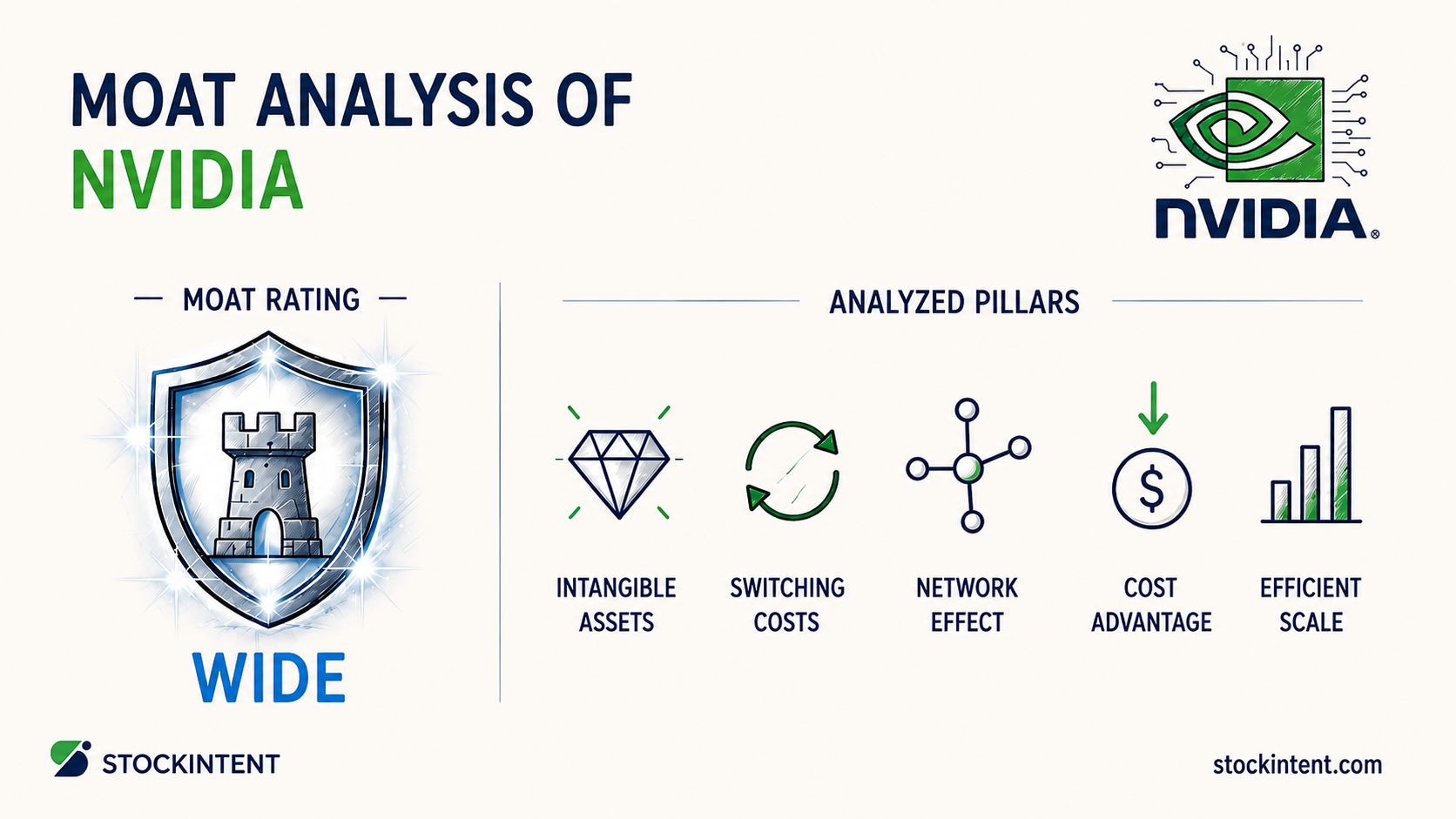
NVIDIA carries a wide economic moat with a stable trend direction and a medium uncertainty rating. That verdict sounds simple, but the real story is a bit more complicated. The company's grip on AI infrastructure is real, priced in, and actively tested by the very customers who built its revenue mountain.

The core of NVIDIA's moat isn't just silicon. It's the CUDA ecosystem, the switching costs it creates, and the full-stack integration that makes migrating away feel like rebuilding your house while living in it. Gross margins above 70% and a reported ROIC-WACC spread exceeding 50 percentage points are consistent with unusually strong pricing power and capital efficiency.

But here's where it gets interesting. In 2026, the moat's composition is shifting. Software lock-in faces real pressure from AMD's ROCm and OpenAI's Triton. Hyperscalers are designing their own chips. The next architecture transition, from Blackwell through Rubin, will test whether NVIDIA can sustain pricing power as AI inference becomes more cost-sensitive.

  • Strongest moat sources: CUDA ecosystem lock-in, full-stack hardware-software integration, dominant AI-accelerator share, and gross margins around 73%
  • Weakest pillar / main risk: Software moat erosion from open alternatives and hyperscaler custom silicon reducing long-term pricing power
  • Moat trend: Stable, with widening hardware leadership offset by narrowing software exclusivity
  • Uncertainty level: Medium, driven by customer concentration, geopolitical export controls, and the pace of AI infrastructure spending

From what I've watched over years of tracking semiconductor cycles, the companies that look most invincible often face their toughest tests right when the market prices them as permanent winners. NVIDIA's moat is wide, but moats don't defend themselves. The question for long-term investors isn't whether the company dominates today. It's whether the economics of that dominance look similar five years from now when the competitive landscape has shifted.

NVIDIA's Competitive Advantages

NVIDIA's moat isn't a single wall. It's a compound structure where software lock-in, ecosystem gravity, and full-stack integration reinforce each other. Think of it like a medieval castle with multiple rings of defense: take one down, and others still slow the attacker.

I've watched enough tech cycles to know that hardware leadership alone rarely sustains pricing power for more than a few years. What makes NVIDIA different, at least for now, is how CUDA and its surrounding software stack turn a chip purchase into a long-term relationship. Here's how that plays out across the five classic moat pillars.

Switching Costs: The Strongest Pillar

This is where NVIDIA's moat lives and breathes. CUDA isn't just a programming interface; it's years of optimized code, trained models, and institutional know-how baked into millions of developer workflows.

Moving a large AI workload to AMD's ROCm or Intel's alternatives isn't a simple recompile. When you've got thousands of engineers trained on CUDA, customized libraries built on cuDNN, and production pipelines tuned for TensorRT, the friction isn't only technical; it is also organizational. Debugging, retraining, and lost productivity can make even a technically viable migration difficult to approve.

NVIDIA also raises switching costs by combining compute and networking into an integrated platform, including InfiniBand and Spectrum-X. Once your data center runs on NVIDIA's end-to-end fabric, ripping out one piece weakens everything else.

Network Effects: Self-Reinforcing and Expanding

CUDA functions as a de facto standard partly because so many people already use it. Its large developer and optimized-model ecosystem means new entrants choose CUDA not because it's technically perfect, but because it's where the talent, tutorials, and pre-built solutions live.

This creates a classic two-sided network: more developers attract more tools and models, which attract more developers. Every paper published with CUDA, every GitHub repo, every grad student trained on PyTorch + CUDA, deepens the trench.

That said, network effects in developer tools can erode. We've seen it before, Fortran didn't last forever, neither did Internet Explorer's dominance. OpenAI's Triton and the broader push for hardware-agnostic AI compilers represent real pressure here.

Intangible Assets: Software Depth, Not Just Brand

NVIDIA's intangible moat isn't about logo recognition or celebrity endorsements. It's about accumulated software IP: CUDA itself, cuDNN for deep learning primitives, TensorRT for inference optimization, NIMs for deployment, and the broader NeMo ecosystem.

These assets are harder to value than patents, but they may be more durable. A patent expires; fifteen years of optimized kernel code and developer relationships doesn't depreciate on a schedule. The ByteDive investment thesis emphasizes this software layer as the real margin protector, and gross margins near 73% support that view.

Still, intangibles here are fuzzy. They're real, but tracking their erosion rate is more art than science.

Cost Advantage: Partial at Best

Here's where the moat analysis gets weaker. NVIDIA doesn't win on being the cheapest producer in some classic commodity sense. Its chips are expensive, its systems are expensive, and customers pay up because the total performance justifies the price, not because NVIDIA has structural manufacturing cost advantages AMD or Intel can't match.

What NVIDIA does offer is system-level efficiency. The Rubin architecture promises up to 10x inference economics improvement, meaning lower cost per token for AI workloads. But that's product performance, not production cost advantage. If TSMC gives Samsung or Intel Foundry comparable process access, NVIDIA's unit economics look less special.

I'd label this pillar moderate and disputed. It helps customers, but it doesn't structurally protect NVIDIA from pricing pressure.

Efficient Scale: Not Material Here

This one simply doesn't apply. Efficient scale moats work when a market is small enough that one or two players can serve it profitably, but a third would destroy returns for everyone. Think regional newspapers, small-town utilities, niche chemicals.

AI infrastructure is the opposite: a massive, expanding, global market with room for multiple players. NVIDIA dominates because it's built the best ecosystem, not because the market can only support one supplier. The Finterra deep-dive analysis makes clear that competitive pressure is real and growing, which rules out efficient scale as a meaningful pillar.

Putting It Together: A Compound Moat, Not a Monolith

None of these pillars alone explains NVIDIA's $5 trillion valuation. What does: the way they interact. Switching costs keep customers in place while network effects attract new developers, and intangible software assets make both stickier over time.

The honest framing? Two pillars are strong, one is moderate, one is partial and disputed, and one is irrelevant. That's still a formidable position, but it also maps where the risks concentrate. Software moat erosion, whether from open standards or hyperscaler vertical integration, represents the clearest path to narrowing.

Why the Moat Matters: How It Shows Up in Business Performance

A moat only counts if you can see it in the numbers. NVIDIA's advantages translate into some of the most unusual economics in hardware, though not every pillar is equally visible.

Data Center dominance is the clearest signal. Q4 FY2026 revenue reached $68.1 billion, while non-GAAP gross margin reached 75.2%. Those margins are the financial fingerprint of pricing power. They're also well above what typical semiconductor businesses sustain, which suggests customers aren't yet treating NVIDIA's products as interchangeable commodities.

Revenue visibility is unusually strong for a hardware company. Morningstar highlighted $0.5 trillion of cumulative Blackwell and Rubin revenue visibility across calendar 2025 and 2026. That kind of forward demand visibility is rare in cyclical industries and hints at ecosystem lock-in: customers aren't just buying chips, they're committing to multi-year platform roadmaps.

Market position remains lopsided. One estimate places NVIDIA's AI-accelerator market share at more than 90%, though estimates vary by market definition. AMD and hyperscaler custom silicon are growing as challengers or complements rather than full replacements.

Moat SourceObservable Outcome (2026)Confidence Level
Hardware performance leadership154% Data Center growth; 75%+ gross marginsHigh
Scale and supply-chain execution$500B+ Blackwell/Rubin revenue visibilityHigh
Ecosystem/software lock-inStrong but harder to measure directly from financialsMedium
Pricing power in training/enterpriseVisible in margins and premium positioningHigh
Pricing power in inferenceLess secure; price competition emergingMedium/Low

Where the moat looks weaker. Software lock-in is disputed. AMD's ROCm and OpenAI's Triton are reducing barriers to CUDA alternatives. Inference pricing faces more pressure than training as custom silicon and alternative stacks challenge NVIDIA's pricing power. Customer diversification also cuts both ways: broader revenue is healthy, but major buyers are simultaneously building alternatives.

The honest read? NVIDIA's moat is most convincingly expressed in financial outcomes that are hard to fake: high growth, mid-70% gross margins, and dominant data-center economics. The software moat is real but more inferential, and its durability is the key debate for long-term investors.

Pro Insight: When I evaluate moat durability, I weight gross margin stability above almost any other signal. The current margin profile indicates customers still lack good alternatives; sustained compression would be a clearer erosion signal than a market-share headline alone.

Moat Trend: What Could Strengthen or Weaken the Moat?

We assess the moat as widening in infrastructure depth while becoming more fragile at the edges. NVIDIA is embedding itself deeper into AI infrastructure through supply-chain control, capacity partnerships, and system-level integration. At the same time, hyperscaler custom silicon and open software stacks are chipping away at the software exclusivity that once felt unassailable.

Where the Moat Is Getting Deeper

The most important widening dynamic in 2026 is NVIDIA's shift from chip vendor to infrastructure architect. Its collaboration with IREN on up to 5 gigawatts of DSX-aligned AI infrastructure, including a five-year option on 30 million shares, shows NVIDIA inserting itself into power, networking, and data-center operations. This isn't just selling GPUs; it's shaping how AI factories get built.

Supply-chain moat-building is equally deliberate. NVIDIA has reportedly taken equity stakes and locked in capacity rights for critical components like optical and laser parts, a strategy Asia Times described as a "$2 billion sprinkler" remaking the AI supply chain. When competitors can't secure the same bottlenecks, NVIDIA's availability advantage compounds.

Hardware leadership persists. Analysis of 2025-2026 data center performance points to a widening performance gap around Blackwell and the next platform cycle. For training and the most demanding workloads, NVIDIA still sets the pace.

Where the Moat Faces Real Pressure

The clearest weakening signal is hyperscaler vertical integration. Amazon, Google, Meta, and Microsoft are designing their own chips, partly to lower costs at scale, and they're spending real money to reduce NVIDIA dependence. This matters because these customers represent enormous revenue concentration. When your biggest buyers become your biggest potential competitors, pricing power gets tested.

Software lock-in is also fraying at the margins. Open frameworks and abstraction layers are making cross-hardware deployment easier. AMD's ROCm and OpenAI's Triton won't displace CUDA overnight, but they lower the barrier for new projects to consider alternatives. Switching costs are falling, especially for inference workloads where cost sensitivity is highest.

Execution risk on the product roadmap adds another layer. Concerns about potential delays in Rubin-class products mean NVIDIA can't afford to stumble on cadence. The analyst view at Benzinga frames this as a genuine 2026 problem: the $20 trillion path depends on sustained execution.

Market Position: Still Dominant, More Contested

NVIDIA's market share in AI accelerators remains extremely high, with some estimates still in the 90%+ range for certain segments. But that dominance is increasingly uneven:

  • Training and frontier workloads: Still NVIDIA's stronghold
  • Inference and cost-sensitive deployments: More vulnerable to custom silicon and price competition
  • Enterprise and mid-market: Depends on CUDA ecosystem retention and ease of deployment

The industry structure itself is fragmenting by workload type rather than collapsing toward generic competition. That's a subtler threat than a direct rival overtaking NVIDIA everywhere, but it means the company must defend multiple fronts simultaneously.

Pro Insight: From watching semiconductor cycles, the most dangerous moat erosion happens when market share stays high but pricing power quietly leaks. That is why gross margin trajectory belongs alongside market share on the investor watchlist: margin compression can be an early signal that customers have found viable alternatives.

Investor Watchlist: 4 Indicators to Monitor

IndicatorWhat to WatchWhy It Matters
CUDA ecosystem retentionDeveloper surveys, framework adoption rates, GitHub activity for non-CUDA alternativesReveals whether software lock-in is holding or eroding
Hyperscaler custom-silicon shareCapEx allocation disclosures, chip deployment announcements from AMZN, GOOGL, META, MSFTDirect measure of customer defection from NVIDIA hardware
Product cadence executionOn-time delivery of Rubin-class products, analyst commentary on roadmap delaysSustained performance gaps require sustained execution
Gross margin trendQuarterly gross margin progression, segment mix, pricing commentaryMost direct financial signal of pricing power and competitive pressure

These four indicators cut through the noise. CUDA retention and hyperscaler silicon share tell you about the strategic direction of software and customer relationships. Product cadence and gross margins tell you whether NVIDIA is translating that strategy into sustained economics.

The honest framing: NVIDIA's moat is still wide, but it's no longer a simple GPU monopoly story. It's an AI infrastructure moat that must be defended on hardware, software, supply chain, and customer relationship dimensions simultaneously. For long-term investors, the question isn't whether NVIDIA dominates today. It's whether the economics of that dominance look similar when you check these four indicators three to five years from now.

Uncertainty Rating: How Confident Are We in This Moat Assessment?

NVIDIA earns a medium uncertainty rating in our moat analysis. Not low, not high, but squarely in the middle. Here's why that matters: medium uncertainty doesn't mean the moat is weak. It means the range of plausible futures is wide enough that investors need to think in scenarios, not certainties.

The near-term revenue picture looks unusually clear for a semiconductor company. NVIDIA reported $215.9 billion in fiscal 2026 revenue, with $68.1 billion in Q4 alone. Morningstar said NVIDIA's cumulative Blackwell and Rubin revenue visibility implies 40%-plus growth in fiscal 2027. That's the kind of forward clarity most chip companies never achieve.

But visibility isn't the same as durability. Data Center revenue accounts for roughly 90% of the reported total, based on the segment figures in the same analysis, making growth more dependent on a narrow set of hyperscaler customers, product transitions, and spending cycles. Management said the revenue outlook had grown more bullish because of large customer deals and increased adoption of new AI models. Yet that same concentration is what widens the range of outcomes if even one or two major buyers pause.

The bull case is straightforward: NVIDIA keeps its lead in training and inference, CUDA lock-in persists, Blackwell and Rubin execute flawlessly, and the platform becomes the default stack for AI infrastructure. Gross margins stay in the mid-70% range, and the company compounds as a dominant toll collector on global AI buildout.

The base case is more contested: NVIDIA remains the leading supplier but loses share to hyperscaler ASICs, AMD rack-scale systems, and alternative architectures. It grows faster than semiconductors overall, but pricing pressure narrows the exceptional economics.

The bear case is where uncertainty lives. Customer insourcing, export restrictions, infrastructure bottlenecks, and competition could compress growth and margins enough that NVIDIA becomes strong but no longer exceptional. CNBC's early 2026 coverage noted that competition and customer self-sufficiency efforts were already visible.

What widens the range most? Three interacting variables: customer concentration, geopolitical permissions, and whether AI capex stays in expansion mode or normalizes. Major customers are already developing competing chips, so that threat is not distant.

From what I've watched across semiconductor cycles, the tricky part is distinguishing between revenue visibility and competitive stability. You can have twelve months of backlog certainty and still face a strategic cliff three years out. NVIDIA's medium uncertainty rating reflects exactly that tension: the next few quarters look unusually forecastable, but the 3-5 year competitive position depends on variables NVIDIA doesn't fully control.

For investors, the practical implication is scenario-based thinking, not point estimates. A wide moat with medium uncertainty can still be a quality compounding machine. It just means position sizing and valuation matters more than the headline rating alone suggests.

Bottom Line

NVIDIA earns a wide economic moat with a stable trend and medium uncertainty. That's the same verdict we opened with, but now you see what's underneath it.

The moat is real. CUDA lock-in, ecosystem gravity, and full-stack integration still make migration costly for most customers. For investors who believe AI infrastructure spend keeps climbing, NVIDIA remains the default toll collector.

The two issues that matter most from here are margin trajectory and customer defection. Sustained margin compression would signal that hyperscaler custom silicon and AMD alternatives are biting harder than headlines suggest. Watch how quickly major cloud customers shift capex toward their own chips; revenue can grow while pricing power leaks.

The moat trend is stable because hardware leadership and supply-chain depth are widening even as software exclusivity faces real pressure. That duality is the story. NVIDIA isn't losing its moat outright; it's defending a more complex perimeter against smarter, better-funded challengers.

This moat profile suits investors comfortable with medium uncertainty and willing to monitor competitive dynamics actively. It is less suited for those seeking predictable, low-maintenance compounders where the competitive picture looks similar in five years.

If you're evaluating NVIDIA alongside peers, StockIntent can help compare margins, growth rates, and revenue concentration across semiconductor names to see whether this moat profile stands out or blends in.

NVIDIA carries a wide economic moat with a stable trend direction and a medium uncertainty rating. That verdict sounds simple, but the real story is a bit more complicated. The company's grip on AI infrastructure is real, priced in, and actively tested by the very customers who built its revenue mountain.

The core of NVIDIA's moat isn't just silicon. It's the CUDA ecosystem, the switching costs it creates, and the full-stack integration that makes migrating away feel like rebuilding your house while living in it. Gross margins above 70% and a reported ROIC-WACC spread exceeding 50 percentage points are consistent with unusually strong pricing power and capital efficiency.

But here's where it gets interesting. In 2026, the moat's composition is shifting. Software lock-in faces real pressure from AMD's ROCm and OpenAI's Triton. Hyperscalers are designing their own chips. The next architecture transition, from Blackwell through Rubin, will test whether NVIDIA can sustain pricing power as AI inference becomes more cost-sensitive.

  • Strongest moat sources: CUDA ecosystem lock-in, full-stack hardware-software integration, dominant AI-accelerator share, and gross margins around 73%
  • Weakest pillar / main risk: Software moat erosion from open alternatives and hyperscaler custom silicon reducing long-term pricing power
  • Moat trend: Stable, with widening hardware leadership offset by narrowing software exclusivity
  • Uncertainty level: Medium, driven by customer concentration, geopolitical export controls, and the pace of AI infrastructure spending

From what I've watched over years of tracking semiconductor cycles, the companies that look most invincible often face their toughest tests right when the market prices them as permanent winners. NVIDIA's moat is wide, but moats don't defend themselves. The question for long-term investors isn't whether the company dominates today. It's whether the economics of that dominance look similar five years from now when the competitive landscape has shifted.

NVIDIA's Competitive Advantages

NVIDIA's moat isn't a single wall. It's a compound structure where software lock-in, ecosystem gravity, and full-stack integration reinforce each other. Think of it like a medieval castle with multiple rings of defense: take one down, and others still slow the attacker.

I've watched enough tech cycles to know that hardware leadership alone rarely sustains pricing power for more than a few years. What makes NVIDIA different, at least for now, is how CUDA and its surrounding software stack turn a chip purchase into a long-term relationship. Here's how that plays out across the five classic moat pillars.

Switching Costs: The Strongest Pillar

This is where NVIDIA's moat lives and breathes. CUDA isn't just a programming interface; it's years of optimized code, trained models, and institutional know-how baked into millions of developer workflows.

Moving a large AI workload to AMD's ROCm or Intel's alternatives isn't a simple recompile. When you've got thousands of engineers trained on CUDA, customized libraries built on cuDNN, and production pipelines tuned for TensorRT, the friction isn't only technical; it is also organizational. Debugging, retraining, and lost productivity can make even a technically viable migration difficult to approve.

NVIDIA also raises switching costs by combining compute and networking into an integrated platform, including InfiniBand and Spectrum-X. Once your data center runs on NVIDIA's end-to-end fabric, ripping out one piece weakens everything else.

Network Effects: Self-Reinforcing and Expanding

CUDA functions as a de facto standard partly because so many people already use it. Its large developer and optimized-model ecosystem means new entrants choose CUDA not because it's technically perfect, but because it's where the talent, tutorials, and pre-built solutions live.

This creates a classic two-sided network: more developers attract more tools and models, which attract more developers. Every paper published with CUDA, every GitHub repo, every grad student trained on PyTorch + CUDA, deepens the trench.

That said, network effects in developer tools can erode. We've seen it before, Fortran didn't last forever, neither did Internet Explorer's dominance. OpenAI's Triton and the broader push for hardware-agnostic AI compilers represent real pressure here.

Intangible Assets: Software Depth, Not Just Brand

NVIDIA's intangible moat isn't about logo recognition or celebrity endorsements. It's about accumulated software IP: CUDA itself, cuDNN for deep learning primitives, TensorRT for inference optimization, NIMs for deployment, and the broader NeMo ecosystem.

These assets are harder to value than patents, but they may be more durable. A patent expires; fifteen years of optimized kernel code and developer relationships doesn't depreciate on a schedule. The ByteDive investment thesis emphasizes this software layer as the real margin protector, and gross margins near 73% support that view.

Still, intangibles here are fuzzy. They're real, but tracking their erosion rate is more art than science.

Cost Advantage: Partial at Best

Here's where the moat analysis gets weaker. NVIDIA doesn't win on being the cheapest producer in some classic commodity sense. Its chips are expensive, its systems are expensive, and customers pay up because the total performance justifies the price, not because NVIDIA has structural manufacturing cost advantages AMD or Intel can't match.

What NVIDIA does offer is system-level efficiency. The Rubin architecture promises up to 10x inference economics improvement, meaning lower cost per token for AI workloads. But that's product performance, not production cost advantage. If TSMC gives Samsung or Intel Foundry comparable process access, NVIDIA's unit economics look less special.

I'd label this pillar moderate and disputed. It helps customers, but it doesn't structurally protect NVIDIA from pricing pressure.

Efficient Scale: Not Material Here

This one simply doesn't apply. Efficient scale moats work when a market is small enough that one or two players can serve it profitably, but a third would destroy returns for everyone. Think regional newspapers, small-town utilities, niche chemicals.

AI infrastructure is the opposite: a massive, expanding, global market with room for multiple players. NVIDIA dominates because it's built the best ecosystem, not because the market can only support one supplier. The Finterra deep-dive analysis makes clear that competitive pressure is real and growing, which rules out efficient scale as a meaningful pillar.

Putting It Together: A Compound Moat, Not a Monolith

None of these pillars alone explains NVIDIA's $5 trillion valuation. What does: the way they interact. Switching costs keep customers in place while network effects attract new developers, and intangible software assets make both stickier over time.

The honest framing? Two pillars are strong, one is moderate, one is partial and disputed, and one is irrelevant. That's still a formidable position, but it also maps where the risks concentrate. Software moat erosion, whether from open standards or hyperscaler vertical integration, represents the clearest path to narrowing.

Why the Moat Matters: How It Shows Up in Business Performance

A moat only counts if you can see it in the numbers. NVIDIA's advantages translate into some of the most unusual economics in hardware, though not every pillar is equally visible.

Data Center dominance is the clearest signal. Q4 FY2026 revenue reached $68.1 billion, while non-GAAP gross margin reached 75.2%. Those margins are the financial fingerprint of pricing power. They're also well above what typical semiconductor businesses sustain, which suggests customers aren't yet treating NVIDIA's products as interchangeable commodities.

Revenue visibility is unusually strong for a hardware company. Morningstar highlighted $0.5 trillion of cumulative Blackwell and Rubin revenue visibility across calendar 2025 and 2026. That kind of forward demand visibility is rare in cyclical industries and hints at ecosystem lock-in: customers aren't just buying chips, they're committing to multi-year platform roadmaps.

Market position remains lopsided. One estimate places NVIDIA's AI-accelerator market share at more than 90%, though estimates vary by market definition. AMD and hyperscaler custom silicon are growing as challengers or complements rather than full replacements.

Moat SourceObservable Outcome (2026)Confidence Level
Hardware performance leadership154% Data Center growth; 75%+ gross marginsHigh
Scale and supply-chain execution$500B+ Blackwell/Rubin revenue visibilityHigh
Ecosystem/software lock-inStrong but harder to measure directly from financialsMedium
Pricing power in training/enterpriseVisible in margins and premium positioningHigh
Pricing power in inferenceLess secure; price competition emergingMedium/Low

Where the moat looks weaker. Software lock-in is disputed. AMD's ROCm and OpenAI's Triton are reducing barriers to CUDA alternatives. Inference pricing faces more pressure than training as custom silicon and alternative stacks challenge NVIDIA's pricing power. Customer diversification also cuts both ways: broader revenue is healthy, but major buyers are simultaneously building alternatives.

The honest read? NVIDIA's moat is most convincingly expressed in financial outcomes that are hard to fake: high growth, mid-70% gross margins, and dominant data-center economics. The software moat is real but more inferential, and its durability is the key debate for long-term investors.

Pro Insight: When I evaluate moat durability, I weight gross margin stability above almost any other signal. The current margin profile indicates customers still lack good alternatives; sustained compression would be a clearer erosion signal than a market-share headline alone.

Moat Trend: What Could Strengthen or Weaken the Moat?

We assess the moat as widening in infrastructure depth while becoming more fragile at the edges. NVIDIA is embedding itself deeper into AI infrastructure through supply-chain control, capacity partnerships, and system-level integration. At the same time, hyperscaler custom silicon and open software stacks are chipping away at the software exclusivity that once felt unassailable.

Where the Moat Is Getting Deeper

The most important widening dynamic in 2026 is NVIDIA's shift from chip vendor to infrastructure architect. Its collaboration with IREN on up to 5 gigawatts of DSX-aligned AI infrastructure, including a five-year option on 30 million shares, shows NVIDIA inserting itself into power, networking, and data-center operations. This isn't just selling GPUs; it's shaping how AI factories get built.

Supply-chain moat-building is equally deliberate. NVIDIA has reportedly taken equity stakes and locked in capacity rights for critical components like optical and laser parts, a strategy Asia Times described as a "$2 billion sprinkler" remaking the AI supply chain. When competitors can't secure the same bottlenecks, NVIDIA's availability advantage compounds.

Hardware leadership persists. Analysis of 2025-2026 data center performance points to a widening performance gap around Blackwell and the next platform cycle. For training and the most demanding workloads, NVIDIA still sets the pace.

Where the Moat Faces Real Pressure

The clearest weakening signal is hyperscaler vertical integration. Amazon, Google, Meta, and Microsoft are designing their own chips, partly to lower costs at scale, and they're spending real money to reduce NVIDIA dependence. This matters because these customers represent enormous revenue concentration. When your biggest buyers become your biggest potential competitors, pricing power gets tested.

Software lock-in is also fraying at the margins. Open frameworks and abstraction layers are making cross-hardware deployment easier. AMD's ROCm and OpenAI's Triton won't displace CUDA overnight, but they lower the barrier for new projects to consider alternatives. Switching costs are falling, especially for inference workloads where cost sensitivity is highest.

Execution risk on the product roadmap adds another layer. Concerns about potential delays in Rubin-class products mean NVIDIA can't afford to stumble on cadence. The analyst view at Benzinga frames this as a genuine 2026 problem: the $20 trillion path depends on sustained execution.

Market Position: Still Dominant, More Contested

NVIDIA's market share in AI accelerators remains extremely high, with some estimates still in the 90%+ range for certain segments. But that dominance is increasingly uneven:

  • Training and frontier workloads: Still NVIDIA's stronghold
  • Inference and cost-sensitive deployments: More vulnerable to custom silicon and price competition
  • Enterprise and mid-market: Depends on CUDA ecosystem retention and ease of deployment

The industry structure itself is fragmenting by workload type rather than collapsing toward generic competition. That's a subtler threat than a direct rival overtaking NVIDIA everywhere, but it means the company must defend multiple fronts simultaneously.

Pro Insight: From watching semiconductor cycles, the most dangerous moat erosion happens when market share stays high but pricing power quietly leaks. That is why gross margin trajectory belongs alongside market share on the investor watchlist: margin compression can be an early signal that customers have found viable alternatives.

Investor Watchlist: 4 Indicators to Monitor

IndicatorWhat to WatchWhy It Matters
CUDA ecosystem retentionDeveloper surveys, framework adoption rates, GitHub activity for non-CUDA alternativesReveals whether software lock-in is holding or eroding
Hyperscaler custom-silicon shareCapEx allocation disclosures, chip deployment announcements from AMZN, GOOGL, META, MSFTDirect measure of customer defection from NVIDIA hardware
Product cadence executionOn-time delivery of Rubin-class products, analyst commentary on roadmap delaysSustained performance gaps require sustained execution
Gross margin trendQuarterly gross margin progression, segment mix, pricing commentaryMost direct financial signal of pricing power and competitive pressure

These four indicators cut through the noise. CUDA retention and hyperscaler silicon share tell you about the strategic direction of software and customer relationships. Product cadence and gross margins tell you whether NVIDIA is translating that strategy into sustained economics.

The honest framing: NVIDIA's moat is still wide, but it's no longer a simple GPU monopoly story. It's an AI infrastructure moat that must be defended on hardware, software, supply chain, and customer relationship dimensions simultaneously. For long-term investors, the question isn't whether NVIDIA dominates today. It's whether the economics of that dominance look similar when you check these four indicators three to five years from now.

Uncertainty Rating: How Confident Are We in This Moat Assessment?

NVIDIA earns a medium uncertainty rating in our moat analysis. Not low, not high, but squarely in the middle. Here's why that matters: medium uncertainty doesn't mean the moat is weak. It means the range of plausible futures is wide enough that investors need to think in scenarios, not certainties.

The near-term revenue picture looks unusually clear for a semiconductor company. NVIDIA reported $215.9 billion in fiscal 2026 revenue, with $68.1 billion in Q4 alone. Morningstar said NVIDIA's cumulative Blackwell and Rubin revenue visibility implies 40%-plus growth in fiscal 2027. That's the kind of forward clarity most chip companies never achieve.

But visibility isn't the same as durability. Data Center revenue accounts for roughly 90% of the reported total, based on the segment figures in the same analysis, making growth more dependent on a narrow set of hyperscaler customers, product transitions, and spending cycles. Management said the revenue outlook had grown more bullish because of large customer deals and increased adoption of new AI models. Yet that same concentration is what widens the range of outcomes if even one or two major buyers pause.

The bull case is straightforward: NVIDIA keeps its lead in training and inference, CUDA lock-in persists, Blackwell and Rubin execute flawlessly, and the platform becomes the default stack for AI infrastructure. Gross margins stay in the mid-70% range, and the company compounds as a dominant toll collector on global AI buildout.

The base case is more contested: NVIDIA remains the leading supplier but loses share to hyperscaler ASICs, AMD rack-scale systems, and alternative architectures. It grows faster than semiconductors overall, but pricing pressure narrows the exceptional economics.

The bear case is where uncertainty lives. Customer insourcing, export restrictions, infrastructure bottlenecks, and competition could compress growth and margins enough that NVIDIA becomes strong but no longer exceptional. CNBC's early 2026 coverage noted that competition and customer self-sufficiency efforts were already visible.

What widens the range most? Three interacting variables: customer concentration, geopolitical permissions, and whether AI capex stays in expansion mode or normalizes. Major customers are already developing competing chips, so that threat is not distant.

From what I've watched across semiconductor cycles, the tricky part is distinguishing between revenue visibility and competitive stability. You can have twelve months of backlog certainty and still face a strategic cliff three years out. NVIDIA's medium uncertainty rating reflects exactly that tension: the next few quarters look unusually forecastable, but the 3-5 year competitive position depends on variables NVIDIA doesn't fully control.

For investors, the practical implication is scenario-based thinking, not point estimates. A wide moat with medium uncertainty can still be a quality compounding machine. It just means position sizing and valuation matters more than the headline rating alone suggests.

Bottom Line

NVIDIA earns a wide economic moat with a stable trend and medium uncertainty. That's the same verdict we opened with, but now you see what's underneath it.

The moat is real. CUDA lock-in, ecosystem gravity, and full-stack integration still make migration costly for most customers. For investors who believe AI infrastructure spend keeps climbing, NVIDIA remains the default toll collector.

The two issues that matter most from here are margin trajectory and customer defection. Sustained margin compression would signal that hyperscaler custom silicon and AMD alternatives are biting harder than headlines suggest. Watch how quickly major cloud customers shift capex toward their own chips; revenue can grow while pricing power leaks.

The moat trend is stable because hardware leadership and supply-chain depth are widening even as software exclusivity faces real pressure. That duality is the story. NVIDIA isn't losing its moat outright; it's defending a more complex perimeter against smarter, better-funded challengers.

This moat profile suits investors comfortable with medium uncertainty and willing to monitor competitive dynamics actively. It is less suited for those seeking predictable, low-maintenance compounders where the competitive picture looks similar in five years.

If you're evaluating NVIDIA alongside peers, StockIntent can help compare margins, growth rates, and revenue concentration across semiconductor names to see whether this moat profile stands out or blends in.