
Aug 5, 2026
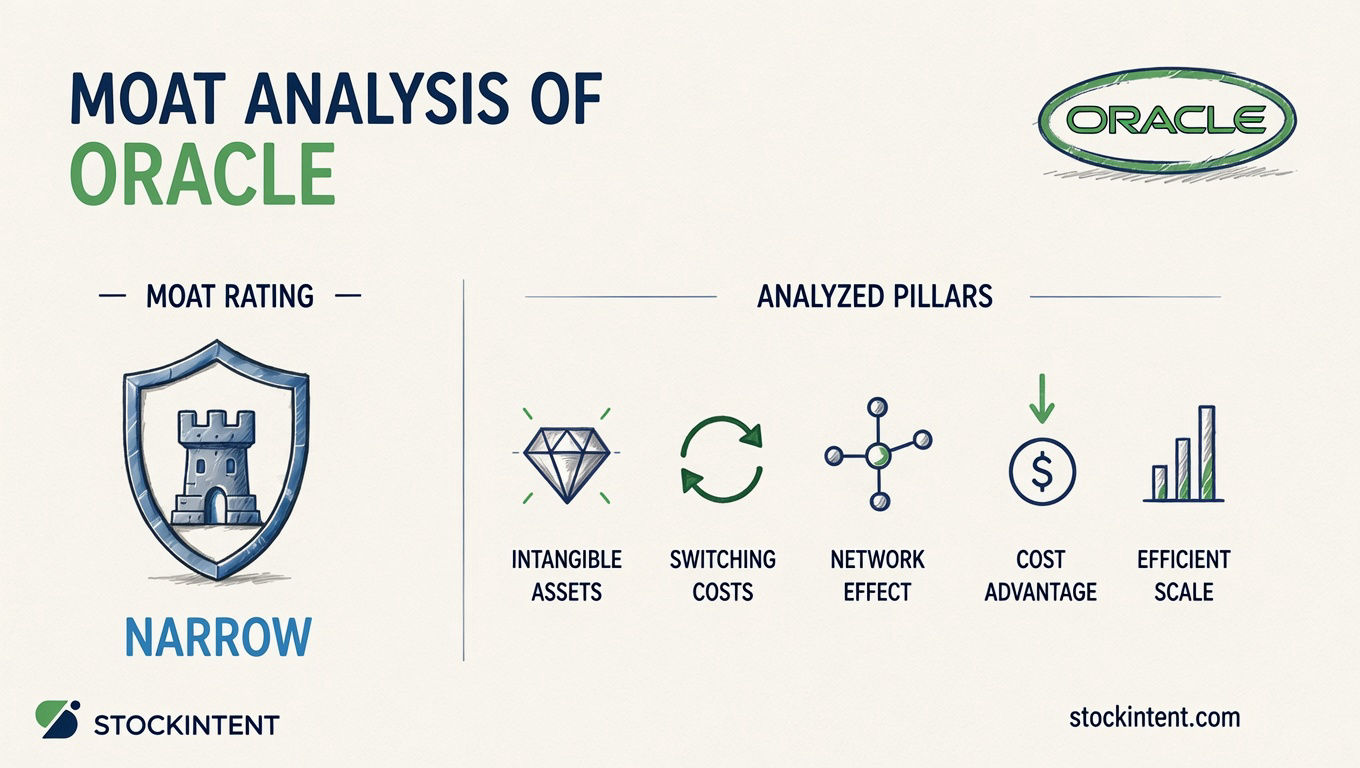
Oracle carries a narrow moat with a widening trend in cloud infrastructure and medium-to-high uncertainty tied to execution risk. That verdict may surprise investors watching the company post record numbers.
In FY2026, Oracle reported $67.4 billion in revenue, up 17% year-over-year, with cloud revenue climbing 39% to $34.0 billion. Meanwhile, Morningstar lowered Oracle's moat rating from wide to narrow in 2026, citing reduced certainty that AI will augment rather than disrupt the database and enterprise software advantages that built the company.
For long-term investors, the question is not whether Oracle can grow. It clearly can. The question is whether that growth hardens into durable competitive protection or burns capital without building a defendable position.
Oracle's competitive position rests on switching costs and intangible assets far more than on cost leadership or network effects. I'll rank all five pillars by strength, noting where the evidence is strong and where it disappoints.
Switching costs: strongest. This is Oracle's bedrock. The company's databases sit at the center of mission-critical systems for governments, banks, and Fortune 500 companies. According to MoatScan AI's 2026 analysis, displacing Oracle requires "extensive rewrites, complex migration work, and long implementation cycles." That friction doesn't just deter departures; it creates pricing power. Customers gripe about licensing costs, but they stay because the alternative is riskier and more expensive than the annual renewal.
Intangible assets: strong. Four decades of database leadership build something that can't be replicated overnight: institutional trust. Oracle's brand means "it won't go down" in industries where downtime costs millions. This expertise shows up in proprietary architectures, patents, and the accumulated know-how embedded in consulting and support relationships. It's not as flashy as switching costs, but it widens the gap with newer entrants who can match features faster than they can match confidence.
Network effects: moderate. Oracle's cloud marketplace, partner ecosystem, and AI agent marketplace do create some ecosystem stickiness. But these benefits are secondary to lock-in rather than true user-driven compounding network effects. Partners build on Oracle because customers are already there, not because the platform becomes more valuable with each new participant. The dynamic helps retention; it doesn't drive the flywheel we see in pure platform businesses.
Efficient scale: niche-specific. In specialized enterprise workloads and regulated industries, only a handful of vendors can compete. Oracle benefits from this concentration in corners of the market where compliance requirements and complexity create natural barriers. But this is fragmented protection, not a company-wide fortress. Cloud-native competitors keep pressure on pricing and features across broader swaths of the portfolio.
Cost advantage: weak or disputed. Artificall's 2026 analysis finds no strong evidence of durable structural cost advantage versus AWS, Azure, or Google Cloud. Oracle may win specific deals on price in infrastructure, but that's tactical pricing, not a systemic edge. Meanwhile, heavy debt loads and massive capital requirements point the other direction entirely.
Pro Insight: Morningstar's downgrade to narrow moat despite record cloud growth highlights a crucial tension. AI may disrupt Oracle's traditional database lock-in before the new cloud infrastructure moat fully hardens. The switching costs that protected Oracle for decades may matter less if AI interfaces commoditize the underlying database layer.
In 2026, Morningstar lowered Oracle's rating from wide to narrow, explicitly citing "reduced certainty around AI" and the risk that new technology disrupts rather than extends the historical software advantages. The moat exists. Whether it remains as durable as it once was, that's the open question.
Oracle's competitive advantages translate into tangible business performance most clearly through contracted demand visibility, segment-level growth divergence, and the gap between returns and capital costs.
The $553 billion in remaining performance obligations as of Q3 FY2026, up 325% year-over-year according to Reuters, is the most concrete evidence that customer lock-in converts into financial visibility. This is a signed backlog representing multi-year commitments from enterprises that cannot easily migrate away.
Segment performance reveals where the moat is strengthening versus maturing. S&P Global Market Intelligence reported FY2026 IaaS revenue growth of 76% against SaaS growth of just 12%. Infrastructure is where Oracle's differentiation around AI workloads and multicloud flexibility is winning new commitments. Applications growth, by contrast, reflects a more saturated market where switching costs maintain revenue but don't drive expansion.
Here's the catch. Despite strong top-line momentum, the moat isn't yet generating clear economic profits. Artificall's 2026 analysis puts ROIC at 10.86% against a WACC of 10.25%. That 61 basis point spread is technically positive, but it's razor-thin for a company claiming competitive protection. For context, wide-moat businesses typically sustain spreads of several hundred basis points or more.
What does this mean? Oracle's moat is real enough to retain customers and capture demand. Whether it's strong enough to generate durable excess returns after heavy capital deployment, that's still unproven.
Oracle's moat is widening, but I'd put an asterisk on that call. The cloud infrastructure business is pulling the company forward at a pace that would have seemed impossible three years ago. Yet Oracle still holds only roughly 3-4% of cloud infrastructure market share, far behind AWS, Azure, and Google Cloud. The moat is expanding where it counts most for future growth, but from a smaller base than the headline numbers suggest.
The widening case starts with demand. Oracle's cloud revenue hit $34.0 billion in FY2026, up 39% year-over-year, and management guided to 58-64% cloud growth in FY2027. IaaS specifically grew 76% to approximately $18.0 billion. That represents new workload capture, much of it AI-related.
The multicloud strategy adds a twist I find genuinely interesting. Oracle runs its databases on AWS, Google Cloud, and Microsoft Azure, turning neutrality into a competitive weapon. Customers don't have to choose between Oracle and hyperscalers. That's flexibility as differentiation, and it's a smart way to compete when you can't outspend rivals on raw infrastructure.
But here's what keeps me up at night about this trend. Oracle raised $43 billion in debt and $5 billion in equity during FY2026, with another $40 billion in financing planned. The $50 billion capital expenditure plan for AI infrastructure is enormous. If demand normalizes or pricing weakens, that debt becomes a heavy anchor. Morningstar flagged this explicitly, noting that heavy capital intensity creates financing risk and potential return pressure.
So what should investors actually watch? I've narrowed it to four indicators that will tell us whether this widening trend is durable or not:
At StockIntent, we use watchlists to track exactly these kinds of multi-metric theses over multi-year horizons. You can organize companies into custom views that flag when these indicators shift, which matters more for a story like Oracle's than any single quarterly earnings surprise.
We rate Oracle's moat uncertainty as medium-high. The company has exceptional near-term revenue visibility, yet several intersecting risks could widen the range of outcomes substantially.
Sales predictability looks strong on the surface. Oracle's $553 billion in remaining performance obligations, reported by Reuters in March 2026, represents contracted revenue that normally signals reliability. The company also raised FY2027 guidance to $90 billion, well above consensus. But here's the catch: Oracle explicitly warned in its FY2026 filings that results depend on securing sufficient data-center capacity, GPU sourcing, and delivering on contracted obligations. Backlog is only valuable if you can build fast enough to fulfill it.
Operating stability is pressured by capital intensity. Oracle's $50 billion planned capex for AI infrastructure is massive for any company, let alone one historically known for software-like margins. Management maintains a 16%-20% non-GAAP EPS growth target, yet CNBC reported the company raised $43 billion in debt and $5 billion in equity during FY2026, with another $40 billion in financing planned. That leverage amplifies outcomes in both directions.
Financial leverage introduces cyclical risk. Oracle's balance sheet is transforming from the low-debt profile that software investors typically prefer. Heavy borrowing to fund infrastructure creates vulnerability if interest rates spike or if revenue conversion lags.
Technological disruption remains the wild card. Morningstar's 2026 downgrade specifically cited "reduced certainty around AI" as the core concern. AI interfaces could potentially commoditize database access, making Oracle's switching costs less relevant even if the underlying technology remains superior.
The range of plausible outcomes over 3-5 years is genuinely wide. Bull cases see Oracle cementing itself as a top-tier AI infrastructure provider. Bear cases see heavy capex compressing returns without building durable share. The current evidence supports neither extreme with confidence, which is exactly why we think that medium-high uncertainty is justified.
This content is for informational or educational purposes and is not investment advice.
Oracle earns a narrow moat with a widening trend and medium-high uncertainty. That summary captures the central tension: the company is growing faster than it has in years, yet the durability of its competitive protection remains an open question.
The evidence in favor is out there. Switching costs in enterprise databases still lock in customers despite years of complaints about pricing. The $553 billion backlog provides rare revenue visibility. IaaS growth of 76% shows the moat strengthening where future value lives.
But two issues matter most from here. First, can Oracle convert that massive backlog into profitable revenue without margin compression? The $50 billion capex plan and heavy financing suggest the economics are still being built, not proven. Second, will AI augment the database moat or commoditize it? Morningstar's downgrade reflects genuine doubt on this point.
The slim ROIC-WACC spread of 61 basis points says what words cannot: Oracle's moat retains customers, but it has not yet demonstrated it can generate durable excess returns. For long-term investors, this is a transition to monitor, not a verdict to finalize.
Oracle carries a narrow moat with a widening trend in cloud infrastructure and medium-to-high uncertainty tied to execution risk. That verdict may surprise investors watching the company post record numbers.
In FY2026, Oracle reported $67.4 billion in revenue, up 17% year-over-year, with cloud revenue climbing 39% to $34.0 billion. Meanwhile, Morningstar lowered Oracle's moat rating from wide to narrow in 2026, citing reduced certainty that AI will augment rather than disrupt the database and enterprise software advantages that built the company.
For long-term investors, the question is not whether Oracle can grow. It clearly can. The question is whether that growth hardens into durable competitive protection or burns capital without building a defendable position.
Oracle's competitive position rests on switching costs and intangible assets far more than on cost leadership or network effects. I'll rank all five pillars by strength, noting where the evidence is strong and where it disappoints.
Switching costs: strongest. This is Oracle's bedrock. The company's databases sit at the center of mission-critical systems for governments, banks, and Fortune 500 companies. According to MoatScan AI's 2026 analysis, displacing Oracle requires "extensive rewrites, complex migration work, and long implementation cycles." That friction doesn't just deter departures; it creates pricing power. Customers gripe about licensing costs, but they stay because the alternative is riskier and more expensive than the annual renewal.
Intangible assets: strong. Four decades of database leadership build something that can't be replicated overnight: institutional trust. Oracle's brand means "it won't go down" in industries where downtime costs millions. This expertise shows up in proprietary architectures, patents, and the accumulated know-how embedded in consulting and support relationships. It's not as flashy as switching costs, but it widens the gap with newer entrants who can match features faster than they can match confidence.
Network effects: moderate. Oracle's cloud marketplace, partner ecosystem, and AI agent marketplace do create some ecosystem stickiness. But these benefits are secondary to lock-in rather than true user-driven compounding network effects. Partners build on Oracle because customers are already there, not because the platform becomes more valuable with each new participant. The dynamic helps retention; it doesn't drive the flywheel we see in pure platform businesses.
Efficient scale: niche-specific. In specialized enterprise workloads and regulated industries, only a handful of vendors can compete. Oracle benefits from this concentration in corners of the market where compliance requirements and complexity create natural barriers. But this is fragmented protection, not a company-wide fortress. Cloud-native competitors keep pressure on pricing and features across broader swaths of the portfolio.
Cost advantage: weak or disputed. Artificall's 2026 analysis finds no strong evidence of durable structural cost advantage versus AWS, Azure, or Google Cloud. Oracle may win specific deals on price in infrastructure, but that's tactical pricing, not a systemic edge. Meanwhile, heavy debt loads and massive capital requirements point the other direction entirely.
Pro Insight: Morningstar's downgrade to narrow moat despite record cloud growth highlights a crucial tension. AI may disrupt Oracle's traditional database lock-in before the new cloud infrastructure moat fully hardens. The switching costs that protected Oracle for decades may matter less if AI interfaces commoditize the underlying database layer.
In 2026, Morningstar lowered Oracle's rating from wide to narrow, explicitly citing "reduced certainty around AI" and the risk that new technology disrupts rather than extends the historical software advantages. The moat exists. Whether it remains as durable as it once was, that's the open question.
Oracle's competitive advantages translate into tangible business performance most clearly through contracted demand visibility, segment-level growth divergence, and the gap between returns and capital costs.
The $553 billion in remaining performance obligations as of Q3 FY2026, up 325% year-over-year according to Reuters, is the most concrete evidence that customer lock-in converts into financial visibility. This is a signed backlog representing multi-year commitments from enterprises that cannot easily migrate away.
Segment performance reveals where the moat is strengthening versus maturing. S&P Global Market Intelligence reported FY2026 IaaS revenue growth of 76% against SaaS growth of just 12%. Infrastructure is where Oracle's differentiation around AI workloads and multicloud flexibility is winning new commitments. Applications growth, by contrast, reflects a more saturated market where switching costs maintain revenue but don't drive expansion.
Here's the catch. Despite strong top-line momentum, the moat isn't yet generating clear economic profits. Artificall's 2026 analysis puts ROIC at 10.86% against a WACC of 10.25%. That 61 basis point spread is technically positive, but it's razor-thin for a company claiming competitive protection. For context, wide-moat businesses typically sustain spreads of several hundred basis points or more.
What does this mean? Oracle's moat is real enough to retain customers and capture demand. Whether it's strong enough to generate durable excess returns after heavy capital deployment, that's still unproven.
Oracle's moat is widening, but I'd put an asterisk on that call. The cloud infrastructure business is pulling the company forward at a pace that would have seemed impossible three years ago. Yet Oracle still holds only roughly 3-4% of cloud infrastructure market share, far behind AWS, Azure, and Google Cloud. The moat is expanding where it counts most for future growth, but from a smaller base than the headline numbers suggest.
The widening case starts with demand. Oracle's cloud revenue hit $34.0 billion in FY2026, up 39% year-over-year, and management guided to 58-64% cloud growth in FY2027. IaaS specifically grew 76% to approximately $18.0 billion. That represents new workload capture, much of it AI-related.
The multicloud strategy adds a twist I find genuinely interesting. Oracle runs its databases on AWS, Google Cloud, and Microsoft Azure, turning neutrality into a competitive weapon. Customers don't have to choose between Oracle and hyperscalers. That's flexibility as differentiation, and it's a smart way to compete when you can't outspend rivals on raw infrastructure.
But here's what keeps me up at night about this trend. Oracle raised $43 billion in debt and $5 billion in equity during FY2026, with another $40 billion in financing planned. The $50 billion capital expenditure plan for AI infrastructure is enormous. If demand normalizes or pricing weakens, that debt becomes a heavy anchor. Morningstar flagged this explicitly, noting that heavy capital intensity creates financing risk and potential return pressure.
So what should investors actually watch? I've narrowed it to four indicators that will tell us whether this widening trend is durable or not:
At StockIntent, we use watchlists to track exactly these kinds of multi-metric theses over multi-year horizons. You can organize companies into custom views that flag when these indicators shift, which matters more for a story like Oracle's than any single quarterly earnings surprise.
We rate Oracle's moat uncertainty as medium-high. The company has exceptional near-term revenue visibility, yet several intersecting risks could widen the range of outcomes substantially.
Sales predictability looks strong on the surface. Oracle's $553 billion in remaining performance obligations, reported by Reuters in March 2026, represents contracted revenue that normally signals reliability. The company also raised FY2027 guidance to $90 billion, well above consensus. But here's the catch: Oracle explicitly warned in its FY2026 filings that results depend on securing sufficient data-center capacity, GPU sourcing, and delivering on contracted obligations. Backlog is only valuable if you can build fast enough to fulfill it.
Operating stability is pressured by capital intensity. Oracle's $50 billion planned capex for AI infrastructure is massive for any company, let alone one historically known for software-like margins. Management maintains a 16%-20% non-GAAP EPS growth target, yet CNBC reported the company raised $43 billion in debt and $5 billion in equity during FY2026, with another $40 billion in financing planned. That leverage amplifies outcomes in both directions.
Financial leverage introduces cyclical risk. Oracle's balance sheet is transforming from the low-debt profile that software investors typically prefer. Heavy borrowing to fund infrastructure creates vulnerability if interest rates spike or if revenue conversion lags.
Technological disruption remains the wild card. Morningstar's 2026 downgrade specifically cited "reduced certainty around AI" as the core concern. AI interfaces could potentially commoditize database access, making Oracle's switching costs less relevant even if the underlying technology remains superior.
The range of plausible outcomes over 3-5 years is genuinely wide. Bull cases see Oracle cementing itself as a top-tier AI infrastructure provider. Bear cases see heavy capex compressing returns without building durable share. The current evidence supports neither extreme with confidence, which is exactly why we think that medium-high uncertainty is justified.
This content is for informational or educational purposes and is not investment advice.
Oracle earns a narrow moat with a widening trend and medium-high uncertainty. That summary captures the central tension: the company is growing faster than it has in years, yet the durability of its competitive protection remains an open question.
The evidence in favor is out there. Switching costs in enterprise databases still lock in customers despite years of complaints about pricing. The $553 billion backlog provides rare revenue visibility. IaaS growth of 76% shows the moat strengthening where future value lives.
But two issues matter most from here. First, can Oracle convert that massive backlog into profitable revenue without margin compression? The $50 billion capex plan and heavy financing suggest the economics are still being built, not proven. Second, will AI augment the database moat or commoditize it? Morningstar's downgrade reflects genuine doubt on this point.
The slim ROIC-WACC spread of 61 basis points says what words cannot: Oracle's moat retains customers, but it has not yet demonstrated it can generate durable excess returns. For long-term investors, this is a transition to monitor, not a verdict to finalize.