Apr 9, 2026
O'Reilly Automotive (NASDAQ: ORLY) stands as one of the largest specialty retailers in the automotive aftermarket, with over 6,200 stores across the US, Mexico, Puerto Rico, and Canada. For investors evaluating this $77 billion market cap company, understanding its oreilly automotive mission statement and strategic identity isn't just corporate trivia, it's insight into what drives 32 consecutive years of comparable store sales growth and aggressive expansion plans for 225-235 new stores in 2026.
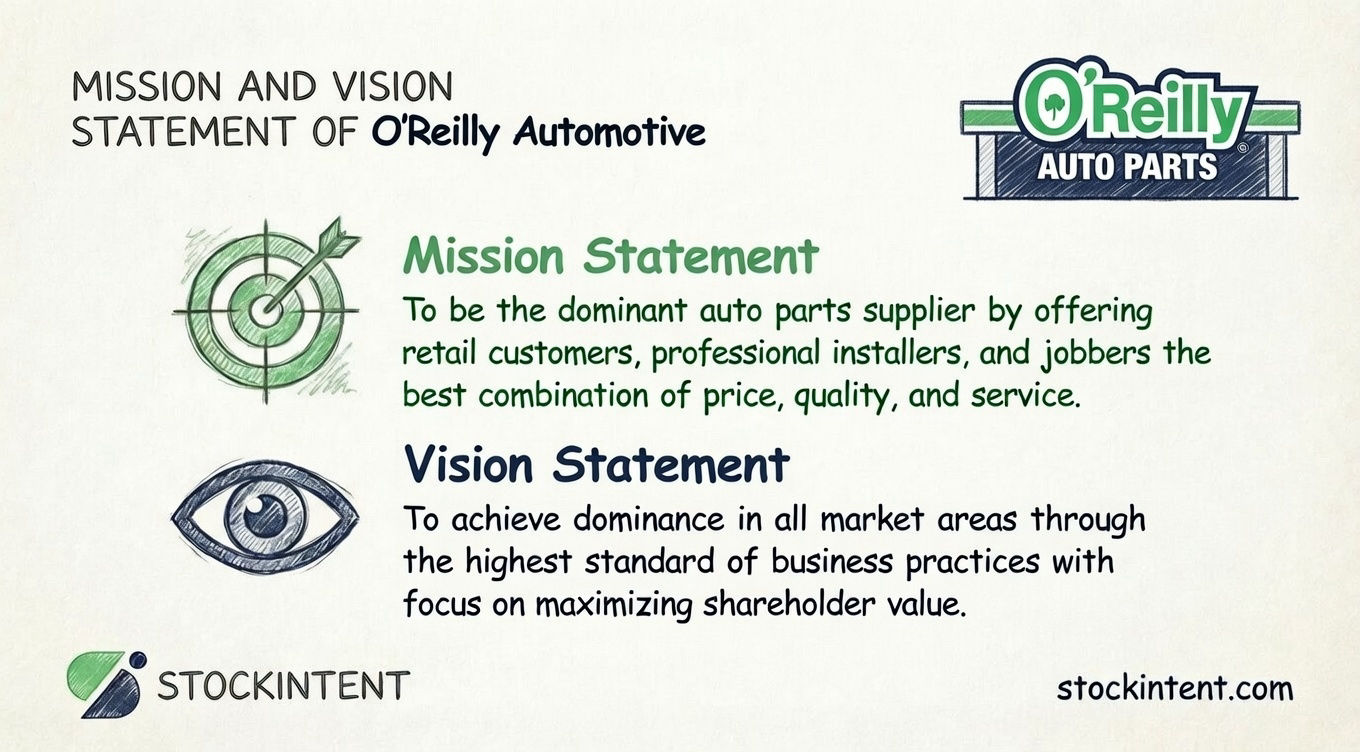
O'Reilly Automotive's official mission statement is straightforward and aggressive: "O'Reilly Automotive intends to be the dominant supplier of auto parts in our market areas by offering our retail customers, professional installers, and jobbers the best combination of price and quality provided with the highest possible service level." The company reinforces this with a commitment to employee development, stating it will "provide a benefit and compensation plan that will attract and keep the kind of people that will enable the Company to reach its goals of growth and success."
This isn't marketing fluff. The mission explicitly names three customer segments, three value pillars (price, quality, service), and ties everything to market dominance. It's operationally focused in a way that many corporate mission statements avoid.
The Board of Directors adds another layer with its formal mission: "to direct O'Reilly Automotive, Inc. in achieving dominance in all of its market areas through conscientious adherence to the highest standard of business practices, with the focus of maximizing shareholder value." This governance-level framing connects operational dominance to fiduciary responsibility.
O'Reilly Automotive operates as one of the largest specialty retailers in the automotive aftermarket, serving a dual customer base of DIY consumers and professional installers across more than 6,200 stores in the US, Mexico, Puerto Rico, and Canada. Founded in 1957 by C.H. "Chub" O'Reilly and his family in Springfield, Missouri, the company has grown from a single store into a $77 billion market cap giant through disciplined execution of its dominance-focused mission.
In our experience analyzing specialty retail businesses, O'Reilly's operational model stands out for its intentional blurring of traditional retail boundaries. The company doesn't neatly separate consumer and commercial operations; instead, it runs a single integrated retail segment where the same store infrastructure serves weekend mechanics and professional shops alike. This creates density advantages that pure-play competitors struggle to match.
Quick Stats Snapshot:
| Metric | Figure |
|---|---|
| Market Cap | ~$77 billion |
| Store Count | 6,200+ locations |
| 2025 Revenue | ~$17-18 billion (estimated) |
| 2026 Store Openings | 225-235 net new stores |
| Consecutive Years of Comp Growth | 32+ years |
| Forward P/E Ratio | 32.5x |
The company's core offering centers on automotive replacement parts, tools, supplies, equipment, and accessories. But here's what separates O'Reilly from a typical parts retailer: its "Professional Parts People" provide free technical advice and services that turn transactions into relationships. This service layer, embedded in the O'Reilly Automotive mission statement we examined earlier, creates switching costs for both DIYers and professional installers who depend on that expertise.
CEO Brad Beckham highlighted this operational advantage in the company's February 2026 earnings release, emphasizing "industry-leading parts availability" and "service levels and parts availability in our stores that are critical to winning share." The numbers back this up: Q4 2025 delivered 5.6% comparable store sales growth, capping a 10% full-year EPS increase.
From a competitive positioning standpoint, O'Reilly ranks among the top three players in the $400+ billion North American automotive aftermarket, trading market share blows with AutoZone and Advance Auto Parts. Unlike many specialty retail categories getting disrupted by e-commerce, auto parts retail benefits from immediate need, technical complexity, and the value of local inventory. A failed water pump doesn't wait for two-day shipping.
The company's 2026 expansion strategy reflects confidence in this positioning: 225-235 net new stores, entry into Canada, and a new Virginia distribution center that Beckham noted "unlocks exciting store growth opportunities in the mid-Atlantic region." For investors using platforms like StockIntent to evaluate retail expansion stories, O'Reilly's track record of 32 consecutive years of positive comparable store sales growth provides a data point worth stress-testing against its premium valuation.
"O'Reilly Automotive intends to be the dominant supplier of auto parts in our market areas by offering our retail customers, professional installers, and jobbers the best combination of price and quality provided with the highest possible service level."
This isn't aspirational poetry. It's a battle plan. The oreilly automotive mission statement explicitly names three customer segments, declares three competitive weapons (price, quality, service), and sets a clear victory condition: dominance. The company doubles down on execution by committing to "a benefit and compensation plan that will attract and keep the kind of people that will enable the Company to reach its goals of growth and success."
The word "dominant" appears twice in O'Reilly's official communications, including in the Board's formal mission "to direct O'Reilly Automotive, Inc. in achieving dominance in all of its market areas through conscientious adherence to the highest standard of business practices, with the focus of maximizing shareholder value." This governance-level framing tells us something critical: market dominance isn't a marketing slogan, it's a fiduciary obligation.
The mission's three-pillar structure, price, quality, service, reveals how O'Reilly thinks about competitive positioning. Most retailers pick one lane. Walmart owns price. Nordstrom owns service. O'Reilly's bet is that integrating all three creates a moat that single-focus competitors can't cross.
💡 Expert Tip: When analyzing retail mission statements, watch for the tension between aspirational language and operational specificity. O'Reilly's mission works because it names exact customer segments (retail, professional, jobbers) and measurable competitive levers. Vague missions like "delighting customers" give investors nothing to track.
The dominance framework directly shapes O'Reilly's investment decisions. The company opened 207 net new stores in 2025 and plans 225-235 in 2026, each opening a physical manifestation of the "dominant supplier" objective. CEO Brad Beckham connected this expansion to mission execution, noting that a new Virginia distribution center "unlocks exciting store growth opportunities in the mid-Atlantic region" and emphasizing "industry-leading parts availability" as critical to winning share.
The mission also explains O'Reilly's integrated retail model. By serving DIY consumers and professional installers from the same store infrastructure, the company achieves density advantages that pure-play competitors struggle to replicate. This isn't accidental; it's the "best combination of price and quality provided with the highest possible service level" applied to capital efficiency.
Here's what separates O'Reilly's approach from typical specialty retail: the mission explicitly links customer value to employee investment. The compensation commitment isn't buried in an HR handbook; it's right there in the mission statement. This signals to investors that workforce quality is treated as a strategic input, not a cost to minimize. In an industry where technical knowledge creates switching costs for professional installers, that talent strategy matters.
The mission has remained remarkably stable over time. While O'Reilly has layered on sustainability commitments (net-zero by 2050) and expanded internationally (Mexico, Canada entry in 2026), the core dominance framework hasn't shifted. For investors using StockIntent to evaluate retail execution stories, that consistency is a data point worth noting; businesses that change their mission every few years often struggle to build the cumulative advantages that compound over decades.
O'Reilly's mission isn't just words on a wall. It's a three-pillar operational framework that shapes every capital allocation decision, hiring practice, and store opening. Let's break down how each pillar works in practice, and more importantly, how each translates into the competitive advantages that have driven 32 consecutive years of comparable store sales growth.
The first pillar, price competitiveness, might seem obvious for a retailer. But O'Reilly's approach goes deeper than simply undercutting competitors. The company embeds expense control as a core cultural value, one of its 12 stated culture principles. This isn't about cutting corners; it's about operational efficiency that enables sustainable pricing power.
In our experience analyzing retail economics, companies that treat cost discipline as cultural DNA rather than a cyclical initiative tend to maintain margin stability through inflationary periods. O'Reilly's 2026 guidance projects gross margins of 51.5-52.0% despite labor and occupancy cost pressures, suggesting this cultural value translates into financial resilience. The company's ability to offer competitive pricing while expanding its store network, 225-235 new locations planned for 2026, demonstrates that expense control enables growth, not just survival.
The second pillar, quality, manifests most visibly in what CEO Brad Beckham calls "industry-leading parts availability." This isn't abstract. It means when a professional installer or weekend mechanic needs a specific part, O'Reilly's distribution network can deliver it same-day or next-day across its 6,200+ store footprint.
The company has invested heavily in this capability. The new Virginia distribution center that Beckham noted "unlocks exciting store growth opportunities in the mid-Atlantic region" represents infrastructure spending that directly supports the quality pillar. More distribution centers mean faster replenishment, broader SKU coverage, and higher in-stock rates. For professional installers who lose money when vehicles sit waiting for parts, this availability creates real switching costs.
Here's how O'Reilly's quality investments translate into operational metrics that matter for investors:
| Quality Investment | Operational Outcome | Investor Relevance |
|---|---|---|
| Virginia DC + 600+ delivery lanes | Same-day coverage expansion | Supports 3-5% comparable store sales growth target |
| SKU rationalization + safety stock increases | Higher fill rates | Reduces lost sales to competitors |
| Extended delivery cut-offs + 'hot-shot' multi-delivery | Faster professional service | Captures share in $400B+ aftermarket |
| Regional DC expansion in Mexico | Post-Mayasa integration support | International growth runway |
The third pillar, service, is where O'Reilly most clearly differentiates from pure e-commerce competitors and even some brick-and-mortar rivals. The company's "Professional Parts People" don't just transact; they advise. They provide free technical assistance that turns a parts purchase into a problem-solving relationship.
This service layer creates economic moats in two ways. First, for DIY customers, the technical guidance reduces the risk of buying wrong parts, building trust that drives repeat visits. Second, for professional installers, the relationship with knowledgeable counter staff becomes embedded in their workflow. Switching to a competitor isn't just about price; it's about retraining staff on new systems and rebuilding trusted supplier relationships.
The company's own words capture this: "we are in the customer service business. Yes, we sell auto parts, but our motivation for coming to work every day is helping people." This framing, while sounding like standard corporate messaging, actually reveals strategic intent. O'Reilly recognizes that in an age of Amazon and RockAuto, the physical retail experience must deliver value that digital channels cannot replicate.
Here's what separates O'Reilly from competitors who might excel at one pillar. The mission explicitly targets the "best combination" of all three. Most retailers pick a lane. Walmart owns price. Nordstrom owns service. O'Reilly's bet is that integrating all three creates a moat that single-focus competitors cannot cross.
This integration shows up in capital allocation. The 2026 plan to open 225-235 stores while maintaining industry-leading parts availability and service levels requires simultaneous investment in real estate, distribution, and workforce development. The company's commitment to "a benefit and compensation plan that will attract and keep the kind of people that will enable the Company to reach its goals" isn't HR boilerplate; it's recognition that service quality depends on talent retention in a tight labor market.
For investors using StockIntent to evaluate retail competitive positioning, O'Reilly's three-pillar framework provides a useful stress-test. Ask: which competitors can match all three simultaneously? AutoZone has scale and price discipline but has historically lagged in professional installer service. Advance Auto Parts has struggled with integration challenges that O'Reilly avoided. The pillar integration, not any single pillar, creates the economic moat that supports O'Reilly's 32.5x forward P/E premium.
O'Reilly Automotive does not publish a formal, standalone vision statement on its corporate website or in SEC filings. Unlike companies that articulate future-state aspirations in sweeping language about "changing the world" or "redefining industries," O'Reilly expresses its long-term direction through the relentless operational execution of its dominance-focused mission.
That said, the closest thing to an official vision emerges from the Board of Directors' formal mission: "to direct O'Reilly Automotive, Inc. in achieving dominance in all of its market areas through conscientious adherence to the highest standard of business practices, with the focus of maximizing shareholder value." This governance framing essentially treats market dominance as the destination, with shareholder value maximization as the measurable outcome.
"O'Reilly Automotive intends to be the dominant supplier of auto parts in our market areas."
; the operative phrase that functions as de facto vision
O'Reilly's implied vision translates into concrete, measurable ambitions that any investor can track. The company has achieved 32 consecutive years of comparable store sales growth, a streak that speaks to execution rather than aspiration. For 2026, management has articulated specific targets that reveal where they believe dominance comes from:
| Strategic Ambition | 2026 Target | Vision Dimension |
|---|---|---|
| Store network density | 225-235 net new stores | Geographic dominance |
| Same-store momentum | 3.0-5.0% comparable sales growth | Market share capture |
| Revenue scale | $18.7-19.0 billion | Volume leadership |
| International expansion | Entry into Canada | Geographic extension |
| Parts availability | Industry-leading coverage | Service superiority |
CEO Brad Beckham emphasized this last point in the February 2026 earnings release, noting that the new Virginia distribution center "unlocks exciting store growth opportunities in the mid-Atlantic region" and stressing "industry-leading parts availability" as critical to winning share. The vision isn't about becoming something different; it's about becoming more of what already works, denser, faster, harder to replicate.
O'Reilly's vision framework, implicit dominance through operational excellence, positions the company favorably against macro trends reshaping specialty retail. While e-commerce disrupts many brick-and-mortar categories, auto parts retail benefits from structural tailwinds that favor O'Reilly's physical-heavy model:
The company's dual focus on professional installers and DIY consumers creates operational leverage that pure-play e-commerce competitors struggle to match. Professional installers value same-day availability and established relationships; DIY customers need technical guidance that algorithms haven't replicated. By serving both segments from the same store infrastructure, O'Reilly achieves density economics that justify continued physical expansion even as broader retail retreats from brick-and-mortar.
This positioning explains why analysts generally view O'Reilly's strategic direction as sound, if expensive. The consensus "Moderate Buy" rating reflects confidence that the dominance-through-execution model will continue delivering, even as the 32.5x forward P/E demands near-perfect delivery. The vision doesn't require reinvention; it requires compound execution. For investors evaluating specialty retail exposure, that consistency matters. As we noted earlier, O'Reilly's mission has remained stable for decades while the company layered on sustainability commitments and international expansion. The same approach applies to vision: dominance as a concept doesn't change, even as the footprint and capabilities required to achieve it expand.
O'Reilly Automotive does not publish a formal vision statement with aspirational language about future states. Instead, the company expresses its long-term direction through three interconnected strategic themes that operationalize its dominance-focused mission. These themes, geographic densification, supply chain superiority, and professional installer capture, form the de facto vision that investors can track through concrete metrics and capital allocation decisions.
The most visible expression of O'Reilly's implied vision is relentless physical expansion. The company opened 207 net new stores in 2025 and plans 225-235 openings in 2026, including entry into Canada. CEO Brad Beckham connected this expansion to strategic infrastructure, noting that a new Virginia distribution center "unlocks exciting store growth opportunities in the mid-Atlantic region."
This isn't growth for growth's sake. Each new store increases the density of the distribution network, reducing delivery times and expanding same-day coverage for professional installers. The vision here is geographic dominance through operational proximity: be close enough to every repair shop that switching to a competitor imposes meaningful friction.
The second theme centers on what Beckham calls "industry-leading parts availability." This vision component manifests in specific infrastructure investments:
| Investment | Strategic Purpose | 2026 Impact |
|---|---|---|
| Virginia distribution center | Mid-Atlantic market penetration | Supports store openings in underserved region |
| 600+ delivery lanes | Same-day coverage expansion | Reduces professional installer downtime |
| SKU rationalization + safety stock increases | Higher fill rates | Captures sales that competitors lose to stockouts |
| Extended delivery cut-offs | Faster professional service | Builds installer dependency on O'Reilly systems |
| Regional DC expansion in Mexico | Post-Mayasa integration support | International growth runway |
The vision here is straightforward: make it economically irrational for professional installers to source parts elsewhere. When a shop loses $100+ per hour of bay time waiting for parts, availability becomes more valuable than marginal price differences.
The third theme involves deepening penetration of the professional installer segment while maintaining DIY retail presence. This dual-market approach creates operational leverage that pure-play competitors struggle to replicate. The same store infrastructure serves weekend mechanics and professional shops, achieving density economics that justify continued physical expansion even as broader retail retreats from brick-and-mortar.
Analysts note that "to own O'Reilly, you need to believe its dense store network and distribution engine can keep parts on shelves at attractive margins, even as costs and competition rise." This captures the vision precisely: operational excellence at scale that compounds over time.
The three themes reinforce each other in ways that create durable competitive advantages. Geographic densification enables supply chain superiority; supply chain superiority attracts professional installers; professional installer volume justifies further geographic expansion. This flywheel effect is why O'Reilly has achieved 32 consecutive years of comparable store sales growth.
For investors using StockIntent to evaluate retail expansion stories, these vision themes provide specific metrics to track: store opening cadence, distribution center investments, professional sales mix, and same-day coverage expansion. The vision isn't about becoming something different; it's about becoming more of what already works, denser, faster, harder to replicate.
RBC Capital Markets highlighted this execution consistency, noting "strong early momentum" in 2026 from store openings and Canada expansion. The vision themes aren't changing; the scale at which they're executed is.
O'Reilly Automotive's 12 core culture values aren't corporate wallpaper. They're the operating system that translates the oreilly automotive mission statement into daily execution across 6,200+ stores. The company explicitly states that these values guide how team members interact with customers, each other, and the business itself, creating consistency that supports 32 consecutive years of comparable store sales growth.
In our experience analyzing retail operations, companies with this many stated values often struggle to make any of them stick. O'Reilly's approach works because the values directly map to competitive advantages: expense control enables price competitiveness, excellent customer service creates switching costs, and teamwork supports the dual-market model serving both DIYers and professional installers.
💡 Expert Tip: When evaluating a company's cultural claims, look for which values show up in capital allocation decisions. O'Reilly's expense control value appears in 51.5-52.0% gross margin guidance for 2026 despite inflationary pressure. That's not coincidence; it's cultural DNA translating into financial resilience.
Commitment at O'Reilly means dedication to customers and team members alike. This isn't abstract loyalty; it's operationalized through the company's promote-from-within philosophy. Leadership opportunities are filled first by internal candidates who exceed performance expectations and demonstrate the right expertise. This creates institutional knowledge retention that matters when you're serving professional installers who depend on consistent counter staff relationships.
Dedication focuses efforts on doing your best for the company. The practical manifestation shows up in O'Reilly's inventory management: SKU rationalization combined with safety stock increases to boost fill rates. When a professional installer needs a part, dedication means having it available, not almost available.
Enthusiasm, passion and determination for success, might sound like motivational poster material. But O'Reilly channels this into tangible programs like the multiyear NASCAR title sponsorship starting January 2026, which emphasizes teamwork and customer service values through high-visibility marketing.
This value directly supports the mission's "highest possible service level" commitment. O'Reilly's "Professional Parts People" provide free technical advice and services that transform transactions into relationships. For DIY customers, this reduces the risk of buying wrong parts. For professional installers, it embeds O'Reilly into their workflow in ways that price alone cannot dislodge.
Expense control is embedded as a core cultural value, not a cyclical cost-cutting initiative. This discipline enables the price competitiveness pillar of O'Reilly's mission while maintaining margins that support aggressive expansion. The 2026 guidance for 51.5-52.0% gross margins, despite labor and occupancy cost pressures, demonstrates this value in action.
Working harder and smarter than competition manifests in O'Reilly's distribution investments. The new Virginia distribution center with 600+ delivery lanes, extended cut-offs, and 'hot-shot' multi-delivery capabilities represents infrastructure that outworks competitors on availability metrics that professional installers actually care about.
The company's Code of Business Conduct explicitly commits to seeking competitive advantages "through superior performance, never through unethical or illegal business practices". No director, officer, or team member shall take unfair advantage through manipulation, concealment, abuse of privileged information, or fraudulent behavior. This governance layer supports long-term trust with suppliers and customers.
Taking pride in responsibilities and abilities connects to the technical expertise that differentiates O'Reilly from pure e-commerce competitors. When modern vehicles require increasingly specialized knowledge, professionalism at the counter becomes a genuine competitive moat.
Treating others as you would like to be treated underpins the collaborative environment O'Reilly aims to create. The company conducts annual "Voice of the Team Member" surveys to understand what's working, what needs improvement, and how to better support employees. This feedback loop, while standard in theory, matters more in a promote-from-within culture where internal relationships drive advancement.
Practicing safe choices and healthy habits supports workforce stability in a physically demanding retail environment. Lower turnover among knowledgeable counter staff directly translates to better customer service for professional installers who value consistent relationships.
Building positive teams enables the dual-market model where the same store infrastructure serves DIY consumers and professional shops. This requires coordination between retail operations, commercial sales, and distribution that siloed competitors struggle to replicate.
Working with a positive attitude to help everyone succeed aligns with O'Reilly's supplier relationships and community engagement. The company's foundation emphasizes economic stability and workforce development, extending the win-win framework beyond immediate transactions.
Here's where it gets interesting. According to employee survey data from Comparably, only 25% of O'Reilly Auto Parts employees find the company's mission, vision, and values motivating, with 50% finding them "not important." Even more telling: 0% of employees cited "Company Mission" as a reason they stay, while 56% cited "Comfort & Familiarity."
This gap between stated values and employee motivation deserves investor attention. Culture is notoriously difficult to measure from outside, but retention metrics and Glassdoor reviews provide imperfect windows. O'Reilly's promote-from-within philosophy suggests some cultural cohesion, if only because institutional knowledge accumulation requires stability. The 32-year comparable store sales growth streak also implies execution consistency that inconsistent culture rarely achieves.
For investors using StockIntent to evaluate retail operations, we'd suggest stress-testing the cultural claims against turnover data and same-store sales consistency. Values that don't motivate employees can still drive behavior through systems and incentives; O'Reilly's expense control value clearly shapes capital allocation regardless of whether team members find it inspiring. But the gap between 12 stated values and 25% motivation rates suggests either measurement methodology issues or genuine cultural execution challenges that could surface during stress periods.
O'Reilly has layered sustainability commitments onto its core value framework without changing the underlying dominance-focused mission. The company has committed to net-zero greenhouse gas emissions by 2050, with a 50% emissions reduction target by 2035. This includes working with suppliers on their own net-zero journeys, extending the win-win and teamwork values into supply chain relationships.
The "LIVE GREEN" principle appears in company communications, though with less operational detail than the core 12 values. For investors, the sustainability commitments represent risk management and brand positioning rather than core strategic drivers. The 2050 net-zero timeline provides flexibility, and the company's physical retail model, with immediate-need inventory distributed across 6,200+ locations, faces inherent challenges in emissions reduction that pure digital competitors avoid.
The O'Reilly Automotive Foundation extends values into community engagement with "building civic pride and giving back to the community" as a guiding philosophy established by co-founder C.H. "Chub" O'Reilly. This aligns with the respect and win-win values, though specific program details and measurable outcomes receive less disclosure than investors might prefer for genuine ESG integration assessment.
O'Reilly Automotive's oreilly automotive mission statement, vision framework, and core values form a cohesive strategic identity built on one uncompromising objective: market dominance through operational excellence. The mission's three pillars, price, quality, and service, operationalized through 12 cultural values and relentless geographic expansion, have produced 32 consecutive years of comparable store sales growth and a $77 billion market cap that commands a 32.5x forward P/E premium.
🎯 Pro Insight: When we evaluate specialty retail management quality, we look for consistency between stated strategy and capital allocation. O'Reilly's 225-235 planned store openings for 2026, combined with the Virginia distribution center investment, show management putting dollars where the mission is. That's rarer than you'd think; many retailers talk dominance while buying back stock to offset dilution from executive compensation.
The strategic identity we've traced through this article translates into specific investment-relevant signals:
| Strategic Element | Investment Implication | Evidence |
|---|---|---|
| Dominance-focused mission | Market share compounding | 32 years of positive comparable store sales growth |
| Three-pillar execution (price/quality/service) | Competitive moat durability | Gross margins 51.5-52.0% despite cost pressures |
| Geographic densification + supply chain investment | Reinvestment runway | 225-235 new stores in 2026, Canada entry, Virginia DC |
| Promote-from-within culture | Management continuity risk mitigation | Leadership filled internally first |
| Professional installer focus | Recession-resistant revenue mix | Dual-market model captures both DIY and commercial |
Wall Street's consensus "Moderate Buy" rating, based on 20-28 analyst coverage with 18-23 buy recommendations, reflects confidence in this execution model. The mean price target of $108-112 implies 12-15% upside, though analysts at Mizuho, Truist, and RBC trimmed targets after Q4 2025's conservative 2026 guidance (GAAP EPS $3.10-$3.20 vs. $3.31 expected).
In our experience analyzing retail compounding stories, the tension between O'Reilly's premium valuation and its execution consistency is the central investment question. The company isn't cheap at 32.5x forward earnings. But as we noted earlier, the mission-driven expansion model, 6,200+ store density, and professional installer relationships create switching costs that pure e-commerce competitors struggle to replicate. For investors using StockIntent to stress-test retail expansion stories against historical data, O'Reilly's 32-year track record provides a baseline that few specialty retailers can match.
Looking ahead, O'Reilly's mission-vision-values framework positions it for continued execution rather than strategic reinvention. The 2026 catalysts, Canada entry, mid-Atlantic expansion via the Virginia DC, and 225-235 new stores, represent more of what has already worked. CEO Brad Beckham's emphasis on "industry-leading parts availability" and service levels as "critical to winning share" suggests the vision isn't changing; the scale at which it's executed is.
The risks are equally clear: labor and occupancy cost inflation, tariff pressures on supply chains, and the long-term EV transition that could reshape parts demand. But O'Reilly's strategic identity, dominance through density and service, is specifically designed to compound through these cycles. When a professional installer loses $100+ per hour of bay time waiting for parts, availability beats marginal price differences. That economic reality, embedded in the O'Reilly Automotive mission statement since its formulation, isn't changing in 2026.
For investors seeking exposure to specialty retail with demonstrated compounding characteristics, O'Reilly's strategic coherence offers a data point worth analyzing further. The mission is clear. The execution is tracked. The only question is whether the price already reflects the quality you get.
Start your 7-day free trial and find quality compounders faster.
— StockIntent Score ╌ S&P 500