
Aug 12, 2026
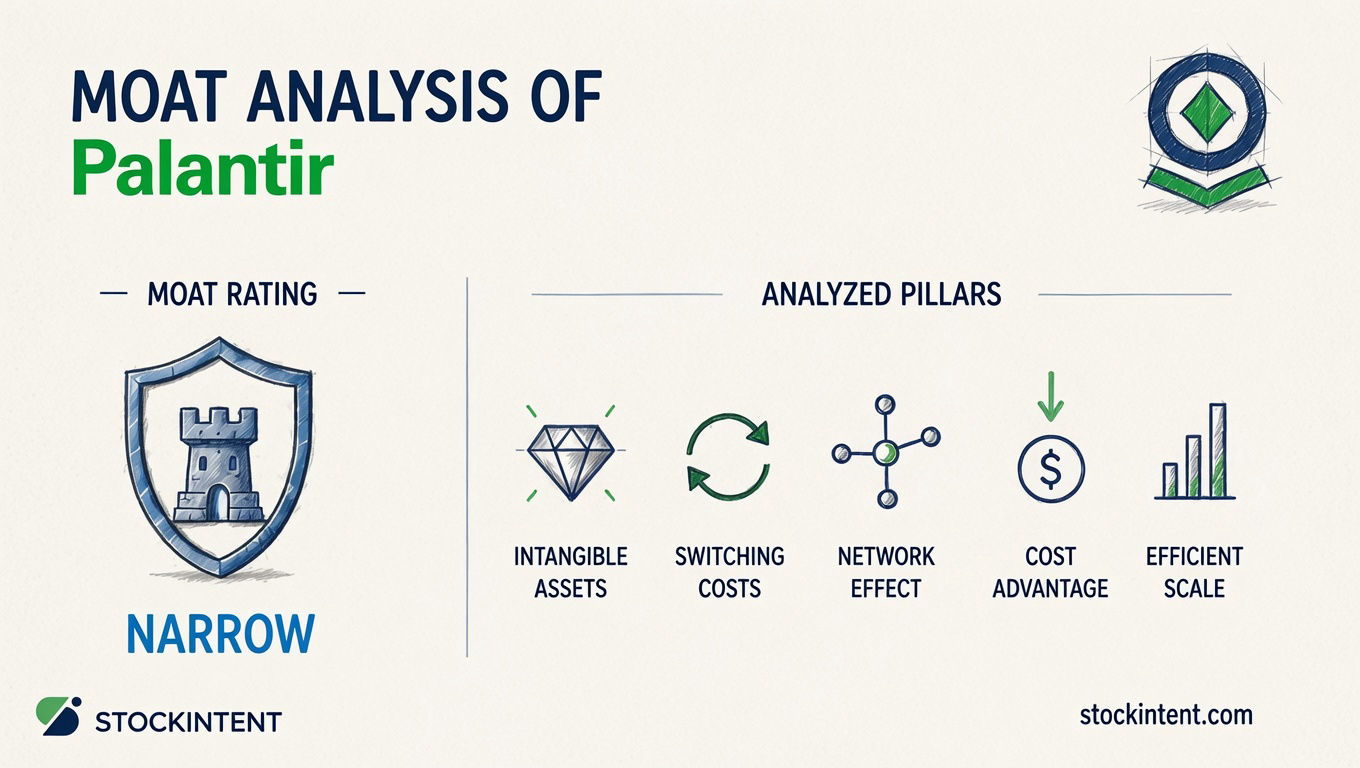
Palantir carries a Narrow economic moat with a Widening trend in its core U.S. commercial and government segments, paired with High uncertainty. In Q1 2026, Palantir reported total revenue of $1.63 billion, an 85% year-over-year jump that prompted management to raise full-year guidance to $7.65–$7.66 billion. The business is clearly accelerating. Whether that acceleration translates into durable competitive protection is a separate question.
Here is what matters most for investors evaluating Palantir's moat quality:
The distinction we want to emphasize upfront: moat quality and investment merit are not the same thing. Palantir's business economics look strong. Its valuation demands near-perfection. The sections that follow examine where that moat actually comes from, how it shows up in the financials, and what could strengthen or erode it from here.
Palantir's moat rests on two genuinely strong pillars, two weak ones, and one that's actively disputed. We think investors should focus their attention accordingly.
This is Palantir's most defensible advantage. The company's platforms, particularly in defense and regulated enterprise settings, become deeply embedded in customer workflows over multi-year deployments. Once operational, extracting them is costly, risky, and time-consuming.
The financial evidence is compelling. Futurum Group reported approximately 150% net dollar retention in Palantir's U.S. commercial segment during Q1 2026. Customers aren't just staying; they're expanding. That figure suggests genuine workflow dependency rather than mere contractual lock-in.
Still, we think it is important to highlight skeptical voices too. Michael Burry has characterized Palantir's moat as "obstruction of data transfer" rather than pure product superiority. The distinction matters. Lock-in from data friction and integration complexity is real, but it's a grittier, more vulnerable advantage than delighted customer captivity. If rivals eventually smooth that friction, retention could soften faster than the 150% figure implies.
Palantir's proprietary Ontology, its knowledge-graph architecture, and its accumulated implementation expertise in security-cleared environments create meaningful barriers to entry. Moatscan-AI's 2026 analysis flags these intangible assets as particularly potent in regulated and defense use cases, where competitors cannot easily replicate the trust, clearances, and domain-specific knowledge Palantir has built over years.
This isn't a consumer brand advantage. It's a deep, technical moat that shows up in procurement decisions and multi-year framework agreements.
Here's where the bull case gets shakier. Some analysts argue Palantir benefits from data network effects and cross-customer learning, particularly through its AIP platform. One Medium analysis made this case explicitly.
But the more rigorous assessment from more professional analysts cuts against it: customer data largely stays siloed. Each new customer doesn't materially improve the platform for all others. Without that self-reinforcing dynamic, Palantir lacks the classic platform moat that justifies the loftiest tech valuations. We'd classify network effects as aspirational rather than proven at scale.
Palantir does not compete on price. Moatscan-AI's analysis found only a moderate efficiency edge, not a structural cost lead. The company wins on capability and integration, not on delivering equivalent outcomes cheaper. For investors evaluating moat durability, this is a neutral-to-negative finding. Cost advantages can be brutally durable; their absence leaves Palantir more exposed to competitive pressure.
This pillar applies in limited government and intelligence niches where buyer counts are small and entry barriers are prohibitively high. Moatscan-AI flags these specialized markets as the only place efficient scale operates for Palantir. It is not a company-wide moat source and shouldn't factor heavily into the overall assessment.
When we evaluate companies for durable competitive positioning, we look for the specific evidence we've outlined here: retention metrics that prove switching costs, proprietary assets that resist replication, and honest assessment of where the bull case thins out. StockIntent's stock screener helps investors identify companies combining these moat characteristics with strong returns on capital, making it easier to build a watchlist of durable compounders worth following closely.
Palantir's competitive advantages aren't theoretical. They're showing up right now in the numbers that matter for long-term business quality.
The clearest evidence is the company's Rule of 40 score, which Morningstar reported reached 127% in Q1 2026. For context, the Rule of 40 adds revenue growth rate to profit margin. Hitting 127% means Palantir is simultaneously growing faster than nearly every large software peer while expanding profitability. That's the signature of a business with genuine pricing power and operating leverage.
That leverage shows up in the cash flow statement too. Palantir generated $2.13 billion in operating cash flow, supported by gross margins around 82% according to StrategyLens. High margins plus rapid growth is a rare combination. It suggests customers value Palantir's ontology and workflow integration enough to pay premium prices, and that the business can scale without proportional cost increases.
The revenue visibility is equally striking. Palantir carried $11.8 billion in total remaining deal value and $4.5 billion in remaining performance obligations as of Q1 2026, per Nasdaq's analysis. These aren't pipeline fantasies. They're signed commitments that convert to revenue over time. That backlog gives Palantir something many high-growth tech companies lack: near-term predictability.
Here's where we need to be honest with ourselves. The business quality looks strong. The investment merit is murkier. Morningstar flags Palantir trading at roughly 90x trailing revenue. That multiple prices in not just continued execution, but near-flawless expansion. Palantir's $8 billion cash position and debt-free balance sheet provide strategic optionality, yet they don't make the stock cheap.
The gap between moat quality and valuation is the central tension. The moat is real. Whether it justifies the price is a separate judgment entirely.
Palantir's moat trend is widening in its U.S. commercial and government core, but stable-to-narrow overall once you look past those high-security, high-switching-cost segments. The Q1 2026 numbers tell a bifurcated story: U.S. commercial revenue grew 133% year-over-year, U.S. government revenue grew 84%, and the company closed 206 deals of at least $1 million, 72 deals of at least $5 million, and 47 deals of at least $10 million per its earnings release. Total contract value hit $2.41 billion, up 61% year-over-year, and management raised full-year guidance including U.S. commercial revenue growth of at least 120%.
But sector dynamics are splitting in two. Palantir increasingly functions as a mission-critical AI operating layer for government and large enterprises, not a generic analytics vendor. MCH Advisory Research's 2026 analysis describes a market dividing into a high-security, high-switching-cost layer where Palantir dominates, and a broader AI/software tooling layer where hyperscalers and open-source alternatives compete aggressively on price and platform flexibility. The moat is deepening in the first arena. It is contested in the second.
Customer buying patterns suggest expansion, not experimentation. The jump in $10M+ deals and rising total contract value indicate customers are moving from pilots into production and deepening their commitments. That is classic land-and-expand behavior, the kind that builds structural advantage over time.
OK, here's where it gets interesting. The same research that validates Palantir's government entrenchment also flags its vulnerability in commercial AI. If AIP bootcamps don't convert to production deployments, or if hyperscalers close the capability gap, Palantir's commercial moat could stall while its government moat keeps widening. That would leave the overall trend stable rather than clearly improving.
Four indicators should be on every Palantir investor's watchlist through 2028:
StockIntent's watchlists let you organize these metrics and track them across quarters without losing signal in the noise. Palantir is a case where the story changes faster than the filings arrive.
We rate Palantir's moat uncertainty as High. The company's Q1 2026 results, including the raised FY2026 guidance to $7.65–$7.66 billion and $4.5 billion in remaining performance obligations, provide near-term revenue visibility. But the range of possible outcomes three to five years out is unusually wide.
Three drivers create this uncertainty. Revenue predictability is the first. Government procurement cycles and AIP pilot conversion rates introduce lumpiness that backlogs alone can't smooth. Q2 2026 revenue guidance of roughly $1.80 billion shows management's near-term confidence, yet multi-year contract timing and enterprise AI adoption curves remain hard to forecast. Reuters attributed the raised outlook to robust U.S. government demand, a demand source vulnerable to budget shifts and administration changes.
ESG and regulatory risk is the second driver. Yahoo Finance's 2026 analysis flagged defense contract scrutiny, shareholder activism on human rights grounds, and broader AI deployment ethics as material constraints. These pressures could limit Palantir's addressable market with non-U.S. customers and institutions sensitive to procurement controversies. Reputational damage doesn't always show up in quarterly revenue, but it can narrow the long-term outcome range abruptly.
Execution risk at extreme valuation is the third. With Palantir trading at roughly 90x trailing revenue per Morningstar, the market has already baked in flawless AIP commercialization and sustained government expansion. Any stumble, whether from hyperscaler competition or slower enterprise adoption, would compress the multiple sharply. The business quality is genuine. The margin for error is not.
Pro Insight: The range of outcomes for Palantir's competitive position over 3-5 years is unusually wide. While recent results suggest a widening moat in core segments, the 90x revenue valuation and dependence on AIP execution against hyperscalers create a binary risk profile. Conservative investors should weigh the possibility of Palantir becoming the dominant AI operating system against the risk of it remaining a contested niche player.
High uncertainty does not mean low quality. It means the evidence supports multiple futures. For moat-focused investors, the practical implication is clear: monitor the trend indicators closely, size positions with the wide outcome range in mind, and distinguish between a durable business and a stock priced for perfection.
Palantir earns a Narrow economic moat, a Widening trend in core segments, and a High uncertainty rating. The strongest evidence sits in its switching costs, with roughly 150% net dollar retention in U.S. commercial and $11.8 billion in total remaining deal value backing future revenue. Its proprietary ontology and security-cleared positioning add real, if narrower, protection.
Two issues should dominate investor attention from here. First, can AIP bootcamps convert to production deployments fast enough to sustain commercial switching costs? Second, does the current valuation leave any room for execution missteps? At roughly 90x trailing revenue, the market is not pricing in a stumble.
We want to be explicit about what could change our view. Faster-than-expected hyperscaler encroachment in commercial AI, a sustained drop in large-deal counts, or government budget contraction would all argue for a stable or weakening trend. Sustained bootcamp conversion and expanding $10 million-plus deal flow would support continued widening.
Moat quality and investment merit remain separate judgments. Palantir's business economics are genuinely strong. Whether that strength justifies the price is a question each investor must answer with their own risk tolerance and return requirements in mind.
This analysis is for informational purposes only and does not constitute investment advice.
Palantir carries a Narrow economic moat with a Widening trend in its core U.S. commercial and government segments, paired with High uncertainty. In Q1 2026, Palantir reported total revenue of $1.63 billion, an 85% year-over-year jump that prompted management to raise full-year guidance to $7.65–$7.66 billion. The business is clearly accelerating. Whether that acceleration translates into durable competitive protection is a separate question.
Here is what matters most for investors evaluating Palantir's moat quality:
The distinction we want to emphasize upfront: moat quality and investment merit are not the same thing. Palantir's business economics look strong. Its valuation demands near-perfection. The sections that follow examine where that moat actually comes from, how it shows up in the financials, and what could strengthen or erode it from here.
Palantir's moat rests on two genuinely strong pillars, two weak ones, and one that's actively disputed. We think investors should focus their attention accordingly.
This is Palantir's most defensible advantage. The company's platforms, particularly in defense and regulated enterprise settings, become deeply embedded in customer workflows over multi-year deployments. Once operational, extracting them is costly, risky, and time-consuming.
The financial evidence is compelling. Futurum Group reported approximately 150% net dollar retention in Palantir's U.S. commercial segment during Q1 2026. Customers aren't just staying; they're expanding. That figure suggests genuine workflow dependency rather than mere contractual lock-in.
Still, we think it is important to highlight skeptical voices too. Michael Burry has characterized Palantir's moat as "obstruction of data transfer" rather than pure product superiority. The distinction matters. Lock-in from data friction and integration complexity is real, but it's a grittier, more vulnerable advantage than delighted customer captivity. If rivals eventually smooth that friction, retention could soften faster than the 150% figure implies.
Palantir's proprietary Ontology, its knowledge-graph architecture, and its accumulated implementation expertise in security-cleared environments create meaningful barriers to entry. Moatscan-AI's 2026 analysis flags these intangible assets as particularly potent in regulated and defense use cases, where competitors cannot easily replicate the trust, clearances, and domain-specific knowledge Palantir has built over years.
This isn't a consumer brand advantage. It's a deep, technical moat that shows up in procurement decisions and multi-year framework agreements.
Here's where the bull case gets shakier. Some analysts argue Palantir benefits from data network effects and cross-customer learning, particularly through its AIP platform. One Medium analysis made this case explicitly.
But the more rigorous assessment from more professional analysts cuts against it: customer data largely stays siloed. Each new customer doesn't materially improve the platform for all others. Without that self-reinforcing dynamic, Palantir lacks the classic platform moat that justifies the loftiest tech valuations. We'd classify network effects as aspirational rather than proven at scale.
Palantir does not compete on price. Moatscan-AI's analysis found only a moderate efficiency edge, not a structural cost lead. The company wins on capability and integration, not on delivering equivalent outcomes cheaper. For investors evaluating moat durability, this is a neutral-to-negative finding. Cost advantages can be brutally durable; their absence leaves Palantir more exposed to competitive pressure.
This pillar applies in limited government and intelligence niches where buyer counts are small and entry barriers are prohibitively high. Moatscan-AI flags these specialized markets as the only place efficient scale operates for Palantir. It is not a company-wide moat source and shouldn't factor heavily into the overall assessment.
When we evaluate companies for durable competitive positioning, we look for the specific evidence we've outlined here: retention metrics that prove switching costs, proprietary assets that resist replication, and honest assessment of where the bull case thins out. StockIntent's stock screener helps investors identify companies combining these moat characteristics with strong returns on capital, making it easier to build a watchlist of durable compounders worth following closely.
Palantir's competitive advantages aren't theoretical. They're showing up right now in the numbers that matter for long-term business quality.
The clearest evidence is the company's Rule of 40 score, which Morningstar reported reached 127% in Q1 2026. For context, the Rule of 40 adds revenue growth rate to profit margin. Hitting 127% means Palantir is simultaneously growing faster than nearly every large software peer while expanding profitability. That's the signature of a business with genuine pricing power and operating leverage.
That leverage shows up in the cash flow statement too. Palantir generated $2.13 billion in operating cash flow, supported by gross margins around 82% according to StrategyLens. High margins plus rapid growth is a rare combination. It suggests customers value Palantir's ontology and workflow integration enough to pay premium prices, and that the business can scale without proportional cost increases.
The revenue visibility is equally striking. Palantir carried $11.8 billion in total remaining deal value and $4.5 billion in remaining performance obligations as of Q1 2026, per Nasdaq's analysis. These aren't pipeline fantasies. They're signed commitments that convert to revenue over time. That backlog gives Palantir something many high-growth tech companies lack: near-term predictability.
Here's where we need to be honest with ourselves. The business quality looks strong. The investment merit is murkier. Morningstar flags Palantir trading at roughly 90x trailing revenue. That multiple prices in not just continued execution, but near-flawless expansion. Palantir's $8 billion cash position and debt-free balance sheet provide strategic optionality, yet they don't make the stock cheap.
The gap between moat quality and valuation is the central tension. The moat is real. Whether it justifies the price is a separate judgment entirely.
Palantir's moat trend is widening in its U.S. commercial and government core, but stable-to-narrow overall once you look past those high-security, high-switching-cost segments. The Q1 2026 numbers tell a bifurcated story: U.S. commercial revenue grew 133% year-over-year, U.S. government revenue grew 84%, and the company closed 206 deals of at least $1 million, 72 deals of at least $5 million, and 47 deals of at least $10 million per its earnings release. Total contract value hit $2.41 billion, up 61% year-over-year, and management raised full-year guidance including U.S. commercial revenue growth of at least 120%.
But sector dynamics are splitting in two. Palantir increasingly functions as a mission-critical AI operating layer for government and large enterprises, not a generic analytics vendor. MCH Advisory Research's 2026 analysis describes a market dividing into a high-security, high-switching-cost layer where Palantir dominates, and a broader AI/software tooling layer where hyperscalers and open-source alternatives compete aggressively on price and platform flexibility. The moat is deepening in the first arena. It is contested in the second.
Customer buying patterns suggest expansion, not experimentation. The jump in $10M+ deals and rising total contract value indicate customers are moving from pilots into production and deepening their commitments. That is classic land-and-expand behavior, the kind that builds structural advantage over time.
OK, here's where it gets interesting. The same research that validates Palantir's government entrenchment also flags its vulnerability in commercial AI. If AIP bootcamps don't convert to production deployments, or if hyperscalers close the capability gap, Palantir's commercial moat could stall while its government moat keeps widening. That would leave the overall trend stable rather than clearly improving.
Four indicators should be on every Palantir investor's watchlist through 2028:
StockIntent's watchlists let you organize these metrics and track them across quarters without losing signal in the noise. Palantir is a case where the story changes faster than the filings arrive.
We rate Palantir's moat uncertainty as High. The company's Q1 2026 results, including the raised FY2026 guidance to $7.65–$7.66 billion and $4.5 billion in remaining performance obligations, provide near-term revenue visibility. But the range of possible outcomes three to five years out is unusually wide.
Three drivers create this uncertainty. Revenue predictability is the first. Government procurement cycles and AIP pilot conversion rates introduce lumpiness that backlogs alone can't smooth. Q2 2026 revenue guidance of roughly $1.80 billion shows management's near-term confidence, yet multi-year contract timing and enterprise AI adoption curves remain hard to forecast. Reuters attributed the raised outlook to robust U.S. government demand, a demand source vulnerable to budget shifts and administration changes.
ESG and regulatory risk is the second driver. Yahoo Finance's 2026 analysis flagged defense contract scrutiny, shareholder activism on human rights grounds, and broader AI deployment ethics as material constraints. These pressures could limit Palantir's addressable market with non-U.S. customers and institutions sensitive to procurement controversies. Reputational damage doesn't always show up in quarterly revenue, but it can narrow the long-term outcome range abruptly.
Execution risk at extreme valuation is the third. With Palantir trading at roughly 90x trailing revenue per Morningstar, the market has already baked in flawless AIP commercialization and sustained government expansion. Any stumble, whether from hyperscaler competition or slower enterprise adoption, would compress the multiple sharply. The business quality is genuine. The margin for error is not.
Pro Insight: The range of outcomes for Palantir's competitive position over 3-5 years is unusually wide. While recent results suggest a widening moat in core segments, the 90x revenue valuation and dependence on AIP execution against hyperscalers create a binary risk profile. Conservative investors should weigh the possibility of Palantir becoming the dominant AI operating system against the risk of it remaining a contested niche player.
High uncertainty does not mean low quality. It means the evidence supports multiple futures. For moat-focused investors, the practical implication is clear: monitor the trend indicators closely, size positions with the wide outcome range in mind, and distinguish between a durable business and a stock priced for perfection.
Palantir earns a Narrow economic moat, a Widening trend in core segments, and a High uncertainty rating. The strongest evidence sits in its switching costs, with roughly 150% net dollar retention in U.S. commercial and $11.8 billion in total remaining deal value backing future revenue. Its proprietary ontology and security-cleared positioning add real, if narrower, protection.
Two issues should dominate investor attention from here. First, can AIP bootcamps convert to production deployments fast enough to sustain commercial switching costs? Second, does the current valuation leave any room for execution missteps? At roughly 90x trailing revenue, the market is not pricing in a stumble.
We want to be explicit about what could change our view. Faster-than-expected hyperscaler encroachment in commercial AI, a sustained drop in large-deal counts, or government budget contraction would all argue for a stable or weakening trend. Sustained bootcamp conversion and expanding $10 million-plus deal flow would support continued widening.
Moat quality and investment merit remain separate judgments. Palantir's business economics are genuinely strong. Whether that strength justifies the price is a question each investor must answer with their own risk tolerance and return requirements in mind.
This analysis is for informational purposes only and does not constitute investment advice.