
Aug 14, 2026
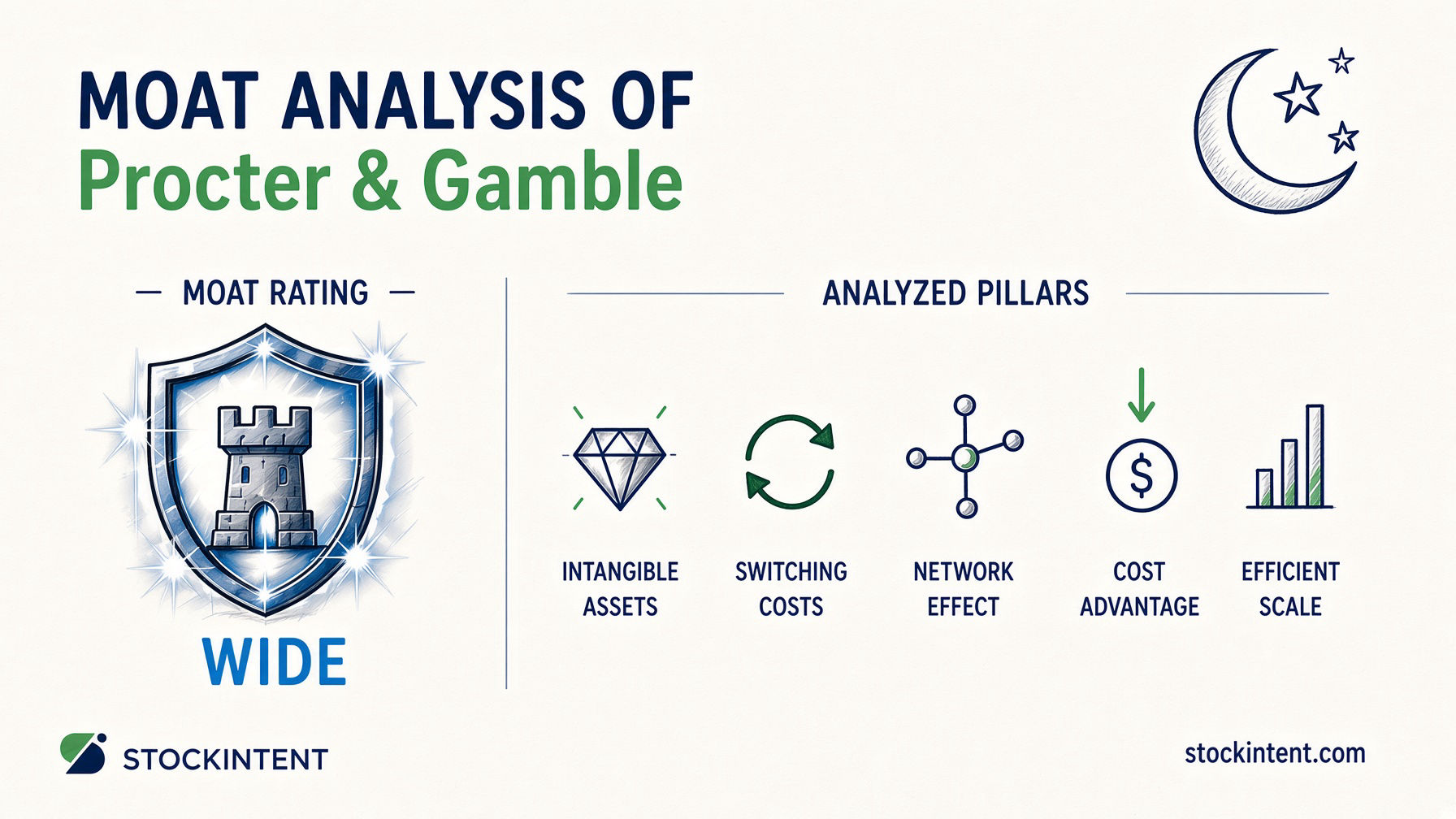
Procter & Gamble carries a Wide Moat with a Stable trend and Medium uncertainty. Morningstar's 2026 assessment holds that P&G's "holistic brand-investing system should support that moat long term," and the company's fiscal Q3 2026 operating margin of 25% (up from 24% in the prior year) offers immediate evidence that its economics remain formidable. Yet the moat is not untested. Private-label competition, tariff headwinds, and shifting consumer behavior are applying pressure that investors cannot ignore.
Here's what matters most at a glance:
The question for long-term investors is not whether P&G is cheap, but whether it remains a wonderful company worth owning at a fair price. A durable moat protects excess returns and enables compounding over decades. If that moat is thinning, even a low multiple may not compensate for eroding business quality.
This analysis examines the evidence behind P&G's competitive position so you can judge for yourself.
P&G's competitive position rests on three pillars that matter, two that help modestly, and one that barely registers. Understanding which is which prevents the common mistake of treating every well-known brand as equally protected.
Intangible assets: Strong
This is the load-bearing pillar. Morningstar's 2026 analysis identifies brand equity, consumer trust, product performance claims, and sustained advertising and innovation as the core of P&G's wide moat. The company's household names don't merely occupy shelf space; they command premium pricing because consumers believe the product will perform as promised. That trust is expensive to build and hard to replicate. P&G's 2025 annual report emphasizes continued investment in digital capabilities, supply chain execution, and sustainability, all of which reinforce brand differentiation rather than commoditized scale. Our interpretation is that this pillar explains why P&G maintains margins peers cannot match.
Switching costs: Moderate
Here's where nuance matters. P&G benefits from repeat-purchase habits and consumer loyalty, but calling these "wide switching costs" overstates the case. You can try a different laundry detergent next shopping trip without penalty, contract, or data loss. The friction is psychological and habitual, not structural. We describe this as loyalty rather than true switching costs. It's meaningful, especially in categories where purchase decisions are automatic, but it's softer than the lock-in you'd see in enterprise software or financial services.
Cost advantage: Moderate to strong
Scale delivers real benefits in sourcing, manufacturing productivity, logistics, and trade execution. P&G's size helps it absorb commodity and freight volatility better than smaller rivals, and its ability to maintain operating margins above 24% for eight consecutive quarters suggests this advantage is currently operational. But the cost advantage has limits. Tariff exposure, oil price volatility, and transportation cost spikes can compress even well-run operations.
Efficient scale: Limited
P&G's size creates some shelf-space and distribution benefits, but the categories it competes in are massive global markets with strong rivals. This is not a case where the market is so small that only one or two firms can profitably serve it. Efficient scale helps in specific situations, but it is not a standalone moat pillar for P&G.
Network effects: Not material
This one is straightforward. Morningstar confirms that network effects, where value increases as more users join a platform, do not apply to P&G. A consumer choosing Tide does not make Tide more valuable to other Tide users. P&G's value comes from brand preference and shelf presence, not from user-to-user interaction dynamics. Any "feedback loop" described in commentary is better understood as brand reinforcement and scale economics, not genuine network effects.
P&G's competitive advantages are most visible in its profitability, not its growth rate. The clearest evidence is operating margin: fiscal Q3 2026 came in at 25%, up from 24% a year earlier, and the company has held above 24% for eight consecutive quarters. That's a level that even Colgate-Palmolive and Kimberly-Clark haven't approached in the same period. Margin durability this persistent suggests the brand moat is translating into real pricing power and cost discipline.
Volume is telling a more nuanced story. P&G reported 2% volume growth in Q3 2026, the first company-wide increase in a year. This matters because it signals consumers are returning to P&G's brands at scale, not just accepting price hikes. Organic sales grew 3% overall, with roughly half the business generated outside the United States. The geographic mix adds resilience; weakness in one region can be offset by strength in others.
But the moat has soft spots. Three percent organic growth is defensive excellence, not rapid expansion. Private-label competition is eroding pricing power in certain categories, and consumer sensitivity to value means premium positioning is harder to sustain when wallets tighten. Management declined to provide fiscal 2027 guidance, explicitly citing uncertainty about whether current momentum will persist. That caution is worth noting: the moat is real, but it's not currently driving breakout performance.
Our interpretation is that P&G's moat is showing up as margin protection under pressure rather than growth acceleration. The brand strength is visible in profitability; it is less conclusively visible in sustained volume expansion or decisive victory over cheaper alternatives. For investors, this means the business quality is intact, but the compounding story depends on whether volume growth can build from here without relying solely on pricing tailwinds.
P&G's moat is stable to slightly weakening right now. The brand and scale advantages that built its wide moat are still intact, but they're absorbing more pressure than we've seen in years. The question for investors is whether this pressure is cyclical, tied to inflation and tariff volatility, or structural, driven by a permanent shift toward cheaper alternatives.
The evidence of pressure is concrete. Global aggregate value share declined 20 basis points in a recent quarter, and private-label competition is actively eroding pricing power in certain categories. Cost headwinds are stacking up fast: approximately $500 million in fiscal 2026 tariff-related costs, a projected $1 billion fiscal 2027 profit impact from higher oil prices, and $150 million in Q4 2026 transportation costs from elevated fuel prices. These are not minor line items. Together, they test whether P&G's cost advantage and pricing power can absorb simultaneous shocks.
Yet the moat is not cracking. 25 of P&G's top 50 category-country combinations held or gained share, and the return to 2% volume growth in Q3 2026 suggests consumers are buying more P&G products, not just paying more for the same quantity. Innovation execution remains a strength, with launches like Tide evo and Oral-B iO10 reinforcing brand differentiation. Margins expanded despite the headwinds, which is exactly what you'd hope to see from a business with durable advantages.
From Our Experience: In our experience following consumer staples through multiple economic cycles, private-label pressure often peaks during inflationary periods but reverses when employment and wage growth stabilize. P&G's return to volume growth in Q3 2026, while maintaining pricing, suggests the brand moat is absorbing the cyclical pressure rather than suffering structural erosion. The key distinction investors should watch is whether volume growth sustains as inflation normalizes, not whether private label is currently gaining share.
Four indicators deserve your attention over the next three to five years. First, quarterly organic sales and volume growth will test whether brand pull is converting into real demand or merely price-driven revenue. Second, market share trends in North America and Europe will reveal whether pricing power is holding where competition is fiercest. Third, gross and operating margin trajectory will show if cost advantages and productivity can offset tariff and commodity pressure. Fourth, innovation launch results will indicate whether P&G can still differentiate better than private-label rivals.
You can organize these indicators into a watchlist to track P&G and its peers over time, with custom views for volume and margin trends that help judge whether the moat trend is improving or weakening.
The restructuring program, which includes a reduction of approximately 7,000 jobs, adds execution risk to the picture. If it delivers savings and sharper focus, the moat could strengthen through improved capital allocation. If it disrupts operations without clear payoff, overhead becomes a competitive drag. The next few quarters will tell which path P&G is on.
We rate Procter & Gamble's moat uncertainty as Medium.
The company's revenue base is still unusually predictable for a large-cap consumer business. It sells essential products that people buy repeatedly, and analyst estimates have stayed in a relatively narrow range. But P&G is no longer the "lockstep" defensive stock it once was. Management has described a "dynamic, difficult, and volatile environment," and the specific headwinds they have disclosed are large enough to widen the range of plausible outcomes.
Four drivers shape this rating. Revenue predictability remains solid but softened by pricing and mix volatility. Cost and tariff exposure is concrete and material: P&G disclosed approximately $500 million in fiscal 2026 tariff-related costs before tax, while Reuters reported a projected $1 billion fiscal 2027 profit impact from higher oil prices. CNBC noted an additional $150 million transportation cost hit in Q4 2026 from fuel prices alone. These are quantified immediate pressures.
Consumer behavior uncertainty adds another layer. Management declined to provide fiscal 2027 guidance during the Q3 2026 earnings call, explicitly citing uncertainty about whether current momentum would persist. That is a meaningful signal from a management team that typically offers directional outlooks.
Execution risk rounds out the picture. P&G's restructuring program includes a reduction of approximately 7,000 jobs. If it streamlines operations and sharpens focus, the cost advantage pillar could strengthen. If it disrupts execution without clear savings, overhead becomes a drag.
The plausible range of outcomes over the next three to five years is moderately narrow. P&G's structural advantages, scale, brand equity, and essential categories limit dramatic downside. But the spread between "stable compounding" and "margins under pressure with slower growth" is wide enough to matter for valuation. The moat is durable; the incremental edge over peers depends on execution in volume growth, cost control, and channel adaptation.
This content is for informational and educational purposes only and is not investment advice. The uncertainty rating and forward-looking indicators discussed represent analytical assessments based on disclosed company information, not predictions of future performance.
Procter & Gamble earns a Wide Moat with a Stable trend and Medium uncertainty. The brand equity, scale economics, and margin durability discussed above remain formidable, but the moat is being tested in ways that matter for long-term investors.
Two questions will determine whether P&G stays a compounding-quality business or gradually normalizes toward peer economics. First, can volume growth sustain without relying on pricing tailwinds, proving the brand moat is cyclically resilient rather than structurally impaired? Second, will margins hold above 24% as the tariff and commodity headwinds detailed previously materialize, testing whether the cost advantage pillar is genuine or merely temporary?
Our view is that P&G's structural advantages limit dramatic downside, but the spread between stable compounding and margin pressure is wide enough to affect valuation. The moat is durable; the incremental edge depends on execution. Investors should prioritize monitoring the four indicators identified earlier, organic growth, share trends, margins, and innovation results, over the next three to five years to see whether the uncertainty rating resolves favorably.
Procter & Gamble carries a Wide Moat with a Stable trend and Medium uncertainty. Morningstar's 2026 assessment holds that P&G's "holistic brand-investing system should support that moat long term," and the company's fiscal Q3 2026 operating margin of 25% (up from 24% in the prior year) offers immediate evidence that its economics remain formidable. Yet the moat is not untested. Private-label competition, tariff headwinds, and shifting consumer behavior are applying pressure that investors cannot ignore.
Here's what matters most at a glance:
The question for long-term investors is not whether P&G is cheap, but whether it remains a wonderful company worth owning at a fair price. A durable moat protects excess returns and enables compounding over decades. If that moat is thinning, even a low multiple may not compensate for eroding business quality.
This analysis examines the evidence behind P&G's competitive position so you can judge for yourself.
P&G's competitive position rests on three pillars that matter, two that help modestly, and one that barely registers. Understanding which is which prevents the common mistake of treating every well-known brand as equally protected.
Intangible assets: Strong
This is the load-bearing pillar. Morningstar's 2026 analysis identifies brand equity, consumer trust, product performance claims, and sustained advertising and innovation as the core of P&G's wide moat. The company's household names don't merely occupy shelf space; they command premium pricing because consumers believe the product will perform as promised. That trust is expensive to build and hard to replicate. P&G's 2025 annual report emphasizes continued investment in digital capabilities, supply chain execution, and sustainability, all of which reinforce brand differentiation rather than commoditized scale. Our interpretation is that this pillar explains why P&G maintains margins peers cannot match.
Switching costs: Moderate
Here's where nuance matters. P&G benefits from repeat-purchase habits and consumer loyalty, but calling these "wide switching costs" overstates the case. You can try a different laundry detergent next shopping trip without penalty, contract, or data loss. The friction is psychological and habitual, not structural. We describe this as loyalty rather than true switching costs. It's meaningful, especially in categories where purchase decisions are automatic, but it's softer than the lock-in you'd see in enterprise software or financial services.
Cost advantage: Moderate to strong
Scale delivers real benefits in sourcing, manufacturing productivity, logistics, and trade execution. P&G's size helps it absorb commodity and freight volatility better than smaller rivals, and its ability to maintain operating margins above 24% for eight consecutive quarters suggests this advantage is currently operational. But the cost advantage has limits. Tariff exposure, oil price volatility, and transportation cost spikes can compress even well-run operations.
Efficient scale: Limited
P&G's size creates some shelf-space and distribution benefits, but the categories it competes in are massive global markets with strong rivals. This is not a case where the market is so small that only one or two firms can profitably serve it. Efficient scale helps in specific situations, but it is not a standalone moat pillar for P&G.
Network effects: Not material
This one is straightforward. Morningstar confirms that network effects, where value increases as more users join a platform, do not apply to P&G. A consumer choosing Tide does not make Tide more valuable to other Tide users. P&G's value comes from brand preference and shelf presence, not from user-to-user interaction dynamics. Any "feedback loop" described in commentary is better understood as brand reinforcement and scale economics, not genuine network effects.
P&G's competitive advantages are most visible in its profitability, not its growth rate. The clearest evidence is operating margin: fiscal Q3 2026 came in at 25%, up from 24% a year earlier, and the company has held above 24% for eight consecutive quarters. That's a level that even Colgate-Palmolive and Kimberly-Clark haven't approached in the same period. Margin durability this persistent suggests the brand moat is translating into real pricing power and cost discipline.
Volume is telling a more nuanced story. P&G reported 2% volume growth in Q3 2026, the first company-wide increase in a year. This matters because it signals consumers are returning to P&G's brands at scale, not just accepting price hikes. Organic sales grew 3% overall, with roughly half the business generated outside the United States. The geographic mix adds resilience; weakness in one region can be offset by strength in others.
But the moat has soft spots. Three percent organic growth is defensive excellence, not rapid expansion. Private-label competition is eroding pricing power in certain categories, and consumer sensitivity to value means premium positioning is harder to sustain when wallets tighten. Management declined to provide fiscal 2027 guidance, explicitly citing uncertainty about whether current momentum will persist. That caution is worth noting: the moat is real, but it's not currently driving breakout performance.
Our interpretation is that P&G's moat is showing up as margin protection under pressure rather than growth acceleration. The brand strength is visible in profitability; it is less conclusively visible in sustained volume expansion or decisive victory over cheaper alternatives. For investors, this means the business quality is intact, but the compounding story depends on whether volume growth can build from here without relying solely on pricing tailwinds.
P&G's moat is stable to slightly weakening right now. The brand and scale advantages that built its wide moat are still intact, but they're absorbing more pressure than we've seen in years. The question for investors is whether this pressure is cyclical, tied to inflation and tariff volatility, or structural, driven by a permanent shift toward cheaper alternatives.
The evidence of pressure is concrete. Global aggregate value share declined 20 basis points in a recent quarter, and private-label competition is actively eroding pricing power in certain categories. Cost headwinds are stacking up fast: approximately $500 million in fiscal 2026 tariff-related costs, a projected $1 billion fiscal 2027 profit impact from higher oil prices, and $150 million in Q4 2026 transportation costs from elevated fuel prices. These are not minor line items. Together, they test whether P&G's cost advantage and pricing power can absorb simultaneous shocks.
Yet the moat is not cracking. 25 of P&G's top 50 category-country combinations held or gained share, and the return to 2% volume growth in Q3 2026 suggests consumers are buying more P&G products, not just paying more for the same quantity. Innovation execution remains a strength, with launches like Tide evo and Oral-B iO10 reinforcing brand differentiation. Margins expanded despite the headwinds, which is exactly what you'd hope to see from a business with durable advantages.
From Our Experience: In our experience following consumer staples through multiple economic cycles, private-label pressure often peaks during inflationary periods but reverses when employment and wage growth stabilize. P&G's return to volume growth in Q3 2026, while maintaining pricing, suggests the brand moat is absorbing the cyclical pressure rather than suffering structural erosion. The key distinction investors should watch is whether volume growth sustains as inflation normalizes, not whether private label is currently gaining share.
Four indicators deserve your attention over the next three to five years. First, quarterly organic sales and volume growth will test whether brand pull is converting into real demand or merely price-driven revenue. Second, market share trends in North America and Europe will reveal whether pricing power is holding where competition is fiercest. Third, gross and operating margin trajectory will show if cost advantages and productivity can offset tariff and commodity pressure. Fourth, innovation launch results will indicate whether P&G can still differentiate better than private-label rivals.
You can organize these indicators into a watchlist to track P&G and its peers over time, with custom views for volume and margin trends that help judge whether the moat trend is improving or weakening.
The restructuring program, which includes a reduction of approximately 7,000 jobs, adds execution risk to the picture. If it delivers savings and sharper focus, the moat could strengthen through improved capital allocation. If it disrupts operations without clear payoff, overhead becomes a competitive drag. The next few quarters will tell which path P&G is on.
We rate Procter & Gamble's moat uncertainty as Medium.
The company's revenue base is still unusually predictable for a large-cap consumer business. It sells essential products that people buy repeatedly, and analyst estimates have stayed in a relatively narrow range. But P&G is no longer the "lockstep" defensive stock it once was. Management has described a "dynamic, difficult, and volatile environment," and the specific headwinds they have disclosed are large enough to widen the range of plausible outcomes.
Four drivers shape this rating. Revenue predictability remains solid but softened by pricing and mix volatility. Cost and tariff exposure is concrete and material: P&G disclosed approximately $500 million in fiscal 2026 tariff-related costs before tax, while Reuters reported a projected $1 billion fiscal 2027 profit impact from higher oil prices. CNBC noted an additional $150 million transportation cost hit in Q4 2026 from fuel prices alone. These are quantified immediate pressures.
Consumer behavior uncertainty adds another layer. Management declined to provide fiscal 2027 guidance during the Q3 2026 earnings call, explicitly citing uncertainty about whether current momentum would persist. That is a meaningful signal from a management team that typically offers directional outlooks.
Execution risk rounds out the picture. P&G's restructuring program includes a reduction of approximately 7,000 jobs. If it streamlines operations and sharpens focus, the cost advantage pillar could strengthen. If it disrupts execution without clear savings, overhead becomes a drag.
The plausible range of outcomes over the next three to five years is moderately narrow. P&G's structural advantages, scale, brand equity, and essential categories limit dramatic downside. But the spread between "stable compounding" and "margins under pressure with slower growth" is wide enough to matter for valuation. The moat is durable; the incremental edge over peers depends on execution in volume growth, cost control, and channel adaptation.
This content is for informational and educational purposes only and is not investment advice. The uncertainty rating and forward-looking indicators discussed represent analytical assessments based on disclosed company information, not predictions of future performance.
Procter & Gamble earns a Wide Moat with a Stable trend and Medium uncertainty. The brand equity, scale economics, and margin durability discussed above remain formidable, but the moat is being tested in ways that matter for long-term investors.
Two questions will determine whether P&G stays a compounding-quality business or gradually normalizes toward peer economics. First, can volume growth sustain without relying on pricing tailwinds, proving the brand moat is cyclically resilient rather than structurally impaired? Second, will margins hold above 24% as the tariff and commodity headwinds detailed previously materialize, testing whether the cost advantage pillar is genuine or merely temporary?
Our view is that P&G's structural advantages limit dramatic downside, but the spread between stable compounding and margin pressure is wide enough to affect valuation. The moat is durable; the incremental edge depends on execution. Investors should prioritize monitoring the four indicators identified earlier, organic growth, share trends, margins, and innovation results, over the next three to five years to see whether the uncertainty rating resolves favorably.