
Mar 27, 2026
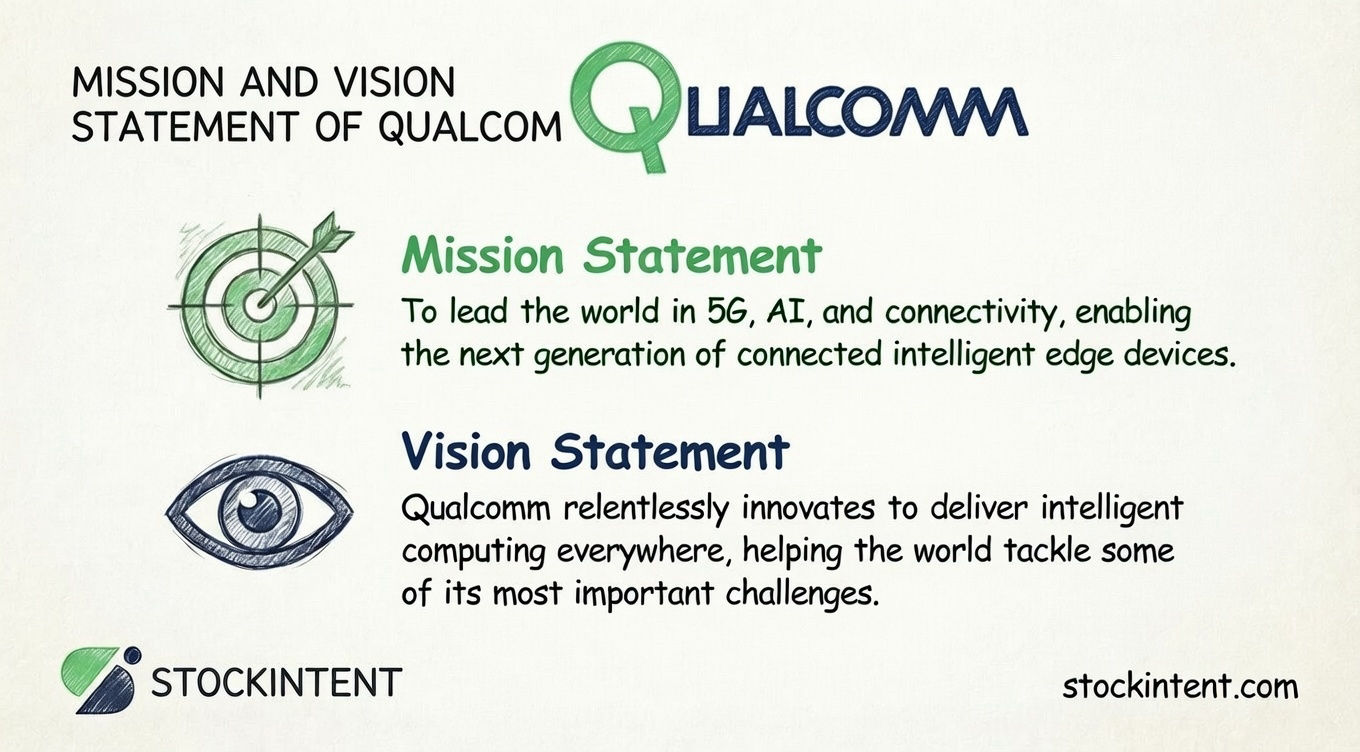
If you're evaluating Qualcomm (QCOM) as a potential investment, understanding what drives the company beyond quarterly earnings can give you an edge. A company's mission, vision, and values aren't just corporate buzzwords; they reveal how leadership thinks about capital allocation, competitive positioning, and long-term value creation.
Qualcomm has transformed from a mobile chip specialist into a diversified semiconductor powerhouse. Its strategic identity now centers on three interconnected pillars: 5G leadership, AI integration, and ubiquitous connectivity. Here's what you need to know before diving deeper.
For investors who appreciate quality businesses with durable competitive advantages, Qualcomm's mission-driven expansion into high-margin, high-growth verticals warrants closer examination. Let's break down each element of Qualcomm's strategic identity and what it means for your portfolio.
Founded in 1985 by Irwin Jacobs and six colleagues, Qualcomm began as a wireless communications research firm in San Diego. The company pioneered CDMA technology and built its empire on cellular patents and modem chips. Today, it stands as one of the world's largest semiconductor companies, though it's evolved far beyond its mobile roots.
Qualcomm operates through three business segments that work together like a well-oiled machine:
Qualcomm CDMA Technologies (QCT) — The engine room, developing integrated circuits and system software for 3G/4G/5G and beyond. This is where Snapdragon lives, powering everything from smartphones to cars to robots.
Qualcomm Technology Licensing (QTL) — The patent goldmine. QTL licenses intellectual property for wireless standards, generating high-margin revenue streams that fund R&D.
Qualcomm Strategic Initiatives (QSI) — The venture arm, investing early in 5G, AI, automotive, cloud, and IoT startups.
In our experience analyzing semiconductor companies, Qualcomm's recent performance tells a compelling story of strategic transformation:
The company is targeting $22 billion in combined Automotive and IoT revenues by fiscal 2029, a bold bet on diversification that would fundamentally reshape its revenue mix.
| Segment | Position | Key Metrics (Q1 FY2026) |
|---|---|---|
| Mobile | Dominant in premium Android | ~75% share in Samsung flagships |
| Automotive | Fastest-growing vertical | $1.1B quarterly revenue, $45B design-win pipeline |
| IoT/Industrial | Expanding rapidly | Dragonwing platforms for edge computing |
| Robotics | New entrant with full suite | Dragonwing IQ10 for AMRs and humanoids |
| Data Center | Emerging opportunity | CPU/NPU roadmap update expected H1 2026 |
CEO Cristiano Amon captured the transformation bluntly in the latest earnings call: "We are creating really a completely different company with relevance in many, many markets."
Qualcomm isn't just a smartphone chip company anymore. Its qualcomm mission statement — to lead in 5G, AI, and connectivity — is playing out through deliberate expansion into higher-margin, stickier markets. The automotive design-win pipeline alone ($45 billion) exceeds many semiconductor companies' total enterprise value.
For investors using platforms like StockIntent to screen for quality compounders, Qualcomm's strategic pivot offers a case study in mission-driven capital allocation. The company is essentially redeploying its wireless expertise, built over four decades, into adjacent verticals where it can leverage existing R&D while capturing new growth vectors.
The competitive moat remains intact: patent-protected licensing revenue, Snapdragon platform stickiness, and now, early-mover advantages in automotive software-defined vehicles and edge AI. Whether this diversification succeeds will largely determine whether Qualcomm deserves a higher multiple than its historical handset-dependent valuation.
Qualcomm's official mission statement is refreshingly direct for a company of its scale:
"To lead the world in 5G, AI, and connectivity, enabling the next generation of connected intelligent edge devices."
This isn't corporate poetry; it's a declaration of strategic intent. Three technologies, one enabling purpose, and a clear target market. For investors, this statement is worth parsing carefully because it signals exactly where management is directing capital and talent.
The sequencing matters. 5G comes first because it's Qualcomm's foundational moat, built on four decades of wireless innovation and a patent portfolio that generates high-margin licensing revenue through QTL. AI follows because it's the growth vector; every Snapdragon platform now integrates on-device neural processing. Connectivity ties them together, reflecting Qualcomm's belief that the future belongs to devices that think locally while communicating globally.
The phrase "intelligent edge devices" is the telling pivot. It explicitly moves Qualcomm beyond smartphones into automotive, industrial IoT, robotics, and data centers. This isn't aspirational language; it's already showing up in the numbers. Automotive revenue hit $1.1 billion in Q1 FY2026, up 36% year-over-year, with a $45 billion design-win pipeline that would make most semiconductor CEOs envious.
🎯 Pro Insight: Mission statements that list specific technologies rather than vague aspirations typically indicate management with clear capital allocation discipline. When a company names its battlefields this precisely, you can track execution against each pillar. Qualcomm's QCT segment revenue of $10.6 billion in Q1 FY2026, with automotive and IoT growing faster than handsets, suggests the mission is translating into measurable results.
The mission directly influences where Qualcomm invests its $8+ billion annual R&D budget. In 2026, we're seeing this play out through:
The mission also explains what Qualcomm doesn't do. You won't see them chasing commodity memory chips or low-margin consumer electronics. Every investment must advance 5G, AI, or connectivity at the intelligent edge. This focus is a double-edged sword; it creates vulnerability if any of these three pillars weakens, but it also prevents the dilution that plagues conglomerates trying to be everything to everyone.
For investors using screening tools to evaluate management quality, Qualcomm's mission provides a clear benchmark. Is the company leading in 5G, AI, and connectivity? Are intelligent edge devices driving growth? The answers to these questions, found in quarterly earnings and segment disclosures, tell you whether leadership is walking the talk or just writing pretty words.
Qualcomm's mission statement isn't just marketing copy; it's a capital allocation blueprint. When management says they want to "lead the world in 5G, AI, and connectivity," they're telling investors exactly where the $8+ billion annual R&D budget is going. Let's break down each pillar and what it means for your portfolio.
This is Qualcomm's original moat, built on four decades of wireless innovation and a patent portfolio that still generates high-margin licensing revenue through QTL. But 5G leadership in 2026 means something different than it did in 2019.
What it is: Standards leadership from modem to antenna, spanning 5G Advanced research and early 6G development. Qualcomm isn't just participating in standards bodies; it's driving them.
Why it matters strategically: Patent-protected licensing creates a toll booth on global wireless communication. Every 5G device sold, regardless of brand, likely sends royalty dollars to Qualcomm. This revenue funds everything else.
Concrete example: In Q1 FY2026, QCT revenue hit a record $10.6 billion, with 5G modem-RF integration powering Samsung's premium flagships and ByteDance's first agentic AI smartphone. The company's earnings presentation shows 5G Advanced capabilities now extending into automotive C-V2X and industrial IoT, not just handsets.
Investor takeaway: This pillar creates the cash flow stability that lets Qualcomm take risks elsewhere. The licensing moat isn't growing fast, but it's not eroding either.
If 5G is the foundation, AI is the growth engine. Qualcomm recognized early that on-device AI would matter more than cloud-dependent models for latency, privacy, and power efficiency.
What it is: Embedding neural processing units (NPUs) into every Snapdragon platform, from smartphones to cars to robots, enabling generative AI at the edge.
Why it matters strategically: AI workloads are exploding, but not every device can afford cloud connectivity or wants to send data off-device. Qualcomm's bet: the intelligent edge will be bigger than the cloud for many applications.
Concrete example: The Dragonwing IQ10 chipset for robotics and humanoids, announced at CES 2026, integrates sensor fusion and on-device AI processing. CEO Cristiano Amon noted in the Q1 earnings call that Qualcomm is "one of the best positioned companies" in physical AI and edge robotics. The company also targets 10% annual power efficiency gains in Snapdragon platforms to make on-device AI practical at scale.
Investor takeaway: This is where multiple expansion happens. If Qualcomm becomes the default AI processor for edge devices, the valuation re-rates from "mobile chip company" to "AI infrastructure play."
The third pillar ties the first two together. 5G without AI is just faster data; AI without connectivity is just local computation. Together, they enable the "intelligent edge."
What it is: End-to-end connectivity solutions spanning cellular, Wi-Fi, Bluetooth, and positioning, integrated from modem to antenna.
Why it matters strategically: Fragmented connectivity creates friction. Qualcomm's integrated approach reduces design complexity for customers while locking them into the Snapdragon ecosystem.
Concrete example: The automotive design-win pipeline reached $45 billion in early 2026, with Volkswagen Group signing a letter of intent to make Qualcomm its primary technology provider for software-defined vehicle architecture starting in 2027. This isn't just selling chips; it's becoming the central nervous system for next-generation vehicles.
In our experience tracking semiconductor companies through multiple cycles, we've found that design-win pipelines this large, this early in a vertical's transformation, rarely happen by accident. They indicate platform stickiness that competitors struggle to displace once established.
| Pillar | Strategic Moat | Key 2026 Metric | Investor Relevance |
|---|---|---|---|
| 5G Leadership | Patent licensing + standards control | QCT: $10.6B quarterly revenue | Cash flow stability, R&D funding |
| AI Integration | On-device NPU platforms | Dragonwing IQ10 robotics launch | Multiple expansion potential |
| Connectivity | End-to-end integration | $45B automotive pipeline | Platform stickiness, switching costs |
How the pillars reinforce each other: A car with Snapdragon gets 5G connectivity, on-board AI for autonomous features, and seamless integration with other Snapdragon devices. Each pillar makes the others more valuable. This isn't accidental; it's exactly what the mission statement promises.
For investors using screening tools to evaluate competitive positioning, these three pillars create a simple test: is Qualcomm extending its lead in each area, or is competition catching up? The Q1 FY2026 numbers suggest the former, but the next few quarters will tell us whether the automotive and IoT momentum is sustainable or just a cyclical uptick.
Qualcomm's official vision statement frames its long-term ambition in stark, forward-looking terms:
"Qualcomm relentlessly innovates to deliver intelligent computing everywhere, helping the world tackle some of its most important challenges."
This isn't idle aspiration. The vision explicitly extends the mission's three pillars, 5G, AI, and connectivity, into a world where computation becomes truly ubiquitous. For investors, understanding this vision matters because it explains why Qualcomm is pouring billions into automotive, robotics, and data centers rather than milking its mobile dominance.
Leadership has articulated concrete strategic goals that map directly to this vision:
In our experience analyzing management guidance across the semiconductor industry, targets this specific usually indicate either exceptional confidence or exceptional pressure. With Qualcomm, it's increasingly the former. The company hit record Q1 FY2026 revenue of $12.3 billion while automotive revenue grew 36% year-over-year to $1.1 billion quarterly.
The vision positions Qualcomm squarely where semiconductor growth is heading in 2026 and beyond. Three macro trends validate this strategic direction:
Edge AI over cloud dependence: As AI workloads explode, latency, privacy, and power constraints are pushing computation to the device level. Qualcomm's bet on on-device neural processing, from smartphones to robots to cars, aligns with a market that Gartner projects will see edge AI chip revenue triple by 2028.
Software-defined everything: Vehicles, factories, and even cities are becoming software-defined. Qualcomm's Snapdragon Digital Chassis and Dragonwing industrial platforms position it as the central nervous system provider for this transformation, not just a component supplier.
Connectivity as infrastructure: 5G Advanced and eventual 6G aren't just faster data pipes; they're enabling real-time coordination between intelligent devices. Qualcomm's modem-to-antenna integration and standards leadership create the foundation for this interconnected future.
CEO Cristiano Amon captured the transformation bluntly in the latest earnings call: "We are creating really a completely different company with relevance in many, many markets."
For investors using screening tools to evaluate long-term positioning, Qualcomm's vision offers a clear test: is the company successfully expanding its addressable market beyond smartphones while maintaining its core technology advantages?
The early evidence suggests yes. The automotive design-win pipeline reached $45 billion in early 2026, with Volkswagen Group signing a letter of intent to make Qualcomm its primary technology provider for software-defined vehicle architecture starting in 2027. This isn't selling chips; it's becoming essential infrastructure.
The vision also explains what Qualcomm won't do. You won't see them chasing commodity memory or low-margin consumer electronics. Every investment must advance "intelligent computing everywhere." This focus creates concentration risk, certainly, but it also prevents the strategic drift that has diluted returns at more diversified semiconductor conglomerates.
Whether Qualcomm achieves this vision will largely determine if it deserves a premium multiple or remains valued as a mature mobile chip company with growth challenges. The next three years, particularly the data center entry and automotive ramp, will tell us whether management is building the future they envision or simply describing it.
Qualcomm's vision statement, "to deliver intelligent computing everywhere," isn't abstract philosophy; it's a capital allocation blueprint. Four interconnected themes drive how management deploys resources and where investors should focus their attention.
The first theme centers on pushing AI processing from centralized data centers to distributed devices. Qualcomm isn't betting on cloud AI dominance; it's positioning itself as the essential infrastructure for on-device intelligence.
Why this matters strategically: Latency, privacy, and power constraints make cloud-dependent AI impractical for many applications. A self-driving car that needs to check the cloud before braking won't work. Qualcomm's NPU-integrated platforms aim to own this constraint.
Concrete moves: The Dragonwing IQ10 chipset for robotics and humanoids, announced at CES 2026, integrates sensor fusion with on-device generative AI. CEO Cristiano Amon noted in the Q1 FY2026 earnings call that Qualcomm is "one of the best positioned companies" in physical AI and edge robotics. The company also targets 10% annual power efficiency gains in Snapdragon platforms to make on-device AI economically viable at scale.
Investor relevance: If edge AI becomes the dominant paradigm, Qualcomm's early positioning creates platform stickiness similar to what it enjoyed in mobile. The risk, of course, is if cloud AI costs collapse faster than expected, making local processing less essential.
The second theme shows up in every earnings presentation: reducing handset dependency while leveraging existing expertise into adjacent verticals. This isn't retreat from mobile; it's using mobile-generated cash flows to fund optionality elsewhere.
Why this matters strategically: Smartphone growth is mature. The premium Android market, where Qualcomm dominates, isn't disappearing but it's not doubling either. Automotive, IoT, and data centers offer larger addressable markets with similar technology requirements.
Concrete moves: Management has publicly committed to $22 billion in combined Automotive and IoT revenue by fiscal 2029, roughly double the annualized early 2026 run rate. The automotive design-win pipeline reached $45 billion with Volkswagen Group signing a letter of intent to make Qualcomm its primary technology provider for software-defined vehicle architecture starting in 2027. In Q1 FY2026, automotive revenue hit $1.1 billion quarterly, up 36% year-over-year.
Investor relevance: This is where multiple expansion lives or dies. If Qualcomm executes, it transitions from "mobile chip company" to "intelligent infrastructure provider." If execution falters, it remains a cyclical handset play with cost pressures.
The third theme reflects Qualcomm's recognition that proprietary advantage in semiconductors is temporary, but standards leadership endures. The company isn't just building chips; it's shaping what 5G Advanced and 6G will become.
Why this matters strategically: Standards participation creates patent-protected licensing revenue that funds everything else. It also gives early visibility into roadmaps, letting Qualcomm optimize Snapdragon platforms before competitors know the rules.
Concrete moves: Active contribution to 3GPP for 5G NR evolution, plus early 6G research integrating AI, sensing, and digital twinning. The FY2025 10-K filing notes these R&D investments as foundational to maintaining the licensing moat that generated $5.6 billion in QTL revenue in fiscal 2025.
Investor relevance: This is the defensive anchor. Even if new verticals stumble, the patent portfolio keeps generating high-margin cash. The question is whether regulatory and geopolitical pressures erode this advantage over time.
The fourth theme, less discussed by investors but central to employee and partner narratives, ties Qualcomm's technical ambitions to broader societal impact. This isn't altruism; it's recruitment, retention, and regulatory positioning.
Why this matters strategically: Talent competition in semiconductors is brutal. Purpose-driven narratives attract engineers who could work anywhere. ESG credibility also smooths regulatory relationships and enterprise sales cycles.
Concrete moves: The Qualcomm Wireless Reach program targets reaching 27 million people by 2025 through connectivity-enabled social initiatives. The 2030 Sustainability Vision advances human rights due diligence and supply chain transparency. These programs map directly to the "Do the Right Thing" core value and support the long-term licensing relationships that require regulatory and governmental trust.
Investor relevance: Secondary to near-term financials, but relevant for multi-year holding periods. ESG-related risks have materialized for semiconductor companies through supply chain audits, export restrictions, and talent access.
| Vision Theme | Strategic Priority | Key 2026 Metric | Risk Factor |
|---|---|---|---|
| Ubiquitous AI at the Edge | On-device NPU platforms | Dragonwing IQ10 robotics launch | Cloud AI cost collapse |
| Diversification Beyond Mobile | Automotive/IoT revenue growth | $45B automotive pipeline; 36% YoY auto growth | Execution delays, competitive displacement |
| Standards & Ecosystem Leadership | 5G Advanced/6G R&D | $5.6B QTL annual revenue | Regulatory/patent disputes |
| Purposeful Innovation | ESG integration; talent attraction | 27M Wireless Reach target by 2025 | Reputational incidents |
How themes interconnect: These aren't independent bets. A car with Snapdragon gets 5G connectivity (standards theme), on-board AI for autonomy (edge AI theme), and qualifies for enterprise sustainability procurement (ESG theme). The platform strategy, which we've seen work in mobile, is being replicated across verticals.
For investors using StockIntent to screen for quality compounders, these vision themes provide a diagnostic framework. Is Qualcomm extending its lead in each area? Recent results suggest momentum, particularly in automotive where the $45 billion pipeline exceeds many semiconductor companies' total enterprise value. The next few quarters will tell us whether this is sustainable platform building or just cyclical tailwinds catching favorable timing.
Behind every mission statement worth its salt, there's a set of values that actually shape behavior. Qualcomm's four core values, known internally as "The Qualcomm Way," provide the framework for how the company makes decisions, evaluates talent, and allocates capital. For investors, these values matter because they signal whether management is building a durable culture or just writing inspirational posters.
The four values are refreshingly direct: Win Together, Achieve Excellence, Make the Impossible Inevitable, and Do the Right Thing matrixbcg.com blog on Qualcomm mission. Let's break down what each actually means in practice.
This value emphasizes collaboration over internal competition, a necessity for a company whose products require modem, RF, AI, and software teams to ship integrated platforms.
What it means operationally: Cross-functional teamwork isn't optional at Qualcomm; it's how Snapdragon gets built. The value manifests in organizational design where licensing (QTL), chip design (QCT), and strategic investments (QSI) must coordinate rather than optimize for their own P&Ls.
Strategic role: In a technology ecosystem where customers demand end-to-end solutions, siloed excellence loses to integrated platforms. Win Together protects Qualcomm's platform advantage by making collaboration profitable.
Real-world example: The automotive Snapdragon Digital Chassis required licensing, silicon, and software teams to co-develop with Volkswagen Group for a 2027 production start. That level of coordination, spanning years and thousands of engineers, doesn't happen without cultural reinforcement Q1 FY2026 earnings call transcript.
This value sounds generic until you recognize how specifically Qualcomm defines excellence: not just working hard, but delivering measurable outcomes that advance the mission.
What it means operationally: Rigorous performance standards tied to the three mission pillars. Engineering teams are evaluated on power efficiency gains, licensing teams on portfolio monetization, automotive teams on design-win conversion.
Strategic role: Excellence in semiconductors is survival. Qualcomm's 10% annual power efficiency target for Snapdragon platforms isn't aspirational; it's required to make on-device AI economically viable at scale.
Real-world example: The Dragonwing IQ10 robotics chipset, announced at CES 2026, integrated sensor fusion and generative AI processing in a single platform. It wasn't first to market, but it aimed to be best, reflecting a culture that prioritizes execution over speed-to-launch Qualcomm press release on robotics technologies.
💡 Expert Tip: When evaluating company values, look for specific metrics tied to each one. Qualcomm's 10% power efficiency improvement target and $22 billion Automotive/IoT revenue commitment by 2029 turn abstract values into trackable accountability. Vague values without measurable outcomes usually signal marketing over culture.
This one's quintessentially Silicon Valley, but Qualcomm has the patent portfolio to back up the bravado. The value celebrates breakthrough innovation that redefines what's technically possible.
What it means operationally: Willingness to invest in 6G research before 5G pays out, to build robotics platforms before the market exists, to enter data centers despite entrenched competition.
Strategic role: Semiconductor leadership requires betting on technology transitions years before they mature. This value justifies R&D intensity (roughly 20% of revenue) that would terrify more conservative industries.
Real-world example: Qualcomm's push into automotive software-defined vehicles exemplifies this value. The company had essentially zero automotive revenue a decade ago; the $45 billion design-win pipeline announced in 2026 represents a bet that seemed impossible to many industry observers Q1 FY2026 earnings presentation.
In our experience analyzing technology companies through multiple cycles, we've found that "innovation" values are easy to claim and hard to verify. The test is capital allocation: does R&D spending actually precede revenue growth, or does it follow it? Qualcomm's automotive and robotics investments, made before these markets generated meaningful returns, suggest genuine commitment.
The final value anchors the others in ethics and integrity, particularly important for a company whose licensing business requires regulatory and governmental trust.
What it means operationally: Integrity in patent negotiations, transparency in sustainability reporting, human rights due diligence in supply chains.
Strategic role: The licensing model depends on global regulatory legitimacy. Ethical lapses don't just damage reputation; they threaten the fundamental business model.
Real-world example: Qualcomm's 2030 Sustainability Vision includes human rights gap analyses, supply chain transparency requirements, and the Wireless Reach program targeting 27 million people by 2025. These aren't peripheral CSR activities; they're operationalized through internal working groups and board-level accountability Qualcomm corporate responsibility page.
Here's where it gets interesting for investors. Employee sentiment data from Comparably suggests mixed alignment: about 50% of employees report being genuinely motivated by mission and values, while the full 100% emphasize speed and innovation as cultural priorities. That's not bad for a 40-year-old company, but it's not cult-like devotion either.
The stronger evidence comes from operational consistency:
| Value | Observable Metric | 2026 Evidence |
|---|---|---|
| Win Together | Cross-segment platform integration | Snapdragon Digital Chassis co-development with automotive OEMs |
| Achieve Excellence | Power efficiency targets | 10% annual improvement commitment in all Snapdragon platforms |
| Make Impossible Inevitable | Pre-revenue R&D investment | $45B automotive pipeline from near-zero baseline |
| Do the Right Thing | Sustainability integration | 2030 Vision with supply chain due diligence |
The financial results provide the ultimate test. Record Q1 FY2026 revenue of $12.3 billion, with automotive growing 36% year-over-year, suggests these values aren't just corporate theater. The company is executing on its diversification strategy while maintaining licensing discipline.
Qualcomm's environmental, social, and governance commitments map directly onto the Do the Right Thing value, but they're sufficiently material to warrant separate consideration.
Environmental: The company's chip design increasingly prioritizes power efficiency, which sounds like greenwashing until you recognize that battery life is a primary purchasing criterion for edge devices. The 10% annual efficiency target serves customer needs and carbon reduction simultaneously.
Social: The Wireless Reach program extends beyond traditional philanthropy into business model alignment, using connectivity to address education and healthcare gaps in underserved markets. This creates future customers while delivering measurable social outcomes.
Governance: Human rights due diligence in semiconductor supply chains isn't optional given regulatory pressures and customer procurement requirements. Qualcomm's 2030 roadmap formalizes what many competitors handle reactively.
For investors using StockIntent to screen for quality, these ESG elements function as risk indicators rather than moral preferences. Companies with mature sustainability programs tend to have better supply chain visibility, stronger governmental relationships, and more resilient talent pipelines. All three matter for a licensing-dependent business with global operations.
The core values won't show up directly in DCF models, but they shape the reliability of management's execution against the strategic goals we've outlined. When a company says it will hit $22 billion in Automotive and IoT revenue by 2029, you're betting partly on technology trends and partly on cultural capacity to deliver. Qualcomm's stated values, backed by visible operational integration, suggest that bet is more credible than it would be at a company with prettier words and thinner evidence.
Qualcomm's mission, vision, and values aren't corporate window dressing; they're the operating system for a $180+ billion company reinventing itself in real time. Let's tie this together and see what it means for your portfolio.
The mission, to lead in 5G, AI, and connectivity for intelligent edge devices, provides the strategic compass. The vision, delivering intelligent computing everywhere, sets the destination. And the four core values, Win Together, Achieve Excellence, Make the Impossible Inevitable, and Do the Right Thing, determine how management allocates the $8+ billion annual R&D budget to get there.
📌 From Our Experience: After analyzing semiconductor companies through multiple cycles, we've found that mission-driven capital allocation is one of the most reliable predictors of long-term compounding. Companies that can articulate why they're investing, not just what they're building, tend to make better decisions when markets turn volatile. Qualcomm's specificity here, naming 5G, AI, and connectivity as its three battlefields, lets investors track execution quarter by quarter.
Wall Street's view on Qualcomm's strategic execution is cautiously optimistic. The consensus rating stands at "Moderate Buy" among 31 analysts, with price targets clustering in the high-$180s, implying roughly 7-8% upside from current levels Barchart analyst estimates. Management gets credit for consistently beating earnings expectations, with four consecutive quarters of consensus EPS beats, and for pushing aggressively into AI and automotive diversification.
The concerns? Handset headwinds remain real. Mizuho downgraded Qualcomm to Neutral in January 2026, citing limited near-term upside as smartphone growth matures Barchart analyst estimates. The stock's 10.7% year-to-date decline versus the S&P 500's modest gains reflects this tension between long-term transformation and near-term cyclical pressures.
The consensus view on Qualcomm's competitive positioning within semiconductors comes down to one question: can it successfully diversify beyond mobile while maintaining its core technology advantages?
Early evidence suggests yes. The automotive design-win pipeline reached $45 billion in early 2026, with Volkswagen Group signing a letter of intent to make Qualcomm its primary technology provider for software-defined vehicle architecture starting in 2027. That's not a chip sale; that's becoming essential infrastructure. The $22 billion combined Automotive and IoT revenue target for fiscal 2029, roughly double the early 2026 run rate, would fundamentally reshape Qualcomm's revenue mix.
🎯 Pro Insight: When evaluating competitive positioning in semiconductors, focus less on market share and more on design-win pipelines and platform stickiness. Qualcomm's $45 billion automotive pipeline exceeds the total enterprise value of many semiconductor companies. Once an OEM integrates Snapdragon Digital Chassis across infotainment, connectivity, and automated driving, switching costs become prohibitive. This is how temporary technology advantages become durable economic moats.
Looking ahead, Qualcomm's most significant strategic initiative is its push into data centers and AI infrastructure. Management has teased a CPU/NPU roadmap update expected in the first half of 2026, which could position Snapdragon platforms as alternatives to NVIDIA's dominance in AI training and inference Q1 FY2026 earnings call transcript.
This isn't a mission change; it's mission extension. "Intelligent computing everywhere" explicitly includes data centers, and Qualcomm's bet on power-efficient AI processing, targeting 10% annual efficiency gains in Snapdragon platforms, addresses the energy constraints that plague cloud AI deployments.
The robotics expansion, announced at CES 2026 with the Dragonwing IQ10 chipset for autonomous mobile robots and humanoids, represents another frontier. CEO Cristiano Amon noted that Qualcomm is "one of the best positioned companies" in physical AI and edge robotics Q1 FY2026 earnings call transcript. This isn't speculative; it's the logical extension of on-device AI expertise into machines that must process sensor data and make decisions locally.
For investors using platforms like StockIntent to screen for quality compounders, Qualcomm offers a case study in mission-driven transformation. The company is essentially redeploying four decades of wireless expertise, built through $5.6 billion in annual licensing revenue, into adjacent verticals where it can leverage existing R&D while capturing new growth vectors.
The key metrics to watch:
| Metric | Current Status | 2026 Target | Investor Significance |
|---|---|---|---|
| Automotive + IoT Revenue | ~$11B annualized | $22B by FY2029 | Diversification validation |
| Automotive Pipeline | $45B design wins | Continued expansion | Platform stickiness indicator |
| QCT Operating Margin | ~28% | 30% long-term | Profitability discipline |
| Data Center Entry | Roadmap teased | H1 2026 update | New growth vector |
The risk, of course, is execution. Diversification strategies fail more often than they succeed, and Qualcomm faces entrenched competition in automotive (NVIDIA, Mobileye) and data centers (AMD, Intel, NVIDIA). The mission and vision provide the strategic clarity, but only quarterly results will prove whether management can deliver.
For investors comfortable with moderate risk in exchange for potential multiple expansion, Qualcomm's mission-driven pivot warrants a closer look. The company isn't just describing a future where intelligent computing is everywhere; it's investing billions to build it. Whether that investment generates shareholder returns will largely determine if Qualcomm deserves a place in your quality compounder portfolio.
Want to dig deeper into Qualcomm's fundamentals? Try StockIntent's 7-day free trial to screen for companies with similar mission-driven capital allocation and durable competitive positioning.
If you're evaluating Qualcomm (QCOM) as a potential investment, understanding what drives the company beyond quarterly earnings can give you an edge. A company's mission, vision, and values aren't just corporate buzzwords; they reveal how leadership thinks about capital allocation, competitive positioning, and long-term value creation.
Qualcomm has transformed from a mobile chip specialist into a diversified semiconductor powerhouse. Its strategic identity now centers on three interconnected pillars: 5G leadership, AI integration, and ubiquitous connectivity. Here's what you need to know before diving deeper.
For investors who appreciate quality businesses with durable competitive advantages, Qualcomm's mission-driven expansion into high-margin, high-growth verticals warrants closer examination. Let's break down each element of Qualcomm's strategic identity and what it means for your portfolio.
Founded in 1985 by Irwin Jacobs and six colleagues, Qualcomm began as a wireless communications research firm in San Diego. The company pioneered CDMA technology and built its empire on cellular patents and modem chips. Today, it stands as one of the world's largest semiconductor companies, though it's evolved far beyond its mobile roots.
Qualcomm operates through three business segments that work together like a well-oiled machine:
Qualcomm CDMA Technologies (QCT) — The engine room, developing integrated circuits and system software for 3G/4G/5G and beyond. This is where Snapdragon lives, powering everything from smartphones to cars to robots.
Qualcomm Technology Licensing (QTL) — The patent goldmine. QTL licenses intellectual property for wireless standards, generating high-margin revenue streams that fund R&D.
Qualcomm Strategic Initiatives (QSI) — The venture arm, investing early in 5G, AI, automotive, cloud, and IoT startups.
In our experience analyzing semiconductor companies, Qualcomm's recent performance tells a compelling story of strategic transformation:
The company is targeting $22 billion in combined Automotive and IoT revenues by fiscal 2029, a bold bet on diversification that would fundamentally reshape its revenue mix.
| Segment | Position | Key Metrics (Q1 FY2026) |
|---|---|---|
| Mobile | Dominant in premium Android | ~75% share in Samsung flagships |
| Automotive | Fastest-growing vertical | $1.1B quarterly revenue, $45B design-win pipeline |
| IoT/Industrial | Expanding rapidly | Dragonwing platforms for edge computing |
| Robotics | New entrant with full suite | Dragonwing IQ10 for AMRs and humanoids |
| Data Center | Emerging opportunity | CPU/NPU roadmap update expected H1 2026 |
CEO Cristiano Amon captured the transformation bluntly in the latest earnings call: "We are creating really a completely different company with relevance in many, many markets."
Qualcomm isn't just a smartphone chip company anymore. Its qualcomm mission statement — to lead in 5G, AI, and connectivity — is playing out through deliberate expansion into higher-margin, stickier markets. The automotive design-win pipeline alone ($45 billion) exceeds many semiconductor companies' total enterprise value.
For investors using platforms like StockIntent to screen for quality compounders, Qualcomm's strategic pivot offers a case study in mission-driven capital allocation. The company is essentially redeploying its wireless expertise, built over four decades, into adjacent verticals where it can leverage existing R&D while capturing new growth vectors.
The competitive moat remains intact: patent-protected licensing revenue, Snapdragon platform stickiness, and now, early-mover advantages in automotive software-defined vehicles and edge AI. Whether this diversification succeeds will largely determine whether Qualcomm deserves a higher multiple than its historical handset-dependent valuation.
Qualcomm's official mission statement is refreshingly direct for a company of its scale:
"To lead the world in 5G, AI, and connectivity, enabling the next generation of connected intelligent edge devices."
This isn't corporate poetry; it's a declaration of strategic intent. Three technologies, one enabling purpose, and a clear target market. For investors, this statement is worth parsing carefully because it signals exactly where management is directing capital and talent.
The sequencing matters. 5G comes first because it's Qualcomm's foundational moat, built on four decades of wireless innovation and a patent portfolio that generates high-margin licensing revenue through QTL. AI follows because it's the growth vector; every Snapdragon platform now integrates on-device neural processing. Connectivity ties them together, reflecting Qualcomm's belief that the future belongs to devices that think locally while communicating globally.
The phrase "intelligent edge devices" is the telling pivot. It explicitly moves Qualcomm beyond smartphones into automotive, industrial IoT, robotics, and data centers. This isn't aspirational language; it's already showing up in the numbers. Automotive revenue hit $1.1 billion in Q1 FY2026, up 36% year-over-year, with a $45 billion design-win pipeline that would make most semiconductor CEOs envious.
🎯 Pro Insight: Mission statements that list specific technologies rather than vague aspirations typically indicate management with clear capital allocation discipline. When a company names its battlefields this precisely, you can track execution against each pillar. Qualcomm's QCT segment revenue of $10.6 billion in Q1 FY2026, with automotive and IoT growing faster than handsets, suggests the mission is translating into measurable results.
The mission directly influences where Qualcomm invests its $8+ billion annual R&D budget. In 2026, we're seeing this play out through:
The mission also explains what Qualcomm doesn't do. You won't see them chasing commodity memory chips or low-margin consumer electronics. Every investment must advance 5G, AI, or connectivity at the intelligent edge. This focus is a double-edged sword; it creates vulnerability if any of these three pillars weakens, but it also prevents the dilution that plagues conglomerates trying to be everything to everyone.
For investors using screening tools to evaluate management quality, Qualcomm's mission provides a clear benchmark. Is the company leading in 5G, AI, and connectivity? Are intelligent edge devices driving growth? The answers to these questions, found in quarterly earnings and segment disclosures, tell you whether leadership is walking the talk or just writing pretty words.
Qualcomm's mission statement isn't just marketing copy; it's a capital allocation blueprint. When management says they want to "lead the world in 5G, AI, and connectivity," they're telling investors exactly where the $8+ billion annual R&D budget is going. Let's break down each pillar and what it means for your portfolio.
This is Qualcomm's original moat, built on four decades of wireless innovation and a patent portfolio that still generates high-margin licensing revenue through QTL. But 5G leadership in 2026 means something different than it did in 2019.
What it is: Standards leadership from modem to antenna, spanning 5G Advanced research and early 6G development. Qualcomm isn't just participating in standards bodies; it's driving them.
Why it matters strategically: Patent-protected licensing creates a toll booth on global wireless communication. Every 5G device sold, regardless of brand, likely sends royalty dollars to Qualcomm. This revenue funds everything else.
Concrete example: In Q1 FY2026, QCT revenue hit a record $10.6 billion, with 5G modem-RF integration powering Samsung's premium flagships and ByteDance's first agentic AI smartphone. The company's earnings presentation shows 5G Advanced capabilities now extending into automotive C-V2X and industrial IoT, not just handsets.
Investor takeaway: This pillar creates the cash flow stability that lets Qualcomm take risks elsewhere. The licensing moat isn't growing fast, but it's not eroding either.
If 5G is the foundation, AI is the growth engine. Qualcomm recognized early that on-device AI would matter more than cloud-dependent models for latency, privacy, and power efficiency.
What it is: Embedding neural processing units (NPUs) into every Snapdragon platform, from smartphones to cars to robots, enabling generative AI at the edge.
Why it matters strategically: AI workloads are exploding, but not every device can afford cloud connectivity or wants to send data off-device. Qualcomm's bet: the intelligent edge will be bigger than the cloud for many applications.
Concrete example: The Dragonwing IQ10 chipset for robotics and humanoids, announced at CES 2026, integrates sensor fusion and on-device AI processing. CEO Cristiano Amon noted in the Q1 earnings call that Qualcomm is "one of the best positioned companies" in physical AI and edge robotics. The company also targets 10% annual power efficiency gains in Snapdragon platforms to make on-device AI practical at scale.
Investor takeaway: This is where multiple expansion happens. If Qualcomm becomes the default AI processor for edge devices, the valuation re-rates from "mobile chip company" to "AI infrastructure play."
The third pillar ties the first two together. 5G without AI is just faster data; AI without connectivity is just local computation. Together, they enable the "intelligent edge."
What it is: End-to-end connectivity solutions spanning cellular, Wi-Fi, Bluetooth, and positioning, integrated from modem to antenna.
Why it matters strategically: Fragmented connectivity creates friction. Qualcomm's integrated approach reduces design complexity for customers while locking them into the Snapdragon ecosystem.
Concrete example: The automotive design-win pipeline reached $45 billion in early 2026, with Volkswagen Group signing a letter of intent to make Qualcomm its primary technology provider for software-defined vehicle architecture starting in 2027. This isn't just selling chips; it's becoming the central nervous system for next-generation vehicles.
In our experience tracking semiconductor companies through multiple cycles, we've found that design-win pipelines this large, this early in a vertical's transformation, rarely happen by accident. They indicate platform stickiness that competitors struggle to displace once established.
| Pillar | Strategic Moat | Key 2026 Metric | Investor Relevance |
|---|---|---|---|
| 5G Leadership | Patent licensing + standards control | QCT: $10.6B quarterly revenue | Cash flow stability, R&D funding |
| AI Integration | On-device NPU platforms | Dragonwing IQ10 robotics launch | Multiple expansion potential |
| Connectivity | End-to-end integration | $45B automotive pipeline | Platform stickiness, switching costs |
How the pillars reinforce each other: A car with Snapdragon gets 5G connectivity, on-board AI for autonomous features, and seamless integration with other Snapdragon devices. Each pillar makes the others more valuable. This isn't accidental; it's exactly what the mission statement promises.
For investors using screening tools to evaluate competitive positioning, these three pillars create a simple test: is Qualcomm extending its lead in each area, or is competition catching up? The Q1 FY2026 numbers suggest the former, but the next few quarters will tell us whether the automotive and IoT momentum is sustainable or just a cyclical uptick.
Qualcomm's official vision statement frames its long-term ambition in stark, forward-looking terms:
"Qualcomm relentlessly innovates to deliver intelligent computing everywhere, helping the world tackle some of its most important challenges."
This isn't idle aspiration. The vision explicitly extends the mission's three pillars, 5G, AI, and connectivity, into a world where computation becomes truly ubiquitous. For investors, understanding this vision matters because it explains why Qualcomm is pouring billions into automotive, robotics, and data centers rather than milking its mobile dominance.
Leadership has articulated concrete strategic goals that map directly to this vision:
In our experience analyzing management guidance across the semiconductor industry, targets this specific usually indicate either exceptional confidence or exceptional pressure. With Qualcomm, it's increasingly the former. The company hit record Q1 FY2026 revenue of $12.3 billion while automotive revenue grew 36% year-over-year to $1.1 billion quarterly.
The vision positions Qualcomm squarely where semiconductor growth is heading in 2026 and beyond. Three macro trends validate this strategic direction:
Edge AI over cloud dependence: As AI workloads explode, latency, privacy, and power constraints are pushing computation to the device level. Qualcomm's bet on on-device neural processing, from smartphones to robots to cars, aligns with a market that Gartner projects will see edge AI chip revenue triple by 2028.
Software-defined everything: Vehicles, factories, and even cities are becoming software-defined. Qualcomm's Snapdragon Digital Chassis and Dragonwing industrial platforms position it as the central nervous system provider for this transformation, not just a component supplier.
Connectivity as infrastructure: 5G Advanced and eventual 6G aren't just faster data pipes; they're enabling real-time coordination between intelligent devices. Qualcomm's modem-to-antenna integration and standards leadership create the foundation for this interconnected future.
CEO Cristiano Amon captured the transformation bluntly in the latest earnings call: "We are creating really a completely different company with relevance in many, many markets."
For investors using screening tools to evaluate long-term positioning, Qualcomm's vision offers a clear test: is the company successfully expanding its addressable market beyond smartphones while maintaining its core technology advantages?
The early evidence suggests yes. The automotive design-win pipeline reached $45 billion in early 2026, with Volkswagen Group signing a letter of intent to make Qualcomm its primary technology provider for software-defined vehicle architecture starting in 2027. This isn't selling chips; it's becoming essential infrastructure.
The vision also explains what Qualcomm won't do. You won't see them chasing commodity memory or low-margin consumer electronics. Every investment must advance "intelligent computing everywhere." This focus creates concentration risk, certainly, but it also prevents the strategic drift that has diluted returns at more diversified semiconductor conglomerates.
Whether Qualcomm achieves this vision will largely determine if it deserves a premium multiple or remains valued as a mature mobile chip company with growth challenges. The next three years, particularly the data center entry and automotive ramp, will tell us whether management is building the future they envision or simply describing it.
Qualcomm's vision statement, "to deliver intelligent computing everywhere," isn't abstract philosophy; it's a capital allocation blueprint. Four interconnected themes drive how management deploys resources and where investors should focus their attention.
The first theme centers on pushing AI processing from centralized data centers to distributed devices. Qualcomm isn't betting on cloud AI dominance; it's positioning itself as the essential infrastructure for on-device intelligence.
Why this matters strategically: Latency, privacy, and power constraints make cloud-dependent AI impractical for many applications. A self-driving car that needs to check the cloud before braking won't work. Qualcomm's NPU-integrated platforms aim to own this constraint.
Concrete moves: The Dragonwing IQ10 chipset for robotics and humanoids, announced at CES 2026, integrates sensor fusion with on-device generative AI. CEO Cristiano Amon noted in the Q1 FY2026 earnings call that Qualcomm is "one of the best positioned companies" in physical AI and edge robotics. The company also targets 10% annual power efficiency gains in Snapdragon platforms to make on-device AI economically viable at scale.
Investor relevance: If edge AI becomes the dominant paradigm, Qualcomm's early positioning creates platform stickiness similar to what it enjoyed in mobile. The risk, of course, is if cloud AI costs collapse faster than expected, making local processing less essential.
The second theme shows up in every earnings presentation: reducing handset dependency while leveraging existing expertise into adjacent verticals. This isn't retreat from mobile; it's using mobile-generated cash flows to fund optionality elsewhere.
Why this matters strategically: Smartphone growth is mature. The premium Android market, where Qualcomm dominates, isn't disappearing but it's not doubling either. Automotive, IoT, and data centers offer larger addressable markets with similar technology requirements.
Concrete moves: Management has publicly committed to $22 billion in combined Automotive and IoT revenue by fiscal 2029, roughly double the annualized early 2026 run rate. The automotive design-win pipeline reached $45 billion with Volkswagen Group signing a letter of intent to make Qualcomm its primary technology provider for software-defined vehicle architecture starting in 2027. In Q1 FY2026, automotive revenue hit $1.1 billion quarterly, up 36% year-over-year.
Investor relevance: This is where multiple expansion lives or dies. If Qualcomm executes, it transitions from "mobile chip company" to "intelligent infrastructure provider." If execution falters, it remains a cyclical handset play with cost pressures.
The third theme reflects Qualcomm's recognition that proprietary advantage in semiconductors is temporary, but standards leadership endures. The company isn't just building chips; it's shaping what 5G Advanced and 6G will become.
Why this matters strategically: Standards participation creates patent-protected licensing revenue that funds everything else. It also gives early visibility into roadmaps, letting Qualcomm optimize Snapdragon platforms before competitors know the rules.
Concrete moves: Active contribution to 3GPP for 5G NR evolution, plus early 6G research integrating AI, sensing, and digital twinning. The FY2025 10-K filing notes these R&D investments as foundational to maintaining the licensing moat that generated $5.6 billion in QTL revenue in fiscal 2025.
Investor relevance: This is the defensive anchor. Even if new verticals stumble, the patent portfolio keeps generating high-margin cash. The question is whether regulatory and geopolitical pressures erode this advantage over time.
The fourth theme, less discussed by investors but central to employee and partner narratives, ties Qualcomm's technical ambitions to broader societal impact. This isn't altruism; it's recruitment, retention, and regulatory positioning.
Why this matters strategically: Talent competition in semiconductors is brutal. Purpose-driven narratives attract engineers who could work anywhere. ESG credibility also smooths regulatory relationships and enterprise sales cycles.
Concrete moves: The Qualcomm Wireless Reach program targets reaching 27 million people by 2025 through connectivity-enabled social initiatives. The 2030 Sustainability Vision advances human rights due diligence and supply chain transparency. These programs map directly to the "Do the Right Thing" core value and support the long-term licensing relationships that require regulatory and governmental trust.
Investor relevance: Secondary to near-term financials, but relevant for multi-year holding periods. ESG-related risks have materialized for semiconductor companies through supply chain audits, export restrictions, and talent access.
| Vision Theme | Strategic Priority | Key 2026 Metric | Risk Factor |
|---|---|---|---|
| Ubiquitous AI at the Edge | On-device NPU platforms | Dragonwing IQ10 robotics launch | Cloud AI cost collapse |
| Diversification Beyond Mobile | Automotive/IoT revenue growth | $45B automotive pipeline; 36% YoY auto growth | Execution delays, competitive displacement |
| Standards & Ecosystem Leadership | 5G Advanced/6G R&D | $5.6B QTL annual revenue | Regulatory/patent disputes |
| Purposeful Innovation | ESG integration; talent attraction | 27M Wireless Reach target by 2025 | Reputational incidents |
How themes interconnect: These aren't independent bets. A car with Snapdragon gets 5G connectivity (standards theme), on-board AI for autonomy (edge AI theme), and qualifies for enterprise sustainability procurement (ESG theme). The platform strategy, which we've seen work in mobile, is being replicated across verticals.
For investors using StockIntent to screen for quality compounders, these vision themes provide a diagnostic framework. Is Qualcomm extending its lead in each area? Recent results suggest momentum, particularly in automotive where the $45 billion pipeline exceeds many semiconductor companies' total enterprise value. The next few quarters will tell us whether this is sustainable platform building or just cyclical tailwinds catching favorable timing.
Behind every mission statement worth its salt, there's a set of values that actually shape behavior. Qualcomm's four core values, known internally as "The Qualcomm Way," provide the framework for how the company makes decisions, evaluates talent, and allocates capital. For investors, these values matter because they signal whether management is building a durable culture or just writing inspirational posters.
The four values are refreshingly direct: Win Together, Achieve Excellence, Make the Impossible Inevitable, and Do the Right Thing matrixbcg.com blog on Qualcomm mission. Let's break down what each actually means in practice.
This value emphasizes collaboration over internal competition, a necessity for a company whose products require modem, RF, AI, and software teams to ship integrated platforms.
What it means operationally: Cross-functional teamwork isn't optional at Qualcomm; it's how Snapdragon gets built. The value manifests in organizational design where licensing (QTL), chip design (QCT), and strategic investments (QSI) must coordinate rather than optimize for their own P&Ls.
Strategic role: In a technology ecosystem where customers demand end-to-end solutions, siloed excellence loses to integrated platforms. Win Together protects Qualcomm's platform advantage by making collaboration profitable.
Real-world example: The automotive Snapdragon Digital Chassis required licensing, silicon, and software teams to co-develop with Volkswagen Group for a 2027 production start. That level of coordination, spanning years and thousands of engineers, doesn't happen without cultural reinforcement Q1 FY2026 earnings call transcript.
This value sounds generic until you recognize how specifically Qualcomm defines excellence: not just working hard, but delivering measurable outcomes that advance the mission.
What it means operationally: Rigorous performance standards tied to the three mission pillars. Engineering teams are evaluated on power efficiency gains, licensing teams on portfolio monetization, automotive teams on design-win conversion.
Strategic role: Excellence in semiconductors is survival. Qualcomm's 10% annual power efficiency target for Snapdragon platforms isn't aspirational; it's required to make on-device AI economically viable at scale.
Real-world example: The Dragonwing IQ10 robotics chipset, announced at CES 2026, integrated sensor fusion and generative AI processing in a single platform. It wasn't first to market, but it aimed to be best, reflecting a culture that prioritizes execution over speed-to-launch Qualcomm press release on robotics technologies.
💡 Expert Tip: When evaluating company values, look for specific metrics tied to each one. Qualcomm's 10% power efficiency improvement target and $22 billion Automotive/IoT revenue commitment by 2029 turn abstract values into trackable accountability. Vague values without measurable outcomes usually signal marketing over culture.
This one's quintessentially Silicon Valley, but Qualcomm has the patent portfolio to back up the bravado. The value celebrates breakthrough innovation that redefines what's technically possible.
What it means operationally: Willingness to invest in 6G research before 5G pays out, to build robotics platforms before the market exists, to enter data centers despite entrenched competition.
Strategic role: Semiconductor leadership requires betting on technology transitions years before they mature. This value justifies R&D intensity (roughly 20% of revenue) that would terrify more conservative industries.
Real-world example: Qualcomm's push into automotive software-defined vehicles exemplifies this value. The company had essentially zero automotive revenue a decade ago; the $45 billion design-win pipeline announced in 2026 represents a bet that seemed impossible to many industry observers Q1 FY2026 earnings presentation.
In our experience analyzing technology companies through multiple cycles, we've found that "innovation" values are easy to claim and hard to verify. The test is capital allocation: does R&D spending actually precede revenue growth, or does it follow it? Qualcomm's automotive and robotics investments, made before these markets generated meaningful returns, suggest genuine commitment.
The final value anchors the others in ethics and integrity, particularly important for a company whose licensing business requires regulatory and governmental trust.
What it means operationally: Integrity in patent negotiations, transparency in sustainability reporting, human rights due diligence in supply chains.
Strategic role: The licensing model depends on global regulatory legitimacy. Ethical lapses don't just damage reputation; they threaten the fundamental business model.
Real-world example: Qualcomm's 2030 Sustainability Vision includes human rights gap analyses, supply chain transparency requirements, and the Wireless Reach program targeting 27 million people by 2025. These aren't peripheral CSR activities; they're operationalized through internal working groups and board-level accountability Qualcomm corporate responsibility page.
Here's where it gets interesting for investors. Employee sentiment data from Comparably suggests mixed alignment: about 50% of employees report being genuinely motivated by mission and values, while the full 100% emphasize speed and innovation as cultural priorities. That's not bad for a 40-year-old company, but it's not cult-like devotion either.
The stronger evidence comes from operational consistency:
| Value | Observable Metric | 2026 Evidence |
|---|---|---|
| Win Together | Cross-segment platform integration | Snapdragon Digital Chassis co-development with automotive OEMs |
| Achieve Excellence | Power efficiency targets | 10% annual improvement commitment in all Snapdragon platforms |
| Make Impossible Inevitable | Pre-revenue R&D investment | $45B automotive pipeline from near-zero baseline |
| Do the Right Thing | Sustainability integration | 2030 Vision with supply chain due diligence |
The financial results provide the ultimate test. Record Q1 FY2026 revenue of $12.3 billion, with automotive growing 36% year-over-year, suggests these values aren't just corporate theater. The company is executing on its diversification strategy while maintaining licensing discipline.
Qualcomm's environmental, social, and governance commitments map directly onto the Do the Right Thing value, but they're sufficiently material to warrant separate consideration.
Environmental: The company's chip design increasingly prioritizes power efficiency, which sounds like greenwashing until you recognize that battery life is a primary purchasing criterion for edge devices. The 10% annual efficiency target serves customer needs and carbon reduction simultaneously.
Social: The Wireless Reach program extends beyond traditional philanthropy into business model alignment, using connectivity to address education and healthcare gaps in underserved markets. This creates future customers while delivering measurable social outcomes.
Governance: Human rights due diligence in semiconductor supply chains isn't optional given regulatory pressures and customer procurement requirements. Qualcomm's 2030 roadmap formalizes what many competitors handle reactively.
For investors using StockIntent to screen for quality, these ESG elements function as risk indicators rather than moral preferences. Companies with mature sustainability programs tend to have better supply chain visibility, stronger governmental relationships, and more resilient talent pipelines. All three matter for a licensing-dependent business with global operations.
The core values won't show up directly in DCF models, but they shape the reliability of management's execution against the strategic goals we've outlined. When a company says it will hit $22 billion in Automotive and IoT revenue by 2029, you're betting partly on technology trends and partly on cultural capacity to deliver. Qualcomm's stated values, backed by visible operational integration, suggest that bet is more credible than it would be at a company with prettier words and thinner evidence.
Qualcomm's mission, vision, and values aren't corporate window dressing; they're the operating system for a $180+ billion company reinventing itself in real time. Let's tie this together and see what it means for your portfolio.
The mission, to lead in 5G, AI, and connectivity for intelligent edge devices, provides the strategic compass. The vision, delivering intelligent computing everywhere, sets the destination. And the four core values, Win Together, Achieve Excellence, Make the Impossible Inevitable, and Do the Right Thing, determine how management allocates the $8+ billion annual R&D budget to get there.
📌 From Our Experience: After analyzing semiconductor companies through multiple cycles, we've found that mission-driven capital allocation is one of the most reliable predictors of long-term compounding. Companies that can articulate why they're investing, not just what they're building, tend to make better decisions when markets turn volatile. Qualcomm's specificity here, naming 5G, AI, and connectivity as its three battlefields, lets investors track execution quarter by quarter.
Wall Street's view on Qualcomm's strategic execution is cautiously optimistic. The consensus rating stands at "Moderate Buy" among 31 analysts, with price targets clustering in the high-$180s, implying roughly 7-8% upside from current levels Barchart analyst estimates. Management gets credit for consistently beating earnings expectations, with four consecutive quarters of consensus EPS beats, and for pushing aggressively into AI and automotive diversification.
The concerns? Handset headwinds remain real. Mizuho downgraded Qualcomm to Neutral in January 2026, citing limited near-term upside as smartphone growth matures Barchart analyst estimates. The stock's 10.7% year-to-date decline versus the S&P 500's modest gains reflects this tension between long-term transformation and near-term cyclical pressures.
The consensus view on Qualcomm's competitive positioning within semiconductors comes down to one question: can it successfully diversify beyond mobile while maintaining its core technology advantages?
Early evidence suggests yes. The automotive design-win pipeline reached $45 billion in early 2026, with Volkswagen Group signing a letter of intent to make Qualcomm its primary technology provider for software-defined vehicle architecture starting in 2027. That's not a chip sale; that's becoming essential infrastructure. The $22 billion combined Automotive and IoT revenue target for fiscal 2029, roughly double the early 2026 run rate, would fundamentally reshape Qualcomm's revenue mix.
🎯 Pro Insight: When evaluating competitive positioning in semiconductors, focus less on market share and more on design-win pipelines and platform stickiness. Qualcomm's $45 billion automotive pipeline exceeds the total enterprise value of many semiconductor companies. Once an OEM integrates Snapdragon Digital Chassis across infotainment, connectivity, and automated driving, switching costs become prohibitive. This is how temporary technology advantages become durable economic moats.
Looking ahead, Qualcomm's most significant strategic initiative is its push into data centers and AI infrastructure. Management has teased a CPU/NPU roadmap update expected in the first half of 2026, which could position Snapdragon platforms as alternatives to NVIDIA's dominance in AI training and inference Q1 FY2026 earnings call transcript.
This isn't a mission change; it's mission extension. "Intelligent computing everywhere" explicitly includes data centers, and Qualcomm's bet on power-efficient AI processing, targeting 10% annual efficiency gains in Snapdragon platforms, addresses the energy constraints that plague cloud AI deployments.
The robotics expansion, announced at CES 2026 with the Dragonwing IQ10 chipset for autonomous mobile robots and humanoids, represents another frontier. CEO Cristiano Amon noted that Qualcomm is "one of the best positioned companies" in physical AI and edge robotics Q1 FY2026 earnings call transcript. This isn't speculative; it's the logical extension of on-device AI expertise into machines that must process sensor data and make decisions locally.
For investors using platforms like StockIntent to screen for quality compounders, Qualcomm offers a case study in mission-driven transformation. The company is essentially redeploying four decades of wireless expertise, built through $5.6 billion in annual licensing revenue, into adjacent verticals where it can leverage existing R&D while capturing new growth vectors.
The key metrics to watch:
| Metric | Current Status | 2026 Target | Investor Significance |
|---|---|---|---|
| Automotive + IoT Revenue | ~$11B annualized | $22B by FY2029 | Diversification validation |
| Automotive Pipeline | $45B design wins | Continued expansion | Platform stickiness indicator |
| QCT Operating Margin | ~28% | 30% long-term | Profitability discipline |
| Data Center Entry | Roadmap teased | H1 2026 update | New growth vector |
The risk, of course, is execution. Diversification strategies fail more often than they succeed, and Qualcomm faces entrenched competition in automotive (NVIDIA, Mobileye) and data centers (AMD, Intel, NVIDIA). The mission and vision provide the strategic clarity, but only quarterly results will prove whether management can deliver.
For investors comfortable with moderate risk in exchange for potential multiple expansion, Qualcomm's mission-driven pivot warrants a closer look. The company isn't just describing a future where intelligent computing is everywhere; it's investing billions to build it. Whether that investment generates shareholder returns will largely determine if Qualcomm deserves a place in your quality compounder portfolio.
Want to dig deeper into Qualcomm's fundamentals? Try StockIntent's 7-day free trial to screen for companies with similar mission-driven capital allocation and durable competitive positioning.