
Mar 29, 2026
Roblox isn't just another gaming stock. With 151.5 million daily active users spending over 40 billion hours on the platform in Q3 2025 alone, this company has evolved into something far more ambitious than a traditional video game publisher. For investors trying to understand what drives Roblox's strategic decisions, capital allocation, and long-term competitive positioning, the company's mission statement, vision, and core values offer a clear window into management's priorities.
Understanding Roblox's mission isn't just corporate trivia. It explains why management accepts lower near-term margins to fund safety initiatives, why they're building their own data centers instead of leasing cloud space, and why creator payouts keep climbing even as investors watch the bottom line. For value investors who believe in owning exceptional businesses with durable competitive advantages, Roblox's mission-driven strategy reveals the foundation of its economic moat.
Roblox Corporation operates within the electronic gaming and multimedia industry, though its management prefers the label "human co-experience platform." Founded in 2004 by David Baszucki and Erik Cassel, the company spent over a decade quietly building its creator ecosystem before going public via direct listing in March 2021. Today, it sits at an interesting intersection: part gaming infrastructure, part social network, part communication service.
In our experience analyzing platform businesses, Roblox's economic model stands out. Unlike traditional game publishers who bear development costs and hit-driven revenue volatility, Roblox functions more like a marketplace. Creators build experiences using Roblox Studio; the company takes a cut of virtual currency transactions and monetization. This shifts capital intensity to the creator base while Roblox focuses on infrastructure, safety, and discovery algorithms.
Quick Stats Snapshot (Q4 2025):
| Metric | Figure |
|---|---|
| Daily Active Users | 151.5 million |
| Engagement Hours (Q3 2025) | 40 billion |
| Q4 2025 Bookings | $2.2 billion (+63% YoY) |
| Developer Exchange Payouts (Q3 2025) | $427.9 million (+85% YoY) |
| Operating Cash Flow Growth | 229% to $607 million |
The company's competitive positioning is distinctive. While Meta's Horizon Worlds competes directly in immersive social VR, and traditional gaming giants like Epic Games (Fortnite) and Microsoft (Minecraft) vie for younger demographics, Roblox maintains dominant share among under-18 users. Comscore data consistently ranks it as the top platform for this demographic in the U.S.
Roblox's product portfolio extends beyond the core gaming platform into several interconnected segments:
The strategic ambition is captured in management's stated goal: capture 10% of the estimated $180 billion global gaming content market, up from under 3% currently. This isn't modest incrementalism; it's a bet that the platform can expand meaningfully into older demographics, international markets, and adjacent categories like education and virtual events.
Analyst consensus reflects this tension between opportunity and execution risk. Current ratings show 69-73% Buy recommendations with average price targets between $117-$153 against recent trading around $82. The bull case centers on network effects, creator ecosystem lock-in, and the platform's unique position spanning gaming, social, and communication services. The bear case focuses on AI-native tools potentially democratizing game creation elsewhere, engagement volatility, and persistent margin pressure from heavy infrastructure and safety investments.
For investors evaluating Roblox through a quality-compounding lens, the key question isn't whether the platform is popular today. It's whether the mission-driven capital allocation, creator economics, and safety infrastructure build a durable moat that compounds over the next decade. The company is clearly playing the long game; whether that translates to shareholder returns depends on execution against ambitious unit economics targets.
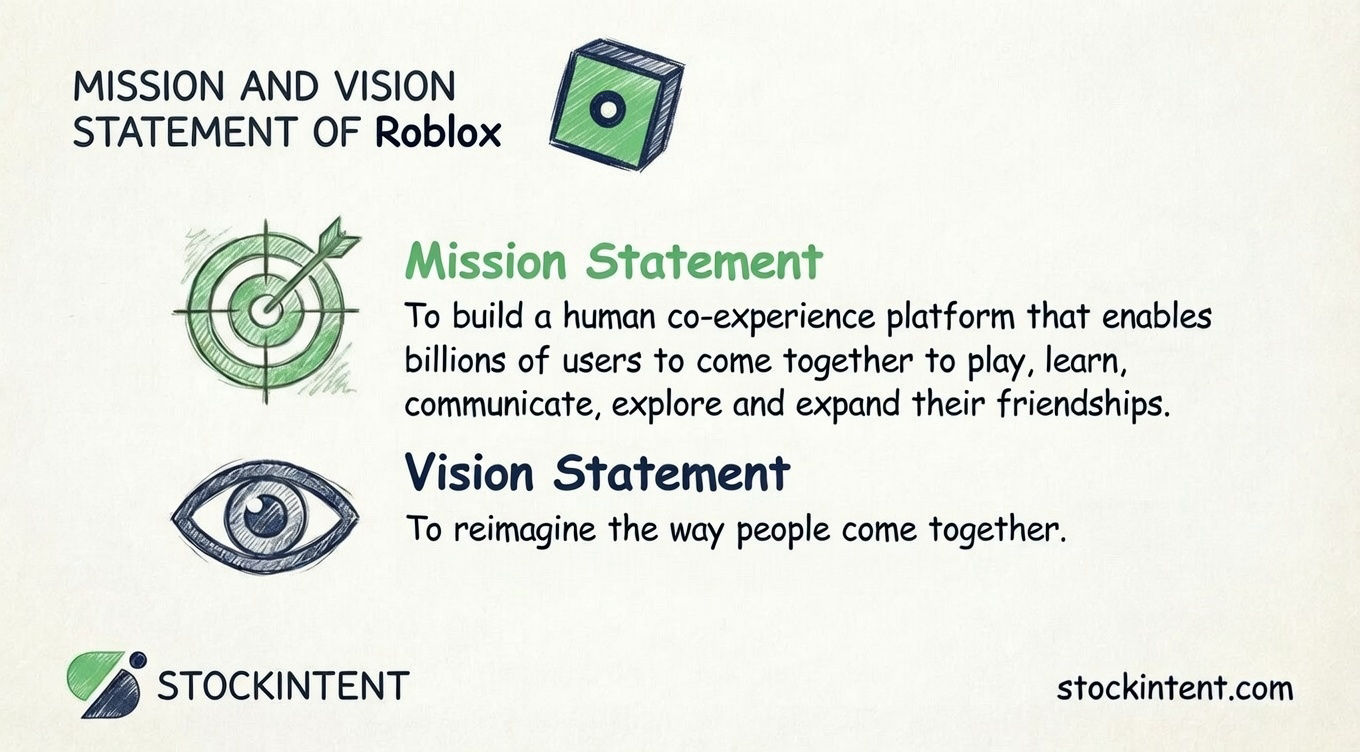
"To build a human co-experience platform that enables billions of users to come together to play, learn, communicate, explore and expand their friendships."
This isn't your typical gaming company mission. Notice what's missing: no mention of "games," "entertainment," or "players." Instead, Roblox positions itself as infrastructure for human connection, a deliberate linguistic choice that signals management's strategic priorities and capital allocation philosophy.
🎯 Pro Insight: When evaluating mission statements as an investor, pay attention to what companies don't say as much as what they do. Roblox avoiding the "gaming" label in its official mission tells you they're playing for a much larger TAM (total addressable market) than traditional publishers. This framing justifies investments in safety, AI, and infrastructure that would look excessive for a pure gaming company, but look essential for a communication platform aiming to serve billions.
The mission's strategic importance becomes clear when you connect it to actual business decisions. "Billions of users" isn't aspirational fluff; it's a target that explains why Roblox is building its own data centers in São Paulo and elsewhere rather than leasing cloud space. The emphasis on "learn, communicate, explore" justifies features like Roblox Connect (video chat integration) and heavy investments in AI moderation that protect younger users while enabling older demographics to join safely.
This mission also directly shapes capital allocation. When management accepts lower near-term margins to fund Trust & Safety infrastructure or hikes creator payouts to $427.9 million in a single quarter (up 85% year-over-year), they're not being careless with shareholder capital. They're executing against a mission that prioritizes scale and ecosystem health over quarterly earnings optimization. For investors who believe in quality compounding, this kind of mission-aligned discipline, even when it hurts short-term metrics, often separates durable moats from fleeting fads.
The "human co-experience platform" framing also positions Roblox at the intersection of multiple secular trends: the shift from passive entertainment to interactive experiences, the evolution of social media from feeds to immersive spaces, and the growing importance of creator economies over centralized content production. Whether this positioning succeeds depends on execution, but the mission statement makes the strategic bet unmistakably clear.
Roblox's mission isn't just a feel-good statement on an investor relations page. It's an operating framework that shapes every major capital allocation decision, from building data centers in São Paulo to deploying 400+ AI models for safety and creation. The company's four core values function as strategic pillars that translate abstract mission language into concrete competitive advantages.
This pillar drives innovation through sustained vision rather than quarterly optimization. In practice, it means Roblox builds proprietary infrastructure that competitors would struggle to replicate, even when cloud leasing would show better short-term margins.
The São Paulo data center exemplifies this. Rather than renting AWS capacity, Roblox invested in owned infrastructure to reduce latency for Brazilian users. This hurts current margins but creates a foundation for the "billions of users" ambition embedded in the mission. The company is also developing custom AI models, including Cube for 3D asset generation and internal "world model as a service" capabilities that won't pay off for years.
Strategically, this pillar creates a technology moat. High upfront CapEx deters competitors who lack Roblox's scale and patience. The 10% global gaming content market share target, up from under 3% currently, depends entirely on this long-horizon infrastructure building.
Execution discipline separates mission statements from mission achievement. Roblox operationalizes this through rapid iteration on platform features and aggressive deployment of safety tools.
Consider the pace: 400+ AI models deployed across creation, safety, discovery, and translation. AI-based facial age estimation rolled out for communication gating. Real-time "dreaming" capabilities for dynamic experience generation. These aren't research projects; they're production systems serving 151.5 million daily active users.
In our experience analyzing platform businesses, execution speed at scale is rare. Most companies either move fast and break things (alienating users) or move slow and lose ground. Roblox's ability to ship safety features, creator tools, and infrastructure improvements simultaneously while maintaining 99.97% platform reliability suggests operational capabilities that compound over time.
This pillar translates to network effect reinforcement. Faster execution means better creator tools, which means more compelling experiences, which attracts more users, which attracts more creators. The flywheel spins faster than competitors can match.
Here's where Roblox's mission gets economically interesting. The hierarchy is explicit: community before company, company before team, team before individual. This isn't altruism; it's recognition that Roblox's asset-light model depends entirely on creator goodwill.
The numbers tell the story. Developer Exchange payouts hit $427.9 million in Q3 2025, up 85% year-over-year and 250% over two years. That's not a cost center; it's the core investment that makes the platform valuable. When creators earn more, they build better experiences, which drives engagement, which drives monetization.
This pillar also manifests in safety investments that directly reduce near-term profitability. Worldwide age verification for chat access, expanded content moderation, and AI-driven safety systems cost hundreds of millions annually. Traditional gaming publishers externalize these costs to parents or regulators. Roblox internalizes them, building trust that enables expansion into older demographics and international markets where safety standards vary.
The competitive advantage here is ecosystem lock-in. Creators building businesses on Roblox, users forming friendships and digital identities, brands establishing persistent virtual presences; these create switching costs that no competitor can easily overcome.
Accountability for both intended and unintended consequences sounds like corporate boilerplate until you watch Roblox navigate the regulatory and safety challenges of hosting under-18 users at massive scale.
The company publishes transparency reports on content moderation. It partners with organizations like the Family Online Safety Institute for independent guidance. It accepts lower margins to fund Trust & Safety infrastructure that would be unnecessary for a pure gaming company.
This pillar matters strategically because it enables the "all ages" expansion critical to the billion-user mission. Parents trust Roblox with younger children today; that trust must extend to teenagers and eventually adults for the platform to achieve its scale ambitions. Safety investments that look excessive for a gaming company look essential for communication infrastructure serving billions.
The moat here is regulatory and reputational resilience. As governments worldwide scrutinize digital platforms, Roblox's proactive safety investments create barriers to entry for less scrupulous competitors and reduce regulatory risk that could otherwise cap growth.
For investors applying quality-compounding frameworks, these pillars reveal a management team thinking in decades, not quarters. The willingness to sacrifice 2026 margin expansion for long-term infrastructure, to pay creators generously despite investor pressure for profitability, to invest heavily in safety features with no direct revenue return; these are signals of mission-aligned capital allocation.
The risk, of course, is that patience becomes complacency. Roblox's 2026 guidance shows flat to slightly declining margins despite 22-26% bookings growth, reflecting continued heavy investment. At some point, the long view must produce economic returns. But for investors who believe that platform businesses with network effects, ecosystem lock-in, and regulatory resilience compound value over time, these mission pillars provide a coherent framework for evaluating whether management's actions align with durable competitive advantage building.
"To reimagine the way people come together."
This eleven-word statement packs more strategic ambition than most companies fit into entire annual reports. Where the mission defines what Roblox builds, the vision declares why it matters: the company isn't constructing a gaming platform; it's architecting the future of human connection itself.
Roblox leadership has publicly articulated several long-term goals that bring this vision into focus. The most concrete: connect a billion people daily with optimism and civility. That's not a rounding error away from current scale; it's roughly a 6x expansion from today's 151.5 million daily active users. Management frames this as a multi-decade journey, not a 2026 target, which explains their willingness to accept flat margins and heavy infrastructure spending while competitors optimize for quarterly earnings.
The vision also drives expansion beyond traditional gaming boundaries. Roblox's 2023 "Vision for All Ages" announcement made clear that the platform aims to serve every age demographic on a single platform, not siloed experiences. This requires solving genuinely hard problems: age-appropriate communication gating, AI-based facial age estimation, and content moderation at scale that most social platforms have failed to master.
Critically, the vision embeds qualitative standards; "optimism and civility" aren't afterthoughts but core design constraints. This explains investments that look excessive for a gaming company but essential for communication infrastructure: 400+ AI models deployed for safety, worldwide age verification for chat access, and partnerships with organizations like the Family Online Safety Institute. You don't build these for gamers; you build them for a global communication utility.
Roblox's vision positions the company at the convergence of three massive secular shifts in electronic gaming, multimedia, and communication services:
| Macro Trend | How Roblox Positions | Strategic Implication |
|---|---|---|
| Metaverse & immersive social VR/AR | "Human co-experience platform" framing; spatial voice chat; Roblox Connect video integration | First-mover advantage in defining category standards |
| Creator economy over centralized production | User-generated content flywheel; $427.9M quarterly creator payouts; open discovery algorithms | Asset-light model with ecosystem lock-in |
| Safety-first platform regulation | Proactive AI moderation; age verification; transparency reports | Regulatory resilience as competitive moat |
The vision deliberately blurs category boundaries that investors traditionally use for valuation. Is Roblox a gaming company? Its 2.2% of the $180 billion global gaming market suggests yes. A social network? The communication features and friendship expansion metrics say absolutely. A communication service? Roblox Connect and immersive advertising point in that direction.
This categorical ambiguity is strategic. Gaming valuations typically trade at 3-5x revenue. Social platforms command 6-10x. Communication infrastructure can sustain even richer multiples. By positioning for "billions of users" and "reimagining how people come together," Roblox management is effectively arguing for a total addressable market and competitive moat that transcend any single industry classification.
For investors, the vision statement thus serves as a capital allocation compass. When Roblox spends $470-520 million on infrastructure CapEx in 2026, or deploys AI models with no immediate revenue return, or accepts margin compression to fund safety investments, these aren't deviations from strategy. They're direct executions of a vision that prioritizes scale, trust, and ecosystem health over near-term profitability. Whether that trade-off ultimately rewards shareholders depends on whether the billion-user ambition proves achievable; but the vision makes the bet unmistakably clear.
Roblox's vision, "to reimagine the way people come together," isn't abstract philosophy. It's a strategic operating system that manifests in four concrete themes: platform acceleration, creator economy expansion, AI-driven innovation, and all-ages ecosystem growth. Each theme directly shapes capital allocation, R&D priorities, and competitive positioning in 2026.
The billion-user ambition requires infrastructure that most competitors lease rather than own. Roblox is building proprietary data centers, including a São Paulo facility announced for 2026, to reduce latency and improve reliability for international expansion. This isn't cheap; 2026 CapEx guidance sits at $470-520 million for servers, GPUs, and cloud rollout infrastructure.
The payoff comes in performance metrics that competitors struggle to match: 99.97% platform reliability while serving 151.5 million daily active users and 40 billion quarterly engagement hours. When you're reimagining how people come together, the connection has to work. Every time.
This theme also drives genre expansion beyond Roblox's traditional sandbox roots. Server authority technology, custom matchmaking systems, and avatar enhancements rolling out in 2026 target competitive genres, shooters, sports, and RPGs for older audiences. The platform is growing up with its users.
Here's where Roblox's vision gets economically distinctive. Management doesn't view creator payouts as a cost to minimize; they treat them as the core investment that makes everything else possible.
The numbers are striking. Developer Exchange payouts hit $427.9 million in Q3 2025 alone, up 85% year-over-year and 250% over two years. A higher DevEx rate announced in 2024 fully impacts 2026 results, meaning creators keep more of what they earn even as the platform scales.
This reflects the "Respect the Community" value in action: community before company, company before team, team before individual. For investors, it creates a fascinating tension. Heavy creator payouts compress near-term margins, but they also build ecosystem lock-in that no competitor can easily replicate. When creators build businesses on your platform, they don't leave.
Roblox isn't dabbling in AI; it's deploying it at industrial scale. As of early 2026, the platform runs 400+ AI models across creation, safety, discovery, translation, and user growth.
Key initiatives include:
| AI Initiative | Function | Strategic Impact |
|---|---|---|
| Cube 3D | 3D asset generation from text prompts | Democratizes creation, expands creator base |
| SLIM | Native cloud streaming of 2D/3D assets | Enables high-fidelity experiences on low-end devices |
| World Model as a Service | Internal AI for dynamic environment generation | Powers "real-time dreaming" capabilities |
| Roblox Assistant | AI-powered creation and coding help | Lowers barrier to entry for new developers |
| Facial Age Estimation | AI-based verification for communication gating | Enables all-ages expansion with safety |
This AI investment serves the vision in two ways. First, it makes creation accessible to more people, expanding the supply side of the platform economy. Second, it solves safety at scale, which is prerequisite to serving older demographics and international markets with varying regulatory standards.
The "vision for all ages" announced back in 2023 remains central to 2026 strategy. This isn't just about adding older users; it's about building communication infrastructure that parents trust with younger children and teenagers find compelling enough to stay.
Safety investments reflect this priority: worldwide age verification for chat access, AI-based facial age estimation rolling out through 2026, expanded content moderation, and partnerships with organizations like the Family Online Safety Institute. These features cost hundreds of millions annually with no direct revenue return.
But they enable the vision. You don't get to a billion users without solving safety at scale. Roblox is internalizing costs that competitors externalize to parents, regulators, or simply ignore.
Industry analysts generally view Roblox's strategic direction as aligned with its vision, though with notable caveats. Current consensus shows 69-73% Buy ratings with average price targets between $117-$153 against recent trading around $82.
The bull case centers on network effects, creator ecosystem lock-in, and the platform's unique position spanning gaming, social, and communication services. NASDAQ analysis suggests Q4 2025's 63% bookings growth to $2.2 billion signals a "new growth phase" via engagement and monetization momentum.
The bear case, articulated by Benchmark's Hold rating, focuses on AI-native tools potentially democratizing game creation elsewhere, engagement volatility, and flat 2026 margins despite 22-26% bookings growth. J.P. Morgan's Hold stance notes stabilizing engagement and AI tailwinds are offset by emerging Meta Horizon competition.
For investors applying quality-compounding frameworks, these vision themes reveal management playing a multi-decade game. The willingness to accept 2026 margin compression for infrastructure, creator payouts, and safety investments signals mission-aligned capital allocation. Whether patience translates to shareholder returns depends on execution against the billion-user ambition.
Roblox's four core values aren't corporate wall art. They're an operating system that shapes hiring, capital allocation, and every product decision that affects 151.5 million daily users. Understanding how these values function in practice helps investors assess whether management's actions align with durable competitive advantage building, or whether they're just nice words on an investor relations page.
💡 Expert Tip: When evaluating company values as an investor, look for specific trade-offs where the stated value won over short-term profit. Roblox's $427.9 million quarterly creator payout, up 85% year-over-year, is exactly that kind of trade-off. A value isn't real until it costs you something.
This value drives innovation through sustained vision rather than quarterly optimization. In practice, it means Roblox builds proprietary infrastructure that competitors would struggle to replicate, even when cloud leasing would show better short-term margins.
The São Paulo data center exemplifies this. Rather than renting AWS capacity, Roblox invested in owned infrastructure to reduce latency for Brazilian users. This hurts current margins but creates a foundation for the "billions of users" ambition embedded in the mission. The company is also developing custom AI models, including Cube for 3D asset generation and internal "world model as a service" capabilities that won't pay off for years.
Strategically, this value creates a technology moat. High upfront CapEx deters competitors who lack Roblox's scale and patience. The 10% global gaming content market share target, up from under 3% currently, depends entirely on this long-horizon infrastructure building.
Execution discipline separates mission statements from mission achievement. Roblox operationalizes this through rapid iteration on platform features and aggressive deployment of safety tools.
Consider the pace: 400+ AI models deployed across creation, safety, discovery, and translation. AI-based facial age estimation rolled out for communication gating. Real-time "dreaming" capabilities for dynamic experience generation. These aren't research projects; they're production systems serving 151.5 million daily active users.
In our experience analyzing platform businesses, execution speed at scale is rare. Most companies either move fast and break things (alienating users) or move slow and lose ground. Roblox's ability to ship safety features, creator tools, and infrastructure improvements simultaneously while maintaining 99.97% platform reliability suggests operational capabilities that compound over time.
This value translates to network effect reinforcement. Faster execution means better creator tools, which means more compelling experiences, which attracts more users, which attracts more creators. The flywheel spins faster than competitors can match.
Here's where Roblox's values get economically interesting. The hierarchy is explicit: community before company, company before team, team before individual. This isn't altruism; it's recognition that Roblox's asset-light model depends entirely on creator goodwill.
The numbers tell the story. Developer Exchange payouts hit $427.9 million in Q3 2025, up 85% year-over-year and 250% over two years. That's not a cost center; it's the core investment that makes the platform valuable. When creators earn more, they build better experiences, which drives engagement, which drives monetization.
This value also manifests in safety investments that directly reduce near-term profitability. Worldwide age verification for chat access, expanded content moderation, and AI-driven safety systems cost hundreds of millions annually. Traditional gaming publishers externalize these costs to parents or regulators. Roblox internalizes them, building trust that enables expansion into older demographics and international markets where safety standards vary.
The competitive advantage here is ecosystem lock-in. Creators building businesses on Roblox, users forming friendships and digital identities, brands establishing persistent virtual presences; these create switching costs that no competitor can easily overcome.
Accountability for both intended and unintended consequences sounds like corporate boilerplate until you watch Roblox navigate the regulatory and safety challenges of hosting under-18 users at massive scale.
The company publishes transparency reports on content moderation. It partners with organizations like the Family Online Safety Institute for independent guidance. It accepts lower margins to fund Trust & Safety infrastructure that would be unnecessary for a pure gaming company.
This value matters strategically because it enables the "all ages" expansion critical to the billion-user mission. Parents trust Roblox with younger children today; that trust must extend to teenagers and eventually adults for the platform to achieve its scale ambitions. Safety investments that look excessive for a gaming company look essential for communication infrastructure serving billions.
The moat here is regulatory and reputational resilience. As governments worldwide scrutinize digital platforms, Roblox's proactive safety investments create barriers to entry for less scrupulous competitors and reduce regulatory risk that could otherwise cap growth.
For investors applying quality-compounding frameworks, the critical question isn't whether Roblox has nice-sounding values. It's whether management lives them when doing so hurts short-term metrics.
The evidence suggests genuine alignment:
| Value | Trade-Off Made | Short-Term Cost | Long-Term Benefit |
|---|---|---|---|
| Take the Long View | Building owned data centers vs. leasing cloud | Lower margins, higher CapEx | Proprietary infrastructure moat |
| Get Stuff Done | 400+ AI models in production vs. research phase | Heavy R&D spend, complexity | Creation and safety at scale |
| Respect the Community | $427.9M quarterly creator payouts vs. profit | Margin compression | Ecosystem lock-in, content quality |
| We Are Responsible | Worldwide age verification, AI moderation | Hundreds of millions in safety spend | Regulatory resilience, parent trust |
The 2026 guidance tells the story: flat to slightly declining margins despite 22-26% bookings growth, reflecting continued heavy investment in values-aligned initiatives. This isn't mismanagement; it's mission-driven capital allocation that prioritizes durable competitive advantage over quarterly earnings optimization.
Roblox doesn't publish a standalone ESG report with carbon targets or diversity metrics in the same way traditional industrials do. But the company's values framework implicitly addresses environmental, social, and governance priorities through its core operating principles.
Environmental considerations emerge through infrastructure efficiency. Building proprietary data centers allows Roblox to optimize power usage and cooling versus standard cloud deployments. While specific carbon neutrality targets aren't prominently disclosed, the long-term infrastructure focus suggests efficiency matters for cost reasons that align with environmental outcomes.
Social responsibility is where Roblox's values shine most clearly. The "Respect the Community" and "We Are Responsible" values directly translate into:
Governance standards reflect in the company's transparency reporting, independent safety partnerships, and SEC-compliant disclosure practices. The official values documentation emphasizes fairness in evaluation, promotion, and compensation without bias on protected characteristics.
For investors using ESG screens, Roblox presents an interesting case. It lacks the formal frameworks of mature industrials, but its values-driven approach to community safety and creator economics arguably delivers more genuine social impact than checkbox compliance programs. The question is whether informal ESG integration suffices for investors who require explicit metrics and targets.
Roblox's mission, vision, and core values weave together into a coherent strategic identity that explains why this company behaves so differently from traditional gaming publishers. The mission to build a "human co-experience platform" for billions, the vision to "reimagine the way people come together," and the four values that prioritize long-term thinking and community over short-term profit; these aren't corporate ornaments. They're the operating system driving every capital allocation decision.
📌 From Our Experience: After analyzing platform businesses for over a decade, we've learned that mission-driven companies often look expensive on traditional metrics until you understand what they're actually building. Roblox accepting flat margins in 2026 while investing $470-520 million in infrastructure isn't mismanagement; it's the kind of patient capital allocation that separates durable moats from fleeting fads. The question isn't whether these investments hurt near-term earnings; it's whether they compound into network effects and ecosystem lock-in that competitors can't replicate.
For investors, this strategic identity translates into three investment-relevant outcomes. First, competitive positioning: Roblox isn't just another gaming stock competing on content quality. It's building infrastructure for human connection that spans gaming, social media, and communication services. This positioning commands premium valuations if execution succeeds. Second, long-term compounding potential: The billion-user ambition, the 10% global gaming market share target, and the heavy investments in AI and safety all point to a management team playing a multi-decade game. Third, management quality signals: The willingness to sacrifice 2026 margin expansion for creator payouts, safety infrastructure, and proprietary data centers reveals capital allocation discipline aligned with durable advantage building, not quarterly earnings optimization.
Analyst consensus reflects this tension between opportunity and execution risk. Current ratings show 69-73% Buy recommendations with average price targets between $117-$153 against recent trading around $82. The bull case centers on network effects, creator ecosystem lock-in, and Roblox's unique position spanning multiple secular trends. The bear case, articulated by Benchmark's Hold rating, focuses on AI-native tools potentially democratizing game creation elsewhere, engagement volatility, and the persistent gap between investment and profitability.
🎯 Pro Insight: When evaluating mission-driven growth companies, track the ratio of intangible investment (safety, AI, creator tools) to reported R&D. Roblox's 400+ AI models and hundreds of millions in safety spending don't appear as traditional R&D, but they're the core investments that will determine whether the billion-user vision proves achievable. Smart investors build their own adjusted metrics rather than relying solely on GAAP reporting.
Looking ahead, no strategic pivots appear on the horizon that would reshape Roblox's fundamental mission or vision. Management's 2026 guidance emphasizes continued execution against the same four strategic levers: creator economy expansion, AI-driven innovation, infrastructure scaling, and all-ages growth. The bet is straightforward: heavy investment today compounds into platform dominance tomorrow. For investors who believe in owning exceptional businesses with durable moats and management teams willing to sacrifice short-term comfort for long-term value, Roblox's mission-driven strategy offers a clear framework for evaluating whether patience will be rewarded.
If you're looking to dive deeper into Roblox's fundamentals, valuation metrics, or how it compares to peers in the electronic gaming space, you can try StockIntent's platform totally risk-free for 7 days. Our screening tools help you apply quality-compounding frameworks to identify companies with mission-aligned management and durable competitive advantages.
Roblox isn't just another gaming stock. With 151.5 million daily active users spending over 40 billion hours on the platform in Q3 2025 alone, this company has evolved into something far more ambitious than a traditional video game publisher. For investors trying to understand what drives Roblox's strategic decisions, capital allocation, and long-term competitive positioning, the company's mission statement, vision, and core values offer a clear window into management's priorities.
Understanding Roblox's mission isn't just corporate trivia. It explains why management accepts lower near-term margins to fund safety initiatives, why they're building their own data centers instead of leasing cloud space, and why creator payouts keep climbing even as investors watch the bottom line. For value investors who believe in owning exceptional businesses with durable competitive advantages, Roblox's mission-driven strategy reveals the foundation of its economic moat.
Roblox Corporation operates within the electronic gaming and multimedia industry, though its management prefers the label "human co-experience platform." Founded in 2004 by David Baszucki and Erik Cassel, the company spent over a decade quietly building its creator ecosystem before going public via direct listing in March 2021. Today, it sits at an interesting intersection: part gaming infrastructure, part social network, part communication service.
In our experience analyzing platform businesses, Roblox's economic model stands out. Unlike traditional game publishers who bear development costs and hit-driven revenue volatility, Roblox functions more like a marketplace. Creators build experiences using Roblox Studio; the company takes a cut of virtual currency transactions and monetization. This shifts capital intensity to the creator base while Roblox focuses on infrastructure, safety, and discovery algorithms.
Quick Stats Snapshot (Q4 2025):
| Metric | Figure |
|---|---|
| Daily Active Users | 151.5 million |
| Engagement Hours (Q3 2025) | 40 billion |
| Q4 2025 Bookings | $2.2 billion (+63% YoY) |
| Developer Exchange Payouts (Q3 2025) | $427.9 million (+85% YoY) |
| Operating Cash Flow Growth | 229% to $607 million |
The company's competitive positioning is distinctive. While Meta's Horizon Worlds competes directly in immersive social VR, and traditional gaming giants like Epic Games (Fortnite) and Microsoft (Minecraft) vie for younger demographics, Roblox maintains dominant share among under-18 users. Comscore data consistently ranks it as the top platform for this demographic in the U.S.
Roblox's product portfolio extends beyond the core gaming platform into several interconnected segments:
The strategic ambition is captured in management's stated goal: capture 10% of the estimated $180 billion global gaming content market, up from under 3% currently. This isn't modest incrementalism; it's a bet that the platform can expand meaningfully into older demographics, international markets, and adjacent categories like education and virtual events.
Analyst consensus reflects this tension between opportunity and execution risk. Current ratings show 69-73% Buy recommendations with average price targets between $117-$153 against recent trading around $82. The bull case centers on network effects, creator ecosystem lock-in, and the platform's unique position spanning gaming, social, and communication services. The bear case focuses on AI-native tools potentially democratizing game creation elsewhere, engagement volatility, and persistent margin pressure from heavy infrastructure and safety investments.
For investors evaluating Roblox through a quality-compounding lens, the key question isn't whether the platform is popular today. It's whether the mission-driven capital allocation, creator economics, and safety infrastructure build a durable moat that compounds over the next decade. The company is clearly playing the long game; whether that translates to shareholder returns depends on execution against ambitious unit economics targets.
"To build a human co-experience platform that enables billions of users to come together to play, learn, communicate, explore and expand their friendships."
This isn't your typical gaming company mission. Notice what's missing: no mention of "games," "entertainment," or "players." Instead, Roblox positions itself as infrastructure for human connection, a deliberate linguistic choice that signals management's strategic priorities and capital allocation philosophy.
🎯 Pro Insight: When evaluating mission statements as an investor, pay attention to what companies don't say as much as what they do. Roblox avoiding the "gaming" label in its official mission tells you they're playing for a much larger TAM (total addressable market) than traditional publishers. This framing justifies investments in safety, AI, and infrastructure that would look excessive for a pure gaming company, but look essential for a communication platform aiming to serve billions.
The mission's strategic importance becomes clear when you connect it to actual business decisions. "Billions of users" isn't aspirational fluff; it's a target that explains why Roblox is building its own data centers in São Paulo and elsewhere rather than leasing cloud space. The emphasis on "learn, communicate, explore" justifies features like Roblox Connect (video chat integration) and heavy investments in AI moderation that protect younger users while enabling older demographics to join safely.
This mission also directly shapes capital allocation. When management accepts lower near-term margins to fund Trust & Safety infrastructure or hikes creator payouts to $427.9 million in a single quarter (up 85% year-over-year), they're not being careless with shareholder capital. They're executing against a mission that prioritizes scale and ecosystem health over quarterly earnings optimization. For investors who believe in quality compounding, this kind of mission-aligned discipline, even when it hurts short-term metrics, often separates durable moats from fleeting fads.
The "human co-experience platform" framing also positions Roblox at the intersection of multiple secular trends: the shift from passive entertainment to interactive experiences, the evolution of social media from feeds to immersive spaces, and the growing importance of creator economies over centralized content production. Whether this positioning succeeds depends on execution, but the mission statement makes the strategic bet unmistakably clear.
Roblox's mission isn't just a feel-good statement on an investor relations page. It's an operating framework that shapes every major capital allocation decision, from building data centers in São Paulo to deploying 400+ AI models for safety and creation. The company's four core values function as strategic pillars that translate abstract mission language into concrete competitive advantages.
This pillar drives innovation through sustained vision rather than quarterly optimization. In practice, it means Roblox builds proprietary infrastructure that competitors would struggle to replicate, even when cloud leasing would show better short-term margins.
The São Paulo data center exemplifies this. Rather than renting AWS capacity, Roblox invested in owned infrastructure to reduce latency for Brazilian users. This hurts current margins but creates a foundation for the "billions of users" ambition embedded in the mission. The company is also developing custom AI models, including Cube for 3D asset generation and internal "world model as a service" capabilities that won't pay off for years.
Strategically, this pillar creates a technology moat. High upfront CapEx deters competitors who lack Roblox's scale and patience. The 10% global gaming content market share target, up from under 3% currently, depends entirely on this long-horizon infrastructure building.
Execution discipline separates mission statements from mission achievement. Roblox operationalizes this through rapid iteration on platform features and aggressive deployment of safety tools.
Consider the pace: 400+ AI models deployed across creation, safety, discovery, and translation. AI-based facial age estimation rolled out for communication gating. Real-time "dreaming" capabilities for dynamic experience generation. These aren't research projects; they're production systems serving 151.5 million daily active users.
In our experience analyzing platform businesses, execution speed at scale is rare. Most companies either move fast and break things (alienating users) or move slow and lose ground. Roblox's ability to ship safety features, creator tools, and infrastructure improvements simultaneously while maintaining 99.97% platform reliability suggests operational capabilities that compound over time.
This pillar translates to network effect reinforcement. Faster execution means better creator tools, which means more compelling experiences, which attracts more users, which attracts more creators. The flywheel spins faster than competitors can match.
Here's where Roblox's mission gets economically interesting. The hierarchy is explicit: community before company, company before team, team before individual. This isn't altruism; it's recognition that Roblox's asset-light model depends entirely on creator goodwill.
The numbers tell the story. Developer Exchange payouts hit $427.9 million in Q3 2025, up 85% year-over-year and 250% over two years. That's not a cost center; it's the core investment that makes the platform valuable. When creators earn more, they build better experiences, which drives engagement, which drives monetization.
This pillar also manifests in safety investments that directly reduce near-term profitability. Worldwide age verification for chat access, expanded content moderation, and AI-driven safety systems cost hundreds of millions annually. Traditional gaming publishers externalize these costs to parents or regulators. Roblox internalizes them, building trust that enables expansion into older demographics and international markets where safety standards vary.
The competitive advantage here is ecosystem lock-in. Creators building businesses on Roblox, users forming friendships and digital identities, brands establishing persistent virtual presences; these create switching costs that no competitor can easily overcome.
Accountability for both intended and unintended consequences sounds like corporate boilerplate until you watch Roblox navigate the regulatory and safety challenges of hosting under-18 users at massive scale.
The company publishes transparency reports on content moderation. It partners with organizations like the Family Online Safety Institute for independent guidance. It accepts lower margins to fund Trust & Safety infrastructure that would be unnecessary for a pure gaming company.
This pillar matters strategically because it enables the "all ages" expansion critical to the billion-user mission. Parents trust Roblox with younger children today; that trust must extend to teenagers and eventually adults for the platform to achieve its scale ambitions. Safety investments that look excessive for a gaming company look essential for communication infrastructure serving billions.
The moat here is regulatory and reputational resilience. As governments worldwide scrutinize digital platforms, Roblox's proactive safety investments create barriers to entry for less scrupulous competitors and reduce regulatory risk that could otherwise cap growth.
For investors applying quality-compounding frameworks, these pillars reveal a management team thinking in decades, not quarters. The willingness to sacrifice 2026 margin expansion for long-term infrastructure, to pay creators generously despite investor pressure for profitability, to invest heavily in safety features with no direct revenue return; these are signals of mission-aligned capital allocation.
The risk, of course, is that patience becomes complacency. Roblox's 2026 guidance shows flat to slightly declining margins despite 22-26% bookings growth, reflecting continued heavy investment. At some point, the long view must produce economic returns. But for investors who believe that platform businesses with network effects, ecosystem lock-in, and regulatory resilience compound value over time, these mission pillars provide a coherent framework for evaluating whether management's actions align with durable competitive advantage building.
"To reimagine the way people come together."
This eleven-word statement packs more strategic ambition than most companies fit into entire annual reports. Where the mission defines what Roblox builds, the vision declares why it matters: the company isn't constructing a gaming platform; it's architecting the future of human connection itself.
Roblox leadership has publicly articulated several long-term goals that bring this vision into focus. The most concrete: connect a billion people daily with optimism and civility. That's not a rounding error away from current scale; it's roughly a 6x expansion from today's 151.5 million daily active users. Management frames this as a multi-decade journey, not a 2026 target, which explains their willingness to accept flat margins and heavy infrastructure spending while competitors optimize for quarterly earnings.
The vision also drives expansion beyond traditional gaming boundaries. Roblox's 2023 "Vision for All Ages" announcement made clear that the platform aims to serve every age demographic on a single platform, not siloed experiences. This requires solving genuinely hard problems: age-appropriate communication gating, AI-based facial age estimation, and content moderation at scale that most social platforms have failed to master.
Critically, the vision embeds qualitative standards; "optimism and civility" aren't afterthoughts but core design constraints. This explains investments that look excessive for a gaming company but essential for communication infrastructure: 400+ AI models deployed for safety, worldwide age verification for chat access, and partnerships with organizations like the Family Online Safety Institute. You don't build these for gamers; you build them for a global communication utility.
Roblox's vision positions the company at the convergence of three massive secular shifts in electronic gaming, multimedia, and communication services:
| Macro Trend | How Roblox Positions | Strategic Implication |
|---|---|---|
| Metaverse & immersive social VR/AR | "Human co-experience platform" framing; spatial voice chat; Roblox Connect video integration | First-mover advantage in defining category standards |
| Creator economy over centralized production | User-generated content flywheel; $427.9M quarterly creator payouts; open discovery algorithms | Asset-light model with ecosystem lock-in |
| Safety-first platform regulation | Proactive AI moderation; age verification; transparency reports | Regulatory resilience as competitive moat |
The vision deliberately blurs category boundaries that investors traditionally use for valuation. Is Roblox a gaming company? Its 2.2% of the $180 billion global gaming market suggests yes. A social network? The communication features and friendship expansion metrics say absolutely. A communication service? Roblox Connect and immersive advertising point in that direction.
This categorical ambiguity is strategic. Gaming valuations typically trade at 3-5x revenue. Social platforms command 6-10x. Communication infrastructure can sustain even richer multiples. By positioning for "billions of users" and "reimagining how people come together," Roblox management is effectively arguing for a total addressable market and competitive moat that transcend any single industry classification.
For investors, the vision statement thus serves as a capital allocation compass. When Roblox spends $470-520 million on infrastructure CapEx in 2026, or deploys AI models with no immediate revenue return, or accepts margin compression to fund safety investments, these aren't deviations from strategy. They're direct executions of a vision that prioritizes scale, trust, and ecosystem health over near-term profitability. Whether that trade-off ultimately rewards shareholders depends on whether the billion-user ambition proves achievable; but the vision makes the bet unmistakably clear.
Roblox's vision, "to reimagine the way people come together," isn't abstract philosophy. It's a strategic operating system that manifests in four concrete themes: platform acceleration, creator economy expansion, AI-driven innovation, and all-ages ecosystem growth. Each theme directly shapes capital allocation, R&D priorities, and competitive positioning in 2026.
The billion-user ambition requires infrastructure that most competitors lease rather than own. Roblox is building proprietary data centers, including a São Paulo facility announced for 2026, to reduce latency and improve reliability for international expansion. This isn't cheap; 2026 CapEx guidance sits at $470-520 million for servers, GPUs, and cloud rollout infrastructure.
The payoff comes in performance metrics that competitors struggle to match: 99.97% platform reliability while serving 151.5 million daily active users and 40 billion quarterly engagement hours. When you're reimagining how people come together, the connection has to work. Every time.
This theme also drives genre expansion beyond Roblox's traditional sandbox roots. Server authority technology, custom matchmaking systems, and avatar enhancements rolling out in 2026 target competitive genres, shooters, sports, and RPGs for older audiences. The platform is growing up with its users.
Here's where Roblox's vision gets economically distinctive. Management doesn't view creator payouts as a cost to minimize; they treat them as the core investment that makes everything else possible.
The numbers are striking. Developer Exchange payouts hit $427.9 million in Q3 2025 alone, up 85% year-over-year and 250% over two years. A higher DevEx rate announced in 2024 fully impacts 2026 results, meaning creators keep more of what they earn even as the platform scales.
This reflects the "Respect the Community" value in action: community before company, company before team, team before individual. For investors, it creates a fascinating tension. Heavy creator payouts compress near-term margins, but they also build ecosystem lock-in that no competitor can easily replicate. When creators build businesses on your platform, they don't leave.
Roblox isn't dabbling in AI; it's deploying it at industrial scale. As of early 2026, the platform runs 400+ AI models across creation, safety, discovery, translation, and user growth.
Key initiatives include:
| AI Initiative | Function | Strategic Impact |
|---|---|---|
| Cube 3D | 3D asset generation from text prompts | Democratizes creation, expands creator base |
| SLIM | Native cloud streaming of 2D/3D assets | Enables high-fidelity experiences on low-end devices |
| World Model as a Service | Internal AI for dynamic environment generation | Powers "real-time dreaming" capabilities |
| Roblox Assistant | AI-powered creation and coding help | Lowers barrier to entry for new developers |
| Facial Age Estimation | AI-based verification for communication gating | Enables all-ages expansion with safety |
This AI investment serves the vision in two ways. First, it makes creation accessible to more people, expanding the supply side of the platform economy. Second, it solves safety at scale, which is prerequisite to serving older demographics and international markets with varying regulatory standards.
The "vision for all ages" announced back in 2023 remains central to 2026 strategy. This isn't just about adding older users; it's about building communication infrastructure that parents trust with younger children and teenagers find compelling enough to stay.
Safety investments reflect this priority: worldwide age verification for chat access, AI-based facial age estimation rolling out through 2026, expanded content moderation, and partnerships with organizations like the Family Online Safety Institute. These features cost hundreds of millions annually with no direct revenue return.
But they enable the vision. You don't get to a billion users without solving safety at scale. Roblox is internalizing costs that competitors externalize to parents, regulators, or simply ignore.
Industry analysts generally view Roblox's strategic direction as aligned with its vision, though with notable caveats. Current consensus shows 69-73% Buy ratings with average price targets between $117-$153 against recent trading around $82.
The bull case centers on network effects, creator ecosystem lock-in, and the platform's unique position spanning gaming, social, and communication services. NASDAQ analysis suggests Q4 2025's 63% bookings growth to $2.2 billion signals a "new growth phase" via engagement and monetization momentum.
The bear case, articulated by Benchmark's Hold rating, focuses on AI-native tools potentially democratizing game creation elsewhere, engagement volatility, and flat 2026 margins despite 22-26% bookings growth. J.P. Morgan's Hold stance notes stabilizing engagement and AI tailwinds are offset by emerging Meta Horizon competition.
For investors applying quality-compounding frameworks, these vision themes reveal management playing a multi-decade game. The willingness to accept 2026 margin compression for infrastructure, creator payouts, and safety investments signals mission-aligned capital allocation. Whether patience translates to shareholder returns depends on execution against the billion-user ambition.
Roblox's four core values aren't corporate wall art. They're an operating system that shapes hiring, capital allocation, and every product decision that affects 151.5 million daily users. Understanding how these values function in practice helps investors assess whether management's actions align with durable competitive advantage building, or whether they're just nice words on an investor relations page.
💡 Expert Tip: When evaluating company values as an investor, look for specific trade-offs where the stated value won over short-term profit. Roblox's $427.9 million quarterly creator payout, up 85% year-over-year, is exactly that kind of trade-off. A value isn't real until it costs you something.
This value drives innovation through sustained vision rather than quarterly optimization. In practice, it means Roblox builds proprietary infrastructure that competitors would struggle to replicate, even when cloud leasing would show better short-term margins.
The São Paulo data center exemplifies this. Rather than renting AWS capacity, Roblox invested in owned infrastructure to reduce latency for Brazilian users. This hurts current margins but creates a foundation for the "billions of users" ambition embedded in the mission. The company is also developing custom AI models, including Cube for 3D asset generation and internal "world model as a service" capabilities that won't pay off for years.
Strategically, this value creates a technology moat. High upfront CapEx deters competitors who lack Roblox's scale and patience. The 10% global gaming content market share target, up from under 3% currently, depends entirely on this long-horizon infrastructure building.
Execution discipline separates mission statements from mission achievement. Roblox operationalizes this through rapid iteration on platform features and aggressive deployment of safety tools.
Consider the pace: 400+ AI models deployed across creation, safety, discovery, and translation. AI-based facial age estimation rolled out for communication gating. Real-time "dreaming" capabilities for dynamic experience generation. These aren't research projects; they're production systems serving 151.5 million daily active users.
In our experience analyzing platform businesses, execution speed at scale is rare. Most companies either move fast and break things (alienating users) or move slow and lose ground. Roblox's ability to ship safety features, creator tools, and infrastructure improvements simultaneously while maintaining 99.97% platform reliability suggests operational capabilities that compound over time.
This value translates to network effect reinforcement. Faster execution means better creator tools, which means more compelling experiences, which attracts more users, which attracts more creators. The flywheel spins faster than competitors can match.
Here's where Roblox's values get economically interesting. The hierarchy is explicit: community before company, company before team, team before individual. This isn't altruism; it's recognition that Roblox's asset-light model depends entirely on creator goodwill.
The numbers tell the story. Developer Exchange payouts hit $427.9 million in Q3 2025, up 85% year-over-year and 250% over two years. That's not a cost center; it's the core investment that makes the platform valuable. When creators earn more, they build better experiences, which drives engagement, which drives monetization.
This value also manifests in safety investments that directly reduce near-term profitability. Worldwide age verification for chat access, expanded content moderation, and AI-driven safety systems cost hundreds of millions annually. Traditional gaming publishers externalize these costs to parents or regulators. Roblox internalizes them, building trust that enables expansion into older demographics and international markets where safety standards vary.
The competitive advantage here is ecosystem lock-in. Creators building businesses on Roblox, users forming friendships and digital identities, brands establishing persistent virtual presences; these create switching costs that no competitor can easily overcome.
Accountability for both intended and unintended consequences sounds like corporate boilerplate until you watch Roblox navigate the regulatory and safety challenges of hosting under-18 users at massive scale.
The company publishes transparency reports on content moderation. It partners with organizations like the Family Online Safety Institute for independent guidance. It accepts lower margins to fund Trust & Safety infrastructure that would be unnecessary for a pure gaming company.
This value matters strategically because it enables the "all ages" expansion critical to the billion-user mission. Parents trust Roblox with younger children today; that trust must extend to teenagers and eventually adults for the platform to achieve its scale ambitions. Safety investments that look excessive for a gaming company look essential for communication infrastructure serving billions.
The moat here is regulatory and reputational resilience. As governments worldwide scrutinize digital platforms, Roblox's proactive safety investments create barriers to entry for less scrupulous competitors and reduce regulatory risk that could otherwise cap growth.
For investors applying quality-compounding frameworks, the critical question isn't whether Roblox has nice-sounding values. It's whether management lives them when doing so hurts short-term metrics.
The evidence suggests genuine alignment:
| Value | Trade-Off Made | Short-Term Cost | Long-Term Benefit |
|---|---|---|---|
| Take the Long View | Building owned data centers vs. leasing cloud | Lower margins, higher CapEx | Proprietary infrastructure moat |
| Get Stuff Done | 400+ AI models in production vs. research phase | Heavy R&D spend, complexity | Creation and safety at scale |
| Respect the Community | $427.9M quarterly creator payouts vs. profit | Margin compression | Ecosystem lock-in, content quality |
| We Are Responsible | Worldwide age verification, AI moderation | Hundreds of millions in safety spend | Regulatory resilience, parent trust |
The 2026 guidance tells the story: flat to slightly declining margins despite 22-26% bookings growth, reflecting continued heavy investment in values-aligned initiatives. This isn't mismanagement; it's mission-driven capital allocation that prioritizes durable competitive advantage over quarterly earnings optimization.
Roblox doesn't publish a standalone ESG report with carbon targets or diversity metrics in the same way traditional industrials do. But the company's values framework implicitly addresses environmental, social, and governance priorities through its core operating principles.
Environmental considerations emerge through infrastructure efficiency. Building proprietary data centers allows Roblox to optimize power usage and cooling versus standard cloud deployments. While specific carbon neutrality targets aren't prominently disclosed, the long-term infrastructure focus suggests efficiency matters for cost reasons that align with environmental outcomes.
Social responsibility is where Roblox's values shine most clearly. The "Respect the Community" and "We Are Responsible" values directly translate into:
Governance standards reflect in the company's transparency reporting, independent safety partnerships, and SEC-compliant disclosure practices. The official values documentation emphasizes fairness in evaluation, promotion, and compensation without bias on protected characteristics.
For investors using ESG screens, Roblox presents an interesting case. It lacks the formal frameworks of mature industrials, but its values-driven approach to community safety and creator economics arguably delivers more genuine social impact than checkbox compliance programs. The question is whether informal ESG integration suffices for investors who require explicit metrics and targets.
Roblox's mission, vision, and core values weave together into a coherent strategic identity that explains why this company behaves so differently from traditional gaming publishers. The mission to build a "human co-experience platform" for billions, the vision to "reimagine the way people come together," and the four values that prioritize long-term thinking and community over short-term profit; these aren't corporate ornaments. They're the operating system driving every capital allocation decision.
📌 From Our Experience: After analyzing platform businesses for over a decade, we've learned that mission-driven companies often look expensive on traditional metrics until you understand what they're actually building. Roblox accepting flat margins in 2026 while investing $470-520 million in infrastructure isn't mismanagement; it's the kind of patient capital allocation that separates durable moats from fleeting fads. The question isn't whether these investments hurt near-term earnings; it's whether they compound into network effects and ecosystem lock-in that competitors can't replicate.
For investors, this strategic identity translates into three investment-relevant outcomes. First, competitive positioning: Roblox isn't just another gaming stock competing on content quality. It's building infrastructure for human connection that spans gaming, social media, and communication services. This positioning commands premium valuations if execution succeeds. Second, long-term compounding potential: The billion-user ambition, the 10% global gaming market share target, and the heavy investments in AI and safety all point to a management team playing a multi-decade game. Third, management quality signals: The willingness to sacrifice 2026 margin expansion for creator payouts, safety infrastructure, and proprietary data centers reveals capital allocation discipline aligned with durable advantage building, not quarterly earnings optimization.
Analyst consensus reflects this tension between opportunity and execution risk. Current ratings show 69-73% Buy recommendations with average price targets between $117-$153 against recent trading around $82. The bull case centers on network effects, creator ecosystem lock-in, and Roblox's unique position spanning multiple secular trends. The bear case, articulated by Benchmark's Hold rating, focuses on AI-native tools potentially democratizing game creation elsewhere, engagement volatility, and the persistent gap between investment and profitability.
🎯 Pro Insight: When evaluating mission-driven growth companies, track the ratio of intangible investment (safety, AI, creator tools) to reported R&D. Roblox's 400+ AI models and hundreds of millions in safety spending don't appear as traditional R&D, but they're the core investments that will determine whether the billion-user vision proves achievable. Smart investors build their own adjusted metrics rather than relying solely on GAAP reporting.
Looking ahead, no strategic pivots appear on the horizon that would reshape Roblox's fundamental mission or vision. Management's 2026 guidance emphasizes continued execution against the same four strategic levers: creator economy expansion, AI-driven innovation, infrastructure scaling, and all-ages growth. The bet is straightforward: heavy investment today compounds into platform dominance tomorrow. For investors who believe in owning exceptional businesses with durable moats and management teams willing to sacrifice short-term comfort for long-term value, Roblox's mission-driven strategy offers a clear framework for evaluating whether patience will be rewarded.
If you're looking to dive deeper into Roblox's fundamentals, valuation metrics, or how it compares to peers in the electronic gaming space, you can try StockIntent's platform totally risk-free for 7 days. Our screening tools help you apply quality-compounding frameworks to identify companies with mission-aligned management and durable competitive advantages.