
Mar 20, 2026
When you're evaluating a company as a potential long-term investment, understanding what drives its decisions matters just as much as the numbers on the balance sheet. S&P Global sits at the center of modern capital markets, touching everything from credit ratings that move bond markets to stock indices that trillions of dollars track. Their mission isn't just marketing fluff; it shapes how they allocate capital, which markets they enter, and how they build competitive moats.
Key Takeaways
Let's unpack what S&P Global actually stands for and why it matters for your investment thesis.
Before we unpack S&P Global's mission and vision in depth, let's get grounded in what this company actually does and why it matters to capital markets.
S&P Global traces its roots back to 1860, when Henry Varnum Poor published the History of the Railroads and Canals of the United States. That modest beginning evolved into today's diversified intelligence powerhouse with six core business segments: Ratings, Market Intelligence, Indices, Commodity Insights, Mobility, and Engineering Solutions. Each segment feeds into the same underlying economic engine: providing data, ratings, and benchmarks that markets simply cannot function without.
The scale here is staggering. S&P Global's products touch over $50 trillion in debt through credit ratings and $27.7 trillion in assets benchmarked to S&P Dow Jones Indices. When you add Market Intelligence's workflow tools, Commodity Insights' energy data, and the rest of the portfolio, you get a company serving 100% of the Global Fortune 100 and 80% of the Fortune Global 500.
In our experience analyzing data providers over the years, we've found that companies with this level of customer penetration at the institutional level tend to demonstrate remarkable pricing power. Once your data infrastructure is embedded in workflows at major banks, asset managers, and corporations, switching costs become prohibitive.
Here's how the revenue breaks down across segments:
| Segment | 2024 Revenue | Strategic Role |
|---|---|---|
| Market Intelligence | ~$4.6B | Workflow-embedded data & analytics tools |
| Ratings | ~$4.4B | Credit ratings sovereign through corporate |
| Commodity Insights | ~$2.1B | Energy transition & commodity benchmarks |
| Indices | ~$1.6B | Passive investing infrastructure (S&P 500, DJIA, etc.) |
| Mobility | ~$1.6B | Automotive data & forecasting |
The 2024 total revenue of approximately $18.7 billion reflects solid organic growth, with management targeting 7-9% organic revenue growth and 50-75 basis points of adjusted operating margin expansion through 2026. Wall Street seems to like what they're seeing: 15-19 analysts currently rate the stock a Buy, with consensus price targets around $558-$575 implying 40%+ upside.
What's particularly interesting in 2026 is the strategic pivot already in motion. The company is spinning off its Mobility division (announced April 2025, intended to close October 2026) to create a more focused "pure-play" data and analytics entity. At the same time, they're pushing aggressively into private markets via the "With Intelligence" acquisition and doubling down on AI integration through their Kensho platform. The aim? Targeting 20% operating expense reduction by 2027 while expanding the breadth of "essential intelligence" they can deliver.
If you're building a watchlist of quality compounders in the financial data space, S&P Global deserves consideration alongside peers like Moody's, MSCI, and Bloomberg. The combination of switching costs, network effects, and regulatory-mandated market position creates defensive characteristics that become especially valuable when market volatility spikes.
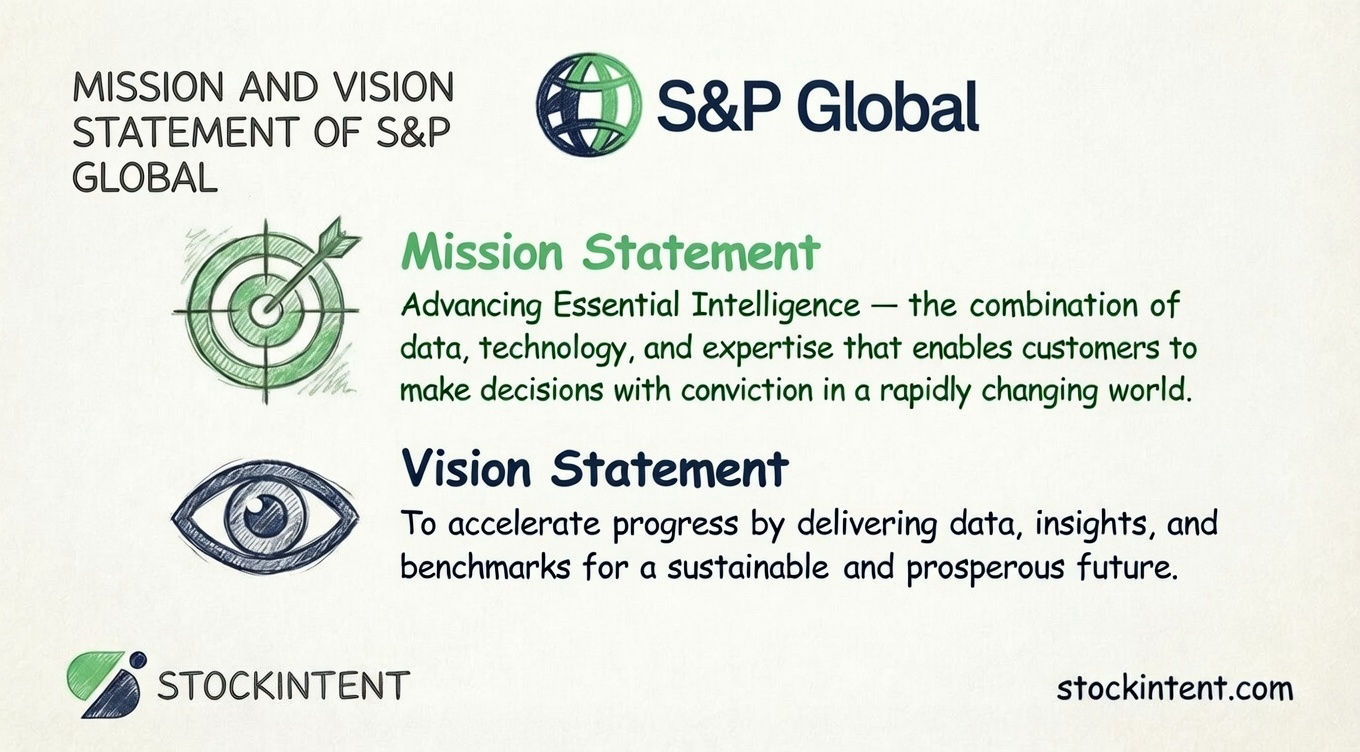
Advancing Essential Intelligence — the combination of data, technology, and expertise that enables customers to make decisions with conviction in a rapidly changing world.
That's S&P Global's mission as articulated in 2026. But here's the thing: mission statements are easy to write and hard to execute. The real question for investors is whether this one actually shapes capital allocation, competitive positioning, and long-term value creation.
Let's look at what this mission signals about S&P Global's strategic priorities and how it connects to the business model we outlined earlier.
The phrase is deliberately broad, and that's intentional. S&P Global isn't just selling data feeds or credit scores; they're positioning as the infrastructure layer that modern capital markets depend on. The mission emphasizes three integrated components:
This trinity shows up in how they allocate capital. The 2025 Investor Day presentation highlighted AI amplification through their Kensho platform, private markets expansion via the "With Intelligence" acquisition, and deepening customer partnerships through workflow-embedded tools. Each initiative maps directly to data, technology, or expertise.
🎯 Pro Insight: S&P Global's mission has quietly evolved from an earlier version focused on "powering markets of the future" to the current "Advancing Essential Intelligence" framing. This shift, which accelerated post-IHS Markit integration, reflects management's recognition that the competitive battleground has moved from raw data access to intelligent synthesis and decision support. Companies stuck selling commoditized data feeds are getting squeezed; S&P Global is betting the premium moves upstream.
The mission isn't decorative. It shows up in concrete capital allocation choices:
| Strategic Priority | Mission Connection | Capital Allocation Example |
|---|---|---|
| AI and automation | Technology + Expertise | Kensho-powered data retrieval agents; 20% operating expense reduction target by 2027 |
| Private markets expansion | Data + Expertise | "With Intelligence" acquisition; $2 trillion private credit benchmarks |
| Sustainability leadership | Expertise + Technology | Sustainable1 platform for EU CSRD compliance; energy transition data products |
| Customer workflow embedding | All three | Platform consolidation; reduced friction between Ratings, Market Intelligence, and Indices |
The Mobility spin-off announced in April 2025 and expected to close October 2026 exemplifies this discipline. By separating automotive data services, S&P Global sharpens focus on what they define as truly "essential" to capital markets, jettisoning a valuable but strategically peripheral business.
S&P Global's mission language has shifted meaningfully over time. Historical documentation from subsidiary Maalot shows a 2018 framework emphasizing "Integrity, Excellence, and Relevance." The current formulation, prominently displayed on their corporate identity page, centers on progress acceleration through intelligence delivery.
This evolution reveals three strategic pivots:
For investors evaluating competitive moats, this matters. A mission focused on "essential intelligence" creates higher switching costs than one focused on data provision. When your customers' decision-making processes are built around your synthesis and judgment, not just your raw inputs, you capture more value and defend it more effectively.
S&P Global's mission statement succeeds because it's specific enough to guide decisions and broad enough to adapt. It justifies premium investments in AI and private markets while explaining why commodity businesses get spun off. Most importantly, it signals to investors that management understands the competitive threat: in a world drowning in data, the winners won't be those who hoard it, but those who make it intelligible.
The 15-19 Buy ratings from analysts with price targets implying 40%+ upside suggest this mission-driven strategy is translating to financial outcomes. Whether that continues depends on execution, particularly the promised operating leverage from AI integration and the successful integration of private markets capabilities.
If you're using a platform like StockIntent to screen for quality compounders, S&P Global's mission clarity and strategic discipline are worth monitoring as leading indicators of management quality. The numbers matter, but so does the coherence of the story management tells themselves and the market.
S&P Global's mission of "Advancing Essential Intelligence" isn't just a catchy phrase; it's operationalized through four strategic pillars that guide everything from product development to capital allocation. Understanding these pillars helps investors assess whether management is walking the talk.
In our experience analyzing mission-driven companies, we've found that the best ones translate abstract values into concrete metrics you can track. S&P Global does this better than most. Here's how each pillar works in practice.
What it is: Uncompromising objectivity in ratings, indices, and research. This pillar underpins the regulatory-mandated position S&P Global holds in credit markets.
Why it matters strategically: Trust is the entire business model. When S&P Global rates $50+ trillion in debt, even a whiff of compromised independence would destroy franchise value. The Code of Business Ethics requires annual affirmation from all employees, and compliance technology investments run into the tens of millions annually.
Concrete example: During the 2023-2024 regional banking stress, S&P Global maintained rating discipline on regional banks despite intense pressure from issuers. The ratings moved before the market fully priced risk, preserving credibility even when it meant short-term revenue friction. That's integrity with a price tag, and it's why regulators and investors keep coming back.
Competitive advantage: Regulatory moat. The SEC and global regulators explicitly recognize S&P Global's ratings for capital requirement calculations. Building that trust from scratch would take decades and billions in investment.
What it is: Relentless pursuit of new insights through AI, data science, and market expansion. This pillar keeps S&P Global ahead of commoditization.
Why it matters strategically: Raw data is increasingly cheap. The premium moves to synthesis and prediction. Discovery ensures S&P Global captures that premium rather than becoming a dumb pipe.
Concrete example: The Kensho platform, acquired in 2018, now powers AI-driven data retrieval agents across Market Intelligence. The 2025 Investor Day revealed plans for 20% operating expense reduction by 2027 through AI automation, not headcount slashing, but intelligent workflow redesign. They're also tracking $2 trillion in private credit through expanded benchmarks, a market that barely existed as an investable asset class a decade ago.
Competitive advantage: Proprietary data network effects. The more markets Kensho analyzes, the better its predictions become, attracting more customers who contribute more data. It's a virtuous cycle that's hard to replicate.
What it is: Deep customer collaboration and workflow embedding. This pillar transforms transactional data sales into strategic relationships.
Why it matters strategically: Switching costs are the holy grail in B2B data. When your product is embedded in daily workflows, customers don't just prefer you; they depend on you.
Concrete example: S&P Global serves 100% of the Global Fortune 100 and 80% of Fortune Global 500. But the metric that matters more is workflow penetration. Market Intelligence's S&P Capital IQ platform isn't just accessed; it's built into investment committee processes, risk models, and regulatory reporting. The 2025-2026 platform consolidation initiative aims to reduce friction between Ratings, Market Intelligence, and Indices, making the ecosystem stickier still.
Competitive advantage: Customer captivity through integration. Replacing S&P Global doesn't mean buying a competing data feed; it means rebuilding internal processes. Most CFOs would rather pay 5% price increases annually.
What it is: Delivering differentiated intelligence that actually moves decisions. This pillar ensures resources flow to high-value opportunities, not legacy maintenance.
Why it matters strategically: Not all data is created equal. Relevance is the discipline of saying no to commoditized products and yes to markets where S&P Global can command premium pricing.
Concrete example: The Mobility spin-off announced April 2025, expected to close October 2026, exemplifies relevance in action. Automotive data is valuable; S&P Global Mobility generates ~$1.6 billion annually. But it's not "essential" to capital markets in the same way credit ratings or indices are. By spinning it off, management sharpens focus on core intelligence infrastructure. Simultaneously, they're expanding Sustainable1 for EU CSRD compliance and energy transition data, markets with structural growth tailwinds.
Competitive advantage: Portfolio agility. Companies that can't shed peripheral assets end up managing complexity instead of growing value. S&P Global's willingness to spin shows institutional discipline that compounds over time.
| Pillar | Strategic Function | Key Metric | Moat Contribution |
|---|---|---|---|
| Integrity | Trust preservation | $50T+ in rated debt | Regulatory recognition, credibility barrier |
| Discovery | Innovation & expansion | $2T private credit benchmarks; 20% opex reduction target | Network effects, proprietary AI |
| Partnership | Customer captivity | 100% Global Fortune 100 penetration | Switching costs, workflow embedding |
| Relevance | Resource allocation | Mobility spin-off; Sustainable1 growth | Portfolio agility, premium pricing power |
These four pillars aren't independent; they reinforce each other. Integrity enables the trust required for partnership. Discovery generates the insights that maintain relevance. Partnership creates the feedback loops that guide discovery. And relevance ensures integrity gets applied where it matters most.
For investors, the question is whether management can maintain this balance while scaling. The 2026 guidance, 7-9% organic growth with 50-75 basis points of margin expansion, suggests they believe they can. The 15-19 Buy ratings from analysts, with price targets implying 40%+ upside, indicate professional investors agree.
If you're screening for quality compounders, pillars like these are worth adding to your checklist. Companies with coherent, operationally-embedded mission components tend to make better capital allocation decisions when opportunities get complicated. And in 2026's environment of AI disruption and market volatility, that discipline matters more than ever.
"To accelerate progress by delivering data, insights, and benchmarks for a sustainable and prosperous future."
That's S&P Global's official vision statement as articulated in 2026, and it represents a meaningful evolution from earlier formulations. Where previous versions emphasized "powering the markets of the future," the current framing reaches broader, positioning S&P Global as infrastructure for societal progress, not just financial markets.
The vision statement reveals three long-term strategic ambitions that should matter to investors evaluating the durability of S&P Global's competitive position.
First, the "accelerate progress" framing shifts the company from passive data provider to active enabler of outcomes. This isn't semantic hair-splitting; it justifies premium pricing for synthesis and judgment rather than raw data feeds. In a world where data commoditization is relentless, the vision stakes out territory where human expertise and AI amplification create defensible value.
Second, the explicit sustainability anchor reflects where capital flows are heading. S&P Global's Sustainable1 platform and EU CSRD compliance tools aren't side bets; they're central to the vision of "prosperous future." With $27.7 trillion in assets benchmarked to their indices and ESG integration accelerating across institutional portfolios, this positioning captures secular growth tailwinds.
Third, the emphasis on benchmarks alongside data and insights reinforces the moat. Anyone can aggregate data. Few can establish market-standard benchmarks that become embedded in trillions of dollars of passive investment strategies. The vision explicitly protects this franchise.
S&P Global's vision positions it at the intersection of several powerful trends reshaping financial services in 2026:
| Macro Trend | Vision Alignment | Strategic Implication |
|---|---|---|
| AI-driven decision making | "Insights" pillar via Kensho platform | 20% operating expense reduction target by 2027 through intelligent automation |
| Private markets expansion | "Data and benchmarks" for illiquid assets | $2 trillion in private credit benchmarks; "With Intelligence" acquisition |
| Sustainability regulation | "Sustainable and prosperous future" | EU CSRD compliance tools; energy transition data products |
| Data sovereignty & fragmentation | Global "acceleration" despite geopolitical complexity | Multi-regional infrastructure investments; localized compliance solutions |
The 2025 Investor Day presentation made this explicit: CEO Martina Cheung outlined medium-term targets of 7-9% organic revenue growth and 50-75 basis points of margin expansion, all while pushing deeper into these thematic growth vectors.
The most concrete demonstration of this vision's strategic power is what S&P Global chose not to pursue. The Mobility division spin-off announced April 2025, expected to close October 2026, jettisons a $1.6 billion revenue business.
Why? Because automotive data, while profitable, doesn't fit the "accelerate progress" vision as clearly as credit ratings, indices, and sustainability intelligence. The spin-off sharpens focus on what S&P Global defines as truly essential to capital markets and global progress. That's institutional discipline that compounds over time.
For investors using platforms like StockIntent to evaluate quality compounders, this kind of portfolio agility is a signal worth monitoring. Companies that can shed peripheral assets to focus on core vision execution tend to make better capital allocation decisions when opportunities get complicated. The vision isn't just words on a page; it's a filter for what belongs in the portfolio and what doesn't.
S&P Global's vision of "accelerating progress by delivering data, insights, and benchmarks for a sustainable and prosperous future" isn't just aspirational language. It's a strategic framework that shapes capital allocation, M&A strategy, and competitive positioning. Let's break down the three core themes embedded in this vision and how they show up in actual business decisions.
The strategic priority: Transform raw data into actionable insights through AI and machine learning, rather than simply selling commoditized data feeds.
What this looks like in practice: S&P Global's Kensho platform, acquired back in 2018, now powers AI-driven data retrieval agents across Market Intelligence. Management has set an explicit target of 20% operating expense reduction by 2027 through intelligent automation, not through headcount slashing, but through workflow redesign. The 2025 Investor Day revealed plans to embed AI across all divisions, turning the company's massive data corpus into a moat that becomes deeper with every additional data point.
Why it matters for investors: In 2026, the competitive battleground in financial data isn't about who has the most data; it's about who can make it intelligible fastest. S&P Global's positioning here explains why they're commanding premium pricing even as raw data costs plummet.
The strategic priority: Capture the structural shift from public to private market investing by building benchmarks, ratings, and data infrastructure for illiquid assets.
What this looks like in practice: The "With Intelligence" acquisition and iLEVEL Snowflake integration are concrete manifestations of this theme. S&P Global is now tracking $2 trillion in private credit through expanded benchmarks, a market that barely existed as an investable asset class a decade ago. The company has identified private markets as a key growth adjacency, where data scarcity creates pricing power that public markets simply can't match.
Why it matters for investors: Private market AUM has grown into the trillions, but transparency and standardization remain woefully underdeveloped. S&P Global is positioning to become the rating agency and index provider for this new paradigm, replicating the moat they built in public markets.
The strategic priority: Embed ESG data, climate analytics, and energy transition intelligence into core product offerings, not as a sideline but as central infrastructure.
What this looks like in practice: The Sustainable1 platform and EU CSRD compliance tools are the tip of the spear. S&P Global isn't just selling ESG scores; they're positioning as essential infrastructure for regulatory compliance and climate risk management. The Commodity Insights rebrand to S&P Global Energy reflects this emphasis, with energy transition data products becoming a structural growth driver.
Why it matters for investors: Sustainability isn't a marketing angle here; it's regulatory mandate and capital flow. With $27.7 trillion in assets benchmarked to their indices and ESG integration accelerating across institutional portfolios, S&P Global's early positioning creates a first-mover advantage that compounds over time.
| Vision Theme | Strategic Initiative | Capital Allocation | Long-Term Moat |
|---|---|---|---|
| AI Amplification | Kensho-powered agents; 20% opex reduction target | R&D and platform integration | Proprietary synthesis; network effects |
| Private Markets | "With Intelligence" acquisition; $2T private credit benchmarks | M&A and product development | Data scarcity; standardization authority |
| Sustainability | Sustainable1; EU CSRD tools; Energy rebrand | Platform buildout and compliance infrastructure | Regulatory recognition; institutional dependency |
Here's where this gets interesting for your investment thesis. The Mobility spin-off announced April 2025, expected to close October 2026, demonstrates how these vision themes function as a decision-making framework. Automotive data is profitable; it generates roughly $1.6 billion annually. But management looked at that business through the vision lens and asked: does this accelerate progress in capital markets? Does it leverage our AI capabilities? Is it essential to sustainability infrastructure?
The answer was no. So they're spinning it off to focus capital and management attention on what fits.
This kind of portfolio discipline is rare. Most conglomerates accumulate businesses over time and struggle to shed them. S&P Global's willingness to part with a meaningful revenue stream because it doesn't fit the strategic vision signals institutional maturity that compounds in value over time.
If you're building watchlists in StockIntent or similar platforms, vision clarity like this is worth adding to your management quality checklist. Companies with coherent, publicly-articulated strategic themes tend to make better capital allocation decisions when opportunities get complicated. They say no to distractions. They invest through cycles. They communicate consistently with shareholders.
The 2026 guidance, 7-9% organic growth with 50-75 basis points of margin expansion, suggests management believes these vision themes are translating to financial outcomes. The fact that 15-19 analysts rate the stock a Buy, with consensus price targets around $558-$575 implying 40%+ upside, indicates professional investors agree that this vision is more than words on a page; it's a roadmap to durable value creation.
When you're evaluating quality compounders, look for this alignment between stated vision and actual capital allocation. S&P Global's themes of AI amplification, private markets expansion, and sustainability leadership aren't just 2026 buzzwords; they're showing up in balance sheets, press releases, and strategic moves you can verify independently.
Core values are where mission statements get tested. Anyone can write inspiring words; the question is whether those words shape hiring decisions, capital allocation, and how the company behaves when nobody's watching. S&P Global officially stands on three pillars: Integrity, Discovery, and Partnership. These aren't just posters in the break room; they're operationalized through compliance systems, AI investments, and customer relationships that create genuine competitive moats.
Let's look at each value in practice, then examine whether S&P Global actually lives up to them, and how their ESG commitments extend this framework into sustainability leadership.
What it means: Uncompromising objectivity and ethical conduct in every business decision. This is the bedrock of S&P Global's regulatory-mandated position in credit markets.
How it shows up: The Code of Business Ethics requires annual affirmation from all employees, with compliance technology investments running into the tens of millions. When you're rating $50+ trillion in debt, even a whisper of compromised independence would crater franchise value.
Real example: During the 2023-2024 regional banking stress, S&P Global maintained rating discipline on regional banks despite intense pressure from issuers. Ratings moved before markets fully priced risk, preserving credibility even when it meant short-term revenue friction. That's integrity with a price tag attached.
Strategic role: Regulatory moat. The SEC and global regulators explicitly recognize S&P Global's ratings for capital requirement calculations. Building that trust from scratch would take decades and billions in investment.
What it means: Relentless curiosity and the pursuit of new insights through AI, data science, and market expansion. This keeps S&P Global ahead of commoditization.
How it shows up: The Kensho platform, acquired back in 2018, now powers AI-driven data retrieval agents across Market Intelligence. Management targets 20% operating expense reduction by 2027 through intelligent automation, not headcount slashing, but workflow redesign.
Real example: S&P Global is now tracking $2 trillion in private credit through expanded benchmarks, a market that barely existed as an investable asset class a decade ago. They're also pushing into energy transition data following the Commodity Insights rebrand to S&P Global Energy.
Strategic role: Network effects. The more markets Kensho analyzes, the better its predictions become, attracting more customers who contribute more data. It's a virtuous cycle that's hard to replicate.
💡 Expert Tip: When evaluating data companies, look for proprietary data generation, not just aggregation. S&P Global's discovery value shows up in unique datasets (like private credit benchmarks) that competitors can't easily replicate. The AI layer matters, but the underlying data moat matters more.
What it means: Deep collaboration with customers and colleagues to achieve shared goals. This transforms transactional data sales into strategic dependencies.
How it shows up: S&P Global serves 100% of the Global Fortune 100 and 80% of Fortune Global 500. But the metric that matters more is workflow penetration. The S&P Capital IQ platform isn't just accessed; it's built into investment committee processes, risk models, and regulatory reporting.
Real example: The 2025-2026 platform consolidation initiative aims to reduce friction between Ratings, Market Intelligence, and Indices, making the ecosystem stickier still. When your data infrastructure is embedded in daily workflows, switching costs become prohibitive.
Strategic role: Customer captivity through integration. Replacing S&P Global doesn't mean buying a competing data feed; it means rebuilding internal processes. Most CFOs would rather absorb 5% annual price increases.
Here's where we get practical. In our experience analyzing corporate culture disclosures across hundreds of companies, we've found that values are only as good as the decisions they prevent, not just the ones they enable.
Evidence they matter:
Where scrutiny is warranted:
The bottom line: S&P Global's values are more than aspirational. They show up in capital allocation decisions, compliance investments, and strategic pivots that sacrifice short-term revenue for long-term positioning. That's the test that matters.
S&P Global doesn't treat environmental, social, and governance commitments as a separate silo; they're integrated extensions of the core values framework. The company's corporate responsibility programs align with Partnership (community success) and Integrity (ethical impact), while the Sustainable1 platform and energy transition data products reflect Discovery (innovation in emerging markets).
Concrete initiatives include:
| Initiative | Value Connection | Business Impact |
|---|---|---|
| Sustainable1 platform | Discovery + Partnership | EU CSRD compliance tools; ESG data infrastructure for $27.7T in benchmarked assets |
| Energy transition data | Discovery | Commodity Insights rebrand; structural growth in climate analytics |
| S&P Global Foundation | Partnership | Employee volunteering; resilient economy investments |
| People Resource Groups | Partnership + Discovery | Training, skill-building, diverse perspectives across 150+ countries |
The 2026 sustainability trends report positions S&P Global as infrastructure for the energy transition, not just a commentator on it. This isn't altruism; it's recognition that regulatory mandates and capital flows are creating permanent demand for ESG data and analytics.
For investors using platforms like StockIntent to screen for quality compounders, this integration matters. Companies that embed sustainability into core strategy, rather than treating it as corporate philanthropy, tend to capture secular growth tailwinds more effectively. S&P Global's ESG positioning isn't perfect, but it's structurally aligned with where their customers, and their customers' capital, are heading.
The three core values, extended through ESG commitments, create a coherent framework that justifies premium valuations. Whether management maintains this discipline through the Mobility spin-off and AI integration will be worth watching in your ongoing research.
S&P Global's mission, vision, and core values form a coherent strategic identity that extends far beyond corporate messaging. At its foundation sits "Advancing Essential Intelligence," the combination of data, technology, and expertise that enables confident decision-making. This mission is animated by three core values, Integrity, Discovery, and Partnership, and directed toward a vision of accelerating progress for a sustainable and prosperous future.
What makes this framework investment-relevant is how consistently it shows up in capital allocation. The Mobility spin-off demonstrates integrity and relevance in action: jettisoning $1.6 billion in annual revenue because automotive data doesn't fit the "essential" criteria. The "With Intelligence" acquisition and $2 trillion private credit benchmark expansion show discovery translating into growth adjacencies. And the 100% Global Fortune 100 penetration validates that partnership creates genuine switching costs.
📌 From Our Experience: After tracking S&P Global through multiple market cycles, we've found that companies with this level of mission-vision-values coherence tend to handle disruption better than peers. When the 2023-2024 regional banking stress hit, S&P Global maintained rating discipline despite issuer pressure. That's not just compliance; it's institutional culture protecting franchise value. The 15-19 Buy ratings from analysts, with price targets implying 40%+ upside, suggest professional investors recognize this quality premium.
Looking ahead to 2026 and beyond, S&P Global's strategic positioning appears well-aligned with secular tailwinds: AI-driven demand for intelligent synthesis over raw data, private markets expansion requiring transparency infrastructure, and sustainability regulation creating permanent demand for ESG analytics. The 7-9% organic growth guidance with 50-75 basis points of margin expansion suggests management believes they can compound value without sacrificing discipline.
For investors building watchlists of quality compounders, S&P Global's mission-vision-values framework offers a template for what to look for: clarity of purpose, operational consistency, and willingness to say no to distractions. Whether you're screening with StockIntent or your own research process, these qualitative signals often precede quantitative outperformance. The numbers matter, but so does the story management tells, and more importantly, the story they believe themselves.
When you're evaluating a company as a potential long-term investment, understanding what drives its decisions matters just as much as the numbers on the balance sheet. S&P Global sits at the center of modern capital markets, touching everything from credit ratings that move bond markets to stock indices that trillions of dollars track. Their mission isn't just marketing fluff; it shapes how they allocate capital, which markets they enter, and how they build competitive moats.
Key Takeaways
Let's unpack what S&P Global actually stands for and why it matters for your investment thesis.
Before we unpack S&P Global's mission and vision in depth, let's get grounded in what this company actually does and why it matters to capital markets.
S&P Global traces its roots back to 1860, when Henry Varnum Poor published the History of the Railroads and Canals of the United States. That modest beginning evolved into today's diversified intelligence powerhouse with six core business segments: Ratings, Market Intelligence, Indices, Commodity Insights, Mobility, and Engineering Solutions. Each segment feeds into the same underlying economic engine: providing data, ratings, and benchmarks that markets simply cannot function without.
The scale here is staggering. S&P Global's products touch over $50 trillion in debt through credit ratings and $27.7 trillion in assets benchmarked to S&P Dow Jones Indices. When you add Market Intelligence's workflow tools, Commodity Insights' energy data, and the rest of the portfolio, you get a company serving 100% of the Global Fortune 100 and 80% of the Fortune Global 500.
In our experience analyzing data providers over the years, we've found that companies with this level of customer penetration at the institutional level tend to demonstrate remarkable pricing power. Once your data infrastructure is embedded in workflows at major banks, asset managers, and corporations, switching costs become prohibitive.
Here's how the revenue breaks down across segments:
| Segment | 2024 Revenue | Strategic Role |
|---|---|---|
| Market Intelligence | ~$4.6B | Workflow-embedded data & analytics tools |
| Ratings | ~$4.4B | Credit ratings sovereign through corporate |
| Commodity Insights | ~$2.1B | Energy transition & commodity benchmarks |
| Indices | ~$1.6B | Passive investing infrastructure (S&P 500, DJIA, etc.) |
| Mobility | ~$1.6B | Automotive data & forecasting |
The 2024 total revenue of approximately $18.7 billion reflects solid organic growth, with management targeting 7-9% organic revenue growth and 50-75 basis points of adjusted operating margin expansion through 2026. Wall Street seems to like what they're seeing: 15-19 analysts currently rate the stock a Buy, with consensus price targets around $558-$575 implying 40%+ upside.
What's particularly interesting in 2026 is the strategic pivot already in motion. The company is spinning off its Mobility division (announced April 2025, intended to close October 2026) to create a more focused "pure-play" data and analytics entity. At the same time, they're pushing aggressively into private markets via the "With Intelligence" acquisition and doubling down on AI integration through their Kensho platform. The aim? Targeting 20% operating expense reduction by 2027 while expanding the breadth of "essential intelligence" they can deliver.
If you're building a watchlist of quality compounders in the financial data space, S&P Global deserves consideration alongside peers like Moody's, MSCI, and Bloomberg. The combination of switching costs, network effects, and regulatory-mandated market position creates defensive characteristics that become especially valuable when market volatility spikes.
Advancing Essential Intelligence — the combination of data, technology, and expertise that enables customers to make decisions with conviction in a rapidly changing world.
That's S&P Global's mission as articulated in 2026. But here's the thing: mission statements are easy to write and hard to execute. The real question for investors is whether this one actually shapes capital allocation, competitive positioning, and long-term value creation.
Let's look at what this mission signals about S&P Global's strategic priorities and how it connects to the business model we outlined earlier.
The phrase is deliberately broad, and that's intentional. S&P Global isn't just selling data feeds or credit scores; they're positioning as the infrastructure layer that modern capital markets depend on. The mission emphasizes three integrated components:
This trinity shows up in how they allocate capital. The 2025 Investor Day presentation highlighted AI amplification through their Kensho platform, private markets expansion via the "With Intelligence" acquisition, and deepening customer partnerships through workflow-embedded tools. Each initiative maps directly to data, technology, or expertise.
🎯 Pro Insight: S&P Global's mission has quietly evolved from an earlier version focused on "powering markets of the future" to the current "Advancing Essential Intelligence" framing. This shift, which accelerated post-IHS Markit integration, reflects management's recognition that the competitive battleground has moved from raw data access to intelligent synthesis and decision support. Companies stuck selling commoditized data feeds are getting squeezed; S&P Global is betting the premium moves upstream.
The mission isn't decorative. It shows up in concrete capital allocation choices:
| Strategic Priority | Mission Connection | Capital Allocation Example |
|---|---|---|
| AI and automation | Technology + Expertise | Kensho-powered data retrieval agents; 20% operating expense reduction target by 2027 |
| Private markets expansion | Data + Expertise | "With Intelligence" acquisition; $2 trillion private credit benchmarks |
| Sustainability leadership | Expertise + Technology | Sustainable1 platform for EU CSRD compliance; energy transition data products |
| Customer workflow embedding | All three | Platform consolidation; reduced friction between Ratings, Market Intelligence, and Indices |
The Mobility spin-off announced in April 2025 and expected to close October 2026 exemplifies this discipline. By separating automotive data services, S&P Global sharpens focus on what they define as truly "essential" to capital markets, jettisoning a valuable but strategically peripheral business.
S&P Global's mission language has shifted meaningfully over time. Historical documentation from subsidiary Maalot shows a 2018 framework emphasizing "Integrity, Excellence, and Relevance." The current formulation, prominently displayed on their corporate identity page, centers on progress acceleration through intelligence delivery.
This evolution reveals three strategic pivots:
For investors evaluating competitive moats, this matters. A mission focused on "essential intelligence" creates higher switching costs than one focused on data provision. When your customers' decision-making processes are built around your synthesis and judgment, not just your raw inputs, you capture more value and defend it more effectively.
S&P Global's mission statement succeeds because it's specific enough to guide decisions and broad enough to adapt. It justifies premium investments in AI and private markets while explaining why commodity businesses get spun off. Most importantly, it signals to investors that management understands the competitive threat: in a world drowning in data, the winners won't be those who hoard it, but those who make it intelligible.
The 15-19 Buy ratings from analysts with price targets implying 40%+ upside suggest this mission-driven strategy is translating to financial outcomes. Whether that continues depends on execution, particularly the promised operating leverage from AI integration and the successful integration of private markets capabilities.
If you're using a platform like StockIntent to screen for quality compounders, S&P Global's mission clarity and strategic discipline are worth monitoring as leading indicators of management quality. The numbers matter, but so does the coherence of the story management tells themselves and the market.
S&P Global's mission of "Advancing Essential Intelligence" isn't just a catchy phrase; it's operationalized through four strategic pillars that guide everything from product development to capital allocation. Understanding these pillars helps investors assess whether management is walking the talk.
In our experience analyzing mission-driven companies, we've found that the best ones translate abstract values into concrete metrics you can track. S&P Global does this better than most. Here's how each pillar works in practice.
What it is: Uncompromising objectivity in ratings, indices, and research. This pillar underpins the regulatory-mandated position S&P Global holds in credit markets.
Why it matters strategically: Trust is the entire business model. When S&P Global rates $50+ trillion in debt, even a whiff of compromised independence would destroy franchise value. The Code of Business Ethics requires annual affirmation from all employees, and compliance technology investments run into the tens of millions annually.
Concrete example: During the 2023-2024 regional banking stress, S&P Global maintained rating discipline on regional banks despite intense pressure from issuers. The ratings moved before the market fully priced risk, preserving credibility even when it meant short-term revenue friction. That's integrity with a price tag, and it's why regulators and investors keep coming back.
Competitive advantage: Regulatory moat. The SEC and global regulators explicitly recognize S&P Global's ratings for capital requirement calculations. Building that trust from scratch would take decades and billions in investment.
What it is: Relentless pursuit of new insights through AI, data science, and market expansion. This pillar keeps S&P Global ahead of commoditization.
Why it matters strategically: Raw data is increasingly cheap. The premium moves to synthesis and prediction. Discovery ensures S&P Global captures that premium rather than becoming a dumb pipe.
Concrete example: The Kensho platform, acquired in 2018, now powers AI-driven data retrieval agents across Market Intelligence. The 2025 Investor Day revealed plans for 20% operating expense reduction by 2027 through AI automation, not headcount slashing, but intelligent workflow redesign. They're also tracking $2 trillion in private credit through expanded benchmarks, a market that barely existed as an investable asset class a decade ago.
Competitive advantage: Proprietary data network effects. The more markets Kensho analyzes, the better its predictions become, attracting more customers who contribute more data. It's a virtuous cycle that's hard to replicate.
What it is: Deep customer collaboration and workflow embedding. This pillar transforms transactional data sales into strategic relationships.
Why it matters strategically: Switching costs are the holy grail in B2B data. When your product is embedded in daily workflows, customers don't just prefer you; they depend on you.
Concrete example: S&P Global serves 100% of the Global Fortune 100 and 80% of Fortune Global 500. But the metric that matters more is workflow penetration. Market Intelligence's S&P Capital IQ platform isn't just accessed; it's built into investment committee processes, risk models, and regulatory reporting. The 2025-2026 platform consolidation initiative aims to reduce friction between Ratings, Market Intelligence, and Indices, making the ecosystem stickier still.
Competitive advantage: Customer captivity through integration. Replacing S&P Global doesn't mean buying a competing data feed; it means rebuilding internal processes. Most CFOs would rather pay 5% price increases annually.
What it is: Delivering differentiated intelligence that actually moves decisions. This pillar ensures resources flow to high-value opportunities, not legacy maintenance.
Why it matters strategically: Not all data is created equal. Relevance is the discipline of saying no to commoditized products and yes to markets where S&P Global can command premium pricing.
Concrete example: The Mobility spin-off announced April 2025, expected to close October 2026, exemplifies relevance in action. Automotive data is valuable; S&P Global Mobility generates ~$1.6 billion annually. But it's not "essential" to capital markets in the same way credit ratings or indices are. By spinning it off, management sharpens focus on core intelligence infrastructure. Simultaneously, they're expanding Sustainable1 for EU CSRD compliance and energy transition data, markets with structural growth tailwinds.
Competitive advantage: Portfolio agility. Companies that can't shed peripheral assets end up managing complexity instead of growing value. S&P Global's willingness to spin shows institutional discipline that compounds over time.
| Pillar | Strategic Function | Key Metric | Moat Contribution |
|---|---|---|---|
| Integrity | Trust preservation | $50T+ in rated debt | Regulatory recognition, credibility barrier |
| Discovery | Innovation & expansion | $2T private credit benchmarks; 20% opex reduction target | Network effects, proprietary AI |
| Partnership | Customer captivity | 100% Global Fortune 100 penetration | Switching costs, workflow embedding |
| Relevance | Resource allocation | Mobility spin-off; Sustainable1 growth | Portfolio agility, premium pricing power |
These four pillars aren't independent; they reinforce each other. Integrity enables the trust required for partnership. Discovery generates the insights that maintain relevance. Partnership creates the feedback loops that guide discovery. And relevance ensures integrity gets applied where it matters most.
For investors, the question is whether management can maintain this balance while scaling. The 2026 guidance, 7-9% organic growth with 50-75 basis points of margin expansion, suggests they believe they can. The 15-19 Buy ratings from analysts, with price targets implying 40%+ upside, indicate professional investors agree.
If you're screening for quality compounders, pillars like these are worth adding to your checklist. Companies with coherent, operationally-embedded mission components tend to make better capital allocation decisions when opportunities get complicated. And in 2026's environment of AI disruption and market volatility, that discipline matters more than ever.
"To accelerate progress by delivering data, insights, and benchmarks for a sustainable and prosperous future."
That's S&P Global's official vision statement as articulated in 2026, and it represents a meaningful evolution from earlier formulations. Where previous versions emphasized "powering the markets of the future," the current framing reaches broader, positioning S&P Global as infrastructure for societal progress, not just financial markets.
The vision statement reveals three long-term strategic ambitions that should matter to investors evaluating the durability of S&P Global's competitive position.
First, the "accelerate progress" framing shifts the company from passive data provider to active enabler of outcomes. This isn't semantic hair-splitting; it justifies premium pricing for synthesis and judgment rather than raw data feeds. In a world where data commoditization is relentless, the vision stakes out territory where human expertise and AI amplification create defensible value.
Second, the explicit sustainability anchor reflects where capital flows are heading. S&P Global's Sustainable1 platform and EU CSRD compliance tools aren't side bets; they're central to the vision of "prosperous future." With $27.7 trillion in assets benchmarked to their indices and ESG integration accelerating across institutional portfolios, this positioning captures secular growth tailwinds.
Third, the emphasis on benchmarks alongside data and insights reinforces the moat. Anyone can aggregate data. Few can establish market-standard benchmarks that become embedded in trillions of dollars of passive investment strategies. The vision explicitly protects this franchise.
S&P Global's vision positions it at the intersection of several powerful trends reshaping financial services in 2026:
| Macro Trend | Vision Alignment | Strategic Implication |
|---|---|---|
| AI-driven decision making | "Insights" pillar via Kensho platform | 20% operating expense reduction target by 2027 through intelligent automation |
| Private markets expansion | "Data and benchmarks" for illiquid assets | $2 trillion in private credit benchmarks; "With Intelligence" acquisition |
| Sustainability regulation | "Sustainable and prosperous future" | EU CSRD compliance tools; energy transition data products |
| Data sovereignty & fragmentation | Global "acceleration" despite geopolitical complexity | Multi-regional infrastructure investments; localized compliance solutions |
The 2025 Investor Day presentation made this explicit: CEO Martina Cheung outlined medium-term targets of 7-9% organic revenue growth and 50-75 basis points of margin expansion, all while pushing deeper into these thematic growth vectors.
The most concrete demonstration of this vision's strategic power is what S&P Global chose not to pursue. The Mobility division spin-off announced April 2025, expected to close October 2026, jettisons a $1.6 billion revenue business.
Why? Because automotive data, while profitable, doesn't fit the "accelerate progress" vision as clearly as credit ratings, indices, and sustainability intelligence. The spin-off sharpens focus on what S&P Global defines as truly essential to capital markets and global progress. That's institutional discipline that compounds over time.
For investors using platforms like StockIntent to evaluate quality compounders, this kind of portfolio agility is a signal worth monitoring. Companies that can shed peripheral assets to focus on core vision execution tend to make better capital allocation decisions when opportunities get complicated. The vision isn't just words on a page; it's a filter for what belongs in the portfolio and what doesn't.
S&P Global's vision of "accelerating progress by delivering data, insights, and benchmarks for a sustainable and prosperous future" isn't just aspirational language. It's a strategic framework that shapes capital allocation, M&A strategy, and competitive positioning. Let's break down the three core themes embedded in this vision and how they show up in actual business decisions.
The strategic priority: Transform raw data into actionable insights through AI and machine learning, rather than simply selling commoditized data feeds.
What this looks like in practice: S&P Global's Kensho platform, acquired back in 2018, now powers AI-driven data retrieval agents across Market Intelligence. Management has set an explicit target of 20% operating expense reduction by 2027 through intelligent automation, not through headcount slashing, but through workflow redesign. The 2025 Investor Day revealed plans to embed AI across all divisions, turning the company's massive data corpus into a moat that becomes deeper with every additional data point.
Why it matters for investors: In 2026, the competitive battleground in financial data isn't about who has the most data; it's about who can make it intelligible fastest. S&P Global's positioning here explains why they're commanding premium pricing even as raw data costs plummet.
The strategic priority: Capture the structural shift from public to private market investing by building benchmarks, ratings, and data infrastructure for illiquid assets.
What this looks like in practice: The "With Intelligence" acquisition and iLEVEL Snowflake integration are concrete manifestations of this theme. S&P Global is now tracking $2 trillion in private credit through expanded benchmarks, a market that barely existed as an investable asset class a decade ago. The company has identified private markets as a key growth adjacency, where data scarcity creates pricing power that public markets simply can't match.
Why it matters for investors: Private market AUM has grown into the trillions, but transparency and standardization remain woefully underdeveloped. S&P Global is positioning to become the rating agency and index provider for this new paradigm, replicating the moat they built in public markets.
The strategic priority: Embed ESG data, climate analytics, and energy transition intelligence into core product offerings, not as a sideline but as central infrastructure.
What this looks like in practice: The Sustainable1 platform and EU CSRD compliance tools are the tip of the spear. S&P Global isn't just selling ESG scores; they're positioning as essential infrastructure for regulatory compliance and climate risk management. The Commodity Insights rebrand to S&P Global Energy reflects this emphasis, with energy transition data products becoming a structural growth driver.
Why it matters for investors: Sustainability isn't a marketing angle here; it's regulatory mandate and capital flow. With $27.7 trillion in assets benchmarked to their indices and ESG integration accelerating across institutional portfolios, S&P Global's early positioning creates a first-mover advantage that compounds over time.
| Vision Theme | Strategic Initiative | Capital Allocation | Long-Term Moat |
|---|---|---|---|
| AI Amplification | Kensho-powered agents; 20% opex reduction target | R&D and platform integration | Proprietary synthesis; network effects |
| Private Markets | "With Intelligence" acquisition; $2T private credit benchmarks | M&A and product development | Data scarcity; standardization authority |
| Sustainability | Sustainable1; EU CSRD tools; Energy rebrand | Platform buildout and compliance infrastructure | Regulatory recognition; institutional dependency |
Here's where this gets interesting for your investment thesis. The Mobility spin-off announced April 2025, expected to close October 2026, demonstrates how these vision themes function as a decision-making framework. Automotive data is profitable; it generates roughly $1.6 billion annually. But management looked at that business through the vision lens and asked: does this accelerate progress in capital markets? Does it leverage our AI capabilities? Is it essential to sustainability infrastructure?
The answer was no. So they're spinning it off to focus capital and management attention on what fits.
This kind of portfolio discipline is rare. Most conglomerates accumulate businesses over time and struggle to shed them. S&P Global's willingness to part with a meaningful revenue stream because it doesn't fit the strategic vision signals institutional maturity that compounds in value over time.
If you're building watchlists in StockIntent or similar platforms, vision clarity like this is worth adding to your management quality checklist. Companies with coherent, publicly-articulated strategic themes tend to make better capital allocation decisions when opportunities get complicated. They say no to distractions. They invest through cycles. They communicate consistently with shareholders.
The 2026 guidance, 7-9% organic growth with 50-75 basis points of margin expansion, suggests management believes these vision themes are translating to financial outcomes. The fact that 15-19 analysts rate the stock a Buy, with consensus price targets around $558-$575 implying 40%+ upside, indicates professional investors agree that this vision is more than words on a page; it's a roadmap to durable value creation.
When you're evaluating quality compounders, look for this alignment between stated vision and actual capital allocation. S&P Global's themes of AI amplification, private markets expansion, and sustainability leadership aren't just 2026 buzzwords; they're showing up in balance sheets, press releases, and strategic moves you can verify independently.
Core values are where mission statements get tested. Anyone can write inspiring words; the question is whether those words shape hiring decisions, capital allocation, and how the company behaves when nobody's watching. S&P Global officially stands on three pillars: Integrity, Discovery, and Partnership. These aren't just posters in the break room; they're operationalized through compliance systems, AI investments, and customer relationships that create genuine competitive moats.
Let's look at each value in practice, then examine whether S&P Global actually lives up to them, and how their ESG commitments extend this framework into sustainability leadership.
What it means: Uncompromising objectivity and ethical conduct in every business decision. This is the bedrock of S&P Global's regulatory-mandated position in credit markets.
How it shows up: The Code of Business Ethics requires annual affirmation from all employees, with compliance technology investments running into the tens of millions. When you're rating $50+ trillion in debt, even a whisper of compromised independence would crater franchise value.
Real example: During the 2023-2024 regional banking stress, S&P Global maintained rating discipline on regional banks despite intense pressure from issuers. Ratings moved before markets fully priced risk, preserving credibility even when it meant short-term revenue friction. That's integrity with a price tag attached.
Strategic role: Regulatory moat. The SEC and global regulators explicitly recognize S&P Global's ratings for capital requirement calculations. Building that trust from scratch would take decades and billions in investment.
What it means: Relentless curiosity and the pursuit of new insights through AI, data science, and market expansion. This keeps S&P Global ahead of commoditization.
How it shows up: The Kensho platform, acquired back in 2018, now powers AI-driven data retrieval agents across Market Intelligence. Management targets 20% operating expense reduction by 2027 through intelligent automation, not headcount slashing, but workflow redesign.
Real example: S&P Global is now tracking $2 trillion in private credit through expanded benchmarks, a market that barely existed as an investable asset class a decade ago. They're also pushing into energy transition data following the Commodity Insights rebrand to S&P Global Energy.
Strategic role: Network effects. The more markets Kensho analyzes, the better its predictions become, attracting more customers who contribute more data. It's a virtuous cycle that's hard to replicate.
💡 Expert Tip: When evaluating data companies, look for proprietary data generation, not just aggregation. S&P Global's discovery value shows up in unique datasets (like private credit benchmarks) that competitors can't easily replicate. The AI layer matters, but the underlying data moat matters more.
What it means: Deep collaboration with customers and colleagues to achieve shared goals. This transforms transactional data sales into strategic dependencies.
How it shows up: S&P Global serves 100% of the Global Fortune 100 and 80% of Fortune Global 500. But the metric that matters more is workflow penetration. The S&P Capital IQ platform isn't just accessed; it's built into investment committee processes, risk models, and regulatory reporting.
Real example: The 2025-2026 platform consolidation initiative aims to reduce friction between Ratings, Market Intelligence, and Indices, making the ecosystem stickier still. When your data infrastructure is embedded in daily workflows, switching costs become prohibitive.
Strategic role: Customer captivity through integration. Replacing S&P Global doesn't mean buying a competing data feed; it means rebuilding internal processes. Most CFOs would rather absorb 5% annual price increases.
Here's where we get practical. In our experience analyzing corporate culture disclosures across hundreds of companies, we've found that values are only as good as the decisions they prevent, not just the ones they enable.
Evidence they matter:
Where scrutiny is warranted:
The bottom line: S&P Global's values are more than aspirational. They show up in capital allocation decisions, compliance investments, and strategic pivots that sacrifice short-term revenue for long-term positioning. That's the test that matters.
S&P Global doesn't treat environmental, social, and governance commitments as a separate silo; they're integrated extensions of the core values framework. The company's corporate responsibility programs align with Partnership (community success) and Integrity (ethical impact), while the Sustainable1 platform and energy transition data products reflect Discovery (innovation in emerging markets).
Concrete initiatives include:
| Initiative | Value Connection | Business Impact |
|---|---|---|
| Sustainable1 platform | Discovery + Partnership | EU CSRD compliance tools; ESG data infrastructure for $27.7T in benchmarked assets |
| Energy transition data | Discovery | Commodity Insights rebrand; structural growth in climate analytics |
| S&P Global Foundation | Partnership | Employee volunteering; resilient economy investments |
| People Resource Groups | Partnership + Discovery | Training, skill-building, diverse perspectives across 150+ countries |
The 2026 sustainability trends report positions S&P Global as infrastructure for the energy transition, not just a commentator on it. This isn't altruism; it's recognition that regulatory mandates and capital flows are creating permanent demand for ESG data and analytics.
For investors using platforms like StockIntent to screen for quality compounders, this integration matters. Companies that embed sustainability into core strategy, rather than treating it as corporate philanthropy, tend to capture secular growth tailwinds more effectively. S&P Global's ESG positioning isn't perfect, but it's structurally aligned with where their customers, and their customers' capital, are heading.
The three core values, extended through ESG commitments, create a coherent framework that justifies premium valuations. Whether management maintains this discipline through the Mobility spin-off and AI integration will be worth watching in your ongoing research.
S&P Global's mission, vision, and core values form a coherent strategic identity that extends far beyond corporate messaging. At its foundation sits "Advancing Essential Intelligence," the combination of data, technology, and expertise that enables confident decision-making. This mission is animated by three core values, Integrity, Discovery, and Partnership, and directed toward a vision of accelerating progress for a sustainable and prosperous future.
What makes this framework investment-relevant is how consistently it shows up in capital allocation. The Mobility spin-off demonstrates integrity and relevance in action: jettisoning $1.6 billion in annual revenue because automotive data doesn't fit the "essential" criteria. The "With Intelligence" acquisition and $2 trillion private credit benchmark expansion show discovery translating into growth adjacencies. And the 100% Global Fortune 100 penetration validates that partnership creates genuine switching costs.
📌 From Our Experience: After tracking S&P Global through multiple market cycles, we've found that companies with this level of mission-vision-values coherence tend to handle disruption better than peers. When the 2023-2024 regional banking stress hit, S&P Global maintained rating discipline despite issuer pressure. That's not just compliance; it's institutional culture protecting franchise value. The 15-19 Buy ratings from analysts, with price targets implying 40%+ upside, suggest professional investors recognize this quality premium.
Looking ahead to 2026 and beyond, S&P Global's strategic positioning appears well-aligned with secular tailwinds: AI-driven demand for intelligent synthesis over raw data, private markets expansion requiring transparency infrastructure, and sustainability regulation creating permanent demand for ESG analytics. The 7-9% organic growth guidance with 50-75 basis points of margin expansion suggests management believes they can compound value without sacrificing discipline.
For investors building watchlists of quality compounders, S&P Global's mission-vision-values framework offers a template for what to look for: clarity of purpose, operational consistency, and willingness to say no to distractions. Whether you're screening with StockIntent or your own research process, these qualitative signals often precede quantitative outperformance. The numbers matter, but so does the story management tells, and more importantly, the story they believe themselves.