
Sep 19, 2026
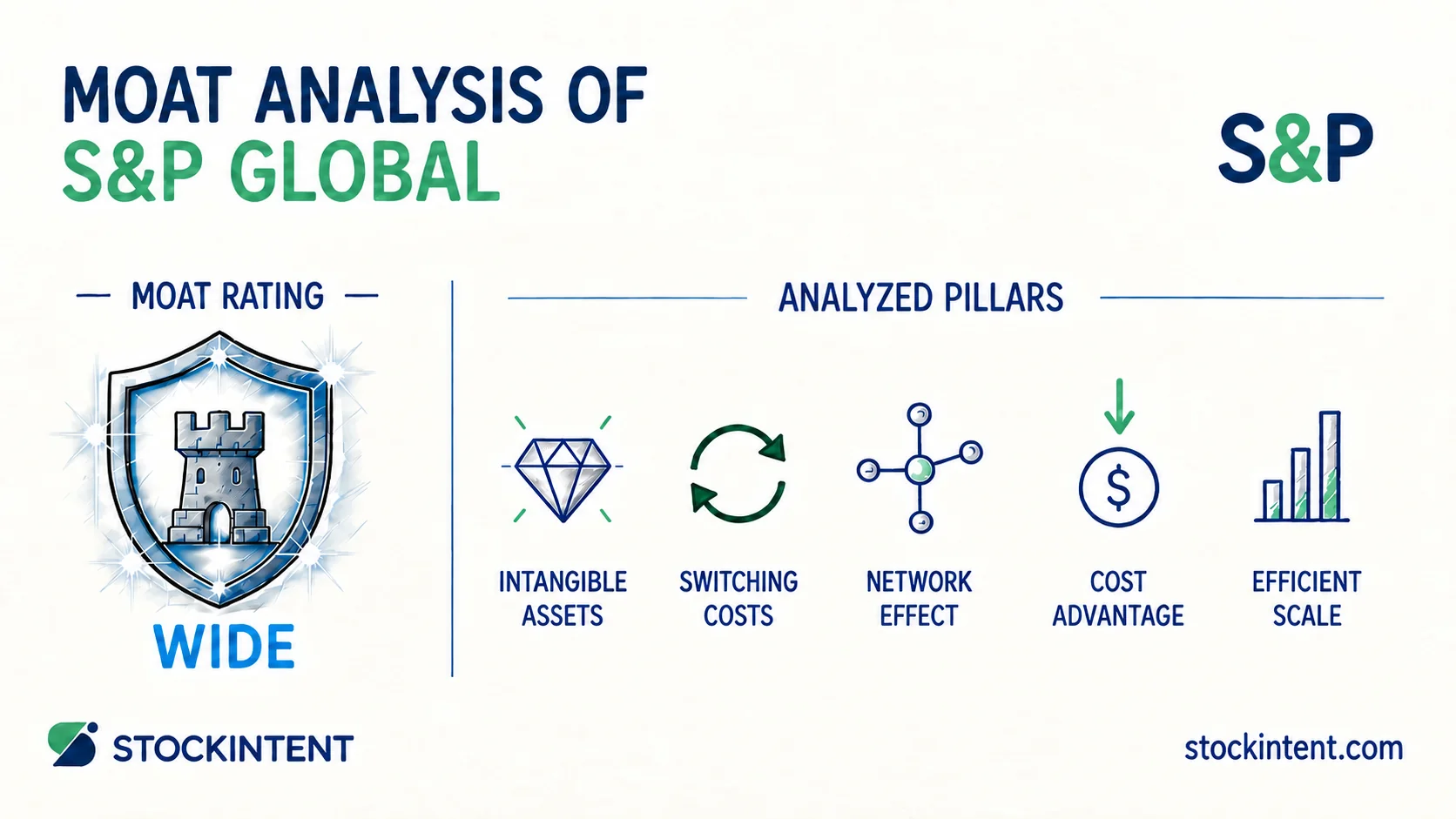
S&P Global earns a Wide economic moat rating, a Stable moat trend, and a Medium uncertainty rating. For quality-focused investors, moat durability matters far more than trying to time price swings. A durable moat protects economic goodwill and lets a business compound returns on capital year after year without getting competed away.
Recent results confirm this structural edge. In S&P Global's Q2 2026 earnings release, the company reported 11% pro forma revenue growth (10% reported). During the quarter, adjusted operating margins expanded to 54.3%, gross margin reached 70.47%, and return on equity stood at 15%. Ratings revenue grew 17% while Indices revenue rose 20%, showing that the core franchises are not only defensive; they are thriving.
Here is what you need to know about S&P Global's competitive position:
S&P Global defends its business economics through durable franchise strength rather than cheap valuation multiples. For long-term investors, exceptional businesses compound wealth because their structural advantages prevent competitors from eroding excess returns. In Q2 2026, the company generated an adjusted operating margin of 54.3% and a 15% return on equity. Those numbers indicate real competitive insulation. Breaking down the five classic moat pillars shows where this protection lives in detail.
Brand reputation and institutional credibility form S&P Global's deepest protective barrier. In credit ratings, decades of history have turned the S&P brand into a trusted regulatory and financial standard. Bond issuers need ratings that institutional buyers accept without question. In its 2026 moat evaluation, Morningstar reaffirmed S&P Global's wide moat rating, highlighting multidecade track records and institutional trust. You cannot replicate a century of reputational capital overnight.
S&P Global's data feeds, enterprise software, and benchmark tools are embedded directly into day-to-day capital market workflows. As AInvest's 2026 moat assessment points out, financial institutions face operational disruption and serious reputational risk if they attempt to swap out core benchmark data. Replacing these feeds means retraining analysts, rewriting proprietary code, and risking compliance errors. Once installed, these subscriptions stick.
Credit ratings operate within a self-reinforcing two-sided ecosystem. Debt issuers seek ratings from S&P because global fixed-income managers mandate them in their investment charters. In turn, investors rely on S&P standards because nearly every major issuer provides them. A similar dynamic powers the Indices franchise. Billions of dollars in passive exchange-traded funds and institutional mandates track benchmarks like the S&P 500, drawing deeper liquidity that attracts even more capital.
Pro Insight: Many surface-level analyses claim S&P Global possesses all five moat pillars equally. Our assessment, aligned with Morningstar's framework, identifies cost advantage as structurally weak and incidental. The moat rests primarily on intangible assets, switching costs, and network effects. Claiming equal strength across every pillar overstates the franchise and obscures where actual competitive risks reside.
You can review detailed segment financials, moat assessments, and historical margin trends using StockIntent's company reports to see how these factors hold up over full market cycles.
The global debt rating market operates as a natural oligopoly. Because the financial system requires standardized, universally accepted criteria, the market cannot efficiently support dozens of competing agencies. Outside ratings, however, scale is less defensive. S&P Global's data and market intelligence segments compete in broader, more contested environments where rivals continually bid for market share.
Cost advantage is S&P Global's weakest pillar. Scale delivers healthy corporate efficiencies and high operating leverage on subscription software. Even so, the business does not operate with a fundamentally lower unit-cost structure than its primary peers. The firm commands high margins because clients are willing to pay premium prices for trusted standards, not because S&P Global gathers data cheaper than everyone else.
S&P Global's competitive advantages are directly visible in its pricing power, operating leverage, and robust capital returns. When intangible trust, embedded customer workflows, and network effects function properly, a business does not struggle to defend its profitability.
In its Q2 2026 earnings release, the company reported 17% revenue growth in Ratings and 20% growth in Indices. In our analysis at StockIntent, these figures demonstrate genuine pricing power and sustainable franchise strength rather than cyclical luck. Management also raised its full-year 2026 outlook, guiding for 75 to 100 basis points of adjusted operating margin expansion alongside an adjusted operating margin that reached 54.3% in Q2.
Yet the economic moat is not uniform across every division. While Ratings and Indices generate exceptional economics, Market Intelligence and Commodity Insights grew at slower single-digit rates. In contestable financial data and analytics markets, workflow stickiness faces tougher competition from specialized providers. Wide-moat characteristics belong to the benchmark ecosystems; non-core data segments require continuous product investment simply to maintain position.
Still, the cash generation from the core businesses remains remarkable. Backed by high recurring margins, the board expanded its share repurchase authorization to $7 billion in Q2 2026. That authorization underscores disciplined capital allocation, returning surplus cash to owners while compounding underlying per-share value.
S&P Global's moat trend is stable to modestly widening. The franchise continues to solidify its core positions across capital market workflows. In an industry increasingly centered on proprietary benchmarks and integrated datasets, scale incumbents with institutional credibility hold a distinct edge.
Two primary drivers are expanding the firm's competitive reach:
At the same time, structural stability remains intact. Core ratings activity, fixed-income benchmarks, and annual recurring software subscriptions continue to produce sticky revenue streams. Management maintained its full-year 2026 organic revenue growth target of 6% to 8%, signaling baseline predictability across changing market environments.
Still, competitive dynamics present real risks that require watching. As AInvest's 2026 portfolio analysis observes, portfolio restructuring such as the planned Mobility separation introduces operational complexity that demands executive focus. Geopolitical disruptions can also crimp transactional volume, as seen in Q1 2026 when energy market volatility dampened demand in Commodity Insights. Furthermore, broader data commoditization poses lingering pricing friction in contested data workflows.
To track S&P Global's competitive trajectory, we monitor four forward-looking indicators:
Investors can track signals like these and compare peer metrics side by side using StockIntent's watchlist feature to see if underlying advantages are strengthening over time.
We assign S&P Global a Medium uncertainty rating. This rating does not question whether the economic moat exists. Instead, it reflects the variance in the company's future earnings trajectory due to cyclical capital markets and portfolio repositioning.
Sales predictability rests on two distinct engines. On one side, recurring subscription and fee revenues across Market Intelligence provide a dependable financial floor. On the other side, transaction-driven credit ratings and commodity benchmarks introduce real cyclical swings. Management's 2026 outlook calls for 6% to 8% organic constant-currency revenue growth, reflecting durable baseline demand. Yet external shocks still sway results. During Q1 2026, geopolitical friction tied to the Iran conflict disrupted energy markets and clipped growth in the Energy segment.
Execution and competitive hurdles also widen the range of outcomes. Navigating the separation of the Mobility business introduces operational friction and demands management focus. Over the longer term, analyst research from Invetso flags potential pricing pressure from institutional clients and gradual data commoditization in market intelligence workflows.
At StockIntent, we believe transparent evidence improves investment decisions without eliminating uncertainty. For S&P Global, the plausible range of outcomes over the next three to five years is bounded. The floor is defended by essential credit ratings and benchmark monopolies, while the ceiling hinges on successful portfolio execution and disciplined AI product monetization.
S&P Global concludes our assessment with a Wide economic moat rating, a Stable moat trend, and a Medium uncertainty rating.
The underlying economics remain formidable. In Q2 2026, the business demonstrated its pricing power and structural leverage through a 54.3% adjusted operating margin, 17% revenue growth in Ratings, and 20% growth in Indices. Furthermore, the board's expanded $7 billion share repurchase authorization reflects sustained capital allocation discipline and strong underlying cash conversion.
Looking ahead, long-term business owners should focus on two pivotal operational tests rather than day-to-day share price noise:
If the company executes across both fronts, its competitive moat should comfortably endure.
This content is for informational and educational purposes and is not investment advice.
S&P Global earns a Wide economic moat rating, a Stable moat trend, and a Medium uncertainty rating. For quality-focused investors, moat durability matters far more than trying to time price swings. A durable moat protects economic goodwill and lets a business compound returns on capital year after year without getting competed away.
Recent results confirm this structural edge. In S&P Global's Q2 2026 earnings release, the company reported 11% pro forma revenue growth (10% reported). During the quarter, adjusted operating margins expanded to 54.3%, gross margin reached 70.47%, and return on equity stood at 15%. Ratings revenue grew 17% while Indices revenue rose 20%, showing that the core franchises are not only defensive; they are thriving.
Here is what you need to know about S&P Global's competitive position:
S&P Global defends its business economics through durable franchise strength rather than cheap valuation multiples. For long-term investors, exceptional businesses compound wealth because their structural advantages prevent competitors from eroding excess returns. In Q2 2026, the company generated an adjusted operating margin of 54.3% and a 15% return on equity. Those numbers indicate real competitive insulation. Breaking down the five classic moat pillars shows where this protection lives in detail.
Brand reputation and institutional credibility form S&P Global's deepest protective barrier. In credit ratings, decades of history have turned the S&P brand into a trusted regulatory and financial standard. Bond issuers need ratings that institutional buyers accept without question. In its 2026 moat evaluation, Morningstar reaffirmed S&P Global's wide moat rating, highlighting multidecade track records and institutional trust. You cannot replicate a century of reputational capital overnight.
S&P Global's data feeds, enterprise software, and benchmark tools are embedded directly into day-to-day capital market workflows. As AInvest's 2026 moat assessment points out, financial institutions face operational disruption and serious reputational risk if they attempt to swap out core benchmark data. Replacing these feeds means retraining analysts, rewriting proprietary code, and risking compliance errors. Once installed, these subscriptions stick.
Credit ratings operate within a self-reinforcing two-sided ecosystem. Debt issuers seek ratings from S&P because global fixed-income managers mandate them in their investment charters. In turn, investors rely on S&P standards because nearly every major issuer provides them. A similar dynamic powers the Indices franchise. Billions of dollars in passive exchange-traded funds and institutional mandates track benchmarks like the S&P 500, drawing deeper liquidity that attracts even more capital.
Pro Insight: Many surface-level analyses claim S&P Global possesses all five moat pillars equally. Our assessment, aligned with Morningstar's framework, identifies cost advantage as structurally weak and incidental. The moat rests primarily on intangible assets, switching costs, and network effects. Claiming equal strength across every pillar overstates the franchise and obscures where actual competitive risks reside.
You can review detailed segment financials, moat assessments, and historical margin trends using StockIntent's company reports to see how these factors hold up over full market cycles.
The global debt rating market operates as a natural oligopoly. Because the financial system requires standardized, universally accepted criteria, the market cannot efficiently support dozens of competing agencies. Outside ratings, however, scale is less defensive. S&P Global's data and market intelligence segments compete in broader, more contested environments where rivals continually bid for market share.
Cost advantage is S&P Global's weakest pillar. Scale delivers healthy corporate efficiencies and high operating leverage on subscription software. Even so, the business does not operate with a fundamentally lower unit-cost structure than its primary peers. The firm commands high margins because clients are willing to pay premium prices for trusted standards, not because S&P Global gathers data cheaper than everyone else.
S&P Global's competitive advantages are directly visible in its pricing power, operating leverage, and robust capital returns. When intangible trust, embedded customer workflows, and network effects function properly, a business does not struggle to defend its profitability.
In its Q2 2026 earnings release, the company reported 17% revenue growth in Ratings and 20% growth in Indices. In our analysis at StockIntent, these figures demonstrate genuine pricing power and sustainable franchise strength rather than cyclical luck. Management also raised its full-year 2026 outlook, guiding for 75 to 100 basis points of adjusted operating margin expansion alongside an adjusted operating margin that reached 54.3% in Q2.
Yet the economic moat is not uniform across every division. While Ratings and Indices generate exceptional economics, Market Intelligence and Commodity Insights grew at slower single-digit rates. In contestable financial data and analytics markets, workflow stickiness faces tougher competition from specialized providers. Wide-moat characteristics belong to the benchmark ecosystems; non-core data segments require continuous product investment simply to maintain position.
Still, the cash generation from the core businesses remains remarkable. Backed by high recurring margins, the board expanded its share repurchase authorization to $7 billion in Q2 2026. That authorization underscores disciplined capital allocation, returning surplus cash to owners while compounding underlying per-share value.
S&P Global's moat trend is stable to modestly widening. The franchise continues to solidify its core positions across capital market workflows. In an industry increasingly centered on proprietary benchmarks and integrated datasets, scale incumbents with institutional credibility hold a distinct edge.
Two primary drivers are expanding the firm's competitive reach:
At the same time, structural stability remains intact. Core ratings activity, fixed-income benchmarks, and annual recurring software subscriptions continue to produce sticky revenue streams. Management maintained its full-year 2026 organic revenue growth target of 6% to 8%, signaling baseline predictability across changing market environments.
Still, competitive dynamics present real risks that require watching. As AInvest's 2026 portfolio analysis observes, portfolio restructuring such as the planned Mobility separation introduces operational complexity that demands executive focus. Geopolitical disruptions can also crimp transactional volume, as seen in Q1 2026 when energy market volatility dampened demand in Commodity Insights. Furthermore, broader data commoditization poses lingering pricing friction in contested data workflows.
To track S&P Global's competitive trajectory, we monitor four forward-looking indicators:
Investors can track signals like these and compare peer metrics side by side using StockIntent's watchlist feature to see if underlying advantages are strengthening over time.
We assign S&P Global a Medium uncertainty rating. This rating does not question whether the economic moat exists. Instead, it reflects the variance in the company's future earnings trajectory due to cyclical capital markets and portfolio repositioning.
Sales predictability rests on two distinct engines. On one side, recurring subscription and fee revenues across Market Intelligence provide a dependable financial floor. On the other side, transaction-driven credit ratings and commodity benchmarks introduce real cyclical swings. Management's 2026 outlook calls for 6% to 8% organic constant-currency revenue growth, reflecting durable baseline demand. Yet external shocks still sway results. During Q1 2026, geopolitical friction tied to the Iran conflict disrupted energy markets and clipped growth in the Energy segment.
Execution and competitive hurdles also widen the range of outcomes. Navigating the separation of the Mobility business introduces operational friction and demands management focus. Over the longer term, analyst research from Invetso flags potential pricing pressure from institutional clients and gradual data commoditization in market intelligence workflows.
At StockIntent, we believe transparent evidence improves investment decisions without eliminating uncertainty. For S&P Global, the plausible range of outcomes over the next three to five years is bounded. The floor is defended by essential credit ratings and benchmark monopolies, while the ceiling hinges on successful portfolio execution and disciplined AI product monetization.
S&P Global concludes our assessment with a Wide economic moat rating, a Stable moat trend, and a Medium uncertainty rating.
The underlying economics remain formidable. In Q2 2026, the business demonstrated its pricing power and structural leverage through a 54.3% adjusted operating margin, 17% revenue growth in Ratings, and 20% growth in Indices. Furthermore, the board's expanded $7 billion share repurchase authorization reflects sustained capital allocation discipline and strong underlying cash conversion.
Looking ahead, long-term business owners should focus on two pivotal operational tests rather than day-to-day share price noise:
If the company executes across both fronts, its competitive moat should comfortably endure.
This content is for informational and educational purposes and is not investment advice.