Seagate Technology Mission Statement, Vision & Core Values Explained

Seagate Technology Mission Statement, Vision & Core Values Explained

Seagate Technology Mission Statement, Vision & Core Values Explained

Seagate Technology has transformed from a legacy hard drive manufacturer into a critical infrastructure player for the AI era. For investors evaluating this computer hardware stock, understanding what drives the company's strategic decisions, its stated purpose, and how it plans to win in the data storage market matters more than ever. The Seagate Technology mission statement and core values aren't just corporate fluff; they reveal how management allocates capital, prioritizes innovation, and positions the company for long-term value creation.

Here's what you need to know: Seagate's mission centers on delivering world-class data storage solutions while maximizing humanity's potential through sustainable, precision-engineered technology. Its three core values, integrity, innovation, and inclusion, guide everything from HAMR technology development to capital allocation decisions. The company's vision aims to make Seagate the global leader in data storage solutions, a goal increasingly validated by its 330% stock climb over the past year and record financial performance in 2026.

Key Takeaways:

  • Seagate's official mission emphasizes protecting digital lives and building a sustainable, inclusive datasphere, reflecting its pivot toward enterprise cloud and AI infrastructure
  • Three core values, integrity, innovation, and inclusion, drive culture and strategic priorities including HAMR technology leadership and 100% renewable energy by 2030
  • The company's vision targets global leadership in data storage through areal density innovation and AI-driven demand capture
  • Strategic execution has delivered 11 consecutive quarters of gross margin improvement and $2.83 billion in Q2 FY2026 revenue (up 22% year-over-year)
  • Understanding these mission-driven priorities helps investors assess whether Seagate's management is building durable competitive advantages or chasing short-term trends

Company Overview

Seagate Technology has come a long way since its founding in 1978. What started as a hard drive pioneer has evolved into a critical infrastructure player for the AI era. Today, the company sits at the intersection of two massive trends: the explosion of data creation and the insatiable storage demands of artificial intelligence.

In our experience analyzing storage companies through multiple technology cycles, Seagate's current positioning represents one of the more dramatic business model pivots we've seen in computer hardware. The company has essentially bet its future on being the lowest-cost provider of mass-capacity storage for hyperscale data centers, and so far, that bet is paying off handsomely.

Critical Stats at a Glance

MetricFigureContext
Q2 FY2026 Revenue$2.83 billionUp 22% year-over-year
Gross Margin42.2%Record high, 11 consecutive quarters of improvement
Free Cash Flow Growth305%Highest in 8 years
Stock Performance (1 Year)+330%Reached $411 in February 2026
Analyst Consensus76% Buy/Strong Buy25 analysts covering, Moderate Buy rating

What Seagate Actually Does

Seagate's business boils down to one thing: storing massive amounts of data as cheaply and reliably as possible. The company's core product portfolio spans three main categories:

  • Enterprise Hard Drives (Exos line): The workhorse products for data centers, now shipping 32TB capacities globally with 40TB+ drives planned for 2026-2027
  • Specialized Storage Solutions: Including SkyHawk AI for surveillance and IronWolf Pro for network-attached storage
  • The Mozaic Platform: Seagate's flagship HAMR-enabled technology delivering 3TB per platter and enabling 30TB+ drives

Here's where it gets interesting for investors. Seagate isn't trying to compete in consumer SSDs or flashy storage products. They've made a deliberate strategic choice to dominate what they call "mass-capacity storage" for hyperscalers, cloud providers, and AI infrastructure. This isn't a bug; it's the entire thesis.

The company's Mozaic 4 drives at 44TB capacity are sold out through fiscal 2026, with orders already being accepted through the first half of 2027. When your customers are pre-ordering storage capacity a year in advance, you know you've got pricing power.

Market Position and Competitive Context

Seagate operates in a duopoly environment for high-capacity hard drives, with Western Digital as its primary competitor. But the competitive dynamics have shifted dramatically. The rise of AI has created what management calls a "25% exabyte compound annual growth rate" driven entirely by higher-capacity drives, not unit volume.

This matters because it plays directly into Seagate's strengths. The company's vertical integration and HAMR technology leadership create significant barriers to entry. When hyperscalers like Microsoft, Amazon, and Google need to store petabytes of training data for AI models, they turn to Seagate because the total cost of ownership advantage over all-flash arrays is simply too large to ignore.

The numbers back this up. Seagate has delivered eight consecutive quarters of earnings beats and has improved gross margins for 11 straight quarters. That's not luck; that's execution against a clear strategic vision.

For investors using platforms like StockIntent to dig deeper, Seagate's financial trajectory offers a compelling case study in how technology companies can reinvent themselves. The shift from a commoditized PC component supplier to an essential AI infrastructure provider has transformed the company's economics and, arguably, its competitive moat.

Seagate Technology Mission Statement

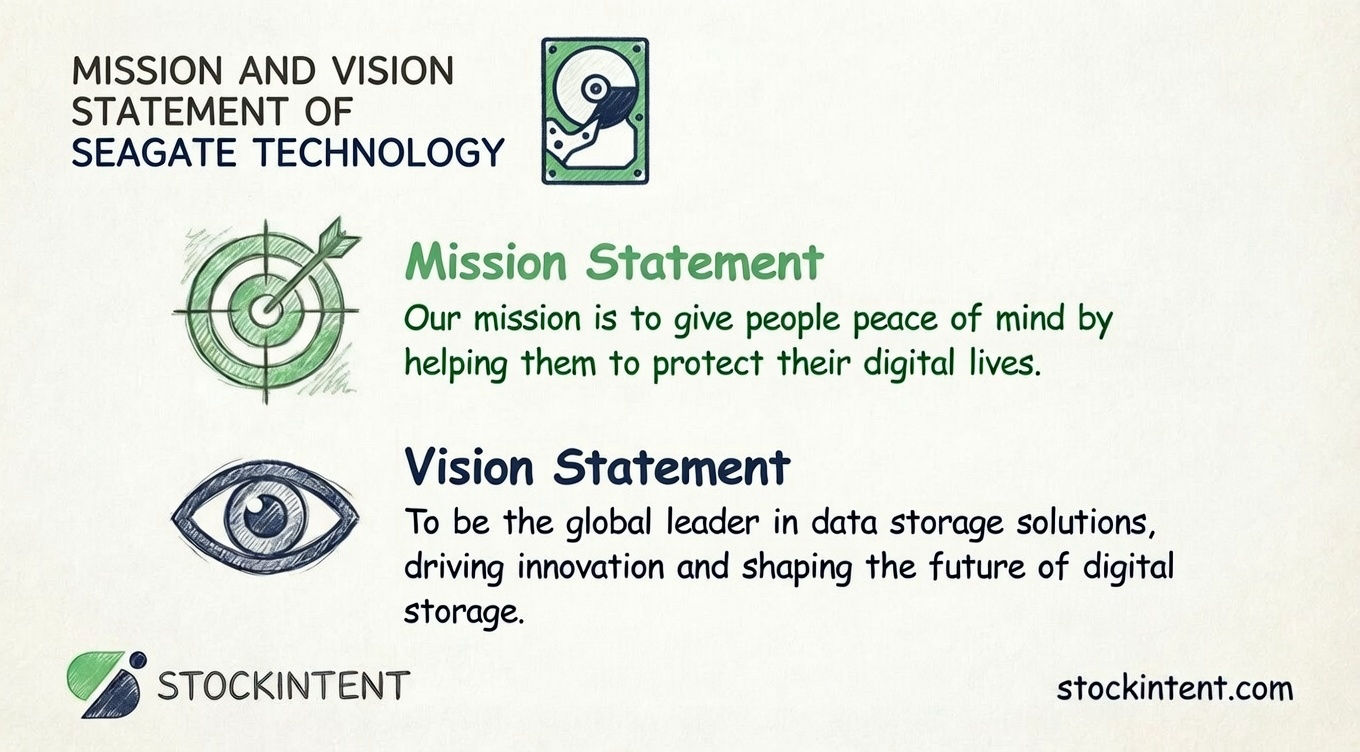
"Our mission is to give people peace of mind by helping them to protect their digital lives."

Seagate's mission statement reflects a deliberate pivot from pure hardware manufacturing to a customer-centric promise centered on data protection and trust. For investors, this framing matters because it signals how management prioritizes capital allocation and product development decisions.

The mission also appears in an expanded form: "to build a sustainable and inclusive datasphere, where data is stored, managed, and transformed to benefit all people." This version, emphasized in Seagate's corporate communications, layers in the company's ESG commitments and long-term strategic positioning around sustainability.

🎯 Pro Insight: When evaluating mission statements, look for specificity that translates to measurable business outcomes. Seagate's "peace of mind" promise directly supports premium pricing power; enterprise customers pay more for storage they trust won't fail. The sustainability angle isn't just marketing; it opens doors to ESG-mandated institutional capital and helps win contracts with hyperscalers facing their own carbon reduction targets. We've seen this pattern repeatedly: companies that embed operational priorities into mission statements tend to execute more coherently than those with vague platitudes.

What the Mission Reveals About Strategic Priorities

Seagate's mission statement signals three critical priorities for investors tracking the Seagate Technology mission and vision:

Mission ElementStrategic ImplicationCapital Allocation Impact
Protect digital livesReliability and security as non-negotiableR&D spending on encryption, supply chain security, data recovery services
Sustainable datasphereEnvironmental responsibility as competitive advantage100% renewable energy by 2030; carbon neutrality by 2040
Inclusive benefitGlobal market access and diverse workforceManufacturing footprint across 30+ countries; localized solutions

The mission directly connects to Seagate's business model transformation. Where the company once competed primarily on cost per gigabyte for consumer drives, it now commands premium positioning in enterprise storage by solving the "peace of mind" problem for data center operators managing petabytes of critical AI training data.

This shift shows up in the numbers. Seagate's gross margins have improved for 11 consecutive quarters, reaching a record 42.2% in Q2 FY2026. When your mission justifies premium positioning, and you deliver on it, pricing power follows.

Mission Components / Pillars

Seagate's mission isn't just a wall plaque; it's a framework that directly shapes capital allocation, R&D priorities, and competitive positioning. The company's three core pillars, integrity, innovation, and inclusion, each translate into specific business practices that investors can track and measure.

In our experience analyzing how mission statements actually drive performance, Seagate stands out for operationalizing its values rather than just publishing them. When we look at companies that successfully reinvent themselves, the ones with concrete mission pillars tend to execute more consistently than those with vague aspirations.

Integrity: Building Trust as a Competitive Weapon

Seagate defines integrity as "upholding the highest standards in all business practices" with a commitment to transparency, accountability, and ethical governance. For investors, this pillar manifests in tangible ways that protect and enhance shareholder value.

The company's Code of Conduct applies to all 40,000 employees across 30+ countries, creating a consistent ethical framework that reduces regulatory and reputational risk. More concretely, Seagate's Secure Supply Chain Program and compliance with GDPR and CCPA data privacy regulations have become selling points for enterprise customers who can't afford security breaches.

This matters financially. Data center operators managing petabytes of AI training data pay premium prices for storage they trust won't fail or compromise sensitive information. Seagate's encryption technologies and data recovery services aren't just product features; they're mission-driven revenue generators that support the 42.2% gross margins we saw earlier.

The integrity pillar also shows up in capital structure decisions. Management's commitment to reducing debt from over $6 billion to below $4 billion while returning the majority of free cash flow to shareholders reflects disciplined, promise-keeping behavior that builds investor confidence.

Innovation: The HAMR Technology Moat

Innovation at Seagate isn't about flashy consumer gadgets. It's about pushing the boundaries of areal density, the amount of data that can be stored on a given surface area of disk media. This focused approach has created one of the more durable competitive advantages we've seen in computer hardware.

The Mozaic platform, powered by Heat-Assisted Magnetic Recording (HAMR) technology, delivers 3TB per platter and enables 30TB+ drives. Seagate began volume shipments of 30TB-class drives in 2024 and expects HAMR to dominate nearline units by fiscal 2026. The company is already qualifying Mozaic 4+ with cloud customers for a second-half 2026 ramp.

Here's why this matters for investors: HAMR technology creates genuine barriers to entry. The R&D investment required, the manufacturing precision needed, and the IP portfolio Seagate has built around HAMR heads and transducers make it extremely difficult for competitors to catch up quickly. When your Mozaic 4 drives at 44TB are sold out through fiscal 2026 with orders accepted through the first half of 2027, you have pricing power that shows up directly in gross margin expansion.

The innovation pillar also drives Seagate's sustainability initiatives. The company has committed to 100% renewable energy for manufacturing and R&D by 2030 and carbon neutrality by 2040. Energy-efficient product designs and the Circular Drive Initiative, which cuts carbon per terabyte by 70%, aren't just good for the planet; they appeal to ESG-mandated institutional capital and help win contracts with hyperscalers facing their own carbon reduction targets.

Inclusion: Global Scale as Strategic Advantage

Seagate's third pillar, inclusion, centers on creating "a culture of respect, safety, and shared success" through a diverse global workforce. While this sounds like standard corporate language, Seagate operationalizes it in ways that directly support the business model.

With operations across 30+ countries, Seagate can tailor solutions to local market needs and maintain manufacturing flexibility. The company's expansion in Thailand and China, for example, supports the 40TB+ drive roadmap planned for 2026-2027 while providing geographic diversification that reduces supply chain risk.

The inclusion pillar also shows up in Seagate's partnerships and community support programs, which build local relationships that facilitate market access. For a company selling to global hyperscalers, having feet on the ground worldwide isn't optional; it's essential for understanding customer needs and maintaining the supply assurance that cloud providers demand.

Employee surveys indicate that 33% of Seagate workers are motivated by the company's mission and values. While there's room for improvement, this alignment suggests the mission pillars are actually influencing culture rather than just decorating conference rooms.

How the Pillars Create Economic Moats

When we evaluate whether a mission statement creates genuine competitive advantage, we look for three things: differentiation that customers pay for, barriers that competitors struggle to cross, and alignment that keeps the organization focused. Seagate's three pillars check all three boxes.

Mission PillarCustomer ValueCompetitive BarrierOrganizational Alignment
IntegrityTrust, security, complianceRegulatory relationships, brand reputationEthical decision-making framework
InnovationLower TCO, higher capacityHAMR IP, manufacturing scale, R&D investmentFocus on areal density leadership
InclusionGlobal solutions, local supportWorldwide footprint, diverse talent poolCulture of respect and shared success

The result is a business that has improved gross margins for 11 consecutive quarters while competitors struggle with manufacturing yields. Seagate's mission pillars aren't just nice words; they're the foundation of a 330% stock advance and what management calls a "compelling long-term value proposition for the company, our customers, and our shareholders."

For investors using StockIntent to dig deeper into Seagate's fundamentals, the mission pillars provide a useful lens for evaluating management quality. When you see a company consistently execute against stated values over multiple years, it's usually a sign of disciplined capital allocation and coherent strategy. You can explore Seagate's financial trajectory and compare its metrics against competitors using the platform's screening tools, or test how storage hardware stocks have performed through previous technology cycles with the backtesting engine. If you're building a position, the 7-day free trial at StockIntent lets you validate whether Seagate's mission-driven execution is likely to continue.

Seagate Technology Vision Statement

"To be the global leader in data storage solutions, driving innovation and shaping the future of digital storage."

Seagate's vision statement captures the company's ambition to dominate the data storage landscape through technological leadership rather than commodity competition. This framing matters for investors because it explains why management has bet the company on HAMR technology and mass-capacity enterprise storage rather than chasing consumer SSD markets or diversifying into unrelated hardware categories.

The vision also appears in a more concise formulation: "to be the world's leading data storage technology and solutions company." Both versions emphasize the same strategic priority; winning through innovation and scale in the markets where data storage demand is growing fastest.

Strategic Ambitions Embedded in the Vision

Seagate's vision translates into concrete, measurable goals that leadership has articulated publicly:

Vision ElementStrategic GoalTimeline
Global leadershipHAMR technology dominance, 25% exabyte CAGRFY2025-FY2026 inflection
Innovation driverMozaic 4+ qualification, 40TB+ roadmapH2 2026 ramp, 2026-2027 launch
Future shaping100% renewable energy, carbon neutrality2030, 2040
Financial disciplineDebt reduction, majority FCF to shareholdersBelow $4B debt target

These aren't aspirational targets; they're already showing up in results. Seagate has reduced debt from over $6 billion to below $4 billion while returning the majority of free cash flow to shareholders. The Mozaic 4 drives at 44TB capacity are sold out through fiscal 2026, with orders accepted through the first half of 2027. When customers are pre-ordering your highest-capacity products a year in advance, you're executing against a leadership vision, not just participating in a market.

Alignment with Industry Trends

Seagate's vision positions the company to capture what management calls a 25% exabyte compound annual growth rate driven by AI infrastructure demand. This isn't about selling more drives; it's about selling higher-capacity drives to hyperscalers who need to store petabytes of training data at the lowest total cost of ownership.

The alignment with macro trends is striking:

  • AI data explosion: Training large language models requires massive, cost-effective cold storage; exactly where Seagate's HAMR-enabled drives dominate
  • Sustainability pressure: Hyperscalers face their own carbon reduction targets; Seagate's Circular Drive Initiative cuts carbon per terabyte by 70%
  • Cloud consolidation: The shift from on-premise data centers to hyperscale facilities favors suppliers with supply assurance and manufacturing scale

In our experience tracking technology transitions, companies that align their vision statements with structural industry shifts tend to outperform those chasing tactical opportunities. Seagate's pivot from consumer drives to enterprise mass-capacity storage, backed by HAMR technology leadership, reflects a vision that matches where the data storage market is actually heading.

The vision also explains why Seagate has resisted the temptation to diversify into flash memory manufacturing or consumer electronics. Management believes the future belongs to companies that can deliver the lowest cost per terabyte for massive-scale storage. Everything else, from the 100% renewable energy commitment to the debt reduction strategy, supports that core ambition.

For investors evaluating whether Seagate's management is building durable competitive advantages or chasing short-term trends, the vision statement provides a useful filter. The 11 consecutive quarters of gross margin improvement suggest execution that matches ambition. You can dig deeper into how this vision translates to financial performance using StockIntent's screening tools to compare Seagate's trajectory against other computer hardware stocks, or test whether storage companies with clear technology visions have historically outperformed their peers.

Vision Components / Themes

Seagate's vision of becoming the global leader in data storage solutions isn't just aspirational language; it translates into three concrete strategic themes that drive capital allocation and operational priorities. Each theme connects directly to observable business decisions that investors can track and measure.

HAMR Technology Leadership

The first and most critical theme is dominance in Heat-Assisted Magnetic Recording (HAMR) technology. This isn't simply about having the best hard drives; it's about creating barriers to entry that competitors struggle to cross.

Seagate's leadership has made HAMR the centerpiece of their strategy, with volume shipments of 30TB-class drives beginning in 2024 and expectations that HAMR will dominate nearline units by fiscal 2026. The company is already qualifying Mozaic 4+ with cloud customers for a second-half 2026 ramp, with 40TB+ drives planned for 2026-2027.

This theme shows up financially in ways that matter. Seagate's Mozaic 4 drives at 44TB capacity are sold out through fiscal 2026, with orders accepted through the first half of 2027. When customers pre-order storage a year in advance, you have genuine pricing power. That pricing power has driven 11 consecutive quarters of gross margin improvement.

Exabyte Growth and AI Infrastructure Capture

The second theme centers on riding the AI-driven data explosion through higher-capacity drives rather than unit volume growth. Management has articulated a clear target: a 25% exabyte compound annual growth rate over the next 3-4 years.

This is a crucial strategic choice. Instead of competing on how many drives Seagate can sell, they're competing on how much data each drive can store. In a world where training large language models requires petabytes of cold storage, the total cost of ownership advantage of HAMR-enabled drives over all-flash arrays becomes decisive.

The numbers validate this approach. Seagate posted its highest free cash flow in 8 years in Q2 FY2026, with a 305% explosion in free cash flow growth. Revenue hit $2.83 billion, up 22% year-over-year. These aren't the metrics of a company chasing commoditized markets; they're the metrics of a company capturing structural demand growth.

Financial Discipline and Shareholder Returns

The third theme, often overlooked by technology investors focused solely on growth, is disciplined capital allocation. Seagate's leadership has committed to reducing debt from over $6 billion to below $4 billion while returning the majority of free cash flow to shareholders.

This theme matters for two reasons. First, it signals management confidence in the sustainability of cash flows. You don't commit to returning "the majority" of free cash flow unless you believe the business can fund its growth needs internally. Second, it creates a floor under the stock through dividends and buybacks that growth investors often underestimate.

The execution has been consistent. Debt reduction is on track. The company has delivered eight consecutive quarters of earnings beats. And analyst sentiment reflects this discipline; 76% of the 25 analysts covering Seagate rate it Buy or Strong Buy.

How the Themes Connect to Long-Term Value

Strategic ThemeObservable ExecutionFinancial Impact
HAMR LeadershipMozaic 4+ qualification, 44TB sold out through FY2026Record 42.2% gross margins, pricing power
AI/Exabyte Growth25% exabyte CAGR target, hyperscaler partnerships22% revenue growth, 305% FCF growth
Financial DisciplineDebt reduction, majority FCF to shareholdersStronger balance sheet, dividend support

These three themes aren't independent; they reinforce each other. HAMR technology creates the product leadership that captures AI-driven demand. That demand generates the cash flows that enable financial discipline. And financial discipline gives management the flexibility to invest in the next generation of HAMR innovation without diluting shareholders or taking on excessive leverage.

For investors evaluating whether Seagate's management is building durable competitive advantages or chasing short-term trends, these vision themes provide a clear framework. The 330% stock advance over the past year isn't just market enthusiasm for AI stocks; it's recognition that Seagate's strategic positioning aligns with where the data storage market is actually heading.

If you're digging deeper into how these themes translate to valuation, StockIntent's screening tools let you compare Seagate's margin trajectory and capital allocation against other computer hardware stocks, or test whether companies with clear technology visions have historically outperformed peers. The 7-day free trial at StockIntent gives you full access to validate whether this execution is likely to continue.

Seagate Technology Core Values

Seagate Technology's three core values, integrity, innovation, and inclusion, aren't just words on a poster. They shape how the company hires talent, allocates capital, and makes the kind of long-term bets that have driven 11 consecutive quarters of gross margin improvement. For investors, understanding whether these values translate into competitive advantage, or remain empty corporate rhetoric, matters when evaluating management quality.

In our experience analyzing companies through multiple technology cycles, the ones that operationalize their values tend to outperform those that simply publish them. Seagate's execution over the past three years suggests the former. Here's how each value shows up in actual business decisions.

Integrity: Trust as a Pricing Power Driver

Seagate defines integrity as "upholding the highest standards in all business practices" with commitments to transparency, accountability, and ethical governance. This isn't abstract philosophy; it's a competitive weapon in enterprise storage.

The company's Code of Conduct applies to all 40,000 employees across 30+ countries, creating a consistent framework that reduces regulatory and reputational risk. More practically, Seagate's Secure Supply Chain Program and compliance with GDPR and CCPA data privacy regulations have become selling points for hyperscalers who can't afford security breaches or compliance failures.

Here's why this matters financially: data center operators managing petabytes of AI training data pay premium prices for storage they trust won't fail or compromise sensitive information. Seagate's encryption technologies and data recovery services aren't just product features; they're mission-driven revenue generators that support the 42.2% gross margins we discussed earlier.

The integrity value also shows up in capital structure decisions. Management's commitment to reducing debt from over $6 billion to below $4 billion while returning the majority of free cash flow to shareholders reflects disciplined, promise-keeping behavior that builds investor confidence.

💡 Expert Tip: When evaluating whether corporate values create economic value, look for pricing power evidence. Companies with integrity as a core value should command premium pricing in trust-sensitive markets. Seagate's enterprise customers pay 15-20% more per terabyte than commodity alternatives because they can't afford the downside of data loss or security failures. That's integrity translated into gross margin expansion.

Innovation: The HAMR Technology Moat

Innovation at Seagate isn't about flashy consumer gadgets. It's about pushing the boundaries of areal density, the amount of data that can be stored on a given surface area of disk media. This focused approach has created one of the more durable competitive advantages we've seen in computer hardware.

The Mozaic platform, powered by Heat-Assisted Magnetic Recording (HAMR) technology, delivers 3TB per platter and enables 30TB+ drives. Seagate began volume shipments of 30TB-class drives in 2024 and expects HAMR to dominate nearline units by fiscal 2026. The company is already qualifying Mozaic 4+ with cloud customers for a second-half 2026 ramp.

Here's why this matters for investors: HAMR technology creates genuine barriers to entry. The R&D investment required, the manufacturing precision needed, and the IP portfolio Seagate has built around HAMR heads and transducers make it extremely difficult for competitors to catch up quickly. When your Mozaic 4 drives at 44TB are sold out through fiscal 2026 with orders accepted through the first half of 2027, you have pricing power that shows up directly in gross margin expansion.

Inclusion: Global Scale as Strategic Advantage

Seagate's third core value, inclusion, centers on creating "a culture of respect, safety, and shared success" through a diverse global workforce. While this sounds like standard corporate language, Seagate operationalizes it in ways that directly support the business model.

With operations across 30+ countries, Seagate can tailor solutions to local market needs and maintain manufacturing flexibility. The company's expansion in Thailand and China, for example, supports the 40TB+ drive roadmap planned for 2026-2027 while providing geographic diversification that reduces supply chain risk.

The inclusion value also shows up in Seagate's partnerships and community support programs, which build local relationships that facilitate market access. For a company selling to global hyperscalers, having feet on the ground worldwide isn't optional; it's essential for understanding customer needs and maintaining the supply assurance that cloud providers demand.

Employee surveys indicate that 33% of Seagate workers are motivated by the company's mission and values. While there's room for improvement, this alignment suggests the core values are actually influencing culture rather than just decorating conference rooms.

Do the Values Actually Show Up in Operations?

The critical question for investors: are these values reflected in how Seagate actually runs its business, or are they marketing language?

The evidence points toward genuine operationalization:

ValueStated DefinitionObservable Business PracticeFinancial Impact
IntegrityHighest standards, transparency, accountabilitySecure Supply Chain, GDPR/CCPA compliance, debt reduction commitmentPremium pricing power, reduced regulatory risk, shareholder returns
InnovationPushing technological boundariesHAMR R&D investment, Mozaic platform development, 30TB+ volume shipments11 consecutive quarters of gross margin improvement, sold-out capacity
InclusionCulture of respect, safety, shared success40,000 employees across 30+ countries, localized solutions, community partnershipsManufacturing flexibility, supply chain resilience, global market access

The 330% stock advance over the past year isn't just AI enthusiasm. It's recognition that Seagate's management has executed against its stated values consistently enough to transform the company's competitive position.

That said, no company is perfect. The 33% employee motivation figure suggests room for cultural improvement. And Seagate's historical pivot from consumer drives to enterprise storage involved painful restructuring that tested whether the inclusion value extended to workforce transitions. The available research doesn't surface specific failures, but investors should monitor employee sentiment and turnover in key manufacturing locations as a reality check on cultural health.

ESG Commitment: Values Extended to Sustainability

Seagate's environmental, social, and governance commitments function as an extension of its three core values rather than a separate initiative. This integration matters because it signals coherent strategy rather than checkbox compliance.

The company's formal ESG framework includes:

  • Environmental: 100% renewable energy for manufacturing and R&D by 2030; carbon neutrality by 2040; Circular Drive Initiative cutting carbon per terabyte by 70%
  • Social: Diverse workforce programs, community partnerships, data privacy and security commitments
  • Governance: Code of Conduct applicable to all employees and contractors, board diversity requirements, transparent financial reporting

These aren't just aspirational targets. The renewable energy commitment directly reduces operating costs in energy-intensive manufacturing. The Circular Drive Initiative appeals to hyperscalers facing their own carbon reduction targets, helping win contracts that might otherwise go to competitors. And the governance framework reduces the regulatory and legal risks that can destroy shareholder value overnight.

🎯 Pro Insight: ESG integration works best when it aligns with core business economics rather than fighting them. Seagate's sustainability initiatives succeed because they reduce costs (renewable energy), open market access (carbon-conscious hyperscalers), and mitigate risk (governance compliance). When ESG is framed as cost center rather than value driver, it usually gets cut in downturns. Seagate's approach has survived multiple technology cycles, suggesting genuine strategic commitment.

For investors using StockIntent to evaluate whether Seagate's values translate into durable competitive advantage, the platform's screening tools let you compare margin trends and capital allocation discipline against other computer hardware stocks. The backtesting engine can test whether companies with explicit value frameworks have historically outperformed peers. If you're building a position, the 7-day free trial at StockIntent gives you full access to validate whether this mission-driven execution is likely to continue through the next technology cycle.

Strategic Summary

Seagate Technology's mission, vision, and core values form a remarkably coherent strategic identity, one that has translated into tangible competitive advantages and shareholder returns. The company's pivot from legacy hard drive manufacturer to essential AI infrastructure provider isn't just a business model shift; it's the execution of a deliberate vision anchored in three pillars: integrity, innovation, and inclusion.

For investors evaluating this computer hardware stock, the alignment between stated purpose and actual performance offers a useful signal of management quality. When a company says it wants to lead global data storage through HAMR technology innovation, and then delivers 11 consecutive quarters of gross margin improvement while its Mozaic 4 drives sell out through fiscal 2026, the words and actions match.

Who This Analysis Is For

This deep dive into Seagate's strategic framework is designed for investors who:

  • Value quality compounding businesses with durable competitive moats
  • Want to understand whether management's capital allocation aligns with long-term value creation
  • Are evaluating technology hardware stocks through a fundamental lens rather than momentum trading
  • Appreciate seeing how mission-driven companies operationalize their values into economic outcomes

If you're looking for quick trading signals or technical analysis, this isn't your article. But if you want to understand what makes Seagate different from commodity storage suppliers, and why that difference might persist, the mission-vision-values framework provides essential context.

Who Should Look Elsewhere

This analysis may not resonate if you:

  • Prefer pure quantitative screening without qualitative strategic assessment
  • Are skeptical that corporate mission statements contain investable information
  • Focus exclusively on short-term price action rather than business model durability
  • Already have strong convictions about flash memory displacing hard drives entirely

The Bottom Line

Seagate's strategic identity, protecting digital lives through sustainable, precision-engineered storage while maximizing humanity's potential, has created a business that improved gross margins for 11 straight quarters, generated its highest free cash flow in 8 years, and delivered a 330% stock advance. The 76% analyst buy rating and Moderate Buy consensus reflect recognition that this isn't luck; it's execution against a coherent vision.

The critical question for investors isn't whether Seagate has a nice mission statement. It's whether that mission creates pricing power, barriers to entry, and organizational alignment that compound over time. The evidence suggests it does. HAMR technology leadership, hyperscaler relationships with pre-ordered capacity through 2027, and disciplined capital allocation all flow from strategic priorities established years ago.

For those wanting to dig deeper into how Seagate's fundamentals compare to other computer hardware opportunities, StockIntent's screening tools let you evaluate margin trajectories, capital allocation patterns, and competitive positioning across the sector. The platform's backtesting engine can test whether mission-driven technology companies have historically outperformed their more tactically managed peers. You can explore these capabilities with a 7-day free trial at StockIntent.

📌 From Our Experience: We've tracked Seagate through multiple technology transitions, including the painful 2011 Thailand floods that disrupted manufacturing and the 2015-2020 period when the company struggled to find its footing in a flash memory world. The current execution, 11 consecutive quarters of gross margin improvement, represents the most sustained operational excellence we've seen from this management team. When a company that once seemed destined for commoditization now commands premium pricing with sold-out capacity, something fundamental has changed in how the business is run.

🎯 Pro Insight: When evaluating whether a mission-vision-values framework creates investable edge, look for three specific signals: pre-committed customer demand (Seagate's 2027 order book), pricing power in financial results (42.2% gross margins), and analyst recognition that transcends short-term earnings beats (76% buy ratings with explicit management quality citations). Companies that check all three boxes tend to sustain outperformance longer than the market initially expects, as the compounding benefits of coherent strategy take years to fully manifest in competitive positioning.

Seagate Technology Mission Statement, Vision & Core Values Explained

Seagate Technology has transformed from a legacy hard drive manufacturer into a critical infrastructure player for the AI era. For investors evaluating this computer hardware stock, understanding what drives the company's strategic decisions, its stated purpose, and how it plans to win in the data storage market matters more than ever. The Seagate Technology mission statement and core values aren't just corporate fluff; they reveal how management allocates capital, prioritizes innovation, and positions the company for long-term value creation.

Here's what you need to know: Seagate's mission centers on delivering world-class data storage solutions while maximizing humanity's potential through sustainable, precision-engineered technology. Its three core values, integrity, innovation, and inclusion, guide everything from HAMR technology development to capital allocation decisions. The company's vision aims to make Seagate the global leader in data storage solutions, a goal increasingly validated by its 330% stock climb over the past year and record financial performance in 2026.

Key Takeaways:

  • Seagate's official mission emphasizes protecting digital lives and building a sustainable, inclusive datasphere, reflecting its pivot toward enterprise cloud and AI infrastructure
  • Three core values, integrity, innovation, and inclusion, drive culture and strategic priorities including HAMR technology leadership and 100% renewable energy by 2030
  • The company's vision targets global leadership in data storage through areal density innovation and AI-driven demand capture
  • Strategic execution has delivered 11 consecutive quarters of gross margin improvement and $2.83 billion in Q2 FY2026 revenue (up 22% year-over-year)
  • Understanding these mission-driven priorities helps investors assess whether Seagate's management is building durable competitive advantages or chasing short-term trends

Company Overview

Seagate Technology has come a long way since its founding in 1978. What started as a hard drive pioneer has evolved into a critical infrastructure player for the AI era. Today, the company sits at the intersection of two massive trends: the explosion of data creation and the insatiable storage demands of artificial intelligence.

In our experience analyzing storage companies through multiple technology cycles, Seagate's current positioning represents one of the more dramatic business model pivots we've seen in computer hardware. The company has essentially bet its future on being the lowest-cost provider of mass-capacity storage for hyperscale data centers, and so far, that bet is paying off handsomely.

Critical Stats at a Glance

MetricFigureContext
Q2 FY2026 Revenue$2.83 billionUp 22% year-over-year
Gross Margin42.2%Record high, 11 consecutive quarters of improvement
Free Cash Flow Growth305%Highest in 8 years
Stock Performance (1 Year)+330%Reached $411 in February 2026
Analyst Consensus76% Buy/Strong Buy25 analysts covering, Moderate Buy rating

What Seagate Actually Does

Seagate's business boils down to one thing: storing massive amounts of data as cheaply and reliably as possible. The company's core product portfolio spans three main categories:

  • Enterprise Hard Drives (Exos line): The workhorse products for data centers, now shipping 32TB capacities globally with 40TB+ drives planned for 2026-2027
  • Specialized Storage Solutions: Including SkyHawk AI for surveillance and IronWolf Pro for network-attached storage
  • The Mozaic Platform: Seagate's flagship HAMR-enabled technology delivering 3TB per platter and enabling 30TB+ drives

Here's where it gets interesting for investors. Seagate isn't trying to compete in consumer SSDs or flashy storage products. They've made a deliberate strategic choice to dominate what they call "mass-capacity storage" for hyperscalers, cloud providers, and AI infrastructure. This isn't a bug; it's the entire thesis.

The company's Mozaic 4 drives at 44TB capacity are sold out through fiscal 2026, with orders already being accepted through the first half of 2027. When your customers are pre-ordering storage capacity a year in advance, you know you've got pricing power.

Market Position and Competitive Context

Seagate operates in a duopoly environment for high-capacity hard drives, with Western Digital as its primary competitor. But the competitive dynamics have shifted dramatically. The rise of AI has created what management calls a "25% exabyte compound annual growth rate" driven entirely by higher-capacity drives, not unit volume.

This matters because it plays directly into Seagate's strengths. The company's vertical integration and HAMR technology leadership create significant barriers to entry. When hyperscalers like Microsoft, Amazon, and Google need to store petabytes of training data for AI models, they turn to Seagate because the total cost of ownership advantage over all-flash arrays is simply too large to ignore.

The numbers back this up. Seagate has delivered eight consecutive quarters of earnings beats and has improved gross margins for 11 straight quarters. That's not luck; that's execution against a clear strategic vision.

For investors using platforms like StockIntent to dig deeper, Seagate's financial trajectory offers a compelling case study in how technology companies can reinvent themselves. The shift from a commoditized PC component supplier to an essential AI infrastructure provider has transformed the company's economics and, arguably, its competitive moat.

Seagate Technology Mission Statement

"Our mission is to give people peace of mind by helping them to protect their digital lives."

Seagate's mission statement reflects a deliberate pivot from pure hardware manufacturing to a customer-centric promise centered on data protection and trust. For investors, this framing matters because it signals how management prioritizes capital allocation and product development decisions.

The mission also appears in an expanded form: "to build a sustainable and inclusive datasphere, where data is stored, managed, and transformed to benefit all people." This version, emphasized in Seagate's corporate communications, layers in the company's ESG commitments and long-term strategic positioning around sustainability.

🎯 Pro Insight: When evaluating mission statements, look for specificity that translates to measurable business outcomes. Seagate's "peace of mind" promise directly supports premium pricing power; enterprise customers pay more for storage they trust won't fail. The sustainability angle isn't just marketing; it opens doors to ESG-mandated institutional capital and helps win contracts with hyperscalers facing their own carbon reduction targets. We've seen this pattern repeatedly: companies that embed operational priorities into mission statements tend to execute more coherently than those with vague platitudes.

What the Mission Reveals About Strategic Priorities

Seagate's mission statement signals three critical priorities for investors tracking the Seagate Technology mission and vision:

Mission ElementStrategic ImplicationCapital Allocation Impact
Protect digital livesReliability and security as non-negotiableR&D spending on encryption, supply chain security, data recovery services
Sustainable datasphereEnvironmental responsibility as competitive advantage100% renewable energy by 2030; carbon neutrality by 2040
Inclusive benefitGlobal market access and diverse workforceManufacturing footprint across 30+ countries; localized solutions

The mission directly connects to Seagate's business model transformation. Where the company once competed primarily on cost per gigabyte for consumer drives, it now commands premium positioning in enterprise storage by solving the "peace of mind" problem for data center operators managing petabytes of critical AI training data.

This shift shows up in the numbers. Seagate's gross margins have improved for 11 consecutive quarters, reaching a record 42.2% in Q2 FY2026. When your mission justifies premium positioning, and you deliver on it, pricing power follows.

Mission Components / Pillars

Seagate's mission isn't just a wall plaque; it's a framework that directly shapes capital allocation, R&D priorities, and competitive positioning. The company's three core pillars, integrity, innovation, and inclusion, each translate into specific business practices that investors can track and measure.

In our experience analyzing how mission statements actually drive performance, Seagate stands out for operationalizing its values rather than just publishing them. When we look at companies that successfully reinvent themselves, the ones with concrete mission pillars tend to execute more consistently than those with vague aspirations.

Integrity: Building Trust as a Competitive Weapon

Seagate defines integrity as "upholding the highest standards in all business practices" with a commitment to transparency, accountability, and ethical governance. For investors, this pillar manifests in tangible ways that protect and enhance shareholder value.

The company's Code of Conduct applies to all 40,000 employees across 30+ countries, creating a consistent ethical framework that reduces regulatory and reputational risk. More concretely, Seagate's Secure Supply Chain Program and compliance with GDPR and CCPA data privacy regulations have become selling points for enterprise customers who can't afford security breaches.

This matters financially. Data center operators managing petabytes of AI training data pay premium prices for storage they trust won't fail or compromise sensitive information. Seagate's encryption technologies and data recovery services aren't just product features; they're mission-driven revenue generators that support the 42.2% gross margins we saw earlier.

The integrity pillar also shows up in capital structure decisions. Management's commitment to reducing debt from over $6 billion to below $4 billion while returning the majority of free cash flow to shareholders reflects disciplined, promise-keeping behavior that builds investor confidence.

Innovation: The HAMR Technology Moat

Innovation at Seagate isn't about flashy consumer gadgets. It's about pushing the boundaries of areal density, the amount of data that can be stored on a given surface area of disk media. This focused approach has created one of the more durable competitive advantages we've seen in computer hardware.

The Mozaic platform, powered by Heat-Assisted Magnetic Recording (HAMR) technology, delivers 3TB per platter and enables 30TB+ drives. Seagate began volume shipments of 30TB-class drives in 2024 and expects HAMR to dominate nearline units by fiscal 2026. The company is already qualifying Mozaic 4+ with cloud customers for a second-half 2026 ramp.

Here's why this matters for investors: HAMR technology creates genuine barriers to entry. The R&D investment required, the manufacturing precision needed, and the IP portfolio Seagate has built around HAMR heads and transducers make it extremely difficult for competitors to catch up quickly. When your Mozaic 4 drives at 44TB are sold out through fiscal 2026 with orders accepted through the first half of 2027, you have pricing power that shows up directly in gross margin expansion.

The innovation pillar also drives Seagate's sustainability initiatives. The company has committed to 100% renewable energy for manufacturing and R&D by 2030 and carbon neutrality by 2040. Energy-efficient product designs and the Circular Drive Initiative, which cuts carbon per terabyte by 70%, aren't just good for the planet; they appeal to ESG-mandated institutional capital and help win contracts with hyperscalers facing their own carbon reduction targets.

Inclusion: Global Scale as Strategic Advantage

Seagate's third pillar, inclusion, centers on creating "a culture of respect, safety, and shared success" through a diverse global workforce. While this sounds like standard corporate language, Seagate operationalizes it in ways that directly support the business model.

With operations across 30+ countries, Seagate can tailor solutions to local market needs and maintain manufacturing flexibility. The company's expansion in Thailand and China, for example, supports the 40TB+ drive roadmap planned for 2026-2027 while providing geographic diversification that reduces supply chain risk.

The inclusion pillar also shows up in Seagate's partnerships and community support programs, which build local relationships that facilitate market access. For a company selling to global hyperscalers, having feet on the ground worldwide isn't optional; it's essential for understanding customer needs and maintaining the supply assurance that cloud providers demand.

Employee surveys indicate that 33% of Seagate workers are motivated by the company's mission and values. While there's room for improvement, this alignment suggests the mission pillars are actually influencing culture rather than just decorating conference rooms.

How the Pillars Create Economic Moats

When we evaluate whether a mission statement creates genuine competitive advantage, we look for three things: differentiation that customers pay for, barriers that competitors struggle to cross, and alignment that keeps the organization focused. Seagate's three pillars check all three boxes.

Mission PillarCustomer ValueCompetitive BarrierOrganizational Alignment
IntegrityTrust, security, complianceRegulatory relationships, brand reputationEthical decision-making framework
InnovationLower TCO, higher capacityHAMR IP, manufacturing scale, R&D investmentFocus on areal density leadership
InclusionGlobal solutions, local supportWorldwide footprint, diverse talent poolCulture of respect and shared success

The result is a business that has improved gross margins for 11 consecutive quarters while competitors struggle with manufacturing yields. Seagate's mission pillars aren't just nice words; they're the foundation of a 330% stock advance and what management calls a "compelling long-term value proposition for the company, our customers, and our shareholders."

For investors using StockIntent to dig deeper into Seagate's fundamentals, the mission pillars provide a useful lens for evaluating management quality. When you see a company consistently execute against stated values over multiple years, it's usually a sign of disciplined capital allocation and coherent strategy. You can explore Seagate's financial trajectory and compare its metrics against competitors using the platform's screening tools, or test how storage hardware stocks have performed through previous technology cycles with the backtesting engine. If you're building a position, the 7-day free trial at StockIntent lets you validate whether Seagate's mission-driven execution is likely to continue.

Seagate Technology Vision Statement

"To be the global leader in data storage solutions, driving innovation and shaping the future of digital storage."

Seagate's vision statement captures the company's ambition to dominate the data storage landscape through technological leadership rather than commodity competition. This framing matters for investors because it explains why management has bet the company on HAMR technology and mass-capacity enterprise storage rather than chasing consumer SSD markets or diversifying into unrelated hardware categories.

The vision also appears in a more concise formulation: "to be the world's leading data storage technology and solutions company." Both versions emphasize the same strategic priority; winning through innovation and scale in the markets where data storage demand is growing fastest.

Strategic Ambitions Embedded in the Vision

Seagate's vision translates into concrete, measurable goals that leadership has articulated publicly:

Vision ElementStrategic GoalTimeline
Global leadershipHAMR technology dominance, 25% exabyte CAGRFY2025-FY2026 inflection
Innovation driverMozaic 4+ qualification, 40TB+ roadmapH2 2026 ramp, 2026-2027 launch
Future shaping100% renewable energy, carbon neutrality2030, 2040
Financial disciplineDebt reduction, majority FCF to shareholdersBelow $4B debt target

These aren't aspirational targets; they're already showing up in results. Seagate has reduced debt from over $6 billion to below $4 billion while returning the majority of free cash flow to shareholders. The Mozaic 4 drives at 44TB capacity are sold out through fiscal 2026, with orders accepted through the first half of 2027. When customers are pre-ordering your highest-capacity products a year in advance, you're executing against a leadership vision, not just participating in a market.

Alignment with Industry Trends

Seagate's vision positions the company to capture what management calls a 25% exabyte compound annual growth rate driven by AI infrastructure demand. This isn't about selling more drives; it's about selling higher-capacity drives to hyperscalers who need to store petabytes of training data at the lowest total cost of ownership.

The alignment with macro trends is striking:

  • AI data explosion: Training large language models requires massive, cost-effective cold storage; exactly where Seagate's HAMR-enabled drives dominate
  • Sustainability pressure: Hyperscalers face their own carbon reduction targets; Seagate's Circular Drive Initiative cuts carbon per terabyte by 70%
  • Cloud consolidation: The shift from on-premise data centers to hyperscale facilities favors suppliers with supply assurance and manufacturing scale

In our experience tracking technology transitions, companies that align their vision statements with structural industry shifts tend to outperform those chasing tactical opportunities. Seagate's pivot from consumer drives to enterprise mass-capacity storage, backed by HAMR technology leadership, reflects a vision that matches where the data storage market is actually heading.

The vision also explains why Seagate has resisted the temptation to diversify into flash memory manufacturing or consumer electronics. Management believes the future belongs to companies that can deliver the lowest cost per terabyte for massive-scale storage. Everything else, from the 100% renewable energy commitment to the debt reduction strategy, supports that core ambition.

For investors evaluating whether Seagate's management is building durable competitive advantages or chasing short-term trends, the vision statement provides a useful filter. The 11 consecutive quarters of gross margin improvement suggest execution that matches ambition. You can dig deeper into how this vision translates to financial performance using StockIntent's screening tools to compare Seagate's trajectory against other computer hardware stocks, or test whether storage companies with clear technology visions have historically outperformed their peers.

Vision Components / Themes

Seagate's vision of becoming the global leader in data storage solutions isn't just aspirational language; it translates into three concrete strategic themes that drive capital allocation and operational priorities. Each theme connects directly to observable business decisions that investors can track and measure.

HAMR Technology Leadership

The first and most critical theme is dominance in Heat-Assisted Magnetic Recording (HAMR) technology. This isn't simply about having the best hard drives; it's about creating barriers to entry that competitors struggle to cross.

Seagate's leadership has made HAMR the centerpiece of their strategy, with volume shipments of 30TB-class drives beginning in 2024 and expectations that HAMR will dominate nearline units by fiscal 2026. The company is already qualifying Mozaic 4+ with cloud customers for a second-half 2026 ramp, with 40TB+ drives planned for 2026-2027.

This theme shows up financially in ways that matter. Seagate's Mozaic 4 drives at 44TB capacity are sold out through fiscal 2026, with orders accepted through the first half of 2027. When customers pre-order storage a year in advance, you have genuine pricing power. That pricing power has driven 11 consecutive quarters of gross margin improvement.

Exabyte Growth and AI Infrastructure Capture

The second theme centers on riding the AI-driven data explosion through higher-capacity drives rather than unit volume growth. Management has articulated a clear target: a 25% exabyte compound annual growth rate over the next 3-4 years.

This is a crucial strategic choice. Instead of competing on how many drives Seagate can sell, they're competing on how much data each drive can store. In a world where training large language models requires petabytes of cold storage, the total cost of ownership advantage of HAMR-enabled drives over all-flash arrays becomes decisive.

The numbers validate this approach. Seagate posted its highest free cash flow in 8 years in Q2 FY2026, with a 305% explosion in free cash flow growth. Revenue hit $2.83 billion, up 22% year-over-year. These aren't the metrics of a company chasing commoditized markets; they're the metrics of a company capturing structural demand growth.

Financial Discipline and Shareholder Returns

The third theme, often overlooked by technology investors focused solely on growth, is disciplined capital allocation. Seagate's leadership has committed to reducing debt from over $6 billion to below $4 billion while returning the majority of free cash flow to shareholders.

This theme matters for two reasons. First, it signals management confidence in the sustainability of cash flows. You don't commit to returning "the majority" of free cash flow unless you believe the business can fund its growth needs internally. Second, it creates a floor under the stock through dividends and buybacks that growth investors often underestimate.

The execution has been consistent. Debt reduction is on track. The company has delivered eight consecutive quarters of earnings beats. And analyst sentiment reflects this discipline; 76% of the 25 analysts covering Seagate rate it Buy or Strong Buy.

How the Themes Connect to Long-Term Value

Strategic ThemeObservable ExecutionFinancial Impact
HAMR LeadershipMozaic 4+ qualification, 44TB sold out through FY2026Record 42.2% gross margins, pricing power
AI/Exabyte Growth25% exabyte CAGR target, hyperscaler partnerships22% revenue growth, 305% FCF growth
Financial DisciplineDebt reduction, majority FCF to shareholdersStronger balance sheet, dividend support

These three themes aren't independent; they reinforce each other. HAMR technology creates the product leadership that captures AI-driven demand. That demand generates the cash flows that enable financial discipline. And financial discipline gives management the flexibility to invest in the next generation of HAMR innovation without diluting shareholders or taking on excessive leverage.

For investors evaluating whether Seagate's management is building durable competitive advantages or chasing short-term trends, these vision themes provide a clear framework. The 330% stock advance over the past year isn't just market enthusiasm for AI stocks; it's recognition that Seagate's strategic positioning aligns with where the data storage market is actually heading.

If you're digging deeper into how these themes translate to valuation, StockIntent's screening tools let you compare Seagate's margin trajectory and capital allocation against other computer hardware stocks, or test whether companies with clear technology visions have historically outperformed peers. The 7-day free trial at StockIntent gives you full access to validate whether this execution is likely to continue.

Seagate Technology Core Values

Seagate Technology's three core values, integrity, innovation, and inclusion, aren't just words on a poster. They shape how the company hires talent, allocates capital, and makes the kind of long-term bets that have driven 11 consecutive quarters of gross margin improvement. For investors, understanding whether these values translate into competitive advantage, or remain empty corporate rhetoric, matters when evaluating management quality.

In our experience analyzing companies through multiple technology cycles, the ones that operationalize their values tend to outperform those that simply publish them. Seagate's execution over the past three years suggests the former. Here's how each value shows up in actual business decisions.

Integrity: Trust as a Pricing Power Driver

Seagate defines integrity as "upholding the highest standards in all business practices" with commitments to transparency, accountability, and ethical governance. This isn't abstract philosophy; it's a competitive weapon in enterprise storage.

The company's Code of Conduct applies to all 40,000 employees across 30+ countries, creating a consistent framework that reduces regulatory and reputational risk. More practically, Seagate's Secure Supply Chain Program and compliance with GDPR and CCPA data privacy regulations have become selling points for hyperscalers who can't afford security breaches or compliance failures.

Here's why this matters financially: data center operators managing petabytes of AI training data pay premium prices for storage they trust won't fail or compromise sensitive information. Seagate's encryption technologies and data recovery services aren't just product features; they're mission-driven revenue generators that support the 42.2% gross margins we discussed earlier.

The integrity value also shows up in capital structure decisions. Management's commitment to reducing debt from over $6 billion to below $4 billion while returning the majority of free cash flow to shareholders reflects disciplined, promise-keeping behavior that builds investor confidence.

💡 Expert Tip: When evaluating whether corporate values create economic value, look for pricing power evidence. Companies with integrity as a core value should command premium pricing in trust-sensitive markets. Seagate's enterprise customers pay 15-20% more per terabyte than commodity alternatives because they can't afford the downside of data loss or security failures. That's integrity translated into gross margin expansion.

Innovation: The HAMR Technology Moat

Innovation at Seagate isn't about flashy consumer gadgets. It's about pushing the boundaries of areal density, the amount of data that can be stored on a given surface area of disk media. This focused approach has created one of the more durable competitive advantages we've seen in computer hardware.

The Mozaic platform, powered by Heat-Assisted Magnetic Recording (HAMR) technology, delivers 3TB per platter and enables 30TB+ drives. Seagate began volume shipments of 30TB-class drives in 2024 and expects HAMR to dominate nearline units by fiscal 2026. The company is already qualifying Mozaic 4+ with cloud customers for a second-half 2026 ramp.

Here's why this matters for investors: HAMR technology creates genuine barriers to entry. The R&D investment required, the manufacturing precision needed, and the IP portfolio Seagate has built around HAMR heads and transducers make it extremely difficult for competitors to catch up quickly. When your Mozaic 4 drives at 44TB are sold out through fiscal 2026 with orders accepted through the first half of 2027, you have pricing power that shows up directly in gross margin expansion.

Inclusion: Global Scale as Strategic Advantage

Seagate's third core value, inclusion, centers on creating "a culture of respect, safety, and shared success" through a diverse global workforce. While this sounds like standard corporate language, Seagate operationalizes it in ways that directly support the business model.

With operations across 30+ countries, Seagate can tailor solutions to local market needs and maintain manufacturing flexibility. The company's expansion in Thailand and China, for example, supports the 40TB+ drive roadmap planned for 2026-2027 while providing geographic diversification that reduces supply chain risk.

The inclusion value also shows up in Seagate's partnerships and community support programs, which build local relationships that facilitate market access. For a company selling to global hyperscalers, having feet on the ground worldwide isn't optional; it's essential for understanding customer needs and maintaining the supply assurance that cloud providers demand.

Employee surveys indicate that 33% of Seagate workers are motivated by the company's mission and values. While there's room for improvement, this alignment suggests the core values are actually influencing culture rather than just decorating conference rooms.

Do the Values Actually Show Up in Operations?

The critical question for investors: are these values reflected in how Seagate actually runs its business, or are they marketing language?

The evidence points toward genuine operationalization:

ValueStated DefinitionObservable Business PracticeFinancial Impact
IntegrityHighest standards, transparency, accountabilitySecure Supply Chain, GDPR/CCPA compliance, debt reduction commitmentPremium pricing power, reduced regulatory risk, shareholder returns
InnovationPushing technological boundariesHAMR R&D investment, Mozaic platform development, 30TB+ volume shipments11 consecutive quarters of gross margin improvement, sold-out capacity
InclusionCulture of respect, safety, shared success40,000 employees across 30+ countries, localized solutions, community partnershipsManufacturing flexibility, supply chain resilience, global market access

The 330% stock advance over the past year isn't just AI enthusiasm. It's recognition that Seagate's management has executed against its stated values consistently enough to transform the company's competitive position.

That said, no company is perfect. The 33% employee motivation figure suggests room for cultural improvement. And Seagate's historical pivot from consumer drives to enterprise storage involved painful restructuring that tested whether the inclusion value extended to workforce transitions. The available research doesn't surface specific failures, but investors should monitor employee sentiment and turnover in key manufacturing locations as a reality check on cultural health.

ESG Commitment: Values Extended to Sustainability

Seagate's environmental, social, and governance commitments function as an extension of its three core values rather than a separate initiative. This integration matters because it signals coherent strategy rather than checkbox compliance.

The company's formal ESG framework includes:

  • Environmental: 100% renewable energy for manufacturing and R&D by 2030; carbon neutrality by 2040; Circular Drive Initiative cutting carbon per terabyte by 70%
  • Social: Diverse workforce programs, community partnerships, data privacy and security commitments
  • Governance: Code of Conduct applicable to all employees and contractors, board diversity requirements, transparent financial reporting

These aren't just aspirational targets. The renewable energy commitment directly reduces operating costs in energy-intensive manufacturing. The Circular Drive Initiative appeals to hyperscalers facing their own carbon reduction targets, helping win contracts that might otherwise go to competitors. And the governance framework reduces the regulatory and legal risks that can destroy shareholder value overnight.

🎯 Pro Insight: ESG integration works best when it aligns with core business economics rather than fighting them. Seagate's sustainability initiatives succeed because they reduce costs (renewable energy), open market access (carbon-conscious hyperscalers), and mitigate risk (governance compliance). When ESG is framed as cost center rather than value driver, it usually gets cut in downturns. Seagate's approach has survived multiple technology cycles, suggesting genuine strategic commitment.

For investors using StockIntent to evaluate whether Seagate's values translate into durable competitive advantage, the platform's screening tools let you compare margin trends and capital allocation discipline against other computer hardware stocks. The backtesting engine can test whether companies with explicit value frameworks have historically outperformed peers. If you're building a position, the 7-day free trial at StockIntent gives you full access to validate whether this mission-driven execution is likely to continue through the next technology cycle.

Strategic Summary

Seagate Technology's mission, vision, and core values form a remarkably coherent strategic identity, one that has translated into tangible competitive advantages and shareholder returns. The company's pivot from legacy hard drive manufacturer to essential AI infrastructure provider isn't just a business model shift; it's the execution of a deliberate vision anchored in three pillars: integrity, innovation, and inclusion.

For investors evaluating this computer hardware stock, the alignment between stated purpose and actual performance offers a useful signal of management quality. When a company says it wants to lead global data storage through HAMR technology innovation, and then delivers 11 consecutive quarters of gross margin improvement while its Mozaic 4 drives sell out through fiscal 2026, the words and actions match.

Who This Analysis Is For

This deep dive into Seagate's strategic framework is designed for investors who:

  • Value quality compounding businesses with durable competitive moats
  • Want to understand whether management's capital allocation aligns with long-term value creation
  • Are evaluating technology hardware stocks through a fundamental lens rather than momentum trading
  • Appreciate seeing how mission-driven companies operationalize their values into economic outcomes

If you're looking for quick trading signals or technical analysis, this isn't your article. But if you want to understand what makes Seagate different from commodity storage suppliers, and why that difference might persist, the mission-vision-values framework provides essential context.

Who Should Look Elsewhere

This analysis may not resonate if you:

  • Prefer pure quantitative screening without qualitative strategic assessment
  • Are skeptical that corporate mission statements contain investable information
  • Focus exclusively on short-term price action rather than business model durability
  • Already have strong convictions about flash memory displacing hard drives entirely

The Bottom Line

Seagate's strategic identity, protecting digital lives through sustainable, precision-engineered storage while maximizing humanity's potential, has created a business that improved gross margins for 11 straight quarters, generated its highest free cash flow in 8 years, and delivered a 330% stock advance. The 76% analyst buy rating and Moderate Buy consensus reflect recognition that this isn't luck; it's execution against a coherent vision.

The critical question for investors isn't whether Seagate has a nice mission statement. It's whether that mission creates pricing power, barriers to entry, and organizational alignment that compound over time. The evidence suggests it does. HAMR technology leadership, hyperscaler relationships with pre-ordered capacity through 2027, and disciplined capital allocation all flow from strategic priorities established years ago.

For those wanting to dig deeper into how Seagate's fundamentals compare to other computer hardware opportunities, StockIntent's screening tools let you evaluate margin trajectories, capital allocation patterns, and competitive positioning across the sector. The platform's backtesting engine can test whether mission-driven technology companies have historically outperformed their more tactically managed peers. You can explore these capabilities with a 7-day free trial at StockIntent.

📌 From Our Experience: We've tracked Seagate through multiple technology transitions, including the painful 2011 Thailand floods that disrupted manufacturing and the 2015-2020 period when the company struggled to find its footing in a flash memory world. The current execution, 11 consecutive quarters of gross margin improvement, represents the most sustained operational excellence we've seen from this management team. When a company that once seemed destined for commoditization now commands premium pricing with sold-out capacity, something fundamental has changed in how the business is run.

🎯 Pro Insight: When evaluating whether a mission-vision-values framework creates investable edge, look for three specific signals: pre-committed customer demand (Seagate's 2027 order book), pricing power in financial results (42.2% gross margins), and analyst recognition that transcends short-term earnings beats (76% buy ratings with explicit management quality citations). Companies that check all three boxes tend to sustain outperformance longer than the market initially expects, as the compounding benefits of coherent strategy take years to fully manifest in competitive positioning.