
Mar 19, 2026
ServiceNow has transformed from a niche IT service management tool into one of the most valuable enterprise software companies on the planet. For investors evaluating whether NOW stock deserves a place in a quality-focused portfolio, understanding what actually drives this company matters. A lot.
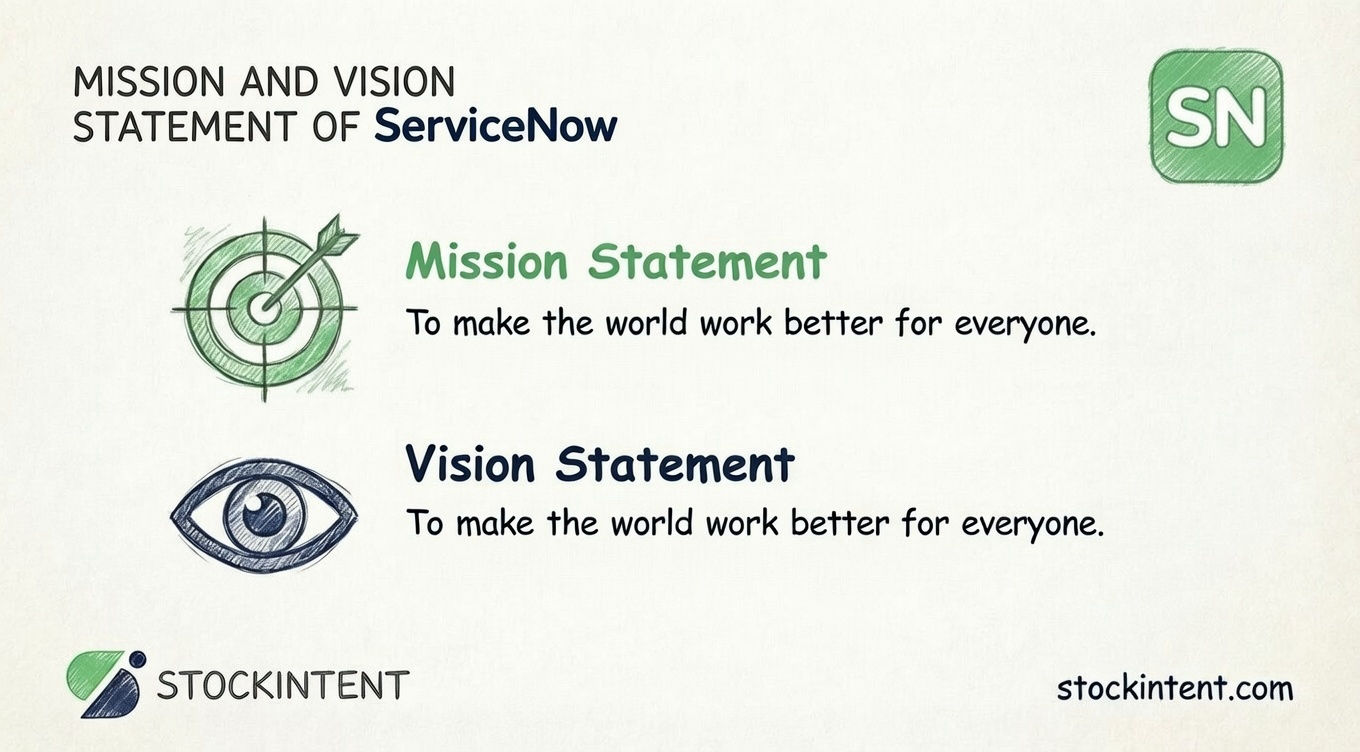
The ServiceNow mission statement is refreshingly direct: "to make the world work better for everyone." This isn't corporate fluff. It's a declaration that shapes how ServiceNow builds products, allocates capital, and positions itself for the AI era. In 2026, that mission has evolved from streamlining IT tickets to orchestrating entire enterprise workflows with autonomous AI agents.
This article breaks down ServiceNow's mission, vision, and core values, and more importantly, what they mean for investors sizing up this $150+ billion software giant.
ServiceNow started in 2004 when founder Fred Luddy wrote the original workflow code in a converted gym in San Diego. Twenty-two years later, this $150+ billion enterprise software giant has become the dominant platform for digitizing how large companies actually operate. Not just IT tickets anymore; we're talking HR onboarding, customer service, finance operations, security response; essentially any workflow that keeps a Fortune 500 running.
The company's evolution tracks neatly with the ServiceNow mission statement and vision. What began as IT service management (ITSM) automation has expanded into a comprehensive AI platform integrating workflows, data, and security across every major business function. In 2026, ServiceNow serves roughly 80% of the Fortune 500, including 603 customers spending $5 million or more annually (averaging $14.7 million each).
In our experience analyzing enterprise software companies, ServiceNow's transformation from a single-product vendor to a unified platform represents one of the more successful expansions in the sector. Most companies stumble when they try to move beyond their core competence. ServiceNow pulled it off, largely because the mission gave them permission to solve adjacent problems rather than forcing them to stay in a shrinking box.
The company's competitive positioning is strengthened by high switching costs; once you've got 80% of your workflows running on ServiceNow, moving elsewhere becomes genuinely painful. That moat, combined with the platform's native AI integration (not bolted-on afterthoughts), explains why analyst consensus sits at roughly 90% Buy ratings despite premium valuation multiples.
ServiceNow ranks among the top-tier enterprise software applications by market position, though precise market share comparisons to competitors like Salesforce or Microsoft remain difficult given the fragmented nature of workflow automation versus CRM or productivity suites. What we can say: in the specific territory ServiceNow carved out, they're the dominant species.
"To make the world work better for everyone."
That's ServiceNow's official mission, and it's deceptively simple. At first glance, it reads like generic corporate-speak. But dig deeper, and you'll see why this framing matters for anyone trying to understand where this company is actually headed.
The genius here is the word "everyone." ServiceNow could have easily said "for enterprises" or "for IT departments," which is where they started. Instead, they chose inclusive language that creates permission to solve problems far beyond their original beachhead. When Fred Luddy wrote that first workflow code back in 2004, he was fixing IT ticketing. In 2026, that same mission justifies AI agents that handle HR onboarding, voice-activated procurement, and autonomous security responses. The mission didn't change; the scope of "better work" expanded dramatically.
🎯 Pro Insight: When evaluating mission-driven companies, watch how the mission enables or constrains strategic expansion. ServiceNow's "world" framing lets them enter any workflow-heavy domain without mission drift. Compare this to Salesforce's "customer" focus or Workday's "people" emphasis; each creates different expansion boundaries. The broadest mission often wins the longest runway.
From an investor perspective, the mission signals three strategic priorities that directly impact capital allocation:
Platform over point solutions — The mission demands unified experiences, not fragmented tools. This explains why ServiceNow builds native AI rather than acquiring bolt-on capabilities, and why they've resisted the temptation to monetize through forced app marketplace fragmentation like some competitors.
Customer outcomes over feature checklists — "Work better" implies measurable impact, not just functionality. This shapes how they price (outcome-based models emerging) and how they invest R&D dollars toward agentic AI that actually completes tasks rather than merely assists.
Permission to wander adjacent workflows — The mission creates cover for entering customer service management, HR automation, finance operations, and eventually vertical-specific workflows. Each expansion is defensible because it serves the same master: making work function more smoothly for the humans doing it.
The mission has remained remarkably stable over the years, despite ServiceNow's evolution from a $2.5 million revenue startup to a $13+ billion platform giant. That consistency matters. Companies that pivot their mission every few years typically lack strategic conviction or are chasing trends. ServiceNow's steady North Star, combined with massive scope expansion under that stable umbrella, suggests genuine clarity about what they're actually building.
Also worth noting: the mission is indistinguishable from their vision statement. ServiceNow doesn't artificially separate "what we do today" from "what we're becoming." The mission is the vision. In practice, this eliminates the common corporate problem where mission and vision drift apart, confusing employees and investors alike. When the CEO talks about "making the world work better through AI", he's using the same framing as the 2004 founding story. That coherence builds trust and execution focus.
The ServiceNow mission statement isn't just aspirational language; it's operational architecture. Three strategic pillars translate "make the world work better for everyone" into day-to-day execution: digital workflows, great experiences, and unlocking productivity through AI. Each pillar feeds directly into the competitive positioning investors care about.
This is the foundation. ServiceNow's core insight, dating back to Fred Luddy's original code in that San Diego gym, was that work gets stuck in handoffs and manual processes. The digital workflows pillar automates these movements across IT, HR, customer service, finance, and security operations.
What makes this strategically valuable is the platform unification. Rather than stitching together dozens of point solutions, ServiceNow offers a single workflow engine. In practice, this means a security alert can automatically trigger an IT ticket, notify HR if employee credentials are compromised, and update customer service records; all without human intervention. According to company research, their intelligent service models can automatically resolve most inbound requests, reducing resolution times from days to under one minute.
For investors, the workflow pillar creates switching costs that deepen over time. Once you've mapped 80% of your business processes onto this platform, migrating away becomes genuinely painful. That's moat territory.
The second pillar focuses on the human side of those workflows. "Work better" implies more than efficiency; it means employees actually want to use the tools. ServiceNow operationalizes this through what they call "co-innovation" with customers; shoulder-to-shoulder development of agentic AI journeys rather than top-down product mandates.
The employee experience focus manifests in specific programs. The People Pact commits to employee development and wellbeing. Belonging initiatives support diverse communities and neurodiversity accommodations. These aren't HR checkbox exercises; they tie directly to talent retention in a competitive AI labor market.
The business outcome? Customer retention and expansion. Companies that report high employee satisfaction with internal tools tend to renew contracts and buy additional modules. ServiceNow's 603 customers spending $5 million or more annually (up 20% year-over-year) suggests this experience focus translates to wallet share growth.
📌 From Our Experience: After analyzing dozens of enterprise software companies, we've noticed that mission statements including "experience" or "people" language tend to correlate with higher net revenue retention; but only when backed by specific programs. ServiceNow's People Pact and measured employee satisfaction metrics (like their Glassdoor recognition) suggest they're actually operationalizing this pillar rather than just talking about it. Companies with similar missions but no structural programs typically underperform on customer retention.
The third pillar is where the AI transformation lives. ServiceNow's framing is agentic AI: systems that don't just assist but actually act, automate, and execute at scale. This moves beyond the chatbot era into autonomous workflows that complete tasks without human intervention.
Concrete initiatives include:
The productivity pillar directly addresses investor concerns about AI monetization. Unlike vendors bolting AI onto legacy products, ServiceNow's native integration across workflows, data, and security creates differentiated value. When AI agents can actually complete procurement requests or resolve security incidents autonomously, pricing power follows.
| Pillar | Strategic Focus | Investor Relevance |
|---|---|---|
| Digital Workflows | Automate cross-functional processes | Switching costs, platform stickiness |
| Great Experiences | Human-centric design, employee/customer satisfaction | Net revenue retention, expansion rates |
| Unlocking Productivity | Agentic AI, autonomous task completion | AI monetization, pricing power, growth |
These three pillars aren't independent. They reinforce each other. Better workflows enable better experiences; better experiences drive adoption; adoption generates data that trains more productive AI. This flywheel effect, rooted in the mission's permission to serve "everyone" rather than just IT departments, explains how ServiceNow has expanded from a single product to a $13+ billion platform without strategic drift.
"To make the world work better for everyone."
That's ServiceNow's official vision statement, and here's something interesting: it's identical to their mission. No corporate gymnastics trying to separate "what we do today" from "what we aspire to become." Just one clean North Star that scales from Fred Luddy's original IT ticketing code to a $150+ billion AI platform serving 80% of the Fortune 500.
This isn't lazy branding. It's strategic clarity. By collapsing mission and vision into a single statement, ServiceNow eliminates the drift that kills execution at most companies. When the CEO talks about "making the world work better through AI," he's using the exact same framing as the 2004 founding story. That coherence matters for investors trying to assess whether management actually knows where they're steering this ship.
ServiceNow's leadership has articulated three interconnected goals that bring this vision to life:
1. Native Agentic AI Integration
The company isn't bolting AI onto legacy workflows; they're embedding autonomous agents that act, automate, and execute at scale. NOW Assist has already crossed $600 million in annual contract value as of 2025, with a $1 billion target by fiscal 2026. Voice agents, web agents, and cross-application task completion without traditional APIs; these aren't demo features. They're revenue-generating products with measurable enterprise impact.
2. Unified Platform Dominance
The vision demands a single AI-data-workflow fabric rather than fragmented point solutions. ServiceNow's Workflow Data Fabric and RaptorDB investments aim to unify people, data, and processes across IT, HR, customer service, finance, and security. The strategic bet: customers will pay premium prices for integration that actually works, not integration they have to build themselves.
3. Responsible AI at Scale
Leadership has committed to 100% renewable electricity, carbon-neutral cloud operations, and ethical AI governance as non-negotiable foundations for growth. This isn't ESG window dressing; it's risk management. Enterprise buyers increasingly require sustainability and responsible AI credentials before signing eight-figure contracts.
ServiceNow's vision positions it squarely at the intersection of three macro forces reshaping enterprise software in 2026:
| Macro Trend | ServiceNow Positioning | Investor Implication |
|---|---|---|
| AI-First Enterprise Shift | Native agentic AI, not bolted-on features | Differentiated pricing power, higher switching costs |
| Workflow Unification | Single platform vs. fragmented best-of-breed | Consolidation tailwind as CIOs reduce vendor sprawl |
| Voice/Multimodal Interfaces | AI Voice Agents, accessibility expansion | Early mover advantage in next UX paradigm |
The AI Voice Agents initiative exemplifies this positioning. While competitors debate whether voice interfaces matter for enterprise software, ServiceNow is already deploying hands-free workflow triggers that reduce resolution times from days to minutes. They're not following trends; they're betting that voice and multimodal AI will become standard enterprise interaction patterns by 2027-2028.
For investors, this vision alignment matters because it explains the premium valuation. ServiceNow isn't just growing; it's growing into the exact shape that enterprise software is becoming. The vision creates permission to enter adjacent markets, from IT service management to HR automation to security operations, without strategic drift. Each expansion serves the same master: making complex organizational work function more smoothly for the humans trapped inside it.
The risk, of course, is execution. Vision statements are cheap. ServiceNow's $600M+ in AI ACV suggests they're converting vision to revenue faster than most, but the $1B target for 2026 and the broader platform ambitions will test whether this vision can scale beyond the early adopter cohort.
ServiceNow's vision isn't just words on a page; it's a strategic blueprint that shapes every major decision management makes. The company's leadership has articulated several interconnected themes that translate "make the world work better for everyone" into concrete capital allocation and R&D priorities. For investors, understanding these themes helps separate genuine strategic conviction from quarterly earnings hype.
The dominant theme in ServiceNow's current vision is becoming the AI platform for business transformation. This isn't about bolting chatbots onto legacy workflows. Leadership has emphasized native agentic AI, embedded directly into the workflow fabric, where systems autonomously act, automate, and execute at scale.
Concrete investments reflect this priority. NOW Assist has already generated over $600 million in annual contract value as of 2025, with management targeting $1 billion by fiscal 2026. The company is deploying AI Voice Agents for hands-free support and AI Web Agents that complete cross-application tasks without traditional API integrations. These aren't future roadmap items; they're live products with measurable enterprise adoption.
The strategic rationale is straightforward: every major enterprise is becoming AI-first, but most lack the platform infrastructure to deploy autonomous agents at scale. ServiceNow is positioning as that infrastructure. Their Workflow Data Fabric and RaptorDB investments aim to unify people, data, and processes across IT, HR, customer service, finance, and security into a single AI-ready layer.
A second theme centers on platform unification over fragmented point solutions. ServiceNow's leadership has consistently rejected the "best-of-breed" approach that fragments enterprise software into dozens of disconnected tools. Instead, they're betting that CIOs will pay premium prices for integration that actually works out of the box.
This theme shapes acquisition strategy. Rather than buying niche players to fill feature gaps, ServiceNow has made targeted moves like the Armis acquisition to complete their security platform vision. Management has explicitly stated they don't need additional large acquisitions to hit revenue targets; organic growth drivers are sufficient. That's confidence in the platform strategy, and it keeps capital returns flowing to shareholders through the $5 billion share repurchase authorization announced in early 2026.
The unification theme also explains pricing power. Once a customer has 80% of their workflows running on ServiceNow, switching costs become genuinely painful. That stickiness is worth paying up for.
The third vision theme is responsible AI as a competitive moat, not just ESG window dressing. ServiceNow's leadership has committed to 100% renewable electricity, carbon-neutral cloud operations, and ethical AI governance as foundational to growth.
Why does this matter for investors? Enterprise buyers increasingly require sustainability and responsible AI credentials before signing eight-figure contracts. ServiceNow's positioning here is defensive; lack of these credentials becomes a deal-breaker in competitive procurements. The company isn't leading with ethics as a marketing angle, they're treating it as table stakes for the Fortune 500 segment they dominate.
A fourth theme involves geographic and sector diversification. The company has committed CA$110 million to multi-year AI initiatives for Canada's public sector, and continues investing in data center expansion for public cloud geo-scaling. U.S. Federal growth is highlighted as a specific priority alongside core workflow expansion.
This theme matters because it extends ServiceNow's moat beyond the commercial enterprises where they already hold dominant share. Government and regulated industries have even higher switching costs and longer contract durations. Winning here compounds the platform's defensive characteristics.
ServiceNow's four core values aren't wall decorations. They're decision-making filters that shape hiring, product development, and how the company allocates its $13+ billion in annual revenue. For investors, understanding whether these values are genuine operational principles or corporate theater matters. Culture drives execution, and execution drives returns.
The company's values are: Win as a Team, Wow our Customers, Stay Hungry and Humble, and Create Belonging. Each carries specific meaning and observable behaviors that we can evaluate against actual company performance.
This value emphasizes collaboration over individual heroics. ServiceNow operationalizes it through cross-functional "swarming" on customer problems, where engineers, product managers, and customer success reps work shoulder-to-shoulder rather than throwing issues over departmental walls.
The strategic impact shows up in platform unification. While competitors fragment into dozens of disconnected tools, ServiceNow's team-first culture enables the hard work of building a single workflow engine. That cohesion creates switching costs customers actually feel. According to employee testimonials on the company's careers site, this collaboration focus yields better customer experiences because internal silos don't become customer problems.
💡 Expert Tip: When evaluating software companies, look for "team" values that manifest in product architecture, not just HR slide decks. ServiceNow's unified platform is the product of genuine cross-functional collaboration. Fragmented product suites usually signal fragmented internal culture.
ServiceNow frames this as co-innovation rather than vendor-customer transactions. The company deploys "customer success architects" who embed with Fortune 500 teams to build agentic AI journeys together, not deliver top-down product mandates.
This value directly impacts the economic moat. That 603-customer cohort spending $5 million+ annually (averaging $14.7 million each) doesn't happen through transactional relationships. It requires genuine partnership where customers feel their specific workflows are understood. The company's values documentation emphasizes that "wow" means measurable outcomes, not just friendly service.
In our experience analyzing enterprise software retention, "customer success" programs are easy to announce and hard to execute. ServiceNow's 20% year-over-year growth in large customers, combined with their 40% growth in $1 million+ deals, suggests they're converting this value into actual wallet share expansion. That's the metric that matters.
This value explicitly rejects the complacency that kills successful technology companies. "Hungry" shows up in aggressive AI investment ($600M+ in NOW Assist ACV already, targeting $1 billion by FY2026). "Humble" manifests in management's willingness to acknowledge what they don't know and partner rather than build everything internally.
The company's values blog describes this as "empowerment without ego, speed with intention, and relentless curiosity." For investors, the humility component matters most. Management has explicitly stated they don't need additional large acquisitions to hit revenue targets; organic growth drivers are sufficient. That's confidence without arrogance. It also preserves capital for shareholder returns through the $5 billion share repurchase program announced in early 2026.
ServiceNow's fourth value centers on inclusion and authentic self-expression. The company supports employee resource groups for families, interfaith communities, Pride (LGBTQ+), and neurodiversity advocates. This isn't peripheral HR activity; it's framed as essential to attracting the AI talent required for their platform ambitions.
The operational evidence includes Glassdoor Best Places to Work recognition, Fortune 100 Best Companies to Work For placement, and specific awards for Best Workplaces for Parents, Women, Disability Inclusion, and LGBTQ+ Equality. These third-party validations matter more than self-reported culture scores.
However, employee survey data from Comparably reveals a more nuanced picture: 43% of employees are motivated by mission and values, but only 10% cite mission as their primary reason for staying. Compensation and benefits dominate at 80%. This isn't necessarily a failure; top AI talent is genuinely expensive to retain. But it suggests ServiceNow's culture is competitive, not uniquely compelling, in a tight labor market.
ServiceNow extends its core values into formal environmental, social, and governance commitments. These aren't separate from the value system; they're presented as natural extensions of "making the world work better for everyone."
Environmental: The company has committed to 100% renewable electricity and carbon-neutral cloud operations. For a platform processing billions of workflows annually, this represents genuine operational investment, not marketing gloss.
Social: Beyond internal belonging initiatives, ServiceNow.org aims to reach 1 billion people through AI access, knowledge equity, and opportunity expansion aligned with UN Sustainable Development Goals. The company's global impact reporting frames this as philanthropy integrated with business strategy rather than separate corporate citizenship.
Governance: Ethical AI governance and transparency standards are positioned as competitive requirements, not just compliance. Enterprise buyers increasingly demand responsible AI credentials before signing eight-figure contracts. ServiceNow's positioning here is defensive risk management; lack of these credentials becomes a deal-breaker.
Evaluating whether stated values match reality requires looking at behavior under pressure, not just prosperity.
Evidence of alignment: The platform's native AI integration (not bolted-on acquisitions) reflects genuine "Win as a Team" collaboration. The $600M+ in NOW Assist ACV demonstrates "Stay Hungry" execution. Customer concentration in long-term, high-value relationships suggests "Wow our Customers" isn't just talk. The specific DEI investments and third-party recognitions validate "Create Belonging" as more than performative.
Potential gaps: The employee retention data suggests values are a supporting factor, not the primary driver, for talent decisions. The company's rapid growth and aggressive financial targets create natural tension with "humility" as a value. And like any large technology company, ServiceNow has faced standard Silicon Valley pressures around work-life balance and burnout that test the "People Pact" commitment to "living best lives."
For investors, the relevant question isn't whether ServiceNow perfectly embodies its values; no large company does. It's whether these values create durable competitive advantages. The unified platform architecture, high customer retention, and ability to attract AI talent at scale suggest the values are genuinely operational, not decorative. That's worth something in a sector where culture often degrades as companies scale past $10 billion in revenue.
ServiceNow's mission, vision, and core values weave together into something rarer than it looks: genuine strategic coherence. The ServiceNow mission statement and vision are identical by design; "to make the world work better for everyone" serves as both North Star and daily operating principle. That collapsing of mission into vision eliminates the drift that kills execution at most companies. When leadership talks about "making the world work better through AI," they're using the same framing Fred Luddy used in 2004. That consistency builds trust.
The four core values; Win as a Team, Wow our Customers, Stay Hungry and Humble, Create Belonging; aren't wall decorations. They're decision filters visible in product architecture (unified platform, not fragmented tools), capital allocation ($5 billion share repurchases plus organic R&D rather than acquisition binges), and talent retention (Glassdoor recognition, Fortune Best Workplaces). The People Pact formalizes the employee commitment, but the real signal is behavioral: management explicitly stated they don't need large acquisitions to hit revenue targets. That's confidence without arrogance.
🎯 Pro Insight: When evaluating management quality in software, watch how they talk about capital allocation during periods of strength. ServiceNow's willingness to return cash while investing aggressively in AI R&D suggests discipline that often disappears when growth feels easy. The $600 million in NOW Assist ACV, targeting $1 billion by FY2026, shows they're converting strategic vision into measurable revenue faster than most platform transitions.
Analyst consensus reflects this execution quality. Roughly 90% of covering analysts rate ServiceNow Buy or Strong Buy, with price targets implying 20-94% upside from early 2026 levels. BTIG maintained their Buy rating post-earnings, citing the "strong 2026 outlook" with 18.75% subscription revenue growth above consensus. The consensus view sees ServiceNow's competitive positioning as stable; enterprise migration slowdowns actually protect established leaders like ServiceNow from upstart disruption.
In our experience analyzing quality compounders, the intersection of mission clarity and capital allocation discipline is where long-term outperformance lives. ServiceNow checks both boxes. The mission creates permission to solve adjacent problems without strategic drift. The values shape execution that builds switching costs. The financial results validate the approach.
Looking forward, no fundamental reshaping of ServiceNow's mission or vision appears on the horizon. The strategic trajectory centers on execution: hitting that $1 billion NOW Assist target, expanding AI Voice Agents and Workflow Data Fabric, and proving that native agentic AI integration commands pricing power. The mission doesn't need to change because it was architected for expansion from day one. "Everyone" and "world" are deliberately broad words. They create cover for entering any workflow-heavy domain.
For investors, this framework matters because it explains the premium valuation and suggests durability. Quality businesses with coherent strategy, strong moats, and disciplined management tend to compound shareholder value over decades, not quarters. ServiceNow's mission-vision-values architecture positions it for exactly that kind of long-term compounding; assuming, of course, that execution continues to match ambition.
If you're evaluating NOW stock for your own portfolio, tools like StockIntent can help you dig deeper into the financial metrics, backtest how similar quality-growth compounders have performed historically, and build conviction through data rather than narrative alone. You can try it risk-free for 7 days to see how fundamental analysis fits your investment process.
ServiceNow has transformed from a niche IT service management tool into one of the most valuable enterprise software companies on the planet. For investors evaluating whether NOW stock deserves a place in a quality-focused portfolio, understanding what actually drives this company matters. A lot.
The ServiceNow mission statement is refreshingly direct: "to make the world work better for everyone." This isn't corporate fluff. It's a declaration that shapes how ServiceNow builds products, allocates capital, and positions itself for the AI era. In 2026, that mission has evolved from streamlining IT tickets to orchestrating entire enterprise workflows with autonomous AI agents.
This article breaks down ServiceNow's mission, vision, and core values, and more importantly, what they mean for investors sizing up this $150+ billion software giant.
ServiceNow started in 2004 when founder Fred Luddy wrote the original workflow code in a converted gym in San Diego. Twenty-two years later, this $150+ billion enterprise software giant has become the dominant platform for digitizing how large companies actually operate. Not just IT tickets anymore; we're talking HR onboarding, customer service, finance operations, security response; essentially any workflow that keeps a Fortune 500 running.
The company's evolution tracks neatly with the ServiceNow mission statement and vision. What began as IT service management (ITSM) automation has expanded into a comprehensive AI platform integrating workflows, data, and security across every major business function. In 2026, ServiceNow serves roughly 80% of the Fortune 500, including 603 customers spending $5 million or more annually (averaging $14.7 million each).
In our experience analyzing enterprise software companies, ServiceNow's transformation from a single-product vendor to a unified platform represents one of the more successful expansions in the sector. Most companies stumble when they try to move beyond their core competence. ServiceNow pulled it off, largely because the mission gave them permission to solve adjacent problems rather than forcing them to stay in a shrinking box.
The company's competitive positioning is strengthened by high switching costs; once you've got 80% of your workflows running on ServiceNow, moving elsewhere becomes genuinely painful. That moat, combined with the platform's native AI integration (not bolted-on afterthoughts), explains why analyst consensus sits at roughly 90% Buy ratings despite premium valuation multiples.
ServiceNow ranks among the top-tier enterprise software applications by market position, though precise market share comparisons to competitors like Salesforce or Microsoft remain difficult given the fragmented nature of workflow automation versus CRM or productivity suites. What we can say: in the specific territory ServiceNow carved out, they're the dominant species.
"To make the world work better for everyone."
That's ServiceNow's official mission, and it's deceptively simple. At first glance, it reads like generic corporate-speak. But dig deeper, and you'll see why this framing matters for anyone trying to understand where this company is actually headed.
The genius here is the word "everyone." ServiceNow could have easily said "for enterprises" or "for IT departments," which is where they started. Instead, they chose inclusive language that creates permission to solve problems far beyond their original beachhead. When Fred Luddy wrote that first workflow code back in 2004, he was fixing IT ticketing. In 2026, that same mission justifies AI agents that handle HR onboarding, voice-activated procurement, and autonomous security responses. The mission didn't change; the scope of "better work" expanded dramatically.
🎯 Pro Insight: When evaluating mission-driven companies, watch how the mission enables or constrains strategic expansion. ServiceNow's "world" framing lets them enter any workflow-heavy domain without mission drift. Compare this to Salesforce's "customer" focus or Workday's "people" emphasis; each creates different expansion boundaries. The broadest mission often wins the longest runway.
From an investor perspective, the mission signals three strategic priorities that directly impact capital allocation:
Platform over point solutions — The mission demands unified experiences, not fragmented tools. This explains why ServiceNow builds native AI rather than acquiring bolt-on capabilities, and why they've resisted the temptation to monetize through forced app marketplace fragmentation like some competitors.
Customer outcomes over feature checklists — "Work better" implies measurable impact, not just functionality. This shapes how they price (outcome-based models emerging) and how they invest R&D dollars toward agentic AI that actually completes tasks rather than merely assists.
Permission to wander adjacent workflows — The mission creates cover for entering customer service management, HR automation, finance operations, and eventually vertical-specific workflows. Each expansion is defensible because it serves the same master: making work function more smoothly for the humans doing it.
The mission has remained remarkably stable over the years, despite ServiceNow's evolution from a $2.5 million revenue startup to a $13+ billion platform giant. That consistency matters. Companies that pivot their mission every few years typically lack strategic conviction or are chasing trends. ServiceNow's steady North Star, combined with massive scope expansion under that stable umbrella, suggests genuine clarity about what they're actually building.
Also worth noting: the mission is indistinguishable from their vision statement. ServiceNow doesn't artificially separate "what we do today" from "what we're becoming." The mission is the vision. In practice, this eliminates the common corporate problem where mission and vision drift apart, confusing employees and investors alike. When the CEO talks about "making the world work better through AI", he's using the same framing as the 2004 founding story. That coherence builds trust and execution focus.
The ServiceNow mission statement isn't just aspirational language; it's operational architecture. Three strategic pillars translate "make the world work better for everyone" into day-to-day execution: digital workflows, great experiences, and unlocking productivity through AI. Each pillar feeds directly into the competitive positioning investors care about.
This is the foundation. ServiceNow's core insight, dating back to Fred Luddy's original code in that San Diego gym, was that work gets stuck in handoffs and manual processes. The digital workflows pillar automates these movements across IT, HR, customer service, finance, and security operations.
What makes this strategically valuable is the platform unification. Rather than stitching together dozens of point solutions, ServiceNow offers a single workflow engine. In practice, this means a security alert can automatically trigger an IT ticket, notify HR if employee credentials are compromised, and update customer service records; all without human intervention. According to company research, their intelligent service models can automatically resolve most inbound requests, reducing resolution times from days to under one minute.
For investors, the workflow pillar creates switching costs that deepen over time. Once you've mapped 80% of your business processes onto this platform, migrating away becomes genuinely painful. That's moat territory.
The second pillar focuses on the human side of those workflows. "Work better" implies more than efficiency; it means employees actually want to use the tools. ServiceNow operationalizes this through what they call "co-innovation" with customers; shoulder-to-shoulder development of agentic AI journeys rather than top-down product mandates.
The employee experience focus manifests in specific programs. The People Pact commits to employee development and wellbeing. Belonging initiatives support diverse communities and neurodiversity accommodations. These aren't HR checkbox exercises; they tie directly to talent retention in a competitive AI labor market.
The business outcome? Customer retention and expansion. Companies that report high employee satisfaction with internal tools tend to renew contracts and buy additional modules. ServiceNow's 603 customers spending $5 million or more annually (up 20% year-over-year) suggests this experience focus translates to wallet share growth.
📌 From Our Experience: After analyzing dozens of enterprise software companies, we've noticed that mission statements including "experience" or "people" language tend to correlate with higher net revenue retention; but only when backed by specific programs. ServiceNow's People Pact and measured employee satisfaction metrics (like their Glassdoor recognition) suggest they're actually operationalizing this pillar rather than just talking about it. Companies with similar missions but no structural programs typically underperform on customer retention.
The third pillar is where the AI transformation lives. ServiceNow's framing is agentic AI: systems that don't just assist but actually act, automate, and execute at scale. This moves beyond the chatbot era into autonomous workflows that complete tasks without human intervention.
Concrete initiatives include:
The productivity pillar directly addresses investor concerns about AI monetization. Unlike vendors bolting AI onto legacy products, ServiceNow's native integration across workflows, data, and security creates differentiated value. When AI agents can actually complete procurement requests or resolve security incidents autonomously, pricing power follows.
| Pillar | Strategic Focus | Investor Relevance |
|---|---|---|
| Digital Workflows | Automate cross-functional processes | Switching costs, platform stickiness |
| Great Experiences | Human-centric design, employee/customer satisfaction | Net revenue retention, expansion rates |
| Unlocking Productivity | Agentic AI, autonomous task completion | AI monetization, pricing power, growth |
These three pillars aren't independent. They reinforce each other. Better workflows enable better experiences; better experiences drive adoption; adoption generates data that trains more productive AI. This flywheel effect, rooted in the mission's permission to serve "everyone" rather than just IT departments, explains how ServiceNow has expanded from a single product to a $13+ billion platform without strategic drift.
"To make the world work better for everyone."
That's ServiceNow's official vision statement, and here's something interesting: it's identical to their mission. No corporate gymnastics trying to separate "what we do today" from "what we aspire to become." Just one clean North Star that scales from Fred Luddy's original IT ticketing code to a $150+ billion AI platform serving 80% of the Fortune 500.
This isn't lazy branding. It's strategic clarity. By collapsing mission and vision into a single statement, ServiceNow eliminates the drift that kills execution at most companies. When the CEO talks about "making the world work better through AI," he's using the exact same framing as the 2004 founding story. That coherence matters for investors trying to assess whether management actually knows where they're steering this ship.
ServiceNow's leadership has articulated three interconnected goals that bring this vision to life:
1. Native Agentic AI Integration
The company isn't bolting AI onto legacy workflows; they're embedding autonomous agents that act, automate, and execute at scale. NOW Assist has already crossed $600 million in annual contract value as of 2025, with a $1 billion target by fiscal 2026. Voice agents, web agents, and cross-application task completion without traditional APIs; these aren't demo features. They're revenue-generating products with measurable enterprise impact.
2. Unified Platform Dominance
The vision demands a single AI-data-workflow fabric rather than fragmented point solutions. ServiceNow's Workflow Data Fabric and RaptorDB investments aim to unify people, data, and processes across IT, HR, customer service, finance, and security. The strategic bet: customers will pay premium prices for integration that actually works, not integration they have to build themselves.
3. Responsible AI at Scale
Leadership has committed to 100% renewable electricity, carbon-neutral cloud operations, and ethical AI governance as non-negotiable foundations for growth. This isn't ESG window dressing; it's risk management. Enterprise buyers increasingly require sustainability and responsible AI credentials before signing eight-figure contracts.
ServiceNow's vision positions it squarely at the intersection of three macro forces reshaping enterprise software in 2026:
| Macro Trend | ServiceNow Positioning | Investor Implication |
|---|---|---|
| AI-First Enterprise Shift | Native agentic AI, not bolted-on features | Differentiated pricing power, higher switching costs |
| Workflow Unification | Single platform vs. fragmented best-of-breed | Consolidation tailwind as CIOs reduce vendor sprawl |
| Voice/Multimodal Interfaces | AI Voice Agents, accessibility expansion | Early mover advantage in next UX paradigm |
The AI Voice Agents initiative exemplifies this positioning. While competitors debate whether voice interfaces matter for enterprise software, ServiceNow is already deploying hands-free workflow triggers that reduce resolution times from days to minutes. They're not following trends; they're betting that voice and multimodal AI will become standard enterprise interaction patterns by 2027-2028.
For investors, this vision alignment matters because it explains the premium valuation. ServiceNow isn't just growing; it's growing into the exact shape that enterprise software is becoming. The vision creates permission to enter adjacent markets, from IT service management to HR automation to security operations, without strategic drift. Each expansion serves the same master: making complex organizational work function more smoothly for the humans trapped inside it.
The risk, of course, is execution. Vision statements are cheap. ServiceNow's $600M+ in AI ACV suggests they're converting vision to revenue faster than most, but the $1B target for 2026 and the broader platform ambitions will test whether this vision can scale beyond the early adopter cohort.
ServiceNow's vision isn't just words on a page; it's a strategic blueprint that shapes every major decision management makes. The company's leadership has articulated several interconnected themes that translate "make the world work better for everyone" into concrete capital allocation and R&D priorities. For investors, understanding these themes helps separate genuine strategic conviction from quarterly earnings hype.
The dominant theme in ServiceNow's current vision is becoming the AI platform for business transformation. This isn't about bolting chatbots onto legacy workflows. Leadership has emphasized native agentic AI, embedded directly into the workflow fabric, where systems autonomously act, automate, and execute at scale.
Concrete investments reflect this priority. NOW Assist has already generated over $600 million in annual contract value as of 2025, with management targeting $1 billion by fiscal 2026. The company is deploying AI Voice Agents for hands-free support and AI Web Agents that complete cross-application tasks without traditional API integrations. These aren't future roadmap items; they're live products with measurable enterprise adoption.
The strategic rationale is straightforward: every major enterprise is becoming AI-first, but most lack the platform infrastructure to deploy autonomous agents at scale. ServiceNow is positioning as that infrastructure. Their Workflow Data Fabric and RaptorDB investments aim to unify people, data, and processes across IT, HR, customer service, finance, and security into a single AI-ready layer.
A second theme centers on platform unification over fragmented point solutions. ServiceNow's leadership has consistently rejected the "best-of-breed" approach that fragments enterprise software into dozens of disconnected tools. Instead, they're betting that CIOs will pay premium prices for integration that actually works out of the box.
This theme shapes acquisition strategy. Rather than buying niche players to fill feature gaps, ServiceNow has made targeted moves like the Armis acquisition to complete their security platform vision. Management has explicitly stated they don't need additional large acquisitions to hit revenue targets; organic growth drivers are sufficient. That's confidence in the platform strategy, and it keeps capital returns flowing to shareholders through the $5 billion share repurchase authorization announced in early 2026.
The unification theme also explains pricing power. Once a customer has 80% of their workflows running on ServiceNow, switching costs become genuinely painful. That stickiness is worth paying up for.
The third vision theme is responsible AI as a competitive moat, not just ESG window dressing. ServiceNow's leadership has committed to 100% renewable electricity, carbon-neutral cloud operations, and ethical AI governance as foundational to growth.
Why does this matter for investors? Enterprise buyers increasingly require sustainability and responsible AI credentials before signing eight-figure contracts. ServiceNow's positioning here is defensive; lack of these credentials becomes a deal-breaker in competitive procurements. The company isn't leading with ethics as a marketing angle, they're treating it as table stakes for the Fortune 500 segment they dominate.
A fourth theme involves geographic and sector diversification. The company has committed CA$110 million to multi-year AI initiatives for Canada's public sector, and continues investing in data center expansion for public cloud geo-scaling. U.S. Federal growth is highlighted as a specific priority alongside core workflow expansion.
This theme matters because it extends ServiceNow's moat beyond the commercial enterprises where they already hold dominant share. Government and regulated industries have even higher switching costs and longer contract durations. Winning here compounds the platform's defensive characteristics.
ServiceNow's four core values aren't wall decorations. They're decision-making filters that shape hiring, product development, and how the company allocates its $13+ billion in annual revenue. For investors, understanding whether these values are genuine operational principles or corporate theater matters. Culture drives execution, and execution drives returns.
The company's values are: Win as a Team, Wow our Customers, Stay Hungry and Humble, and Create Belonging. Each carries specific meaning and observable behaviors that we can evaluate against actual company performance.
This value emphasizes collaboration over individual heroics. ServiceNow operationalizes it through cross-functional "swarming" on customer problems, where engineers, product managers, and customer success reps work shoulder-to-shoulder rather than throwing issues over departmental walls.
The strategic impact shows up in platform unification. While competitors fragment into dozens of disconnected tools, ServiceNow's team-first culture enables the hard work of building a single workflow engine. That cohesion creates switching costs customers actually feel. According to employee testimonials on the company's careers site, this collaboration focus yields better customer experiences because internal silos don't become customer problems.
💡 Expert Tip: When evaluating software companies, look for "team" values that manifest in product architecture, not just HR slide decks. ServiceNow's unified platform is the product of genuine cross-functional collaboration. Fragmented product suites usually signal fragmented internal culture.
ServiceNow frames this as co-innovation rather than vendor-customer transactions. The company deploys "customer success architects" who embed with Fortune 500 teams to build agentic AI journeys together, not deliver top-down product mandates.
This value directly impacts the economic moat. That 603-customer cohort spending $5 million+ annually (averaging $14.7 million each) doesn't happen through transactional relationships. It requires genuine partnership where customers feel their specific workflows are understood. The company's values documentation emphasizes that "wow" means measurable outcomes, not just friendly service.
In our experience analyzing enterprise software retention, "customer success" programs are easy to announce and hard to execute. ServiceNow's 20% year-over-year growth in large customers, combined with their 40% growth in $1 million+ deals, suggests they're converting this value into actual wallet share expansion. That's the metric that matters.
This value explicitly rejects the complacency that kills successful technology companies. "Hungry" shows up in aggressive AI investment ($600M+ in NOW Assist ACV already, targeting $1 billion by FY2026). "Humble" manifests in management's willingness to acknowledge what they don't know and partner rather than build everything internally.
The company's values blog describes this as "empowerment without ego, speed with intention, and relentless curiosity." For investors, the humility component matters most. Management has explicitly stated they don't need additional large acquisitions to hit revenue targets; organic growth drivers are sufficient. That's confidence without arrogance. It also preserves capital for shareholder returns through the $5 billion share repurchase program announced in early 2026.
ServiceNow's fourth value centers on inclusion and authentic self-expression. The company supports employee resource groups for families, interfaith communities, Pride (LGBTQ+), and neurodiversity advocates. This isn't peripheral HR activity; it's framed as essential to attracting the AI talent required for their platform ambitions.
The operational evidence includes Glassdoor Best Places to Work recognition, Fortune 100 Best Companies to Work For placement, and specific awards for Best Workplaces for Parents, Women, Disability Inclusion, and LGBTQ+ Equality. These third-party validations matter more than self-reported culture scores.
However, employee survey data from Comparably reveals a more nuanced picture: 43% of employees are motivated by mission and values, but only 10% cite mission as their primary reason for staying. Compensation and benefits dominate at 80%. This isn't necessarily a failure; top AI talent is genuinely expensive to retain. But it suggests ServiceNow's culture is competitive, not uniquely compelling, in a tight labor market.
ServiceNow extends its core values into formal environmental, social, and governance commitments. These aren't separate from the value system; they're presented as natural extensions of "making the world work better for everyone."
Environmental: The company has committed to 100% renewable electricity and carbon-neutral cloud operations. For a platform processing billions of workflows annually, this represents genuine operational investment, not marketing gloss.
Social: Beyond internal belonging initiatives, ServiceNow.org aims to reach 1 billion people through AI access, knowledge equity, and opportunity expansion aligned with UN Sustainable Development Goals. The company's global impact reporting frames this as philanthropy integrated with business strategy rather than separate corporate citizenship.
Governance: Ethical AI governance and transparency standards are positioned as competitive requirements, not just compliance. Enterprise buyers increasingly demand responsible AI credentials before signing eight-figure contracts. ServiceNow's positioning here is defensive risk management; lack of these credentials becomes a deal-breaker.
Evaluating whether stated values match reality requires looking at behavior under pressure, not just prosperity.
Evidence of alignment: The platform's native AI integration (not bolted-on acquisitions) reflects genuine "Win as a Team" collaboration. The $600M+ in NOW Assist ACV demonstrates "Stay Hungry" execution. Customer concentration in long-term, high-value relationships suggests "Wow our Customers" isn't just talk. The specific DEI investments and third-party recognitions validate "Create Belonging" as more than performative.
Potential gaps: The employee retention data suggests values are a supporting factor, not the primary driver, for talent decisions. The company's rapid growth and aggressive financial targets create natural tension with "humility" as a value. And like any large technology company, ServiceNow has faced standard Silicon Valley pressures around work-life balance and burnout that test the "People Pact" commitment to "living best lives."
For investors, the relevant question isn't whether ServiceNow perfectly embodies its values; no large company does. It's whether these values create durable competitive advantages. The unified platform architecture, high customer retention, and ability to attract AI talent at scale suggest the values are genuinely operational, not decorative. That's worth something in a sector where culture often degrades as companies scale past $10 billion in revenue.
ServiceNow's mission, vision, and core values weave together into something rarer than it looks: genuine strategic coherence. The ServiceNow mission statement and vision are identical by design; "to make the world work better for everyone" serves as both North Star and daily operating principle. That collapsing of mission into vision eliminates the drift that kills execution at most companies. When leadership talks about "making the world work better through AI," they're using the same framing Fred Luddy used in 2004. That consistency builds trust.
The four core values; Win as a Team, Wow our Customers, Stay Hungry and Humble, Create Belonging; aren't wall decorations. They're decision filters visible in product architecture (unified platform, not fragmented tools), capital allocation ($5 billion share repurchases plus organic R&D rather than acquisition binges), and talent retention (Glassdoor recognition, Fortune Best Workplaces). The People Pact formalizes the employee commitment, but the real signal is behavioral: management explicitly stated they don't need large acquisitions to hit revenue targets. That's confidence without arrogance.
🎯 Pro Insight: When evaluating management quality in software, watch how they talk about capital allocation during periods of strength. ServiceNow's willingness to return cash while investing aggressively in AI R&D suggests discipline that often disappears when growth feels easy. The $600 million in NOW Assist ACV, targeting $1 billion by FY2026, shows they're converting strategic vision into measurable revenue faster than most platform transitions.
Analyst consensus reflects this execution quality. Roughly 90% of covering analysts rate ServiceNow Buy or Strong Buy, with price targets implying 20-94% upside from early 2026 levels. BTIG maintained their Buy rating post-earnings, citing the "strong 2026 outlook" with 18.75% subscription revenue growth above consensus. The consensus view sees ServiceNow's competitive positioning as stable; enterprise migration slowdowns actually protect established leaders like ServiceNow from upstart disruption.
In our experience analyzing quality compounders, the intersection of mission clarity and capital allocation discipline is where long-term outperformance lives. ServiceNow checks both boxes. The mission creates permission to solve adjacent problems without strategic drift. The values shape execution that builds switching costs. The financial results validate the approach.
Looking forward, no fundamental reshaping of ServiceNow's mission or vision appears on the horizon. The strategic trajectory centers on execution: hitting that $1 billion NOW Assist target, expanding AI Voice Agents and Workflow Data Fabric, and proving that native agentic AI integration commands pricing power. The mission doesn't need to change because it was architected for expansion from day one. "Everyone" and "world" are deliberately broad words. They create cover for entering any workflow-heavy domain.
For investors, this framework matters because it explains the premium valuation and suggests durability. Quality businesses with coherent strategy, strong moats, and disciplined management tend to compound shareholder value over decades, not quarters. ServiceNow's mission-vision-values architecture positions it for exactly that kind of long-term compounding; assuming, of course, that execution continues to match ambition.
If you're evaluating NOW stock for your own portfolio, tools like StockIntent can help you dig deeper into the financial metrics, backtest how similar quality-growth compounders have performed historically, and build conviction through data rather than narrative alone. You can try it risk-free for 7 days to see how fundamental analysis fits your investment process.