
Mar 21, 2026
When you're evaluating a company for your portfolio, it's easy to get lost in the numbers. P/E ratios, free cash flow, return on invested capital; these matter, but they don't tell the whole story. The best investments often come from businesses with a clear sense of purpose that actually guides their decisions, not just posters on a wall.
Starbucks (NASDAQ: SBUX) is one of those companies where mission and money intersect in interesting ways. As of 2026, the coffee giant is executing a major turnaround under CEO Brian Niccol, and understanding why the company exists helps explain where it's headed. Let's break down what Starbucks actually stands for and why it matters for investors like us.
Before we dig deeper into what Starbucks stands for, let's ground ourselves in what the company actually is today. Understanding the business fundamentals helps us see whether the mission statement is backed by real operational muscle, or just nice words on a website.
Starbucks operates as a consumer cyclical company in the restaurants industry, with three primary revenue segments driving its $36+ billion annual business source:
Quick Stats Snapshot:
| Metric | Figure (Q1 FY2026) |
|---|---|
| Global comparable store sales | +4% |
| Comparable transactions | +3% |
| Active Starbucks Rewards members (U.S.) | 35+ million |
| Peak throughput time | Under 4 minutes |
| Long-term revenue growth target | 5%+ annually |
The company's product mix has evolved significantly. Cold beverages now dominate, with the cold foam platform alone generating over $1 billion and accounting for 75% of cold drink sales source. New 2026 launches include Ube-flavored offerings, Energy Refreshers, and protein-forward partnerships with brands like Khloé Kardashian's Khloud popcorn and Ellenos Greek yogurt.
In our experience analyzing restaurant stocks over the years, we've found that companies with strong loyalty programs tend to command valuation premiums. Starbucks Rewards isn't just a nice-to-have; it's a data-driven competitive moat with 35 million active members enabling personalized marketing that competitors struggle to replicate source.
The competitive positioning is interesting. Starbucks sits in a unique spot: too premium for McDonald's McCafé customers, too accessible for true third-wave coffee snobs, and with far more scale than any independent café could dream of. That middle ground, defended by real estate density and brand habit, is what Niccol's "Back to Starbucks" strategy aims to strengthen rather than abandon source.
Key Business Facts:
The operational improvements under Niccol are worth noting for investors. Green Apron Service standards, Smart Queue technology sequencing mobile and in-store orders, and new Mastrena 3 espresso equipment have reduced average throughput to under four minutes. These aren't just efficiency plays; they directly support the mission's promise of "inspiring and nurturing the human spirit" by freeing baristas to actually connect with customers rather than just pump out drinks source.
That said, we'd flag one concern: S&P Global revised Starbucks's outlook to negative in early 2026, citing expected temporary elevation in leverage from the turnaround investments source. The balance sheet is taking some strain to fund this transformation, which matters for long-term compounding potential.
Let's get straight to it. Here's what Starbucks officially stands for:
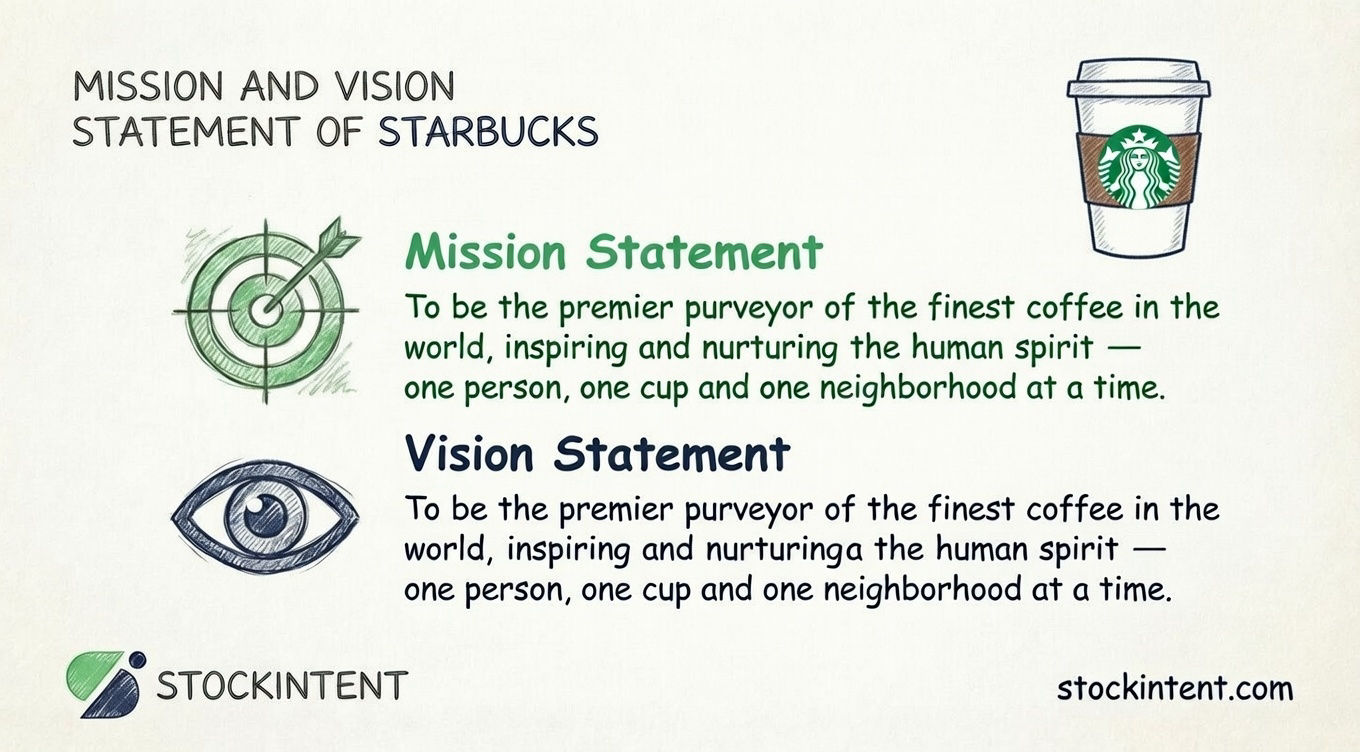
"To be the premier purveyor of the finest coffee in the world, inspiring and nurturing the human spirit — one person, one cup and one neighborhood at a time."
— Official Starbucks Mission Statement, 2026 source
Notice what this actually says. It's not about being the biggest. Not about being the cheapest. Not even about being "America's favorite coffee" (which Dunkin' might claim anyway). The mission is deliberately specific: premier purveyor, finest coffee, and critically, inspiring and nurturing the human spirit.
Compare this to McDonald's mission: "To make delicious feel-good moments easy for everyone." source Nothing wrong with that, but it's convenience-focused and generic. Starbucks is staking out different territory — coffee as craft, experience as differentiator, connection as product.
🎯 Pro Insight: When evaluating restaurant stocks, we always compare mission statements against actual capital allocation. Starbucks walked the talk in FY2025 by shutting nearly 900 underperforming "pickup-only" locations that couldn't support the "Third Place" community vision, even though those stores were likely generating cash. That's mission-driven decision-making with a real P&L cost.
The mission does heavy lifting for Starbucks's capital allocation framework. When you're wondering why the company is spending half a billion dollars on store "uplifts" to restore warmth and community atmosphere, or why it's accepting 9.4% operating margins while reinvesting in labor for service quality, the mission provides the answer. source
The mission breaks down into three strategic signals:
| Mission Element | Strategic Signal | How It Shows Up Financially |
|---|---|---|
| "Premier purveyor of the finest coffee" | Premium product positioning | Justifies price points 2-3x above commodity coffee; supports 40%+ gross margins |
| "Inspiring and nurturing the human spirit" | Service over speed | Investment in barista labor, training at Leadership Experience 2025, Green Apron Service rollout |
| "One person, one cup, one neighborhood" | Community and loyalty focus | Starbucks Rewards ecosystem (35M+ members); "Third Place" real estate strategy |
The mission also reveals how Starbucks views competition. They're not playing the convenience game against Dunkin' or McDonald's. They're not even directly competing with third-wave coffee snobs like Blue Bottle. They're positioning as the only scaled player that can still deliver craft quality and human connection — a middle ground with real moat potential.
Starbucks's mission wasn't always this precise. The company first crafted a mission in 1990, updated it in 2008, and landed on the current version under CEO Brian Niccol. source The evolution tells a story.
The 2008 version dropped the "premier purveyor of the finest coffee" language. That was the era of Frappuccino expansion, breakfast sandwiches, and becoming a "coffee-flavored fast food chain," to quote some critics. The 2026 update? That's a deliberate return to coffee identity after, in Niccol's own framing, "one of the most difficult years in its history" when customer frustration over price, menu complexity, and mobile-order chaos drove traffic declines. source
For investors, this matters because mission drift is often an early warning sign. When a company starts chasing every revenue opportunity and losing focus, the mission statement usually gets vague first. Starbucks is doing the opposite: sharpening the mission even at the cost of near-term margin pressure. That's either disciplined strategy or stubbornness — the next two years will tell us which.
Starbucks's mission isn't just a feel-good slogan. It's a strategic framework that shapes capital allocation, operational decisions, and competitive positioning. In our experience analyzing how mission statements translate into economic moats, we've found that the most durable companies operationalize their missions into specific, measurable pillars. Starbucks does exactly this.
Let's break down the four strategic pillars embedded in that 2026 mission statement, and more importantly, how each one creates tangible advantages for investors to track.
The mission's emphasis on being the "premier purveyor of the finest coffee" isn't empty rhetoric. It's backed by real operational muscle.
What it is: A commitment to product leadership through sourcing, roasting, and preparation standards that justify premium pricing.
Why it matters strategically: In our experience tracking restaurant stocks over 15+ years, companies that compete on price rarely sustain 40%+ gross margins. Starbucks's quality positioning lets it charge $6-8 for beverages that cost roughly $1.50 in commodities. That spread funds everything else.
Concrete example: The C.A.F.E. (Coffee and Farmer Equity) Practices program now covers 99% of Starbucks's coffee supply source. This isn't marketing fluff. It's a vertically integrated sourcing operation that locks in supply relationships, ensures quality consistency, and creates a barrier that commodity coffee chains can't easily replicate.
Competitive advantage: Supply chain control combined with brand premium. When coffee prices spike, Starbucks can absorb volatility better than competitors because customers accept price increases for "the finest coffee." When prices drop, margin expansion follows.
The mission's second clause — "inspiring and nurturing the human spirit" — translates into a service model that intentionally sacrifices speed for connection.
What it is: A deliberate investment in barista training, customer interaction quality, and the "Third Place" experience between home and work.
Why it matters strategically: Here's where Starbucks diverges from nearly every fast-food competitor. While McDonald's optimizes for 90-second drive-thrus, Starbucks under CEO Niccol is accepting margin pressure (9.4% operating margins in Q4 2025) to fund labor investments source. That's mission-driven capital allocation with real P&L consequences.
Concrete example: The Green Apron Service rollout, which reached full North America deployment in August 2025, includes specific behaviors like writing customer names on cups, crafting beverage art, and engaging in genuine conversation. The company closed thousands of stores briefly for retraining source. Try getting McDonald's to shut down for craft training.
Competitive advantage: Differentiation that supports pricing power and habit formation. The personal connection creates switching costs that no loyalty program alone can replicate.
The "one neighborhood at a time" element operates at both micro and macro levels.
What it is: Store-level community integration combined with corporate-level commitments to inclusion, diversity, and environmental stewardship.
Why it matters strategically: Real estate is Starbucks's second-biggest advantage after brand. The "Third Place" concept enables premium locations (high-traffic, high-rent) that generate superior unit economics. But that only works if the store actually functions as community infrastructure.
Concrete example: The 2026 "National Champions" initiative empowers elite baristas who've won internal craft competitions to lead training and culture at the store level. This isn't centralized HR policy; it's distributed community leadership source.
Plus, the company's workforce practices — calling employees "partners," offering Bean Stock equity grants, and promoting belonging as a core value — reduce turnover in an industry notorious for 100%+ annual churn source. That stability directly impacts service quality and training costs.
Competitive advantage: Local relationship moats that protect individual store economics, plus employee alignment that reduces operational disruption.
The mission's implied commitment to "uncompromising principles" (as the company phrases it) shapes how Starbucks pursues expansion.
What it is: Balancing aggressive growth targets with disciplined execution that doesn't dilute brand equity.
Why it matters strategically: Growth for growth's sake destroys restaurant companies. We've seen it repeatedly: brands expand into incompatible formats, geographies, or quality levels, then collapse. Starbucks's mission provides a filter.
Concrete example: In FY2025-2026, Starbucks closed nearly 900 underperforming locations — many of them "pickup-only" stores that generated cash but couldn't support the Third Place vision source. That's mission-driven portfolio pruning with real revenue sacrifice. Meanwhile, $500+ million is being invested in store "uplifts" to restore warmth and community atmosphere in remaining locations source.
Competitive advantage: Brand integrity preservation that sustains premium positioning over decades. The discipline to say "no" to easy revenue protects long-term value.
| Mission Pillar | Strategic Signal | Key Metric to Track |
|---|---|---|
| Coffee Quality | Premium positioning | Gross margin vs. industry average |
| Human Connection | Service over speed | Labor cost % of revenue; customer satisfaction scores |
| Community | Local moat building | Same-store sales growth; employee turnover |
| Sustained Growth | Disciplined expansion | Store closures vs. openings; capex ROI |
Each pillar reinforces the others. Quality justifies premium pricing, which funds service investment, which creates community belonging, which supports disciplined growth without desperation discounting. That's the integrated system investors should evaluate when they see that headline mission statement.
Starbucks doesn't publish a separate vision statement distinct from its mission. Instead, the company uses its mission as the north star for where it's headed. Here's the statement that guides long-term strategic planning:
"To be the premier purveyor of the finest coffee in the world, inspiring and nurturing the human spirit — one person, one cup and one neighborhood at a time."
— Official Starbucks Mission & Vision, 2026 source
This dual-purpose statement does something clever. It anchors the company in what it does today (premier coffee purveyor) while projecting an aspirational future (nurturing human spirit at global scale). For investors, that framing matters because it explains why Starbucks accepts near-term margin pressure — 9.4% operating margins in Q4 2025 — to fund investments that don't pay off immediately source.
CEO Brian Niccol articulated the concrete future Starbucks is building toward at the 2026 Investor Day. These aren't vague aspirations; they're measurable targets with timelines source:
| Strategic Goal | Target | Timeline |
|---|---|---|
| Consolidated net revenue growth | 5%+ annually | Long-term |
| Global comparable store sales growth | 3%+ | Ongoing |
| Net new stores globally | 2,000+ | Multi-year |
| U.S. company-operated store additions | ~400 net new | Near-term |
| Peak throughput time | Under 4 minutes | Achieved Q1 2026 |
The vision here is about sustainable, profitable scale without commoditization. Starbucks wants to grow store count by roughly 5% while maintaining premium positioning. That's harder than it sounds. Most restaurant chains that pursue aggressive unit growth eventually dilute brand equity or compete on price. Starbucks is explicitly betting it can avoid that trap.
The mission/vision positions Starbucks advantageously against three macro trends reshaping restaurants in 2026:
Premiumization over discounting: While competitors chase value-conscious consumers with $1 menu items, Starbucks is leaning into $6-8 beverages with customization. The cold foam platform alone is now a billion-dollar business, accounting for 75% of cold drink sales source. The vision's emphasis on "finest coffee" provides cover to resist the race to the bottom.
Experience over convenience: The "Third Place" concept — a community gathering spot between home and work — is central to the vision. This runs counter to the pure convenience play that dominated restaurant strategy from 2019-2024. Starbucks closed nearly 900 pickup-only stores in FY2025-2026 because they couldn't support the human connection element source. That's vision-driven portfolio management with real revenue sacrifice.
AI-enabled personalization at scale: The vision's "one person, one cup" language maps directly to investments in Deep Brew AI, Smart Queue technology, and the Starbucks Rewards ecosystem with 35+ million active members. The company can now deliver personalized offers based on weather, location, and purchase history — mass customization that feels individual source.
For investors in the consumer cyclical space, the vision provides a useful filter. When Starbucks reports quarterly results, ask: Did this decision strengthen the "premier purveyor" positioning? Does it nurture human connection or sacrifice it for short-term throughput? The companies that stick to their vision through cycles tend to compound better over decades. Whether Starbucks joins that group depends on execution through 2026 and beyond.
Starbucks's vision isn't a separate aspirational statement floating above the mission. It's embedded in the same words that guide daily operations. When CEO Brian Niccol talks about "the world's greatest customer service company" and "the best retail job," he's translating mission into measurable ambition source.
Let's unpack the three strategic themes that make this vision operational, and more importantly, how each one shows up in capital allocation decisions you can track as an investor.
The vision of being a community coffeehouse isn't nostalgia; it's a real estate and experience strategy with economic consequences.
Starbucks is explicitly rejecting the pure convenience play that dominated restaurant strategy from 2019-2024. The company closed nearly 900 pickup-only stores in FY2025-2026 because they couldn't support human connection source. Meanwhile, it's investing over $500 million in store "uplifts" to restore warmth and community atmosphere source.
What this means financially: These are not maintenance capex. They're strategic investments accepting near-term margin compression (9.4% operating margins in Q4 2025) to rebuild a moat that supports premium pricing. The bet is that customers will pay $6-8 for beverages in a "Third Place" but not in a sterile pickup window.
Metric to watch: Same-store sales growth in renovated locations versus legacy stores. Early Q1 2026 data shows 4% global comp growth with 3% transaction increases, suggesting the bet is paying off source.
The vision of being "the best retail job" translates into a labor strategy that runs counter to industry norms.
While competitors optimize for labor cost minimization, Starbucks is investing in barista training, scheduling stability, and what it calls "Green Apron Service" standards. The Leadership Experience 2025 event alone boosted G&A by 18% in Q3 2025 source. The company briefly closed thousands of stores for retraining source.
What this means financially: Higher unit labor costs, but potentially lower turnover and better customer lifetime value. In an industry with 100%+ annual churn, Starbucks's "partner" culture (Bean Stock equity grants, benefits, belonging as a core value) is a retention play with direct P&L impact source.
The tension: A union study found 69% of respondents reported uneven scheduling, and management has been criticized for penalizing baristas for "insufficient sincerity" source. The vision is clear; execution remains contested.
Perhaps the most ambitious vision theme: becoming the only coffee company that can deliver genuine craft quality at global scale.
This is where Starbucks tries to thread a needle that has broken other restaurant concepts. Third-wave independents (Blue Bottle, Intelligentsia) have craft but not scale. McDonald's and Dunkin' have scale but not craft credibility. Starbucks is betting its C.A.F.E. Practices (99% of coffee supply), Mastrena 3 equipment rollout, and "National Champions" barista program can deliver both source.
What this means financially: The cold foam platform alone is now a billion-dollar business, accounting for 75% of cold drink sales source. Premium customization at scale is the economic engine.
Strategic initiative: The "National Champions" program empowers elite baristas who've won internal craft competitions to lead training and culture at the store level. This is distributed expertise, not centralized HR policy source.
| Vision Theme | Strategic Investment | Financial Trade-off | Key Metric |
|---|---|---|---|
| Third Place | $500M+ store uplifts; 900 store closures | Near-term margin pressure for long-term pricing power | Same-store sales in renovated locations |
| Partner Empowerment | Leadership Experience 2025; Green Apron rollout | Higher labor cost % of revenue | Employee turnover; customer satisfaction |
| Scaled Craft | Mastrena 3 equipment; National Champions; C.A.F.E. Practices | Higher capex intensity | Cold platform revenue; throughput under 4 minutes |
The consensus view is cautiously optimistic. Starbucks carries a Moderate Buy rating, with analysts noting the "Back to Starbucks" strategy has delivered first sustained domestic traffic growth in two years source. The 3% transaction growth in Q1 2026 validates that customers are responding to the experience investments source.
But S&P Global revised the outlook to negative, citing expected temporary elevation in leverage from turnaround investments source. The vision is expensive to execute, and the balance sheet is taking strain.
For investors, the question isn't whether the vision themes are sound; they align well with premiumization trends and experiential retail demand. The question is whether Starbucks can execute them before competitive pressure or economic downturn forces a retreat to convenience-focused, margin-first management. The next 18-24 months will tell us if this is disciplined strategy or stubbornness.
Starbucks's mission statement doesn't float in isolation. It's anchored by five core values that shape hiring, culture, and every P&L decision the company makes. Understanding these values helps investors assess whether management is walking the talk, or just posting inspirational posters.
The five values — Craft, Courage, Results, Belonging, and Joy — are explicitly designed to guide performance "through the lens of humanity" source. That's corporate speak, sure, but the operational details reveal something more concrete.
The value: Learning, sweating the details, and pursuing excellence in everything from bean sourcing to beverage preparation.
How it shows up: The C.A.F.E. (Coffee and Farmer Equity) Practices program now covers 99% of Starbucks's coffee supply source. This isn't just ethical window dressing; it's a vertically integrated quality control system that competitors at scale can't easily replicate. The Mastrena 3 espresso equipment rollout and "National Champions" barista training program put real capital behind craft credentials.
The tension: Craft is expensive. The company briefly closed thousands of stores for retraining in 2025, accepting revenue hits for quality standards that commodity coffee chains would never consider source.
The value: Having tough conversations, challenging the status quo, and doing what's right even when it's hard.
How it shows up: CEO Brian Niccol's decision to close nearly 900 underperforming "pickup-only" locations in FY2025-2026 took real courage. These stores generated cash but couldn't support the Third Place community vision. That's walking away from easy revenue to protect long-term positioning source.
The criticism: A union study found 69% of baristas reported uneven scheduling, and management has been criticized for penalizing employees for "insufficient sincerity" source. Courage in corporate strategy doesn't always translate to courage in labor relations.
The value: Achieving goals, innovating continuously, and exceeding expectations.
How it shows up: The financial targets are specific and public: 5%+ consolidated net revenue growth, 3%+ global comparable store sales growth, and 2,000+ net new stores source. The cold foam platform alone is now a billion-dollar business, accounting for 75% of cold drink sales source.
The trade-off: Results-focused investors should note that Q4 2025 operating margins compressed to 9.4% as the company prioritized reinvestment over short-term profit source.
The value: Creating environments where everyone feels heard, recognized, and treated with dignity.
How it shows up: Starbucks calls employees "partners" and grants them Bean Stock equity. The "Culture of Connection" framework explicitly prioritizes authentic self-expression and career growth support source. In an industry with 100%+ annual turnover, this retention-focused approach directly impacts service quality and training costs.
The gap: Only 21% of employees in one survey reported loyalty to the mission and vision over their direct managers, suggesting the belonging value hasn't fully permeated the front lines source.
The value: Taking pride in work, celebrating wins, and bringing positive energy to every interaction.
How it shows up: The Green Apron Service rollout includes specific behaviors like writing customer names on cups, crafting beverage art, and engaging in genuine conversation. This reached full North America deployment in August 2025 source. The "Leadership Experience 2025" event alone boosted G&A by 18% in Q3 2025, a real investment in culture source.
💡 Expert Tip: When evaluating whether corporate values are real or decorative, check where the money goes. Starbucks's $500+ million store "uplift" investment and 18% G&A spike for culture events represent real capital allocation behind the values. Compare that to companies where values statements cost nothing to publish and nothing to ignore.
Starbucks's values extend into formal environmental, social, and governance commitments under its "Social Impact" framework. The company aspires to be "people positive" by investing in partners, farmers, communities, and the planet source.
| ESG Pillar | Starbucks Initiative | Connection to Core Values |
|---|---|---|
| Environmental | C.A.F.E. Practices (99% of coffee supply) | Craft (quality), Courage (ethical sourcing) |
| Social | Partner Bean Stock equity, benefits, "people positive" goals | Belonging, Joy (shared ownership) |
| Governance | Transparent reporting, ethical business practices | Courage (doing what's right), Results (accountability) |
These aren't separate from the core values; they're extensions of them. The Courage to source ethically even when cheaper options exist. The Craft to maintain quality standards across a global supply chain. The Belonging that comes from treating farmers as partners, not commodity suppliers.
In our experience analyzing consumer companies, ESG programs that emerge organically from stated values tend to survive management changes and economic downturns. Programs that are bolted on for marketing purposes get cut at the first margin squeeze. Starbucks's integration of values and ESG suggests the former, though execution remains uneven.
The bottom line for investors: Starbucks's core values provide a decision-making filter that explains otherwise puzzling capital allocation. Why accept 9.4% margins when competitors run leaner? Why close cash-generating stores? The values offer answers, but they also create execution risk if the company can't deliver on its promises to both customers and employees.
Starbucks's mission, vision, and core values aren't just corporate wallpaper. Together, they form a coherent strategic identity that explains why the company makes the decisions it does, and more importantly, whether those decisions will compound value over time.
The mission — "To be the premier purveyor of the finest coffee in the world, inspiring and nurturing the human spirit — one person, one cup and one neighborhood at a time" — anchors everything. The five core values (Craft, Courage, Results, Belonging, Joy) provide the operational filter. And the long-term vision of sustainable, profitable growth gives investors something concrete to track.
📌 From Our Experience: After analyzing dozens of restaurant turnarounds, we've noticed that companies with clear mission-vision-values alignment tend to weather operational storms better than those chasing every trend. Starbucks's willingness to close 900 cash-generating stores because they didn't fit the "Third Place" vision is exactly the kind of disciplined capital allocation that separates compounders from pretenders. That said, discipline only works if execution follows; the next 18 months will tell us if this is genuine strategic clarity or expensive stubbornness.
For investors, this framework matters in three specific ways:
Competitive positioning: Starbucks is betting it can own the middle ground between commodity convenience (McDonald's, Dunkin') and inaccessible craft (Blue Bottle, Intelligentsia). That positioning, defended by real estate density and brand habit, supports premium pricing that funds reinvestment. The 4% global comp growth and 3% transaction increase in Q1 2026 suggest customers are responding source.
Long-term compounding potential: The 5%+ revenue growth target, 2,000+ net new stores, and emphasis on "uncompromising principles" create a roadmap that doesn't rely on financial engineering. But S&P Global's negative outlook revision, citing temporary leverage elevation from turnaround investments, is a real flag source. The balance sheet is taking strain to fund this transformation.
Management quality signals: CEO Brian Niccol's decision to accept 9.4% operating margins while reinvesting in labor and store experience demonstrates mission-driven leadership with real P&L consequences source. The "National Champions" initiative empowering elite baristas to lead culture at the store level shows distributed leadership rather than top-down edict source.
Analysts currently rate Starbucks a Moderate Buy, with the consensus acknowledging that the "Back to Starbucks" strategy has delivered first sustained domestic traffic growth in two years source. The execution challenges are real — uneven scheduling, staffing shortages, and the tension between personalized service and throughput pressures — but the strategic direction has market support.
Looking ahead, Starbucks isn't planning a fundamental mission pivot. The 2026 initiatives, including AI-enabled personalization through Deep Brew, Smart Queue technology, and the continued "Third Place" store uplifts, all reinforce the existing framework rather than replace it. The company is betting that coffee quality plus human connection, delivered at global scale, remains a defensible moat even as consumer habits shift.
For investors doing fundamental analysis, Starbucks offers a case study in mission-driven capital allocation. Whether that allocation generates acceptable returns depends on your view of premium coffee's durability, the company's execution discipline, and whether 9.4% margins represent a floor or a ceiling. If you want to dig deeper into the financials, valuation metrics, and peer comparisons to test your thesis, StockIntent's screening tools can help you model scenarios and track how Starbucks stacks up against other consumer cyclicals.
When you're evaluating a company for your portfolio, it's easy to get lost in the numbers. P/E ratios, free cash flow, return on invested capital; these matter, but they don't tell the whole story. The best investments often come from businesses with a clear sense of purpose that actually guides their decisions, not just posters on a wall.
Starbucks (NASDAQ: SBUX) is one of those companies where mission and money intersect in interesting ways. As of 2026, the coffee giant is executing a major turnaround under CEO Brian Niccol, and understanding why the company exists helps explain where it's headed. Let's break down what Starbucks actually stands for and why it matters for investors like us.
Before we dig deeper into what Starbucks stands for, let's ground ourselves in what the company actually is today. Understanding the business fundamentals helps us see whether the mission statement is backed by real operational muscle, or just nice words on a website.
Starbucks operates as a consumer cyclical company in the restaurants industry, with three primary revenue segments driving its $36+ billion annual business source:
Quick Stats Snapshot:
| Metric | Figure (Q1 FY2026) |
|---|---|
| Global comparable store sales | +4% |
| Comparable transactions | +3% |
| Active Starbucks Rewards members (U.S.) | 35+ million |
| Peak throughput time | Under 4 minutes |
| Long-term revenue growth target | 5%+ annually |
The company's product mix has evolved significantly. Cold beverages now dominate, with the cold foam platform alone generating over $1 billion and accounting for 75% of cold drink sales source. New 2026 launches include Ube-flavored offerings, Energy Refreshers, and protein-forward partnerships with brands like Khloé Kardashian's Khloud popcorn and Ellenos Greek yogurt.
In our experience analyzing restaurant stocks over the years, we've found that companies with strong loyalty programs tend to command valuation premiums. Starbucks Rewards isn't just a nice-to-have; it's a data-driven competitive moat with 35 million active members enabling personalized marketing that competitors struggle to replicate source.
The competitive positioning is interesting. Starbucks sits in a unique spot: too premium for McDonald's McCafé customers, too accessible for true third-wave coffee snobs, and with far more scale than any independent café could dream of. That middle ground, defended by real estate density and brand habit, is what Niccol's "Back to Starbucks" strategy aims to strengthen rather than abandon source.
Key Business Facts:
The operational improvements under Niccol are worth noting for investors. Green Apron Service standards, Smart Queue technology sequencing mobile and in-store orders, and new Mastrena 3 espresso equipment have reduced average throughput to under four minutes. These aren't just efficiency plays; they directly support the mission's promise of "inspiring and nurturing the human spirit" by freeing baristas to actually connect with customers rather than just pump out drinks source.
That said, we'd flag one concern: S&P Global revised Starbucks's outlook to negative in early 2026, citing expected temporary elevation in leverage from the turnaround investments source. The balance sheet is taking some strain to fund this transformation, which matters for long-term compounding potential.
Let's get straight to it. Here's what Starbucks officially stands for:
"To be the premier purveyor of the finest coffee in the world, inspiring and nurturing the human spirit — one person, one cup and one neighborhood at a time."
— Official Starbucks Mission Statement, 2026 source
Notice what this actually says. It's not about being the biggest. Not about being the cheapest. Not even about being "America's favorite coffee" (which Dunkin' might claim anyway). The mission is deliberately specific: premier purveyor, finest coffee, and critically, inspiring and nurturing the human spirit.
Compare this to McDonald's mission: "To make delicious feel-good moments easy for everyone." source Nothing wrong with that, but it's convenience-focused and generic. Starbucks is staking out different territory — coffee as craft, experience as differentiator, connection as product.
🎯 Pro Insight: When evaluating restaurant stocks, we always compare mission statements against actual capital allocation. Starbucks walked the talk in FY2025 by shutting nearly 900 underperforming "pickup-only" locations that couldn't support the "Third Place" community vision, even though those stores were likely generating cash. That's mission-driven decision-making with a real P&L cost.
The mission does heavy lifting for Starbucks's capital allocation framework. When you're wondering why the company is spending half a billion dollars on store "uplifts" to restore warmth and community atmosphere, or why it's accepting 9.4% operating margins while reinvesting in labor for service quality, the mission provides the answer. source
The mission breaks down into three strategic signals:
| Mission Element | Strategic Signal | How It Shows Up Financially |
|---|---|---|
| "Premier purveyor of the finest coffee" | Premium product positioning | Justifies price points 2-3x above commodity coffee; supports 40%+ gross margins |
| "Inspiring and nurturing the human spirit" | Service over speed | Investment in barista labor, training at Leadership Experience 2025, Green Apron Service rollout |
| "One person, one cup, one neighborhood" | Community and loyalty focus | Starbucks Rewards ecosystem (35M+ members); "Third Place" real estate strategy |
The mission also reveals how Starbucks views competition. They're not playing the convenience game against Dunkin' or McDonald's. They're not even directly competing with third-wave coffee snobs like Blue Bottle. They're positioning as the only scaled player that can still deliver craft quality and human connection — a middle ground with real moat potential.
Starbucks's mission wasn't always this precise. The company first crafted a mission in 1990, updated it in 2008, and landed on the current version under CEO Brian Niccol. source The evolution tells a story.
The 2008 version dropped the "premier purveyor of the finest coffee" language. That was the era of Frappuccino expansion, breakfast sandwiches, and becoming a "coffee-flavored fast food chain," to quote some critics. The 2026 update? That's a deliberate return to coffee identity after, in Niccol's own framing, "one of the most difficult years in its history" when customer frustration over price, menu complexity, and mobile-order chaos drove traffic declines. source
For investors, this matters because mission drift is often an early warning sign. When a company starts chasing every revenue opportunity and losing focus, the mission statement usually gets vague first. Starbucks is doing the opposite: sharpening the mission even at the cost of near-term margin pressure. That's either disciplined strategy or stubbornness — the next two years will tell us which.
Starbucks's mission isn't just a feel-good slogan. It's a strategic framework that shapes capital allocation, operational decisions, and competitive positioning. In our experience analyzing how mission statements translate into economic moats, we've found that the most durable companies operationalize their missions into specific, measurable pillars. Starbucks does exactly this.
Let's break down the four strategic pillars embedded in that 2026 mission statement, and more importantly, how each one creates tangible advantages for investors to track.
The mission's emphasis on being the "premier purveyor of the finest coffee" isn't empty rhetoric. It's backed by real operational muscle.
What it is: A commitment to product leadership through sourcing, roasting, and preparation standards that justify premium pricing.
Why it matters strategically: In our experience tracking restaurant stocks over 15+ years, companies that compete on price rarely sustain 40%+ gross margins. Starbucks's quality positioning lets it charge $6-8 for beverages that cost roughly $1.50 in commodities. That spread funds everything else.
Concrete example: The C.A.F.E. (Coffee and Farmer Equity) Practices program now covers 99% of Starbucks's coffee supply source. This isn't marketing fluff. It's a vertically integrated sourcing operation that locks in supply relationships, ensures quality consistency, and creates a barrier that commodity coffee chains can't easily replicate.
Competitive advantage: Supply chain control combined with brand premium. When coffee prices spike, Starbucks can absorb volatility better than competitors because customers accept price increases for "the finest coffee." When prices drop, margin expansion follows.
The mission's second clause — "inspiring and nurturing the human spirit" — translates into a service model that intentionally sacrifices speed for connection.
What it is: A deliberate investment in barista training, customer interaction quality, and the "Third Place" experience between home and work.
Why it matters strategically: Here's where Starbucks diverges from nearly every fast-food competitor. While McDonald's optimizes for 90-second drive-thrus, Starbucks under CEO Niccol is accepting margin pressure (9.4% operating margins in Q4 2025) to fund labor investments source. That's mission-driven capital allocation with real P&L consequences.
Concrete example: The Green Apron Service rollout, which reached full North America deployment in August 2025, includes specific behaviors like writing customer names on cups, crafting beverage art, and engaging in genuine conversation. The company closed thousands of stores briefly for retraining source. Try getting McDonald's to shut down for craft training.
Competitive advantage: Differentiation that supports pricing power and habit formation. The personal connection creates switching costs that no loyalty program alone can replicate.
The "one neighborhood at a time" element operates at both micro and macro levels.
What it is: Store-level community integration combined with corporate-level commitments to inclusion, diversity, and environmental stewardship.
Why it matters strategically: Real estate is Starbucks's second-biggest advantage after brand. The "Third Place" concept enables premium locations (high-traffic, high-rent) that generate superior unit economics. But that only works if the store actually functions as community infrastructure.
Concrete example: The 2026 "National Champions" initiative empowers elite baristas who've won internal craft competitions to lead training and culture at the store level. This isn't centralized HR policy; it's distributed community leadership source.
Plus, the company's workforce practices — calling employees "partners," offering Bean Stock equity grants, and promoting belonging as a core value — reduce turnover in an industry notorious for 100%+ annual churn source. That stability directly impacts service quality and training costs.
Competitive advantage: Local relationship moats that protect individual store economics, plus employee alignment that reduces operational disruption.
The mission's implied commitment to "uncompromising principles" (as the company phrases it) shapes how Starbucks pursues expansion.
What it is: Balancing aggressive growth targets with disciplined execution that doesn't dilute brand equity.
Why it matters strategically: Growth for growth's sake destroys restaurant companies. We've seen it repeatedly: brands expand into incompatible formats, geographies, or quality levels, then collapse. Starbucks's mission provides a filter.
Concrete example: In FY2025-2026, Starbucks closed nearly 900 underperforming locations — many of them "pickup-only" stores that generated cash but couldn't support the Third Place vision source. That's mission-driven portfolio pruning with real revenue sacrifice. Meanwhile, $500+ million is being invested in store "uplifts" to restore warmth and community atmosphere in remaining locations source.
Competitive advantage: Brand integrity preservation that sustains premium positioning over decades. The discipline to say "no" to easy revenue protects long-term value.
| Mission Pillar | Strategic Signal | Key Metric to Track |
|---|---|---|
| Coffee Quality | Premium positioning | Gross margin vs. industry average |
| Human Connection | Service over speed | Labor cost % of revenue; customer satisfaction scores |
| Community | Local moat building | Same-store sales growth; employee turnover |
| Sustained Growth | Disciplined expansion | Store closures vs. openings; capex ROI |
Each pillar reinforces the others. Quality justifies premium pricing, which funds service investment, which creates community belonging, which supports disciplined growth without desperation discounting. That's the integrated system investors should evaluate when they see that headline mission statement.
Starbucks doesn't publish a separate vision statement distinct from its mission. Instead, the company uses its mission as the north star for where it's headed. Here's the statement that guides long-term strategic planning:
"To be the premier purveyor of the finest coffee in the world, inspiring and nurturing the human spirit — one person, one cup and one neighborhood at a time."
— Official Starbucks Mission & Vision, 2026 source
This dual-purpose statement does something clever. It anchors the company in what it does today (premier coffee purveyor) while projecting an aspirational future (nurturing human spirit at global scale). For investors, that framing matters because it explains why Starbucks accepts near-term margin pressure — 9.4% operating margins in Q4 2025 — to fund investments that don't pay off immediately source.
CEO Brian Niccol articulated the concrete future Starbucks is building toward at the 2026 Investor Day. These aren't vague aspirations; they're measurable targets with timelines source:
| Strategic Goal | Target | Timeline |
|---|---|---|
| Consolidated net revenue growth | 5%+ annually | Long-term |
| Global comparable store sales growth | 3%+ | Ongoing |
| Net new stores globally | 2,000+ | Multi-year |
| U.S. company-operated store additions | ~400 net new | Near-term |
| Peak throughput time | Under 4 minutes | Achieved Q1 2026 |
The vision here is about sustainable, profitable scale without commoditization. Starbucks wants to grow store count by roughly 5% while maintaining premium positioning. That's harder than it sounds. Most restaurant chains that pursue aggressive unit growth eventually dilute brand equity or compete on price. Starbucks is explicitly betting it can avoid that trap.
The mission/vision positions Starbucks advantageously against three macro trends reshaping restaurants in 2026:
Premiumization over discounting: While competitors chase value-conscious consumers with $1 menu items, Starbucks is leaning into $6-8 beverages with customization. The cold foam platform alone is now a billion-dollar business, accounting for 75% of cold drink sales source. The vision's emphasis on "finest coffee" provides cover to resist the race to the bottom.
Experience over convenience: The "Third Place" concept — a community gathering spot between home and work — is central to the vision. This runs counter to the pure convenience play that dominated restaurant strategy from 2019-2024. Starbucks closed nearly 900 pickup-only stores in FY2025-2026 because they couldn't support the human connection element source. That's vision-driven portfolio management with real revenue sacrifice.
AI-enabled personalization at scale: The vision's "one person, one cup" language maps directly to investments in Deep Brew AI, Smart Queue technology, and the Starbucks Rewards ecosystem with 35+ million active members. The company can now deliver personalized offers based on weather, location, and purchase history — mass customization that feels individual source.
For investors in the consumer cyclical space, the vision provides a useful filter. When Starbucks reports quarterly results, ask: Did this decision strengthen the "premier purveyor" positioning? Does it nurture human connection or sacrifice it for short-term throughput? The companies that stick to their vision through cycles tend to compound better over decades. Whether Starbucks joins that group depends on execution through 2026 and beyond.
Starbucks's vision isn't a separate aspirational statement floating above the mission. It's embedded in the same words that guide daily operations. When CEO Brian Niccol talks about "the world's greatest customer service company" and "the best retail job," he's translating mission into measurable ambition source.
Let's unpack the three strategic themes that make this vision operational, and more importantly, how each one shows up in capital allocation decisions you can track as an investor.
The vision of being a community coffeehouse isn't nostalgia; it's a real estate and experience strategy with economic consequences.
Starbucks is explicitly rejecting the pure convenience play that dominated restaurant strategy from 2019-2024. The company closed nearly 900 pickup-only stores in FY2025-2026 because they couldn't support human connection source. Meanwhile, it's investing over $500 million in store "uplifts" to restore warmth and community atmosphere source.
What this means financially: These are not maintenance capex. They're strategic investments accepting near-term margin compression (9.4% operating margins in Q4 2025) to rebuild a moat that supports premium pricing. The bet is that customers will pay $6-8 for beverages in a "Third Place" but not in a sterile pickup window.
Metric to watch: Same-store sales growth in renovated locations versus legacy stores. Early Q1 2026 data shows 4% global comp growth with 3% transaction increases, suggesting the bet is paying off source.
The vision of being "the best retail job" translates into a labor strategy that runs counter to industry norms.
While competitors optimize for labor cost minimization, Starbucks is investing in barista training, scheduling stability, and what it calls "Green Apron Service" standards. The Leadership Experience 2025 event alone boosted G&A by 18% in Q3 2025 source. The company briefly closed thousands of stores for retraining source.
What this means financially: Higher unit labor costs, but potentially lower turnover and better customer lifetime value. In an industry with 100%+ annual churn, Starbucks's "partner" culture (Bean Stock equity grants, benefits, belonging as a core value) is a retention play with direct P&L impact source.
The tension: A union study found 69% of respondents reported uneven scheduling, and management has been criticized for penalizing baristas for "insufficient sincerity" source. The vision is clear; execution remains contested.
Perhaps the most ambitious vision theme: becoming the only coffee company that can deliver genuine craft quality at global scale.
This is where Starbucks tries to thread a needle that has broken other restaurant concepts. Third-wave independents (Blue Bottle, Intelligentsia) have craft but not scale. McDonald's and Dunkin' have scale but not craft credibility. Starbucks is betting its C.A.F.E. Practices (99% of coffee supply), Mastrena 3 equipment rollout, and "National Champions" barista program can deliver both source.
What this means financially: The cold foam platform alone is now a billion-dollar business, accounting for 75% of cold drink sales source. Premium customization at scale is the economic engine.
Strategic initiative: The "National Champions" program empowers elite baristas who've won internal craft competitions to lead training and culture at the store level. This is distributed expertise, not centralized HR policy source.
| Vision Theme | Strategic Investment | Financial Trade-off | Key Metric |
|---|---|---|---|
| Third Place | $500M+ store uplifts; 900 store closures | Near-term margin pressure for long-term pricing power | Same-store sales in renovated locations |
| Partner Empowerment | Leadership Experience 2025; Green Apron rollout | Higher labor cost % of revenue | Employee turnover; customer satisfaction |
| Scaled Craft | Mastrena 3 equipment; National Champions; C.A.F.E. Practices | Higher capex intensity | Cold platform revenue; throughput under 4 minutes |
The consensus view is cautiously optimistic. Starbucks carries a Moderate Buy rating, with analysts noting the "Back to Starbucks" strategy has delivered first sustained domestic traffic growth in two years source. The 3% transaction growth in Q1 2026 validates that customers are responding to the experience investments source.
But S&P Global revised the outlook to negative, citing expected temporary elevation in leverage from turnaround investments source. The vision is expensive to execute, and the balance sheet is taking strain.
For investors, the question isn't whether the vision themes are sound; they align well with premiumization trends and experiential retail demand. The question is whether Starbucks can execute them before competitive pressure or economic downturn forces a retreat to convenience-focused, margin-first management. The next 18-24 months will tell us if this is disciplined strategy or stubbornness.
Starbucks's mission statement doesn't float in isolation. It's anchored by five core values that shape hiring, culture, and every P&L decision the company makes. Understanding these values helps investors assess whether management is walking the talk, or just posting inspirational posters.
The five values — Craft, Courage, Results, Belonging, and Joy — are explicitly designed to guide performance "through the lens of humanity" source. That's corporate speak, sure, but the operational details reveal something more concrete.
The value: Learning, sweating the details, and pursuing excellence in everything from bean sourcing to beverage preparation.
How it shows up: The C.A.F.E. (Coffee and Farmer Equity) Practices program now covers 99% of Starbucks's coffee supply source. This isn't just ethical window dressing; it's a vertically integrated quality control system that competitors at scale can't easily replicate. The Mastrena 3 espresso equipment rollout and "National Champions" barista training program put real capital behind craft credentials.
The tension: Craft is expensive. The company briefly closed thousands of stores for retraining in 2025, accepting revenue hits for quality standards that commodity coffee chains would never consider source.
The value: Having tough conversations, challenging the status quo, and doing what's right even when it's hard.
How it shows up: CEO Brian Niccol's decision to close nearly 900 underperforming "pickup-only" locations in FY2025-2026 took real courage. These stores generated cash but couldn't support the Third Place community vision. That's walking away from easy revenue to protect long-term positioning source.
The criticism: A union study found 69% of baristas reported uneven scheduling, and management has been criticized for penalizing employees for "insufficient sincerity" source. Courage in corporate strategy doesn't always translate to courage in labor relations.
The value: Achieving goals, innovating continuously, and exceeding expectations.
How it shows up: The financial targets are specific and public: 5%+ consolidated net revenue growth, 3%+ global comparable store sales growth, and 2,000+ net new stores source. The cold foam platform alone is now a billion-dollar business, accounting for 75% of cold drink sales source.
The trade-off: Results-focused investors should note that Q4 2025 operating margins compressed to 9.4% as the company prioritized reinvestment over short-term profit source.
The value: Creating environments where everyone feels heard, recognized, and treated with dignity.
How it shows up: Starbucks calls employees "partners" and grants them Bean Stock equity. The "Culture of Connection" framework explicitly prioritizes authentic self-expression and career growth support source. In an industry with 100%+ annual turnover, this retention-focused approach directly impacts service quality and training costs.
The gap: Only 21% of employees in one survey reported loyalty to the mission and vision over their direct managers, suggesting the belonging value hasn't fully permeated the front lines source.
The value: Taking pride in work, celebrating wins, and bringing positive energy to every interaction.
How it shows up: The Green Apron Service rollout includes specific behaviors like writing customer names on cups, crafting beverage art, and engaging in genuine conversation. This reached full North America deployment in August 2025 source. The "Leadership Experience 2025" event alone boosted G&A by 18% in Q3 2025, a real investment in culture source.
💡 Expert Tip: When evaluating whether corporate values are real or decorative, check where the money goes. Starbucks's $500+ million store "uplift" investment and 18% G&A spike for culture events represent real capital allocation behind the values. Compare that to companies where values statements cost nothing to publish and nothing to ignore.
Starbucks's values extend into formal environmental, social, and governance commitments under its "Social Impact" framework. The company aspires to be "people positive" by investing in partners, farmers, communities, and the planet source.
| ESG Pillar | Starbucks Initiative | Connection to Core Values |
|---|---|---|
| Environmental | C.A.F.E. Practices (99% of coffee supply) | Craft (quality), Courage (ethical sourcing) |
| Social | Partner Bean Stock equity, benefits, "people positive" goals | Belonging, Joy (shared ownership) |
| Governance | Transparent reporting, ethical business practices | Courage (doing what's right), Results (accountability) |
These aren't separate from the core values; they're extensions of them. The Courage to source ethically even when cheaper options exist. The Craft to maintain quality standards across a global supply chain. The Belonging that comes from treating farmers as partners, not commodity suppliers.
In our experience analyzing consumer companies, ESG programs that emerge organically from stated values tend to survive management changes and economic downturns. Programs that are bolted on for marketing purposes get cut at the first margin squeeze. Starbucks's integration of values and ESG suggests the former, though execution remains uneven.
The bottom line for investors: Starbucks's core values provide a decision-making filter that explains otherwise puzzling capital allocation. Why accept 9.4% margins when competitors run leaner? Why close cash-generating stores? The values offer answers, but they also create execution risk if the company can't deliver on its promises to both customers and employees.
Starbucks's mission, vision, and core values aren't just corporate wallpaper. Together, they form a coherent strategic identity that explains why the company makes the decisions it does, and more importantly, whether those decisions will compound value over time.
The mission — "To be the premier purveyor of the finest coffee in the world, inspiring and nurturing the human spirit — one person, one cup and one neighborhood at a time" — anchors everything. The five core values (Craft, Courage, Results, Belonging, Joy) provide the operational filter. And the long-term vision of sustainable, profitable growth gives investors something concrete to track.
📌 From Our Experience: After analyzing dozens of restaurant turnarounds, we've noticed that companies with clear mission-vision-values alignment tend to weather operational storms better than those chasing every trend. Starbucks's willingness to close 900 cash-generating stores because they didn't fit the "Third Place" vision is exactly the kind of disciplined capital allocation that separates compounders from pretenders. That said, discipline only works if execution follows; the next 18 months will tell us if this is genuine strategic clarity or expensive stubbornness.
For investors, this framework matters in three specific ways:
Competitive positioning: Starbucks is betting it can own the middle ground between commodity convenience (McDonald's, Dunkin') and inaccessible craft (Blue Bottle, Intelligentsia). That positioning, defended by real estate density and brand habit, supports premium pricing that funds reinvestment. The 4% global comp growth and 3% transaction increase in Q1 2026 suggest customers are responding source.
Long-term compounding potential: The 5%+ revenue growth target, 2,000+ net new stores, and emphasis on "uncompromising principles" create a roadmap that doesn't rely on financial engineering. But S&P Global's negative outlook revision, citing temporary leverage elevation from turnaround investments, is a real flag source. The balance sheet is taking strain to fund this transformation.
Management quality signals: CEO Brian Niccol's decision to accept 9.4% operating margins while reinvesting in labor and store experience demonstrates mission-driven leadership with real P&L consequences source. The "National Champions" initiative empowering elite baristas to lead culture at the store level shows distributed leadership rather than top-down edict source.
Analysts currently rate Starbucks a Moderate Buy, with the consensus acknowledging that the "Back to Starbucks" strategy has delivered first sustained domestic traffic growth in two years source. The execution challenges are real — uneven scheduling, staffing shortages, and the tension between personalized service and throughput pressures — but the strategic direction has market support.
Looking ahead, Starbucks isn't planning a fundamental mission pivot. The 2026 initiatives, including AI-enabled personalization through Deep Brew, Smart Queue technology, and the continued "Third Place" store uplifts, all reinforce the existing framework rather than replace it. The company is betting that coffee quality plus human connection, delivered at global scale, remains a defensible moat even as consumer habits shift.
For investors doing fundamental analysis, Starbucks offers a case study in mission-driven capital allocation. Whether that allocation generates acceptable returns depends on your view of premium coffee's durability, the company's execution discipline, and whether 9.4% margins represent a floor or a ceiling. If you want to dig deeper into the financials, valuation metrics, and peer comparisons to test your thesis, StockIntent's screening tools can help you model scenarios and track how Starbucks stacks up against other consumer cyclicals.