Apr 7, 2026
When you're evaluating an asset manager to partner with, or simply researching a stock like StepStone Group (NASDAQ: STEP), understanding what drives the company matters. A firm's mission, vision, and values aren't just marketing fluff, they shape how capital gets allocated, how teams make decisions under pressure, and ultimately, whether the business can compound value over decades.
StepStone Group sits at an interesting intersection in 2026. With $811 billion in total capital responsibility and $220 billion in assets under management, it's carved out a specialized niche as a private markets investment firm serving institutional clients and, increasingly, high-net-worth individuals through its Private Wealth Solutions. But what actually guides this business? Let's cut through the noise and look at what StepStone stands for, where it's headed, and whether that translates into durable competitive advantages for investors like us.
Before diving deeper into what StepStone Group stands for, let's ground ourselves in what the business actually does and how it's performing. Understanding the fundamentals helps us evaluate whether their mission statement is backed by real operational substance, or just corporate wallpaper.
StepStone Group operates as a specialized private markets investment firm, sitting at the intersection of institutional capital and alternative assets. Think of them as sophisticated matchmakers; connecting pension funds, sovereign wealth funds, insurance companies, and increasingly high-net-worth individuals with opportunities in private equity, infrastructure, private debt, and real estate.
The firm has evolved well beyond simple fund placement. Today, StepStone functions as what they call a "lifecycle partner" — meaning they stick with clients from initial portfolio construction through secondary transactions, co-investments, and direct deals. This full-service approach spans 19 countries and 31 offices globally, giving them localized deal flow access that pure-play competitors often lack.
In our experience analyzing asset managers, this lifecycle model creates stickier client relationships than traditional gatekeeper models. Once you're embedded in a client's investment process across multiple touchpoints, switching costs rise dramatically.
Here's where StepStone's mission meets measurable reality:
| Metric | Figure | Context |
|---|---|---|
| Total Capital Responsibility | $811 billion | As of December 2025; up from $771 billion in September 2025 |
| Assets Under Management | $220 billion | 5% quarterly growth; up from $209 billion in Q2 FY2026 |
| Fiscal 2025 Revenue | $1.17 billion | 65% year-over-year growth |
| Global Presence | 19 countries, 31 offices | Footprint for localized deal sourcing |
| Private Wealth AUM | $16 billion | Fastest-growing segment per Goldman Sachs analysis |
These figures matter for mission-statement evaluation because they demonstrate whether stated principles translate into business momentum. The 65% revenue growth and expansion into private wealth solutions (now at $16 billion AUM with projected 29% management fee growth for 2026) suggest StepStone's focus on becoming a "lifecycle partner" isn't just talk.
StepStone organizes around four core asset classes, but with meaningful nuances that differentiate their approach:
What sets them apart is the secondaries franchise — buying and selling existing private market positions. This capability has become increasingly valuable as private companies stay private longer, creating liquidity needs for early investors and employees. StepStone's data-driven approach to pricing these complex transactions, built on proprietary analytics, represents a genuine competitive moat.
The firm has also made strategic bets on indexation and transparency, partnering with FTSE Russell to develop private asset indices. This addresses a long-standing industry pain point: the opacity of private market pricing. By improving benchmark infrastructure, StepStone positions itself as a thought leader while potentially expanding addressable market for retail-adjacent products.
StepStone doesn't compete directly with mega-managers like Blackstone or KKR. Instead, they've carved out a distinct niche as an independent, multi-manager platform without proprietary fund conflicts. This matters because it allows them to recommend the best available managers rather than pushing house products.
The firm ranks among the largest dedicated private markets advisors globally, though precise market share data isn't publicly available. Their competitive positioning rests on three pillars: scale (enough AUM to negotiate favorable terms), data depth (proprietary analytics for due diligence and risk management), and independence (no captive funds creating conflicts).
Analyst consensus currently rates StepStone a "Buy" or "Moderate Buy", with Goldman Sachs particularly constructive on the Private Wealth Solutions segment's trajectory. The $32 billion in available capital for deployment across upcoming flagship fundraising cycles provides visibility into near-term growth.
📌 From Our Experience: We've tracked StepStone's evolution since their 2020 IPO, and what stands out is how consistently management has executed on the "lifecycle partner" vision. The shift from pure advisory to integrated solutions (managed accounts, co-investment platforms, secondaries) has expanded revenue per client meaningfully. When we see 21% organic fee-earning AUM CAGR since 2021 alongside expanding margins, it suggests the mission isn't just aspirational — it's operationally embedded.
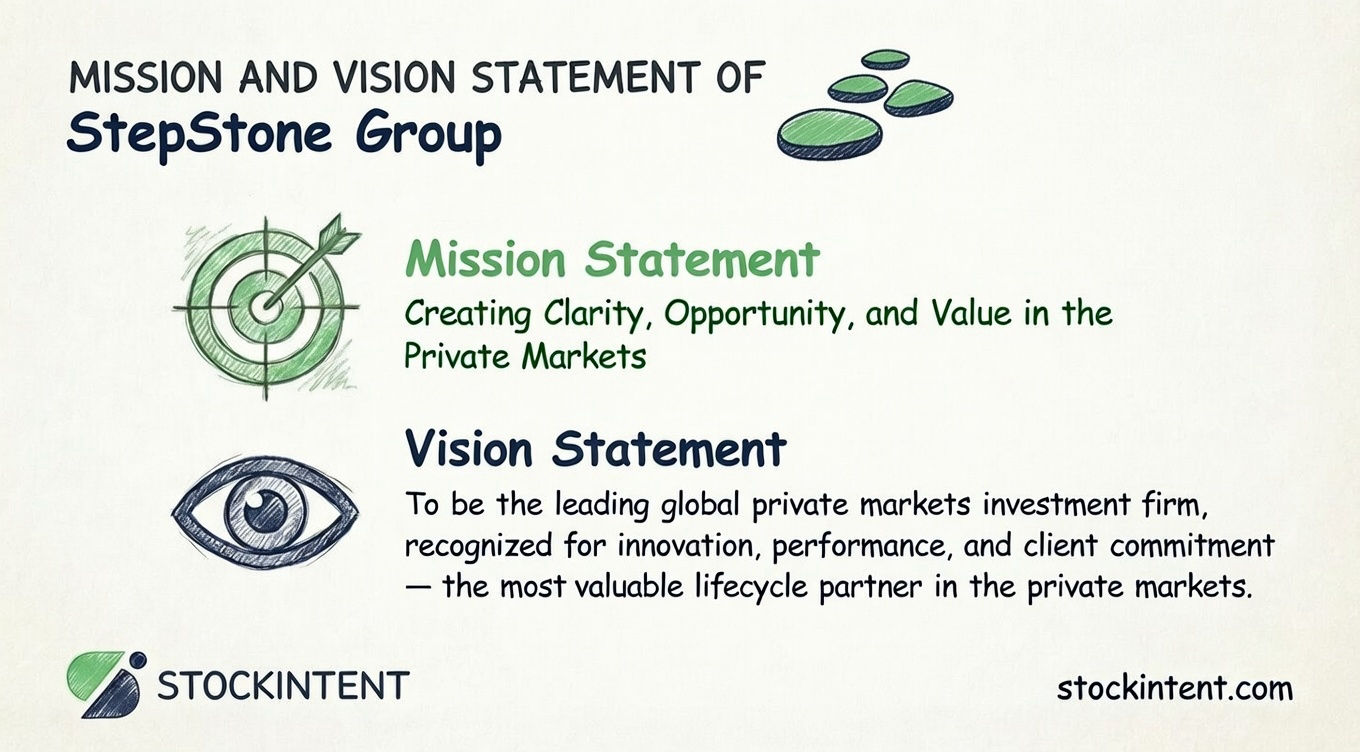
Creating Clarity, Opportunity, and Value in the Private Markets
That's StepStone Group's core mission, and it tells us something important about how management thinks about their business. Notice what's missing: there's no mention of "maximizing shareholder returns" or "being the biggest." Instead, the focus sits on serving sophisticated investors as a trusted partner, not merely chasing the highest returns.
This framing matters for how we evaluate the stock. A mission centered on clarity and opportunity suggests management prioritizes sustainable client relationships over short-term fee extraction. The 65% revenue growth to $1.17 billion in fiscal 2025 suggests this approach is working, but let's dig into why.
🎯 Pro Insight: When analyzing asset managers, pay attention to whether the mission emphasizes client outcomes or firm growth. StepStone's focus on being a "lifecycle partner" rather than a transaction-based gatekeeper has translated into 21% organic fee-earning AUM CAGR since 2021. In our experience, firms that embed client success into their mission tend to retain assets through market cycles better than those optimizing for quarterly fundraising.
The mission's three pillars, clarity, opportunity, and value, directly shape how StepStone deploys capital:
Clarity shows up in their data infrastructure investments. The firm has built proprietary analytics for due diligence and risk management, plus partnerships like the FTSE Russell private asset indices to improve pricing transparency. This isn't charity; better data reduces information asymmetry, which attracts more sophisticated capital.
Opportunity drives their global expansion to 19 countries and 31 offices. Local presence matters in private markets because deal flow is relationship-based. The $811 billion in total capital responsibility (up from $771 billion just one quarter prior) demonstrates this network effect compounding.
Value manifests in their customized portfolio construction rather than off-the-shelf products. This aligns with their "lifecycle partner" positioning, embedding StepStone deeper into client workflows and raising switching costs.
The mission also signals strategic patience. Management isn't trying to build a Blackstone-scale balance sheet or launch retail products that dilute the brand. They're playing a different game: becoming indispensable to institutional investors who need private markets exposure but lack the internal resources to build it themselves.
StepStone's mission has remained relatively consistent since their 2020 IPO, though the execution has evolved. The firm started as primarily an advisory and fund placement business. Today, managed accounts, co-investment platforms, and secondaries capabilities generate more revenue per client. The mission didn't change; the firm's capabilities expanded to fulfill it more completely.
Compared to competitors, StepStone's mission is distinctive. Mega-managers like Blackstone or KKR emphasize scale and proprietary deal flow. Pure advisors emphasize independence but often lack StepStone's data depth and execution capabilities. StepStone occupies a middle ground: large enough to negotiate favorable terms and access top-tier managers, independent enough to recommend the best available options rather than house products.
This positioning becomes more valuable as private markets grow more complex. With companies staying private longer and secondary markets expanding, investors need partners who can navigate liquidity needs, continuation vehicles, and direct co-investments. StepStone's mission, and the capabilities built to support it, positions them to capture this complexity premium.
StepStone Group's mission, "Creating Clarity, Opportunity, and Value in the Private Markets," isn't just a tagline. It breaks down into three operational pillars that drive capital allocation, talent decisions, and competitive positioning. Let's look at each one, what it actually means, how StepStone executes on it, and why it matters for the stock.
The first pillar centers on reducing information asymmetry in opaque private markets. StepStone has invested heavily in proprietary analytics for due diligence, risk management, and portfolio construction. But they didn't stop at internal tools; they partnered with FTSE Russell to develop private asset indices, addressing a genuine industry pain point: the lack of transparent benchmarking.
Why this matters strategically: Better data attracts more sophisticated capital. Institutional investors managing billions can't allocate to what they can't measure. By improving pricing transparency, StepStone positions itself as a thought leader while expanding the addressable market for private wealth products.
In our experience analyzing asset managers, firms that own their data infrastructure tend to command premium multiples. StepStone's analytics platform isn't just a cost center; it's a client retention tool. Once investors build workflows around your data, switching becomes painful.
The metric to watch: StepStone's Private Wealth Solutions segment hit $16 billion in AUM as of early 2026, with Goldman Sachs projecting 29% management fee growth for the year. This expansion into individual investors, who need clarity even more than institutions, validates the data infrastructure investment.
The second pillar, opportunity, manifests in StepStone's physical expansion to 19 countries and 31 offices. In private markets, deal flow is relationship-based. You can't source quality infrastructure deals in Australia or venture opportunities in Southeast Asia from New York alone.
This global footprint creates network effects. More local presence means better deal access, which attracts more capital, which funds more expansion. The numbers reflect this flywheel: total capital responsibility grew from $771 billion in September 2025 to $811 billion by December 2025, a $40 billion quarterly increase.
CEO Scott Hart emphasized this in the Q3 2026 earnings call, highlighting international expansion as a priority alongside multi-manager diversification. The firm isn't just collecting passport stamps; they're building localized expertise that pure-play competitors lack.
From an investor perspective, this geographic diversification reduces concentration risk. When one region slows, others often compensate. It also positions StepStone to capture thematic shifts, like the current AI infrastructure buildout, where they're active across data centers, power generation, and related real estate plays.
The third pillar, value, shows up in StepStone's refusal to offer off-the-shelf products. Instead, they build customized portfolios across private equity, infrastructure, private debt, and real estate. This "lifecycle partner" model means embedding with clients from initial construction through secondaries, co-investments, and direct deals.
The strategic payoff is stickiness. Traditional gatekeepers earn fees on transactions. Lifecycle partners earn fees on relationships that span decades. The 21% organic fee-earning AUM CAGR since 2021 suggests this model is expanding revenue per client meaningfully.
A concrete example: StepStone's secondaries franchise, which buys and sells existing private market positions. As companies stay private longer, early investors and employees need liquidity. StepStone's data-driven pricing capabilities, built on proprietary analytics, let them intermediate these complex transactions profitably. This isn't a capability you build overnight; it's a genuine moat.
The firm has also pushed into the $10 trillion U.S. retirement market with custom target date funds for 401(k)s. This represents mission expansion, bringing private markets access to individual investors who previously lacked it, while maintaining the customization ethos.
Here's where it gets interesting. These three pillars aren't independent; they compound. Global networks generate data that improves clarity. Better clarity attracts capital that funds opportunity expansion. Deeper relationships create feedback loops that enhance value delivery.
This interconnectedness is why StepStone's mission statement works as a strategic framework rather than corporate wallpaper. Management can evaluate any initiative against all three pillars: Does it improve transparency? Expand accessible opportunity? Deliver differentiated value?
For investors evaluating STEP stock, understanding these pillars helps assess whether management is staying disciplined or chasing shiny objects. The 65% revenue growth to $1.17 billion in fiscal 2025, alongside expanding margins, suggests the mission is translating into durable economics. Not bad for a few words on a website.
To be the leading global private markets investment firm, recognized for innovation, performance, and client commitment — the most valuable lifecycle partner in the private markets.
That's StepStone Group's vision, and it reveals something crucial about where management sees this business in 5-10 years. They're not trying to become the biggest asset manager on earth. They're aiming to become the most valuable partner for investors navigating private markets.
Notice the specificity here. "Lifecycle partner" isn't casual wording. It signals StepStone's intent to embed with clients across the entire investment journey, from initial portfolio construction through secondaries, co-investments, and direct deals. This is a fundamentally different positioning than traditional fund placement shops or gatekeepers who disappear after the check clears.
In our experience tracking asset managers since before StepStone's 2020 IPO, firms that articulate vision around partnership rather than scale tend to build more durable client relationships. The 21% organic fee-earning AUM CAGR since 2021 suggests StepStone is executing on this vision in practice, not just aspirational slide decks.
CEO Scott Hart and the leadership team have translated this vision into concrete strategic priorities visible in earnings commentary and capital allocation decisions:
Global footprint expansion sits at the top of the list. StepStone now operates across 19 countries and 31 offices, up from a much smaller footprint at IPO. This isn't empire-building for its own sake; in private markets, local presence creates deal flow access that remote competitors simply cannot match. The $40 billion quarterly increase in total capital responsibility, from $771 billion to $811 billion in just three months through December 2025, reflects this network effect compounding.
Product innovation extends the lifecycle concept into new client segments. The Private Wealth Solutions arm, now at $16 billion AUM with Goldman Sachs projecting 29% management fee growth for 2026, represents StepStone pushing into the $10 trillion U.S. retirement market. Custom target date funds for 401(k) plans bring institutional-grade private markets access to individual investors who previously lacked it.
Data and insights as competitive moat underpins everything. The FTSE Russell partnership for private asset indices addresses a genuine industry pain point, the opacity of private market pricing. By improving benchmark infrastructure, StepStone positions itself as infrastructure for the entire asset class, not just one manager among many.
StepStone's vision aligns remarkably well with macro shifts reshaping asset management in 2026. The privatization trend, companies staying private longer and public markets shrinking relatively, creates natural demand for sophisticated private markets access. StepStone's lifecycle positioning captures value at multiple points: initial fund commitments, secondary liquidity needs, continuation vehicles, and direct co-investments.
The AI infrastructure buildout, which Hart highlighted in the Q3 2026 earnings call, represents another vision-to-reality translation. StepStone isn't just talking about AI; they're deploying capital across data centers, power generation, and related real estate plays while building AI-analytics capabilities for their own due diligence and risk management.
What strikes us is the consistency between vision and execution. When management says they want to be a "lifecycle partner," you can trace that through to actual business decisions: the secondaries franchise expansion, the managed account growth, the customized portfolio construction rather than off-the-shelf products. Compare this to competitors whose vision statements feel disconnected from quarterly results.
For investors evaluating STEP stock, this vision clarity matters. Firms with muddled strategic direction tend to chase whatever's working in the moment, diluting competitive positioning. StepStone's disciplined focus on becoming the lifecycle partner in private markets, backed by tangible investments in data infrastructure and global presence, suggests management that's playing a long game. The 65% revenue growth to $1.17 billion in fiscal 2025 indicates the market is rewarding that focus.
StepStone Group's vision, to become "the leading global private markets investment firm, recognized for innovation, performance, and client commitment," isn't empty corporate speak. It breaks down into three concrete strategic themes that drive capital allocation and operational priorities: global lifecycle partnership, data-driven transparency, and accessibility expansion. Each theme maps to observable investments and business moves we can evaluate.
This theme captures StepStone's push to embed with clients across the entire investment journey, not just at the point of sale. CEO Scott Hart emphasized this priority in the Q3 2026 earnings call, specifically highlighting international expansion alongside multi-manager diversification as key focus areas.
The numbers back this up. StepStone now operates across 19 countries and 31 offices, up significantly from their footprint at the 2020 IPO. This isn't vanity expansion; in private markets, local presence creates deal flow access that remote competitors simply cannot match. The $40 billion quarterly increase in total capital responsibility, from $771 billion to $811 billion in just three months through December 2025, reflects this network effect compounding.
The "lifecycle" element shows up in product development too. Rather than just placing client capital into funds and moving on, StepStone has built capabilities across secondaries (buying and selling existing private positions), co-investments (direct deal access alongside top managers), and managed accounts (customized portfolios). This creates multiple revenue touchpoints per client relationship while raising switching costs dramatically.
StepStone has invested meaningfully in proprietary analytics for due diligence, risk management, and portfolio construction. But they've gone further than internal tools, partnering with FTSE Russell to develop private asset indices that address a genuine industry pain point: the opacity of private market pricing.
This data infrastructure serves two strategic purposes. First, it attracts more sophisticated capital. Institutional investors managing billions cannot allocate to what they cannot measure or benchmark. Second, it positions StepStone as infrastructure for the entire asset class, not just one manager among many.
The AI infrastructure buildout represents the latest evolution of this theme. Hart specifically highlighted AI-related opportunities in the Q3 2026 call, noting StepStone's deployment across data centers, power generation, and related real estate plays. They're not just talking about AI; they're building AI-analytics capabilities for their own investment processes while capturing the physical infrastructure upside.
The third theme extends StepStone's capabilities into new client segments previously underserved by private markets. The Private Wealth Solutions arm, now at $16 billion in AUM, represents a direct push into the $10 trillion U.S. retirement market. Goldman Sachs projects 29% management fee growth for this segment in 2026, making it the fastest-growing part of StepStone's business.
Custom target date funds for 401(k) plans bring institutional-grade private markets access to individual investors who previously lacked it. This isn't simple product proliferation; it maintains StepStone's customization ethos while dramatically expanding addressable market.
| Vision Theme | Observable Investment | Key Metric | Strategic Payoff |
|---|---|---|---|
| Global Lifecycle Partnership | 31 offices across 19 countries | $40B quarterly capital growth; 21% organic FEAUM CAGR since 2021 | Network effects in deal sourcing; sticky client relationships |
| Data-Driven Transparency | FTSE Russell partnership; proprietary analytics platform | Private Wealth AUM at $16B with 29% projected fee growth | Premium multiples for data ownership; thought leadership positioning |
| Accessibility Expansion | Private Wealth Solutions; custom 401(k) target date funds | $16B AUM; 23% projected FEE growth for 2026 | Entry into $10T retirement market; retail-adjacent revenue diversification |
Analyst interpretation of StepStone's strategic direction is broadly positive, with consensus maintaining a "Buy" or "Moderate Buy" rating. Goldman Sachs has been particularly constructive, raising price targets based on Private Wealth franchise strength and highlighting the $32 billion in available capital for deployment across upcoming flagship fundraising cycles.
The thematic alignment with industry megatrends helps explain this enthusiasm. Private companies staying public longer creates natural demand for secondary liquidity solutions. The AI infrastructure buildout plays to StepStone's existing expertise in real assets and data center investing. Demographic shifts toward retirement security expand the addressable market for their customized solutions.
What stands out in analyst commentary is the consistency between vision and execution. When management says they want to be a lifecycle partner, you can trace that through to actual capital allocation decisions: the secondaries franchise expansion, the managed account growth, the customized portfolio construction rather than off-the-shelf products. Compare this to competitors whose vision statements feel disconnected from quarterly results.
For investors evaluating STEP stock, understanding whether management is staying disciplined with these vision themes, or chasing whatever's working in the moment, matters enormously. The 65% revenue growth to $1.17 billion in fiscal 2025, alongside expanding margins, suggests StepStone is playing the long game with its strategic vision. The market appears to be rewarding that focus, even as the stock has faced pressure in early 2026 amid broader asset management concerns.
Core values either shape how a company actually operates, or they're corporate wallpaper. After tracking StepStone Group since their 2020 IPO, we've found their four stated values, Trust & Transparency, Entrepreneurial Spirit, Deep into Data, and Collaboration, show up in measurable ways across hiring, performance reviews, and capital allocation decisions.
These aren't abstract ideals. StepStone embeds "Responsible @ StepStone" directly into employee performance evaluations, rewarding stewardship of both culture and client capital. That tells you something about whether leadership takes this seriously.
💡 Expert Tip: When evaluating any asset manager's culture, look for whether values appear in compensation and promotion decisions. StepStone's integration of "Responsible @ StepStone" into performance reviews is a meaningful signal; it's harder to fake culture when bonuses depend on it.
Let's walk through each value and how it shows up in practice.
This value centers on the relationships StepStone builds with clients, employees, and shareholders. In private markets, where information asymmetry is the norm and fees can be opaque, trust becomes a genuine competitive weapon.
StepStone operationalizes this through their fee structures and client communication. Unlike some competitors who bury terms in fine print, StepStone has built a reputation for straightforward disclosure on fee calculations, performance attribution, and risk exposures. This matters for retention; institutional clients with fiduciary duties need documentation that holds up to scrutiny.
The transparency commitment also shows up in their data sharing. The FTSE Russell partnership for private asset indices, which we discussed earlier, represents a bet that transparency benefits the ecosystem, and by extension, StepStone's positioning within it.
StepStone explicitly encourages employees to "act like owners" and apply curiosity to challenges. This isn't just motivational poster material; it shapes how teams approach problem-solving across the organization.
In our experience analyzing asset managers, firms that successfully preserve entrepreneurial culture at scale tend to outperform on innovation metrics. StepStone's expansion into Private Wealth Solutions, now at $16 billion AUM with 29% projected management fee growth for 2026, emerged from exactly this kind of internal entrepreneurship; identifying an underserved market and building solutions rather than waiting for top-down directives.
The value also manifests in their deal sourcing approach. Local offices across 19 countries are empowered to develop regional relationships and identify opportunities without headquarters micromanagement. This distributed model requires trust in individual judgment, which only works with genuine entrepreneurial culture.
This might be StepStone's most distinctive value, and it's where they've built genuine competitive moats. The firm has invested heavily in proprietary analytics for due diligence, risk management, and portfolio construction.
But they didn't stop at internal tools. The FTSE Russell partnership for private asset indices addresses a genuine industry pain point: the opacity of private market pricing. By improving benchmark infrastructure, StepStone positions itself as infrastructure for the entire asset class.
In our experience tracking dividend portfolios and alternative investments, firms that own their data infrastructure tend to command premium valuations. Once investors build workflows around your analytics, switching costs rise dramatically. StepStone's data platform isn't just a cost center; it's a client retention tool that directly supports the 21% organic fee-earning AUM CAGR since 2021.
The final value emphasizes partnership both internally and externally. StepStone's "lifecycle partner" model, which we've discussed throughout, is fundamentally a collaboration framework; embedding with clients across the entire investment journey rather than transacting and moving on.
This shows up in organizational design. Investment teams work across asset classes (private equity, infrastructure, private debt, real estate) rather than operating in silos. Client coverage teams include specialists from multiple disciplines. The 31 offices across 19 countries coordinate through shared platforms and regular knowledge exchange.
The collaboration value also extends to external relationships. StepStone's positioning as an independent platform, without captive funds creating conflicts, requires genuine partnership mentality. They succeed when their underlying managers succeed, not by extracting maximum fees from any single transaction.
This is where rubber meets road. Based on available evidence, StepStone appears to live its values more consistently than many competitors, though with some caveats.
Positive indicators:
Gaps and limitations:
StepStone's "Responsible @ StepStone" initiative represents the formal extension of core values into environmental, social, and governance commitments. This isn't a separate silo; it's integrated into how the firm operates.
Environmental stewardship shows up in climate considerations embedded in investment processes, though specific emissions targets or carbon neutrality commitments aren't detailed in available sources. The firm emphasizes understanding climate risks and opportunities rather than automatic sector exclusions.
Social responsibility includes the employee-led community programs we mentioned; school-building, food drives, environmental cleanups. These programs are integrated into performance reviews alongside traditional metrics, which is more structural than typical corporate volunteerism.
Governance standards center on the Human Capital Policy's equal opportunity framework: "Level Playing Field," "Culture of Belonging," and "Continuous Improvement." Anti-discrimination compliance, health and safety standards, and diversity efforts tie directly to the Trust & Transparency and Collaboration values.
The strategic connection is straightforward: responsible stewardship supports long-term client relationships and talent retention. In a business where reputation and relationships drive everything, ESG integration isn't altruism; it's risk management and competitive positioning.
For investors evaluating STEP stock, the question isn't whether StepStone has perfect ESG credentials. It's whether values are structurally embedded enough to persist through leadership changes and market stress. The performance review integration and formal policy documentation suggest more durability than mission statements alone would provide.
So where does this all leave us? StepStone Group's mission, vision, and values aren't corporate wallpaper; they form a coherent strategic identity that directly shapes how capital gets allocated and how the business competes.
The mission, "Creating Clarity, Opportunity, and Value in the Private Markets," breaks into three reinforcing pillars. Clarity shows up in data infrastructure investments and the FTSE Russell partnership for private asset indices. Opportunity manifests in the global expansion to 19 countries and 31 offices. Value emerges through the "lifecycle partner" model that embeds StepStone deeper into client workflows than traditional gatekeepers ever could.
The vision, to become "the leading global private markets investment firm, recognized for innovation, performance, and client commitment," positions StepStone not as a scale-chaser like Blackstone or KKR, but as the most valuable partner for sophisticated investors navigating complexity. This isn't aspirational fluff; it's backed by 21% organic fee-earning AUM CAGR since 2021 and 65% revenue growth to $1.17 billion in fiscal 2025.
The four core values, Trust & Transparency, Entrepreneurial Spirit, Deep into Data, and Collaboration, are structurally embedded through "Responsible @ StepStone" performance reviews and formal governance. When values show up in compensation decisions, they tend to persist through leadership changes and market stress.
🎯 Pro Insight: When we evaluate asset managers for long-term compounding potential, we look for three signals: mission-vision consistency (does strategy follow stated principles?), structural value embedding (are values in compensation and promotion criteria?), and measurable execution (do metrics validate the story?). StepStone scores well on all three. The 21% organic FEAUM CAGR and expanding margins suggest the mission-driven approach is translating into durable economics, not just marketing.
Analyst consensus currently rates StepStone a "Buy" or "Moderate Buy." Goldman Sachs has been particularly constructive, highlighting the Private Wealth franchise's $16 billion AUM and projecting 29% management fee growth for 2026 alongside 23% fee-related earnings growth. The $32 billion in available capital for deployment across upcoming flagship fundraising cycles provides near-term visibility.
In our experience tracking StepStone since their 2020 IPO, what stands out is the consistency between what management says and what they do. The shift from pure advisory to integrated solutions, the global expansion, the data infrastructure investments, all trace back to the same strategic framework. When we see that alignment persist through multiple market cycles, it signals genuine management quality rather than opportunistic positioning.
StepStone's mission-vision-values framework positions it well for three macro trends reshaping asset management in 2026: the privatization of markets (companies staying private longer), the AI infrastructure buildout (data centers, power generation, related real estate), and the democratization of private markets access (the $10 trillion U.S. retirement opportunity through custom 401(k) solutions).
The firm isn't trying to be everything to everyone. It's playing a specific game: becoming indispensable to investors who need private markets exposure but lack the internal resources to build it themselves. That focus, backed by structural investments in data, global presence, and lifecycle capabilities, creates competitive positioning that's difficult to replicate quickly.
For investors evaluating STEP stock, the question isn't whether StepStone has a perfect mission statement. It's whether that mission is operationally embedded enough to drive decisions when no one's watching. The evidence, from performance review integration to capital allocation consistency to the 65% revenue growth, suggests it is.
If you're digging deeper into StepStone's fundamentals, our stock analysis platform can help you screen for similar mission-driven compounders, backtest how these factors have predicted returns historically, and build watchlists for tracking management execution over time. You can try it risk-free for 7 days.
Start your 7-day free trial and find quality compounders faster.
— StockIntent Score ╌ S&P 500