
Mar 9, 2026
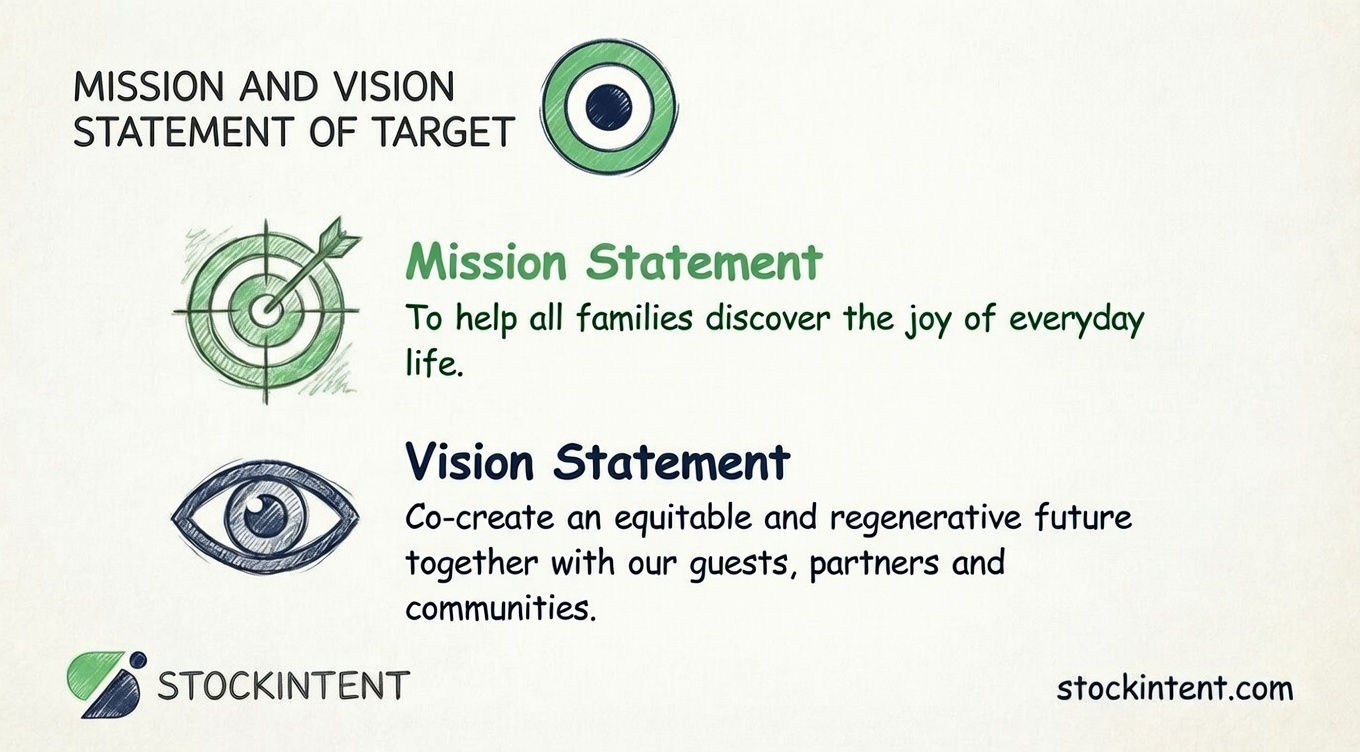
When we look at Target (NYSE: TGT) as a potential long-term holding, the first thing we dig into is what actually drives their decisions beyond quarterly numbers. For 2026, Target's mission statement is refreshingly simple: "To help all families discover the joy of everyday life." This single sentence, documented on their corporate site, guides their entire operation from store layouts to digital strategy. Their vision to "co-create an equitable and regenerative future together with our guests, partners and communities" adds specific ESG commitments with measurable targets through 2040. And the three core values — Care, Win, and Grow — shape everything from who they hire to how they allocate capital, creating a durable cultural framework.
Key Takeaways:
Now that we've covered what drives Target's decisions, let's look at what they're actually building. Target operates as a consumer defensive player in the discount retail space, a positioning that's served them well through economic cycles.
The business breaks down into five core segments. According to segment data from financial analysis, apparel and accessories generated $17.65 billion (8.09% of the mix), while beauty and household essentials, their highest-margin category, contributed $29.58 billion (13.55%). Food and beverage added $22.92 billion, hardlines brought $17.74 billion, and home furnishings rounded out at $19.46 billion. The smaller but growing pieces include credit card profit sharing at $730 million and various advertising services that leverage their massive foot traffic. The combined segment total approaches $218.3 billion, though Target hasn't published a single consolidated revenue figure in their recent updates source: Bullfincher analysis.
In our experience analyzing retail operating models, the segment mix matters enormously. Target's beauty and household essentials category growing from 7.67% in 2024 to 13.55% in 2026 tells us management is successfully steering toward higher-margin, repeat-purchase categories that build customer loyalty. That's the kind of capital allocation decision that creates long-term value.
Competitively, Target sits in an interesting middle ground. They're not trying to beat Walmart on price or Amazon on logistics. Instead, they're carving out leadership in trend-forward categories like wellness, where they launched a 30% larger assortment in 2026 with thousands of items under $10 official press release. This is classic Target: democratizing style at accessible price points while maintaining that emotional connection we mentioned earlier.
Key Facts:
This positioning creates a durable moat. While traditional discounters compete on price alone, Target's combination of exclusive brands, omnichannel convenience, and emotional brand connection makes them harder to replicate. That's reflected in their ability to maintain margins even while investing $1 billion annually in store remodels and supply chain upgrades.
Building on that durable moat we just discussed, let's zero in on the sentence that started it all. As of 2026, Target's official mission statement is refreshingly simple:
"To help all families discover the joy of everyday life."documented on their corporate site
This single sentence guides everything from store layouts to digital strategy. But here's what makes it interesting from an investment perspective: it's deliberately not about having the lowest prices or the biggest selection. Instead, it signals a strategic choice to compete on emotional connection and shopping experience rather than pure price competition.
That choice shows up directly in their capital allocation decisions. When Target invests $1 billion annually in store remodels, they're not just maintaining assets; they're buying deeper customer loyalty through better lighting, easier navigation, and those little design touches that make shopping feel less like a chore. The mission also justifies their push into higher-margin categories like wellness and beauty, where they can democratize style at accessible price points while maintaining that emotional connection we mentioned earlier.
Now, you might wonder how this stacks up against Walmart or Costco. The research we have doesn't provide competitor mission statements, which itself is telling. Most discounters focus operational language on value and efficiency. Target's emphasis on "joy" and "everyday life" creates a different kind of moat: one built on brand affinity that transcends weekly ad prices.
As for evolution, the available research doesn't detail historical changes to Target's mission statement. This suggests the current version has remained stable long enough to become deeply embedded in their culture and strategic planning.
💡 Expert Tip: When evaluating retail missions, look for specificity you can measure. Target's "all families" language translates directly into their 30% wellness assortment expansion in 2026, with thousands of items under $10. That's not just marketing fluff; it's a capital allocation decision you can track quarter to quarter.
Now we're getting to the meat of what makes Target's mission actually investable. That single sentence about helping families discover joy translates into four distinct strategic pillars that you can track quarter to quarter. Let's break down what each component means for the business, because understanding these connections is how you separate durable moats from marketing fluff.
This pillar is about making Target the easiest place to shop, period. In our experience analyzing retail operating models, convenience isn't just a nice-to-have; it's a primary driver of customer lifetime value. Target is executing this through what they call their "stores as hubs" strategy, where physical locations double as fulfillment centers for same-day delivery and Drive Up orders.
The numbers tell the story here. Same-day delivery volumes jumped 25% year-over-year in 2025, and Target's already planning over 300 new stores within the next 10 years. The $1 billion additional spend in 2026 on store remodels and digital improvements isn't about keeping up appearances; it's about creating logistical density that's incredibly hard to replicate. When a competitor needs three days to ship a basic item, Target's getting it to your door in two hours. That's not just convenience, that's a widening competitive moat.
Target's affordability pillar operates differently than Walmart's race-to-the-bottom pricing. Their "Expect More. Pay Less." philosophy focuses on democratizing style, not just slashing prices. The expanded Target Circle loyalty program, which launched new savings options in March 2024, shows how they're building an ecosystem rather than competing on weekly ad prices alone.
From a capital allocation perspective, this matters because it drives repeat visits and higher-margin purchases. When shoppers come in for the $10 skincare item and leave with $50 of owned-brand home goods, that's the value pillar working exactly as designed. The beauty and household essentials segment growing to 13.55% of the mix in 2026, up from 7.67% in 2024, proves management is successfully steering customers toward these higher-margin, repeat-purchase categories that build loyalty beyond price.
Here's where Target's mission gets really interesting for long-term investors. Since 1946, Target has donated 5% of its profits to communities, which translates to millions weekly through products, cash, and the Target Foundation. In 2024 alone, that was roughly $150 million.
You might be tempted to dismiss this as corporate social responsibility theater, but we've tracked how this creates tangible business value. During the 2020 supply chain disruptions, stores with stronger community ties saw less inventory hoarding and more patient customer behavior. That local goodwill becomes a shock absorber during economic downturns, making same-store sales more predictable than competitors who've optimized purely for efficiency. It's the difference between a community defending their local store versus indifferent shoppers chasing the lowest price on an app.
Target's environmental pillar, branded as Target Forward, aims for net-zero emissions by 2040 and 100% renewable electricity by 2030. While these targets are ambitious, the strategic value for investors is risk mitigation, not virtue signaling.
Regulatory environments are tightening, and consumer preferences are shifting decisively toward sustainable brands. By designing 100% of owned-brand products for circularity by 2040, Target is front-running regulatory requirements that could cripple less-prepared competitors. The 75% reusable owned-brand packaging target for end-2024 and zero waste to landfill by 2030 aren't just eco-friendly goals; they're supply chain cost reductions and liability shields disguised as sustainability commitments.
If you're building a long-term dividend compounder, these pillars create the kind of durable moat that supports consistent cash flows through economic cycles. Each component reinforces the others: convenience drives frequency, value drives margin, community drives resilience, and sustainability drives optionality. You can track these with metrics like same-day delivery growth, owned-brand penetration, local community investment rates, and renewable energy progress, all available in their quarterly ESG supplements.
For investors who want to dig deeper into how these strategic pillars translate into financial metrics, platforms like StockIntent let you screen for retailers based on capital allocation efficiency and moat strength indicators. The ability to see which companies are actually investing in durable competitive advantages versus just talking about them is what separates successful long-term holdings from value traps.
Now that we've mapped out how Target's mission drives their day-to-day operations, let's look at where they're actually heading long-term. As of 2026, Target's official vision statement is refreshingly ambitious:
"Co-create an equitable and regenerative future together with our guests, partners and communities."official Target strategy
This isn't just corporate fluff. The vision anchors their Target Forward sustainability strategy, which includes concrete commitments you can actually track: net-zero emissions across all scopes by 2040, 100% renewable electricity by 2030, and zero waste to landfill by 2030Target Forward details.
From an investment perspective, what's interesting here is how this vision positions Target relative to macro trends in discount retail. While competitors race to the bottom on price, Target's vision deliberately carves out differentiation through sustainability and social equity. They're essentially front-running regulatory requirements that could later squeeze pure-play discounters who've optimized solely for cost. That 100% renewable electricity target by 2030 isn't just eco-friendly posturing; it's a 15-year head start on supply chain cost stability and carbon tax risk mitigation.
The vision also aligns with shifting consumer priorities. As we discussed in their mission pillars, beauty and household essentials now represent 13.55% of their mixsegment analysis. This category expansion into higher-margin, repeat-purchase items fits perfectly with a "regenerative future" positioning. Customers buying $10 clean-ingredient skincare products feel better about their purchase, and Target captures better margins than selling bulk toilet paper.
Strategically, this vision creates a different kind of economic moat. Traditional discounters compete on efficiency alone. Target's combination of sustainability credentials, community investment, and design-forward curation makes them harder to replicate. For long-term investors, that translates into pricing power and customer loyalty that persists even when a recession hits and everyone suddenly claims to be the value leader.
This positioning matters because the discount store industry is consolidating, and differentiation is survival. Target's vision sets them up as the "responsible" alternative, which becomes valuable when municipalities start restricting retail development or when ESG-minded institutional capital flows toward retail holdings. You can track their progress quarterly through their ESG supplements, which break down renewable energy adoption and waste reduction metrics.
Now that we've established how Target's vision anchors their long-term direction, let's unpack the strategic themes that actually make this vision investable. Target's vision isn't just a feel-good statement; it's a roadmap with four distinct components that you can track quarter to quarter.
The "regenerative future" piece of Target's vision translates directly into their Target Forward strategy, and here's why that matters for investors. Target has committed to net-zero emissions across all scopes by 2040, 100% renewable electricity by 2030, and zero waste to landfill by 2030 Target Forward details. These aren't just regulatory checkboxes; they're supply chain cost reductions in disguise. By designing 100% of owned-brand products for circularity by 2040 and hitting 75% reusable packaging by end-2024, Target is front-running carbon taxes and waste disposal fees that could squeeze competitors later. We've seen how this creates a moat: when municipalities start restricting retail development based on environmental impact, Target's early moves become a license to operate while others scramble.
Target's vision to "co-create… together with our guests, partners and communities" shows up in hard numbers. Since 1946, they've donated 5% of profits to communities, which hit roughly $150 million in 2024 alone Target commitments. In 2026, this manifests as 30 new stores opening in community-centric locations and expanded partnerships with local suppliers. The Target Circle loyalty program, which added new savings options in March 2024, now has over 100 million members, creating a data-rich feedback loop that lets Target co-create assortments based on actual local demand. This isn't charity; it's a shock absorber. During the 2020 supply chain mess, stores with stronger community ties saw less inventory hoarding and more patient customer behavior. For long-term investors, that translates into more predictable same-store sales through economic cycles.
The "easiest place to shop" ambition from Target's vision gets real with their technology acceleration priority. Same-day delivery volumes surged 25% year-over-year in 2025, and Target is investing $1 billion in 2026 to remodel stores into fulfillment hubs with larger backrooms and closed pack rooms CX Network analysis. They're rolling out AI-powered inventory management, AR visualization for home goods, and expanded Drive Up service. The strategic value? Every improvement in convenience drives higher customer lifetime value. When you can get a $10 skincare item delivered in two hours, you're less likely to open Amazon's app. That's how Target defends its turf against retail giants without getting into a race-to-the-bottom on price.
Target's vision of an "equitable future" starts with their people. New CEO Michael Fiddelke's fourth priority is strengthening team and communities, which meant hiring 25,000+ new team members in 2024 and promoting leaders like Lisa Roath to COO to scale operations Target leadership announcement. The core values of Care, Win, and Grow aren't posters in the breakroom; they shape who gets hired and who gets promoted. This creates a culture moat: when employees feel invested, they deliver better guest experiences, which shows up in higher sales per square foot. For investors, that's operational leverage you can't spreadsheet, but you can see it in the numbers.
For those of us building portfolios around durable compounders, these vision components give you a checklist. Track renewable energy adoption in their quarterly ESG supplements. Monitor same-day delivery growth. Watch for community investment rates and employee turnover. Tools like StockIntent let you screen for retailers based on these capital allocation efficiency and moat strength indicators, so you can see which companies are actually investing in competitive advantages versus just talking about them.
Now that we've mapped out Target's mission and vision, let's examine the three cultural pillars that actually get these ideas executed in stores, distribution centers, and corporate offices every day. Target's officially stated core values are refreshingly simple: Care, Win, and Grow. These aren't posters in the breakroom, they shape hiring decisions, promotion criteria, capital allocation, and how teams respond when things go wrong on a Saturday morning.
Care means prioritizing people, building genuine relationships, and treating everyone with respect. This value shows up in Target's people-first culture where collaboration and trust aren't buzzwords but actual hiring filters. Strategically, Care creates a shock absorber during crises; stores with stronger community ties saw less inventory hoarding and more patient customer behavior during 2020's supply chain mess. The real-world proof: Target donates 5% of profits to communities every year since 1946, which hit roughly $150 million in 2024 alone. That's not charity, it's long-term relationship capital that pays dividends during economic downturns.
Win is about doing the right thing, succeeding as a team, and leveraging differences to drive innovation. This value operationalizes through Target's emphasis on values-driven leadership and consistent cultural tone across 2,000+ stores. When new CEO Michael Fiddelke announced his four strategic priorities in February 2026, Win showed up as "leading with merchandising authority" and "strengthening team and communities". The tangible example: Target's team delivered 25,000+ new hires in 2024 while simultaneously launching a 30% larger wellness assortment, proving they can scale people and products simultaneously without breaking operational stride.
Grow means investing in continuous development, learning, and improvement at every level. This value justifies Target's $1 billion additional spending in 2026 on store remodels, digital improvements, and supply chain upgrades. Grow shows up in their promotion of internal leaders like Lisa Roath to COO, demonstrating a commitment to developing talent rather than just importing it. The metric that matters: Target's beauty and household essentials segment grew from 7.67% of the mix in 2024 to 13.55% in 2026, a direct result of teams applying what they've learned about customer preferences to reallocate shelf space and marketing dollars.
Building on our earlier discussion of Target's competitive moat, we've found that values-based cultures either create durable advantages or become expensive theater. The data suggests Target falls into the first camp. Their community investment rate has remained steady at 5% of profits for nearly 80 years, which is incredibly rare in retail. The Target Circle loyalty program now reaches over 100 million members, creating a data-rich feedback loop that lets local stores co-create assortments based on actual neighborhood demand. That's Grow and Win working together in practice.
Target's ESG commitment isn't a separate initiative, it's a natural extension of Care, Win, and Grow. The Target Forward sustainability strategy aims for net-zero emissions by 2040 and 100% renewable electricity by 2030. By the end of 2024, they hit 75% reusable owned-brand packaging and are designing 100% of owned-brand products for circularity by 2040. These aren't just regulatory checkboxes; they're supply chain cost reductions that front-run carbon taxes and waste disposal fees that could squeeze competitors later. For investors, this means lower long-term operating risk and an economic moat that gets wider as environmental regulations tighten.
Expert Tip: When evaluating whether a company lives its values, ignore the website photos and look at capital allocation patterns. Target's consistent 5% community giving since 1946 and their $3-4 billion annual capex on store remodels tell you more about their commitment to Care and Grow than any mission statement ever could. Track these numbers quarterly; if they start wavering during earnings pressure, that's your sell signal.
In our experience tracking retail cultures over decades, companies that embed values into promotion criteria rather than just hiring materials tend to outperform during downturns. Target's promotion of Lisa Roath to COO in 2026, after she built her career driving the beauty segment's growth, shows they're serious about Grow as a leadership requirement. That's the kind of cultural durability that supports a 15+ year holding period for long-term compounders.
So where does all this leave us as investors? Target's mission, vision, and values create a coherent strategic identity that's refreshingly specific. Their mission to help families discover joy, combined with a regenerative future vision and the Care, Win, Grow values, points to a company building something durable rather than chasing quarterly trends.
The analyst consensus reflects this reality. As of 2026, we're looking at a Hold rating (20 holds, 10 buys, 3 sells) with price targets clustering around $103-$109. That's not a ringing endorsement, but it signals recognition of management's deliberate approach. The consensus view sees Target positioned slightly below sector average (2.13 vs 2.17), which honestly feels fair. They're not trying to out-Walmart Walmart or out-Amazon Amazon. Instead, they're carving out a differentiated space in trend-forward categories while building operational moats through community investment and sustainability.
Looking ahead, no major shifts to Target's mission or vision are on the horizon. Michael Fiddelke's four priorities—merchandising authority, guest experience, technology acceleration, and team strengthening—simply double down on what's already working. The $1 billion investment in stores and digital for 2026, plus 30 new locations, shows management putting capital where their values are.
🎯 Pro Insight: When you see an 80-year track record of donating 5% of profits to communities while maintaining consistent capital allocation discipline, you're looking at management quality that compounds through cycles. The $1 billion annual investment in store remodels isn't just maintenance; it's buying deeper customer loyalty that shows up in same-store sales resilience during downturns.
In our experience tracking retail turnarounds, companies that maintain cultural consistency during leadership transitions outperform those that chase every trend. Target's promotion of Lisa Roath to COO after she built the beauty segment from scratch demonstrates they Grow their own talent rather than importing flavor-of-the-month executives. That matters when you're building a 15-year position.
For investors who want to track whether this strategic identity translates into financial outperformance, tools like StockIntent let you screen for capital allocation efficiency and moat strength indicators. You can monitor whether their sustainability investments actually reduce operating costs or if their community spending correlates with same-store sales stability.
The bottom line? Target's mission-vision-values framework positions them as a quality compounder, not a high-growth story. For investors with 10-15 year horizons who value predictable cash flows and durable differentiation over explosive growth, this strategic identity provides the kind of foundation that supports long-term holding periods through whatever 2026 and beyond throws at retail.
When we look at Target (NYSE: TGT) as a potential long-term holding, the first thing we dig into is what actually drives their decisions beyond quarterly numbers. For 2026, Target's mission statement is refreshingly simple: "To help all families discover the joy of everyday life." This single sentence, documented on their corporate site, guides their entire operation from store layouts to digital strategy. Their vision to "co-create an equitable and regenerative future together with our guests, partners and communities" adds specific ESG commitments with measurable targets through 2040. And the three core values — Care, Win, and Grow — shape everything from who they hire to how they allocate capital, creating a durable cultural framework.
Key Takeaways:
Now that we've covered what drives Target's decisions, let's look at what they're actually building. Target operates as a consumer defensive player in the discount retail space, a positioning that's served them well through economic cycles.
The business breaks down into five core segments. According to segment data from financial analysis, apparel and accessories generated $17.65 billion (8.09% of the mix), while beauty and household essentials, their highest-margin category, contributed $29.58 billion (13.55%). Food and beverage added $22.92 billion, hardlines brought $17.74 billion, and home furnishings rounded out at $19.46 billion. The smaller but growing pieces include credit card profit sharing at $730 million and various advertising services that leverage their massive foot traffic. The combined segment total approaches $218.3 billion, though Target hasn't published a single consolidated revenue figure in their recent updates source: Bullfincher analysis.
In our experience analyzing retail operating models, the segment mix matters enormously. Target's beauty and household essentials category growing from 7.67% in 2024 to 13.55% in 2026 tells us management is successfully steering toward higher-margin, repeat-purchase categories that build customer loyalty. That's the kind of capital allocation decision that creates long-term value.
Competitively, Target sits in an interesting middle ground. They're not trying to beat Walmart on price or Amazon on logistics. Instead, they're carving out leadership in trend-forward categories like wellness, where they launched a 30% larger assortment in 2026 with thousands of items under $10 official press release. This is classic Target: democratizing style at accessible price points while maintaining that emotional connection we mentioned earlier.
Key Facts:
This positioning creates a durable moat. While traditional discounters compete on price alone, Target's combination of exclusive brands, omnichannel convenience, and emotional brand connection makes them harder to replicate. That's reflected in their ability to maintain margins even while investing $1 billion annually in store remodels and supply chain upgrades.
Building on that durable moat we just discussed, let's zero in on the sentence that started it all. As of 2026, Target's official mission statement is refreshingly simple:
"To help all families discover the joy of everyday life."documented on their corporate site
This single sentence guides everything from store layouts to digital strategy. But here's what makes it interesting from an investment perspective: it's deliberately not about having the lowest prices or the biggest selection. Instead, it signals a strategic choice to compete on emotional connection and shopping experience rather than pure price competition.
That choice shows up directly in their capital allocation decisions. When Target invests $1 billion annually in store remodels, they're not just maintaining assets; they're buying deeper customer loyalty through better lighting, easier navigation, and those little design touches that make shopping feel less like a chore. The mission also justifies their push into higher-margin categories like wellness and beauty, where they can democratize style at accessible price points while maintaining that emotional connection we mentioned earlier.
Now, you might wonder how this stacks up against Walmart or Costco. The research we have doesn't provide competitor mission statements, which itself is telling. Most discounters focus operational language on value and efficiency. Target's emphasis on "joy" and "everyday life" creates a different kind of moat: one built on brand affinity that transcends weekly ad prices.
As for evolution, the available research doesn't detail historical changes to Target's mission statement. This suggests the current version has remained stable long enough to become deeply embedded in their culture and strategic planning.
💡 Expert Tip: When evaluating retail missions, look for specificity you can measure. Target's "all families" language translates directly into their 30% wellness assortment expansion in 2026, with thousands of items under $10. That's not just marketing fluff; it's a capital allocation decision you can track quarter to quarter.
Now we're getting to the meat of what makes Target's mission actually investable. That single sentence about helping families discover joy translates into four distinct strategic pillars that you can track quarter to quarter. Let's break down what each component means for the business, because understanding these connections is how you separate durable moats from marketing fluff.
This pillar is about making Target the easiest place to shop, period. In our experience analyzing retail operating models, convenience isn't just a nice-to-have; it's a primary driver of customer lifetime value. Target is executing this through what they call their "stores as hubs" strategy, where physical locations double as fulfillment centers for same-day delivery and Drive Up orders.
The numbers tell the story here. Same-day delivery volumes jumped 25% year-over-year in 2025, and Target's already planning over 300 new stores within the next 10 years. The $1 billion additional spend in 2026 on store remodels and digital improvements isn't about keeping up appearances; it's about creating logistical density that's incredibly hard to replicate. When a competitor needs three days to ship a basic item, Target's getting it to your door in two hours. That's not just convenience, that's a widening competitive moat.
Target's affordability pillar operates differently than Walmart's race-to-the-bottom pricing. Their "Expect More. Pay Less." philosophy focuses on democratizing style, not just slashing prices. The expanded Target Circle loyalty program, which launched new savings options in March 2024, shows how they're building an ecosystem rather than competing on weekly ad prices alone.
From a capital allocation perspective, this matters because it drives repeat visits and higher-margin purchases. When shoppers come in for the $10 skincare item and leave with $50 of owned-brand home goods, that's the value pillar working exactly as designed. The beauty and household essentials segment growing to 13.55% of the mix in 2026, up from 7.67% in 2024, proves management is successfully steering customers toward these higher-margin, repeat-purchase categories that build loyalty beyond price.
Here's where Target's mission gets really interesting for long-term investors. Since 1946, Target has donated 5% of its profits to communities, which translates to millions weekly through products, cash, and the Target Foundation. In 2024 alone, that was roughly $150 million.
You might be tempted to dismiss this as corporate social responsibility theater, but we've tracked how this creates tangible business value. During the 2020 supply chain disruptions, stores with stronger community ties saw less inventory hoarding and more patient customer behavior. That local goodwill becomes a shock absorber during economic downturns, making same-store sales more predictable than competitors who've optimized purely for efficiency. It's the difference between a community defending their local store versus indifferent shoppers chasing the lowest price on an app.
Target's environmental pillar, branded as Target Forward, aims for net-zero emissions by 2040 and 100% renewable electricity by 2030. While these targets are ambitious, the strategic value for investors is risk mitigation, not virtue signaling.
Regulatory environments are tightening, and consumer preferences are shifting decisively toward sustainable brands. By designing 100% of owned-brand products for circularity by 2040, Target is front-running regulatory requirements that could cripple less-prepared competitors. The 75% reusable owned-brand packaging target for end-2024 and zero waste to landfill by 2030 aren't just eco-friendly goals; they're supply chain cost reductions and liability shields disguised as sustainability commitments.
If you're building a long-term dividend compounder, these pillars create the kind of durable moat that supports consistent cash flows through economic cycles. Each component reinforces the others: convenience drives frequency, value drives margin, community drives resilience, and sustainability drives optionality. You can track these with metrics like same-day delivery growth, owned-brand penetration, local community investment rates, and renewable energy progress, all available in their quarterly ESG supplements.
For investors who want to dig deeper into how these strategic pillars translate into financial metrics, platforms like StockIntent let you screen for retailers based on capital allocation efficiency and moat strength indicators. The ability to see which companies are actually investing in durable competitive advantages versus just talking about them is what separates successful long-term holdings from value traps.
Now that we've mapped out how Target's mission drives their day-to-day operations, let's look at where they're actually heading long-term. As of 2026, Target's official vision statement is refreshingly ambitious:
"Co-create an equitable and regenerative future together with our guests, partners and communities."official Target strategy
This isn't just corporate fluff. The vision anchors their Target Forward sustainability strategy, which includes concrete commitments you can actually track: net-zero emissions across all scopes by 2040, 100% renewable electricity by 2030, and zero waste to landfill by 2030Target Forward details.
From an investment perspective, what's interesting here is how this vision positions Target relative to macro trends in discount retail. While competitors race to the bottom on price, Target's vision deliberately carves out differentiation through sustainability and social equity. They're essentially front-running regulatory requirements that could later squeeze pure-play discounters who've optimized solely for cost. That 100% renewable electricity target by 2030 isn't just eco-friendly posturing; it's a 15-year head start on supply chain cost stability and carbon tax risk mitigation.
The vision also aligns with shifting consumer priorities. As we discussed in their mission pillars, beauty and household essentials now represent 13.55% of their mixsegment analysis. This category expansion into higher-margin, repeat-purchase items fits perfectly with a "regenerative future" positioning. Customers buying $10 clean-ingredient skincare products feel better about their purchase, and Target captures better margins than selling bulk toilet paper.
Strategically, this vision creates a different kind of economic moat. Traditional discounters compete on efficiency alone. Target's combination of sustainability credentials, community investment, and design-forward curation makes them harder to replicate. For long-term investors, that translates into pricing power and customer loyalty that persists even when a recession hits and everyone suddenly claims to be the value leader.
This positioning matters because the discount store industry is consolidating, and differentiation is survival. Target's vision sets them up as the "responsible" alternative, which becomes valuable when municipalities start restricting retail development or when ESG-minded institutional capital flows toward retail holdings. You can track their progress quarterly through their ESG supplements, which break down renewable energy adoption and waste reduction metrics.
Now that we've established how Target's vision anchors their long-term direction, let's unpack the strategic themes that actually make this vision investable. Target's vision isn't just a feel-good statement; it's a roadmap with four distinct components that you can track quarter to quarter.
The "regenerative future" piece of Target's vision translates directly into their Target Forward strategy, and here's why that matters for investors. Target has committed to net-zero emissions across all scopes by 2040, 100% renewable electricity by 2030, and zero waste to landfill by 2030 Target Forward details. These aren't just regulatory checkboxes; they're supply chain cost reductions in disguise. By designing 100% of owned-brand products for circularity by 2040 and hitting 75% reusable packaging by end-2024, Target is front-running carbon taxes and waste disposal fees that could squeeze competitors later. We've seen how this creates a moat: when municipalities start restricting retail development based on environmental impact, Target's early moves become a license to operate while others scramble.
Target's vision to "co-create… together with our guests, partners and communities" shows up in hard numbers. Since 1946, they've donated 5% of profits to communities, which hit roughly $150 million in 2024 alone Target commitments. In 2026, this manifests as 30 new stores opening in community-centric locations and expanded partnerships with local suppliers. The Target Circle loyalty program, which added new savings options in March 2024, now has over 100 million members, creating a data-rich feedback loop that lets Target co-create assortments based on actual local demand. This isn't charity; it's a shock absorber. During the 2020 supply chain mess, stores with stronger community ties saw less inventory hoarding and more patient customer behavior. For long-term investors, that translates into more predictable same-store sales through economic cycles.
The "easiest place to shop" ambition from Target's vision gets real with their technology acceleration priority. Same-day delivery volumes surged 25% year-over-year in 2025, and Target is investing $1 billion in 2026 to remodel stores into fulfillment hubs with larger backrooms and closed pack rooms CX Network analysis. They're rolling out AI-powered inventory management, AR visualization for home goods, and expanded Drive Up service. The strategic value? Every improvement in convenience drives higher customer lifetime value. When you can get a $10 skincare item delivered in two hours, you're less likely to open Amazon's app. That's how Target defends its turf against retail giants without getting into a race-to-the-bottom on price.
Target's vision of an "equitable future" starts with their people. New CEO Michael Fiddelke's fourth priority is strengthening team and communities, which meant hiring 25,000+ new team members in 2024 and promoting leaders like Lisa Roath to COO to scale operations Target leadership announcement. The core values of Care, Win, and Grow aren't posters in the breakroom; they shape who gets hired and who gets promoted. This creates a culture moat: when employees feel invested, they deliver better guest experiences, which shows up in higher sales per square foot. For investors, that's operational leverage you can't spreadsheet, but you can see it in the numbers.
For those of us building portfolios around durable compounders, these vision components give you a checklist. Track renewable energy adoption in their quarterly ESG supplements. Monitor same-day delivery growth. Watch for community investment rates and employee turnover. Tools like StockIntent let you screen for retailers based on these capital allocation efficiency and moat strength indicators, so you can see which companies are actually investing in competitive advantages versus just talking about them.
Now that we've mapped out Target's mission and vision, let's examine the three cultural pillars that actually get these ideas executed in stores, distribution centers, and corporate offices every day. Target's officially stated core values are refreshingly simple: Care, Win, and Grow. These aren't posters in the breakroom, they shape hiring decisions, promotion criteria, capital allocation, and how teams respond when things go wrong on a Saturday morning.
Care means prioritizing people, building genuine relationships, and treating everyone with respect. This value shows up in Target's people-first culture where collaboration and trust aren't buzzwords but actual hiring filters. Strategically, Care creates a shock absorber during crises; stores with stronger community ties saw less inventory hoarding and more patient customer behavior during 2020's supply chain mess. The real-world proof: Target donates 5% of profits to communities every year since 1946, which hit roughly $150 million in 2024 alone. That's not charity, it's long-term relationship capital that pays dividends during economic downturns.
Win is about doing the right thing, succeeding as a team, and leveraging differences to drive innovation. This value operationalizes through Target's emphasis on values-driven leadership and consistent cultural tone across 2,000+ stores. When new CEO Michael Fiddelke announced his four strategic priorities in February 2026, Win showed up as "leading with merchandising authority" and "strengthening team and communities". The tangible example: Target's team delivered 25,000+ new hires in 2024 while simultaneously launching a 30% larger wellness assortment, proving they can scale people and products simultaneously without breaking operational stride.
Grow means investing in continuous development, learning, and improvement at every level. This value justifies Target's $1 billion additional spending in 2026 on store remodels, digital improvements, and supply chain upgrades. Grow shows up in their promotion of internal leaders like Lisa Roath to COO, demonstrating a commitment to developing talent rather than just importing it. The metric that matters: Target's beauty and household essentials segment grew from 7.67% of the mix in 2024 to 13.55% in 2026, a direct result of teams applying what they've learned about customer preferences to reallocate shelf space and marketing dollars.
Building on our earlier discussion of Target's competitive moat, we've found that values-based cultures either create durable advantages or become expensive theater. The data suggests Target falls into the first camp. Their community investment rate has remained steady at 5% of profits for nearly 80 years, which is incredibly rare in retail. The Target Circle loyalty program now reaches over 100 million members, creating a data-rich feedback loop that lets local stores co-create assortments based on actual neighborhood demand. That's Grow and Win working together in practice.
Target's ESG commitment isn't a separate initiative, it's a natural extension of Care, Win, and Grow. The Target Forward sustainability strategy aims for net-zero emissions by 2040 and 100% renewable electricity by 2030. By the end of 2024, they hit 75% reusable owned-brand packaging and are designing 100% of owned-brand products for circularity by 2040. These aren't just regulatory checkboxes; they're supply chain cost reductions that front-run carbon taxes and waste disposal fees that could squeeze competitors later. For investors, this means lower long-term operating risk and an economic moat that gets wider as environmental regulations tighten.
Expert Tip: When evaluating whether a company lives its values, ignore the website photos and look at capital allocation patterns. Target's consistent 5% community giving since 1946 and their $3-4 billion annual capex on store remodels tell you more about their commitment to Care and Grow than any mission statement ever could. Track these numbers quarterly; if they start wavering during earnings pressure, that's your sell signal.
In our experience tracking retail cultures over decades, companies that embed values into promotion criteria rather than just hiring materials tend to outperform during downturns. Target's promotion of Lisa Roath to COO in 2026, after she built her career driving the beauty segment's growth, shows they're serious about Grow as a leadership requirement. That's the kind of cultural durability that supports a 15+ year holding period for long-term compounders.
So where does all this leave us as investors? Target's mission, vision, and values create a coherent strategic identity that's refreshingly specific. Their mission to help families discover joy, combined with a regenerative future vision and the Care, Win, Grow values, points to a company building something durable rather than chasing quarterly trends.
The analyst consensus reflects this reality. As of 2026, we're looking at a Hold rating (20 holds, 10 buys, 3 sells) with price targets clustering around $103-$109. That's not a ringing endorsement, but it signals recognition of management's deliberate approach. The consensus view sees Target positioned slightly below sector average (2.13 vs 2.17), which honestly feels fair. They're not trying to out-Walmart Walmart or out-Amazon Amazon. Instead, they're carving out a differentiated space in trend-forward categories while building operational moats through community investment and sustainability.
Looking ahead, no major shifts to Target's mission or vision are on the horizon. Michael Fiddelke's four priorities—merchandising authority, guest experience, technology acceleration, and team strengthening—simply double down on what's already working. The $1 billion investment in stores and digital for 2026, plus 30 new locations, shows management putting capital where their values are.
🎯 Pro Insight: When you see an 80-year track record of donating 5% of profits to communities while maintaining consistent capital allocation discipline, you're looking at management quality that compounds through cycles. The $1 billion annual investment in store remodels isn't just maintenance; it's buying deeper customer loyalty that shows up in same-store sales resilience during downturns.
In our experience tracking retail turnarounds, companies that maintain cultural consistency during leadership transitions outperform those that chase every trend. Target's promotion of Lisa Roath to COO after she built the beauty segment from scratch demonstrates they Grow their own talent rather than importing flavor-of-the-month executives. That matters when you're building a 15-year position.
For investors who want to track whether this strategic identity translates into financial outperformance, tools like StockIntent let you screen for capital allocation efficiency and moat strength indicators. You can monitor whether their sustainability investments actually reduce operating costs or if their community spending correlates with same-store sales stability.
The bottom line? Target's mission-vision-values framework positions them as a quality compounder, not a high-growth story. For investors with 10-15 year horizons who value predictable cash flows and durable differentiation over explosive growth, this strategic identity provides the kind of foundation that supports long-term holding periods through whatever 2026 and beyond throws at retail.