
Aug 3, 2026
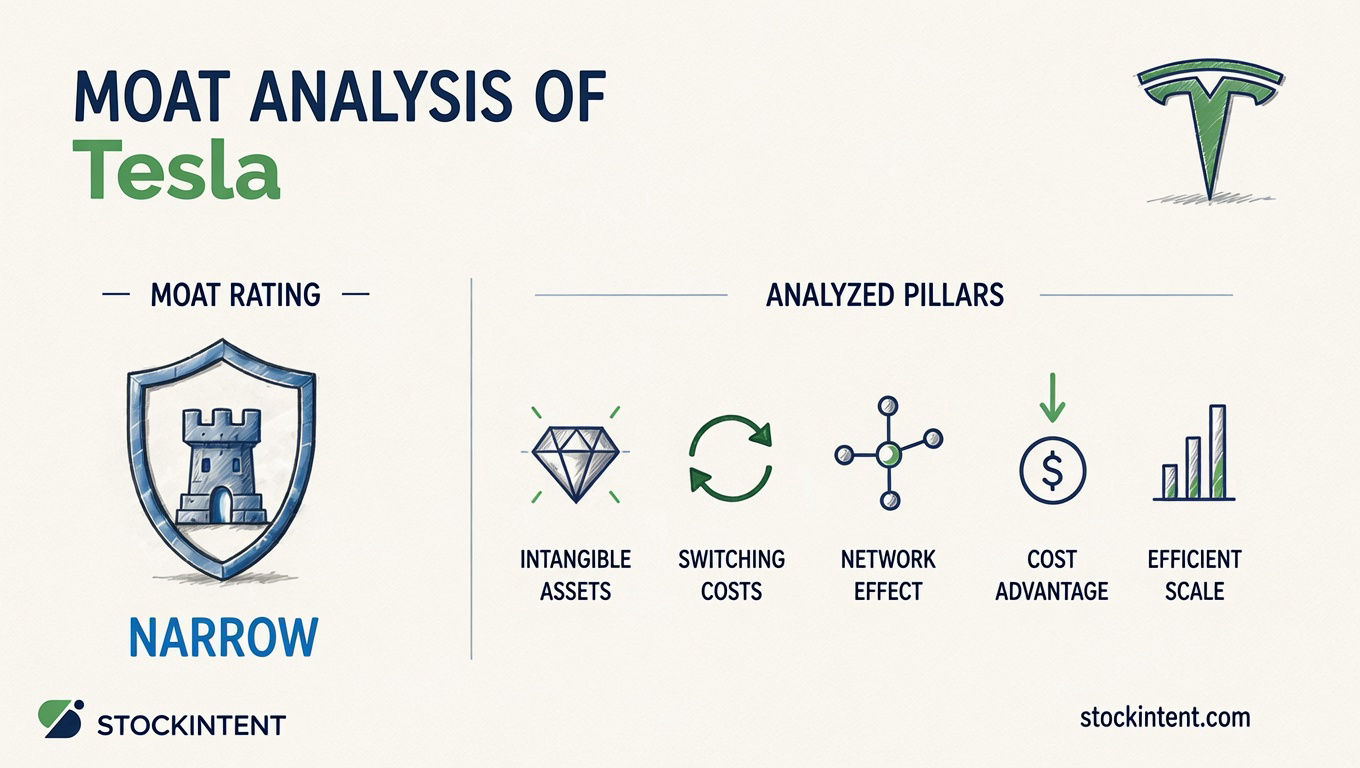
Tesla holds a Narrow economic moat in 2026, with a Stable-to-Weakening trend in its automotive core and Widening potential in energy and autonomy, all under a High uncertainty rating. The company's competitive position is splitting in two: manufacturing scale and vertical integration still defend margins in select segments, but rising competition and a costly pivot toward unproven AI and robotics businesses have widened the range of possible outcomes dramatically.
Here's what matters most:
Moat durability matters because it determines whether Tesla compounds as a durable platform business or reverts toward a cyclical auto manufacturer. Our verdict rests on evidence from Q1 2026 earnings, industry analyses, and Tesla's own SEC filings.
Tesla's moat is real but uneven. In our view, cost advantage stands as the strongest pillar, followed by intangible assets and switching costs, while network effects remain weaker than commonly claimed and efficient scale offers limited protection. This hierarchy matters because it tells investors where Tesla's competitive position is actually defensible versus where narrative has outrun evidence.
Cost advantage is the most evidence-backed pillar. Tesla's manufacturing scale, vertical integration, and learning-curve advantages show up in hard numbers. The Energy segment posted a 39.5% gross margin in Q1 2026, well above typical industrial hardware businesses. That figure reflects vertical integration in battery cells, power electronics, and software control systems that few competitors have replicated at comparable scale. Manufacturing efficiency also supports the automotive business, though pressure from Chinese EV makers and global price competition limits how unique this advantage remains.
Intangible assets rate as moderate. Tesla's brand strength, software stack, autonomy know-how, and fleet data all carry weight, but the moat here depends more on execution and product perception than on exclusive patents or hard-to-replicate IP barriers. The brand still commands premium pricing, as the recent $15,000 price increase on Model S and Model X demonstrates. Still, analysts note Tesla faces "brand fatigue" and is "no longer the obvious choice for all EV buyers" as customer preferences evolve.
Switching costs create moderate friction. Tesla owners face convenience-based barriers from Supercharger familiarity, in-app integration, over-the-air updates, and service relationships. These factors make leaving the ecosystem mildly painful, but they are not hard contractual lock-ins. A driver can switch to a rival EV without losing data or facing penalties; the friction is real but shallow.
Pro Insight: Most investors overstate Tesla's network effects and underappreciate its manufacturing cost advantage. In our experience following industrial transitions, true network effects require high switching costs and platform dominance that Tesla's open Supercharger network and competitive EV market do not yet support. The real moat is in execution efficiency and manufacturing scale, not platform lock-in.
Network effects are the most disputed pillar. The argument goes that Supercharger density and fleet-scale driving data create self-reinforcing advantages. There is some truth here. Tesla's Supercharger buildout does improve convenience and can reinforce adoption, especially with NACS-compatible charging expanding access. Fleet data theoretically helps improve driver-assist systems faster than rivals.
But here's the problem: charging access is increasingly standardized, and the network does not make Tesla vehicles indispensable in the way a dominant digital platform locks in users. Multiple 2026 analyses classify Tesla's network effects as "weak to moderate" because the dependencies are avoidable and the data advantage remains unproven at monetization scale. The robotaxi network effect is better described as an option on a future moat than an established one.
Efficient scale offers limited protection. Tesla has real scale in factories, charging infrastructure, and software development, but the EV market is broad and contested. Analysts note that Tesla does not enjoy the kind of protected market structure where scale alone prevents equally large rivals from competing. BYD has already surpassed Tesla in global EV sales volume, and the U.S. market has compressed from 48.2% to 41% share.
For investors evaluating similar manufacturing-driven moats beyond Tesla, StockIntent's screener can filter on gross margin stability, vertical integration indicators, and capital efficiency to identify durable compounders with comparable cost advantages.
Tesla's moat is visible in some segments and missing in others. The clearest evidence appears in Energy profitability, cash conversion, and premium pricing power, while the core automotive business shows the opposite pattern.
The Energy segment is the standout. Its 39.5% gross margin in Q1 2026 is the highest inside Tesla and well above typical industrial hardware. That figure reflects real scale advantages in battery cells, power electronics, and software integration. The company also generated $3.94 billion in operating cash flow and $1.44 billion in free cash flow in the same quarter, proving it can still convert demand into cash despite top-line volatility. At the premium end, Tesla pushed through a $15,000 price increase on Model S and Model X, which is genuine pricing power in a market where most automakers are cutting prices.
But the automotive core tells a different story. Automotive revenue declined 9.79%, and Tesla's own SEC filing shows Energy revenue also fell 12% year over year due to lower Megapack and Powerwall deployments. Even high-margin segments can be lumpy. Meanwhile, U.S. EV market share compressed from 48.2% to 41%, and inventory built to more than 50,000 unsold vehicles. These are not the signals of a widening moat in the business that still drives the majority of revenue.
The bottom line: Tesla's cost advantage shows up where manufacturing scale and vertical integration matter most, but that advantage is not yet translating into durable auto-market dominance.
Tesla's moat trend in 2026 is Mixed: widening in energy and autonomy, but stable-to-weakening in the automotive core that still generates most revenue. This split is not a temporary phase. It reflects a structural shift in how Tesla competes, from a pure EV manufacturer toward a hybrid auto-energy-AI business where the moat's durability depends on execution in entirely new markets.
The widening case rests on two pillars. First: Tesla Energy has become the company's fastest-growing, highest-margin segment. The 39.5% gross margin in Q1 2026 reflects deployment scale advantages in batteries and power electronics that most auto rivals cannot easily replicate. Second: robotaxi, FSD, and Optimus robotics represent potential moat-expanders that could create software, data, and ecosystem advantages beyond vehicle manufacturing. If commercialized at scale, these would convert Tesla from a hardware seller into a recurring-revenue platform.
But the auto core is under real pressure. Automotive revenue declined 9.79%, and U.S. EV market share compressed from 48.2% to 41%. BYD has already surpassed Tesla in global EV sales volume, and buyers are becoming more price-sensitive, which hurts older Model 3/Y demand. Multiple sources point to rising rivalry, pricing pressure, and EV commoditization, especially from lower-cost Chinese manufacturers.
The pivot itself adds pressure. Tesla raised 2026 capex guidance to over $25 billion, up from a prior projection above $20 billion, with the CFO indicating negative free cash flow ahead. This is a heavy bet on unproven businesses at a time when the core auto cash engine is softening.
Here are the four indicators we are watching to judge whether the moat widens or narrows over the next three to five years:
Robotaxi commercialization milestones. City count, paid rides, and especially safety-driver removal are the clearest proof points for autonomy monetization. Analysts describe these initiatives as "execution-heavy, unproven at scale, and exposed to regulatory scrutiny."
FSD economics. Subscription attach rates and autonomy revenue growth are the key metrics of the moat-transition thesis. Without clear monetization, the software moat remains a promise rather than a profit engine.
Energy trajectory. Deployment growth and margin sustainability in storage matter because this is currently Tesla's highest-quality business. Any compression here would weaken the strongest widening narrative.
Auto core health. Vehicle deliveries, automotive gross margin excluding credits, and market share trends signal whether the original moat is holding while new businesses mature.
For investors tracking these developments across scattered earnings calls, filings, and analyst reports, StockIntent's watchlist feature can organize these metrics into predefined or custom views to monitor moat trajectory without information fragmentation.
The range of outcomes is genuinely wide. One 2026 analysis describes it as a "barbell" distribution: either Tesla becomes a durable category leader with new platform businesses, or it ends up as a highly competitive automaker with intermittent optionality. The moat trend depends on which side of that barbell materializes first.
We rate Tesla's moat uncertainty as High. The range of plausible outcomes over the next three to five years is unusually wide, and the assumptions behind any moat rating depend heavily on execution in businesses that do not yet exist at scale.
Four drivers create this uncertainty. First, Tesla is spending aggressively on unproven initiatives. The company raised 2026 capex guidance to over $25 billion, up from a January projection above $20 billion, and the CFO indicated negative free cash flow ahead. That is a heavy bet on robotaxis, Optimus, and AI infrastructure while the core auto business softens.
Second, regulatory risk is material for autonomy products. The Cybercab has no steering wheel and would require FMVSS exemptions for U.S. consumer sale, making approval a real gating item rather than a formality.
Third, competitive pressure is intensifying. BYD has surpassed Tesla in global EV sales volume, and U.S. market share compressed from 48.2% to 41%. Chinese manufacturers are offering advanced but lower-priced EVs that pressure Tesla's pricing and volumes.
Fourth, financial and cyclical risk is rising. Inventory built to more than 50,000 unsold vehicles, and automotive revenue declined 9.79%. They signal a more cyclical earnings profile than Tesla's own growth narrative suggests.
Expert Tip: Tesla's 3-5 year outcome range resembles a barbell distribution rather than a normal distribution. In our assessment, probability-weighted scenarios cluster at the extremes: either autonomy and energy scale to justify a wide moat, or the auto business commoditizes before new segments mature. Position sizing should reflect this binary risk profile.
The question is not whether Tesla survives, but whether its competitive position three years from now looks more like a durable platform leader or a highly competitive automaker. That gap is what makes the uncertainty high.
Tesla holds a Narrow economic moat in 2026, with a Mixed trend and High uncertainty. The strongest evidence comes from a 39.5% Energy gross margin and $3.94 billion in Q1 2026 operating cash flow, which demonstrate real cost advantage and capital conversion capability. The central risk is whether a $25 billion-plus AI and robotics pivot can commercialize before the automotive core erodes further.
Two issues matter most from here. First, the auto business is weakening in ways that matter: revenue declined 9.79%, U.S. market share compressed from 48.2% to 41%, and inventory built to more than 50,000 unsold vehicles. These indicate structural pressures. Second, the widening case depends on execution in businesses that do not yet generate material profit. Robotaxi commercialization, FSD subscription economics, and Optimus production pace remain unproven at scale and exposed to regulatory scrutiny.
What could change this view? Successful robotaxi deployment with safety-driver removal and paid ride growth would shift the moat toward Wide by creating genuine network effects and recurring revenue. Conversely, accelerated commoditization in autos combined with delays in autonomy commercialization would narrow the moat further and test balance sheet resilience during a period of expected negative free cash flow.
The moat assessment rests on Q1 2026 financials, SEC filings, and competitive evidence, not on any stock price target or valuation call. Investors should treat the uncertainty as genuinely high and size positions accordingly.
This content is for informational purposes only and is not investment advice. Historical performance does not guarantee future results.
Tesla holds a Narrow economic moat in 2026, with a Stable-to-Weakening trend in its automotive core and Widening potential in energy and autonomy, all under a High uncertainty rating. The company's competitive position is splitting in two: manufacturing scale and vertical integration still defend margins in select segments, but rising competition and a costly pivot toward unproven AI and robotics businesses have widened the range of possible outcomes dramatically.
Here's what matters most:
Moat durability matters because it determines whether Tesla compounds as a durable platform business or reverts toward a cyclical auto manufacturer. Our verdict rests on evidence from Q1 2026 earnings, industry analyses, and Tesla's own SEC filings.
Tesla's moat is real but uneven. In our view, cost advantage stands as the strongest pillar, followed by intangible assets and switching costs, while network effects remain weaker than commonly claimed and efficient scale offers limited protection. This hierarchy matters because it tells investors where Tesla's competitive position is actually defensible versus where narrative has outrun evidence.
Cost advantage is the most evidence-backed pillar. Tesla's manufacturing scale, vertical integration, and learning-curve advantages show up in hard numbers. The Energy segment posted a 39.5% gross margin in Q1 2026, well above typical industrial hardware businesses. That figure reflects vertical integration in battery cells, power electronics, and software control systems that few competitors have replicated at comparable scale. Manufacturing efficiency also supports the automotive business, though pressure from Chinese EV makers and global price competition limits how unique this advantage remains.
Intangible assets rate as moderate. Tesla's brand strength, software stack, autonomy know-how, and fleet data all carry weight, but the moat here depends more on execution and product perception than on exclusive patents or hard-to-replicate IP barriers. The brand still commands premium pricing, as the recent $15,000 price increase on Model S and Model X demonstrates. Still, analysts note Tesla faces "brand fatigue" and is "no longer the obvious choice for all EV buyers" as customer preferences evolve.
Switching costs create moderate friction. Tesla owners face convenience-based barriers from Supercharger familiarity, in-app integration, over-the-air updates, and service relationships. These factors make leaving the ecosystem mildly painful, but they are not hard contractual lock-ins. A driver can switch to a rival EV without losing data or facing penalties; the friction is real but shallow.
Pro Insight: Most investors overstate Tesla's network effects and underappreciate its manufacturing cost advantage. In our experience following industrial transitions, true network effects require high switching costs and platform dominance that Tesla's open Supercharger network and competitive EV market do not yet support. The real moat is in execution efficiency and manufacturing scale, not platform lock-in.
Network effects are the most disputed pillar. The argument goes that Supercharger density and fleet-scale driving data create self-reinforcing advantages. There is some truth here. Tesla's Supercharger buildout does improve convenience and can reinforce adoption, especially with NACS-compatible charging expanding access. Fleet data theoretically helps improve driver-assist systems faster than rivals.
But here's the problem: charging access is increasingly standardized, and the network does not make Tesla vehicles indispensable in the way a dominant digital platform locks in users. Multiple 2026 analyses classify Tesla's network effects as "weak to moderate" because the dependencies are avoidable and the data advantage remains unproven at monetization scale. The robotaxi network effect is better described as an option on a future moat than an established one.
Efficient scale offers limited protection. Tesla has real scale in factories, charging infrastructure, and software development, but the EV market is broad and contested. Analysts note that Tesla does not enjoy the kind of protected market structure where scale alone prevents equally large rivals from competing. BYD has already surpassed Tesla in global EV sales volume, and the U.S. market has compressed from 48.2% to 41% share.
For investors evaluating similar manufacturing-driven moats beyond Tesla, StockIntent's screener can filter on gross margin stability, vertical integration indicators, and capital efficiency to identify durable compounders with comparable cost advantages.
Tesla's moat is visible in some segments and missing in others. The clearest evidence appears in Energy profitability, cash conversion, and premium pricing power, while the core automotive business shows the opposite pattern.
The Energy segment is the standout. Its 39.5% gross margin in Q1 2026 is the highest inside Tesla and well above typical industrial hardware. That figure reflects real scale advantages in battery cells, power electronics, and software integration. The company also generated $3.94 billion in operating cash flow and $1.44 billion in free cash flow in the same quarter, proving it can still convert demand into cash despite top-line volatility. At the premium end, Tesla pushed through a $15,000 price increase on Model S and Model X, which is genuine pricing power in a market where most automakers are cutting prices.
But the automotive core tells a different story. Automotive revenue declined 9.79%, and Tesla's own SEC filing shows Energy revenue also fell 12% year over year due to lower Megapack and Powerwall deployments. Even high-margin segments can be lumpy. Meanwhile, U.S. EV market share compressed from 48.2% to 41%, and inventory built to more than 50,000 unsold vehicles. These are not the signals of a widening moat in the business that still drives the majority of revenue.
The bottom line: Tesla's cost advantage shows up where manufacturing scale and vertical integration matter most, but that advantage is not yet translating into durable auto-market dominance.
Tesla's moat trend in 2026 is Mixed: widening in energy and autonomy, but stable-to-weakening in the automotive core that still generates most revenue. This split is not a temporary phase. It reflects a structural shift in how Tesla competes, from a pure EV manufacturer toward a hybrid auto-energy-AI business where the moat's durability depends on execution in entirely new markets.
The widening case rests on two pillars. First: Tesla Energy has become the company's fastest-growing, highest-margin segment. The 39.5% gross margin in Q1 2026 reflects deployment scale advantages in batteries and power electronics that most auto rivals cannot easily replicate. Second: robotaxi, FSD, and Optimus robotics represent potential moat-expanders that could create software, data, and ecosystem advantages beyond vehicle manufacturing. If commercialized at scale, these would convert Tesla from a hardware seller into a recurring-revenue platform.
But the auto core is under real pressure. Automotive revenue declined 9.79%, and U.S. EV market share compressed from 48.2% to 41%. BYD has already surpassed Tesla in global EV sales volume, and buyers are becoming more price-sensitive, which hurts older Model 3/Y demand. Multiple sources point to rising rivalry, pricing pressure, and EV commoditization, especially from lower-cost Chinese manufacturers.
The pivot itself adds pressure. Tesla raised 2026 capex guidance to over $25 billion, up from a prior projection above $20 billion, with the CFO indicating negative free cash flow ahead. This is a heavy bet on unproven businesses at a time when the core auto cash engine is softening.
Here are the four indicators we are watching to judge whether the moat widens or narrows over the next three to five years:
Robotaxi commercialization milestones. City count, paid rides, and especially safety-driver removal are the clearest proof points for autonomy monetization. Analysts describe these initiatives as "execution-heavy, unproven at scale, and exposed to regulatory scrutiny."
FSD economics. Subscription attach rates and autonomy revenue growth are the key metrics of the moat-transition thesis. Without clear monetization, the software moat remains a promise rather than a profit engine.
Energy trajectory. Deployment growth and margin sustainability in storage matter because this is currently Tesla's highest-quality business. Any compression here would weaken the strongest widening narrative.
Auto core health. Vehicle deliveries, automotive gross margin excluding credits, and market share trends signal whether the original moat is holding while new businesses mature.
For investors tracking these developments across scattered earnings calls, filings, and analyst reports, StockIntent's watchlist feature can organize these metrics into predefined or custom views to monitor moat trajectory without information fragmentation.
The range of outcomes is genuinely wide. One 2026 analysis describes it as a "barbell" distribution: either Tesla becomes a durable category leader with new platform businesses, or it ends up as a highly competitive automaker with intermittent optionality. The moat trend depends on which side of that barbell materializes first.
We rate Tesla's moat uncertainty as High. The range of plausible outcomes over the next three to five years is unusually wide, and the assumptions behind any moat rating depend heavily on execution in businesses that do not yet exist at scale.
Four drivers create this uncertainty. First, Tesla is spending aggressively on unproven initiatives. The company raised 2026 capex guidance to over $25 billion, up from a January projection above $20 billion, and the CFO indicated negative free cash flow ahead. That is a heavy bet on robotaxis, Optimus, and AI infrastructure while the core auto business softens.
Second, regulatory risk is material for autonomy products. The Cybercab has no steering wheel and would require FMVSS exemptions for U.S. consumer sale, making approval a real gating item rather than a formality.
Third, competitive pressure is intensifying. BYD has surpassed Tesla in global EV sales volume, and U.S. market share compressed from 48.2% to 41%. Chinese manufacturers are offering advanced but lower-priced EVs that pressure Tesla's pricing and volumes.
Fourth, financial and cyclical risk is rising. Inventory built to more than 50,000 unsold vehicles, and automotive revenue declined 9.79%. They signal a more cyclical earnings profile than Tesla's own growth narrative suggests.
Expert Tip: Tesla's 3-5 year outcome range resembles a barbell distribution rather than a normal distribution. In our assessment, probability-weighted scenarios cluster at the extremes: either autonomy and energy scale to justify a wide moat, or the auto business commoditizes before new segments mature. Position sizing should reflect this binary risk profile.
The question is not whether Tesla survives, but whether its competitive position three years from now looks more like a durable platform leader or a highly competitive automaker. That gap is what makes the uncertainty high.
Tesla holds a Narrow economic moat in 2026, with a Mixed trend and High uncertainty. The strongest evidence comes from a 39.5% Energy gross margin and $3.94 billion in Q1 2026 operating cash flow, which demonstrate real cost advantage and capital conversion capability. The central risk is whether a $25 billion-plus AI and robotics pivot can commercialize before the automotive core erodes further.
Two issues matter most from here. First, the auto business is weakening in ways that matter: revenue declined 9.79%, U.S. market share compressed from 48.2% to 41%, and inventory built to more than 50,000 unsold vehicles. These indicate structural pressures. Second, the widening case depends on execution in businesses that do not yet generate material profit. Robotaxi commercialization, FSD subscription economics, and Optimus production pace remain unproven at scale and exposed to regulatory scrutiny.
What could change this view? Successful robotaxi deployment with safety-driver removal and paid ride growth would shift the moat toward Wide by creating genuine network effects and recurring revenue. Conversely, accelerated commoditization in autos combined with delays in autonomy commercialization would narrow the moat further and test balance sheet resilience during a period of expected negative free cash flow.
The moat assessment rests on Q1 2026 financials, SEC filings, and competitive evidence, not on any stock price target or valuation call. Investors should treat the uncertainty as genuinely high and size positions accordingly.
This content is for informational purposes only and is not investment advice. Historical performance does not guarantee future results.