
Mar 23, 2026
Texas Instruments (TXN) has been a cornerstone of the semiconductor industry for over 90 years, building a reputation for analog chips and embedded processors that power everything from industrial automation to electric vehicles. For investors evaluating this $160+ billion company, understanding what actually drives strategic decisions goes far beyond quarterly earnings reports. The company's mission statement reveals how management thinks about long-term value creation and why they've bet so heavily on vertical integration while competitors outsourced manufacturing.
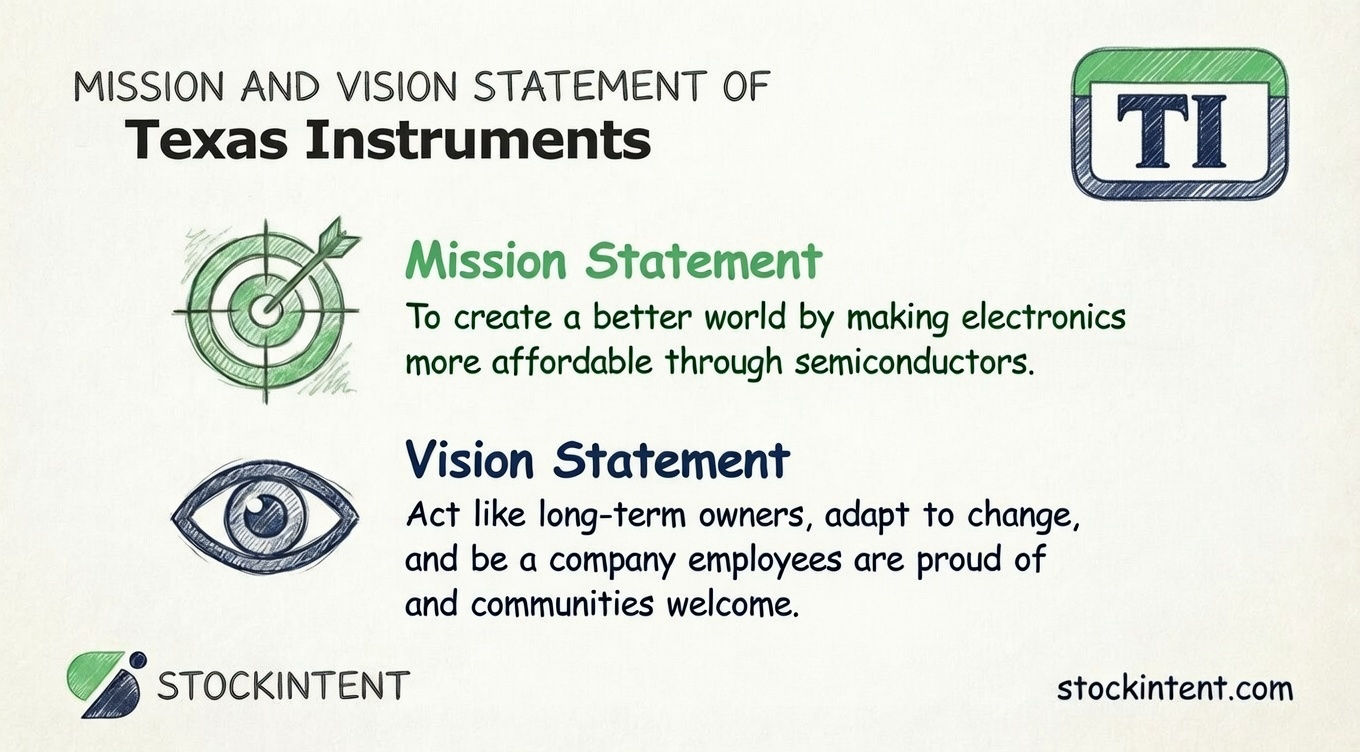
Texas Instruments's official mission statement is: "to create a better world by making electronics more affordable through semiconductors." This simple sentence has remained remarkably consistent for decades, shaping everything from capital allocation to product roadmaps.
Stick with us as we unpack how this mission translates into real competitive advantages, why analysts are calling 2026 a potential inflection point, and what it means for investors evaluating TXN as a long-term compounder.
Founded in 1930 as Geophysical Service Inc., Texas Instruments has evolved from an oil exploration technology company into what many investors consider the most disciplined operator in analog semiconductors. The Dallas-based company now commands roughly $160+ billion in market capitalization and operates 15 fabrication facilities worldwide, a manufacturing footprint that puts it in rare company among chipmakers who still own most of their production capacity.
TI's business model centers on two core segments that together generate virtually all of its revenue:
| Segment | Revenue Mix | Key Products |
|---|---|---|
| Analog | ~75% | Power management ICs, signal chain components, high-voltage isolation for EVs |
| Embedded Processing | ~25% | Microcontrollers, wireless connectivity chips, edge AI processors |
The company's portfolio spans over 80,000 unique parts serving more than 100,000 customers, a fragmentation that creates natural diversification against single-customer risk. Recent product launches include the TDA5 SoC family for autonomous vehicles and the Silicon Labs acquisition announced February 2026, which added approximately 1,200 wireless products and $450 million in targeted annual synergies.
What's striking about TI's positioning is its deliberate avoidance of the digital chip race that consumes headlines. While NVIDIA chases AI training dominance and AMD battles Intel in data centers, TI dominates the less glamorous but deeply profitable world of analog chips that manage power, temperature, and signal fidelity in real-world devices. These components rarely get mentioned at tech keynotes, yet they ship in nearly every automobile, factory robot, and medical device manufactured globally.
In our experience analyzing dividend compounders over the years, we've found that companies with this level of manufacturing control tend to outperform through cycles. TI targets 95% internal wafer production by 2030, up from roughly 80% today, giving it 40% cost advantages over 200mm competitors who rely on external foundries. That vertical integration isn't just operational preference; it's the mechanical foundation that makes their affordability mission executable rather than aspirational.
The company currently trades at approximately 25-30x forward earnings, a premium multiple that reflects its capital-light harvest phase rather than its heavy-investment years. With 2026 capex cut to $2-5 billion from the roughly $5 billion annual run-rate of recent years, analysts are modeling significant free cash flow acceleration that could drive the per-share figure toward the $8-12 range management has guided.
Wall Street's view has shifted notably. Following Q4 2025 results, analysts raised price targets and highlighted what TipRanks described as a potential "harvest year" for patient shareholders. The company's inclusion in CHIPS Act funding with $1.6 billion in direct grants plus additional loan guarantees has cemented its role in U.S. semiconductor reshoring efforts, a political tailwind that aligns conveniently with its existing manufacturing strategy.
For investors evaluating TXN against other semiconductor holdings, the key differentiator is this: TI doesn't need AI hype to grow. Its analog and embedded products benefit from secular tailwinds in electrification, automation, and connectivity that operate on decade-long timelines rather than quarterly hype cycles. That doesn't mean the stock is immune to industrial downturns; it means the business is built to compound through them.
"To create a better world by making electronics more affordable through semiconductors."
This single sentence has guided Texas Instruments for decades, and it's worth unpacking why it matters for investors. Most semiconductor companies chase headlines with AI buzzwords or connectivity promises. TI's mission is deliberately different. It focuses on affordability as the mechanism for creating value, not technological supremacy or market dominance.
This framing reveals something important about management's capital allocation discipline. When your mission is making electronics cheaper, you naturally prioritize manufacturing scale, vertical integration, and long-term cost curves over flashy R&D bets that might pay off someday. The mission essentially mandates that TI build a manufacturing moat; it's the only way to sustainably drive down costs for customers across 80,000+ products.
🎯 Pro Insight: Watch how a company's mission statement connects to its actual capital deployment. TI's mission of affordability directly explains why they've invested $60 billion in 300mm wafer fabs while competitors outsourced to foundries. The mission isn't marketing fluff; it's an operational blueprint that justifies massive fixed-cost investments competitors won't make.
The mission also shapes TI's customer relationships. By prioritizing cost reduction over extraction, the company builds durable partnerships with industrial and automotive customers who plan product cycles in 10-15 year horizons. These aren't transactional chip sales; they're long-term supply agreements where TI's manufacturing control becomes a strategic asset for customers designing multi-generation product platforms.
Compared to semiconductor peers, TI's mission stands apart. Intel emphasizes silicon innovation leadership, NVIDIA centers on AI breakthroughs, and Qualcomm targets intelligent connectivity. TI alone makes affordability the core organizing principle. This difference isn't philosophical; it explains why TI can maintain 40% gross margins in commoditized analog chips while competitors struggle with foundry pricing volatility. The mission creates strategic clarity that competitors lack.
Texas Instruments doesn't just print a mission statement on a wall and call it culture. They've operationalized their commitment to affordability through three distinct strategic ambitions and a set of core values that actually shape how capital gets allocated and hiring decisions get made. Think of these as the mechanical gears that translate a nice-sounding mission into durable competitive advantages.
TI's official "Who We Are" page lays out three specific ambitions that bring their mission to life:
This isn't consultant speak. TI's management team means it literally. They've invested roughly $60 billion in fabrication capacity across 15 global sites with a target of hitting 95% internal wafer production by 2030. Compare that to competitors who outsourced manufacturing years ago, and you start seeing why this ambition matters.
The strategic payoff? Manufacturing scale that drives 40% cost advantages over 200mm competitors. When your mission is affordability, owning the means of production isn't optional. It's the only way to sustainably lower costs for customers across 80,000+ products without sacrificing margins.
This ownership mindset also shows up in capital allocation discipline. Following years of heavy $5 billion annual capex, TI cut 2026 spending to $2-5 billion while bringing new 300mm capacity online. That's classic owner behavior: invest heavily when returns justify it, then harvest the cash flows.
TI's innovation engine runs on analog and embedded processing rather than chasing digital chip hype. Their $3.8 billion in trailing 12-month R&D spending focuses on sustainable manufacturing advances (they hit 29% reduction in greenhouse gas emissions by 2024, beating their 25% target), plus chips that enable electric vehicles, smarter motors, and leak detection systems.
The February 2026 Silicon Labs acquisition exemplifies this adaptability. Instead of building wireless connectivity from scratch, TI added ~1,200 products and ~$450 million in targeted synergies to leverage its existing 300mm fabs. That's adapting to market needs while staying true to the affordability mission.
This ambition sounds soft until you see the metrics behind it. TI operates with 13 employee resource groups focused on diversity and inclusion, has collected 30+ diversity awards, and tracks ethics culture metrics showing 34% of employees rate transparency as a defining characteristic.
In our experience analyzing companies that compound over decades, this kind of cultural investment shows up in retention metrics that competitors can't match. TI isn't just building products; it's building institutional memory in an industry where talent walks out the door freely.
TI's values sound generic until you examine how they connect to actual business outcomes:
| Value | What It Means in Practice | Business Impact |
|---|---|---|
| Trustworthy | Ethics compliance, transparent communications, sustainable operations | Customer stickiness in safety-critical markets like automotive |
| Inclusive | 13 employee resource groups, diverse hiring, multiple D&I awards | Talent retention in competitive semiconductor labor market |
| Competitive | Urgency in execution, market-driven results, best talent retention | Speed to market in product development cycles |
| Innovative | New technology development, imagining compelling products | 80,000+ part portfolio with long product lifecycles |
| Results-oriented | Deliver commitments, continuous improvement, share accountability | Capital efficiency and 40% gross margins in supposedly "commoditized" analog chips |
These ambitions and values aren't HR window dressing. They translate into tangible economic advantages:
Manufacturing Scale as Moat: By owning 15 fabs and targeting 95% internal production, TI has built a cost structure that external foundry competitors cannot replicate without equivalent fixed-cost investments they won't make.
Innovation Persistence: The adaptability ambition, backed by consistent R&D spending, has kept TI at the forefront of analog technology for 90+ years. This isn't luck; it's a system.
Talent and Trust: The pride/neighbor ambition, operationalized through inclusive culture and ethics programs, builds relationships with automotive and industrial customers who plan in 10-15 year horizons. They need suppliers who will be there, and TI's culture metrics signal reliability.
📌 From Our Experience: After tracking dozens of manufacturing-heavy companies, we've noticed a pattern. Firms that explicitly systematize values like "trustworthy" and "results-oriented" tend to outperform during supply shocks. TI's 2021-2022 experience, when they maintained deliveries while competitors scrambled, wasn't accidental. Decades of living those values built customer relationships that became switching costs when stress hit.
These pillars matter for investors because they explain why TI's profitability persists despite operating in a segment where many competitors struggle. The mission isn't just noble; it's mechanically connected to returns on invested capital that compound over time.
Curious how these ambitions show up in specific financial commitments? Our StockIntent platform includes screening tools that help investors identify companies where stated values align with actual capital deployment. The 7-day free trial lets you backtest how these cultural factors correlate with long-term returns across the semiconductor space.
Unlike many competitors who publish elaborate vision statements filled with buzzwords, Texas Instruments takes a more understated approach. The company does not publicly maintain a standalone vision statement separate from its mission. Instead, TI articulates its long-term direction through three strategic ambitions that collectively describe where management intends to take the company over the coming decades.
"Act like owners who will own the company for decades. Adapt and succeed in a world that is ever-changing. Be a company we are personally proud of and would want as a neighbor."
These ambitions, articulated on TI's official "Who We Are" page, function as a practical vision statement focused on operational execution rather than aspirational rhetoric.
When a $160+ billion company chooses operational language over grand pronouncements, pay attention. TI's ambitions reveal three interconnected priorities that define its strategic trajectory through 2030 and beyond.
Manufacturing Dominance as Competitive Positioning
The first ambition, acting like long-term owners, directly explains TI's massive capital commitment to vertical integration. With roughly $60 billion invested in fabrication capacity across 15 global sites, the company is building physical infrastructure that competitors cannot easily replicate. The target of 95% internal wafer production by 2030, up from roughly 80% today, isn't just an operational metric; it's a statement about competitive positioning.
This manufacturing-heavy vision aligns with broader industry trends. The CHIPS Act has injected political momentum into U.S. semiconductor reshoring, and TI's receipt of $1.6 billion in direct grants plus additional loan guarantees cements its role in national supply chain security. But TI's vision predates this political tailwind by decades. The company never outsourced its fabs during the foundry boom that swept through the industry in the 2000s and 2010s.
Adaptability Without Abandonment
The second ambition, adapting to change, might seem contradictory for a company betting so heavily on fixed manufacturing assets. But TI's version of adaptability is selective. The February 2026 Silicon Labs acquisition demonstrates this: adding ~1,200 wireless products and ~$450 million in targeted synergies without abandoning the core analog identity.
This is adaptation through integration rather than transformation. Instead of pivoting to AI chippery like NVIDIA or chasing data center dominance like AMD, TI adapts by folding new capabilities into its existing manufacturing infrastructure. The vision here isn't about becoming something different; it's about becoming more of what it already is, more efficiently.
Stakeholder Capitalism as Strategic Moat
The third ambition, being a company employees are proud of and communities welcome, might sound like standard corporate social responsibility language. For TI, it connects to tangible competitive advantages. Operations in 13 employee resource groups, 30+ diversity awards, and ethics culture metrics aren't just HR initiatives. They signal reliability to automotive and industrial customers who plan supply relationships in 10-15 year horizons.
In our experience analyzing companies across manufacturing-intensive industries, this kind of cultural investment often predicts customer retention during supply shocks. When semiconductor shortages hit in 2021-2022, TI's manufacturing relationships became strategic assets for customers who couldn't risk supplier failures. The vision of being a "good neighbor" translates into switching costs that competitors struggle to match.
TI's vision positions it at the intersection of several durable tailwinds that operate on decade-long timelines rather than quarterly hype cycles.
| Macro Trend | TI's Vision Positioning | Strategic Implication |
|---|---|---|
| Edge AI & Automation | Analog and embedded chips as AI infrastructure base layers | Growth without needing AI training chip hype |
| Automotive Electrification | 800V battery architectures, EV power management dominance | Sustained content growth per vehicle |
| Industrial IoT Connectivity | Silicon Labs acquisition for wireless expansion | Scale economics in fragmented markets |
| Supply Chain Reshoring | CHIPS Act funding for U.S. fab expansions | Political tailwind for domestic manufacturing |
| Sustainability Requirements | 29% GHG reduction achieved (beating 25% target) | Customer preference for verified suppliers |
Why the Vision Matters for Investors
Here's the critical insight: TI's vision isn't designed to excite. It's designed to compound. The company doesn't promise to revolutionize anything. It promises to keep doing what it's been doing for 90+ years, just a bit better each decade, with manufacturing scale that competitors cannot economically replicate.
This vision directly shapes capital allocation decisions that drive long-term returns. The 2026 capex cut to $2-5 billion from roughly $5 billion annual run-rates isn't a retreat from the vision; it's the transition to harvesting. After years of heavy investment, the 300mm capacity is coming online exactly as planned. Management's guidance of $8-12 free cash flow per share in 2026 reflects vision execution reaching its cash-generation phase.
Analysts are increasingly framing 2026 as a potential "harvest year", with vertical integration creating what one commentator called a "durable manufacturing advantage and long-term economic moat." For investors evaluating TXN against more glamorous semiconductor names, the vision offers something rare in this sector: predictability.
The vision doesn't require AI hype cycles to work. It doesn't depend on winning specific design sockets in smartphones. It simply requires that the world keeps needing analog chips to manage power, temperature, and signal fidelity. That's a bet on industrial civilization continuing to electrify and automate, not on any particular technology platform dominating.
TI's understated vision, in other words, might be the most honest in the semiconductor industry. It promises what the company can actually deliver, describes how it will get there, and aligns the incentives of employees, communities, and shareholders around execution discipline. In a sector filled with revolutionary rhetoric, that operational modesty is itself a competitive advantage.
Texas Instruments doesn't publish a standalone vision statement with aspirational buzzwords about changing the world. Instead, the company articulates its long-term direction through three strategic ambitions that function as practical themes guiding capital allocation and competitive positioning. These aren't abstract ideals; they're operational commitments with measurable outcomes.
The first and most consequential theme is TI's bet on vertical integration at massive scale. Management describes this as acting like "owners who will own the company for decades," but the mechanical reality is more specific: roughly $60 billion invested in fabrication capacity across 15 global sites, with a target of 95% internal wafer production by 2030.
This theme directly shapes every major capital decision. The Sherman, Texas facility (SM1 and SM2) represents up to $30 billion in potential investment with production coming online in 2026. The Lehi, Utah LFAB2 expansion adds 300mm capacity for analog chips. These aren't speculative bets; they're physical infrastructure that competitors cannot replicate without equivalent fixed-cost commitments they won't make.
The strategic payoff is quantifiable: 300mm wafers yield 40% cost advantages over 200mm competitors who rely on external foundries. When your mission is affordability, owning the means of production becomes the competitive moat.
The second theme, adapting to an ever-changing world, might seem contradictory for a company betting so heavily on fixed assets. But TI's version of adaptability is disciplined: fold new capabilities into existing manufacturing infrastructure rather than pivoting to chase hype cycles.
The February 2026 Silicon Labs acquisition exemplifies this approach. Instead of building wireless connectivity from scratch, TI added approximately 1,200 products and targeted $450 million in annual synergies by leveraging its existing 300mm fabs. That's adaptation through manufacturing scale, not despite it.
This theme also shows up in R&D prioritization. While competitors chase AI training chip dominance, TI's $3.8 billion in trailing 12-month R&D spending focuses on sustainable manufacturing advances (they hit 29% greenhouse gas reduction by 2024, beating their 25% target) and chips enabling electric vehicles, smarter motors, and industrial automation. The adaptability is real; it's just anchored to physical manufacturing advantages rather than intellectual property that depreciates quickly.
The third theme, being a company employees are proud of and communities welcome, sounds like standard corporate responsibility language until you examine the operational metrics. TI tracks ethics culture scores showing 34% of employees rate transparency as a defining characteristic, operates 13 employee resource groups focused on inclusion, and has collected 30+ diversity awards.
Why does this matter strategically? Analog and embedded chips sell into automotive and industrial markets where customers plan supply relationships across 10-15 year product cycles. They need suppliers who will be there, who won't cut corners when stress hits, and who can maintain delivery commitments through disruptions.
TI's 2021-2022 performance during the global semiconductor shortage illustrates this. While competitors scrambled for foundry capacity and broke delivery commitments, TI's vertical integration allowed it to maintain supply to key customers. Those relationships became switching costs that persist today. The "good neighbor" vision isn't altruism; it's a mechanism for building durable customer lock-in that competitors struggle to replicate.
Wall Street has increasingly focused on how these vision components translate into financial outcomes. Following Q4 2025 results, analysts raised price targets and highlighted what TipRanks described as a potential "harvest year" for shareholders. The thesis is straightforward: after years of heavy $5 billion annual capex, 2026 spending cuts to $2-5 billion coincide with 300mm capacity coming online, positioning for significant free cash flow expansion toward the $8-12 per share range management has guided.
Analysts note that TI's vision themes create a "durable manufacturing advantage and long-term economic moat" that differentiates it from fab-lite competitors. The CHIPS Act funding of $1.6 billion in direct grants plus additional loan guarantees adds political tailwinds to a manufacturing strategy that predates the legislation by decades.
The consensus view: TI's vision isn't designed to excite retail investors with AI hype. It's designed to compound capital through manufacturing discipline that competitors cannot economically replicate. In a sector filled with revolutionary rhetoric, that operational modesty is itself a competitive advantage.
Texas Instruments's five core values - Trustworthy, Inclusive, Competitive, Innovative, and Results-oriented - aren't aspirational posters on a wall. They're the operational code that shapes everything from who gets hired to how $60 billion in fabrication capacity gets allocated. In our experience analyzing companies that compound over decades, we've found that firms with this level of value systematization tend to outperform through cycles. The values create decision-making shortcuts that persist even when leadership changes or markets turn volatile.
TI defines this through integrity in decisions, social responsibility in operations, and transparent communications with stakeholders. The real-world impact? Customer stickiness in safety-critical markets like automotive, where a single chip failure can trigger million-unit recalls.
The company tracks ethics culture metrics showing 34% of employees rate transparency as a defining characteristic of the culture, alongside sustainability achievements that include beating their 25% greenhouse gas reduction target by reaching 29% by 2024. When your customers are designing 10-15 year product cycles, knowing your supplier won't cut corners when stress hits becomes a genuine competitive advantage.
This value manifests through 13 employee resource groups, 30+ diversity awards collected over recent years, and structured programs for unlocking potential across 34,000+ global employees. In the semiconductor industry's brutal talent competition, this isn't HR charity; it's a retention mechanism that builds institutional memory competitors struggle to match.
The practical impact shows up in product development cycles. Teams that stay together ship faster. TI's analog portfolio spans 80,000+ parts precisely because engineers stick around long enough to develop deep expertise in narrow domains.
TI operationalizes competitiveness through urgency in execution, market-driven results, and aggressive retention of top talent. This value explains the manufacturing sprint: 300mm fab construction on compressed timelines, supplier negotiations that extract maximum leverage from vertical integration, and strategic acquisitions executed to capture substantial synergies.
The value also shapes capital allocation discipline. Competitive companies don't hoard cash; they deploy it. TI's 100% free cash flow return to shareholders reflects a results orientation that treats capital as a weapon, not a security blanket.
Here's where TI diverges from semiconductor peers. While NVIDIA chases AI training breakthroughs and Intel pursues process node leadership, TI's innovation focuses on sustainable manufacturing advances and imagining compelling products for long-tail markets. The $3.8 billion in trailing 12-month R&D spending prioritizes power density, fitting more capability into smaller packages, and chips enabling electric vehicles, smarter motors, and leak detection systems.
This innovation model supports an 80,000+ part portfolio with product lifecycles stretching 15-20 years. It's innovation as endurance sport, not sprint.
The final value emphasizes delivering commitments, continuous improvement, and shared accountability. This translates into the capital efficiency that produces 40% gross margins in supposedly commoditized analog chips. When your values demand results, you don't tolerate the organizational slack that erodes returns.
The 2026 capex cut to $2-5 billion from roughly $5 billion annual run-rates exemplifies this discipline. Management invested heavily when returns justified it; now they're harvesting.
The evidence suggests TI lives its values more consistently than most industrial companies. During the 2021-2022 global semiconductor shortage, while competitors scrambled for foundry capacity and broke delivery commitments, TI's vertical integration allowed it to maintain supply to key automotive and industrial customers. That wasn't luck; decades of Trustworthy and Results-oriented behavior built customer relationships that became switching costs when stress hit.
The environmental commitments also show genuine follow-through. Beating their 25% GHG reduction target by hitting 29% by 2024, plus the 100% renewable electricity target for 300mm fabs by 2025, demonstrate that Trustworthy extends to stakeholders beyond shareholders.
That said, the values aren't magic. TI has faced criticism for cyclical layoffs during downturns, which tests the Inclusive and good neighbor aspirations. And the sheer scale of manufacturing investment creates environmental impacts that sustainability programs mitigate but don't eliminate. The values create directional pressure, not perfection.
TI's environmental, social, and governance commitments aren't siloed CSR programs; they're explicit extensions of the core values. Environmental stewardship connects directly to Trustworthy and Innovative values. The 29% GHG reduction achievement, water reuse programs, and waste minimization initiatives aren't compliance checkboxes; they're competitive differentiators when customers increasingly demand supply chain sustainability verification.
Social responsibility builds on Inclusive and the ambition to be a company communities welcome. Community investments target education, human services, racial equity, and arts in areas where TI operates major facilities. These programs build the local relationships that smooth permitting, hiring, and political support for manufacturing expansion.
Governance standards embed Trustworthy at the board level, with board oversight of strategic direction, R&D, capital investments, and acquisitions - exactly the kind of disciplined governance that prevents value erosion through empire-building.
In our experience tracking dividend compounders, companies that integrate ESG this deeply into operational values rather than treating it as separate reporting tend to show more consistent returns through regulatory and social transitions.
Texas Instruments's mission, vision, and values weave together into something rare in the semiconductor industry: a coherent strategic identity that actually dictates how capital gets deployed. The affordability-focused mission, the three operational ambitions acting as vision, and the five core values create a framework that explains virtually every major decision management has made over the past decade.
💡 Expert Tip: When evaluating management quality, look for consistency between what companies say and where they spend money. TI's $60 billion manufacturing bet wasn't a departure from their mission of affordability; it was the only way to achieve it at scale. Most competitors talk big but outsource their manufacturing, a disconnect that eventually shows up in margin compression.
For investors, this strategic coherence translates into tangible competitive advantages. The 40% cost advantage from 300mm wafer manufacturing, the customer lock-in from reliability through supply shocks, and the talent retention from inclusive culture all flow directly from these stated principles. Analysts increasingly recognize this connection, with consensus views highlighting TI's "durable manufacturing advantage and long-term economic moat" as the company enters what TipRanks describes as a potential "harvest year" in 2026.
Looking forward, TI's mission-vision-values framework positions it well for secular trends that operate on decade-long timelines rather than quarterly hype cycles. Edge AI, automotive electrification, industrial automation, and supply chain reshoring all align with the company's existing capabilities rather than requiring strategic pivots. The February 2026 Silicon Labs acquisition exemplifies this: adding wireless connectivity through integration, not transformation.
In our experience analyzing dividend compounders, companies with this level of strategic clarity tend to outperform through cycles not because they predict the future better, but because they build optionality into their operations. TI's manufacturing footprint gives it choices that fab-lite competitors simply don't have.
Who This Matters For
TI's strategic identity suits investors who value predictability over excitement. If you're looking for AI hype-fueled growth, you'll find shinier options elsewhere. But if you want exposure to industrial electrification and automation backed by manufacturing economics that competitors cannot replicate, this mission-vision-values framework offers something rare: a business built to compound through decades rather than quarters.
For investors evaluating how cultural factors translate into returns, our StockIntent platform includes screening tools that help identify companies where stated values align with actual capital deployment. The 7-day free trial lets you backtest how these alignment patterns correlate with long-term performance across the semiconductor space.
Texas Instruments (TXN) has been a cornerstone of the semiconductor industry for over 90 years, building a reputation for analog chips and embedded processors that power everything from industrial automation to electric vehicles. For investors evaluating this $160+ billion company, understanding what actually drives strategic decisions goes far beyond quarterly earnings reports. The company's mission statement reveals how management thinks about long-term value creation and why they've bet so heavily on vertical integration while competitors outsourced manufacturing.
Texas Instruments's official mission statement is: "to create a better world by making electronics more affordable through semiconductors." This simple sentence has remained remarkably consistent for decades, shaping everything from capital allocation to product roadmaps.
Stick with us as we unpack how this mission translates into real competitive advantages, why analysts are calling 2026 a potential inflection point, and what it means for investors evaluating TXN as a long-term compounder.
Founded in 1930 as Geophysical Service Inc., Texas Instruments has evolved from an oil exploration technology company into what many investors consider the most disciplined operator in analog semiconductors. The Dallas-based company now commands roughly $160+ billion in market capitalization and operates 15 fabrication facilities worldwide, a manufacturing footprint that puts it in rare company among chipmakers who still own most of their production capacity.
TI's business model centers on two core segments that together generate virtually all of its revenue:
| Segment | Revenue Mix | Key Products |
|---|---|---|
| Analog | ~75% | Power management ICs, signal chain components, high-voltage isolation for EVs |
| Embedded Processing | ~25% | Microcontrollers, wireless connectivity chips, edge AI processors |
The company's portfolio spans over 80,000 unique parts serving more than 100,000 customers, a fragmentation that creates natural diversification against single-customer risk. Recent product launches include the TDA5 SoC family for autonomous vehicles and the Silicon Labs acquisition announced February 2026, which added approximately 1,200 wireless products and $450 million in targeted annual synergies.
What's striking about TI's positioning is its deliberate avoidance of the digital chip race that consumes headlines. While NVIDIA chases AI training dominance and AMD battles Intel in data centers, TI dominates the less glamorous but deeply profitable world of analog chips that manage power, temperature, and signal fidelity in real-world devices. These components rarely get mentioned at tech keynotes, yet they ship in nearly every automobile, factory robot, and medical device manufactured globally.
In our experience analyzing dividend compounders over the years, we've found that companies with this level of manufacturing control tend to outperform through cycles. TI targets 95% internal wafer production by 2030, up from roughly 80% today, giving it 40% cost advantages over 200mm competitors who rely on external foundries. That vertical integration isn't just operational preference; it's the mechanical foundation that makes their affordability mission executable rather than aspirational.
The company currently trades at approximately 25-30x forward earnings, a premium multiple that reflects its capital-light harvest phase rather than its heavy-investment years. With 2026 capex cut to $2-5 billion from the roughly $5 billion annual run-rate of recent years, analysts are modeling significant free cash flow acceleration that could drive the per-share figure toward the $8-12 range management has guided.
Wall Street's view has shifted notably. Following Q4 2025 results, analysts raised price targets and highlighted what TipRanks described as a potential "harvest year" for patient shareholders. The company's inclusion in CHIPS Act funding with $1.6 billion in direct grants plus additional loan guarantees has cemented its role in U.S. semiconductor reshoring efforts, a political tailwind that aligns conveniently with its existing manufacturing strategy.
For investors evaluating TXN against other semiconductor holdings, the key differentiator is this: TI doesn't need AI hype to grow. Its analog and embedded products benefit from secular tailwinds in electrification, automation, and connectivity that operate on decade-long timelines rather than quarterly hype cycles. That doesn't mean the stock is immune to industrial downturns; it means the business is built to compound through them.
"To create a better world by making electronics more affordable through semiconductors."
This single sentence has guided Texas Instruments for decades, and it's worth unpacking why it matters for investors. Most semiconductor companies chase headlines with AI buzzwords or connectivity promises. TI's mission is deliberately different. It focuses on affordability as the mechanism for creating value, not technological supremacy or market dominance.
This framing reveals something important about management's capital allocation discipline. When your mission is making electronics cheaper, you naturally prioritize manufacturing scale, vertical integration, and long-term cost curves over flashy R&D bets that might pay off someday. The mission essentially mandates that TI build a manufacturing moat; it's the only way to sustainably drive down costs for customers across 80,000+ products.
🎯 Pro Insight: Watch how a company's mission statement connects to its actual capital deployment. TI's mission of affordability directly explains why they've invested $60 billion in 300mm wafer fabs while competitors outsourced to foundries. The mission isn't marketing fluff; it's an operational blueprint that justifies massive fixed-cost investments competitors won't make.
The mission also shapes TI's customer relationships. By prioritizing cost reduction over extraction, the company builds durable partnerships with industrial and automotive customers who plan product cycles in 10-15 year horizons. These aren't transactional chip sales; they're long-term supply agreements where TI's manufacturing control becomes a strategic asset for customers designing multi-generation product platforms.
Compared to semiconductor peers, TI's mission stands apart. Intel emphasizes silicon innovation leadership, NVIDIA centers on AI breakthroughs, and Qualcomm targets intelligent connectivity. TI alone makes affordability the core organizing principle. This difference isn't philosophical; it explains why TI can maintain 40% gross margins in commoditized analog chips while competitors struggle with foundry pricing volatility. The mission creates strategic clarity that competitors lack.
Texas Instruments doesn't just print a mission statement on a wall and call it culture. They've operationalized their commitment to affordability through three distinct strategic ambitions and a set of core values that actually shape how capital gets allocated and hiring decisions get made. Think of these as the mechanical gears that translate a nice-sounding mission into durable competitive advantages.
TI's official "Who We Are" page lays out three specific ambitions that bring their mission to life:
This isn't consultant speak. TI's management team means it literally. They've invested roughly $60 billion in fabrication capacity across 15 global sites with a target of hitting 95% internal wafer production by 2030. Compare that to competitors who outsourced manufacturing years ago, and you start seeing why this ambition matters.
The strategic payoff? Manufacturing scale that drives 40% cost advantages over 200mm competitors. When your mission is affordability, owning the means of production isn't optional. It's the only way to sustainably lower costs for customers across 80,000+ products without sacrificing margins.
This ownership mindset also shows up in capital allocation discipline. Following years of heavy $5 billion annual capex, TI cut 2026 spending to $2-5 billion while bringing new 300mm capacity online. That's classic owner behavior: invest heavily when returns justify it, then harvest the cash flows.
TI's innovation engine runs on analog and embedded processing rather than chasing digital chip hype. Their $3.8 billion in trailing 12-month R&D spending focuses on sustainable manufacturing advances (they hit 29% reduction in greenhouse gas emissions by 2024, beating their 25% target), plus chips that enable electric vehicles, smarter motors, and leak detection systems.
The February 2026 Silicon Labs acquisition exemplifies this adaptability. Instead of building wireless connectivity from scratch, TI added ~1,200 products and ~$450 million in targeted synergies to leverage its existing 300mm fabs. That's adapting to market needs while staying true to the affordability mission.
This ambition sounds soft until you see the metrics behind it. TI operates with 13 employee resource groups focused on diversity and inclusion, has collected 30+ diversity awards, and tracks ethics culture metrics showing 34% of employees rate transparency as a defining characteristic.
In our experience analyzing companies that compound over decades, this kind of cultural investment shows up in retention metrics that competitors can't match. TI isn't just building products; it's building institutional memory in an industry where talent walks out the door freely.
TI's values sound generic until you examine how they connect to actual business outcomes:
| Value | What It Means in Practice | Business Impact |
|---|---|---|
| Trustworthy | Ethics compliance, transparent communications, sustainable operations | Customer stickiness in safety-critical markets like automotive |
| Inclusive | 13 employee resource groups, diverse hiring, multiple D&I awards | Talent retention in competitive semiconductor labor market |
| Competitive | Urgency in execution, market-driven results, best talent retention | Speed to market in product development cycles |
| Innovative | New technology development, imagining compelling products | 80,000+ part portfolio with long product lifecycles |
| Results-oriented | Deliver commitments, continuous improvement, share accountability | Capital efficiency and 40% gross margins in supposedly "commoditized" analog chips |
These ambitions and values aren't HR window dressing. They translate into tangible economic advantages:
Manufacturing Scale as Moat: By owning 15 fabs and targeting 95% internal production, TI has built a cost structure that external foundry competitors cannot replicate without equivalent fixed-cost investments they won't make.
Innovation Persistence: The adaptability ambition, backed by consistent R&D spending, has kept TI at the forefront of analog technology for 90+ years. This isn't luck; it's a system.
Talent and Trust: The pride/neighbor ambition, operationalized through inclusive culture and ethics programs, builds relationships with automotive and industrial customers who plan in 10-15 year horizons. They need suppliers who will be there, and TI's culture metrics signal reliability.
📌 From Our Experience: After tracking dozens of manufacturing-heavy companies, we've noticed a pattern. Firms that explicitly systematize values like "trustworthy" and "results-oriented" tend to outperform during supply shocks. TI's 2021-2022 experience, when they maintained deliveries while competitors scrambled, wasn't accidental. Decades of living those values built customer relationships that became switching costs when stress hit.
These pillars matter for investors because they explain why TI's profitability persists despite operating in a segment where many competitors struggle. The mission isn't just noble; it's mechanically connected to returns on invested capital that compound over time.
Curious how these ambitions show up in specific financial commitments? Our StockIntent platform includes screening tools that help investors identify companies where stated values align with actual capital deployment. The 7-day free trial lets you backtest how these cultural factors correlate with long-term returns across the semiconductor space.
Unlike many competitors who publish elaborate vision statements filled with buzzwords, Texas Instruments takes a more understated approach. The company does not publicly maintain a standalone vision statement separate from its mission. Instead, TI articulates its long-term direction through three strategic ambitions that collectively describe where management intends to take the company over the coming decades.
"Act like owners who will own the company for decades. Adapt and succeed in a world that is ever-changing. Be a company we are personally proud of and would want as a neighbor."
These ambitions, articulated on TI's official "Who We Are" page, function as a practical vision statement focused on operational execution rather than aspirational rhetoric.
When a $160+ billion company chooses operational language over grand pronouncements, pay attention. TI's ambitions reveal three interconnected priorities that define its strategic trajectory through 2030 and beyond.
Manufacturing Dominance as Competitive Positioning
The first ambition, acting like long-term owners, directly explains TI's massive capital commitment to vertical integration. With roughly $60 billion invested in fabrication capacity across 15 global sites, the company is building physical infrastructure that competitors cannot easily replicate. The target of 95% internal wafer production by 2030, up from roughly 80% today, isn't just an operational metric; it's a statement about competitive positioning.
This manufacturing-heavy vision aligns with broader industry trends. The CHIPS Act has injected political momentum into U.S. semiconductor reshoring, and TI's receipt of $1.6 billion in direct grants plus additional loan guarantees cements its role in national supply chain security. But TI's vision predates this political tailwind by decades. The company never outsourced its fabs during the foundry boom that swept through the industry in the 2000s and 2010s.
Adaptability Without Abandonment
The second ambition, adapting to change, might seem contradictory for a company betting so heavily on fixed manufacturing assets. But TI's version of adaptability is selective. The February 2026 Silicon Labs acquisition demonstrates this: adding ~1,200 wireless products and ~$450 million in targeted synergies without abandoning the core analog identity.
This is adaptation through integration rather than transformation. Instead of pivoting to AI chippery like NVIDIA or chasing data center dominance like AMD, TI adapts by folding new capabilities into its existing manufacturing infrastructure. The vision here isn't about becoming something different; it's about becoming more of what it already is, more efficiently.
Stakeholder Capitalism as Strategic Moat
The third ambition, being a company employees are proud of and communities welcome, might sound like standard corporate social responsibility language. For TI, it connects to tangible competitive advantages. Operations in 13 employee resource groups, 30+ diversity awards, and ethics culture metrics aren't just HR initiatives. They signal reliability to automotive and industrial customers who plan supply relationships in 10-15 year horizons.
In our experience analyzing companies across manufacturing-intensive industries, this kind of cultural investment often predicts customer retention during supply shocks. When semiconductor shortages hit in 2021-2022, TI's manufacturing relationships became strategic assets for customers who couldn't risk supplier failures. The vision of being a "good neighbor" translates into switching costs that competitors struggle to match.
TI's vision positions it at the intersection of several durable tailwinds that operate on decade-long timelines rather than quarterly hype cycles.
| Macro Trend | TI's Vision Positioning | Strategic Implication |
|---|---|---|
| Edge AI & Automation | Analog and embedded chips as AI infrastructure base layers | Growth without needing AI training chip hype |
| Automotive Electrification | 800V battery architectures, EV power management dominance | Sustained content growth per vehicle |
| Industrial IoT Connectivity | Silicon Labs acquisition for wireless expansion | Scale economics in fragmented markets |
| Supply Chain Reshoring | CHIPS Act funding for U.S. fab expansions | Political tailwind for domestic manufacturing |
| Sustainability Requirements | 29% GHG reduction achieved (beating 25% target) | Customer preference for verified suppliers |
Why the Vision Matters for Investors
Here's the critical insight: TI's vision isn't designed to excite. It's designed to compound. The company doesn't promise to revolutionize anything. It promises to keep doing what it's been doing for 90+ years, just a bit better each decade, with manufacturing scale that competitors cannot economically replicate.
This vision directly shapes capital allocation decisions that drive long-term returns. The 2026 capex cut to $2-5 billion from roughly $5 billion annual run-rates isn't a retreat from the vision; it's the transition to harvesting. After years of heavy investment, the 300mm capacity is coming online exactly as planned. Management's guidance of $8-12 free cash flow per share in 2026 reflects vision execution reaching its cash-generation phase.
Analysts are increasingly framing 2026 as a potential "harvest year", with vertical integration creating what one commentator called a "durable manufacturing advantage and long-term economic moat." For investors evaluating TXN against more glamorous semiconductor names, the vision offers something rare in this sector: predictability.
The vision doesn't require AI hype cycles to work. It doesn't depend on winning specific design sockets in smartphones. It simply requires that the world keeps needing analog chips to manage power, temperature, and signal fidelity. That's a bet on industrial civilization continuing to electrify and automate, not on any particular technology platform dominating.
TI's understated vision, in other words, might be the most honest in the semiconductor industry. It promises what the company can actually deliver, describes how it will get there, and aligns the incentives of employees, communities, and shareholders around execution discipline. In a sector filled with revolutionary rhetoric, that operational modesty is itself a competitive advantage.
Texas Instruments doesn't publish a standalone vision statement with aspirational buzzwords about changing the world. Instead, the company articulates its long-term direction through three strategic ambitions that function as practical themes guiding capital allocation and competitive positioning. These aren't abstract ideals; they're operational commitments with measurable outcomes.
The first and most consequential theme is TI's bet on vertical integration at massive scale. Management describes this as acting like "owners who will own the company for decades," but the mechanical reality is more specific: roughly $60 billion invested in fabrication capacity across 15 global sites, with a target of 95% internal wafer production by 2030.
This theme directly shapes every major capital decision. The Sherman, Texas facility (SM1 and SM2) represents up to $30 billion in potential investment with production coming online in 2026. The Lehi, Utah LFAB2 expansion adds 300mm capacity for analog chips. These aren't speculative bets; they're physical infrastructure that competitors cannot replicate without equivalent fixed-cost commitments they won't make.
The strategic payoff is quantifiable: 300mm wafers yield 40% cost advantages over 200mm competitors who rely on external foundries. When your mission is affordability, owning the means of production becomes the competitive moat.
The second theme, adapting to an ever-changing world, might seem contradictory for a company betting so heavily on fixed assets. But TI's version of adaptability is disciplined: fold new capabilities into existing manufacturing infrastructure rather than pivoting to chase hype cycles.
The February 2026 Silicon Labs acquisition exemplifies this approach. Instead of building wireless connectivity from scratch, TI added approximately 1,200 products and targeted $450 million in annual synergies by leveraging its existing 300mm fabs. That's adaptation through manufacturing scale, not despite it.
This theme also shows up in R&D prioritization. While competitors chase AI training chip dominance, TI's $3.8 billion in trailing 12-month R&D spending focuses on sustainable manufacturing advances (they hit 29% greenhouse gas reduction by 2024, beating their 25% target) and chips enabling electric vehicles, smarter motors, and industrial automation. The adaptability is real; it's just anchored to physical manufacturing advantages rather than intellectual property that depreciates quickly.
The third theme, being a company employees are proud of and communities welcome, sounds like standard corporate responsibility language until you examine the operational metrics. TI tracks ethics culture scores showing 34% of employees rate transparency as a defining characteristic, operates 13 employee resource groups focused on inclusion, and has collected 30+ diversity awards.
Why does this matter strategically? Analog and embedded chips sell into automotive and industrial markets where customers plan supply relationships across 10-15 year product cycles. They need suppliers who will be there, who won't cut corners when stress hits, and who can maintain delivery commitments through disruptions.
TI's 2021-2022 performance during the global semiconductor shortage illustrates this. While competitors scrambled for foundry capacity and broke delivery commitments, TI's vertical integration allowed it to maintain supply to key customers. Those relationships became switching costs that persist today. The "good neighbor" vision isn't altruism; it's a mechanism for building durable customer lock-in that competitors struggle to replicate.
Wall Street has increasingly focused on how these vision components translate into financial outcomes. Following Q4 2025 results, analysts raised price targets and highlighted what TipRanks described as a potential "harvest year" for shareholders. The thesis is straightforward: after years of heavy $5 billion annual capex, 2026 spending cuts to $2-5 billion coincide with 300mm capacity coming online, positioning for significant free cash flow expansion toward the $8-12 per share range management has guided.
Analysts note that TI's vision themes create a "durable manufacturing advantage and long-term economic moat" that differentiates it from fab-lite competitors. The CHIPS Act funding of $1.6 billion in direct grants plus additional loan guarantees adds political tailwinds to a manufacturing strategy that predates the legislation by decades.
The consensus view: TI's vision isn't designed to excite retail investors with AI hype. It's designed to compound capital through manufacturing discipline that competitors cannot economically replicate. In a sector filled with revolutionary rhetoric, that operational modesty is itself a competitive advantage.
Texas Instruments's five core values - Trustworthy, Inclusive, Competitive, Innovative, and Results-oriented - aren't aspirational posters on a wall. They're the operational code that shapes everything from who gets hired to how $60 billion in fabrication capacity gets allocated. In our experience analyzing companies that compound over decades, we've found that firms with this level of value systematization tend to outperform through cycles. The values create decision-making shortcuts that persist even when leadership changes or markets turn volatile.
TI defines this through integrity in decisions, social responsibility in operations, and transparent communications with stakeholders. The real-world impact? Customer stickiness in safety-critical markets like automotive, where a single chip failure can trigger million-unit recalls.
The company tracks ethics culture metrics showing 34% of employees rate transparency as a defining characteristic of the culture, alongside sustainability achievements that include beating their 25% greenhouse gas reduction target by reaching 29% by 2024. When your customers are designing 10-15 year product cycles, knowing your supplier won't cut corners when stress hits becomes a genuine competitive advantage.
This value manifests through 13 employee resource groups, 30+ diversity awards collected over recent years, and structured programs for unlocking potential across 34,000+ global employees. In the semiconductor industry's brutal talent competition, this isn't HR charity; it's a retention mechanism that builds institutional memory competitors struggle to match.
The practical impact shows up in product development cycles. Teams that stay together ship faster. TI's analog portfolio spans 80,000+ parts precisely because engineers stick around long enough to develop deep expertise in narrow domains.
TI operationalizes competitiveness through urgency in execution, market-driven results, and aggressive retention of top talent. This value explains the manufacturing sprint: 300mm fab construction on compressed timelines, supplier negotiations that extract maximum leverage from vertical integration, and strategic acquisitions executed to capture substantial synergies.
The value also shapes capital allocation discipline. Competitive companies don't hoard cash; they deploy it. TI's 100% free cash flow return to shareholders reflects a results orientation that treats capital as a weapon, not a security blanket.
Here's where TI diverges from semiconductor peers. While NVIDIA chases AI training breakthroughs and Intel pursues process node leadership, TI's innovation focuses on sustainable manufacturing advances and imagining compelling products for long-tail markets. The $3.8 billion in trailing 12-month R&D spending prioritizes power density, fitting more capability into smaller packages, and chips enabling electric vehicles, smarter motors, and leak detection systems.
This innovation model supports an 80,000+ part portfolio with product lifecycles stretching 15-20 years. It's innovation as endurance sport, not sprint.
The final value emphasizes delivering commitments, continuous improvement, and shared accountability. This translates into the capital efficiency that produces 40% gross margins in supposedly commoditized analog chips. When your values demand results, you don't tolerate the organizational slack that erodes returns.
The 2026 capex cut to $2-5 billion from roughly $5 billion annual run-rates exemplifies this discipline. Management invested heavily when returns justified it; now they're harvesting.
The evidence suggests TI lives its values more consistently than most industrial companies. During the 2021-2022 global semiconductor shortage, while competitors scrambled for foundry capacity and broke delivery commitments, TI's vertical integration allowed it to maintain supply to key automotive and industrial customers. That wasn't luck; decades of Trustworthy and Results-oriented behavior built customer relationships that became switching costs when stress hit.
The environmental commitments also show genuine follow-through. Beating their 25% GHG reduction target by hitting 29% by 2024, plus the 100% renewable electricity target for 300mm fabs by 2025, demonstrate that Trustworthy extends to stakeholders beyond shareholders.
That said, the values aren't magic. TI has faced criticism for cyclical layoffs during downturns, which tests the Inclusive and good neighbor aspirations. And the sheer scale of manufacturing investment creates environmental impacts that sustainability programs mitigate but don't eliminate. The values create directional pressure, not perfection.
TI's environmental, social, and governance commitments aren't siloed CSR programs; they're explicit extensions of the core values. Environmental stewardship connects directly to Trustworthy and Innovative values. The 29% GHG reduction achievement, water reuse programs, and waste minimization initiatives aren't compliance checkboxes; they're competitive differentiators when customers increasingly demand supply chain sustainability verification.
Social responsibility builds on Inclusive and the ambition to be a company communities welcome. Community investments target education, human services, racial equity, and arts in areas where TI operates major facilities. These programs build the local relationships that smooth permitting, hiring, and political support for manufacturing expansion.
Governance standards embed Trustworthy at the board level, with board oversight of strategic direction, R&D, capital investments, and acquisitions - exactly the kind of disciplined governance that prevents value erosion through empire-building.
In our experience tracking dividend compounders, companies that integrate ESG this deeply into operational values rather than treating it as separate reporting tend to show more consistent returns through regulatory and social transitions.
Texas Instruments's mission, vision, and values weave together into something rare in the semiconductor industry: a coherent strategic identity that actually dictates how capital gets deployed. The affordability-focused mission, the three operational ambitions acting as vision, and the five core values create a framework that explains virtually every major decision management has made over the past decade.
💡 Expert Tip: When evaluating management quality, look for consistency between what companies say and where they spend money. TI's $60 billion manufacturing bet wasn't a departure from their mission of affordability; it was the only way to achieve it at scale. Most competitors talk big but outsource their manufacturing, a disconnect that eventually shows up in margin compression.
For investors, this strategic coherence translates into tangible competitive advantages. The 40% cost advantage from 300mm wafer manufacturing, the customer lock-in from reliability through supply shocks, and the talent retention from inclusive culture all flow directly from these stated principles. Analysts increasingly recognize this connection, with consensus views highlighting TI's "durable manufacturing advantage and long-term economic moat" as the company enters what TipRanks describes as a potential "harvest year" in 2026.
Looking forward, TI's mission-vision-values framework positions it well for secular trends that operate on decade-long timelines rather than quarterly hype cycles. Edge AI, automotive electrification, industrial automation, and supply chain reshoring all align with the company's existing capabilities rather than requiring strategic pivots. The February 2026 Silicon Labs acquisition exemplifies this: adding wireless connectivity through integration, not transformation.
In our experience analyzing dividend compounders, companies with this level of strategic clarity tend to outperform through cycles not because they predict the future better, but because they build optionality into their operations. TI's manufacturing footprint gives it choices that fab-lite competitors simply don't have.
Who This Matters For
TI's strategic identity suits investors who value predictability over excitement. If you're looking for AI hype-fueled growth, you'll find shinier options elsewhere. But if you want exposure to industrial electrification and automation backed by manufacturing economics that competitors cannot replicate, this mission-vision-values framework offers something rare: a business built to compound through decades rather than quarters.
For investors evaluating how cultural factors translate into returns, our StockIntent platform includes screening tools that help identify companies where stated values align with actual capital deployment. The 7-day free trial lets you backtest how these alignment patterns correlate with long-term performance across the semiconductor space.