Thermo Fisher Scientific Mission Statement, Vision & Core Values Explained

Thermo Fisher Scientific Mission Statement, Vision & Core Values Explained

Thermo Fisher Scientific Mission Statement, Vision & Core Values Explained

Thermo Fisher Scientific isn't just another healthcare stock. With over $40 billion in annual revenue and a market position as the world's leading supplier of scientific instruments and services, this is a company that touches everything from cancer research to food safety testing. For investors evaluating quality compounders, understanding why this business exists, not just how it makes money, provides crucial insight into its durability and competitive positioning.

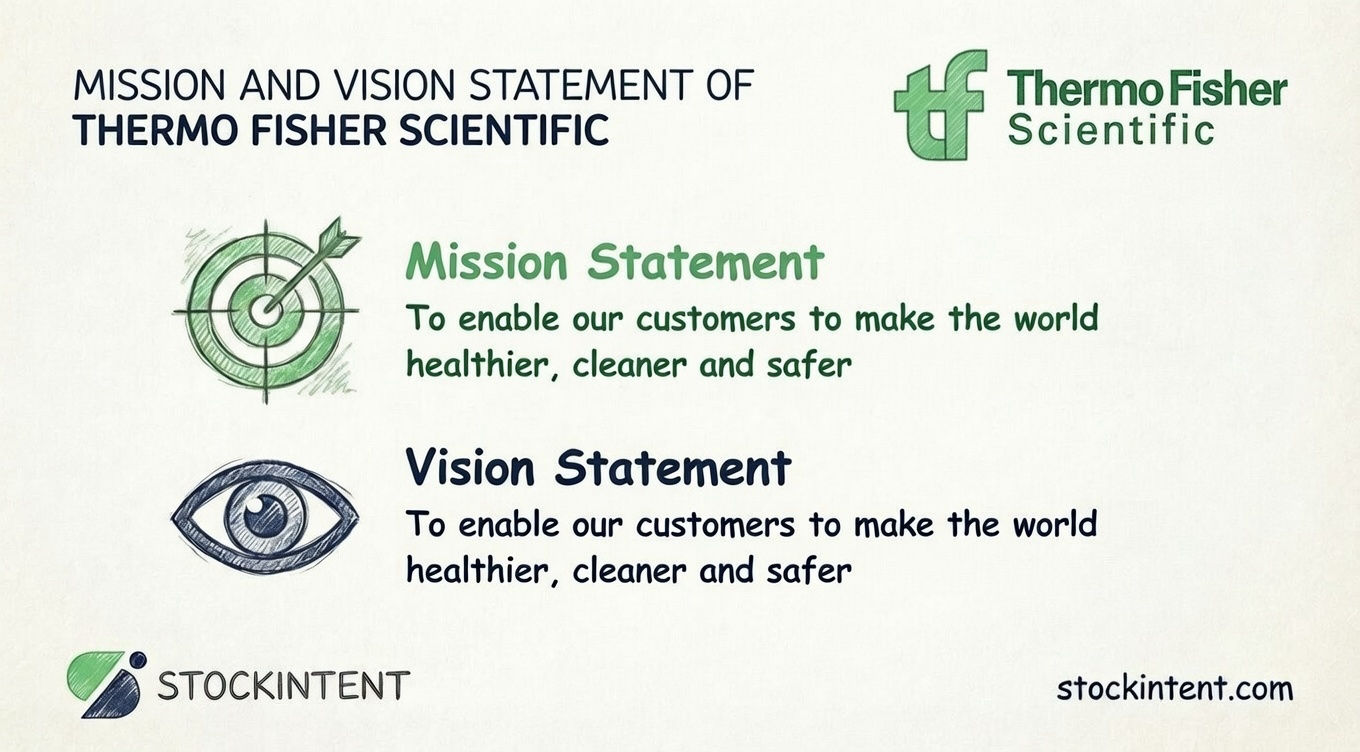
Thermo Fisher Scientific's mission statement is straightforward: "To enable our customers to make the world healthier, cleaner and safer." This isn't marketing fluff. It's a strategic filter that guides $16.5 billion in annual capital deployment, R&D investments, and major acquisitions like Patheon and PPD. The company backs this with four core values, the "4i Values": Integrity, Intensity, Innovation, and Involvement.

Here's what matters most if you're analyzing this business:

  • Customer enablement, not direct competition: Thermo Fisher supplies the tools and services that let pharma companies, researchers, and healthcare providers do their work, rather than competing with them
  • Mission-driven M&A: The company deployed $13 billion toward acquisitions in 2025, filtering deals through whether they advance the healthier/cleaner/safer mandate
  • Employee alignment atypical for industrials: 100% of surveyed employees report motivation from the mission, with 18% citing it as a primary retention factor
  • Sustainability integrated, not bolted on: Net-zero by 2050, 80% renewable electricity by 2030, and Scope 1+2 emissions already down 29% from 2018 baselines
  • AI and digital transformation accelerating: Strategic partnerships with NVIDIA and OpenAI announced in late 2025 signal continued innovation investment

Let's unpack what this mission, vision, and value structure actually means for your investment analysis and whether it supports a durable economic moat.

Company Overview

Thermo Fisher Scientific stands as the world's largest supplier of scientific instruments, reagents, and services to the life sciences and healthcare industries. Formed through the 2006 merger of Thermo Electron and Fisher Scientific, the company has grown into a $40+ billion revenue powerhouse serving pharma, biotech, academic research, and clinical diagnostics markets globally.

In our experience analyzing healthcare compounders, Thermo Fisher's scale creates a structural advantage that's difficult to replicate. The company operates across four core segments: Life Sciences Solutions, Analytical Instruments, Specialty Diagnostics, and Laboratory Products & Biopharma Services. Each segment reinforces the others, creating what management calls a "one Thermo Fisher" ecosystem where customers can source everything from basic lab consumables to complex clinical trial services under one relationship.

Quick Stats Snapshot:

MetricFigure
2025 Revenue$40+ billion
Market Cap~$200 billion (Feb 2026)
Employees120,000+ globally
R&D Investment$1.4 billion annually
Capital Deployment (2025)$16.5 billion
Credit RatingA- (Fitch, Stable Outlook)

The company's competitive positioning is best understood through its role in the value chain: rather than competing directly with drug developers, Thermo Fisher sells the "picks and shovels" that enable the entire industry's innovation. This supplier positioning generates recurring revenue through consumables and services while avoiding the binary risks of drug development.

Analysts currently rate the stock a "Moderate Buy" with price targets suggesting 4-30% upside, reflecting confidence in management's execution and the company's dominant market position. The 4.5% projected revenue growth for fiscal 2026 may seem modest, but for a business of this scale generating consistent free cash flow, steady compounding is exactly what quality-focused investors look for.

Key products and services driving this performance include:

  • Clinical research and CDMO services (via Patheon and PPD acquisitions)
  • Laboratory automation and liquid handling systems
  • Mass spectrometry and chromatography instruments
  • Next-generation sequencing platforms and reagents
  • Cryo-EM imaging and biobanking solutions
  • Diagnostics and analytical instruments for food safety and environmental monitoring

The company's strategic collaboration with NVIDIA announced in early 2026 signals continued investment in AI-enabled laboratory performance, a trend that should deepen customer relationships and switching costs over time.

Thermo Fisher Scientific Mission Statement

"To enable our customers to make the world healthier, cleaner and safer."

— Thermo Fisher Scientific Official Mission Statement

This isn't corporate wallpaper. It's a strategic filter that has guided $16.5 billion in annual capital deployment and shaped every major acquisition from Patheon to PPD.

The mission's genius lies in what it omits. Notice there's no mention of market share, revenue targets, or beating competitors. Instead, it positions Thermo Fisher as an enabler rather than a direct participant. The company doesn't try to cure cancer; it sells the instruments that let researchers do so. It doesn't manufacture drugs; it provides the bioproduction services that pharma companies depend on. This supplier positioning generates recurring revenue while avoiding the binary risks of end-product development.

🎯 Pro Insight: When evaluating mission-driven companies, look for this "picks and shovels" pattern. Businesses that sell tools to an entire industry typically enjoy more stable cash flows than those competing for end-market share. Thermo Fisher's mission explicitly reinforces this by focusing on customer enablement rather than direct competition.

The three pillars, healthier, cleaner, and safer, map directly to business segments. "Healthier" drives Life Sciences Solutions and diagnostics. "Cleaner" supports environmental monitoring and analytical instruments. "Safer" underpins food safety testing and clinical services. This alignment isn't accidental; it's how management evaluates whether a potential acquisition or R&D project deserves capital.

What's particularly notable is the mission's stability. Unlike competitors who refresh their statements every few years to chase trends, Thermo Fisher has maintained this exact phrasing through multiple CEO transitions, the 2006 merger that created the modern company, and the massive portfolio shifts of the past decade. This consistency signals something important: management believes the mission describes something fundamental about the business, not just current strategy.

For investors, this matters because durable mission statements tend to produce durable capital allocation. When management evaluates a $13 billion acquisition, they can ask a simple question: does this enable customers to make the world healthier, cleaner, or safer? If yes, proceed. If no, pass. That clarity reduces the risk of empire-building or distraction into adjacent markets where the company lacks competitive advantage.

Mission Components / Pillars

Thermo Fisher's mission distills into three strategic pillars that function as a capital allocation filter: healthier, cleaner, and safer. Each maps to distinct business segments and creates measurable competitive advantages for investors tracking durability.

Healthier: Accelerating Medical Breakthroughs

This pillar drives the Life Sciences Solutions and Diagnostics segments, focused on precision medicine, bioproduction, and therapeutic development. It's not about Thermo Fisher developing drugs; it's about selling the infrastructure that makes drug development possible.

Concrete execution shows up in numbers. The company deployed $1.4 billion to R&D in 2024 alone, supporting everything from next-generation sequencing platforms to cryo-EM imaging systems. A tangible example: Thermo Fisher's Olink™ technology powered the UK Biobank Pharma Proteomics Project, analyzing 5,400+ proteins across 600,000 samples to identify disease biomarkers. That's the kind of high-utility research infrastructure that creates sticky customer relationships.

In our experience analyzing healthcare compounders, the "healthier" pillar generates the most visible moat: recurring consumables revenue. Labs don't just buy an instrument; they buy reagents, service contracts, and software subscriptions for years. This creates the classic "razor-and-blades" economics that Warren Buffett recognized in Gillette, but with 10-year instrument lifecycles and regulatory switching costs.

Cleaner: Environmental Monitoring and Remediation

The "cleaner" pillar centers air and water quality, food safety, and environmental compliance. This feeds the Analytical Instruments and Specialty Diagnostics segments with applications across industrial, environmental, and food/beverage markets.

Strategically, this pillar benefits from regulatory tailwinds. As global environmental standards tighten, demand for sensitive detection technologies grows. Thermo Fisher's mass spectrometry and chromatography instruments become essential infrastructure for compliance. The company reports Scope 1 and 2 emissions down 29% from 2018 baselines, with a commitment to 80% renewable electricity globally by 2030.

From a moat perspective, "cleaner" creates diversification. When pharma R&D spending cycles down, environmental compliance spending tends to be stickier, buffered by regulatory mandates rather than discretionary budgets.

Safer: Trust, Diagnostics, and Operational Excellence

The "safer" pillar addresses food safety testing, forensics, clinical diagnostics, and laboratory efficiency. This is where the Laboratory Products and Biopharma Services segment, now generating nearly $6 billion in quarterly revenue, operates most directly.

The strategic differentiator here is trust. When a lab produces diagnostic results or a food manufacturer certifies safety compliance, the stakes are high. Thermo Fisher's Integrity value translates into quality systems and regulatory track records that become competitive barriers. New entrants can't simply undercut on price; they need years of reliable performance to earn equivalent trust.

Employee data supports this focus. According to workforce surveys, 100% of Thermo Fisher employees report motivation from the mission, with 18% citing it as a primary retention factor. That's unusual for an industrial company and suggests cultural alignment that reduces execution risk.

How the Pillars Translate to Economic Moats

Each pillar reinforces the others, creating what management calls "one Thermo Fisher" ecosystem effects:

PillarPrimary SegmentMoat MechanismRevenue Characteristic
HealthierLife Sciences Solutions, DiagnosticsR&D infrastructure lock-in, consumables recurringHigh-margin, innovation-driven
CleanerAnalytical Instruments, Specialty DiagnosticsRegulatory compliance requirements, detection sensitivitySticky, mandate-supported
SaferLaboratory Products & Biopharma ServicesTrust-based relationships, quality systemsVolume-driven, service-anchored

The integrated result? Customers can source everything from basic consumables to complex clinical trial services under one vendor relationship. That consolidation reduces procurement friction and raises switching costs precisely where competitors would need to displace Thermo Fisher.

When we evaluate whether a mission statement describes a genuine economic moat or just marketing, we look for this: does it guide capital allocation toward activities with increasing returns? Thermo Fisher's $16.5 billion in 2025 capital deployment, filtered through these three pillars, suggests it does.

Thermo Fisher Scientific Vision Statement

Here's where things get interesting. Unlike many Fortune 500 companies that publish elaborate vision statements about "transforming industries" or "shaping the future," Thermo Fisher Scientific takes a different approach. The company does not maintain a separate, publicly stated vision statement distinct from its mission.

Instead, Thermo Fisher operates with a unified strategic framework centered on its mission: "to enable our customers to make the world healthier, cleaner and safer." This mission functions as both purpose and directional compass, guiding where the company aims to be and what future it is actively building toward.

"To enable our customers to make the world healthier, cleaner and safer."

— Thermo Fisher Scientific Official Mission Statement (serving as strategic vision)

What This Reveals About Long-Term Strategic Ambition

The absence of a separate vision statement isn't an oversight; it's a deliberate strategic choice that tells us something important about management's priorities. Rather than anchoring to a distant, abstract future state, Thermo Fisher's leadership has embedded forward-looking ambition directly into executable mission pillars. The "healthier, cleaner, safer" framework isn't just about today; it's a perpetual direction that remains relevant regardless of technological disruption or market evolution.

This approach aligns with what we've observed in other exceptional compounders: clarity beats complexity. When we analyze companies with durable competitive advantages, those with simple, stable strategic anchors tend to execute more consistently than those chasing trendy vision statements every few years.

Alignment with Macro Trends in Diagnostics & Research

Thermo Fisher's mission-as-vision positioning places it squarely at the intersection of several powerful 2026 healthcare and research trends:

Precision Medicine AccelerationThe "healthier" pillar directly captures the shift toward biomarker-driven therapeutics, personalized oncology, and genetic medicine. The company's $1.4 billion annual R&D investment and strategic AI partnerships with NVIDIA and OpenAI position it as infrastructure provider for an industry moving toward increasingly targeted treatments.

Environmental and Food Safety RegulationThe "cleaner" and "safer" pillars map to tightening global standards for environmental monitoring, food safety testing, and pharmaceutical quality assurance. As regulatory complexity increases, so does demand for the sensitive detection technologies and compliance infrastructure where Thermo Fisher holds leading market positions.

AI-Enabled Laboratory TransformationThe company's 2026 strategic collaborations signal recognition that laboratory workflows are being fundamentally reimagined. By embedding AI capabilities into instrumentation and data platforms, Thermo Fisher aims to deepen its role as essential infrastructure rather than just equipment supplier.

Growth Trajectory Implications

For investors evaluating Thermo Fisher's thermo fisher scientific vision statement and strategic direction, the unified mission framework offers a useful lens for assessing capital allocation. When management evaluates the $16.5 billion deployed in 2025, the filter is straightforward: does this acquisition, partnership, or R&D investment enable customers to advance healthier, cleaner, or safer outcomes?

This clarity reduces strategic drift risk. We've seen industrial conglomerates lose their way chasing adjacent markets where they lacked competitive advantage. Thermo Fisher's mission-bound approach, confirmed by its 'A-' credit rating with stable outlook from Fitch, suggests management maintains disciplined focus on core enablement rather than empire-building.

The vision, then, isn't about Thermo Fisher becoming something fundamentally different. It's about becoming more essential to the scientific and healthcare infrastructure its customers depend on. That's a vision, or mission, that compounds.

Vision Components / Themes

Since Thermo Fisher Scientific operates with its mission statement serving dual duty as strategic vision, the "healthier, cleaner, safer" framework functions as three distinct strategic themes that guide capital allocation and long-term planning. Let's examine how each theme translates into concrete investment priorities and competitive positioning.

Innovation & Technology Leadership

The first strategic theme centers on maintaining technological edge across life sciences, diagnostics, and analytical instruments. This isn't about incremental improvements; it's about positioning Thermo Fisher as essential infrastructure for scientific breakthroughs.

Recent execution validates this priority. The company's $1.4 billion annual R&D investment supports everything from next-generation sequencing platforms to cryo-EM imaging systems. More tellingly, the NVIDIA strategic collaboration announced in early 2026 signals recognition that AI-enabled laboratory performance will separate winners from losers in the next decade. The company isn't just selling instruments; it's embedding itself into the data and analytics workflows that increasingly define modern research.

This theme directly supports the "healthier" pillar by accelerating drug discovery timelines and enabling precision medicine at scale.

Strategic M&A & Market Expansion

The second theme involves disciplined acquisition activity that extends capabilities without diluting focus. Thermo Fisher deployed $16.5 billion in capital during 2025, with approximately $13 billion directed toward acquisitions. The Patheon and PPD integrations exemplify this approach: rather than competing with pharma companies, Thermo Fisher acquired the contract manufacturing and clinical research services that pharma increasingly outsources.

This capital allocation discipline matters for investors. We've seen industrial conglomerates destroy value through empire-building acquisitions outside their core competence. Thermo Fisher's filter is straightforward: does the target enable customers to advance healthier, cleaner, or safer outcomes? If not, management passes. This reduces strategic drift risk and preserves the economic moat.

The M&A theme reinforces all three mission pillars by expanding the toolkit available to customers across research, manufacturing, and testing applications.

Operational Excellence & Sustainability

The third strategic theme focuses on operational efficiency and environmental responsibility as competitive differentiators, not just compliance exercises. This aligns with the "cleaner" and "safer" pillars while generating tangible business benefits.

Specific commitments include net-zero emissions by 2050, 80% renewable electricity globally by 2030, and Scope 1 and 2 emissions already reduced 29% from 2018 baselines. These aren't vanity metrics; they reflect operational efficiency that reduces costs and regulatory risk while appealing to sustainability-focused customers and employees.

The sustainability theme also supports talent retention. According to workforce data, 100% of surveyed employees report motivation from the mission, with 18% citing it as a primary retention factor. In a competitive labor market for scientific talent, this alignment reduces turnover costs and preserves institutional knowledge.

How Themes Translate to Long-Term Value Creation

Strategic ThemePrimary Capital AllocationMoat ReinforcementRevenue Characteristic
Innovation & Technology Leadership$1.4B annual R&D, AI partnershipsInfrastructure lock-in, switching costsHigh-margin, recurring consumables
Strategic M&A & Market Expansion$13B acquisition deployment (2025)Scale advantages, one-stop ecosystemDiversified, service-anchored
Operational Excellence & SustainabilityRenewable energy, efficiency investmentsRegulatory positioning, talent retentionCost-competitive, risk-reduced

The integration of these three themes creates what management calls "one Thermo Fisher" ecosystem effects. Customers can source everything from basic consumables to complex clinical trial services under one relationship. That consolidation raises switching costs precisely where competitors would need to displace the company.

For investors evaluating thermo fisher scientific strategic vision and its durability, this thematic structure offers a useful diagnostic. When management announces a new initiative or acquisition, ask: which theme does it advance? If the answer is unclear, that may signal strategic drift worth monitoring.

Thermo Fisher Scientific Core Values

Behind every durable business is a set of values that actually shape behavior. Not the kind plastered on lobby walls and forgotten, but the kind that filter hiring decisions, acquisition criteria, and daily trade-offs. Thermo Fisher Scientific's 4i Values, Integrity, Intensity, Innovation, and Involvement, fall into this operational category. They're not decorative; they're structural.

These four values translate the mission, "to enable our customers to make the world healthier, cleaner and safer," into actionable standards. Each value maps to a specific organizational need: trust (Integrity), execution speed (Intensity), competitive differentiation (Innovation), and scale leverage (Involvement). Together, they create a cultural framework that supports the economic moat we've traced through Thermo Fisher's mission and strategic pillars.

💡 Expert Tip: When analyzing corporate values, look for specificity over aspiration. Values like "excellence" or "integrity" mean little until you see how they're measured. Thermo Fisher's 99% ethics training completion rate and explicit Supplier Code prohibiting forced labor give teeth to the Integrity value.

Let's examine each value and how it operates in practice.

Integrity: The Foundation of Trust

Definition: Honor commitments, communicate openly, and demonstrate the highest ethical standards.

This value directly addresses a critical business reality for Thermo Fisher: customers must trust results. When a lab produces diagnostic data that determines cancer treatment, or a food manufacturer certifies safety compliance, there's no room for ambiguity. Integrity isn't abstract here; it's embedded in quality systems, regulatory track records, and the 99% completion rate for ethics and compliance training across the global workforce in 2024.

The strategic role? Switching cost creation. Trust-based relationships take years to build and seconds to destroy. New competitors can't simply undercut Thermo Fisher on price because labs won't risk their reputation on unproven suppliers. The company's Code of Business Conduct & Ethics, updated in April 2024, operationalizes this through clear standards for all employees and a Global Ethics Hotline for reporting concerns.

Real-world example: The 2025 Supplier Code explicitly prohibits forced labor in the supply chain. This isn't just ethical positioning; it's risk management that protects the entire value chain from contamination by unethical practices that could damage customer trust.

Intensity: Speed with Excellence

Definition: Be determined to deliver results with speed, excellence, and a passion to succeed.

Intensity acknowledges that scientific breakthroughs don't wait for quarterly planning cycles. Researchers need reagents now. Contract manufacturing operates on drug development timelines that can't slip. This value pushes operational speed without sacrificing the quality standards that support the Integrity value.

The strategic role? Customer dependency. When Thermo Fisher consistently delivers faster than alternatives without compromising quality, customers build workflows around that reliability. The $16.5 billion in 2025 capital deployment, including approximately $13 billion toward acquisitions, reflects this intensity. Management moves decisively when targets like Patheon or PPD become available, integrating quickly to maintain service continuity.

From our experience tracking compounders across healthcare, this intensity manifests in working capital efficiency. Thermo Fisher's ability to scale operations rapidly, the company's Laboratory Products and Biopharma Services segment generated $5.97 billion in Q3 2025 revenue alone, demonstrates organizational velocity that smaller competitors struggle to match.

Innovation: Differentiation Through R&D

Definition: Create value by transforming knowledge and ideas into differentiated products and services for customers.

Innovation is where Thermo Fisher's mission meets its moat. The company doesn't compete on price for commodity products; it competes on capability. The $1.4 billion annual R&D investment and strategic NVIDIA collaboration announced in early 2026 exemplify how this value drives capital allocation toward technologies that deepen customer relationships.

The strategic role? Recurring revenue architecture. Innovative instruments create annuity-like consumables revenue. When a lab invests in Thermo Fisher's next-generation sequencing platform or cryo-EM imaging system, they're also committing to years of reagents, service contracts, and software subscriptions. This creates the "razor-and-blades" economics that compound returns over time.

Real-world example: The UK Biobank Pharma Proteomics Project used Thermo Fisher's Olink™ technology to analyze 5,400+ proteins across 600,000 samples, identifying disease biomarkers. This isn't just a sale; it's a capability integration that makes Thermo Fisher infrastructure essential for future research.

Involvement: Global Scale, Local Execution

Definition: Make connections to work as one global team, embracing unique perspectives and treating others with dignity and respect.

Involvement addresses a structural challenge: Thermo Fisher operates in 180+ countries with 120,000+ employees. Without intentional connection, this scale fragments into inefficiency. The value pushes for coordination across geographies, functions, and acquired businesses.

The strategic role? Ecosystem effects. Management calls this "one Thermo Fisher" customer experience. A research lab in Boston can source reagents, instruments, and clinical trial services through one relationship rather than managing dozens of vendors. This consolidation raises switching costs and captures more customer lifetime value.

Employee data suggests this resonates culturally. According to workforce surveys, 100% of employees report motivation from the mission and values, with 18% citing them as a primary retention factor. In a competitive labor market for scientific talent, this alignment reduces turnover costs and preserves institutional knowledge.

Do the Values Hold Up Under Scrutiny?

Here's the honest assessment: Thermo Fisher's values appear genuinely operational, not aspirational, though with caveats.

Evidence of authenticity:

  • Measurable outputs: 99% ethics training completion, 29% Scope 1+2 emissions reduction from 2018, verified third-party data
  • Capital alignment: $13 billion in 2025 acquisitions filtered through mission/value compatibility
  • Employee retention: Unusually high mission-motivation scores for an industrial company
  • Customer integration: Platform-level relationships that span multiple product categories, indicating cross-functional coordination

Areas of healthy skepticism:

  • Limited independent verification: Most value-related data comes from company sources; third-party analyst coverage focuses on financials over cultural assessment
  • No visible value failures: Every company has cultural challenges; the absence of documented issues may reflect selective disclosure rather than perfect execution
  • Acquisition integration risk: Rapid M&A (Patheon, PPD, others) tests whether values can scale across newly absorbed organizations

ESG as Value Extension: Sustainability as Strategy

Thermo Fisher's environmental, social, and governance commitments function as an extension of its 4i Values rather than a separate initiative. Here's how the mapping works:

ESG PillarValue ConnectionConcrete CommitmentProgress
EnvironmentalInnovation + IntensityNet-zero by 2050; 80% renewable electricity by 2030Scope 1+2 emissions down 29% from 2018
SocialInvolvement + Integrity4,800+ nonprofits supported; diversity and inclusion programsEmployee-led safety improvements; community development programs
GovernanceIntegrityCode of Business Conduct; Supplier Code prohibiting forced labor99% ethics training completion in 2024

The strategic significance? These aren't compliance checkboxes. The 80% renewable electricity target by 2030 reduces operational risk from energy price volatility and regulatory shifts. The Supplier Code protects brand value in an era of supply chain transparency. The 90% supplier science-based targets commitment by 2027 extends the company's own environmental standards throughout its value chain.

For investors evaluating thermo fisher scientific company values and their durability, this integration matters. ESG programs that are bolted on create compliance costs. ESG programs that extend core values create competitive positioning. Thermo Fisher's approach appears to be the latter, though ongoing monitoring of execution against stated targets remains warranted.

Bottom line: The 4i Values provide a coherent cultural framework that supports the economic moat described in Thermo Fisher's mission and vision components. They're specific enough to guide decisions, measured enough to track implementation, and aligned enough with business strategy to reinforce returns. That's the standard for values that actually matter to long-term investors.

Strategic Summary

Pulling this together, Thermo Fisher Scientific's mission, vision, and core values form a coherent strategic identity that directly supports its economic moat. The mission, "to enable our customers to make the world healthier, cleaner and safer," isn't marketing language; it's a capital allocation filter that has guided $16.5 billion in annual deployment and shaped acquisitions from Patheon to PPD. The absence of a separate vision statement isn't a gap; it's a deliberate choice to embed forward-looking ambition directly into executable mission pillars.

🎯 Pro Insight: When evaluating management quality, look for this pattern: a stable, specific mission that survives CEO transitions and M&A cycles. Thermo Fisher has maintained the exact same mission phrasing through multiple leadership changes and the massive portfolio shifts of the past decade. That consistency signals strategic discipline that reduces empire-building risk.

For investors, this framework translates into tangible competitive advantages. The "healthier, cleaner, safer" pillars create diversification across revenue streams, regulatory tailwinds, and customer relationships that compound over time. The 4i Values operationalize this through measurable behaviors: 99% ethics training completion, $1.4 billion annual R&D investment, and the organizational velocity to integrate $13 billion in acquisitions annually.

Analysts currently rate Thermo Fisher a "Moderate Buy" with price targets suggesting 4-30% upside, reflecting confidence in management's execution and the company's dominant market position. The 'A-' credit rating with stable outlook from Fitch provides independent validation of financial stability and strategic discipline.

Looking ahead, the company's 2026 strategic collaborations with NVIDIA and OpenAI signal continued investment in AI-enabled laboratory performance. These initiatives don't represent a departure from the mission; they deepen Thermo Fisher's role as essential infrastructure for scientific advancement.

In our experience analyzing quality compounders, the businesses that sustain premium valuations over decades share this characteristic: their mission statements describe something fundamental about how they create value, not just what they sell today. Thermo Fisher's framework passes that test. For investors seeking exposure to healthcare innovation without the binary risks of drug development, this "picks and shovels" positioning, backed by a coherent mission-vision-values structure, offers a compelling case for long-term compounding.

Want to dig deeper into Thermo Fisher's fundamentals? StockIntent's platform lets you screen for mission-driven compounders, backtest quality-focused strategies, and analyze financial health metrics that matter for long-term holding. Try it free for 7 days.

Thermo Fisher Scientific Mission Statement, Vision & Core Values Explained

Thermo Fisher Scientific isn't just another healthcare stock. With over $40 billion in annual revenue and a market position as the world's leading supplier of scientific instruments and services, this is a company that touches everything from cancer research to food safety testing. For investors evaluating quality compounders, understanding why this business exists, not just how it makes money, provides crucial insight into its durability and competitive positioning.

Thermo Fisher Scientific's mission statement is straightforward: "To enable our customers to make the world healthier, cleaner and safer." This isn't marketing fluff. It's a strategic filter that guides $16.5 billion in annual capital deployment, R&D investments, and major acquisitions like Patheon and PPD. The company backs this with four core values, the "4i Values": Integrity, Intensity, Innovation, and Involvement.

Here's what matters most if you're analyzing this business:

  • Customer enablement, not direct competition: Thermo Fisher supplies the tools and services that let pharma companies, researchers, and healthcare providers do their work, rather than competing with them
  • Mission-driven M&A: The company deployed $13 billion toward acquisitions in 2025, filtering deals through whether they advance the healthier/cleaner/safer mandate
  • Employee alignment atypical for industrials: 100% of surveyed employees report motivation from the mission, with 18% citing it as a primary retention factor
  • Sustainability integrated, not bolted on: Net-zero by 2050, 80% renewable electricity by 2030, and Scope 1+2 emissions already down 29% from 2018 baselines
  • AI and digital transformation accelerating: Strategic partnerships with NVIDIA and OpenAI announced in late 2025 signal continued innovation investment

Let's unpack what this mission, vision, and value structure actually means for your investment analysis and whether it supports a durable economic moat.

Company Overview

Thermo Fisher Scientific stands as the world's largest supplier of scientific instruments, reagents, and services to the life sciences and healthcare industries. Formed through the 2006 merger of Thermo Electron and Fisher Scientific, the company has grown into a $40+ billion revenue powerhouse serving pharma, biotech, academic research, and clinical diagnostics markets globally.

In our experience analyzing healthcare compounders, Thermo Fisher's scale creates a structural advantage that's difficult to replicate. The company operates across four core segments: Life Sciences Solutions, Analytical Instruments, Specialty Diagnostics, and Laboratory Products & Biopharma Services. Each segment reinforces the others, creating what management calls a "one Thermo Fisher" ecosystem where customers can source everything from basic lab consumables to complex clinical trial services under one relationship.

Quick Stats Snapshot:

MetricFigure
2025 Revenue$40+ billion
Market Cap~$200 billion (Feb 2026)
Employees120,000+ globally
R&D Investment$1.4 billion annually
Capital Deployment (2025)$16.5 billion
Credit RatingA- (Fitch, Stable Outlook)

The company's competitive positioning is best understood through its role in the value chain: rather than competing directly with drug developers, Thermo Fisher sells the "picks and shovels" that enable the entire industry's innovation. This supplier positioning generates recurring revenue through consumables and services while avoiding the binary risks of drug development.

Analysts currently rate the stock a "Moderate Buy" with price targets suggesting 4-30% upside, reflecting confidence in management's execution and the company's dominant market position. The 4.5% projected revenue growth for fiscal 2026 may seem modest, but for a business of this scale generating consistent free cash flow, steady compounding is exactly what quality-focused investors look for.

Key products and services driving this performance include:

  • Clinical research and CDMO services (via Patheon and PPD acquisitions)
  • Laboratory automation and liquid handling systems
  • Mass spectrometry and chromatography instruments
  • Next-generation sequencing platforms and reagents
  • Cryo-EM imaging and biobanking solutions
  • Diagnostics and analytical instruments for food safety and environmental monitoring

The company's strategic collaboration with NVIDIA announced in early 2026 signals continued investment in AI-enabled laboratory performance, a trend that should deepen customer relationships and switching costs over time.

Thermo Fisher Scientific Mission Statement

"To enable our customers to make the world healthier, cleaner and safer."

— Thermo Fisher Scientific Official Mission Statement

This isn't corporate wallpaper. It's a strategic filter that has guided $16.5 billion in annual capital deployment and shaped every major acquisition from Patheon to PPD.

The mission's genius lies in what it omits. Notice there's no mention of market share, revenue targets, or beating competitors. Instead, it positions Thermo Fisher as an enabler rather than a direct participant. The company doesn't try to cure cancer; it sells the instruments that let researchers do so. It doesn't manufacture drugs; it provides the bioproduction services that pharma companies depend on. This supplier positioning generates recurring revenue while avoiding the binary risks of end-product development.

🎯 Pro Insight: When evaluating mission-driven companies, look for this "picks and shovels" pattern. Businesses that sell tools to an entire industry typically enjoy more stable cash flows than those competing for end-market share. Thermo Fisher's mission explicitly reinforces this by focusing on customer enablement rather than direct competition.

The three pillars, healthier, cleaner, and safer, map directly to business segments. "Healthier" drives Life Sciences Solutions and diagnostics. "Cleaner" supports environmental monitoring and analytical instruments. "Safer" underpins food safety testing and clinical services. This alignment isn't accidental; it's how management evaluates whether a potential acquisition or R&D project deserves capital.

What's particularly notable is the mission's stability. Unlike competitors who refresh their statements every few years to chase trends, Thermo Fisher has maintained this exact phrasing through multiple CEO transitions, the 2006 merger that created the modern company, and the massive portfolio shifts of the past decade. This consistency signals something important: management believes the mission describes something fundamental about the business, not just current strategy.

For investors, this matters because durable mission statements tend to produce durable capital allocation. When management evaluates a $13 billion acquisition, they can ask a simple question: does this enable customers to make the world healthier, cleaner, or safer? If yes, proceed. If no, pass. That clarity reduces the risk of empire-building or distraction into adjacent markets where the company lacks competitive advantage.

Mission Components / Pillars

Thermo Fisher's mission distills into three strategic pillars that function as a capital allocation filter: healthier, cleaner, and safer. Each maps to distinct business segments and creates measurable competitive advantages for investors tracking durability.

Healthier: Accelerating Medical Breakthroughs

This pillar drives the Life Sciences Solutions and Diagnostics segments, focused on precision medicine, bioproduction, and therapeutic development. It's not about Thermo Fisher developing drugs; it's about selling the infrastructure that makes drug development possible.

Concrete execution shows up in numbers. The company deployed $1.4 billion to R&D in 2024 alone, supporting everything from next-generation sequencing platforms to cryo-EM imaging systems. A tangible example: Thermo Fisher's Olink™ technology powered the UK Biobank Pharma Proteomics Project, analyzing 5,400+ proteins across 600,000 samples to identify disease biomarkers. That's the kind of high-utility research infrastructure that creates sticky customer relationships.

In our experience analyzing healthcare compounders, the "healthier" pillar generates the most visible moat: recurring consumables revenue. Labs don't just buy an instrument; they buy reagents, service contracts, and software subscriptions for years. This creates the classic "razor-and-blades" economics that Warren Buffett recognized in Gillette, but with 10-year instrument lifecycles and regulatory switching costs.

Cleaner: Environmental Monitoring and Remediation

The "cleaner" pillar centers air and water quality, food safety, and environmental compliance. This feeds the Analytical Instruments and Specialty Diagnostics segments with applications across industrial, environmental, and food/beverage markets.

Strategically, this pillar benefits from regulatory tailwinds. As global environmental standards tighten, demand for sensitive detection technologies grows. Thermo Fisher's mass spectrometry and chromatography instruments become essential infrastructure for compliance. The company reports Scope 1 and 2 emissions down 29% from 2018 baselines, with a commitment to 80% renewable electricity globally by 2030.

From a moat perspective, "cleaner" creates diversification. When pharma R&D spending cycles down, environmental compliance spending tends to be stickier, buffered by regulatory mandates rather than discretionary budgets.

Safer: Trust, Diagnostics, and Operational Excellence

The "safer" pillar addresses food safety testing, forensics, clinical diagnostics, and laboratory efficiency. This is where the Laboratory Products and Biopharma Services segment, now generating nearly $6 billion in quarterly revenue, operates most directly.

The strategic differentiator here is trust. When a lab produces diagnostic results or a food manufacturer certifies safety compliance, the stakes are high. Thermo Fisher's Integrity value translates into quality systems and regulatory track records that become competitive barriers. New entrants can't simply undercut on price; they need years of reliable performance to earn equivalent trust.

Employee data supports this focus. According to workforce surveys, 100% of Thermo Fisher employees report motivation from the mission, with 18% citing it as a primary retention factor. That's unusual for an industrial company and suggests cultural alignment that reduces execution risk.

How the Pillars Translate to Economic Moats

Each pillar reinforces the others, creating what management calls "one Thermo Fisher" ecosystem effects:

PillarPrimary SegmentMoat MechanismRevenue Characteristic
HealthierLife Sciences Solutions, DiagnosticsR&D infrastructure lock-in, consumables recurringHigh-margin, innovation-driven
CleanerAnalytical Instruments, Specialty DiagnosticsRegulatory compliance requirements, detection sensitivitySticky, mandate-supported
SaferLaboratory Products & Biopharma ServicesTrust-based relationships, quality systemsVolume-driven, service-anchored

The integrated result? Customers can source everything from basic consumables to complex clinical trial services under one vendor relationship. That consolidation reduces procurement friction and raises switching costs precisely where competitors would need to displace Thermo Fisher.

When we evaluate whether a mission statement describes a genuine economic moat or just marketing, we look for this: does it guide capital allocation toward activities with increasing returns? Thermo Fisher's $16.5 billion in 2025 capital deployment, filtered through these three pillars, suggests it does.

Thermo Fisher Scientific Vision Statement

Here's where things get interesting. Unlike many Fortune 500 companies that publish elaborate vision statements about "transforming industries" or "shaping the future," Thermo Fisher Scientific takes a different approach. The company does not maintain a separate, publicly stated vision statement distinct from its mission.

Instead, Thermo Fisher operates with a unified strategic framework centered on its mission: "to enable our customers to make the world healthier, cleaner and safer." This mission functions as both purpose and directional compass, guiding where the company aims to be and what future it is actively building toward.

"To enable our customers to make the world healthier, cleaner and safer."

— Thermo Fisher Scientific Official Mission Statement (serving as strategic vision)

What This Reveals About Long-Term Strategic Ambition

The absence of a separate vision statement isn't an oversight; it's a deliberate strategic choice that tells us something important about management's priorities. Rather than anchoring to a distant, abstract future state, Thermo Fisher's leadership has embedded forward-looking ambition directly into executable mission pillars. The "healthier, cleaner, safer" framework isn't just about today; it's a perpetual direction that remains relevant regardless of technological disruption or market evolution.

This approach aligns with what we've observed in other exceptional compounders: clarity beats complexity. When we analyze companies with durable competitive advantages, those with simple, stable strategic anchors tend to execute more consistently than those chasing trendy vision statements every few years.

Alignment with Macro Trends in Diagnostics & Research

Thermo Fisher's mission-as-vision positioning places it squarely at the intersection of several powerful 2026 healthcare and research trends:

Precision Medicine AccelerationThe "healthier" pillar directly captures the shift toward biomarker-driven therapeutics, personalized oncology, and genetic medicine. The company's $1.4 billion annual R&D investment and strategic AI partnerships with NVIDIA and OpenAI position it as infrastructure provider for an industry moving toward increasingly targeted treatments.

Environmental and Food Safety RegulationThe "cleaner" and "safer" pillars map to tightening global standards for environmental monitoring, food safety testing, and pharmaceutical quality assurance. As regulatory complexity increases, so does demand for the sensitive detection technologies and compliance infrastructure where Thermo Fisher holds leading market positions.

AI-Enabled Laboratory TransformationThe company's 2026 strategic collaborations signal recognition that laboratory workflows are being fundamentally reimagined. By embedding AI capabilities into instrumentation and data platforms, Thermo Fisher aims to deepen its role as essential infrastructure rather than just equipment supplier.

Growth Trajectory Implications

For investors evaluating Thermo Fisher's thermo fisher scientific vision statement and strategic direction, the unified mission framework offers a useful lens for assessing capital allocation. When management evaluates the $16.5 billion deployed in 2025, the filter is straightforward: does this acquisition, partnership, or R&D investment enable customers to advance healthier, cleaner, or safer outcomes?

This clarity reduces strategic drift risk. We've seen industrial conglomerates lose their way chasing adjacent markets where they lacked competitive advantage. Thermo Fisher's mission-bound approach, confirmed by its 'A-' credit rating with stable outlook from Fitch, suggests management maintains disciplined focus on core enablement rather than empire-building.

The vision, then, isn't about Thermo Fisher becoming something fundamentally different. It's about becoming more essential to the scientific and healthcare infrastructure its customers depend on. That's a vision, or mission, that compounds.

Vision Components / Themes

Since Thermo Fisher Scientific operates with its mission statement serving dual duty as strategic vision, the "healthier, cleaner, safer" framework functions as three distinct strategic themes that guide capital allocation and long-term planning. Let's examine how each theme translates into concrete investment priorities and competitive positioning.

Innovation & Technology Leadership

The first strategic theme centers on maintaining technological edge across life sciences, diagnostics, and analytical instruments. This isn't about incremental improvements; it's about positioning Thermo Fisher as essential infrastructure for scientific breakthroughs.

Recent execution validates this priority. The company's $1.4 billion annual R&D investment supports everything from next-generation sequencing platforms to cryo-EM imaging systems. More tellingly, the NVIDIA strategic collaboration announced in early 2026 signals recognition that AI-enabled laboratory performance will separate winners from losers in the next decade. The company isn't just selling instruments; it's embedding itself into the data and analytics workflows that increasingly define modern research.

This theme directly supports the "healthier" pillar by accelerating drug discovery timelines and enabling precision medicine at scale.

Strategic M&A & Market Expansion

The second theme involves disciplined acquisition activity that extends capabilities without diluting focus. Thermo Fisher deployed $16.5 billion in capital during 2025, with approximately $13 billion directed toward acquisitions. The Patheon and PPD integrations exemplify this approach: rather than competing with pharma companies, Thermo Fisher acquired the contract manufacturing and clinical research services that pharma increasingly outsources.

This capital allocation discipline matters for investors. We've seen industrial conglomerates destroy value through empire-building acquisitions outside their core competence. Thermo Fisher's filter is straightforward: does the target enable customers to advance healthier, cleaner, or safer outcomes? If not, management passes. This reduces strategic drift risk and preserves the economic moat.

The M&A theme reinforces all three mission pillars by expanding the toolkit available to customers across research, manufacturing, and testing applications.

Operational Excellence & Sustainability

The third strategic theme focuses on operational efficiency and environmental responsibility as competitive differentiators, not just compliance exercises. This aligns with the "cleaner" and "safer" pillars while generating tangible business benefits.

Specific commitments include net-zero emissions by 2050, 80% renewable electricity globally by 2030, and Scope 1 and 2 emissions already reduced 29% from 2018 baselines. These aren't vanity metrics; they reflect operational efficiency that reduces costs and regulatory risk while appealing to sustainability-focused customers and employees.

The sustainability theme also supports talent retention. According to workforce data, 100% of surveyed employees report motivation from the mission, with 18% citing it as a primary retention factor. In a competitive labor market for scientific talent, this alignment reduces turnover costs and preserves institutional knowledge.

How Themes Translate to Long-Term Value Creation

Strategic ThemePrimary Capital AllocationMoat ReinforcementRevenue Characteristic
Innovation & Technology Leadership$1.4B annual R&D, AI partnershipsInfrastructure lock-in, switching costsHigh-margin, recurring consumables
Strategic M&A & Market Expansion$13B acquisition deployment (2025)Scale advantages, one-stop ecosystemDiversified, service-anchored
Operational Excellence & SustainabilityRenewable energy, efficiency investmentsRegulatory positioning, talent retentionCost-competitive, risk-reduced

The integration of these three themes creates what management calls "one Thermo Fisher" ecosystem effects. Customers can source everything from basic consumables to complex clinical trial services under one relationship. That consolidation raises switching costs precisely where competitors would need to displace the company.

For investors evaluating thermo fisher scientific strategic vision and its durability, this thematic structure offers a useful diagnostic. When management announces a new initiative or acquisition, ask: which theme does it advance? If the answer is unclear, that may signal strategic drift worth monitoring.

Thermo Fisher Scientific Core Values

Behind every durable business is a set of values that actually shape behavior. Not the kind plastered on lobby walls and forgotten, but the kind that filter hiring decisions, acquisition criteria, and daily trade-offs. Thermo Fisher Scientific's 4i Values, Integrity, Intensity, Innovation, and Involvement, fall into this operational category. They're not decorative; they're structural.

These four values translate the mission, "to enable our customers to make the world healthier, cleaner and safer," into actionable standards. Each value maps to a specific organizational need: trust (Integrity), execution speed (Intensity), competitive differentiation (Innovation), and scale leverage (Involvement). Together, they create a cultural framework that supports the economic moat we've traced through Thermo Fisher's mission and strategic pillars.

💡 Expert Tip: When analyzing corporate values, look for specificity over aspiration. Values like "excellence" or "integrity" mean little until you see how they're measured. Thermo Fisher's 99% ethics training completion rate and explicit Supplier Code prohibiting forced labor give teeth to the Integrity value.

Let's examine each value and how it operates in practice.

Integrity: The Foundation of Trust

Definition: Honor commitments, communicate openly, and demonstrate the highest ethical standards.

This value directly addresses a critical business reality for Thermo Fisher: customers must trust results. When a lab produces diagnostic data that determines cancer treatment, or a food manufacturer certifies safety compliance, there's no room for ambiguity. Integrity isn't abstract here; it's embedded in quality systems, regulatory track records, and the 99% completion rate for ethics and compliance training across the global workforce in 2024.

The strategic role? Switching cost creation. Trust-based relationships take years to build and seconds to destroy. New competitors can't simply undercut Thermo Fisher on price because labs won't risk their reputation on unproven suppliers. The company's Code of Business Conduct & Ethics, updated in April 2024, operationalizes this through clear standards for all employees and a Global Ethics Hotline for reporting concerns.

Real-world example: The 2025 Supplier Code explicitly prohibits forced labor in the supply chain. This isn't just ethical positioning; it's risk management that protects the entire value chain from contamination by unethical practices that could damage customer trust.

Intensity: Speed with Excellence

Definition: Be determined to deliver results with speed, excellence, and a passion to succeed.

Intensity acknowledges that scientific breakthroughs don't wait for quarterly planning cycles. Researchers need reagents now. Contract manufacturing operates on drug development timelines that can't slip. This value pushes operational speed without sacrificing the quality standards that support the Integrity value.

The strategic role? Customer dependency. When Thermo Fisher consistently delivers faster than alternatives without compromising quality, customers build workflows around that reliability. The $16.5 billion in 2025 capital deployment, including approximately $13 billion toward acquisitions, reflects this intensity. Management moves decisively when targets like Patheon or PPD become available, integrating quickly to maintain service continuity.

From our experience tracking compounders across healthcare, this intensity manifests in working capital efficiency. Thermo Fisher's ability to scale operations rapidly, the company's Laboratory Products and Biopharma Services segment generated $5.97 billion in Q3 2025 revenue alone, demonstrates organizational velocity that smaller competitors struggle to match.

Innovation: Differentiation Through R&D

Definition: Create value by transforming knowledge and ideas into differentiated products and services for customers.

Innovation is where Thermo Fisher's mission meets its moat. The company doesn't compete on price for commodity products; it competes on capability. The $1.4 billion annual R&D investment and strategic NVIDIA collaboration announced in early 2026 exemplify how this value drives capital allocation toward technologies that deepen customer relationships.

The strategic role? Recurring revenue architecture. Innovative instruments create annuity-like consumables revenue. When a lab invests in Thermo Fisher's next-generation sequencing platform or cryo-EM imaging system, they're also committing to years of reagents, service contracts, and software subscriptions. This creates the "razor-and-blades" economics that compound returns over time.

Real-world example: The UK Biobank Pharma Proteomics Project used Thermo Fisher's Olink™ technology to analyze 5,400+ proteins across 600,000 samples, identifying disease biomarkers. This isn't just a sale; it's a capability integration that makes Thermo Fisher infrastructure essential for future research.

Involvement: Global Scale, Local Execution

Definition: Make connections to work as one global team, embracing unique perspectives and treating others with dignity and respect.

Involvement addresses a structural challenge: Thermo Fisher operates in 180+ countries with 120,000+ employees. Without intentional connection, this scale fragments into inefficiency. The value pushes for coordination across geographies, functions, and acquired businesses.

The strategic role? Ecosystem effects. Management calls this "one Thermo Fisher" customer experience. A research lab in Boston can source reagents, instruments, and clinical trial services through one relationship rather than managing dozens of vendors. This consolidation raises switching costs and captures more customer lifetime value.

Employee data suggests this resonates culturally. According to workforce surveys, 100% of employees report motivation from the mission and values, with 18% citing them as a primary retention factor. In a competitive labor market for scientific talent, this alignment reduces turnover costs and preserves institutional knowledge.

Do the Values Hold Up Under Scrutiny?

Here's the honest assessment: Thermo Fisher's values appear genuinely operational, not aspirational, though with caveats.

Evidence of authenticity:

  • Measurable outputs: 99% ethics training completion, 29% Scope 1+2 emissions reduction from 2018, verified third-party data
  • Capital alignment: $13 billion in 2025 acquisitions filtered through mission/value compatibility
  • Employee retention: Unusually high mission-motivation scores for an industrial company
  • Customer integration: Platform-level relationships that span multiple product categories, indicating cross-functional coordination

Areas of healthy skepticism:

  • Limited independent verification: Most value-related data comes from company sources; third-party analyst coverage focuses on financials over cultural assessment
  • No visible value failures: Every company has cultural challenges; the absence of documented issues may reflect selective disclosure rather than perfect execution
  • Acquisition integration risk: Rapid M&A (Patheon, PPD, others) tests whether values can scale across newly absorbed organizations

ESG as Value Extension: Sustainability as Strategy

Thermo Fisher's environmental, social, and governance commitments function as an extension of its 4i Values rather than a separate initiative. Here's how the mapping works:

ESG PillarValue ConnectionConcrete CommitmentProgress
EnvironmentalInnovation + IntensityNet-zero by 2050; 80% renewable electricity by 2030Scope 1+2 emissions down 29% from 2018
SocialInvolvement + Integrity4,800+ nonprofits supported; diversity and inclusion programsEmployee-led safety improvements; community development programs
GovernanceIntegrityCode of Business Conduct; Supplier Code prohibiting forced labor99% ethics training completion in 2024

The strategic significance? These aren't compliance checkboxes. The 80% renewable electricity target by 2030 reduces operational risk from energy price volatility and regulatory shifts. The Supplier Code protects brand value in an era of supply chain transparency. The 90% supplier science-based targets commitment by 2027 extends the company's own environmental standards throughout its value chain.

For investors evaluating thermo fisher scientific company values and their durability, this integration matters. ESG programs that are bolted on create compliance costs. ESG programs that extend core values create competitive positioning. Thermo Fisher's approach appears to be the latter, though ongoing monitoring of execution against stated targets remains warranted.

Bottom line: The 4i Values provide a coherent cultural framework that supports the economic moat described in Thermo Fisher's mission and vision components. They're specific enough to guide decisions, measured enough to track implementation, and aligned enough with business strategy to reinforce returns. That's the standard for values that actually matter to long-term investors.

Strategic Summary

Pulling this together, Thermo Fisher Scientific's mission, vision, and core values form a coherent strategic identity that directly supports its economic moat. The mission, "to enable our customers to make the world healthier, cleaner and safer," isn't marketing language; it's a capital allocation filter that has guided $16.5 billion in annual deployment and shaped acquisitions from Patheon to PPD. The absence of a separate vision statement isn't a gap; it's a deliberate choice to embed forward-looking ambition directly into executable mission pillars.

🎯 Pro Insight: When evaluating management quality, look for this pattern: a stable, specific mission that survives CEO transitions and M&A cycles. Thermo Fisher has maintained the exact same mission phrasing through multiple leadership changes and the massive portfolio shifts of the past decade. That consistency signals strategic discipline that reduces empire-building risk.

For investors, this framework translates into tangible competitive advantages. The "healthier, cleaner, safer" pillars create diversification across revenue streams, regulatory tailwinds, and customer relationships that compound over time. The 4i Values operationalize this through measurable behaviors: 99% ethics training completion, $1.4 billion annual R&D investment, and the organizational velocity to integrate $13 billion in acquisitions annually.

Analysts currently rate Thermo Fisher a "Moderate Buy" with price targets suggesting 4-30% upside, reflecting confidence in management's execution and the company's dominant market position. The 'A-' credit rating with stable outlook from Fitch provides independent validation of financial stability and strategic discipline.

Looking ahead, the company's 2026 strategic collaborations with NVIDIA and OpenAI signal continued investment in AI-enabled laboratory performance. These initiatives don't represent a departure from the mission; they deepen Thermo Fisher's role as essential infrastructure for scientific advancement.

In our experience analyzing quality compounders, the businesses that sustain premium valuations over decades share this characteristic: their mission statements describe something fundamental about how they create value, not just what they sell today. Thermo Fisher's framework passes that test. For investors seeking exposure to healthcare innovation without the binary risks of drug development, this "picks and shovels" positioning, backed by a coherent mission-vision-values structure, offers a compelling case for long-term compounding.

Want to dig deeper into Thermo Fisher's fundamentals? StockIntent's platform lets you screen for mission-driven compounders, backtest quality-focused strategies, and analyze financial health metrics that matter for long-term holding. Try it free for 7 days.