Apr 8, 2026
TJX Companies has quietly built one of the most resilient retail empires in the world. While department stores have crumbled and fast-fashion giants have stumbled, this off-price behemoth has grown to over 5,000 stores across nine countries. For value investors, understanding what drives TJX's culture and strategic direction isn't just interesting background, it's essential due diligence. A company's mission shapes its capital allocation, competitive positioning, and long-term durability.
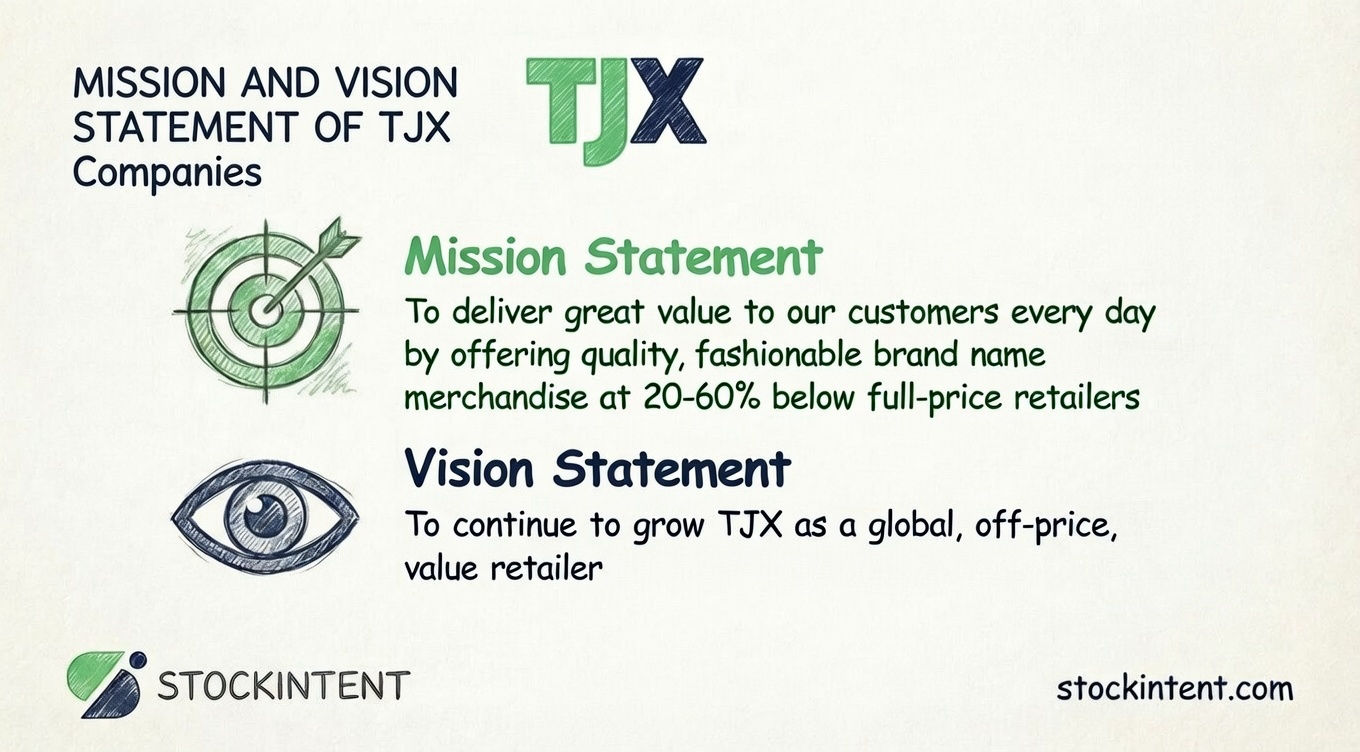
TJX Companies' mission is straightforward and has remained unchanged for 48 years: "to deliver great value to our customers every day." The company executes this by offering a rapidly changing assortment of quality, fashionable, brand name, and designer merchandise at prices generally 20% to 60% below full-price retailers' regular prices. This isn't a tagline slapped on a website, it's the operational engine that has generated $4.9 billion in net income and an 11.5% pretax profit margin in fiscal 2025.
To understand why TJX Companies's mission statement has remained unchanged for 48 years, we need to look at the business itself. What exactly does this company do, and how has it built a retail empire while competitors have crumbled?
TJX operates four distinct off-price retail segments that all execute the same core mission: delivering brand-name merchandise at 20-60% below full-price retailers.
Marmaxx (U.S.) — The foundation of the empire. This segment includes TJ Maxx and Marshalls, offering apparel, accessories, beauty, jewelry, and home fashions. TJ Maxx targets fashion-conscious bargain hunters, while Marshalls focuses on family-oriented mid-market consumers.
HomeGoods and Homesense — The home fashion specialists. HomeGoods delivers the "treasure hunt" experience for décor and accessories, while Homesense offers larger-scale modern furniture. This segment recently crossed $10 billion in annual sales with 5% comparable sales growth.
Sierra — The outdoor and active play. Positioned to compete with REI and specialty outdoor retailers, Sierra offers active apparel, footwear, and gear at off-price points.
TJX International and Canada — The global expansion engine. Operating across Canada, the U.K., Germany, Austria, and preparing to enter Spain in early 2026.
The company also runs six e-commerce sites, though the physical "treasure hunt" experience remains central to the model.
Here's where the mission meets the balance sheet. In our experience analyzing retail operators, TJX's financial profile stands out for its consistency and scale:
| Metric | Fiscal 2025 | Fiscal 2026 (Q4) | Fiscal 2027 Outlook |
|---|---|---|---|
| Net Sales | $56.4 billion | $17.7 billion (Q4 only) | $62.7-63.3 billion |
| Growth Rate | 4% YoY | 9% YoY (Q4) | 4-5% projected |
| Net Income | ~$4.9 billion | — | — |
| Pretax Margin | 11.5% | — | — |
| Diluted EPS | $4.26 | $1.58 (Q4) | $4.93-5.02 projected |
| Comparable Store Sales | 4% | 4% full year | 2-3% projected |
Sources: TJX Q4 FY2026 Earnings Release, Investing.com Earnings Transcript
The company plans to add 146 net new stores in fiscal 2027, bringing the total to over 5,300 locations. Long-term, management targets 7,000 stores globally — a 30%+ expansion from current levels.
TJX isn't just surviving retail's apocalypse; it's capturing market share from dying competitors. While department stores struggle with relevance and traffic erosion, TJX's off-price model has proven resilient across economic cycles and consumer segments.
The company's flexible buying strategy — opportunistically purchasing excess inventory from brands and manufacturers — creates a structural advantage that full-price retailers cannot replicate. This isn't simply discounting; it's a different business model entirely. When we've compared gross margins across retail subsectors, TJX's ability to maintain 11.5% pretax margins while offering 20-60% discounts demonstrates world-class operational efficiency.
Key competitive strengths:
Analysts consistently rate TJX a "Strong Buy" with 4.75/5 consensus from 20+ covering firms. The company has beaten earnings estimates 100% of the time over the past two years, with 8 upward EPS revisions in the last quarter alone.
TJX Companies isn't a typical retailer. It's a global off-price value machine with 5,300+ stores, $56+ billion in annual sales, and a 48-year track record of executing a single, unchanging mission. For investors evaluating whether this mission translates into durable competitive advantage, the numbers suggest it does. The combination of scale, vendor relationships, operational flexibility, and consistent execution has created a retail operator that grows through both expansion and market share capture from struggling competitors.
"Our mission is to deliver great value to our customers every day. We do this by offering a rapidly changing assortment of quality, fashionable, brand name, and designer merchandise at prices generally 20% to 60% below full-price retailers' regular prices on comparable merchandise."
This statement has remained unchanged for 48 years; a remarkable streak of strategic constancy in an industry that has otherwise been reshaped by e-commerce, shifting consumer preferences, and economic cycles.
💡 Expert Tip: When evaluating a retailer's mission, check if it includes measurable commitments. TJX's specific 20-60% discount range isn't marketing fluff; it's embedded in buyer compensation structures, inventory decisions, and store-level KPIs. This kind of quantifiable anchoring separates durable mission statements from vague corporate aspirations.
TJX's mission reveals three non-negotiable priorities that have guided capital allocation for nearly half a century:
This mission directly shapes how TJX deploys capital. Rather than investing heavily in e-commerce infrastructure or loyalty programs like competitors, the company channels resources into store expansion, global buying offices, and the vendor relationships that secure opportunistic inventory. The mission justifies the "treasure hunt" format that would frustrate shoppers expecting predictable availability.
The mission isn't detached from operations; it's the operating manual. TJX's flexible buying strategy, opportunistic sourcing model, and store expansion playbook all flow from this single commitment. When management targets 7,000 stores globally, they're not chasing growth for its own sake; they're expanding the physical footprint through which "great value" gets delivered. The 11.5% pretax margin achieved in fiscal 2025 demonstrates that this mission-driven model generates returns sufficient to fund its own expansion.
For investors evaluating whether a mission statement creates durable advantage, TJX offers a compelling case study. A mission that has survived nearly five decades, directly dictates capital allocation, and remains deeply understood by 75% of employees isn't corporate wallpaper. It's a strategic instrument that has helped build one of retail's most resilient franchises.
TJX doesn't just talk about delivering value; they've built an operational framework to execute it. The mission translates into four strategic pillars that shape everything from buyer incentives to store expansion. Each pillar connects directly to competitive advantages that matter for investors.
In our experience analyzing mission-driven companies, the ones that outperform typically have this kind of structural decomposition. A mission without pillars is corporate wallpaper. A mission with pillars you can trace to financial outcomes is a moat detection system.
What it is: The operational core of TJX's mission is offering brand-name merchandise at 20% to 60% below full-price retailers' regular prices on comparable items.[2] This isn't marketing language; it's embedded in buyer compensation structures, inventory selection criteria, and store-level KPI tracking.
Why it matters strategically: The specific discount range creates measurable accountability. When TJX reports fiscal 2025 net income of approximately $4.9 billion and an 11.5% pretax profit margin,[1] it's proof that deep discounting and profitability aren't mutually exclusive. The margin demonstrates world-class buying power; competitors offering similar discounts typically can't match TJX's profitability.
Concrete example: The company's flexible, opportunistic buying model allows it to purchase excess inventory from brands at distressed prices, then pass savings to customers while preserving margin. This is fundamentally different from promotional discounting; it's a sourcing advantage competitors struggle to replicate.[3]
What it is: TJX's mission extends internally through a workplace culture built on honesty, integrity, and treating each other with dignity and respect—values that have remained unchanged alongside the mission itself.[4]
Why it matters strategically: Employee alignment reduces turnover costs and preserves institutional knowledge in executing the complex off-price model. 75% of TJX associates report that the company's mission, vision, and values motivate them, with 20% citing the mission specifically as their primary reason for staying.[2] In retail, where turnover bleeds margins, this is a genuine competitive advantage.
Concrete example: The company's Global Code of Conduct operationalizes these values across hiring, vendor relations, and daily operations—with open-door philosophies and talent development programs designed to build careers, not just fill shifts.[4]
What it is: TJX has anchored specific sustainability targets to its mission, including a 55% absolute reduction in greenhouse gas emissions from operations by fiscal 2030 and diverting 85% of global operational waste from landfill.[1]
Why it matters strategically: Sourcing renewable energy and optimizing logistics reduces long-term operating costs. More importantly, these commitments signal to vendors that TJX is a stable, long-term partner worth prioritizing in inventory allocation decisions.
Concrete example: The company's environmental initiatives are framed as "smart for business"—not charity contradicted by profit motives.[3] This pragmatic approach prevents the mission drift that can occur when ESG commitments conflict with core operations.
What it is: TJX maintains a Global Social Compliance Program and Vendor Code of Conduct ensuring ethical supply chain operations, human rights respect, and IT risk mitigation.[4]
Why it matters strategically: This is where mission meets moat. TJX's access to quality brand-name inventory at opportunistic prices depends entirely on trust-based vendor relationships. The company's reputation for fair dealing, discretion in handling excess inventory, and consistent payment terms creates a sourcing advantage that new entrants or less scrupulous competitors cannot easily replicate.[1]
Concrete example: When a premium brand needs to move excess inventory without damaging brand perception through visible discounting, TJX's 48-year track record of ethical handling makes it a preferred partner. This access is what enables the 20-60% discount promise in the first place.
| Mission Pillar | Competitive Advantage | Moat Indicator |
|---|---|---|
| Value Delivery (20-60%) | Customer acquisition & retention | 4% comp sales growth in fiscal 2025 |
| Workplace/Associates | Lower turnover, execution consistency | 75% mission-motivated workforce |
| Environmental Responsibility | Vendor prioritization, cost reduction | 55% GHG reduction target by 2030 |
| Responsible Sourcing | Exclusive inventory access | 11.5% pretax margin with deep discounts |
Sources: TJX Corporate Responsibility Report 2025, TJX Investor Success Factors
For investors using platforms like StockIntent to evaluate competitive positioning, TJX's mission pillars provide clear metrics to track: employee engagement scores, sustainability progress, vendor relationship stability, and margin maintenance during economic cycles. These aren't soft intangibles; they're operational indicators of moat durability.
"To continue to grow TJX as a global, off-price, value retailer."
This vision statement sits alongside TJX's 48-year-old mission, providing directional clarity without corporate buzzword bloat. Where many retailers craft elaborate visions about "transforming commerce" or "redefining experiences," TJX keeps it grounded. The vision is essentially a commitment to do more of what's already working, but bigger and across more geographies.
In our experience analyzing retail strategies, this kind of restrained ambition often signals management discipline. Companies that chase trendy visions ("we're becoming a tech platform," "we're building an ecosystem") frequently destroy shareholder value pivoting away from core competencies. TJX's vision explicitly rejects that temptation.
The vision breaks down into three concrete strategic imperatives that leadership has repeatedly articulated:
Geographic Expansion to 7,000 Stores
TJX currently operates approximately 5,300 locations. The 7,000-store target represents roughly 30% growth, with specific segment allocations that reveal strategic priorities:TJX Investor Success Factors
| Segment | Current Stores | Target Stores | Growth Opportunity |
|---|---|---|---|
| TJ Maxx/Marshalls (U.S.) | ~2,400 | 3,000 | Rural/small-format expansion |
| HomeGoods/Homesense (U.S.) | ~1,000 | 1,800 | Home category dominance |
| Sierra (U.S.) | ~200 | 325 | Outdoor/active growth |
| TJX Canada | ~500 | 650 | Market penetration |
| TJX International | ~1,000 | 1,225 | Spain entry (early 2026) |
The company plans 146 net new stores in fiscal 2027, a measured pace that prioritizes site quality over speed.
International Market Development
TJX's vision explicitly includes global growth beyond its North American foundation. The Spain entry in early 2026 marks the tenth country, following successful expansions into Germany and Austria. The company has also formed strategic partnerships through a 2024 joint venture with Grupo Axo in Mexico and a minority investment in Brands for Less in the Middle East, creating optionality without full capital commitment.
Maintaining the Off-Price Model Integrity
Perhaps most importantly, the vision specifies how TJX will grow: as an "off-price, value retailer." This isn't growth at any cost. It's growth within a proven model. The company has rejected opportunities to expand into full-price retail or dramatically alter its treasure-hunt format, even as e-commerce competitors have pressured traditional retail.
TJX's vision positions the company to capitalize on several macro trends reshaping apparel retail in 2026:
The Value-Seeking Consumer Shift
Post-inflation consumer behavior has stuck. Even high-income shoppers now actively seek value, a behavioral shift that plays directly to TJX's strengths. The company's ability to attract "high-income discount shoppers" across all income brackets reflects a broadening addressable market that supports the 7,000-store ambition.Times-News Market Analysis
Department Store Collapse
Traditional department stores continue hemorrhaging market share. TJX's vision explicitly targets this whitespace, capturing traffic and spending that once flowed to Macy's, Nordstrom, and similar full-price competitors. The off-price model has proven resilient where department stores have not, making TJX's growth trajectory contrarian but rational.
Physical Retail Renaissance
After years of "retail apocalypse" narratives, 2026 is seeing selective investment in physical retail. TJX's vision aligns with this shift, emphasizing store expansion while maintaining e-commerce as a secondary channel. The Manhattan flagship reopening signals management's conviction that physical presence, executed correctly, remains a competitive weapon.
Supply Chain Opportunism
The vision's focus on "off-price" growth assumes continued access to excess inventory from brands and manufacturers. In an era of supply chain volatility and demand forecasting challenges, this inventory source has actually expanded. TJX's global buying offices and vendor relationships, built over decades, create sourcing advantages that support both the mission (value delivery) and the vision (global scale).
For investors evaluating whether TJX's vision translates into durable returns, the alignment between stated ambitions and industry tailwinds is notable. The company isn't betting on a retail transformation; it's betting that its existing model will capture share from failing competitors while expanding geographically. It's a vision built on execution excellence rather than strategic reinvention, which, in our experience, tends to be the more reliable kind.
TJX's vision to "continue to grow TJX as a global, off-price, value retailer" breaks down into three interconnected strategic themes that guide capital allocation and operational priorities. These aren't abstract aspirations; they're observable in quarterly earnings calls, investor presentations, and the specific metrics management tracks.
The most concrete expression of TJX's vision is the 7,000-store target, representing roughly 30% growth from current levels.TJX Investor Success Factors This isn't growth for growth's sake; it's disciplined expansion into markets where the off-price model has proven transferable.
Management has articulated specific segment-level targets that reveal strategic priorities:
| Segment | Current Stores | Target Stores | Strategic Rationale |
|---|---|---|---|
| TJ Maxx/Marshalls (U.S.) | ~2,400 | 3,000 | Rural and small-format penetration |
| HomeGoods/Homesense (U.S.) | ~1,000 | 1,800 | Home category dominance |
| Sierra (U.S.) | ~200 | 325 | Outdoor/active lifestyle capture |
| TJX Canada | ~500 | 650 | Market depth in proven region |
| TJX International | ~1,000 | 1,225 | Spain entry (early 2026), European expansion |
The company plans 146 net new stores in fiscal 2027, a measured pace that prioritizes site quality and format optimization over speed. This includes the Manhattan flagship reopening, signaling conviction that physical retail, executed correctly, remains a competitive weapon even in 2026.
TJX's vision explicitly encompasses global growth beyond its North American foundation. The Spain entry in early 2026 marks the tenth country, following successful expansions into Germany and Austria.
Rather than pursuing wholly-owned expansion everywhere, TJX has adopted a capital-efficient partnership strategy:
These partnerships allow TJX to export operational expertise while limiting downside risk, a approach that aligns with the vision's emphasis on "global" growth without specifying the ownership structure required to achieve it.
Perhaps most importantly, the vision specifies how TJX will grow: as an "off-price, value retailer." This is growth within constraints. The company has rejected opportunities to expand into full-price retail or dramatically alter its treasure-hunt format, even as e-commerce competitors have pressured traditional retail.Colliers Industry Analysis
This theme manifests in several observable commitments:
Analysts note that this execution-focused approach carries both strengths and risks. The fiscal 2026 results — 9% net sales growth to $17.74 billion and 28% diluted EPS growth to $1.58 — validate the model's resilience. However, some analysts caution that the aggressive expansion raises "stakes around execution risk, store productivity, and the cost of growth at a time when expectations are already high."Sahm Capital Analysis
The vision themes directly shape how TJX deploys shareholder capital. In fiscal 2027, the company plans to:
This allocation — returning substantial cash to shareholders while funding measured expansion — reflects management's confidence that the off-price model generates sufficient returns to fund its own growth without external financing. The 13% dividend increase and new buyback authorization announced in Q4 2026 demonstrate that vision execution and shareholder returns aren't treated as competing priorities.
For investors using platforms like StockIntent to evaluate retail operators, TJX's vision themes provide clear metrics to track: store opening cadence by segment, international revenue contribution, comparable store sales trends in new markets, and pretax margin maintenance during expansion phases. These operational indicators matter more than aspirational language when assessing whether a vision statement translates into durable competitive advantage.
A mission statement is only as durable as the values that support it. TJX's 48-year mission has survived because it's anchored in core principles that shape hiring, vendor relationships, and daily operations. For investors evaluating management quality, understanding these values, and whether they're genuinely practiced, offers insight into the sustainability of TJX's competitive advantages.
TJX Companies officially articulates its core values as honesty, integrity, and treating each other with dignity and respectTJX Global Code of Conduct. These aren't recent additions or consultant-crafted language; they've remained unchanged alongside the mission itself. The company operationalizes them through a Global Code of Conduct that applies universally across hiring, customer interactions, vendor negotiations, and internal decision-making.
At TJX, honesty translates into transparent business practices and straightforward communication with all stakeholders. This value underpins the company's vendor relationships, which are essential to the off-price model. When a premium brand needs to move excess inventory without damaging its full-price positioning, TJX's reputation for honest dealing, discreet handling, and consistent payment terms makes it a preferred partnerTJX Corporate Responsibility.
The practical impact: TJX gets first look at inventory that competitors can't access. The company doesn't hide behind complex fee structures or surprise chargebacks. Vendors know what to expect, and that reliability, built over decades, creates sourcing advantages that directly enable the 20-60% discount promiseTJX Investor Success Factors.
Integrity at TJX manifests as ethical consistency across business cycles and geographies. The company maintains a Global Social Compliance Program and Vendor Code of Conduct ensuring human rights respect, fair labor practices, and IT risk mitigation throughout its supply chain. This isn't altruism divorced from strategy; it's operational hygiene that protects the brand relationships TJX depends on.
🎯 Pro Insight: In retail, vendor relationships are often the moat nobody talks about. TJX's 48-year track record of integrity in handling excess inventory, particularly from premium brands that guard their image jealously, creates a sourcing advantage that can't be replicated through better technology or lower prices. We've seen competitors with similar discount structures fail because they couldn't secure consistent access to quality inventory.
When management discusses the 7,000-store expansion target, integrity in execution matters enormously. Each new market requires building vendor networks from scratch, and the company's reputation precedes it. TJX's expansion into Spain in early 2026, its tenth country, relies on vendors trusting that TJX will handle their inventory with the same discretion shown in the U.S. for nearly 50 yearsTJX Company Background.
TJX's third core value, treating each other with dignity and respect, shapes its workplace culture and talent retention. The numbers here are notable: 75% of TJX associates report that the company's mission, vision, and values motivate them, with 20% specifically citing the mission as their primary reason for stayingComparably Employee Survey.
In retail, where turnover drains margins and destroys institutional knowledge, this alignment matters for returns. The company fosters inclusive workplaces with participatory decision-making, open-door policies, and talent development programs designed to build careers rather than fill shiftsTJX Early Careers. Management emphasizes diversity and inclusion metrics, with specific representation targets throughout the talent pipelineTJX Inclusion Diversity.
Evaluating whether stated values translate into actual behavior requires looking at both commitments and outcomes.
Evidence of alignment:
Potential gaps to monitor:
In our experience analyzing mission-driven retailers, the most reliable indicator of value authenticity isn't perfection; it's consistency over time across multiple stakeholder groups. TJX's core values have remained stable for 48 years, suggesting they reflect genuine organizational identity rather than reactive positioning.
TJX's environmental, social, and governance commitments function as an extension of its stated core values rather than a separate corporate initiative. The 2025 Global Corporate Responsibility Report anchors specific, measurable targets to the value framework:
| Commitment Area | Target | Fiscal 2025 Progress |
|---|---|---|
| Greenhouse Gas Emissions | 55% absolute reduction from operations by 2030 | On track toward interim targets |
| Waste Diversion | 85% of global operational waste from landfill | 80% achieved |
| Renewable Energy | Net zero GHG emissions in company operations | Sourcing expanded |
| Diversity & Inclusion | Increased representation throughout talent pipeline | Progress reported by segment |
Source: TJX 2025 Global Corporate Responsibility Report
These targets aren't framed as philanthropy or marketing. TJX explicitly describes environmental initiatives as "smart for business" — positioning sustainability as operational efficiency rather than charity contradicted by profit motivesTJX CEO Message. The 55% GHG reduction target, for example, correlates with logistics optimization that reduces fuel costs and warehouse energy expenses.
Governance standards include the Global Social Compliance Program, IT risk management protocols, and board-level oversight of corporate responsibility metrics. The company's Code of Conduct extends to all associates worldwide, with specific provisions for anti-corruption, conflicts of interest, and confidential information protection.
For value investors evaluating TJX, the integration of ESG into core values rather than treating it as a separate silo suggests management sophistication. The company recognizes that long-term vendor relationships, employee retention, and operational efficiency all depend on stakeholder trust. Whether TJX's 7,000-store ambition can be achieved while maintaining these commitments will be a key variable to watch in coming years.
If you're tracking sustainability metrics and governance quality across your portfolio, platforms like StockIntent can help screen for companies with consistent ESG execution alongside strong fundamentals.
TJX Companies has built something rare in retail: a strategic identity where mission, vision, and core values reinforce each other rather than existing as separate corporate documents. The 48-year-old mission to "deliver great value to our customers every day" isn't marketing wallpaper; it's the operational engine that generated $4.9 billion in net income and an 11.5% pretax margin in fiscal 2025. The vision to grow as a "global, off-price, value retailer" provides directional clarity without strategic drift. And the core values of honesty, integrity, and dignity create the trust-based vendor relationships that make the entire model possible.
🎯 Pro Insight: When we evaluate retailers for long-term compounding potential, we look for exactly this alignment. TJX's mission has survived five decades because it directly dictates capital allocation: store expansion over e-commerce infrastructure, opportunistic buying over vertical integration, physical treasure hunts over predictable availability. A mission that shapes actual spending decisions is a mission that creates durable advantage.
For investors evaluating whether this strategic identity translates into competitive positioning, the evidence is compelling:
Management Quality Signals: Analysts rate TJX a "Strong Buy" with 4.75/5 consensus from 20+ covering firms. The company has beaten earnings estimates 100% of the time over the past two years, with 8 upward EPS revisions in the last quarter alone. This consistency reflects management discipline in executing a well-understood model rather than chasing trends.
Competitive Positioning: TJX isn't just surviving retail's transformation; it's capturing market share from dying competitors. While department stores struggle with relevance and traffic erosion, TJX's off-price model has proven resilient across economic cycles. The company's access to quality brand-name inventory at 20-60% discounts, built on 48 years of vendor trust, creates a sourcing moat that new entrants cannot replicate.
Long-Term Compounding Potential: The 7,000-store target represents roughly 30% growth from current levels, with measured expansion into Spain (early 2026) and partnerships in Mexico and the Middle East testing geographic optionality. The company funds this growth while returning substantial capital to shareholders: a 13% dividend increase and $2.5-2.75 billion buyback program announced in February 2026 demonstrate that expansion and returns aren't treated as competing priorities.
In our experience tracking mission-driven retailers, the ones that compound over decades share TJX's characteristics: a quantifiable value proposition embedded in operations, employee alignment that reduces turnover costs, and vendor relationships that create sourcing advantages. The 75% of associates who report that TJX's mission motivates them, and the 20% who cite it as their primary reason for staying, aren't soft metrics; they're indicators of execution consistency that shows up in financial results.
Looking ahead to 2026 and beyond, TJX's mission-vision-values framework positions it to capture several industry tailwinds: the persistent value-seeking behavior of post-inflation consumers, the continued collapse of department store competitors, and the supply chain volatility that creates opportunistic inventory access. The company isn't betting on retail transformation; it's betting that disciplined execution of a proven model will capture share from failing competitors while expanding geographically.
For investors seeking exposure to resilient retail with durable competitive advantages, TJX offers a case study in strategic consistency. The mission has remained unchanged for 48 years not because of inertia, but because it works. If you're evaluating whether this quality compounds in your portfolio, platforms like StockIntent can help you screen for similar mission-driven operators with strong fundamentals and consistent execution.
Start your 7-day free trial and find quality compounders faster.
— StockIntent Score ╌ S&P 500