
Mar 24, 2026
Uber Technologies (UBER) has become a fixture in global transportation over the past decade and a half. What began as a sleek app for booking black car rides in 2010 has expanded into a sprawling multi-vertical platform spanning rideshare, food delivery, freight logistics, and even advertising. For investors, understanding how a company defines its purpose, where it's headed, and what values guide day-to-day decisions is fundamental to evaluating long-term durability. These elements shape capital allocation, competitive positioning, and how management navigates disruption. Uber's official investor relations materials provide the clearest window into this strategic identity.
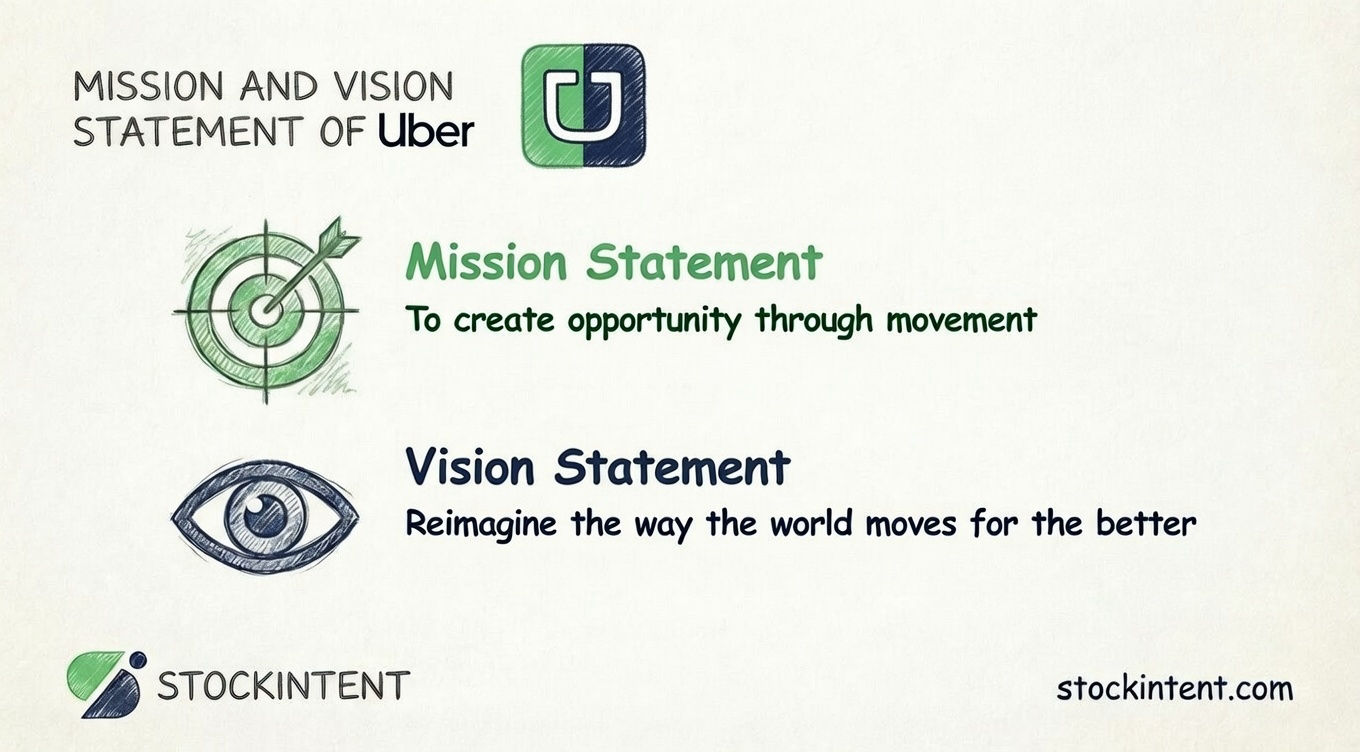
So here's the quick version: Uber's mission is to "create opportunity through movement," its vision aims to "reimagine the way the world moves for the better," and eight core values, from "Trip obsessed" to "Do the right thing," anchor its culture and decision-making.
Uber Technologies has transformed from a simple ride-hailing app into a sprawling technology platform that touches nearly every aspect of urban logistics. Founded in 2010 by Garrett Camp and Travis Kalanick, the company started with a straightforward premise: what if you could summon a black car with a tap on your phone? That kernel of an idea has since ballooned into a $196 billion market cap operation spanning 10,000+ cities worldwide.
In our experience analyzing platform businesses, Uber's evolution offers a masterclass in network effects and strategic expansion. The company now operates four distinct business segments, each with its own growth trajectory and margin profile:
| Segment | Description | 2025 Performance Highlights |
|---|---|---|
| Mobility | Ride-sharing, micromobility (scooters/bikes), and public transit integrations | Core profit engine with stable take rates; 3.5 billion quarterly trips (up 22% YoY) |
| Delivery | Uber Eats for food, grocery, and retail delivery | 46 million Uber One subscribers driving 40% of bookings; trailing DoorDash in U.S. but leading globally |
| Freight | Digital brokerage connecting shippers with carriers | Expanding logistics footprint with technology-enabled matching |
| Advertising | Targeted ads across Uber's app ecosystem | Exceeded $2 billion in annualized revenue; high-margin growth driver |
Beyond these core segments, Uber has built a robust subscription business through Uber One, which now boasts 46 million members and accounts for 40% of total bookings. The company also serves over 200,000 businesses through Uber for Business, providing enterprise tools for corporate travel and employee meal programs.
The financial picture in early 2026 reflects this diversification strategy paying dividends. Uber achieved structural profitability in 2025, with management focusing heavily on free cash flow generation. The advertising segment's march past $2 billion in annualized revenue represents a particularly attractive development for investors, as ad revenue carries significantly higher margins than the core mobility business. Cross-platform users, those who engage with both mobility and delivery, spend roughly 3x more than single-product users, reinforcing the strategic logic behind Uber's super-app ambitions.
From a competitive standpoint, Uber sits in an unusual position within the software-application landscape. It dominates global ride-hailing and holds the top spot in worldwide food delivery, yet trails DoorDash in the crucial U.S. market. This geographic and segment diversification creates resilience, but also complexity. The company's push into autonomous vehicles, through partnerships with Waymo, Waabi, and others, represents both a potential threat to its driver-dependent model and an enormous opportunity to capture a multi-trillion-dollar market.
For investors evaluating Uber's mission-driven strategy, the numbers tell a compelling story of execution. The platform facilitated 3.5 billion trips in Q3 2025 alone, with gross bookings hitting $49.7 billion (up 21% year-over-year). Yet the investment case ultimately hinges on whether Uber can maintain its network effects moat while navigating the transition toward autonomous, electric, and increasingly regulated urban mobility.
Uber's current mission statement, as confirmed in the company's official investor relations communications, is straightforward yet deliberately broad:
"To create opportunity through movement."
This phrasing has evolved from earlier formulations. Some sources reference previous versions like "ignite opportunity by setting the world in motion" or the more aspirational "reimagine the way the world moves for the better." The 2026 iteration, however, reflects a maturing company that has moved beyond pure ride-hailing into a multi-vertical platform spanning mobility, delivery, freight, and advertising.
🎯 Pro Insight: When evaluating mission statements as an investor, pay attention to verb choice. "Create" signals active value generation rather than passive facilitation. Uber's shift from "ignite" to "create" reflects a company that no longer needs to spark demand; it's now focused on systematically building economic infrastructure. This linguistic evolution typically accompanies companies transitioning from growth phase to profitability phase, which aligns with Uber's 2025 achievement of structural profitability.
The strategic importance of this mission becomes clear when you examine how it guides capital allocation. The emphasis on "opportunity" justifies investments that don't immediately generate returns, like the $800 million Green Future program helping drivers transition to electric vehicles, or partnerships with Waymo and Waabi for autonomous vehicle deployment. These bets on driverless technology could eventually eliminate Uber's largest variable cost, human drivers, while the "movement" component keeps the company anchored to its core competency: coordinating physical logistics at scale.
The mission also signals priorities to investors watching competitive positioning. Unlike pure software plays, Uber's mission commits it to real-world operations with all their messy complexity, regulatory exposure, and capital intensity. This isn't a bug; it's the moat. Competitors like DoorDash may beat Uber in specific markets or verticals, but few can match the cross-platform network effects that come from genuinely believing your purpose is to move people, food, and freight through the same coordinated infrastructure.
Uber's mission to "create opportunity through movement" isn't just marketing copy. In our experience analyzing platform businesses, it breaks down into three interconnected pillars that drive capital allocation and competitive positioning. Each pillar translates directly into economic moat sources that matter for long-term investors.
This pillar focuses on creating flexible earning opportunities for drivers, couriers, and merchants through technology-enabled gig work. It's the foundation of Uber's two-sided marketplace model.
Why it matters strategically: Without supply-side liquidity, Uber's platform collapses. By positioning itself as an opportunity engine rather than merely a ride dispatcher, Uber attracts and retains the 7+ million drivers and couriers who power its network. The Uber Pro rewards program gamifies loyalty with benefits like tuition coverage and priority trip requests, directly addressing driver churn, which historically averaged 50%+ annually in the gig economy.
Concrete example: In 2024, driver and courier earnings on the platform surpassed prior benchmarks, with Q3 2025 showing 3.5 billion trips (up 22% year-over-year). The Uber One subscription program now claims 46 million members, driving 40% of total bookings and boosting cross-platform retention by 35%. These aren't vanity metrics; they demonstrate that opportunity creation translates directly into supply retention and customer lifetime value.
Investor takeaway: This pillar builds switching costs on both sides of the marketplace. Drivers with earned benefits and ratings history face real friction leaving for competitors. Riders with subscription perks and stored preferences similarly face inertia. That's classic network effects moat construction.
This operational pillar emphasizes reliable, on-demand movement of people, food, and goods through coordinated technology infrastructure.
Why it matters strategically: Uber's bet is that coordinating physical logistics at scale creates defensible data advantages and operational expertise that pure software competitors cannot easily replicate. The complexity of matching supply and demand across 10,000+ cities in real-time, while optimizing for ETAs, pricing, and route efficiency, represents genuine technical moat.
Concrete example: The platform has facilitated over 25 billion lifetime trips with $150+ billion in 2024 gross bookings. More telling for investors: cross-platform users, those engaging with both mobility and delivery, spend roughly 3x more than single-product users. This validates the "super-app" strategy and justifies the infrastructure investments that enable it.
The company's push into autonomous vehicles through partnerships with Waymo, Waabi, and others represents the ultimate expression of this pillar. CEO Dara Khosrowshahi has called AVs a "multi-trillion-dollar market opportunity," with Uber planning to expand robotaxi services to more than 10 global markets by year-end 2026.
Investor takeaway: This pillar creates economies of scale in data and technology that compound over time. Every trip improves routing algorithms; every delivery refines demand prediction. Competitors can copy the app interface; they cannot easily replicate 15 years of operational data and learned expertise.
The final pillar addresses friction reduction, inclusive access, and environmental responsibility in urban transportation.
Why it matters strategically: This pillar serves dual purposes. Internally, it guides product development priorities and capital allocation toward long-term platform sustainability. Externally, it provides regulatory and social license to operate in an industry facing intense scrutiny around labor practices, congestion, and emissions.
Concrete example: Uber's sustainability commitments include a fully electric, zero-emission platform by 2040, with 100% zero-emission rides in London and Amsterdam by end of 2025. The $800 million Green Future program supports hundreds of thousands of drivers transitioning to EVs. These aren't just ESG checkboxes; they anticipate regulatory pressure and position Uber favorably for carbon-pricing regimes.
On the accessibility front, Uber Health provides non-emergency medical transportation, while the Global Safety Management System (a four-pillar framework) addresses liability and brand risk. The advertising segment, now exceeding $2 billion in annualized revenue, leverages the seamless user experience to insert high-margin monetization without disrupting core utility.
Investor takeaway: This pillar builds regulatory and social moat. Companies perceived as solving urban congestion and emissions problems face less political risk and may capture preferential treatment in city partnerships. The sustainability investments also create optionality in a carbon-constrained future.
In our experience tracking platform businesses through multiple cycles, Uber's three-pillar mission architecture stands out for its coherence. Each pillar reinforces the others: opportunity attracts supply, motion coordinates demand, and sustainability secures license to operate. For investors evaluating whether Uber's $196 billion market cap reflects durable advantage or temporary scale, this framework offers a useful lens. The mission isn't just what Uber says; it's how management allocates capital and measures success. And in 2026, that alignment appears stronger than at any point in the company's history.
Uber's official vision statement, as confirmed across company communications and investor materials, frames its long-term ambition:
"We reimagine the way the world moves for the better."
This vision deliberately extends beyond the company's current operations to describe the future Uber is actively constructing. Where the mission focuses on immediate value creation, the vision articulates a transformed transportation ecosystem, one that is seamless, accessible, and sustainable by design.
Uber's leadership has translated this vision into concrete, time-bound objectives that reveal where capital and attention are flowing:
| Strategic Goal | Target Timeline | Investor Relevance |
|---|---|---|
| Fully electric, zero-emission platform | 2040 | Positions Uber favorably for carbon-pricing regimes and urban access restrictions |
| 100% zero-emission rides in London and Amsterdam | End of 2025 | Proves operational viability in regulated European markets |
| 35-45% reduction in carbon intensity (US/Canada) | Near-term | Demonstrates measurable progress toward sustainability commitments |
| Robotaxi expansion to 10+ global markets | End of 2026 | Multi-trillion-dollar AV opportunity per CEO Dara Khosrowshahi |
| Support hundreds of thousands of drivers transitioning to EVs | Ongoing via $800M Green Future program | Reduces supply-side friction for sustainability transition |
These aren't aspirational platitudes. They're capital allocation priorities with attached budgets and accountability metrics. The robotaxi initiative, in particular, represents the ultimate expression of "reimagining movement"; removing human drivers entirely while scaling coordination technology globally.
Uber's vision positions it as a platform orchestrator riding several macro waves in technology and urban mobility:
Super-app ecosystem enablement: The vision supports Uber's push to become what management calls the "operating system for everyday life." With 46 million Uber One subscribers and cross-platform users spending 3x more than single-product users, the company is building the network effects that make this ambition economically viable.
Mobility-as-a-Service (MaaS): Rather than owning vehicles, Uber coordinates access. This asset-light, data-heavy model aligns perfectly with software-application economics where scale drives marginal cost toward zero. The vision explicitly rejects the ownership model in favor of seamless access.
Sustainability-driven technology: The 2040 zero-emission target isn't merely ESG positioning. It anticipates regulatory pressure in major urban markets where congestion pricing and emission zones are expanding. Cities like London already penalize non-electric vehicles; Uber's vision ensures it remains compliant and competitive.
Autonomous and AI integration: The robotaxi expansion directly addresses what CEO Khosrowshahi has identified as a multi-trillion-dollar market opportunity. By 2026, Uber plans to operate in 15 AV markets, up from seven currently, using its existing demand density and marketplace technology as competitive moats.
For investors evaluating Uber's $196 billion market cap, the vision statement provides a critical lens. It explains why the company invests in seemingly peripheral initiatives, from EV transition programs to autonomous vehicle partnerships, that don't immediately boost quarterly earnings. The vision frames these as essential infrastructure for the transportation ecosystem Uber is building, not optional side bets. Whether that ecosystem justifies the current valuation depends on execution against these ambitious timelines.
Uber's vision to "reimagine the way the world moves for the better" breaks down into three interconnected strategic themes. Each theme shapes capital allocation, guides product development, and creates observable competitive positioning that investors can track. Here's how they show up in practice.
Uber is betting that self-driving technology will fundamentally reshape transportation economics. CEO Dara Khosrowshahi has called autonomous vehicles a "multi-trillion-dollar market opportunity," and the company is putting capital behind that conviction.
Strategic moves you can see:
Why this matters for investors: AVs could eliminate Uber's largest variable cost, driver payouts, while preserving its network effects advantage. The company isn't building its own self-driving stack from scratch; it's partnering with specialists while contributing its unmatched demand density and marketplace technology. That's capital-efficient optionality.
Uber wants to be the "operating system for everyday life," not just a ride-hailing app. This theme explains why the company keeps pushing into adjacent services even when individual margins look thin.
Strategic moves you can see:
Why this matters for investors: Network effects compound across products. A user who orders Uber Eats today is more likely to book a ride tomorrow. The subscription model locks in recurring revenue and reduces price sensitivity. High-margin advertising monetizes attention without adding operational complexity. This is classic platform economics at work.
Uber's 2040 zero-emission target isn't ESG window dressing. It's a strategic hedge against regulatory pressure in major urban markets where congestion pricing and emission zones are expanding.
Strategic moves you can see:
Why this matters for investors: Cities like London already penalize non-electric vehicles. Uber's sustainability investments ensure continued market access as regulations tighten. The company also captures goodwill with regulators and urban planners, potentially securing preferential treatment in competitive licensing processes. This is regulatory moat construction disguised as environmental responsibility.
These three themes aren't independent bets; they reinforce each other. Autonomous vehicles reduce per-trip costs and enable 24/7 service availability. Platform density attracts more users, which generates more data to train AI systems. Sustainability commitments secure urban access that competitors may lose. Together, they support Uber's push toward what management calls a "barbell strategy"—growing both low-end and high-end service offerings simultaneously.
The financial results suggest this framework is working. Q3 2025 showed 3.5 billion trips (up 22% year-over-year) and $49.7 billion in gross bookings (up 21%). The company achieved structural profitability in 2025, with free cash flow generation now a stated management priority. For investors evaluating whether Uber's $196 billion market cap reflects durable advantage, these vision themes provide a concrete lens for tracking execution.
Uber's eight core values, as listed on its official careers page, serve as the cultural backbone for a company that operates in 10,000+ cities with millions of drivers, couriers, and merchants. These aren't just wall plaques; they shape hiring decisions, product roadmaps, and how management allocates capital. For investors, understanding whether stated values translate into durable competitive advantages, or merely corporate theater, is essential for evaluating long-term quality.
💡 Expert Tip: When analyzing company values as an investment signal, look for consistency between what's stated and where management actually deploys capital. Uber's $800 million Green Future program and aggressive autonomous vehicle partnerships align with "Build with heart" and "See the forest and the trees" in ways that are measurable, not merely aspirational. Values without capital allocation backing are just marketing.
This value emphasizes relentless pursuit and bias toward action. At Uber, it translates into a culture that rewards initiative over perfect planning, a necessity when coordinating physical logistics across wildly different regulatory and infrastructure environments. The value shows up in how Uber enters new markets, often launching before regulatory frameworks are fully settled, then iterating rapidly. For investors, this explains both Uber's growth velocity and its occasional regulatory friction. The 2025 push into 15 autonomous vehicle markets by year-end, up from seven, exemplifies this "figure it out as we go" mentality.
Customer obsession sits at the center of Uber's product development philosophy. This value drives the relentless focus on reducing friction in the user experience, from one-tap booking to real-time ETA accuracy. The payoff shows in the numbers: cross-platform users, those who engage with both mobility and delivery, spend roughly 3x more than single-product users. That 3x multiplier isn't accidental; it's the result of thousands of micro-optimizations guided by a culture that measures success through user outcomes. The advertising segment's growth past $2 billion in annualized revenue also stems from this obsession; ads only work if they don't degrade the core experience.
Empathy in innovation sounds soft, but at Uber it has concrete implications. This value underpins the Uber Pro rewards program, which offers drivers tuition coverage and other benefits designed to reduce the 50%+ annual churn typical in gig work. It also shapes accessibility features like Uber Health for non-emergency medical transportation. For investors, "Build with heart" represents a strategic hedge against supply-side instability. Drivers with earned benefits and ratings history face real friction leaving for competitors, creating switching costs that compound over time.
Safety operates as both a moral imperative and a liability management framework at Uber. The company has invested heavily in its Global Safety Management System, a four-pillar approach covering prevention, incident response, investigation, and transparency. This value gained particular prominence after the company's 2017 cultural crisis, when safety failures and toxic behavior contradicted stated principles and contributed to leadership changes. The current emphasis reflects genuine operational priority; in a business where trust failures can trigger regulatory shutdowns, safety isn't just values-driven, it's survival-driven.
Strategic thinking balanced with operational detail is essential for a company managing both long-term bets like autonomous vehicles and daily execution across four business segments. This value explains how Uber's leadership justifies investments, like the $800 million Green Future program, that don't immediately boost quarterly earnings but position the company for a carbon-constrained future. It also shows up in the "barbell strategy" CEO Dara Khosrowshahi has described, growing both low-end and high-end service offerings simultaneously rather than choosing between volume and margin.
Unity across a sprawling global organization sounds like standard corporate speak, but at Uber it addresses a genuine structural challenge. With mobility, delivery, freight, and advertising operating as distinct segments, siloed thinking could easily fragment the platform's network effects. The "One Uber" value pushes for cross-functional collaboration that enables the super-app strategy. The 46 million Uber One subscribers, who get benefits across all Uber services, represent the financial payoff of this integration; they drive 40% of total bookings and exhibit significantly higher retention than single-product users.
Diversity as a value serves dual purposes at Uber. Internally, it addresses the homogeneity that contributed to the company's 2017 cultural failures. Externally, it supports global expansion by ensuring product teams understand local nuances across 10,000+ cities. For investors, this value connects to competitive moat; a platform designed by people who actually understand Mumbai traffic patterns or São Paulo payment preferences will outperform one designed solely in San Francisco. The value also shows up in hiring practices that prioritize curiosity and collaborative spirit over pure credentials.
Integrity as a capstone value reflects Uber's post-2017 evolution. Under founder Travis Kalanick, the company developed a reputation for aggressive tactics that sometimes crossed ethical lines. The current leadership has explicitly prioritized "Do the right thing" as a cultural reset, with implications for everything from driver treatment to regulatory compliance. For investors, this value is particularly important given Uber's history; it signals management's recognition that sustainable competitive advantage requires social license to operate, not just technological superiority.
Uber's values extend directly into formal environmental, social, and governance commitments that shape long-term strategy. The company's sustainability goals include a fully electric, zero-emission platform by 2040, with 100% zero-emission rides in London and Amsterdam by end of 2025. These aren't peripheral initiatives; they're operationalized through the $800 million Green Future program supporting driver EV transitions and partnerships with cities on sustainable mobility infrastructure.
In our experience analyzing how companies translate values into durable advantage, Uber's ESG integration stands out for its specificity. The targets have dates, budgets, and accountability metrics attached. The 35-45% carbon intensity reduction target for US/Canada operations, for example, is measurable and time-bound in ways that many corporate sustainability commitments aren't. This specificity reflects the "See the forest and the trees" value in action; long-term vision paired with near-term execution milestones.
The social component shows up in the Fund for Sustainable Mobility and programs improving access to nutrition and healthcare through Uber Health. These initiatives align with "Build with heart" and "Create opportunity through movement" while also expanding addressable market. Governance improvements since 2017, including board restructuring and enhanced safety oversight, reflect "Do the right thing" as operational reality rather than aspiration.
For investors evaluating Uber's $196 billion market cap, the values framework offers a lens for assessing execution quality. The eight values aren't equally weighted in practice; "Trip obsessed" and "Go get it" drive near-term performance, while "See the forest and the trees" and "Build with heart" shape long-term positioning. The 65% of employees who find the mission and values motivating, per employee sentiment data, suggests cultural alignment that supports consistent execution. Whether that alignment justifies the current valuation depends on whether Uber can maintain its network effects moat while navigating the transition toward autonomous, electric, and increasingly regulated urban mobility.
Uber's mission, vision, and core values form a coherent strategic identity that has matured significantly since its 2010 founding. From "create opportunity through movement" to "reimagine the way the world moves for the better," the company has evolved from a ride-hailing disruptor into a $196 billion platform orchestrator spanning mobility, delivery, freight, and advertising. The eight core values, from "Trip obsessed" to "Do the right thing," aren't just cultural decoration; they guide capital allocation toward network effects moats, sustainable infrastructure, and autonomous vehicle partnerships that will define the next decade.
💡 Expert Tip: When analyzing mission-driven companies, track the ratio of aspirational language to measurable execution. Uber's 2026 disclosure of specific targets, like 15 robotaxi markets by year-end and 100% zero-emission rides in London and Amsterdam, suggests management is translating vision into accountable milestones. Watch for companies that attach dates and budgets to their mission pillars; that's where values become competitive positioning.
From an investment perspective, this strategic framework matters because it explains where management deploys capital when trade-offs arise. The $800 million Green Future program doesn't boost next quarter's earnings, but it secures urban market access as emissions regulations tighten. The robotaxi expansion, targeting a multi-trillion-dollar opportunity per CEO Dara Khosrowshahi, represents optionality on the largest variable cost elimination in the business model. In our experience analyzing platform companies, Uber's 2025 achievement of structural profitability, combined with its mission-aligned capital allocation, suggests a management team that has moved beyond growth-at-all-costs toward durable competitive advantage construction.
Analysts broadly endorse this execution, with consensus ratings of "Moderate Buy" to "Strong Buy" and no Sell recommendations across major firms. The strategic identity Uber has built, opportunistic yet infrastructure-minded, aggressive yet sustainability-conscious, positions it favorably against both legacy transportation and pure software competitors. Whether that positioning justifies the current valuation depends on execution against ambitious 2026 targets, from AV scaling to advertising margin expansion. For investors seeking to evaluate these fundamentals more deeply, StockIntent offers a 7-day risk-free trial with institutional-grade screening tools to track Uber's progress across these strategic dimensions.
Uber Technologies (UBER) has become a fixture in global transportation over the past decade and a half. What began as a sleek app for booking black car rides in 2010 has expanded into a sprawling multi-vertical platform spanning rideshare, food delivery, freight logistics, and even advertising. For investors, understanding how a company defines its purpose, where it's headed, and what values guide day-to-day decisions is fundamental to evaluating long-term durability. These elements shape capital allocation, competitive positioning, and how management navigates disruption. Uber's official investor relations materials provide the clearest window into this strategic identity.
So here's the quick version: Uber's mission is to "create opportunity through movement," its vision aims to "reimagine the way the world moves for the better," and eight core values, from "Trip obsessed" to "Do the right thing," anchor its culture and decision-making.
Uber Technologies has transformed from a simple ride-hailing app into a sprawling technology platform that touches nearly every aspect of urban logistics. Founded in 2010 by Garrett Camp and Travis Kalanick, the company started with a straightforward premise: what if you could summon a black car with a tap on your phone? That kernel of an idea has since ballooned into a $196 billion market cap operation spanning 10,000+ cities worldwide.
In our experience analyzing platform businesses, Uber's evolution offers a masterclass in network effects and strategic expansion. The company now operates four distinct business segments, each with its own growth trajectory and margin profile:
| Segment | Description | 2025 Performance Highlights |
|---|---|---|
| Mobility | Ride-sharing, micromobility (scooters/bikes), and public transit integrations | Core profit engine with stable take rates; 3.5 billion quarterly trips (up 22% YoY) |
| Delivery | Uber Eats for food, grocery, and retail delivery | 46 million Uber One subscribers driving 40% of bookings; trailing DoorDash in U.S. but leading globally |
| Freight | Digital brokerage connecting shippers with carriers | Expanding logistics footprint with technology-enabled matching |
| Advertising | Targeted ads across Uber's app ecosystem | Exceeded $2 billion in annualized revenue; high-margin growth driver |
Beyond these core segments, Uber has built a robust subscription business through Uber One, which now boasts 46 million members and accounts for 40% of total bookings. The company also serves over 200,000 businesses through Uber for Business, providing enterprise tools for corporate travel and employee meal programs.
The financial picture in early 2026 reflects this diversification strategy paying dividends. Uber achieved structural profitability in 2025, with management focusing heavily on free cash flow generation. The advertising segment's march past $2 billion in annualized revenue represents a particularly attractive development for investors, as ad revenue carries significantly higher margins than the core mobility business. Cross-platform users, those who engage with both mobility and delivery, spend roughly 3x more than single-product users, reinforcing the strategic logic behind Uber's super-app ambitions.
From a competitive standpoint, Uber sits in an unusual position within the software-application landscape. It dominates global ride-hailing and holds the top spot in worldwide food delivery, yet trails DoorDash in the crucial U.S. market. This geographic and segment diversification creates resilience, but also complexity. The company's push into autonomous vehicles, through partnerships with Waymo, Waabi, and others, represents both a potential threat to its driver-dependent model and an enormous opportunity to capture a multi-trillion-dollar market.
For investors evaluating Uber's mission-driven strategy, the numbers tell a compelling story of execution. The platform facilitated 3.5 billion trips in Q3 2025 alone, with gross bookings hitting $49.7 billion (up 21% year-over-year). Yet the investment case ultimately hinges on whether Uber can maintain its network effects moat while navigating the transition toward autonomous, electric, and increasingly regulated urban mobility.
Uber's current mission statement, as confirmed in the company's official investor relations communications, is straightforward yet deliberately broad:
"To create opportunity through movement."
This phrasing has evolved from earlier formulations. Some sources reference previous versions like "ignite opportunity by setting the world in motion" or the more aspirational "reimagine the way the world moves for the better." The 2026 iteration, however, reflects a maturing company that has moved beyond pure ride-hailing into a multi-vertical platform spanning mobility, delivery, freight, and advertising.
🎯 Pro Insight: When evaluating mission statements as an investor, pay attention to verb choice. "Create" signals active value generation rather than passive facilitation. Uber's shift from "ignite" to "create" reflects a company that no longer needs to spark demand; it's now focused on systematically building economic infrastructure. This linguistic evolution typically accompanies companies transitioning from growth phase to profitability phase, which aligns with Uber's 2025 achievement of structural profitability.
The strategic importance of this mission becomes clear when you examine how it guides capital allocation. The emphasis on "opportunity" justifies investments that don't immediately generate returns, like the $800 million Green Future program helping drivers transition to electric vehicles, or partnerships with Waymo and Waabi for autonomous vehicle deployment. These bets on driverless technology could eventually eliminate Uber's largest variable cost, human drivers, while the "movement" component keeps the company anchored to its core competency: coordinating physical logistics at scale.
The mission also signals priorities to investors watching competitive positioning. Unlike pure software plays, Uber's mission commits it to real-world operations with all their messy complexity, regulatory exposure, and capital intensity. This isn't a bug; it's the moat. Competitors like DoorDash may beat Uber in specific markets or verticals, but few can match the cross-platform network effects that come from genuinely believing your purpose is to move people, food, and freight through the same coordinated infrastructure.
Uber's mission to "create opportunity through movement" isn't just marketing copy. In our experience analyzing platform businesses, it breaks down into three interconnected pillars that drive capital allocation and competitive positioning. Each pillar translates directly into economic moat sources that matter for long-term investors.
This pillar focuses on creating flexible earning opportunities for drivers, couriers, and merchants through technology-enabled gig work. It's the foundation of Uber's two-sided marketplace model.
Why it matters strategically: Without supply-side liquidity, Uber's platform collapses. By positioning itself as an opportunity engine rather than merely a ride dispatcher, Uber attracts and retains the 7+ million drivers and couriers who power its network. The Uber Pro rewards program gamifies loyalty with benefits like tuition coverage and priority trip requests, directly addressing driver churn, which historically averaged 50%+ annually in the gig economy.
Concrete example: In 2024, driver and courier earnings on the platform surpassed prior benchmarks, with Q3 2025 showing 3.5 billion trips (up 22% year-over-year). The Uber One subscription program now claims 46 million members, driving 40% of total bookings and boosting cross-platform retention by 35%. These aren't vanity metrics; they demonstrate that opportunity creation translates directly into supply retention and customer lifetime value.
Investor takeaway: This pillar builds switching costs on both sides of the marketplace. Drivers with earned benefits and ratings history face real friction leaving for competitors. Riders with subscription perks and stored preferences similarly face inertia. That's classic network effects moat construction.
This operational pillar emphasizes reliable, on-demand movement of people, food, and goods through coordinated technology infrastructure.
Why it matters strategically: Uber's bet is that coordinating physical logistics at scale creates defensible data advantages and operational expertise that pure software competitors cannot easily replicate. The complexity of matching supply and demand across 10,000+ cities in real-time, while optimizing for ETAs, pricing, and route efficiency, represents genuine technical moat.
Concrete example: The platform has facilitated over 25 billion lifetime trips with $150+ billion in 2024 gross bookings. More telling for investors: cross-platform users, those engaging with both mobility and delivery, spend roughly 3x more than single-product users. This validates the "super-app" strategy and justifies the infrastructure investments that enable it.
The company's push into autonomous vehicles through partnerships with Waymo, Waabi, and others represents the ultimate expression of this pillar. CEO Dara Khosrowshahi has called AVs a "multi-trillion-dollar market opportunity," with Uber planning to expand robotaxi services to more than 10 global markets by year-end 2026.
Investor takeaway: This pillar creates economies of scale in data and technology that compound over time. Every trip improves routing algorithms; every delivery refines demand prediction. Competitors can copy the app interface; they cannot easily replicate 15 years of operational data and learned expertise.
The final pillar addresses friction reduction, inclusive access, and environmental responsibility in urban transportation.
Why it matters strategically: This pillar serves dual purposes. Internally, it guides product development priorities and capital allocation toward long-term platform sustainability. Externally, it provides regulatory and social license to operate in an industry facing intense scrutiny around labor practices, congestion, and emissions.
Concrete example: Uber's sustainability commitments include a fully electric, zero-emission platform by 2040, with 100% zero-emission rides in London and Amsterdam by end of 2025. The $800 million Green Future program supports hundreds of thousands of drivers transitioning to EVs. These aren't just ESG checkboxes; they anticipate regulatory pressure and position Uber favorably for carbon-pricing regimes.
On the accessibility front, Uber Health provides non-emergency medical transportation, while the Global Safety Management System (a four-pillar framework) addresses liability and brand risk. The advertising segment, now exceeding $2 billion in annualized revenue, leverages the seamless user experience to insert high-margin monetization without disrupting core utility.
Investor takeaway: This pillar builds regulatory and social moat. Companies perceived as solving urban congestion and emissions problems face less political risk and may capture preferential treatment in city partnerships. The sustainability investments also create optionality in a carbon-constrained future.
In our experience tracking platform businesses through multiple cycles, Uber's three-pillar mission architecture stands out for its coherence. Each pillar reinforces the others: opportunity attracts supply, motion coordinates demand, and sustainability secures license to operate. For investors evaluating whether Uber's $196 billion market cap reflects durable advantage or temporary scale, this framework offers a useful lens. The mission isn't just what Uber says; it's how management allocates capital and measures success. And in 2026, that alignment appears stronger than at any point in the company's history.
Uber's official vision statement, as confirmed across company communications and investor materials, frames its long-term ambition:
"We reimagine the way the world moves for the better."
This vision deliberately extends beyond the company's current operations to describe the future Uber is actively constructing. Where the mission focuses on immediate value creation, the vision articulates a transformed transportation ecosystem, one that is seamless, accessible, and sustainable by design.
Uber's leadership has translated this vision into concrete, time-bound objectives that reveal where capital and attention are flowing:
| Strategic Goal | Target Timeline | Investor Relevance |
|---|---|---|
| Fully electric, zero-emission platform | 2040 | Positions Uber favorably for carbon-pricing regimes and urban access restrictions |
| 100% zero-emission rides in London and Amsterdam | End of 2025 | Proves operational viability in regulated European markets |
| 35-45% reduction in carbon intensity (US/Canada) | Near-term | Demonstrates measurable progress toward sustainability commitments |
| Robotaxi expansion to 10+ global markets | End of 2026 | Multi-trillion-dollar AV opportunity per CEO Dara Khosrowshahi |
| Support hundreds of thousands of drivers transitioning to EVs | Ongoing via $800M Green Future program | Reduces supply-side friction for sustainability transition |
These aren't aspirational platitudes. They're capital allocation priorities with attached budgets and accountability metrics. The robotaxi initiative, in particular, represents the ultimate expression of "reimagining movement"; removing human drivers entirely while scaling coordination technology globally.
Uber's vision positions it as a platform orchestrator riding several macro waves in technology and urban mobility:
Super-app ecosystem enablement: The vision supports Uber's push to become what management calls the "operating system for everyday life." With 46 million Uber One subscribers and cross-platform users spending 3x more than single-product users, the company is building the network effects that make this ambition economically viable.
Mobility-as-a-Service (MaaS): Rather than owning vehicles, Uber coordinates access. This asset-light, data-heavy model aligns perfectly with software-application economics where scale drives marginal cost toward zero. The vision explicitly rejects the ownership model in favor of seamless access.
Sustainability-driven technology: The 2040 zero-emission target isn't merely ESG positioning. It anticipates regulatory pressure in major urban markets where congestion pricing and emission zones are expanding. Cities like London already penalize non-electric vehicles; Uber's vision ensures it remains compliant and competitive.
Autonomous and AI integration: The robotaxi expansion directly addresses what CEO Khosrowshahi has identified as a multi-trillion-dollar market opportunity. By 2026, Uber plans to operate in 15 AV markets, up from seven currently, using its existing demand density and marketplace technology as competitive moats.
For investors evaluating Uber's $196 billion market cap, the vision statement provides a critical lens. It explains why the company invests in seemingly peripheral initiatives, from EV transition programs to autonomous vehicle partnerships, that don't immediately boost quarterly earnings. The vision frames these as essential infrastructure for the transportation ecosystem Uber is building, not optional side bets. Whether that ecosystem justifies the current valuation depends on execution against these ambitious timelines.
Uber's vision to "reimagine the way the world moves for the better" breaks down into three interconnected strategic themes. Each theme shapes capital allocation, guides product development, and creates observable competitive positioning that investors can track. Here's how they show up in practice.
Uber is betting that self-driving technology will fundamentally reshape transportation economics. CEO Dara Khosrowshahi has called autonomous vehicles a "multi-trillion-dollar market opportunity," and the company is putting capital behind that conviction.
Strategic moves you can see:
Why this matters for investors: AVs could eliminate Uber's largest variable cost, driver payouts, while preserving its network effects advantage. The company isn't building its own self-driving stack from scratch; it's partnering with specialists while contributing its unmatched demand density and marketplace technology. That's capital-efficient optionality.
Uber wants to be the "operating system for everyday life," not just a ride-hailing app. This theme explains why the company keeps pushing into adjacent services even when individual margins look thin.
Strategic moves you can see:
Why this matters for investors: Network effects compound across products. A user who orders Uber Eats today is more likely to book a ride tomorrow. The subscription model locks in recurring revenue and reduces price sensitivity. High-margin advertising monetizes attention without adding operational complexity. This is classic platform economics at work.
Uber's 2040 zero-emission target isn't ESG window dressing. It's a strategic hedge against regulatory pressure in major urban markets where congestion pricing and emission zones are expanding.
Strategic moves you can see:
Why this matters for investors: Cities like London already penalize non-electric vehicles. Uber's sustainability investments ensure continued market access as regulations tighten. The company also captures goodwill with regulators and urban planners, potentially securing preferential treatment in competitive licensing processes. This is regulatory moat construction disguised as environmental responsibility.
These three themes aren't independent bets; they reinforce each other. Autonomous vehicles reduce per-trip costs and enable 24/7 service availability. Platform density attracts more users, which generates more data to train AI systems. Sustainability commitments secure urban access that competitors may lose. Together, they support Uber's push toward what management calls a "barbell strategy"—growing both low-end and high-end service offerings simultaneously.
The financial results suggest this framework is working. Q3 2025 showed 3.5 billion trips (up 22% year-over-year) and $49.7 billion in gross bookings (up 21%). The company achieved structural profitability in 2025, with free cash flow generation now a stated management priority. For investors evaluating whether Uber's $196 billion market cap reflects durable advantage, these vision themes provide a concrete lens for tracking execution.
Uber's eight core values, as listed on its official careers page, serve as the cultural backbone for a company that operates in 10,000+ cities with millions of drivers, couriers, and merchants. These aren't just wall plaques; they shape hiring decisions, product roadmaps, and how management allocates capital. For investors, understanding whether stated values translate into durable competitive advantages, or merely corporate theater, is essential for evaluating long-term quality.
💡 Expert Tip: When analyzing company values as an investment signal, look for consistency between what's stated and where management actually deploys capital. Uber's $800 million Green Future program and aggressive autonomous vehicle partnerships align with "Build with heart" and "See the forest and the trees" in ways that are measurable, not merely aspirational. Values without capital allocation backing are just marketing.
This value emphasizes relentless pursuit and bias toward action. At Uber, it translates into a culture that rewards initiative over perfect planning, a necessity when coordinating physical logistics across wildly different regulatory and infrastructure environments. The value shows up in how Uber enters new markets, often launching before regulatory frameworks are fully settled, then iterating rapidly. For investors, this explains both Uber's growth velocity and its occasional regulatory friction. The 2025 push into 15 autonomous vehicle markets by year-end, up from seven, exemplifies this "figure it out as we go" mentality.
Customer obsession sits at the center of Uber's product development philosophy. This value drives the relentless focus on reducing friction in the user experience, from one-tap booking to real-time ETA accuracy. The payoff shows in the numbers: cross-platform users, those who engage with both mobility and delivery, spend roughly 3x more than single-product users. That 3x multiplier isn't accidental; it's the result of thousands of micro-optimizations guided by a culture that measures success through user outcomes. The advertising segment's growth past $2 billion in annualized revenue also stems from this obsession; ads only work if they don't degrade the core experience.
Empathy in innovation sounds soft, but at Uber it has concrete implications. This value underpins the Uber Pro rewards program, which offers drivers tuition coverage and other benefits designed to reduce the 50%+ annual churn typical in gig work. It also shapes accessibility features like Uber Health for non-emergency medical transportation. For investors, "Build with heart" represents a strategic hedge against supply-side instability. Drivers with earned benefits and ratings history face real friction leaving for competitors, creating switching costs that compound over time.
Safety operates as both a moral imperative and a liability management framework at Uber. The company has invested heavily in its Global Safety Management System, a four-pillar approach covering prevention, incident response, investigation, and transparency. This value gained particular prominence after the company's 2017 cultural crisis, when safety failures and toxic behavior contradicted stated principles and contributed to leadership changes. The current emphasis reflects genuine operational priority; in a business where trust failures can trigger regulatory shutdowns, safety isn't just values-driven, it's survival-driven.
Strategic thinking balanced with operational detail is essential for a company managing both long-term bets like autonomous vehicles and daily execution across four business segments. This value explains how Uber's leadership justifies investments, like the $800 million Green Future program, that don't immediately boost quarterly earnings but position the company for a carbon-constrained future. It also shows up in the "barbell strategy" CEO Dara Khosrowshahi has described, growing both low-end and high-end service offerings simultaneously rather than choosing between volume and margin.
Unity across a sprawling global organization sounds like standard corporate speak, but at Uber it addresses a genuine structural challenge. With mobility, delivery, freight, and advertising operating as distinct segments, siloed thinking could easily fragment the platform's network effects. The "One Uber" value pushes for cross-functional collaboration that enables the super-app strategy. The 46 million Uber One subscribers, who get benefits across all Uber services, represent the financial payoff of this integration; they drive 40% of total bookings and exhibit significantly higher retention than single-product users.
Diversity as a value serves dual purposes at Uber. Internally, it addresses the homogeneity that contributed to the company's 2017 cultural failures. Externally, it supports global expansion by ensuring product teams understand local nuances across 10,000+ cities. For investors, this value connects to competitive moat; a platform designed by people who actually understand Mumbai traffic patterns or São Paulo payment preferences will outperform one designed solely in San Francisco. The value also shows up in hiring practices that prioritize curiosity and collaborative spirit over pure credentials.
Integrity as a capstone value reflects Uber's post-2017 evolution. Under founder Travis Kalanick, the company developed a reputation for aggressive tactics that sometimes crossed ethical lines. The current leadership has explicitly prioritized "Do the right thing" as a cultural reset, with implications for everything from driver treatment to regulatory compliance. For investors, this value is particularly important given Uber's history; it signals management's recognition that sustainable competitive advantage requires social license to operate, not just technological superiority.
Uber's values extend directly into formal environmental, social, and governance commitments that shape long-term strategy. The company's sustainability goals include a fully electric, zero-emission platform by 2040, with 100% zero-emission rides in London and Amsterdam by end of 2025. These aren't peripheral initiatives; they're operationalized through the $800 million Green Future program supporting driver EV transitions and partnerships with cities on sustainable mobility infrastructure.
In our experience analyzing how companies translate values into durable advantage, Uber's ESG integration stands out for its specificity. The targets have dates, budgets, and accountability metrics attached. The 35-45% carbon intensity reduction target for US/Canada operations, for example, is measurable and time-bound in ways that many corporate sustainability commitments aren't. This specificity reflects the "See the forest and the trees" value in action; long-term vision paired with near-term execution milestones.
The social component shows up in the Fund for Sustainable Mobility and programs improving access to nutrition and healthcare through Uber Health. These initiatives align with "Build with heart" and "Create opportunity through movement" while also expanding addressable market. Governance improvements since 2017, including board restructuring and enhanced safety oversight, reflect "Do the right thing" as operational reality rather than aspiration.
For investors evaluating Uber's $196 billion market cap, the values framework offers a lens for assessing execution quality. The eight values aren't equally weighted in practice; "Trip obsessed" and "Go get it" drive near-term performance, while "See the forest and the trees" and "Build with heart" shape long-term positioning. The 65% of employees who find the mission and values motivating, per employee sentiment data, suggests cultural alignment that supports consistent execution. Whether that alignment justifies the current valuation depends on whether Uber can maintain its network effects moat while navigating the transition toward autonomous, electric, and increasingly regulated urban mobility.
Uber's mission, vision, and core values form a coherent strategic identity that has matured significantly since its 2010 founding. From "create opportunity through movement" to "reimagine the way the world moves for the better," the company has evolved from a ride-hailing disruptor into a $196 billion platform orchestrator spanning mobility, delivery, freight, and advertising. The eight core values, from "Trip obsessed" to "Do the right thing," aren't just cultural decoration; they guide capital allocation toward network effects moats, sustainable infrastructure, and autonomous vehicle partnerships that will define the next decade.
💡 Expert Tip: When analyzing mission-driven companies, track the ratio of aspirational language to measurable execution. Uber's 2026 disclosure of specific targets, like 15 robotaxi markets by year-end and 100% zero-emission rides in London and Amsterdam, suggests management is translating vision into accountable milestones. Watch for companies that attach dates and budgets to their mission pillars; that's where values become competitive positioning.
From an investment perspective, this strategic framework matters because it explains where management deploys capital when trade-offs arise. The $800 million Green Future program doesn't boost next quarter's earnings, but it secures urban market access as emissions regulations tighten. The robotaxi expansion, targeting a multi-trillion-dollar opportunity per CEO Dara Khosrowshahi, represents optionality on the largest variable cost elimination in the business model. In our experience analyzing platform companies, Uber's 2025 achievement of structural profitability, combined with its mission-aligned capital allocation, suggests a management team that has moved beyond growth-at-all-costs toward durable competitive advantage construction.
Analysts broadly endorse this execution, with consensus ratings of "Moderate Buy" to "Strong Buy" and no Sell recommendations across major firms. The strategic identity Uber has built, opportunistic yet infrastructure-minded, aggressive yet sustainability-conscious, positions it favorably against both legacy transportation and pure software competitors. Whether that positioning justifies the current valuation depends on execution against ambitious 2026 targets, from AV scaling to advertising margin expansion. For investors seeking to evaluate these fundamentals more deeply, StockIntent offers a 7-day risk-free trial with institutional-grade screening tools to track Uber's progress across these strategic dimensions.