
Aug 14, 2026
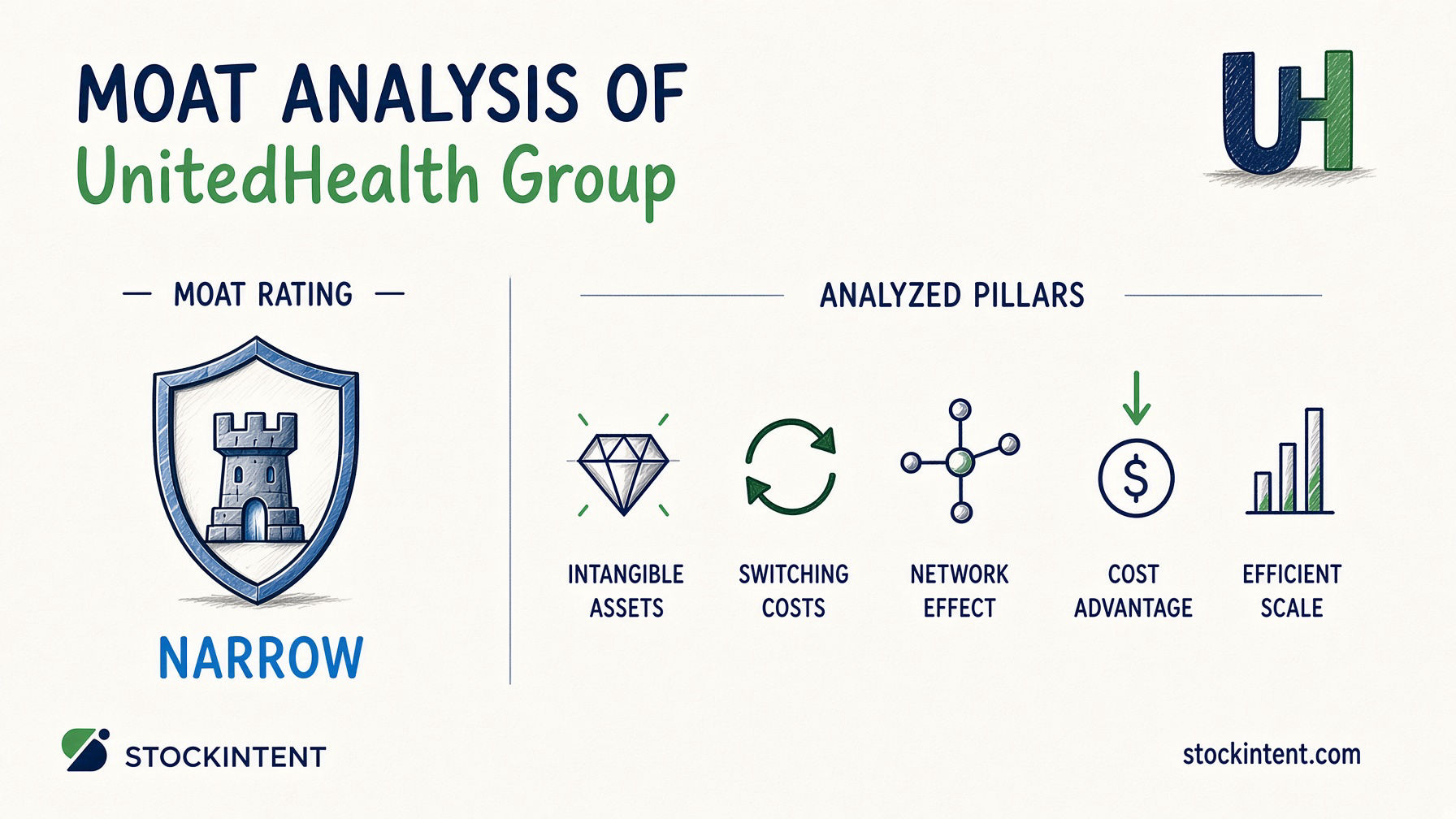
UnitedHealth Group carries a Narrow economic moat with a Stable trend and Medium uncertainty as of mid-2026. The company's scale and vertical integration still generate durable economics, but margin compression and regulatory pressure prevent us from calling the moat wide.
Pro Insight: In healthcare, investors often confuse "network reach" with "network effects." UnitedHealth's advantage comes from scale and purchasing leverage, not from the self-reinforcing platform dynamics that define true network effects. This distinction is critical for moat assessment because scale can be competed away through consolidation, whereas genuine network effects are harder to replicate.
For investors evaluating business quality, the key question isn't whether UnitedHealth is large. It clearly is. The question is whether its scale and integration create genuine long-term compounding potential or merely temporary size.
UnitedHealth Group's moat is fundamentally a scale-and-integration story, not a network-effects story. The company leverages its $447.6 billion revenue base and nearly 49.8 million customers to extract cost advantages that smaller rivals cannot easily match, while the Optum side of the house adds vertical integration across pharmacy benefits, care delivery, and healthcare IT.
This is UnitedHealth's clearest moat pillar. The massive membership base supports administrative cost leverage, powerful provider contracting power, and the ability to spread fixed costs across a huge base. Morningstar and other analysts point to vertically integrated model across insurance, care delivery, PBM, and data infrastructure as a way to improve efficiency and bid competitiveness. Even with recent medical-cost pressure compressing margins, the scale economics remain structurally favorable.
UnitedHealth's scale in UnitedHealthcare membership and Optum Rx / Optum Insight appears economically meaningful and hard for smaller rivals to match. The company's size helps it negotiate with providers and drug manufacturers and spread overhead across a huge base. That said, efficient scale is not uniform across the whole company. Profitability deterioration in Optum Health and medical-cost volatility reduce confidence in care-delivery scale economics for every subsegment. On balance, the evidence is more convincing for insurance, PBM, and administrative scale than for the full Optum portfolio.
UnitedHealth benefits from real switching friction in Medicare Advantage, employer benefits, PBM relationships, and integrated care-management contracts. Changing vendors disrupts formularies, claims processing, and provider workflows, while regulatory familiarity in Medicare Advantage entrenches the company's position. However, switching costs are not overwhelming. Annual contract repricing and re-bidding limit true lock-in, and the company projects losing 2.3 to 2.8 million members across lines of business in 2026.
Brand recognition, regulatory know-how, embedded workflows, and Optum's analytics capabilities represent genuine intangible assets that took decades to build. These advantages matter because they create operational embedding that competitors cannot replicate overnight. Still, these are not patent-like exclusivities. They support the moat rather than independently defining it, and they are secondary to the scale and integration dynamics that drive the core economics.
Network effects are UnitedHealth's most disputed and weakest moat pillar. Some analytic frameworks label the company as having network effects, but the actual evidence points to scale and integration rather than self-reinforcing platform dynamics. More members and provider relationships improve negotiating leverage and data, but that is better characterized as scale and network reach than the classic two-sided network effects that define true platform businesses. Scale can be competed away through consolidation; genuine network effects are much harder to replicate.
The $1.5 billion AI investment announced in 2026 for operational streamlining is best understood as management doubling down on the cost advantage pillar. If automation reduces administrative expenses and medical cost management improves, the moat widens through execution rather than through any new intangible exclusivity. The bet here is that reinvestment at scale compounds into lower unit costs, not that UnitedHealth invents something its rivals cannot copy.
The moat currently shows up most clearly in earnings resilience, medical-cost discipline, and scale-driven cash generation. The clearest evidence is the sharp improvement in UnitedHealthcare's medical cost ratios. Morningstar highlighted a Q2 2026 medical cost ratio of 86.7%, down from 89.4% in the same period last year. A Trefis analysis cited an even lower Q1 2026 ratio of 83.9%. These figures suggest repricing and tighter utilization management are working.
The financial results also tell the story. UnitedHealth generated $19.7 billion in 2025 operating cash flow, roughly 1.5 times net income. Management has raised 2026 adjusted EPS guidance three times this year, now targeting $19.50–$20.00 per share, up from an initial outlook of greater than $17.75 in January. You can review these financial statements and segment margins yourself using StockIntent company reports to see how the numbers have evolved.
But the moat is also showing stress in places. Optum operating income declined 15% in Q1 2026 due to contract terminations and restructuring. UnitedHealthcare's operating margin compressed to 2.7% in 2025, down from 5.2% the prior year, and management projects losing 2.3 to 2.8 million members across Medicare Advantage, Medicaid, and commercial lines in 2026. Our interpretation is that margin improvement may reflect repricing discipline rather than structural widening of the moat.
Relative to peers, UnitedHealth appears ahead on current momentum. Morningstar contrasted UnitedHealth's Q2 2026 strength with Elevance Health's "underwhelming guidance," noting clearer margin trajectory and earnings revision strength at UnitedHealth. That suggests cost advantages and scale are translating into better near-term execution than at least one major rival.
We think that the current moat trend is Stable.
2026 is a transition year. UnitedHealth is shifting from top-line expansion to margin repair, which stabilizes rather than widens the competitive position until execution proves durable. Management describes the focus as "margin recovery" and "durable performance improvement" through tighter operational discipline, not aggressive growth. That posture makes sense, but it also means investors should not assume the moat is widening automatically.
The sector context explains why. Health insurers face tighter scrutiny around Medicare Advantage rates, PBM practices, and ACA policy, which caps how fast any moat can widen. Medical cost inflation is running hot, with a 7.5% trend in 2025 and a 10% trend reaffirmed for 2026. Meanwhile, Medicare funding cuts and reimbursement pressure have created what analysts describe as "massive headwinds" and "tremendous uncertainty" around business outcomes. These forces are structural, not cyclical. They mean scale and integration still matter, but pricing power is constrained by government policy rather than market competition.
Company-specific dynamics reinforce the stable call. On the positive side, the company is exiting structurally unprofitable contracts and investing $1.5 billion in AI initiatives for operational streamlining. The 2026 revenue guidance of more than $439 billion reflects this right-sizing discipline, representing an approximate 2% decline from 2025's $447.6 billion as the company prioritizes profitability over volume. On the negative side, Optum operating income fell 15% in Q1 2026 due to contract terminations and restructuring charges, and the company projects losing 2.3 to 2.8 million members across Medicare Advantage, Medicaid, and commercial lines. The moat is being repaired in some places while shrinking in others.
For investors monitoring the trajectory, we recommend tracking four indicators:
You can organize these metrics into a monitoring workflow using StockIntent watchlists to track how the moat evolves quarter by quarter.
A widening trend would require sustained margin recovery without membership collapse, plus evidence that the $1.5 billion AI investment is translating into durable unit-cost advantages. A weakening trend would show up as medical cost ratio deterioration despite repricing, continued Optum margin compression, or regulatory changes that permanently compress reimbursement. For now, neither scenario has clearly won.
Our uncertainty rating for UnitedHealth Group is Medium.
The rating reflects a moderately wide range of future outcomes. Healthcare demand is structurally recurring, which normally narrows uncertainty. But regulatory and reimbursement cyclicality have become real drivers of earnings volatility. Management described 2026 as a "transition year" facing "tremendous uncertainty," and analysts have characterized Medicare funding cuts and reimbursement pressure as "massive headwinds." These are not passing concerns. They shape how much return UnitedHealth can extract from its scale.
Three factors drive this medium rating. First, Medicare Advantage reimbursement rates and star ratings are set by the government, not the market. CMS pricing power limits UnitedHealth's ability to pass through rising medical costs, which ran at a 7.5% trend in 2025 and are reaffirmed at 10% for 2026. Second, Optum execution risk remains elevated. Operating income declined 15% in Q1 2026 due to contract terminations and restructuring, and the $1.5 billion AI investment for operational streamlining is a bet that has not yet paid off. Third, policy uncertainty around PBM regulation and the V28 coding transition creates a moving target for revenue recognition and margin planning.
The uncertainty here is about the width of future excess returns, not business survival. UnitedHealth generated $19.7 billion in 2025 operating cash flow, roughly 1.5 times net income. Scale and recurring demand protect against existential risk. What they do not protect against is a prolonged compression of the spread between returns on capital and cost of capital. If regulatory pressure permanently lowers Medicare Advantage and PBM economics, the narrow moat could erode further. If operational discipline sustains margins despite these headwinds, the moat stabilizes at its current width. Investors should not confuse stock price volatility with business uncertainty, but they should also not mistake size for immunity to policy-driven outcome dispersion.
UnitedHealth Group maintains a Narrow economic moat with a Stable trend and Medium uncertainty. Scale, vertical integration, and disciplined capital allocation still protect returns, but the moat is not expanding effortlessly and regulatory pressure remains the decisive variable.
Two issues matter most from here. First, whether UnitedHealthcare's 2026 margin recovery sustains without further membership erosion. The medical cost ratio improvement to 86.7% in Q2 2026 and raised EPS guidance to $19.50–$20.00 are encouraging, yet the projected loss of 2.3 to 2.8 million members shows repricing carries a volume cost. Second, regulatory outcomes on Medicare Advantage rates and PBM economics will determine whether the narrow moat compresses or stabilizes. Government pricing power limits UnitedHealth's ability to pass through medical cost inflation running at a 10% trend, so policy is the swing factor.
The moat is durable but conditional. Investors should watch the medical care ratio trend and Optum turnaround as the decisive factors for whether the narrow moat remains intact or narrows further. Execution can preserve it; execution failure and regulatory compression can erode it.
UnitedHealth Group carries a Narrow economic moat with a Stable trend and Medium uncertainty as of mid-2026. The company's scale and vertical integration still generate durable economics, but margin compression and regulatory pressure prevent us from calling the moat wide.
Pro Insight: In healthcare, investors often confuse "network reach" with "network effects." UnitedHealth's advantage comes from scale and purchasing leverage, not from the self-reinforcing platform dynamics that define true network effects. This distinction is critical for moat assessment because scale can be competed away through consolidation, whereas genuine network effects are harder to replicate.
For investors evaluating business quality, the key question isn't whether UnitedHealth is large. It clearly is. The question is whether its scale and integration create genuine long-term compounding potential or merely temporary size.
UnitedHealth Group's moat is fundamentally a scale-and-integration story, not a network-effects story. The company leverages its $447.6 billion revenue base and nearly 49.8 million customers to extract cost advantages that smaller rivals cannot easily match, while the Optum side of the house adds vertical integration across pharmacy benefits, care delivery, and healthcare IT.
This is UnitedHealth's clearest moat pillar. The massive membership base supports administrative cost leverage, powerful provider contracting power, and the ability to spread fixed costs across a huge base. Morningstar and other analysts point to vertically integrated model across insurance, care delivery, PBM, and data infrastructure as a way to improve efficiency and bid competitiveness. Even with recent medical-cost pressure compressing margins, the scale economics remain structurally favorable.
UnitedHealth's scale in UnitedHealthcare membership and Optum Rx / Optum Insight appears economically meaningful and hard for smaller rivals to match. The company's size helps it negotiate with providers and drug manufacturers and spread overhead across a huge base. That said, efficient scale is not uniform across the whole company. Profitability deterioration in Optum Health and medical-cost volatility reduce confidence in care-delivery scale economics for every subsegment. On balance, the evidence is more convincing for insurance, PBM, and administrative scale than for the full Optum portfolio.
UnitedHealth benefits from real switching friction in Medicare Advantage, employer benefits, PBM relationships, and integrated care-management contracts. Changing vendors disrupts formularies, claims processing, and provider workflows, while regulatory familiarity in Medicare Advantage entrenches the company's position. However, switching costs are not overwhelming. Annual contract repricing and re-bidding limit true lock-in, and the company projects losing 2.3 to 2.8 million members across lines of business in 2026.
Brand recognition, regulatory know-how, embedded workflows, and Optum's analytics capabilities represent genuine intangible assets that took decades to build. These advantages matter because they create operational embedding that competitors cannot replicate overnight. Still, these are not patent-like exclusivities. They support the moat rather than independently defining it, and they are secondary to the scale and integration dynamics that drive the core economics.
Network effects are UnitedHealth's most disputed and weakest moat pillar. Some analytic frameworks label the company as having network effects, but the actual evidence points to scale and integration rather than self-reinforcing platform dynamics. More members and provider relationships improve negotiating leverage and data, but that is better characterized as scale and network reach than the classic two-sided network effects that define true platform businesses. Scale can be competed away through consolidation; genuine network effects are much harder to replicate.
The $1.5 billion AI investment announced in 2026 for operational streamlining is best understood as management doubling down on the cost advantage pillar. If automation reduces administrative expenses and medical cost management improves, the moat widens through execution rather than through any new intangible exclusivity. The bet here is that reinvestment at scale compounds into lower unit costs, not that UnitedHealth invents something its rivals cannot copy.
The moat currently shows up most clearly in earnings resilience, medical-cost discipline, and scale-driven cash generation. The clearest evidence is the sharp improvement in UnitedHealthcare's medical cost ratios. Morningstar highlighted a Q2 2026 medical cost ratio of 86.7%, down from 89.4% in the same period last year. A Trefis analysis cited an even lower Q1 2026 ratio of 83.9%. These figures suggest repricing and tighter utilization management are working.
The financial results also tell the story. UnitedHealth generated $19.7 billion in 2025 operating cash flow, roughly 1.5 times net income. Management has raised 2026 adjusted EPS guidance three times this year, now targeting $19.50–$20.00 per share, up from an initial outlook of greater than $17.75 in January. You can review these financial statements and segment margins yourself using StockIntent company reports to see how the numbers have evolved.
But the moat is also showing stress in places. Optum operating income declined 15% in Q1 2026 due to contract terminations and restructuring. UnitedHealthcare's operating margin compressed to 2.7% in 2025, down from 5.2% the prior year, and management projects losing 2.3 to 2.8 million members across Medicare Advantage, Medicaid, and commercial lines in 2026. Our interpretation is that margin improvement may reflect repricing discipline rather than structural widening of the moat.
Relative to peers, UnitedHealth appears ahead on current momentum. Morningstar contrasted UnitedHealth's Q2 2026 strength with Elevance Health's "underwhelming guidance," noting clearer margin trajectory and earnings revision strength at UnitedHealth. That suggests cost advantages and scale are translating into better near-term execution than at least one major rival.
We think that the current moat trend is Stable.
2026 is a transition year. UnitedHealth is shifting from top-line expansion to margin repair, which stabilizes rather than widens the competitive position until execution proves durable. Management describes the focus as "margin recovery" and "durable performance improvement" through tighter operational discipline, not aggressive growth. That posture makes sense, but it also means investors should not assume the moat is widening automatically.
The sector context explains why. Health insurers face tighter scrutiny around Medicare Advantage rates, PBM practices, and ACA policy, which caps how fast any moat can widen. Medical cost inflation is running hot, with a 7.5% trend in 2025 and a 10% trend reaffirmed for 2026. Meanwhile, Medicare funding cuts and reimbursement pressure have created what analysts describe as "massive headwinds" and "tremendous uncertainty" around business outcomes. These forces are structural, not cyclical. They mean scale and integration still matter, but pricing power is constrained by government policy rather than market competition.
Company-specific dynamics reinforce the stable call. On the positive side, the company is exiting structurally unprofitable contracts and investing $1.5 billion in AI initiatives for operational streamlining. The 2026 revenue guidance of more than $439 billion reflects this right-sizing discipline, representing an approximate 2% decline from 2025's $447.6 billion as the company prioritizes profitability over volume. On the negative side, Optum operating income fell 15% in Q1 2026 due to contract terminations and restructuring charges, and the company projects losing 2.3 to 2.8 million members across Medicare Advantage, Medicaid, and commercial lines. The moat is being repaired in some places while shrinking in others.
For investors monitoring the trajectory, we recommend tracking four indicators:
You can organize these metrics into a monitoring workflow using StockIntent watchlists to track how the moat evolves quarter by quarter.
A widening trend would require sustained margin recovery without membership collapse, plus evidence that the $1.5 billion AI investment is translating into durable unit-cost advantages. A weakening trend would show up as medical cost ratio deterioration despite repricing, continued Optum margin compression, or regulatory changes that permanently compress reimbursement. For now, neither scenario has clearly won.
Our uncertainty rating for UnitedHealth Group is Medium.
The rating reflects a moderately wide range of future outcomes. Healthcare demand is structurally recurring, which normally narrows uncertainty. But regulatory and reimbursement cyclicality have become real drivers of earnings volatility. Management described 2026 as a "transition year" facing "tremendous uncertainty," and analysts have characterized Medicare funding cuts and reimbursement pressure as "massive headwinds." These are not passing concerns. They shape how much return UnitedHealth can extract from its scale.
Three factors drive this medium rating. First, Medicare Advantage reimbursement rates and star ratings are set by the government, not the market. CMS pricing power limits UnitedHealth's ability to pass through rising medical costs, which ran at a 7.5% trend in 2025 and are reaffirmed at 10% for 2026. Second, Optum execution risk remains elevated. Operating income declined 15% in Q1 2026 due to contract terminations and restructuring, and the $1.5 billion AI investment for operational streamlining is a bet that has not yet paid off. Third, policy uncertainty around PBM regulation and the V28 coding transition creates a moving target for revenue recognition and margin planning.
The uncertainty here is about the width of future excess returns, not business survival. UnitedHealth generated $19.7 billion in 2025 operating cash flow, roughly 1.5 times net income. Scale and recurring demand protect against existential risk. What they do not protect against is a prolonged compression of the spread between returns on capital and cost of capital. If regulatory pressure permanently lowers Medicare Advantage and PBM economics, the narrow moat could erode further. If operational discipline sustains margins despite these headwinds, the moat stabilizes at its current width. Investors should not confuse stock price volatility with business uncertainty, but they should also not mistake size for immunity to policy-driven outcome dispersion.
UnitedHealth Group maintains a Narrow economic moat with a Stable trend and Medium uncertainty. Scale, vertical integration, and disciplined capital allocation still protect returns, but the moat is not expanding effortlessly and regulatory pressure remains the decisive variable.
Two issues matter most from here. First, whether UnitedHealthcare's 2026 margin recovery sustains without further membership erosion. The medical cost ratio improvement to 86.7% in Q2 2026 and raised EPS guidance to $19.50–$20.00 are encouraging, yet the projected loss of 2.3 to 2.8 million members shows repricing carries a volume cost. Second, regulatory outcomes on Medicare Advantage rates and PBM economics will determine whether the narrow moat compresses or stabilizes. Government pricing power limits UnitedHealth's ability to pass through medical cost inflation running at a 10% trend, so policy is the swing factor.
The moat is durable but conditional. Investors should watch the medical care ratio trend and Optum turnaround as the decisive factors for whether the narrow moat remains intact or narrows further. Execution can preserve it; execution failure and regulatory compression can erode it.