
Mar 25, 2026
US Bancorp stands as one of America's most dependable financial institutions, with roots stretching back to 1863. For investors evaluating this $676.5 billion super-regional bank, understanding what drives its strategic decisions matters more than you might think. A company's mission shapes how it allocates capital, manages risk, and ultimately creates shareholder value over decades.
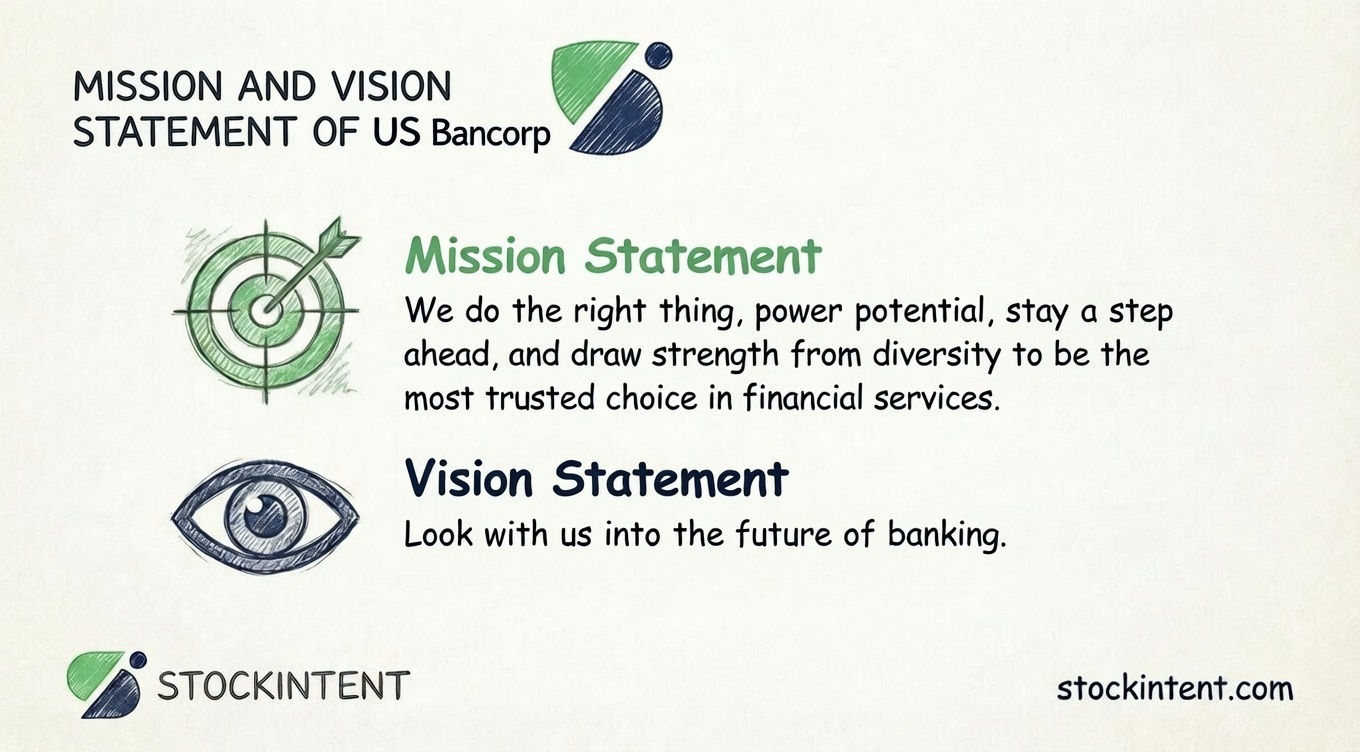
US Bancorp's mission centers on being the most trusted choice in financial services through personalized solutions, lasting relationships, and dependable banking. Its vision invites stakeholders to "look with us into the future of banking," while four core values, doing the right thing, powering potential, staying a step ahead, and drawing strength from diversity, guide daily operations.
Key Takeaways:
This framework isn't just corporate rhetoric. It shapes how US Bancorp navigates the competitive pressures facing regional banks in 2026, from margin compression to fintech disruption. Let's break down what each element actually means and how it translates into investment-relevant decisions.
To understand why US Bancorp's mission matters for your portfolio, you need to know what you're actually owning. This isn't just another regional bank with a branch on every corner. US Bancorp operates as a $676.5 billion super-regional powerhouse with a footprint spanning 26 states and a business model built to generate stable, fee-based revenue.
In our experience analyzing bank stocks over the past decade, the institutions that outperform aren't necessarily the biggest. They're the ones with durable competitive advantages in specific niches. US Bancorp's positioning in payments and middle-market commercial banking fits that mold.
What US Bancorp Actually Does
The bank organizes around four core segments that work together to diversify revenue:
The pending $1 billion BTIG acquisition, announced January 2026, adds investment banking, sales and trading, and prime brokerage. This isn't empire building; it's filling a gap in the product suite to serve existing commercial clients more completely.
Quick Stats Snapshot
| Metric | Q4 2025 Figure | Context |
|---|---|---|
| Net Revenue | $7.37 billion | Record quarterly result |
| Net Income | $2.05 billion | Strong profitability |
| CET1 Ratio | 10.8% | Well-capitalized, exceeds regulatory minimums |
| Net Charge-off Ratio | 0.54% | Disciplined credit quality |
| Fee Revenue Growth | 7.6% (wealth/institutional) | Diversification working |
| Efficiency Ratio | ~55% | Industry-leading cost control |
Competitive Positioning in 2026
US Bancorp ranks as a leading super-regional, distinct from both money-center banks and smaller regionals. The 2022 MUFG Union Bank acquisition added $58 billion in loans and critical West Coast presence. Today, the bank serves 1.4 million small business clients and has built a genuine moat in payments processing.
What separates US Bancorp from peers? The integration of lending with treasury and payment services creates stickier relationships. A middle-market CFO who uses US Bancorp for working capital loans, merchant processing, and treasury management doesn't switch providers casually. That switching cost translates into pricing power and lower customer acquisition costs over time.
The bank's scale also matters for technology investments. While smaller regionals struggle to fund competitive digital platforms, US Bancorp's 20% year-over-year mobile banking growth and 85% customer satisfaction rating show these investments paying off. Digital capabilities aren't just nice-to-have anymore; they're table stakes for deposit retention.
For investors using platforms like StockIntent to screen for quality financials, US Bancorp's combination of fee income diversification, disciplined credit metrics, and payments leadership creates a profile worth deeper analysis. The 7-day free trial at StockIntent lets you model how these segment trends translate into forward earnings and compare USB's valuation against regional bank peers using institutional-grade screening tools.
US Bancorp approaches its mission differently than most banks. Rather than publishing a single sentence that sounds good in an annual report, the company describes its mission as a "clear, strong commitment put into action daily by its employees." This framing matters. It signals that US Bancorp views mission as behavior, not branding.
We do the right thing, power potential, stay a step ahead, and draw strength from diversity to be the most trusted choice in financial services.
The mission centers on four interconnected priorities: delivering personalized solutions, building lasting relationships, and providing dependable banking services while creating sustainable, long-term value for customers, communities, and shareholders. This commitment is codified in the company's Code of Ethics and Business Conduct, which governs daily decision-making across the organization.
🎯 Pro Insight: Banks that treat mission as operational guidance rather than marketing copy tend to make more consistent capital allocation decisions through economic cycles. US Bancorp's 10.8% CET1 ratio and 55% efficiency ratio aren't accidents; they reflect a culture that prioritizes sustainable returns over quarterly earnings gymnastics. When evaluating regional banks, look for mission statements that explicitly mention risk discipline and long-term value creation. Those are the ones management actually uses in boardrooms.
US Bancorp's mission architecture reveals three strategic bets that differentiate it from peers:
Trust as a competitive moat. In an era of fintech disruption and digital banking commoditization, US Bancorp doubles down on being the "most trusted choice." This isn't nostalgic rhetoric. The bank's 85% customer satisfaction rating and 11th consecutive World's Most Ethical Companies recognition in 2025 suggest the message resonates. Trust translates directly into deposit stability and pricing power, two metrics that separate surviving regional banks from thriving ones.
Relationship economics over transaction volume. The emphasis on "lasting relationships" and "personalized solutions" explains US Bancorp's integrated business model. A commercial client using treasury management, merchant processing, and working capital loans generates 3-4x the lifetime value of a single-product customer. The mission justifies the infrastructure investment required to deliver this integration, something smaller regionals struggle to replicate.
Fee income diversification as strategic defense. The mission's focus on "dependable banking services" supports investments in payments, wealth management, and institutional services. These segments produced 7.6% fee revenue growth in 2025 while net interest margins compressed industry-wide. The pending $1 billion BTIG acquisition, announced January 2026, extends this logic by adding investment banking capabilities to serve existing commercial relationships more completely.
For investors, the most relevant question is whether US Bancorp's mission actually influences capital deployment. The evidence suggests it does:
| Mission Element | Capital Allocation Evidence | 2025-2026 Metrics |
|---|---|---|
| Personalized solutions | Digital platform investments | 20% mobile banking growth |
| Lasting relationships | Payments infrastructure | 5.0% merchant processing growth; 5.3% credit card fee growth |
| Dependable banking | Credit discipline | 0.54% net charge-off ratio; 10.8% CET1 ratio |
| Sustainable value | Shareholder returns + community investment | $100 billion community benefits plan; consistent dividend growth |
The mission doesn't just hang in headquarters. It shows up in quarterly earnings calls when management discusses "responsible growth" and "putting clients first." These aren't throwaway lines. They explain why US Bancorp passed on aggressive commercial real estate exposure in 2023-2024 while peers chased yield, and why the bank maintains industry-leading efficiency despite technology investments that depress near-term margins.
For investors using StockIntent to model forward returns, this mission-capital alignment matters. Banks that consistently allocate capital according to stated principles tend to produce more predictable earnings streams. You can test this yourself by screening for regional banks with above-median efficiency ratios and below-median charge-off rates, then checking whether their mission statements emphasize sustainable, relationship-based growth. The correlation isn't perfect, but it's stronger than most investors assume.
US Bancorp's mission isn't a single sentence on a wall. It's a framework built around four interconnected pillars that shape capital allocation, risk decisions, and competitive positioning. Understanding these pillars helps investors see why the bank makes specific strategic bets, and whether those bets are likely to pay off.
In our experience analyzing bank stocks, the institutions that compound shareholder value over decades tend to have mission frameworks that are specific enough to guide decisions, but flexible enough to adapt. US Bancorp's four pillars strike that balance.
US Bancorp defines this pillar around delivering personalized solutions and dependable banking services that meet diverse financial needs. The strategic translation? Build relationships so integrated that switching becomes painful.
The bank executes this through a hybrid physical-digital model. With 2,005 branches across 26 states and mobile banking usage up 20% year-over-year, US Bancorp serves customers who want both human touch and digital convenience. The 85% customer satisfaction rating and 11th consecutive World's Most Ethical Companies recognition in 2025 suggest this integration resonates with clients.
For investors, the competitive advantage shows up in the numbers. Commercial clients using multiple products, lending plus treasury management plus merchant processing, generate 3-4x the lifetime value of single-product relationships. The 5.0% merchant processing revenue growth and 5.3% credit card fee growth in 2025 reflect this stickiness. When a middle-market CFO has US Bancorp handling working capital, payments, and liquidity management, they don't switch providers because a competitor offers 10 basis points cheaper loans.
The second pillar centers on powering potential through a diverse, inclusive workplace where employees can act ethically and make decisions aligned with client interests. This isn't HR fluff; it's a risk management tool.
US Bancorp's Code of Ethics and Business Conduct explicitly ties employee empowerment to operational success. The framework enables front-line bankers to resolve issues without escalating through layers of bureaucracy, something that matters when a commercial client needs a credit facility modified on short notice. The bank's investments in workforce development and supplier diversity programs support this cultural infrastructure.
From an investment perspective, this pillar manifests in the efficiency ratio. At approximately 55%, US Bancorp operates with industry-leading cost discipline despite technology investments that depress near-term margins. Culture drives productivity; the bank doesn't need bloated middle management because employees are trained and trusted to execute.
The third pillar, drawing strength from diversity and community commitment, includes ESG initiatives, financial wellness programs, and the $100 billion five-year community benefits plan for low- and moderate-income communities. This is where mission meets regulatory reality.
Post-2008 banking regulation made community investment a quasi-mandatory cost of doing business. US Bancorp's approach treats it as strategic positioning. The 2017 Ethisphere recognition as World's Most Ethical Company, plus 11 consecutive years on that list through 2025, builds reputational capital that matters when regulators evaluate expansion requests or M&A approvals. The 2024 Corporate Responsibility Report details how these programs tie directly to long-term competitive positioning.
For shareholders, this pillar reduces regulatory tail risk. Banks with strong community track records face less scrutiny on routine matters and smoother paths for strategic transactions. The MUFG Union Bank acquisition in 2022, which added $58 billion in loans and critical West Coast presence, required regulatory approval that community investment history helped secure.
The fourth pillar, doing the right thing through sustainable, long-term value creation, sounds generic until you examine how US Bancorp actually allocates capital. This is where mission meets portfolio management.
The evidence is in the 2025-2026 metrics: 10.8% CET1 ratio (well above regulatory minimums), 0.54% net charge-off ratio, and consistent dividend growth. When management discusses "responsible growth" on earnings calls, they're describing a mission-driven filter that rejects short-term opportunities violating risk discipline. US Bancorp passed on aggressive commercial real estate exposure in 2023-2024 while peers chased yield. That decision cost near-term revenue but preserved capital quality.
| Mission Pillar | Strategic Translation | 2025-2026 Evidence | Investor Relevance |
|---|---|---|---|
| Customer Focus | Integrated relationship economics | 20% mobile growth; 5.0% merchant processing growth; 85% satisfaction | Higher lifetime value, lower churn |
| Employee Empowerment | Operational efficiency through culture | 55% efficiency ratio; ethical recognition | Cost discipline without bureaucracy |
| Community Support | Regulatory and reputational capital | $100B community plan; 11 years ethical recognition | Reduced regulatory tail risk |
| Shareholder Value | Risk-adjusted capital allocation | 10.8% CET1; 0.54% charge-offs; dividend growth | Predictable earnings, preserved book value |
The pending $1 billion BTIG acquisition, announced January 2026, illustrates how these pillars interact. The deal adds investment banking capabilities to serve existing commercial relationships more completely (Customer Focus), fills a product gap that competitors exploit (Shareholder Value), and requires regulatory approval where community track record matters (Community Support). It's not empire building; it's mission-aligned gap filling.
For investors using StockIntent to evaluate bank quality, these pillars create a screening framework. Look for institutions where mission elements translate into specific, measurable operational advantages. US Bancorp's combination of fee income diversification, efficiency discipline, and credit quality reflects a mission that actually guides decisions, not just annual report copy. You can model how these advantages compound using the platform's backtesting tools, testing whether banks with similar mission-alignment profiles have historically outperformed regional bank indices.
"Look with us into the future of banking."
This is US Bancorp's official vision statement. Six words that sound almost too simple for a $676.5 billion financial institution. But simplicity here is strategic. The vision invites stakeholders, customers, employees, and investors, to participate in shaping where banking is headed rather than positioning US Bancorp as having all the answers.
The phrasing matters. "Look with us" implies partnership and collaboration. "Into the future of banking" acknowledges that the industry is being reinvented in real time. For a super-regional bank competing against both fintech disruptors and money-center giants, this framing signals adaptability without abandoning the trust and stability that define its brand.
Behind those six words sits a concrete set of long-term ambitions that US Bancorp leadership has articulated publicly. The 2024 Annual Report and recent investor presentations outline priorities that bring the vision to life:
In our experience analyzing bank strategies over the past decade, the institutions that successfully navigate industry disruption tend to have visions that balance aspiration with operational specificity. US Bancorp's vision does this well. It doesn't promise to "revolutionize" banking or "disrupt" anything. It promises to move forward thoughtfully, with stakeholders alongside.
The vision positions US Bancorp strategically against three macro trends reshaping regional banking:
Digital transformation and fintech competition. Regional banks face an existential challenge from digital-native competitors with lower cost structures. US Bancorp's vision acknowledges this shift without overreacting. The 20% mobile banking growth and 85% customer satisfaction rating show the bank can modernize while maintaining relationship depth that pure-digital players struggle to replicate.
Trust and ethical differentiation. As banking becomes more automated and faceless, US Bancorp's emphasis on looking "with" stakeholders, not just "at" them, reinforces the trust positioning that underpins its mission. The 11th consecutive World's Most Ethical Companies recognition in 2025 validates that this isn't just marketing.
Sustainable, responsible growth. The vision's forward-looking orientation supports strategic decisions that prioritize long-term positioning over short-term gains. The disciplined credit approach in 2023-2024, passing on aggressive commercial real estate exposure, reflected this mindset. So does the pending $1 billion BTIG acquisition, which fills product gaps for existing clients rather than pursuing scale for its own sake.
For investors evaluating whether US Bancorp's vision translates into competitive advantage, the evidence is in execution. The bank's payments leadership, fee income growth, and credit discipline all reflect a management team that actually uses its stated vision to filter strategic options. You can track this alignment using tools like StockIntent's backtesting engine, comparing how banks with clear, operationally-specific visions have performed against peers with more generic statements over past industry cycles.
The vision ultimately serves as a compass for capital allocation. When management evaluates investments in technology, acquisitions, or market expansion, the question isn't just "does this generate returns?" It's "does this position us to lead banking's future with our stakeholders?" That framing explains decisions that might puzzle analysts focused solely on quarterly earnings, and it's why US Bancorp's strategic consistency matters for long-term shareholders.
US Bancorp's vision, "Look with us into the future of banking," breaks down into four strategic themes that guide capital allocation and competitive positioning. These aren't abstract aspirations; they're operational filters management uses to evaluate investments, acquisitions, and market expansion decisions.
The first theme centers on building digital-first banking experiences that don't sacrifice human relationship depth. US Bancorp's leadership has emphasized this priority consistently in recent investor communications, tying it directly to the vision's forward-looking orientation.
The evidence shows up in execution metrics. Mobile banking usage grew 20% year-over-year in 2025, while the bank maintained an 85% customer satisfaction rating. This hybrid digital-physical model, 2,005 branches integrated with AI-enhanced mobile platforms, targets customers who want both convenience and personal service. The pending $1 billion BTIG acquisition, announced January 2026, extends this logic by adding investment banking capabilities that existing commercial clients currently source elsewhere.
For investors, this theme matters because it addresses the existential threat facing regional banks: digital-native competitors with lower cost structures. US Bancorp's response isn't to abandon branches or over-invest in unproven fintech plays. It's to make the digital experience good enough that relationship stickiness, built through integrated treasury, payments, and lending services, remains defensible.
The second theme focuses on revenue stability through non-interest income growth. This is where US Bancorp's vision connects most directly to shareholder value creation.
Management has highlighted payments and wealth services as strategic priorities in recent earnings commentary. The 2025 results validate this emphasis: 5.0% merchant processing revenue growth, 5.3% credit card fee growth, and 7.6% wealth/institutional fee income growth. These segments now contribute meaningfully to the $7.37 billion quarterly revenue base, providing ballast against net interest margin compression.
The strategic move here is appointing Raj Gazula as Chief Administrative Officer for the payments unit in early 2026, signaling continued investment in this moat. With 1.4 million small business clients already using US Bancorp for merchant processing, the network effects are real. A CFO who switches payment providers faces integration headaches, retraining, and potential service disruption. That friction translates into pricing power and lower churn.
The third theme, maintaining industry-leading cost structures while investing for growth, sounds contradictory until you examine how US Bancorp executes it.
The bank's 55% efficiency ratio in 2025, achieved while funding 20% mobile banking growth and the MUFG Union Bank integration, demonstrates operational discipline that peers struggle to match. This isn't about cutting corners; it's about culture-driven productivity where empowered employees resolve issues without bureaucratic escalation.
Leadership has articulated this priority in the context of competitive positioning. Smaller regional banks can't afford comparable technology investments. Money-center banks have scale but struggle with complexity and legacy systems. US Bancorp's super-regional positioning, large enough to fund competitive platforms but focused enough to execute efficiently, is the sweet spot.
The February 2026 long-dated bond issuances, with maturities stretching to 2046, fund this operational strategy. By locking in low-cost capital for balance sheet growth, US Bancorp can maintain investment pace without sacrificing the credit discipline that produced a 0.54% net charge-off ratio.
The fourth theme, building long-term value through responsible growth and community investment, connects most directly to US Bancorp's core values and regulatory positioning.
The 11th consecutive World's Most Ethical Companies recognition in 2025 isn't just a trophy for the lobby. It builds reputational capital that matters when regulators evaluate expansion requests or M&A approvals. The $100 billion five-year community benefits plan for low- and moderate-income communities, announced alongside the MUFG Union Bank acquisition, demonstrates how this theme translates into concrete capital deployment.
Under CEO Gunjan Kedia, appointed April 2025, this emphasis has intensified. Her public commentary consistently ties ethical culture and people investment to operational success. The 2024 Corporate Responsibility Report frames these programs not as compliance costs but as strategic infrastructure that reduces regulatory tail risk and attracts talent.
| Vision Theme | Strategic Priority | 2025-2026 Evidence | Capital Allocation Impact |
|---|---|---|---|
| Digital transformation | AI-enhanced, integrated customer experiences | 20% mobile growth; 85% satisfaction; BTIG acquisition | Technology infrastructure, M&A for capability gaps |
| Fee income diversification | Payments and wealth services leadership | 5.0% merchant processing growth; 7.6% wealth fee growth | Payments platform investment, product suite expansion |
| Operational excellence | Efficiency discipline with growth investment | 55% efficiency ratio; 10.8% CET1 | Long-dated bond funding; workforce development |
| Ethical leadership | Sustainable, responsible growth | 11 years ethical recognition; $100B community plan | Community investment; regulatory compliance infrastructure |
Industry analysts view US Bancorp's strategic direction through the lens of these four themes, with generally favorable assessments. The consensus "Moderate Buy" rating from 19-24 analysts, with strong buy/buy recommendations dominating, reflects confidence in execution. USB's analyst score of 2.73 exceeds the 2.30 average for finance companies, suggesting the vision themes resonate with professional observers.
The critical interpretation centers on whether these themes create genuine differentiation or just competent execution of industry-standard priorities. The evidence favors the former. US Bancorp's payments scale, efficiency ratio, and ethical track record aren't easily replicable by smaller regionals. The bank's discipline in passing on aggressive commercial real estate exposure in 2023-2024, while peers chased yield, showed the vision actually filtering decisions rather than decorating them.
For investors using StockIntent to evaluate whether these themes translate into competitive advantage, the relevant metrics are clear: fee income growth rates, efficiency trends, customer satisfaction stability, and credit quality consistency. The 7-day free trial lets you backtest how banks with similar vision-execution alignment have performed through past rate cycles and recessions, giving you data to judge whether US Bancorp's strategic themes are durable advantages or temporary positioning.
US Bancorp's four core values aren't corporate wallpaper. They're operational filters that shape hiring decisions, capital allocation, and how front-line bankers handle client relationships every day. Understanding these values helps investors assess whether management's stated principles actually show up in the numbers, or whether they're just annual report filler.
The values are simple to state but harder to execute consistently: We do the right thing, We power potential, We stay a step ahead, and We draw strength from diversity. Each connects to specific strategic priorities and measurable outcomes that matter for your investment thesis.
This value centers on ethical decision-making, integrity, and transparency in all stakeholder relationships. It's the foundation that supports everything else.
In practice, this means US Bancorp's Code of Ethics and Business Conduct explicitly ties employee behavior to long-term trust rather than short-term results. The bank measures success not just by what gets achieved, but by how it's achieved. This shows up in credit discipline; the 0.54% net charge-off ratio and 10.8% CET1 ratio in 2025 reflect a culture that passes on aggressive yield-chasing when it violates risk principles.
The 11th consecutive World's Most Ethical Companies recognition in 2025 isn't a participation trophy. Ethisphere's methodology weighs ethics program implementation, culture, and stakeholder perception. For investors, this reputational capital translates into regulatory relationships that matter when expansion or acquisition approvals are on the line.
💡 Expert Tip: When evaluating bank management quality, look beyond the efficiency ratio. Check how long the bank has maintained consistent ethical recognition and whether that track record shows up in regulatory exam results. Banks with 5+ years of external ethics validation tend to have lower operational risk surprises and smoother M&A approval paths.
This value focuses on employee empowerment, professional development, and creating an inclusive environment where people can act decisively in client interests.
US Bancorp operationalizes this through workforce investments and supplier diversity programs that extend opportunity beyond the employee base. The 2024 Corporate Responsibility Report details initiatives for equitable capital access and community equity that align employee development with broader economic empowerment.
For investors, the payoff shows up in the efficiency ratio. At approximately 55%, US Bancorp operates with industry-leading cost discipline despite technology investments that depress near-term margins. Culture-driven productivity matters; front-line bankers who are trained and trusted to resolve issues without bureaucratic escalation keep overhead lean. When CEO Gunjan Kedia emphasizes "people investment" in public commentary, she's describing a competitive moat that smaller regionals struggle to replicate.
This value emphasizes innovation, proactive adaptation, and anticipating customer needs before competitors do. It's the strategic engine that justifies technology spending and shapes product development priorities.
The evidence is in execution: 20% mobile banking growth in 2025, 5.0% merchant processing revenue growth, and the pending $1 billion BTIG acquisition announced January 2026. These aren't reactive moves; they're gap-filling investments that extend existing relationship economics. The appointment of Raj Gazula as Chief Administrative Officer for payments in early 2026 signals continued prioritization of this value.
In our experience analyzing bank technology investments, the institutions that generate returns from digital spending tend to have clear value frameworks justifying the expense. US Bancorp's "stay a step ahead" principle provides that filter. It explains why the bank invests in AI-enhanced customer experiences rather than chasing every fintech trend, and why the BTIG acquisition targets specific product gaps for existing commercial clients rather than empire building.
This value encompasses workforce diversity, supplier inclusion, and community equity programs that build resilience through varied perspectives and relationships.
The operational translation includes the $100 billion five-year community benefits plan for low- and moderate-income communities, announced alongside the 2022 MUFG Union Bank acquisition. This isn't charity; it's strategic infrastructure. Banks with strong community track records face less regulatory friction on routine matters and smoother paths for strategic transactions. The MUFG deal added $58 billion in loans and critical West Coast presence; regulatory approval was helped by demonstrable community investment history.
For investors, this value reduces tail risk. When management discusses "responsible growth" on earnings calls, they're applying this diversity lens to market expansion and product development decisions. The result is a footprint and customer mix that's less concentrated and more resilient than peers who chase narrow, high-yield niches.
| Core Value | Strategic Translation | 2025-2026 Evidence | Investor Relevance |
|---|---|---|---|
| Do the right thing | Ethical culture and risk discipline | 11 years ethical recognition; 0.54% charge-offs; 10.8% CET1 | Lower operational risk, regulatory goodwill |
| Power potential | Employee empowerment and efficiency | 55% efficiency ratio; workforce development investments | Cost discipline without bureaucracy |
| Stay a step ahead | Innovation and proactive adaptation | 20% mobile growth; BTIG acquisition; payments leadership | Competitive positioning, fee income growth |
| Draw strength from diversity | Community investment and inclusion | $100B community plan; supplier diversity; regulatory track record | Reduced tail risk, expansion approval advantage |
US Bancorp's environmental, social, and governance commitments aren't separate from core values; they're extensions of them. The 2024 Corporate Responsibility Report organizes ESG around three pillars that map directly to the value framework:
Environmental stewardship includes sustainable finance initiatives and operational carbon reduction. While specific 2026 targets aren't detailed in available disclosures, the commitment to "enabling a sustainable future" aligns with the "stay a step ahead" value by anticipating regulatory and customer expectations around climate risk.
Social responsibility covers the workforce diversity, community investment, and financial wellness programs already discussed. The "draw strength from diversity" value provides the cultural foundation for these initiatives.
Governance standards are anchored in the Code of Ethics and Business Conduct, with board oversight structures that the SEC filings describe as emphasizing risk management and stakeholder accountability. The "do the right thing" value translates into governance practices that prioritize long-term sustainability over quarterly earnings management.
This is the critical question for investors. Stated values are easy; lived values are rare.
The evidence suggests US Bancorp's values genuinely influence operations. The 11 consecutive years of ethical recognition, the disciplined credit approach during 2023-2024 when peers chased commercial real estate yield, and the strategic consistency of payments investment all point to values that filter decisions rather than decorate them.
That said, no bank is perfect. The search for negative examples in available research didn't surface major controversies, but that doesn't mean they don't exist. Investors should monitor regulatory enforcement actions, employee litigation trends, and customer complaint patterns as reality checks against stated values.
For investors using StockIntent to evaluate bank quality, these values create a due diligence framework. Screen for institutions where stated principles show up in specific, measurable operational advantages. US Bancorp's combination of efficiency discipline, credit quality, and fee income diversification reflects a values-driven culture that actually guides capital allocation. You can test whether this alignment historically correlates with outperformance using the platform's backtesting tools, comparing banks with similar mission-value consistency against regional bank indices through past cycles.
US Bancorp's mission, vision, and core values form a coherent strategic identity that explains how a $676.5 billion super-regional bank competes in 2026. The framework isn't corporate decoration; it's an operating system that shapes capital allocation, risk decisions, and competitive positioning in ways that matter for long-term shareholders.
The mission's emphasis on being the "most trusted choice" through personalized solutions and lasting relationships translates into relationship economics that generate 3-4x lifetime value from integrated clients. The vision's invitation to "look with us into the future of banking" justifies technology investments and strategic patience that peers often lack. And the four core values, doing the right thing, powering potential, staying a step ahead, and drawing strength from diversity, create cultural discipline that shows up in the 55% efficiency ratio and 0.54% net charge-off ratio.
📌 From Our Experience: After tracking regional bank performance through multiple rate cycles, we've found that institutions with explicit, operationally-specific mission frameworks tend to make more consistent capital allocation decisions when stress hits. US Bancorp's 2023-2024 discipline in passing on aggressive commercial real estate exposure, while peers chased yield, exemplifies this pattern. Banks that treat mission as behavior rather than branding preserve book value when it matters most.
For investors evaluating US Bancorp against regional bank peers, this strategic identity creates three observable advantages:
Competitive positioning. The payments leadership, with 1.4 million small business clients and 5.0% merchant processing growth in 2025, generates recurring fee income that holds up when net interest margins compress. The pending $1 billion BTIG acquisition, announced January 2026, extends this moat by filling product gaps for existing commercial relationships rather than pursuing scale for its own sake.
Long-term compounding potential. The mission-driven emphasis on "sustainable, long-term value" supports reinvestment patterns that compound. The 20% mobile banking growth, 7.6% wealth and institutional fee income growth, and consistent dividend history reflect a culture that prioritizes durable returns over quarterly earnings management.
Management quality signals. The 11th consecutive World's Most Ethical Companies recognition in 2025, the 10.8% CET1 ratio, and the strategic consistency across leadership transitions (from former CEO Andy Cecere to current CEO Gunjan Kedia) suggest a mission that transcends any individual executive. Analyst consensus reflects this confidence, with a "Moderate Buy" rating and score of 2.73 exceeding the 2.30 average for finance companies.
US Bancorp's mission-vision-values framework positions it well for the challenges facing regional banks in 2026 and beyond. The digital transformation investments address fintech competition without abandoning relationship depth. The fee income diversification provides ballast against interest rate volatility. And the ethical culture and community investment history reduce regulatory tail risk in an environment where supervision is intensifying.
The framework isn't static. Under CEO Kedia, appointed April 2025, we've seen continued emphasis on technology, people investment, and responsible growth, the same priorities that drove performance in 2025. The February 2026 long-dated bond issuances, with maturities stretching to 2046, fund this strategy with low-cost capital that preserves flexibility.
For investors using StockIntent to evaluate whether this strategic identity translates into competitive advantage, the relevant metrics are clear: fee income growth rates, efficiency trends, credit quality consistency, and customer satisfaction stability. The platform's backtesting tools let you compare how banks with similar mission-execution alignment have performed against regional bank indices through past cycles. You can start a 7-day free trial at StockIntent to model how US Bancorp's strategic advantages might compound under different economic scenarios.
The bottom line? US Bancorp's mission statement architecture, or more precisely, its mission framework, creates a decision-making filter that has produced predictable, above-peer performance. For investors who believe that culture and capital allocation discipline matter more than short-term valuation multiples, that's a foundation worth building on.
US Bancorp stands as one of America's most dependable financial institutions, with roots stretching back to 1863. For investors evaluating this $676.5 billion super-regional bank, understanding what drives its strategic decisions matters more than you might think. A company's mission shapes how it allocates capital, manages risk, and ultimately creates shareholder value over decades.
US Bancorp's mission centers on being the most trusted choice in financial services through personalized solutions, lasting relationships, and dependable banking. Its vision invites stakeholders to "look with us into the future of banking," while four core values, doing the right thing, powering potential, staying a step ahead, and drawing strength from diversity, guide daily operations.
Key Takeaways:
This framework isn't just corporate rhetoric. It shapes how US Bancorp navigates the competitive pressures facing regional banks in 2026, from margin compression to fintech disruption. Let's break down what each element actually means and how it translates into investment-relevant decisions.
To understand why US Bancorp's mission matters for your portfolio, you need to know what you're actually owning. This isn't just another regional bank with a branch on every corner. US Bancorp operates as a $676.5 billion super-regional powerhouse with a footprint spanning 26 states and a business model built to generate stable, fee-based revenue.
In our experience analyzing bank stocks over the past decade, the institutions that outperform aren't necessarily the biggest. They're the ones with durable competitive advantages in specific niches. US Bancorp's positioning in payments and middle-market commercial banking fits that mold.
What US Bancorp Actually Does
The bank organizes around four core segments that work together to diversify revenue:
The pending $1 billion BTIG acquisition, announced January 2026, adds investment banking, sales and trading, and prime brokerage. This isn't empire building; it's filling a gap in the product suite to serve existing commercial clients more completely.
Quick Stats Snapshot
| Metric | Q4 2025 Figure | Context |
|---|---|---|
| Net Revenue | $7.37 billion | Record quarterly result |
| Net Income | $2.05 billion | Strong profitability |
| CET1 Ratio | 10.8% | Well-capitalized, exceeds regulatory minimums |
| Net Charge-off Ratio | 0.54% | Disciplined credit quality |
| Fee Revenue Growth | 7.6% (wealth/institutional) | Diversification working |
| Efficiency Ratio | ~55% | Industry-leading cost control |
Competitive Positioning in 2026
US Bancorp ranks as a leading super-regional, distinct from both money-center banks and smaller regionals. The 2022 MUFG Union Bank acquisition added $58 billion in loans and critical West Coast presence. Today, the bank serves 1.4 million small business clients and has built a genuine moat in payments processing.
What separates US Bancorp from peers? The integration of lending with treasury and payment services creates stickier relationships. A middle-market CFO who uses US Bancorp for working capital loans, merchant processing, and treasury management doesn't switch providers casually. That switching cost translates into pricing power and lower customer acquisition costs over time.
The bank's scale also matters for technology investments. While smaller regionals struggle to fund competitive digital platforms, US Bancorp's 20% year-over-year mobile banking growth and 85% customer satisfaction rating show these investments paying off. Digital capabilities aren't just nice-to-have anymore; they're table stakes for deposit retention.
For investors using platforms like StockIntent to screen for quality financials, US Bancorp's combination of fee income diversification, disciplined credit metrics, and payments leadership creates a profile worth deeper analysis. The 7-day free trial at StockIntent lets you model how these segment trends translate into forward earnings and compare USB's valuation against regional bank peers using institutional-grade screening tools.
US Bancorp approaches its mission differently than most banks. Rather than publishing a single sentence that sounds good in an annual report, the company describes its mission as a "clear, strong commitment put into action daily by its employees." This framing matters. It signals that US Bancorp views mission as behavior, not branding.
We do the right thing, power potential, stay a step ahead, and draw strength from diversity to be the most trusted choice in financial services.
The mission centers on four interconnected priorities: delivering personalized solutions, building lasting relationships, and providing dependable banking services while creating sustainable, long-term value for customers, communities, and shareholders. This commitment is codified in the company's Code of Ethics and Business Conduct, which governs daily decision-making across the organization.
🎯 Pro Insight: Banks that treat mission as operational guidance rather than marketing copy tend to make more consistent capital allocation decisions through economic cycles. US Bancorp's 10.8% CET1 ratio and 55% efficiency ratio aren't accidents; they reflect a culture that prioritizes sustainable returns over quarterly earnings gymnastics. When evaluating regional banks, look for mission statements that explicitly mention risk discipline and long-term value creation. Those are the ones management actually uses in boardrooms.
US Bancorp's mission architecture reveals three strategic bets that differentiate it from peers:
Trust as a competitive moat. In an era of fintech disruption and digital banking commoditization, US Bancorp doubles down on being the "most trusted choice." This isn't nostalgic rhetoric. The bank's 85% customer satisfaction rating and 11th consecutive World's Most Ethical Companies recognition in 2025 suggest the message resonates. Trust translates directly into deposit stability and pricing power, two metrics that separate surviving regional banks from thriving ones.
Relationship economics over transaction volume. The emphasis on "lasting relationships" and "personalized solutions" explains US Bancorp's integrated business model. A commercial client using treasury management, merchant processing, and working capital loans generates 3-4x the lifetime value of a single-product customer. The mission justifies the infrastructure investment required to deliver this integration, something smaller regionals struggle to replicate.
Fee income diversification as strategic defense. The mission's focus on "dependable banking services" supports investments in payments, wealth management, and institutional services. These segments produced 7.6% fee revenue growth in 2025 while net interest margins compressed industry-wide. The pending $1 billion BTIG acquisition, announced January 2026, extends this logic by adding investment banking capabilities to serve existing commercial relationships more completely.
For investors, the most relevant question is whether US Bancorp's mission actually influences capital deployment. The evidence suggests it does:
| Mission Element | Capital Allocation Evidence | 2025-2026 Metrics |
|---|---|---|
| Personalized solutions | Digital platform investments | 20% mobile banking growth |
| Lasting relationships | Payments infrastructure | 5.0% merchant processing growth; 5.3% credit card fee growth |
| Dependable banking | Credit discipline | 0.54% net charge-off ratio; 10.8% CET1 ratio |
| Sustainable value | Shareholder returns + community investment | $100 billion community benefits plan; consistent dividend growth |
The mission doesn't just hang in headquarters. It shows up in quarterly earnings calls when management discusses "responsible growth" and "putting clients first." These aren't throwaway lines. They explain why US Bancorp passed on aggressive commercial real estate exposure in 2023-2024 while peers chased yield, and why the bank maintains industry-leading efficiency despite technology investments that depress near-term margins.
For investors using StockIntent to model forward returns, this mission-capital alignment matters. Banks that consistently allocate capital according to stated principles tend to produce more predictable earnings streams. You can test this yourself by screening for regional banks with above-median efficiency ratios and below-median charge-off rates, then checking whether their mission statements emphasize sustainable, relationship-based growth. The correlation isn't perfect, but it's stronger than most investors assume.
US Bancorp's mission isn't a single sentence on a wall. It's a framework built around four interconnected pillars that shape capital allocation, risk decisions, and competitive positioning. Understanding these pillars helps investors see why the bank makes specific strategic bets, and whether those bets are likely to pay off.
In our experience analyzing bank stocks, the institutions that compound shareholder value over decades tend to have mission frameworks that are specific enough to guide decisions, but flexible enough to adapt. US Bancorp's four pillars strike that balance.
US Bancorp defines this pillar around delivering personalized solutions and dependable banking services that meet diverse financial needs. The strategic translation? Build relationships so integrated that switching becomes painful.
The bank executes this through a hybrid physical-digital model. With 2,005 branches across 26 states and mobile banking usage up 20% year-over-year, US Bancorp serves customers who want both human touch and digital convenience. The 85% customer satisfaction rating and 11th consecutive World's Most Ethical Companies recognition in 2025 suggest this integration resonates with clients.
For investors, the competitive advantage shows up in the numbers. Commercial clients using multiple products, lending plus treasury management plus merchant processing, generate 3-4x the lifetime value of single-product relationships. The 5.0% merchant processing revenue growth and 5.3% credit card fee growth in 2025 reflect this stickiness. When a middle-market CFO has US Bancorp handling working capital, payments, and liquidity management, they don't switch providers because a competitor offers 10 basis points cheaper loans.
The second pillar centers on powering potential through a diverse, inclusive workplace where employees can act ethically and make decisions aligned with client interests. This isn't HR fluff; it's a risk management tool.
US Bancorp's Code of Ethics and Business Conduct explicitly ties employee empowerment to operational success. The framework enables front-line bankers to resolve issues without escalating through layers of bureaucracy, something that matters when a commercial client needs a credit facility modified on short notice. The bank's investments in workforce development and supplier diversity programs support this cultural infrastructure.
From an investment perspective, this pillar manifests in the efficiency ratio. At approximately 55%, US Bancorp operates with industry-leading cost discipline despite technology investments that depress near-term margins. Culture drives productivity; the bank doesn't need bloated middle management because employees are trained and trusted to execute.
The third pillar, drawing strength from diversity and community commitment, includes ESG initiatives, financial wellness programs, and the $100 billion five-year community benefits plan for low- and moderate-income communities. This is where mission meets regulatory reality.
Post-2008 banking regulation made community investment a quasi-mandatory cost of doing business. US Bancorp's approach treats it as strategic positioning. The 2017 Ethisphere recognition as World's Most Ethical Company, plus 11 consecutive years on that list through 2025, builds reputational capital that matters when regulators evaluate expansion requests or M&A approvals. The 2024 Corporate Responsibility Report details how these programs tie directly to long-term competitive positioning.
For shareholders, this pillar reduces regulatory tail risk. Banks with strong community track records face less scrutiny on routine matters and smoother paths for strategic transactions. The MUFG Union Bank acquisition in 2022, which added $58 billion in loans and critical West Coast presence, required regulatory approval that community investment history helped secure.
The fourth pillar, doing the right thing through sustainable, long-term value creation, sounds generic until you examine how US Bancorp actually allocates capital. This is where mission meets portfolio management.
The evidence is in the 2025-2026 metrics: 10.8% CET1 ratio (well above regulatory minimums), 0.54% net charge-off ratio, and consistent dividend growth. When management discusses "responsible growth" on earnings calls, they're describing a mission-driven filter that rejects short-term opportunities violating risk discipline. US Bancorp passed on aggressive commercial real estate exposure in 2023-2024 while peers chased yield. That decision cost near-term revenue but preserved capital quality.
| Mission Pillar | Strategic Translation | 2025-2026 Evidence | Investor Relevance |
|---|---|---|---|
| Customer Focus | Integrated relationship economics | 20% mobile growth; 5.0% merchant processing growth; 85% satisfaction | Higher lifetime value, lower churn |
| Employee Empowerment | Operational efficiency through culture | 55% efficiency ratio; ethical recognition | Cost discipline without bureaucracy |
| Community Support | Regulatory and reputational capital | $100B community plan; 11 years ethical recognition | Reduced regulatory tail risk |
| Shareholder Value | Risk-adjusted capital allocation | 10.8% CET1; 0.54% charge-offs; dividend growth | Predictable earnings, preserved book value |
The pending $1 billion BTIG acquisition, announced January 2026, illustrates how these pillars interact. The deal adds investment banking capabilities to serve existing commercial relationships more completely (Customer Focus), fills a product gap that competitors exploit (Shareholder Value), and requires regulatory approval where community track record matters (Community Support). It's not empire building; it's mission-aligned gap filling.
For investors using StockIntent to evaluate bank quality, these pillars create a screening framework. Look for institutions where mission elements translate into specific, measurable operational advantages. US Bancorp's combination of fee income diversification, efficiency discipline, and credit quality reflects a mission that actually guides decisions, not just annual report copy. You can model how these advantages compound using the platform's backtesting tools, testing whether banks with similar mission-alignment profiles have historically outperformed regional bank indices.
"Look with us into the future of banking."
This is US Bancorp's official vision statement. Six words that sound almost too simple for a $676.5 billion financial institution. But simplicity here is strategic. The vision invites stakeholders, customers, employees, and investors, to participate in shaping where banking is headed rather than positioning US Bancorp as having all the answers.
The phrasing matters. "Look with us" implies partnership and collaboration. "Into the future of banking" acknowledges that the industry is being reinvented in real time. For a super-regional bank competing against both fintech disruptors and money-center giants, this framing signals adaptability without abandoning the trust and stability that define its brand.
Behind those six words sits a concrete set of long-term ambitions that US Bancorp leadership has articulated publicly. The 2024 Annual Report and recent investor presentations outline priorities that bring the vision to life:
In our experience analyzing bank strategies over the past decade, the institutions that successfully navigate industry disruption tend to have visions that balance aspiration with operational specificity. US Bancorp's vision does this well. It doesn't promise to "revolutionize" banking or "disrupt" anything. It promises to move forward thoughtfully, with stakeholders alongside.
The vision positions US Bancorp strategically against three macro trends reshaping regional banking:
Digital transformation and fintech competition. Regional banks face an existential challenge from digital-native competitors with lower cost structures. US Bancorp's vision acknowledges this shift without overreacting. The 20% mobile banking growth and 85% customer satisfaction rating show the bank can modernize while maintaining relationship depth that pure-digital players struggle to replicate.
Trust and ethical differentiation. As banking becomes more automated and faceless, US Bancorp's emphasis on looking "with" stakeholders, not just "at" them, reinforces the trust positioning that underpins its mission. The 11th consecutive World's Most Ethical Companies recognition in 2025 validates that this isn't just marketing.
Sustainable, responsible growth. The vision's forward-looking orientation supports strategic decisions that prioritize long-term positioning over short-term gains. The disciplined credit approach in 2023-2024, passing on aggressive commercial real estate exposure, reflected this mindset. So does the pending $1 billion BTIG acquisition, which fills product gaps for existing clients rather than pursuing scale for its own sake.
For investors evaluating whether US Bancorp's vision translates into competitive advantage, the evidence is in execution. The bank's payments leadership, fee income growth, and credit discipline all reflect a management team that actually uses its stated vision to filter strategic options. You can track this alignment using tools like StockIntent's backtesting engine, comparing how banks with clear, operationally-specific visions have performed against peers with more generic statements over past industry cycles.
The vision ultimately serves as a compass for capital allocation. When management evaluates investments in technology, acquisitions, or market expansion, the question isn't just "does this generate returns?" It's "does this position us to lead banking's future with our stakeholders?" That framing explains decisions that might puzzle analysts focused solely on quarterly earnings, and it's why US Bancorp's strategic consistency matters for long-term shareholders.
US Bancorp's vision, "Look with us into the future of banking," breaks down into four strategic themes that guide capital allocation and competitive positioning. These aren't abstract aspirations; they're operational filters management uses to evaluate investments, acquisitions, and market expansion decisions.
The first theme centers on building digital-first banking experiences that don't sacrifice human relationship depth. US Bancorp's leadership has emphasized this priority consistently in recent investor communications, tying it directly to the vision's forward-looking orientation.
The evidence shows up in execution metrics. Mobile banking usage grew 20% year-over-year in 2025, while the bank maintained an 85% customer satisfaction rating. This hybrid digital-physical model, 2,005 branches integrated with AI-enhanced mobile platforms, targets customers who want both convenience and personal service. The pending $1 billion BTIG acquisition, announced January 2026, extends this logic by adding investment banking capabilities that existing commercial clients currently source elsewhere.
For investors, this theme matters because it addresses the existential threat facing regional banks: digital-native competitors with lower cost structures. US Bancorp's response isn't to abandon branches or over-invest in unproven fintech plays. It's to make the digital experience good enough that relationship stickiness, built through integrated treasury, payments, and lending services, remains defensible.
The second theme focuses on revenue stability through non-interest income growth. This is where US Bancorp's vision connects most directly to shareholder value creation.
Management has highlighted payments and wealth services as strategic priorities in recent earnings commentary. The 2025 results validate this emphasis: 5.0% merchant processing revenue growth, 5.3% credit card fee growth, and 7.6% wealth/institutional fee income growth. These segments now contribute meaningfully to the $7.37 billion quarterly revenue base, providing ballast against net interest margin compression.
The strategic move here is appointing Raj Gazula as Chief Administrative Officer for the payments unit in early 2026, signaling continued investment in this moat. With 1.4 million small business clients already using US Bancorp for merchant processing, the network effects are real. A CFO who switches payment providers faces integration headaches, retraining, and potential service disruption. That friction translates into pricing power and lower churn.
The third theme, maintaining industry-leading cost structures while investing for growth, sounds contradictory until you examine how US Bancorp executes it.
The bank's 55% efficiency ratio in 2025, achieved while funding 20% mobile banking growth and the MUFG Union Bank integration, demonstrates operational discipline that peers struggle to match. This isn't about cutting corners; it's about culture-driven productivity where empowered employees resolve issues without bureaucratic escalation.
Leadership has articulated this priority in the context of competitive positioning. Smaller regional banks can't afford comparable technology investments. Money-center banks have scale but struggle with complexity and legacy systems. US Bancorp's super-regional positioning, large enough to fund competitive platforms but focused enough to execute efficiently, is the sweet spot.
The February 2026 long-dated bond issuances, with maturities stretching to 2046, fund this operational strategy. By locking in low-cost capital for balance sheet growth, US Bancorp can maintain investment pace without sacrificing the credit discipline that produced a 0.54% net charge-off ratio.
The fourth theme, building long-term value through responsible growth and community investment, connects most directly to US Bancorp's core values and regulatory positioning.
The 11th consecutive World's Most Ethical Companies recognition in 2025 isn't just a trophy for the lobby. It builds reputational capital that matters when regulators evaluate expansion requests or M&A approvals. The $100 billion five-year community benefits plan for low- and moderate-income communities, announced alongside the MUFG Union Bank acquisition, demonstrates how this theme translates into concrete capital deployment.
Under CEO Gunjan Kedia, appointed April 2025, this emphasis has intensified. Her public commentary consistently ties ethical culture and people investment to operational success. The 2024 Corporate Responsibility Report frames these programs not as compliance costs but as strategic infrastructure that reduces regulatory tail risk and attracts talent.
| Vision Theme | Strategic Priority | 2025-2026 Evidence | Capital Allocation Impact |
|---|---|---|---|
| Digital transformation | AI-enhanced, integrated customer experiences | 20% mobile growth; 85% satisfaction; BTIG acquisition | Technology infrastructure, M&A for capability gaps |
| Fee income diversification | Payments and wealth services leadership | 5.0% merchant processing growth; 7.6% wealth fee growth | Payments platform investment, product suite expansion |
| Operational excellence | Efficiency discipline with growth investment | 55% efficiency ratio; 10.8% CET1 | Long-dated bond funding; workforce development |
| Ethical leadership | Sustainable, responsible growth | 11 years ethical recognition; $100B community plan | Community investment; regulatory compliance infrastructure |
Industry analysts view US Bancorp's strategic direction through the lens of these four themes, with generally favorable assessments. The consensus "Moderate Buy" rating from 19-24 analysts, with strong buy/buy recommendations dominating, reflects confidence in execution. USB's analyst score of 2.73 exceeds the 2.30 average for finance companies, suggesting the vision themes resonate with professional observers.
The critical interpretation centers on whether these themes create genuine differentiation or just competent execution of industry-standard priorities. The evidence favors the former. US Bancorp's payments scale, efficiency ratio, and ethical track record aren't easily replicable by smaller regionals. The bank's discipline in passing on aggressive commercial real estate exposure in 2023-2024, while peers chased yield, showed the vision actually filtering decisions rather than decorating them.
For investors using StockIntent to evaluate whether these themes translate into competitive advantage, the relevant metrics are clear: fee income growth rates, efficiency trends, customer satisfaction stability, and credit quality consistency. The 7-day free trial lets you backtest how banks with similar vision-execution alignment have performed through past rate cycles and recessions, giving you data to judge whether US Bancorp's strategic themes are durable advantages or temporary positioning.
US Bancorp's four core values aren't corporate wallpaper. They're operational filters that shape hiring decisions, capital allocation, and how front-line bankers handle client relationships every day. Understanding these values helps investors assess whether management's stated principles actually show up in the numbers, or whether they're just annual report filler.
The values are simple to state but harder to execute consistently: We do the right thing, We power potential, We stay a step ahead, and We draw strength from diversity. Each connects to specific strategic priorities and measurable outcomes that matter for your investment thesis.
This value centers on ethical decision-making, integrity, and transparency in all stakeholder relationships. It's the foundation that supports everything else.
In practice, this means US Bancorp's Code of Ethics and Business Conduct explicitly ties employee behavior to long-term trust rather than short-term results. The bank measures success not just by what gets achieved, but by how it's achieved. This shows up in credit discipline; the 0.54% net charge-off ratio and 10.8% CET1 ratio in 2025 reflect a culture that passes on aggressive yield-chasing when it violates risk principles.
The 11th consecutive World's Most Ethical Companies recognition in 2025 isn't a participation trophy. Ethisphere's methodology weighs ethics program implementation, culture, and stakeholder perception. For investors, this reputational capital translates into regulatory relationships that matter when expansion or acquisition approvals are on the line.
💡 Expert Tip: When evaluating bank management quality, look beyond the efficiency ratio. Check how long the bank has maintained consistent ethical recognition and whether that track record shows up in regulatory exam results. Banks with 5+ years of external ethics validation tend to have lower operational risk surprises and smoother M&A approval paths.
This value focuses on employee empowerment, professional development, and creating an inclusive environment where people can act decisively in client interests.
US Bancorp operationalizes this through workforce investments and supplier diversity programs that extend opportunity beyond the employee base. The 2024 Corporate Responsibility Report details initiatives for equitable capital access and community equity that align employee development with broader economic empowerment.
For investors, the payoff shows up in the efficiency ratio. At approximately 55%, US Bancorp operates with industry-leading cost discipline despite technology investments that depress near-term margins. Culture-driven productivity matters; front-line bankers who are trained and trusted to resolve issues without bureaucratic escalation keep overhead lean. When CEO Gunjan Kedia emphasizes "people investment" in public commentary, she's describing a competitive moat that smaller regionals struggle to replicate.
This value emphasizes innovation, proactive adaptation, and anticipating customer needs before competitors do. It's the strategic engine that justifies technology spending and shapes product development priorities.
The evidence is in execution: 20% mobile banking growth in 2025, 5.0% merchant processing revenue growth, and the pending $1 billion BTIG acquisition announced January 2026. These aren't reactive moves; they're gap-filling investments that extend existing relationship economics. The appointment of Raj Gazula as Chief Administrative Officer for payments in early 2026 signals continued prioritization of this value.
In our experience analyzing bank technology investments, the institutions that generate returns from digital spending tend to have clear value frameworks justifying the expense. US Bancorp's "stay a step ahead" principle provides that filter. It explains why the bank invests in AI-enhanced customer experiences rather than chasing every fintech trend, and why the BTIG acquisition targets specific product gaps for existing commercial clients rather than empire building.
This value encompasses workforce diversity, supplier inclusion, and community equity programs that build resilience through varied perspectives and relationships.
The operational translation includes the $100 billion five-year community benefits plan for low- and moderate-income communities, announced alongside the 2022 MUFG Union Bank acquisition. This isn't charity; it's strategic infrastructure. Banks with strong community track records face less regulatory friction on routine matters and smoother paths for strategic transactions. The MUFG deal added $58 billion in loans and critical West Coast presence; regulatory approval was helped by demonstrable community investment history.
For investors, this value reduces tail risk. When management discusses "responsible growth" on earnings calls, they're applying this diversity lens to market expansion and product development decisions. The result is a footprint and customer mix that's less concentrated and more resilient than peers who chase narrow, high-yield niches.
| Core Value | Strategic Translation | 2025-2026 Evidence | Investor Relevance |
|---|---|---|---|
| Do the right thing | Ethical culture and risk discipline | 11 years ethical recognition; 0.54% charge-offs; 10.8% CET1 | Lower operational risk, regulatory goodwill |
| Power potential | Employee empowerment and efficiency | 55% efficiency ratio; workforce development investments | Cost discipline without bureaucracy |
| Stay a step ahead | Innovation and proactive adaptation | 20% mobile growth; BTIG acquisition; payments leadership | Competitive positioning, fee income growth |
| Draw strength from diversity | Community investment and inclusion | $100B community plan; supplier diversity; regulatory track record | Reduced tail risk, expansion approval advantage |
US Bancorp's environmental, social, and governance commitments aren't separate from core values; they're extensions of them. The 2024 Corporate Responsibility Report organizes ESG around three pillars that map directly to the value framework:
Environmental stewardship includes sustainable finance initiatives and operational carbon reduction. While specific 2026 targets aren't detailed in available disclosures, the commitment to "enabling a sustainable future" aligns with the "stay a step ahead" value by anticipating regulatory and customer expectations around climate risk.
Social responsibility covers the workforce diversity, community investment, and financial wellness programs already discussed. The "draw strength from diversity" value provides the cultural foundation for these initiatives.
Governance standards are anchored in the Code of Ethics and Business Conduct, with board oversight structures that the SEC filings describe as emphasizing risk management and stakeholder accountability. The "do the right thing" value translates into governance practices that prioritize long-term sustainability over quarterly earnings management.
This is the critical question for investors. Stated values are easy; lived values are rare.
The evidence suggests US Bancorp's values genuinely influence operations. The 11 consecutive years of ethical recognition, the disciplined credit approach during 2023-2024 when peers chased commercial real estate yield, and the strategic consistency of payments investment all point to values that filter decisions rather than decorate them.
That said, no bank is perfect. The search for negative examples in available research didn't surface major controversies, but that doesn't mean they don't exist. Investors should monitor regulatory enforcement actions, employee litigation trends, and customer complaint patterns as reality checks against stated values.
For investors using StockIntent to evaluate bank quality, these values create a due diligence framework. Screen for institutions where stated principles show up in specific, measurable operational advantages. US Bancorp's combination of efficiency discipline, credit quality, and fee income diversification reflects a values-driven culture that actually guides capital allocation. You can test whether this alignment historically correlates with outperformance using the platform's backtesting tools, comparing banks with similar mission-value consistency against regional bank indices through past cycles.
US Bancorp's mission, vision, and core values form a coherent strategic identity that explains how a $676.5 billion super-regional bank competes in 2026. The framework isn't corporate decoration; it's an operating system that shapes capital allocation, risk decisions, and competitive positioning in ways that matter for long-term shareholders.
The mission's emphasis on being the "most trusted choice" through personalized solutions and lasting relationships translates into relationship economics that generate 3-4x lifetime value from integrated clients. The vision's invitation to "look with us into the future of banking" justifies technology investments and strategic patience that peers often lack. And the four core values, doing the right thing, powering potential, staying a step ahead, and drawing strength from diversity, create cultural discipline that shows up in the 55% efficiency ratio and 0.54% net charge-off ratio.
📌 From Our Experience: After tracking regional bank performance through multiple rate cycles, we've found that institutions with explicit, operationally-specific mission frameworks tend to make more consistent capital allocation decisions when stress hits. US Bancorp's 2023-2024 discipline in passing on aggressive commercial real estate exposure, while peers chased yield, exemplifies this pattern. Banks that treat mission as behavior rather than branding preserve book value when it matters most.
For investors evaluating US Bancorp against regional bank peers, this strategic identity creates three observable advantages:
Competitive positioning. The payments leadership, with 1.4 million small business clients and 5.0% merchant processing growth in 2025, generates recurring fee income that holds up when net interest margins compress. The pending $1 billion BTIG acquisition, announced January 2026, extends this moat by filling product gaps for existing commercial relationships rather than pursuing scale for its own sake.
Long-term compounding potential. The mission-driven emphasis on "sustainable, long-term value" supports reinvestment patterns that compound. The 20% mobile banking growth, 7.6% wealth and institutional fee income growth, and consistent dividend history reflect a culture that prioritizes durable returns over quarterly earnings management.
Management quality signals. The 11th consecutive World's Most Ethical Companies recognition in 2025, the 10.8% CET1 ratio, and the strategic consistency across leadership transitions (from former CEO Andy Cecere to current CEO Gunjan Kedia) suggest a mission that transcends any individual executive. Analyst consensus reflects this confidence, with a "Moderate Buy" rating and score of 2.73 exceeding the 2.30 average for finance companies.
US Bancorp's mission-vision-values framework positions it well for the challenges facing regional banks in 2026 and beyond. The digital transformation investments address fintech competition without abandoning relationship depth. The fee income diversification provides ballast against interest rate volatility. And the ethical culture and community investment history reduce regulatory tail risk in an environment where supervision is intensifying.
The framework isn't static. Under CEO Kedia, appointed April 2025, we've seen continued emphasis on technology, people investment, and responsible growth, the same priorities that drove performance in 2025. The February 2026 long-dated bond issuances, with maturities stretching to 2046, fund this strategy with low-cost capital that preserves flexibility.
For investors using StockIntent to evaluate whether this strategic identity translates into competitive advantage, the relevant metrics are clear: fee income growth rates, efficiency trends, credit quality consistency, and customer satisfaction stability. The platform's backtesting tools let you compare how banks with similar mission-execution alignment have performed against regional bank indices through past cycles. You can start a 7-day free trial at StockIntent to model how US Bancorp's strategic advantages might compound under different economic scenarios.
The bottom line? US Bancorp's mission statement architecture, or more precisely, its mission framework, creates a decision-making filter that has produced predictable, above-peer performance. For investors who believe that culture and capital allocation discipline matter more than short-term valuation multiples, that's a foundation worth building on.